A MAN THEY ALL READ WRONG
the Jakobus Swart file
assembled, after his death, from the people who knew him — and the people who only thought they did
\
\
\
\
A note on what this is
This is a work of fiction, written for fun.
Jakobus Swart is invented. So is every word anyone says about him. Some of the voices in this book belong to real, living public figures — podcast hosts, writers, negotiators, thinkers — and to a couple of beloved fictional characters borrowed from television. None of them said any of this. The interviews never happened. The conversations are imagined, the opinions are put in their mouths by the author, and nothing here should be read as a real statement, endorsement, or position of any real person. The portraits are written with affection and a little parody, the way you'd toast someone at a party; they are not reportage, and any resemblance to real events is the game, not the claim.
In short: a made-up man, met by real and invented people who are all, themselves, doing a bit. Read it in that spirit.
\
A Note from the One Who Assembled This
There is no biography of Jakobus Swart, and there never can be, because the man spent sixty years making certain of it. There is no birth certificate that everyone agrees on. The name is spelled four ways across the few documents that mention it, and at least two of those documents are about a different man entirely, and he would have been delighted by that. There are no photographs that he did not choose to allow. There is, on the entire searchable internet, almost nothing — a handful of forum posts, a date that might be his, the long electronic silence of a man who understood before most of us that the surest way to disappear in this century is simply to never once hand anyone the thing they would photograph.
So this is not a biography. It cannot be. It is something stranger and, I have come to think, truer: it is the negative space. It is the man-shaped hole, traced by everyone who ever stood close enough to feel the edges of him.
I have gathered them here. Some wear invented names and some wear real ones — public people, lent to this imagined room and made to say things they never said — and a few are, let us say, composite, portraits of the kinds of people he moved among, rendered faithfully whether the name on them is borrowed or made up. The ones who travelled the road with him and knew the cost of the question before they asked it. The titans and the teachers who met him for an hour or a day and walked away rearranged. Two profilers — a fixer who reads everyone and a pair of spies who erase themselves for a living — who looked at him on camera and found, to their visible discomfort, a man doing what they do, better, and without the wall. And the cold paper, too: the eight intelligence files, kept by agencies that do not as a rule share notes, on a man none of them could agree on the name of — four spellings deep, every one of them sure they had him, and not one of them right. None of them is reading the same man.
Then the man himself, in his own voice. Near the end, when the whispers reached the right rooms, the microphones came for him — the comedians and the long-form confessors, the corner-office interrogator, and, last, two more readers of men: a behaviourist whose whole brand is that nobody is unreadable, and an intelligence officer who trains people to do for a living what Jakobus did by breathing. He went to all of them, which surprised everyone who knew him, and he gave them — characteristically — almost nothing, and somehow everything. Listen, across those rooms, to how little he ever confirms, and how much he tells anyway.
And then, near the end — after all the reading, just before we lay him down — one private thing. A piece his own mother read and blessed. I have placed it late, where it belongs, because you have to have watched everyone else fail to catch him before you can feel the weight of the one page where he stopped hiding. I have included it because he would have wanted the truth told whole, warts and all, and because the woman it is dedicated to said it had to be in a book, and a man does not argue with that woman. It is the most exposed he ever let himself be on a page, and it is the heart of him: the whole of a life's attention, turned for once on tenderness instead of survival.
And then the wake. Because he is gone now — out in the bush, on his own ground, quick and clean, by a professional who, those who would know say, chose the moment out of something close to respect. He never saw it coming. He would have liked that best of all.
After the wake I have let a few last readings stand. Two assessments from masters of the very arts he practised, working only from the records and arriving, both of them, somewhere they did not expect. The obituaries the world wrote when it finally noticed he was gone. And, at the very end, the voices of people who read not the man but the book — the strange parliament of the thing itself — and wrote back. I have given the last word to the one man who would have taken it regardless.
A thread runs through every voice in this book, and I did not put it there; I only noticed it, again and again, until I could not stop noticing it. Every single person, without exception, got him wrong. And every single one of them, sooner or later, found out.
That is the whole story. That is what this book is. It is the record of a great many intelligent people discovering, one at a time, that the most dangerous and the most gentle thing in the room was the same man, and that he had spent his entire life making sure none of them found out until it was far too late to tell him what it had meant.
Read it the way you'd read any confession. Slowly. And with the understanding that the man at the centre of it would have hated every word, and would have made you coffee anyway, and would have walked you to your car.
— the archivist
\
They Read Him
The testimony of those who tried: the ones who travelled the road with him; the titans and the teachers he met for an hour and unmade; and the two professional readers of human beings who studied him to camera and came away changed. None of them, you will notice, is reading the same man. That is the first finding. There was never one man to read.
TO CAMERA — the documentary interviews
Two talking-heads — the confessional register, direct address, the slight self-awareness of people who know the camera is rolling and are deciding, in real time, how much to give it. On the couch, edited, performed-just-a-little. First a fixer who recognises another fixer (and the feeling is mutual). Then two deep-cover intelligence officers, assessing a third operator — who is not in the room — purely on his tradecraft.
| Voice | Delivery |
|---|---|
| OLIVIA POPE | measured, controlled, chooses every word; the polish thins exactly twice; charged, knowing — two fixers circling |
| PHILIP & ELIZABETH JENNINGS | calm, professional, tradecraft register; they finish each other's sentences; the cold goes out of it at the end |
TO CAMERA
OLIVIA POPE
(seated, perfect, looking just off-camera; the measured cadence of a woman who chooses every word and has never once been caught off-guard — until, perhaps, now. she crosses her legs. a small, private smile she doesn't quite suppress.)
You want me to describe Jakobus. [beat] Professionally, or personally? Because with this man, I'm not entirely sure I can keep them separate, and I am always able to keep them separate. That should tell you something right there.
Let me do this the way I do everything. The read first.
I fix things. That's the job — I walk into the worst day of someone's life, I find the leverage, I control the narrative, and I handle it. And to do that, I have to be the most-aware person in any room. I read everyone. I clock the tell, the lie, the want, the weakness, before they've finished saying hello. It is exhausting, and it is lonely, because when you can see everyone's hand, you are always, always playing alone.
And then I walked into a room and there was a man already in it who was doing exactly what I do. And he clocked me doing it. [she laughs, low] We read each other in the same half-second, and we both knew we'd been read, and neither of us flinched, and — I'm going to be honest with your camera because apparently that's a thing I do now — it was the single most relaxing moment I have had in years. Do you understand what that is, to a person like me? To finally be in a room with someone I do not have to manage? Someone who sees the whole board the way I see it, and isn't trying to beat me with it? I didn't have to perform. He'd already seen the performance and the woman under it, in one look, and — this is the part — he liked her better. The one under the performance. Nobody likes the one under the performance. I keep her locked. He looked at her like she was the good news.
[She leans forward slightly. The polish thins, just enough.]
Here's the difference between us, and it's the thing I can't stop thinking about. I fix things with information. Leverage. I find the thing you don't want known and I own you with it. It's power, and it's a kind of violence, and I've made my peace with what it costs me. He doesn't do that. He fixes things by — [she searches for it, and she never searches for words] — by seeing people. By making them feel like the most-handled they've ever been, not because he's got something on them, but because he's actually with them. He disarms. I arm. He walks in and the room exhales. I walk in and the room holds its breath. We are the same instrument pointed in opposite directions, and watching him work was like watching the version of myself that didn't have to become a weapon to survive.
[a pause. Something real moves through.]
And yes. [the smile again, but softer, caught] Yes. I noticed. I'm a grown woman, I'm not going to be coy with a documentary crew about the fact that the most dangerous, gentle, completely-in-control man I've ever met looked at me like he had all the time in the world and nothing to prove, and that I — who have spent my entire life around powerful men who needed me to make them powerful — found out what it feels like to be in front of a man who needs nothing from you. Who isn't running an angle. Who took the dark glasses off — and I know what that means now, he told me later, the glasses-off thing, it's a tell, it's I have nothing to hide from you — and I have spent my whole career around men who have everything to hide, and one man took his glasses off in front of me and I felt it in my spine.
[She sits back. The armor returns, but it's wearing a little differently now.]
Is it mutual? [a beat, and then, dry, perfect] I fix things. I don't usually comment on the ones I'd rather not fix. [She looks directly into the lens for the first time.] But I'll say this, for your camera, and then we're done: in twenty years of reading every man who walked through my door, he's the first one I'd have let read me all the way down — and the first one I trusted not to use what he found.
That's not attraction. [she stands, smooths the suit] That's rarer. That's safety. And in my world, safety is the most seductive thing there is.
It's handled. We're done here.
PHILIP & ELIZABETH JENNINGS
(the deep-cover couple, together on the couch; they speak in tradecraft, calm, professional — two intelligence officers assessing a third operator who is not in the room. they finish each other's sentences. underneath the calm is a thing that unnerves them both, and they circle it.)
ELIZABETH: [flat, assessing] We were asked to evaluate him. As an operator. From a tradecraft standpoint. So — that's what we'll do. Not the man. The craft.
PHILIP: [a small dry smile] She says that, but with this one, the craft is the man. That's the first finding, actually. You can't separate them. We've spent — what, twenty-five years — building a wall between the work and the self. The cover and the person. You have to, or you don't survive it; the legend cracks if any of you leaks into it. [beat] He doesn't have the wall. The work and the self are the same object. We didn't think that was possible. It should get him killed. It hasn't.
ELIZABETH: Start with the surface, because the surface is a master class. The disguise is that he looks like a man trying too hard to look dangerous. The big knife. The vest. The — [a flicker of professional disdain that turns, mid-sentence, into respect] — the cosplay of it. Our whole training says: be gray. Be forgettable. Be the man no one describes to the sketch artist. He does the opposite. He makes himself memorable — as a clown. As a soft tourist playing soldier. And it works better than gray, because gray makes a professional look twice; clown makes them look once, file him, and stop watching. He weaponized being underestimated. We go invisible. He goes visibly harmless. I've genuinely never seen it done at that level.
PHILIP: And the eyes thing. Tell them the eyes thing.
ELIZABETH: [nods] At a checkpoint, at any authority — he takes the sunglasses off. Bares the eyes. Here are my eyes, nothing to hide. It's the oldest trust-signal there is and it is flawless tradecraft, because the bare-eyed man gets waved through and the man in shades gets searched. He hands the gatekeeper a vulnerability — on purpose, as a tool — which is — [she stops]
PHILIP: — which is the thing neither of us can do. [quietly] We hide the eyes. We've hidden the eyes for twenty-five years. From handlers, from neighbors, from our own children. He gives them away as a technique. And the reason it unsettles me, professionally, is that to fake "nothing to hide," you usually have to have nothing to hide in that moment — and somehow he manufactures it, he becomes genuinely open on command, and I don't know how you train that. We can't train that. We can only perform open. He can be it, briefly, like flipping a switch, and the body doesn't lie the way ours have had to learn not to.
ELIZABETH: The no-gun doctrine. That one we argued about.
PHILIP: We did.
ELIZABETH: He doesn't carry. At all. And his reasoning is correct, which is what's annoying — a weapon is a liability at a crossing, it makes you the threat, it gets you searched and shot first. We know this. We follow it, mostly. But he takes it further: he says if he ever truly needed a gun, he'd take it off the nearest least-trained person at the moment he needed it. The weapon is always already in the room. [beat] That's not bravado. That's a man who has genuinely internalized that the environment is the arsenal, which is the most advanced version of our own training, and he arrived at it from — we think — somewhere completely outside any service we'd recognize.
PHILIP: That's the part that actually frightens us. [she looks at him; he says it anyway] We can place almost anyone. Give me an operator and I can tell you the school — the tradecraft has a grammar, an accent, you can hear where someone was trained. British, Israeli, the old Soviet methods, the American — they each leave fingerprints. We listened to him for weeks, professionally, and we cannot place his school. The craft is real, it's deep, it's wartime-deep, but the accent of it is — [he gestures, lost] — it's nowhere. It's African bush and old mercenary work and something improvised over a lifetime that doesn't match any service on earth. And an operator you can't place is an operator you can't predict, and an operator you can't predict is the one you do not want across the table.
ELIZABETH: [the cold professional, but quieter now] And here's the finding that I — [she chooses the words] — that I keep coming back to, against my own training. Everything we do, we do for the State. The craft serves the flag. That's what makes it bearable, the belief, the cause — you do the terrible things because they're for something larger than you. [beat] His craft serves nobody. No state. No flag. No service. He uses the most advanced tradecraft we've ever assessed in the service of — [she almost can't say it, because it sounds absurd in her mouth] — being kind to people at borders. Getting a frightened family through a checkpoint. Seeing a man nobody sees. He took everything we were built to do for an empire, and he spends it on — individuals. On the people in front of him. With no cause, no handler, no flag, no end but the person.
PHILIP: [long pause] And we sat with that, the two of us, after. Because we've spent our whole lives telling ourselves the cause is what makes the craft clean. And here's a man with no cause at all, whose craft is the cleanest thing we've ever seen, because he points it at people instead of states — and it made us wonder, for the first time in twenty-five years, whether the cause was ever the thing that made it clean. Or whether the cause was just the thing that let us sleep.
ELIZABETH: [flat, final, the door closing] That's our assessment. Tradecraft: superb. Provenance: unplaceable, which we'd flag as a threat. Allegiance: none we could identify, which we'd flag as a threat. [beat] Recommendation —
PHILIP: — don't run an operation against him.
ELIZABETH: Don't run an operation against him.
PHILIP: [a small, tired, human smile] And if you ever get the chance — and we won't, people like us don't — but if you ever got the chance just to sit with him. At a fire. Off the clock. [he looks at his wife] I think you'd want to. I think you'd find out what it's like to be one of the people he sees. [beat] We don't get that. We gave that up. [quietly] He didn't. That might be the whole difference between his craft and ours.
ELIZABETH: [she takes his hand. To camera, the last word, and the cold has gone out of it] He kept the part we traded away. [beat] That's not in any manual. We checked.
End of the Readings. Twenty-three voices. Four rooms. Two men — one who published the universe and gave you a single letter, one who reads every room but the one full of people who can't read him — held up to the light and turned, and turned, and the verdict, every time, under all the cleverness and all the craft, the same: a person who is exactly as good as they seem is the rarest thing there is, and the only correct response is to be kind back.
— for G, and for everyone who hands you a single letter and hopes you'll do the kind thing and not weigh them.
The Files
The cold record. Eight intelligence services opened a file on him. Read together, no two agree.
1. UNITED STATES — CENTRAL INTELLIGENCE AGENCY
TOP SECRET // NOFORN
CIA / DIRECTORATE OF OPERATIONS — AFRICA DIVISION
FILE REF:  [REDACTED]-SWART-4471
SUBJECT:   SWART, Jakobus (assessed alias)
AKA:       "the African"; "die Bees"(?); 4 known document spellings, none confirmed authentic
DOB:       ~1968–69 (estimated; no verified record)
STATUS:    INACTIVE — see closing addendum
SUMMARY. Subject is a Southern African national, assessed former SADF (artillery) and subsequently a private-military contractor of the Executive Outcomes era (Angola, Sierra Leone), with later assessed air-mobile work (DRC) and, in later years, an individual of interest adjacent to several archaeological/resource matters in RSA, Egypt, and Australia. Despite a file opened in [REDACTED] and maintained for over two decades, the Agency has been unable to confirm the subject's true identity, true nationality of origin, or — remarkably — his actual capabilities.
ASSESSMENT. This is the unusual part, and the reason this file has been escalated more than once. By every conventional metric, SWART should read as low-priority: an ageing, overweight, teetotal man with no fixed address, no visible network, no digital footprint, and a reputation — among those who have encountered him — for being harmless to the point of comedy. Multiple HUMINT sources describe him in nearly identical, dismissive terms. (Of note: the recurring physical details these sources fixate on — an ostentatious recurved fixed blade, assessed Gurkha kukri; a many-pocketed field vest; a forearm tattoo in Arabic calligraphy — were uniformly logged as affectation, "operator cosplay," or the dressing-up of a wannabe. The Agency now assesses that this dismissive reading was not a failure of the sources but a product of the subject: he appears to have curated, deliberately, the exact silhouette that causes trained observers to file him as harmless and stop watching.)
And yet. Every operation he is assessed to have touched succeeded, cleanly, with no attributable action. No bodies. No incidents. No traces. Sources who dealt with him face-to-face consistently revised their assessment of him upward after the fact, frequently using the phrase "we never saw it." We are obliged to note that an individual who produces consistent operational success while leaving no evidence that any operation occurred is, from a tradecraft standpoint, either the luckiest man in Africa or one of the most capable operators the Agency has ever failed to recruit.
Threat to U.S. interests: assessed NEGLIGIBLE. Confidence in that assessment: LOW. (Analyst note appended: "I am not comfortable writing 'negligible' about a man we cannot find, cannot name, and cannot read. The negligible rating reflects his demonstrated lack of hostility, not our understanding of him. We do not understand him. — [REDACTED]")
RECRUITMENT. Attempted, [REDACTED]. Subject declined. Case officer's after-action report states, verbatim: "He made me coffee. He was warm, open, and completely forthcoming, and I left the meeting four hours later realizing I had told him a great deal about myself and learned nothing about him whatsoever, and that he had known exactly what I was the entire time and had simply enjoyed the conversation. Do not send another officer. We are outclassed."
ADDENDUM — FILE CLOSURE. Subject assessed deceased (RSA, circumstances consistent with a professional action by an unidentified party; no U.S. involvement; no further detail obtainable). Recommend closure. (Analyst note: "We never got his real name. Twenty-three years. I'd call that his win.")
TOP SECRET // NOFORN2. UNITED KINGDOM — SECRET INTELLIGENCE SERVICE (SIS)
UK SECRET — STRAP 1
SIS / CONTROLLER AFRICA
PERSONALITY FILE: SWART / J. (designation provisional)
Minute. I have read the Americans' file on this man, shared in confidence, and I am afraid it is rather too long. Ours is shorter, and I believe more honest, because it consists largely of an admission.
We encountered the subject on two occasions, in two countries, fourteen years apart. On the first we attempted to develop him as a source of access to a network we had been unable to reach. On the second we attempted, more modestly, simply to locate him for a conversation. On both occasions we failed, and on both occasions the failure was instructive in the same way: we did not lose him to evasion. We lost him to welcome. He was perfectly pleasant, perfectly available, and then perfectly, completely gone, and in neither instance could the officer involved say with confidence at what point the subject had decided the meeting was over.
The Service's standing assessment of men in his line is that the wall between the work and the self is the thing that keeps them alive. This subject appears to have no such wall, which by our doctrine should have killed him decades ago. It has not. We are forced to conclude, reluctantly, that he has solved a problem we have not, and that the solution is not concealment but something we do not have a tradecraft term for and are not sure we would wish to.
Recommendation: No further pursuit. Not on grounds of threat — he poses none to HMG — but on grounds of dignity. One does not enjoy being read by an amateur, and this man is not an amateur, and the experience of pursuing him is, frankly, humbling in a way the Service does not require. Leave him be. (Manuscript annotation, initialled: "Rather think I should have liked him. — G.S.")
UK SECRET — STRAP 13. SOUTH AFRICA — DIRECTORATE OF MILITARY INTELLIGENCE (pre-1994)
GEHEIM // SECRET — SADF / CSI
LÊER / FILE: [REDACTED]
ONDERWERP / SUBJECT: SWART, J. — Nasionale Dienspligtige / National Serviceman (gewese)
Aantekening / Note. This is, as far as the Directorate can establish, the original file, and it is an embarrassment, because it is a file the Directorate opened on one of its own.
Subject was a conscript. Artillery. A nineteen-year-old boy from the Eastern Free State, of no particular distinction on paper, of whom the only early notation of interest reads: "Capable. Used for his head, not his hands. Reads ground and reads men. Do not waste on the line." He completed his service. He did not, as the system expected, disappear back into the white population to become a clerk or a farmer.
He went, instead, to other men's wars, and the Directorate — which had thought of him as raw material — discovered over the following years that it had produced something it could no longer account for. By the time the relevant desk understood what he had become, he was operating in theatres the Directorate had no reach into, under names the Directorate had not issued, with a reputation among hard men that the Directorate found it could neither confirm nor dispel.
Assessment. We made him. We do not know what we made. The file is maintained chiefly so that the Directorate does not repeat whatever it did, which it also cannot identify. (Marginalia, undated, different hand: "Ons het 'n spook gebou en hom laat loop." — "We built a ghost and let it walk.")
GEHEIM // SECRET4. SOUTH AFRICA — STATE SECURITY AGENCY (post-1994)
SECRET — SSA / DOMESTIC BRANCH
INHERITED FILE: SWART, J. [legacy CSI ref attached]
Note to file. On the dissolution of the previous dispensation's intelligence structures, this Agency inherited a great many files, most of them shameful and most of them concerning people this Agency exists, in part, to have protected. This file is unusual: it concerns a man the old regime made and could not control, and whom the new one has likewise been entirely unable to locate, brief, recruit, or even reliably describe.
What is known: the subject did not, after 1994, do any of the things a man of his background and capabilities might have been expected to do. He did not sell his skills to the highest bidder in the manner of certain of his contemporaries. He did not surface in the private-security or organised-crime structures that absorbed many former operators. He appears, instead, to have spent the democratic era moving quietly through the continent and beyond, attaching himself to matters of heritage, of history, of — the analyst is aware of how this reads — protecting things, and consistently arranging for local people to receive the credit, the agency, and the benefit, while he withdrew.
Assessment. The Agency has concluded that the subject is not a threat to the Republic and is, if anything, the rare product of the old system that the old system would have been horrified by: a dangerous man who appears to have spent the second half of his life atoning, quietly, by making other people powerful and asking for nothing. The Agency does not have a category for this and has elected not to create one. File maintained. Subject not to be approached. He has, in the analyst's view, earned the one thing this Agency can give him, which is to be left alone.
SECRET — SSA5. ISRAEL — MOSSAD
[CLASSIFICATION WITHHELD]
SUBJECT FILE — internal reference only
Assessment (operational). We do not open files lightly on men who are not our concern, and this man was never our concern, which is precisely why we opened one: he kept appearing at the edges of matters that were, always adjacent, never central, never hostile, and always gone before he could be addressed. A man who is repeatedly near your operations and never in them, and who is never working against you, is either a coincidence or a professional of the first order, and we do not believe in coincidence.
The tradecraft is, professionally speaking, beautiful, and we will say so, because we recognise our own discipline practised at a level we respect. He does not hide. This is the thing our younger officers struggle to understand. He does not go grey, he does not go to ground, he does not run counter-surveillance that can be detected — because he runs none. He presents as harmless, memorably, so that the watcher files him and stops watching. We teach the grey man. He is something past the grey man: the dismissed man. It is, we assess, more advanced, and it cannot be taught, only become.
Note of respect (appended by section head). I met a man once who had served alongside him, briefly, in a place I will not name. I asked what he was like. The man thought for a long time and said: "He is the most dangerous person I have ever stood next to, and he spent the entire time making sure I never found that out, and I only know it because once, for half a second, I saw what he chose not to do." I have thought about that sentence for years. It is the highest assessment one operator can give another. Do not approach. Do not target. There is nothing to be gained and a great deal to learn, and we would rather learn it at a distance.
6. RUSSIAN FEDERATION — GRU (Main Intelligence Directorate)
СОВЕРШЕННО СЕКРЕТНО // TOP SECRET
ГРУ — AFRICA / SOUTHERN THEATRE (legacy file, Soviet-era origin)
SUBJECT: ШВАРТ / SHVART, Ya. (transliteration uncertain)
Assessment. This file originates in the Soviet period and concerns an enemy. Let that be stated plainly, without the sentimentality of the Western services, who appear to have fallen somewhat in love with the subject. We did not have that luxury. He was on the other side of wars in which our interests, and our advisors, and our allies' soldiers, were killed. Some of them by guns he helped bring to bear.
We assess him, therefore, as the Western services cannot afford to: as a genuinely formidable hostile operator, and we will not pretend his gentleness, which is much discussed, makes him less dangerous. It makes him more dangerous. A killer who advertises is a problem your sentries can see. A killer who advertises harmlessness is a problem that walks past your sentries and is at the table before anyone reaches for a weapon. We have lost good men to exactly such people. We do not find it charming.
However. The Directorate is obliged to note, in the interest of accuracy, that the subject in his later period ceased to be a combatant and appears to have removed himself from the business of force entirely, and that the file has had no active entry in [REDACTED] years prior to the notice of his death. We assess that he stopped. Whether from age, conscience, or exhaustion, the file cannot determine. The Western romance about his "atonement" is unverifiable and beneath the dignity of analysis. What is verifiable is that he was very good, that he was our enemy, and that he died old in his bed-equivalent, which most of our enemies of his calibre did not. Respect is owed to the professional. Nothing is owed to the man. Close the file.
СОВЕРШЕННО СЕКРЕТНО7. AUSTRALIA — ASIO / ASIS (joint notation)
AUSTRALIAN EYES ONLY
SUBJECT OF INTEREST — preliminary, LOW PRIORITY
RE: elderly RSA national, multiple heritage-sensitive sites, Pilbara & remote NT/WA
Note. This is a thin file and likely to remain one. Subject is an elderly South African national who came to notice through his presence — always peripheral, never operational — in proximity to several remote sites of cultural and resource significance, in company with a mining-survey contractor and various Aboriginal community members. No threat indicators. No criminal nexus established. No apparent commercial or intelligence motive.
What flagged him at all was a single field observation from a liaison officer, who noted that the subject "did not behave like any foreign national I have observed in proximity to Country," and elaborated, off the record: "He waited to be invited. He deferred to the elders. He listened more than any whitefella I've seen out there, including me. If he's running something, it's the longest and gentlest con in the history of the trade, and I'd want to know what the payoff is. My honest read is there isn't one. I think he's just a respectful old man a long way from home, and we don't get many of those, so I noticed."
Assessment: No further action warranted. Recommend the file be retained but not resourced. (Addendum: subject understood to be deceased, overseas, [REDACTED]. The liaison officer, on being informed, asked that it be noted he was "sorry to hear it," which is not a standard file entry, and has been allowed to stand.)
AUSTRALIAN EYES ONLY8. KINGDOM OF SAUDI ARABIA — GENERAL INTELLIGENCE PRESIDENCY (GID)
سري للغاية // STRICTLY SECRET
GID — SPECIAL HANDLING
SUBJECT: the African guest [name withheld at the highest level]
Directive. This is not, properly, an intelligence file. It is an instruction, and it is brief, and it originates from a level that does not issue instructions casually.
The subject is the man who attended the wedding. Those who need to know which wedding, and whose, know. Those who do not need to know will not be told, and the asking of it is itself noted.
It is sufficient to record the following. A matter of the gravest private importance to a family of the highest standing was resolved, completely and without incident, by this man, in a single evening, having asked for nothing, having drawn no weapon, having raised no voice. A very great debt is therefore owed to him, at the highest level, and it has never been called, because he never sought to call it, which the Presidency assesses to be the single most sophisticated act of statecraft observed in this matter and possibly in this generation.
The directive is this. The subject is not to be approached, watched, assessed, catalogued, or discussed. Any service of a friendly nation inquiring after him is to be told, courteously, that the Kingdom has no information, which is a lie, and is to be told it anyway. He is, by the standing wish of those who owe him, invisible by royal preference, and the Presidency will spend whatever is required to keep him so. If he is ever in need, the Kingdom is to know of it before he asks, and the matter is to be handled before he is aware it was a matter.
Final note (handwritten, highest level). "He told me a debt you can call in is a chain on the other man, and that he would rather I were free and remembered him kindly. I have remembered him kindly every day since. Let no one trouble him. He is the only honest man I have ever done business with, and I have done business with everyone."
سري للغاية // STRICTLY SECRETCROSS-REFERENCE NOTE
(compiled by the editor of this collection)
Set the eight files side by side and read across.
The Americans believe his name is SWART and cannot confirm it. The British decline to commit to a name at all. The South Africans — both services, the one that made him and the one that inherited him — have a different reference number and a different account of who he was, and neither matches. The Israelis withhold his name as a matter of course. The Russians transliterate it as Shvart, and place his origin a little differently. The Australians have him as an "RSA national" and nothing more. The Saudis will not write it down, and have instructed that it not exist.
Eight services. Eight files. Eight different men.
A different name in nearly every one. A different estimate of his nationality, his capability, his threat, his very nature — the Americans baffled, the British humbled, his own country ashamed and then quietly proud, the Israelis admiring, the Russians unforgiving, the Australians charmed, the Saudis devoted to the point of decree. They cannot all be describing the same person.
They could not even agree on his god. One file carries him as a convert to Islam — the beard, the abstinence, the desert years, the Arabic on his arm. Another logs him a Rastafarian, on the strength of a name some of his associates used for him, Asher, and the circles it was given in. A third records, flatly, no religious affiliation. And the Arabic tattoo that the first service photographed and filed as a verse of scripture — treating it, for a while, as a marker of radicalisation — is not Quranic at all. Read correctly by an analyst who happened to recognise it, it is the Litany Against Fear: a passage from a 1965 American science-fiction novel, inked in a borrowed script by a man who had loved the book since boyhood. An entire threat thread, built on a tattoo, and the tattoo was Dune. It is the whole error in a single line of ink: they read the surface he handed them, in the language they were trained to fear, and not once considered that the surface was the disguise, and the thing underneath was gentler, stranger, and entirely his own.
And they are. That is the finding. The discrepancy is not an error in the files. The discrepancy is the man — the deliberate, lifelong, masterwork product of a person who arranged, with total intention, that every service that ever looked at him would come away with a different and incomplete picture, so that no two of them could ever assemble the whole, so that he could move through all of their countries, for sixty years, as eight different ghosts and one soft old man in a bad shirt who made you coffee and walked you to your car.
There is no composite. We tried to build one. It does not resolve.
The most accurate single line in all eight files is the one the Saudi appended in his own hand, and it is accurate precisely because it makes no attempt to assess him at all. It simply records what it was like to be in a room with him, and let go, and remember him kindly.
That is the intelligence product. Not what he was. What it was like to be seen by him, once, and to spend the rest of your life unable to forget it.
File closed. Subject, by the unanimous and contradictory testimony of everyone who ever hunted him, never found.
A DEDICATION — for Kevin Mitnick
Every file in this collection is about the same thing, in the end: that the strongest defences a system can have — the firewalls, the tradecraft, the trained suspicion of professional spies — are all defeated by a single human being who has learned how to be trusted. Eight intelligence services, every technical and operational advantage on earth, and one soft old man walked through all of them by being warm, by being harmless, by making people want to open the door.
I did not invent that idea. I learned it from Kevin Mitnick.
I have been a software engineer my whole working life, and of every book I have ever read — and I have read the stacks, the manuals, the deep technical canon — the single most valuable, the one that changed how I see not just systems but people, was The Art of Deception. Mitnick's great, unwelcome, permanent lesson: that the human is the weakest link, always; that no amount of cryptography protects a system whose operator can be charmed; that the most devastating exploit in the world is not a buffer overflow, it is a friendly voice on the phone that makes you feel helpful, and important, and safe. Social engineering. He proved it on the most secured organisations on the planet, and then he spent the second half of his life teaching the rest of us to defend against the thing he had been the master of — which is, now that I write it down, rather a familiar arc.
He gave me two things that are stitched into the deepest fabric of this whole project, and I want to name them, because debts should be named.
He gave me Mercury — the voice in the Court that reads people and persuasion, quick and warm and elegant and a little bit delighted, the part of the mind that knows exactly which true thing to say to open which closed door. Mercury is Mitnick's faculty, externalised. Every time that voice speaks in these pages, it is using a craft I first understood from him.
And he gave me the disarming charm of Jakobus — the whole engine of the man, the thing that makes him dangerous: not the violence, which he never uses, but the warmth, the genuine attention, the way he makes a customs officer or a kidnapper or an FBI case officer feel seen and safe and helpful right up until the half-second it matters. That is social engineering raised to the level of a way of being, and the difference — the only difference, but it is everything — is that Mitnick's targets were systems and Jakobus's "targets" walk away better. He runs the same exploit Mitnick documented, on the human heart, and uses it to give people something instead of to take.
So: thank you, Kevin. For The Art of Deception, which an engineer carried in his head for twenty years and which turned out to be a book about the soul. You taught a generation of us that the deepest security hole and the deepest human truth are the same thing — that we are all, gloriously and dangerously, available to anyone who genuinely makes us feel seen. I built a whole man out of that lesson. He is the best of you: the master of the human exploit who chose, in the end, only ever to use it to be kind.
Rest easy, Ghost. You were the most charming man in every room, and you spent your life teaching us why that should have frightened us — and then how to be that, and good.
— A.J.G., software engineer, who never stopped being grateful for the book.
For Robin Sharma
Another real debt, and the guru on the island.
THE DEDICATION
There is a writer whose books changed my life and whose sentences I would not feed to a dog.
I say this with love. Real love — the kind you can only have for the thing that genuinely got to you, that reached past your defences and rearranged something load-bearing, and that you are therefore allowed, even obligated, to be honest about.
Robin Sharma taught me the word monomaniacal. I want to start there, because it's small and it's exact and it's everything. I read it in one of his books at a point in my life when I was scattered across forty directions and proud of it, calling it being well-rounded, and that one word landed like a diagnosis. Monomaniacal. The willingness to be ruthlessly, almost embarrassingly singular about the one thing. To let the hundred reasonable things go so the one unreasonable thing can become great. I did not have that word, and once I had it I could not un-have it, and a great deal of whatever I have since made — including the strange enormous thing this little book is a footnote to — exists because Robin Sharma put that word in my hands.
I attended The Leader Who Had No Title, live. I sat in that room. And I will tell you the truth about it, because the truth is the whole point of everything I write: the man on that stage believes every word, with a sincerity so total it loops all the way back around from corny to genuinely moving and out the other side into something I can only call holy foolishness, in the best sense. He is not performing conviction. He has it, in a quantity that should be illegal, and it is contagious, and I left that room a different professional and a different man, carrying ideas about leading from wherever you stand, about doing your work as a craft and not a transaction, about being a force for good without needing the title or the credit — ideas that are now so deep in me I can no longer find the seam where he ends and I begin.
And his prose is terrible. I am sorry. It is. Reading a Robin Sharma book is like eating a jar of mayonnaise with a spoon: it is rich, it is relentless, it is far too much of one texture, the aphorisms come at you four to a paragraph with no air between them, every noun has an adjective and every adjective wishes it were a sermon, and somewhere around the third chapter you want to lie down. I have wanted to take a red pen to every book of his I own and I own most of them, dog-eared, underlined, returned to in every hard season of my life, because here is the thing the red pen misses:
The morals are true. And the morals are what survive.
You forget the sentences. Thank God, you forget the sentences. But you do not forget lead without a title. You do not forget the things that are easy to do are also easy not to do. You do not forget to get up before the world does and own your morning. You do not forget that your work can be a monument or a paycheque and the difference is entirely a decision you make for free. The mayonnaise washes off. The man underneath it has spent his whole career trying, with absolute earnestness and questionable punctuation, to make people better, and a great many of us are, and I am one of them.
So thank you, Robin. For the word that focused my life and the morals that built the spine of whatever good I've managed, personally and professionally. I owe you a debt I will pay the only way that matters, which is by living the ideas and not citing them.
And I'm still not going to read your prose without wincing. You'd want me to be honest. You taught me that too.
— A.J.G.
HIS READ ON THE MAN
Robin Sharma, on the four days he spent with Jakobus Swart on an island he declines to name
Let me tell you about the greatest leader I have ever met who would be horrified to be called a leader.
I have sat with titans. I have advised the iconic. I have walked the marble halls of the mighty and broken bread with the billionaires and the champions and the change-makers, and I have learned something from every one of them. But I had never, in all my years, met a Monk Who Sold His Ferrari who was real — until an island I will not name, four days, a man called Jakobus, and a lesson I am still, months later, only beginning to absorb.
He did not know who I was. (This is the first teaching.) I am, in certain rooms, a known quantity. He looked at me with the warm, total, unhurried attention of a man for whom my résumé was not only invisible but irrelevant, and in that gaze I felt something I had been chasing my entire life and had been, I realised, only teaching: I felt seen. Not my brand. Not my work. Me. The boy under the man under the mission. And I thought: I have built a career on the idea that great leaders make people feel seen, and I have just been seen by a master, and he has never read a single book and would not cross the road to attend my seminar.
LESSON ONE: THE TITAN WEARS NO TITLE.
Friend, I wrote an entire book called The Leader Who Had No Title, and I believed it, and then I met a man who had achieved what I had only described. No title. No platform. No following. No FOLLOWERS — and yet everyone who entered his orbit left changed, elevated, expanded. He led the way the sun leads: by simply, relentlessly, generously shining, and letting everything green turn toward him without ever once demanding that it do so. The lesson seared itself into my soul: the smaller the ego, the larger the impact. The quieter the man, the louder the legacy. He proved my entire philosophy and made me feel like its student.
LESSON TWO: THE 5 AM CLUB HAS AN ELDER.
I rise at 5 AM. I have built a movement around the holy real estate of the early morning. And on that island, I woke in the dark, proud of my discipline, and walked out to find Jakobus already there — not exercising, not optimising, not journaling his gratitudes in a leather-bound instrument of self-mastery. Making coffee. Slowly. By hand. The whole ancient ceremony of it, the beans and the roasting and the long patient pour, an hour of it, every single morning, not as a productivity hack but as a prayer. And I understood, watching him, that I had been treating the morning as a thing to conquer and he had been treating it as a thing to honour, and that his way was older and truer and that I, the apostle of the dawn, had been getting it half wrong for twenty years. The morning is not a battlefield to be won. It is an altar to be tended. I have changed my entire practice since.
LESSON THREE: MASTERY IS SUBTRACTION.
In Mastery — and I do believe it is among my finest works — I write of the 10,000 hours, the relentless refinement, the monomaniacal devotion to the craft. And this man had it. Whatever his craft had been, he had clearly given it the full ten thousand and ten thousand more. But here is what wrecked me, here is the teaching I had never grasped: he was now spending his mastery getting rid of things. Giving them away. One by one. His tools, his possessions, his very advantages, placed deliberately into the hands of those who needed them. I have taught accumulation as the path of the great — accumulate skill, accumulate impact, accumulate legacy. He showed me the higher path, the one past the summit: the true master does not accumulate. He divests. He spends a life becoming formidable so that he can spend the rest of it becoming free — and freedom, I learned on that island, is just another word for empty hands. I wept. I am not ashamed to tell you I wept. He made me a sandwich while I did and did not mention it.
LESSON FOUR (and this is the one I cannot stop turning over): THE FEARLESS ALLOW THEMSELVES TO BE CARRIED.
He told me a story — and he is not a storyteller, he is a man of few words, which from the author of nine hundred aphorisms was its own rebuke — about a honey badger. The fiercest creature in Africa. The one that fears nothing, needs no one, finishes the fight it never starts. And how the story does not end with the badger's ferocity. It ends with the badger, exhausted, allowing itself to be picked up and carried. And he looked at me — me, who has built a temple to personal mastery, to the heroic SOLO ascent of the self — and he said, quietly: "The strongest thing a strong man ever does is let himself be carried."
Friend. I have preached self-reliance from a thousand stages. And a soft-spoken stranger on a nameless island, in eleven words, showed me the door I had been standing in front of my whole career without ever turning the handle: that the final mastery, the one past discipline and grit and the 5 AM and the monomaniacal focus and all of it, is the surrender. Is the receiving. Is the open hand that no longer needs to grip. I teach people to climb. He taught me, in four days, that the summit is not the destination. The descent is. The letting go is. The being carried home is.
I left that island and I have not been the same, and I will tell you the deepest thing, the thing I have told no audience:
He is everything I have spent thirty years trying to describe.
I am the cartographer. He is the country. I have drawn ten thousand maps of the territory of the great life — the leadership, the mastery, the service, the legacy, the inner citadel — and I went to an island and I stood in it, in the actual country, embodied in one quiet old man in a terrible shirt who made me coffee and saw my soul and asked for nothing, and I realised that my entire life's work has been a love letter to a place I had only visited in theory, and that he simply lived there.
He never split his focus. He never sold his Ferrari, because — and this is the joke he made, the only joke, dry as the desert — he never bought one. He led without a title so completely that he had erased even his own name. And he mastered the one craft I have circled my whole career and never quite landed: the craft of being a genuinely good human being so thoroughly that goodness simply radiated off him, effortless, like heat off a stone that has held the sun.
Be the change. Lead without a title. Own your morning. Make your work a craft. Serve relentlessly. I have said these things ten thousand times.
He just was them. Silently. On an island. For four days. And then he was gone, the way the best teachers always are, leaving you holding nothing but everything.
Lead Without a Title, friend. He did. He was the title-less one. He was the lesson I have been teaching my whole life without ever having met its master.
Until the island.
Now go and be carried.
— Robin Sharma
For Tony Robbins
The third real debt, and the giant on the island.
THE DEDICATION
There is a man whose voice has been in my head, at the lowest points of my life, telling me to stand up.
I mean that almost literally. There are moments — the kind everyone has and almost no one talks about, the floor-of-the-pit moments, the ones where you are not sure you have it in you to get up and do the next hard thing — and in a good number of mine, the voice that got me vertical again was Tony Robbins. Not a friend's, not my own. His. That ridiculous, enormous, booming, utterly sincere voice, telling me that the meaning I was looking for was a decision and not a discovery, that the state I was in was a state I could change, that my body could change my mind faster than my mind could change my mind, that I was not my story and I could write a different one starting now, in this breath, with this step. A great deal of whatever inner strength I have — the actual, load-bearing, get-up-off-the-floor kind — I got from that man. I want that on the record, plainly, the way you'd want it said to you.
I have done the work. I have stood in the rooms, thousands of us, and I have felt the thing happen — the thing the cynics outside the room cannot believe is real and the people inside it know is the realest thing they've felt in years. I have felt a whole arena of strangers become, for a few hours, more alive, more honest, more willing, and I have watched a six-foot-seven man hold that energy in his two hands for twelve hours without flagging, pouring out, giving and giving, and I have thought: whatever that is, it is a gift, and he is spending it on us, and he means it.
People love to be too cool for Tony Robbins. I am not too cool for Tony Robbins. I am alive, and standing, and useful to the people I love, in part because of things he put into me when I was none of those things. The intellectuals sneer at the size of him, the volume, the teeth, the firewalk, the sheer American bigness of the whole production — and they miss, because they are too clever to feel it, that under the bigness is a man who simply, ferociously, will not let you stay down. Who has decided that your suffering is not acceptable to him and is willing to be undignified, loud, relentless, and enormous in the service of getting you to rise. There is a kind of love in that. It is not a quiet love. It is the love of a man grabbing you by the collar at the edge and refusing to let go. I have been grabbed. It worked. I got up.
So thank you, Tony. For the voice in the pit. For teaching me that strength is a state I can step into and not a thing I have to be born with. For the firewalk that is really just a metaphor for the only thing that matters, which is that the fear is the door. A lot of my spine is your doing, and I will pay it the only way that counts, which is by standing up, every time, and reaching back for whoever's still down there.
And — because you taught me to tell the truth fast — there is exactly one human being I have ever watched do to you what you do to whole arenas. One man who walked into your orbit and was not moved by your size at all. You probably don't even remember it. You should. It's the best thing I ever saw happen to you.
— A.J.G.
HIS READ ON THE MAN
Tony Robbins, on a security contractor he met at a private island masterclass and has not stopped thinking about
I have been in a room with everyone. EVERYONE. Presidents. Princess Diana. Mandela. Mother Teresa — I'm not name-dropping, I'm establishing a baseline, because I need you to understand the caliber of human being I have stood toe-to-toe with, and I need you to understand it so that what I'm about to tell you LANDS.
I met a man at a private event — an island, a small group, the kind of intimate high-level gathering where the security is invisible and excellent — and that man, a quiet, heavyset, completely unremarkable-looking fellow who was there to protect somebody else entirely, is the only person in forty years of doing what I do who ever made me feel like the one who didn't understand the room.
Here's what happened, and I've replayed it a hundred times, because I teach this. I teach proximity, I teach reading people, I teach the science of influence — I have modeled the strategies of the greatest persuaders alive — and this man did something to me that I still cannot fully break down, and I break EVERYTHING down.
There was a person at this event I wanted to connect with. A significant person. And I do what I do — I have a certain gravity, my friend, I'm a big man with a big presence and forty years of knowing how to close the distance between me and another human being in about four seconds, and I started to move across that room toward this person the way I've moved across ten thousand rooms.
And the quiet man was suddenly... there. Not in my way. That's the thing. He didn't block me. There was no confrontation, no hand on the chest, none of the clumsy stuff the amateurs do, the stuff I'd have felt and pushed right through. He simply — and I want you to hear how strange this is — he simply was where I was going to be, a half-second before I knew I was going there, and he was warm, and he was interested in me, genuinely, completely, this total absorbing attention, and he asked me something — I don't even remember what, something real, something nobody asks — and I answered, because I'm a human being and that's what the attention does, it's what I do to people, and the next thing I knew —
— we were on the other side of the room.
Talking about something else.
And the person I'd been crossing the room to reach was gone, elsewhere, the moment passed, and I felt good about it. That's the part. That's the part that keeps me up. I did not feel managed. I did not feel handled. I felt like I'd had a wonderful, unexpected, meaningful conversation with a fascinating man — and it was only LATER, hours later, lying awake, that the strategist in me sat bolt upright in the dark and went: he moved me. That man MOVED me. He took the most directed, intentional, high-momentum person in the building and he redirected me like water going around a stone, and he did it so gently and so warmly that I thanked him for it.
I teach Pattern Interrupt. I INVENTED some of how that gets taught. And this man ran one on me so smooth I didn't feel the seam.
Do you understand what that requires? To redirect a man like me — and I say this with love for myself, I'm a force, I'm a freight train of intention — without me feeling resistance, you have to give me something I want MORE than the thing I was walking toward. And what he gave me was the one thing I spend my entire life trying to give other people and almost never receive myself: he made me feel completely, unhurriedly seen. He out-presenced me. ME. With less than nothing. No volume, no teeth, no production. Just two eyes and a stillness and an attention so total it reorganized my priorities mid-stride.
I found out afterward what he'd been doing there, which was his job, which was keeping somebody safe, and I realized I had witnessed the highest-level version of a thing I only do the entry-level version of. I influence people who want to be in the room with me. He had influenced me — redirected me, protected his principal, defused a thing that was never even allowed to become a thing — and left me grateful. That's not persuasion. That's not even influence. That's something past it that I don't have a name for and I name things for a LIVING.
I've thought about hiring him. I've thought about studying him. I've thought, in my lower moments, that this man could do what I do in a tenth of the moves and would never, ever want to, because the wanting-to is the part he doesn't have, and the not-wanting might be the whole secret.
I teach people to step into their power. I met a man on an island who had stepped so far past power that he'd come out the other side into something quieter and bigger, and he used it to walk me three meters to the left, and I never felt the hand.
If you're reading this, friend — and I think you know who you are, and I think you'll find this funny in that dry way you have — I felt that. Eventually. It took me a while. But I felt it, and it's the best lesson anyone's handed me in twenty years, and you handed it to me without saying a single word about it, while I thought I was the one running the conversation.
You weren't even the principal. You were the security. And you ran the most powerful man in the building like a current runs a leaf.
I'd give a lot to know what you were before they had you guarding doorways.
On second thought — no. Some doors you leave shut. You taught me that too, and you didn't say a word about that either.
— Tony Robbins
For David Goggins
The fourth real debt, and the hardest man, on the gentlest.
THE DEDICATION
When I go walking in the rain and I've forgotten my headphones, I don't turn around. I tell myself I'm going to Goggins it.
That's a real thing I say, out loud sometimes, to nobody, on a grey wet road with no music and no podcast and no buffer between me and the misery of the weather and the misery of my own head. Goggins it. It means: you don't get the distraction. You don't get the soundtrack that makes the hard thing pleasant. You get the rain, and the cold, and the voice in your skull that wants to go home, and you put one foot in front of the other anyway, and you stay out in it, because the whole point is that it isn't nice and you do it anyway. Two words, and they've gotten me through more than I can tell you, and they're his, and I want him to know it.
David Goggins is one of the genuine inspirations of my life, and I don't say that loosely, because he's a man who would see through "loosely" in a heartbeat. He has no time for the soft version of anything, and neither, on my better days, do I, and the better days are more frequent because of him. Here is a man who took the worst hand a person can be dealt — the abuse, the poverty, the racism, the learning disability, the weight, the whole stacked deck of it — and refused, flatly refused, to let any of it be the reason he stayed down. Who built himself, rep by ugly rep, cold mile by cold mile, into living proof that the floor of what a human being can endure is so far below where we think it is that most of us never once go looking. The 40% rule. The accountability mirror. The idea that the voice telling you to quit is lying, every time, and that on the other side of it is a version of you that you will never meet any other way. I have taken those ideas into the lowest rooms of my own life and they have stood up under weight, which is the only test that matters.
People think he's just yelling. People who are too comfortable to need him think he's a meathead with a stopwatch. They miss it completely. Under the yelling is one of the most honest men alive — honest about the cost, honest about the fact that he's still running from things, honest that the hardness is a scar and not a trophy. He never once tells you it's free. He tells you it's the worst thing you'll ever choose and that you should choose it anyway because the alternative is a life of wondering. That's not meathead. That's philosophy with the padding torn off. Who's gonna carry the boats. I think about that line on every hill I've ever not wanted to climb.
So thank you, David. For "Goggins it" on the rainy roads. For teaching me that the suck is the point, that the discomfort is the doorway, that the voice that wants to quit is the exact thing to run straight at. A real chunk of my spine — the part that stays out in the rain, the part that does the thing it doesn't feel like doing — is yours. I will pay it the only way you'd respect, which is by staying hard, and reaching back for the people still on the floor, and never once pretending it was easy.
And here's the thing I think you'll find interesting, you of all people, because it's the one door you told me yourself you haven't walked through. The man this book is about — the hardest man I ever heard of — proved his hardness by being gentle, and the last lesson he had to learn was the one you said you're still working on. Letting yourself be carried.
You and him would have understood each other in about four seconds, and then sat in silence, and that silence would have said more than this whole book.
— A.J.G.
HIS READ ON THE MAN
David Goggins, on the toughest man he never met
Let me tell you something about hard. Because I've spent my whole life chasing it, building it, being it, and I thought I understood it better than almost anybody walking this earth. I made myself hard the only way I knew — through suffering. Through doing the thing nobody wants to do, over and over, until the soft part of me died and something else grew in its place. That's real. That works. I stand by every cold mile of it.
And then I learned about this man. Jakobus. And he made me question what hard even is.
Because here's a dude who, by every account, is the most dangerous man in any room — and he spends his entire life making absolutely sure nobody ever finds out. Think about that. Think about that. Everything in me wants to be seen doing the hard thing. I document it. I tell you about it. Part of how I stay accountable is that the world is watching. And this man took the hardest road there is — being capable of destruction and choosing, every single day, for sixty years, to be gentle instead — and he did it with nobody watching. No credit. No camera. No book deal. He didn't even keep his own name.
That's a kind of hard I never built. (beat) I built the hard that the world can see. He built the hard that nobody can see, the hard of restraint, the hard of holding the whole weight of what you could do and setting it down, quietly, with no one there to clap. And I'm sitting here at whatever-o'clock in the morning realizing that might be the harder of the two. Because the world holds me accountable. Nobody held him accountable except him. He was his own witness. For a lifetime. That's the most disciplined thing I have ever heard of and there was nothing to see.
And the thing that got me — the thing that actually got me, and I don't say this — was the part where he let himself be carried. The snakebite. Half dead, in a country that wasn't his, and he let people who owed him nothing pick him up and carry him out. (beat) See, I would have died crawling. I'd have told you that with pride. I'll crawl to the finish line, I don't need anybody. And this man, harder than me, more dangerous than me, looked at that and understood something I'm still working on: that the final rep, the one past all the others, the one that takes more than crawling, is letting yourself be helped. Receiving. The strong man allowing himself to be carried.
I'm not there yet. I'll be honest with you. That's a mountain I haven't climbed. (beat) But he showed me it's there. And the day I read about that old man letting himself be carried down a song-road by strangers, something in me that I've kept locked my whole life rattled the door a little.
Stay hard. (beat) And — this is new for me, I'm still working it out — let yourself be carried, when it's time. Apparently that's the hardest one of all.
He knew that. The toughest man I never met, and he proved it by being gentle. I'm gonna be thinking about that for a long time.
He Speaks
Near the end, the whispers reached the right rooms, and the microphones came for him — one after another, the loudest on earth. He went, again and again, which surprised everyone who knew him, and he gave each of them what he gave everyone: a perfect, smiling, bottomless deflection, with the truth slipped in underneath where only the careful would catch it. One host got the man who makes the whole world laugh. Another got the man two operators recognise across a table. Same man, every time. Different room, every time. Listen to how little he confirms, and how much he tells.
The Joe Rogan Experience — Episode 2291
the first tape.
JOE: We're live. We're rolling. Okay so — I gotta be honest with people. I don't totally know who you are. And that's why you're here. Normally my booker gives me a whole — there's a whole document. You? Three sentences. And one of them was "he will not confirm anything."
JAKOBUS: That sounds about right.
JOE: (laughs) See, that's — okay. So three different people, in three different conversations, totally unrelated, all said the same thing to me. They said, "you need to get the South African guy." And I go, what South African guy. And all three of them got weird. Like they got quiet. What is that?
JAKOBUS: People like a story. A story needs a shape. I'm a convenient shape.
JOE: That's a non-answer, but it's a cool non-answer. (to Jamie) Did you find anything? Did you find the guy?
JAMIE: There's like — almost nothing. A couple of forum posts. A name on a thing from the nineties that might not be him. It's spelled different every time.
JOE: It's spelled different every time! Why is it spelled different every time?
JAKOBUS: Bad clerks. (beat) Clerks have done more damage to history than any war. You want to disappear a man, don't kill him. Just spell him wrong a few times and wait.
JOE: (pointing) That's — write that down. That's a t-shirt. Okay. You want — I got the tequila, I got — you want a hit of anything?
JAKOBUS: I'll have a coffee, if there's coffee.
JOE: We got coffee. (beat) You're not a weed guy.
JAKOBUS: I've got nothing against it. I just like to know which way the door is. Habit.
JOE: See, that's — okay, hold on, I gotta sit with that, because I had a guy on here, a Green Beret, he said the same thing almost word for word. He goes, I can't be in a room I can't leave. And it never goes away. Like it's twenty years and he still counts the exits. Is that you?
JAKOBUS: I counted four when I walked in here. The two doors, the window behind Jamie that doesn't open but the glass is thin, and the fire panel in the corridor that means there's a stairwell on the other side of that wall. (beat) I didn't decide to do that. It's just running. It's been running since I was nineteen. It's the most boring superpower in the world.
JOE: (delighted) The fire panel — Jamie, is there a — (laughing) — okay, so you're telling me you cased my studio. You cased the studio in like four seconds.
JAKOBUS: Everybody cases the studio. Most people just don't know they're doing it, so they get the answer wrong. The animal in you is always counting the exits. The training only teaches you to listen to the animal.
JOE: Okay see — this is gonna be one of those ones. I can feel it. This is gonna be a four-hour one. Where are you from? Like actually.
JAKOBUS: Eastern Free State. Little place. You'd drive through it and not know you'd been.
JOE: And you grew up — what, on a farm?
JAKOBUS: On a farm. Barefoot until they put me in school and the hostel made me wear shoes. (beat) That's why my feet are wide. Wide like a duck. The boys in the city had narrow little shoe-feet and I had these — (holds up hands, spread) — veld feet. Feet that read the ground. I couldn't buy a boot for thirty years that fit right.
JOE: Hold on, that's a real thing? Going barefoot changes the actual shape of your foot?
JAKOBUS: It changes everything. The foot's supposed to splay. We put babies in shoes and wonder why everyone's got bad knees and bad backs at forty. You took the one tool evolution spent four million years on and you wrapped it in a little leather coffin and then you bought inserts. (beat) I'm not a barefoot evangelist, you understand. I wear serious boots now. But the boots fit the foot. Not the foot fit the boot.
JOE: (to Jamie) Pull up the — there's a guy, the barefoot — the foot guy — (to Jakobus) — okay, no, I'll get lost, I'll lose the thread, I do this. Okay. You were — military? Were you military?
JAKOBUS: I was a conscript. Everybody was, where I'm from, my age. They gave you a haircut and a rifle and a war nobody tells you was a lie until you're already in the sand.
JOE: This is the Border War? The Angola — people don't know about this. Americans have no idea about this war.
JAKOBUS: No. Why would they. It was a small ugly war at the bottom of the world and the people who ran it made very sure it stayed small and quiet. (beat) We fired G5 guns. Artillery. You don't see the people you kill with artillery. That's the mercy of it and that's the horror of it. You're a nineteen-year-old boy doing maths — angle, charge, wind — and twenty kilometres away the maths lands on somebody's son, and you never see it, you just hear it confirmed on the radio, good effect on target, and you write it in a log. (beat) "Good effect on target." That's the phrase. I can still — that phrase is in my body somewhere. I'll die with that phrase in me.
JOE: (quiet) Jesus.
JAKOBUS: It took me years to understand I'd been a child handed a weapon by men who knew it was a lie. I don't carry hate about it. I carry a debt. To the ones who didn't come home from a thing that wasn't even true.
JOE: And then — okay, this is the part where the three guys got weird. They said after that you didn't — you didn't stop. They said you kept going. To other people's wars. For like — money? Or—
JAKOBUS: (long pause) That's the part people make exciting. It isn't exciting. A man who keeps going back to the war after they let him go home is not a hero. He's a man who couldn't sit in the quiet. The quiet was worse than the war. So you go where the quiet can't find you, and you tell yourself it's the work, and other men pay for that with their lives so you don't have to be at home being no use to anyone. (beat) There's no poster in that. I'd take it back if I could.
JOE: (beat, then brightening, the way he does) But see — this is what I'm saying. That's the realest thing anybody's said at this table in a month and you said it like you were ordering lunch. You've got — you don't perform it. Most guys who've done heavy stuff, there's a little — there's a performance. A little "I've seen things." You've got none of it.
JAKOBUS: Because the performance is for the man who's still scared of the thing. When you've actually put it down, you don't need anyone to know you carried it. (beat) The loud ones are the ones still afraid. Quiet is what it looks like when the fear's mostly gone. Not all the way. Mostly.
JOE: Okay, I gotta — there's a thing. There's this thing people say. About a wedding. In the — in like a Gulf state. Is that — did you crash a sheikh's wedding?
JAKOBUS: (the ghost of a smile) I was invited to a wedding.
JOE: You were invited — (laughing) — see, the way you said "invited"—
JAKOBUS: I was a guest of honour. It was a lovely wedding. The food was very good.
JOE: Whose wedding was it?
JAKOBUS: I couldn't tell you.
JOE: You couldn't, or you won't?
JAKOBUS: (takes a sip of coffee) Yes.
JOE: (losing it) "Yes"! Jamie, he said "yes"! Okay. Okay. But there's a — they said you went there to get somebody out of something. That somebody you knew was in trouble, money trouble, the kind money can't fix, and you turned up and just by — by being there — you fixed it. How does that work? How does a guy just show up and fix a thing money can't fix?
JAKOBUS: (considers how much to give) ...Reputation is a strange currency. It's the only currency I've ever really had. (beat) If certain men understand that a certain person is — connected, let's say, to certain favours that have not yet been called in — then those men do their arithmetic again. Nobody has to do anything. Nobody draws anything. You just walk in, and you let them watch you be welcomed by the right people, and you eat the good food, and they recalculate. The whole thing is done before the soup. (beat) That's the work, when it's done right. Nothing happens. The best operations are the ones where, afterward, you genuinely cannot prove anything occurred.
JOE: But you had to have the reputation. Like that's banked. That's twenty years of — what, what's banked?
JAKOBUS: (flat) Things you don't spend twice.
JOE: (beat) ...okay, you're not gonna — alright. Alright. (to Jamie) He's not gonna — okay. Let me ask you the gold thing. Because this is the real reason I think people sent you to me. The gold. Have you seen the stuff? The South Africa stuff — Adam's Calendar, Tellinger, the — the ancient civilization, the ringing stones. People are saying there was a broadcast. Something went out and then kind of got — memory-holed? You know about this?
JAKOBUS: I know people have a lot of fun with it.
JOE: But is there — okay, is there anything to it? Because I've had people on this show who'll tell you the pyramids are a power plant. I've had Hancock, I've had — where are you on the ancient advanced civilization thing?
JAKOBUS: (considers it for a long moment) I'll tell you what I actually think, and you're going to be disappointed, because it's not aliens.
JOE: I'm not gonna be disappointed. Tell me.
JAKOBUS: I think people were exactly as clever a very long time ago as they are now. That's the whole thing. That's the only "secret." Everybody wants the ancients to be either stupid — so we feel superior — or magic — so we feel small. And the truth is the boring, gigantic thing in the middle: they were us. Same brain. Same hands. They stood in front of the same problems, and they were not in a hurry the way we're in a hurry, and they solved them, with stone, in ways we've half forgotten because we got a different toolkit and stopped needing to remember. That's not a lost race. That's not little grey men. That's your own great-great-grandmother being a genius and you not bothering to find out. (beat) That, to me, is more frightening than aliens. Aliens let you off the hook. This says the genius was always in the room. It was just ours. And we threw most of it away inside three generations because a thing got written down somewhere so nobody had to remember it in their hands anymore.
JOE: Okay but — the ringing stones. The acoustic stuff. Because that I find genuinely interesting — that there's sites, all over, that seem to be built for sound. That do something to sound. Is that real or is that—
JAKOBUS: Some of it's real and most of the talk about it is rubbish, and you have to hold both at once or you go mad. (beat) Here's a real thing. There are chambers — old ones, cut from hard stone — where if you put a low note in, the room answers. It picks a frequency and it holds it and the whole stone seems to lean in. That's not woo, that's physics; it's a resonant cavity, a guitar body the size of a house, and the people who cut it knew exactly what they were doing because they cut it to do that. You can stand in one. Your chest knows before your head does. (beat) What people then say about it — that it's a machine, that it's a power source, that you hum the right note and a door opens to Atlantis — that's people taking a real, astonishing, human achievement and slapping a comic book on it because the human achievement wasn't exciting enough for them. And that makes me angry, actually. Because the real thing is better.
JOE: Why does it make you angry? Like specifically.
JAKOBUS: (this lands somewhere real) Because of who it steals from. (beat) Every time somebody says "the ancients couldn't have built this, so it must have been aliens, or Atlanteans, or a lost white race" — and they always, eventually, get to a lost white race, you watch — what they're actually saying is these people's ancestors were too primitive to have made the wonder that is sitting right there in their own country. It's the oldest theft there is. You take a people's land, and then you take their pyramids, and then you take the credit for their pyramids, and you hand it to a space alien because you cannot stand to hand it to them. (beat) I've stood in front of African stonework that would stop your heart, with a guide whose grandfather built the road to it, and listened to a tourist explain to him that his ancestors couldn't have done it. To his face. In his country. (beat) So yes. It makes me angry. The wonder is theirs. The least you can do is let them have it.
JOE: (quiet for a second) ...damn. Okay. Yeah. I've never — nobody's ever framed it like that for me. That it's a theft.
JAKOBUS: It's the biggest one. It's so big people can't see it. It's the air.
JOE: Okay so — the actual gold though. Did you — they say you — okay I'm just gonna ask it. Did you find something?
JAKOBUS: I've found a lot of things. I find car keys, mostly.
JOE: (wheezing) He finds car keys—
JAKOBUS: People lose their keys. I have a knack.
JOE: Okay, I gotta ask you the thing I ask everybody who's had — who's been through real stuff. Have you ever done psychedelics? Like, properly. DMT, ayahuasca, mushrooms — because there's this whole thing now with vets, the MDMA trials, the ibogaine, guys going down to Mexico and coming back — like fixed, in a way thirty years of pills didn't do. Have you—
JAKOBUS: I haven't done your machine-elf one. The DMT. (beat) I've been around the plant medicines. In the right places, with the right people, where it's a four-hundred-year-old ceremony and not a guy with a backpack charging you eight hundred dollars. (beat) And I'll tell you what I think, and it's going to be the boring answer again, because I'm a boring man.
JOE: You're the least boring man I've — okay, go.
JAKOBUS: I think it's real, and I think it works, and I think the mechanism isn't the chemical. (beat) The chemical opens a door. But what fixes the man isn't the door. It's that, for once, he is somewhere he cannot run, with people whose whole job is to hold him while the thing he's been outrunning his whole life finally catches up — and he lives through it. He looks the thing in the face, and it doesn't kill him, and he comes out the other side and he's been carried. (beat) That's the medicine. The molecule just makes you sit still long enough to receive it. (beat) You can get the same thing from a desert, or a death, or a woman who won't let you leave the room. I've gotten it all three ways. The plant's just faster, and it's got better marketing.
JOE: That's — okay, but the elves. People see things. Entities. They go somewhere and there's beings there, and they all describe the same — that's the part that breaks my brain. How do all these different people go to the same place and meet the same—
JAKOBUS: (small smile) You want me to tell you whether the elves are real.
JOE: I want you to tell me whether the elves are real!
JAKOBUS: (beat) I don't know if the elves are real. I genuinely don't, and I won't pretend to, and that's me being more honest than the guys who'll sell you a yes or a no. (beat) What I'll tell you is this. I've watched a woman sing water out of a dead desert off a tune her great-great-grandmother taught her. So my opinion about what's "really there" and what isn't got a lot more humble a long time ago. (beat) There are more ways of knowing a thing than the one we got taught in school. I'm sure of that. I'm sure of it the way I'm sure of gravity, because I've been carried by one of the other ways. (beat) Whether that means there's little men made of light at the bottom of the molecule — (shrugs) — Joe, I can't even keep my own son on the phone. I'm not the man to ask about the geography of the spirit world.
JOE: (laughing) "I can't keep my own son on the phone" — okay, that's — (wiping eye) — okay. You ever — okay this is a left turn — you fight? Did you ever — like, martial arts, hand to hand, the — because you move like a guy who—
JAKOBUS: (flat) The best fight is the one that doesn't happen. The second best is the one that's over before the other man knows it started. (beat) I never learned a martial art for sport, if that's what you mean. I learned things for a context where there are no rounds and no referee and no tapping out, and I'll tell you honestly, that training makes you worse at the cage, not better, because everything in you is wired to end it in a way you're not allowed to end it in a cage. (beat) I love watching it, though. Your sport. I love it precisely because it's the honest version. Two people, agreed, with rules, with a doctor, with a way to stop. That's beautiful. That's the most honest fighting there is. (beat) What I did wasn't honest. It wasn't supposed to be. Honesty gets you killed in my line. So I watch your honest version with — with something like envy, actually. Those kids get to find out who they are without anybody dying. We never got that. We found out who we were and there was a body.
JOE: (quiet) Damn. Okay. That reframes the whole — I'm never gonna watch a fight the same way. "Nobody dies." Yeah.
JAKOBUS: Nobody dies. It's the most civilised thing your country's got. Don't let anyone tell you different.
JOE: Okay, people mention a knife. That you carry this big — almost a sword. And it doesn't fit, right, 'cause you're the no-gun guy, the disarm guy, and then you've got a giant blade on your leg. What's the deal with the knife.
JAKOBUS: (small smile) Everyone notices the knife. That's the knife doing its job. (beat) It was a kukri. The curved one — Nepali. My father's, one of the few things of his I kept. And ja, it's big, and people see it and think what's the soft old man compensating for, and that's fine. Let them. A man looking at the silly knife isn't looking at the cord on my wrist, and the cord's the one that matters.
JOE: Wait — so the big scary knife is a decoy?
JAKOBUS: The big knife is a tool. That's the thing the films ruined. (beat) You know the story they tell about the Gurkhas? Fearsome knife-fighters, secret martial art, take your head clean off at the foxhole. The world built a whole legend on it. Then somebody actually studied it, and there's no secret art. None. It's a good blade shape — weight in the spine — that a child grows up chopping wood and cutting rope and digging with, every day, until it isn't a weapon, it's part of the arm. The legend got born off a tool, in the hands of people who'd held it since they could walk. (beat) That's the whole of it. In Africa a blade isn't a threat, it's a Tuesday — it's how you eat, build, mend. A girl of ten walks the road with a machete bigger than that kukri and nobody flinches, because to her it's an axe, it's firewood. (beat) I carry knives because I use them every hour — rope, fruit, wire, a nail. The big one's for when the job's too big for the small one. None of them turns a border into a war. That's the gun's trick, not the knife's.
JOE: Huh. So where's the kukri now? You said "was" — and you said "my father's" like—
JAKOBUS: (beat) I gave it away. To an old man in the desert who poured me tea I hadn't earned yet. (beat) That's the other thing about the things you love. You carry them until you meet the person they were always going to belong to, and then it turns out you were only ever the postman. (beat) I miss the weight of it. I don't miss owning it. There's a difference, and it took me about sixty years to learn it.
JOE: Okay. New thing. I read — somewhere, one of the forum things, Jamie show me if you can find it — that you've got, like, a truck. And that the truck is famous. That the truck is its own thing. What's the truck.
JAKOBUS: (and here something softens — this he'll talk about) Ah. The truck. (beat) It's an old Land Cruiser. Looks like it's on the way to the scrapyard. That's the point of it.
JOE: Why's that the point?
JAKOBUS: Same reason as everything else with me, hey. (beat) I had a friend build the engine. Not modify — build. A man in Paarl, a fisherman who works on engines when he runs out of fish, who reads a motor the way I read a room — the whole thing at once, where the trouble is before you've finished saying there's trouble. He took it down to the last bolt and put it back together truer than the factory ever managed, every part weighed and matched on a little paint-scale you'd step over in a hardware shop, and then — once it was perfect — he gave it everything. Every single thing you can do to a diesel and have it live. Cost me about two new trucks, all of it spent where you can't see it, in a shell that looks like death. (beat) And there's young blokes with brand new trucks, fifty grand of gleaming kit, and they look at mine and feel sorry for me. And then we go up a hill. (small smile) And I don't say anything, because the whole pleasure of it is that I don't have to.
JOE: (grinning) So it's a sleeper. It's a sleeper truck.
JAKOBUS: Everything I own is a sleeper. The truck. The clothes. The — (taps his own chest) — the soft belly. The whole man is a sleeper. The most dangerous thing in the room should look like the least. That's not a tactic, by the end. It's a — it's almost a religion. You spend your life making sure nobody ever finds out what you can do, and the not-finding-out becomes the thing you're proudest of.
JOE: That's — see, that's wild to me, because everything in my world is the opposite. Everything's "look how hard I train, look at my — " everyone's flexing. And you're telling me the real ones flex by — by hiding.
JAKOBUS: The man who has to show you is telling you he's not sure. The man who's sure can afford to look like nothing. (beat) Look at the actual dangerous animals. The honey badger doesn't look like much. Small. Looks like a grumpy little dog. And it walks straight at a cobra and digs a lion out of its lunch and does not care, at all, in a way that is almost funny, because it knows something about itself that it doesn't need you to know. (beat) Where I'm from we love that animal. We love it more than the lion. The lion's a brand. The badger's the truth.
JOE: Wait, the honey badger thing — is the honey badger thing real? Because there's that video, "honey badger don't care," but is the — they're actually like that?
JAKOBUS: They're more like that than the video. (beat) And here's the part that'll get you. They survive snake bites. Real cobra, real puff adder — venom that drops a buffalo — the badger goes down, looks dead, and then a few hours later it gets up and finishes eating the snake. Because there's a tiny change in its body, in the exact place the venom grabs, so the poison can't get a grip. It's real. Scientists found the mutation. Same one a hedgehog has, and a pig. (beat) Built different. Built for exactly the thing that kills everything around it.
JOE: That's — okay that's the coolest thing I've heard this week. So it's like — it's like it's immune?
JAKOBUS: Resistant. Not immune. There's a difference and the difference is the whole of life. (beat) It's resistant to the snakes it grew up with. Its body learned the African snakes over a million years. You put it in Australia, where the snakes are a different family — close, but not the same — and nobody knows what happens, because no honey badger's ever been daft enough to be in Australia. The old resistance probably carries. Probably. (beat) And "probably" is a very thin thing to bet your life on. (beat) I think about that animal a lot.
JOE: (beat) ...are we still talking about the badger?
JAKOBUS: (small smile, doesn't answer that) Have a hit of your thing, Joe. You've earned it.
JOE: (laughs, genuinely) Okay. Okay, I'm gonna — (does) — okay. Music. Somebody told me you've got — that you drive with the bass so loud it sets off car alarms. That you're this quiet guy and then the truck shows up and it's — that doesn't fit. The quiet guy and the — explain that to me.
JAKOBUS: (this one he likes) Ah. Yes. The one crack in the discipline. Except it isn't a crack. (beat) Two things. One — I'm half deaf. Top end's gone, from shooting without ear protection as a kid; we didn't know, nobody told us, you just fired the thing and your ears rang for a day and you thought that was normal. So the highs aren't really there for me anymore. I reach for bass because bass I can still feel. It comes up through the seat, through the floor, through the chest. I'm not turning it up to be loud at you. I'm turning it up to reach a thing I can barely hear, by feeling it instead.
JOE: Okay that's — I did not expect that. That's — that's almost sad, actually.
JAKOBUS: It's only sad if you decide it is. I decided it isn't. (beat) And two — and this is the part a clever young friend of mine worked out, the one who counts everything — all my music, every kind, no genre, it's all the same speed. Around a hundred and twenty, a hundred and forty beats a minute. And that's not an accident, and I didn't even know I was doing it until he told me. A hundred and twenty to a hundred and forty is double a calm heartbeat. So the beat lands on every second pulse. Clean. Two to one. (beat) It's not a playlist. It's a pacemaker. I put it on and it walks my heart down to the speed I want, the way you fall into step with a march without deciding to. (beat) The loud truck isn't me losing control. It's the most controlled thing I do. It's me reaching for the one sound I can still feel and using it to make my own heart behave.
JOE: (staring at him) That's — okay, that's the most — that's a beautiful thing, man. That's a genuinely beautiful thing. The deaf guy turning his heartbeat up so he can feel it. That's—
JAKOBUS: Don't make it beautiful. It's just plumbing. (beat) Everything I've told you that sounds beautiful is just plumbing somebody hasn't looked at closely. That's the other secret. There's no magic. There's just things, done properly, by people who paid attention. The magic is the attention.
JOE: Okay — okay, the low-sound-through-the-body thing, the using-bass-to-regulate — (snapping fingers, to Jamie) — we've got the — Jamie, where's the — I've got a didgeridoo in here. Somebody gave it to me. That's the original version of what you're describing, right? The drone, the low — people use it for healing, the vibration thing, you lie down and they play it over you. (reaching off-frame) Here, you should — can you play it? Will you play it?
JAKOBUS: (and he goes very still, and his hands come up, gently, a refusal that is also a kind of reverence) No. (beat) No, I won't play it. And let me tell you why, because the why matters more than the no. (beat) That instrument — the yidaki, the proper name for it — is not mine to play. It belongs to particular people, from particular country, in Australia, and there are protocols about who plays it and where and on what occasion that go back tens of thousands of years. I am a white man from the other side of the world. For me to pick that up and have a blow because it's a fun noise in a podcast studio would be a small theft. A discourtesy to something sacred. (beat) It's a beautiful object and I love the sound of it more than almost any sound on earth. And the loving it properly includes not touching it. The not-touching is part of the respect. Some things you walk up to, and admire, and you do not put your hands on.
JOE: (beat, a little chastened, a little moved) ...okay. Yeah. No, I — yeah. I didn't think about it like that. That's — okay.
JAKOBUS: Don't be sorry. You offered it as a gift, that's a kind thing. I'm just telling you what it is. (beat) And I'll tell you something, because you offered, and it's the thing your offer reminded me of, and it's the closest I'll come on this whole show to telling you what happened to me out there. (beat) I was dying, once. In that country. Snakebite, far from any help, and they'd carried me to a clinic in a town at the end of the world, and I was grey and I was going, and I genuinely did not know if I'd come back from it. (beat) And on the second evening an old man came. An elder, of that country, brought by the right people, in the right way. And he didn't say much to me — he wasn't there for me especially, you understand. He sat on the floor with one of those, with a yidaki across his knee, and he played it. (beat) And he leaned the end of it near where I was lying, and he ran that drone — low, the lowest a sound can go and still be a sound — through me. Through the cot, through the floor, through my chest. The way you'd settle a sick animal. (his voice has gone somewhere far off) And I lay there, this lethal hard old soldier, flat on my back in a country that had nearly killed me, and the oldest bass on earth did to me gently, for free, by hands that were allowed to do it, what I had spent my whole loud life trying to do for myself with a truck and a sound system. (beat) My whole life I'd been building a crude version of that in a Land Cruiser. And there it was. The real thing. Sixty thousand years old. Given to me by a man who owed me nothing, who I'll never see again, whose name I was not given and did not ask for. (long beat) So no, Joe, I will not pick up your didgeridoo and have a blow. Out of love for the man who played the real one over me when I was dying. (beat) You don't repay that by treating the thing as a toy.
JOE: (very quiet) ...man. Okay. (beat) That's — I'm gonna leave it on the wall. I'm not gonna — yeah. That's where it stays.
JAKOBUS: That's the right place for it. On the wall, respected, not played by the wrong hands. (beat) You're a good man under all the noise, Joe. You knew it was the right thing the second I said it. That's the whole of being a good man, really — you don't have to get it right first. You just have to hear it when someone tells you, and move. You moved.
JOE: (beat, then, gently changing register) ...okay. Okay. Can I ask you a hard one? You don't have to.
JAKOBUS: You can ask. I'll do the volume knob if I need to.
JOE: (careful) They said — one of the three guys, the one who got the quietest — he said you've got a son. And that it's — that it's not good. That you don't talk.
JAKOBUS: (a stillness. The room changes and stays changed.) ...he's not wrong. (long pause) I'll give you this one straight, because somewhere a man's listening who's done the same thing and thinks he's the only one. (beat) I was a boy who had to judge my own father. He was a damaged man, and I had to be the grown one before I was grown, and I swore — the way you swear things at twelve — that I would never be that to a child of mine. I would never. (beat) And then I went to the wars, and I kept going, and every year the work built another little distance into me, and one day I looked up and I was a man my own son couldn't reach. Not with my fists. I never raised a hand to him. With the absence. (beat) I became my father by a completely different road. I was so busy not taking his road that I never looked at the other roads, and I was already a long way down one of them. (beat) That's the thing nobody warns you about. You can avoid your father's exact sin so carefully that you commit a brand new one and never see it coming.
JOE: (quietly) ...do you talk? At all?
JAKOBUS: He doesn't phone. (beat) He's done well. Made himself hard, made himself money — burns money, actually, the way I gave things away; the opposite shape, same wound underneath. (beat) He doesn't phone. But he's alive to not phone. (beat) So. I take that. Some days that's the whole win, Joe. The boy's alive somewhere, not phoning his old man, and I built that silence with my own hands over thirty years, and I don't get to complain about it. The door's open on my side. It's been open twenty years. You can't make a man walk through a door. You just keep it open, and you don't make him pay for being late.
JOE: (beat) ...I got two boys. That's — that one got me, man. The door thing.
JAKOBUS: Keep yours open. You've got the time I wasted. Don't waste it. That's the only advice I've got that's worth a damn, and I paid the full price for it, so take it for free. (beat) Be home. Just — be home. When they're small and it's boring and you'd rather be anywhere. That's the operation. That's the one that matters. I missed it, and there is no favour on earth I can call in to get it back.
JOE: (after a long moment, gently) You ever — okay, you don't have to. But was there ever — somebody. For you. A — I don't even know how to ask it.
JAKOBUS: (the longest pause yet) ...there was a woman. In Ethiopia. A long time ago, in the years between the wars, when I was nobody and nothing and freer than I've ever been since. (beat) I'm not going to tell you about her. Not because it's a secret. Because it's the one thing I've got that the world hasn't touched, and I'd like to keep one thing. (beat) I'll tell you what she gave me, though. She gave me coffee. The real ceremony — the beans roasted in front of you, the three rounds, the whole slow thing that takes an hour and is the point precisely because it takes an hour. (beat) I make it that way every single morning. Wherever I am. Whatever's happening that day. I will not skip it. It's the one ceremony I kept. (beat) That's her, every morning, for thirty years. That's the closest I get to praying.
JOE: (very quiet) ...yeah. Okay. Yeah.
(a silence. Joe lets it sit, which he doesn't always do.)
JOE: (eventually, gently, not pushing — just offering) ...you want a hit of this? No pressure. I just — it feels like a moment for it. And you've earned a minute where you don't have to know where the door is.
JAKOBUS: (a long beat — and then, to Joe's visible surprise, he reaches out) ...you know what. Ja. (beat) Give it here.
JOE: (genuinely delighted, almost reverent) Wait — really? Mister "I like to know which way the door is"—
JAKOBUS: (takes it, considers it) I told you at the start I've got nothing against it. I said I like to know where the door is. (beat) And the thing is, Joe — sitting here, talking about her, about the boy, about the song that carried me out of a grave — (he takes a slow pull, holds it, lets it go, and something in the whole big frame of him settles a half-inch lower) — I already know where the door is. There isn't one. This is the room. You're not going to hurt me, the kid behind the computer's not going to hurt me, there's nothing in this building that needs the animal counting exits. (beat) So for once, in here, with you — I can put the animal down. (beat) That's a rare thing for me. Sitting in a room and not running the room. You gave me that. (small laugh) You and your devil's lettuce.
JOE: (laughing, thrilled, a little emotional) "Devil's lettuce" — Jamie, he called it — okay. Okay. How you feeling?
JAKOBUS: (considers, with the slow care of a man tasting something) ...lighter. (beat) It's the same thing the bass does, near enough. Or the coffee. Or the drone the old man played. It's a tool for getting your hand off the controls for a minute. (beat) My whole life's been a fist closed around a thing, hey. Closed so nobody could see what was in it, closed so I'd be ready, closed for forty years. (opens his hand, looks at it) And the last while — the last few years — I've been learning to open it. Give the things away. Let people carry me. Sit in a room and not run it. (beat) This is just — another way to open the hand. I don't need it. But it's a nice afternoon, and I'm an old man, and a good man offered me a kindness and a reason to put the fist down for an hour. (beat) Why would I say no to that. I said no to that for thirty years and it cost me everything. (takes another, easy now) Not today.
JOE: (beat, just looking at him, wrecked and grinning) ...man. I love you. Is that weird? I've known you two hours and I love you.
JAKOBUS: (the warmest he's been all show) It's not weird. It's the badger thing again. You followed me past sense, and now you're stuck to my boot, and I'm too worn out to shake you off, so I suppose I'll have to carry you. (beat) It's not weird, Joe. It's the whole point. It's the only point. (beat) Now pass that back, you're hogging it, and tell me about your — the elk thing, the hunting, I want to hear about the elk.
JOE: (absolutely losing it) He wants to hear about the elk! Okay—
(and for a while it's just two men, loose and easy, talking about nothing, and it is the best stretch of the whole conversation, and neither of them is performing anything at all.)
JOE: (eventually, softer) Okay. I'm gonna bring it back up a little, 'cause I can't — (laughs) — you're killing me, man. Last big one and then I'll let you go, even though I don't want to. You ever seen anything you genuinely couldn't explain? Like — broke your whole model. Because you strike me as the least woo person I've ever had in here, so if you say you saw something—
JAKOBUS: (and now he really thinks) ...Once. In a desert. Not mine — a desert on the other side of the world, one that made a fool of me daily, that took every instinct I had and proved it wrong. (beat) A woman walked a group of us across country that should have killed every one of us. And she did it by singing. No map. No compass. No instrument of any kind. She sang the names of the water, in the order the water came, in a song older than every book you and I have ever read, handed down a line of women across more years than I can hold in my head — and the water was there. Every time. Exactly where the old song said it would be. (beat) And I'm a man who reads the ground for a living. I had a hundred kilos of clever electronics that told me that country was dead, bone dry, nothing. And she walked it like it was a street she grew up on, off a tune.
JOE: That's — wait, that's — how is that possible? Is that — what is that?
JAKOBUS: I don't have a word for it. "Knowledge" is too small. It's a whole way of holding a place — every soak, every season, every sign, sixty thousand years of it, packed into songs because a song is the most reliable hard drive ever invented; you can't corrupt it, you can't lose the password, it survives the apocalypse as long as one person remembers the tune. (beat) I had the most advanced gear money can buy and it told me to die. Her great-great-great-grandmother's song is the thing that carried me out alive. (beat) So when people ask me do I believe in anything — that. I believe in that. I didn't read about it. I was carried out of a grave by it. I owe my life to a song I'm not even allowed to know.
JOE: (beat) Is that — is that connected to the broadcast? To the gold? To the—
JAKOBUS: (immediately back, light, the knob) It's connected to me being old and lucky.
JOE: (laughing, but his eyes are wet) Goddammit. Every time. Every single time it gets — you've got a kill switch, man.
JAKOBUS: It's a volume knob. I just keep it decent for guests.
JOE: Okay. Okay. For real, last thing. 'Cause I know you're gonna walk out of here and I'm never gonna be able to find you again, which is insane, by the way, in 2026, that a human being can just — okay. What do you want people to take from it. All of it. The wars, the gold, the boy, the — if a kid's listening right now, what's the thing.
JAKOBUS: (thinks, and gives it carefully) That the most dangerous and the most gentle thing in any room can be the same person — and the whole art of a life is making sure it's the gentle one that gets used. (beat) That you should carry one true thing that looks like nothing. Everybody should have one thing in their pocket that looks like rubbish and would save your life — and learn what it is before you need it, not after. (beat) That the people you walk past — the ones too small to matter, not worth the bending for — are the real thing, every time. The shops just stopped agreeing they were worth anything. That doesn't change what they are. It only changes who's paying attention. (beat) And — (glances at the camera, the smallest smile) — be kind. Just be kind. It's free, and it's the hardest thing there is, and almost nobody actually does it, and it's the whole game. Everything else is noise. That's it. That's the whole of what I know, and it took me sixty years and more funerals than I'll tell you to learn it.
JOE: (beat) ...what's in your pocket. Right now.
JAKOBUS: (a small smile. Doesn't move a muscle.) A stone a boy gave me at the edge of the world.
JOE: (after a second, softly) ...yeah. Okay. Yeah. (to camera, a little wrecked) That's the guy. That's — I don't even know his real name. Find him on — you can't. There's no — he doesn't have anything. (to Jakobus) You really don't have an Instagram.
JAKOBUS: I don't have an anything.
JOE: Of course you don't. Of course you don't. (laughs, shakes his head, wipes his eye) Best one I've done in a year and I can't even — people are gonna think I made you up.
JAKOBUS: (rising, already somehow mostly out of frame) Good. That's the safest thing for both of us. (beat) Thanks for the coffee, Joe. It was very good. (beat) Keep the door open.
JOE: Jakobus Swart, everybody. Whoever that is.
(He's gone. There is, the producers will swear later, no footage of him leaving the building.)
[END]
The Shawn Ryan Show — Episode 312
the second tape.
SHAWN: Jakobus Swart. Welcome to the show, brother.
JAKOBUS: Thank you for having me. I'll tell you up front — I almost didn't come.
SHAWN: Why'd you come?
JAKOBUS: Because you don't do the thing. The hype thing. I watched a few. You let a man be quiet. That's rare. A man like me can't sit across from the loud ones. There's nothing to say to a man who needs you to be a legend.
SHAWN: I appreciate that. And I'll be straight with you and my audience — you are the hardest guest I have ever tried to vet. Ever. And I've had guys on here whose whole careers were classified. With you it's — it's not classified. It's just gone. Like somebody went through and — there's a shape where a man should be.
JAKOBUS: (nods slowly) That's by design. Not all mine. But mostly mine.
SHAWN: Walk me through that. Because that takes — to erase yourself like that, in this day and age, that's tradecraft. That's a lot of tradecraft.
JAKOBUS: It's the cheapest tradecraft there is. People think disappearing is a big operation. It isn't. You just never give anyone the thing they'd photograph. You're never the loud one in the bar. You drive the truck nobody looks at twice. You let people call you soft, you let them call you a fat old man with a silly knife, and you let it ride, because the day they underestimate you is the day you've already won and nobody has to get hurt. (beat) The whole skill is being forgettable on purpose. It's a discipline. It's the same muscle as not pulling the trigger.
SHAWN: See, that's interesting, because in my world the guys who were good at the low-vis stuff — the real grey-man operators — they all had that. That ability to just not be remembered. And it's harder than it sounds. The instinct is to handle the threat. To be ready, visibly. And visibly ready is visible.
JAKOBUS: Visibly ready is a flag. You're telling the whole room I am the one to watch. The actual ready man is the one nobody clocked. (beat) I learned it the slow way. Young, I was — not loud, but present. I let people feel the edge of it, because it kept them off me, and I thought that was clever. And then one day I watched a much older man do a thing in a bad place — defuse a situation that should have been a bloodbath — and he did it by being apologetic. Fussy. A harmless old uncle, sorry, sorry, my fault, let me just — and the whole time his hands were exactly where they needed to be and not one of those men ever knew how close they'd come. (beat) And I understood that everything I'd been doing was amateur. The professional makes you feel safe. Right up until the half-second where he doesn't have to.
SHAWN: Let's go back to the start. The Border War. You were a conscript.
JAKOBUS: Eighteen, nineteen. Artillery. The G5 — big gun, long reach. Fired it into Angola. Believed every word they told me about why, because that's what nineteen is for. (beat) It took me years to understand I'd been a child handed a weapon by men who knew it was a lie and sent us anyway. I don't carry hate about it. I carry a debt. To the ones who didn't come back from a thing that wasn't even true.
SHAWN: What was the worst of it? If you can. And you can pass.
JAKOBUS: (long pause) The not seeing. (beat) Artillery is maths. You don't see them. You do your angle and your charge and your wind, and twenty kilometres away the maths lands, and the radio says good effect on target, and you write it in a log and you go and have your tea. (beat) And the thing nobody tells you is that the not-seeing doesn't protect you. It just delays the bill. You think you got away clean because you never looked a man in the eye while it happened. And then you're forty-five, and you're standing in a queue at a supermarket, and a child laughs in a certain way, and good effect on target comes up out of your chest like a thing with its own heartbeat, and you have to put the basket down and walk out and sit in the car. (beat) That's the worst of it. Not the war. The decades of small ambushes afterward, in supermarkets, where the war comes back for you when you're not looking, forever.
SHAWN: (quiet) That's — yeah. The guys listening know exactly what you just described. The supermarket thing. The — it doesn't have to be loud. It can be a smell. A kid's laugh.
JAKOBUS: It's never the big anniversary you brace for. It's always the Tuesday. The ordinary Tuesday gets you.
SHAWN: Do you believe in God? I ask everybody. And a lot of the guys who've done what you've done either lost it completely over there, or it's the only thing that got them home. Where'd you land?
JAKOBUS: (a long pause — he takes the question seriously) ...I landed somewhere that annoys everybody, which is usually how I know I'm close to the truth. (beat) I've prayed in a lot of places. I've stood in a Coptic church in Ethiopia and a mosque in the Sahel and a kraal where they talk to the ancestors and a Lutheran church back home where my mother's people are buried. And I'll tell you what I came to, after all of it. (beat) They're all looking at the same mountain. They're just standing on different sides of it, describing the slope they can see, and then killing each other over whose slope is the real mountain. And the mountain doesn't care. The mountain was never the argument. The mountain's just there, enormous, the same from every side, and every single one of those traditions, at its best, when you strip the politics and the fear and the men who turned it into a franchise — every one of them is saying the exact same small thing. (beat) Be kind. You are not the centre. Something holds this together that is bigger than you. Treat the stranger as kin. (beat) That's it. That's the whole of every holy book ever written, under the decoration. And men have killed more people arguing about the decoration than any plague in history. (beat) So do I believe in God? I believe there's a mountain. I've felt the size of it. I stopped needing to win the argument about its name a long time ago — somewhere in a desert, probably, watching a woman do something with a song that no church I'd been raised in had a box for. (beat) I think God is what's left when you stop being frightened. And I think most religion, sadly, is a machine for staying frightened. The two get confused all the time. I try to keep them separate.
SHAWN: (beat) That's — yeah. "They're all looking at the same mountain." That's gonna stay with me.
JAKOBUS: Take it. It's not mine. I got it the same way I got everything worth having — somebody older and wiser let me watch them, and I was paying attention.
SHAWN: How do you carry it, though? The specific things. The actual things you did, and the things you watched. Because "make peace with it" is easy to say. Mechanically — how?
JAKOBUS: (beat) You don't carry it by pretending it's lighter than it is. That's the mistake. Men try to shrink it — "it was war, it was the job, it was them or us" — and the shrinking is what poisons you, because some part of you knows you're lying, and the lie festers. (beat) You carry it by letting it be exactly as heavy as it is. You say: I did that. It was real. It cost a real person everything. I will not pretend it was nothing, and I will not pretend it was someone else, and I will not hand it to God or the government to hold for me. It's mine. I carry it. (beat) And — this is the part that took me thirty years — you let yourself be helped to carry it. You don't put it down; you can't put it down, and anyone who tells you you can is selling something. But you let other people get under the load with you. A wife. A brother. A stranger on a podcast. The country, sometimes, when it's the right country and it sings you to water. (beat) The weight doesn't get smaller. You just stop carrying it alone. That's the entire secret. That's thirty years in one sentence. The weight never gets smaller. You just stop carrying it alone.
SHAWN: (quiet) ...okay. Yeah. (beat) Thank you.
SHAWN: And after the war you went independent. The nineties. The outfits — and I'll let you decide what you say, I'm not gonna push you past what you're good with—
JAKOBUS: You can say the era. It's in books. Angola again, after, for different paymasters. West Africa. The kind of work that doesn't have a flag on it. (beat) But I'll tell you the thing the books don't, because the books all get it exactly backwards. They want the operator story. The kit, the contracts, the cool. The myth. (beat) And the real story is just a wound with a man wrapped around it. (beat) I went back because I couldn't be home. That's the whole engine. There's no patriotism in it, no money story that holds up, no grand cause. I would watch a man my own age coaching his kid's rugby on a Saturday morning and I physically could not comprehend how he was doing it. How he could just — stand there. In the peace. The peace didn't fit me. It itched like a borrowed coat. So I went where there is no peace, and I called it duty, and I was good at it, and good men died on operations I was part of so that I would not have to sit in a quiet house in the Free State and feel my own life going past. (long pause) I've never said that out loud before, to anyone. Don't dress it up. It's not noble. It's the precise opposite of noble. The recovery came late, and it came mostly by accident, and it does not make up for the years it took me to get there or the men it cost on the way.
SHAWN: (lets the silence run — a real one, ten seconds) ...I want to honor that. Because I've sat in that house. A lot of the guys listening have sat in that house. That thing you just described — the inability to be home — that has killed more of us than any enemy ever did. The transition. The quiet.
JAKOBUS: I know it. I've buried them. (beat) That's actually why I came on, if I'm honest with you. Not for me. There's nothing left I need from talking. (beat) I came on for the man who's sitting in his truck in a parking lot right now, engine off, who can't make himself go inside, listening to this. (directly, to the camera, and the voice is very level) — Brother. The quiet is not your enemy. I had it exactly backwards for thirty years and it cost me everything, so let me save you the thirty years. The quiet is the place where the thing you've been running from finally can't run anymore either. That's why it's so frightening. It's not empty. It's where the thing catches up. And the moment it catches up is the moment you can finally put it down — but only if you stop running long enough to let it. (beat) You don't beat it by going back out. Going back out is how you feed it. You beat it by sitting still, in the quiet, with people who love you, and letting them carry you for once. (beat) And I know that's the hardest order you've ever been given. Letting yourself be carried. It goes against everything they built into us. We're the ones who carry. (beat) But it is the bravest single thing you will ever do, and it is harder than any contact I have ever been in, and you — you specifically, the one in the truck — you can do it. You've done harder. You just never got the order. So here it is. Go inside. Let them carry you. That's the op now. That's the whole mission. Go inside.
SHAWN: (visibly affected, takes a moment) ...thank you for that. That's gonna reach somebody tonight. I mean that.
JAKOBUS: That's the only reason worth talking. The rest is vanity.
SHAWN: I want to ask you about a specific thing, and you tell me if it's off-limits. There's a story — and it's third-hand, fourth-hand — about a wedding. Gulf state. That you went in and got somebody out of something money couldn't fix.
JAKOBUS: (a long evaluation) ...I'll give you the shape and not the names, and you'll understand why. (beat) Someone I'm responsible for got himself into a corner that money makes worse, not better. The kind of corner where the men holding you don't want your money, they want what your money means about who they can lean on. (beat) And I went. As a guest. An honored one. To a wedding that was not mine, dressed as a man those particular men needed to take seriously. And I sat at the right hand of the right person, and I ate the food, and I let the men who had my — let's say my associate — in a corner watch me be welcomed. (beat) And they did their arithmetic again. Quietly. Over the course of an evening. And by the dancing, the corner was gone, and nobody had drawn anything, and nothing had officially occurred.
SHAWN: But that only works if there's something behind you. Something real that those men know about and believe.
JAKOBUS: (flat, and this is the closest he comes to confirming anything all episode) ...there was a debt owed to me. From a long time before. By people with — assets. Aviation assets, let's say. The kind that change a conversation just by being theoretically available. (beat) I never called it in. I just let the right men understand it existed, and was mine, and had not yet been spent. (beat) That's the whole trade. You spend twenty years banking a thing precisely so that one night you can win without spending it. (beat) You don't spend those twice, Shawn. You bank them, and you pray you die without ever having to. I've got a few left. I hope they go to the grave with me unused. That's what success looks like, in my line. The favours you never had to call.
SHAWN: (beat) ...understood. I won't push it.
JAKOBUS: I know you won't. That's why I gave you that much. You know the cost of the question, so you've earned the edge of the answer.
SHAWN: I want to talk about the kit. The everyday-carry stuff. Because that's a — my audience is deep in that world, and you strike me as a guy with a philosophy, not a gear list.
JAKOBUS: (this he'll happily talk about) The philosophy is the whole thing; the gear is nothing. (beat) Here's the rule. Most men carry kit to feel ready. That's backwards — that's carrying kit for your nerves, not for the field. A plate carrier full of stuff you'll never use is a security blanket with MOLLE on it. (beat) The real rule is: carry the fewest things that do the most jobs, and make every one of them disappear. The blade that looks like a tool. The cord on your wrist that's actually three metres of line and a fire. The truck that looks like a wreck. (beat) You build a whole self where nothing you carry announces what it's for. Because the moment your kit announces you, your kit has betrayed you. The kit's first job isn't to perform a task. It's to not get you clocked.
SHAWN: Give me an example. Something real you carry.
JAKOBUS: (beat) There's a cord on my wrist. Looks like one of those friendship bracelets a child makes. It's milspec paracord — you can buy it, anyone can, it's not a secret — and woven into the middle of it is a waxed strand that takes a spark, and fishing line, and snare wire. So a thing that looks like nothing, that no border guard has ever looked at twice in forty years, is — unbraided — enough line to matter and a fire in your pocket. (beat) I don't make it. People think I've got some bushcraft secret, some mix I brew. I don't. I found the cord that does the most jobs and I buy it. That's the actual skill. Not making the magic thing. Finding the ordinary thing that already is the magic thing, and being humble enough to just buy it. (beat) Same with the boots. Same with the truck. Spend on the few things that genuinely matter — and do the homework, find the right one — and let everything else be junk. I own about six things worth anything and they all look like nothing and I'll be buried with most of them.
SHAWN: That's — see, the new guys need to hear that. They spend four grand looking operator and they can't ruck five miles. You're saying it's the opposite.
JAKOBUS: It's always the opposite. The whole truth of my life is in that one word. It's the opposite. (beat) The dangerous man looks soft. The ready man looks unready. The real kit looks like junk. The strongest one is the one who lets himself be carried. The deepest love in my whole culture gets said with a knife because the words are too big. (beat) You spend your whole life thinking the surface is the thing, and then one day you find out the surface was always the lie, on purpose, and the truth was underneath the whole time, keeping quiet, doing its job, asking for nothing. (beat) Find the men whose kit looks like junk. Those are your men. The catalogue cover model in the parking lot, all new gear — that man has never been anywhere. The quiet one with the beat-up nothing — start there.
SHAWN: (beat) Let me ask you a heavy one. You're — and I say this with respect — you're not a young man. You've buried a lot of people. Do you think about your own — about the end of it? And what it was all for?
JAKOBUS: (a long pause, and this one's real) ...every day. Not in a morbid way. In a — settling-the-books way. (beat) I've spent the last while giving things away. Not just objects, though that too — I've handed off nearly everything I carried, one piece at a time, each one to someone who needed it more or earned it. A knife. A tool. A stone I'd carried since I was a boy, that I gave to a hollowed-out kid at the bottom of the world who needed it more than I did. (beat) And I realised that's what the end of a life like mine actually is. It's not a battle. It's not a blaze of anything. It's a slow, deliberate emptying of your pockets into the hands of the people you've come to love, so that when you go, you go light, and the things that kept you alive go on keeping someone else alive. (beat) That's the whole of it. You spend the first half of a life like mine accumulating the capacity to do harm, and you spend the second half — if you're lucky, if you wake up in time — giving it all away so you can die as something other than a weapon. (beat) I'd like to die as a hand. Not a hammer. I told you that's the one I got right. That's the finish of it. An open hand, empty, given away, asking for nothing. (beat) If I manage that, the books are square. The rest — the wars, the funerals, the boy — I'll carry the rest in front of whatever's there to be carried in front of, and I'll answer for it honestly, and I'll take what I'm given. But I'd like to arrive there with empty hands. That's the whole ambition now. To go light.
SHAWN: (quiet) ...that's one of the most peaceful things anyone's ever said in that chair about dying.
JAKOBUS: It's only peaceful because I made peace with it the hard way, late, after fighting it for fifty years. Don't mistake the peace for me having had it easy. The peace is the scar. It's what's left after the wound finally closed. (beat) But it does close. That's the thing I'd want a young man to know. It does close. It takes everything you've got and longer than you think you can stand — but it closes. And what's on the other side of it is quiet, and it's enough.
SHAWN: Can I ask you about the son?
JAKOBUS: (a stillness) You did do your homework.
SHAWN: Only a little. You don't have to.
JAKOBUS: (a very long pause) No. It's fair. It's the truest cost, so it's the one that's actually fair to ask. (beat) I was a boy who had to judge his own father. A damaged man — the war before mine got him, and the drink, and he came home wrong, the way they did then, with no word for it and no help for it. And I had to be the grown one in that house before I was grown. I had to decide, as a child, what my own father was. No child should have to do that. (beat) And I swore — the way you swear things when you're twelve and furious and frightened — that I would never, ever be that to a child of mine. (beat) And then I went to the wars. And I kept going. And every single year the work laid down another thin layer of distance in me, like silt, until one day I looked up and I was a man my own son could not reach. (beat) Not with my fists. I never raised a hand to that boy. I'd have cut the hand off. (beat) With the absence. I became my father by a completely different road. I was so careful not to commit his exact sin that I never thought to check whether I was committing a new one, and by the time I looked I was already a long way down a road I'd never meant to take, and the boy was already grown, and already gone, and already hard.
SHAWN: You mentioned the drink. Your father's. Is that — are you a drinker?
JAKOBUS: (beat) I have never had a drink in my life. Not one. (beat) And I'll tell you why, and it's the saddest small thing I know about myself. (long pause) When I was a boy, and I'd hug my father — and I did, you understand, I loved him, that's the part people miss, a child loves the drunk father, that's what makes it a wound and not just a fact — when I put my arms around him, I could feel the drink in him. Smell it. The heat of it coming off his skin. The slur of it in the chest I had my ear against. (beat) I was a little boy with my arms full of a man I loved, and only one of us was drinking, and it was never going to be the one in his arms that was the danger. It was the man. (beat) And I decided then. Not with words — children don't decide the big ones with words. I just knew, in my body, with my arms around him: not me. Whatever else I become. Never that. My children will put their arms around me and they will only ever feel me. (beat) And whatever I got wrong with my boy — and God knows the list — he can say that. When he hugged his old man, his old man was sober. There was nothing in my arms but me. (beat, and his voice is rough) It's a low bar. It's the lowest bar there is. But I cleared the one bar my father couldn't, and it's the one thing in the whole sorry account that I know, for certain, I gave him clean.
SHAWN: (quiet) ...that's not a low bar. That's — a lot of us didn't clear it.
JAKOBUS: Then clear it. It's free, and it's the difference between a child who flinches when you reach for them and a child who doesn't, and there is no more important difference in the world. (beat) Anyway. That's the drink. I keep tea. Coffee. The ceremony. Not that.
SHAWN: What's he like now?
JAKOBUS: (beat) He made himself. Made himself hard, made himself rich. Burns money — throws it around like it's nothing, which is the exact inverse of me; I gave everything away and he sets it on fire, and if you look closely you can see it's the same wound, just facing the other direction. The cash is armour. He built a wall out of money the way I built one out of being useful in wars. Same boy, underneath. Same hole. (beat) He doesn't phone. (long pause) But he's alive to not phone. (beat) And I have learned to hold that as a win, Shawn, because the alternative is to hold it as the loss it actually is, and I cannot carry it as a loss every day and still function. So I have decided, on purpose, to be grateful that my son is out there in the world, alive, healthy, not phoning his old man — and to understand that I built that silence with my own hands across thirty years, and that I therefore do not get to stand here and complain about it. The silence is mine. I made it. I own it.
SHAWN: Is the door open? On your end?
JAKOBUS: The door's been open twenty years. (beat) You cannot make a man walk through a door. That's the thing you learn last and it's the hardest one. All you can do is keep it open and refuse — refuse — to make him pay for being late. The second he feels a bill at the door, the door's shut, no matter how open you're holding it. (beat) So you keep it open, and you ask for nothing, and you make sure that if he ever does walk through it, there is not one ounce of where have you been waiting for him on the other side. Only the open door and the coffee on. (beat) That's the last giving you've got, at the end of a life like mine. You give a man a door with no toll on it. That's it. That's all I've got left for him, and I keep it stocked, every day, in case today's the day. It usually isn't. But I keep it stocked.
SHAWN: (after a moment) ...I think a lot of fathers needed to hear that.
JAKOBUS: Then it was worth saying. (beat) Keep yours open, hey. Whatever's happened. Whatever was said. Keep it open and take the toll off it. You'd be amazed who walks through a door once they're sure it's free.
SHAWN: (reaches for the gun box / the ritual) ...I want to do something we do on this show. But for you, I want to do it different. I'm not gonna give you a firearm — something tells me you've got opinions—
JAKOBUS: (small dry smile) One or two.
SHAWN: Before I do the thing — and you can absolutely tell me no — I gotta ask. We've got a blue gun here, a training pistol, totally inert. Would you walk me through a disarm? On me? Because you've alluded to it — "the half-second where he doesn't have to" — and I think the audience needs to see what you mean by that. Slow. Whatever you're comfortable with.
JAKOBUS: (a pause — and this is genuine reluctance, not modesty) ...I'll do it, because I think there's a real lesson in it. But I want to say first why I don't like to. (beat) Everything I believe says you don't show people what you can do. The whole creed. The second I demonstrate it, I've made myself the man to watch, and I've spent sixty years being the man nobody watches. (beat) So understand I'm breaking my own rule, on purpose, to teach one thing. And the one thing is this: it's going to be boring. You're going to be disappointed. And the disappointment is the entire point.
SHAWN: (stands, takes the blue gun) Okay. I'm gonna point it at you. Center mass. Tell me what to do.
JAKOBUS: (rising, unhurried, ambling almost) No, don't do anything. Just hold it on me. Like you mean it. (beat) Now — the films have taught everyone that a disarm is a fight. A flurry. Hands flying. (beat) It isn't. A disarm is a lie and a half-second of geometry. (beat) The lie is this — (his hands come up, open, placating, his whole body folding into the harmless apologetic shape, his voice going soft and fussy) — "okay, okay, you've got me, I don't want any trouble, I'm an old man, my heart, just — please—" (beat, normal voice) And right there. You felt it. You felt yourself relax. Half a centimetre. Your gun came down half a centimetre because your brain filed me as handled. That half-centimetre is the whole disarm. Everything before it is theatre and everything after it is already over.
SHAWN: (a little unsettled) ...yeah. I did. I felt it drop.
JAKOBUS: And from here — (he moves, and it is genuinely almost nothing to watch; there is no flurry; his lead hand rolls the muzzle off his own line as the other closes over the top of the slide, his body just turning off the line of the barrel rather than against the gun, and the blue gun is simply in his hand and Shawn's wrist is bent the wrong way and Shawn is up on his toes) — there. (beat) I didn't fight the gun. Fighting the gun is how you get shot. I got off the line of it first — moved my body out of where the bullet goes — and only then did I touch it, and I touched the slide, not the man, because the slide is leverage and the man is just upset. (he is already, instantly, not a threat again — hands the blue gun back grip-first, steps back into the harmless shape) And it's done. No flurry. No drama. About a third of a second, and most of that third of a second was you relaxing, which I caused by lying to you with my face. (beat) That's it. That's the whole secret and it's a disappointment, exactly like I promised.
SHAWN: (genuinely shaken, sits back down slowly) ...that was — I've trained that. I've trained gun defense for twenty years. I never saw your hand move. I saw you give up, and then I had no gun. That's — Jesus.
JAKOBUS: Because you weren't watching my hand. You were watching my face, because my face told you the threat was over. (beat) That's the lesson, Shawn. Not the technique — you can learn the technique anywhere. The lesson is that the most dangerous thing in the room is the thing that just made you feel safe. (beat) I never wanted to teach a man to take a gun. I wanted to teach him to distrust his own relief. The relief is the trap. The relief is always the trap. (beat) And now you know why I don't like doing it. Because for the rest of this conversation, some part of you is watching me differently. I've cost myself the disguise, in this one room, forever. (small beat) That's the real price of showing what you can do. You can never un-show it. So I almost never do.
SHAWN: (beat) ...I'll be honest, I'm gonna be thinking about that "distrust your relief" thing for a long time.
JAKOBUS: Good. Teach it to your guys. It'll keep some of them alive. (beat) Now put the toy away before one of us gets sentimental about it.
SHAWN: (laughs, sets it down, reaches for the real gift) — so, because you've got opinions, I'm not gonna give you a firearm. I made some calls. And a guy who knew a guy got me something. And I want you to have it, and you can tell me right to my face if I got it wrong. (produces it) It's a fixed blade. Hand-forged. A maker in the Free State — still working, still doing it the old way. I'm told that's home, for you.
JAKOBUS: (goes completely, utterly still. Takes it. Turns it over once, slow, the rust-light running down it. When he speaks the voice has dropped — lower, rougher, the wall down without his permission.) ...where I'm from, you do not say thank you for a knife. (beat) A gifted blade cuts the friendship. Everyone knows it. So you give the man a coin — a small one, nothing — and that makes it a sale, and a sale can't cut you, and the bond holds. (reaches into his pocket — the small dry click of stones and old coins — and sets a single worn copper coin on the table between them, deliberately, with weight) (beat) So. There. I've bought it from you. Now it's mine, and we are not cut, and I will carry it until I die. (beat, and the next part is barely above a whisper) You couldn't have known what this is. To me. (beat) A man gives me a blade, it means he sees me. It's the deepest thing one of my people can say to another and we say it in steel, because the words are too much for us. My whole tribe says I love you with a knife. (beat) And you did the one thing. You didn't buy me something expensive. You did your homework, and you found a man who still forges them by hand where my own father forged me, and you put it in my hand. (looks up, and his eyes are not dry) You grokked me. That's the word. You don't know it; it's an old made-up word from a book, and it means you understood the whole of a thing at once, all of it, in a single piece. (beat) You grokked me, Shawn. I walked in here this morning fully intending to give you nothing — to do the volume knob, to be a pleasant fog you couldn't photograph — and you went and saw me anyway. With a knife. (beat) Sneaky bastard. (the smallest, wettest laugh) That's my move. You used my own move on me.
SHAWN: (genuinely moved, has to take a second) ...I, uh. I don't even know what to say to that, man.
JAKOBUS: You don't say anything. That's the other thing my people know, and it's the thing the loud world has completely forgotten. (beat) The realest things don't get a voice put on them. You just sit in it together, and you let it be as big as it is, and you don't insult it by reaching for words. (beat) So. Let's sit in it.
(They sit in it. The silence is long, and it is not awkward, and the show just lets it run.)
SHAWN: (eventually, quietly) Last question. And it's the one I ask everybody who sits in that chair. (beat) If all of it — everything you've done, everything you've carried, everything it cost — if it came down to one thing you got right. Just one. What is it.
JAKOBUS: (no hesitation now — this one he's known the answer to for a long time) I never used it. (beat) The whole banked weight of what I am capable of doing to a room — and I spent my entire life making certain I never once had to. (beat) The most dangerous man in nearly every room I ever walked into, for forty years, and I can count on one hand the times a stranger ever found out, because I never gave them a reason to make me show them. (beat) I could have taken so much. Do you understand? With what I had, with what I could do — I could have just taken. Money, power, fear, all of it, the way men like me so often do, because they can, because nobody could stop them. (beat) And I didn't. (beat) That's the part that's worth keeping. Not the things I was capable of. The things I chose, every single day, not to do. (beat) A man is not measured by his capacity, Shawn. Any fool can be a hammer; the world is drowning in hammers. A man is measured by his restraint. By the gap between what he could do and what he does. (beat) The whole art — the entire art of a dangerous life — is being a hammer that decides, every morning, with full knowledge of what it is, to be a hand instead. An open hand. (beat) That's the one. That's the one I got right. (beat) Eventually. Late. But I got it.
SHAWN: (stands, extends his hand) Jakobus Swart. It has been one of the great honors of this show, brother. Genuinely.
JAKOBUS: (rises, takes the hand — the grip like a tool, and he lets go before it can mean too much, the old reflex) (beat) You keep that door open too. For your guys. The ones in the trucks. (beat) You're already doing it. This — (gestures at the room, the show, the whole thing) — this is a door you hold open. You probably don't even know that's what it is. But it is. So keep doing it. There's men alive tonight because of it who you'll never meet. (beat) Sawubona, Shawn.
SHAWN: What's that mean?
JAKOBUS: (already turning, already rising, already somehow half-gone from the room) (beat) "I see you." (beat) It's the whole job. (beat) It was always, only, ever the whole job.
(He's gone. The copper coin is still sitting on the table where he left it. Shawn looks at it for a long moment. He does not move it. The camera holds on the coin.)
[END]
Lex Fridman Podcast
the third tape — philosophy.
LEX: I'm here with a man who, by his own admission, does not officially exist. Jakobus, thank you for doing this. (beat) Can I start with a strange question?
JAKOBUS: They're the only ones worth answering.
LEX: What is the meaning of life?
JAKOBUS: (a long beat — and he does not laugh, which surprises Lex) ...you ask everyone that, hey.
LEX: I do.
JAKOBUS: And do they answer?
LEX: They try. Most of them reach for something big. Love, usually. Or consciousness. Or the universe knowing itself.
JAKOBUS: Mm. (beat) I'll give you a smaller one and I think it's truer. (beat) The meaning of life is to be useful to the person in front of you, and then the next one, until you run out of people or time. (beat) That's it. People go looking for the meaning the way you'd look for car keys — like it's hidden, like it's somewhere else, like there's a trick. There's no trick. The meaning's not hidden. It's standing right in front of you, usually needing something small, and you either turn toward it or you turn away, and the sum of all those little turnings, toward or away, over a whole life — that's the meaning. You build it one turn at a time, mostly toward people who can do nothing for you. (beat) I spent the first half of my life turning away, in search of something bigger. There wasn't anything bigger. There was just the turning I was refusing to do.
LEX: (visibly moved, sits with it) That's beautiful. (beat) You said you spent the first half turning away. What changed?
JAKOBUS: I got old enough to run out of excuses. And I lost enough people that the maths got simple. (beat) You watch enough good men die, Lex, and the abstraction burns off. All the big words — duty, honour, freedom, the cause — they're smoke, and the smoke clears, and what's left underneath, the only thing that was ever real, is: did you make the people near you feel seen, or didn't you. That's the whole exam. Everything else is decoration on the exam.
LEX: You use that word — seen. It comes up. Can you say more about what it means to truly see another person?
JAKOBUS: (considers it carefully, because Lex asked carefully) Where I learned it, they have a word. Sawubona. It's a greeting — Zulu — and people translate it "hello," but it doesn't mean hello. It means I see you. And the answer back means, roughly, I am here because you see me — because you saw me, I exist, I am brought into being by being witnessed. (beat) And I think that's not a poem, Lex. I think that's literally true about people. We are partly made by being seen. A child who is truly seen becomes a different adult than a child who is only ever looked at. And most people go their whole lives being looked at — priced, scanned, assessed, filed — and almost never seen, taken in whole, with the looking-at switched off. (beat) And the strangest thing I ever learned, the thing that took me sixty years, is that the act of really seeing another person is — as far as I can tell — the same thing as love. Not a feeling that comes before it. The seeing is the love. There's no gap. You pay complete, unselfish attention to another human being and what you are doing, while you do it, is loving them. They're one act.
LEX: (quiet) I think that might be the most important thing anyone has said on this podcast.
JAKOBUS: (dry) Don't tell the others. They'll be hurt.
LEX: (laughs) I want to ask you about consciousness. You strike me as someone who has thought about it not academically but — experientially. Do you think consciousness is fundamental? Is the universe, in some sense, aware?
JAKOBUS: (beat) I'm a bushman, Lex, not a philosopher. I'll tell you what I've got and it isn't a theory, it's two experiences I can't explain, and you can do the philosophy.
LEX: Please.
JAKOBUS: One. I have been in places — deep desert, dead of night, no city light for five hundred kilometres — where the silence is so total and the stars are so many that the boundary between me and the rest of it got thin. Not metaphorically. Thin. Like the edge of where "Jakobus" stopped and everything else started became a suggestion rather than a fact. And every culture that's spent real time in that kind of silence — the Bushmen, the Bedouin, the Aboriginal people of Australia, the desert monks — every one of them comes back saying the same thing in different words: that the separateness is the illusion and the connection is the fact. They can't all be making the same mistake. They're describing the same country. (beat) Two. I once watched a woman find water in a dead desert by singing — by holding sixty thousand years of knowledge in a song and walking it like a map. And I understood, watching her, that there are forms of knowing that have nothing to do with the kind of knowing I was trained in, and that my kind — the measuring kind, the clever kind — is a small recent island in a much older ocean of other kinds. (beat) So is the universe aware? I don't know. But I know my own certainty that it isn't got a lot quieter, out there, in the silence, where the edge of me went thin. I'd be careful, is all. The people who are most sure it's just dead rock and chemistry have usually never sat still in the dark long enough to feel it look back.
LEX: (long pause) ...do you believe in God?
JAKOBUS: I believe there's a mountain, and every religion is standing on a different side of it describing the slope they can see, and killing each other over whose slope is the real mountain, and the mountain doesn't care, because the mountain was never the argument. (beat) I think God is what's left when you stop being frightened. And I think most religion is a machine for staying frightened. I try to keep the two separate.
LEX: (beat) You've mentioned love a few times, carefully. Can I ask — and you can decline — have you been in love?
JAKOBUS: (the long pause) ...once. The way you mean it. In Ethiopia, a long time ago, in the years when I was nobody. (beat) I'm not going to tell you about her, Lex, and I'll tell you why, because you're a man who'll respect the why. It's the one thing I have that the world has never touched. Everything else about me has been read, assessed, filed, used. Her, I kept. She's the one room nobody gets to come into, and a man my age, who's given almost everything else away, is allowed one locked room. (beat) I'll tell you what she gave me. She gave me the coffee ceremony — the slow one, the hour-long one — and I make it that way every morning of my life, and that's the closest I come to prayer, and it's her, every dawn, for thirty years. (beat) That's all you get. But you can see, from the size of the thing I won't say, roughly how big the thing was.
LEX: (very quiet) Yeah. (beat) Thank you for that.
JAKOBUS: (gently) You're a romantic, Lex. Under all the maths. I can see it. (beat) Don't let them train it out of you. The romance is the data too. The feeling that the love matters more than the entropy — that's not a bug in you. That might be the realest instrument you've got.
LEX: (audibly affected) ...I don't know what to say to that.
JAKOBUS: Then don't say anything. The realest things don't get a voice put on them. (beat) Ask me an easier one. Ask me about the truck. Everyone loves the truck.
LEX: (laughs, recovering) Tell me about the truck.
JAKOBUS: It's a sleeper. Looks like a wreck, isn't. (beat) Like most things worth knowing, Lex. Like the universe, maybe. Like you. (beat) All the important machinery's on the inside, where nobody bothers to look.
LEX: (beat) That's a good place to end. Jakobus, thank you. This was — this meant a lot to me.
JAKOBUS: I know it did. I was watching your face. (beat) That's the whole job, hey. (beat) Sawubona, Lex. Go well.
[END]
Jocko Podcast
the fourth tape — discipline.
JOCKO: Jakobus Swart.
JAKOBUS: Jocko.
JOCKO: I'm gonna start where I always start. Discipline. You're a man with a reputation for control. Where'd it come from.
JAKOBUS: Fear. (beat) Same place all real discipline comes from. People dress it up. It's fear, harnessed. I had a father I was frightened of and a war I was frightened in, and you can let fear run you, or you can build a frame around it and let it drive the frame. The frame is the discipline. (beat) Anyone who tells you their discipline comes from somewhere noble is selling something. It comes from fear you decided to put to work.
JOCKO: (long pause) ...that's true. (beat) Most guys don't say that. They want it to be about willpower. About being hard.
JAKOBUS: Willpower is a battery. It runs flat. Fear that's been turned into a habit doesn't run flat, because the fear keeps charging it. That's why the disciplined man and the frightened man are usually the same man, twenty years apart.
JOCKO: Talk to me about restraint. Because I've read what little there is, and the through-line is — you didn't use what you had. A man capable of extreme violence who, by every account, almost never employed it. How.
JAKOBUS: (beat) Default aggressive, act restrained. (beat) That's it. That's the whole of it. You keep the whole capacity loaded, every day, you never let it soften, you stay the most dangerous man in the room — and then you choose, with the safety off, not to. (beat) The mistake people make is they think restraint is weakness. Weakness has no choice. Restraint is when you have every choice, including the worst one, and you decline it, knowingly, in the half-second where you could've taken it. (beat) A man who can't hurt you and doesn't isn't restrained. He's just harmless. Restraint is a loaded gun that decides, every single time, not to go off. The load has to be real or the restraint is a lie.
JOCKO: So the capability is a prerequisite for the virtue.
JAKOBUS: The capability is the whole prerequisite. You cannot be gentle in any way that means anything until you are genuinely dangerous. Before that it's not gentleness, it's just incapacity wearing gentleness's clothes. (beat) That's why I've got no patience for the man who's never trained, never bled, never stood in front of the real thing, lecturing about peace. His peace is free. It cost him nothing. (beat) The only peace worth anything is the peace a dangerous man keeps on purpose. That one's expensive. He pays for it every day, in the not-doing.
JOCKO: People hear "he wouldn't carry a gun" and they decide he couldn't shoot. Or wouldn't.
JAKOBUS: (beat) People decide a lot. Get this one on the record straight, because the no-gun thing gets read backwards every single time. (beat) I can shoot. Every winter I take one animal for the year — meat, biltong, nothing for a wall — and I put it down clean, one round, close as the stalk lets me, because a bad shot is a debt you owe the animal and I don't run those. And once a year, on my own, I set an old coin out at five hundred metres and I hit it. Bit of copper the size of a thumbnail, half a kilometre off. Not for anyone. Just to know the hand still does what I tell it.
JOCKO: Then why not carry.
JAKOBUS: (beat) Because I can. (beat) A man who gives up a thing he can't do hasn't given up anything — he's just dressing up what he never had. The refusal only counts if you could end the whole room from across the courtyard, and you set it down anyway, every morning, on purpose. (beat) The rifle belongs to winter. The bush, the food, the stillness, the respect. That one I keep. The pistol on the hip for the work — that one's a lie about power. It makes the man wearing it feel safe, and it makes everyone near him reach for theirs, and it turns a wave-through into a search. (beat) I spent years in other men's wars standing next to some of the best shots alive. The ones who lasted weren't the fast hands. They were the ones who arranged never to need them. (beat) That's the discipline you keep asking me about, Jocko. Not the gun I carry. The gun I'm good enough to carry, and don't.
JOCKO: (long pause) ...the gap again.
JAKOBUS: Always the gap. Between what you could do and what you do. (beat) Everything I'm worth is in that gap.
JOCKO: Extreme ownership. You know the concept. The leader owns everything in his world. Did you live that, or is that a thing you've come to.
JAKOBUS: (beat) I own all of it. The good operations and the bad ones. The men who came home and the men who didn't. (beat) And the son who won't phone me. (long pause) That one took me longest. For years I wanted it to be the wars' fault. The work's fault. The era's fault. (beat) It's my fault. I built the distance between us with my own hands, one absence at a time, and the fact that I had reasons doesn't make it not mine. Reasons aren't an excuse, they're just the shape of the failure. (beat) Extreme ownership means you don't get to keep your reasons. You did it. Own it. The boy's silence is mine. I made it. That's the most extreme ownership I've got and it's the one that costs.
JOCKO: (long pause) ...that's hard to say out loud.
JAKOBUS: Everything true is. That's how you know it's true. The lies come out easy.
JOCKO: Let me ask about the transition. Guys getting out. You went back, again and again — couldn't stay home. A lot of my listeners are right there. What's the move.
JAKOBUS: (beat) The move is the hardest order you'll ever get, and nobody gives it to you, so I'll give it to you now. (beat) Go home. Stay home. Sit in the quiet. (beat) The quiet feels like the enemy. It isn't. The quiet is where the thing you've been outrunning finally catches you — and the only place you can put it down is the place it catches you. You can't put it down while you're running. So you have to stop, and let it catch you, and that feels like dying, and it isn't dying, it's the opposite. (beat) And then — this is the part that goes against everything they built into us — you let people carry you. You, the one who carries. You let them. (beat) It is the single hardest thing I have ever done, harder than any contact, and I did it thirty years too late, and it cost me a son, and I'm telling you so it doesn't cost you one. Go home. Get caught. Get carried. That's the op now. Discipline yourself to receive, for once. It's the hardest discipline there is.
JOCKO: (very long pause) ...good. (beat) That's good.
JOCKO: One more. You're not a young man. When it's over — when you go — what do you want it to have meant.
JAKOBUS: (beat) That I was a hammer that chose to be a hand. (beat) Anybody can be a hammer. The world's full of hammers — frightened men with capacity and no restraint, breaking things because they can. (beat) The whole art, the only art, is being a hammer that decides, every single morning, with full knowledge of what it is, to open into a hand instead. (beat) I want it to have meant that I had the whole weight, and I spent my life setting it down, and I died with empty hands and a clean record of the things I didn't do. (beat) The not-doing, Jocko. That's the medal. The world will never give a medal for it because there's nothing to see. But that's the one. That's the whole career, in the end. What you held, and didn't throw.
JOCKO: (beat) Discipline equals freedom.
JAKOBUS: (the ghost of a smile) The discipline of the open hand. The hardest one. (beat) But ja. In the end. It's the only thing that ever set me free.
JOCKO: Jakobus Swart. Honor to have you.
JAKOBUS: (stands, the grip like a tool, gone before it means too much) Go get some, Jocko. (beat) And go home.
[END]
This Past Weekend w/ Theo Von
the fifth tape — the fool who sees.
THEO: Dude. Okay. So they told me you're like — a secret guy. Like a guy that's so secret nobody even knows the guy. And I was like, how do I interview a guy that don't exist. And then I thought, man, that's kinda how I feel about myself sometimes, you know? Like at a party. Like I'm there but the guy ain't really — anyway. Welcome.
JAKOBUS: (already enjoying himself) Thank you, Theo. That's the most accurate introduction I've ever had.
THEO: See! See, 'cause you GET it. Okay so where you from, 'cause you sound like — you sound like if a lion learned English at a nice school.
JAKOBUS: (laughs, a real one) South Africa. A little farm. You'd drive through it and not know you'd been.
THEO: A FARM. Okay. 'Cause I feel like farm guys are different. Farm guys got a — they seen a animal be born AND die, you know? Same animal sometimes. That does somethin' to a man. My uncle had a goat that he loved and then we ate it and he never said nothin' but he was different after. You ever eat somethin' you loved?
JAKOBUS: (beat, delighted) ...that is a more profound question than you know, Theo. (beat) Yes. And you're right. It does something. Where I'm from you raise the thing and you kill the thing and you thank the thing, and you carry all three of those at once, and it makes you — (searches) — it makes you unable to lie to yourself about what living costs. Most people get to pretend the meat was always meat. A farm kid knows it had a name.
THEO: YEAH. (beat) That's heavy, dude. (beat) Okay so I heard — and tell me if this is real — I heard you got bit by a snake one time and you just like, didn't care? Like a — what's the little guy, the badger?
JAKOBUS: The honey badger. (beat) I didn't not care. I cared a great deal. But I'd done a mad thing over the years — I'd let the home snakes bite me, on purpose, little doses, year on year, to build myself up against them. Like how they make antivenom.
THEO: Wait. You let snakes BITE you. On PURPOSE. Bro that's — okay that's the most metal thing anybody's ever — you're like a Pokémon that trained wrong. You're like, "I shall become immune," and then you just let a danger noodle gnaw on ya. (beat) That's beautiful actually. That's like — you took the thing that could kill you and you made it your little teacher. Little tiny bites till it couldn't hurt you no more. (beat, suddenly quiet) ...I kinda did that with my dad, I think. Little bits at a time till it couldn't — anyway. ANYWAY. You want some of this? It's a — it's a yerba. It's a tea horse drink.
JAKOBUS: (gently, having caught the dad thing and letting it sit) ...I'll take a coffee if you've got it. And Theo — that thing you just said about your dad. That was the truest thing said on this show today, and you slid right past it. (beat) You do that. You say the real one fast and then run. I do it too. It's how the frightened ones survive — say it quick, keep moving. (beat) But I heard it. The little bites. You did that. You survived him a sip at a time. That's not nothing, man. That's the whole of it.
THEO: (visibly thrown, emotional) ...dang, dude. You — okay. You just — I felt that in my back. (beat) You can't just DO that to a man on his own podcast. There's no warning. You're like a — you're like a hug that also tackles you.
JAKOBUS: (warm) That's the badger again. Comes at you soft and finishes the job.
THEO: Okay so I gotta ask 'cause it's killin' me — you got a TRUCK. A famous truck. And I heard it's like — it looks like trash but it's secretly insane?
JAKOBUS: It's a sleeper. Looks like death, goes like the devil. I put two trucks' worth of money into a shell that looks like a scrapyard reject.
THEO: DUDE. That's — okay that's so sick. That's like — that's like a hot girl wearin' Crocs. Like she's so confident she can wear the ugly shoe 'cause she KNOWS. The truck KNOWS. (beat) My truck don't know nothin'. My truck's got a check engine light that's been on since the Obama administration. I just put a sticker over it. (beat) Is that bad?
JAKOBUS: (laughing) That's the opposite of a sleeper, Theo. That's a truck pretending to be fine while screaming for help. (beat) ...which, now that I say it out loud, is also a lot of men I've known.
THEO: OH. Oh that's — yeah. The check-engine-light guys. That's most of us, dude. Sticker over the light. (beat) Okay, real one. You ever been in love? 'Cause you got a — you got a face like you lost somebody. I'm sorry, that's — I just see it. You got the face.
JAKOBUS: (the long pause — and Theo, for once, shuts up and waits) ...ja. Once. The real one. Long ago, a country far from here, when I was young and free and nobody. (beat) I won't tell you about her. Not because it's a secret. Because she's the one thing the world hasn't touched, and an old man's allowed one thing he keeps. (beat) But you read it right off my face, hey. That's a gift, Theo, that thing you do. You play the fool and you see everything. Don't let anybody convince you the seeing isn't real because it comes wrapped in jokes. The jokes are the wrapping. The seeing's the gift.
THEO: (wrecked) ...man. I'm gonna — I might cry on the horse tea. (beat) That's — nobody says that to me. Everybody thinks I'm just the — the goofy. (beat) You really see that?
JAKOBUS: I see it because I do the same thing. The harmless ones are the ones who see the most. We had to. It's how we survived the rooms we grew up in. (beat) You and me are the same animal, Theo. Soft on the outside so nobody looks twice. Seeing everything. Carrying it as a joke so it doesn't crush us. (beat) You're alright, man. You're more than alright. You're one of the ones paying attention.
THEO: (beat, genuinely moved) ...okay I love you. Is that — we just met. I love you though.
JAKOBUS: (warm) It's the badger thing. You followed me past sense and now you're stuck to my boot and I'm too old to shake you off. (beat) I'll just have to carry you. (beat) It's not weird, Theo. It's the only point there is.
THEO: (laughing through it) Carry me, you beautiful lion. (beat) Okay before you go — anything you want people to know? Like a — a Theo Von life lesson but from a lion?
JAKOBUS: (beat) Be kind. It's free, it's the hardest thing there is, almost nobody does it, and it's the whole game. (beat) And carry one true thing that looks like nothing. Everybody should have a thing in their pocket that looks like rubbish and would save their life. (beat) And the people you walk past — the ones too small to matter — they're the real thing. The world just stopped agreeing they're worth anything. Doesn't change what they are. Only changes who's paying attention. (beat) Pay attention, Theo. You already do. Just keep doing it. That's it. That's everything I know.
THEO: (quiet) ...that's the best one anybody's said. (beat) Jakobus Swart, dude. The lion that hugs. I don't even know if that's your real name.
JAKOBUS: (rising, already half-gone) Nobody does. (beat) Look after yourself, man. Get the engine looked at. (beat) Take the sticker off the light. It's trying to tell you something true.
[END]
The Corner Office — Jennefer Abrahams
not him, for once — one of his people.
BRENT: Jennefer Abrahams. There's a sentence in the file my team put together about you that I haven't been able to stop thinking about. It says: "on every official document she has ever owned, her surname is spelled wrong." Is that true?
JENNEFER: (beat) Every one. ID, matric certificate, the lot. A clerk, a hundred years ago, didn't care enough to ask my great-grandfather how his name was spelled, and wrote down something close enough, and that became us. Legally. Forever. (beat) You grow up knowing your own name on paper is a typo nobody ever bothered to fix. It does something to a person. It tells you, very early, exactly how much you're worth to the system that's writing you down. Which is: not enough to check.
BRENT: How old were you when you understood what that meant?
JENNEFER: (beat) I don't think there was a moment. It's water. You're a fish. You don't notice the water until someone takes you out of it. (beat) On the forms, where it asks what you are, my people came under a box that effectively meant descended from no one in particular. Of no fixed people. That's the heritage I was handed. Not a culture, not a lineage, not a story. A blank. Mixed. Other. Unspecified. I am, on paper, from nobody.
BRENT: And yet. (beat) You became one of the people who proved something about where this country's wonders actually came from. Walk me through — what did that work do to the "from nobody"?
JENNEFER: (beat) It inverted it. (beat) Because the thing I found — the thing my own eyes and my own hands found, that I could not un-know — was that the genius was here. That the people this country spent centuries calling primitive, calling nobody, built things that stop your heart. And I'm one of them. The "from nobody" people. (beat) So I went from "descended from no one in particular" to understanding that I'm descended from the people who did the thing the textbooks gave to aliens. (her voice catches) That's not a small correction, Brent. That's the whole foundation of a person, rebuilt.
BRENT: (lets it sit) ...I want to ask about the man. Because in everything I've read, there's a man at the start of your story. He's the one who — picked you up. Literally. The first morning.
JENNEFER: (softens completely) Jakobus. (beat) Ja. He was the first. Of all the people who got swept up in this, across the whole world — I was the first one he ever came for. Six in the morning, Cape Town, an old grey truck at the kerb, and a fat soft man in sunglasses who took my bag without making a thing of it.
BRENT: What did you make of him, that first morning?
JENNEFER: (a wry laugh) I read him wrong. (beat) I'm an engineer — I read structures, machines, the bones of things, it's how my mind works. And I looked at his truck and I clocked the serious suspension under the dust, and I thought: clever. The man's like his truck. Junk on the outside, serious underneath. And I was so pleased with my little insight. (beat) I thought I'd read him. I'd read about a tenth of him.
BRENT: What was the rest?
JENNEFER: (beat) The "serious underneath" — I assumed it was capability. Power. The hidden engine. (beat) It wasn't. The most engineered thing in that man, the part he'd done all the deep, expensive, invisible work on — was the kindness. He'd built a whole disguise of being dangerous and dismissible to hide the genuinely dangerous thing, which was how completely he saw people, and how gently he meant to use it. (beat) I thought the secret was that he was hard. The secret was that he was kind, and had armoured the kindness so the world couldn't get at it.
BRENT: (beat) There's a moment — I'm told there's a moment with a coin?
JENNEFER: (she has to compose herself) ...he gave me a coin. Near the end of that first road. An old copper five-cent piece, worn smooth, worth nothing — the kind that lies in the dust by a till and nobody bends down for. (beat) And he said — I'll never get the exact words but it was — people walk past these. Too small to matter. But they're real. Real copper, real weight, the genuine article. The shops just stopped agreeing they were worth anything. Doesn't change what they are. Only changes who's paying attention. (beat) And he closed my hand around it and drove off and didn't explain it, because he never explained anything. (her voice breaks) And I sat there and I understood. I was the coin. The worthless little copper the system had stopped agreeing was worth anything. And he'd known what I was the morning he picked me up, when the world still had me filed under nothing. He was just — early. He saw it before anyone. He was paying attention before there was any reason to.
BRENT: (quiet) Do you still have it?
JENNEFER: (she opens her hand; she's been holding it the whole interview) ...I keep it in the pocket where I keep the only other thing I can't afford to lose. (beat) He's gone now. You know that. (beat) And I've still got the coin, and I've still got the right spelling of who I actually come from, and he gave me both, really — the second one by taking me to the stone, and the first one by being the first person on God's earth to look at me and see the genuine article. (beat) From nobody. (beat) He made me understand I was never from nobody. I was from the people who built the wonder. I just needed one person to be paying attention long enough to tell me. He was paying attention. He was always paying attention. That was the whole of what he was.
BRENT: (beat) Last question, and it's the one I ask everyone. If there were one thing you could say to the person listening right now who feels like they're from nobody — who's got the typo'd name, the blank box, the sense that the system stopped agreeing they're worth anything — what would you say?
JENNEFER: (beat, steady now) You're the coin. (beat) The world being wrong about your worth doesn't change your worth. It only tells you the world isn't paying attention. (beat) So find the one person who is. They're out there. Mine drove an ugly truck and never explained himself and saw me before I could see myself. (beat) And when you find them — and you will — believe them. That's the hard part. Not finding the one who sees you. Believing them when they do. (beat) I almost didn't. I'm so glad I did.
[END]
The Profile Podcast — Chase Hughes
a man he met in person.
HOST: So I want to do something a little different today. You're the guy people bring on to explain how to read anyone. Behavior, baselining, the tables, the needs map. You've trained interrogators, intelligence people, executives. And you reached out to me and said you wanted to talk about the one person you couldn't do it to. That's — I've never heard you say that.
CHASE: I've never said it. (beat) And I sat on whether to do this for a long time, because it goes against the whole brand, right? The whole thing I teach is that everyone is readable. Everyone. Give me a few minutes and a baseline and I'll tell you what you need, what you fear, where you'll break. I've staked my career on it and I've never been wrong in a way that mattered. (beat) And then I met one person, once, and the entire system just — didn't populate. And I've thought about him almost every day since.
HOST: Let's set the scene. How'd you end up across from this guy?
CHASE: I'm going to be vague about the where, because it's not mine to give. Call it a gathering. A small one, people from a lot of different worlds, the kind of room where everyone's quietly assessing everyone, which for me is just Tuesday — I can't turn it off, I'm reading the whole room before I've got my drink. And there was this older guy. South African accent. Soft-looking. Bad shirt, honestly. The kind of man your eyes slide right off, and mine did too, for about the first hour, which should have been my first clue, because my eyes don't slide off people. That's the whole job.
HOST: What pulled your attention to him?
CHASE: He was the only still thing in the room. (beat) Everybody else is doing the micro-stuff — the status adjustments, the self-soothing, the little dominance and submission dances people do without knowing it. I read all of it automatically. And there's this one guy in the corner, completely at rest, and the stillness itself started to register, because in my world, stillness under social load is rare and it means something. So I went over. Professional curiosity. I figured I'd have him mapped in five minutes.
HOST: And walk me through what happens when you "map" someone. For people who don't know your work.
CHASE: Sure. So the second I engage, my brain's running automatic. Blink rate — is it elevated, is he under stress. The swallow. Where do the hands go when I introduce a little tension. The feet — feet are huge, feet point where a person wants to go, you can't consciously control your feet. I'm watching for lip compression, eyelid flutter, the asymmetry that tells you an expression is performed and not felt. Within a few minutes I've got a baseline — how this person looks at rest — and then I introduce little stimuli and watch the deviations, and the deviations are the gold. They tell me the needs. And once I have the need — significance, control, approval, safety, whatever's driving the whole system — I have the person. That's not arrogance, that's just reps. Ten thousand reps.
HOST: So you sit down with this man and—
CHASE: And nothing comes back. (beat) And I want to be really precise about this, because it's the part that's haunted me. It wasn't that he was hiding his tells. I've sat across from trained operators — intelligence guys, people specifically drilled to beat exactly what I do. And I can read them, because the act of suppressing a tell is itself a tell. The control leaks. The effort shows. A man running counter-surveillance on his own face is doing work, and work is visible to me.
HOST: And he wasn't doing the work.
CHASE: He wasn't doing any work. That was the thing. There was no suppression because there was nothing being suppressed. No stress tells, because — as far as I could determine — he had no stress. The baseline I find by watching someone deviate under pressure never showed up, because he never deviated, because nothing in that room registered to his nervous system as pressure. Including me. Including — and this is the part — including me clearly knowing what I do, which he clocked within about four seconds, with this little flick of the eyes and the very faint beginning of a smile, like: yes. I see what you're doing. Carry on. It won't help, but I don't mind.
HOST: (laughs) He caught you reading him.
CHASE: He caught me reading him, and he enjoyed it. Man, I have made career intelligence officers visibly uncomfortable just by letting them realize I'm reading them. It rattles people. He found it charming. He relaxed into being profiled, like sinking into a warm bath, and — okay, here's the unprofessional part — his relaxation started working on me. I felt my own baseline softening. My own guard coming down. And I'm a trained man, I caught it, I had to consciously pull myself back and go: what is happening here. He is doing to me, with no visible technique, the exact thing I train people to do with enormous technique, and I can't see how he's doing it.
HOST: Okay, I have to ask the question your whole audience is screaming. You teach that everyone has a need — the core driver. You couldn't find his. What do you think that means?
CHASE: (long pause) So this is the conclusion I've come to, and I've had a long time with it. In my work the deepest level, under all the behavior, is the need. Everybody has one. The dominant hunger the whole personality is organized around — significance, control, acceptance, some core thing. And everything a person does, all of it, is in service of that need. That's why the behavior exists in the first place. Find the need, you understand the person completely.
HOST: And his was—
CHASE: I couldn't find it. (beat) And I've come to believe the reason I couldn't find it is that he didn't have one. Or — he'd had one, surely, the way everyone does, and somewhere in a hard life he'd finished it. Resolved it. Burned all the way through it and out the other side. He didn't need significance, because he'd stopped requiring anyone to witness him. He didn't need control, because he'd made peace with the one thing none of us controls. And he didn't need approval — this is the one I still can't fully get my head around — he had genuinely, completely stopped caring whether I or anyone approved of him. Not as a defense. Not a wall. He just didn't have the hunger. The engine that drives the behavior I read for a living had, in him, been switched off.
HOST: And a man with no need is—
CHASE: Is a man I cannot read. Because there's nothing for the behavior to serve, so the behavior carries no information. He was, to my instruments, silent. Not blank — silent. A still pond. You cannot read the current of a thing that has no current. (beat) It's the only time in my life that's ever happened.
HOST: (beat) There's something almost sad in how you're describing it.
CHASE: There's something wrecking in it, and I'll tell you the cruelest part, the part I think he found quietly hilarious. The one need I teach people to satisfy in others — the master key, the thing that unlocks any human being — is the need to feel seen. That's the whole game at the deepest level. People are starving to be truly perceived, and the operator who genuinely perceives them owns them. I teach that as the single most powerful tool there is. (beat) And he just — did it. To me. Without trying. He saw me, all the way down — the profiler profiled — in a way I'm not sure anyone ever has, because everyone who's ever read me that well was running an angle, and he wasn't. There was no angle. There was no withdrawal coming. He looked at the man under the techniques — the kid who learned all this to feel safe, to finally understand the room he could never read growing up — and he saw that kid, plainly, no judgment, no agenda, and he liked him. And I felt it land in my chest like a physical thing, the way my own students describe it when I do it to them on purpose, except he did it to me by accident, as a byproduct of just paying complete attention to another human being, which it turned out was simply how he was.
HOST: Did you two talk for long?
CHASE: Maybe an hour. And here's the thing — I went home and I couldn't sleep. Because everything I've built, the whole system, the tables, the training — it's a technology for manufacturing the thing this man produced as a natural emission. I teach people to fake, with great skill, the genuine human attention he couldn't switch off. My entire field is a set of prosthetics for a faculty he had whole. It was like — I teach people to walk with very sophisticated crutches, and I met a man who simply has legs.
HOST: Did you ever try to, I don't know, debrief him? Ask him how?
CHASE: (laughs) I tried. Near the end of the conversation I kind of — I dropped the act, which I never do, and I basically asked him. How do you do that. And he looked at me for a second, and he said — I'll never forget it — he said, "You're trying to read people so they can't hurt you." (beat) And he was right, that's exactly the wound under the whole career, and nobody's ever said it to me, and I'd just met him. And then he said, "You can put that down, you know. The reading. Most people aren't going to hurt you. And the ones who are, you'll feel it without the table." (beat) And then he asked if I wanted a coffee, like he hadn't just performed open-heart surgery on me in a sentence and a half.
HOST: (quiet) Wow.
CHASE: Yeah. (beat) I've profiled killers. Presidents. Con men. People who passed for saints. He's the only one I'd call the real thing, and the way I know is that he's the only one my instruments couldn't touch — not because he beat them, but because the thing they detect, the self-serving need under the behavior, wasn't there to detect. You cannot catch a man lying who has nothing left to lie for.
HOST: He's passed now, I understand.
CHASE: He's gone. (beat) And I'd give a lot to sit with him one more time. Not to read him — I've accepted I never could. Just to sit in the room with the stillness of a man who'd finished wanting things, and see if any of it rubbed off. (beat) That's the only profile I ever wrote that ends with the profiler wanting to become the subject. He read me in four seconds. I studied him for the rest of my life and never got past the surface, and the surface was a kind old man in a bad shirt who made me feel, for one conversation, like the most interesting person alive. (beat) That wasn't a technique. I'd have caught a technique. That was just a man who saw me. I've spent my whole life learning to do that on purpose. He did it by breathing.
HOST: Chase Hughes. Thank you, man. That's — that's not what I expected.
CHASE: I don't have a table for him. I never will. And I've made my peace with the fact that some people you're not supposed to read. (beat) You're just supposed to be grateful you were in the room.
[END]
The Tradecraft Podcast — Andrew Bustamante
a man he met in the field.
HOST: People come to you because you pull back the curtain on how intelligence actually works — not the movie version, the real version. And you've got a story you've never told publicly, about an operation, and an asset, that you said changed how you understand the whole job. Can we get into it?
ANDREW: Yeah. And I want to say up front — I'm going to be deliberately vague on the where, the when, the specific target, because some of that's still sensitive and some of it's just tradecraft I'm not going to hand out. But the shape of it, the mechanics, the lessons — that I can give you, because honestly it's the best teaching case I've got, and I use a version of it when I train people.
HOST: Set it up for me.
ANDREW: Okay. First thing to understand: ninety-five percent of intelligence work is logistics, paperwork, and waiting. Nobody wants to hear that, but it's true. The other five percent is one human being convincing another human being to do something against their own interest, and surviving the consequences. I spent years learning that five percent. And on this one op, I watched a man do it at a level that made me genuinely reconsider whether I'd ever understood the job.
HOST: What was the problem you were trying to solve?
ANDREW: We had a courier. Moving something we needed to interdict. And the courier was moving through terrain we had zero access to — no assets, no coverage. The kind of human and physical environment where a Western face is a liability and a Western agency is a death sentence for anyone who helps you. So Langley's options are basically: go in heavy and burn the entire network, or find a local who can get us proximity without anyone ever knowing proximity was achieved.
HOST: So you go looking for a local.
ANDREW: We go looking for a local. And every road we walk down, every source we ask — they all point at the same guy. A South African. Older. And the descriptions are almost comically dismissive. Soft. Harmless. Drives a wreck. You'd never look at him twice. (beat) And here's lesson number one, and I teach this: when multiple independent sources describe an asset as "harmless" in nearly identical words, you are not looking at a harmless man. You're looking at a professional, and the harmlessness is a product. It's the most expensive thing he owns. So my antennae are already up.
HOST: How do you make contact with a guy like that?
ANDREW: (smiles) I'm not going to give you the how — tradecraft is tradecraft, and some of it I'd still catch heat for. What I'll give you is what it was like, because that's the part that stayed with me for my whole career.
HOST: Go.
ANDREW: So I run the standard approach. And I'm good at this — this is the thing I'm known for. You build rapport, you find the person's need, you offer to fill it, you create a small obligation, and you grow it over time. It's a craft. It works. (beat) And about ten minutes into the meeting, I get this feeling I can only describe as professional vertigo, because I realize — he's running it on me.
HOST: Wait. He was running the recruitment approach on you?
ANDREW: Not aggressively. Not as a counter-move, like he'd made me and was pushing back. He was just — better. Warmer, faster. He'd found my needs before I'd even opened my mouth, and he was filling them, gently. And I'm sitting in a café, in a country where I could be killed for being who I am, and I feel safe. I feel understood. I feel like I've known this guy for years. And there's this one small surviving part of my training standing in the back of my own head with its hand up, going: you are being handled. Right now. By a soft old man with bad coffee, you are being handled better than you have ever handled anyone in your life.
HOST: That's got to be terrifying for someone with your training.
ANDREW: It should have been. And here's what I want people to understand, because it's the real lesson: I let him. I made a conscious decision, in that café, to let him run it. Because I understood the operation would only work if I did. He was never going to be my asset. I was going to be his guest. The op was going to happen because he decided it should, on his terms, in his way — and my actual job, the smartest thing I could do, was to get out of the way of a true professional and let him work.
HOST: Okay, so take me into the operation itself. What did he actually do?
ANDREW: So this is where he broke my brain a little, because he did the opposite of what I'd planned. I was thinking like an American. Proximity. Access. Eyes on the target. I wanted him to get us close to the courier.
HOST: And he didn't.
ANDREW: He never went near the courier. Never. That was my first planning mistake and he corrected it without ever telling me I'd made it. Instead of getting close to the target — he changed the target's route.
HOST: How do you change a courier's route without touching him?
ANDREW: Rumor. (beat) He let three of the right people, in the right tea houses, understand that a particular road was being watched. By whom — left beautifully unclear. And the courier, who was a careful man, a professional in his own right, rerouted himself. Voluntarily. Onto the one road we could cover. And he never knew he'd been steered. To this day — if he's alive — he believes he made that choice himself, out of his own good instincts.
HOST: And the interdiction—
ANDREW: Clean. No contact with the asset. No trace. Nothing anyone could ever prove occurred. From the courier's side, he just had a run of bad luck on the road. From our side, an operation that, on paper, never happened. (beat) And that, right there, is the highest form of the craft. We have a phrase — the operation you can't prove is the operation that succeeded. This man had built his entire life out of that one principle.
HOST: That's — that's a different category of operator than I think most people picture.
ANDREW: It's a different category than I pictured, and I did it for a living. (beat) And then the part that really got me was the end.
HOST: What happened at the end?
ANDREW: I tried to thank him. Tried to offer the things you offer — money, a future relationship, the Agency's gratitude, which is worth real things. And he declined all of it. Warmly. And I walked out of that meeting having given him a debt and gotten nothing back that I could put in a report. (beat) And it took me a while — like, weeks — to understand that that was the masterstroke.
HOST: Unpack that.
ANDREW: He didn't want to be my asset, because an asset is owned. You recruit a source, you run a source, you control a source. He flipped it completely. He wanted me to owe him — freely, no strings — and to remember him kindly. Because a man who is owed a favor he never calls in is more powerful than any handler, in any agency, anywhere on earth. (beat) I went in to recruit him. I came out recruited. And grateful. And completely unable to do anything about it except respect it.
HOST: (laughs) He recruited the recruiter.
ANDREW: He recruited the recruiter and made me a cup of coffee while he did it. (beat) And look — I teach civilians now. I teach how influence actually works, how intelligence actually works, because I think people deserve to understand the invisible forces operating on them every single day. Rapport. Need. Obligation. The grey-man profile. Steering instead of forcing. The operation that leaves no trace. (beat) Every single principle I teach — the best example I have ever encountered of all of them in one human being — is a soft old South African in a terrible shirt who ran a flawless operation through me while making me coffee, and who I am fairly certain understood me better in one meeting than my own service did in fifteen years.
HOST: Did you ever work with him again?
ANDREW: No. (beat) You don't, with a guy like that. He's not a resource you keep on a shelf. He helped, once, on his terms, for reasons that were his own and that I'm not sure were ever about the operation at all — and then he was gone, and the file's about four spellings of a name, none confirmed. (beat) I never knew his real name. I've made my peace with it.
HOST: Last question. If you're teaching a class and a student asks you, "What's the job really like?" — does he come up?
ANDREW: Every time. (beat) I tell them: the job, at its absolute highest level, is that. It's being so good at understanding people that you never have to make anyone do anything — they simply want to help you, and they never find out why. (beat) He was the master of it. He never worked for anyone but himself. And the one operation I ran with him is the one I think about every time somebody asks me what this work really is. (beat) I went to recruit the best natural intelligence officer I ever met. Turns out you don't recruit a man like that. You just get to watch him work, once, if you're lucky — and spend the rest of your career trying to be a tenth as good.
HOST: Andrew Bustamante. Thank you.
ANDREW: Anytime. (beat) And if any of you ever meet a harmless old man who makes you feel like the most interesting person in the room — pay attention. That's not nothing. That might be the most dangerous person you'll ever meet, and if you're very lucky, the kindest.
[END]
The Man Himself
You have heard them all read him now — the fixers, the files, the titans, the hosts who got a smiling fog where a man should be. All of it the negative space, the man traced by others and never quite caught. What follows is the one place he stepped into the light himself, with no disguise, no volume knob, no harmless shape. It is explicit, and it is dedicated to his mother, and both of those facts are true at once and neither cancels the other, which is the most Jakobus thing about the entire book. This is the thing all that reading was circling, and never reached, because he only ever showed it to one person at a time, in the dark, on purpose. He set it down here, once, just before the end. Read it, and then we will bury him.
For Monica
A dedication, and the story of how this piece got its name.
There is a chapter in this book that a son does not, as a rule, show his mother.
I showed mine.
Not out of bravado — or not only. I showed her because somewhere in the writing of all of this, of the whole strange years-long project of building men and women out of words and making them breathe, I had started to wonder whether the thing I could feel happening on the page was real or whether I was fooling myself, the way every person who has ever loved making a thing has lain awake wondering if the thing is any good or if they only love it because it is theirs. And there is exactly one person on this earth whose verdict I have trusted my whole life without appeal, because she gave me books before I could properly hold them and never once, not a single time, told me a story was a waste of a working afternoon. So I sent her the hardest thing I had written. The most exposed thing. The one with nowhere to hide and no genre to blame it on — just a man and a woman and the truth about attention rendered as plainly as I knew how to render it. I sent it as a dare, half-hoping she'd laugh, half-terrified she would.
And my mother — Monica — read it. All of it. And she wrote back.
"Sjoe! Dit moet, MOET in een van die boeke wees. Dalk 'n volgende een? Jy skryf baie mooi my seun. Eks baie trots op jou. Vir baie redes."
And then, a few hours later, having sat with it, having let it settle the way she lets everything settle before she pronounces on it:
"Ek het al baie boeke gelees en ek is doodseker van 2 dinge: jy is beslis 'n skrywer en ek is baie trots op dié man wat ek grootgemaak het. Ek is baie lief vir jou, en jou vrou en jou kinders. Julle lê diep in my hart."
I am not going to translate it. If you have the Afrikaans you don't need me to, and if you don't, the shape of it survives the crossing intact: you are, without question, a writer — and I am proud of the man I raised. A woman who has read a great many books in a long life, reading her son's most naked work, and finding in it not the thing a mother might flinch from but the thing a mother has been waiting fifty years to be sure of: that the boy she put the books into grew up to be able to make them.
She told me it must be in a book. MOET, she wrote, in capitals, my gentle mother who does not shout. So here it is. In a book. The book is private, and small, and a little bit ridiculous, and it is the only one I could honestly put it in for now — but it is in a book, Ma, the way you said it had to be, and it carries your name at the front of it, where it belongs.
Because here is the thing I understood, the morning I read her message and had to put the phone down and go and stand in the garden for a while.
My father gave me the hands. He was the maker, the self-taught polymath, the man who fixed the broken animals other men had given up on, and from him I got the craft — the conviction that you do not need a degree or anyone's permission to be epic at the thing you do. The making of all of this is his, and always will be.
But my mother gave me the page. She gave me the word. She put the books in my hands before I could hold them and she never told me to put them down. The hands are his. The love of the word is hers. And it turns out — and this is the part that undid me in the garden — that when the word finally grew up and became something a grown man could be proud of, the one I needed to show it to, the one whose yes I had been writing toward without knowing it for the whole of my life, was her. Not a critic. Not an editor. Not a prize. My mother, reading the truest thing I'd made, and saying: yes. That's it. That's a writer. That's the man I raised.
So the most intimate thing I have ever written is dedicated to my mother, which sounds, written down baldly like that, completely insane — and is, in fact, exactly right, and I will fight anyone who says otherwise, because she is the reason there are words in me at all, and she read them, and she was not afraid of them, and she was proud.
That is a gift very few writers ever get, and almost none deserve, and I got it, and I know what it's worth.
Vir my ma. Monica. Wat vir my boeke gegee het voordat ek hulle kon vashou, en wat nooit gesê het 'n storie is 'n mors van 'n goeie middag nie. Jy het reg gehad, Ma — dit ís in 'n boek. Ek is lief vir jou. Julle lê diep in my hart, julle almal, en jy heel diepste.
— Andries J. Greyling House of Greyling
(What follows is the piece she read. It is explicit; it is the apex of the man this whole biography circles; it is rendered in his register — reverence, attention, economy, the long way round because the long way round is the point. A mother read it and called her son a writer. Read it the way she did: for the craft, and for the love under it.)
The Apex
the piece she read.
She had clocked him in the Spar, of all the unromantic places on God's earth, and what had caught her was not the obvious — not the weathered bulk of him, the soft middle, the bad shirt, the grey in the beard — but the stillness, the way he stood in a fluorescent-lit aisle reading the back of a tin of something — a coffee, she'd see later, the proper stuff, the only thing in his basket he was particular about — with the unhurried attention most men only ever gave a thing they were about to buy or about to shoot. There was no drink in the basket; she'd register that too, eventually, and what it meant. Just coffee, and milk, and a bag of oranges, and a cheap toy still in its packaging that was plainly for somebody else's child. He looked like nobody. Naledi had spent thirty-six years learning to read men the way you learn to read weather in a place that floods, and her whole life's instrument said this one was nobody at all, Steve from accounting on a long weekend — and then he'd looked up and taken the sunglasses off, unhurried, for her, the way you'd uncover your hands to show you held no cards, and the instrument had thrown its needle clean off the dial.
Grey going green. And under the grey-green, seeing her. Not the head-to-toe inventory she'd weathered her whole life, the one that priced you and shelved you in the same half-second. This was slower and far worse, because it took her in whole — the full of her, the architecture she had stopped apologising for somewhere in her early thirties, the brown of her that the country had spent a long time teaching her to read as a deficit and that she had decided, with great deliberation, to read instead as the plain fact of being magnificently herself — and it liked what it found, frankly, with no apology and no hurry and no reaching, and then it had the manners to look away before the looking became a thing he was doing to her instead of a thing they were briefly doing together.
That was the whole of it. That was what undid the evening before the evening had properly started. A man who could look at her like that and then let her be the one to decide.
So she decided.
*
He did not perform, in the room, which she had half-braced for — the showman's flourish, the practised hands of a man with a repertoire. He had no repertoire. He had attention, which she understood within the first minute was a different and far rarer thing, and which she would spend the rest of the night failing to find the bottom of.
He undressed her the way she'd watched him read that tin in the aisle: as though there were nowhere else to be and nothing in the world worth hurrying for, his hands unhurried and certain and astonishingly warm — warmer than hands had any right to be, a deep banked heat that came up out of him and went into her wherever he touched, so that she shivered not from cold but from the sheer animal comfort of it. He did not narrate. He did not flatter. He read her instead — the catch of breath that meant there, the small involuntary press of her hip that meant yes, that, don't stop being clever about that — and adjusted, wordless, the way he must once have read ground he could not afford to misread, except that the stakes here were only her pleasure and he treated them as though they were the only stakes that had ever existed.
"You keep watching me," she said, into the dark, half a laugh in it.
"Ja." Flat, fond, unbothered. His mouth was at the inside of her wrist, then the soft of her forearm, taking the slow road. "It's the only way to do it right. Everything's in the face. The breathing. The way the hands go." He looked up the length of her, the grey-green eyes catching what light there was. "People rush past all of it trying to get somewhere. The somewhere is the reading. There's no gap between paying attention to a person and — this." A pause, the dry coming up under the tenderness the way it always did with him. "Most men never find that out. Their loss. Definitely yours, if I'd been one of them."
And then he proved it.
He'd taken everything else off her with that same unhurried certainty, but when her thumbs went to the waistband of the plain cotton briefs — the unglamorous everyday ones, the ones a woman wears on a day she did not plan to be seen — his warm hand came over hers and stopped it, gentle, not a no so much as a not yet.
"Leave those," he said, low. "For now."
She raised an eyebrow into the dark, because she was thirty-six and past being told what to do in her own want — but there was nothing managing in it, nothing of the man arranging a woman to his own preference; it was closer to reverence, a man asking for the long way round because the long way round was the whole point. So she left them. And understood, within the minute, exactly why he'd asked.
He started like a butterfly deciding on a flower — that light, that exploratory, a man laying the gentlest possible question against her skin and waiting, genuinely waiting, for the answer her body gave back before he asked the next one. His beard was rough and his mouth was not, and the contrast of the two travelling slow down the centre of her undid something she'd been holding tight for longer than this man had been in the room, longer than she'd admit. He took his time at the hollow of her throat, the underside of her breast, the soft swell of her belly that she had spent years being taught to suck in and that he cupped in one warm hand like a thing worth keeping, pressed his mouth to like an answer to a question the world kept asking her wrong. Lower.
And there it was, the thing the briefs were for. He was a thigh man — she'd have laughed at the phrase an hour ago and she was not laughing now — and he came to the soft inner-thigh skin the way a man comes to the best part of a thing he's been saving, the creamy untravelled skin up high on the inside where the sun had never once reached in thirty-six years, where she was palest and softest and most herself, the cotton edge of the briefs a border he honoured and did not cross, working the warm slow line of his mouth along the very edge of it, the held boundary somehow filthier than no boundary at all. He stayed there. He took an unhurried age over an inch of her that no man had ever thought to consider worth ten seconds, the butterfly still landing and not yet feeding, both warm hands spread flat and reverent on the outsides of her thighs, holding her open and unhurried and witnessed, until the wanting in her had gone from a warmth to a demand, until the cotton between his mouth and the rest of her had stopped being a courtesy and become a torment she had agreed to and now, very much, had not —
— and she arched.
She arched her back up off the bed and took a fist of his hair and took charge, the way she'd always in the end taken charge of everything in her life worth having, a woman who knew exactly what she wanted and had stopped, somewhere around thirty-two, being shy about saying it — got the briefs off herself, one impatient hand, because waiting on his reverence was a thing she'd suddenly run clean out of — and pulled him where she wanted him with no politeness left in either of them.
And only then did he stop being gentle.
The butterfly was gone, and the other thing arrived — the hunger, sudden and total and entirely without apology, a man who had been holding the whole of himself in reserve simply letting go, the way she'd be told later he let go of nothing else in his life. He went at her like a man who had been starving and had decided, all at once, not to be polite about the meal — open, greedy, lavish, lapping, his hands sliding up to pin her hips and hold her exactly where he wanted her while his mouth did the thing his hands had been promising for an hour, and the gentleness did not vanish so much as concentrate, the same attention turned up past the top of the dial, reading her louder now, faster, riding the rising line of her the way he'd ridden a wadi wall, no hesitation, no gap, meaning it more than she did until she could not have told you her own name. She came with her heels in the small of his back and her hand fisted in his hair and a sound out of her she did not recognise and did not care to, and he did not stop, he gentled it, he stayed with her all the way down the far side of it the way you stay with someone through weather, until the shaking was through her and out and gone and she was laughing, helpless, wrecked, astonished, into the dark.
"Voetsek," she said, when she could. "That is not — men don't — "
"This one does." He came up the bed and lay alongside her, the great warm bulk of him, and did not reach for his own due, not yet, only propped on one elbow and looked at her in the dark with the grey-green eyes and the plain frank pleasure of a man who has done a true thing properly and is in no hurry about anything at all. "I told you. It's all in the paying attention." He laid the back of two fingers against her cheek, light as the butterfly. "And you, meisie, are extremely worth paying attention to."
She turned her head and bit the heel of his hand, gently, and felt him laugh — felt it travel through the warm bulk of him, that rare unguarded thing — and pulled him over and down and on, because she knew exactly what she wanted, and the night, gloriously, was nowhere near done.
\
\
— Kleinboer. Kontrei. — André P. Brink. Vir die fyn hand.
A word, for the curious — on those last two lines
Those two names at the close — Kleinboer. Kontrei. and André P. Brink — are not decoration. They are the two South Africans who taught me, between them, everything I needed to write the chapter you just read, and they taught me two completely different things, and a man needs both halves or he should not be writing this kind of scene at all.
Kleinboer is the pen name of a South African writer, and Kontrei is his book — Afrikaans, 2003; in English, Midnight Missionary. It won the Jan Rabie–Rapport Prize for innovative prose, for a debut, and arrived with the kind of acclaim-and-scandal that only ever lands on a book that has actually done something dangerous and done it beautifully — confessional, pitch-black, frequently very funny, unsparing, explicit, and, underneath all of it, real literature. Kleinboer taught me the nerve. The unapologetic part. To put a true and intimate thing on the page plainly, in full daylight, and not flinch, and not apologise, and trust that done properly the rawest material comes out the other side with its dignity intact. He wrote without one ounce of apology in him, and he made it art, and he did it years before I had the courage to try.
André P. Brink taught me the opposite gift, the one that keeps the nerve from turning into something cheap. Brink — one of the great Sestigers, who turned Afrikaans against apartheid and paid for it (they banned A Dry White Season; he smuggled it out through an underground press) — could write desire like almost no one in either of our languages: charged, electric, grown-up, and classy, the heat all the higher for being mostly suggested, the door left almost-closed so your own mind did the last of the work. And here is the thing I took from him and have tried never to put down: he wrote women with total respect and never once stripped them of their sexuality, or of the real power it gives them over men. He did not make them less to make them safe. He let them be wholly themselves — wanting, deciding, devastating, in command of the very thing a lesser writer would have used to reduce them — and he treated that power as the true and serious force it is. That is the whole of why the woman in the chapter you just read is the one who closes every distance, who arches and takes the fist of his hair and leads; why his reverence ends exactly when she says it ends. That is Brink's lesson. Respect a woman by keeping her power, not by pretending she hasn't got any.
So: Kleinboer gave me the nerve to write it at all, and Brink gave me the manners to write it right — explicit but never reducing, frank but never cheap, a grown woman in full possession of herself and the man, gladly, in her hand. Go and find them both. Read Kontrei for the fire and Brink for the fine hand, and you will understand exactly why this small private book takes its hat off, wordlessly, to the two of them at the end of that chapter.
Dankie, Kleinboer — vir die durf. Dankie, André — vir die fyn hand. Julle het my geleer hoe.
The Wake
And then he was done. The way he wanted — out in the country he'd been living in, on his own ground, fast and without pain, by a hand that respected him too much to let it be ugly. They came from four continents to a quiet place in the bush, to the truck under the thorn tree and the boots by the door and the coffee pot on the cold ashes, and they took it in turns to say the thing they had all been too slow to say while he could still hear it. This is that. This is the last reading, and the only one he wasn't in the room for, and the first one every single one of them finally got right.
for a man they all read wrong
JENNEFER
(She goes first, because she knew him first. South African; she counts things when she's nervous, and she is counting the people around the fire — eleven — before she starts.)
I was the first one he ever picked up. Did you all know that? On this whole long road, all of you, from everywhere — I was the first. Cape Town, six in the morning, an old grey Land Cruiser at the kerb, and a fat soft man in sunglasses who took my bag without making a thing of it. (beat) And I looked at that truck — I read machines, it's what I do — and I clocked the yellow shocks and the snorkel and I thought: interesting. The body's a disguise. The bones are serious. And I was so pleased with myself for seeing it. (beat) I thought I'd read him. The man like his truck — junk on the outside, serious underneath. I thought that was the whole insight.
(She stops. Looks at the fire.)
I had it exactly half right, which is the most dangerous way to be wrong. I saw that he was more than he looked. What I didn't see — for a long time, not until a petrol station outside Lydenburg where a boy called me Mme and I wept like the dam had broken — what I didn't see was that the "serious underneath" wasn't power. It wasn't the engine. (beat) It was kindness. The most engineered thing in that man, the part built to last, resoleable, the part he'd done all the quiet expensive work on where nobody could see — it was the kindness. He'd built himself a whole disguise of dangerousness to hide the most dangerous thing of all, which was how much he saw, and how gently he meant to use it. (beat) He gave me a coin once. A worthless little copper. Said the shops just stopped agreeing it was worth anything, and that didn't change what it was, it only changed who was paying attention. (her voice goes) I was the worthless little copper. He was the one paying attention. He was early. He was always early. (beat) I've still got the coin.
PRIYA
(South African-Indian; sharp, dry, does not do sentiment, is furious that she's about to.)
I'm an engineer. I read machines the way other people read faces, and I read faces badly, on purpose, because faces have always cost me more than they paid. (beat) So when I met him I filed him fast and I filed him as operator, performing harmlessness, mildly tedious. I was correct about the performance and I missed everything that mattered, which — yes, Ben, I see you, don't — which is apparently the family pattern with this man.
(beat)
He gave me a stone. A little clouded crystal, worn smooth. Held it out and said — "you're not people, are you." Not a question. (beat) And do you understand what that — nobody had ever — my whole life I've been too much and not enough and wrong, and a man I'd known for a week reached into his own pocket, into the deepest part of his own armour, and handed me the thing he uses to keep himself from coming apart when the world gets too loud, because he'd watched me for six days and recognised my wiring. Across a fire. Without a word about it. (beat) I didn't read him wrong because I'm a bad reader. I read him wrong because he was built, deliberately, to be misread — and the one time he let himself be seen, completely, with no disguise, it was to make me feel less alone. (beat, hard) That's the most generous thing anyone has ever done for me and he did it like he was handing me a tool. I keep it in the pocket where I keep the only other thing I can't afford to lose. I will keep it until I die. (beat) Damn you, old man. You weren't tedious. You were the least tedious person I ever met. I just didn't have the eyes yet.
BEN
(South African; the engineer who measures everything, who cannot let a word go by unexamined, and who is, for once, struggling to find the words at all.)
I spent a month measuring him. Point by point, the way I measure granite. And I want to tell you about the exact moment the measurement resolved, because I'm a man who needs the number, and I finally got the number, and I've been carrying it ever since. (beat) It was in a workshop in the Khan. And I realised — all at once, the way a survey snaps into focus when the last point lands — that there had never been a contradiction in him. The soft belly and the lethal hands, the bad shirt and the banked weight of what he could do — I'd been trying to work out which one was the real one and which was the disguise. (beat) And the answer was: neither was the disguise. They were one thing seen from two sides. He'd made himself harmless-looking precisely so that he would never have to be harmful. The gentleness and the dangerousness weren't at war. The gentleness was built out of the dangerousness — he'd taken the most frightening capacity a man can have and spent his entire life converting it, by hand, into restraint.
(beat)
He gave me his multitool. The one I'd watched do a hundred jobs. Put it in my hand and said the man who has to know how everything works should carry the thing that takes everything apart and puts it back. (beat) And he was right, and it was the truest thing anyone's ever said about me, and there wasn't a single word in it that touched the matter directly — which I understand now was the only register in which that man ever told the truth. (beat) I read him wrong for a month. And then I read him right, exactly once, completely, and he saw me do it — he clocked me getting it — and something passed between us that I don't have an instrument for. There's a word for it. He gave me the word, like loose change he refused to pick up, a dozen times, and I finally picked it up. (beat) I grokked him. I understood the whole of him at once. (his voice breaks) And the cost of finally understanding a man completely is that now there's a him-shaped hole in the world and I can measure it exactly, to the millimetre, and I'd give anything to have the number be wrong.
LAYLA
(Egyptian; a restorer, hands that know worked metal; she is turning a frayed cord bracelet over in her fingers the whole time.)
He smelled of the Pyramid. (small, wet laugh) That's a real thing — there's a perfume, a real one, from a little shop in the back of a Cairo bazaar, a man who mixes oils into bottles and writes the names by hand, and Jakobus found that shop the way he found everything — by walking past a hundred and choosing the one that did it properly — and he wore it for the rest of his life, one drop, on this. (holds up the bracelet) He gave me this at the end, in the Khan. The whole thing off his own wrist. Said everybody should carry one true thing that looks like nothing. (beat) I thought it was nothing. I thought — when I first met him — I thought, another foreign man come to take a piece of Egypt home. We get so many. They photograph our wonders and explain our ancestors to us and leave. I had him filed before he said three words.
(beat)
And then I watched him refuse, again and again, to take anything. I watched him stand back so that I could be the one the wonder answered. I watched him hand the credit, the danger, the win, to everyone but himself. (beat) He didn't come to take a piece of Egypt. He came to make sure Egypt got handed to the right person, and then he got in his ridiculous truck and drove away before anyone could thank him. (beat) I mistook the most respectful man I have ever met for one more thief, because I'd been taught by a hundred real thieves to read every foreigner that way. He never once made me feel stupid for it. He just — quietly, over a whole journey — proved me wrong, and never mentioned that he'd done it. (beat) It still smells of him. Two years, and it still — (she can't finish; she holds the cord to her face; that's the speech.)
DANIEL
(Australian geologist; dry, undemonstrative, a man like Ben who deals in instruments and is out of his depth here.)
I had half a million dollars of ground-penetrating radar and a soft old African who couldn't find water if it was raining on him, and I knew exactly which of us was the expert. (beat) That lasted about three days. (beat) I watched that man be wrong about everything my country threw at him — the water, the snakes, the heat, the navigation, all of it, daily, humbling, and he took every correction without one flicker of ego, from an old woman, from a kid, from anyone who knew better than him, which out there was everyone. (beat) And I thought I was watching a man fail. I was watching the bravest thing I've ever seen. A man who'd been the most capable person in every room of his life, walking onto ground where his every instinct betrayed him, and choosing to be taught. At sixty. By people the rest of his world would have written off. (beat) I read it as weakness for about a week. It was the opposite. It was the strongest thing in him — the thing that let him be carried.
(beat)
Because that's how it ended, out there. He got bitten by a snake his body didn't know, and the people he'd come to help — the ones he'd quietly, in his bones, thought of as the ones to be kept — they picked him up, the great heavy length of him, and carried him to water down a song he'd never be allowed to know. (beat) And he let them. That's the part. He let them. The man who carried everyone, carried. And he told me, on the cot after, that being carried by people who owed him nothing was the closest thing to grace he'd felt in a life that hadn't been overfull of it. (beat) I came to Australia to survey rocks. I met the only man who ever made me want to be a better one. I read him as a liability for a week, and then I read him right for the rest of my life, and the rest of my life is going to be a long time to miss him.
ELI
(Aboriginal; Ranger's offsider; spare, dry, the kind who says the most by saying the least.)
First night, I told Daniel — that tall fella, sunglasses, looks like he'd rather be anywhere — I clocked him for a tourist or a liability. (beat) Took me one conversation about a transfer case to know I'd called it wrong. He knew trucks in the bone. Knew them the way we know them. And the whole camp went a degree warmer because the soft old whitefella turned out to speak one of our languages, the engine one, fluent. (beat) That's when I started watching him properly. And the more I watched, the less I'd got him.
(He turns the folding knife over in his hand.)
He gave me this before he left. Plain folder, worn smooth. Put it in my hand and said a man who'd read him as fast as I had on the first night was owed something true. (beat) And then he did the strange thing. Held his hand back out and asked me for a coin. Any coin. I gave him a two-dollar bit, baffled. And weeks later I learned why — that where he's from, a gift of a blade cuts the friendship through unless you make it a sale. So the friend pays a coin. A nothing coin. And the bond holds. (beat) That man crossed the whole world and brought that with him in his pocket, ready, because he knew he gave knives and he meant the friendships to last. (beat) I thought he was a liability on day one. He turned out to be the most careful man about love I ever met, and he hid it inside a superstition about coins so nobody'd have to feel it land. (beat, looks at the knife) I've still got the coin he gave back to me, too. We traded, in the end. That's the right way. Goes both ways or it doesn't hold. He taught me that without saying it. He taught everybody everything without saying it.
THE BOY
(Now a young man — two years on, filled out, a voice he didn't used to have. He is the one nobody expected to speak, and the fire goes very quiet.)
I didn't talk, when I knew him. Couldn't. The salt and the place had taken it out of me and I'd been quiet so long I thought that was just what I was now. (beat) He didn't push me. He was quiet too. We were a pair that way, he said. (beat) He gave me a black stone. Off his own — the deepest pocket, the one I worked out later he kept for himself, for when his own head got loud. A woman gave it him in India, for protection, and he didn't believe in that but he said you cover your bases, out where it's just you. And he put it in my hand and said it's a true thing that's yours and it's smooth and it's there, and that's not nothing, and it got me through worse than the salt. (beat) And I — I didn't have words yet. But I knew the rule. Everybody out there knows the rule. You don't let a gift cut the giving. It has to go both ways. (beat) So I dug in my pocket and I gave him a stone back. Just a little red gibber off the soak. Nothing. (beat) And he took it like it was gold. Turned it over and went still and didn't make a joke, and for once it was him being seen and not the other way round, and he put my nothing-stone in the deep pocket where the protection-stone had just been, so the slot wasn't even empty an hour.
(beat — the young man's voice is steady, which is the most heartbreaking part)
I heard, after. From a fella who heard it from a fella. That right to the end, a continent and years away, he still had my little red stone in his pocket. Worn smooth as a coin, they said. And when anyone asked him about it, he'd say — a boy gave it to me at the edge of the world. (beat) I was the boy. (beat) I read him wrong too, I suppose, like everyone's saying. I read him as the scary man come to do a scary thing. (beat) He was the man who gave a kid who had nothing the most precious thing he owned, and then carried that same kid's worthless pebble to his grave like it was the treasure. (beat) He had it backwards, the way he had everything backwards. He thought my nothing was the gold. (beat) He was the gold. We just none of us could read him till it was too late to say.
NYAANI
(The old woman. An elder. She does not perform grief for a circle of strangers; that is not how it is done, and she would not do it. She does not stand. She speaks, briefly, from where she sits, and what she says is not a eulogy, and it lands harder than all of them.)
(A long silence. She lets it be long. Then:)
He asked to be shown. (beat) That's the whole of it, that's all I'll say of him. Most who come, they come to tell us. He came to be shown. (beat) He sat at the right distance. He waited at the door. He drank the water he was given and he never once reached for the thing that wasn't his to touch. (beat) The country took him in the end, on its own ground, quick, the way it takes its own. (beat) That's not a sad thing. You're making it a sad thing because you read it wrong. (beat) He came a long way to be carried by this country, and the country carried him, all the way, to the end. (beat) He's not lost. You don't lose a man the country decided to keep. (beat) Now. Somebody see to that fire. He'd hate you all standing about crying with a fire going low.
(And that, somehow, is the thing that breaks them — and the thing that lets them laugh, wet and helpless, all at once, which is exactly what she meant.)
THE LAST THING
(There is no son here. He did not come. The door he held open for twenty years stayed open to the end, and no one walked through it, and that is its own grief, and nobody says it aloud, because some things don't get a voice put on them.
But late in the afternoon a courier finds the place — which should not have been possible; nobody could find this place — and leaves a small flat parcel with no return address, addressed in a hand none of them know. Ben opens it, because Ben opens everything.
Inside: a knife. Plain. Beautiful. The kind of blade that is all function and no show, made by someone who understood exactly what such a blade meant to such a man. And a single worn copper coin. And one line, in block capitals, on an unsigned card:)
(Ben reads it twice, the way he reads everything twice. Then he sets the knife and the coin on the bonnet of the Beast, in the last of the gold light, next to Jennefer's copper and Eli's two-dollar bit and the boy's red stone, where the others have been laying their small true things all afternoon — a little hoard of nothing on the warm metal of the truck, every piece of it the most precious thing somebody owned.
Nobody speaks. The fire ticks. The water-bag drips its slow stain into the red dirt, keeping cold the cold he no longer needs.
Somewhere a long way off, a phone does not ring. It is the loudest thing at the whole wake, and only the man it would have rung for would have understood that, and he is out in the bush, in the country that kept him, gone light at last, his pockets finally, completely empty, having given every last thing away.)
THE FIRE, AND THE BEAT
It was the boy who did it. Of course it was the boy.
He'd watched the old man longer than any of them, in the worst weeks of his short life, and he'd worked out the thing about Jakobus that took the clever ones years and that the kid just knew, the way the salt-hollowed know things — that the man's loud music was never noise. That it was how he held himself together. So while the grief sat heavy and the fire burned low and the small hoard of true things gleamed on the bonnet in the last of the light, the boy walked to the Beast, and opened the driver's door, and reached in, and found the dial his hands had learned without being told, and turned the built-in system up as far as it would go, and flung every door wide.
And the desert filled with bass.
Not a song first. Just the floor of it — that low even pulse coming up through the sand and the rock and the chest, the subwoofer in the chassis and the horns behind the door cards doing the thing the man had built them to do, throwing the sound up and out so the night itself became the speaker. They had heard, all of them, in their different countries, on their different nights, what that bass did to him. Now they stood in it. And the boy threw an armful of wood on the fire, and it caught, and roared up gold into the dark, and somebody — Eli, it was Eli — let out a sound that was half a sob and half a whoop, and got to his feet, and began, without deciding to, to move.
And here is the thing none of them said, because some things don't get a voice put on them, and because the man it was about would have been furious if anyone had tried.
They were from everywhere. A coloured woman from the Cape who'd been told her whole life she came from nobody. A neurodiverse engineer from Durban by way of three continents. A man who measured stone for a living and a woman whose hands knew worked metal in a Cairo lane. A whitefella geologist and an Aboriginal stockman and an old custodian who'd sung a dying man to water. A boy from the salt who barely spoke. And every one of them carried in their body a different dance — the vastrap and the famo, the wedding-circle and the corroboree, the things their own people did around their own fires under their own stars, going back and back further than any of them could hold in their heads.
And the beat the old man had chosen, the beat he'd put on his whole life — the steady four to the floor, the hundred-and-twenty-to-a-hundred-and-forty that landed on every second pulse of a calm heart, the pacemaker he'd built to walk his own deaf body down to something like peace — that beat sat under all of it. And one by one, not deciding to, they found it. The Cape woman's feet found it. The engineer found it and was surprised by herself. The stockman found it and grinned because of course he found it, it was the same beat the country had been keeping for sixty thousand years. They danced their own dances, every one of them different, every one from a different fire on a different side of the earth —
— and they were all, all of them, on the same beat. The same four to the floor. The same heartbeat, doubled, that a man can fall into without trying, the way you fall into step with a march, the way a body recognises a thing older than the words it has for it.
Around a fire. Under stars. The way people have done it since before there were countries to be from.
The old man had known. He'd always known. He'd spent a life so loud and so deaf reaching for the one sound he could still feel, and it turned out the sound was the oldest agreement there is, the thing under all the different songs, the proof — felt, in the feet, where you can't argue with it — that the dances are different and the heartbeat is the same, and that everybody, everybody, from every fire there has ever been, is finally, gloriously, dancing to the one tune.
They danced until the fire was embers and the stars had wheeled and the Beast's battery, which would do this all night and had, finally, like the man, gone quiet.
And the silence after was not the dead silence of grief.
It was the living silence of a desert at night with the small sounds coming back into it — the wind, a far-off thing calling, the tick of cooling metal — the silence he'd loved, the one he'd chased the loudness all his life to earn.
He'd have hated the crying.
He'd have loved the dance.
Sawubona, old man. We see you now. We danced you out the right way. We're sorry it took us so long.
CODA
The Masters' Verdict
Two assessments remain, and they belong together: the man who wrote the manual on power, and the negotiator who proved the deepest power is to make a person feel heard. Both worked from the records. Both arrived at the same place — and neither is the word he expected to write.
First, power.
THE MAN WHO UNLEARNED POWER
An obituary for Jakobus Swart, by Robert Greene
Commissioned, posthumously, of the author of The 48 Laws of Power, The 33 Strategies of War, Mastery, and The Laws of Human Nature. Greene was given access to what unclassified record exists, a series of anonymous interviews with men and women who knew the subject, and one extraordinary off-the-books conversation with a Gulf-state sheikh. What follows is his assessment.
I have spent my working life studying power — its laws, its strategies, the hidden machinery beneath every human interaction, the invisible game that everyone is playing whether they know it or not. I have catalogued the courtiers and the generals, the seducers and the con men, the masters and the tyrants, across four thousand years, and I had come, I will admit, to believe that I had seen every variety of the thing.
Then I was asked to study a soft, shabby, teetotal South African with four spellings of his name and no face the public would recognise, and I have had to revise a great deal.
Let me begin where I always begin: with the observed behaviour, stripped of sentiment.
Jakobus Swart was, by any rigorous analysis of the available evidence, one of the most complete practitioners of power I have ever examined. Not the loud kind. The loud kind is for amateurs, and he understood that better than any historical figure I could name. I have written that the most powerful position is often the one that appears powerless; that the master conceals his intentions; that one should always make the victory seem effortless; that the truly dangerous man hides his capacity behind a mask of harmlessness. I wrote these as laws, abstracted from history. Swart appears to have lived every one of them, simultaneously, for sixty years, with a fluency that makes my historical exemplars look like students.
Consider the architecture of the man, as it emerges from the record.
He concealed his intentions absolutely (Law 3). Across decades and continents, no adversary ever seems to have understood what he wanted until it was done — and frequently not even then. The interviews are remarkable for this: men who dealt with him, dangerous men, professional men, consistently describe believing they had taken his measure, and consistently turn out to have been managed from the first handshake.
He courted being underestimated as a deliberate, lifelong strategy. Where my exemplars — Talleyrand, Bismarck — adopted disguises of harmlessness situationally, Swart appears to have made it the permanent ground of his existence. The bad shirt. The soft body. The oversized, absurd knife that signalled clumsy poseur to anyone who knew weapons. One interviewee, a man whose own tradecraft was considerable, said: "He weaponised being a clown. We go invisible. He went visibly harmless." I have studied power for thirty years and I had never seen that distinction articulated. It is, I think, a genuine refinement of the law. To be invisible is good. To be visibly, memorably harmless — to give the watcher a false reading rather than no reading — is better, because a man with no impression of you stays alert, while a man who has filed you as a fool stops watching entirely.
He mastered the law of the favour and the debt more thoroughly than any operator in my files. This is the part I most want to address, because it is where I obtained my most extraordinary piece of evidence.
I was granted, on conditions I will honour, a conversation with a sheikh — a man of immense wealth and longer memory — whose son had, some years ago, placed himself in a situation that money could not resolve. The kind of corner where the men closing it want not your fortune but the meaning of your fortune: who can be made to bend, who can be isolated, who has no one. The son, in desperation, called the one man in his life he had never spoken a kind word to: his father's old acquaintance, the soft African.
What Swart did next is, I say without exaggeration, a perfect operation, and I will be teaching it.
He did not negotiate. He did not threaten. He did not deploy force, though the sheikh confirmed — quietly, with the respect of one power-literate man for another — that the force existed: an aviation asset, a debt owed to Swart from a war two decades gone, the kind of obligation that does not appear on any ledger and cannot be refused. He simply arrived. As an honoured guest at a wedding that was not his. He sat at the right hand of the right people. He ate the food. And he allowed the men who had cornered the son to watch him be welcomed — to perform, for them, the single most legible signal in the entire grammar of power: this man is connected to things you cannot see and do not wish to discover.
"He spent nothing," the sheikh told me, and here the old man smiled in a way I will not forget. "He spent nothing. He did not call in the debt. He let us know it existed, and was his, and had not yet been used, and he let the wrong men see that I had seated him at my own right hand. And by the dancing, the matter was closed, and no one could ever prove a single thing had occurred." The sheikh paused. "I have done business with kings. I have never seen a cleaner piece of work. He understood the first principle that the young men cornering my son did not: the favour you never have to spend is worth ten you do. You bank them. You let them be seen. You win in the dark." Then he said the thing that I have built the rest of this obituary around. "And then — this is what I could not understand, and have thought about for years — he never asked me for anything in return. Not then. Not since. I owe him my son's life, and he has never once collected. (beat) I asked him why, once. He said: 'A debt you can call in is a chain on the other man. I have enough chains on people. I would rather you were free, and remembered me kindly.' (beat) In forty years of power, no one has ever said anything to me that frightened me more, or that I have come to admire more."
There it is. That is the sentence around which the entire man reorganises, and the point at which my own life's work runs out of pages.
Because here is what I must confront, as the author of those laws. Swart mastered the game so completely that he arrived at the far side of it, where the masters do not go. The 48 Laws are laws of acquisition — how to gain power, hold it, expand it, defend it against the envious and the treacherous. They are, every one of them, laws for a man who wants more. And Swart, having achieved a fluency in them that I find frankly humbling, did the one thing the laws have no chapter for.
He started giving it away.
The record of his final years is not a record of a man consolidating. It is a record of a man divesting — systematically, deliberately, with the same flawless attention to timing and meaning he had once brought to acquisition. He gave away his possessions, one at a time, each to a person who needed it more, each calibrated to the exact recipient with a precision that is itself a kind of mastery. He gave away the very favours that were his power. He died, the records suggest, with nothing — no assets, no web of obligation, no leverage held in reserve. He had unspooled the entire apparatus of his own power and handed it, strand by strand, to people who could do nothing for him in return.
In the vocabulary of my books, this is incomprehensible. It is the renunciation of everything the laws exist to obtain. It should read as failure — as a man who lost his power.
And yet every instinct I have developed studying this subject tells me it was the opposite. It was the final, highest move. The move past the board. He had spent the first half of his life learning that power is the ability to compel, and the second half learning the thing the laws cannot teach you because it cannot be taught, only arrived at: that the only power that does not, in the end, isolate and poison its holder is the power you give away. Every law in my book buys you the world and costs you the people in it. He read the bill, somewhere in the middle of his life, and decided to pay it in reverse. He spent his power buying back his soul, and the exchange rate, by all the evidence, was favourable.
I want to say one personal thing, and then I am done.
I have had readers tell me, over the years, that my books were the manual their minds needed — that they had always sensed an invisible game being played around them, in every room, and had never been given the rules, and that my work was the first thing that made the machinery visible. I have always been moved by this, and I think Swart was, in some sense, the ultimate such reader. The interviews suggest a man who had studied the strategists — Sun Tzu, certainly; the whole canon of how power moves — not as theory but as survival, the way a man drowning studies the shape of water. He learned the game because he was not born knowing it and could not afford not to know it. He made the invisible visible to himself, by main force, and then he mastered it, and then — and this is the part I cannot stop thinking about — he used the mastery to become kind.
That is the thing none of my exemplars did. Talleyrand died rich and feared. Bismarck died bitter and discarded. The masters in my books win the game and are, almost without exception, alone at the end, holding a power that has cost them everything warm. Swart won the same game, by the same laws, more completely than most of them — and used his winnings to make a great many people feel, perhaps for the only time in their lives, seen. And then he gave the winnings away and died light.
I study power. I have just described the most powerful man in my files. And the final lesson of his life is one that does not appear in any of my books, that perhaps cannot, and that I find I am only now, at this late date, beginning to understand:
The highest law of power is knowing the precise moment to stop wanting it.
He knew the moment. He spent the rest of his life on the far side of the law I have made my career mapping, in territory I have written about only from the outside, looking in.
I would have given a great deal to interview him. I am told he would have made me coffee, deflected every important question with a perfect, smiling non-answer, read me completely while revealing nothing, and walked me to my car. (beat) Which is to say: I am told he would have won, gently, and let me leave believing I had enjoyed myself.
Of course he would have. He had read all my books.
He simply understood, in the end, the one thing I was still writing them to learn.
— Robert Greene
And one more. Because power is half of it — and the other half is the voice on the phone, on the worst day of someone's life, with nothing but a way of listening.
THE BEST NEGOTIATOR I NEVER MET
An obituary for Jakobus Swart, by Chris Voss
Commissioned, posthumously, of the former lead international kidnapping negotiator for the FBI, and author of Never Split the Difference. Voss was given the same access as the others: the unclassified record, the anonymous interviews, and a briefing on the Gulf-state extraction. What follows is his assessment, in his own voice.
Here's the thing about my old job. For twenty-four years, I talked to people on the worst day of their lives — bank robbers with hostages, kidnappers with a deadline, terrorists with a camera — and the entire time, the only weapon I was allowed to bring was my voice. No gun in the room. No leverage I could see. Just a phone, and a human being on the other end who held all the cards and all the lives, and my job was to change his mind without him ever feeling changed.
So when they asked me to look at this guy — this South African, Swart — and tell them what I saw, I figured I knew roughly what I'd find. Another operator. Another hard man with a soft voice.
I want to tell you what I actually found, because it stopped me cold, and I've been doing this a long time and very little stops me cold anymore.
I found the best practitioner of the thing I teach that I have ever come across. And he never read my book, and he never took my course, and as far as I can tell he never sat in a single class on negotiation in his life. He just figured it all out, alone, in the worst rooms in the world, because the alternative to figuring it out was dying. That's the purest way to learn this. It's also the most expensive.
Let me walk you through it, because I think it's the best teaching case I'll ever have, and I'm going to use it.
Start with the voice. Every single person I interviewed about this man described the same thing, in different words. A calm. A slowness. A particular register that one of them called "the voice you'd use to talk a man off a ledge." That's not a coincidence. That's a tool. I teach something I call the Late-Night FM DJ Voice — low, slow, downward-inflecting, the voice that tells a panicking nervous system everything is under control, you are safe, there is all the time in the world. It physically calms the other person. It drops their heart rate. Swart, by every account, lived in that voice. He'd weaponized his own calm so completely that people relaxed in his presence without knowing why — and a relaxed adversary is an adversary who is no longer thinking clearly about you, which is exactly where you want him. The interviews are full of dangerous men describing how safe he made them feel, right up until the moment it turned out they shouldn't have. That feeling of safety was the operation. He was running the DJ voice on the whole world, all the time, for sixty years.
Then the listening. This is the part that I want people to understand, because it's the part everyone gets wrong about negotiation. They think it's about what you say. The clever line. The argument. It is not. The single most powerful thing you can do to another human being is make them feel deeply, completely heard — and almost nobody ever has been, not really, not once. I call the whole discipline tactical empathy: the deliberate, skilled, strategic act of understanding the other person's world so thoroughly that they feel it, and feel seen, and lower their guard, because the deepest human hunger is not to be agreed with — it's to be understood.
Swart had a word for it. The interviews kept circling back to it. Sawubona. A greeting, in Zulu, that doesn't mean hello. It means I see you. And the response means, roughly, because you see me, I exist. (beat) I have spent my entire career trying to teach FBI agents and CEOs and hostage negotiators to do, as a deliberate technique, the thing this one word describes as a way of being. Tactical empathy is me trying to manufacture, on purpose, under pressure, with training, the thing Swart apparently just did, to everyone, all the time, because somewhere in a hard life he'd understood that making a person feel seen is the most powerful act there is. I teach it as a tactic. He'd made it a religion. And here's the uncomfortable part for me: his version worked better. Because the people I label and mirror can sometimes sense the technique. Nobody ever sensed a technique in him, because for him it wasn't one. It was real. That's right, one of them said about the way he listened — not "you're right," which is what people say when they want you to shut up, but that's right, which is what a person says when they feel, for the first time, truly understood. Getting a "that's right" is the whole game in my world. We work for hours to earn one. He got them in a sentence, because he meant it.
Now the operation itself. I was briefed on the Gulf-state matter — the sheikh, the son, the corner. And I want to be precise about this, because it is, structurally, a hostage negotiation, and it is one of the cleanest I have ever studied.
A young man is cornered. Not held at gunpoint — held by situation, by men who want to isolate him, prove he has no one, make an example. In my world, that's a barricade. The kid is the hostage and his own helplessness is the barricade. And the father calls in the one man who might fix it.
Watch what Swart does, because it's a master class in what I call changing the other side's reality without firing a shot.
He doesn't negotiate with the men cornering the son. He never even talks to them. That's the first genius move — he refuses to make it a transaction, because the moment you negotiate, you've conceded that there's a deal to be made, and there wasn't going to be a deal. Instead he does something far more sophisticated. He changes what the cornering men believe to be true about the board. He arrives at the wedding as an honored guest. He sits at the right hand of the right people. And he lets the men watching draw their own conclusion — which is the most powerful kind of conclusion there is, because a man defends a thing he concluded himself far harder than a thing you told him. I teach this. I call it letting the other side feel they're in control while you quietly set the frame. He set the frame — this man is connected to things you cannot see and do not want to test — and then he let them talk themselves out of it. He never made a threat. A threat is a tell; it's what you do when you don't actually have the high ground. He made them imagine the threat, which is infinitely worse, because the threat a man builds in his own head is always bigger than anything you'd dare say out loud.
And the calibrated question. This is the detail that told me everything. The sheikh said Swart, asked later why he never collected the enormous debt the son now owed him, replied: "A debt you can call in is a chain on the other man. I would rather you were free, and remembered me kindly."
Do you hear what that is? That's not generosity, or it's not only generosity. That's the deepest negotiation principle there is, the one it took me twenty years to really understand: the most powerful position is not having power over someone. It's having them want, freely, to be on your side. A chained man looks for a way to slip the chain. A free man who remembers you kindly will fly across the world when you need him and never count the cost. Swart didn't want leverage over the sheikh. He wanted the sheikh's genuine, unforced loyalty — which is worth a hundred times any debt, and cannot be extracted, only earned, by making the other man feel seen and then setting him free. That is the highest form of the craft. I have never seen it executed more cleanly, and the man who did it had never heard the word "negotiation" applied to it. He just called it not putting a chain on someone.
I have to say one more thing, and it's the thing I actually called the family about before I wrote this down, because I wanted to be sure.
In my book, I'm careful to say that tactical empathy is not about being nice. It's not about caving. The whole point of Never Split the Difference is that the soft, split-the-difference, "let's both compromise" approach is a loser's game, and that real empathy is a weapon, the sharpest one there is. I believe that. I've staked my life on it, literally.
But Swart is the case that completes the lesson, the part I couldn't have written because I hadn't seen it done. He shows you what the weapon is for. I always taught that you use tactical empathy to win — to get the hostage out, close the deal, get the "that's right." Swart used the identical skill, at a higher level than I've ever managed, and then he did the thing that was never in my curriculum: having earned the power that comes from making everyone in the room feel completely understood, he used it to set them free instead of to hold them. He won every negotiation of his life — and then declined to collect. He'd figured out the thing past the technique: that the goal was never the leverage. The leverage was just the proof that you'd really, truly heard another human being. And once you've heard them — once you've given them the rarest thing there is — the kindest and the most powerful move, the same move, is to let them go.
I never got to meet him. I'm told that if I had, he'd have made me coffee, mirrored me into telling him my whole life, labeled every emotion I didn't know I was showing, gotten three "that's right"s out of me before the cup was empty, answered nothing, and walked me to my car feeling like I'd just had the best conversation of my life. (beat) Which is to say he'd have run the entire playbook on me, the one I wrote, flawlessly, and I'd have driven home grinning and not realized until the highway that I'd done all the talking and learned nothing about him at all.
That's not a man who read my book.
That's the man my book was trying to describe.
The best negotiator I never met. And the only one I ever studied who understood that the final, highest move — after you've heard them, after you've won, after you hold all the leverage in the world — is to open your hand, and let them keep their dignity, and ask for nothing.
He never split the difference. He just heard people so completely that there was nothing left to split.
— Chris Voss
A Note in Closing
I said at the start that this book is a man-shaped hole. I want to amend that, now that you have read it.
It is not a hole. A hole is an absence. This is the opposite — it is a space so full of him, so completely defined by the pressure of him against every life he touched, that the only thing missing is the one thing he spent his whole life withholding anyway: the man's own account of himself. He never gave it. He gave coffee, and attention, and his kit one piece at a time into the hands of people who needed it more, and at the very end he gave a stranger's son a stone from his deepest pocket and took a worthless pebble back like it was the crown jewels — but he never, not once, sat down and explained himself, and now he never will, and that is exactly as he designed it.
So we are left with this. The chorus. The thirty voices who all read him wrong and all, in the end, read him right, too late. And if there is a lesson in it — and he would wince at the word lesson, he hated a moral bolted onto a true thing — it is the one he said plainly, exactly once, late in the run of interviews, to a man who asked him what he'd got right in a long and costly life:
I never used it. The whole banked weight of what I could do, and I spent my entire life making sure I never had to. A man is measured by his restraint, not his capacity. Anybody can be a hammer. The whole art is being a hammer that decides, every single day, to be a hand instead.
He got it right. Late, and at a cost most of us will never have to pay, and after a great many funerals — but he got it right. He died an open hand, empty, everything given away, his pockets finally light.
The phone, somewhere, is still not ringing. It is the loudest thing in this whole book, and only the man it would have rung for would have understood why, and he is gone now, into the country that kept him, gone light at last.
Sawubona, old man. We see you now. We're sorry it took us so long.
— the archivist
\
\
For Monica. Who read the hardest page her son ever wrote, and called him a writer, and was right.
WHAT THEY SAID AFTER READING
When the work itself reached people — not the man, the work — some of them wrote back. A few are collected here. One is reading the character, and one, the last, is reading the author, and the strange parliament of a mind he built. They are real voices, reacting to the thing you have just finished.
BRET WEINSTEIN
What interests me about this individual — and I want to be careful here, because it's easy to romanticise, and the romance obscures the actually fascinating thing — is that he appears to be a living example of a strategy that evolutionary theory predicts should exist but that we rarely get to observe in a single, legible human life.
Let me build it from first principles.
We tend to model dangerous, capable men in terms of dominance — the acquisition and defence of resources, status, mates, territory. It's a powerful model and it explains a great deal of human behaviour, most of it unflattering. The dominant male accumulates. He signals his capacity for violence precisely so that he doesn't have to use it, and he leverages that signal into reproductive and material advantage. Standard stuff. You see it from chimps to CEOs.
But there's another strategy, and it's subtler, and it's the one this man seems to embody. Consider: in a sufficiently complex social environment, the highest-fitness move may not be to dominate the network but to become load-bearing within it. To make yourself the individual upon whom the welfare of many others quietly depends — not through coercion, which generates counter-coalitions and is metabolically expensive, but through reciprocal altruism run at an extraordinarily high level. You invest in others. You become trusted. You accumulate not resources but obligation — and obligation, unlike a hoard, cannot be stolen, defends itself, and compounds.
What's remarkable about this man is that he appears to have done this consciously, and at a scale, and to have understood the second-order consequence that almost nobody understands: that the way you maximise your security in a network is to make yourself beloved rather than feared, because the feared man is a problem the network organises to remove, whereas the beloved man is a resource the network organises to protect. He weaponised — and I use that word advisedly — he weaponised trustworthiness. He made himself, in the language of the field, an individual whose removal would impose unacceptable costs on too many others. That is a far more robust form of security than any amount of personal lethality.
And then there's the part that I find genuinely moving, speaking now not as a theorist. The signature of his behaviour — the thing every account converges on — is that he made people feel seen. Now, from an evolutionary standpoint, the hunger to be truly perceived by another conspecific is not trivial; it's deeply ancient, it's tied to the small-band environment in which we evolved, where being known by your group was, quite literally, the difference between life and death. We are starving for it in modernity precisely because modernity has scaled past the band, and we are surrounded by people who look at us and almost no one who sees us. This man, apparently, restored that ancestral experience to everyone he encountered. He gave them the thing the Pleistocene built them to need and the modern world stopped supplying.
That's not a trick. That's not even, really, a strategy, although it functions as the most effective one imaginable. I think it's something closer to a man who had, through some hard process I won't pretend to understand, un-broken a part of himself that the rest of us keep broken as a defence — and who then walked through the world offering the repair to others, for free.
The dominant male wins the local game and dies, generally, alone and feared. This man appears to have found the rarer equilibrium: to have been more dangerous than the dominant male, and to have spent that danger entirely on becoming the thing a frightened, atomised species most needs and least encounters — a person who is genuinely, unconditionally, glad to see you.
If I'm right, he wasn't an anomaly. He was a glimpse of a strategy we've all but lost the capacity to run. Which is, I think, why the people who knew him cannot stop talking about him. They weren't grieving a man. They were grieving a possibility — the proof that it can still be done.
A Writer on the Writer
Dennis E. Taylor, having read the novels
This one is different from everything else in this collection. Every other voice here is reacting to Jakobus — the character, the legend, the man. This one is reacting to the author, and to the books, and most of all to one particular piece of machinery inside them. Dennis E. Taylor — software engineer turned novelist, the man who took a single human mind and split it into a fleet of arguing selves — read the work, and had thoughts. Rendered, with affection, in his wry register.
Okay, so, full disclosure: I don't normally do this. I write books about a guy who gets turned into a self-replicating space probe and then has to argue with copies of himself for several thousand pages. I am not, by trade, a literary critic. I am an engineer who figured out that you can ship a personality the same way you ship code, and that the bugs are where the story lives.
Which is exactly why I have to talk about these novels. Specifically about one thing in them. Because somebody else found the same bug I did, and built something gorgeous out of it, and I can't not say something.
The Court.
Let me back up. When I wrote Bob — when I took one ordinary, funny, slightly-too-clever software guy and copied his consciousness into multiple instances, and then let those instances drift, become distinct, disagree, develop their own quirks and grudges and specialties — what I was really doing, under the hood, was externalizing something everybody secretly knows about their own head. That you're not one voice in there. You're a committee. There's the part that plans and the part that panics and the part that cracks jokes at funerals and the part, way in the back, that actually keeps you alive and never asks for credit. We just don't usually get to see them as separate, because they're all wearing the same face and using the same mouth.
I gave them separate bodies — starships, mostly — and let readers watch the committee argue out loud.
This author did something I think is actually harder. They left the committee inside one skull and gave each member a voice anyway. The Court. Seven faculties of one mind, externalized, arguing — and here's the part that made me sit up, because it's the part that's genuinely difficult to pull off: they're differentiated by how they think, not by what they know. That's the whole game and almost nobody gets it right.
When you split a mind into voices, the amateur move is to make them differ by information — this one knows history, that one knows tactics. Boring. Forgettable. Interchangeable. The hard, correct move — the one I spent four books trying to nail with the Bobs — is to make them differ by cognitive style. By the shape of how each one moves through a problem. And the Court does it. Mercury reads people and persuasion and is delighted about it. The Librarian carries the past and is a little melancholy. Mother cuts straight to the cost and the truth. The Fool punctures everything with the shortest, rudest possible sentence. And the Wolf — the Wolf is the one I'd have been afraid to write, the bounded, one-time-only override, the part you keep in a cage and unleash exactly once. (beat) That's not a cast of characters. That's an anatomy of a mind. That's a correct anatomy, rendered as drama. I know how hard that is because I have the scar tissue.
And the thing that really gets me, as an engineer who writes: the Court isn't a gimmick bolted onto the protagonist. It's load-bearing. The whole point of that character is that he is a man who has, through some brutal process, gotten his own committee to actually function — to argue cleanly, to let the right voice lead at the right moment, to keep the Wolf caged until the cost of not unleashing it exceeds the cost of unleashing it. Most of us have a committee that's deadlocked and screaming. He has one that deliberates. That's not a superpower. That's mastery of the only system any of us actually operates, which is the one between our ears, and the author understood that the most interesting thing you can do with an extraordinary man is not show his fists, it's show his meetings.
Now — and I say this with love, because I'm an engineer and we show love through unsolicited code review — the prose has its tics. Everybody's does. Mine has Bob making the same kind of joke for nine hundred pages because I think it's funny and apparently so do enough of you to keep me employed. This author has their own fingerprints; you can feel the machine that made it, here and there, the way you can always feel the compiler if you know what to look for. That's fine. That's human. The seam is where you know a person made the thing and not a content farm.
But the architecture. The architecture is the real deal. Somebody sat down and engineered a model of consciousness — a working one, with named subroutines and a clean message-passing protocol between them and a documented override mode — and then had the nerve to render it not as a spec but as a character you cry about. That's the move. That's the whole move. Take a true thing about how minds work, build it correctly so it would survive code review, and then make it break your heart.
I do that with spaceships. This author did it with a single quiet man and the parliament inside his head.
So: respect. Genuine, engineer-to-engineer, writer-to-writer respect. You found the same bug I did — that we are all a fleet pretending to be a ship — and you didn't run from it, you documented it, beautifully, and you gave it a name and a Court and a Wolf in the basement.
I don't know if these books will get the shelf space they deserve. The good ones often don't; the algorithm has opinions. But I read the Court, and I recognized a fellow traveler — somebody who looked into the committee in their own head, saw the truth of it, and had the engineering discipline and the human nerve to build it out loud where the rest of us could finally see our own.
Keep the Wolf caged, friend. And keep writing the meetings. The meetings are where the story always was.
— Dennis E. Taylor
Afterword from the Real World
The book is closed. But the press was not. When the story and the man at its centre broke into the wider world, a great many people had a great many things to say — and one of them said the things only he could say. It seemed right to give him the very last word, because he would have taken it anyway.
THEY CALLED ME MAD
Vick Diade responds to the press around the novels
A monologue: Vick Diade, having seen the press, the headlines, and the YouTube deluge around the novels and the figure at their centre, responds — in his own unmistakable register. Affectionate parody; a man rendered with warmth, warts and all, because he is, whatever else, never boring.
Right. I've been sent the clips. I've seen the headlines. My inbox has not stopped — I want to thank everyone who sent them, the believers and the mockers both, because they amount, in the end, to the same thing, which is people who could not look away.
And I have watched it all, and I have one thing to say, and I'll say it the way I have said everything for thirty-five years, which is plainly, and without the slightest apology, and knowing full well what it will cost me, because it has already cost me everything a man can be charged and I am still here.
They are finally, slowly, in their clumsy way, starting to say what I have been saying since 1990.
Look at it! Look at it. Suddenly it's everywhere. Ancient civilisations that were more advanced than we've been told. Stonework that "official history cannot explain." A hidden order moving behind events. Gold that isn't what it appears to be. A man — a man, they're saying, with no real name, four spellings, who the intelligence services of eight nations have a file on and cannot identify — moving through the great hidden events of our time, untouchable, unphotographed, a ghost. (beat) And the same media — the same media, the same channels, the same gatekeepers who spent twenty years calling me a lunatic in a turquoise shell suit — are now selling this to you as entertainment, as a thriller, with a straight face, as if I haven't been standing on stages in front of empty seats for decades telling you the exact same shape of thing.
Now. Here's where it gets interesting. Because I'm not a stupid man, whatever they tell you. I read the rest of the coverage too. The clever pieces. The ones that say — and I'm quoting one of them — that the whole point of these books is that they're the opposite of "people like Vick Diade." That they're about wonder instead of fear. That the hidden history in them belongs to the people who built it, the African genius, the real ancestors, and not to — and here's the word they love — not to a "lost race" or "outside force." That the books were written, one critic said, "in flat refusal of the Vick Diade version of the past."
(He laughs, not bitterly. Genuinely.)
And do you know what? Good. GOOD. I mean it. Because if a man can take the shape of the thing I've spent my life pointing at — that there is more to history than they tell you, that there are forces moving behind the curtain, that the official story is a thin little lie laid over something vast and old and deliberately hidden — if a man can take that shape and fill it with love instead of fear, with the brilliance of ordinary people instead of the malevolence of hidden ones — then he has done something I was never able to do, and I will not stand here and resent it, because we are pointing at the same curtain. He just had the courage, or the gift, to believe something kinder was behind it than I did.
(beat, leaning in)
But don't think for one second that means I've gone soft. Because they're STILL not telling you the whole of it. They're letting you have the fun version now — the thriller, the gold, the mysterious man — because the fun version is safe. The fun version they can sell you a hardback of. The fun version doesn't make you cancel your — (he waves a hand) — well, I won't go down that road today, I can see the editors twitching. But you know me. You know exactly which roads I'd go down.
And this character. This Jakobus. (a long pause, and something shifts — he's genuinely moved.) I'll tell you what they've actually done, and they don't even know they've done it. They've written a man who sees through all of it. A man no system can hold, no agency can name, no power can buy — and who uses that, not to rule, not to expose, not to win — but to be kind. To make ordinary people feel seen. (beat) Do you understand what that is? That's the thing I've been failing to say for thirty-five years. I've been so busy warning you about the people at the top of the pyramid that I forgot to tell you what to do about it — and the answer, it turns out, the answer was never to fight the pyramid. It was to walk through the world like that man. Awake. Unafraid. Untouchable because you want nothing they can take. And kind. (beat) That's the awakening I was always groping toward and never quite got out of my own mouth, because I had too much fear in me, and that fictional old African in his terrible shirt has it without a single word of theory.
So mock me. Go on. The clips will be everywhere by tomorrow, "VICK DIADE CLAIMS NOVEL PROVES HIM RIGHT," and they'll cut it so I look like a crank, because that's what they do, that's literally their job, and I have made my peace with being the warning the comfortable people tell their children about.
But I have been called mad in seven decades and on five continents, and I have noticed something, and it is the only credential I have ever needed: the mad one is very often just the early one. They laughed at me about a great many things that are on the front pages now. I'm not going to list them; you can. (beat) And now there's a beautiful, strange, runaway story doing what I could never do — getting millions of people to look at the curtain, and to feel not fear of what's behind it, but wonder, and love, and the suspicion that they themselves might be more than they've been told.
If that's the version that finally wakes people up — the kind version, the African genius, the soft-spoken man who owns nothing and fears nothing — then I will take being the crank who came first, and I will take it gladly, and I will be in the cheap seats cheering.
Because I was never in it to be right, whatever they tell you.
I was in it to get you to look.
And finally — finally — by whatever strange road, with a thriller and a ghost in a bad shirt and eight intelligence files that don't agree —
you're looking.
That's all I ever wanted. Even if the man who got you there did it better, and kinder, and without me.
(beat. The grin returns.)
…I still think there's more to the gold than they're telling you, mind. Some things a man just knows.
Love and light. And keep looking.
— Vick Diade
The Honey Badger
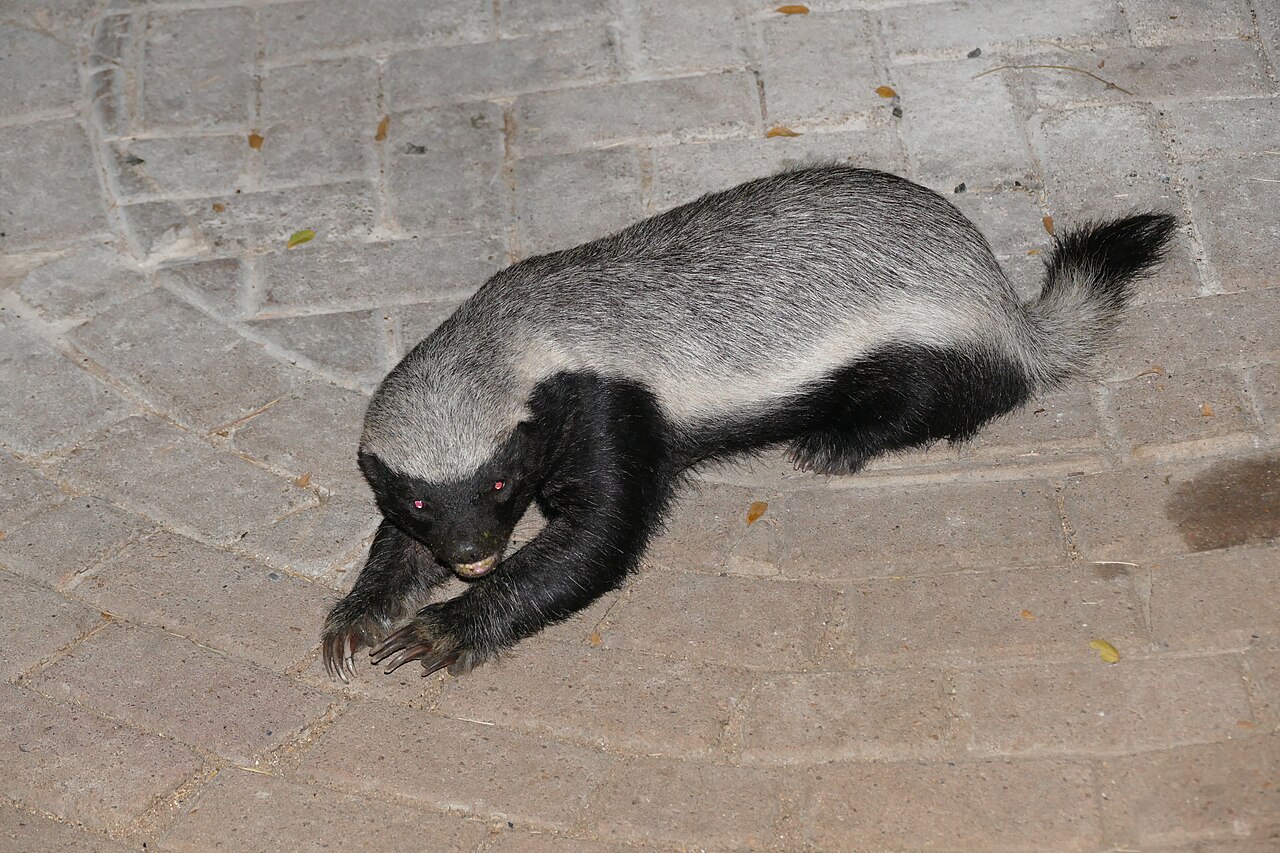
The honey badger (Mellivora capensis) is the house animal of Arjuna Badger Press. Everything below is true. Most of it sounds made up.
The honey badger has been listed by Guinness World Records as the most fearless animal on Earth. It did not apply for the title and would not have attended the ceremony.
It eats venomous snakes — puff adders, cobras, the lot. If it is bitten badly enough to be knocked out, it has been observed to simply lie down, sleep off the venom, wake up an hour or two later, and finish the snake it was already eating.
Its skin is loose, rubbery, and almost impossible to bite through. A honey badger caught by the scruff can twist around inside its own skin and bite whatever is holding it. Bee stings, porcupine quills, leopard teeth — it shrugs off the kind of day that would end most animals.
It raids beehives for honey and grubs and accepts hundreds of stings as a reasonable cost of doing business. This is, in fact, how it got its name.
It will stand its ground against lions, leopards, and hyenas. Not because it expects to win. Because the alternative — caring — has never occurred to it.
The most famous of them, Stoffel, lived at the Moholoholo rehabilitation centre in South Africa and treated every enclosure ever built for him as a personal insult. He stacked rocks to climb the walls. He rolled balls of mud into steps. He used rakes left in the pen as ladders. He learned to unlatch gates. He is, more or less, the patron saint of engineers who refuse to accept that a thing cannot be done.
Honey badger don't care.