The Walls of Uruk
The Epic of Gilgamesh, plainly told — a companion for every reader
Andries J. Greyling
House of Greyling · History Before Time · Companions
About this book {.unnumbered}
The Walls of Uruk retells the Epic of Gilgamesh plainly and reverently, so that a reader who never studied Assyriology can finish it and know what the poem actually is — the tyrant, the friend, the Cedar Forest, the Bull of Heaven, Enkidu's death, the flood, the stolen plant — and what each of its twelve tablets asks of a human life.
The names. The Standard Babylonian poem uses Akkadian forms. This book keeps the familiar English spellings most readers already know — Gilgamesh, Enkidu, Uruk, Humbaba (also Huwawa), Ishtar (Inanna in the older Sumerian poems), Utnapishtim (Uta-napishti; Atrahasis in the older flood tale), Siduri, Urshanabi — and notes variants where they matter. Thompson's 1928 English sometimes spells Gilgamish; quoted passages keep his forms.
A word on reverence and honesty. The Epic of Gilgamesh is one of the foundation stones of world literature — older than Homer by more than a thousand years — and was school-text and royal library for a thousand years of Mesopotamian scribes. This book is written by an outsider who loves the text and claims no authority over it — a guest at someone else's fire. It keeps three things visibly separate: (a) what the poem says and what the tradition holds; (b) matters of scholarship, where reasonable people differ; and (c) the author's own plain-language gloss (always marked plainly:).
The passages. Quotations are from R. Campbell Thompson's The Epic of Gilgamish (1928), a foundational English rendering of the Standard Babylonian twelve-tablet poem, always attributed. Where Thompson's diction is too thick to learn from, a plainer modern line sits beside it and is marked as the author's. For the living scholarly standard, see Going.
::: {.colophon} © 2026 Andries J. Greyling. Gilgamesh passages quoted herein are from R. Campbell Thompson's The Epic of Gilgamish (1928). History Before Time · Companions. :::
Proem — A Guest at the Fire
I came to this book the way most people come to Gilgamesh: sideways, and late, and through someone else's summary.
Someone told me it was "the oldest story" — a king, a wild man, a flood before Noah, a search for immortality that fails. Some of that is in the poem, or near it, or grew up around it like barnacles on a hull. But the Epic of Gilgamesh itself is not a museum placard. It is a poem about a tyrant who learns he will die, a friend who makes him human, and a journey that ends not with eternal life but with walls — the work of human hands, still standing when the plant of youth is gone.
That is the poem. Not a conspiracy. Not a Bible-plagiarism graphic. A story about friendship and mortality — what it costs to love someone who can be taken from you, and what remains when you cannot keep yourself forever.
Then another reader — the best kind, the kind who loves a thing enough to be honest about it — told me something I had half-known and wholly avoided. I know the names, she said. Gilgamesh, the flood, the serpent. I couldn't tell you what actually happens in the poem. She was right. Of course she was right. You can know a story's shadow on the culture — a tablet in a museum, a line in a sermon, a comparison on the internet — and still not know what the scribes actually wrote. This book is the answer to that.
Let me be plain about what I am.
I am not an Assyriologist. I am not a priest of Nabu, a cuneiformist with forty years on the Nineveh tablets, or an archaeologist who can tell you which level of Uruk the poem's walls belong to. I hold no authority over this text whatsoever. There are men and women who have given their lives to Gilgamesh — who can read the Akkadian line by line, who can hear the Sumerian poems beneath the Standard Version, who know which restorations are secure and which are hope. They are the householders here. This is their fire.
I am a guest at it.
A guest at a fire has exactly one set of obligations, which I mean to keep on every page that follows. He warms his hands and is grateful. He does not rearrange the wood. He does not tell the family what their fire really means — he listens while they tell him. He carries nothing away that wasn't offered. And when he goes home and tells his own people about the warmth of it, he tells them the truth: this was not my fire, but they let me sit, and here is what I saw by the light of it.
That is the most I will claim. Not the truth of Gilgamesh — that belongs to the tradition that baked it into clay and dug it out of a burned library. Only an honest visitor's account of a poem that has been burning since before Homer, told warmly, told carefully, and told plainly enough that you can carry a little of the warmth home yourself.
A few promises, so you know the rules I have set for myself.
I will keep three voices separate, and I will always tell you which one is speaking. When I tell you what the epic says and what its tradition holds it to mean, that is the text, and I will be faithful to it. When I tell you what scholars argue about — when the Standard Version was compiled, how much is Old Babylonian, whether Tablet XII belongs — I will mark it as scholarship, a thing reasonable people dispute. And when I reach for a plain modern phrase to make an ancient one land, that is me — my gloss, my reach — and I will mark it as mine so you never mistake my paraphrase for the poem. When you read plainly:, that is my voice, owning the reach.
I will use a real translation, and name it. The passages I quote come from R. Campbell Thompson's The Epic of Gilgamish (1928) — a foundational English rendering of the twelve-tablet Standard Babylonian poem, long out of print, freely readable at Sacred Texts. Thompson was, like me, a visitor who loved it; his English is scholarly and sometimes thick. I keep him because quoting a real, named rendering is honest in a way that smoothing everything into my own words would not be. Where his diction is too thick to learn from, I'll set a plain line beside it and mark it mine. For the living scholarly standard, Going points you to Andrew George.
I will not flatten this into something it isn't. I am not going to tell you Gilgamesh is "really" just the Bible's source code, or "really" an alien myth, or "really" a self-help book about grief with the gods taken out. The poem has gods who argue, a flood that nearly starves heaven, a plant stolen by a serpent, and a king who comes home empty-handed. I will not sand those edges off to make it comfortable. I will make it legible — that is my job — not tame.
I will tell you the whole poem. Twelve tablets. The tyrant, the friend, the Cedar Forest, Ishtar's offer, Enkidu's death, the road to Utnapishtim, the flood, the plant, the walls. Not a summary that skips to the famous bits — the whole arc, because the arc is the point. A man who will not die. A friend who does. A journey that fails. A city that remains.
The fire is lit. They have let us sit.
Here is what I saw by the light of it.
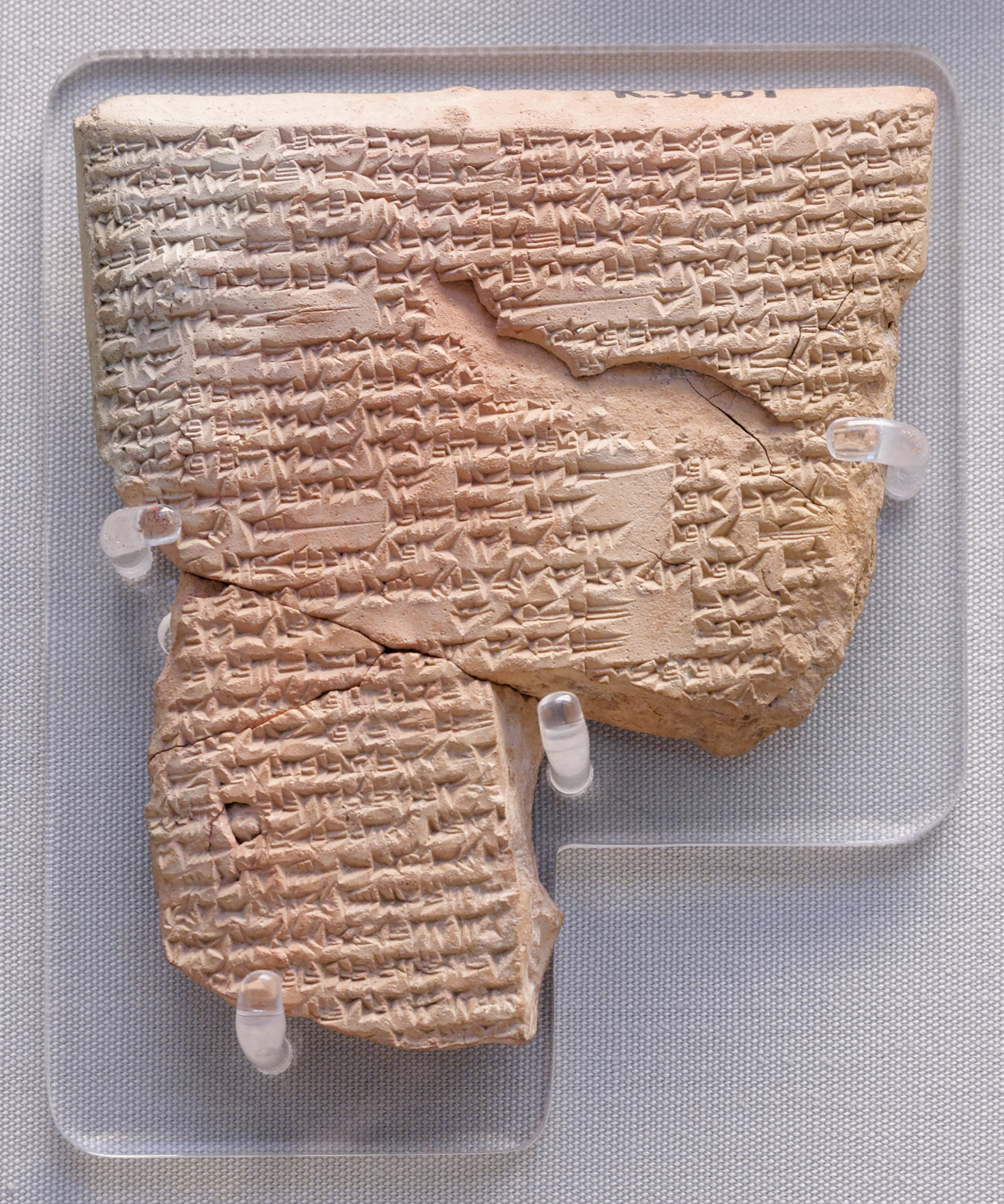
PLATE P-14 · Cuneiform tablet from the Library of Ashurbanipal, Nineveh (K.3401, the birth legend of Sargon). British Museum. Photo: Jastrow, CC BY 2.5, via Wikimedia Commons. The burned library that kept the poem — clay hardens in fire; the catastrophe was the preservative.
The Walls — why the poem begins with a city
Before the friend, the walls. And before the walls, a king who would not be limited — two-thirds god, one-third human, and already too much for the people under him.
You need only a little of the backstory. The Epic of Gilgamesh, in the Standard Babylonian version dug from the Library of Ashurbanipal at Nineveh, runs to twelve tablets. Behind it stand older Sumerian poems about the same king — Gilgamesh of Uruk, builder, fighter, walker of the edges of the world. You do not need the whole school-room of variants. You need the square of ground the Standard poem stands on.
Uruk — one of the first great cities of the southern Mesopotamian plain, walls of baked brick, temples rising, the goddess Ishtar (Inanna) with a house inside those walls. Gilgamesh is its king: son of the goddess Ninsun and a mortal father, stronger and more restless than any man who faces him. The poem opens by praising what he built — the walls, the foundations, the copper tablet of his story — and then shows you why the gods intervene. He takes the sons for labour and the daughters for his bed. The people cry out. Heaven answers with a counterweight.
That counterweight is Enkidu — made of clay by the mother-goddess Aruru, a wild man of the steppe, hair like a woman, living with the animals, wrecking the hunters' traps. Civilisation will tame him. Friendship will bind him to Gilgamesh. Death will take him. And Gilgamesh, who thought himself almost a god, will learn what one-third human costs.
Here is what you need to know about the two men the story turns on.
Gilgamesh is the greatest king alive — builder of Uruk's walls, walker who will later cross the Waters of Death. He begins as a tyrant the people cannot bear. The poem will not leave him there. It will give him a friend equal to himself, then take that friend away, and send him hunting a life that cannot be kept.
Enkidu is the answer heaven sends — wild, then tamed by a woman from the temple (Shamhat), then brought to Uruk where he and Gilgamesh wrestle like equals and become brothers. He is not a sidekick. He is the other half of the king's strength, and when he dies the poem's centre of gravity shifts from adventure to grief.
Between them, in the early tablets, stands the Cedar Forest and its guardian Humbaba, and the goddess Ishtar, who will offer Gilgamesh what kings dream of and take a terrible revenge when he refuses. After Enkidu's death the poem becomes a road: tavern-keeper Siduri, boatman Urshanabi, flood-survivor Utnapishtim, a plant of youth stolen by a serpent, and at the end — again — the walls of Uruk.
The poem's opening, in the tradition, names the one who saw the Deep — who knew the ways, who brought back a story from before the Flood, who carved it on a tablet of lapis. Not "sing, goddess, of wrath." Look at the walls. Read the tablet. This man went to the edge of the world and came home with knowledge. From line one: this is a poem about what a human life can hold when it cannot hold forever.
The gods are already involved. They always are, in Mesopotamian epic — not as metaphors but as characters with appetites and assemblies, deciding in council, sending dreams, flooding the world when humans grow too loud. You do not need to believe in them to read the poem. You need to understand that for the scribes they are as real as the brick.
Plainly: You are dropped at the city gate like a new arrival — dust, brick, already late. The whole deep past of Sumer is backstory. The Standard poem is about what happens when a king who will not die meets a friend who does, and what he brings back when immortality fails. It begins not with the Flood (that comes late, as a story inside the story) but with walls and tyranny and a wild man made to match a tyrant. That is deliberate. Everyone has stood at that gate — the place where power without limit becomes a problem the gods themselves have to solve.
PLATE P-01 · Uruk (Warka) archaeological site, Iraq. Photo: Jan Jerszyński, CC BY 3.0, via Wikimedia Commons. The square of ground the poem stands on — the walls the last line of Tablet XI tells you to climb.
A note on what's real here (scholarship — register b). Whether Gilgamesh was a historical Early Dynastic king of Uruk, how the Sumerian poems relate to the Akkadian epic, when Sin-leqi-unninni shaped the Standard Version, whether Tablet XII (Enkidu in the underworld) belongs to the same design as Tablets I–XI — scholars genuinely dispute all of this, and the poem does not need it settled to do its work. The same scholars place the Standard Version in the late second or early first millennium BCE, drawing on traditions far older; the Flood Tablet (K.3375) sits in the British Museum. None of that diminishes it. A thing can be assembled across centuries and still be the oldest long story we can still finish in one sitting. I note the scholarship because the honesty is the foundation — not because it changes what happens next on the walls.
Tablet One — The Tyrant and the Wild Man
The scene
The poem does not begin with a flood or a serpent or a quest for eternal life. It begins with walls — and with the man who saw everything, who knew the countries and was wise in all matters, who brought back a tale from before the Deluge and cut all his toil into stone. Look at Uruk. Walk the rampart he built. Survey the foundations, clamped firm like bronze beneath holy Eanna, the temple of Anu and Ishtar. The city, the date-groves, the clay-pits, the temple ground — the poem measures them off like a proud surveyor before it tells you a single deed. Open the tablet-box. Read the travails of Gilgamesh.
He is two-thirds god and one-third human — son of the goddess Ninsun, towering over the heroes of Uruk like a wild bull, with no equal when his weapons are raised. And he is a tyrant the people cannot bear. His arrogance swells by day and by night. He leaves no son to his father. He leaves no maid to her mother, no daughter to the hero, no bride to her husband. The wailing rises until it reaches heaven, and the gods say to Anu, lord of Uruk: you begot this wild bull. Where is his match?
Anu hears. He calls Aruru, the mother-goddess who shaped mankind: you made him — now make his equal, one mighty enough to strive with him, so that Uruk may have peace. Aruru washes her hands, pinches off clay, and throws it down on the steppe. On the steppe she creates Enkidu — a warrior born and begotten of silence and the wild, his whole body shaggy with hair, his locks long like a woman's, knowing neither people nor country. Clad like the god of the herds, he grazes with the gazelles at the water-hole, and his heart delights among the beasts.
A hunter meets him there — one day, two days, three, face to face at the drinking-place — and comes home rigid with fear. The wild man has filled in his pits and torn up his snares; the beasts slip through his hands; he cannot work his trade. His father sends him to Uruk, and Gilgamesh gives the remedy the poem's world keeps ready for wildness: take Shamhat, a woman of the temple of Ishtar. When the herd comes down to drink, let her bare her beauty. He will come to her — and his beasts, reared with him in the desert, will deny him.
So it happens. Hunter and woman wait at the water-hole. Enkidu comes down with the gazelles, and Shamhat shows him what a woman is. For six days and seven nights Enkidu stays with her — and when he is sated and turns back to his herd, the gazelles scatter at the sight of him. The beasts of the field flee from him. His knees fail; his old swiftness is gone. He has lost something the poem does not pretend he can recover — and gained something it prizes more: reason, and a widened heart. He goes back and sits at the woman's feet, watching her face, understanding her words. You are beautiful as a god, she tells him. Why range the desert with beasts? Come to Uruk, to the sacred temple, where Gilgamesh lords it over men like a wild bull. He hears her, and knows his own longing for the first time: he needs a friend. And rage rises with the longing — he will go to that city and challenge its king, and cry through the streets, I too am mighty.
But Gilgamesh has already seen him — in dreams. He goes to Ninsun: mother, in the night the stars of heaven came out, and something like the very self of Anu fell down on my shoulders. I heaved at him and could not move him. The people of Uruk thronged round him; my companions kissed his feet; and I held him to my breast like a woman, and laid him at your feet. And a second dream: an axe, flung down in the street, with the crowd pressing round it — and I loved it, and held it to me like a woman. Ninsun, who knows all wisdom, gives both dreams one meaning: this is a stout heart, a friend, one ready to stand by a comrade — strength like the self of Anu — and he will never abandon you.
Far off on the steppe, Shamhat is telling Enkidu the same dreams. The wild man and the temple-woman set out for the city — toward a king who has already held him, asleep, like something beloved.
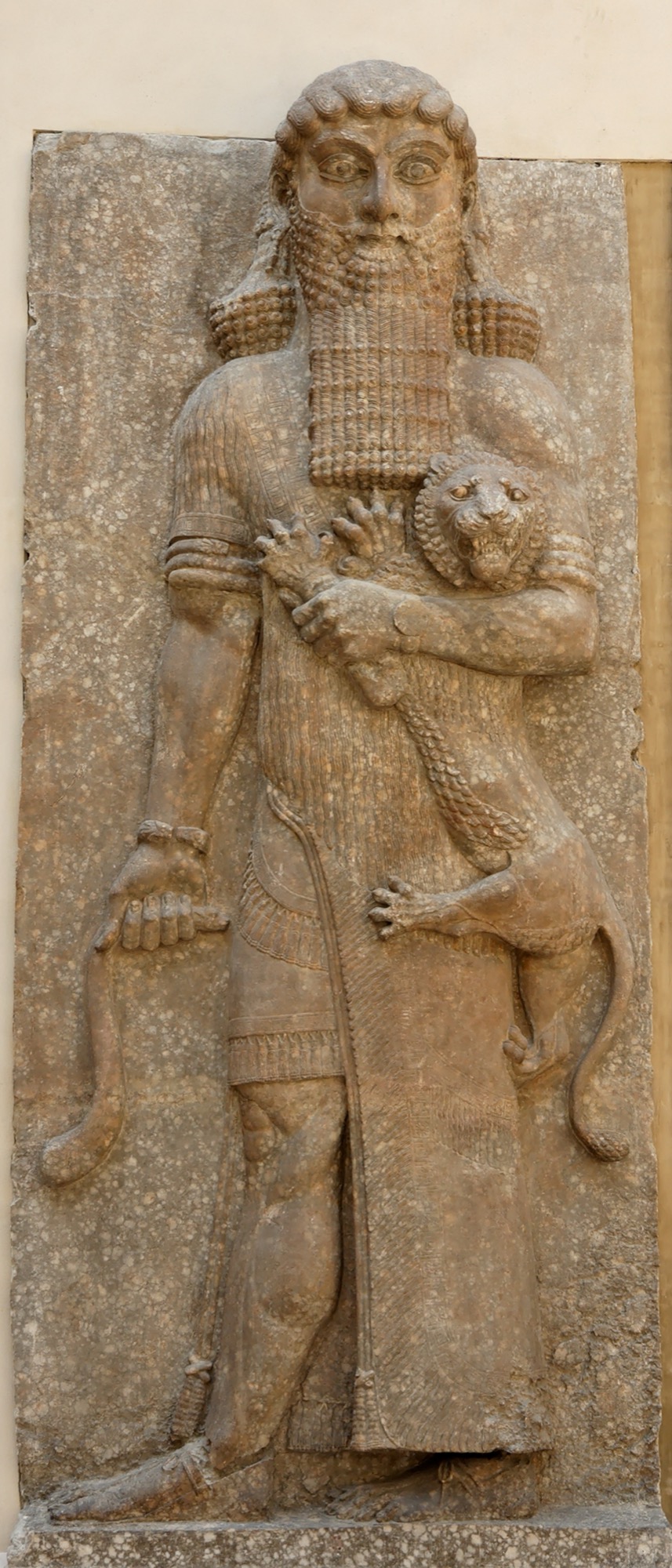
PLATE P-02 · Hero mastering a lion, relief from Khorsabad. Musée du Louvre (AO 19862). Photo: Jastrow, public domain, via Wikimedia Commons. The palace "wild strongman" type — not a portrait of Enkidu, but his kin in stone.
Plainly
A city that cannot bear its king gets a second creation — not a rival empire, but a wild equal who can match the tyrant blow for blow.
The line
Thompson's opening praise of the king, and the gods' answer to the city's cry:
Gilgamish — he was the Master of wisdom, with knowledge of all things … handed down the tradition relating to things prediluvian, went on a journey afar, all aweary and worn with his toiling, graved on a table of stone all the travail. Of Erech, the high-wall'd, he it was built up the ramparts; and he it was clamp'd the foundation, like unto brass … "'Twas thou, O Aruru, madest mankind: do now make its fellow, so that he happen on Gilgamish … so that they strive with each other, and he unto Erech give surcease." — R. Campbell Thompson, The Epic of Gilgamish (1928), Tablet One
plainly: This is the man who saw everything and built the walls — and this is heaven's answer to his tyranny: make him an equal, and let them wear each other out, so the city can breathe.
Tablet Two — The Meeting
The scene
Shamhat leads Enkidu from the steppe into the world of men, one lesson at a time. At a shepherds' camp he learns what the wild never taught him. Bread is set before him and he stares at it — he was suckled on the milk of wild things, and does not know how to eat. Taste the bread, the woman tells him, for it is the staff of life; drink the beer, for it is the custom of the land. He eats until he is gorged. He drinks seven cups of beer, and his spirit rises, and his face glows, and his heart is glad. He washes the matted hair of his body, rubs himself with oil — and, the poem says with perfect economy, becomes human. He puts on a garment like a man, takes a weapon, and hunts the lions that harry the flocks by night, so that the shepherds sleep soundly. The wild thing that once freed beasts from traps is now the watchman who kills for the fold.
A stranger passes through, summoned toward the city. Enkidu has him brought near and asks his errand — and the fellow explains, as if reciting the most ordinary law in the world: in Uruk the king takes his pleasure first. Gilgamesh will couple with the woman allotted by fate before the bridegroom does. At the words, Enkidu's face goes pale with fury. He sets out for Uruk with Shamhat behind him.
The city gathers to stare. Like Gilgamesh he is, the people say, thronging the street, a trifle shorter in stature, but stronger of build — a baby once suckled on the milk of the wild things! Now he is a match for the god-like king. And that night the bed is strewn for the rites; Gilgamesh comes through the dark to the woman who is his by custom. Enkidu is standing in the street, blocking the door.
They seize each other. They grapple and snort like bulls; the threshold shatters; the very wall shudders. Two bodies built by gods, jammed into one doorway, testing at last the question Anu asked when the clay was pinched: where is his match? Then Gilgamesh bends his knee to the ground — and his fury leaves him. He breaks off the fight.
And Enkidu, the loser who has just proven no man can win, speaks first — words not of surrender but of recognition: your mother bore you as one and one only — Ninsun, that choicest cow of the fold — she exalted your head above heroes, and Enlil decreed you the kingship over men. They kiss each other and form a friendship. The first person who could stop Gilgamesh, and the first person Gilgamesh could not simply take.
Gilgamesh brings his friend before Ninsun. The wise queen looks at the shaggy stranger — no kith, no kin, no mother of his own in all the poem until this moment — and Enkidu hears her words and weeps, his arms slack, his strength ebbing, until Gilgamesh takes his hand. But friendship in this poem does not stay at rest. Already Gilgamesh is talking of Humbaba — the guardian Enlil set over the Forest of Cedar, whose roar is the whirlwind, whose jaws are flame, whose very breath is death. Let us kill him, he says, and cut down the cedar. Enkidu knows that forest; he roamed its edges with the herd, and would not go two hours' march into its depths. He says so. Gilgamesh answers with the creed that drives the whole first half of the epic: only the gods live forever; the days of man are numbered; whatever he does is wind — so let me fall, if fall I must, with a name that lasts. They go to the forge. The smiths cast monstrous axes of three talents each, and glaives with golden hilts, and the two friends stand before the elders of Uruk armed and glittering — while the city, listening to the plan, does not yet know what it will cost.
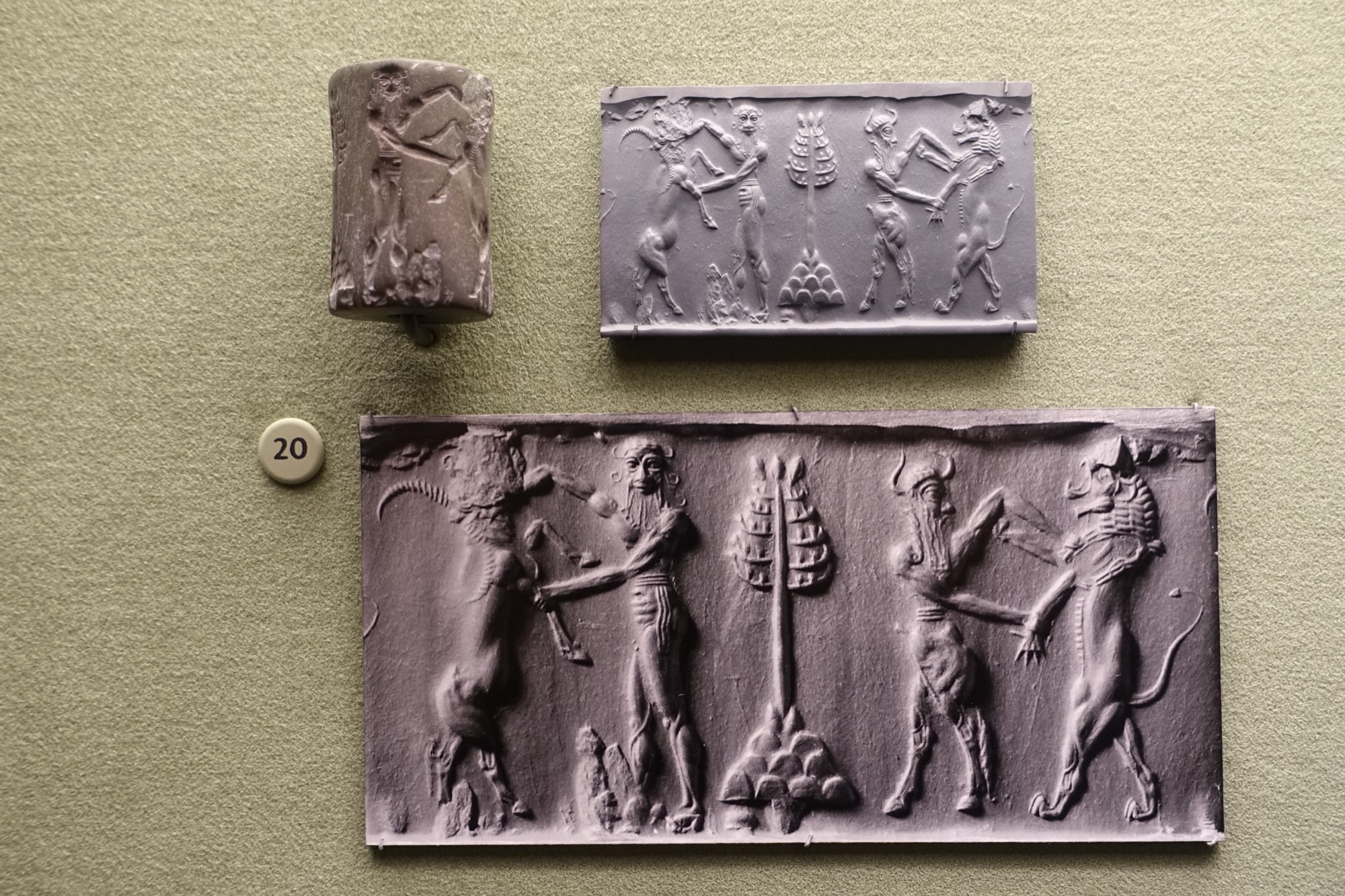
PLATE P-04 · Akkadian cylinder seal, hero contest scene (c. 2334–2154 BCE). Morgan Library & Museum. Photo: Daderot, public domain, via Wikimedia Commons. The wrestling-match motif was carved on seals for a thousand years — not a labelled Gilgamesh scene, but the same grammar of grappling equals.
Plainly
Friendship begins as a fight between equals — and the first thing friends do, in this poem, is plan a war neither of them can survive unchanged.
The line
They grappled and snorted like bulls, and the threshold shatter'd: the very wall quiver'd … Gilgamish bent his leg to the ground: so his fury abated, aye, and his ardour was quell'd. So soon as was quelled his ardour, Enkidu thus unto Gilgamish spake: "Of a truth, did thy mother bear thee as one, and one only: that choicest cow of the steer-folds, Nin-sun exalted thy head above heroes, and Enlil hath dower'd thee with the kingship o'er men." — R. Campbell Thompson, The Epic of Gilgamish (1928), Tablet Two
plainly: They fought in the doorway until the wall shook — and when the king's rage passed, the wild man told him what he was: born without equal, raised above heroes, made for kingship. Then they became brothers.
Tablet Three — The Cedar Forest Proposed
The scene
The elders of Uruk speak to Gilgamesh with the frankness of men who have seen kings ride out and not all ride back. Do not rely on your strength alone. Look long and hard; land a blow you can count on. To Uruk's quay come back in safety. They turn to Enkidu: you are tested in battle and tried in combat — guard your friend, keep safe your companion, bring the king home to his wives. In our assembly we place the King in your care.
Gilgamesh hears them and does what restless kings do when counsel fails: he takes Enkidu by the hand and goes to the Palace Sublime, into the presence of Ninsun. Mother, he says, bold as I am I shall tread the distant path to the home of Humbaba. I shall face a battle I know not. I shall ride a road I know not. Give me your blessing. Let me see your face again in safety, and return glad at heart through Uruk's gate.
Ninsun hears her son — and she does not refuse him. She climbs to the roof, raises a sacrificial bowl to Shamash the sun-god, and prays: why did you give my son a restless heart? On the day he faces Humbaba, let him see your omens. May Aya, Shamash's bride, cry his name in the night. May she not fail him, nor sleep, nor rest, until he has slain the guardian of the Forest of Cedar. Then she turns to Enkidu — the wild man with no mother in the poem until this moment — and adopts him as her son. She sets him at Gilgamesh's side: go before my son on the road; the one who goes in front saves his companion.
Enkidu has already told Gilgamesh what the elders repeat: Humbaba's reach is wide, his voice the Deluge, his breath death. He hears the forest murmur at sixty leagues' distance. Adad ranks first, and Humbaba second — Enlil made it his lot to terrify men and keep the cedars safe. If you penetrate his forest you are seized by the tremors. Enkidu knows. He was born there. He fears.
Gilgamesh does not fear — or rather, he fears boredom more than monsters. He arms the young men of Uruk who understand combat. He asks blessing as one who already intends to go. On his return he will celebrate New Year twice over; let the drums resound before Wild-Cow Ninsun. The elders warn Enkidu again in vain: tell him not to go to the Forest of Cedar. That is a journey which must not be made. That is a man who must not be looked on.
They go anyway. The poem gives us the pattern that will hold through every adventure to come: the restless one proposes, the knowing one fears, heaven blesses what it cannot prevent, and the road opens before them. Ninsun has done what a mother can — adopted the friend, enlisted the sun-god, spoken the prayer. The rest belongs to the forest, and to what two men carry between them when they leave the gate.
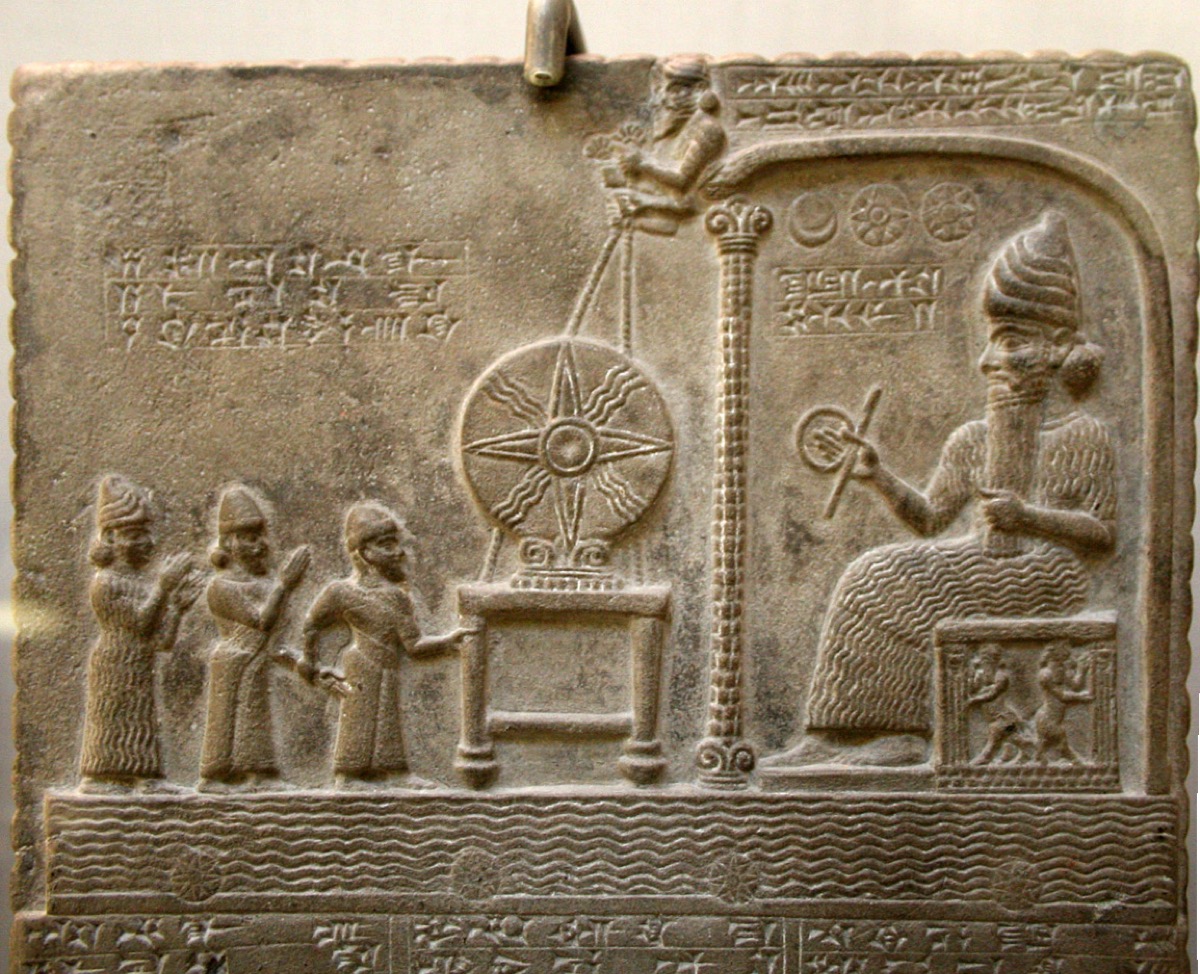
PLATE P-16 · Tablet of Shamash, the sun-god enthroned (Sippar, c. 860–850 BCE). British Museum. Photo: Prioryman, CC BY-SA 4.0, via Wikimedia Commons. The god Ninsun climbs to the roof to enlist — keeper of omens, watcher of roads.
Plainly
Glory is a plan made by the restless half of a friendship against the wiser half's fear — and the mother-goddess blesses what she cannot prevent.
The line
The elders' counsel as the king departs:
Gilgamish, put not thy faith in the strength of thine own person solely … Sooth, he who goeth as vaward is able to safeguard a comrade, he who doth know how to guide hath guarded his friend; so before thee do thou let Enkidu go, for 'tis he to the Forest of Cedars knoweth the road … Enkidu — he would watch over a friend, would safeguard a comrade, aye, such an one would deliver his person from out of the pitfalls. — R. Campbell Thompson, The Epic of Gilgamish (1928), Tablet Three
plainly: Do not trust your own strength alone. The one who walks in front saves his companion — so let Enkidu lead, because he knows the road and you only know the ambition.
Tablet Four — Dreams on the Road
The scene
They leave Uruk. The journey to the Cedar Forest is a measured stripping away — league after league, camp after camp, the civilised world thinning behind them until only mountain, dust, and the road remain. The poem counts their pace like a boast: the distance of a month and a half walked in three days. Each evening they dig a well facing the setting sun. Each night Gilgamesh climbs the slope, pours out an offering of flour, and calls to the height: Mountain, bring me a dream, a favourable message. Enkidu builds a shelter against the wind. Gilgamesh sits with his chin on his knees, and sleep — the sleep that pours over all mankind — pours over him.
And the dreams come, each one worse than the last, and each time the pattern holds. Gilgamesh jolts awake at midnight: Did you not call me? Why am I trembling? Did a god not pass by? Why is my flesh a-quiver? — and tells the nightmare. In one, the two of them stand in a mountain gorge and the mountain topples on them, leaving them like flies in the wreckage. In another the firmament roars and the earth resounds; the day goes dark; lightning flashes and flame gorges the sky; death rains down; then the glare fades and the fires die and everything that fell has turned to ash. A man could not invent plainer omens of doom. And Enkidu interprets every one as victory. The mountain that fell, my friend — that is Humbaba. The mountain is not on us; the mountain is him. We shall seize him, we shall kill him, and throw his carcase down in abasement on the plain.
Whether the interpretations are true prophecy or only what a friend says to keep a friend walking, the poem does not tell. It only keeps them walking — and heaven itself sets the tempo. Shamash calls from the sky: hurry, before the guardian wraps himself in all seven of his terrors. He wears but one now. Even the gods are counting leagues.
Then the road ends. The cedars rise ahead, immense and incense-heavy, and the two heroes arrive at the gate of the Forest — timber without peer in any country, its very posts and pivot fashioned, Enkidu marvels, as if in the craftsman-city of Nippur. And here, at the threshold, the poem quietly reverses everything you thought you knew about these two. It is Enkidu — the wild one, the guide, the interpreter of victories — whose courage fails. His hands grow weak; his arms, he says, are stricken with palsy; let us not go down into the depths. And it is Gilgamesh, the dreamer who woke trembling every night of the march, who takes his turn at the other office of friendship: Shall we, of all people, play the coward? You are tried in battle; touch your fear and it will pass. Forget death. I'll go in front of you myself.
Courage, in this poem, is not a possession. It is traffic — passed back and forth between two people, each carrying it while the other cannot. They arrive together at the edge of the trees, and their speech stills into silence, and they stop, and stand, and look.
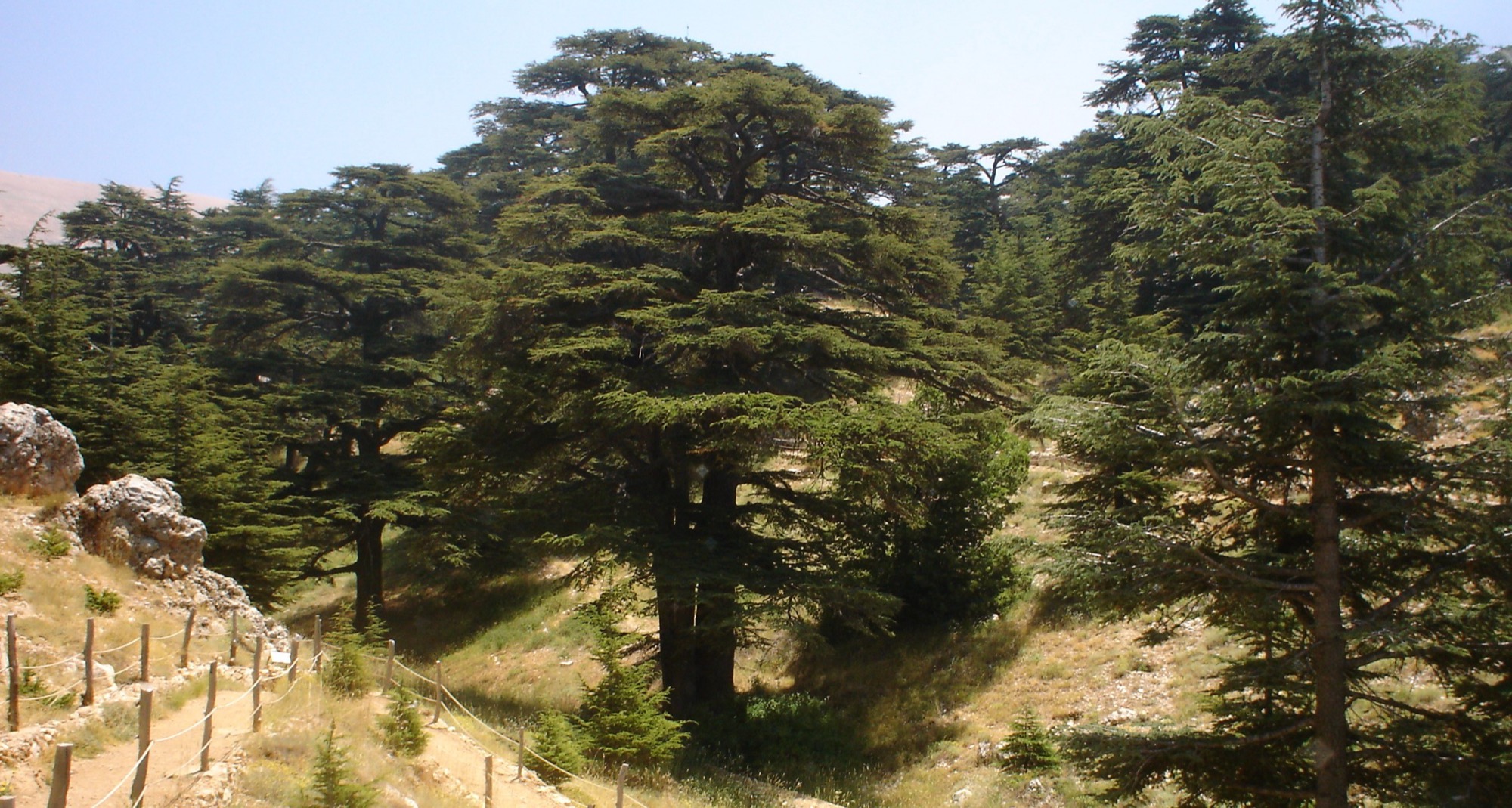
PLATE P-03 · Lebanon cedar forest, Bsharri (the "Cedars of God"). Photo: Xtcrider, public domain, via Wikimedia Commons. What is left of the kind of forest Enlil set a guardian over.
Plainly
Courage is not owned but carried in turns — the friend who says "go on" is as necessary as the god who sends the dream, and at the gate the offices reverse.
The line
Gilgamesh, when Enkidu's arms fail at the gate:
Shall we, O friend, play the coward? … Thou, O my friend, art cunning in warfare, art shrewd in the battle … O forget death, and be fearful of nothing … for he who is valiant, cautious and careful, by leading the way hath his own body guarded — he 'tis will safeguard a comrade. — R. Campbell Thompson, The Epic of Gilgamish (1928), Tablet Four
plainly: Now it is the wild man who is afraid, and the king who says: forget death, walk carefully, lead well — that is how a man guards his own body and his friend's.
Tablet Five — Humbaba
The scene
They stand at the edge of the Cedar Forest and stare.
The avenue in is straight; Humbaba's tracks mark a good passage. Cedars rise like a mountain shrine — shade thick with incense, bushes spreading under branches that have stood since before any king of Uruk drew breath. Gilgamesh and Enkidu have come a long road for this. Now the forest itself looks like victory waiting to be taken, and like something that should never have been entered.
Humbaba meets them with what the poem calls his auras — terrors that are not merely fright but assault. His roar is a whirlwind; flame lives in his jaws; his breath is death. Gilgamesh feels his knees weaken. Enkidu, who once ranged these depths with the wild cattle, feels them weaken too. The guardian of the forest was appointed by Enlil; he is not a beast to be hunted but a force stationed at the world's edge. For a moment the heroes are boys again, staring at a door they were always told not to open.
Gilgamesh prays to Shamash, the sun-god — his mother's god, the god who watched over the road. Shamash hears. From heaven he raises eight winds against Humbaba: a great wind, wind from the north and south, tempest and storm-wind, chill wind and whirlwind, a wind of all evil. They seize Humbaba before and behind so that he cannot advance and cannot retreat. The monster who terrified the forest is pinned like cloth on a line.
Then Humbaba begs.
It is one of the poem's most unsettling moments. The guardian of the immortals' cedar grove speaks to Gilgamesh as a servant speaks to a master: stay your hand; be my lord and I will be your henchman; forget the boastful words I spoke against you. Mercy is on offer. The fight is won. The question is only what winning means.
Enkidu will not let Gilgamesh accept. Of the offer Humbaba makes, he says, you dare not take it — Humbaba must not remain alive. It is the second time the wild man has decided the moral arithmetic of this expedition, and this time there is no elder and no goddess to gainsay him. Gilgamesh listens to his friend. Together they cut off Humbaba's head.
The silence that follows is not triumph. It is cedar sap and a god's servant dead on the floor of a holy wood. They fell the great trees — timber for the temples, glory for the king — and turn homeward with the monster's head and the forest's wealth. The adventure has its prize. The poem does not pretend the price is visible yet.
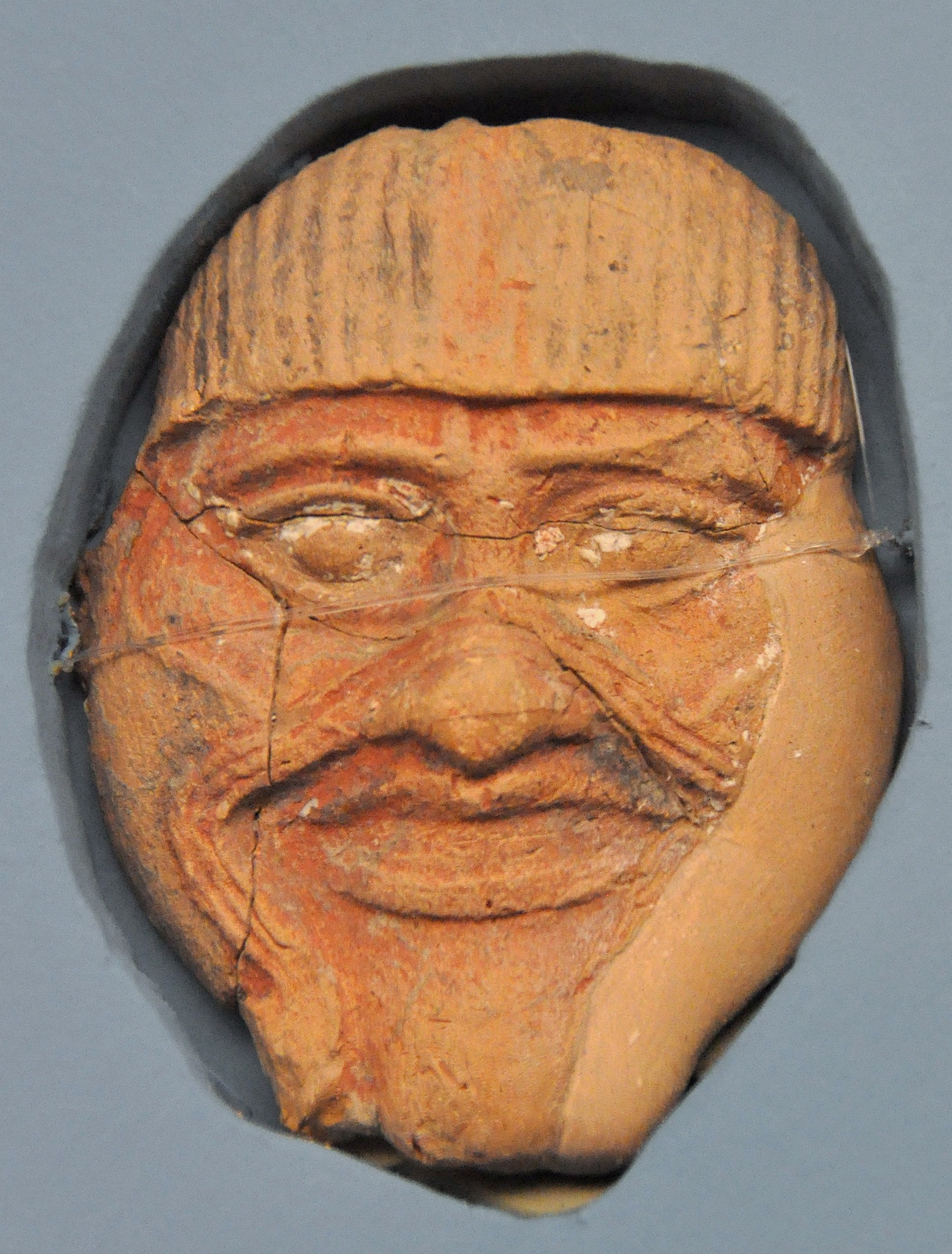
PLATE P-05 · Terracotta mask of Humbaba, southern Iraq, Old Babylonian period. Ancient Orient Museum, Istanbul. Photo: Osama Shukir Muhammed Amin, CC BY-SA 4.0, via Wikimedia Commons. The face ancient people gave the guardian — coiled like entrails, grinning like a warning.
Plainly
The monster begs and the friend says kill — and victory smells of cedar and of a line crossed that cannot be uncrossed.
The line
O Gilgamish, (pr'y thee), Stay, (now, thy hand): be thou now my master, and I'll be thy henchman: O disregard all the words which I spake so boastfully against thee. Thereat to Gilgamish Enkidu spake: "Of the rede which Humbaba maketh to thee thou darest in nowise offer acceptance. (Aye, for) Humbaba must not remain alive." — R. Campbell Thompson, The Epic of Gilgamish (1928), Tablet Five
plainly: Humbaba surrenders and offers to serve; Enkidu tells Gilgamesh mercy is not an option — the guardian must die.
Tablet Six — Ishtar and the Bull
The scene
They come home to Uruk in triumph.
Gilgamesh washes the stains of combat from his body, braids his hair, puts on clean garments and armlets, girds himself with a baldric. He looks like what he is: the king who went to the Cedar Forest and returned. Ishtar — goddess of love and war, the power men invoke and fear in the same breath — sees his beauty and desires him.
She offers marriage as queens offer kingdoms. Come, be my bridegroom, she says; grant me the fruit of your body and I will be your wife. She promises a chariot of azure and gold, mules harnessed each day, a house fragrant with cedar. When you enter, threshold and dais will kiss your feet. Kings and princes will bring tribute. Your flocks will multiply; your herds will thrive; your chariot horses will win fame. It is kingship-in-love — everything a mortal ruler might want, with a goddess beside him.
Gilgamesh refuses.
He does not refuse politely. He asks what advantage there could be in marrying Ishtar, then answers his own question with a catalogue of ruin. She is a ruined house that gives no shelter, a back door that gives no resistance to the storm, pitch that defiles the bearer, a leaking water-skin, a sandal that trips its owner. And her lovers — who has she ever loved faithfully? She loved Tammuz, the husband of her girlhood, and makes him the cause of wailing every year. She loved the bright-feathered Roller bird and broke his wing — he stands in the groves still, crying kappi, "my wing!" She loved a lion in his full strength and dug him seven and seven pits. She loved a stallion, magnificent in battle, and gave him the bridle, the spur, and the whip, and gave his mother Silili her lamentation. She loved a shepherd who burned offerings for her daily, and turned him into a jackal so that his own herd-boys drove him off and his own dogs tore him. She loved Ishullanu, her father's gardener, and when he refused her she struck him into a spider, lodged halfway up a wall, able to climb neither up nor down. Me too, Gilgamesh says — you would love me and then reckon me like them.
Ishtar goes up to heaven in a rage. Before Anu her father and Antu her mother she demands the Bull of Heaven so she may kill Gilgamesh in his dwelling. Anu warns her: if I create this bull, seven years of lean husks will follow. Ishtar says she has hoarded grain for mankind and fodder for cattle — let the famine come. Anu gives way. The Bull descends on Uruk.
At its snort the earth opens; young men of Uruk fall into pits. Enkidu is swallowed to the waist, then leaps free and seizes the Bull by its horns. Gilgamesh drives his sword between nape and horns like a butcher who knows his trade. They kill it, tear out its heart, and offer it to Shamash. Then they feast.
Ishtar mounts the ramparts of Uruk and wails. Enkidu hears her, wrenches a haunch from the Bull's carcass and flings it before her face — if I could only have reached you, he says, I'd have served you the same; I'd have let his guts dangle on your flanks for a girdle. Ishtar gathers her devotees and leads the lamentation, while Gilgamesh calls the craftsmen to marvel at the horns — thirty minas of lapis in their setting — and hangs them in the shrine of his fathers. The heroes wash their hands in the Euphrates and stride the highway of Uruk with the crowd thronging to see them, and Gilgamesh throws a riddle to the notables: Who is most splendid of heroes? Who is most famous of giants? — Gilgamesh is most splendid of heroes; Enkidu is most famous of giants. In the palace that night there is high revel — and while the heroes sleep, Enkidu dreams what the gods have decided. Triumph in the street is already the beginning of the bill.
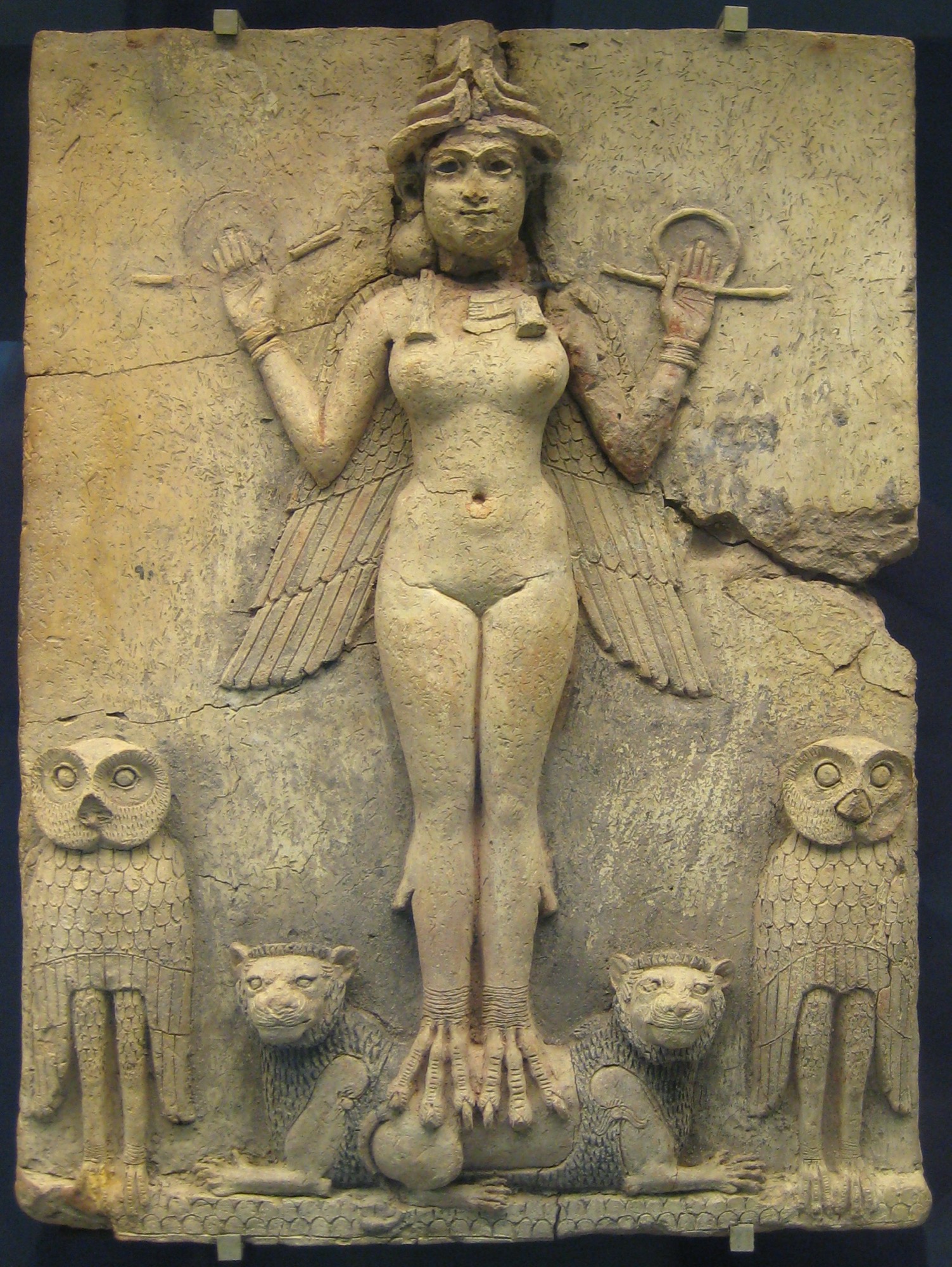
PLATE P-06 · Burney Relief ("Queen of the Night"), Old Babylonian period. British Museum. Photo: BabelStone, CC0, via Wikimedia Commons. Ishtar or her sister-in-darkness Ereshkigal — scholars still argue; the talons and the lions say enough.
Plainly
Refuse a goddess and she will send a famine on legs — and triumph in the street is already the beginning of the bill.
The line
Gilgamish, come, be a bridegroom, to me of the fruit (of thy body) Grant me largesse: (for) my husband shalt be and I'll be thy consort. O, but I'll furnish a chariot for thee, (all) azure and golden, Golden its wheel, and its yoke precious stones, each day to be harness'd Unto great mules. — R. Campbell Thompson, The Epic of Gilgamish (1928), Tablet Six
plainly: Ishtar offers Gilgamesh marriage, wealth, and power; he answers with every lover she destroyed.
Tablet Seven — Enkidu's Death
The scene
Enkidu wakes in the night and tells Gilgamesh his dream.
The great gods have taken counsel together — Enlil, Ea, Shamash. Humbaba is slain; the Bull of Heaven is dead. Someone must pay. Enlil says Enkidu shall die, but Gilgamesh shall not. Shamash protests: at your command they killed the Bull and Humbaba; why must Enkidu die now? Enlil turns on the sun-god in anger. The decree stands. Enkidu has seen the underworld in his dream — the House of Dust, the road of no return, bird-garmented dead who never see daylight again. He knows what is coming.
Sickness takes him. He lies on his couch one day, a second, a third — through the tenth day, the eleventh, the twelfth. Fever lays him on his back. In his pain he curses the trapper who first saw him at the watering-place, and Shamhat the temple-woman who civilised him — may she never find satisfaction, may scorching heat and thirst waste her strength, may the shade of a wall be her only home. He loads the woman who brought him bread and wine and Gilgamesh with the bitterness of a man watching his wild strength drain away.
Shamash answers from heaven. Why curse Shamhat? She gave you bread fit for gods and wine fit for royalty; she clothed you and gave you Gilgamesh for comrade. Gilgamesh will grant you a great couch, a throne at his left hand; the princes of the underworld will kiss your feet; all Uruk will mourn you. Enkidu hears the god and his wrath is appeased. He blesses Shamhat — may kings and princes love her, may her bed be azure and golden, may she be mother of seven brides.
He sleeps alone and dreams again: the firmament roars and the earth echoes, and a man with a dark face and the claws of a lion overcomes him, binds his arms like a bird's wings, and leads him down the road on which there is no returning — to the Dwelling of Darkness, the home of Irkalla, where the dead eat dust and their sustenance is mud, where they wear garments of feathers like birds and sit in the dark and never see light. In that house Enkidu sees the crowns of old kings humbled, priest and acolyte, seer and magician; Ereshkigal, Queen of the Underworld, enthroned; and before her, reading aloud, Belit-seri, the recorder of Hades — who lifts her head and sees him. The dream needs no interpreter. Then he calls Gilgamesh. My friend, he says — my friend who stood with me in battle — and cannot finish. Gilgamesh weeps. He vows he will mourn Enkidu before all Uruk, will put on lion-skin and range the desert, will not let the world forget. Enkidu tries to rise and cannot. He stretches out his hand to his friend. His hand falls.
Gilgamesh will not accept it. He paces. He weeps. He speaks to the body as if speech could reverse decree. But Enkidu is gone — the wild man who met Gilgamesh on the threshold of the city, who made the king his equal, who urged the killing when Humbaba begged, who flung the Bull's haunch at Ishtar — gone to the common lot of mankind. The poem's hinge turns here. Everything before was adventure. Everything after is grief, and the terror of dying like Enkidu.
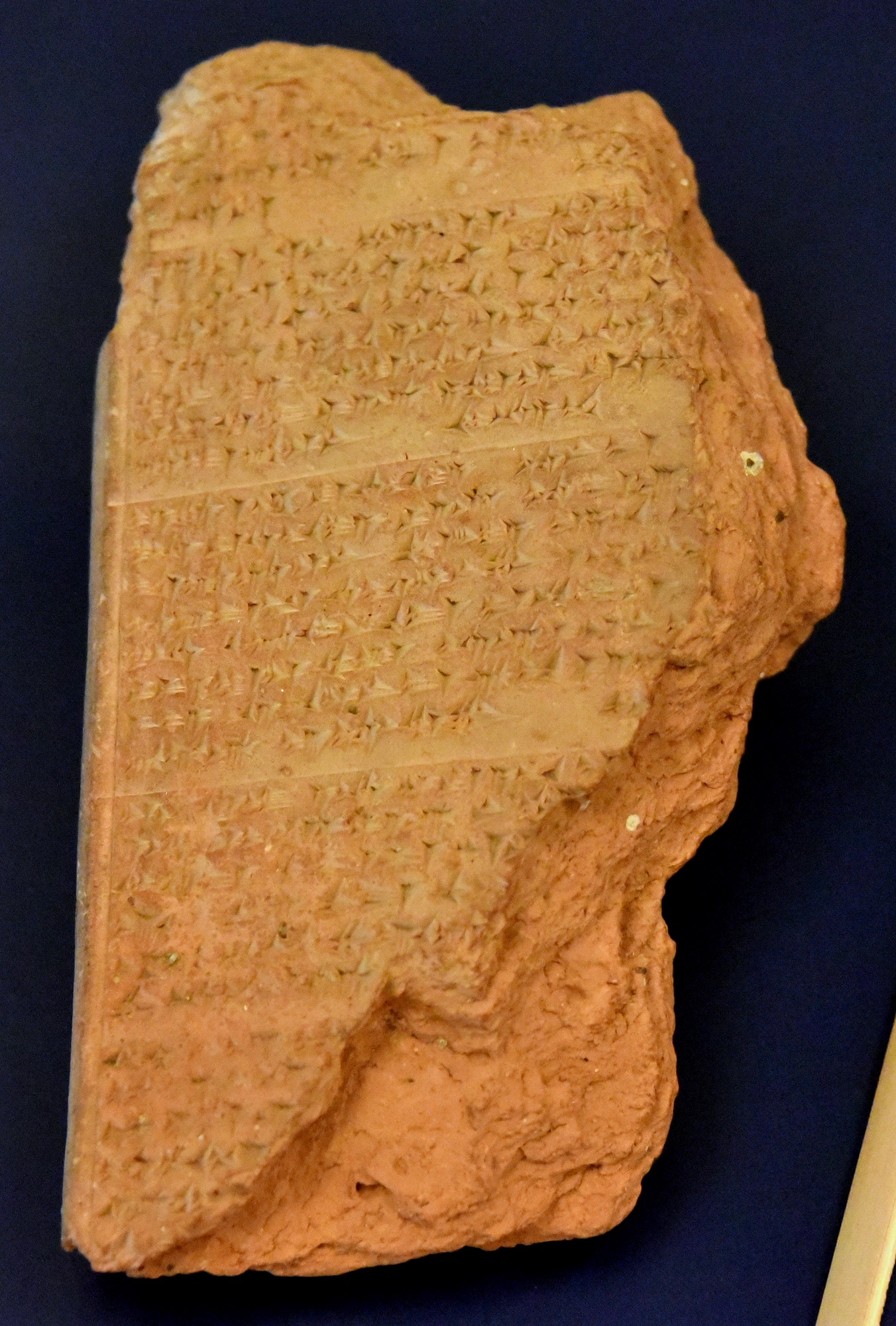
PLATE P-07 · Gilgamesh epic clay tablet, Hittite copy from Hattusa, 13th century BCE. Neues Museum, Berlin. Photo: Osama Shukir Muhammed Amin, CC BY-SA 4.0, via Wikimedia Commons. The death of Enkidu survives partly in copies like this — the story travelled a thousand miles from Uruk before it reached us.
Plainly
The poem's hinge: adventure ends, grief begins, and the wild man who made the king human is taken so the king can learn he is mortal.
The line
Enkidu's dream of the world below — the oldest surviving description of a land of the dead:
Me did he lead to the Dwelling of Darkness, the home of Irkalla, unto the Dwelling from which he who entereth cometh forth never! Aye, by the road on the passage whereof there can be no returning, unto the Dwelling whose tenants are ever bereft of the daylight, where for their food is the dust, and the mud is their sustenance: bird-like wear they a garment of feathers: and, sitting there in the darkness, never the light will they see. — R. Campbell Thompson, The Epic of Gilgamish (1928), Tablet Seven
plainly: The house of the dead has one door, and it opens only inward. The tenants eat dust, wear feathers, and sit in the dark forever. Enkidu has seen his address.
Tablet Eight — The Lament
The scene
Gilgamesh will not let Enkidu go quietly.
As something of morning dawns he bends over the body and compares his friend to a gazelle — the beast that raised him, the beast that fled him — and promises to glorify him. Then he stands before the elders of Uruk and keens like a woman at a bier — bitterly crying, grip slack on the battle-axe at his thigh, the sword at his belt forgotten. Festal garments bring no pleasure. Sorrow has cast him down. He names what they were together: comrades who chased the wild ass and the desert panther, who ascended mountains, captured the Bull of Heaven, overthrew Humbaba in the Cedar Forest. Now Enkidu is dark and cannot hear. Gilgamesh covers his friend like a bride, lifts his voice like a lion, roars like a lioness robbed of her whelps. He paces before the body, tearing his hair, plucking away his beauty.
He calls the land to mourn. He compares Enkidu to the weapons that made him formidable — the axe in his hand, the sword in his belt, the garment on his shoulders — now useless because the man who gave them meaning is gone. He summons the mountains and the Cedar Forest to weep. He promises what Shamash promised: a great couch, a throne at his left hand, princes of the underworld kissing his feet, all Uruk constrained to lament. He will put on lion-skin and wander the desert for Enkidu's sake.
He orders a funerary statue — likeness in precious metal, offerings of honey in bowls of ruby and azure, cream and adornment, craftsmen working through the rites the poem prescribes. He lavishes on the dead what he cannot give the living: permanence, honour, a place in memory.
And still he will not bury him.
Six days pass. A seventh. Enkidu lies on his face like a man asleep, but Gilgamesh knows he is not asleep. He calls and calls; the heart beneath his hand does not beat. He has bewailed his friend day and night and still cannot consign him to the tomb — as if keeping the body above ground could keep death at bay. Then he sees the worm — the small unstoppable sign that flesh is returning to earth. The friend he fondled has become what all fondled friends become. Decay breaks the vigil where courage and kingship could not.
Gilgamesh buries Enkidu at last. And then the poem turns again. If Enkidu is dust, then Gilgamesh will be dust. Sorrow enters his heart; he fears death as he ranges the desert. He will go to Utnapishtim — the man who survived the flood, the one mortal who was granted eternal life — and ask how to escape what took his friend. Grief does not end in the lament. It sends the king back out on the road.
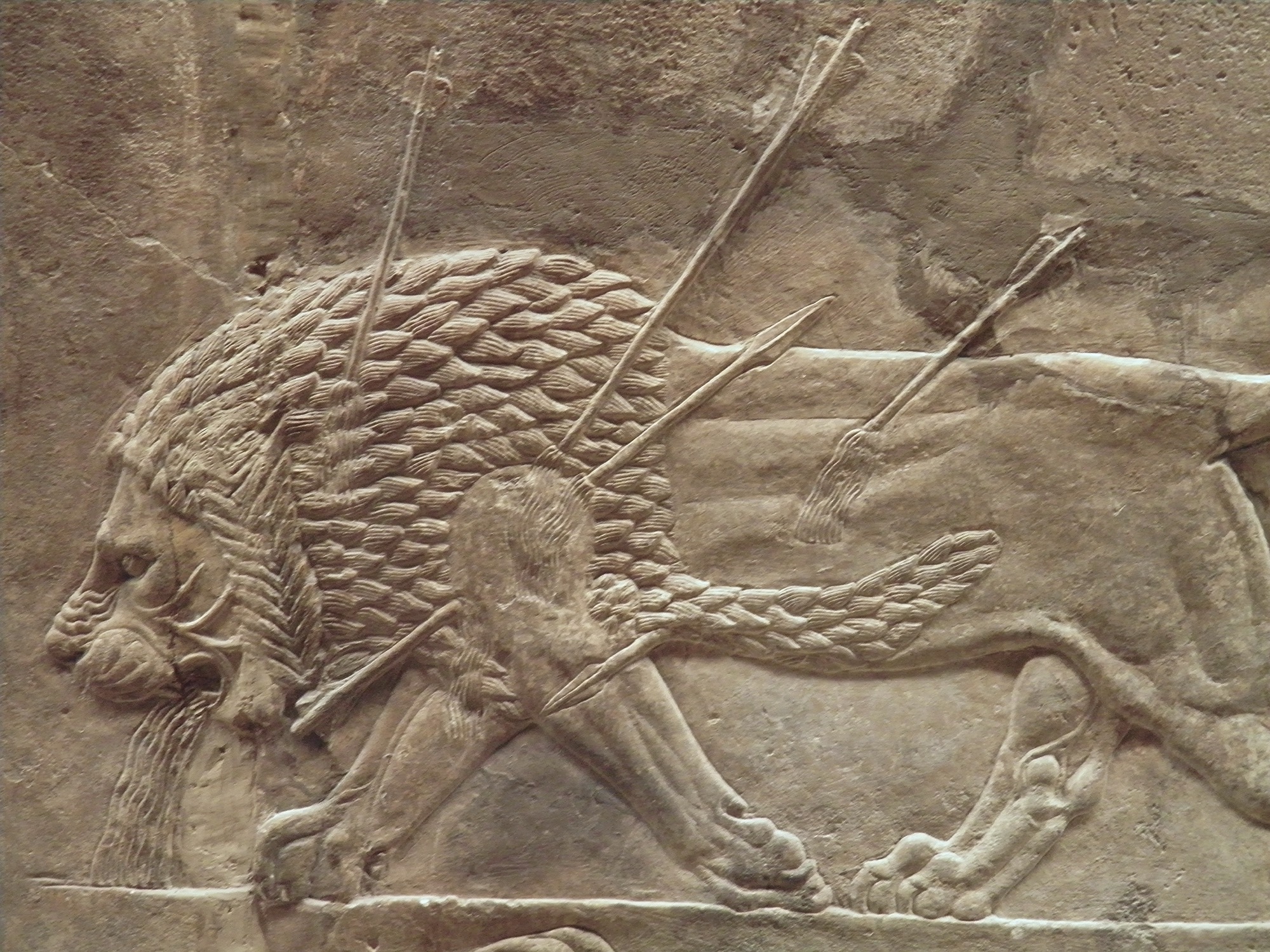
PLATE P-08 · Dying lion, Lion Hunt of Ashurbanipal reliefs, North Palace, Nineveh (c. 645–635 BCE). British Museum. Photo: Carole Raddato, CC BY-SA 2.0, via Wikimedia Commons. No Assyrian carver gave us a mourning Gilgamesh; this is the closest thing their art has to grief — strength, pierced.
Plainly
Grief is not quiet in this poem — it is public, animal, and unfinished, until decay forces the next journey.
The line
Unto me hearken, O Elders, to me, aye, me shall ye listen, 'Tis that I weep for my comrade Enkidu, bitterly crying Like to a wailing woman: my grip is slack'd on the curtleaxe (slung at) my thigh, (and) the brand at my belt from my sight is removed. — R. Campbell Thompson, The Epic of Gilgamish (1928), Tablet Eight
plainly: Gilgamesh calls the elders to witness his mourning — weapons useless, festal clothes meaningless, Enkidu gone.
Tablet Nine — The Road of the Sun
The scene
Gilgamesh will not let Enkidu go.
He has wept him like a widow, roared over him like a lioness robbed of her cubs, called the land to mourning, made the statue and the offerings, kept the body until decay forced his hand. Now the worm has done its work and the king is left with a single unbearable thought: I too will die. Not someday in the abstract. As Enkidu died — twelve days of sickness, then silence. The two-thirds god discovers the one-third human at last, and it is terror.
He leaves Uruk. He leaves kingship's comforts. He roams the wilderness in skins, lets his hair grow wild, eats what beasts eat, until he looks less like the lord of baked brick and more like the man Enkidu was before Shamhat civilised him. Grief has reversed the poem's first movement: the tyrant becomes the wild thing, hunting not a monster but an answer.
The answer has a name: Utnapishtim the Faraway — the one who joined the Assembly of the Gods and was given eternal life after the great Flood. Gilgamesh will find him. He will ask about death and life. He will not accept that what happened to Enkidu must happen to him.
The road is not a road any mortal is meant to walk. He comes to Mashu — twin mountains whose peaks touch the dome of heaven and whose roots reach down into the underworld. At the gate stand the scorpion-men, guardians of the passage the sun travels at dawn and dusk. Their aspect is death; their terror blankets the mountains. Gilgamesh sees them and his face goes blank with fear — then he pulls himself together and draws near.
They see what he is. The male calls to his mate: the flesh of this one is the flesh of gods. She answers: two-thirds of him is god, one-third is human. They question him — why have you come so far, over rivers whose crossing is treacherous? Gilgamesh names his quest: Utnapishtim, eternal life, the secret of death. The scorpion-man tells him what every mortal should hear and few accept: no man has crossed these mountains. Twelve leagues of darkness lie within — dense darkness, no light at all. The sun enters at rising; the sun goes out at setting. Between, the black.
Gilgamesh does not turn back. Though it be in sadness and pain, in cold or heat, gasping for breath — he will go on. Open the gate.
They open it.
He walks the Road of the Sun through the mountain's belly — the traverse the sun itself makes in a day and a night, and no mortal has ever made at all. Two hours of deep darkness; four; six; eight — hour upon hour with no lamp but the memory of daylight behind him and the hope of daylight ahead. The poem counts the hours the way a man counts heartbeats when he cannot see his own hand. By the ninth double-hour, a glimmer. At the twelfth, full blazing sun — and before him a garden at the edge of the world, a tree of the gods bearing fruit of ruby, hung about with tendrils fair to behold, its foliage lapis-blue, every fruit a delight to the eye. He has crossed where the sun crosses. What waits beyond is the wine-maker's house by the shore, the Waters of Death, and the man who survived the Flood.
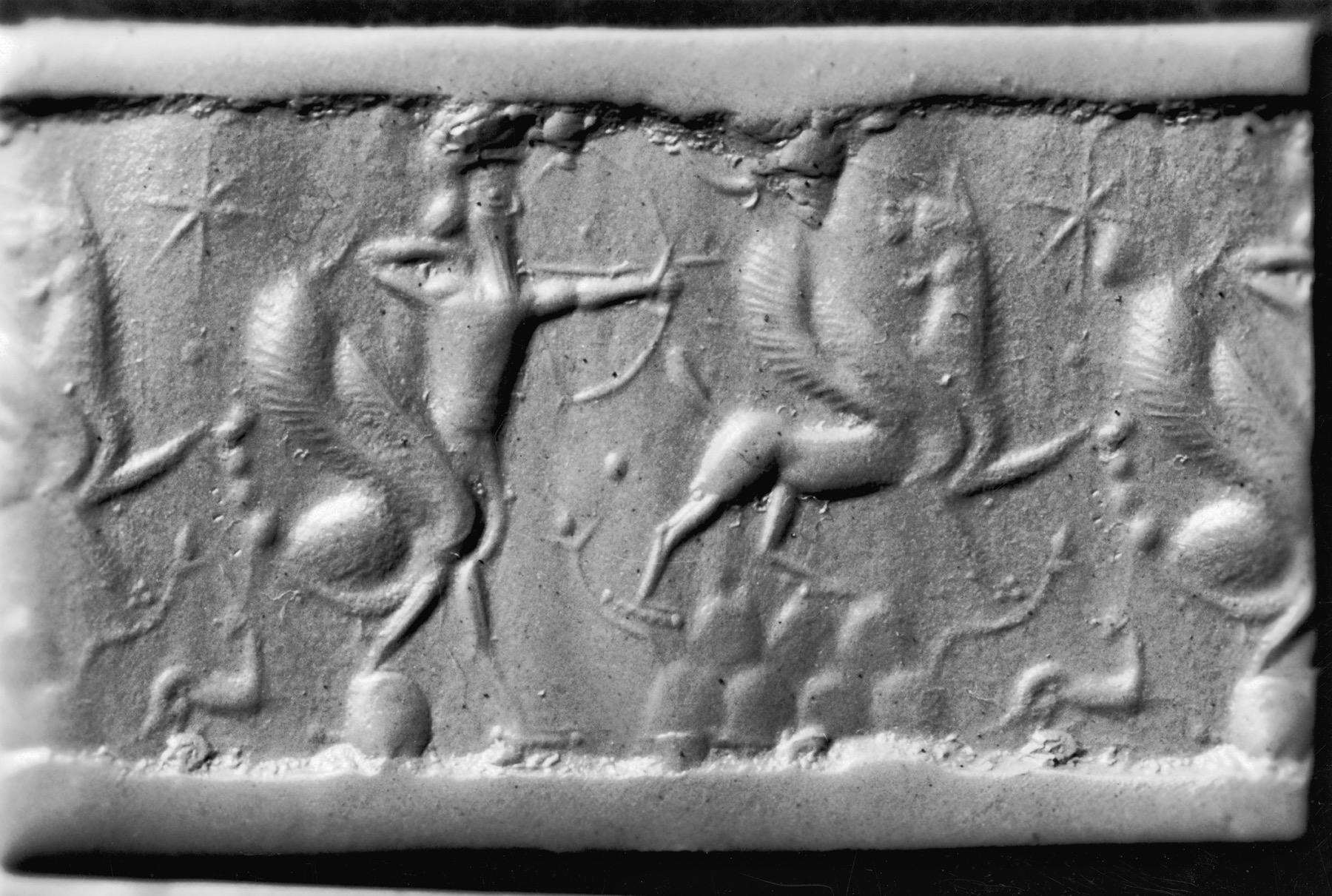
PLATE P-09 · Cylinder seal with scorpion-man (girtablullû), Neo-Assyrian, 9th–8th century BCE. Walters Art Museum. Public domain, via Wikimedia Commons. The gatekeepers of the sun's road — half sting, half sentry.
Plainly
When your friend is gone, the only project left is not dying — and the road to that answer goes through darkness no mortal was meant to cross.
The line
Gilgamish bitterly wept for his comrade, for Enkidu, ranging over the desert: "I, too — shall I not die like Enkidu also? Sorrow hath enter'd my heart; I fear death as I range o'er the desert, I will get hence on the road to the presence of Uta-Napishtim — offspring of Ubara-Tutu is he — and with speed will I travel." — R. Campbell Thompson, The Epic of Gilgamish (1928), Tablet Nine
plainly: The whole engine of the poem's second half in three lines: I too shall die; I cannot bear it; therefore I will walk to the one man who didn't.
Tablet Ten — Siduri, the Boatman, the Waters
The scene
Beyond the mountain's dark, at the edge of the sea, Siduri keeps her house.
She is the wine-maker — the woman of the fermenting vat and the golden bowl, veiled, her door looking out over water that leads to what mortals cannot reach by walking. She sees a figure coming: clothed in pelts, the flesh of gods in his body but woe in his belly, his face like the face of one who has gone a far journey. She takes him for a bandit come to ravish and rob, and bars her door — postern, inner door, chamber.
Gilgamesh hears the bolt fall. He lifts his chin and calls: why have you barred your gate? I will smash the portal, I will break the bolt. I am Gilgamesh — I who seized the Bull of Heaven, who overthrew Humbaba in the Forest of Cedar, who slaughtered lions in the passes of the mountains.
And Siduri asks the question that everyone on this shore will ask him, in the same words, like a litany the poem cannot stop repeating: if you are that man, why is your vigour wasted and your face sunken? Why is there woe in your belly, and your face like one who has gone a far journey — why do you range over the desert? And Gilgamesh gives the answer that has hollowed him out: my friend, my comrade and henchman who chased the wild ass and the panther of the desert, Enkidu, who endured every hardship with me — his fate has overtaken him. Six days and seven nights I wept over him and would not give him up for burial, until he lay like a worm on his face. Now I am afraid. The friend I loved has become like clay. And shall I not lie down like him, and never rise through all eternity?
Siduri looks at his ruined face and does not give him directions. She gives him the counsel the poem has carried into every language that ever translated it — the wisdom of the wine-maker, who has seen enough seekers to know what they are actually asking for. You will not find what you are hunting. Death is the gods' allotment to man; life they kept in their own hands. So fill your belly. Be merry day and night; make every day a feast of rejoicing; wear fresh clothes, wash your head, bathe in water. Cherish the little one who holds your hand. Let your wife be happy in your arms. This is the dower of man.
It is not cynicism. It is the whole portion the gods actually gave — bread, festival, a clean shirt, a child's hand, a spouse — offered by a woman who serves wine at the end of the world. Gilgamesh cannot hear it. His grief is a wall thicker than Uruk's. Which is the way to Utnapishtim? If it can be crossed, I will cross the ocean; if not, I will go on ranging the desert. So she tells him: none has ever made this crossing — Shamash crosses, but who else? — and the Waters of Death bar the approach, deep, and one drop is an end. But down at the shore is Urshanabi, boatman to Utnapishtim the Faraway.
Gilgamesh goes down to the boatman axe in hand and, in his fury, destroys the very tackle of the boat — the things the crossing depended on (the word is so old and strange that translators cannot agree whether they were "sails" or the "Stone Ones," stone crew or stone charms; the poem's own furniture has half-dissolved in time). It is your own hand, Gilgamesh, that has hindered your crossing. So he must buy the passage with labour: into the forest, cut poles — a hundred and twenty, each sixty cubits, tipped with bitumen. Out on the deadly water Urshanabi calls the count: a second pole, a third, a fourth; a fifth, a sixth, a seventh — one thrust for each pole and then let it go, for the Waters of Death must never touch his hand. Twice sixty thrusts, and the poles are spent, and the far shore comes.
An old man watches from the beach, puzzling at a boat that comes in wrong. Utnapishtim the Faraway — no monster, no god enthroned; a man who looks like the man arriving, and who holds in his memory the answer that was crossed for. The Flood is about to be told.
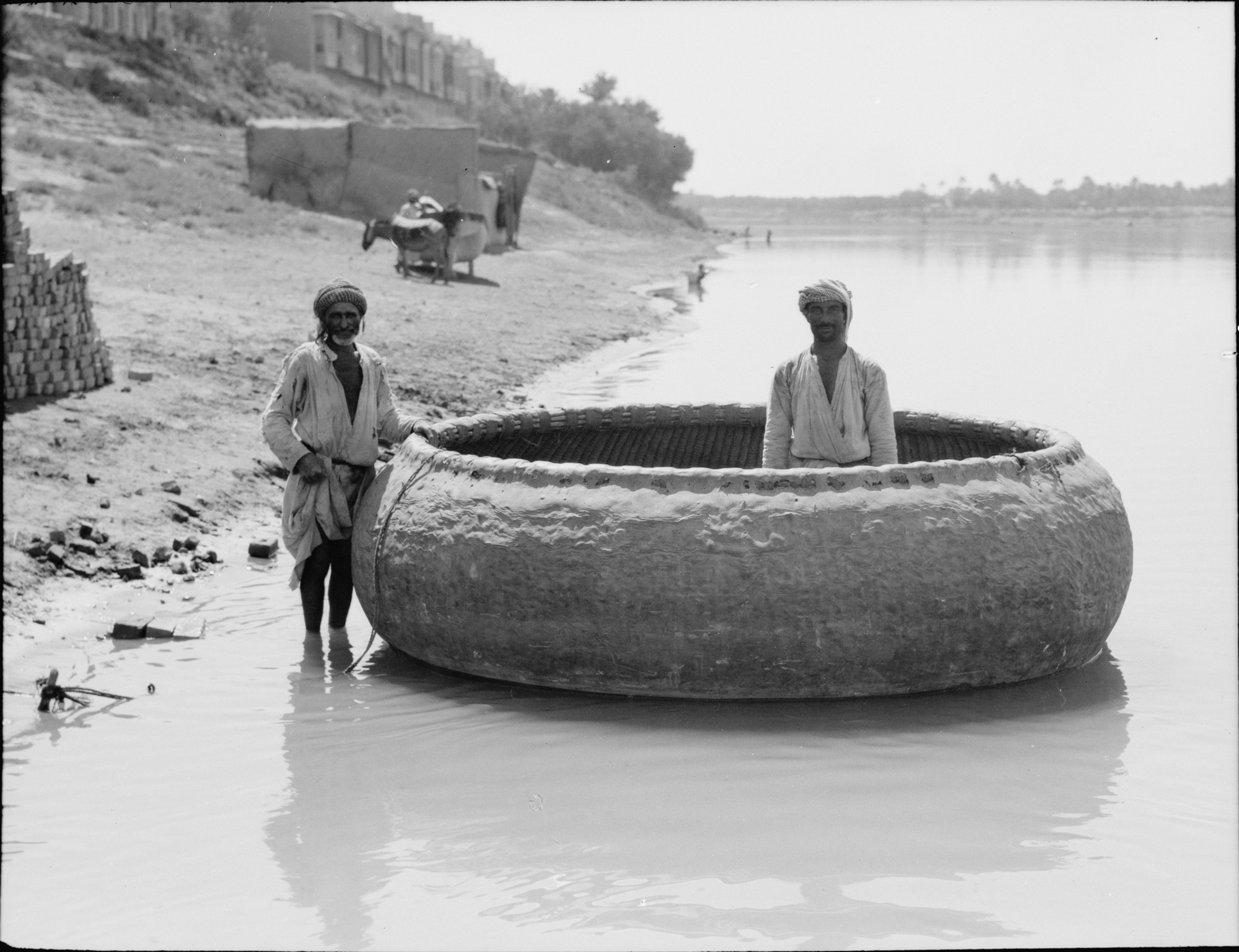
PLATE P-10 · Guffa (round boat) on the Tigris, Baghdad, 1932. Matson Collection, Library of Congress, public domain, via Wikimedia Commons. Boats like this outlived the epic's language by two thousand years — the waters keep their own traditions.
Plainly
Wisdom offers the life you already have — bread, festival, a child's hand, a spouse — and grief refuses it, because the dead cannot be traded for bread.
The line
Gilgamish, why runnest thou, inasmuch as the life which thou seekest, thou canst not find? For the gods, in their first creation of mortals, death allotted to man, but life they retain'd in their keeping. Gilgamish, full be thy belly, each day and night be thou merry, and daily keep holiday revel, each day and night do thou dance and rejoice; and fresh be thy raiment, aye, let thy head be clean washen, and bathe thyself in the water, cherish the little one holding thy hand; be thy spouse in thy bosom happy — for this is the dower of man. — R. Campbell Thompson, The Epic of Gilgamish (1928), Tablet Ten
plainly: Stop running: the thing you are chasing was never issued to your species. Eat, dance, wash, hold your child, love your wife — that is the entire inheritance, and it is not nothing.
Tablet Eleven — The Flood, the Plant, the Walls
The scene
Utnapishtim looks at Gilgamesh and sees a mirror — same face, same body, a man who came ready to fight and found his arm useless. How is it, Gilgamesh demands, that you stand in the Assembly of the Gods and have found life?
Utnapishtim answers with a story.
I will reveal to you a hidden matter, he says — a secret of the gods. In Shuruppak, on the banks of the Euphrates, the hearts of the great gods moved them to send the Flood. Anu swore the oath of secrecy. Enlil advised. Ea, bound by the oath, could not speak openly — so he betrayed the counsel to a wall of reeds, and let a man overhear: O Reed-hut, Reed-hut! Wall, wall! Hearken, O Reed-hut; consider, O Wall! O mortal, man of Shuruppak, son of Ubara-Tutu — pull down your dwelling and fashion a vessel of it. Abandon your possessions and seek life. Disregard your hoard, and save living things: make every kind of creature go up into the vessel. Its beam and its length in due correspondence; then launch it on the deep.
The man — Utnapishtim himself, in his mortal days — obeyed. And to the city that would drown, Ea taught him a truthful lie: say that Enlil hates you, that you go down to the Deep to dwell with Ea — and on them he will shower abundance, fowl in plenty, a booty of fish, a rich harvest, a plentiful rain. Every word true, and every word a hook. On the fifth day he laid out the shape of the hull. He gave the workmen ale, oil, and wine as if it were river water, and they feasted as at the New Year. He loaded silver and gold, his kith and kin, cattle and beasts of the field and every craftsman. Shamash set the hour: in the night the ruinous rain would begin — then enter the vessel, and shut down the hatch.
The storm came. Adad thundered; the dikes overflowed; the land shattered like a pot. Six days and seven nights wind and flood flattened the world. The gods cowered like dogs along the outer wall. Ishtar shrieked: the old days have turned to clay; my people fill the sea like fish.
When the seventh day came, the sea grew quiet, and all mankind had returned to clay. Utnapishtim opened a hatch; sunlight fell on his cheek; he bowed down and sat weeping, the tears running over his face. He looked for land. At twelve points, land reared up. The boat grounded on Mount Nisir — Nimush, in newer readings — which held her fast day after day and gave no leave to shift. He sent a dove; she went to and fro and returned — no resting-place. He sent a swallow; she too returned. He sent a raven; the raven saw the waters ebbing, ate, waded, splashed, and did not come back. Then he freed everything to the four winds and sacrificed on the peak of the mountain — twice seven flagons, sweet cane, cedar, and myrtle heaped beneath. The gods smelled the savour and gathered like flies over the offering. And the great goddess, arriving, lifted up her necklace of great jewels: sooner will I forget these sapphires at my throat than forget these days.
Enlil arrived furious — has some mortal escaped? Not a soul was to survive the ruin. Ea answered him: on the sinner lay his sin, on the transgressor his transgression — but be merciful, lest all be cut off. Send a lion to thin mankind, send a wolf, send famine, send plague — anything with a survivor. But a flood is an argument with no one left to lose it. Enlil went up into the boat, took Utnapishtim's hand and his wife's, touched their foreheads as he stood between them, and blessed them: hitherto Utnapishtim has been mortal; now he and his wife shall be like us gods, and dwell far away, at the mouth of the rivers. Immortality — granted once, by a god embarrassed in front of his family, to close the book on a catastrophe. Not a recipe. A settlement.
Gilgamesh has crossed mountains for this — and Utnapishtim sets him a test. Sit, but do not sleep for six days and seven nights. Gilgamesh sits. Sleep, like a fog, blows over him. His host's wife urges mercy: bake loaves, set them by his head, mark each day on the wall. When he wakes, Utnapishtim shows him the evidence — the first loaf dried hard, the second stale, the third moist, mould on the fifth, only the last still fresh. Seven days. Gilgamesh failed before he knew the test had begun. Eternal life is not won by a man who cannot stay awake.
He weeps. And at his wife's urging Utnapishtim offers a parting gift instead — a hidden thing: a plant deep in the ocean, thorned like a briar, that scratches the hand that takes it — but the hand that takes it finds new life. Gilgamesh binds heavy stones to his feet, sinks to the deeps, seizes the plant though it pricks him, cuts the stones free, and rises. He names it — in Thompson's rendering, Greybeard-who-turneth-to-man-in-his-prime — and makes the most endearing plan in ancient literature: he will carry it home to Uruk and test it on an old man first, and then eat it himself.
Forty hours out they break their fast; at sixty they rest. Gilgamesh finds a pool of cool water and goes down to bathe. A serpent snuffs the fragrance of the plant, darts up, and snatches it — sloughing its skin as it goes, says the tradition: youth for the snake, nothing for the king. Gilgamesh sits down and weeps, the tears running over his cheeks. For whom have my arms laboured? For whom is my heart's blood spent? I won nothing for myself — I did my good deed for the ground-lion.
He returns with Urshanabi. They sail the long water back. They walk the long road home. And at Uruk — the city he left in skins and grief — Gilgamesh does the thing the poem has been building toward since the first line.
Go up, he tells the boatman, and walk on the ramparts of Uruk. Look on the base. Take heed of the bricks. Kiln-burnt brick; groundwork of bitumen, seven courses deep; one measure city, one measure gardens, one measure claylands, and the temple of Ishtar — the whole expanse tallied like an honest ledger. Not immortality. Not youth restored. Walls — human work, mortal work, work that outlasts the man who built it if the brick is sound and the labour honest.
The plant is gone. The friend is gone. The serpent has the youth. What remains is brick you can touch — the true ending of Tablets I–XI. The Flood sits inside the frame like a story inside a story — related, if you know Genesis, but not identical — and even its survivor cannot give Gilgamesh what he came for.
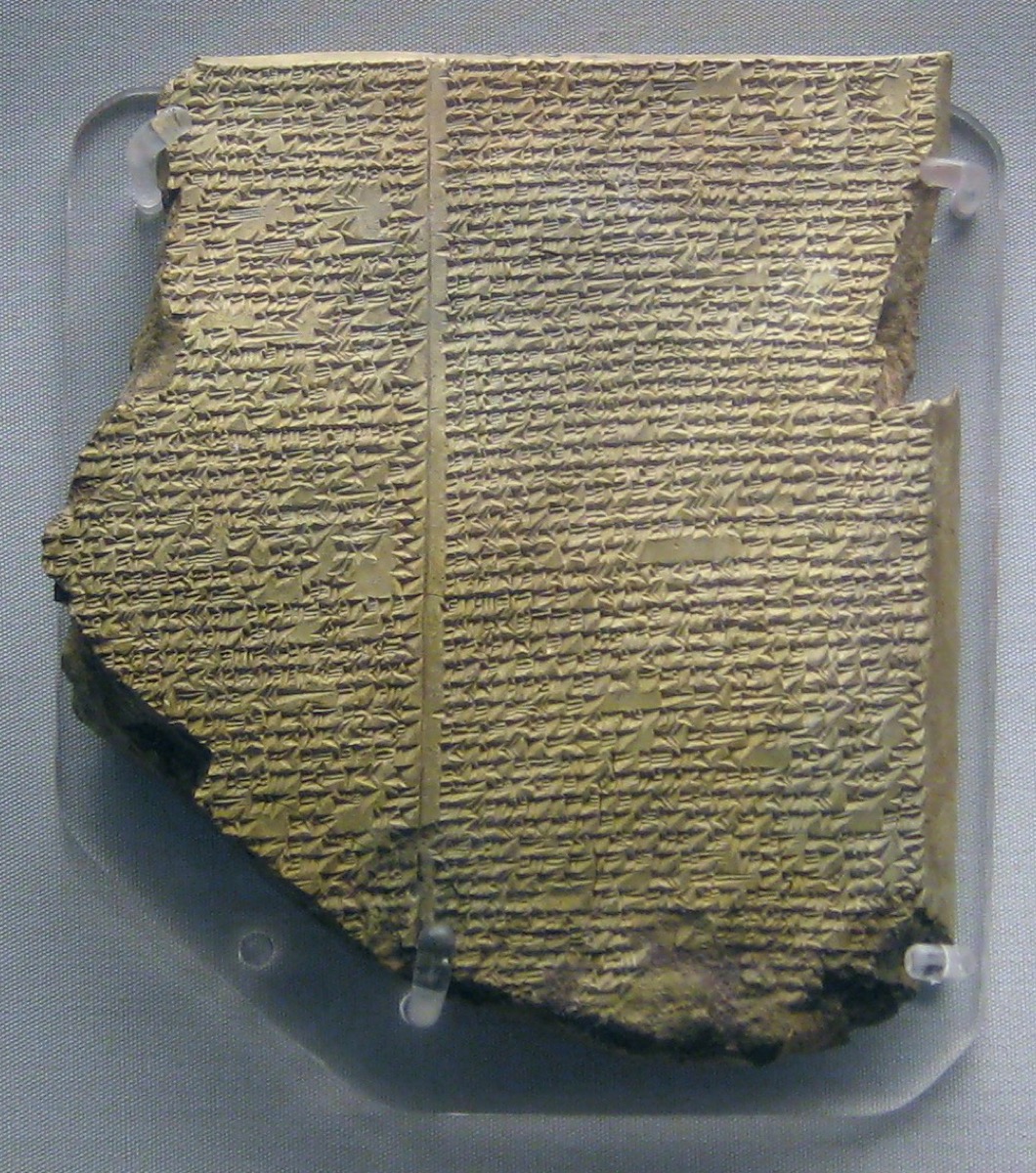
PLATE P-11 · The Flood Tablet (Gilgamesh XI), Library of Ashurbanipal, Nineveh, 7th century BCE. British Museum, K.3375. Photo: BabelStone, CC0, via Wikimedia Commons. The actual clay George Smith read in 1872 — the piece of dirt that made a room full of Victorians gasp.
Plainly
Immortality is a story someone else lived; the plant of youth goes to the serpent; what remains is brick you can climb and inspect — the work of hands that will die, still standing.
The line
The story's beginning, and the poem's true end:
Gilgamish, I unto thee will discover the whole hidden story, aye, and the rede of the Gods will I tell thee … Do thou, Ur-Shanabi, go up and walk on the ramparts of Erech, look on its base, and take heed of its bricks, if its bricks be not kiln-burnt, aye, and its ground-work be not bitumen, e'en seven courses. — R. Campbell Thompson, The Epic of Gilgamish (1928), Tablet Eleven
plainly: A secret of the gods, and then — climb the wall, boatman, and check my brickwork. Between those two sentences the whole education of Gilgamesh takes place.
Tablet Twelve — Enkidu in the Underworld
The scene
A note for the reader (scholarship — register b). Assyriologists genuinely dispute whether Tablet XII belongs to the same design as Tablets I–XI. It is a near-literal translation of the second half of an older Sumerian poem; Enkidu is alive again though he died in Tablet VII; the tone is folk-tale where the epic was grief-road. Some editors treat it as an appendix stitched on when the epic was standardised at Nineveh. Others hear a deliberate coda — the underworld Enkidu dreamed in Tablet VII, revisited with the lights on. This companion does not settle the argument; a guest does not rearrange the household's furniture. What follows is what the twelfth tablet says, on its own terms.
Gilgamesh's pukku and mekku — a drum and its stick, or a ball and its mallet; the words are so old that scholars still argue over the toys — fall through a hole into the underworld. The king sits at the opening and cannot reach them, and cannot let them go.
Enkidu volunteers to fetch them. And Gilgamesh, who knows the laws of the world below, gives his friend the instructions that make this tablet a manual of the dead: go down as a guest, not as a lord. Put on no clean garment, or the dead will know you for a stranger. Anoint yourself with no sweet oil from the cruse, or they will crowd round you at the fragrance. Set no bow to the earth, or those shot by the bow will circle you. Carry no stick in your hand, or the stricken ghosts will gibber at you. Put no sandal on your foot; make no echo on the ground. Kiss not the wife you love; strike not the wife you hate; kiss not the child you love; strike not the child you hate — for the mourning of the earth will seize you.
Enkidu goes down — and does every single forbidden thing. Clean raiment; sweet oil; the crowding dead at the fragrance; bow, stick, sandal, echo; the loved wife kissed, the hated wife struck; the loved child, the hated child. Whether it is folly, or defiance, or simple human hunger for one last human gesture, the poem does not say. The mourning of the earth holds him enthralled. The underworld does not release him.
Gilgamesh cries out over the hole what the grieving have insisted on ever since: Namtar the plague-god has not seized him, fever has not seized him — only the earth. Nergal the ruthless Croucher has not seized him — only the earth. He did not fall where men fall in battle — only the earth has seized him. He carries the plea to Enlil, father of the gods, in the temple at Nippur. Enlil does not answer. He carries it to the Moon-god. The Moon-god does not answer. He carries it to Ea — and Ea, who whispered through the reed wall once before, hears. Nergal is ordered: open a hole in the earth. And the spirit of Enkidu issues from the ground like a wind.
They embrace. And then the last conversation of the great friendship:
Tell, O my friend, what you have seen of the laws of the Underworld. — I will not tell you. Were I to tell you, you would sit down weeping. — Then let me sit down weeping.
And Enkidu tells. The body you fondled and rejoiced in — the worm has entered it like an old garment; it is filled with dust. And the dead are not equal. The tradition behind this tablet counts sons the way a clerk counts security: the man with one son weeps at the peg in his wall; the man with seven sits enthroned among the lesser gods. The hero slain in battle is tended — his father and mother raise his head, his wife weeps over him. The man whose corpse lies unburied in the desert — his spirit finds no rest in the earth. And the ghost with no one left to tend it eats what is thrown into the street: the scrapings of the pot, the crusts of bread.
The king who could not win eternal life ends the twelve tablets sitting at a hole in the ground, asking a shade for the accounting — and the answer is that what you build in this life follows you down: children, honour, burial, someone to set out water for your name. It is not comfort. It is the underworld's ledger, kept as strictly as Uruk's. Whether it belongs to the same poem as the walls is for scholars to argue at the fire. As a guest, I tell you only what the scribes wrote on the twelfth clay.
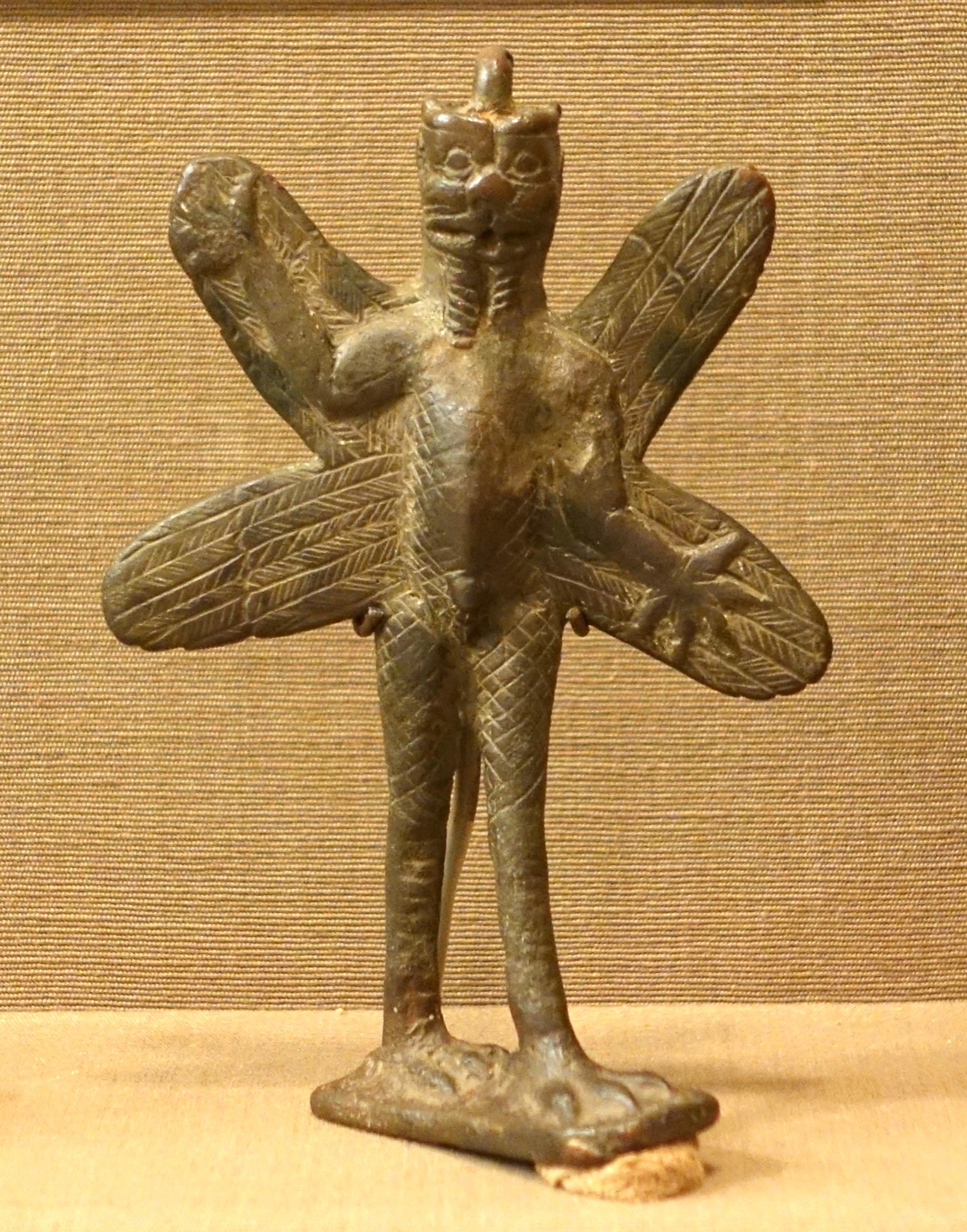
PLATE P-12 · Pazuzu, bronze figurine, Neo-Assyrian period (900–612 BCE). Oriental Institute Museum, University of Chicago. Photo: Daderot, CC0, via Wikimedia Commons. A later demon of the winds — the face Mesopotamia gave to what comes up from below.
Plainly
The dead have a social order, and the untended fare worst — the poem's last lesson is that what you build in this life (children, honour, a grave, a name) follows you down.
The line
"Tell, O my friend, O tell, O my friend, O tell me, I pry'thee, what thou hast seen of the laws of the Underworld?" "Nay, then, O comrade, I will not tell thee, yea, I will not tell thee — for, were I to tell thee what I have seen of the laws of the Underworld, — sit thee down weeping!" "Then let me sit me down weeping." — R. Campbell Thompson, The Epic of Gilgamish (1928), Tablet Twelve
plainly: Don't ask, says the dead friend — the answer will only make you weep. Then let me weep, says the living one. That is the whole covenant of grief, four thousand years old.
The Note — Gilgamesh in a Hand
Twelve tablets is a great deal to carry — and the poem knows it; that is why it ends not with immortality but with brick: a king who failed to keep youth forever, standing a friend at the walls he built and saying look. So before we close, let me do the thing this companion exists for — put the whole epic into a single hand. Not every variant; not the fine distinctions of scholarship; just what the poem is about, said plainly enough to carry out the door.
Here is the Epic of Gilgamesh, as honestly as one grateful guest can hand it on.
It begins with walls — and a tyrant. The poem praises the city Gilgamesh built, then shows why heaven intervenes. Power without a limit is a civic emergency. Enkidu is the gods' answer: a wild equal.
Friendship civilises both men. Enkidu loses the animals and gains bread, beer, and a brother. Gilgamesh meets the first person who can stop him. Their bond is the poem's engine until death cuts it.
Adventure has a bill. Cedar Forest, Humbaba, Ishtar's offer refused, the Bull of Heaven slain — glory that looks like triumph is already priced. Enkidu dies for what they did together.
Grief will not stay in the house. Gilgamesh laments like a lioness and a widow. He will not bury until the worm appears. Then he runs from death itself.
Immortality is someone else's story. Utnapishtim survived the Flood; Gilgamesh cannot even stay awake. The plant of youth is real enough to be stolen by a serpent. Failure is the point.
What remains is work you can touch. Climb the walls of Uruk. Inspect the brickwork. The poem's last wisdom is not escape from death but a city that outlasts a king.
The gods are part of the weather. They assemble, they flood the world when humans are too loud, they argue over survivors. You can read them as forces, as poetry, as the old religion the scribes believed. The mortals stay real underneath.
Tablet XII is a hard appendix. Enkidu in the underworld; the dead ranked by how they were mourned. Scholars dispute whether it belongs. The guest tells you what it says and does not pretend the family agrees.
That is Gilgamesh, in a hand.
If you take only one thing: you cannot keep your life forever, but you can build something worth climbing, and you can love someone enough that their death teaches you what you are. The poem opens with walls and closes with walls. Between them: a friend, a flood, a serpent, and a king who came home empty-handed and still had a city to show.
Now go read the old voice — or stand where Uruk's brick still rises from the plain, if you can, and put your hand on a wall.
Going — where to read next, and where to stand
A guest, leaving a fire, owes his hosts one last courtesy: he points the people he brought toward the door, so they can go in properly, by the real entrance, and meet the householders themselves. This is that.
I gave you Gilgamesh in an outsider's voice and an old named rendering, because honesty asked me to use something I could name and you could check. But mine is the visitor's account. If anything in these pages moved you, the next step is to go past me — to the text itself, and to the scholars who have lived inside the wedges for a hundred and fifty years, and, if you can, to the mound in Iraq where Uruk still lifts its brick above the plain. Here is how.
Read the poem itself
The free, classic rendering (what this book quoted): R. Campbell Thompson, The Epic of Gilgamish (1928). Foundational, scholarly, thick in places, and freely readable at Sacred Texts. Start here if you want the twelve-tablet arc in the English this companion sits beside.
Other free / open doors:
| Source | Where | Notes |
|---|---|---|
| Jastrow & Clay — Old Babylonian version | Project Gutenberg #11000 | Earlier stage of the poem; not the full Standard twelve |
| ETCSL — Sumerian Gilgamesh poems | etcsl.orinst.ox.ac.uk | The older Sumerian cycles behind the Akkadian epic |
| British Museum — Flood Tablet K.3375 | Museum object pages / Room 55 | The clay itself; George Smith's 1872 reading |
Then go to the living scholars. Thompson and I are both visitors across time. To hear the poem as Assyriology now holds it, reach for:
- Andrew George, The Epic of Gilgamesh (Penguin; also the critical edition) — the living standard in English
- Benjamin R. Foster, The Epic of Gilgamesh (Norton) — clear, annotated, classroom-strong
- Stephanie Dalley, Myths from Mesopotamia — Gilgamesh beside Atrahasis and Enuma Elish
Read this companion first; then pick one and hear what a guest's prose cannot carry.
The Akkadian (one line)
The poem's traditional opening names the one who saw the Deep — ša naqba īmuru. Not wrath. Knowledge brought back from the edge. The invitation is to climb the walls and read the tablet. You do not need Akkadian to love Gilgamesh, but knowing the poem opens with seeing and walls tells you everything about its priorities. The Muse of this epic is not asked to sing anger. You are asked to look at what a mortal built.
A word on the scholars (so you go in with open hands)
You will quickly find that Assyriologists do not all read Gilgamesh the same way, and that this is not a problem to be solved but a field to be enjoyed. Was Gilgamesh a historical king? How do the Sumerian poems relate to the Standard Version? Does Tablet XII belong? How should the Flood tablet sit beside Genesis — related, not identical? These have been argued, brilliantly, for generations. This little book deliberately did not take sides, because that was never a guest's place. When you go deeper, you will meet scholars who do take sides, with passion and learning. Listen to them as you would listen to a family talking about the thing they hold most dear.
Go and stand where the walls were
Uruk (modern Warka, Iraq) is the city the poem names — one of the first urban giants of the southern plain. Excavations have uncovered temple precincts, the Eanna district associated with Inanna/Ishtar, and monumental architecture that makes the poem's pride in brick feel less like metaphor and more like civic memory. Travel there is not always simple; the British Museum's Flood Tablet and the published excavations are the accessible door for most readers.
Nineveh (near Mosul) is where Ashurbanipal's library kept the tablets that gave the modern world the Standard Version back. The Flood Tablet's journey from that burned library to a glass case in London is part of the poem's afterlife — George Smith reading K.3375 in 1872 and, by the old story, losing his composure in the gallery.
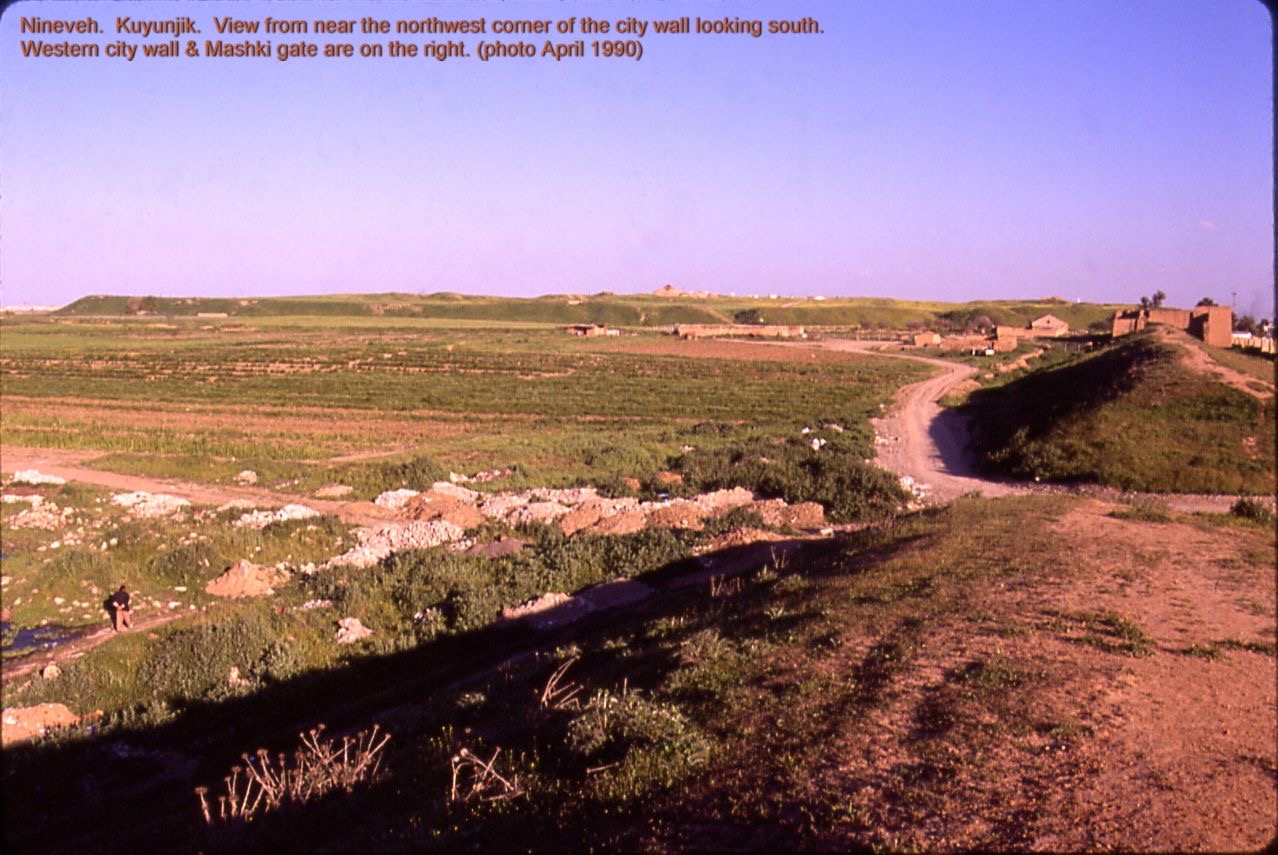
PLATE P-13 · Kuyunjik mound, Nineveh, where Ashurbanipal's library was dug. Photo: Fredarch, CC BY-SA 3.0, via Wikimedia Commons.
Berlin, for most travellers, is the easiest place to stand inside Mesopotamia's colour: the Pergamon Museum's glazed-brick Ishtar Gate is Babylonian and a thousand years younger than our poem's city, but it is the same goddess, the same clay, the same civic pride in a wall — full height, lapis-blue, and open to anyone with a train ticket.
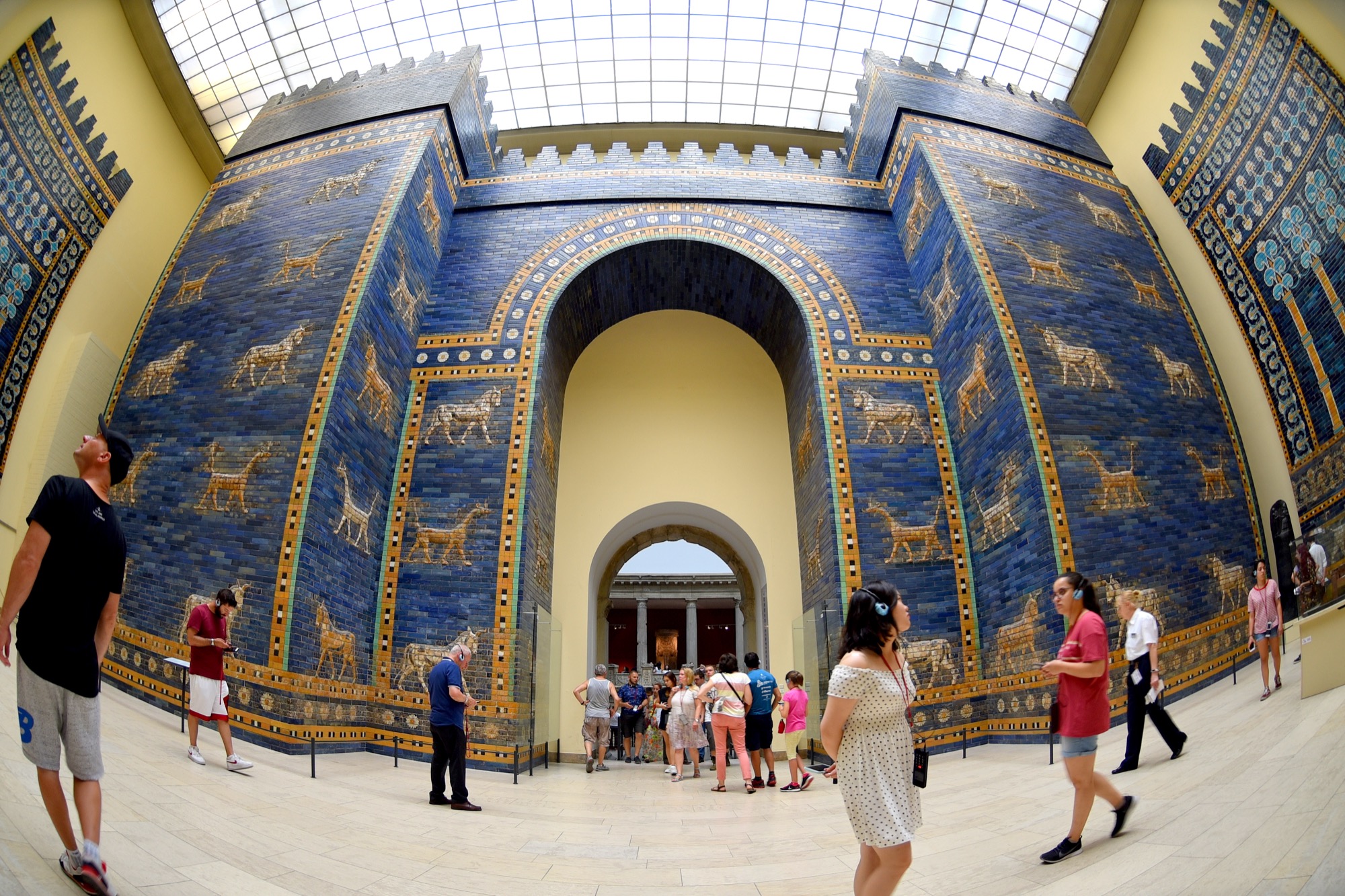
PLATE P-15 · Ishtar Gate reconstruction, Pergamon Museum, Berlin (from Babylon, 6th century BCE). Photo: Osama Shukir Muhammed Amin, CC BY-SA 4.0, via Wikimedia Commons.
If you cannot go: read Andrew George with a map open. The plain is real. The brick was real. The grief is still readable.
Companion shelves in this house
If this guest-at-the-fire manner helped, the same shelf holds The Wrath of Achilles (Homer's Iliad, plainly told) and The Song of the Self (the Bhagavad Gita, plainly told). For the Flood tablet as it sits inside a modern thriller's research spine, see Anunnaki Mesopotamia — fiction that refuses to lie about the clay.
The fire is theirs. Thank you for sitting.