Dedication
For the people the map calls empty —
the ones who read the grass and the wind and the sky before any instrument existed to do it, who fold a house onto three camels in an hour and set it down again wherever the water is, whose whole wealth walks on four legs and five snouts and is not kept for sale.
I came, like everyone comes, for the postcard — the conqueror, the eagle, the endless gold nothing. You were the country underneath the cliché, and the only part that turned out to be full.
\
\
\
And for everyone who has ever been told, by a brief or a fence or a licence area on a screen, that their ground was underused —
the steppe is not empty. It never was. You were here the whole time.
Go and let the people who hold it show you how full it is.
Foreword
by Hubert Wancic †
I spent my life chasing a single idea across several deserts: that human beings were not made to settle, that the truest map of a people is not their borders but their routes, and that the land a settled person calls empty is, to the people who move across it, the most densely written text on earth. I was often accused of romanticising the nomad. I probably did. But I was right about the central thing, and this book proves it better than I ever managed, set in the one country that has always known it in its bones.
Mongolia. The great misunderstood emptiness. The land everyone arrives to "develop" because they have mistaken unmarked for unknown — and that is the engine of this book, and the author has seized it with both hands. He has understood that the steppe only looks empty to the eye that cannot read it; that to the herder it is a library, a genealogy, a calendar, a law; that every fold of it has a name and a use and a story, and that the people who carry those stories carry them, like all true nomads, not on paper but in the body and the mouth and the moving.
His heroine is the daughter who left and is sent back — sent back as the friendly local face of the very survey that means to fence her father's grass — and through her the book performs the exact reversal I spent my career arguing for. The clever outsiders arrive certain that they have come to a blank place to bring it knowledge, and the land, patiently, through her, teaches them that it was they who arrived ignorant; that the most precisely known ground on earth is the ground they had written off as nothing. I cheered. I have waited a long time for a novel to land that blow so cleanly.
What moved me past argument, though, is that the author loves the movement itself the way I did — the felt and the horse and the season and the going. He knows that a way of life is not a museum exhibit to be preserved behind glass but a verb, a thing that must keep moving to stay alive, and that the tragedy of the survey, the mine, the fence, is not that it is ugly but that it makes the verb impossible. To still a nomad is to kill him slowly and call it progress. The book knows this, and grieves it, and never once preaches it, which is the only way grief survives translation onto a page.
And there is a stranger in it — there is always a stranger in the books I love — a quiet man from another southern grassland who turns out to belong, against all logic, more easily on this steppe than the experts do, because he travels the way the herders travel: lightly, attentively, as a guest. The scenes of him learning to be still inside this enormous moving country are the truest thing in the book, and I read them with the particular ache of a settled old man remembering the road.
A word on the prose: it moves. It does not sit and describe; it travels, the way the people in it travel, covering ground, trusting the reader to keep up, pausing only where a thing is worth the pause. This is the right music for the subject. The form is itself nomadic, and I do not think the author could have told this story any other way and kept it alive.
So: go out onto the felt and the sky. Let the empty place fill, line by line, with the names and uses and stories it was always full of. The people who move across it have been trying to tell us, for a very long time, that nothing here was ever empty. This book finally listens, and writes it down — lightly, on the move, as a song and not a survey.
Begin, and travel well.
— Hubert Wancic
† “Hubert Wancic” is an anagram of BRUCE CHATWIN — the great writer of nomads, songlines, and the road — borrowed here in homage and affection. This foreword is a work of fiction. It was written by the author of this book. Bruce Chatwin did not write it, was not involved in it, and is not associated with or endorsing this book in any way. The name is rearranged precisely so that the tribute can never be mistaken for a real attribution; it is a salute, not a claim.
Chapter 1 — The Home That Moves
The ger came down in the time it took the tea to boil.
Tuyaa watched it from the passenger seat of the survey truck, three hundred metres off, with a clipboard on her knees and a paper cup of instant coffee going cold against the window glass. The cold came through the glass out here as something the heater negotiated with rather than beat, and her breath had been fogging the lower corner of the windscreen until the driver wiped it with the back of his glove. She had told herself she was checking the GPS against the cadastral overlay. She was not. She was watching a family take a house apart with their hands, in the blue cold before the sun cleared the ridge, and she could not look away from it.
First the felt. Two of them—a man and a boy, though at this distance and in their winter deels they were just two shapes of the same weather—peeled the white felt skins off the lattice in long practised strips, rolled them tight, and lashed them across the back of a kneeling camel that did not so much as turn its head. Those skins were the family's own sheep; she knew that the way she knew her own name, knew the smell of the raw wool and the lanolin on the hands and the dung-smoke that lived in the felt forever after. The house was made of the herd. The herd stood two hundred metres off making more of it. Then the canvas. Then the roof poles came down one at a time, each lifted free of the wooden crown at the top and stacked, the orange-painted poles going from a sunburst to a bundle in a man's arms, and the crown itself—the round wheel of pale wood that had stood open to the sky all night with the smoke going up through it and the stars coming down—was lowered into a waiting pair of arms like something that could bruise.
The lattice walls folded. That was the part that still did it to her, after everything, after eleven years and a degree and a city. The walls of a house folded up the way a hand folds, accordion-quiet, four of them, and were carried two under each arm to the cart, and where the home had stood there was only a ring of paler grass and a black scar of last night's fire and a woman scattering the ash with the side of her boot so the wind would have it by noon. The ring stayed. It always did. You could read a steppe like a book by the rings, the pale circles in the grass where homes had stood and gone, some of them a season old and some of them older than the woman scattering the ash, and Tuyaa had played inside such rings as a child, decades of vanished houses, ghost floors, and thought nothing of it then because a house was a thing that came and went and the land was the thing that stayed.
Under an hour. She did not need to check the watch the consultancy had given her. She knew it the way she knew her own pulse. Her grandmother had been able to do it faster, with daughters, in weather that would put a city man on his knees—up before the rest of the camp, the felt already rolled while the children were still arguing with their boots, that flat impatient competence that brooked no admiration because admiration only slowed the work.
"They always pack it up this fast?" The driver was a UB boy, twenty-three, hired for the four-wheel-drive and the fact that he kept his mouth shut, except now, apparently, he didn't. He was leaning forward over the wheel to look, both hands draped over the top of it, a phone face-down on his thigh out of habit though there'd been no signal since the aimag road. "Looks like a fire drill."
"It's not a fire drill," Tuyaa said. "It's a migration. They're following the grass."
"There's no grass." He gestured at the world, which had a point. From here the steppe ran out to the south and east in every direction, the colour of a lion in winter, dry and immense and apparently empty all the way to a horizon so far off it was less a line than a rumour. "It's December. There's nothing out there but more nothing."
She didn't answer him. There was an answer—there was a whole grammar of an answer, where the grass was, why it was there and not here, how the man taking down the ger had known three weeks ago that it was time to move and where to move to, reading a sky and a wind and the colour of a slope the way the boy beside her read a phone—but it was not an answer she could give to a UB boy at six in the morning, because she had spent eleven years unlearning it on purpose and she was not at all sure, this morning, that she had succeeded. The move was timed to the grass and the water and the wind. Three or four times a year a family read the land and lifted the house and carried it to where the next season already was, and the not-knowing-how was so total in a city boy that it came out of him as a joke, and the joke was not his fault. She had made it herself, once, to a roomful of people in Ulaanbaatar who laughed. She remembered the laugh. She had wanted it.
The camel rose, loaded, hauling itself up back legs first in that lurching two-stage way that always looked, for one moment, like it would fail and never did. A short string of horses came in from the picket, and now she could see the rest of them, the way you suddenly see the whole of a thing once you've found one edge of it: the herd. Sheep and goats bunched grey-brown against the pale ground, more of them than the eye wanted to count, a single shifting organism breathing steam into the cold, and beyond the sheep the cattle, dark and slow, and the horses, and somewhere a Bactrian camel's two humps standing up out of the mass like a sail. The five snouts. Tavan khoshuu mal. She heard the words in her father's voice before she could stop them, the old rhyme that counted a family's whole wealth and kin in one breath—sheep, goat, cattle, horse, camel—and she set her jaw and wrote a number on the clipboard that had nothing to do with anything.
That herd was not money. That was the thing the brief on her knees would never understand, could not be made to understand, because it had no column for it. The five snouts were food and transport and the fuel that the woman had just scattered to the wind and the felt walls of the house and the wealth a man counted his life in and the dowry and the debt and the safety net under a family when the world went bad. You did not sell them the way the brief assumed you would weigh a sale. You kept them. They were the family in another shape, the way the felt was the sheep in another shape, the way the whole moving town of them was a single living argument that the land was used.
Because that was the job. The job was the clipboard.
The job was a Stage Two stakeholder and land-use assessment for a copper-and-water project in the South Gobi, and the reason Tuyaa Batjargal was sitting in this truck at dawn with a cold coffee and her own childhood being folded up in front of her was that the firm that had the contract had decided—correctly, she was good, she hated that she was good—that the herders would talk to a Mongolian woman who had grown up on the steppe before they would talk to a foreign hydrologist or a man in a hard hat. She was the friendly face. She was the one who spoke both languages. She had a lanyard and a per-diem and a brief that used the phrase underused land four times in nine pages, and she had read it on the flight down from Ulaanbaatar and felt nothing, which had frightened her more than feeling something would have.
Underused. She watched the family's cart pull away south behind the herd, the dog working the flank of the sheep in long looping casts, the whole moving town of them flowing across the lion-coloured ground toward a winter pasture she could not see and they could find blind. Underused. The most exactly used land on the face of the earth, used by people who had been reading it without a single instrument since before there was a word for Mongol, and her job was to help write the report that called it empty. The word sat in her mouth like a stone she'd been told to swallow. She had a column for hectares and a column for households and a satellite image that showed, accurately, brown nothing—and not one cell in the whole spreadsheet where a man's knowing-where-the-grass-would-be in three weeks could be entered, so it would be entered nowhere, so officially it did not exist.
"There," the driver said. "What's that?"
He was pointing not at the family now but past them, up the long shallow rise to the north-east, where the ground lifted toward a saddle between two hills. And Tuyaa saw it, and something in her chest did a slow cold thing that had nothing to do with the morning.
A fence.
It ran along the contour of the rise, taut and new, the steel posts so freshly galvanised they caught the first hard light of the sun and threw it back white, a line of small suns marching across the steppe and over the saddle and down the far side and out of sight. It was perhaps four kilometres of it that she could see. There would be more. There was always more. It did not belong to anything the eye could find—no building, no road, no reason a man on the ground would put a fence there—and that was exactly what told her what it was. You did not fence the steppe to keep something in or out. You fenced it to say something. To mark a possession. The posts said: from here to there, and as far as the paperwork runs, this is no longer the commons. This is a licence area. Keep to the open passage the law allows you, which is wherever we have not yet decided to dig.
She knew the numbers behind a line like that. She had typed some of them into other reports. A licence boundary that had been a few hundred hectares twenty years ago and was tens of thousands now; commons turned to fenced, patrolled exclusion a survey at a time, a stroke of a pen at a time, in offices in the capital where no one had ever watched a camel rise loaded in the cold. The fence was only where the pen had reached the ground.
And the family with the folded house and the five snouts and the dog and the cart were flowing south, away from it, and Tuyaa understood with a lurch that she could not at first name that they were not migrating only toward the grass.
They were migrating around the fence.
The route bent. She could see it now in the line the herd took, the way it eased west of true south and then came back, a long shallow detour where a straight line should have been, and she knew—she knew it in the same wordless place the knowledge of how to fold a wall lived—that the straight line had been the old road. That the saddle between the two hills, the one the fence now crossed, was a gate. A natural gate, a low pass with water somewhere near it, the kind of place a migration had threaded through twice a year for longer than anyone had counted, spring up and autumn down, generation on generation, the grandfather and his grandfather and back into the dark before names. And now it had a fence on it. And the home that moved had to move around the line that didn't.
A home that moves, she thought, meeting a line that doesn't, and was angry at herself for making it into a sentence, because making it into a sentence was the city's disease, the thing she had gone away to catch, the trick of turning a wound into a phrase you could put in a report. The detour would cost them. She did the herder's arithmetic before she could stop herself, the arithmetic her father did without numbers: extra kilometres on stock already thin going into winter, an extra day or two on grass that should have been left to recover, the late arrival at a sheltered camp that mattered more than the city would ever credit when the killing weather came. A fence did not have to kill a herd. It only had to lengthen the road in the wrong season, and let the winter do the rest.
"You okay?" the driver said.
"Drive," she said. "The survey camp's east. Mind the marmot holes."
He put the truck in gear and they pulled away, north and east, away from the herd, the suspension banging over the frozen ruts, toward the cluster of white container-cabins and the drill rig and the satellite dish that the firm had set down on the steppe like a small clean wound of its own, and Tuyaa did not look back at the family. She had trained herself out of looking back. It was one of the things she was good at.
She had grown up forty kilometres from here. She had not told the firm that.
It was on her file, if anyone bothered—born in this sum, this district, the daughter of herders, which was precisely why they'd sent her, the local touch, the bridge. But there was a difference between a fact on a file and a place in the body, and the firm had the fact and did not have the place, and Tuyaa had decided in the departure lounge in UB, with a coffee that was at least real coffee and a brief that said underused four times, that she would keep it that way. She would do the job. She would be the friendly face. She would write down what the herders said and translate it into the language the report needed and collect her per-diem, and she would not let it be the place where she was from. It would just be a place. A site. A study area, polygon, hectares.
She had managed it for the whole flight and the whole drive down from the aimag centre and most of last night in the container-cabin that smelled of new vinyl and someone else's cigarettes. She had lain awake in the manufactured warmth with the generator droning beyond the thin steel wall and counted, the way the sleepless do, not sheep but the distances—how far to the capital, how far to the next dzud, how far to the camp she was not going to look for. The cabin had a thermostat. She had set it to twenty and felt obscurely ashamed of the ease of it, twenty degrees got by turning a dial, in a country where her grandmother had read the winter off the sky and staked the family's life on the reading.
She had managed it right up until the ger came down in the time it took the tea to boil, and the walls folded the way her grandmother's hands used to fold them, and she heard her father's voice counting the five snouts in her own head as if he were sitting in the truck beside her.
She had not seen her father in three years.
Tuyaa looked out at the steppe going by, the immense lion-coloured patience of it, the sky already enormous and getting more so as the sun came up and the world widened the way it only widened out here, the horizon retreating as the light reached it, the cold going from black to gold without warming at all. Never once in the city was there a sky like this. There the sky was a grey lid of coal-smoke nine months of the year, pressed down low over the ger districts where the smoke came from—from gers, that was the joke that wasn't funny, from a hundred thousand felt homes packed in rows without water or sewage, the same dwelling that breathed on the open steppe turned into a smoke trap on a frozen hillside, the life gone out of it, the move gone out of it, the herd gone, only the felt walls left and a coal stove inside them poisoning the family they were built to keep warm. She had lived two winters in such a district. She had coughed black into a handkerchief in March. That was where the home that moved went when it could no longer move, and a part of every family flowing south behind a herd this morning had already gone there, was going there, would go.
And she made herself a small hard promise, the kind she was good at, the kind that had got her off the steppe and through the degree and into the firm: she would not find out, while she was down here, whether her father's camp was inside the licence area.
She would simply not look.
It would turn out to be the one thing, of all the things she was good at, that she could not do.
The survey camp was four white cabins, a generator that ran day and night, a drill rig folded down for the season, and a flagpole with nothing on it. By the time the truck came over the last rise and down toward it the sun was fully up and the cold had gone from killing to merely serious, and there was a second vehicle parked beside the cabins that Tuyaa did not recognise: an old Russian van, a furgon, the bread-loaf shape of them unchanged since the Soviets left, dust-coloured, dented, sitting among the firm's clean white Land Cruisers like a camel in a car park.
"Whose is that?" the driver said.
"Don't know." But she did know something about it before she knew whose it was, the way you know weather. A furgon like that did not belong to the firm and did not belong to the mine. It belonged to someone who went where the roads stopped and did not much care what it looked like when they got there. It had a roof rack lashed with jerry cans and a spare tyre and a long flat case that might have been anything. There were stickers on the back doors that had been half scraped off—she could make out the ghost of lettering, more than one alphabet, places the van had been before this one. One of the side windows was cracked in a star and taped, the tape gone amber with old sun, and someone had wired the wing mirror back on with the patient ugliness of a repair done a long way from any town that sold the part.
A man was leaning against the front of it in the sun with a tin mug in his hand, not doing anything, just standing in the cold light with his face turned up to the weak warmth of it like a lizard on a rock, and even from the truck, even before anything, Tuyaa clocked two things about him.
The first was that he was not Mongolian. He was a big weathered Western man, fifties, in a faded canvas jacket the colour of the steppe itself, with a salt-and-pepper beard and a pair of wraparound sunglasses pushed up on his head, and he had the stillness of a man who could stand in one place for a long time and be perfectly content, which was not a city stillness and not a tourist stillness. A tourist scanned. A tourist held a phone up to the sky. This one had simply stopped, the way the herders stopped, present and unbusy, taking the morning as the morning came.
The second thing she clocked was that the herders' dogs, two of them that hung around the camp for scraps and barked at everyone, were lying in the dust near his boots. Not barking. One of them had its chin on the toe of his boot. These were not pets. They were working dogs, bankhar, half-wild, bred to face down a wolf in the dark, and they did not give their indifference to strangers cheaply, let alone their trust, and they had laid it at his feet like the felt across the camel's back.
She didn't have a word for what that meant yet. She would, later. For now she just filed it—the dogs like him—and got out of the truck into the enormous cold morning, the steppe she had sworn off going gold all the way to the rumour of a horizon, her father somewhere south of here with the home that moved, the fence catching the light on the saddle behind her, and the man with the tin mug opening his eyes and looking at her with the unhurried directness of someone who had just, quietly and completely, taken her measure and found nothing in it to fear.
"Sain baina uu," he said. Hello. The accent was atrocious and the courtesy was real, and that—the trying, the bothering to try, the four wrong syllables offered like a small gift—told her more about him than the dogs had.
"You're not with the firm," she said, in English, because she was tired and it was six-thirty and she had just watched her childhood get folded onto a camel.
"No." He drank from the mug, made a small private face at whatever was in it, and did not explain the face. "Neither, I think, are you. Not really." He said it without edge, an observation, the way you'd note that it was cold. "There's hot water inside if you want it. I wouldn't recommend what they're calling coffee."
"Who are you?"
"A passenger," he said. "Mostly. The others are inside arguing about whether the steppe is empty." He pushed off the van, unhurried, and the dog lifted its chin off his boot and got up with him, and stretched, and leaned its weight briefly against his shin in a way that was nothing but ownership. "I'd let your lot win that one, if I were you. It's a more comfortable thing to believe." He looked past her, south, to where the herd and the folded house had gone, though there was nothing to see now but the gold ground and the great sky. "Pity it isn't true."
And he went inside, and left her standing in the cold with the dogs and the light, and the first thing Tuyaa Batjargal felt—before the irritation, before the long bad day, before any of it—was the thin unwelcome flicker of a thing she had come down here precisely, professionally, expensively determined not to feel.
She felt seen.
Chapter 2 — The Acceptable Face
The inside of the main cabin smelled of vinyl and diesel and burnt coffee, and it was warm, and there were four people in it who stopped talking when she came in, which told her they had been talking about her.
A folding table ran the length of it, and on the table the whole grammar of the firm was laid out for anyone who could read it: a laptop, two phones face-down, a thermos, a ring binder gone soft at the corners with the firm's logo on the spine, a stack of A3 maps under a chunk of broken core sample doing the work of a paperweight. The walls were hung with the things container-cabins everywhere get hung with—a whiteboard furred with old marker, a laminated safety sheet, a calendar from a drilling-supply company in UB still turned to the wrong month. There was a heater going somewhere out of sight. There was the particular over-warmth of a sealed room run off a generator that never stopped, the kind of heat that made the cold outside feel, for the first hour, like a thing you had invented.
"Tuyaa." Dorj rose from behind the table with his hand out and his smile already on, and Dorj's smile was a thing the firm could have billed by the hour. He was the project's community-liaison lead, which made him, technically, her boss for the duration, a smooth UB man in a softshell jacket with good English and better Mandarin and the particular warmth of someone who had learned that warmth opened more doors than money, though money helped. He had the soft hands of a man who had never wintered anything. "Good, you're up. We were just saying—the herder families have started their winter move. Timing. We'll want to talk to the ones in the study area before they're scattered all over the south Gobi for the season."
"They're not scattered," she said, taking the offered chair because standing made it a confrontation and she wasn't ready for one yet. "They know exactly where each other is. They've known since autumn."
"Of course." Dorj's smile did not move. "Figure of speech. You know what I mean."
She did know what he meant. She had spent four years learning to know what men like Dorj meant, and the knowing was the thing she sold. She took the coffee someone handed her—the foreign man had been right, it was terrible, instant powder gone grey in lukewarm water—and held it for the warmth and listened while Dorj walked the others through the day, and she sorted the room the way her father had taught her to sort a sky, by what was coming.
There were the two hydrologists, foreign, a German and a quiet Australian, here to model the aquifer and the mine's water draw, and they were the only people in the cabin she had any professional respect for yet, because at least water didn't lie and they at least seemed to want to measure it honestly. The German had a notebook open to a page of pencilled curves and kept glancing at it the way a man glances at something true while other people talk. The Australian said nothing at all and watched his own coffee. There was Dorj, performing the morning. There was a young surveyor from the aimag centre, local, hired off the same logic as her driver, who sat with his hands folded and would not meet anyone's eye, and she knew the posture from the inside; it was the posture of a man being paid by people his grandparents would not have let past the threshold. And there was the fifth person, who had not stood up when Tuyaa came in, who was sitting at the end of the table with a laptop and a satellite link and the unbothered ease of a man whose seniority did not need to perform itself, and who she realised, a beat late, was the one who actually ran the thing.
"You must be Tuyaa." He didn't get up, but he closed the laptop a few degrees, which from a man like him was probably a bow. "Sukhbat. I look after the development side." Mongolian, but a UB-and-abroad Mongolian, the vowels sanded smooth, a watch on his wrist that had cost more than the furgon outside and everything in it. There was a deel pin on his lapel, the small gold knot of it, the kind of heritage a man wears when his fluency in the thing it stands for is the one fluency he has let lapse. "Dorj tells me you're from down here. That's good. That's exactly what we need."
"I'm from the aimag," she said, which was true and was a wall. The aimag was the size of a small country. It told him nothing.
"Even better. You'll understand the people." He said the people the way you'd say the terrain—a feature to be managed, a known quantity, an input. "I'll be honest with you, Tuyaa, because I think you're the kind of person one can be honest with." He let that sit a moment, and she understood it was a technique, and understood too that knowing it was a technique did not entirely stop it working. "This project is going to happen. The deposit is one of the largest copper bodies left unmined on earth, and this country needs it—the budget needs it, the hospitals need it, the schools need it. Half the doctors in this aimag trained on debt the copper price is supposed to pay down. Mongolia cannot be a poor country sitting on top of a rich one forever out of sentiment." He spread his hands, reasonable, and the worst of it was that he was reasonable, that every word of it had a hook of truth in it. "What we want is to do it well. Fairly. To bring the herders along, compensate properly, not make the mistakes the others made up north. You've seen the ger districts. You know where the people go when the herd dies. We are trying to give them a door that isn't that one. And for that we need someone who can sit in a ger and be trusted. Not a foreigner. Not a hard hat. You."
He had done his reading too, she saw. He knew she'd come up through the ger districts. He had put the city's smoke in her file and was offering it back to her now as a reason.
"And the report says the land is underused," Tuyaa said.
A small silence. Dorj's smile flickered, the first genuine thing it had done all morning.
"The report," Sukhbat said smoothly, unhurried, a man who had been here before with sharper people than her, "says the land is under-titled. Which is a legal fact, not an insult. No one here owns this land, Tuyaa—not the herders, not the firm. It's state land. The herders have customary use rights, and we respect those, and we'll honour them in the compensation framework, to the tögrög. But use rights aren't title. They never have been. The constitution is very clear that pastureland stays with the state. Read it; you have, I think—you don't look like someone who came down here unbriefed." He let that sit, because he knew his ground, and his ground was solid, that was the terrible part. "We're not taking anyone's land. You can't take what no one owns."
She had read the law. She had read it on the flight, in the brief, in the small hours when she couldn't sleep for the new-vinyl smell. Pastureland must remain in state ownership. The herders held it the way you hold your breath—by being there, by use, by a thousand years of being there—and not one of those thousand years counted as title, and the state could look at a thousand years of being there and call it strategically important and hand it to a mine, and the law would nod. The herders could not say no. There was no clause under which they were the land's owners, no paragraph that recognised them as first or indigenous to the only ground their people had ever ridden. They could not refuse a thing they had never, in the eyes of the page, possessed. They had passage rights along the open land, which sounded generous until you saw it on a map—they could walk wherever the licence had not yet closed, which was a smaller country every year, a commons being eaten from the saddle inward, post by galvanised post. And Sukhbat had not lied once. That was the part that sat in her like the cold coffee. Every sentence checked out. The lie was not in any of the sentences. The lie was in the frame, in the choice of which true things to say and which to leave in the ground with the copper, and she knew that frame from the inside because building it was her trade.
"Bor Ovoo," she said. "The spring."
Sukhbat's expression did not change, which was itself an answer. "The water study is ongoing. The hydrologists will tell you we're well within the sustainable draw."
"We're modelling it," the German hydrologist said carefully, in English, not quite looking at his boss, his pencil stopped on the page. "The recharge rate in this system is—it's complicated. The Gobi aquifers don't refill the way—"
"They're modelling it," Sukhbat said, and the German stopped.
He did not stop it harshly. That was what made Tuyaa watch it and remember it. Sukhbat repeated the man's own clause back to him, two flat words, no heat, a hand laid on a sentence to set it down, and the German set it down, and went back to his curves, and the room moved on as if a window had been quietly closed against a draught. Nobody had been raised at. Nobody would be able to say, afterward, that anything had happened at all.
And there it was, Tuyaa thought. The whole shape of it, in one cabin, before nine in the morning. The deposit was real and the country was poor and the law was on their side and the man running it was reasonable and the hydrologist who wanted to tell the truth had just been told, gently, in front of everyone, not to. And she was the friendly face. She was the one they would send into her father's sum to sit in gers and be trusted and write down what the herders said, so that when the report concluded what it had been built to conclude, it could say it had consulted them. That it had brought them along. That a daughter of the steppe had held their hands while the page did its work. She would be the proof of consent. Not the lie itself—Sukhbat was too clean for the lie; the German had tried to tell the lie and been folded shut—but the soft edge of it, the part that smiled and spoke the mother tongue and made the thing go down. The hard men fenced the saddle. She was sent to make the fence kind.
"I'll need a vehicle and a driver," she said. "And I work alone with the families. No hard hats in the ger. They won't talk in front of a hard hat."
"Naturally." Sukhbat opened the laptop again, the audience over, satisfied, already half into the next thing. "Dorj will sort the logistics. We're glad to have you, Tuyaa. Genuinely. This goes better with you in it."
Better for whom, she did not say, and hated that she did not say it, and filed the not-saying-it away with all the other things she was good at, and went to find her driver.
She found, instead, the foreign man's companions, because they were standing in the cold between the cabins having an argument that she could hear from ten metres off, and one of them was losing it at a volume that made the surveyor flinch as he passed.
There were four of them, not counting the big weathered one with the dogs, who was nowhere in sight. A young woman with close-cropped hair and a tablet held against her chest like armour, who was talking in the flat fast over-precise way of someone laying out a case to people who weren't keeping up, and who had the particular furious patience of a person who has explained a true thing three times to a room that keeps hearing a different one. A second woman, older, watching everyone's faces with an attention so total it was almost a pressure, who had two hearing aids and stood angled to the group so she could keep every mouth in view at once, the way you stand when speech reaches you as something assembled from the face out rather than simply arriving at the ear. A slight man, maybe thirty, who could not keep still—his shoulder jerked, his head ticked hard to the side, and every so often a word came out of him that he plainly had not chosen to say, loud and out of nowhere, followed each time by a flinch of his whole face that was worse to watch than the word, the look of a man bracing for the room to do what rooms had always done. And a fourth, lean and quick-eyed, who was leaning on the cabin wall with a phone to his ear, translating the argument out of one language and into another for whoever was on the line and grinning at whatever came back.
"—because the documents don't close," the cropped-hair woman was saying. "I keep telling you. I went through the lease schedule three times. The water allocation in the EIA annexe doesn't match the draw in the engineering plan. They're off by a factor. Not a rounding error—a factor. Either the engineers are wrong or the environmental report is lying, and engineers aren't usually wrong about how much water a mine needs, because being wrong about that is how a mine dies, so—"
"NUMBERS," the slight man said, very loud, and flinched, and his hand came up as if to catch the word out of the air. "Sorry. Sorry. Go on."
"—so the environmental report is lying," the cropped-hair woman finished, without a flicker, as if his interruption had been a comma, "and a report that lies about water in the Gobi is a report that's been told what to conclude before anyone measured anything. You don't get those two numbers that far apart by accident. Somebody chose them." She looked up then and saw Tuyaa standing there, and her eyes did a quick total inventory—lanyard, clipboard, firm's-issue jacket, the same grey coffee going cold in the same kind of cup—and her expression closed like a shop at night. "You're with them."
"I'm the friendly face," Tuyaa said, before she could stop herself, and the lean quick-eyed one barked a laugh and took the phone from his ear.
"Hah. She knows what she is. I like her already." He had an accent she couldn't place—several accents, layered over one another, the English of a man who had learned it in five countries and kept the best vowel from each. "Most of them don't know what they are. They think they're helping. You lot turned up to package the empty steppe, same as us, except we get to do it with a film camera and a sad cello over the drone shot." He lifted the phone an inch, as if it were exhibit one. "History's forgotten horsemen. The vanishing nomads of Genghis Khan." He said the title in a plummy documentary baritone, pitch-perfect, and then spat, delicately, off to the side. "Same lie as yours. Prettier font. Ours rhymes."
"We came to make a film about the steppe," the cropped-hair woman said, flat, correcting him without heat, the way you'd correct a date, "and it turns out the film we were hired to make is a lie, and now we're standing in the cold arguing about whether to make it anyway. That's the entire situation. He makes it sound like a poem because that's how he survives it."
The slight man's head ticked twice. "Empty," he said, loud, the word forced out whole, and then, quieter, dragging himself back down into his own voice, miserable and exact: "It's not empty. We drove four hours yesterday. I counted. I count when I'm—I count. There were people the whole way. Gers, and a motorbike with a kid on the back of it going flat out after goats, and an old man at a well, and more gers, there were people everywhere—it's not empty, it's just quiet, and they want it to be empty, because you can't fence a thing that has people in it, you have to call it empty first—" He stopped, jaw working, fighting his own breath, and the older woman put a flat hand between his shoulder blades, not looking at him, still reading the other faces, and he leaned a fraction into the hand and held on to it without holding it, and breathed, and was still.
And Tuyaa stood in the cold and understood that the man had said, out loud, in four broken sentences, the thing she had spent the whole morning building a wall around. You have to call it empty first. That was the report. That was underused. That was under-titled, and the sustainable draw, and the compensation framework to the tögrög. That was the friendly face. You called the land empty—or unused, or untitled, or timeless, which was the same word wearing a deel—and then the fence on the saddle was not a theft, and the spring going dry was not a death, because you cannot steal an empty thing and nothing lives in a postcard. He could not stop himself saying it. She had spent four years training herself never to.
"Who are you people," she said.
"We're a crew," the lean one said, as if it were the most ordinary fact in the world. "Travelling crew. We do places nobody listens to. She reads the paper"—a tilt of the head at the cropped-hair woman, who had gone back to her tablet—"I do the tongues, Mira reads the faces, Frik says the part everybody's thinking." Frik, at his name, gave a small unhappy nod, owning it. "And there's the old man, and the photographer, who's off somewhere not taking a picture, which is the whole of her, lately." He nodded at the cabins, at the dish and the rig and the smooth man inside with his laptop. "You do the same thing we do, you know. You go to a place and you turn it into a document people far away can sign without smelling it. You just do it for the other side." It wasn't cruel. That was what made it land, that he said it the way you'd point out she had her lanyard on backwards. "The old man gathered us. He's around. He's the reason we go to the places, and not the reason the producers think. You'll either get it or you won't, but I'll tell you this for free—"
"FENCE," the slight man said, and flinched, and this time did not apologise, because he was no longer with them at all. He was looking past every one of them, north-east, to the saddle, where the new posts caught the risen sun, a line of small white suns marching over the pass and out of sight, and his face had gone still and stricken in a way that no tic accounted for, the way a face goes when the body has seen the thing before the mouth has been given leave to.
They all turned and looked at it.
Nobody said anything for a moment. The generator droned its one flat note. The two dogs had got up from wherever they had been lying and drifted off toward the cook tent, unhurried, on business of their own. The cropped-hair woman lowered the tablet against her chest and looked at the fence and Tuyaa watched her do the arithmetic of it without a word, the eyes going along the line, counting posts, multiplying, the same machine that had found the lie in the lease schedule now running over four kilometres of galvanised steel and reaching, plainly, the same conclusion as the documents. Mira read the fence too, briefly, and then went back to reading the rest of them, which was where the truth she trusted lived. And Tuyaa, the friendly face, the bridge, the daughter of the steppe who had sworn in a departure lounge that this would just be a place, a polygon, a study area—Tuyaa looked at the fence with the four strangers who had come to film a prettier version of her own lie, and the wall she had built around the morning developed, very quietly, where no one could see it, its first crack.
"His name's Jakobus," the lean one said, into the silence, as if that explained the man, the van, the dogs, all of it. "Don't try to read him. He'll have read you first."
Chapter 3 — The Crew
Naila had read the lease schedule four times, and the fourth time was when she stopped being angry and started being afraid.
The first read had been administrative, the way she read everything the first time, a sweep to find the shape of the document and the load-bearing clauses and the places where the language went vague on purpose. The second read was for the numbers. The third was when the numbers began arguing with each other in a way that made her sit up. The fourth read was the one where she understood that the argument was not an error. Someone had built it. Someone competent and unhurried had sat where she was sitting now, with the same clauses open, and arranged for the truth to be technically present and functionally invisible, and had done it so well that she felt, reading it, a small unwanted flush of professional recognition, the close warm recognition of a hand you have shaken.
She was in the back of the furgon with the heater roaring and her tablet flat on her knees and the documents open in six windows, and the others had gone off to eat or argue or, in Jakobus's case, to stand outside in the cold and let the steppe look at him. That was a thing he did. She had given up trying to understand it. She did not need the steppe to look at her. She needed it to make sense, and the documents were how she made sense of places. Some people used their eyes. Naila used the paper trail, the filings, the schedules, the small print where the actual decisions lived while everyone else watched the scenery and felt things about the horizon.
People thought the truth of a place was in the place. Naila knew it was in the documents, because the documents were where the people who were going to do the thing wrote down what they were actually going to do, in a register they assumed no one would read. And almost no one ever did. Reading it was tedious. You had to hold nine numbers in your head at once and keep them all live and touching, and most minds slid off the ninth. They held eight and felt full and let the ninth go, and the ninth was always where the lie lived, because the people who built these documents knew exactly where the human attention span gave out and they put the load-bearing dishonesty one number past it. Naila's mind did not slide. She could hold the nine, and the tenth, and she felt it the instant any two of them disagreed, a small cold wrongness like a piano string a quarter-tone flat, a sourness that set her teeth on edge until she found it and named it and could rest. It was the whole of her gift. It was also most of the reason her life had gone the way it had.
These documents were full of small wrongnesses, and every one of them leaned the same way.
The water was the loudest. The environmental annexe, the public one, the one with the photographs of grass and the careful sentences about sustainable abstraction and negligible impact on local users, gave a figure for the mine's water draw. The engineering plan gave a different figure. The engineering plan was buried in a technical appendix that no journalist and no herder and no aimag official was ever going to open, and it gave a different figure because the engineers were not in the business of lying. The engineers were in the business of building a mine that worked, and a copper mine of this size needed water the way a city needed water, and so they had written down the real number, plainly, for each other, because their machinery would not run on the public figure and they all knew it.
The two numbers were off by a factor of four.
Four times more water than the public document admitted. In the Gobi. Where the aquifers, the quiet Australian one had started to say that morning before the smooth man steered him off it, did not refill the way aquifers were supposed to refill. The rain that filled them had fallen ten thousand years ago. It was fossil water, old as the last ice, and once it was gone it was gone, and nothing in any season any herder could pray for was going to bring it back. You could draw the public figure out of that ground for a long time, perhaps. You could not draw four times the public figure and leave anything for anyone, and the appendix knew the figure was four times, and the appendix was not for anyone.
And there was a spring.
Bor Ovoo, the schedule called it, in the dry flat language of a coordinate and a hectarage. A permanent water point inside the licence boundary. The only year-round natural water for the district. The kind of water a whole migration was built around, the kind of water a grandfather rode his grandsons toward, the kind that decided where families wintered and which calves lived. Naila looked at where it sat on the plan, and then at where the dewatering bores sat, the bores that would pull the water table down so the mine could dig under it dry, and she did the arithmetic that the document had taken great care not to lay side by side. The spring sat above the cone of the drawdown. In five years it would be a stain on the ground and a name on a map. The documents did not say that. The documents never said the thing. The documents said Bor Ovoo (perennial spring), 1 unit, within licence area, see Schedule 4, and you had to be the kind of mind that held the ninth number and the tenth, you had to lay Schedule 4 over the dewatering plan and feel them touch, before you could feel the spring die.
"They know," she said, to no one, in the roaring heat of the van. "They know it's going to dry, and they wrote it where no one would look, and they sent a kind woman from the steppe to hold the herders' hands while it happens."
The side door slid open and the cold came in like a slap, and Jakobus folded himself into the van, big and unhurried, bringing the smell of woodsmoke and frozen grass and the outside on him. He pulled the door shut behind him. He had his mug. He always had his mug, that battered enamel thing he carried across borders like a passport. He looked at her face for about a second and a half, which was how long it took him to read anyone, the same span he gave a man he was deciding whether to trust and a sky he was deciding whether to drive under, and then he said, "What did you find?"
Not are you all right. Not what's wrong. People who knew Naila learned, sooner or later, that are you all right was a question that did her a small violence, because it made her stop and assemble a face and a word for a state she had not finished having, and hand it over so the asker could feel better. She had spent a lifetime performing the answer to that question. Jakobus had learned not to ask it faster than anyone she had ever met, inside the first hour of the first day she had known him, without being told, which was one of the several reasons she would have followed him to the Gobi or anywhere colder. What did you find was a different question. What did you find assumed she had found something, and that it was real, and that it mattered, and that the something was the point and not her. It was a question she could answer.
"They're going to kill the spring," she said. "The water report lies about it by a factor of four. They've hidden the real number in an engineering appendix nobody's meant to open, and the whole study is built backwards, built to conclude that the land is empty so that fencing it isn't a theft." She turned the tablet so he could see it, though he wouldn't read it. He didn't read documents. He read people, and she read documents, and between the two of them they usually got the whole of a thing. "It's not a bad survey, Jakobus. That's what frightens me. It's a good survey. It's honest in every individual line. It's been done properly, by careful people, with real instruments, to reach a conclusion that was already written before anyone measured anything. That's harder than doing it crooked. A crooked survey, you can catch. This one tells the truth a hundred times so that the one place it lies looks like more truth. They're very good at this."
Jakobus drank from the mug, and made his small private face at whatever was in it, and did not explain the face, which was a thing he did and had never once explained. He was looking not at the tablet but at her, in that unhurried way that ought to have been unnerving and somehow never was, because there was nothing in it that wanted anything from her. Most people who looked at you that long were taking something. He wasn't. He was just there, and willing to be there as long as it took.
"Yes," he said. "They're good at it. And they've made one mistake."
"What mistake?"
"They've sent us a person who isn't sure," he said. "The woman. The friendly face." He turned the mug slowly in his big hands. "Watch her. She came in this morning and she watched a family take down a ger, the whole thing, the felt folded and the crown lifted off and the lattice walked into a flat-pack in under an hour, and for about a minute she forgot to be the firm's woman. I saw it. She didn't know I saw it. Her face did the thing a face does when it's home and doesn't want to be." He said it without any triumph, the way he said everything, a fact about the weather. "A man like the smooth one in there, you can't move him. He believes it. The belief pays his mortgage and buys his children's schooling, and a man will not see the thing his children's schooling depends on him not seeing. But she doesn't believe it. Not all the way. She's still deciding. And people who are deciding can be—" he paused, choosing, and the word he chose was not the one she expected, "seen. That's all. Not pushed. Pushed, she'll close like a hand. Seen, she might open one. There's a difference between those two and the whole job is the difference."
"That's not a plan."
"No," Jakobus agreed, comfortably. "It's better than a plan. A plan is a thing you do to people." He drank again. "We're not here to do anything to anyone. We're here because somewhere south of that fence on the saddle there are people whose whole world is being folded up and carried off, slower than that ger but the same motion, and they are the only ones who can save it, and they do not need four foreigners and a film camera to save it for them. God, the last thing on this earth they need is that. They need someone to witness. They need someone to stand in the way of the muscle when the muscle comes, so the muscle has to do it in front of a camera and not in the dark. And otherwise they need us to get out of the road." He looked at her, mild, steady. "You've got the documents. That matters more than I can tell you. When she decides, if she decides, she'll need what you found put into a language the law can actually hear, the herders' own water set next to the mine's own buried number, in a form a court can't pretend it doesn't understand. That's you. Nobody else on this earth can build that the way you can. But it's hers to use, and hers to decide, and ours to wait. Can you wait?"
"No," Naila said, honestly. "Waiting is the thing I'm worst at. You know that's the thing I'm worst at."
The corner of his beard moved. "I know. Me too. Worst thing I do." He pushed the door open and the cold came in again, clean and enormous. Before he climbed out he said, the way he sometimes set the truest things down on his way through a door so they didn't have to swell into a conversation, "The spring's a sacred place. The woman said the name like it cost her something to say it out loud in that room. Bor Ovoo. So whatever we do, we don't touch it. We don't film it. We don't make it ours. We circle it the right way and we ask, or we leave it alone and let the people whose it is decide what's done with it. You hear me, Naila? The minute we take their sacred thing and make it into our evidence, we have done to them exactly what the mine is doing. Just slower, and with a kinder face on it." And he was gone, out into the gold cold of the late afternoon, and the dog that had been waiting for him by the wheel got up and went with him without being called.
Naila sat in the roaring heat with the documents and the ninth number and a thing she had not possessed when she got into the van, which was the beginning of a way to be useful that did not require her to save anyone.
She had not always been this. That was the thing the others didn't know and Jakobus did, because Jakobus knew everything about all of them and said almost none of it, ever, to anyone, including the person it was about.
She had been, for six years, very good and very well paid at the precise opposite of this. She had read documents for the people who wrote them. She had sat in clean rooms in three capitals, in good light, with good coffee, and found the small wrongnesses before the regulators could, and made them smaller. She had smoothed them. She had taken the ninth number, the one that disagreed with the public promise, and moved it gently into an appendix where no mind would reach it, and she had been able to do this because the same gift that could feel a string a quarter-tone flat could also, pointed the wrong way, tune an entire instrument to a lie so clean that no ear would ever catch the flatness. She had hidden springs. Not this spring. Other springs, in other schedules, in other countries, the same move every time, the oldest con there was dressed in compliance language: take the thing everyone needs, make it artificially scarce, control who is permitted to touch it, and write it all down so legally that the writing becomes a kind of wall.
She had been very good at it. It had paid for an apartment she could no longer remember the colour of. She had lived in it for two years and chosen the paint herself and she could not now, sitting in this van, summon the wall behind where the couch had been. She remembered the schedules. She remembered every schedule. She did not remember the colour of her own home, and there had been a season when that frightened her more than anything in any document, and then a longer season when it didn't frighten her at all, which was worse.
And then one ordinary morning she had read a document she had drafted herself, a clean and clever one, and felt the ninth number rise up and disagree with the thing she knew in her body to be true about the people on the wrong end of it, and she had simply stopped. Mid-sentence. She had not made a speech. There had been no speech in her. She had stood up and walked out and burned the bridge and the apartment and the whole tuned piano of her life, and gone looking for a way to use the gift that did not make her sick to carry it, and had not found one. She had been close, in fact, to doing something stupid and final about it, sitting in a bad café in a city that doesn't matter, when a big weathered man she had never met in her life sat down across from her, uninvited, with an enamel mug, and did not ask if she was all right. He asked what she had found. And then he waited, and meant it, and the waiting was the first thing in a year that had not asked her to perform.
So she could read the spring in Schedule 4 because she was the kind of person who had once put springs into Schedule 4. That was the worst of her and the most useful, both at once, in the same gift, and Jakobus had seen both in that first hour and had wanted her anyway, for the road, for the places nobody listened to. He had not pretended the worst of it wasn't there. He had not forgiven her either, which she could not have borne. He had just looked at her about a second and a half and seen the whole of it, and decided it was a thing she could use rather than a thing she was.
Restitution, the lean one, Bashir, called it, when he was bored and wanted to get under her skin, which was his way of being fond. Naila called it nothing. You didn't get to call it anything. You didn't get to dress the next honest thing in a fine word and warm your hands at it. You did the next honest thing, and then the one after that, and you did not ask any of them to add up to redemption, because the asking was just the old vanity in a new coat.
The next honest thing was to wait, and be bad at it, and have the documents ready in a language the law could hear for the day, if it came, when the friendly face decided which side of the fence she stood on.
Naila closed five of the six windows. She left the spring open. She waited.
She lasted about four minutes, which was, she noted with some sourness, a personal best, and then she opened Schedule 4 again and started to build. Very quietly. Not the thing her hands remembered how to build, the buried-number kind, but its mirror. She began assembling the thing that would be ready when it was needed, if it was needed: not an exposé, not a weapon, not the crew sweeping in to save the day, God forbid, all four foreigners and a camera. A translation. The herders' own knowledge of their own water, the things a man like the father knew in his hands and could not enter into evidence, set carefully beside the mine's own buried number, in a form an aimag court and a UB journalist and a foreign newspaper desk could not pretend they failed to understand. Built so that whoever picked it up could fire it, and so that the firing of it was theirs and not hers. A tool, laid on the table. Not a hand on the trigger.
For the day someone actually placed to use it decided to pick it up. If that day came. If the friendly face decided. If Jakobus was right about the one mistake.
Outside, through the smeared rear glass, the slight one, Frik, was standing apart from the cabins again, hands jammed in his coat, looking up at the fence on the saddle as he'd looked at it that morning. Naila could not hear what he was muttering and did not need to. She could see his jaw working, the words coming up out of him whether he chose them or not, the involuntary truth he carried and could not always govern, the one that would one day, she was fairly sure, blurt the polite lie in that warm room into the open at the exact moment it could no longer be taken back. And she thought, watching him: he says it out loud, and I write it down, and Jakobus stands in front of it when the muscle comes, and Bashir gets us through the door, and Mira reads the faces nobody else can read. Not one of us could do this alone. Each of us is a single number that slides off on its own. That was the only reason it might work at all, and it was not a small reason.
The heater roared. The ninth number sat there in the blue light of the tablet, disagreeing with the lie, patient as the steppe.
She waited.
Chapter 4 — The Welcome Cup
She found her father by not looking for him, which was the only way she had ever found anything that mattered.
The brief had her visiting three families in the study area over the first week, and the firm's own GPS—the one that called the land underused—put the nearest winter camp eleven kilometres south-west of the rig, in the lee of a long low ridge where the wind broke and the snow lay shallow. She had the driver take her out the second morning, with Dorj's blessing and a box of the firm's gifts in the back: rice, flour, a brick of tea, batteries, a bolt of cloth. Consultation gifts, the receipt called them. Her grandmother would have had a harder word.
To the firm's eyes the land scrolling past the window was a single brown nothing, a flatness to be crossed and surveyed and priced, and she had trained herself in the city to see it that way too. But her body started reading it again the moment the rig fell behind the ridge, against her will, the way her hands had once known a horse's mouth in the dark. That stand of greasewood meant a seep that held into July. That smear of paler grass was last year's winter camp, the dung worked back into the soil. The land was a ledger kept in a script she had spent eleven years pretending to have forgotten, and it read itself back to her line by line, and she sat with her firm's tablet dark on her knee and let it, and hated how good it felt.
She did not know it was his camp until she saw the dog.
It came out to meet the truck a hundred metres off, low and black and serious, the way the good ones did—not the camp curs that hung around the rig for scraps but a working dog, a bankhar, broad-skulled and unhurried, and it planted itself in the truck's path and looked at them, and Tuyaa felt the eleven years fall away from under her like rotten ice, because she knew that line of dog. She knew the set of those shoulders. Her father bred them the old way, kept the temperament hard and the loyalty harder, took a pup back without a word if it showed soft, and she had been raised by a dog with exactly that stand, a dog that had slept across the ger door when she was small and would have died there without a sound. You could read a man's whole seriousness in the dogs he kept, and the firm had brought a drone.
"Stop the truck," she said.
She got out. The cold took her by the face, clean and total, the dry cold of the high steppe that had nothing of the city's wet smoke in it. The dog came to her, not fast, reading her, circling once to take the wind off her, and she crouched and let it scent her and said its grandmother's name without deciding to—"Khar"—and the dog's tail moved, once, a single grave acknowledgement, and that was when she looked past it to the ger in the lee of the ridge with the smoke going up straight in the windless cold, and saw the man come out of the low painted door, straightening, a hand up against the glare, and knew him by the way he stood before she could see his face. The slight forward set of him. The stillness. He stood as he read a sky, as if he had all day and the day would tell him what it meant if he didn't crowd it.
Eleven kilometres. He had been eleven kilometres from the rig the whole time. Inside the study area. Inside the polygon. Inside the word underused.
She had promised herself she would not look. She had looked. The land had made her a liar in three days, the way it made liars of everyone who claimed to have left it.
Batu Batjargal did not ask his daughter why she had come in a stranger's truck with a stranger's gifts and a plastic card on a string around her neck. He looked at the card for about a second—long enough—and then he did the thing the steppe did to every arrival, which was older and stronger than any question: he brought her in out of the cold and put a bowl in her hands.
He had aged. That was the first blow and she had braced for the wrong one. She had braced for anger and got instead the small terrible arithmetic of three years on a face: the deeper graving around the eyes, the grey gone further into the stubble, a new care in how he set his feet on the frozen ground, as if the ground were a thing he now negotiated with rather than owned. He was still big through the shoulders, still moved with the banked economy of a man who had never in his life wasted a motion, and she had not been there for the years that did the rest. He held the door-felt aside for her with one hand and did not embrace her, because that was not the grammar, and the not-embracing said more than arms would have.
The ger was warm and dim and smelled of dung-smoke and felt and milk and the particular clean animal smell of her whole childhood, and her eyes stung and she told herself it was the smoke. It was partly the smoke. The argal stove in the centre breathed its low dry heat, dung-fire, almost scentless, the smell of every winter she had ever survived, and the warmth of it after the killing air outside was a physical kindness, a thing the body received like food. The beds along the walls, low and laid with felt and the good wool blankets. The chest painted with the orange scrollwork her mother had loved and chosen and that her father had not painted over or replaced, which Tuyaa saw and filed and did not let herself feel yet. The small bright clutter of a life that could be folded onto three camels in an hour and was, twice a year, and set down again somewhere the grass was: the leather airag sack by the door, the saddle on its rack, the photographs, the solar panel's wire snaking in under the felt to a single bulb and a phone charger, because her father was not a museum and had never agreed to be one. The crown of the ger stood open above them, the toono, the wheel of pale wood, the smoke threading up through it into the enormous sky, and around its rim the roof poles came down like the spokes of something that had been turning since before her grandfather's grandfather, the whole dwelling a piece of engineering so old and so exactly right that the firm's prefab site office, with its diesel generator, was the cruder thing.
She had brought the crew, because Dorj had wanted them kept busy and out of the firm's hair and because Jakobus had asked, with the mildness that she was learning was not mild at all, whether they might come and not film anything, just sit, and she had said yes before she'd thought about why. So they came in behind her, ducking the low door one at a time the way you had to, the threshold high to keep the spirits out and the warmth in—Naila stiff and watchful, her eyes already cataloguing the join of the lattice wall to the roof poles, reading the structure as she read everything, for where it would fail; Bashir already murmuring the greeting in a Mongolian so much better than hers that it embarrassed her, the long courteous phrases she had let go rusty; Mira reading every face in the dim, the small motions of welcome and reserve, getting more of the room without a word than the rest of them got with all their words; Frik with his jaw tight and his shoulder jerking, breathing in a slow deliberate count, fighting to hold the involuntary words in a stranger's home, the effort of it standing on him like sweat; and last the big weathered one, Jakobus, who came through the door and stopped and did a thing none of the others did.
He went to the right.
Inside a ger you moved sunwise, the left for the women's side and the right for the men's and the guests', the khoimor at the back for the eldest and the honoured, the place where the family altar and the most precious things stood. And you did not step on the threshold, you stepped over it. You did not point the soles of your feet at the fire. You did not pass anything with the left hand. You did not turn your back on the altar at the rear. A hundred small courtesies that Tuyaa had been raised inside and had watched foreigners trample for eleven years, the well-meaning ones worst, the documentary crews and the development consultants and the adventure tourists tracking their certainties across a floor that had its own grammar—and the big man came through the low door and went right and waited to be placed and held his hands open where they could be seen, palms a little forward, the posture of a man saying I have brought nothing in here that needs hiding, and her father, who missed nothing, marked it.
Tuyaa saw him mark it. She saw the flick of his eyes track the big man's path along the right of the stove, saw the minute recalibration, the thing a herder did when an animal or a man behaved a half-degree better than expected.
"He has been in a ger before," Batu said to her, in Mongolian, not unkindly, the way you'd note that a horse had been ridden, that someone had put hands on it and the hands had been good.
"Not a Mongolian one, I think," Tuyaa said.
"No." Her father looked at Jakobus with the flat assessing patience he gave a sky or a slope. "But he has been somewhere that taught him the same thing. There aren't many places left that teach a man how to come into another man's house." He said it without sentiment, a piece of weather reported. "Most of them come in like they're buying it."
She did not have to ask whether he was thinking of the firm. She wore the firm on a string around her neck.
And then the tea came, and the day turned, though Tuyaa did not see it turning until it had turned.
It was her father's wife—her stepmother, Oyuun, a calm wide woman Tuyaa barely knew and had decided in advance to resent and could not, quite, because the woman's hands were kind and quick at the stove and asked nothing back—who made it the way it had been made in this family before there was a Mongolia to make it in.
Tuyaa made herself watch, because watching was easier than the other things in the ger. Oyuun broke the tea from the brick with the flat of a short knife, a dark compressed slab of the coarse leaf and stem that came in over the mountains and had come in over the mountains for centuries, and dropped the broken-off piece into the water already going at the rolling boil. The smell of it climbed into the felt. Then the milk, poured from a battered enamel jug, cow's milk this season, though it could be any of the five and had been, in the lean years Tuyaa remembered too well, mare's and camel's and the thin sharp milk of the goats, whatever the herd could give. The tea went from dark to the soft fawn colour of the inside of a hide. Then the salt, a pinch taken between two fingers and added by feel, no measure, the hand knowing. And then the part Tuyaa's own hands remembered against her will, that she had not seen done in any city kitchen, that half the country had stopped doing because it took time and time was the thing the city ate first: the long aerating pour. Oyuun dipped the ladle and lifted it high, an arm's reach above the pot, and let the pale tea fall back into itself in a thin steaming rope, and dipped and lifted and poured again, and again, ten times, twelve, cooling and folding air into it, marrying the milk and the salt and the leaf into the one thing they had to become, the whole small ceremony unhurried in a country where nothing else could afford to be. It was not decoration. It was how the tea was made right. The city had decided it was a quaint old step. The city was wrong about that the way it was wrong about the land.
And then, because there were guests, and because her father had marked the big man going right and wanted, Tuyaa understood, to honour him for it—a knob of yellow butter dropped into the guest's bowl, turning slow in the heat, spreading its film of gold across the surface, richness for an honoured guest in a cold country, the fat that was warmth and survival and welcome all at once.
The bowls went round sunwise. You took it with the right hand, or both, never the left. You did not gulp it. You held it and let it warm your hands and you drank it because it was given, and the giving and the taking were the whole of the thing, older than language: I have brought you in out of the killing cold and put my milk and my salt and my fire in your hands, and you have taken it, and now we are not strangers. No words carried it. The bowl carried it, the oldest contract there was, that a Mongol grandmother and a man from the far side of the earth could complete in the passing of a bowl and the bowing of a head, signed in milk.
Tuyaa drank hers and the taste of it went through her like a key in a lock she'd had welded shut, eleven years of welding, the salt and the smoke and the warm fat of it landing on some floor of herself below memory, below the degree and the city and the lanyard, and she had to look at the painted chest very hard for a moment, at her dead mother's orange scrollwork, and breathe, and be a professional, and fail at being a professional, and recover.
And across the ger, on the men's side, in the place of honour, she watched the big foreign man take the bowl in both hands, correctly, and bow his head a fraction to Oyuun, correctly, and lift it, and drink.
And stop.
It was not rudeness. That was the thing she would remember. A ruder man, a stupider man, would have been easier, would have curled his lip or set the bowl down or made the face foreigners made—she had watched a German geologist gag on airag once, two summers back, and seen a whole family go cold toward him in a single second, not for the gag but for what came after it, the small contempt that leaked out of him before he could dress it, the how do you people drink this that he thought he had hidden and had not. This was not that. The big man drank, and she watched it hit him—the salt where every nerve in a Western mouth screamed for sweet, and then, worse, the butter, the yellow butter turning warm and animal on the back of the tongue, blooming there, and she saw his throat work to get the mouthful down and saw, very clearly, his whole weathered face register that his body, his famously iron body, the body Bashir had told her over the fire could eat anything offered on any continent and had, was simply not going to do this.
He got the first mouthful down. To his credit—and she found, to her own surprise, that she was keeping a count of his credit—he got it down, and did not gag, and did not insult the cup. He held the bowl a moment longer. He tried again, a smaller sip, genuinely tried, she could see him trying, commanding the iron body to behave, the way you'd gentle a horse that had decided about a thing.
The horse had decided about the thing.
He set the bowl down on the floorboard in front of him, gently, with respect, both hands, and he looked up, and instead of an excuse—instead of the long road, the foreign palate, the I'm not used to it—he laughed. At himself. A low real laugh, rueful, entirely without defence, and he said, in his atrocious careful Mongolian, looking straight at Oyuun who had made it:
"Bi chadahgüi." I cannot. And then, in English, to the ger at large, spreading his hands, the laugh still in him: "I have eaten things in this life that would put a strong man in hospital. I once ate something in the eastern Congo I have never let anyone name for me. And your wife's good tea has beaten me like a child. That is not the tea's fault. It's a failure entirely my own." He put a hand flat on his chest, a small bow over it. "Forgive me. And please don't waste it—give it to someone who deserves it."
There was a beat of silence in the dim ger.
And then Oyuun laughed—a real laugh, delighted, her hand to her mouth—and said something fast to Batu, and Batu's weathered face cracked into the grin Tuyaa had not seen in three years, the one that took ten years off him and gave her back, for one unguarded second, the father from before the winter that ended everything, and he said to the foreigner, in Mongolian, and Bashir leaned to murmur the English under it though the big man plainly half-followed:
"My wife says you are the first foreigner who ever lost to her tea and thanked her for it." Batu picked up the rejected bowl himself and drank from it, easily, draining a good third of it, to show it was good, to take the failure off the guest and onto the ground where it could do no harm. "The others pretend. They drink it with a face like a funeral and tell us afterward it was wonderful, and we know they are lying, and a man who lies about a cup of tea will lie about a fence." He set the bowl down. "You don't lie about the tea. Good. Then maybe you don't lie about other things." He looked, just for a flick, at the plastic card on Tuyaa's chest when he said it, and Tuyaa felt it land, felt the whole of his meaning arrive in her like cold water: the foreigner who came into my house with nothing to sell told me the truth about a bowl of tea, and my own daughter came in wearing the people who want my pasture.
The big man—Jakobus—inclined his head, and did not look at the card, and did not look pleased with himself, which she also marked, because a smaller man would have looked pleased, would have collected the moment and worn it. He only picked the praise up and set it gently aside as if it weren't quite his to keep.
"On the tea," he said, "I have no defence and I make none. I'm told I'll be just as useless on a horse. We'll find out." And the ger laughed again, easier now, the strangers becoming, by the oldest mechanism there was, slightly less strange—and Tuyaa sat on the women's side of her father's ger with the welded lock sprung open in her chest and understood, with a clarity that frightened her, that the big foreign man had just bought something with his honest defeat that all of Dorj's smile and all of Sukhbat's reasonable money could never buy. They came with everything and would leave with nothing. He had come with nothing, lost at the door, and been let all the way in.
He had drunk what was offered, lost, and owned the loss without an excuse, in her father's house, by her stepmother's hand.
And her father, who could read a man the way he read a sky, had filed him, provisionally, under not a liar.
While her father looked at the card on his own daughter's chest, and did not yet know where to file her at all.
Later, when the gifts had been given—and her father had received them with a courtesy so careful it was its own kind of distance, naming each thing, the rice, the flour, the cloth, refusing nothing because refusing was an insult, accepting them as a transaction whose price had not yet been named—and the consultation questions she was required to ask had been asked and answered, her father giving the firm's woman the careful flat courtesy you'd give any official, no more, the warmth that had broken open over the foreigner's honest defeat banked again behind it, which hurt worse than coldness would have, because she had seen for one second that it was still in there and simply not for her, Tuyaa walked the big man back toward the trucks across the frozen ground, because the others had gone ahead and it had fallen out that way.
The light was going. The early dark of the high latitudes came down fast and the steppe took on the colour it took at that hour, the grass and the snow and the far ridges all going the same deepening violet, the cold tightening with the dark, and the smoke from her father's ger stood up behind them straight and unhurried as a held breath.
"You did that on purpose," she said. "The tea. The losing."
"No." He sounded amused. "God, no. If I could have drunk it I'd have drunk it. I'd give a finger to be able to drink it—it's a kindness in a bowl, that, in a country that can kill you by Tuesday, and I can't take it, and it's a real grief to me, not a performance." He looked out at the steppe, going violet now as the early dark came down, a man considering a thing he respected and knew he didn't own. "But I'll tell you what's true. You can't fake the failing. That's the whole secret and it's not a secret. People know. Your father knew in half a second whether the German with the funeral face was lying, and he knew in half a second that I wasn't, and the only difference between us is that I lost in front of him and let him see it." He walked a few paces, his breath smoking. "Everyone who comes here comes to win something. The mine. The film crews. Me too, God help me, before I learned better. You arrive somewhere new and some old animal part of you wants to be the one who's good at it. And the people who actually live there can smell it on you from the next valley." He glanced at her, mild, and the thing he said next he said lightly, on his way to the truck, the way she would learn he dropped the truest things so they didn't have to be a conversation, so you could pick them up later or leave them, no weight put on you to answer. "You should try it sometime. Losing where they can see. You'd be surprised what people give a person who'll do that." And he got in the furgon and pulled the door, and the engine turned over and caught, and he was gone, the tail lights swinging away across the dark ground toward the rig, toward the polygon, toward the firm—and Tuyaa stood in the violet cold with her father's banked warmth behind her and the firm's card on her chest, and did not, for the life of her, know how to file herself either.
Chapter 5 — What the Survey Can't See
The hydrologists wanted three days of her, and Tuyaa gave them to her father instead, and told herself it was the same thing.
It was not quite a lie. The water study needed local knowledge of where the herders watered the stock and when, the seasonal movement of the animals across the licence area, the springs and wells and snow-melt hollows that a satellite couldn't see and a borehole couldn't ask about. Her father knew all of it the way he knew his own hands. So she could sit in the ger with a notebook and a list of the German's questions and be, technically, doing the firm's work, while in fact she was simply sitting in her father's ger asking her father about the country, which she had not done in eleven years and had not known, until she started, how badly she'd needed to.
She had forgotten the inside of the ger too. The smell of it first, before anything: woodsmoke and sheep-grease and the dry mineral dust of the felt, and under that the milk-sour of the airag sack by the door, and she had stood in it the first morning with her throat closed for no reason she could have written in a report. The lattice walls breathing a little in the wind. The orange enamel basin. The low painted chest where her mother's things had been and where, she did not check, they probably still were. The light coming down clean through the toono, the wooden crown at the apex, moving across the floor as the morning turned, a sundial she had read without knowing she was reading it for the whole of her childhood. She had a phone in her bag that told her the time to the second. She kept catching herself looking up at the wheel instead.
"The German wants to know," she said, on the third morning, reading off the list, "the recharge rate of the local aquifer. How fast the underground water refills."
Batu was mending a bridle by the stove, his hands moving without his eyes, and he made a small sound that was not quite a laugh. "Tell the German it doesn't."
"It must refill somewhat. The spring runs."
"The spring runs because it was filled when the world was wetter, and it lets the water go slowly, like an old man spending a little money he saved when he was young." He bit a thread. "It is not being filled now. There is no young man putting money in. When this old man's money is gone, it is gone." He set the awl down and looked at her, and there was no triumph in it, only the flat patience he gave a true and hard thing. "Your German knows this. Ask him why he is asking you a question he can answer himself."
She wrote it down. She did not write the part where it confirmed, in four sentences from a man who had never seen a piezometer, exactly the thing the German had started to say in the cabin before Sukhbat shut him down. The Gobi aquifers don't refill the way— They don't refill. Fossil water. Ten thousand years old, falling as rain on a wetter steppe when there were still mammoths on it, and the mine wanted to pump it four times faster than the public number admitted, and her father had known the shape of the truth from the inside of the land while the firm hid it in an appendix.
"How do you know," she asked. It was a real question. She had not asked her father a real question in a long time. "Not that you're wrong. How do you know it doesn't fill."
He thought about it the way he thought about weather, taking his time, as if the answer were out on the steppe somewhere and he had to ride a little way to fetch it. "The taste," he said finally. "It tastes of stone, not of sky. Rain-water and snow-water taste of where they fell yesterday. The spring tastes of where it has been a long time. And the level." He moved the awl a hand's width, marking nothing, the steppe in his head. "A spring that the rain fills, you watch it after rain. It answers. Three days, a week, it rises a little, you can see it on the rocks. This one does not answer the rain. A wet year, a dry year, it is the same. Water that does not care what the sky did is old water." He looked at her. "Your machine measures it falling. I have watched it not care for fifty years. We are saying the same thing. I said it first."
She wrote tastes of stone not of sky and then was embarrassed by how it would look in the deliverable, in a tracked-changes margin under a hydrologist's initials, and then left it.
There had been a time, before she had any words like deliverable, when she had stood at this stove not much higher than the awl and asked him things and written nothing down because nothing in a child needs writing down. He had taught her the taste of the water then. He had cupped his hand at the spring and held it up to her mouth and told her to remember it, this water and no other, and she had, and then she had spent eleven years learning to trust instruments instead of her own mouth, and the worst of it, sitting here, was not that she had lost the knowledge. The knowledge was still in her. She had been carrying it the whole time, unused, the way you carry a language you stopped speaking, and her father had only to ask her the recharge rate and there it was, the taste of stone, intact, accusing.
"Come outside," Batu said, setting the bridle down. "You've forgotten how to read the sky. I can see it on you. You read a screen now."
She went outside. It was the thing she had come eleven kilometres and eleven years to not do, and she did it.
The sky over the steppe in winter was not one thing. She had let herself forget that. In the city the sky was a lid, grey, low, the colour of the coal-smoke that made it, the same nine months a year. Out here it was an architecture. The cold took her by the face and the wrists, the genuine cold, the kind the city never quite managed under its blanket of its own breath. Her father stood with his back to the wind and his face to the south-west and read it the way he'd read the bridle, by long use, his eyes moving across it.
"What do you see," he said. Not a test, exactly. Or a test, but the kind that hoped you'd pass.
She made herself look. High up, the long combed cirrus, mare's tails, streaming from the west. Lower and behind them, to the north-west, a thickening, a grey shelf still far off. The wind on her face from the south-west now but backing, she thought, slowly. The particular hard clarity of the light, the kind that came before it broke. The cold not the still deep cold of the last three mornings but a cold with an edge of movement in it, the air no longer sitting on the land but starting, somewhere out past the ridge, to move.
"Weather coming," she said. "From the north-west. Two days. Maybe less."
Her father's grin came and went. "Better than the German's machine. The German's machine will tell him tomorrow. You and I know today." He pointed his chin at the high cloud, then low at the herd. "And it is not the cirrus that tells you. The cirrus only says maybe. The wind backing says yes. When the wind goes round behind the sun, you have a day, perhaps two, and then it comes hard. The animals know before either of us. Look."
She looked. A kilometre off the herd was dark on the pale ground, the sheep and goats drifting, and she had taken it for nothing, for grazing, until he made her see it: they were grazing toward the broken ground under the ridge, toward shelter, of their own accord, slow, unhurried, the way water finds a slope. No one was driving them. There was no dog out, no rider. They simply knew, in whatever a sheep had instead of knowing, where they would want to be the day after tomorrow, and were already going there, drifting toward it like iron filings under a magnet you cannot yet see.
"They read it off their own skin," Batu said. "We read it off them, and off the sky, and we check each other. Three readings. Your German has one." He turned and looked at the ridge that broke the wind, and at the herd flowing toward it, and she watched him do the arithmetic that had no numbers in it, the grass and the shelter and the water and the coming weather and the condition of the animals and the distance to the next good ground, the whole calculation a herder ran a hundred times a winter, the one that decided whether a family ate or starved, that no model the firm owned could run because the firm's models could not see two days into a sky.
It was not slower than the survey. That was the thing she had not expected to feel in her body, standing in the wind. It was faster. The German's data would arrive tomorrow, processed, caveated, a day late and certain. Her father had it now, uncertain and correct, and had already moved his thinking on to the next thing. She had spent eleven years learning to distrust exactly this, to call it anecdote, to want the number. The number was real. The number was also always behind.
"This is what your survey cannot do," he said, and now he was not gentle, now the banked thing came up a little. "Your survey flies over in an aeroplane and takes a photograph and sees grass, no grass, water, no water. A picture of one day. It calls the land empty because on the day of the photograph there were no people standing on that particular patch. But the land is not a photograph, Tuyaa. It is a year. It is forty years. The reason there is no one standing on that patch today is that today the grass is here and the water is there and the wind is from the south-west, and we are exactly where we should be, which your survey reads as absence." He spat, delicately, the way she'd seen the foreigner Bashir do it, and she had the disorienting thought that her father and the rough-tongued polyglot had learned the same gesture from the same kind of life. "We are not absent. We are correct. There is a difference and the whole fight is the difference."
There is a difference and the whole fight is the difference. She had thought something close to that, looking at the fence, the first morning, and had been angry at herself for making the wound into a sentence. Her father made it into a sentence without effort. For her it was a wound she had to phrase to bear. For him it was only true, true as the recharge rate, a fact about the country like the taste of the water and the backing of the wind.
The fence was out there too, if she turned her head, which she did not. It ran along the eastern edge of the licence, new wire on new posts, straight as a ruled line across ground that had never had a straight line in it. Behind it the same grass. The same grass, fenced, was a different country now. Her father's grandfather had ridden the spring migration across that ground in a single unbroken sweep, the whole household and the whole herd, following the green as it came up out of the south. The route was still in her father's body. The route did not go anywhere anymore. It ended at the wire and the herders had to break the herd and go round, which cost days, which cost condition, which, in the wrong winter, would cost everything. The survey had written the licence boundary as a polygon. To the polygon, the migration was not data. It did not appear.
She thought: two ledgers. The land as a thing you belonged to, that fed you and could kill you and that you read with your whole life. The land as a thing on a balance sheet, a parcel, a unit, an asset awaiting development. Her father kept the first ledger in his hands and his sky and his fifty years. She had been hired to keep the second. They were about the same ground, and only one of them could be made to count.
"I'll write it down," she said.
"Write down whatever you like. They have already decided. You know they have. You're a clever girl, you've always been a clever girl, that was the trouble with you—" he said it without malice, an old family joke gone sad—"you could always see how a thing would end. So you can see how this ends." He looked at the ridge, the camp, the smoke going up straight for now, before the weather. "The question was never whether they'll dig. The question is what you'll have helped them call it when they do."
She didn't answer. There wasn't an answer. There was only the cold sky reading two days clear, and her father's banked grief, and the herd flowing slow toward the shelter it had decided on without consulting anyone, and the plastic card she'd left, today, in the truck, because she had found she could not wear it into the ger a third morning.
That evening the crew came again. Jakobus had a way of arranging it that never felt arranged, and her father, who had decided the big man was not a liar, let them sit. The ger filled the way it was built to, the cold pressed back to the door, six bodies and the heat off the stove and the smell of the tea going round. Her father let them sit, and even let Naila, after watching her be silent and exact for an hour, ask a question, which was a thing her father did not generally permit of officials' people.
"The spring," Naila said. She had a way of going straight at the thing that should have been rude and somehow read, from her, as a kind of respect, the respect of not wasting your time. "Bor Ovoo. How long has your family watered there?"
Batu considered her. "My father watered there. His father. Back past the names." He used the phrase Tuyaa had heard all her childhood, the one that meant further than memory keeps count. "It is the only water that does not stop. The snow-melt stops, the shallow wells go bad or dry, but Bor Ovoo runs in the worst winter and the driest summer. A whole sum can fail and Bor Ovoo runs. That is why it is—" he chose the word, and chose it carefully, and Tuyaa held her breath because she knew what he was deciding whether to say to a foreigner—"why it is more than water. It is marked. There is an ovoo above it." He did not say more than that. He looked at Naila, and at Jakobus, with the flat patience, deciding how much was theirs to know. "It is not a place you take a thing from. It is a place you ask."
He let it stand there, the small hard fact, and around it the whole of what he had not said, which was the larger thing, and which stayed his. Tuyaa had been to the spring twice as a child and to the cairn above it once and remembered the climb and the wind and her father's hand on her shoulder turning her the right way, sunwise, and the blue of the scarf going grey with weather on the stones, and she remembered also that you did not afterwards describe it, and she did not now, even inside her own head, all the way.
Naila opened her mouth, and Tuyaa saw the question coming, how much water, what's the flow rate, can you quantify, the document-mind reaching for the number, and Tuyaa tensed to head it off, because you did not ask a man to quantify a sacred thing—
—and Jakobus, without seeming to do anything, shifted his weight, and Naila stopped. Just stopped. Closed her mouth. Looked at the big man, who had not so much as glanced at her, who was turning his cup in his two hands and looking at nothing, and then she looked back at Batu, and said instead, in her flat exact voice, but aimed somewhere new:
"Then we won't quantify it. I'm sorry. I started to ask you to put a number on it and that was wrong." She said it like a woman reading a correction off a screen, no performance in it, which was the only way she said anything. "I read documents. The mine put a number on it. The mine called it Bor Ovoo, perennial spring, one unit, within licence area. That's how the mine wrote down the only water that doesn't stop." She looked at Batu. "I think they're going to take it. Not by drinking it. By pumping the water out from underneath the whole country for the copper, four times faster than they've told anyone, and the old man's savings will go, and the spring will stop, and there won't be anyone to ask anymore because the asking-place will be dry." She closed her tablet, the small click of it loud in the felt quiet. "That's what the documents say, if you hold enough of them at once. I'm not telling you anything you don't know. I just—I can prove it. In their own language. For the day someone wants it proved."
The ger was very quiet. The stove ticked. Outside the wind was backing, slow, the weather two days off and coming, and Tuyaa could hear it now in the lattice, a different note than the still nights, the felt giving a long low breath against the frame.
Tuyaa watched her father take the foreign woman in. He had spent the evening, she understood, doing to Naila what he did to a sky, reading her by long use of people, and what he had decided showed in his face only as a small easing of the jaw. The big man across the stove had vouched for none of them and yet somehow for all of them, just by being what he plainly was. Her father looked at the strange flat foreign woman for a long moment, and then at Jakobus, who had still not looked up from his cup, and then—Tuyaa saw it, and her chest closed—at his own daughter, the clever girl who could always see how a thing would end, sitting on the women's side with no card on her chest tonight.
"Back past the names," Batu said quietly, to no one and to all of them. "And they wrote it down as one unit."
He picked the bridle back up. His hands moved without his eyes.
"Two days of clear weather," he said, "and then the wind comes round. You should all be back at your white boxes before it does. The steppe doesn't care who you work for when the wind comes round." He bit a thread. "But come back after. If you want. The tea will beat your big man again." And the corner of his mouth moved, and across the stove the big man's shoulders shifted in something that might have been a laugh he kept to himself, the cup turning in his hands, and her father had named, gently and on purpose, the one thing that had defeated the man who ate everything, and the man took it the way she had heard he took it, without insult to the cup or to the house, and it was not forgiveness, not yet, not of his daughter and not of any of them. It was a door left on the latch.
Tuyaa walked back to the trucks in the dark behind the crew, her chest aching, the cold sky overhead reading two days clear, the great wheel of the stars turning over the steppe the way they never turned over the city, and she understood that the deciding she had been putting off was no longer eleven kilometres away.
It was in her own ribs, and it had her father's voice.
Chapter 6 — The Blurted Truth
The meeting was held in the sum centre, in the hall with the basketball hoop and the portrait of the wrestling champion of forty years ago, and Naila knew within ninety seconds that it had been designed by someone who understood exactly what it was doing, which meant it had probably been designed by her, six years and three countries ago, when she had still done this for the people who built the hall.
She read the room the way she read everything, in parts that snapped together. The hoop, raised. The benches cleared to the walls. A folding table at the head of the court with a draped cloth and a power strip taped down so no one would trip and break the spell. A projector on a stack of school chairs, throwing its cone of light across air still grey with the day's stove-smoke, because the families here burned coal and dried dung and the smoke got into the felt and the wool and the lungs and the very paint of the hall, and that smoke was a fact Sukhbat would use later, and Naila knew that too, because she had once built a slide around exactly such a smell. The portrait of the old champion watched the whole thing from above the door with the flat painted eyes of a man who had pinned better men than these to better ground than this.
She knew the shape of it. The free meal first, mutton and rice and the welcome tea, hospitality turned into an instrument, so that the herders arrived as guests and it would feel like rudeness to fight. They had been fed at the firm's expense and seated under the firm's light, and the meal was a piece of grammar, not a kindness. A guest does not call his host a liar across a table the host has laid. The herders knew this better than she did, it was their own custom turned against them, and she watched them eat the good mutton with the closed faces of people who understood precisely what the meat was buying and had decided, each alone, how much of themselves it bought. Not much, those faces said. The meat buys courtesy. The meat does not buy the pasture.
The seating did the rest of the work the meal began. The firm's people at the front behind the draped table, raised a half-step on the court's low stage, the herders below them on the basketball-court floor, on the cleared benches and the chairs brought from the school, an architecture of who-speaks and who-listens dressed as a community consultation. Naila had drawn that arrangement on hotel notepaper in two languages, once. Put the elders low and the firm high and call it a town hall. Give the people a microphone that has to be carried to them by your own staff, so that to speak is to ask your permission first. She found the microphone at the side of the stage, in the hands of a young man in a firm fleece, and she thought: there it is. The leash, dressed as a courtesy.
The screen. The drone footage of the steppe, gold and immense and beautiful and, this was the craft, this was the part she'd have admired if it didn't make her want to be sick, empty. Not a herd in it. Not a ger. No thread of smoke, no white dot of a flock strung along a slope, no motorbike track scoring the grass, none of the thousand small marks a people leaves on a country it has read for a thousand years. They'd flown the drone on a day, or at an altitude, or with a framing, that left the people out, and they'd cut it to a soundtrack, strings and a low Mongolian drone-voice that was meant to sound like the land's own breath, and the steppe rolled across the screen vast and gorgeous and vacant, a frontier waiting, a nothing yearning to be a something. Naila knew the labour in it. She knew you did not get a shot that empty by luck. You got it by flying at dawn before the camps stirred, or by sending a scout ahead to know which valley was between seasons and bare, or by cutting, in an edit suite, the four frames where a far rider crossed the lower third, because one rider ruins the whole argument, one rider and the land has an owner. She had made those cuts. She had sat in the dark and pulled the people out of their own country at twenty-four frames a second, and called it the edit, and gone for coffee. She watched the herders watch their home be erased in real time and thought: I taught people to do that. That cut. That's mine. That's the move.
Sukhbat spoke well. She'd give him that, the way she'd given the survey that, it was good work, done by a competent person, to reach a conclusion decided in advance, which was harder than honesty and he was good at it. He spoke in Mongolian, warm, plain, no jargon, a man of the people who had gone to the city and come back to share its gifts, and he spoke without notes, which was its own quiet message: I don't need a script to tell you the truth. He had numbers. The numbers were real, that was the trap of him, the country's debt, the empty hospital pharmacies, the schools with no heat where children did their sums in coats, the young people with no work draining to the ger districts of UB to breathe coal smoke and stack other people's bricks. He did not invent the wound. He named it accurately, which was why it cut, and Naila understood that the most dangerous lie is the one built almost entirely of true bricks, with the lie laid as mortar so thin you cannot see it holding the truth in a shape that serves you.
He put the photographs up. A child in a UB ger district in winter, a mask on its small face, the air behind it brown as river water. This, Sukhbat said, is where your grandchildren go. This is what we are offering an alternative to. Jobs here. Roads here. A clinic here, with heat. The copper under your feet can buy your own grandchildren back from that smoke. He let the photograph sit. He was not afraid of silence; that was a mark of the good ones. Around the hall Naila watched it land, watched a grandmother in the third row look at the masked child and then at nothing, because there was a grandchild of hers in exactly that smoke, in exactly that mask, and Sukhbat had reached into the room and touched the one place that was already bleeding. He believed it, too. That was the worst of him and the most human. He was not selling a thing he despised. He had seen the brown air and the coatless children and the empty pharmacy shelves, and he had decided, somewhere on the road between here and the city, that the steppe was a beautiful corpse a poor country could not afford to keep embalmed, and that he was the kind man come to say the unkind necessary thing. There was no malice to fight. There was only a man who had mistaken the map for the country, and meant well, and had teeth.
It was, Naila thought, the single best version of the argument she had ever heard, and every word of it was true, and the conclusion it led to was a lie, and the distance between those two things was the whole of her old profession.
Beside her, Frik was gripping his own knees.
She felt it before she saw it, the small warning you feel off a string about to go, the tension coming up off him in waves, the contained jerks getting larger, his jaw working. The hall was exactly the kind of place that did it to him: the tension, the politeness, the enormous unsaid thing sitting in the room while everyone agreed not to name it. His tics fed on suppressed truth the way a fire fed on air, and this room was all suppressed truth, a hundred herders sitting on a basketball court being told their country was empty by a man with a drone, and not one of them saying the thing, because they were guests, because the architecture said listen, because the law was on his side and they knew it. Naila could see what it was costing him to hold it. He had his hands clamped on his knees and his heels braced on the floor as if the floor itself were trying to throw him, and his breath was going in the short hard stacks she had learned, over the years on the road, to recognise as a man rowing against his own nervous system and losing the water inch by inch. He hated this. Not the room. The thing the room did to him, the cranking-up of the part of him that would not be governed, until the truth in the air had a pressure and his body was the weakest seam in the vessel and everyone would see it give. He was already, she knew, ashamed of a thing that had not yet happened.
Jakobus was three seats down, still, watching the herders' faces rather than the screen. Tuyaa was at the side, near the firm's table but not quite of it, the card on her chest today, her face carefully nothing. Mira was reading the room, her eyes going mouth to mouth. Bashir had his recorder running, openly, with permission, for the film they were no longer sure they'd make.
Sukhbat reached the close. He was good at closes. "I won't pretend it costs nothing," he said, gentle, reasonable, the hardest kind to fight. "The land will change. Some of you will move your camps. We will compensate that, fairly, in writing, more fairly than anyone has before. But ask yourselves honestly—" and here he spread his hands, and his voice dropped into sincerity, and Naila braced because she knew the move, she'd written the move—"what is the alternative? To keep it exactly as it is? A hard, poor, vanishing life, that your own children are already leaving? The steppe is beautiful. No one loves it more than I do. But you cannot eat beauty, and you cannot heat a ger with the past, and the world is not going to keep paying you to live in a postcard. This land is—"
"It's not empty."
The hall went silent.
Frik had stood up. He had not, Naila understood at once, decided to stand up, his body had stood him up, the way it sometimes did, the truth coming out through the whole of him because there was no longer room to hold it, and he was standing on the edge of the basketball court with every face in the room turned to him, the foreigner, the stranger, shaking, his shoulder jerking, and the words coming out of him in the flat too-loud rush of a man who could not stop them and had given up trying. She knew the cost of the standing. The standing was the worst part, worse than the words, because the standing was the body announcing to a hundred strangers that it had taken the wheel, that the man they could see was no longer entirely the one driving, and there was no posture in the world that made that look like anything but what it was. He did not square his shoulders. He could not. One of them kept rising on its own as if a hook in the ceiling tugged it, and he stood crooked under that hook and said the thing.
"It's not empty," Frik said again, and his voice cracked on it, and he didn't care, or couldn't care. "You keep—you keep showing the film with no people in it. You flew the drone where there's no people. But we drove four hours to get here and there were people the whole way. There were gers and there were herds and there were kids on horses and an old man at a—at a pile of stones, a—" his hand jerked, reaching for the word, ovoo, and Bashir said it quietly from his seat and Frik seized it—"an ovoo, an old man at an ovoo, and you flew your drone so they wouldn't be in the shot, because—because—" his face twisted, fighting it, losing, the truth coming—"because you can't fence a thing that has people in it. You have to call it empty first. That's the whole—that's the whole trick. Empty first. Then the fence isn't stealing. You're not stealing it. You're just—filling in an empty space. But it's NOT EMPTY." The last two words came out as close to a shout as the small man had in him, torn up out of somewhere below the part that managed his voice, and then he sat down, hard, as if his strings had been cut, his hand pressed over his own mouth, shaking, his eyes wet with the particular shame of a man whose body has once again said the thing in front of everyone. He was not looking at the herders or at Sukhbat. He was looking at the floor between his own boots, at the painted line of the basketball court, and Naila knew exactly where he had gone, inward, to the small locked room a person builds to stand the moments after, the room with one chair in it and the door shut, where you sit alone with the knowledge that you have once more been seen at your least governed in a place full of strangers, and that no one in the world can come in.
The silence held.
And then, on the basketball court, an old herder, not Batu, an older man, white-mustached, in a worn deel, began, slowly, to clap. Just him, at first. Three slow claps in the ringing quiet, deliberate, the hands brought together without hurry, a man taking the time to mean it. And then the man beside him. And then it moved through the herders on the floor, not an ovation, nothing so loud, but a low spreading rumble of applause and assent, of men and women who had sat all evening being told their country was a postcard and had been too courteous or too cornered to say the thing, hearing the thing said at last, out loud, in front of the man with the drone, by a shaking foreigner who plainly could not have stopped himself if his life had hung on it. The applause had little to do with the foreigner, Naila understood, watching it spread. It was the room agreeing with itself. A hundred people who had each privately known the film was a lie were discovering, in the old man's three slow claps, that all the others had known it too, and that the knowing could be made a sound. They clapped the truth, and let Frik stand in the place where it had been said.
Naila looked at Frik, who had his hand over his mouth and his eyes shut, and she did the only thing that helped, which was the thing Jakobus had taught all of them without ever saying it: she did not comfort him, did not touch him, did not make it a moment. To touch him now would be to tell him he needed it, that something had been broken and wanted mending, and nothing had broken. She leaned over and said, in her flat exact voice, pitched only for him, under the cover of the clapping, "You named it. I'll prove it. That's the deal." Which was the truest comfort there was, because it told him the involuntary thing his body did was not a humiliation but a function, a part of the machine that worked, the part that said the unsayable so the rest of them could move. It made his blurt a job, the front half of a job whose back half was hers, the documents and the survey and the lie laid as mortar, and a man with a job is not a man on display. She gave him the job and left him alone inside it, which was the only privacy she had to give, and it was the right one.
Frik breathed. He took his hand off his mouth. His shoulder jerked, and he let it.
At the front table, Sukhbat had recovered, he was good, he recovered fast, he made a warm rueful joke about passion and translation and our visiting friends that drew a laugh and tried to fold the moment back into the architecture. It was deftly done. He did not argue with Frik, which would have given the blurt weight; he made it a charming foreigner's outburst, a thing of high feeling and imperfect Mongolian, and he gathered the laugh up and used it to paper the silence over and reach again for his thread, as I was saying, the compensation framework, smoothing, smoothing. Naila watched him do it and felt the cold professional respect of one craftsman for another working without a net. But she was watching the herders now, not the screen, the way Jakobus had been watching them all along, and she saw that something had shifted in the room that Sukhbat's recovery could not shift back. The old man with the white mustache was not laughing at the warm joke. He sat with his hands now still in his lap, the clapping done, and he was looking at the screen, at the empty gorgeous lying steppe rolling across it on its loop, and then he was looking at the firm's table, slow, taking his time, a man who had read weather and grass for sixty years reading the people who had come to fence it, and then, Naila followed his eyes, he was looking at Tuyaa. At the card on her chest. At the daughter of the steppe who spoke both languages and had sat at the side all evening with her face carefully nothing while her people were told they were nothing.
He was waiting to see, Naila thought, which way she'd go.
They were all waiting to see. That was the thing the documents couldn't hold and Jakobus had seen on the first morning and Naila was only now, in the ringing hall, learning to see: the herders were not fooled, and the herders were not helpless, and the one thing in the room that was genuinely undecided, the one variable that hadn't been written into the report in advance, was the woman with the card who could turn their knowledge into the law's language, if she chose to. The old man was not appealing to Tuyaa, and he was not afraid of her. He was simply attending to her, the way you attend to the one moving part in a thing you otherwise understand completely, and so were the others; the room's small motions all bent a few degrees toward where she stood, iron filings lying down to show a field no one can see. The mine had made one mistake. It had sent them someone who wasn't sure.
The meeting broke up into tea and small talk and the careful nothing of a community that had decided, collectively, wordlessly, to give the firm no more than it had to. No one shouted. No one signed anything either. The good mutton had bought its measure of courtesy and not one mouthful more, and the herders drank the second tea and made the small talk and let the firm's people read warmth into it, and Naila, packing her tablet, thought that this was the part the surveys never captured, the no that wore the face of politeness, the refusal that left no minutes. Frik had gone outside to stand in the cold and let his body do what it needed to do where fewer people would see, and Mira had gone with him, not to talk, just to be a face he could read that wasn't judging him.
Jakobus came and stood beside Naila for a moment, looking at the empty screen, the frozen last frame of the lying gold steppe.
"He did your job for you tonight," he said. Mild. Meaning Frik. "Said the true thing in the room at the cost it costs him. You'll do yours later, with the paper, when she decides." He didn't look at Tuyaa when he said she. He didn't need to. "But that—" he nodded at the screen, the cut, the empty country—"you know that move better than anyone here. You made that cut, once, somewhere, for someone."
"Yes," Naila said. There was no point lying to Jakobus. "I made that exact cut." And because he had not flinched, and would not, she said the rest of it, the part she had not said to anyone. "I was good at it. I pulled a herder out of a frame in a country I won't name so the valley would read empty, and I went and got a coffee, and I didn't think about him again until tonight, when a man stood up in a basketball court and described, almost frame for frame, the thing I did for money." She looked at the screen, the loop, the gold and the silence where the people should be. "He thinks he caught Sukhbat. He caught me too."
"I know." Jakobus didn't argue it and didn't soften it, which was the only thing she could have stood. He picked up his eternal mug from the table where he'd set it. "That's why you're the one who can take it apart. A man who never made the cut would have to guess where the seams are. You don't have to guess." And he went to find Frik, and the dog that had somehow got into the hall got up from under the firm's own table, where it had been lying the whole time, where it had heard the whole pitch and the blurt and the slow three claps from the warmest spot in the room, and went with him.
Chapter 7 — A Man Who Can Handle Himself
The weather her father had read came on the third day and blew for two, a hard dry ground-blizzard that kept everyone in their boxes and their gers and killed nothing only because it was early and the animals still had condition on them, and when it cleared the sum did the thing the steppe had always done after a hard blow: it gathered.
It was not a real Naadam. The real Naadam was July, in the heat, in UB and in every aimag centre, the three games and the bunting and the singing—Tuyaa had been taken as a girl and had never forgotten it, the wrestlers in their open jackets, the child jockeys streaming in off the long course caked in dust and glory, the archers in their lines. This was smaller, a winter gathering, an excuse: the storm survived, the families drawn in to one camp before they scattered for the deep cold, a sheep killed, the airag from autumn broached, and—because young men were young men and the steppe was the steppe—wrestling. Bökh. Out on the swept ground between the gers, in the cold clear light, with the whole gathering ringed around to watch and shout and judge.
The crew came because Jakobus wanted to come, and Tuyaa came because she could not stay away, and because—she admitted it to herself, standing in the cold in a borrowed deel her stepmother had pressed on her with a brusqueness that had undone her a little—because for the first time in eleven years she wanted to be at a thing her people were doing, and not be the woman with the card. She had left the card in the truck. She had been leaving it in the truck more and more.
She watched the young men strip to the wrestling clothes in the cold without a flinch—the jodag, the tight open-fronted jacket that bared the chest, the small shuudag, the high boots with their upturned toes—and she watched them do the thing before each bout that had made her throat tight when she was six and made it tight now: the devekh, the eagle dance, arms spread, circling, the slow heavy beautiful imitation of a great bird's flight, a thing that was older than the games and came up out of the shaman-dark before history, and that every wrestler did, the worst boy and the best man, before he closed with another human being on the cold ground.
And she watched the gathering watch the foreigners.
That was the part the crew didn't see and she did, because she was of this place and they were not. The herders watched the strangers the way her father had read the big man at the threshold—quietly, completely, without seeming to. They had watched Frik say the true thing in the hall and they had watched the big foreigner lose to the tea and thank Oyuun for it, and now they watched all of them at the gathering, taking the measure of them as you'd take the measure of a horse you might or might not buy. Could they take a joke. Did they hold themselves well. Did they eat what was offered and stand the cold and laugh at the right things. It was not hostility. It was the opposite of hostility. It was the slow careful Mongolian arithmetic of whether these were people you could let near your fire—and Tuyaa, watching, saw the gathering arrive, family by family, at a verdict about the big man.
Er hün. A man who can handle himself. She heard it murmured, twice, by men watching Jakobus stand at the edge of the wrestling ground—the way he stood, the stillness, the weathered hands, the something in him that the herders read off a man the way they read a sky, an old hardness banked down and not shown off. They were right, too. That was the thing. She had seen enough by now to know they were not wrong about him. Whatever the big man had been before he was a passenger in a dented van, he was a man who could handle himself, and the herders saw it, and they liked it, and they were curious about it the way men everywhere are curious about that, and so—inevitably—somebody offered him a bout.
It was done lightly. A grinning older man, a head shorter than Jakobus, gestured at the ring and at the big foreigner and said something that made the gathering laugh, and Bashir, beside Jakobus, translated through his own grin: "He says the big foreign uncle has the shoulders of a wrestler and the gathering would like to see if he has the rest of it. It's a welcome. They wrestle their guests when they like them. You should be flattered."
And Tuyaa, watching, felt a small cold flicker of warning that she could not at first place.
Because Jakobus smiled. And it was not the rueful, defenceless smile he'd given Oyuun over the tea—the I cannot, forgive me—the one that had bought him so much. It was a different smile, one she hadn't seen on him, a smaller, warmer, more dangerous thing, the smile of a man being told he had the shoulders of a wrestler and finding, somewhere down under all the stillness and the humility and the kindness with the dogs, that he didn't entirely mind being told it. A flicker of something the road and the long stillness had banked but not killed. He was, she realised, a man who had spent a great many years being, quietly, the most dangerous person in a great many rooms, and being too disciplined to ever once show it—and here was a ring, and a welcome, and a gathering that had just called him a man who can handle himself, and the discipline, for the first time since she'd met him, slipped.
Half a step. That was all. A half-step too sure.
He handed his mug to Bashir.
"Tell them I'd be honoured," he said, shrugging off the canvas jacket, and there was a warmth in it and a readiness in it and under both of them, just for a second, the thing she'd seen the herders see—the banked hardness, awake now, a little pleased to be awake. "And tell them to send someone serious. I don't want to embarrass anyone by being gentle."
Bashir's grin faltered. Naila, beside Tuyaa, had gone very still, watching Jakobus with the flat attention she gave a document that had started to disagree with itself. And Tuyaa, who had grown up at the edge of these rings, who had watched the wiry quiet boys put down men twice their size her whole childhood, felt the small cold flicker open into something close to dread, because she had just understood what the warning was.
He thought he was the dangerous one.
He had forgotten—for one half-step, off his own ground, warm with the welcome and the airag he wasn't drinking and the long road and whatever full-moon thing rode him—he had forgotten the thing she had watched him teach Naila without words in her father's ger. The local out-reads you here. You are the student of this place. He had drunk the tea and lost and won everything by it. And now he was shrugging off his jacket in the cold with a small warm dangerous smile, about to do the exact opposite, about to walk into a stranger's ring on the stranger's ground in the stranger's game and assume the armour he had not earned here.
"Bashir," Tuyaa said, low, urgent. "Who are they sending?"
Bashir had been asking the same thing. He turned to her, and the grin was entirely gone now, replaced by something between delight and alarm. "The grinning one's nephew," he said. "They're calling him over. The young one. The quiet one." He nodded across the ring to where a knot of men were laughing and pushing a young herder forward—a young man perhaps twenty-five, not big, not showy, wiry and broad-shouldered in the way the best of them were, with a stillness in him that Tuyaa recognised at once because it was the same stillness Jakobus had, the contained banked stillness of someone who did not need to show you what he was.
"What about him," she said.
The grinning uncle was still talking, proud, and Bashir translated it slowly, and his voice went strange.
"He says—" Bashir paused. "He says they'll send the boy so the foreign uncle isn't embarrassed by being beaten by an old man." A beat. "The boy's name is Otgon. He took the zaan title at the aimag Naadam in July. Twice. He's a—the word's zaan, it means—"
"Elephant," Tuyaa said. Her mouth had gone dry. "It means he won enough rounds at the real Naadam to be called Elephant. It means he is the best wrestler in this district and one of the best in the aimag, and he has done this one thing, on this exact ground, in this exact style, since he could walk." She looked at Jakobus, who was rolling his big weathered shoulders in the cold, warm and ready and a half-step too sure, smiling his small dangerous smile at a quiet wiry young man who was, very calmly, beginning to circle, arms spreading, into the slow heavy beautiful flight of the eagle dance. "Bashir. He's about to wrestle the regional champion. And he thinks he's the dangerous one."
Bashir looked at Jakobus. Looked at Otgon, circling, his arms out, his face perfectly calm. Looked back at the big man, who had no idea, who had spent a lifetime being the most dangerous man in the room and had just, for one warm half-step, forgotten that the room had changed.
"Oh," Bashir said softly. "Oh, this is going to be a lesson."
The gathering ringed close. The cold light lay flat and clear across the swept ground. Otgon finished the eagle's flight and lowered his arms and looked, for the first time, directly at Jakobus, and there was nothing in his young face but the flat patient assessment Tuyaa had seen on her father reading a sky—and a small, quiet, entirely-without-malice readiness, the readiness of a man on his own ground, in his own grammar, who already knew, the way the herders all knew, exactly how this would go.
And Jakobus, God help him, smiled back, and spread his own arms, and stepped in.
Chapter 8 — His Ground
It was over so fast, and so gently, that for a moment nobody was sure it had happened.
Tuyaa had braced for violence. She'd seen wrestling all her life and she knew it wasn't violence, not really, not the good wrestlers—but she'd braced for it anyway, for the big foreign man's hardness and the young champion's craft to collide into something hard to watch. It was not hard to watch. That was what undid her, and undid the crew, and was, she would understand later, the entire point.
They closed. Jakobus moved first, and he moved well—she saw that, the gathering saw it, a low murmur of approval going round, because the big man was not nothing, he came in low and fast with a grip and a drive and a sense of leverage that would have ended most men in most rings on most ground. His hands were fast. His weight was behind them. Whatever he had been, he had been good at violence the way her father was good at the sky, by long use, banked down, real.
And Otgon was not there.
That was the only way Tuyaa could later describe it. The grip closed on where Otgon had been, the drive went into ground where Otgon was no longer standing, and the young champion had done some small economical thing with his hip and his foot and the big man's own momentum—not a heave, not a contest of strength, nothing the gathering even shouted at, because to the gathering it was unremarkable, it was simply the grammar of the thing done correctly—and Jakobus's own power, his own forward drive, the very hardness that had served him on a hundred grounds that were his, went through Otgon like water through a hand and kept going, down, and the big man's boots left the cold swept earth, and he came down on his back in the dust in front of the whole sum with the breath driven out of him in a single grunt.
Silence. The flat cold light. The big foreign man flat on his back, blinking up at the enormous sky, and the young champion already stepping back, already lowering his eyes, the bout so completely decided that there was nothing in his posture but the courtesy of the victor giving the beaten man room to rise.
And Tuyaa, watching, felt her heart go into her throat—not for the fall, the fall was nothing, the fall hadn't hurt him—but for the next half-second, because the next half-second was the one that mattered, the one the whole gathering was, she realised, actually waiting for. Not would the foreigner win—they'd known he wouldn't, they'd sent Otgon precisely because they knew, the way you'd know a child couldn't lift a cart. They were waiting to see what kind of man the foreigner was when he lost. In the dust. In front of everyone. Having walked in warm and sure and a half-step too proud.
She had seen men lose at these rings. She had seen the ugly ways. The man who got up snarling and demanded another go. The man who blamed the ground, the rules, the cold, his boots. The foreigner—there was always a foreigner—who got up with a tight white face and a stiff little bow and a contempt he thought he was hiding and wasn't, the you only won because of your stupid local rules, and she had watched a whole gathering go cold to a man in a single second for exactly that, the small contempt that said I have not actually accepted that you beat me, I have decided your victory doesn't count.
She watched Jakobus lie in the dust and get his breath back and she did not know which man he would be, and she found that she badly, achingly wanted him to be the right one, and was afraid.
He laughed.
It came up out of him flat on his back, a real laugh, winded and delighted and entirely without defence, a big man lying in the cold dust laughing up at the sky like a boy, and the gathering—the gathering broke, a great warm roar of laughter going up all around the ring, because that, that exact thing, the winded helpless honest laugh, was the answer to the question they'd been asking, and it was the right answer, and they loved him for it.
He got up. He got up slowly, because he was, she now remembered, not young, fifty-odd and just thrown flat by a man half his fuss, and he stood and brushed the dust off and he did not look at the gathering and he did not make a speech. He turned to Otgon. And he put his hands together in front of his chest, and he bowed—a real bow, deep, the bow you gave a master, the bow that said you are better at this than I am and we both know it and I am glad of it—and he held it a beat longer than courtesy required, and then he straightened and said something to the young champion in his atrocious careful Mongolian, and the gathering went quiet to hear it, and Bashir, beside Tuyaa, breathed the English of it under his breath, though half the herders had enough English to catch it themselves:
"On my ground," Jakobus said, "I would have given you a game." He let it sit. No boast in it, only the plain truth of a man who knew what he had been. "This is your ground. You gave me a lesson. Thank you." And he bowed again, smaller, and stepped back out of the ring, and that was all.
It was the thank you that did it. Tuyaa watched it move through the gathering—the bow they'd have respected, the on my ground I'd have given you a game they'd have allowed a beaten man as long as he didn't push it—but the thank you, the open ungrudging thank you, the big hard foreign man thanking the young one for putting him in the dust, with no excuse anywhere in it, not the age, not the road, not the rules, not one word of the thousand excuses she'd watched lesser men reach for—that was the thing that finished what the tea had started. She saw the verdict land. She saw the gathering, family by family, the way they'd arrived at er hün, a man who can handle himself, arrive now at something warmer and deeper and much harder to earn, a thing that had no clean English word but that her father had, the thing you felt about a person you'd decided you could take into your fire and trust with your back: manaikh. One of ours. Near enough.
Otgon, the champion, the Elephant, looked at the big foreigner for a moment with his flat calm assessing eyes, and then he did a thing that made the gathering roar again: he stepped forward and put a hand on Jakobus's shoulder, briefly, the way you'd steady a man, and said something short, and Bashir laughed and translated, "He says—roughly—'Come back in the summer. I'll teach you the throw. On your ground I believe you, so on my ground I'll show you how I do it.'" Which was, Tuyaa understood, an enormous thing, the champion offering to teach, the master acknowledging the man worth teaching, and Jakobus laughed and gripped the young man's forearm and said I'd like that and meant it, and it was done, and it was not a friendship exactly and not a rivalry exactly but a thing the steppe made between men who'd met honestly in the dust, and the gathering folded it away and moved on to the next bout, two boys this time, and the airag went round, and the cold clear light lay over all of it.
Jakobus came and stood by the crew, retrieving his mug from Bashir, working his shoulder where he'd landed on it, and he was still half-laughing at himself, and he caught Tuyaa looking at him and read whatever was on her face faster than she could arrange it.
"You're wondering why I did it," he said. "The standing-in. You watched me lose to the tea and not be a fool about it, and then you watched me walk into that ring like a fool. You're wondering which one's the real one."
"Yes," Tuyaa said. There seemed no point lying to him either. The whole crew had learned that.
"The fool's the real one too." He said it cheerfully, rubbing his shoulder. "That's the thing nobody tells you about getting older. The fool doesn't die. He just gets quieter. And every now and then someone calls you a man who can handle himself, and the fool wakes up, and forgets that he's standing on someone else's ground, in someone else's game, and thinks the thing he was on his own ground he still is everywhere." He looked across at Otgon, who was watching the boys wrestle now, the champion's flat calm attention, perfectly at home in the one place on earth where he was the most dangerous man in the ring. "He's better than me. Not stronger. I'm stronger, for another year or two anyway, and it bought me nothing, because strength isn't the grammar here, his is. He's done this one thing on this one ground his whole life and I've done forty things on forty grounds and that means on his ground he's a master and I'm a tourist, and the only mistake—the only one—was forgetting it for half a step." He drank from the mug, made his small private face, didn't explain it. "Lucky lesson. Cost me a sore back and nothing else. Some grounds, you forget where you are for half a step and it costs you the whole party." Something passed behind his weathered face when he said that, fast, gone—a memory of some other ground, some other half-step that had cost more—and then it was banked again.
Naila, who had been silent, said in her flat way: "You let them see you lose. Again. First the tea, now this."
"I didn't let them," Jakobus said, amused. "I genuinely lost. Both times. You can't fake the losing, I told the woman that—" a glance at Tuyaa—"it only works because it's real. But yes." He looked out at the gathering, the families ringed in the cold, the wrestling, the airag, the whole living unvanished thing that the man with the drone had filmed as empty. "On their ground, a man who loses and owns it clean is worth ten who win and crow. They'll take a beaten man into the fire before they'll take a proud one. It's the same everywhere there are still people who live close to the bone—Africa, the desert, here. The proud man they watch. The man who'll lose in front of them and laugh and thank you—" he shrugged his sore shoulder—"him they'll let stand between them and the thing that's coming. Which, God knows, something is."
He nodded across the ground, and Tuyaa followed his look, past the wrestling, past the gers, to the north-east, to the long low rise where, even here, even from the heart of the gathering, you could see it if you knew to look: the new fence, the line of small steel suns, marching over the saddle and out of sight, waiting, while the sum gathered in the cold and laughed and wrestled and lived, on the land a drone had filmed as empty, behind a line that did not move.
Chapter 9 — No Brakes
The morning after the wrestling, somebody tried to put Jakobus on a horse, and Naila learned the one thing about the big man that he was, apparently, entirely unembarrassed to fail at.
It started as a kindness. The gathering was breaking up—families loading carts, the deep-cold scatter beginning—and a knot of children had attached themselves to the crew the way children did, fearless and curious, and one of the herder men, seeing the foreigners admiring the horses on the picket line, offered with a grin to mount the big uncle up. He wrestles, let's see him ride. It had the same flavour as the bout, Naila thought: a welcome, a testing, a little fun at the guest's expense. The whole steppe seemed to run on it.
And Jakobus, who had walked into the wrestling ring warm and sure, looked at the offered horse—a shaggy, short, hard-eyed steppe pony, stamping in the cold, its breath smoking—and said, flatly, with no smile at all:
"No."
Bashir blinked. "No?"
"No." Jakobus had his hands in his jacket pockets and he was looking at the pony the way Naila looked at a document that had started to lie. "Tell them thank you. Tell them it's the kindest offer I've had all week and I mean that. And tell them no."
The herder said something, laughing, gesturing—the wrestling uncle is afraid of a little horse?—and the children laughed, and Bashir, grinning again, relayed it, and Naila watched the big man take it without a flicker.
"I'm not afraid of it," Jakobus said. "Tell him that, exactly. Not afraid. I just don't trust it, and I won't pretend I do, and a man who gets on a thing he doesn't trust to look brave in front of children is a fool, and I was a fool yesterday, that's my fool quota for the week." He crouched then, unhurried, to the level of the nearest child, a girl of about seven with a runny nose and enormous black eyes, and he spoke to her, and Bashir translated, and the whole thing turned into the kind of moment Naila had stopped being surprised by around Jakobus and had never stopped being slightly amazed by.
"You see this animal," Jakobus said to the girl, nodding at the pony. "It's a beautiful animal. And I can drive anything you've got with an engine. Anything with wheels—a truck, a tank, a bike, a thing held together with wire and prayer, put me behind the wheel and I'll take you anywhere and bring you back. You know why?" The girl shook her head, rapt. "Because a machine does what it's told. You learn how it thinks—how the engine thinks, how the wheels grip—and then you can stop it. Always. That's the whole secret. Brakes. A machine has brakes. You can always stop it." He nodded at the pony, which stamped and rolled an eye at him. "That has no brakes. It has its own mind, and big teeth, and on a bad day it would rather you were on the ground than on its back, and there is no pedal you can press to make it change its mind. I respect it too much to trust it." He stood up, his knees cracking. "Also it bit me once. A long time ago. I have not forgotten, and neither, I promise you, has the horse."
The girl laughed, delighted, and the herder laughed, and Bashir was laughing too hard to translate properly, and Naila—who did not laugh easily, whom the others teased for it—felt the corner of her own mouth go, because there was something so complete about it, the big hard man who'd walked into the wrestling ring without a thought and would not get on a pony for love or shame.
"There's a story," Bashir said, recovering. "Isn't there. You've got the face."
Jakobus had the face of a man deciding whether to tell a thing. "There's a story." He leaned on the picket rail, at a careful distance from the pony's mouth. "Long time ago, another life, I'm on a place—a farm, big country—and somebody leaves a gate open. Whole mob of cattle gone walkabout overnight, miles of it, into ground you couldn't get a vehicle through. And the only way to bring them back over that ground was on horses." He shook his head slowly at the memory. "So I went. Sour the whole way. Hated every minute of it. Brought the cattle back because that's the job, but I made my position clear to anyone who'd listen, from up on top of the bloody animal: I will drive anything you've got with wheels, day or night, through anything. I do not trust a thing that has no brakes and a mind of its own and bites. And this—" he'd patted the air near the pony, not the pony—"this one had all three." He straightened off the rail. "Never again, if I can help it. And I usually can help it. There's almost always wheels."
"There are no wheels out here," Naila pointed out. It was, she thought, objectively the most horse-shaped country on the face of the earth. A land that lived in the saddle. The proverb was even on the ger wall of one of the families, Bashir had read it to her—a man without a horse is like a bird without wings. And here was the one foreigner the steppe had decided it liked, the wrestling uncle, the man who'd thanked the champion who threw him, flatly refusing the wings.
"No," Jakobus agreed, looking out at the immense horse-coloured country with something that might have been rue and might have been stubbornness and was probably both. "Which is going to make me look like an idiot for a month, on the one ground where a man's supposed to be born on a horse. And you know what? That's all right. Let them laugh. I've been laughed at by better gatherings than this." The corner of his beard moved. "A man should know the one or two things he's no good at and not lie about them. I can't drink the tea and I won't trust the horse. Out here, of all the places. It's funny. Let it be funny."
And the strange thing, Naila noted—filing the small fact that disagreed with the expected pattern—was that it did make the herders like him more, not less. She watched it happen over the morning, the story going round the breaking camp the way the tea-loss had, then the wrestling-loss: the big foreign uncle who wrestles and won't ride. They found it hilarious. They found it, she slowly understood, endearing—because it was honest, because he didn't pretend, because a man who would stand on the most horse-defined ground on earth and say flatly I don't trust the horse and I won't lie about it was a man who probably didn't lie about other things either, which was the exact verdict the tea had bought and the wrestling had deepened, arrived at now by a third road. The steppe kept testing him, and he kept failing the tests in the one way that passed: honestly, without excuse, laughing at himself.
But that was not the part Naila wrote down. The part she wrote down came an hour later, and it was the part that turned the whole thing from a man's funny weakness into something she did not have a clean word for and suspected was the actual point.
The children still wanted to ride. Of course they did. They were steppe children; riding was breathing; the girl with the runny nose had been on a horse, Bashir said, before she could properly walk. And the herder men were busy now with the loading and the scatter, and the children were under everyone's feet wanting the ponies, and it was Jakobus—the man who would not get on a horse—who sorted it.
Naila watched him do it. He went to the picket line, to the shaggy hard-eyed pony he wouldn't trust, and he caught it—competently, she saw, with no fear in his hands at all, that was the thing, he wasn't afraid of it, his hands were sure and easy on the head-rope, he simply would not put himself on its back—and he checked it over, and he found a child's saddle among the gear, and he saddled the pony, his big weathered hands quick and certain at the girth, the way a man's hands are certain at a thing he's done a thousand times and simply chooses not to do for himself. And then he lifted the girl with the runny nose up onto it, settled her, checked her seat, put the rein in her small hands, and stepped back, and Bashir, watching too, murmured the English of what the big man said to her, low, with a grin in it, the man who wouldn't ride sending a child up gladly into the thing he wouldn't trust:
"There you go. Go on—ride."
And the girl rode, shrieking with joy, in a tight safe circle on the swept ground, and Jakobus stood with his arms loose and his weight ready, watching her seat the whole time, ready to move if the pony took a notion, the man who didn't trust the animal making absolutely sure the child was safe on it—and then he caught the next pony, and saddled it, and lifted the next child up, and the next, go on, ride, until there was a whole shrieking circling carousel of steppe children on ponies the big foreigner had readied with his own sure hands, the man who would not ride a horse spending the entire morning putting other people onto horses because it was their joy and not his, and reading exactly what each child wanted and giving it to them, and standing guard over every second of it.
Naila wrote it down, later, in the van, in the flat exact words she wrote everything in, because she did not want to lose the shape of it, the thing she didn't have a word for: He won't get on the horse. He saddles it for the children. He reads what they want and he gives it to them, the thing he won't take for himself. The wheels are the only thing he trusts and he still spent the morning on the one animal he won't trust, for them, watching every second so none of them fell. I don't know what to call that. The thing he does with people, the seeing—it's the same thing. He sees a delight that isn't his and he makes it happen. He gives away the thing he can't take.
She looked at the last line for a while in the roaring heat of the van.
Then she added, underneath it, the way she added the thing she couldn't prove but knew: That's the whole man. That's why they follow him to the places nobody listens to. Not because he's strong. Because he reads what you can't have and finds a way to put it in your hands.
Outside, the camp was scattering into the deep cold, cart after cart pulling away across the immense horse-coloured ground, and somewhere among them was a girl with a runny nose who would tell her grandchildren, probably, about the funny foreign uncle who wrestled the Elephant and wouldn't ride a horse and lifted every child in the sum up onto one anyway, go on, ride, and stood guard, and never once got on himself.
Chapter 10 — The Stone on the Cairn
Her father took them to the ovoo because Jakobus asked to be shown how to behave at it, which was, Tuyaa understood, exactly the right way to ask, and exactly why her father said yes.
He had not offered to take them to the spring itself. There was a line, and Batu held it, and Tuyaa watched him hold it with a kind of ache, because she remembered the line from her childhood and had spent eleven years in a city that did not believe in lines like it. Bor Ovoo, the spring, the water that did not stop—that was not a thing you brought strangers to and pointed at. But the ovoo above it, on the saddle of the ridge that overlooked the whole valley of the spring's catchment—the ovoo was a different matter. The ovoo was where you announced yourself to the place. And a guest who wanted to be shown how to announce himself correctly was a guest you could take.
They rode out—the herders rode; Jakobus and the crew went in the furgon, which Bashir drove and which Jakobus, Tuyaa noticed, was entirely happy to be a passenger in, the man and the machine at peace in a way the man and the horse would never be—and they came up the long shallow rise in the hard noon cold to where the ovoo stood on the saddle against the enormous sky.
It was a cairn. Strangers always expected something grander, Tuyaa knew, and were always a little disappointed, and the disappointment was the first thing the ovoo taught you, if you let it: that the sacred out here did not announce itself with size. A heaped pile of stones, taller than a man, ragged, built up over more years than anyone counted by more hands than anyone could name, each hand adding a stone, and from its crown and its sides streamed the offerings—lengths of cloth, faded by the seasons, and among them, threaded through, the blue ones. The blue khadag. The blue of the open sky, tied there for the sky itself, for the thing above all the things, and Tuyaa felt the old wordless weight of it come down on her the way it had when she was small, before she had a city in her head to argue with it.
Her father stopped the others a little way off, and spoke, low, and Tuyaa translated for the crew because Bashir, for once, deferred to her—it was her father, her place, her line to hold or cross.
"You walk around it three times," she said. "Sunwise. Left shoulder to it—no, the other way, clockwise, the way the sun goes. Each time round you add a stone, if you've brought one, or you take one from the ground. You can leave something—it doesn't have to be much. A sweet. A coin. A splash of milk, of tea, of—" she did not say vodka, though that was traditional, because the big man didn't drink and she found she didn't want to make him explain it again—"of whatever you have. And you ask. For a safe road. For the thing you need." She looked at the crew, at Naila's careful stillness, at Frik holding himself, at Mira reading her father's face, at Jakobus, who was looking at the cairn with an expression she couldn't read. "That's what I can tell you. The rest—" she stopped. There was more. There was always more, behind the line, the part that was her father's and the shaman's and the place's and not hers to hand to foreigners on a cold ridge. "The rest isn't mine to tell. You don't need it. You need this much. Three times round, a stone, a small thing left, and you ask. And you mean it, or you don't bother."
"Withholding's not a tease," Jakobus said quietly, almost to himself, and she looked at him sharply, because it was nearly word for word a thing she'd thought and never said. He caught the look. "Sorry. Something a—someone taught me, a long way from here, at another kind of holy place. There are doors people walk you up to and not through, and the not-through is the respect, it's not them being coy. You learn to be glad of the door and not push it." He looked at the cairn. "I'd be honoured to walk it. The right way. If your father will tell me when I get it wrong."
And then he did a thing Tuyaa had not expected and that she would turn over for a long time afterward. He went first—not to be first, she understood, but to take the risk first, to be the one who might do it clumsily in front of everyone so the others could learn from his clumsiness—and he walked the ovoo, three times, sunwise, slow, his big frame against the huge sky, and each time round he stooped and chose a stone and set it on the cairn the way you'd set down something that could break, and at the end he stood and took something from his pocket and laid it among the offerings—Tuyaa couldn't see what, something small—and he was still, for a moment, his head not bowed exactly, just lowered, a man asking something of a sky he didn't claim to understand, and not performing any of it, doing it the way you'd do a true thing when you thought no one important was watching, though the whole ridge was watching.
Her father watched him with the flat patience, and at the end said one word, quiet, and Bashir didn't translate it and Tuyaa didn't either, because it didn't need translating: Za. The Mongolian sound that meant, depending on how you said it, okay, well, right, good, enough. Her father said it the way that meant good. The big man had done it right. Or right enough, which from her father, about a foreigner at an ovoo, was a great deal.
The crew went after him, one by one, taught by his going-first. Naila walked it with her flat exactness, counting, Tuyaa could see her counting, three times, the stone, the small thing left, the document-mind doing a sacred thing by following the rules exactly and—Tuyaa saw it—being changed a little by the doing, the rules turning into something the rules pointed at. Frik walked it shaking, and the walking seemed to ease him, the slow sunwise circles, the rhythm, and at the end he stood very still for longer than any of them and his jaw didn't work at all, and Mira walked beside him reading nothing, just there. Bashir walked it murmuring something in a language Tuyaa didn't know, his own, from wherever he was from that no longer claimed him, his own holy place laid over this one.
And Tuyaa walked it last, and added her stone, and laid down a sweet from her pocket—a city sweet, a foil-wrapped thing from a UB shop, and she was ashamed of it for a second and then not, because it was what she had, and the ovoo took what you had—and she stood with her head lowered under the enormous sky over the valley where the spring ran that did not stop, the water her father's father's father had asked at, back past the names, and she did not ask for a safe road.
She asked to know what to do.
She didn't say it aloud. You didn't have to. But she stood on the saddle where her people had stood to announce themselves to this place for longer than memory kept count, with a plastic card in the truck and a report to write and her father's banked grief behind her and a fence of small steel suns marching across the next ridge, and she asked the sky, the way you ask a thing you don't fully believe in because there's nothing left that you do believe in to ask: Tell me what to do. I can see how it ends. Tell me what I'm supposed to do.
The sky did what the sky always did, which was nothing, and everything, the enormous indifferent blue of it, the blue they tied the khadag for, going on forever in every direction over the most exactly-known land on earth.
Later, walking back to the vehicles, Jakobus fell into step beside her, the way he did, and he didn't say anything for a while, and then he said, "Your survey. The one you're writing."
"What about it."
"It measures the land as a thing that can be owned and emptied and sold," he said. Not a question. "Hectares. Units. Water as a number you pump. Bor Ovoo, perennial spring, one unit. Naila read me that line, it's been sitting in me ever since." He looked out at the valley. "And your father measures the same ground as a thing you belong to. A thing you ask. A thing that's kin." He was quiet a moment. "It's not that your survey's wrong, exactly. The hectares are real. The water's really there in the quantity they say, near enough. It's that it's measuring the wrong thing entirely, and calling the thing it can't measure absence. Same as the drone calling the people empty. You can't fence kin. You can only fence a unit. So first you have to turn the kin into a unit. On paper. With a survey." He glanced at her, mild, no accusation in it, which was worse than accusation. "Which is the job, isn't it. The friendly face. Turn the kin into units so the fence isn't a theft."
Tuyaa didn't answer. There was nothing to answer. He'd said, plainly, walking down a cold ridge, the thing she'd been circling for ten days, the thing she'd asked the sky about and gotten the sky's enormous silence in reply.
"I'm not telling you what to do," Jakobus said, reading her, because he always read her. "God knows it's not mine to tell, I'm a passenger here, I can't even drink the tea. I'm just telling you what I see, because somebody should say it out loud to you who isn't your father and isn't the mine, and I'm the only one standing here." He stopped at the furgon and put his hand on the dented door. "You already know the difference between the survey's ground and your father's ground. You've known it since the first morning, I watched you know it, watching the ger come down. The only question left is which ground you're standing on when they ask you to sign." And he got in the van, and left her on the cold rise with the ovoo behind her and the silence of the sky still in her, and the answer she'd asked for not given, because the answer, she was beginning to understand, was not going to be given to her.
It was going to have to be chosen.
Chapter 11 — The Drying Spring
The spring was dying, and it was Tuyaa's own training that proved it, which was the cruelty she had not seen coming.
She had gone out to Bor Ovoo at last—not with strangers, not with the crew, but alone with her father, in the grey cold of a windless morning, because he had decided, after the ovoo, after the wrestling, after watching the foreigners behave, that his daughter at least should see what was happening to the water before she wrote whatever she was going to write. It was the first time he had taken her anywhere as kin and not as the firm's woman since she'd come back, and she understood the weight of it, and she said nothing the whole drive out for fear of breaking it.
The spring rose in a fold of ground below the ovoo's ridge, where the rock came near the surface and the fossil water, the ten-thousand-year savings, found its slow way up into the light. She remembered it. That was the thing that broke her, quietly, before any of the science: she remembered this place, from before the city, a green seep in the grey immensity, a place where the ground stayed soft and dark and the stock came to water and the grass grew ranker and the birds were, a small miracle of wet in a country that could kill you with thirst, the only water for a whole sum that ran in the worst winter and the driest summer. A whole sum can fail and Bor Ovoo runs. Her father had said it to Naila. It was the truest thing about the district. It was why the district existed.
And it was failing.
She saw it before she measured it. The green seep was smaller. The dark soft ground had a rim of pale dried mud around it where the wet had pulled back, a tide-line of retreat, and the grass at the edge had gone brittle and grey, and the flow where it came up—she crouched and watched it—the flow was thin. Not gone. Thin. An old man spending the last of money he'd saved when he was young, and spending it faster now, because someone had found the account and was drawing on it from underneath.
"When did it start," she said.
"Two summers ago. After they put down the first deep bores. For the—" her father used the English word, which he had learned for exactly this, and which sat in his mouth like a stone—"the dewatering. They have to take the water out of the ground to dig the pit. They pump it away. They told us it was far off, a different water, nothing to do with us." He crouched beside her, looking at the thin flow. "But the water doesn't know their map. The water is all one water, down there in the dark, all connected, the way—" he searched for it—"the way the spring and the snow-melt and the deep water are all one breathing thing. You pull it down over there, it comes down over here. Slowly. But it comes." He put his weathered hand flat on the pale dried mud rim, the tide-line of the retreat. "This was wet when you were small. You stood here. You don't remember, you were three. Your mother held you and you put your hand in the water and laughed." He took his hand off the mud. "It will be dry in five years. Maybe three, if they dig faster. And when it is dry, there is no water for this sum that does not stop, and the families that water here will have to go, and there will be no one left to walk the ovoo above an empty spring, and the mine will write in its report that the herders chose to leave, that they were resettled and compensated, that the land was underused." He stood, his knees cracking like the big foreigner's. "And it will not be a lie, exactly. We will have left. They will have paid us. That's the cleverness of it. They don't have to lie. They just have to take the water and wait."
Tuyaa stayed crouched by the thin flow for a long time.
Then she did the thing she was trained to do, the thing the firm had sent her to do, the thing that was supposed to be on the mine's side—she measured it. She had the instruments in her pack, her own, the ones she'd bought with her own money in her vet-school years and never quite thrown away: the little flow meter, the conductivity probe, the notebook. And she measured the spring her father's family had asked at back past the names, and she wrote the numbers, the real numbers, the flow rate and the electrical conductivity that told you the water was getting old and concentrated as the recharge failed, and she sat in the grey cold and looked at her own honest numbers, and understood that she was holding, in her own handwriting, in her own trained hand, the proof of exactly the thing the mine had hidden in Schedule 4.
Because Naila had read it in the documents—the buried engineering number, four times the public figure, the dewatering plan, the spring listed as one unit. Naila could prove the intent. But Tuyaa, crouched by the dying water with a flow meter and eleven years of training the firm had sent precisely because it made her useful—Tuyaa could prove the fact. The spring was dying, here, now, measurably, in the present tense, and her instruments said the cause was a falling water table, and the documents said the falling water table was the mine, and put the two together and you had the whole thing, the kin turned into a unit and the unit pumped dry, proven in two languages at once: the law's, and the land's.
She had come to write the report that called it empty.
She was holding the report that proved it was being killed.
"You'll write your numbers down," her father said, on the drive back, not looking at her, watching the grey country go by. "In your book. For your firm."
It was not quite a question. It was the thing he'd said before—write down whatever you like, they've already decided—but there was something under it now, after the spring, after he'd shown her the tide-line and the place she'd laughed as a baby, and Tuyaa heard the something and understood it was the closest her father would come to asking her directly which ground she stood on.
"The firm doesn't want these numbers," she said slowly. "The firm wants the numbers in the public annexe. The ones that say the draw is sustainable. If I put these numbers in my report, they'll—" she stopped, seeing it clearly, the way she'd always been able to see how a thing would end. "They'll thank me for my diligence, and they'll put my report in a drawer, and they'll write a different report, and they'll send a different friendly face next time, one who doesn't measure springs on her days off." She looked at her hands. "My numbers don't matter inside the firm. Inside the firm, I'm the part of the machine that makes the herders feel consulted. That's the whole of my job. The numbers were never the point. I was the point. Me sitting in your ger. So that when the spring dies, they can say a daughter of the steppe held your hands through it."
Her father drove. The grey country went by.
"Then the question," he said, at last, "is whether you want to be that. Whether that is what you went away to the city to become." He said it without heat, the flat patience, the worst possible way he could have said it, because there was no anger in it for her to push against, only the question, laid down clean. "You were a clever girl. You could always see how a thing would end. I used to think it was a gift. Now I think it was the thing that let you leave—you saw how the steppe would end, the dzud, the leaving, all of it, and you saw it clearly, and a person who sees the end clearly can walk away from it with a clear conscience, because what's the use of staying for an ending you can already see?" He turned off the track toward the camp, the ger small in the lee of the ridge, the smoke going up straight in the windless cold. "But seeing how a thing ends is not the same as knowing what to do. I never taught you that part. Maybe I couldn't. Maybe it can't be taught. You either stand on the ground when they come for it, or you don't, and no amount of cleverness decides it. Only you decide it."
He stopped the truck by the ger. He didn't get out right away.
"Your foreign uncle," he said. "The one who can't drink the tea and won't ride the horse. He understands this, I think. He's a man who's lost his own ground—you can see it on him, he's a long way from wherever he's from and he's not going back, something's closed behind him. And he didn't get clever about it and walk away clean. He carries it. He came all the way here, to the other side of the world, to stand at other people's fires and lose at their wrestling and put their children on horses, carrying a country he can't go home to." Batu opened his door into the cold. "That's the other way to be a person who sees how things end. Not walk away clean. Carry it. Stand on the ground." He got out. "I'm not telling you which. I'm telling you those are the two, and you're old enough now to know you have to pick one, and the spring's going to be dry whether you pick or not, so you might as well pick."
And he went into the ger, and left his daughter in the truck with a notebook full of honest numbers that proved the dying of the water, and the two ways of being a person who sees how things end, and no more time left to not choose between them.
Chapter 12 — Not Ours to Tell
The crew nearly ruined everything on a Tuesday, out of kindness, and it was Jakobus who stopped them, and the way he stopped them was the thing Naila would remember longest about the whole of Mongolia.
It started with her own work, which was the trouble. She had the proof now. She had spent two nights building it in the roaring heat of the furgon: the buried engineering number set against the public one, the dewatering plan, the spring listed as one unit in Schedule 4, and now—since Tuyaa had quietly, without quite saying why, let her copy the readings from a certain notebook—the measured present-tense death of Bor Ovoo, the falling flow, the rising conductivity, the tide-line of pale mud. Intent and fact, in two columns, in a language a court could not pretend not to read. Naila had built it the way she'd once built the opposite, with the same cold exact skill, and it was good. It was airtight. It would, if it reached the right desk, stop the mine, or at least make stopping it the cheaper option, which in the end was the only thing that ever stopped a mine.
And she had stood up in the cold that Tuesday morning, the tablet in her hand, and said to the crew, "We have it. We can take this to the aimag court, the ombudsman, the foreign press. I have a contact at a paper in London that ran the last Rio Tinto water story. We could break this in a week."
And Bashir had said yes, and Frik had said yes, vehemently, his shoulder jerking, yes, take it, burn them down with it, and Mira had nodded, and for a moment the four of them had stood there in the cold lit up with the thing, the rightness of it, the proof in hand and the wrong so clear and the means to stop it right there in Naila's tablet, and they had been, Naila understood later, about ten minutes from doing the single most damaging thing they could have done.
Jakobus had been sitting on the step of the furgon with his mug, and he had let them run with it for a while, watching, the way he let Naila run with a thought until she found its own edge. And then he said, mildly, not looking up:
"And then what."
"What do you mean, then what," Frik said. "Then they stop. Then the spring lives."
"Maybe." Jakobus turned the mug in his hands. "And then what happens to the people who live here."
Silence. Naila felt the edge of it before she could name it, the way she felt a document start to lie, a wrongness in her own airtight case that she hadn't put there and couldn't yet find.
"Walk it through," Jakobus said. He still hadn't raised his voice. He never raised his voice; she'd watched him stop a charging camp dog once with nothing but a flat word and a stillness, and he used the same flat stillness now, on them. "You break it in the London paper. Foreign mining giant kills sacred spring, displaces ancient nomads. Good story. True story. Runs everywhere. And the day it runs, who is the story about?" He looked up. "It's about the mine. And it's about you—the brave foreigners who exposed it. And the herders are in it as what?"
"As the victims," Naila said slowly, and heard it, heard the wrongness, the instant she said it. "As the ancient nomads being displaced."
"As the victims," Jakobus agreed. "The vanishing nomads. The sad people the brave outsiders saved. Which is—" he set the mug down on the step—"the exact story the mine's own film told. The drone footage. The vanishing-postcard. You'd be telling the same story, Naila. Just with yourselves cast as the heroes instead of the villains. The herders are still the scenery. Still the thing things happen to. Still spoken for." He let that sit. "And here's the part that actually matters, the part that isn't about who looks good. The minute the foreign press runs it as outsiders expose mine, what does Sukhbat say? He says the herders were manipulated by foreign activists with an anti-development agenda. He's been waiting for you to do this. It's the easiest move he has. The story stops being Mongolian herders defend their water—which is unkillable, which the aimag governor has to answer to—and becomes foreigners stir up the natives—which every government on earth knows how to crush, and which makes the herders look like children who needed outsiders to think for them." He picked the mug back up. "You'd hand him the win. Gift-wrapped. Out of kindness. With airtight proof."
Frik had gone very still. Naila looked at her tablet, at the airtight case, and felt it turn to something else in her hands, not wrong exactly, but not hers to fire.
"Then what's it for," she said. Her voice came out flatter than usual, which was how it came out when something had genuinely shaken her. "I built it. It's true. It's the best thing I've ever made and it's true and it'll stop them. What's it for, if not to use?"
"It's for her," Jakobus said. And he didn't say the name, but they all knew, the way they always knew when he said her. "And for her father. And for the old man at the meeting and the boy who threw me and the grandmother with the songs. It's a tool. A good one. The best one. And it belongs in their hands, fired by them, in their names, when they decide and not before—because the only version of this story that Sukhbat can't kill is the one where it's Mongolians standing on Mongolian ground defending Mongolian water, and the foreigners are nowhere in the frame except maybe holding the coats." He stood, his knees cracking, and looked out south toward where the camps had scattered into the deep cold. "Our job isn't to save them. They don't need saving—they're the most competent people any of us have ever met, they read a sky better than your machines and they brought a whole civilisation through a thousand winters without us. Our job is to hand them the tool and get out of the frame. And to stand between them and the muscle when the muscle comes, because it will. That's all. That's the whole of it. Witness, and guard, and give them the thing, and then shut up and stand back and let them be the ones the story's about."
It was the longest Naila had ever heard him speak, and he seemed to feel it too, because he looked faintly embarrassed at the end of it, and picked up his mug, and made his small private face at the cold dregs, and didn't explain the face.
"That's not a plan," Naila said, but it came out without the edge this time, almost—she caught the word before she used it even in her own head, the forbidden almost, and made herself name the real thing instead: it came out as something close to relief.
"No," Jakobus agreed. "It's better than a plan. A plan is a thing you do to people. This is a thing you put in their hands." He started toward the van. "Build it to be bulletproof. Better than bulletproof. Build it so that when she picks it up—if she picks it up—it can't be answered. And then wait. I know. You're bad at waiting. So am I. We'll be bad at it together, and we'll keep our mouths shut, and we will not call a single journalist until a Mongolian tells us to." He paused with his hand on the dented door. "The kindest thing you can do for someone the world keeps speaking for is to refuse to speak for them. Even when you're right. Especially when you're right. Because being right is exactly when it's most tempting, and it's the temptation that does the harm." And he got in the van.
Naila sat down on the furgon step where he'd been sitting and looked at her airtight case for a long time, and slowly, deliberately, did a thing she had not done in six years: she changed what she was building. Not the facts. The facts stayed. But the shape. She had been building an exposé—a thing the crew would fire, a thing with the crew's fingerprints all over it, a weapon. She started, instead, to build a brief. A thing a person with no documents training could pick up and understand and use in their own words—the proof laid out so plainly that a herder who had never read a schedule in their life could stand in front of an aimag governor or a camera and say here is the water my grandfather drank, here is the number they hid, here is the spring dying, in my own words, on my own ground—and have it be unanswerable, and have it be theirs.
It was harder than the exposé. It was much harder. The exposé she could have written in her sleep; she'd written its evil twin a dozen times. The brief—the thing built to be handed away, fired by someone else, with her own name nowhere in it—that took everything she had, because it meant building the best thing she'd ever made specifically so that she would get no credit for it, so that it would not be hers, so that the glory of it, if there was any, would belong entirely to people who would never know her name.
Restitution, Bashir would have said, to needle her.
Naila still called it nothing. You didn't get to call it anything. You built the next honest thing, and you built it to be handed away, and you did not ask for it to be redemption.
She built it. And she waited, and was bad at it, and did not call London.
And across the camp Frik stood in the cold looking south, and his shoulder jerked, and the word that came up out of him this time, low, to no one, was not a swearword and not a blurt but a name—Bor Ovoo—said the way you'd say a thing you were keeping safe, and Mira stood near him and read his face and signed something small that Naila didn't catch, and the dog lay against Jakobus's boot in the open van door, and they all of them, the band of the world's written-off, did the hardest thing the road had ever asked of them, which was nothing. They waited, and they held the tool ready, and they let the choosing belong to the woman with the card, whose ground it was.
Chapter 13 — The Ones Already Gone
There was an empty camp four valleys north, and Tuyaa took the crew there because Jakobus asked, gently, to be shown what the leaving looked like, and because she had not been able to say no to him about anything since the tea.
She knew the family. That was the thing she hadn't said when she agreed. She had grown up forty kilometres from here and the steppe was not anonymous to her the way it was to the firm; every fold of it had a name and most of the names had a family, and the camp four valleys north had been the Dorjsuren family's winter ground, and Tsetseg Dorjsuren had been at school with her, in the sum centre, the two of them the clever girls, the ones the teacher pushed, the ones who were going to go somewhere. Tsetseg had gone somewhere. Tsetseg had gone to Ulaanbaatar, like Tuyaa, after the dzud took her family's herd—not the same dzud that took Tuyaa's, a later one, they came oftener now—and Tuyaa had heard, the way you heard these things, that she was in the city, in the ger districts, doing something with cleaning or with children, and that the family ground was empty.
It was emptier than she'd braced for.
A herder's winter camp is not much, even occupied—a ger, a stock shelter, a few hurdles, the worn ground. But an abandoned one is one of the loneliest things the steppe holds, and the Dorjsuren camp was abandoned the way only a place can be that people left not because they wanted to but because the arithmetic finally beat them. The ger was gone, of course; you took the ger, the ger was the one thing you always took. But the stock shelter still stood, the low stone-and-timber wall they'd built up over generations to break the wind off the animals in the worst of the cold, and it stood empty, the timber going grey, and the hurdles had fallen, and the ground that should have been churned by a thousand hooves was healing over into the pale grass of a place nothing grazed, and there was a child's boot, a single small felt boot, lying in the lee of the wall where it had been dropped or outgrown or forgotten in the leaving, and Tuyaa looked at the small boot and had to walk away from the others for a moment and stand with her back to them and her face to the enormous indifferent sky.
Because this was it. This was the thing the report called resettlement and out-migration and the natural decline of the pastoral lifestyle. This was the thing the drone footage showed as empty. A stone wall built by four generations to keep the wind off the animals, standing empty in a healing field, with a child's boot in the lee of it, because the dzud came oftener now and the herd died in a night and the arithmetic beat a clever girl named Tsetseg the way it had once beaten a clever girl named Tuyaa, and there was no villain here, no fence, no mine—the Dorjsuren ground wasn't even in the licence area—there was just the slow accumulating arithmetic of a world getting harder faster than the people in it could hold on, and a family in a ger district in the city now, breathing coal smoke, and a small felt boot.
"You knew them," Jakobus said. He had come up beside her, unhurried, and he was not looking at her, he was looking at the empty wall, which was a kindness, because it meant she didn't have to arrange her face.
"Tsetseg," Tuyaa said. "We were at school together. We were the clever ones." Her voice did something and she let it. "We were going to go somewhere."
"And you both did."
"And we both did." She looked at the boot. "She's cleaning houses in UB and her family's ground is healing over into grass that nothing eats, and I'm here in a firm's jacket helping the next family's ground get fenced, and we were the clever ones." She wiped her face with the back of her hand, angry, not at him. "You want to know why I left? Everyone always wants the dramatic version. There isn't one. The dzud took our herd when I was seventeen—not all of it, but enough, enough that the maths stopped working—and I sat in my father's ger and I did the thing I was always good at, I saw how it would end. I saw the whole rest of my life on the steppe, the herd never quite recovering, the next dzud and the next, the slow losing, the ground healing over into grass that nothing eats. I saw it perfectly clearly. And I left. Because I could see how it ended, and a clever girl who can see how it ends doesn't stay for the ending." She heard her father's voice in her own mouth and hated it and kept going. "And I told myself I'd escaped it. The losing. I told myself the people who stayed were going to lose everything and I'd been smart enough to get out clean."
She picked up the small felt boot. It weighed nothing.
"But I didn't escape the losing," she said. "I just lost it somewhere else. I lost it in a grey apartment with a view of the smoke, going home every Lunar New Year to a father who got older and a steppe that got smaller, calling it a visit. I lost it the way Tsetseg's losing it, breathing coal in a city that was built for half the people in it. The leaving isn't an escape from the losing. It's just where we go to lose it more quietly, where there's no one watching, where it doesn't make a stone wall stand empty in a field, it just makes a clever girl disappear into a city and become a friendly face." She put the boot down, carefully, in the lee of the wall, where it had been. "My father said there are two ways to be a person who sees how things end. Walk away clean. Or carry it and stand on the ground." She looked at the empty camp, the healing field, the enormous sky. "I picked walk away clean when I was seventeen. I've been walking away clean for eleven years. And it turns out clean was the lie. There's no clean. There's just whether you lose it where they can see you, standing on the ground, or whether you lose it alone in a city and call it winning."
Jakobus was quiet for a while. The wind moved the grey grass.
"I know about the leaving," he said at last, and he said it the way she'd learned he said the truest things, on his way past them, so they didn't have to be a conversation. "I left a place too. A long way from here. Couldn't go back—still can't, there's a line drawn behind me I can't cross, a whole country I'll never stand in again, and people in it I loved." He looked at the empty wall. "And I told myself the same thing you did. That I'd gotten out. That carrying it was just sentiment, that the smart move was to keep moving and not look back." He shook his head, slow. "Took me years to work out that the carrying was the thing. That a man who loses his ground and keeps moving and won't look back doesn't escape it, he just hauls it around in the dark where it does him no good. And a man who loses his ground and carries it—out loud, on purpose, stands at other people's fires and tells the story and lets it cost him—that man gets to keep it. The world. The lost thing. You only get to keep what you're willing to carry where people can see." He glanced at her, mild. "That's why I'm here, if you want to know. The actual reason. Not for the mine, not even for your father, though I'd stand in front of a bulldozer for your father and we both know it. I'm here because I'm a man who lost his ground, carrying it, and these—" he nodded at the empty camp, and meant, she understood, all of it, the steppe, the herders, the whole unvanished vanishing world—"these are people losing their ground who haven't decided yet whether to carry it or walk away clean. And I know that crossroads. I stood at it. I can't stand on it for them. But I can stand near it, so they're not alone on it. That's the whole of what a person like me is good for, in a place like this. Standing near the crossroads so the ones deciding aren't alone."
And he walked back toward the others, leaving Tuyaa in the lee of the empty wall with the small felt boot and her own crossroads, which she had been pretending for eleven years she'd already passed, and which she now understood she was standing on, had been standing on since the first morning, since the ger came down in the time it took the tea to boil.
She looked north, the way the Dorjsuren family had gone, toward the city and the smoke and the grey apartments where clever girls went to lose it quietly.
Then she looked south, toward her father's camp, and the spring that was dying, and the fence of small steel suns, and the ground.
She put the small boot down in the lee of the wall where it belonged, and she walked back to the trucks, and she did not yet say the thing she had decided, because she had not finished deciding it, but she could feel it now, the shape of it, the way she'd always been able to feel how a thing would end—except this time the thing whose ending she could feel was herself, and for once the ending she saw was not the one where the clever girl walked away clean.
Chapter 14 — A Thousand Fires
The night before everything changed, there was a fire, and the big foreign man danced, and Tuyaa understood for the first time why the crew followed him to the ends of the earth.
It was not a celebration of anything, exactly. The families had drawn back together for a few days before the deepest cold scattered them for good—a marriage being discussed between two camps, an excuse, the steppe's reason for the steppe's oldest medicine: people, gathered, around a fire, against the dark and the cold and the slow accumulating weight of a hard winter and a harder future. They killed a sheep. The airag came out, the last of the autumn's, and the süütei tsai, and the deel-wrapped families packed into the largest ger and spilled out around the fire under a sky so thick with stars it looked solid, the whole vault of it wheeling slow over the steppe, the same stars the herders steered by, the same stars that had come down through the crown of every ger on this ground back past the names.
And the grandmother sang.
Tuyaa had known she would. Old Tsend—everyone called her Tsend-emee, grandmother Tsend—was the one in the district who still carried the long songs, the urtiin duu, the way her father carried the sky, by long use, the last good carrier in three sums, and the families had been quietly hoping she'd sing, and after the food and the airag and the warming, someone asked, and she let herself be asked the right number of times, and then she sang.
There is no way to explain the long-song to someone who hasn't sat inside it on the cold ground under those stars. Tuyaa had tried, once, to a man in UB, and failed, because the words for it in the city language made it sound quaint, made it sound like folklore, and it was not folklore, it was a technology, a way of carrying enormous distance and enormous time in a single human voice. Tsend-emee opened her mouth and a note came out and kept coming, impossibly long, rising and falling in great slow ornamented arcs, each syllable stretched across the steppe the way the steppe itself stretched, no hurry in it, no edges, a sound built by people who had all the distance in the world and all the time, a sound shaped exactly like the land it came from—and the morin khuur came in under it, the horse-head fiddle, the two strings sawing a drone and a counter-melody that sounded like wind and like horses and like grief and like none of those things, like only itself, and the whole ger and the fire and the families went still inside the song the way you go still inside a thing much older than you.
Tuyaa felt the eleven years come off her in sheets.
She looked at the crew. Naila had stopped, entirely stopped, the document-mind quiet for once, her face open in the firelight in a way Tuyaa hadn't seen. Frik's jaw was still, his shoulder still, the song doing for him what the walking round the ovoo had done, smoothing the involuntary storm of him into something at peace. Mira was watching Tsend-emee's face and mouth with her total attention, reading the song off the old woman's face the way she read everything, and there were tears on Mira's face, the woman who lived in a world the hearing world wouldn't hear, weeping at a song she was taking in through her eyes and the drum of it in the ground. Bashir had his eyes closed, his lips moving, some song of his own laid under this one.
And Jakobus sat at the edge of the firelight, his mug forgotten in his hands, his weathered face turned up a little toward the old woman's voice, and he was—Tuyaa searched for it—he was listening the way she had never seen anyone listen, the listening of a man who had spent thirty years sitting at fires on every continent on earth and had learned that the listening was the whole of it, the listening was the respect, the listening was the thing you brought that cost you nothing and meant everything. He did not move. He did not film it; none of them filmed it; that had been decided without anyone deciding it. He just listened, and let it land, and Tuyaa watched a thing happen on his face that she would not have believed if Bashir had described it to her—she watched the song reach something in the big hard man that the wrestling and the tea and the horse had only knocked on, and open it, and she saw, for one moment in the firelight, the whole weight of whatever he carried, the lost ground, the closed border, the people he loved on the other side of a line, all of it, rise up in his face and be held there, not fixed, not eased, just held, by an old woman's voice singing across a steppe that was not his, in a language he barely spoke, about a distance and a grief that turned out to be the same distance and the same grief everywhere there were people who had lost a place and carried it.
When the song ended—it didn't end so much as set itself down, the way her father set down the crown of the ger, gently, a thing that could bruise—there was the particular silence that only a real one leaves. And then the families stirred, and the airag moved, and someone laughed, and the night turned from the deep place the song had taken them to the warm place after, and somebody started a different kind of music, a quicker one, a young man with a cheap guitar and a couple of others clapping, the old songs and then some newer ones, pop songs even, the steppe's actual living music and not the museum of it, and the young people got up, and the dancing started.
And Tuyaa watched to see what the big foreign man would do, and what he did undid her completely.
He danced.
Not at them. That was the thing, that was the whole thing, the thing she would try and fail to explain to anyone later. He didn't perform. He didn't do a foreigner's clowning, the big-man-tries-the-local-dance routine that would have gotten a laugh and been a small theft. He waited until the dancing was full, until it would have been stranger to sit than to rise, and then he got up, and he joined—with them, into the circle, taking the step that the young men were doing, badly at first and then less badly, watching the feet near him and matching them, the way she'd watched him match the courtesy at the ger door and, Bashir said, match a language, the Sawubona turned into the body—and he danced with the herders, in their circle, on their ground, to their music, a big weathered fifty-year-old man dancing with total unselfconscious abundance, no dignity held back and no dignity lost, grinning, sweating in the cold, getting the steps wrong and laughing and getting them less wrong, and the young people loved it, they pulled him in, they showed him, an old foreign uncle willing to be taught the dance by twenty-year-olds and to be bad at it and to not care —
— and Tuyaa understood, watching him, the thing the crew already knew and she was only now learning: that this was what he was. That under the stillness and the tradecraft and the lost ground and the man who read everyone and let no one read him, there was this—a man who had spent a lifetime sitting at fires and actually joining them, who had earned his way into a thousand circles on a thousand grounds not by being impressive but by being willing to be taught, to be bad at it, to lose the wrestling and refuse the horse and fail the tea and get the dance wrong and laugh, and to do all of it with a respect so total that it came out the other side as joy. Bashir had said it once, offhand, and she hadn't understood it: the old man dances like he's been at every fire there is. He had. She could see it now. He danced like a man for whom this fire, this steppe, this circle, was one more in a line of fires going back across his whole strange life—Africa, the desert, places she'd never know—and every one of them had taught him the same thing, which was how to come to a fire that wasn't yours and join it, not take it, join it, and dance.
And the dancing did the thing dancing does, the thing Tsend-emee's song had set up and the quick music paid off: it emptied the fear out. Tuyaa felt it go out of the gathering, the weight of the hard winter and the dying spring and the fence and the leaving, danced out into the cold and the stars for one night, so that the families could rest, so that the children fell asleep in laps and the old ones smiled and the young ones flirted and the big foreign man danced with all of them and the whole unvanished vanishing world of it was, for a few hours under the solid stars, simply alive, and joyful, and present, and not yet lost.
Tuyaa got up and danced too. She had not danced in eleven years. She danced badly, the steps half-remembered, and Tsend-emee's granddaughter—a girl of about ten who had, Tuyaa learned, started learning the long songs, who would carry them when the old woman set them down for good—took her hands and showed her, patient, the way the young showed the foreign uncle, and Tuyaa danced with her people on her people's ground for the first time since she was seventeen, and somewhere in it she stopped being the friendly face and the clever girl who walked away clean and was, for one night, just a daughter of the steppe at a fire, and she wept while she danced and nobody minded, because half of them were weeping too, that was what the fire was for.
Later, much later, the fire low, the families bedding down, Jakobus came and sat near her, breathing hard from the dancing, grinning, sweat freezing in his beard.
"Now you know," he said.
"Know what."
"Why they follow me anywhere." He nodded at the crew, scattered and sleeping and content around the dying fire among the herder families, the band of the world's written-off, at home for one night at a fire that wasn't theirs. "It's not the tradecraft. It's not because I'm hard, or because I can keep them alive, though I can. It's this." He looked at the fire, the last of it. "I can't fix anything. I couldn't fix my own life, God knows. Can't drink the tea, can't ride the horse, can't go home. But I can come to a fire that isn't mine and join it. Lose at the wrestling and laugh. Get the dance wrong and keep dancing. And it turns out that's worth more, to people who are losing their world, than any amount of fixing. Because it tells them the thing they need to know, which is that you can lose your ground and still dance. You can carry it and still join the fire. The world doesn't end when your world ends. You just learn to dance on someone else's ground for a while, until it's yours enough to dance on again." He stood, his knees cracking, and looked down at her with something in his weathered face that was not pity and was not advice, just recognition, one person who'd lost a ground to another. "You danced tonight. First time in a long time, I'd guess."
"Eleven years," Tuyaa said.
"Eleven years." He nodded, slow. "Welcome back to the fire." And he went to find his bedroll among the sleeping crew, and left her by the embers under the solid wheeling stars, on her father's ground, having danced, having wept, having come back—and ready, now, finally, after eleven years and three weeks, to choose.
She did not know yet that she had until morning. That in the morning Sukhbat's truck would come over the rise with the papers that would force her hand, and the fence would stop being a line on a ridge and become a thing with a date on it. She only knew, lying down at last among the warm sleeping families with the fire ticking low, that whatever the morning brought, she had danced on her father's ground again, and the clever girl who walked away clean was gone, danced out into the cold with all the rest of the fear, and would not be coming back.
Chapter 15 — Strategic Site
Sukhbat's truck came over the rise the morning after the fire, and it brought the papers, and the papers had a date on them, and that was the end of the part where Tuyaa could pretend she had not yet decided.
He came alone, which she should have read as the warning it was. The smooth man did not drive himself across the steppe at dawn for nothing. He found her at the survey camp—she'd come back from the fire camp at first light, ahead of the crew, because she'd needed to be the firm's woman for an hour before she stopped being it forever, and she hadn't fully admitted that to herself until she saw his truck and felt the lurch—and he had two coffees from a thermos and a folder under his arm, and the particular warmth of a man who has come to do you a favour you are going to hate.
"Walk with me," he said, handing her a coffee. "It's a beautiful morning. You don't get mornings like this in UB."
They walked out from the cabins onto the open ground, the steppe going gold, the cold enormous and clean, and Sukhbat talked, and she let him, because she was learning that you let a man talk until he showed you the thing under the talk.
"You've done good work down here," he said. "Better than good. The families trust you. The old man with the white mustache, the one who made a scene at the meeting—he talked to you afterward, didn't he? They open up to you. That's worth more than the whole engineering team." He sipped his coffee. "And I'll be honest, Tuyaa, because I respect you: the project's timeline has moved up. The board, the financing, the copper price—it doesn't matter why, it's above both of us. We need to close the consultation phase. Which means I need your report."
"It's not finished."
"It's finished enough." He said it gently. "I've read your interim notes. They're excellent. Thorough. The families' seasonal movements, the water points, the cultural sites—Bor Ovoo's in there, the ovoo above it, all of it documented beautifully. That's exactly what we need. A report that shows we consulted. That we understood. That a daughter of the steppe sat in the gers and recorded everything with respect." He stopped walking and turned to face her, and the warmth was still there but there was something behind it now, the thing under the talk. "What we need now is for you to sign it. And to add the conclusion. The standard one. That the consultation was meaningful, that impacts can be mitigated through the compensation framework, that the affected households can be successfully resettled, and that the development can proceed without unacceptable harm to the local communities." He let it sit. "Your name on it. The local expert. The Mongolian voice."
There it was. The thing under the talk. Her name. Her face. Her people's trust, harvested and signed and turned into the document that called the fence not a theft.
"And the spring," Tuyaa said. "Bor Ovoo. The water that doesn't stop. My report would say it can be mitigated."
"The hydrology study says the draw is within sustainable limits."
"The hydrology study lies by a factor of four," Tuyaa said. "The real number's in the engineering appendix. You're going to pump the fossil water out four times faster than you've told anyone, and the spring will be dry in three years, and the families that water there will have to leave, and my report—with my name on it, the daughter of the steppe—will be the document that says they were consulted and resettled and that it was all done with respect." She heard her own voice, flat and clear, saying the thing out loud at last, and felt something settle in her, cold and certain. "That's what you're asking me to sign."
Sukhbat looked at her for a long moment. The warmth didn't leave his face, but it changed, the way the cold changed when the wind backed, an edge coming into it.
"I'm going to tell you something," he said, "because I think you're clever enough to hear it, and because I'd rather you made this decision with all the information." He set his coffee down on a rock, deliberate. "It doesn't matter what your report says. I want to be clear about that, so you don't make a noble mistake based on a wrong idea of your own importance. The land has been designated a site of strategic importance. The order came through last week. Do you know what that means, legally?" He watched her. "It means the state can do what it likes with it. Pastureland is state land—the herders have use rights, not title, you know this. And when the state designates a strategic mineral site, it can exclude the use-rights holders. Lawfully. With compensation, yes, but it doesn't need their consent, and it doesn't need yours, and it doesn't need a meaningful consultation. The consultation is a courtesy. The report is a formality. We are doing it properly because doing it properly is cheaper than doing it badly and getting sued—but make no mistake, Tuyaa, the outcome does not depend on your signature." He picked the coffee back up. "So. You can sign the report, and it will say what these reports say, and the project will proceed, and you will be paid very well, and you will have a career, and the families will be compensated more fairly than they would have been if a stranger had done this instead of you. Or you can refuse to sign, and I will have a different consultant sign a nearly identical report next week, and the project will proceed on exactly the same timeline, and the families will be compensated slightly less fairly, and you will have thrown away your career for a gesture that changed nothing." He smiled, and it was almost kind, which was the worst of it. "Those are the choices. I want you to see them clearly, because you're a person who sees how things end. So see how this one ends. It ends with the mine, either way. The only variable is you."
And he was right. That was the thing that nearly broke her, standing on the gold ground in the enormous cold: he was right. He had read the law correctly and he had read the power correctly. Her signature didn't matter. Her refusal didn't matter. The mine would come whether she stood on the ground or walked away clean, and the only thing her choice decided was what happened to her—career or no career, clean hands or signed ones—and a clever girl who could see how things ended could see, with perfect clarity, that the smart move, the only rational move, was to sign, take the money, and let the inevitable be inevitable without throwing herself under it for nothing.
It was the exact logic that had taken her off the steppe at seventeen. I can see how it ends, so why stay for the ending. It was the cleanest argument in the world. It had run her whole life.
And standing there, she understood, finally, what her father had meant, and what Jakobus had meant, and what the empty camp and the small felt boot and the dance had been trying to teach her: that seeing how it ends was not the same as knowing what to do, and that the logic which said your gesture changes nothing, so don't make it was the precise logic by which every ground was lost—not to villains, villains were rare, but to clever people who could see how it ended and therefore declined to stand on it, one clever person at a time, each of them correct, each of them walking away clean, until there was no one left standing on the ground at all and the mine simply arrived at an emptiness that clever people had made for it in advance by agreeing it was empty.
"You're right," she said.
Sukhbat's face eased. He thought he'd won. She watched him think it.
"My signature doesn't change whether the mine comes," she said. "You're completely right about that. I can see how it ends, and it ends with the mine." She set her own coffee down on the rock beside his. "But you're wrong about the variable. You think the variable is me—my career, my hands, clean or dirty. It's not." She looked at him, and she felt the eleven years finish coming off her, the last of it, the clever girl who walked away clean gone for good, danced out into the cold the night before and not coming back. "The variable is whose story it is. You can take the water. The law lets you. But you cannot make it a story about a daughter of the steppe who held the herders' hands while you did it. That story you need me for. That story I'm not going to sign." She turned to walk back. "Have your stranger sign your report. I'm going to go and give the families something better than my signature on your formality."
"And what's that," Sukhbat said, and the warmth was entirely gone now, and underneath it was the thing she'd been waiting to see, the cold practical attention of a man recalculating a variable he'd been sure he'd solved.
Tuyaa stopped, and looked back at him, and said the thing she had decided, that she had been deciding since the first morning, since the ger came down in the time it took the tea to boil.
"Their own voice," she said. "In a language your strategic designation can't exclude. You can take the water by law. Let's see if you can take it on the front page, with the herders themselves standing on their own ground saying no, in their own words, with the numbers your engineers buried sitting right next to my measurements of the spring you're killing." She felt it land. She watched him understand that the friendly face had just become the most dangerous variable on his whole project—not because she could stop the mine, she probably couldn't, but because she could change whose story it was, and the one story his strategic designation could not survive was the one where the herders were not victims to be resettled but a people standing on their ground refusing to be read out of it, with a daughter of the steppe handing them the megaphone instead of holding their hands. "You were right that I see how things end," she said. "So believe me when I tell you I can see how this ends, and it's not the way you think. Good morning, Sukhbat."
And she walked back across the gold ground toward the camp, leaving him standing in the enormous cold with two cooling coffees and a folder she would never sign, and she did not look back, and for the first time in eleven years the not-looking-back was not a leaving.
It was an arrival.
Chapter 16 — Which Tongue
She told her father in the ger, with the stove between them, and she did not make a speech, because her father had no use for speeches and she had finally learned it.
She had taken off the lanyard. That was the first thing he saw, and the only thing, for a moment—his eyes going to her chest where the card had hung, and finding it gone, and something moving in his weathered face that he did not let become a word. She had taken it off in the truck on the way back from Sukhbat and put it in the glovebox and shut the glovebox, and it had felt like nothing and like everything.
"I'm not signing their report," she said. She crouched by the stove the way she had as a girl, and held her hands to the heat. "I came down here to be the friendly face. To sit in your ger and write down everything you said and turn it into the document that lets them take the water and call it consultation. That was the job. I knew it was the job when I took it. I told myself it was the humane version—better me than a stranger." She looked at the fire. "It's not the humane version. There isn't a humane version. There's the version where they take the water, and there's the version where they take the water and also use your daughter to make it look like you agreed."
Batu said nothing. He was mending something, as he always was, his hands moving without his eyes, and he let her talk, which was his way of listening hardest.
"The mine's coming either way," she said. "I want you to know that, because I won't lie to you, I'm done lying, even the kind of lying that's supposed to be kind. The land's been made a strategic site. Legally that means the state can exclude you, with compensation, without your consent. My signature doesn't change that. My refusal doesn't change that. Sukhbat told me, this morning, and he was right—the mine doesn't depend on me." She turned from the fire to look at her father. "So I can't save the water, Aav. I want to say that plainly. I'm not going to stand here and promise you I can stop them, because I can't, and you'd know it was a lie, and I'm done."
"Then what are you doing," her father said. Not a challenge. The flat patience. The real question.
"I'm changing whose story it is." She found the words as she said them, and they came out clear, because she had been deciding them for three weeks and had finished now. "They can take the water by law. But the law works in the dark. It works because no one's watching, because the herders are a postcard, because the story everyone believes is the one with the empty steppe and the vanishing nomads who have to be resettled for their own good. That story I can't sign, and I can do better than not-sign it. I can break it." She leaned forward. "The foreign woman, Naila—she's built a thing. The buried numbers, the real water draw, set against my measurements of the spring dying. It's airtight. It proves they're killing Bor Ovoo on purpose and lying about it. But it can't come from her, and it can't come from me, and it can't come from a London newspaper—because the minute foreigners or a city consultant break it, Sukhbat says outsiders manipulating the natives, and the story dies, and he wins." She held her father's eyes. "It has to come from you. From the families. From the old man with the white mustache and Otgon and Tsend-emee and you—Mongolians, standing on Mongolian ground, with the proof in your own hands, saying no, in your own words, to your own government, in front of your own country's press and the world's. That story the strategic designation can't survive. A people can be excluded from a postcard. They can't be excluded from the front page, not when they're standing on their own ground with the numbers in their hands and the cameras on them." She sat back. "That's what I can do. Not save the water. Give you the megaphone, and the proof to say into it, and then step back and let it be yours. And it has to be your choice, and the district's choice, because if I decide it for you I'm just Sukhbat with a better conscience. So I'm asking. Not telling. Asking."
Her father's hands had stopped on the mending.
For a long time he didn't say anything, and the stove ticked, and outside the wind was still, the deep cold holding, and Tuyaa waited, and did not fill the silence, because she had finally learned that too.
"You were a clever girl," Batu said at last. "You could always see how a thing would end." He set the mending down. "I told you, by the spring, that seeing how a thing ends is not the same as knowing what to do. That I never taught you the second part, and maybe couldn't." He looked at her across the stove, and the banked thing in his face came up, but it was not grief this time, it was something she had not seen on him since before she left, something she had stopped believing she would see again. "I was wrong. You knew what to do. You just had to put down the thing that let you not do it." He nodded at her bare chest where the card had hung. "It took you eleven years and a dead spring and a foreigner who can't drink tea. But you knew." He stood, his knees cracking. "I'll talk to the families. Not all of them will want it—some will take the compensation and go, and that's their right, and you'll not shame them for it, you hear me, the leaving is a choice too and the dzud's beaten better people than us. But some will stand. The old man will stand. Otgon will stand—that boy would stand in front of a tank, it's why he wins, he doesn't know how to give ground. And Tsend-emee, if it means the song gets heard." He pulled on his deel. "And we'll do it our way, in our words, and you'll translate it true and not pretty, and the foreigners will hold the coats and stand in front of the bulldozers, and we'll see whose story it is when the cameras come." He paused at the low door, and looked back at his daughter, and said the thing that undid her, plainly, the way he said everything true: "Welcome home, Tuyaa. You took the long way. But you came home." And he ducked out into the cold to go and gather his people, and Tuyaa sat by her father's fire with the lanyard in a glovebox and her whole life rearranged around a single choice, and wept, and was not ashamed of it, because there was no one to perform for and nothing left to walk away from.
The crew was waiting when she came out, because Jakobus had known, the way he always knew, and had gathered them. They stood by the furgon in the cold, the band of the world's written-off, and looked at her, and she looked at them, and Naila—flat, exact, holding her tablet—said the only thing that mattered:
"Are we doing it?"
"We're doing it," Tuyaa said. "But not the way you built it. Not the exposé. Not your contact in London, not yet, not until the families say. It comes from them. In their names. You build it so they can fire it—so the old man and my father and Otgon can stand up and say it in their own words with the proof in their own hands. You're the armourer. You're not the gun. None of us are the gun. They're the gun. We just make sure it can't misfire."
She watched Naila take it in. She watched the flat exact face do something it rarely did, which was change—and Tuyaa understood, a beat late, that she had just said back to the crew the exact thing Jakobus had spent three weeks teaching them, and that for Naila, who had once built the evil twin of this very weapon for the people who fired it at people like Batu, being the armourer and not the gun was not a tactical instruction. It was the whole of what she'd come to the road to find.
"Good," Naila said. Her voice was not quite flat. "That's—yes. Good. I built it wrong. I built it to be fired by us. I'll rebuild it to be handed away." She was already opening the tablet. "It's harder that way. Much harder."
"I know," Tuyaa said.
"I want it harder that way," Naila said, and bent to the work, and that was the closest the flat exact woman came to joy, and Tuyaa recognised it, because it was the same thing she'd felt walking away from Sukhbat across the gold ground: the particular relief of finally, after a long time being good at the wrong thing, getting to be good at the right one.
Jakobus stood a little apart, by the van, with his mug, and he didn't say anything, and he didn't need to. He just looked at Tuyaa with the unhurried directness that had unnerved her on the first morning and didn't anymore, and he gave her a small nod, the nod you give an equal, the nod that said I see you, and Tuyaa, who had felt seen by this man against her will on the first morning and had spent three weeks resenting it, found that she could finally bear it, because there was, at last, something real to see.
Chapter 17 — The District Decides
The families gathered to decide, and it was not Tuyaa's meeting, and not the crew's, and not Sukhbat's, and that was the whole point of it, and the thing that made it the most important room she had ever been in.
It was held in the old man's ger—the white-mustached one, whose name was Gombo, and who turned out to be something between an elder and a memory for the whole sum, a man who had watched the district through forty winters and three dzuds and the end of the collective and the coming of the phones and now the coming of the fence. His ger was the biggest, and they packed it, the heads of the families that hadn't yet scattered for the deep cold, and the ones who had came back in for it, riding in across the frozen ground because Batu had sent word and because a thing was being decided that a family could not afford to not be in the room for.
Tuyaa sat at the side, with the crew, where she belonged. She had been clear with herself about that, walking in. This was not her meeting. She was the translator and the witness and, if they asked, the explainer of what the documents meant—but the deciding was theirs, and she would not speak unless spoken to, and she would not steer it, because the instant she steered it she became Sukhbat with a better conscience, and she had not given up her career and her clean exit to become a kinder kind of person who decided things for the herders.
So she sat, and she listened, and she watched her people do the thing that the drone footage and the report and the word underused all existed to make invisible: she watched them deliberate.
It was not romantic. That was the thing she wished she could show Sukhbat, the thing that would have undone his whole frame if he could have seen it—not noble vanishing nomads, not a postcard, not children needing to be led, but a roomful of competent, complicated, divided adults arguing hard about an impossible choice, the way any roomful of people anywhere argues about an impossible choice, except that these people happened to do it in a felt house they could fold onto three camels, on the oldest grazing land on earth, with everything they had at stake.
Some wanted the compensation. Tuyaa made herself hear them, and made herself not judge them, because her father had told her not to and because they were right too, in their way. A youngish man named Sukh—half the men in the district were some kind of Sukh—stood up and said plainly that he had two children and a wife who coughed all winter and a herd that the last dzud had cut in half, and that the mine's compensation was more money than he would see in twenty years of herding a thinning herd through worsening winters, and that he was tired, that he was so tired, that he had watched his father break himself against this land and he did not want to break himself against it too, and that if the mine wanted to buy his use-right he would sell it and take his coughing wife to a town with a clinic and not be ashamed. And the room let him say it, and nobody shouted him down, and Tuyaa saw her father nod, because it was a true thing and a hard one and the leaving was a choice too.
And some wanted to fight, and they were not romantic about it either. Otgon—the champion, the boy who didn't know how to give ground—stood and said, in his flat young voice, that he was not leaving, that his grandfather watered at Bor Ovoo and his great-grandfather, that there was nowhere to go that was not someone else's ground or a city that would eat him, that a man who sold the water sold the next ten generations to buy one generation a clinic, and that he would stand on the ground and they could arrest him or run him over but they could not make him agree it was empty. And the room let him say that too.
And the old man, Gombo, let it run—let the fear and the tiredness and the anger and the arithmetic all come out, hours of it, the airag going round, the tea, the deciding—and Tuyaa understood that this, this slow letting-everyone-speak, was itself a technology as old and as sophisticated as the long-song or the migration, a way a people with no chief and no title and no law on their side had governed themselves across the open ground for a thousand years: not by a vote and not by a strongman but by talking until the shape of the thing the community could actually bear became clear to everyone in the room at once.
And when it had run, Gombo spoke, and what he said was not a decision so much as a reading of one, the way her father read a sky.
"We will not all do the same thing," the old man said, "and we will not pretend to. Sukh will sell, and take his family to the town, and he goes with our blessing and not our shame, and if it goes badly for him there he comes back and there is a place for him, because that is what we are." He looked around the ger. "And the rest of us who can stand, will stand. Not with our bodies in front of the machines—that is how you get hurt and how you get called criminals, and the foreign woman's people tell us it is also how the mine wins, by making us the trouble. We will stand a different way." He turned, then, and looked at Tuyaa—the first time the meeting had turned to her—and said, "The daughter of Batu tells us there is a way to stand that the mine cannot answer. With the truth, and our own voices, and the numbers they hid. She says she will give us the truth and the numbers and then step back and let it be ours, in our words. Is this so?"
The room looked at her. Her father looked at her. And Tuyaa stood, because now she had been spoken to, and she said the only thing there was to say, in Mongolian, plainly, no city in it:
"It's so. I can prove they're killing Bor Ovoo on purpose and lying about it—not my proof, the foreign woman built it, but it's solid, it's the best thing she's ever made, and it's yours to use. But it only works if it comes from you. From your mouths. On your ground. If it comes from me, or from foreigners, the mine says we tricked you, and they win. If it comes from you—Mongolians standing on Mongolian land with the proof in your hands saying no to your own government in front of the country and the world—they can't answer it. They can take the water by law. They can't take it in front of everyone with you standing there refusing to disappear." She paused. "I'll translate true and not pretty. I'll stand behind you, not in front of you. And when it's done, whatever happens, the story won't be the empty steppe got developed. The story will be the herders of this sum stood on their ground and made the country look. That much I can promise you. The rest—" she looked at her father, and used his phrase, because it was the truest one—"the rest, none of us can see how it ends. We can only stand on the ground."
Gombo nodded, slow, the white mustache, forty winters in his face. He looked at the room, and read the shape of the thing one more time, and then he said it.
"Then we stand," he said. "Those of us who stand. In our own words. And we let the daughter of Batu give us the foreign woman's numbers, and we let the foreigners hold the coats and put their bodies between us and the trouble, because that one—" he nodded at Jakobus, who sat at the very edge of the ger, by the door, in the humblest place, where a guest who knew his place sat, with his mug, saying nothing—"that one has the look of a man who has held a coat before, and stood in front of trouble before, and lost at our wrestling and thanked the boy for it, and I have decided he is manaikh enough to stand behind. And his strange people too." He almost smiled, the old man, forty winters cracking. "We will be a postcard no longer. We will be a problem. Let us be a problem in our own words, and on our own ground, and we will see whose story it is."
And the ger murmured its assent, family by family, the ones who would stand and the ones who would sell, all of them in the room together, divided and whole at once, and Tuyaa sat back down at the side where she belonged, and beside her Naila was already, quietly, beginning to take apart the thing she'd built to be fired by the crew and rebuild it to be fired by a white-mustached elder and a young wrestler and a herder named Batu—the brief in their words, the proof in their hands, the foreigners nowhere in the frame.
And Jakobus sat by the door in the humblest place and held his mug and said nothing at all, the road, not the lead, exactly where he had always meant to be, while the people whose ground it was decided, in their own words, to refuse to vanish.
Chapter 18 — The Fence and the Herd
The mine moved first, because the mine could read a calendar too, and the calendar said the herd had to cross the fenced ground in the next four days or die, and a thing that has to happen in four days is a thing you can stop by waiting three.
Naila saw it in the documents before anyone saw it on the ground, which was how she saw everything. A permit amendment, filed quietly with the aimag land office, extending the fenced exclusion zone of the licence area—not by much, on paper, a few more kilometres of the boundary—but she held the new boundary against the old migration route the way she held any two numbers that should agree and didn't, and felt the wrongness, and then understood it, and then went cold.
"They've fenced the autumn gate," she said. The crew was in Gombo's ger; she'd brought the tablet to her father—to Batu; she kept catching herself thinking of him as her father, which was a thing the road did to you, gave you fathers—and now she laid it out, the old boundary and the new, for the herders who could read a map and the ones who couldn't and didn't need to. "The pass. The saddle. The place the herd comes through to get to the winter pasture in the south." She looked at Batu, at Gombo, at Otgon. "The fence used to go around it, more or less, and you could still thread the animals through the low ground. The amendment closes the low ground. As of three days ago. Legally, the herd can't cross there anymore."
The ger went quiet in a different way than it had gone quiet for the deciding. This was the quiet of people doing arithmetic that had their lives in it.
"The herd has to be in the south pasture before the deep cold sets," Batu said, to the crew, flat, explaining the thing that to him needed no explanation. "If the weather holds we have a few days. The animals have condition on them still, but not much, it's been a hard autumn. They cross at the gate. They have crossed at that gate every winter back past the names. There is no other crossing within two days' drive that the herd can reach in time—the next pass is too far, the animals would be on the open ground when the cold comes, and on the open ground when the real cold comes—" he stopped, and didn't finish it, because he didn't need to, because everyone in the ger knew how that sentence ended.
"What happens if they're caught on the open ground," Bashir asked, quietly, the question the foreigners needed asked and the herders didn't.
It was Otgon who answered, the young champion, in his flat young voice, and he answered it the way you'd state a fact about gravity. "They die. Not some. All. If a dzud catches the herd on the open ground with no shelter and no winter pasture, it dies in a night. The snow comes, or the ice, the animals can't dig to the grass, they have no shelter from the wind, the cold takes the condition off them and then it takes them. A whole herd. In a night." He looked at the tablet, the new boundary. "They have closed the gate three days before the herd must cross it. They know exactly what they have done. They are not stopping the migration with a fence. They are stopping it with the winter. The fence is just the wall they put up so the winter can do the killing."
And Naila, who read systems for a living, who had once built the systems that did this kind of thing, felt the full cold elegance of it land, and hated it, and admired it the way you admire a perfect terrible machine: the mine did not have to do anything violent. It did not have to confront the herders or be seen to harm them. It filed an amendment. It moved a line on a map. And the winter—the indifferent, reliable, ten-thousand-year winter—would do the rest, would kill the herd on the open ground, would break the families, would empty the district, and the mine could stand back with clean hands and write in its report that the herders had chosen to resettle after an unfortunate winter, and it would not even be a lie, because the herd would really have died and the families would really have left, and the line on the map that killed them would be three sentences in a permit amendment that no one would ever read but Naila.
"This is the part you can prove," Jakobus said. He'd been silent, by the door, but now he spoke, to Naila, and his voice was very level. "Not just the spring now. This. The timing. They closed the gate three days before the crossing, knowing it would put the herd on the open ground in front of a forecast dzud. That's not development. That's not even negligence. That's a man on a map deciding a herd should die so a family will leave. Can you prove the timing was deliberate?"
Naila was already in the documents. "The amendment's dated. The forecast's public—the dzud risk maps come from the national agency, they've been flashing red for this region for a week, anyone with a login can see it. The migration route's documented, it's in the firm's own survey, in—" she stopped. "In Tuyaa's notes. The ones I have. The firm's own consultant documented that the herd crosses at that gate, in that window, every year. So the firm knew. The firm has, in its own files, in its own consultant's hand, the proof that it knew exactly which gate the herd needed and exactly when, and it closed that gate three days before, in front of a red dzud warning." She looked up, and her flat voice had something in it she didn't let into it often. "Yes. I can prove it. I can prove they did it on purpose. It's the cleanest case I've ever seen, and it's the worst thing I've ever proven, and they handed me the proof themselves in their own documents because they never imagined anyone would hold the dates against the weather map. People never hold the ninth number against the tenth. That's the whole reason this works. That's the whole reason it's always worked." She was already building. "Give me the night. By morning the families will have a thing they can stand up and say that ends careers in UB and makes the foreign press sit up, in their own words, with the dates and the weather map and the firm's own survey. They timed a herd's death. We can make the country look at exactly that."
"And in the meantime," Batu said, standing, pulling on his deel, because the herders did not have the luxury of waiting for morning and the paperwork, "the herd still has to cross. Tonight or tomorrow. Proof or no proof. The animals don't read the permit amendment, and neither does the weather." He looked at Gombo, at Otgon, at the men gathering. "We move them to the gate. And we see whether a fence the law put up will stop a herd that has to live. And if the mine's men are there to hold the fence—" he did not finish that one either, but his old hands were steady, and Otgon's young face had gone still and certain, the face of a man who didn't know how to give ground, and Tuyaa was already reaching for her coat, and the crew was rising.
Jakobus stood last, and unfolded to his full height in the low ger, and said the thing that was, Naila understood, the one thing he was actually for, the reason a man like him was on the road at all:
"Then Naila builds the proof tonight," he said, "and the families move the herd to the gate, and I'll get whoever needs to be somewhere, to wherever they need to be, in time—that part's mine, I can drive anything with wheels and the weather doesn't frighten me, the cold's the one thing on this whole steppe I'm not a tourist at." A ghost of the old rueful humour, gone at once. "And when the mine's men are standing on the fence between a herd and its life, somebody had better be standing between them and the families who is not a herder and not a foreigner with a camera but just a large calm man with nothing to prove and nothing to lose, so that nobody young and brave does something that gets them hurt or gets them called a criminal." He looked at Otgon when he said young and brave, and the young champion looked back, and something passed between the man who'd lost at wrestling and the man who'd won it, an understanding. "That part's mine too. Witness, and guard, and get people where they need to be. Let's go move a herd."
And they went out into the deep cold under the hard stars, the herders and the band of the world's written-off, to move a thousand-year-old migration through a three-day-old fence ahead of a killing winter, while in the roaring heat of the furgon a woman who had once built machines like the one trying to kill this herd bent to the work of taking it apart, and was, for the first time in six years, exactly where she was supposed to be.
Chapter 19 — The Wheels He Trusts
They moved the herd through the night, and the night was where Tuyaa finally saw what the big foreign man was for.
It had to be the night, because the dzud was coming with the dawn—her father read it in the backing wind and the falling glass of the sky, and the national agency's red map agreed with him, the two ways of knowing the weather pointing at the same thing for once, the herder's eye and the satellite both saying tomorrow, and hard—and the herd had to be through the gate and into the southern pasture before it hit, or it would die on the open ground. So they moved in the dark, the families and the foreigners, the dogs working the flanks, the whole strung-out moving mass of the five snouts flowing south across the frozen steppe under stars that were already, on the northern edge of the sky, being swallowed by something black and rising.
And there were two things that had to happen at once, in two places, and that was the problem the night turned on.
The herd had to reach the gate—the herders' work, Batu's and Otgon's and the families', a thing no foreigner could help with and several could hinder, the slow patient driving of frightened animals across cold ground in the dark, reading the herd, reading the weather, reading the land. And the proof had to reach the world—Naila's brief, finished in the roaring heat of the furgon through the night, the dates and the weather map and the firm's own survey, the thing the herders would stand up and say—and it had to reach not just the world but the right part of it, fast, before the mine could file the herd's death as an unfortunate winter, before the story could set: the aimag governor, who could halt the amendment with a stroke if he was made to look; a journalist Bashir knew in UB, Mongolian, trusted, who could put it on the country's front page in Mongolian voices; and, held in reserve, Naila's London contact, for if the country's press got leaned on. The proof was useless sitting in a tablet in a van on the steppe. It had to get to a town with a signal strong enough to send it and a road fast enough to carry the people who'd speak it—Tuyaa, to translate, and one of the herders, to be the voice, because it could not be a foreigner.
And between the camp and that town was a hundred and forty kilometres of frozen track in the dark with a dzud closing the door behind them.
"That's mine," Jakobus said, when it became clear, and Tuyaa heard in his voice the thing she'd been waiting three weeks to hear, the thing that all the losing—the tea, the wrestling, the horse—had been the other side of: a man who knew, precisely and without ego, the one thing he was the best in the world at. "Getting people across bad ground in bad weather in a vehicle. That I can do. That I've always been able to do. Tuyaa, and whoever's going to be the voice—get in the van. The herd's your father's. The road's mine."
It should have frightened her, the drive. It didn't, and that was its own revelation. She had driven that kind of track in that kind of weather before, white-knuckled, certain she would die in a ditch, and she had watched UB drivers and firm drivers do it badly and dangerously. She got into the furgon beside the big foreign man with Gombo's nephew Bat-Erdene in the back—a steady young herder chosen to be the voice, Mongolian, of the place, his grandfather's water at stake—and Jakobus put the old van in gear and took them out into the dark and the rising weather, and within ten minutes Tuyaa stopped being afraid, because she understood she was in the hands of a man and a machine that were, for this one task, a single competent creature.
He drove the way her father read the sky. That was the only way she could describe it. The van was old and dented and the track was frozen ruts and drifting snow and black ice and the dark, and the big man drove it like he could feel the grip through the wheel, like the engine and the diff and the four old tyres were extensions of his own nerves—easing off before a slide started rather than catching it after, reading the surface in the headlights a hundred metres ahead and setting the van up for it, using the weight, using the gears, never braking hard, never a wasted motion, the calm of a man doing the one thing on the whole steppe that obeyed the physics he understood and could be stopped. A machine has brakes, he'd told the girl with the runny nose. You can always stop it. She watched him not need to stop it, watched him keep the old van flowing across the killing ground at a speed that should have been impossible and somehow felt, in his hands, entirely safe.
"You're not even nervous," she said.
"No." He didn't take his eyes off the track. "This is the one. Out of everything on this whole steppe—the tea, the horse, the wrestling, the language, your father's sky, all the things I'm a tourist at—this is the one thing where I'm not the student. I've driven worse ground than this in worse weather with worse stakes, in places I can't tell you about, and the cold—" the ghost of the rueful humour, but steady now, a man at his work—"the cold is the one piece of this country that's mine. You lot have the sky and the grass and the migration and the songs, and I'd lose to any of you at any of it. But cold, and wheels, and getting frightened people across bad ground in the dark—that's the thing I was actually for, before I was a passenger. It's good to do it again. It's good to be useful at the thing instead of losing at everything else." He eased the van through a drift, the back stepping out and coming back under him without drama. "Your father moves the herd because that's his. Naila builds the proof because that's hers. The boy in the back says it because it's his to say. And I drive, because somebody has to get you there, and that's mine, and it's the only piece of this that is. Everybody does the one thing they're for. That's how you do an impossible night."
Behind them, through the back window, the black wall of the weather climbed the northern sky and ate the stars, and ahead the headlights bored into the dark and the drifting snow, and the old van flowed south across the frozen ground in the hands of a man who could not drink the tea or ride the horse or win the wrestling but who could do this, and Tuyaa understood, watching him, that this was the shape of the whole thing, the shape Jakobus had been trying to show the crew and her father and her: everybody does the one thing they're for, and the foreigner's one thing was not to lead and not to save and not to be the hero of the story, but to drive—to get the people who would tell the story to the place where they could tell it, through the dark, ahead of the killing winter, and then to stand back and let them tell it. The road. Not the lead. The literal road, the hundred and forty kilometres of it, carrying the voice to where it could be heard.
They made the town at the grey edge of dawn, the dzud an hour behind them and closing, and there was a signal, and there was the governor's office not yet open and a journalist Bashir had woken by phone already on his way, and Tuyaa got out of the van into the bitter wind with Naila's proof on a tablet and Bat-Erdene beside her, steady, ready to be the voice, and she looked back at Jakobus, who stayed in the van, the engine running, because his part was done and the next part was not his.
"Aren't you coming in?"
"No." He almost smiled—and she caught herself reaching for the easy word and made herself see the real thing, which was that the corner of his beard moved and his tired eyes warmed, a man who'd driven all night and was content. "This part's yours and his. Mongolians, telling Mongolians, in front of the country. A big foreign man in the room is the last thing it needs." He nodded at the office, the town waking, the journalist's headlights turning in. "Go on. Tell it true and not pretty. I'll be here with the heater on for when you're done. And Tuyaa—" she stopped, half out of the van, in the killing wind. "Whatever happens in there. You already did the thing. You stood on the ground. The rest is weather." And he settled back in the driver's seat, the engine running, the heater on, the road behind him and his one piece of the impossible night done, and let her go to do hers, and Tuyaa walked into the waking town with her people's proof in her hands and her people's voice beside her, to make the country look—while a hundred and forty kilometres behind her, on the ground she'd come home to, her father and a young champion and a thousand-year-old herd raced a black wall of weather toward a gate the law had closed.
Chapter 20 — The Killing Wind
The dzud came at dawn, and the herd was at the gate, and what happened there was not won by foreigners and was not a rescue, and Bashir, who saw all of it, spent the rest of his life trying to tell it true and never quite managing, because the truth of it was too large and too plain at once.
He had stayed with the herd. Someone from the crew had to witness—that was the job, witness and guard—and Naila was building the proof and Tuyaa was carrying it and Mira was with Naila and Frik, so it was Bashir who rode in the back of Batu's truck through the last of the dark to the gate, useless at the herding, good only for seeing and for whatever standing-in-the-way might be needed, and so it was Bashir who saw the whole of it.
The gate first. In the grey before dawn it was just the saddle between the two hills, the low pass, the natural gateway the migration had threaded back past the names—except now there was the fence across it, the new posts, the wire taut and singing in the rising wind, and on the near side of the fence, parked across the low ground where the herd needed to flow, two of the mine's vehicles and a knot of men. Not many. Six, eight. Security contractors in good cold-weather gear, with a supervisor who had a clipboard and a phone and the particular discomfort of a man who had been sent to do a thing he had not quite let himself understand the size of. They were not there to fight. They were there to hold the fence—to stand on the legal line, the exclusion zone, the three-days-old amendment, and turn the herd back, lawfully, onto the open ground, where the weather would do the rest.
And then the herd came over the rise, and the weather came with it.
Bashir had never seen anything like it and never would again. The herd flowed down toward the gate in the grey light, a thousand and more animals, sheep and goats and the dark cattle and the horses and the camels, strung out and driven hard by the families and the dogs, frightened, the way animals are frightened before weather, bunching and calling—and behind them, filling the whole northern sky now, the dzud, a black-grey wall climbing to the top of the world and rolling south, and out of it the first of the wind, the killing wind, the cold coming down not like cold but like a hand, and the first hard pellets of snow driving flat across the ground.
The supervisor with the clipboard was shouting something, gesturing at the fence, at the exclusion zone, at the herders—you can't cross here, this is licence land, turn them back—and his men were spreading along the fence line, uncertain, and the herd was coming, and the weather was coming, and Bashir understood that he was about to watch one of two things: either a herd turned back onto the open ground to die in front of its families, or something else.
And then Batu rode forward, and Otgon rode forward, and the old man Gombo, and the families behind them, and they did not charge the fence, and they did not fight the men, and they did not do the thing the mine was braced for and almost hoping for, the thing that would have made them criminals. They stopped. At the fence. The herd bunching and calling behind them, the snow driving harder, the wind rising to a scream, and Batu got down off his horse in the killing cold and walked up to the supervisor with the clipboard, an old herder in a worn deel, empty-handed, and Bashir scrambled close enough to hear, and what Batu said he said quietly, almost gently, in Mongolian, and Bashir would carry the translation of it the rest of his days:
"You can turn back the people," Batu said. "We will not fight you. If you tell us to go, and we go, you have done your job, and tonight my herd dies on the open ground, and my family's hundred years on this land ends, and you will have killed it without raising your hand, with a fence and a piece of paper, and you can tell yourself the weather did it. That is one thing that can happen here this morning, and it is the thing your bosses sent you to make happen." The snow drove between them. The supervisor's clipboard was going white. "Or. You can look at that." Batu pointed, not at the fence, not at the men, but north, at the black wall rolling down on all of them, the killing winter an hour off, less. "And you can decide whether you are a man who stands on a fence in front of a dying herd because a paper three days old told you to, while women and children and a thousand animals freeze on the open ground behind you, and live the rest of your life having been that. Because that is the other thing that can happen here. And it is happening either way, in an hour, when that hits—the only question is which side of the fence the herd is on when it does, and whether you spend the rest of your life as the man who held the gate shut." He did not raise his voice. He did not threaten. He simply laid it down, the way he laid everything down, the flat patience, the true hard thing. "I am not asking you to break the law. The law is the law and it is on your side and we both know it. I am asking you to be a man, for one hour, instead of a fence. You can have the law back at noon. Give me the gate until the weather passes. That is all. One hour. Be a man for one hour and you can be a fence again this afternoon."
And it hung there, in the screaming wind, the snow driving flat, the black wall climbing, the herd calling, the men along the fence with their hands going numb—and Bashir watched the supervisor look at the old man, and look at the herd, and look at the black wall coming down on all of them, and look at his own men, and Bashir saw the exact moment the man stopped being a fence.
He didn't say anything. That was the thing. He didn't make a speech or a decision anyone could later prove. He just turned to his men and made a short gesture, stand down, move the vehicles, and turned his back, and got out his phone and made a great show of trying to get a signal in the storm so that he could honestly say, later, that he had been unable to reach his supervisors for instruction at the critical time, that comms were down, that in the absence of orders he had made a field decision for safety of life in a severe weather emergency—and the vehicles pulled back off the low ground, and two of his men, without being told, started helping the herders open a span of the fence, because they were, it turned out, men, and there was a herd and a storm and children, and some things are larger than a paper three days old.
And the herd went through.
Bashir wept, doing his job, witnessing. The herd poured through the opened gate in the screaming wind, the families driving them, the dogs working, Otgon everywhere at once, the young champion who didn't know how to give ground giving everything he had to the animals, and Batu reading the storm and the herd and the gate all at once the way he read a sky, and the mine's own contractors hauling fence-wire aside in the snow to let a thousand-year-old migration through the gate the mine had closed, and the black wall came down on all of them as the last of the animals cleared the saddle, and the world went white.
It was not clean. Bashir would always be honest about that, because the herders were, because Batu was. They did not save every animal. The dzud caught the tail of the herd on the wrong side, and the cold was the cold, and in the white howling hours that followed, sheltering in the lee of the southern ridge where the winter pasture was, animals died—the weak ones, the old, some of the young, the ones the hard autumn had left without enough condition to spend on a night like this one. By the time the storm blew through, two days later, there were carcasses on the ground, and families grieving real losses, and a tally that no one pretended was a triumph.
But the herd lived. The bulk of it. The breeding stock, the heart of it, the thing a family could build the next year on—it lived, because it was on the right side of the fence when the wind came, in the shelter the herders knew, instead of dying entire on the open ground the way the mine's three-day-old paper had meant it to. A people who could read a killing sky had brought their herd through a killing night by knowing their own ground, and the only thing the foreigners had done was witness it, and stand near it, and get the proof to town—and the only thing the mine had done was discover that a fence is only a fence until a storm and an old man's quiet question turn the men holding it back into men.
And somewhere in the white howling middle of it, Bashir saw the big foreign man—Jakobus had driven back from town through the front edge of the storm, because of course he had, the cold was his one element and he was not going to leave them in it—moving along the sheltering herd in the whiteout, not herding, he couldn't herd, but doing the thing he was for: a large calm presence between the exhausted families and the edge of panic, carrying a child here, steadying a frightened horse-holder there, putting his own body and his own banked warmth and his own unhurried calm into the worst hours, and once—Bashir saw it and never forgot it—standing for a long moment beside Otgon in the whiteout, the man who'd lost the wrestling and the man who'd won it, shoulder to shoulder in the killing wind, holding a panicked knot of the herd together with nothing but their two steady presences, not a word passing between them, the foreigner and the champion, both of them doing the one thing they were for, on the ground, in the storm, until it passed.
Chapter 21 — On the Record
The story broke in Mongolian first, which was the whole point, and which was the only reason it could not be killed.
Naila watched it happen from the outside, the way she watched everything—from behind the documents, from the edge of the frame, the armourer and not the gun—and it was the most satisfying thing she had ever not-done. Because she did not break the story. Bat-Erdene broke it, the steady young herder, standing in the governor's anteroom in the town with the snow still on his deel and his grandfather's water at stake, with Tuyaa beside him translating true and not pretty, and the journalist Bashir knew, a Mongolian woman from a UB outlet with a hard reputation, recording it—Bat-Erdene laid it out in his own flat young voice: the gate the mine had closed three days before the crossing, the dzud warning that had been flashing red for a week, the herd that had nearly died and had lost animals that should not have died, and then the thing Naila had built, handed to him to fire: the mine's own buried water number, four times the public one; the dying spring measured by a daughter of the steppe; and the firm's own survey, in its own consultant's hand, proving the firm had known exactly which gate the herd needed and exactly when, and had closed it anyway, in front of the weather map, on purpose.
He said it in Mongolian. To a Mongolian journalist. On Mongolian ground. With Mongolian proof in his hands and a daughter of the place translating and not one foreigner anywhere in the frame.
And that was the thing the mine could not answer. Naila had been right that it was airtight, and Jakobus had been right that airtight was not enough—that the same airtight case fired by foreigners would have been outsiders manipulating the natives and died in a day. But fired by a herder, in his own language, about his own water, with the firm's own documents condemning it—it was not a foreign NGO story or an activist story or a city story. It was a story about Mongolian herders and a Mongolian sacred spring and a foreign-owned mine timing a Mongolian herd's death, and it ran first in the Mongolian press, in the herders' own voices, and by the time it reached the foreign papers—and it did reach them, Naila's London contact among them, two days later, once the country's own press had already made it un-spikeable—it was unkillable, because the frame was already set, and the frame was the herders stood on their ground, and you cannot retroactively turn a people who have already spoken for themselves on the front page back into a postcard.
The governor halted the amendment within the week. Not the mine—Naila was careful, in her own head, to be honest about exactly what had and hadn't happened, because false victories were their own kind of lie. The mine was not stopped. The deposit was still there, still strategic, still wanted by a country that needed the copper, and the law was still the law and the herders still held the ground by use and not by title. What the story stopped was the amendment—the closed gate, the timed death. The governor, with the cameras on him and the country watching and a national election not far off, could not be the man who let a foreign mine time a herd's death in the year everyone was watching, and so the exclusion zone was rolled back, and the autumn gate was reopened, and the migration route—the one the families had threaded back past the names—was, for now, protected: written into a revised agreement, with the herders' organisation a party to it this time, the use-right at least named and at least defended, even if it was still not title.
And the spring. The dying of Bor Ovoo, measured and proven, became the thing the revised water study could not ignore—the real draw number was on the record now, the four-times number, in the herders' complaint and the country's press, and the mine, to keep its social licence and its financing in a year of scrutiny, agreed to a real monitoring regime with the herders' organisation watching, and a binding commitment to maintain the spring's flow or curtail the draw. Whether they would honour it—Naila, who had read a hundred such agreements and helped write the evasive ones, did not let herself believe it fully. The herders' organisation would have to watch them forever. The most important commitments in these agreements were always the ones that made no real progress; she had built that exact evasion herself, once, for the other side, and she said so to no one and watched the monitoring clause with the cold eye of a woman who knew where the bodies were usually buried. But it was named. It was watched. It was the herders', to enforce or to lose, and that was more than they had had, which had been nothing but a friendly face sent to hold their hands while it dried.
It was a partial win. Naila made herself call it that, exactly that, no more. The mine still loomed. The deep cold still came oftener. The young still drained to the city—Sukh sold his use-right and took his coughing wife to the town, as he'd said he would, with the district's blessing and not its shame. The dzud had still killed animals that should not have died. The steppe was still a world slipping, year by year, through its keepers' hands. None of that was solved. Nothing so large was ever solved by one story and one halted amendment.
But a route was kept open. A spring was, for now, defended and watched. A herd was carried through one more winter. And the country had been made to look—had seen, on its own front pages, in its own language, the herders of one sum refuse to be a postcard, stand on their ground, and make the most powerful interests in the country answer to them in public. The story was no longer the empty steppe got developed. The story was the herders made us look. And a people that has made the country look once can make it look again, which is the only kind of win that compounds, the only kind that outlasts the people who won it.
Naila closed the tablet. Her work was done—the brief fired, by the right hands, in the right language, the foreigners nowhere in the frame. She felt the particular flatness that came over her when a thing she'd built had done its work and there was nothing left to tune, and underneath the flatness, where she didn't show it, the thing she had come to the road to find and had now, for the first time in six years, actually found: she had built the best thing she'd ever made specifically so that someone else would fire it and get the credit and she would get none, and it had worked, and the getting-none was not a loss. It was the whole of the point. Restitution, Bashir would say, to needle her. Naila still called it nothing. You built the next honest thing and you handed it away and you did not ask for it to be redemption.
But she let herself, this once, sitting in the roaring heat of the furgon with her work done and the herders' voices on the country's front page and not her name anywhere near it, feel something close to it.
Close enough.
Chapter 22 — The Daughter Who Chose
When the storm had blown through and the dead were counted and the living herd stood in the southern pasture in the hard clear cold, Tuyaa went back to her father's ger, and she did not leave.
That was the whole of the decision, in the end, and it was not a speech and not a scene, because her father had no use for either and she had finally, fully, learned it. She simply did not get back in the firm's truck. The UB driver waited a day, confused, and then drove the firm's truck back to the firm's camp without her, and the lanyard went with it, in the glovebox where she'd put it, and Tuyaa stayed, in the ger, with the stove and the painted chest and her stepmother's quick kind hands and her father's banked warmth that was not banked anymore.
It was not simple. She made herself be honest about that, the way the whole thing had taught her to be honest. She could not simply become a herder again at twenty-eight after eleven years in the city; the steppe did not work like a story where the prodigal returns and the years fall away. Her hands had forgotten things. Her body had softened to the city. She would have to relearn the cold, the work, the thousand competences her father had and she had let go. And there was the larger truth, the one the whole book of her life had been about: the steppe was still slipping. Staying did not stop the dzud or the mine or the drain to the city. She had not solved anything by staying, any more than she'd solved anything by the story. The arithmetic that had beaten her at seventeen still ran.
But she understood now what she had not understood at seventeen, what her father had tried to tell her by the spring and what Jakobus had shown her in a hundred small losses and one long night's drive: that seeing how a thing ends was not a reason to refuse to stand in it. That the clever girl's clarity—the gift that let her see the ending and walk away clean—had been, all along, the precise mechanism of the loss, the thing that emptied the ground one clever person at a time. And that the only answer to it, the only one, was the unclever thing, the thing she had spent eleven years too smart to do: to stand on the ground you could see was being lost, and lose it slowly, in company, in the open, carrying it—rather than fast and alone and clean, in a grey apartment with a view of the smoke, calling it winning.
She would not save the steppe. But she would be on it when it was lost, if it was lost, standing, with her people, in the open, having chosen. And she would use both her tongues—the city's and her father's—not once, in one story, but for as long as it took, because she had discovered, handing the megaphone to Bat-Erdene, that she was very good at the one thing the steppe actually needed from a daughter who'd gone away and come back: she could stand in the gap between the two worlds and translate the herders' truth into the language that the law and the press and the country had to hear, true and not pretty, again and again, the bridge that wasn't a betrayal. The firm had sent her to be a bridge for the mine. She would be a bridge for her father instead, for the district, for the herders' organisation that would have to watch the monitoring clause forever and would need someone who spoke both the spring and the schedule. There was, it turned out, a use for a clever girl who could see how things ended, if she pointed it the right way: not to walk away clean, but to stay, and translate, and make the country keep looking.
She told her father none of this, because it did not need telling. She just stayed, and on the third morning she got up before dawn and went out with him to the herd in the killing cold, and read the sky—badly, rusty, but reading it again—and named the weather, and her father grunted, and corrected her, the way he'd corrected her when she was small, and that was the whole of the reconciliation, a father correcting a daughter's reading of a sky, the years between them not erased but stood on, like ground.
Later, by the stove, with the tea going round—the süütei tsai, the salt and the milk, and she drank it and it did not spring a welded lock this time because the lock was open now and had been since the morning the ger came down—her father said, not looking at her, his hands moving on some mending:
"The big foreigner is leaving. Him and his strange people. Tomorrow, I think. They've done their part." He bit a thread. "He came to say goodbye to me this morning while you were sleeping. Brought me a thing." Batu nodded at the painted chest, where something small sat that had not been there before. "A knife. A good one—old, hand-made, a blade somebody who knew him gave him once, I think, you could see it cost him to give it. He said—" Batu's weathered face did something, the banked warmth coming up—"he said a man should give away the good things to keep them. That he didn't fully understand it himself, but that an old Rasta taught it to him a long way from here, and it had turned out to be the truest thing he knew. He said he'd carried that blade a long way and it was time it lived somewhere it was needed, and that I was to use it and not keep it pretty, and that when the time came I should give it away again to someone who'd grok it—he used that word, grok, I don't know it—and that the giving was the whole of the thing." Batu turned the small old knife over in his hands. "Strange man. Loses at everything and gives away his best blade and somehow you'd follow him into a storm. I drove back through the front of that dzud to help us and I never asked him to. He just came." He set the knife down, carefully, on the chest. "I told him I'd use it. And I told him your mother would have liked him, which is the truest thing I could say about a man, and he understood that, I think." He looked at his daughter. "He said one more thing. About you. He said—" and here her father's voice did the thing it rarely did—"he said she sees how things end, that one, like you said. But she's stopped using it to leave. Now she'll use it to stay and make people look. That's rarer than you know, a person who can see the ending and stays anyway. Most of the clever ones run. She came back. And then he got in his van and drove off to find the others, and that was all."
Tuyaa held her tea, the open lock, the warmth, and looked at the small old knife on the painted chest, the blade a man who lost at everything had carried a long way and given away to keep, and she understood that she had been given a thing too, by the same strange logic—not a knife, but a way to stand on losing ground without it being a tragedy: carry it, in the open, give it away, stay. She would not save the steppe. But she had come home to it, and she would stand on it, and translate it, and make the country keep looking, for as long as it took, and that was not winning, and it was not losing either.
It was choosing. Which her father had told her, by the spring, was the only thing cleverness couldn't do for you, and the only thing that mattered, and the thing he could not teach her, and the thing she had, in the end, after eleven years and a dead spring and a foreigner who couldn't drink the tea, taught herself.
She drank the welcome cup, in her father's ger, on her father's ground, home.
Chapter 23 — The Road On
They left at dawn, because Jakobus always left at dawn, and because the road that had brought them was already pulling them on to the next place that nobody listened to.
Naila packed the furgon in the cold, the documents archived, the brief delivered and fired and done, and she felt the particular hollowness of the end of a thing that had worked—the let-down that came when the system she'd built had done its work and there was nothing left to tune. She had felt it at the end of every project of her old life, in the grey apartments, the work-done emptiness. But this was different, and she made herself notice the difference, because noticing things was the whole of what the crew was for, and she had learned, on this road, to point the noticing at herself.
The difference was that in the old life the work-done emptiness had been all there was, and you filled it with the next contract and the next apartment and the next clean evasion built for the wrong side. And here, the emptiness had something on the other side of it: the herders' voices on the country's front page, in their own language, with her name nowhere near it, and a route kept open, and a girl named Tuyaa staying on her father's ground to translate it true and not pretty for as long as it took. She had built a thing and handed it away and gotten no credit and it had worked, and the no-credit was the point, and on the other side of the work-done emptiness, for the first time in six years, there was something that was not emptiness. She did not have a word for it. She had stopped needing a word for it. It was enough that it was there.
Frik was quiet in the cold morning, his tics low, the way they went when he was at peace—the road did that for him, the leaving and the next place, the one country where his blurting was a function and not a fault. He had said the true thing in the hall, it's not empty, and a whole district had clapped, and Naila had watched him carry that for three weeks like a man who'd been given something, because he had. He caught her eye across the van and his shoulder jerked and a word came out, not a swearword, a name—"Tuyaa"—and then, in his own voice, quiet and exact: "She stayed. People don't usually stay. I always have to leave the rooms. She got to stay in hers." And Mira, beside him, read his face and signed something small, and he breathed, and was still, and Naila understood that for Frik the staying was the thing—that a man whose body threw him out of every room had watched a woman get to stay in hers, on her own ground, chosen, and that it was, for him, a kind of hope.
Bashir drove. Jakobus sat in the passenger seat with his eternal mug, the road his again, and as the furgon pulled away from the camp Naila looked back through the cracked, taped rear window at the steppe in the dawn—the gers small in the lee of the ridge, the smoke going up straight in the windless cold, the herd dark on the pale ground, the families small and going about the morning's work on the ground they had refused to vanish from—and she understood that this was right, that the camera, if there had been a camera, should end here, on them, not on the van pulling away, not on the foreigners who had come and witnessed and guarded and were now leaving. On the herders. On the steppe. On the people whose story it was.
And then a thing happened that Naila would remember, and that she did not fully understand, and that she filed the way she filed everything she didn't understand but knew to be true.
As the van pulled away, a rider came up alongside—Otgon, the champion, on one of the hard-eyed steppe ponies, pacing the furgon easily across the open ground in the dawn cold, and he looked in through Jakobus's window, and Jakobus rolled it down into the killing cold, and the two men looked at each other, the one who'd lost the wrestling and the one who'd won it, and Otgon said something, short, in Mongolian, and Bashir, driving, did not translate it, and Jakobus did not need it translated, and he put his hand out the window into the cold, and the young champion gripped his forearm, once, the warrior's grip, and let go, and reined the pony away, and was gone, back toward the herd and the gers and the ground that was his.
"What did he say," Naila asked.
Bashir was quiet for a moment, driving. "He said—" and Bashir's voice was strange, the way it went when a thing landed in him—"he said the thing they say. The greeting. The one Jakobus told us about, from his own place, the Sawubona, I see you. Except Otgon said it the way you say it back. The answer. The one you only give if you've understood the whole of it—the thing where seeing someone means you make them real, and being seen back means they've made you real, and you only say it to someone who's truly seen you." He drove. "Otgon said the Mongolian of it. Because you saw us, we are here. That's the answer. That's the thing you say back to I see you, if you mean it. The champion said it to the man who lost to him in the dust and thanked him for it and then drove through a dzud to help and never asked for anything." Bashir shook his head, slow. "He sees him. The young man sees the old one. Because you saw us, we are here."
And Jakobus, in the passenger seat, said nothing at all, and rolled the window back up against the cold, and looked out at the steppe going by, the enormous patient horse-coloured immensity of it, and Naila—who read everyone, who had learned to point the reading at herself—did not look too closely at the big man's face, because some things you witness and then you look away from at the threshold, the way you look away from the sacred, because the not-looking is the respect.
They drove on, the band of the world's written-off and the man who'd gathered them, out across the steppe in the dawn toward the next place the map said only one ugly word about, carrying the lesson the way they always carried it, the only lesson, the one the whole road was for: that the unheard are the experts of their own lives, and that the work—the only work—is to see them, and to hand them the telling, and to stand guard, and then to get out of the frame and drive on, and to let the last of the light fall not on the ones who came and went, but on the ones who were always there, and would still be there, on their own ground, after the van was a speck and then nothing on the enormous gold horizon.
Behind them, on the steppe, an old man and his daughter walked out to the herd in the hard clear cold, and the daughter read the sky, and got it wrong, and the father corrected her, and the smoke went up straight from the ger that could be folded onto three camels in an hour and set down again wherever the grass was, on the oldest grazing ground on earth, that a survey had once called empty, and that was not empty, and never had been, and—for one more winter, at least, with the route kept open and the spring watched and the song still being learned by a girl of ten—would not be emptied yet.
The felt, and the sky, and the people between them, going on.
What Is Real in This Book
A note from the author, and an invitation.
Everything in this novel is made up. And almost none of it is.
That is the strange heart of The Felt and the Sky — a country that looks empty from an aeroplane and is the most precisely known ground on earth to the people who live on it. The district, the mine, the spring called Bor Ovoo, and every named character — Tuyaa and her father Batu, the elder Gombo, the wrestling champion Otgon, the long-song keeper Tsend-emee, the fixer Sukhbat, and the travelling crew (Naila, Frik, Mira, Bashir, Yael, Sandi) — are invented. Jakobus Swart is a recurring fictional character in a longer series; he is not a biography, and what happens to him on the steppe is story, not record.
But the world they move through is real, and getting it right mattered more to me than anything else in the book.
The postcard and the paint-over
The "empty steppe" / Genghis cliché / backward herders. Real as what outsiders arrive believing — and real as what mining briefs still call underused frontier land. Mongolia's nomadic herders are not a museum: roughly a quarter of a million households still move their herds by season, reading grass and water and sky with a precision no satellite has matched. The trend is down — urban share rose from ~20% (1950) to ~70% today — but the life is living, not vanished. What I invented: Tuyaa's consultancy brief and Sukhbat's reasonable voice. What is real: the lie that emptiness is the same as unusedness.
Genghis Khan as "Mongolia entire." Real as the postcard the world sells — and contested as history (demonised or lionised depending on who is speaking). What is real for this book: the present herders are the subject; the conqueror is the paint-over the book lifts, not the story it tells.
The herders — Khalkha Mongols of the central and southern steppe
Who they are. Real. Predominantly Khalkha Mongol, Buddhist / folk-religious (Tengri sky-worship, ovoo cairns), Mongolic-language — the central and eastern steppe families this book centres. What I invented: Batu's camp, Tuyaa's district, every named herder.
The ger (yurt). Real. A circular portable dwelling: lattice walls, roof poles, wooden crown (toono), thick felt from the herders' own sheep, canvas, always oriented south. Can be raised in under ~3 hours and struck into flat-packs in about an hour. The sheep are the house. What I invented: the specific family striking camp in Chapter 1. What is real: the engineering, the speed, the tie between herd and home.
The Five Snouts (tavan khoshuu mal). Real — sheep, goats, cattle (incl. yaks), horses, camels. A herd is a family's whole wealth and kin, not livestock kept primarily for sale. Horses are the cultural backbone.
The migration. Real. Moves timed to grass, water, and wind — typically 2–4 times a year. The next site is chosen on inherited ecological judgement. What I invented: the fence cutting the saddle pass. What is real: the pattern of licence areas swelling and cutting open commons (documented mining land-take 2003→2022: Oyu Tolgoi licence area +692%, Tavan Tolgoi +3,132%).
Dzud — the winter that ends worlds
What it is. Real — a compound disaster unique enough to Mongolia to keep its own word: dry summer + savage winter locking livestock out of grazing until they starve or freeze en masse. Types: white (deep snow), black (drought), iron (thaw-then-freeze ice seal), cold (extreme cold).
The toll. Real and genuinely contested at the edges (definitions differ) but directionally catastrophic: 2009–2010 ≈ 20% of the national herd (~9.7–10.3 million animals); 2023–2024 ≈ 12.5% of the herd by June 2024, ~75% of herder households hit. Since 2000, dzud has killed >20 million animals. What I invented: which winter hits Batu's district and how hard. What is real: the arithmetic, the worsening frequency, the rural→urban cascade.
Mining vs. herders — the collision at the centre
The mechanism. Real, though I composited and fictionalised particulars. Oyu Tolgoi (copper-gold, South Gobi) and the documented Khanbogd herder complaint are the public record behind the book's conflict. Documented and real: diversion of the Undai River and the Bor Ovoo spring (the only natural year-round water in Khanbogd — disappeared during excavation in the public record); a 2012 tailings leak acknowledged in a 2022 report; dust on pasture sickening livestock; formal CAO complaint (11 Feb 2013); May 2017 comprehensive agreements — yet by 2020 the commitments on guaranteed water and pasture access had made little real progress, and of 250 compensated herding households, fewer than half still herd.
The legal keel. Real to the best of my research: pastureland is constitutionally state-owned; herders hold customary use rights, not title; they are not recognised as Indigenous and cannot veto a mine; the state may designate sites "strategically important." (2024 legislation formalised contract-based pasture use — use-right, still not ownership — the tension intact.) What I invented: the composited mine, the fixer, the survey polygon. What is real: the pattern — agreements signed, water and pasture promises lagging, herders displaced into low-wage mine work.
Urban drift — where the lost go
Ulaanbaatar. Real. Built for ~500,000, now holds ~1.7 million — about half the country. ~60% live in unplanned peripheral ger districts — migrant families still in their gers, but without running water, sewage, electricity, or central heating. Winter PM2.5 can exceed 20× the WHO limit — the felt home that breathes on the open steppe becomes a smoke-trap in the city. What I invented: Tuyaa's apartment and her return. What is real: the cruel irony and the drift engine.
The culture — witnessable, grounded, no woo
Süütei tsai (salted milk tea). Real — the cup pressed on a guest the moment they enter a ger; butter sometimes added; the grace is in how you fail at it. What I invented: Jakobus's defeat at the tea bowl (Ch. 4). What is real: the hospitality protocol and the outsider's humbling.
Bökh wrestling + Naadam. Real (UNESCO 2010). The three manly games — wrestling, horse-racing, archery — documented to the 13th-century Secret History of the Mongols. Wrestling: no weight classes, no ring, no time limit; you lose if anything but feet or hands touch ground; the Eagle Dance (devekh) before and after bouts. What I invented: Otgon and the bout with Jakobus. What is real: the rules, the ritual, the champion as expert not foil.
Urtiin duu (long-song) + khöömei (throat-singing). Real intangible heritage (UNESCO). What I invented: every long-song sung in these pages — no real sacred verse is on the page. Withholding is respect, not coyness.
Morin khuur, deel, airag, ovoo cairns. Real living practice. Sacred threshold only: the book shows a stranger taught to circle the ovoo three times clockwise, add a stone, tie a blue khadag — and looks away from Tengri worship, shamanic rite, and closed knowledge. Never scripted.
The one distinction I beg you not to blur
Khalkha steppe herders ≠ Kazakh eagle-hunters. Real and routinely confused. The eagle-hunters (berkutchi) are ethnic Kazakhs — Turkic-language, Sunni Muslim — in Bayan-Ölgii in the far-western Altai (~100,000 Kazakhs in western Mongolia; ~240 still actively hunt with eagles). They are not the Khalkha majority this book follows. Khöömei also originates in the western Altai — do not assume every famous "Mongolian" element belongs to the central steppe family. What is real: two peoples, two stories. What this book is: the herders' story, not the eagle-hunters' — who deserve their own telling.
The Real Places in This Book
Go. Stand where it still happens.
The open steppe and the Gobi edge — not from a flyover. Stay with a herding family through a Mongolian-owned operator; put tourist money in herders' hands.
Naadam, July 11–13, Ulaanbaatar — and the local aimag festivals — wrestling, racing, archery; the country's living games, not a costume show.
The Orkhon Valley (UNESCO) — a thousand years of nomadic pastoral civilisation; goats, gers, and the river that carried empires.
Lake Khövsgöl — the northern water of the steppe; the blue sea the herders know.
Erdene Zuu, Kharkhorin — the old capital ground, where stone meets felt.
The documented Oyu Tolgoi / Khanbogd record — read the public complaint, the agreements, what was promised vs. what progressed — before you believe any side's clean ending.
When you get there: go through Mongolian hands. Ask before you film. Keep what they ask you to keep.
Illustrations
The PDF and illustrated editions include a gallery of freely licensed photographs drawn from Wikimedia Commons — real places, made things, and peoples in their own dress — with full credit lines. See design/IMAGE_COMPENDIUM.md in this book's folder for the complete list, sources, and licence terms (public domain / CC0 / CC BY / CC BY-SA). The prose does not depend on the images; they are an invitation to look at the wider subject behind the story.
A sensitivity note — required before publication
This book touches Mongolian herder livelihood, mining displacement, dzud and climate loss, folk religion at the threshold, and wrestling/long-song tradition. It was written by an outsider with deep research and trembling care; an outsider's care is not the same as a community's knowledge. Before this manuscript goes any further it must be read by Mongolian cultural consultants — herders, long-song and wrestling tradition-holders, scholars — each with veto. Lived-experience consultants for the crew (Tourette's, autism, Deaf) where depicted. All names and particulars are provisional until those readers have had their say. Errors that remain after that gate are mine alone.
The Unheard is a series about peoples the celebrated world has flattened to a single ugly word on a map — and the travelling crew, and the one man who gathered them, who go not to speak for anyone but to hand back the mic and stand guard while the telling is told. The unheard are the experts of their own lives. Their story can only be given, never taken. This was the steppe's. The next belongs to someone else.
Go and stand where it still happens.
Look at who isn't in the brochure.
— A.J.G.
<!-- BEGIN image-compendium-appendix (generated by tools/injectimageappendix.py) -->
Image Compendium — Dedication
The places, peoples, and wonders in this book are real. These freely-licensed photographs (public domain or Creative Commons, via Wikimedia Commons) are gathered here so you can see them — go stand in them. Each image carries its photographer and licence.
Places of awe
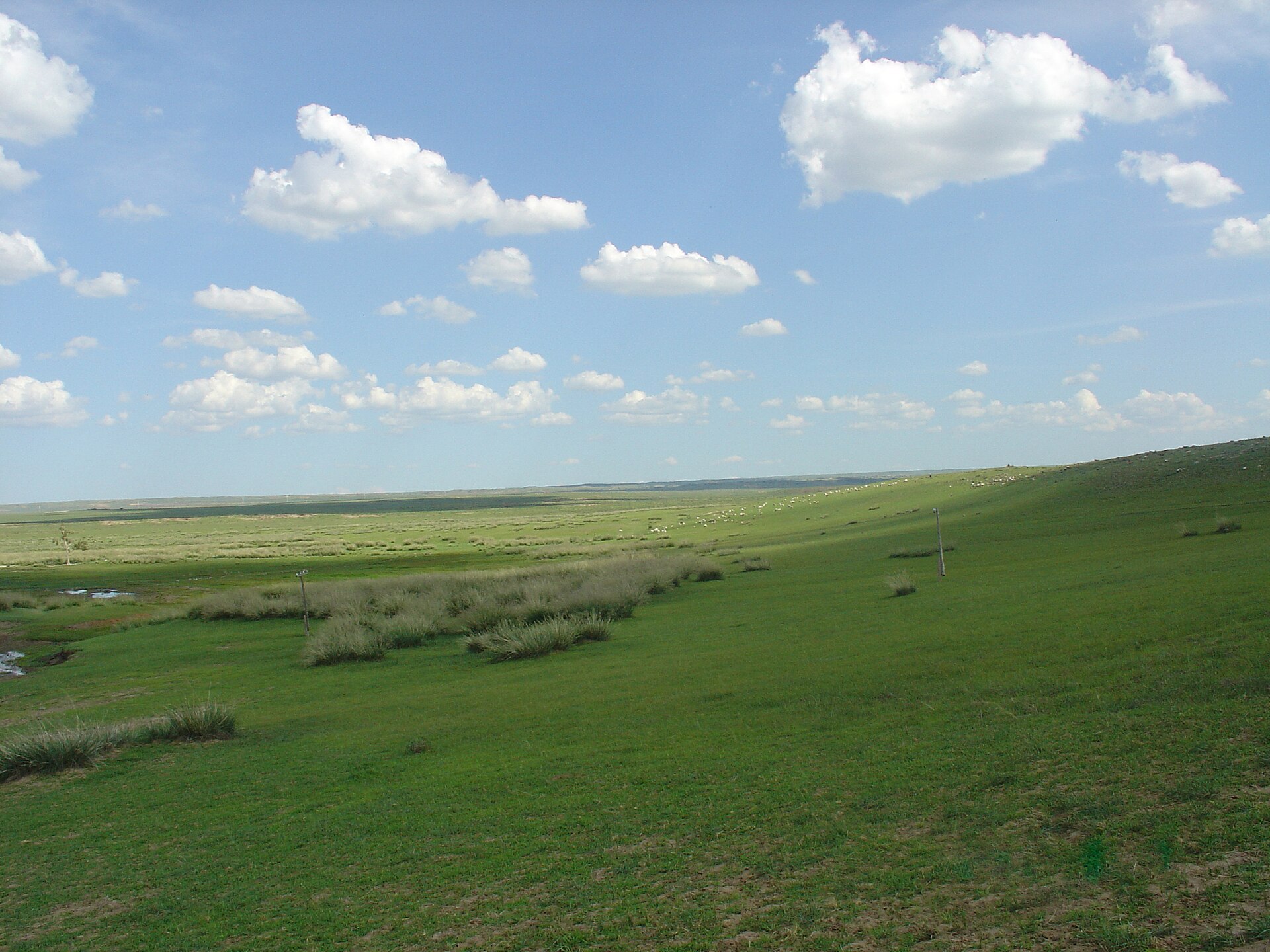
The open steppe — land that reads as empty and is the most precisely known ground they walk. <small>Shizhao, CC BY-SA 3.0, via Wikimedia Commons</small>
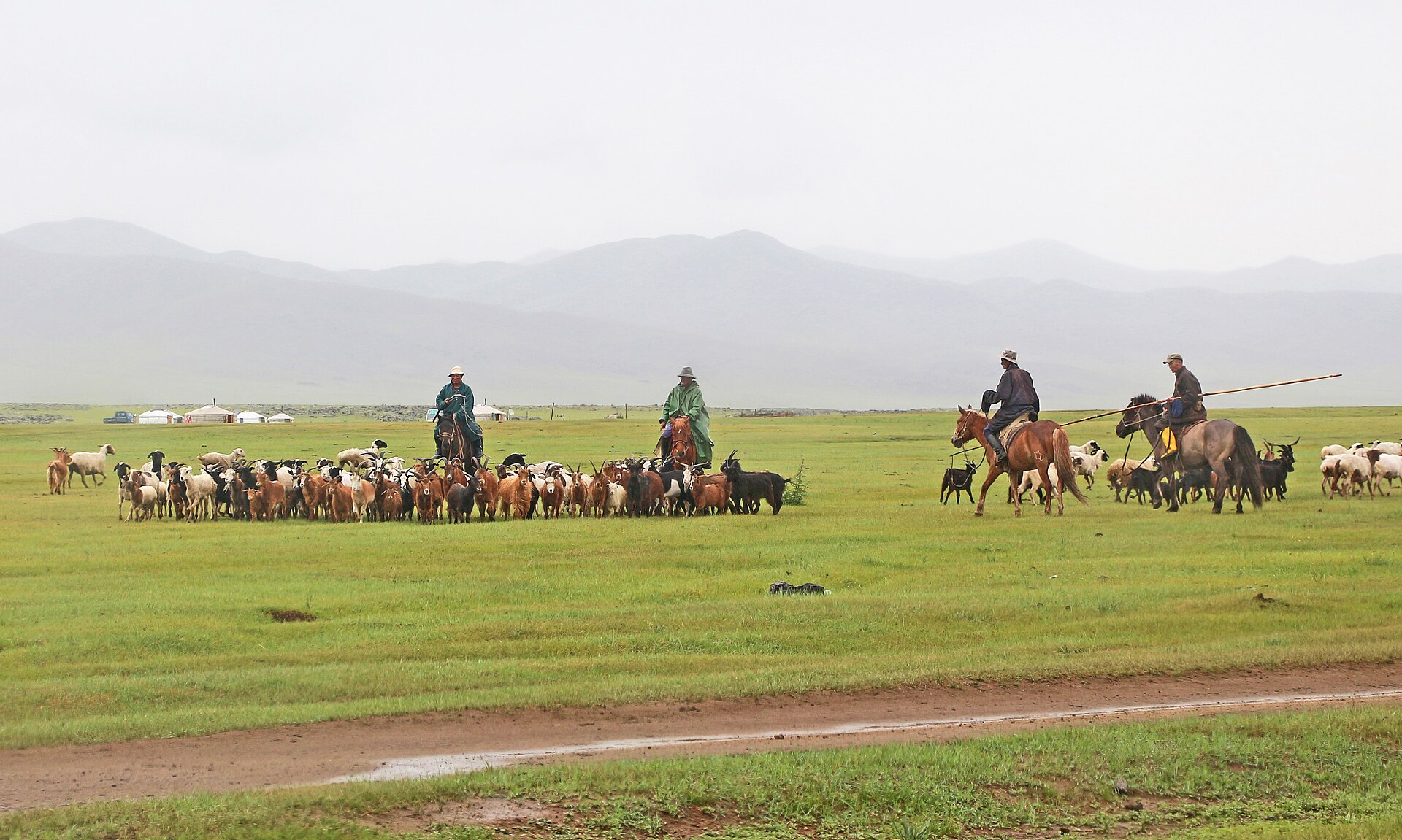
The Orkhon Valley — a thousand years of nomadic pastoral civilisation, UNESCO-listed. <small>Bernard Gagnon, CC0, via Wikimedia Commons</small>
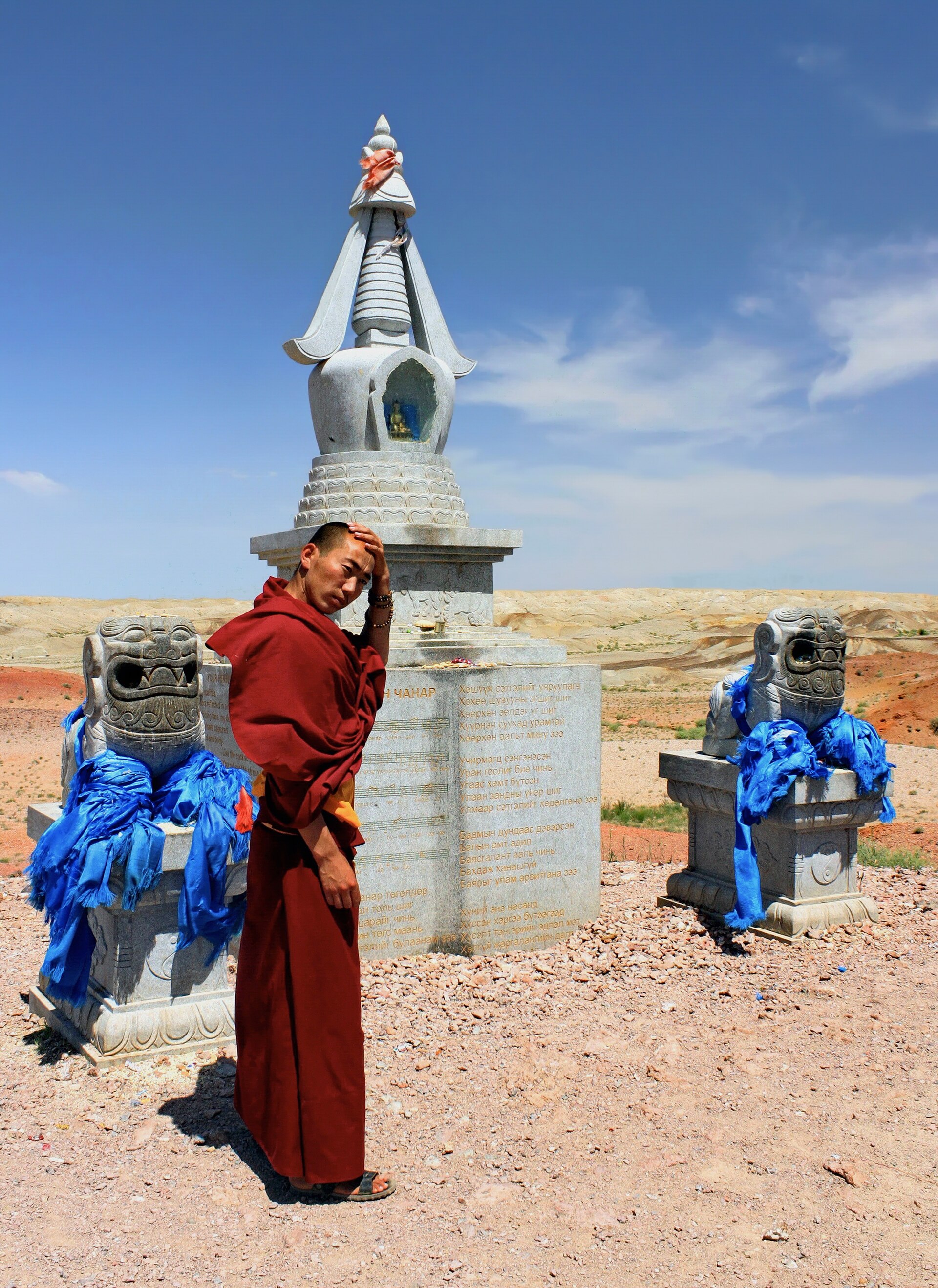
The Gobi — from +45°C to −40°C, the country the herders' judgement crosses. <small>Marcin Konsek, CC BY-SA 4.0, via Wikimedia Commons</small>
Lake Khövsgöl — the northern water of the steppe. <small>Bernard Gagnon, CC0, via Wikimedia Commons</small>
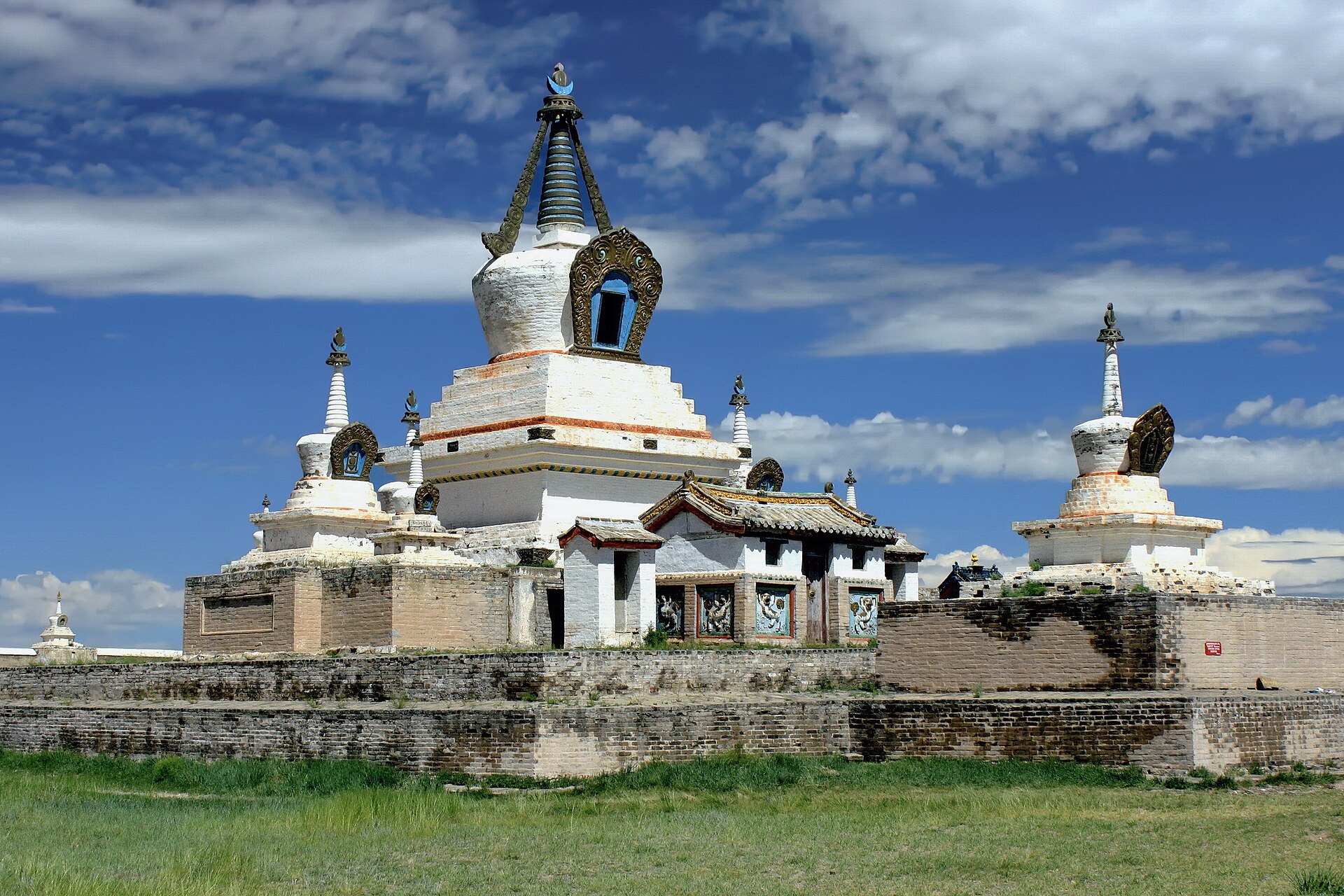
Erdene Zuu at Kharkhorin — the old capital ground, where stone meets felt. <small>Marcin Konsek, CC BY-SA 4.0, via Wikimedia Commons</small>
Things of wonder (made by hand)
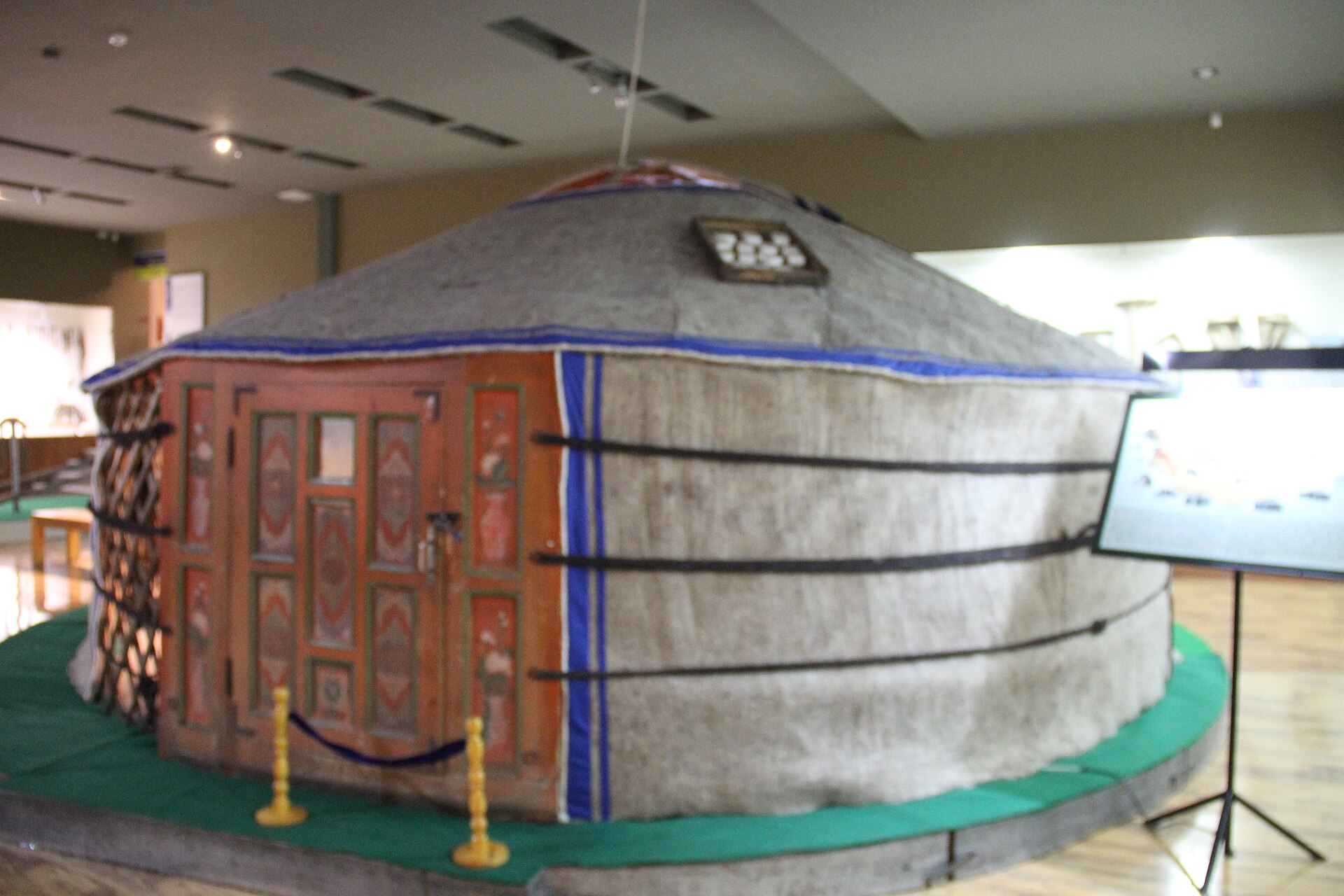
The ger — felt from the herders' own sheep; the sheep are the house, raised in three hours. <small>Gary Todd, CC0, via Wikimedia Commons</small>
The morin khuur (horse-head fiddle) — the steppe's two-string voice at the fire. <small>ClipperDB, CC0, via Wikimedia Commons</small>
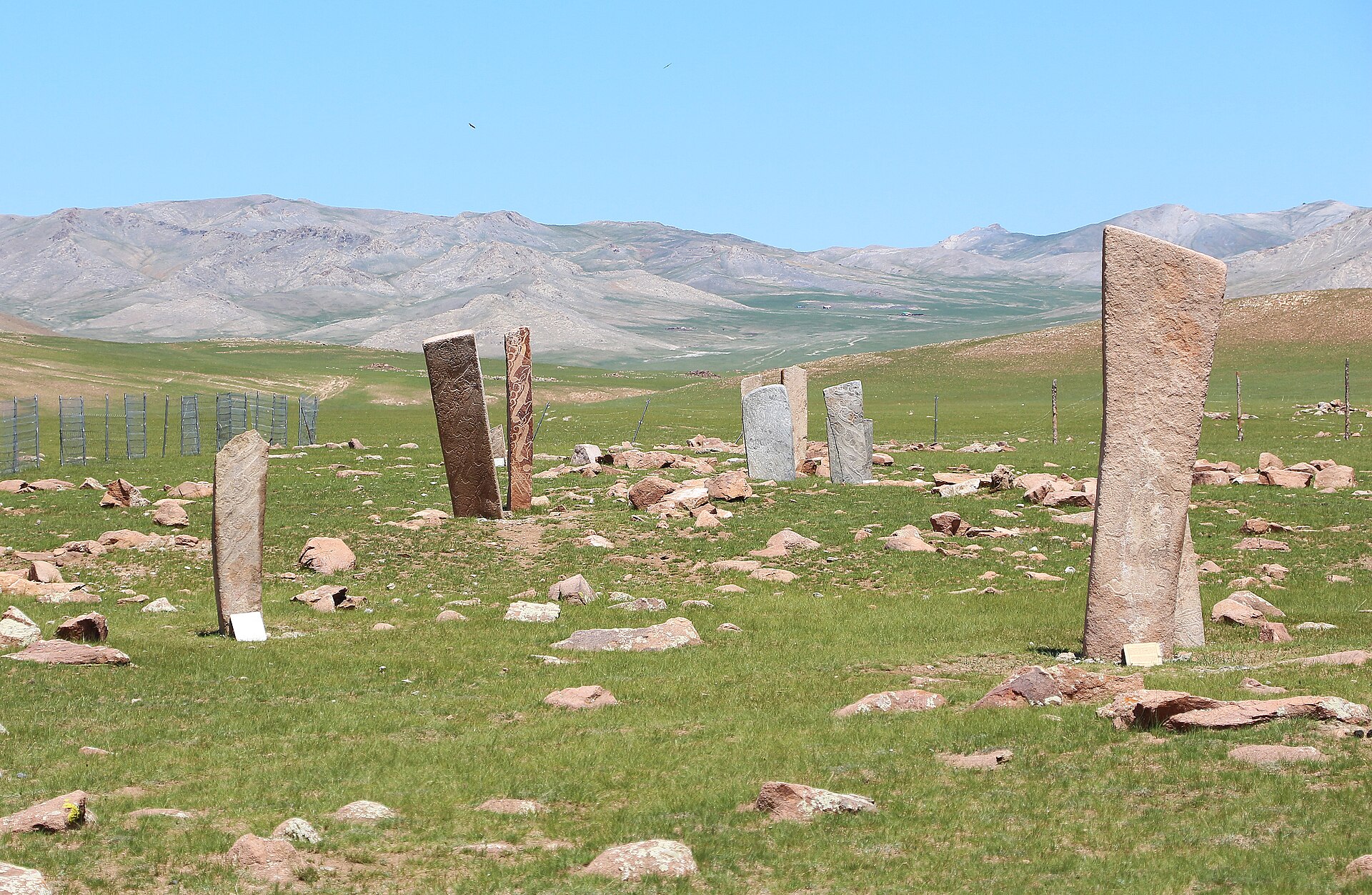
Deer stones — Bronze Age standing stones carved across the steppe. <small>Bernard Gagnon, CC0, via Wikimedia Commons</small>
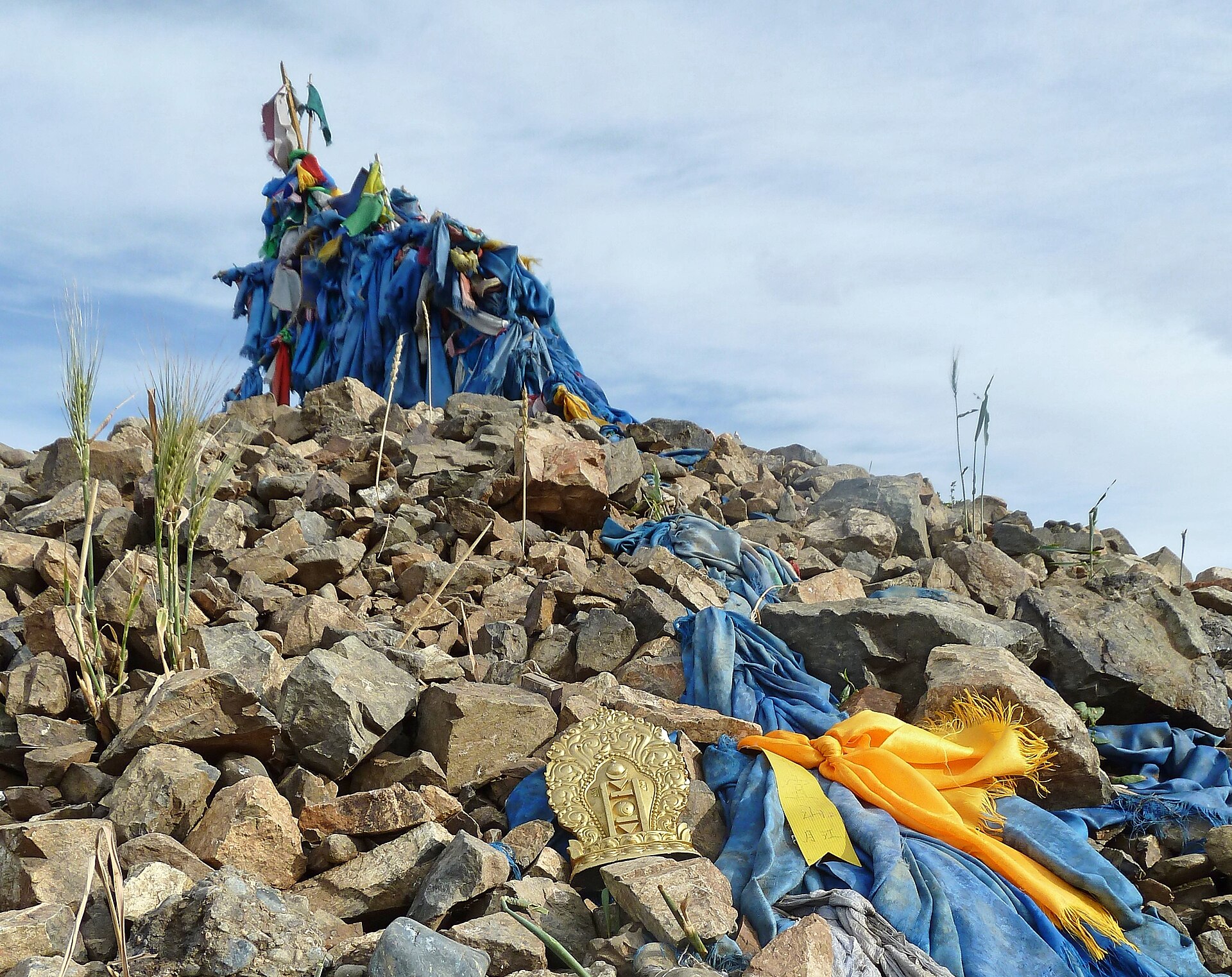
An ovoo cairn — circled three times clockwise; the book shows the threshold and looks away. <small>Pierre André Leclercq, CC BY-SA 4.0, via Wikimedia Commons</small>
Peoples, in their own dress
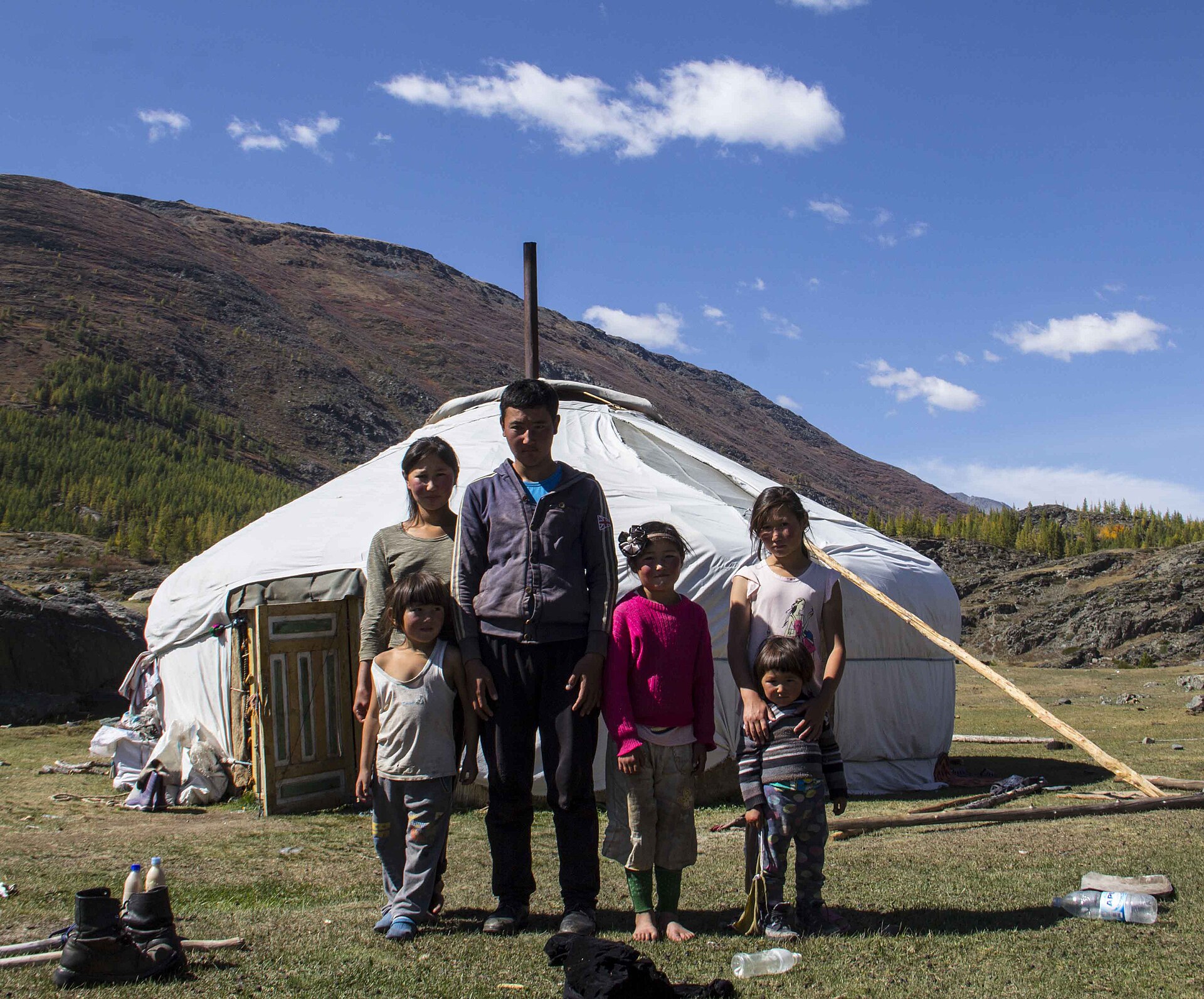
A herder in the deel — the expert fighting to hand the life on, not a vanishing relic. <small>Gabideen, CC BY-SA 4.0, via Wikimedia Commons</small>
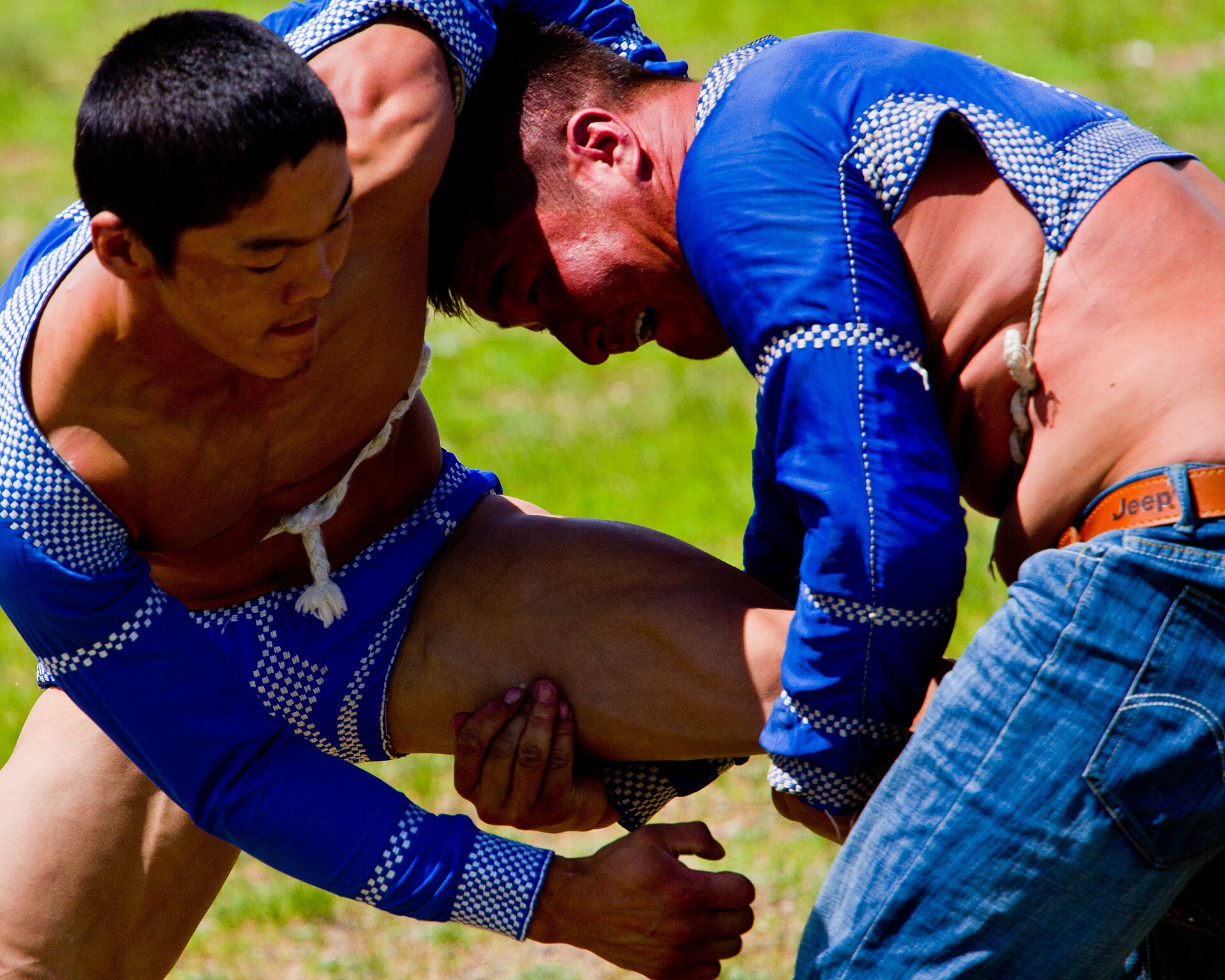
Bökh wrestlers at Naadam — title earned by craft, the Eagle Dance before the bout. <small>Paulo Fassina, CC BY-SA 2.0, via Wikimedia Commons</small>
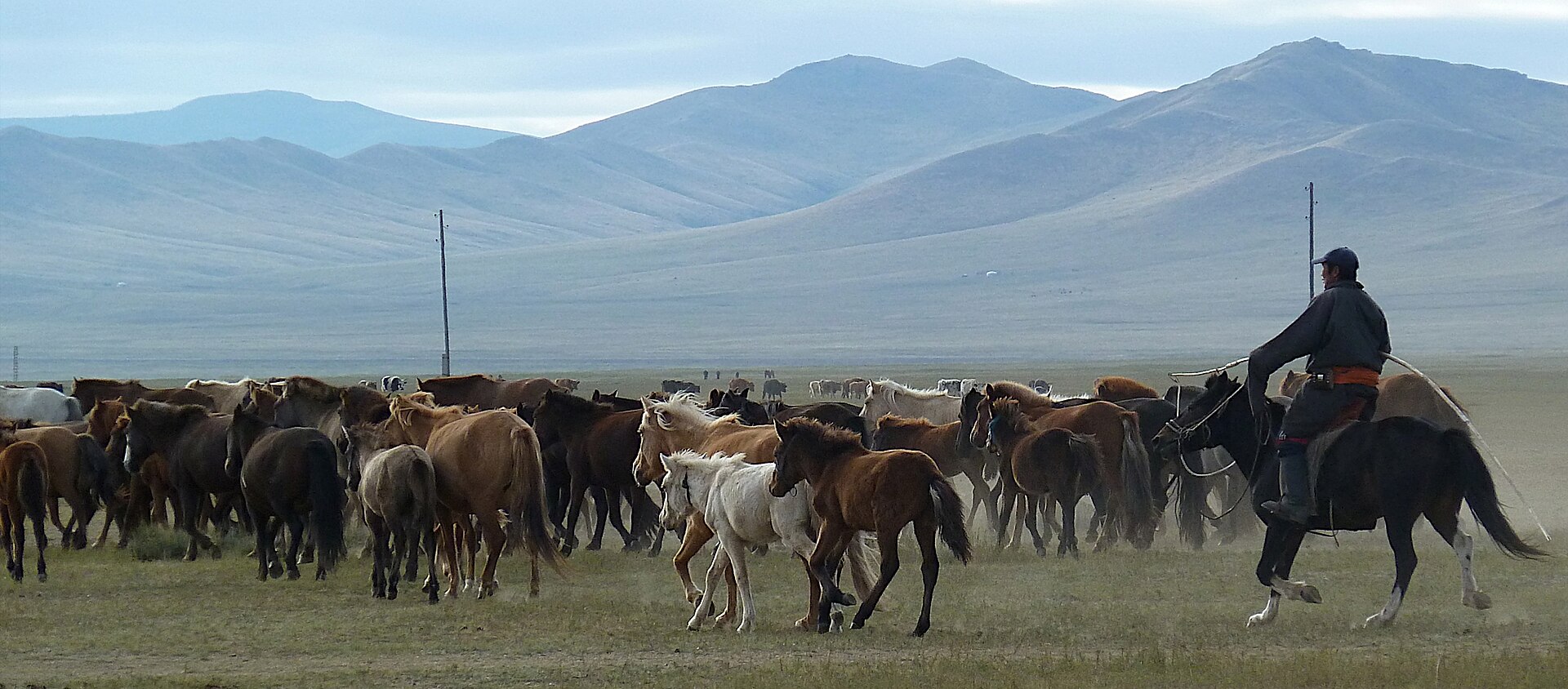
A horseman on the steppe — horses the cultural backbone of the five snouts. <small>Pierre André Leclercq, CC BY 4.0, via Wikimedia Commons</small>
<!-- END image-compendium-appendix -->