Dedication
For the hands left off the map —
the ones who tanned the leather and stretched the skin, who joined the wood and carried the language in a mouth the schoolroom tried to close, whose work holds up the whole beautiful picture and whose names the picture was arranged not to show.
I came, like everyone comes, for the postcard. You were the part I almost didn't think to look at, and the only part that turned out to be true.
\
\
\
And for everyone who has ever been told, by silence, that they were not quite part of we —
the country is not the picture of the country. It never was. You were here the whole time.
Go and look at who isn't in the brochure. Then go and find them, and listen.
Foreword
by Conrad Heildi †
I lived most of my life as a foreigner in Japan, which is the finest vantage point on earth for the one thing this book is about: the difference between a country's account of itself and the truth that account is built to hide. The foreigner sees it because he was never taught not to. He notices the seam the native has been trained, from birth and for kindness, to look politely past.
This book notices the seam. It notices all of them. And it does so with a tact and an affection that I, who spent fifty years learning that tact, did not expect from a writer coming to Japan from the outside and the south.
What he has understood is the thing that took me decades. It is this: that the most beautiful national stories are very often the most recently invented — that "the way of the warrior," the timeless code, the ancient and unchanging spirit, is frequently a thing assembled in living memory, polished to look old, and then sincerely believed by everyone including the polishers. The book takes one such invention and turns it gently over in the light until you can see the join, the maker's mark, the date — and it does this not to debunk, not to sneer, but to perform a far more difficult and loving act: to ask who was left out when the beautiful story was written, and what it cost them to be the part the story paints over.
For that is the real subject, and it is the bravest one a book about Japan can choose. Not the Japan of the brochure — the cherry blossom, the bullet train, the serene and ancient harmony — but the hidden Japan, the people the celebrated story required to be invisible so that it could remain beautiful. The author has gone looking for the painted-over hands, and has found them, and has given them back their faces, and he has done it without a single false note of pity, which is the one note that would have ruined everything. He does not pity these people. He respects them, which is rarer and harder and the only thing they ever actually wanted.
And here is the grace of it: he lets the locals out-see the outsiders. The travellers who come into this story, clever and well-meaning and sure they understand, are gently and repeatedly shown that the person who actually knows is the one they were not looking at — the keeper of the old craft, the bearer of the unfashionable name, the one whom the official Japan would prefer the foreign visitor not to meet. I spent my life learning to be quiet enough to be taught by such people. The author has built a whole book out of that quiet, and it taught me things, at the end of my life, about a country I had presumed to know.
A note on the prose, because it is a particular pleasure. It is restrained in exactly the Japanese way — it trusts the space, the unsaid, the single detail allowed to carry the weight a lesser writer would spread across a paragraph. He has learned the aesthetic he is writing about, and writes in its key, so that the form of the book and its subject rhyme. That is a quiet virtuosity, and I admired it the way one admires a perfectly set stone in a garden: you could almost miss the labour, and missing it is the point.
Go slowly. This is a book that rewards the reader who can sit still, who can attend to the thing the official story hurried past. It is about a way that was invented, and about the people the inventing erased, and it gives them, at last, the one thing that was always owed them and never paid: to be seen.
Begin, and keep your eyes on whoever the story tells you not to watch.
— Conrad Heildi
† “Conrad Heildi” is an anagram of DONALD RICHIE — the great chronicler of hidden Japan — borrowed here in homage and affection. This foreword is a work of fiction. It was written by the author of this book. Donald Richie did not write it, was not involved in it, and is not associated with or endorsing this book in any way. The name is rearranged precisely so that the tribute can never be mistaken for a real attribution; it is a salute, not a claim.
Chapter 0—Clay and Water
In the blue dark before the forge woke, Genzō Aoki painted a blade.
He worked by feel as much as sight, the workshop lit only by the low coals and the grey coming up at the window. The clay he mixed himself—charcoal, stone powder, the ash of his father's recipe, thinned with water until it spread like cold porridge. Thick along the spine. A whisper at the edge. He drew it on with a worn bamboo splint, his hand having drawn it ten thousand times, his grandfather's hand having drawn it before the law of 1876 told men like him to stop making swords and start making knives. They had. A family that wants to eat learns to make the thing people will buy.
Knives, then. For fishermen, for cooks. Honest steel. He still painted them like swords.
He let the clay dry while the fire built. When the steel had eaten enough heat to go the colour he wanted—a deeper thing than red, the colour of the inside of a thought—he lifted it clear and held it one breath in the dark air, and then he laid it into the quench.
The water took it with a sound like the world inhaling.
And the steel curved. It did this itself. The thin bare edge drank the cold faster than the clay-wrapped spine; the two halves of the metal cooled at two speeds and pulled against each other and the blade bent away from its own edge, rose into the long shape that every postcard of this country has tried and failed to hold. There was no mysticism in it. There was clay and water and a man who knew where to put them.
Genzō lifted the blade and looked at the line the clay had drawn: the hamon, the border between hard and soft, the place where the metal had decided what it would be. Hard enough to cut. Soft enough not to shatter. Danger held in something that would not break.
He set it on the rack to temper and went to make tea, an old man alone with a curve he had not made so much as permitted.
At noon, eleven kilometres east, the light was flat and ordinary and a stone the size of a small house appeared to float on water.
It sat in its rock-cut pit at the shrine in Takasago, a worked block of welded tuff—not granite, the guides who say granite are wrong—some five hundred tons of it, its underside seeming to rest on nothing but a thin sheet of standing water, so that the whole mass looked poised to lift off and drift away over the hills. People had been coming to argue about it for a thousand years. A laser survey in 2005 had mapped every plane of it and confirmed the trick: a central pedestal, hidden, a stone foot in the dark beneath the basin, the float a thing engineered by hands that knew exactly what they were doing. The survey solved how. Why it was built nobody knows—honestly, stubbornly unsolved, and the not-knowing is better than any answer a brochure could sell you.
Tourists photographed the float. They photographed the swordsmith's town. They bought small bottles of sake shaped like the blade.
What no one photographed, because no one had thought to look, was the seam that ran under all of it. The leather that wrapped the warrior's armour at the wrist and the lacing-holes. The skin stretched and tuned across the drum that called that same warrior to the field. Both of them tanned, scraped, worked to suppleness by hands this country has spent four hundred years arranging not to name—hands kept off the maps, hands left out of the song. The blade gets the museum. The float gets the survey. The hands get nothing.
Out beyond the hills a borrowed black car came down the coast road, silent as the stone, carrying people who did not yet know any of this.
They were about to be sold a film.
Chapter 1—The Easiest Shoot on the Slate
The room cost more per hour than Yael's first car had cost outright, and it was doing nothing with the money except keeping out noise.
She noticed it the way she noticed everything in a room she hadn't paid for: the carpet thick enough to eat a dropped pen, the glass that held the city at arm's length so the trains running below the fortieth floor made no sound at all, the water poured for them already sweating in tall glasses on a tray that someone had set down and left. A room arranged so that you would never want to leave it, and would feel, faintly, like the kind of person who belonged in rooms like this. Yael knew the build. She had run that build. You made the client comfortable and then you made comfort feel like agreement.
Daniel Reyes stood at the head of the table with no slides up yet, just himself, in a soft grey jacket and good shoes and the open face of a man who genuinely loved his job. That was the first thing she clocked and the thing that made her wary. He wasn't selling them. He was happy to see them, and that was more dangerous.
"I want to start," Reyes said, "with how I felt the first time I came here."
Across the table Naila had not touched her water. She had a stack of paper in front of her—actual paper, a printed brief and behind it a fat clipped block of photocopied history that the production office had couriered to the hotel last night, because Naila did not read PDFs in meetings, she read paper, and she had asked for the paper in a single email and the production office had sent four hundred pages without question, because they had money and because nobody says no to the woman the visiting director has flown business class. She had her hands flat on the top sheet. She was very still. Yael had worked with her long enough to read the stillness: it was a gauge taking a reading, nothing to do with mood.
"I'd been everywhere," Reyes said. "I'd shot Patagonia, I'd shot the Sahara, I'd done the whole—beautiful-planet, swelling-strings thing, and I was good at it and I was bored of it, honestly, and a friend said, just go to Japan, don't research it, just go. So I went. And I'm in this little town and it's six in the morning and there's mist in the rice and a man comes out of a wooden building and starts a fire."
He let it sit. He was good. The fire hung there in the over-conditioned air.
"A swordsmith," he said. "Genzō Aoki. Eighty-one years old. His family has been forging in that valley since before your country existed, no offence." A small laugh, given to the room, taken warmly. "He folds the steel. He prays to it—there's a rope, a sacred rope, over the forge. And he made one cut, one, and the morning was completely silent, and I stood there and I thought: this is the thing I've been looking for my whole career. This is the soul that the modern world has thrown away and these people kept it. They just—kept it."
"What's the film called," Naila said.
In her mouth it wasn't rude. It was a question for which she required the answer before she could proceed.
"Soul of the Samurai," Reyes said. "Working subtitle, Timeless Japan. Brand's calling it KOKORO. That's heart, soul, spirit—there's no clean English word, which is sort of the point." He smiled. "Eight episodes. Premieres globally. We have a number on the table for the families and the artisans that is, frankly, life-changing for some of them, and the streamer wants this to be the flagship of the year. The most beautiful thing on the platform. The thing your aunt watches and cries."
Now the slides came. He'd waited, which was discipline.
A blade catching dawn. Cherry blossom against a temple eave, the petals deliberately soft. An old man's hands, knuckles enormous, lifting a glowing bar. A woman in a kimono pouring tea with both hands, her eyes down. A wide shot of mountains with cloud in the folds, and over it, in a typeface that had cost real money to look this unpurchased, the word KOKORO.
It was gorgeous. That was the trouble. Yael felt the gorgeousness land in her chest the way it was supposed to, the small cathedral hush of it, and she let it land because pretending you were immune was how you got beaten. It worked on her. It would work on everyone. It would make a great deal of money and several old craftsmen would get roofs fixed and grandchildren through school, and that was not nothing, and Reyes believed every word, and that was the worst part of all.
"The thread," Reyes was saying, "is the warrior. The samurai. Discipline, honour, loyalty, the readiness to die, the—restraint. Power held back. The whole code. Bushido. And what I love, what I want to show the world, is that it's not history here. It's not in a museum. It's in how a man makes a knife at dawn. It's in how everyone bows. It's in—there's a word they use, we Japanese, like one breath, this incredible unbroken thing, four thousand years of it, and we get to film the living end of the line."
"Forty-five," Naila said.
Reyes paused, pleasant. "Sorry?"
"You said four thousand years. Bushidō: The Soul of Japan. Inazo Nitobe. Published nineteen hundred. In English. In Philadelphia." She had not looked at the paper. She was reciting from the inside. "He wrote it for Americans. He'd married a Quaker, he was answering a foreign question—a Belgian asked him how Japanese children learn morality without religious instruction in school, and Nitobe couldn't answer, and he was embarrassed, and he went away and built an answer. He built it out of European chivalry because that's the shape his readers already had in their heads. Honour, the knightly virtues. He hung Japanese examples on a Western frame and sold it back as ancient. It's a hundred and twenty-five years old. It's younger than the bicycle."
The room had gone careful. Sandi, down the table, had stopped twirling his pen. Mira was reading the lot of them—she'd put herself where she could see all the faces and Reyes's mouth, and her eyes moved between them fast. Every silence in the room had a texture to her, and there were several now.
"That's—" Reyes recovered, generous, "that's a fascinating bit of scholarship, and honestly it doesn't hurt us. The origin of the word isn't the point. The feeling is real. You feel it the moment you're there."
"Most samurai were clerks," Naila said. "By the Edo period there were no wars to fight, so they did paperwork. Stipends, ledgers, irrigation disputes. Two and a half centuries of peace and a warrior caste with nothing to be warriors at. They were a bureaucracy that wore two swords to the office. There were poor ones and rich ones and drunk ones and corrupt ones and kind ones, the same as any caste of two million people across two hundred and fifty years, because there is no version of two million people that is one thing." She turned the top sheet over, flat, precise. "The word you used. We Japanese. Like one breath. Homogeneous."
"Right. The—the cultural unity, which is real, which is—"
"Homogeneous is a verb here," Naila said.
Reyes blinked.
"You're using it like a description," she said. "It isn't one. It's something people did. Are doing. You make a thing homogeneous. You have to. You start with people who aren't, and you do the work of leaving some of them out of the picture until the picture looks like one breath. That's not a state. It's an activity. It takes effort and it takes a map and it takes deciding whose name doesn't go on it. You said we Japanese and what I heard was a sentence with the labour edited out of it." She squared the stack with both palms. "I can't read four hundred pages and hear that word the way you mean it. I'm sorry. I'm not being difficult. I genuinely can't get there from here."
Yael watched Reyes decide not to be hurt, and mostly manage it. He was a decent man. That was going to be the whole problem, all the way down.
"Okay," he said, slow, warm, regrouping. "Okay. I hear you. And look—that's why you're here. That's exactly why I wanted these eyes on it and not some prestige doc shop that'll just shoot the brochure. I want texture. I want it to breathe." He spread his hands. "But I'm not making a corrective. I'm not making the eight hours where we explain to people that the thing they love is a colonial construction. Nobody watches that. Nobody fixes a roof off that. I'm making the beautiful one. The best version of the beautiful one. The one your aunt cries at."
"I sold this," Yael said.
She hadn't planned to say it. It came out of her in the flat tired register she kept for the truth, and the table turned.
"I'm sorry?" Reyes said.
"Not this. This shape." She turned her glass a quarter turn on the tray, watched the ring it left. "Years ago. Different country, different beautiful thing. I sold the timeless people who kept the soul the rest of us threw away. I sold the silent dignified craftsman and the woman pouring tea with her eyes down. I sold they just kept it. I was extremely good at it and I made a lot of money and the build is exactly the one you've got up on that screen, Daniel, exactly, down to the typeface that's trying not to look like a typeface." She looked up. "It's a good build. It's clean. I'm not insulting it. I'm telling you I recognise it from the inside, the way you recognise your own handwriting on something you don't remember writing."
"And what's wrong with it?"
"Nothing's wrong with it. That's what's wrong with it." She let that land. "It works. It always works. It works because it makes a hard thing into a simple thing, and people are tired, and a simple thing is a kindness, right up until you notice it's simple because somebody got left out to make room. There's always a somebody. There's a somebody in your build right now and neither of us can see them yet, and that's not a flaw in your character, it's a feature of the build. The build is for not seeing them."
Reyes was quiet. The city sat soundless behind the glass.
"You think I'm leaving someone out," he said.
"I think every frame you showed me is honest and every frame you showed me is half a frame," Yael said. "I think you stood in that valley at six in the morning and felt something completely real. And I think the man at the forge has a rope over it because a swordsmith works with fire and steel and a thousand things that can kill him, and the rope is real, and the prayer is real, and somewhere out behind that town, off the map you were handed, there are hands that made the warrior's gear that no version of we Japanese has ever once said thank you to, and you can't put them in the film because they're the part the build is built to hide." She shrugged, and her voice came down soft. "I don't know who they are yet. I just know the shape leaves a hole, because I used to cut the hole myself."
For a moment Reyes looked younger. Like a man who has been told a thing he half knew and was hoping to get all the way through the meeting without hearing.
Then the professional came back over his face, easy and kind. "This," he said, "is exactly the conversation I wanted to have. This is gold. I want all of this energy in it." He gathered them up with a look, brought the warmth back into the room like turning a dimmer. "Let me show you the slate. Aoki the smith. A tattoo master, traditional, hand-poked, the real thing. A drum ensemble in Kansai that'll knock you flat. A guide up in Hokkaidō, Ainu woman, she used to do the heritage parks and walked away from them, which is a story. We've got access nobody's had. We've got the budget. And we've got"—he smiled at Naila, including her, forgiving her, which she would not register as forgiveness—"people who'll fight me. I'd rather fight on the way to beautiful than coast there. Genuinely."
He believed it. He'd fight all the way and lose, and not because he was a villain. He'd lose because the thing he wanted to make was a film that spoke for a people, and a people cannot be spoken for. But that was later. That was the whole reason for the next several weeks. Right now it was a pitch, and the pitch was good, and the water sweated on the tray, and Naila turned to the second page of four hundred and began, silently, to read.
Down on the street, an hour later, the courtesy was waiting.
The fixer's name was on a card, and the man holding the keys had bowed and produced them on a small lacquered tray, and Jakobus stood at the kerb in front of a Lexus LX so white it looked switched off. Yael had come down to sign the money things and stayed for this because it was funny and she needed funny.
It was enormous and it was silent. Cruiser bones under all of it—you could see the truck inside the limousine if you'd ever spent a night in the back of the real thing on a bad road, which Jakobus had, a hundred times, in a vehicle he'd built himself out of favours and welds and other people's wrecked dreams, a thing that announced itself from a kilometre off and that he loved the way you love a dog that bites. This was that animal's housebroken cousin. Climate seats. A engine you had to be told was running. Wood on the dash that had never seen weather.
The host's man was explaining things in careful English—the navigation, the toll transponder, a number to call at any hour. There was a clipboard. There is always, in the end, a clipboard. Jakobus took the pen and signed where the man indicated, his name in his own ugly capable hand, and the man bowed again and pressed the keys into his palm and stepped back, and there it was: Jakobus standing on a Tokyo pavement holding the keys to eighty thousand dollars of someone else's car, and his hands, when he looked at them, were empty.
Yael watched him notice it. She didn't say anything. You didn't, with him.
He'd come into the country armed the way other men come in with a watch, the knives part of his hands, the truck back home part of his feet, and a courteous man at the airport had already explained, with a regret that was completely sincere, that the country he revered above all others for its blades was the country where his blades would have to go in a box. So he had no knife on him and no truck under him and now a car he hadn't built and couldn't hear, handed across like a glass of water.
He turned the keys over once. The silence of the thing seemed to bother him more than the size. He opened the driver's door and it sighed.
"You good?" Yael said.
He looked at the empty white plain of the bonnet, and at the city that made no sound, and at his hands.
"Quietest thing I've ever been trusted with," he said.
Then he got in and pulled the door and it closed itself the last centimetre with a soft hydraulic apology, and the truck that was not allowed to be a truck sat there at the kerb, holding all its weight, going nowhere, making no noise at all.
Upstairs, Naila was still reading, four hundred pages of a country a film was about to make into one breath, turning each sheet face-down with the same flat care, building in her head the map of who the breath would have to leave out. Reyes was already gone to dinner with the streamer, happy, certain, kind, doomed in the gentle way of a man rowing hard toward a shore that is painted on a wall. Sandi was teaching the fixer's assistant a Zulu word for the fun of the trade of it. Mira had walked to the glass and was watching the soundless trains thread the city, and in the held silence of the place she had begun to hear something she would not name out loud yet.
And somewhere a day's drive south and west, in a valley with mist in the rice, an old man had set a knife to temper at dawn and gone to make tea, alone, the rope over his cold forge, knowing none of them.
They were coming to him with cameras and a number that could fix a roof.
First, in the morning, they would have to put the knives in a box.
Chapter 2—The Customs Drawer
The room they sent them to was the most courteous space Mira had ever been asked to wait in.
It was a side office of the prefectural police annexe, off a corridor that smelled faintly of green tea and floor wax, and somebody had set out four chairs and a low table and a thermos and, on the table, a tray of small wrapped sweets the colour of cherry blossom, untouched, perfect, set there before they had even decided what they wanted. Through the window the city went up in pale verticals, glass and concrete drawn fine as a technical pen, and below it a road moved without making the road-sound Mira would have felt anywhere else through her feet. All of it smoothed, all of it managed, all of it pleased to have them.
Jakobus stood with his back to the window because he did not like to sit when a thing had not yet happened. He had his canvas roll out flat on the table, untied, the leather of it gone dark at the fold-creases from twenty years of his hands. Mira could not hear the room but she could read it perfectly, and the room was full of small soft sounds she did not need: the bow of the young officer at the door, the apology in the set of his shoulders before he had said a word, the clipboard held against his chest like a thing he was sorry to be holding.
There were two of them. The young one and an older man behind him with grey at the temples and reading glasses pushed up into his hair, a sergeant or whatever the rank was here, who came in and bowed to all four of them and said something Mira watched land on Sandi's face and bloom there into careful attention.
Sandi answered in Japanese. Slow, a beginner's Japanese, but the shape of it was right and the bow was right and the older officer's whole manner changed by a degree, warmed, became the warmth of a man dealing now with someone who had bothered. Sandi turned to the rest of them.
"He's apologising," Sandi said, and his hands moved as he said it so Mira had it twice, his rough good signing and his mouth both. "He wants us to understand the inconvenience is regrettable and the law is the law. That's roughly the order he put it in. The regret first."
"What law," said Naila.
Mira watched Sandi ask, watched the answer come, watched the young officer step forward with the clipboard and lay a laminated card on the table beside the canvas roll, turned the right way up for them to read, English on one side, the kind of card a place prints when it has had to explain this many times to many people and has decided to be gentle about it.
Naila read it standing, both hands flat on the table. She read like she read everything, the whole thing at once and then again from the top, and Mira saw her jaw do the small involuntary thing it did when a system arranged itself for her and clicked into a shape she could hold.
"Right," Naila said. "It's not the carrying. It's the blade length and the lock and the justifiable reason." She tapped the card. "Anything over six centimetres without a documented occupational reason is an offence. Anything that locks open, basically, regardless of length, is its own offence. You can be a chef. You can be a fisherman with a thing in a box in your tackle. You cannot be a man with a knife on his belt walking around their city because you like having a knife on your belt."
"I have reasons," Jakobus said.
Mira read it off him plainly. He was not arguing. He had said it the way you say a true thing into a room that has politely informed you the true thing does not count here.
Sandi relayed it anyway, because that was the courtesy of the room, and Mira watched the older officer hear reasons and nod, genuinely, sympathetically, and then explain—Sandi turning it over for them as it came—that the difficulty was precisely that the law did not weigh a man's reasons. It weighed the blade. The blade did not know it was on a good man. So the law had to assume nothing about the man and decide everything about the blade.
"That's the cleanest thing anyone's said to us since we landed," Naila said, to nobody, and there was something close to admiration in it.
The young officer unrolled the rest of the canvas, not roughly, with two hands, the way you'd unroll someone's letters. There were four knives in the roll and a steel and a small stone. Mira knew them the way you know the contents of a friend's pockets without ever having looked. The fixed Okapi he'd carried so long the bone scales had worn to the shape of his grip. The skinning knife with the antler handle a man in the Karoo had made him. A folder with a thumb-stud, black, ugly, the one that did most of the actual work of being alive. And the long one, the camp knife, the one he used for everything from splitting kindling to opening a parcel to, once, in a place Mira had been standing right next to him, holding a frightened dog still long enough to cut a snare off its leg.
The young officer laid a form beside each. He wrote in two scripts. He measured each blade with a small steel rule and wrote the number. He noted the lock on the folder and circled something. He did all of it the way a man performs a sacrament he does not personally believe damns anyone but performs without a single cut corner, because the performing is the respect.
Jakobus watched him do it.
This was the part Mira had come into the room to see, though she could not have said so. She had walked over from the meeting tower while the others were still in the lift, had told the fixer's assistant she'd ride down with the bodyguard man, and the assistant had laughed because everyone laughed at the idea of Jakobus needing escorting anywhere. But Mira had wanted to be in this room. She had felt the shape of this morning coming the way she felt weather, in the joints of things, and she had not been wrong.
She watched his face do the arithmetic.
It was small. He was not a man who let a thing show, and to anyone in the room who used their ears for the load-bearing work it would have shown not at all—he stood easy, hands loose, face still, a big calm patient man being processed by a polite young clerk. But Mira did not have ears in the way. Mira had spent forty years reading the part of a face that thinks it is not being read, and on Jakobus's face the arithmetic went like this:
A flicker as the rule touched the Okapi—that one, that one too? Then the still settling-in of yes, that one too. A longer pause on the folder, because the folder was the one that did the work, and his eyes went to it and stayed half a second past calm, and Mira understood she was watching a man learn that the most useful object he owned was, here, the most illegal—that the lock that made it safe to use made it forbidden to have. A man who had built a life around the principle that you carry what you might need, meeting a place that had decided, with great courtesy, that what he might need was the problem.
And then—the thing she would not tell the others, the thing that was his and not theirs—his eyes went to the long camp knife and stayed there longest of all, and whatever the arithmetic was on that one had a name in it, a memory in it, the dog or the parcel or the splitting of a thing on a cold morning that meant fire, and then he let it go. She watched him let it go. It cost him the width of a breath and he paid it and his face closed back over flat and even, and he said, to the young officer, in English, slow and kind so the kindness could be read even without the words landing:
"You're doing it right. Don't worry about me."
The young officer did not understand the words. But he understood the tone, the way Mira understood the room, and he bowed, lower this time, and something passed between the big disarmed man and the young man disarming him that needed no language at all and was, Mira thought, the truest exchange that had happened in this country since their wheels touched the runway.
Sandi started to translate the kindness and Mira touched his wrist. He knows, she signed. Leave it. Sandi left it.
They put the knives in a drawer.
That was the part the others would talk about afterward, in the car, on the plane, for the rest of the trip—they put his knives in a drawer. But it was not a drawer the way that sounded. The young officer brought a tray of clear sealable bags and bagged each knife separately and wrote a number on each bag and entered each number into a ledger and a screen, and then he laid the bags in a long shallow steel drawer with a felt liner, and the felt liner was clean, and the drawer slid on a runner that did not catch, and he gave Jakobus a printed receipt with a barcode and a date and the address of the office where the knives would be held, available for collection on departure, on production of passport and this receipt, with hours of business listed, with a phone number, with a small apology printed at the bottom in two languages thanking him for his understanding.
Jakobus folded the receipt into his shirt pocket. Mira saw him pat it flat. The most carefully receipted disarmament in the history of the world.
"This is a country that loves a blade more than anywhere on earth," Naila said, quietly, watching the drawer close. "There's a man a day's drive south of here we flew across the world to film because he makes the most beautiful blades a human being can make, and they'll put his sword in a museum and bow to it. And they just took four working knives off the most careful man I know and locked them in a felt drawer and apologised for it the whole time."
"Both true," Sandi said.
"Both true," Naila agreed. "That's the thing. That's the actual thing." She had the look she got when a system she'd suspected of being a system turned out to be one. "It's not hypocrisy. Hypocrisy is when the rule and the feeling fight. This isn't fighting. The blade is sacred and the blade is illegal, and the same people built both, on purpose, and they're not even slightly embarrassed. The sword in the shrine is the soul of the nation and the knife on the belt is a crime, and the difference is—" she stopped, and Mira watched her find it—"the difference is who decides. The sword is decided. The shrine decided it. The museum decided it. Your knife decided itself, on your belt, and they can't have that. They can't have an undecided blade walking around."
Jakobus listened to this the way he listened to most things Naila said, which was completely and without comment, a man who had learned long ago that her sentences were buildings and you waited until they had a roof before you walked into them.
"I'll get them back when we leave," he said.
"You'll get them back when you leave," Naila said. "It's a good system. I hate that it's a good system."
The young officer bowed them out. The older one walked them to the lift and said something to Sandi that Sandi grinned at, and Mira asked with her face what, and Sandi said:
"He says if Jakobus needs a knife for the kitchen on the trip he should buy one in a proper shop with a receipt and keep the receipt, and then it's legal, because then there's a reason and a paper. He says it like a man giving us the cheat code. Buy it here, with paper. Then it's allowed."
"There it is again," Naila said. "The paper decides. Not the need. The paper."
In the lift Mira watched the four of them and the one of them and felt the morning settle into them at four different speeds. Sandi was delighted—Sandi was always delighted, a country was a box of new sounds to him, and a place that locked your knives in felt and gave you a receipt was a place with a deep grammar he wanted to learn. Naila had it already, had had it on the laminated card, was three moves ahead and using it to test the whole shape of the country she'd read four hundred pages of in a hotel chair. Yael wasn't with them; Yael was already in the car downstairs, on the phone, doing the thing Yael did, but Mira knew exactly what Yael would say when she heard, because Yael had spent a career selling the postcard and would recognise the seam in it before any of them. They show you what they want you to see, Yael would say, and she'd say it like a professional admiring another professional's clean work.
And Jakobus stood in the corner of the lift with his hand resting flat on the empty place on his belt where the folder had ridden for nine years, not gripping it, not worrying it, just resting the hand there the way you rest a hand on a horse to tell it you're still there, and Mira understood that the empty belt was going to be the truest thing he carried in this country and that he was not going to mention it once.
She thought about saying something to him. She had the words. She could have signed you alright and he would have signed back the rough yes he'd learned from her over the years, the only deaf-talk he had, a yes that meant nothing about how he was and everything about not wanting her to ask. She decided against it. There was a kind of looking-after that was the opposite of asking, and she knew which kind he could stand, and she gave him that one instead: she stood where he could see her not watching him, and she let him have the empty belt private, and when the lift opened she went out first so he could come last, the way a man comes last out of a door he hasn't checked yet.
The car was waiting. The borrowed one, the great silver thing the fixer's people had insisted on, soft as a held breath, a vehicle that had clearly been a serious working truck somewhere down in its bones and had been hushed and panelled and perfumed into a sort of luxury silence. Mira could see it actively unsettled Jakobus, who trusted a machine the way he trusted a man, by how loud it was about what it was. He opened the rear door for the others and then stood holding it, the empty belt and the silent truck, the most disarmed Mira had ever seen him in eleven countries, and entirely, perfectly fine, in the way of a man who has decided to be fine and will be, and the deciding is the whole of it.
Yael got off the phone as Naila slid in.
"They took his knives," Naila said.
"Of course they did," Yael said, not even looking up, sliding her thumb across the screen. "Six centimetres, no lock, occupational reason. I had it in the briefing pack. I should've said. Sorry, Jakobus."
"It's fine," Jakobus said, from outside, still holding the door.
"It's a good rule," Yael said. "I mean it. Lowest knife crime in the developed world and that rule's a big reason why. It works." She looked up at last, and looked at the city through the tinted glass, the clean impossible orderly beautiful city, and Mira watched her professional face do the thing Mira had been waiting for someone to do all morning. "You know what the actual lesson is, though. It's not the knives." She gestured at the window, the whole pale managed miracle of it. "It's that all of this—the sweets they set out before we asked, the bow, the receipt with the apology printed on it, the felt in the drawer—all of it is exactly what they want us to see. Every single piece of it is real. And it's also a wall. They show you the most beautiful true thing, perfectly, so completely, so you don't go looking for the thing behind it."
"Omotenashi," Sandi said. "The hospitality. It's real. And there's a word for the face you show and a word for what's under it, and they're not the same word, and everyone knows it, and that's not a secret here, that's the whole functioning grammar of the place."
"Reyes thinks he's going to film the face," Naila said. "He thinks the face is the soul. He's going to make the most beautiful film anyone's ever seen of the face."
"He's going to make a postcard," Yael said. "A perfect one. And every frame of it'll be true."
Mira sat at the window. Below, the soundless road moved its silent cars. Somewhere south and west of all this glass an old man had a knife on a forge that this same country would put in a shrine, and somewhere north a woman they hadn't met yet was, right now, refusing to do something, Mira didn't know what, but she could feel the refusal coming the way she'd felt this morning coming, a weather in the joints of things.
Jakobus got in last and pulled the door and it closed itself the final centimetre with its soft hydraulic apology, and the truck that was not allowed to be a truck moved off without a sound, carrying a man who was not allowed to be himself, into a country that had just shown them, with the most exquisite courtesy on earth, exactly and only what it wanted them to see.
Mira looked at his hand. It was resting on the empty belt again. She looked away and let him have it.
In the morning they were flying north.
Chapter 3—She Will Not Give You the Postcard
She'd told them eleven. They came at half past nine.
Rera saw the van first, then the second car, then the man getting out of the second car who was clearly the wrong shape for a van, all elbows and apology as he unfolded. The light was wrong already. The light at half past nine in October in this part of Hokkaidō was thin and flat and white, a fluorescent-tube light, a light with no opinion. She'd told them eleven because at eleven the sun came round the shoulder of the ridge and put a warmth on the river that even a phone could find. She'd told them eleven because eleven was kind.
They wanted to start early. Of course they wanted to start early. People with a shooting schedule always wanted to start early, as if the river ran on their call sheet.
A woman came toward her with a tablet held against her chest like a hymnal. Tall, hair scraped back so hard it looked like it hurt, the careful steady walk of someone counting the steps so she didn't have to count the faces.
"Kawamura-san. Naila. We spoke." A small bow, too deep, held a beat too long, the bow of someone who'd been told the angle and was hitting the angle.
"You can stand up," Rera said in English. "You'll do your back."
The woman straightened. Her eyes changed—not a laugh, but the place a laugh lives. "Thank you," she said. "That's useful information."
Behind her the others came on. A woman with bright clever eyes who was already pricing the parking lot, the river, Rera's jacket, Rera. A man whose face did a small private spasm at the corner, a flinch and release, flinch and release, and who looked her dead in the eye while it happened so she'd know it wasn't her. And a man with a beard and a soft enormous gentleness who was holding both hands open at his sides like a man who'd been told to keep them where people could see them.
And then the last one. He came round the front of the van with his eyes already on the river, reading it the way you'd read a road for ice, and Rera thought: he's worked out where you can stand without falling in and where you can't. He didn't come over. He found a spot at the edge of the lot near the treeline, half a step back from everyone, and he stood there with his hands resting on a belt that had nothing on it, and he watched the trees behind them more than he watched the river in front of them.
Nobody introduced him. She let it go.
"Sumimasen—irankarapte," said the gentle bearded man, and bowed, and beamed.
It was almost right. Irankarapte. The greeting. He'd got the consonants. He'd got the rhythm. He'd swallowed the third vowel into something flat and Japanese, irankarapté with the colour of an e that wanted to be a Tokyo e, and the result sat in the air between them like a beautiful coat with the lining showing.
Rera laughed before she'd decided to. The real one, the bark, and not unkind.
"Close," she said. "Irankarapte." She held the vowel open for him, round, the back of the mouth. "Listen. Te. Like—like you're surprised at the end. Not té, you're not from Osaka. Te. Down a little. Land it."
He tried it. "Irankarapte."
"Better. You did the homework." She tilted her head. "Where'd you find it? Phrasebook?"
"App," he said, sheepish, and she watched him decide to tell the truth. "And a video. A man in a museum."
"Mm." She let that sit. "A museum's not a person, you know. The man in the video is a person. The museum's a building with a gift shop." She softened it with the smile. "But you tried, and you let me fix it, and you didn't die of it. That's three things most people don't do. What's your name?"
"Sandi. Sandile."
"Sandile." She got it first time, the l clean, the rest of it where it lived. He blinked.
"You said that perfectly."
"I say a lot of things perfectly," Rera said. "It's the job."
The brief was on Naila's tablet and Naila read it to her in a flat clear voice with all the marketing taken out, like a customs declaration, and Rera appreciated that, the de-shellacking of it, more than she let on.
"Segment four," Naila said. "Indigenous wonder. The director's note is —" a small breath, the breath of a person about to quote something accurately against her own taste—"the timeless soul of the land. Before the borders, before the cities. The Japan beneath Japan. Golden hour. The robe. The river. The instrument."
Rera looked at the river.
"The instrument's a tonkori," she said. "I brought it. It's in the van, I put it in your van, it's in a case, please don't let the big man sit on it."
"He won't sit on it," Naila said, with a certainty Rera filed and did not question.
"The robe," Rera went on, "is an attush. Elm-bast. You strip the inner bark, you soak it, you split it, you spin it, you weave it. It takes a winter. The one they want me to wear is in the van too, because the production company couriered it from a maker in—" she named a town—"for four hundred thousand yen, and it is genuinely beautiful, and the maker is genuinely an artist, and I am genuinely not going to put it on and stand in that river at golden hour."
A small silence. The clever-eyed woman—Yael, she'd be the money—leaned in like a cat that's heard a tin open.
"Why not?" Yael said. Not a challenge. A real question, asked by someone whose whole life was finding out why the deal didn't close.
"Because it's October," Rera said, "and that river's snowmelt, and I'd lose a toe for your golden hour."
Yael laughed. "Fair."
"And," Rera said, and stopped, because the second reason was the real one and the first one had been a gift to let them off easy, and she watched herself decide whether to give the second one. The man at the treeline shifted his weight. A bird went up off the water. She decided.
"And because it's a postcard," she said. "You want me in the old clothes by the clean water with the old music, no road behind me, no jacket"—she plucked the front of her own jacket, a teal puffer, a normal jacket, a Tuesday jacket—"no Sandile, no van. You want me before. You want me as the thing that was here before the thing that's here now came and put the thing that's here now on top of me." She kept her voice easy. She'd learned to keep her voice easy. "And the trouble with that is I'm the thing that's here now. I'm wearing the jacket. I drove a Toyota to meet you. I learned Japanese before I learned a word of my grandmother's language, because my mother made sure of it. So when you point the camera at the robe and not the jacket, you're not finding the soul of the land. You're painting over me. Nicely. Expensively. But over."
Nobody said anything for a second.
The flinching man—Frik—made a sound, low, a soft involuntary hah, and she saw him want to apologise for it and decide not to, and then he said, in a voice that had clearly cost him the decision, "Say that again. The painting-over. Say it again slower. I need it in my body."
"You want me to give you the line," Rera said.
"I want to believe the line," he said. "I read lies for a living. That wasn't one. I want to feel where the true part is before someone sells the false version next to it."
Rera looked at him properly then. The face still did its thing, twice while she watched, and he let it, and held her eyes through it, and she understood she was being asked something real by a man who'd had to learn that being honest in front of people is a nakedness you can practise but never quite get dressed after.
"My mother hid the language," she said. Slower, for him. "Not because she was ashamed of it. Because she loved me. There's a law from 1899—they called it the protection law, that's the joke of it, protection—and it spent a hundred years making sure that a child who grew up speaking what I'm teaching Sandile would get a worse life than a child who didn't. So my mother spoke Japanese to me and Japanese only and she let me pass, and she did it on purpose, with her eyes open, because she'd done the maths on what it cost to be visible and she paid it so I wouldn't have to. And it worked. I passed. I'm extremely good at passing—watch." She turned to Naila and said three sentences of swift, fluent, idiomatic Japanese, the consonants crisp, the politeness levels exact, the cadence of a woman born in Sapporo with a desk job. Naila, who had clearly studied, blinked at the speed of it.
Rera turned back to Frik. "There," she said. "That's the postcard your country wants of me. Smooth. Clean. Solved. No accent." She let it land. "I had to learn my own grandmother's language off an app, like Sandile here, sitting at a museum desk with headphones on, an indigenous woman taking a beginner class in her own indigenous language, because the people who were supposed to give it to me hid it to keep me alive. So no, I'm not going to put on the robe and pretend the river's the whole story. The robe's true. The river's true. The hidden part's true, and it's the only part you didn't put on your call sheet."
Frik's hands had gone still in his lap.
"That's the true part," he said quietly.
"That's the true part."
"It's better than the postcard."
"Everything's better than the postcard," Rera said. "The postcard's a robe with no winter in it."
Sandi sat down on the cold low wall by the lot, which she liked him for, the sitting-down, the giving-up of the height advantage. He had his phone out but face-down on his knee, not recording, just somewhere his hand could find it.
"Teach me to do it right," he said. "Not—not for the film. I just hate getting it wrong on a person."
"You speak how many languages?" she said.
"Depends how you count. Properly, seven. Politely, twelve."
"And you don't have a word of mine."
"I have irankarapte and now I have it badly," he said. "I had it from a building." He looked genuinely pained, a man for whom a language was a person and a building was a building and the gap between them was a moral one.
Rera sat down next to him. The metal of the wall went through her jeans like a slap. She'd grade him later. She liked him already.
"It's a language isolate," she said. "You know what that means."
"No cousins," Sandi said. "No family it married into. It stands by itself."
"Stands by itself." She nodded slowly. "I never heard it put that way. Yeah. No cousins. It's not a dialect of Japanese, it's not Tungusic, it's not anything. It's its own thing, all the way down. And there's a—there's a fight, even, about how many of us speak it. People want a number. Reporters always want a number, governments want a number. And there's no honest number, because what counts? Me, who's learning it off flashcards at thirty-four? My grandmother, who could swear in it but wouldn't bless in it? A kid in a heritage program who can sing one song? You can't put us in a column. The minute you put us in a column you've done the thing again."
"The painting-over," Sandi said.
"You learn fast." She picked a word for him, an easy one, a good one to fail at gently. "Kamuy."
"Kamuy."
"Mm—back of the throat on the uy, less ee, more—yeah. Kamuy. That's everything. The bear's a kamuy. The fire's a kamuy. The owl that watches the village is a kamuy. The grandmother kamuy of the hearth. The thing they don't tell you in the gift shop is it isn't gods, not the way you mean gods, it's not up-there, it's—" she searched, in English, for the shape of it—"it's that everything that does something for you is owed something back. The fire warms you, you feed the fire. The bear feeds you, you send the bear home properly. It's a kind of accounting. The whole world's a relationship and nobody gets to be just a thing."
Sandi was very still.
"Nobody gets to be just a thing," he repeated.
"Now you've got it," Rera said. "Now you understand why I won't be a thing in your river."
Behind them, near the water, Yael had drifted off to take a call, pacing the gravel, one hand pressed to her free ear, her voice rising and falling in the cadence of a person explaining costs to someone who didn't want to hear them. Naila stood where she'd stood, studying the river now as she'd studied the brief, as if it too had a structure she could map if she held still enough.
And the man at the treeline had moved. Not far. He'd drifted out along the edge of the lot to where the gravel gave way to the slope down to the water, and he stood there at the lip of it with his back half to them, looking down at the riverbank, and Rera realised after a moment what he was doing.
There was a school group coming. A line of small children in identical yellow caps, two teachers, the after-them-no-the-other-one chaos of a field trip, coming along the path that ran above the bank, and the path was narrow where it met the lot, and the bank dropped, and the children did not look where they were going because they were six. The big man had put himself, without a word, without a fuss, without looking like he'd done anything at all, exactly at the point where a child running ahead would meet the drop. He stood there like a post. Like part of the scenery. The first kid hit the narrow bit at a dead sprint, swerved off him without quite touching him, laughed, kept going. He didn't reach out. He didn't have to. He was just there, a large still warm thing in the world's way, and the children flowed round him the way a river flows round a stone, and the teachers never even saw the thing that hadn't happened.
"Who's that?" Rera asked.
Sandi followed her look. His face softened, and didn't simplify.
"That's Jakobus," he said.
"Is he in the film?"
"No," Sandi said. "He drives." A pause. "He's the reason we get to do the rest of it stupid. He does the part where we don't die." He looked at the man a moment longer. "He won't be in your river either."
"Good," Rera said. "He'd scare the fish."
The last child passed. Jakobus stayed where he was a beat longer, until the line was clear and clambering up onto the safe path, and then he turned and came back toward the van, unhurried, and as he passed the case in the back of the open van, the long flat case, he stopped, and looked at it, and did not touch it, and instead reached past it and shifted a coil of cable so it wasn't lying across the case, so nothing could slide and land on it, and then he closed the van door the careful three-quarters and let the last of it shut itself.
Rera watched him do it. He didn't see her watching. He didn't know what was in the case. He'd just seen a long thin fragile thing and a heavy thing near it and he'd put the heavy thing somewhere else.
"Your big man moved my tonkori," she said to Sandi.
"He moved a cable off your tonkori," Sandi said. "There's a difference and he'd insist on it."
"Here's what I'll do," Rera said.
She'd stood up. She'd brushed the cold off the back of her jeans. She'd decided, somewhere in the last ten minutes, to give them something, because they were not the worst people she'd guided and Frik had asked her for the true part and Sandi had learned kamuy in one go and the big man had moved a cable, and because she was a professional and a no with nothing after it was just a slammed door.
"You can't have me in the robe in the river at golden hour," she said. "That film already exists. Somebody made it in 1971 and it's a lie and it's beautiful and you don't need a second one. But I'll bring the tonkori up to the workshop tomorrow, the real workshop, where I teach, where there's heating and a kettle and a kid who can actually weave who'll laugh at all of you, and I'll play, and you can point your camera at the whole room. The jacket and the attush both on the same rack. The app on the desk. Me, with the accent I do at home, telling you the true thing. And if your director still wants the river after that, he can come up here himself and stand in it."
Naila looked up from the tablet. "He's not coming up here," she said. "He has a vision."
"Then he's already painted over me," Rera said, "and I won't help him hold the brush."
She said it lightly. She said it with the bark of the laugh under it. But Naila wrote something on the tablet, fast, three words, and Rera saw—she was good at reading the back of a tablet from the angle of someone's wrist—that it wasn't a note about the schedule.
The school group's voices came thin and bright off the river. The white light hadn't warmed. It wouldn't, not till eleven, and they hadn't waited for eleven, and now they never would.
"Tomorrow," Rera said. "The workshop. Bring the gentle one who can't sit on instruments and the flinching one who wants the true part. Bring the money, she's funny. Leave the vision in Tokyo." She picked up her own bag. "And tell your director something from me. Tell him a museum is not a person. Tell him he can put my grandmother's coat behind glass and light it beautifully and it'll still just be a coat in a box, and the woman who'd have worn it is standing in a parking lot in a puffer jacket telling him no, and that's the soul of the land, if he wants it. That's the only soul there is. It's the one that says no."
She walked to her Toyota. She didn't look back to see whether they were writing it down.
But Naila was. And in Tokyo, in the morning, on a wall of monitors in a building made of glass, Daniel Reyes would read the note about the museum—clean, state-blessed, photogenic, no parking lots—and decide, warmly, well-meaningly, with all the certainty of a man who loved the thing he was about to crush, that the segment would be shot indoors after all.
In the gleaming national museum. Where nothing said no.
Chapter 4—The Word the Prime Minister Said
The museum had been built to be loved. Naila understood this in the first ten seconds, the way she understood most architecture—not as beauty but as intention made out of concrete, a sequence of decisions about where a body would go and how it would feel about going there.
The approach was a long boardwalk over reeds, angled so that the lake came in from the left and the buildings rose ahead in pale curving lines, low and reverent and expensive. Everything had been placed. The reeds were placed. The sightline to the water was placed. A heron stood in the shallows with the immobility of a thing on payroll. There was a smell of wet wood and lake-cold and the particular floor-wax of buildings that have never once been allowed to be ordinary.
UPOPOY, the sign said. National Ainu Museum and Park. And under it, smaller, in English: Symbolic Space for Ethnic Harmony.
Naila read the English twice. Symbolic. She didn't say anything. She had learned, over four films and three continents, that the words a place chose for itself were usually a confession, and that the trick was to write them down before anyone could explain them into something kinder.
"It's gorgeous," Yael said, beside her, with the flat tone of a person doing arithmetic. "It is genuinely gorgeous. He's going to want every centimetre of it."
"He already wants it." Naila had the tablet. The new brief had come through at six that morning, warm and total. Move the segment indoors. Upopoy is the answer—let's let the institution carry the dignity. National-museum lighting. Clean. State-blessed. No parking lots. Reyes had even put a smiley after parking lots, a small soft punctuation that meant he'd read her note and found it charming and missed it completely.
Rera was already at the doors. She had not waited for them at the boardwalk's start, had not done the thing local guides did of marshalling the group; she'd simply walked ahead in her puffer jacket and her boots and let them keep up. Now she stood by the glass with her hands in her pockets, watching them arrive the way a person watches weather.
"You came indoors," she said.
"He moved the segment," Naila said. "Indoors. Here."
"Of course he did." Rera didn't sound surprised, or even particularly disappointed. She sounded like a woman confirming a forecast. "It's clean in here. Nobody says no in a museum. The robes are behind glass. They can't take their jackets off and ruin the shot." She turned and pushed through the door. "Come. I'll give you the tour. The one I used to give."
Inside, the air was conditioned to a temperature with no season in it.
Sandi came in last, Mira beside him, and Naila saw him do the thing he did in every new building—go quiet, head slightly tilted, letting the language settle on him. There was a great deal of it. Trilingual placards, Ainu and Japanese and English, the Ainu rendered in a script that wasn't quite either of the others, a roman alphabet doing the work katakana refused to do for a language that wasn't Japanese and had never wanted to be.
"They're spelling it out," Sandi said, low, to nobody. "Look. Kamuy. They're spelling the sounds. That's —" He stopped. "That's a lot of trust in a building."
"It's the only place you're allowed to hear it," Rera said, without turning. "That's the joke. They taught a hundred years of children that this language was nothing, that it would die and good riddance, and now there's a building where you can buy a postcard of it." She walked. "This way. We do the main hall first. Everyone does the main hall first."
The main hall was a vault of light. A wall of windows held the lake; the ceiling lifted; the displays rose out of the floor in their cases like islands, each one lit from a hidden source so that nothing cast a shadow it hadn't been told to. There were robes. Naila counted them before she could stop herself—fourteen visible, the long attus coats of woven elm-bark fibre, the cotton ones, the deep indigo, the appliqué running in spirals and brackets across the backs and cuffs, the patterns that the placard said guarded the openings of the garment, the throat and the wrists and the hem, where bad things tried to get in.
Frik had stopped in front of one. He stood very still, which for Frik was a kind of work, his shoulder ticking once and then held. He read the card. He read it again.
"It's beautiful," he said. It came out plain, no flinch in it. "That's—I'm sorry, that's the most beautiful thing I've seen since we got here."
"Yes," Rera said. "It is. My grandmother made things like that. Not that one. But like it." She looked at the coat for a moment, and her face did nothing Naila could photograph. "It's a coat for a person. There's no person in it. So now it's beautiful instead." She moved on. "That's what the case does. It takes the person out and puts beauty in. You can't film a person who's busy living. You can film a coat all day."
Naila wrote it down. The case takes the person out and puts beauty in. She wrote it the way Rera said it, the syntax intact, because the moment you smoothed a sentence you started agreeing with the smoother.
They went deeper.
Naila kept her own map as they went, the one she always kept, the floor-plan of intention. She marked the entrances and exits because that was how you read a building's argument: by where it let you in easy and where it made you turn. The main hall was easy. The lake was easy. The café, when they passed its glass front, was easy—soft chairs, a view, a menu with the word traditional on it next to a price. The gift shop was easiest of all, and it was positioned, she noted, so that you could not leave without walking through it, the way a church puts the candles by the door.
What was not easy was the thing at the end of a separate path, off the bright spine of the place, set apart on a low rise beyond the buildings where the boardwalks thinned and the reeds came back.
"What's that one," Naila said.
Rera had stopped. She had stopped without seeming to decide to.
"That's the memorial hall," she said. "The Ireihaku." She didn't move toward it. "You don't film that."
"What is it?"
"It's where they put the ancestors." Rera's voice had changed. It was the first time all morning it had cost her something to speak. "The remains. The bones. The universities dug them up—Hokkaidō University, others, decades of it, hundreds of people, more than a thousand. Grave-robbing, but with a research budget, so it had a different name. They measured skulls. They wanted to prove things about us. About what kind of people we were, whether we were the real ones, whether we were leftover." She breathed out. "When the families found out, they asked for them back. To bury them where they came from. And some came back. And some—the universities couldn't say whose was whose anymore. They'd mixed them up. They'd labelled them with the name of the place they'd stolen them from, not the name of the person, because to them the person wasn't the point. So those ones couldn't go home. There was nowhere to send them. So they built that." She looked at the hall. "A box for the ones who can't go home. And they put it here, next to the gift shop. Symbolic space for ethnic harmony."
Nobody spoke. The conditioned air moved over them with no weather in it.
"He'll want to film it," Yael said finally, quietly. "Reyes. It's the most cinematic thing in the building. White stone. Restraint. He'll call it dignity."
"Then you tell him no for me," Rera said, "because I'm tired of saying it." She turned away from the hall. "Repatriation's still happening. Still fighting. Communities raising the money themselves to take back people the state stole and lost. That's now. That's a live wound, this morning, while we stand here. You want to point a luxury camera at it and add strings." She started walking back toward the bright part of the building, where it was safe to look. "There's no glass case big enough for that. So they made a small one and hoped you wouldn't notice the difference."
They came up against the timeline somewhere in the middle of the second hall—a long wall, well-lit, a corridor of dates marching toward the present in the museum's calm typeface.
Naila read walls like this for a living. She read the verbs. A timeline's politics lived entirely in its verbs.
1869—Hokkaidō is established. Established. Not taken. Not renamed over the top of a place that had a name.
1899—The Hokkaidō Former Aborigines Protection Act is enacted. Protection. She felt the word do its work, the soft padding of it. The card went on, in its careful small print: the language discouraged, the names changed, the land redistributed to settlers, the fishing and the hunting curtailed, the children sent to schools that taught them their grandmothers' tongue was a thing to be ashamed of.
"Protection," Sandi said, reading over her shoulder. He said it like something rotten held by one corner. "That's a hell of a verb."
"They kept that law a hundred years," Rera said. "Less ten. It got repealed in 1997. I was —" she paused, did the arithmetic visibly, didn't soften it—"I was already grown. The law that said the language was nothing was still law when I was a child. People talk about it like it's a long time ago. It's not a long time ago. It's my whole life. The not-allowed part is most of my life."
Naila kept reading down the wall. 1997—repealed. And then a long bright stretch of nothing much, the way timelines breathe out after they've buried the worst date, and then:
2019—The Ainu People are recognised by law as an Indigenous people of Japan.
She read it twice. She read what wasn't on the card, which was always the longer document.
"No land," she said.
"No land," Rera agreed.
"No self-determination. No apology."
"Recognition." Rera said the word the way the museum said protection, with the same exact distance. "You get to exist. Officially. As a culture. Cultures are nice. Cultures have museums. Cultures have festivals and craft demonstrations and a building by a lake. What you don't get is to be a people who were here first and were taken from and are owed. That's a different word, and they didn't use it." She tapped the glass over the date, once, lightly, the way you'd correct a child. "2019. We got a culture in 2019. We were a culture all along. We wanted to be a people. They gave us the smaller word and threw a museum in."
Frik had his notebook out. Naila saw his hand shake on the page and saw him write through it anyway, the letters coming out of him in jerks. He looked up.
"How many," he said. "How many of you. Are there now."
Rera laughed—not unkindly, a short real laugh. "There it is. Everybody asks the number. Reyes will ask the number. He'll want it for the voiceover. A vanishing people, fewer than —" She let it hang. "The official survey says about eleven and a half thousand. 2023. Self-identified, in Hokkaidō, willing to be counted." She let that sit. "Willing to be counted. You understand what that means. After a hundred years of it being dangerous to say what you are. After people moved to the cities and stopped telling their own children, to protect them. To protect them—see, that word's true, that one they earned. You don't tell your kid she's Ainu so that nobody calls her a dog at school. So she grows up not knowing. So she's not in the survey. So her kids aren't." She shrugged, and it was the heaviest shrug Naila had ever seen. "Eleven thousand who'll say so. The real number, nobody knows. It's bigger. It's much bigger, and it's invisible by design, because we built the invisible ourselves, to survive. Put that in the voiceover. A people who hid so well from the knife that they can't find each other now." She looked at Frik. "That's the true number. It's a wound, not a figure. He wants a figure."
The placard that broke it was small, and Naila almost walked past it.
It was off to the side, part of a panel on the long argument over whether the Ainu existed as a distinct people at all—the decades of scholars and politicians who had insisted Japan was one thing, all the way down, smooth as a coat in a case. The panel quoted the arguments to show how wrong they had been. It quoted them, Naila thought, with that museum confidence that to display a thing was to defeat it.
Rera stopped beside it. She didn't read it aloud. She let Sandi read it, watching his face, because she had clearly done this exact thing in this exact spot a hundred times when this had been her job, and she knew where the placard kept its detonator.
"1986," Sandi read. His Japanese went careful, the way it did when he didn't want to get a word wrong. He read the Japanese first, then the English under it, and Naila watched it land on him as he said it in English. "The Prime Minister. He said —" Sandi stopped. He read it again to himself. Then he said it out loud, flat, so it stayed a fact and didn't become a performance. "He said Japan was a—homogeneous nation. A monoracial nation. That there were no minorities. No ethnic minorities. In Japan." Sandi looked up. "He said you didn't exist. In 1986. To the press. As Prime Minister."
"He said it to America, actually," Rera said. "He was explaining why Japan was doing better than America. Because America had—those people, he said, the minorities, the ones holding it back. And Japan didn't have any. Japan was clean. One people. That's why we win." She looked at the placard with something that wasn't anger anymore, that had gone past anger years ago into a kind of terrible patience. "I was alive. I remember it on the television. I remember my mother not saying anything. My mother, who never told me what we were until I was grown, watching the Prime Minister say her own mother had never existed, and not saying anything, because what was there to say. He was the Prime Minister. He was telling the truth as the country had built it. We were the thing that had been successfully not built." She turned to face them, all of them, the whole bright vaulted clean state-blessed photogenic hall. "And now there's this. Thirty-odd years later. They built me a museum. The same country that built me out of existence built me a building to be beautiful in. Same builders. You see why I won't wear the coat."
The silence had a shape now. Even Frik was still inside it.
"Your director," Rera said, "wants to film this museum, and call it the answer. He wants the building. The clean lines. The dignity. He'll point the camera at the case and he'll say the soul of the Ainu people, preserved." She said preserved the way you'd say a thing about a corpse. "Preserved. You preserve what's dead. You preserve what you've already finished killing, so you can keep it nice. The whole genius of this place"—she opened her hand at all of it, the lake, the light, the spelled-out language nobody was allowed to speak outside these walls—"is that it lets a country grieve a people it's still in the middle of disappearing. It's a funeral for someone who's standing in the room. And the someone is me. I'm not preserved. I'm standing here in a puffer jacket telling you the building is a lie, and that makes me the only true thing in it, and that's exactly the thing he won't film, because it has a zipper and an opinion."
Naila wrote it all down. Every word, the syntax intact, the zipper and an opinion, because it was perfect and because perfect was the only defence against a man in Tokyo who would otherwise improve it.
"So what do we film," Yael said. Not a challenge. A real question, the producer's question, the one that had to be answered or the segment didn't exist. "If not the building. If not the case. If not the number and not the hall. What's left. What do you give a camera that wants to love you?"
Rera looked at her for a long moment.
"Nothing it'll like," she said. "Come to the workshop tomorrow, like I said. Maeda's. There's a man down south makes drum-skins, and a woman who'll tell you what they did to his people too, and you'll start to see it isn't one wound, it's the same knife, used on whoever the country needed not to exist that year. That's the film. Not the soul of the samurai. The hands the soul was built on. The ones they kept off the postcard." She started for the doors, into the wash of lake-light. "But you won't sell it. He can't sell the people the brochure left out. There's no orchestra cue for that. There's just us, refusing to be lovely on schedule."
She pushed the glass.
Behind them the hall held its perfect light over fourteen coats and no people, and somewhere off the thinned-out boardwalk a small white box held the ones who couldn't go home, and the heron stood in the shallows exactly where it had been placed.
"Tell him," Rera said, holding the door, not turning, "that we'll give him the most beautiful segment he ever cut. And then we'll take it apart in front of him, and he'll thank us, because he's a good man and he won't understand what we did until it's already done." She let the cold come in. "Tomorrow. Bring the gentle one. Bring the flinching one who writes through the shake. Leave the answer in Tokyo. We don't have one. We just have the question they spent a hundred years trying to bury, and the bad manners to keep asking it out loud."
She walked out across the placed reeds, and the door sighed shut, and the museum went on being loved by no one who needed loving.
Chapter 5—The Humility Beat
The crew built the segment the way you build a confession you've already decided to forgive yourself for.
Mira stood at the back of the borrowed room—a workshop off the museum's education wing, all blond plywood and good north light, a space Yael had charmed out of a programs officer with a smile and a lie about "sensitivity." A long table. Two reflectors. Sandi running a lav cable along the skirting so it wouldn't show. Frik in the corner with his sides going, head ticking once, twice, then still, then once. Naila at the wall with her laptop on a stool, transcript open, the cursor blinking against everything Rera had said in the hall.
Mira read the room off their bodies. She'd been doing it forty years. Frik's shoulders had the soft, ruined slope they got when something had moved him and he hadn't put it down yet. Yael wore the bright competent face she wore when she thought she'd found the kind thing to do. Sandi was humming—she could feel it under her feet through the floor, a low working hum, the sound he made when he loved a problem.
They wanted to help. She could read that across all of them like a banner. They had walked through that hall, past fourteen coats and no people, past the small white box that held the ones who couldn't go home, and they had come out of it wanting to give something back. And the only thing a film crew knows how to give is a film.
Yael laid it out for her in clear sightlines, turning so Mira could take her lips, signing the shape of it with her free hand because Yael had learned that much, badly, and used it anyway.
Tender, Yael's hand said, clumsy. Then her mouth: "We make it tender. Rera at the table. The instrument. We do the language—what it costs to lose it. We let the audience grieve. People give a damn when they grieve."
Mira watched the others nod. Even Naila nodded, which was the tell—Naila didn't nod to be agreeable, Naila nodded when a system clicked. Grief is a system, Mira thought. It has inputs and a payoff. Yael's right that it works. That was the trouble. It worked.
Frik signed to her across the room, small, just for her, his hand low against his thigh. You okay? Because he watched her the way she watched all of them. She made the flat hand, fine, and he didn't believe it, and let it go.
Rera came in at ten past, and she had not come alone.
She had her grandmother with her.
The old woman moved on Rera's arm, small and unhurried, in an ordinary cardigan over an ordinary blouse, a wool skirt, sensible shoes. No costume. Nothing the brochure would have wanted. Her face was a country of folds and her hands, when Rera settled her at the table, were a worker's hands, thick at the knuckle. She looked around the room once—the reflectors, the cable, the four foreigners arranged like furniture—with the mild, unimpressed patience of a woman who has been looked at by strangers her whole life and has decided it is their problem.
Rera set a case on the table and opened it and took out the tonkori.
Mira had seen a tonkori once before, in a glass box an hour ago, with a card under it. This one had a strap worn pale where a hand went, and a dent in the spruce near the bottom, and one of the strings was newer than the others, brighter. A repaired thing. A used thing. The case it came out of was a hard plastic instrument case with a sticker peeling off the lid, the kind of sticker a teenager puts on, a band logo gone gray.
Rera caught Mira looking and said, plainly, to the room, "Hers. My grandmother's. The sticker's mine. I was fourteen. She wouldn't let me peel it off. She says it's history now."
The grandmother said something in Japanese, dry, and Rera laughed once and didn't translate, and Sandi did—Mira watched Sandi's mouth go quietly to himself—and Sandi grinned at the floor and didn't translate either, which meant it was rude and good.
Yael moved them into it gently. She was good at this, the soft architecture of getting a person to perform their own feeling. "Whenever you're ready," she said. "There's no script. We'd love to just hear you. About—about what it means. The instrument. The language. What it's like to carry it now."
To carry it, Mira read off her lips, and watched the grandmother's eyes, which had gone to the word carry—Sandi murmuring it across into Ainu and Japanese both—and the old woman's face did a small thing Mira nearly missed. Something more tired than offense. The face of someone who has heard carry and vanish and last and dying aimed at her so many times she has stopped flinching and started simply waiting for it to be over.
Rera said, "Sure," in the voice of someone who has agreed to let a process run its course.
And she gave them the segment.
She gave it to them beautifully. That was the thing Mira would think about for a long time afterward—that Rera, who had every reason to refuse, instead leaned into the light Yael had set and gave them every shot on the list. She talked about loss. She talked about her grandmother going to school in the years when the school was the law's instrument, when the law that called itself Protection meant a child could be made to leave her own mouth at the door. She said the word isolate—that the language was a language related to no other on the earth, that when it goes there is nothing to reconstruct it from, no cousin tongue to lean on, that it is one of one. She let the sentence land in the room and Mira watched it land on Frik like a slow weight, watched his eyes shine, watched him not perform it, just take it, a man who knew about the load of a thing you can't put down.
The grandmother began to play.
Mira couldn't hear it. She wanted to be clear with herself about that, always; she never borrowed a sound she didn't have. But she had her whole life in her hands and her cheekbones and the soles of her feet, and the tonkori spoke in a register that lived where she lived. She felt it come up through the floor and the table and the air against her face. Five strings, plucked open, no stopping the strings, just the bare ringing of them, a drone that pooled and changed and pooled again. The old woman's eyes half closed. Her mouth moved. An upopo—Rera mouthed the word and Mira took it—a round-song, a song built to be sung by more than one, each voice coming in late on the last, so that a single singer is always singing the ghost of the others, the part where the second person should be.
The grandmother sang it as one voice. And Mira understood, watching the gaps in it, the held places where another mouth should answer and didn't, that the song was built for company, that its whole architecture was a room full of women answering each other, and that to hear it sung alone was to hear the shape of everyone who wasn't there.
Frik had stopped moving. Yael had her hand to her mouth. Even Naila had turned from her screen.
Sandi was crying without any fuss about it, the tears just running, his lips still going, because Sandi couldn't stop a song from coming into his mouth, and he was singing the answering part—softly, late, on the turn, the second voice—and the grandmother heard him and didn't stop. Her eyes opened. She found him across the room, this big foreign man with his face wet, fumbling the round, getting the syllables half wrong and the shape exactly right, and she let him in. The two of them passed the round back and forth, late and overlapping, a duet built out of a ruin, and for nine bars the song had the company it was made for.
It was the most beautiful thing the crew had filmed in three countries. Mira knew it the way she knew weather. It would cut itself. The orchestra would write itself underneath it. It would make a streaming-service viewer in a kitchen in Ohio set down their phone. Yael's face said she knew it too. They had it. They had the segment.
The song ended.
The grandmother put her hand flat on the strings to still them and looked at Sandi, and said something, and Sandi said it back in English with his voice not quite steady: "She says you're sharp on the third. But you have the manners of it. She says manners matter more than pitch."
Everyone laughed, the wet helpless laugh of a room that had been somewhere together. Yael wiped her eyes and was already, Mira could see, composing—already cutting it in her head, already loving it.
Rera let the laugh finish.
Then she said, conversationally, an aside about the weather, "You're going to use that to make people sad about us dying."
The room changed temperature.
"That's the segment, right?" Rera went on, pleasant. "Last speaker. Dying language. The grandmother and the old song and the empty places where the others should be. You'll put strings under it. Somebody in an apartment will cry and feel like they witnessed the end of something, and then they'll go to bed feeling deepened." She tilted her head. "It's a good segment. You're good at it. I gave it to you on purpose so you'd have it."
"Rera—" Yael started.
"I'm not angry." She looked genuinely not-angry, which was worse. "I want to be clear about the thing under the thing. You came out of that hall this morning and you wanted to do something kind. I watched it happen. You're decent people, which is the most dangerous kind, because decent people make the prettiest lies." She nodded at the camera. "That one. That elegy. It's the museum again. It's the case. You're putting the beauty in and taking the person out, except now the person did it to herself, on camera, for free."
Frik made a small wounded sound.
"She's not the last speaker," Rera said. "There is no last speaker. That's a number people love because it's clean, and the number isn't clean. Nobody agrees on it—count the fluent ones and you get a few, count the ones learning it and you get a different room entirely, count the ones who have a hundred words and a grandmother and a stubborn streak and you can't count it at all, it won't hold still. You'd have to put a flat figure on it to make it tragic. The figure's a lie. The lie is the whole thing you came here to make."
Naila said, very quietly, "I didn't write a number." She turned the laptop a degree. "I left it. The transcript. I left the count blank because you wouldn't give me one yesterday and I thought that was on purpose."
Rera looked at her. Something passed between them, system to system. "It was on purpose," she said. "Thank you for noticing it was a refusal and not a gap."
"Tell them the radio," the grandmother said, in Japanese, and Rera laughed.
"There's a broadcast," Rera said. "Radio lessons. Fifteen minutes, weekly, decades now. There's an app. There are kids in a classroom up the coast doing it badly and loudly and embarrassing their parents, which is exactly how a language is supposed to be carried, by people too young to do it with dignity. My grandmother teaches a Saturday thing in a community center with the heating that doesn't work and folding chairs and instant coffee, and she is not vanishing, she is annoyed, she is annoyed that the heating doesn't work and that the under-thirties won't conjugate and that every single film crew that comes through wants the empty chairs in the song and not the loud ugly Saturday where we fill them."
She put her hand on the case with the teenager's sticker.
"We're not the end of something. We're the awkward middle. The middle's not pretty. The middle has paperwork and arguments about spelling and a guy who thinks he should be in charge and isn't. You can't score the middle with violins. So you reach past it to the end, because the end is the part you know how to love."
Silence. Sandi had stopped crying. He looked, Mira thought, like a man caught at something tender and shameful.
"What do we do with it, then," Yael said. She wasn't fighting. She'd put her hands down on the table, the surrender of a person who fixes things for a living looking at a thing she can't fix. "The footage. It's—it's real. She's real. It's the truest minute we've shot."
"Maybe you don't do anything with it," Rera said. "Maybe you sat in a room and a woman sang you a song that wasn't for you, and that's the whole event, and the event doesn't have to become a deliverable. Has that ever happened to any of you? Where the thing was just the thing, and not the raw material for a better thing?"
Mira watched it land on each of them differently. Yael—the grift-reader, the one who knew the shape of every con—took it like a recognition, because the deepest con is the one that wears kindness, and she'd nearly run it on herself. Naila sat with it the way she sat with all true difficult things, turning it, testing the joins. Frik just looked wrecked and grateful, which was Frik's whole way of being in the world.
And the grandmother, who'd been watching the foreigners with that mild unimpressed patience the whole time, said something to Rera, low, and Rera's face did something complicated.
"She says," Rera translated, "that the deaf one understood it."
Mira's chest went tight.
"She watched you," Rera said to Mira, and the old woman was looking at her now, directly, with her worker's hands folded. "While she played. She says you weren't listening for the sad part. She says everyone listens for the sad part, they lean in for the empty chairs. She says you watched her face. Like you were learning the song to sing it, not to mourn it."
Mira had to look at the floor for a second. When she looked up the grandmother was still watching her, and she made the only sign she had that was true—she touched two fingers to her own cheekbone, where the song had come up through the air and into her, and then opened her hand toward the old woman, the gesture that in no language means anything official and in every language means it reached me, here, where I live.
The grandmother nodded once. Satisfied. As if a small account had been settled.
"So here's the job," Rera said, to the room now, brisk, because she'd let the soft moment have its full length and not a second more. "If you actually want to do something other than feel deep about us. The job was never to tell. You came in here to tell—to tell the world we're disappearing, to tell them how to feel, to give them the version of us that goes down easy. The job is to put the camera down and listen, and then listen some more, and then notice that listening doesn't produce footage and do it anyway. The job is to not be the thing you came here to be."
Mira watched the words go across the room, watched Yael absorb the cost of them—that the best minute they'd shot was the one they had to be willing to lose—and she thought: this is the whole book in one room. The fix is the violence with the soft handle.
She turned to find Frik. To see if he had it, because Frik read the lie for a living and this was the gentlest lie they'd ever almost told.
But Frik wasn't where she'd find the answer.
In the corner, by the door, half out of the light, Jakobus had been standing the whole time. Mira had clocked him the way she always clocked him—the still mass of him, the guard he didn't know he kept, the hands that were too quiet now without their knives, without the weight the country had taken off him at the airport. He'd had the small handheld up most of the session, the second camera, the safety angle, because that was his job, to cover, to hold the line, to make sure nothing was lost.
He had put it down.
She didn't catch the moment. That was the thing about Jakobus, you never caught him deciding. But it was on the table now, the little camera, face down, the red light she couldn't see but knew was dark, and his hands were empty and open at his sides, and he was just there, in the room. He'd been the first. Before Yael got there with her argument, before Naila with her blank count, before any of them had talked themselves into it—Jakobus had stopped filming a woman who had told them, plainly, that she did not exist for their lens.
He felt Mira's eyes and met them and didn't sign anything, didn't perform the choice. He just gave her the smallest tilt of the head toward the grandmother—her, not us—and that was all. The road, deferring. Standing guard over a thing by refusing to take it.
Rera saw it too. Saw the camera face-down on the table and the man with his empty hands. Her shoulders came down a notch.
"Okay," she said. "Okay. He gets it. The big one gets it first." She looked at the rest of them with something that was almost affection now, the affection you can only have for people once they've stopped being a threat. "Put them down. All of them. Just for the rest of the morning. My grandmother's going to teach the Saturday lesson she always teaches, and you're going to sit in the folding chairs and conjugate badly and be embarrassed, and nobody films it, and at the end you'll know one verb. One. And it won't be footage and it won't be tragic and you won't be able to use it for anything." She smiled, finally, fully. "And that'll be the most honest minute you spend in this whole country."
Sandi was already reaching for the case, for the sticker, asking the grandmother a question in his fumbling beautiful Ainu, getting the verb wrong, getting corrected, getting it wrong again. Frik wiped his face and laughed and set his sides going and let them. Yael, the fixer, sat down empty-handed in a folding chair and folded her hands like a schoolgirl and looked, for once, like she had nothing to sell.
Naila closed the laptop.
And Mira stood at the back and watched the old woman's worker's hands settle the tonkori, and watched the room full of people who had come to record the end of something sit down to be taught the loud awkward middle of it, badly, with no camera running, while the north light came in clean over all of them.
Outside, far south of here, in a workshop nobody put on a map, a man was stretching a skin over a frame, and the question of whose hands and why was waiting for them, patient as stone. But that was tomorrow's road. This morning the only verb that mattered was the one the grandmother was about to teach them wrong three times before they got it, and nobody—for one whole honest hour—was going to be lovely on schedule.
Chapter 6—Changing to Remain Unchanged
The drive south took the colour out of the year. They left Hokkaidō's clean cold light behind and came down into a wetter, older green, the kind that grew over everything if you stopped fighting it, and by the time they reached the gravel forecourt of Ise the cedars stood up around them like a held breath. Sandi got out of the borrowed Lexus and the silence of the car was replaced by the silence of the trees. A different silence. Not engineered, just enormous.
"Okay," Frik said, stretching, his neck giving a small involuntary jerk that he'd long ago stopped apologising for. "This is the postcard. This is the actual postcard. I can feel the brochure designers getting moist."
"Then we don't shoot the brochure," Naila said. She had a printout. She always had a printout, because phones lied to her about distance and a piece of paper did not. "Inner sanctum, Naikū. No photography past the second torii. No tripods. No drone, obviously, Yael, before you ask."
"I wasn't going to ask," Yael said. She had absolutely been going to ask.
Sandi let the others sort the logistics. He stood with his hands in his pockets and looked at the raked path, every furrow of gravel deliberate, and at the river off to the side where, he'd read, you were meant to rinse your hands and not your soul, because your soul was your own problem. He liked that. A lot of the holy places he'd worked in over the years wanted your soul. This one seemed content to ask you to be quiet and clean your hands and not photograph the parts that weren't for you.
The man they'd come to meet was not in the shrine. That was the first thing that unsettled the segment, and Sandi clocked it before Naila even said it out loud.
"The carpenter's at the workyard," Naila said, frowning at the printout. "Not the shrine. The shrine's the thing. He works on the thing. He isn't in the thing."
"Maybe that's the point," Sandi said.
The miyadaiku's name was Takeo Furukawa and he was sixty-one years old and he had the forearms of a man twenty years younger and forty years angrier, except he wasn't angry at all. He was the calmest person Sandi had met in the country, and Sandi had now met a Buddhist priest, two grandmothers, and a customs officer who confiscated knives with the serenity of a tide.
The workyard sat behind a fence, open-sided sheds and the smell of it hitting you before you were through the gate: raw hinoki, the cypress they built the shrines from, a smell like a lemon that had decided to become a church. Long pale timbers lay on trestles. A younger man—apprentice, Sandi guessed, late thirties, which told you something about how long the road was here—was planing a board with a tool Sandi didn't recognise, pulling it toward himself in long even strokes, and the curl of shaving that came off was so thin you could read print through it. It drifted down and joined a drift of others, a small soft snowfall of cypress on the dirt floor.
Sandi went in first. This was the arrangement now, unspoken and settled since Hokkaidō: where there was a language to be wrong in, he went first and got it wrong and the wrongness opened the door faster than competence ever had.
"Furukawa-san," he said, and bowed the amount he'd been taught was correct and then a degree more, because more was rarely the error. "Hajimemashite. We are very grateful that you make the time." His Japanese was careful, road-built, assembled out of three months and a stubborn ear, and he could hear his own particles landing in slightly the wrong holes.
Furukawa looked at him. Then he said, in English flat as a planed board, "Your accent is from a textbook printed before I was born."
Sandi laughed, surprised. "Probably. I learned from whatever I could find."
"It is not bad. It is just old." Furukawa wiped his hands on a cloth that did not get them cleaner. "You can keep speaking Japanese. I will correct you. You will learn faster than your friends, who are looking at me like I am a temple."
Frik, behind, who understood none of the Japanese and all of the tone, said, "He's roasting us, isn't he."
"He's roasting you," Sandi confirmed.
"Good. I respect it."
They filmed the joinery. Furukawa allowed that. He allowed it the way you allow a child to watch you do something with knives—close enough to see, not close enough to be in the way, and with a running commentary designed mostly to keep them from touching anything.
He took two pieces of hinoki, each cut at the end into a shape Sandi didn't have a word for in any of his languages, a series of steps and tongues and shoulders, the wood machined by hand into a kind of three-dimensional handshake. He held them up. The crew's three working cameras—Mira on the A-cam, low, because Mira always shot from where a child or a dog would see, and the framing came out honest every time—found the join.
"No nail," Furukawa said. "No glue. No screw." He fitted the two pieces together in the air, a quarter-turn, a push, and they became one piece with a sound like a soft door closing. He held the result up by one end and the other end did not fall. "The wood holds the wood."
He pulled it apart again and put it together again and apart again, and the third time he held it out to Sandi, who took it with both hands, already careful, and fitted the pieces, and got it wrong, and felt the steps refuse each other.
"Turn," Furukawa said. "It only goes the way it goes. The wrong way is impossible. That is the design. You cannot do it wrong if you do it at all."
Sandi turned. The join took. The soft door closed under his palms and the timber became one timber and he laughed again, helpless, delighted, sixty-one years old in his own grin, and across the yard Mira had swung her camera off the carpenter and onto Sandi's face for exactly that, the joy of a grown man making two sticks behave, and would cut it back the other way in the edit but wanted the reaction on the card.
"That's a thousand-year handshake," Sandi said in English, mostly to himself.
Furukawa, who had heard, took the timber back gently. "No," he said. "It is a new handshake. Made this morning. The wood was a tree four years ago."
Here was where the segment started coming apart in their hands, and Naila felt it first, because Naila felt structure before she felt anything else and the structure was wrong.
"Wait," she said. She had her printout. She had numbers. Numbers were where she lived. "Thirteen hundred years. The shrine. Continuously since the seventh century."
Sandi translated. Furukawa nodded.
"So we're filming a thirteen-hundred-year-old building," Naila said.
Furukawa said something. Sandi listened, and his face did the thing it did when a sentence was about to cost more than it looked like it would cost. He translated carefully.
"He says no. He says the shrine is twenty years old. He says it will be torn down and built again from nothing in a few years, and the new one is already half-imagined, and the one before this was burned to the river and the wood given away, and the one before that, and the one before that. Thirteen hundred years of being twenty years old."
The yard was quiet except for the apprentice's plane: pull, pull, the long whisper of it.
"Every twenty years," Naila said. "They build a whole new shrine."
"Identical," Sandi said, after Furukawa. "Beside the old one, on the empty plot. Two plots. One full, one empty, always. Then they move the god across and pull the old one down and the full plot becomes the empty one and they wait twenty years and build again on it." He paused. "He says—sorry, he's faster than me—he says the timber's already being cut for one that won't be raised until people in this yard are dead. They're growing the trees for it now. Some of the trees for the next-next one aren't planted yet. There's a man whose whole job is the forest two hundred years out."
Frik had gone very still, which for Frik meant his hands were going and his face was doing small things and his attention was an absolute searchlight. "Hang on. Hang on." He looked at the pale new timber on the trestles, at the cypress snow on the floor, at the apprentice. "So nothing here is old. Nothing. It's all new. On purpose."
Sandi asked. Furukawa answered, and this time he set down his tools to do it, which Sandi was learning meant the man considered the next sentence load-bearing.
"He says," Sandi translated, "that's the whole point. He says if they let one building stand for a thousand years, in a thousand years they'd have a thousand-year-old building and nobody alive who knew how to make one. The building would last. The skill would die." He listened. "He says the building is not the thing they're keeping. The building is—disposable. The hands are the thing. You can only learn this by doing it on a real shrine for a real god under a real master who learned it by doing it on a real shrine. So you have to keep building shrines. You build the shrine to keep the knowing-how-to-build-the-shrine alive. The shrine is—he's using a word—the shrine is the exercise. The skill is the temple."
"Jesus," Frik said, very quietly. "That's the smartest thing I've ever heard in my life and it just murdered our entire episode."
The phrase came to Sandi while Furukawa was demonstrating a second joint, a longer one, the kind that ran a beam clean across a span with a scarf joint in the middle that you genuinely could not see once it was seated. The timber became continuous, a lie of unity over a hidden seam, except it wasn't a lie. It was two truths made to bear weight together.
Changing to remain unchanged.
He didn't say it out loud. He'd read it somewhere, in some glossy thing the airline had pushed at him, and it had sounded then like the kind of paradox you printed under a photo to sell business class. Standing in the cypress smell with the long beam seated and bearing in front of him it stopped being a slogan and started being a load-bearing fact. They changed everything every twenty years so that nothing would change. They threw the whole thing away and built it again because the only thing that survived a thousand years was the act of building it. Permanence was a verb here. You didn't have it. You did it. You did it again. You did it until your hands taught younger hands and then you died and the shrine you'd built came down and that was correct, that was the system working, the most beautiful funeral in the world, performed every twenty years on a building so the people could go on.
He thought of Rera's grandmother and the tonkori and the verb she'd made them get wrong three times. In the end you'll know one verb. One. He thought: it's the same thing. It's the exact same thing and it's the opposite. The grandmother had no plot to rebuild on. Nobody was growing her trees two hundred years out. She was the master and the apprentice and the forester all in one body, and the body was tired, and when the upopo came down nobody was building another beside it on the empty plot.
He had to step out of the shot. He stepped out of the shot. He stood at the edge of the open shed and looked at the cedars and got himself level.
"Sandi." Mira, beside him, signing it low, just the name. She'd seen him go. She saw everything go; that was the whole architecture of her. You okay?
He answered in the sign he had, which was bad, which she'd been correcting all trip with the same patient cruelty Furukawa was using on his Japanese. The grandmother, he managed, and then didn't have the rest of it, and just put his hand flat against his own sternum.
Mira nodded. She knew. She put her hand flat against her own sternum, the same place, and held it there a second, and that was the conversation, and it was enough.
When Sandi came back into the yard Furukawa was waiting, not impatiently, with the wood-snow settling on his shoulders, and he looked at Sandi a moment longer than before, and then he said something to him quietly, just to him, not for the cameras.
"He says," Sandi translated, and his voice was steady now, "that you can film the wood. Any of the wood. The joints, the tools, the trees, the apprentice, his hands, all of it." He listened. "But he says there is a rite—when they move the god from the old shrine to the new one, in the dark, the most important night, the one that is the actual point of all of it—that no camera goes to. No outsider. He's not being precious. He says it the way you'd say the fire's hot. He says: the moment it matters most is the moment you may not have. You can have everything around it. You may not have it." Sandi paused. Furukawa added one more thing, dry as the shavings on the floor. "He says: that is also how they have kept it for thirteen hundred years."
Yael, who had been quiet—Yael, who priced everything, who could not help it, who had spent the trip trying to find the seam where the deal lived—said, slowly, "That's the asset. That's the actual asset and it's the one thing he won't sell. And it's why it's the asset."
"Don't say it like that," Frik said, automatic.
"I'm not saying it like that," Yael said, and to Sandi's surprise she meant it. "I'm saying I've been wrong about how a thing keeps its value for thirty years. You don't keep it by protecting the building. You keep it by being willing to burn the building and protect the secret of how to build it. The scarcity isn't the gold. The scarcity is the knowing." She looked genuinely shaken, which on Yael was as rare as snow in the cedars. "We came here to film the most ancient thing in the country and the most ancient thing in the country is a guy growing trees for a building that doesn't exist yet, for a fire that hasn't happened yet, and he won't let us in the door where it actually happens and that's the reason it still exists."
"That's our whole brief in a coffin," Frik said. "'Timeless Japan.' Nothing here is timeless. Everything here is four years old and made by hand to die on a schedule so the hands stay alive."
They filmed the rest of the afternoon. They filmed the apprentice's plane and the long curl of shaving and how he caught it without looking and let it fall. They filmed Furukawa's hands, close, Mira on them like a hawk, the calluses and the one missing fingernail and the wedding ring he hadn't taken off in forty years, worn thin on the underside where it rode the tools. They filmed the empty plot through the fence, the raked gravel where the next shrine would stand, which read on camera as nothing, as a vacant lot, and which was in fact the most pregnant ground in the country, an entire cathedral implied in raked stone.
They did not film the rite. There was no rite that day. But they understood now where it lived, in the dark on a night that wasn't on their schedule, and the not-filming of it became, without anyone deciding, the spine of the segment. Naila said so, at the car, in the failing light, with her printout folded into squares.
"I know how to cut this now," she said. "We don't hide that he won't let us in. We open with it. The thing we can't have is the thing the whole episode's about. The wonder survives because it's withheld. The map's a lie because the map shows you the shrine and tells you it's old. The truth is the empty plot and the man growing trees for a fire he'll never see and the one verb you get wrong three times." She looked up. "It's the same episode as Hokkaidō. It's the exact same episode. Loss and keeping are the same hands."
"They are and they aren't," Sandi said quietly. "He gets to rebuild. She doesn't. Don't make them the same. They rhyme. They're not the same poem."
Naila considered that, which from Naila was a gift, and nodded once, sharp, and unfolded the printout to write it down.
Out past the fence, near the cars, Jakobus had spent the afternoon doing the thing he did, which was nothing, visibly, while accounting for everything. He'd walked the gravel forecourt twice in the first hour, slow, hands loose and empty—no belt, no blade, the police receipt for his knives still folded in the breast pocket of a man who hadn't carried nothing on his hip in thirty years and wore the lack of it like a missing tooth, tonguing the gap. He'd found the river and the place where you cleaned your hands and not your soul, and he'd cleaned his hands. He'd stood at the edge of the workyard long enough to watch a stranger's plane lay down a curl of cypress and not long enough to be in the frame. He stood now by the borrowed Lexus, that absurd silent machine, Cruiser bones under all that hush, and when Frik came down the path still buzzing, hands going, words half-formed, Jakobus put a hand on the roof of the car—empty hand, flat, the way you'd quiet a horse—and said one thing, low, the only thing anyone heard him say all day.
"They give it away every twenty years," he said, "so nobody can take it."
Then he opened the door for whatever it was Naila was carrying, and stood guard over the loading of a hatchback as if it were a coronation, and said nothing else.
Sandi heard it. He turned it over on the long drive while the cedars went dark and the road unrolled south, toward a workshop nobody had put on a map, where tomorrow a man named on his own terms would stretch a hide over a frame and let them film the hide and the frame and the months of it, and the question of whose hands, and why, would be waiting for them, patient as a beam that doesn't fall because the wood holds the wood.
You give it away so nobody can take it.
He didn't think the old man knew he'd said something true. He thought that was probably the only kind of true that lasted.
Chapter 7—Without Leather, No Drum
The hide had been soaking three days when they came.
Tōru heard the cars first—two of them, one with the deep idle of something old, the other almost soundless, a luxury hush that turned into a car only when it stopped. He did not go out. He stood at the workbench with his forearms in the cold water of the tank, fingers reading the cowhide the way you'd read a face for fever, and he let Sayaka bring them to him. That was the agreement. The yard was hers to cross with strangers. The bench was his.
He heard her sandals on the concrete, and the polite shuffle of people who had been told to take off their shoes and had taken them off, and then her voice, warm, careful, the voice she used on the days she taught.
"Tōru-san. They're here."
He lifted his hands out of the water and shook them once, twice, and turned.
There were five of them, and a sixth who didn't come in. The five filled the doorway and then thinned themselves out, the way decent people do in a small room, finding the walls, finding the corners, making themselves smaller than they were. A big pale woman with quick eyes. A tall man whose face moved—a wince, a flicker, a word swallowed before it got out—and who fixed his gaze on the drum frame in the corner and held it there like a man holding a railing. A small woman who watched everyone's mouths. A younger man with the easy loose shoulders of someone who'd been welcomed into a hundred rooms. And a woman near the front with grey-streaked hair and the stillest face of the lot, the kind of stillness that costs something.
"This is Tōru-san," Sayaka said, in Japanese first, then again in English for the ones who needed it. "He makes the heads for the drums. The skin. He's agreed to let you film that. The skin."
"Only that," Tōru said.
He said it in Japanese and let the young man—Sandi, they'd told him, the one with the tongues—render it. Sandi did, and did it cleanly, no smoothing, no adding warmth that wasn't there. Only that. Tōru watched his face while he did it and decided he liked him a little for not flinching at the bareness of the line.
"Only that," the grey-haired woman repeated, in English, to herself, like she was setting it down somewhere she wouldn't lose it.
"You can stand there," Tōru said, pointing with his chin at the long wall where the light came in. "And there. Not behind me. I don't like people behind me when my hands are wet."
Sandi translated. The big woman—Yael—moved to the wall without being told twice, and as she moved she gave him a look he knew. He'd seen it on buyers and on a documentary crew once, years ago, before he'd learned to say no to documentary crews. The look of someone whose whole job was to find the cost of a thing. Not cruel about it. He let her have it. He had nothing on the bench but a hide and a frame and his hands, and the cost of those was three generations, and she could look at it all she liked.
"Frik," Sayaka said, touching the tall man's arm, "this is the one I told you about."
The tall man nodded fast, three times, and a sound came out of him, low, a click and a half-word, and his hand jumped at his side. Tōru watched it. He did not look away and he did not look at it too long. He had spent his life being looked at the wrong way, both too long and too quickly, and he knew the courtesy of the middle distance. He let his eyes rest on the man's face like he'd rest them on anyone's, and the man's shoulders came down half an inch, and Tōru thought: that one knows what it is to have a body that betrays the room.
"Tell him," Tōru said to Sandi, "he can make whatever noise he makes. The drum doesn't mind. The drum is the loudest thing in this room and it hasn't even got a skin yet."
When that was carried over, Frik laughed—a real one, surprised out of him—and said, "Tell him thank you. Tell him —" and then his face pulled and he waited it out, patient, like a man waiting for a wave to pass under a boat, and said, "tell him I'll try to keep it to one drum's worth."
Tōru almost smiled. He turned back to the tank instead.
The hide came out of the water heavy as a wet dog and twice as ungainly, and he laid it over the edge of the bench and let it find its weight. It was cowhide. He wanted them to know that, before anything, before any question got asked or didn't get asked, so he said it first.
"Cow," he said. "From a farm in the next prefecture. I drive and get it myself, or it comes on a truck. People think it's something else. People think a lot of things." He didn't say what people thought. He pressed the flat of his hand into the wet hide and felt the give of it. "It's cow."
He took the curved blade down from the wall—a fleshing knife, two handles, worn pale at the grips where his father's hands and his father's father's hands had worn it before his own—and he set the hide over the curved beam and began to push the blade down it, long even strokes, the fat and the last threads of membrane peeling up in a grey curl. The room got the sound of it. A wet drag, a clean drag, the rhythm of a man who has done a thing ten thousand times and could do it asleep but doesn't, because the one time you do it asleep is the time the blade goes through.
"This is the part nobody films," he said, not looking up. "This is months. You think a drum is the moment somebody hits it. The drum is this. The drum is standing here with your back aching, taking off what isn't drum, until what's left is only the part that can sing."
Sandi translated in a low voice, half a beat behind him, and Tōru pushed the blade and let the words land where they would.
The small woman who watched mouths had come closer. Mira. She wasn't watching his mouth now. She was watching his hands and the hide, and she'd gone very still, her own hands held loosely in front of her, and after a while she lifted one and made a small motion in the air, following the line of the blade, the way a person hums along without knowing they're doing it. He saw it. He let her. There was a kind of attention that asked nothing of you, and hers was that kind.
"How long," the grey-haired woman asked. Naila. She asked it flat, no music to it, and the flatness was a relief after a lifetime of people asking him things in voices that already knew the answer they wanted.
"For one head?" He thought about it, kept the blade moving. "The skin, soaking and fleshing and drying and stretching and resting and stretching, then sun, then resting—a month if I'm quick and I'm not quick. The drum, the body, the wood—that's a different man, that's not me. The whole drum, from a tree someone cut and a cow someone raised to a thing you can play, you're talking years. The wood alone he dries for years. They cut the log and they wait. Sometimes the man who cuts it never hears it played."
Naila wrote nothing down. He noticed that. Everyone wrote things down, scratched at phones and pads, and she just stood there and took it in through that flat still face, and he understood she was the kind who didn't need the note because she didn't lose the thing. He'd known one or two like that. His grandmother had been like that. She'd never written a recipe or a stretching schedule in her life and she'd carried all of it, every weight and every weather, until the day her hands stopped.
"Years," Naila said. Then, quieter, more to the room than to him: "So the drum is older than the day it's finished."
Sandi opened his mouth to translate it back to Tōru and Tōru held up a wet hand. He'd caught enough. He'd caught the shape of it.
"Yes," he said, in English, the one word, his accent thick on it, and he watched it surprise her, watched her recalculate him in half a second, and he liked her for the speed of the recalculation and not for the surprise.
The big woman, Yael, had been quiet a long time. She was good at quiet. He'd been waiting for her. In any crowd there was one who'd actually come to buy.
"Can I ask," she said, and Sandi started to carry it but Tōru lifted his chin to let her finish, "— the frame. The wood. Where does the wood come from, if it's not you?"
A safe question. A wood question. He set the fleshing knife down on the beam.
"You're not asking me about the wood," he said.
Sandi translated it and Yael held very still, and to her credit she didn't pretend.
"No," she said. "I'm not sure what I'm asking."
"You're asking where the line is," Tōru said. "How far in you can come. You've sat in rooms with people who had a thing they didn't want to say and you learned to feel for the wall in the dark." He picked the knife back up. "That's a good job. That's an honest job, the way you do it. I can see you do it carefully." He pushed a stroke of the blade. "The wall is here. The wood is fine. The cow is fine. The months are fine, you can have the months. Ask me about the months all day."
The corner of Yael's mouth went up, briefly. "Understood," she said. "Thank you."
"You're testing whether I'll lunge," she said then, half a beat later, and it wasn't a question, and Tōru looked up at her, and Sandi paused before translating because he wasn't sure it was meant to be translated, and Tōru waved at him to go on, and Sandi went on, and Tōru heard his own test named out loud by the one person in the room whose whole life was naming such things, and he laughed—short, dry, real.
"I'm testing whether you'll lunge," he agreed. "You all do. The good ones lunge slower. You're a good one. You've been in here twenty minutes and you haven't lunged once. Sayaka chose well."
Sayaka, by the door, said nothing, but he saw the breath go out of her, and he was sorry for half a second that she had to hold that—every time, every crew, every stranger she vouched for, she held the same breath until he decided they were safe. She'd married into this. She hadn't been born to the held breath. She'd chosen it, eyes open, and there were days he thought that was a braver thing than being born to it, and days he thought it was an easier thing, and most days he thought it wasn't his to weigh.
He worked. He let them film the working. He carried the fleshed hide to the stretching frame, a great square of timber bolted at the corners, and he showed them how the wet skin was laced to it, rope through the slits punched at the edge, and how he tightened it not all at once but a turn here, a turn there, walking the frame, listening—and he said the word listening and made Sandi say it twice, because he wanted them to understand it wasn't a figure of speech.
"You hit it," he said, and he flicked the half-dry skin with two fingers, and it answered, a dull, fattish thock, "and it tells you it's not ready. You come back tomorrow." He flicked it again. "And it says, not yet. And the day after." He looked at the skin like it was a person he'd known a long time and didn't entirely trust. "And one day it says something else, and you stop, right there, you don't take it further, because past that it goes from a drum to leather, and leather is a different thing for a different use, and the man who can't hear the difference makes a hundred bad drums before he quits."
Frik had come closer, in increments, and was standing now nearer the frame than the wall, his face working through its weather, and he said, "Can I —" and stopped, and Tōru understood he wanted to touch it, and didn't trust his own hands not to do something he hadn't asked them to.
"Touch the edge," Tōru said. "Not the middle. The edge can't hear you yet."
Frik put two fingers on the laced rim, light, the lightest Tōru had seen the man's hands be all afternoon, and something settled in him, a hush, the tremor in his shoulder going quiet, and Tōru watched it and thought of the way his grandmother's hands went still only on the frame, only on the skin, never on a teacup, never folded in church, only here.
"It's cold," Frik said, surprised. "I thought it would be—I don't know. Alive."
"It's a dead cow on a wooden frame," Tōru said. Sandi translated and Frik laughed, the seized laugh, the real one underneath it. "It's not alive. You make it sing. That's not the same as alive. People want it to be magic. It's not magic. It's a man standing here for thirty years learning to hear a thock go from a no to a yes." He wiped his hands on the cloth at his belt. "That's better than magic. Magic, anybody could have. This, you have to earn off your father, and he off his, all the way back to a time nobody likes to talk about."
He said it and then he heard himself say it and he stopped.
The room held.
He had not meant to walk that close to the door. He'd had the door shut all afternoon, latched, a hand on the latch the whole time, and he'd brushed it without meaning to, and now it stood ajar by an inch, and he could feel five people in the room deciding, all at once, what to do with the inch.
The grey-haired woman, Naila, did the only thing that would have kept him in the room. She did nothing. She didn't lean toward the inch. She didn't ask. She looked at the skin on the frame, not at him, and she said, in her flat careful voice, "What does it sound like when it's a yes?"
And he understood that she'd heard the door and stepped back from it on purpose, that she of all of them knew the door was his and not hers, that the asking would have been a kind of theft, and she'd refused the theft, and asked him about the drum instead.
He let out a breath, the cousin of Sayaka's breath by the door.
"Like this," he said.
He went to the corner where the finished drum stood, the one with the skin already on it, tacked and aged, a deep old brown, and he didn't make a show of it. He set his stance and he hit it once with the flat of his hand, not hard, and the sound went out of the drum and into the concrete and up through the soles of every person standing there, a bom that they felt in their teeth and the floor and the small bones of the foot, and Mira—who had been watching his hands—put her palm flat on the wooden wall and closed her eyes and felt it reach her through the building, through the wood, the long way around, and her face did a thing it hadn't done all afternoon.
"That's a yes," Tōru said.
Nobody spoke. The note died out slow in the room.
"You can film that too," he said, after a while, gruff, putting the hand that had struck the drum back in his belt-cloth. "The yes. People should see how far away the yes is. Everyone wants the bom. Nobody wants the three days in the water and the back that doesn't straighten and the —" he stopped again, near the door again, and this time he chose it, set his hand on it, didn't open it, but rested his weight there so they'd know he could. "— and the rest. The part that's none of your business until I say it is."
"Until you say it is," Naila repeated, and there was no hunger in it at all, only a kind of waiting, and Tōru nodded once, slow.
"Until I say," he said.
When the light started to go orange against the long wall, he told them that was enough, and they packed their black cases with the same care they'd unpacked them, and the big woman, Yael, stopped at the door and looked at him and didn't say anything clever, just bowed, lower than tourists bow, and he gave it back.
Sayaka walked them out across the yard. He didn't go. He stood in the doorway with his hand still near the latch and watched her cross the concrete with the five of them, and beyond them, at the gate, the sixth one—the one who hadn't come in. A big man, scarred hands, standing by the silent car with his palms empty, not filming, not phoning, just there, planted at the edge of the property the whole afternoon like a post you could tie a horse to. Tōru had clocked him at the start and decided he didn't like men who stood at the edges of things, and then had watched him stand there for three hours doing nothing but watch the road, turning nobody away and inviting nobody in, just keeping the gate company, and had revised it: he didn't like men who stood at the edges of things to watch you. This one stood at the edge of things so the road couldn't get in while you worked. That was a different animal.
The man caught Tōru's eye across the yard. He didn't wave. He put his hand flat on the roof of the car, the way you'd quiet something, and gave a short nod, the kind that says your house, your terms, I never crossed your line and I never will, and got in.
Tōru went back inside to the skin on the frame. He flicked it with two fingers. It said not yet. He nodded at it, satisfied, and latched the door.
Out in the deepening yard Sayaka watched the cars turn onto the road, and felt the held breath finally leave her all the way, and thought about tomorrow—about the other half of this, the half that was hers, the great beloved lie she'd spent her life loving and refusing, the one with the sword in it and the soul in it and the timeless code that a man in a high collar had written in English in 1900 for people who would never set foot in this yard—and she let it come toward her the way Tōru let the thock come toward a yes, and she went to find Sandi, because in the morning she'd have to make a room full of strangers hear it, and she wanted to practise the first word out loud.
Chapter 8—The Code Written in English
She had picked the wrong room on purpose.
The crew kept offering her better ones. Naila had found a temple sub-hall with paper screens and a view of moss, perfect light, and Yael had priced it and said it was free if they were careful and Sandi had said it photographed like a tea ad. Sayaka had thanked them and booked a back room in a Kyoto machiya that a friend of a friend rented for workshops, with a kitchen smell coming through the wall and a low table that wobbled if you leaned and a window onto a parking lot where someone had grown four enormous tomato plants in halved oil drums.
Because she had learned, over fifteen years of saying this thing to people who did not want to hear it, that the room mattered. If you said it under coffered ceilings with the smell of incense, in a place that looked the way the lie looked, the lie won the room before you opened your mouth. You could not out-talk a beautiful ceiling.
So: the wobbling table. The tomatoes. The kitchen wall.
They came in shoes-off and folded down around the table carefully, like the floor might bill them for it. Mira took the place with the clearest line to Sayaka's mouth without being asked; Sayaka had clocked that the first day and kept faith with it without making it a thing. Frik sat where he could see the door and the window both. Naila had brought her own cushion. Sandi poured the tea, badly, and apologised, and poured it again.
"Okay," Sayaka said. "I want to do this as a conversation and you're going to ruin that by being polite, so let me just—" She put both hands flat on the wobbling table. It rocked. She left them there. "I'm going to tell you the thing your film is about, and it's not the thing your film is about. Can I?"
"That's literally what we're for," Yael said.
"I know. I've read your other ones." Sayaka smiled. "That's why I let you in the workshop."
Frik made a sound—a short hard click in the back of the throat, two of them, kt-kt—and lifted a hand half an inch off his knee in apology and put it down. Nobody flinched. That had been settled days ago. Sayaka liked that it had been settled; it told her something about how they'd be when she got to the part that hurt.
"Start me wrong," she said. "Tell me what you came to film. The brief. The one the streamer signed off."
Yael recited it like a person reading a fortune cookie they were embarrassed to have written. "Soul of the Samurai. Timeless Japan. The unbroken code. Honour, loyalty, the willingness to die. The way of the warrior, handed down a thousand years, still alive in the craftsman's hands, the smith, the—" She stopped. "It tested through the roof. Globally. They've already cut the trailer."
"Of course they have," Sayaka said, without heat. "I'd watch it. I've watched it. I cry at it, every time, it's beautiful." She picked up her tea and didn't drink it. "Here's the problem. Almost none of it is a thousand years old. The word you're building a film around—bushidō—your audience thinks it's ancient. It's younger than the camera."
She let that sit. Sandi's mouth opened and she closed it again, which Sayaka appreciated; he'd been about to translate the surprise off everyone's faces and decided not to.
"How young," Naila said. Not a challenge. Naila wanted the number, to put it where it lived.
"The version the whole world loves? Nineteen hundred." Sayaka watched it land. "A book. Bushido: The Soul of Japan. Written by a man called Inazō Nitobe."
"Nineteen hundred," Naila repeated.
"Nitobe was a Christian. A Quaker, actually. Educated in America, married an American woman, Mary, from Philadelphia. He wrote the book in Pennsylvania." Sayaka tipped her head. "In English. He wrote the soul of Japan in English, sitting in Pennsylvania, for people who didn't read Japanese, because they kept asking him a question."
"What question," Mira said. Her voice came out flat-edged the way it did, and her eyes were on Sayaka's mouth, taking the words off it as fast as Sayaka could make them.
"The story he tells is—somebody at a dinner, a Belgian, asks him: if you have no religious instruction in your schools, how do you teach your children right from wrong? And Nitobe couldn't answer. It bothered him. And the answer he eventually built was: we have a code. Not a religion. A code. The way of the warrior. Bushidō." She set the tea down. "He built it as an answer to a Western dinner-party question. For Westerners. To make Japan legible to people who thought a country without church was a country without morals."
Frik had gone very still, listening with the whole body. The clicks had stopped. That, she'd learned, was not a man relaxing. That was a man whose machine had found the seam.
"Legible," Naila said softly. She was nodding, a small private metronome. "He translated a country into a shape they already had a slot for."
"Yes." Sayaka pointed at her. "Yes. And look at the shape. He compares the samurai to knights. Chivalry. He quotes the Bible, Shakespeare, Carlyle, the European philosophers, more than he quotes anything Japanese, because he's writing in their library, with their books on the shelf. He literally writes that bushidō is the Japanese equivalent of European chivalry. So when the West reads The Soul of Japan, what do they find?"
"Themselves," Yael said. "Dressed up nice."
"They find a samurai who is just a knight who eats rice." Sayaka almost laughed and didn't, because it wasn't a joke she was allowed to make to outsiders without the rest of it. "And they loved it. It sold and sold. Roosevelt read it, handed out copies. Boy Scouts, the whole muscular-Christian thing, it slotted right in. Your great-great-grandparents' idea of the noble samurai? They got it from a Quaker in Pennsylvania who was trying to win a dinner argument."
Sandi finally spoke, and he spoke carefully, the way a man does when he's holding two languages at once and doesn't want to drop either. "But you keep saying 'the version the world loves.' Like there's another version. Like the word existed."
"Good," Sayaka said. "That's the part nobody films, because it's harder. Yes. The word existed before Nitobe, here and there. There were Edo-period writings, Hagakure and others, about how a retainer should conduct himself. There were ideas about loyalty and death and service that men argued about for centuries—argued, Sandi, that's the word, argued, they didn't agree, there was no single code, there were a hundred contradictory ones depending on the domain and the decade and who was paying you." She spread her fingers on the wobbling table. "Hagakure says the way of the warrior is found in death. It also says, basically, don't yawn in front of people and here's how to dry your nose properly. It's a strange, plural, human, contradictory book by a retired retainer who was bitter about peacetime. It is not scripture. Nobody treated it as scripture. It was barely read until—" she stopped, and the next word came out heavier than the rest— "until later."
"Until," Mira said.
"I'll get there." Sayaka breathed. "First the boring truth, because the boring truth is the one that actually breaks the film. You want to know what a samurai mostly was, for most of the time there were samurai?" She looked around the table. "A clerk."
Nobody laughed. Naila leaned forward.
"The Edo period. Two hundred and fifty years, roughly. Two and a half centuries of basically no war. The longest peace anybody had. And in that peace you've got this whole hereditary warrior class with swords and no wars. So what do they do?" She answered herself. "They administer. They're the bureaucracy. They keep ledgers. They run the rice tax and the canals and the licences. They get into debt to merchants they're technically above. A huge number of them are poor, frustrated, indebted paper-pushers with a sword they have to wear because of their rank and have never drawn in anger and never will. Some of them sell the good blade and carry a cheap one to keep up appearances. The romantic duellist on the misty road—he existed, sure, here and there, the way a romantic anything exists. But the typical samurai life was the meeting. The form. The seal. The going to the office."
Frik made a sound then—not the clicks, a single rough syllable that wasn't a word, hk, sharp, and his hand came up and pressed flat against his own throat the way you'd hold a door that wanted to open. Sayaka had watched him do this for three days now. It wasn't shame. It was a man holding something in, and she'd learned that when his hand went to his throat like that, the thing trying to get out was usually true.
She waited. So did everyone. That was a kind of courtesy this crew had that she'd never seen before, this collective unembarrassed patience around the thing Frik's body did.
"You okay," Sandi said to him, low.
Frik nodded, hand still at the throat. "Go," he managed. "Keep going. I've got—" the click— "I've got it coming. Don't stop for me."
So Sayaka went to the hard place.
"Then the modern state needs the past to do a job," she said. "Meiji, they're building a country fast, building an army out of conscripts—peasants, not samurai, the samurai class is actually abolished—and they need to make these conscripts willing to die for the Emperor. You can't run a modern war on a draft of farmers who'd rather be farming. You need them to believe their death belongs to the nation. And here, very conveniently, is this beautiful idea, this bushidō, the warrior who lives ready to die, loyalty unto death, the cherry blossom that falls at its most perfect—"
"Oh no," Yael said quietly.
"Yes." Sayaka's voice didn't rise. She'd promised herself it never would, for this part, because the part that follows wants you to shout and shouting makes it sound like an accusation when it's a grief. "They take Nitobe's chivalry, and the old plural arguments, and the bitter retired retainer's find it in death, and they sand off all the contradictions, and they teach it in the schools and print it on the posters, and by the nineteen-thirties and forties it is a machine for making boys believe that surrender is shame and death is purity. The pilots. The order to never be taken alive. Civilians on the islands at the end, told to die rather than be captured, and doing it, jumping, because they'd been taught that the alternative was worse than dying. That's when Hagakure gets famous. That's when 'the way of the warrior is found in death' gets quoted on the radio." She stopped. Her own throat had gone tight; she let it. "A draft, written in English in Pennsylvania to charm a Belgian, picked up sixty years later and used to push children off cliffs."
The kitchen smell came through the wall. Someone next door was frying something with garlic. The ordinariness of it sat in the room like a third thing.
"So," Sayaka said, and her hands flattened on the table again, and the table rocked again, and she left them. "That's the code your film is about. That's the timeless thousand-year soul of the samurai the streamer cut a trailer for. It's a real tradition. I want to be very clear, because the place people go from here is wrong too. It's not a hoax. Nitobe wasn't a liar. He believed it. He was trying to do something generous—explain his people to a world that despised them, give them a moral grammar the West would respect. The men who carved drums and forged blades and ran those ledgers, they were real, and the things they actually did were more interesting than the postcard, not less. I love this. I love all of it, the clerk in debt and the bitter retainer and the Quaker in Philadelphia and even, God help me, the beautiful terrible poster, because it's ours, it's a real thing real people made for real reasons." She looked around the table, person to person. "It's just that almost none of it is what it says on the box. And your box says: ancient. Unbroken. One soul, one code, one Japan, a thousand years deep. And every single word of that sentence is the part Nitobe invented and the army weaponised. You'd be filming the propaganda and calling it the history."
Silence. Mira's eyes hadn't left her mouth. Naila was very still, the way she got when a system finished assembling in her and she could see all of it at once and it cost her something.
"It's the same machine," Naila said. Quiet. Almost to herself. "It's the exact same machine as everywhere. You take a hundred true plural things, you sand off the contradictions until it's one smooth thing, you put it where the buyer already has a slot, and the smooth single thing sells, and the hundred true things—" she opened her hand, let something invisible go— "stop being able to be heard. They're still there. They're just under it now."
"Yes," Sayaka said. "That's it. That's exactly it. You said it cleaner than I did."
"I've been reading it all week," Naila said. "I just didn't have this one yet. This is the—" she searched— "this is the load-bearing one."
Sandi let out a long breath and rubbed his face. "I've been interpreting this for the streamer's location guy. The word for word. I've been carrying their version into rooms in good Japanese. I made it sound real. That's—" He looked a little sick. "That's a thing I did."
"You didn't know," Yael said.
"That's not the same as it being fine," Sandi said.
"No," Sayaka agreed, gently. "It isn't. But you're allowed to not have known. You're a foreigner with good Japanese, that's exactly who Nitobe wrote the book for. You're his ideal reader. You catching it now is the opposite of the problem."
That got a small grateful wreck of a laugh out of Sandi, the kind you make when someone forgives you a thing you weren't sure you could put down.
And through all of it Frik had sat with his hand against his throat, and now Sayaka watched him take the hand away, slow, the way you take a hand off a wound to see if it's still bleeding, and the room turned to him without anyone deciding to.
He had his tea halfway to his mouth. He'd been holding it there, she realised, for a while. He set it down without drinking.
"It's not that the film's a lie," Frik said. His voice came out scraped, careful, like a man walking a sentence across ice. "That's what I keep—" the click, kt, his shoulder jumping— "that's what I keep wanting to say and it's wrong. It's not lying. I read lies. This isn't a lie. A lie knows it's a lie."
"Frik," Yael said. Not stopping him. Steadying him.
"This is worse." He pressed the heel of his hand briefly to his sternum, breathed, let it come. "The thing Reyes is selling. Daniel. He's not a liar. He's the best kind of believer. He found the most loved version of the thing and he's going to make it perfectly, beautifully, with real craftsmen and real respect and real light, and it's going to be the most honest film anybody ever made about a lie, because he means every frame of it." The click. He rode it. "You said it. You said the word and I couldn't get it out for ten minutes because it's so—" his jaw worked— "it's so big. He's selling the draft as scripture."
Sayaka had been the one to say that, an hour ago, in a sentence she'd built and polished for fifteen years. She heard it come back out of this twitching scarred foreign man as if he'd just minted it.
"The draft as scripture," she said.
"That's the commission." Frik looked around the table, and his eyes were wet and steady, and the clicks had gone quiet again the way they did when the seam was finally open and the pressure off. "That's the whole brief in four words. He's going to film a draft. Somebody's first try, somebody's dinner-party answer, somebody's English book for the West—he's going to film it like it came down off a mountain on stone. And he's going to do it well. That's why we lose to him. Not because he's wrong. Because he loves the smooth thing more than anybody's ever loved it, and he's got the budget to make everyone else love it too." He picked the tea up at last and drank it, cold now, in one go, like a man swallowing the last of something. "And a people can't out-shout that. You can only—" the click, kt-kt, his head ducking— "you can only stand next to the real thing and refuse to leave."
Nobody said anything for a while. Next door, the garlic. Outside the window, the four absurd tomato plants in their oil drums, heavy with fruit nobody in this room had grown, that somebody had decided to plant in a parking lot for no reason except that they wanted tomatoes.
Sayaka looked at them. She'd chosen this room for the wobbling table and the kitchen wall and she hadn't even clocked the tomatoes when she booked it, and now they seemed like the most honest thing in Kyoto, four real plants growing real food in two halved drums, no shrine, no incense, no coffered ceiling.
"Tomorrow," she said, and her own voice surprised her, coming out level. "There's a stone, west of here, that everyone's wrong about in a different way. Some people say gods made it. Some people say spacemen. The truth is people made it, and we still don't actually know why, and the not-knowing is the realest thing about it." She gathered the cups, badly, the way Sandi had poured. "I think you should see what it looks like when even the people who love a mystery refuse to fill it with a lie. Naila especially. There's an engineering thing under it you're going to want to put where it lives."
Naila's head came up.
"It floats," Sayaka said. "Except it doesn't. Come and see how it doesn't."
Chapter 9—The Floating Stone
The borrowed Lexus made no sound at all, which was the problem.
Naila sat in the back with her knees together and her hands flat on her thighs and listened to the absence where an engine should be. Jakobus drove the way he did everything now in this country, with both hands and nothing on his hip, and the car rolled west out of Kyoto through the river towns like a held breath. She didn't trust quiet machines. A machine that made no noise was a machine lying about what it was. Under the leather and the wood veneer and the seat that adjusted itself to her spine she could feel the truck bones, the same heavy commitment to weight as his Beast back home, only with the honesty sanded off it. She preferred the Beast. The Beast told you exactly how much it weighed every metre of the way.
"You're doing the thing," Sandi said from the middle seat, not looking at her.
"What thing."
"The thing where you decide a car is morally suspect."
"It's pretending to be a Lexus," Naila said. "It's a Land Cruiser in a suit."
"That's most of us," said Mira, who'd read it off Sandi's mouth in the mirror, and Frik made a short bark of a sound that meant he agreed, a hard hah that he didn't soften and that nobody asked him to.
Sayaka had taken the front. She'd given Jakobus the turns in plain English a beat before each one, west, then the river, then under the rail line, and he'd taken them without comment, and somewhere around the third town she'd stopped narrating and just let him drive. Trust, extended and received, without anybody making it a moment.
They came into Takasago through the back of it, past a chemical plant and a salt history and a shrine, and the town gave no sign at all that it held a thing five hundred tons heavy that people had been arguing about for thirteen hundred years. It looked like every working town. Vending machines. A man hosing a forecourt. The whole genius of Japan, Yael had said two days ago, counting yen into envelopes, is that they'll put a national treasure behind a 7-Eleven and not tell you which way to look.
Rera and Tōru were already there when they pulled in, standing apart from each other at the foot of the hill, Rera with her hands in the pockets of a canvas jacket and Tōru with a paper coffee going cold, and the fact that they'd both come—separately, by train, on a day neither of them owed anyone—registered with Naila before she'd worked out why it mattered.
"It's up," Sayaka said, and pointed at the steps.
The shrine that held the stone was small and the stone was not.
You came up through a torii and a tight set of buildings and the path turned and then it was simply there, filling the back of a roofed enclosure, and the first thing Naila's mind did was the thing it always did, which was refuse the size until it could account for it. The eye wanted to call it a house. A small grey house, square-shouldered, with a fin or a prow standing off one face, set into the living rock of the hill behind it so that it seemed half-quarried and half-grown. Then the scale arrived all at once, the rail at her waist, the people beside her, and the house became a boulder the weight of a navy ship sitting in a cup of shadow, and she heard her own breath change.
"Don't say wow yet," Sayaka said quietly. "Look at the bottom."
Naila looked at the bottom.
There was water under it. A dark band of standing water in a basin cut around its base, and the stone met that water as a reflection meets a mirror, and the reflection did the work. The grey mass appeared to sit on the surface of the water the way a leaf sits, or to hover just above it, weightless, the most absurd lie a five-hundred-ton object could possibly tell about itself.
"It floats," said Frik, slowly, every consonant fought for and won, and it was the clearest he'd been all day, and nobody clapped because that would have made it a performance, but Tōru smiled into his coffee.
"It doesn't," Naila said.
She was already on her knees at the rail. Not crouching—down, cheek almost to the wood, the way she got when a thing's structure was being withheld from her and she meant to take it anyway. Sandi crouched beside her without comment, because Sandi had learnt that when Naila went down to the floor it was easier to be down there with her than to keep handing words across the height difference.
"There," Naila said. "Under the centre. See how the reflection breaks?"
Sandi saw it once she'd shown him. The water gave back the stone clean across most of its width, an unbroken second stone hanging upside down in the dark, except at the very middle, where the mirror failed, where something rose up out of the basin and met the underside of the mass and held it.
"A pedestal," Sayaka said, behind them. "It's not sitting on the water. It's sitting on a column of the same rock left standing in the middle of the basin, carved down out of the hill it's part of. They cut the water trough all the way around it and left the one foot under the middle, and the foot's hidden by its own shadow and the reflection of the body. Your eye fills the edges with water because the edges are water. So it floats."
"It's a stage trick," Naila said, and there was no contempt in it. She said trick the way you'd say cantilever, or keystone. With respect for the load path.
"It's a perfect one," said Sayaka. "It's been working on people since before there was a word for the country it's in."
Naila got back up. Her knees were wet and she didn't notice. She'd gone into the place she went, the place the others had learnt to make room around, and the stone was no longer a wonder to her, or rather it had become a different and larger wonder, the wonder of how, which for Naila was the only kind worth the name.
"It's tuff," she said. "Welded tuff. Volcanic ash that fell hot and fused under its own heat. Not granite." She corrected it gently and without giving an inch, because she had read, on the train, three separate signboards in three languages call it granite and she had felt each one as a small wrongness done to the world. "It's soft, comparatively. You can work it with iron. That's the only reason any of this is possible. If it were granite they couldn't have shaped it with the tools they had. The whole hill here is the same stuff. They didn't bring it. They didn't lift it. They carved down into it and left this part standing and cut everything else away around it, and they cut the basin under the middle and dropped the water level so the body of it stood clear on its one hidden foot."
"So nobody moved five hundred tons," Sandi said.
"Nobody moved anything. That's the genius of it. Everyone who looks at it asks how you'd lift it or carry it or set it down, and the answer is you wouldn't, you'd never, that's the wrong question. They didn't add. They subtracted. They started with a hill and took away everything that wasn't the stone." She turned to Sayaka, and her face had the bright hard focus that frightened people who didn't know her. "That's harder. People think subtraction is easier. It isn't. You can't put back what you cut. Every cut is final. They did the whole thing in cuts that could not be undone, at that scale, and they got the basin level right enough that the water still does the trick thirteen hundred years later."
"Thirteen hundred years that we know of," Sayaka said.
"What does that mean."
Sayaka came to the rail. She stood with Rera on one side of her and Tōru on the other, and the three of them looked at the stone, and Naila watched the three of them looking at it, and a second structure began to assemble itself in her head that had nothing to do with rock.
"It's in the Harima Fudoki," Sayaka said. "A provincial gazetteer, roughly seven-thirteen. So we know it was already here, already strange enough to write down, twelve hundred and some years ago. The text gives it a story—a god, two gods, building work left unfinished, a quarrel, the usual machinery a culture uses to explain a thing it didn't make and can't ask. Which means that by the time anyone was writing it down, the people who actually cut it were already so far gone that the only available answer was gods did it. The makers were lost before the first surviving sentence about it was written."
"And the survey," Naila said.
"Two thousand five. A proper laser survey, full three-dimensional scan, the whole mass and the basin and the foot." Sayaka's mouth did something complicated. "You want to know what they found."
"I want to know what they found."
"Nothing." Sayaka let that sit. "No tool marks they could date. No inscription. No way to fix who, no way to fix when within the span that matters, no way to fix why. The float mechanism, yes—the pedestal, the basin, the engineering, all confirmed, all human, all deliberate, no question of gods and no question of the other thing your friend Sayaka-from-the-internet says, the spacemen—that part's solved, that part's just very good masons. But the people, the date, the reason—open. Genuinely open. A real mystery with the woo cut out of it and the actual question left standing, like the stone. They surveyed it to the millimetre and at the end of it the honest caption was still three words."
"We don't know," Naila said.
"We don't know."
Frik made a sound. It came up out of him without his leave, a string of it, and his hand went up and pressed flat to his own sternum, hard, the gesture he used when a thing landed in him too big to route through the broken channel between his thought and his mouth. He stood there with his palm on his own chest and his eyes wet and furious at being wet, looking at five hundred tons of float, and nobody told him to calm down.
Mira had been reading the stone its own way, with her whole body, palms not quite touching the rail, watching the water not move. She turned and signed something fast and small to Sandi, and Sandi translated without thinking, the words coming out of him a half-beat behind her hands.
"She says the water's the loudest thing here," Sandi said. "The water's doing all the talking and it's a still pond." He paused, caught up to the rest of it. "She says that's the most honest lie she's ever stood in front of. It tells you exactly how it fools you and you stay fooled."
"Yes," Naila said. "That. The mechanism is visible if you get down on the floor. It hides nothing. The hiding is done by you, by your eye, by your wanting it to float. It's not deceiving you. You're deceiving you. It's just standing there being true and letting you do the rest."
She felt the two structures click into alignment, the rock and the other one, and her breath went short for the second time and not from the size.
She looked at Rera. She looked at Tōru. They were still standing on either side of Sayaka at the rail, two people who had taken trains on a day they owed nothing, and she understood now why they'd both come, and why neither would have been able to say.
"It's you," Naila said. It came out flatter than she meant, the way things did, and she saw Sandi tense to soften it, and she put a hand on his arm to tell him not to. "I'm not being—" She stopped. Restarted, careful, because this mattered and she had only the blunt instrument. "The stone. Nobody knows who made it. Not because the records burned. Because nobody wrote the names down in the first place. They wrote down the god. Whoever actually stood on this hill for however many years and made those final cuts that couldn't be undone—they were the kind of people whose names a country doesn't put on the plaque. So the country put a god there instead, and a story, and the story is beautiful, and the story is exactly the size and shape of the hole where the names should be."
Nobody said anything. The water didn't move. Far off, behind the shrine, someone's strimmer started up and ran and stopped.
"That's not a stretch," Sayaka said quietly. "That's just how it works. That's how it's always worked. The thing gets remembered. The hand that made it gets a god's name pasted over it."
Tōru drank the last of his cold coffee. He was looking at the stone and not at any of them.
"My grandfather," he said, in English, slow, choosing, "made the skins for war drums. His father made leather. The drums are in museums. The leather went into armour that's in museums." He turned the empty cup in his hand. "You'll find the drums on the placard. You'll find the daimyō who ordered them on the placard. The name of the man who scraped the hide—" He lifted the cup an inch and let it down. "There's a god for that, somewhere, probably. There's always a god for that. It's cheaper than a name."
He said it without heat. That was the thing that took the floor out from under Naila. He said it like a man reporting the weather, a fact about the world he'd long since stopped expecting to be otherwise, and he'd come all this way to say it standing next to a five-hundred-ton stone.
Rera laughed, short, not unkind. "On our side they did the opposite," she said. "They wrote our names down. On placards. In the heritage park. Next to a price." She shrugged, hands still in her pockets. "Different way to disappear a person. They put my grandmother's face on a postcard and sold it in the gift shop and called it remembering." She nodded at the stone. "At least this one had the decency to stay a mystery."
Naila took out her phone. Not to film—she didn't film, that was the others—but to write, thumbs slow and exact, because if she didn't fix the sentence now it would dissolve and she would never get it back at this temperature.
The honest caption is: we don't know.
She looked at it. She added one line and put the phone away.
"That's the part Reyes can't sell," she said.
The name landed in the group like a coin in still water. Reyes wasn't here. Reyes was in a hotel in Kyoto or a edit suite in Los Angeles, warm and well-meaning and absolutely certain he was the good guy, and he wanted this stone, Sayaka had told them in the car he wanted this stone, he'd flagged it weeks ago, the floating rock, the mystical heart of the picture, the image that would run under the title card with a low cello under it. Soul of the Samurai. The thing that proved Japan held secrets the modern world had lost.
"He wants the woo," Yael said. She'd come up the steps last, slow, and she'd been standing at the back doing her own kind of survey, the kind that priced things. "I've read his treatment. Three times, because he keeps changing it. The stone's in all three. And in all three the caption is some flavour of what mysteries did the ancients possess. Ellipsis. Cello." She came to the rail. "He'll never run we don't know. You can't license we don't know. It doesn't track. There's no merch in it. There's no soul in it, by his maths, because by his maths soul is the answer you supply when you're afraid of the silence."
"It's the opposite," Naila said. "The not-knowing is the soul of it. The minute you fill it in, it's dead. A god did it—dead. Aliens did it—dead, and stupid. Lost ancient wisdom did it—that's the worst one, that's the one that sells, and it's dead too, it just dies prettier." She looked at the stone, the impossible clean line of it lying on a water it wasn't touching, held up by one honest foot of rock it shared with the hill. "It's alive because nobody knows. Every theory is a lid. The survey took the lid off and found the question still breathing under there and had the discipline to leave it breathing. That's the most respect anyone's paid a wonder in this whole country. They scanned it to the millimetre and then they let it keep its secret because the secret was the only true thing left in it."
"And he wants to put a lid on it," said Sandi.
"He wants to put the most beautiful lid on it," Naila said. "The best-selling lid. The lid everyone loves." She was very still now, the bright hardness gone quiet. "That's the part that's hard to fight. He's not wrong that people want the lid. People do want the lid. The lid feels like more. The lid has a cello under it. We don't know feels like the documentary failed."
Mira signed something. Sandi watched and then didn't say it for a second, and when he did his voice had dropped.
"She says," Sandi said, "the float is the lie that tells you it's a lie and you love it anyway and that's allowed. And we don't know is the truth that tells you it's the truth and you have to be brave enough to love that instead." He stopped. "She says she'd put both captions up. The float, and under it: this is how it fools you. The makers, and under them: we don't know their names because nobody wrote them down, and that's not a mystery, that's a choice."
Frik had taken his hand off his chest. He was breathing normal again. He looked at the stone and then he looked at Tōru and then he did a thing he almost never did on purpose—he made a word, dragged it out whole and clean past the storm in his throat, and the word was small and it cost him and he spent it deliberately.
"Names," Frik said.
Tōru looked at him. Something passed between the two of them, the man who couldn't make his mouth say what he meant and the man whose name a country had spent six hundred years declining to write down, and it didn't need translating.
"Yeah," Tōru said. "Names."
They stayed another half hour. Naila got back down on the floor twice more and made Sandi photograph the broken place in the reflection, the one foot, the seam where the trick lived, because the others would frame the wonder and someone had to bring back the truth of it. Sayaka talked masonry with her until the strimmer started again. Rera bought everyone a hot can of coffee from the machine by the torii and handed Naila hers without asking if she wanted it, which Naila found she did.
When they came back down the steps the borrowed Lexus sat in the lot making its silence, and Jakobus was leaning on the wing of it with his arms crossed and nothing in his hands, watching the road, and he had been watching the road the whole time, which was the only thing he ever did, and Sayaka stopped in front of him and told him plainly that there was a man to see in Kyoto in the morning, an old horishi, that the visit was hers and Tōru's to arrange and not the crew's to film, and that he should come because the man had asked, by name, for the quiet one.
Jakobus uncrossed his arms and opened the back door for Naila first, the way he did, and said nothing, which she had learnt to read as yes.
She got in. The car took her weight and adjusted to her spine and told her nothing true about itself, and behind them the stone went on floating on water it didn't touch, holding all that weight on one foot it would never put down, keeping its secret, asking its three honest words of everyone brave enough to stand still and not answer them.
Chapter 10—Tea First
The studio was up a flight of outside stairs above a dry-cleaner's in a part of Kyoto the maps did not bother to make beautiful, and Mira reached the top first because she had learnt long ago that you saw a room better before everyone arrived to fill it with noise she couldn't use.
She slid her shoes off at the genkan and set them straight. The space beyond was one long tatami room with a kettle going on a low gas ring and a window that took the morning and laid it gently on the floor. There was a workbench against the far wall, very clean. There were needles laid out the way Naila laid out her own tools, by size and by no other logic but rightness. No flash sheets on the walls, no skulls, no dragons curling around the moulding. Only a single hanging scroll of nothing she could name, brushwork that was mostly the white it left alone.
And there was the horishi, kneeling at the low table, pouring water from kettle to pot and from pot to a second smaller pot and waiting, watching the steam, the way a person waits who has decided that time is a thing they own outright.
Hori-Umi. Umeko Tanabe. Old in a way that had nothing apologetic in it. Small, square-handed, hair iron-grey and cut blunt at the jaw, a face that had spent its whole life arranging itself for exactly the expression it wore now, which was none. She did not look up at Mira. She tipped her chin a fraction toward a cushion across the table, an instruction, and went back to the water.
Mira sat. She did not try to speak and was not expected to. The horishi's whole manner said the morning had a shape already and the shape did not require Mira's voice in it, only her attention, which suited her exactly.
The others came up the stairs in a stagger of socked feet and lowered heads. Tōru first, then Sayaka, who knew the room and bowed to it before she bowed to the woman in it. Rera. Frik, going very carefully quiet, his hands pressed flat to his own thighs, the cost of the stillness written all down his forearms. Naila took one look at the laid-out needles and let her shoulders drop. Sandi by the door, ready to be the bridge, finding he was not needed yet.
And last, ducking the lintel out of long habit with low doors, the road himself.
Jakobus came in and the room changed its weight the way a room does when something heavy enters it, not loudly, just truly, the floor reporting it. He had nothing in his hands. He never had anything in his hands here; that was the whole grammar of him in this country, the empty hands, the receipt for the knives folded in his back pocket where another man might keep a wallet. He bowed his head to the horishi, too far, the bow of a man who didn't know the angle and would rather give too much than too little, and she watched him do it without acknowledging it had happened.
He knelt where Tōru pointed, across the low table from her. The cushion looked small under him. He arranged his hands on his knees the way Mira had arranged her shoes, an honest man making himself tidy for an inspection he expected to fail.
The horishi poured the tea.
She poured Mira's first, then Sayaka's, then her own, and Jakobus's last, and Mira watched the order register on Tōru's face and decided it meant something she would learn the size of later. The cups were small and rough and beautiful. The tea was green going gold. The horishi set Jakobus's down in front of him with two hands and sat back on her heels and looked at him over the steam, and that was when the real thing began, and Mira put her own tea down untouched so her hands would be free to read.
She had no sound. She had never had sound. What she had instead was forty years of watching the parts of people that the talking was meant to cover, and across this table a woman who had spent the same forty years doing the same thing with a different tool, and Mira recognised her the way you recognise a member of your own trade in a foreign port. The horishi was not looking at Jakobus's skin. She had not asked him to roll a sleeve. She was looking at his face and his hands and the set of his shoulders and the place his eyes went, which was the window, which was the road, the only thing he ever watched.
Tea first, Sayaka signed for her, low, fingers near her own lap so Mira could catch it without the horishi feeling translated at. She always does tea first. She says you can't read a man who's bracing.
Mira nodded. She understood the principle the way she understood her own breath. She had spent her life waiting for people to stop performing the version of themselves they thought a deaf woman needed, waiting for the second face under the first one, the involuntary one. The horishi was waiting for the same thing. She was waiting for Jakobus to stop holding himself ready to be measured and just be in the room, and she had all morning, and she would win.
He drank his tea. He was bad at the cup, his hands too big for it, and he knew he was bad at it and didn't pretend otherwise, which was the first true thing he gave her. He set it down empty and she filled it again without asking, and that was a sentence too, Mira saw it land: you'll be here a while; settle.
Tōru murmured something. Sayaka leaned to Mira's shoulder.
Tōru told her his name. The Afrikaans of it. She asked how the boys at home say it.
Frik, by the wall, said it the way the boys at home said it, the short rough way, and his shoulder jerked once after, the cost of the speaking, and the horishi turned her head and looked at Frik for the first time, a long flat look, and then she looked back at Jakobus and Mira saw the smallest thing happen in the old face. Not a smile. A recalculation. She had filed the two of them together, the loud broken one and the silent unbroken-looking one, and decided the table was full of men holding something that was trying to get out, and she was at home among them.
For a while nobody said anything Mira needed translated. The kettle ticked. The window gave its light. The horishi drank and watched, and Jakobus drank and watched the road, and Mira watched both their faces and began, slowly, to see the negotiation that wasn't being spoken.
It started when he reached, finally, into the courier bag Sayaka had carried up for him and took out a folded paper.
Mira knew what was on it. Yael had teased him about it on the plane, the way you tease a man you'd die for. He had a picture. Every man who came up these stairs had a picture, an idea, a thing he wanted made permanent on himself because he had decided in advance what he was. He unfolded it on the low table and turned it toward the horishi with both hands, the way she had given him the cup, and Mira leaned to see it before Sayaka's hands could tell her.
It was a wave.
It was a good drawing. Somebody who could draw had drawn it for him, all foam and fury, the kind of wave that was about to come down on a small boat, the great curling fist of water at the top of its rise with the spray flicked off it like teeth. Mira looked at it and understood the man entirely. It was the picture of himself he had chosen. Power coming down. The thing that breaks the boat. He had four other tattoos she had never seen because they lived where his clothes lived, and Yael had said once, careful, that they were all the same conversation in different words, and Mira believed it now, looking at this. He was a man who had spent his life being the wave that came down, and he had come up these foreign stairs to have it written on him one more time so he'd remember what he was, and Mira's chest did something complicated for him, because she thought it was a lie, and not even a brave one. The brave lie. The most beloved version.
The horishi looked at the drawing for a long time.
She didn't touch it. Mira marked that. Naila had not touched the floating stone's seam either; the deep ones, the masters, kept their hands off the thing until they'd decided what it was. The old woman looked at the great breaking wave on the paper and then she looked up at the face of the man who'd brought it and she looked at his hands flat on his knees and his eyes on the road, and Mira watched her read him against his own drawing and find the gap between them, and the gap was the whole story.
She said something. Short.
Sandi, by the door, started to move to translate and Sayaka lifted two fingers—not yet—and signed it to Mira herself, slow, because this part mattered and she wanted Mira to have it clean.
She said: this is not you.
Jakobus didn't move. Mira watched his face do nothing, which from him was the largest possible motion, the held-still of a man who has been told a true thing he came a long way not to hear.
The horishi said more. Sayaka's hands worked.
She said the wave that breaks is easy. Anyone wears the wave that breaks. The boy who draws it for the boat—she pointed at the foam—that boy is angry and frightened and he wants you to know he could break the boat. She said she has inked a thousand of those. She said she will not ink it on you.
Mira looked across the table at the heaviest thing in the room sitting very still on a cushion too small for it, and she understood, all at once, fully, what she was watching.
She had been watching it the whole book. She had been watching it since the airport, since the police counter where they took his knives and gave him a receipt and he folded it away and said nothing, the country deciding what he got to keep on his own body. Since the onsen door that wouldn't open for him because of skin he hadn't earned this way yet. Since the borrowed car that drove him in silence and told him nothing true about itself, made his hands empty, made him a passenger in the thing he was supposed to drive. The whole country had spent two weeks doing one thing to this man, very gently, with bows, with tea—deciding what he got to control. Disarming him. Quieting him. Taking, one courteous transaction at a time, the loud loaded dangerous grammar he had built his whole life in and handing it back to him folded into a receipt.
And here was the last and cleanest version of it. Here was an old woman with iron hair who had looked at his face for an hour and decided she would not let him write his own lie on his own skin. He had come up the stairs to control the one surface he had left, the meat of himself, and she had poured him tea until he settled and then taken that too.
He could stand up. That was the thing Mira's whole body waited for, the thing the room half-braced for without knowing it, Tōru's hand drifting toward his own teacup, Frik gone white-still at the wall. Jakobus could stand up, this man who broke things, who had spent his life being the wave, and he could fold the drawing and bow too far and go back down the stairs and keep his skin his own and find some other hand in some other country that would write what he told it to write.
Mira watched his hands.
His hands stayed flat on his knees.
Then—and she would carry this, she knew it as it happened, she would carry the exact small motion of it—he turned the drawing of the breaking wave face down on the table with one finger. Slid it back across the tatami toward himself. Out of the room, almost. And he opened his empty hands, palms up, the gesture so simple and so total that Sandi's breath caught audibly enough that Mira saw it move his chest.
He gave it to her. The choosing. He took the one surface he had left and laid it open and gave it to a stranger who had decided he didn't know what he was.
The horishi looked at the open hands for a moment. Then she did something with her face that wasn't a smile and was warmer than a smile, a kind of arrival, the look of a craftsman who has been handed exactly the material they hoped for and now intends to be worthy of it. She reached across and turned his right hand over, examined the back of it, the wrist, the forearm, the way Naila had run her eye along the seam of the stone, finding where the trick lived, finding where the thing could be made to do what it actually was. She pressed two fingers into the muscle there and felt it and let go.
She talked then, longer, and Sayaka's hands moved steadily, and Mira read the room and the hands together and got the whole of it.
She says she will give him a wave too. Don't worry—pointed at the boy's drawing—he gets his wave. But not breaking. She says she will hold it at the top. The whole weight of it, the whole—she made a fist and held it, trembling slightly with the effort of holding—the whole size of the thing, the worst it could do, all of it gathered up there at the height of the rise. And it does not come down. She says a wave that breaks is finished, it's spent, it's just water afterward. The frightening thing, the thing worth wearing, she says, is the wave that has all of it and holds. The power that doesn't have to fall.
Mira didn't look at the horishi when she received this. She looked at Jakobus. She wanted to watch him hear it, the one true sentence anyone had managed to say about him in two weeks, the sentence Yael had been circling on planes for years and never landed.
His face moved.
It was nothing. To anyone else in the room it was nothing—the man simply blinked, slowly, the way you blink when something has gone into you past the place you keep things out. But Mira had spent her life on the second face, the one under the first, and she saw the first one slip and the second one show for the length of a held breath, and the second face was just a man being seen accurately for once, which is the most frightening and the kindest thing that can happen to anybody, and then the first face came back and he bowed his head, not too far this time, the right amount, somebody had taught him the angle by accident in the last sixty seconds, and he said the only word Mira ever needed to read off him.
She read it off his mouth, slow and clear, in a language the horishi didn't have and didn't need.
Ja.
Yes. On her terms. The stranger could mark him forever, and she would decide what the mark was, and he would lie still and let it happen, and Mira understood that this was not surrender even though it looked exactly like surrender, that it was the precise opposite of surrender, the single hardest thing she had ever watched the largest man she knew agree to do, which was to let go of the steering wheel of the one car nobody could borrow off him, and trust the silence to drive.
The horishi nodded once, businesslike now, the reading over, the work beginning to be planned. She gathered the cups. She did not gather the drawing of the breaking wave; she left it where he had turned it face down, his to take or leave, and Mira saw he left it.
Sayaka exhaled and her hands, when they came back to Mira, were a little unsteady.
Tomorrow, she signed. She wants him fasted, slept, no drink tonight. By hand, she said. The old way. The needles, not the machine. A pause. Her eyes went to the laid-out tools and back. One sitting. She says he'll sit for it. She says she can already see he'll sit.
Tōru was talking to the horishi now in the low quick register of people who knew each other's worlds, and Rera had drifted to the window to stand near Jakobus without crowding him, two people who didn't talk, keeping each other company in the not-talking, and Frik had come unstuck from the wall and was crouched by the needles asking Naila something she was answering with her whole face lit. The room had let go of its braced weight. The danger had sat very still and very gentle for an hour and let an old woman decide who he was, and the room could breathe.
Mira picked up her tea, finally, and drank it cold and perfect, and watched the back of the largest man she knew, empty-handed at the window, looking at the road he wasn't going to drive tomorrow because tomorrow he'd be lying on a clean mat letting a stranger hold a wave at the top of its rise on his skin, the whole weight of it, the worst it could do, and not let it fall.
She had thought she came to Japan to read the unspoken thing in a country that had built whole machines for not saying things out loud.
She thought she might just have read it, the whole of it, off two faces over a pot of green tea, in a room above a dry-cleaner's the maps didn't bother to make beautiful.
The horishi set the last cup down and looked, once, directly at Mira—the only time all morning—one reader to another across a table of people who needed words. She didn't sign. She didn't need to. She tipped her chin the same fraction she'd used to seat her, and Mira understood it as the whole conversation it was: you saw it too.
Mira tipped her chin back.
Outside, down the metal stairs, the borrowed Lexus sat in the narrow lot making its silence, full of fuel it would burn quietly tomorrow taking a disarmed man to be marked on a stranger's terms, and the morning lay on the tatami floor in the long shape of the window, and nobody hurried to leave it.
Chapter 11—The Wave That Does Not Fall
The needle was not a needle. Mira had imagined a needle, because everyone imagined a needle, and what Umeko Tanabe laid out on the white cloth in the morning was a row of slim lacquered handles tipped with clusters of points bound to the wood with red silk, and a small ceramic dish, and a fan of cotton folded into a precise stack, and a bowl of black ink that held the window in its surface without moving.
She did not call the tools by their tourist names. Sandi had asked, the day before, his polyglot's reflex, and the horishi had answered with a single word, nomi, and the flat patience of a woman who had answered it a thousand times and would not pretend the thousand-and-first was interesting. Sandi had the grace to leave it there.
Now it was morning and the studio above the dry-cleaner held a quality of light Mira had not seen anywhere else in Kyoto—a worked light, filtered through paper screens that someone had repapered by hand and recently, the seams crisp, the cheap of the city's haze softened to milk. Jakobus lay on the mat. He had taken off his shirt and folded it himself, badly, and set it under his head, and the size of him on the floor rearranged the room the way a fallen tree rearranges a path: not wrong, just newly the largest fact of the place.
Mira sat where she had been seated, against the wall, where she could see the horishi's face and a long oblique of the man's back. The others were not there. The horishi had asked, with two fingers turned toward the door and a look that brooked nothing, for the room to thin, and Sayaka had translated it into a courtesy and led them down the metal stairs—Naila to the borrowed Lexus and her files, Frik somewhere to walk the tic out of his shoulders, Yael to find money's local weather. Sandi had hovered, useful, until the horishi looked at him too. Only Mira she had not looked at.
So Mira stayed, the way you stay when the one expert in a room of pretenders decides you are not pretending.
Umeko worked the design onto the skin first with a stick and a thin grey wash, freehand, no stencil. Mira had read about this. The masters drew straight onto the body, the body that breathed and shifted, so the wave had to live on a surface that was alive. She watched the grey shape come up under the brush. It came up wrong, at first, to Mira's eye—too low, too compact, a curl of water gathering along the man's left flank, below the line where a shirt collar sat, below where a swimming costume would sit, low enough that you would have to want to see it.
She had brought a wave that breaks, the day before. Mira had seen the photo on his phone, the famous one, everyone's wave, the foam like fingers, the little boats already lost. He had wanted that—the crash, the proof of force, the moment the water keeps its promise. And the horishi had set it down on the table and said, through Sayaka, this is not you, and the room had stopped breathing, and Mira had watched a man she had crossed an ocean with not know, for thirty long seconds, who he was.
Now the grey wash on his skin was a different wave entirely. It was the instant before. It was the water at the very top of its lift, gathered, hung, the whole tonnage of it stacked and curved and bright with the light it was about to throw away—and not thrown. Caught. Power that had not yet decided to be ruin. It sat low on his side where it would never crest above any collar in the world.
The horishi stepped back and looked at it on him and adjusted three lines with a wet thumb and looked again.
Mira found Umeko watching her watch it. The horishi did not smile. She lifted her chin a fraction toward the grey shape on the skin and then toward Mira, the question plain: yes?
Mira nodded. Not a polite nod. The other kind.
Umeko returned to her tools.
She wound the silk on her hand. She dipped the nomi. And then she began, and the room changed register entirely, because the first thing Mira understood was that there would be no machine—no hum, no buzz, none of the mechanical scream the word tattoo had loaded into her since girlhood, a scream she could feel as a pressure even when she couldn't hear it. There was only the horishi's breath and the small dry tick of the points entering the skin, set and lifted, set and lifted, a sound Mira read off the woman's wrist and shoulder more than heard, a rhythm with no motor in it at all. Tebori. The hand pulls it. Each mark a decision of the body, repeated, repeated, ten thousand small yeses laid into a man too big to be argued into anything.
It was slow. That was the part no one told you. It was so slow that an hour passed and the wave was only a curl of grey beginning to take black at its lowest edge. You could not hurry a hand the way you could goose a motor, so the image arrived at the speed of a person making it, which was the speed of attention—and attention was the one speed Mira had spent her life learning to read, because the world rarely slowed down enough to let her.
She watched the man's back. He did not move. A lesser man would have flinched at the first set of the points; she had seen big men go small under a dentist. He held still the way she imagined he held still in the places he did not talk about, the work that had built him before he had learned the road. His breath went long and even. Once, when the horishi crossed the ridge of a rib, the long muscle of his flank jumped—a single involuntary clench, the body's vote against being marked—and then it stilled again, deliberately, under him, the way you'd put a hand flat on a startled dog.
The horishi felt it through the points and paused, the smallest beat, and went on.
Mira thought about how she read people. She read the unspoken—the held breath before the lie, the eyes that slid left, the shoulder that came up an inch when a name was said. She had built a life on the fraction of a second the face forgot to lie. And what she read off the man on the mat, hour after slow hour, was not a thing a face could say. It was that he had brought the wrong wave because the wrong wave was easier to be. The crash was a confession he could make: I am a thing that breaks over what's beneath me. You could carry that. People understood it. It even read, to the casual eye, as a kind of honesty—look how dangerous I am, look how I've reckoned with it.
And the horishi had refused to write the easy confession on him, because she had read, in one morning over tea, that it was a lie of omission. Not I break. The true thing was harder and lived lower and would never crest above a collar: I hold the weight and don't.
Mira had crossed an ocean to read the unspoken in the most fluent silence on earth, a country that had built whole architectures for the thing not said. She had thought she would read it off a wonder, off a stone that floated, off a film that lied beautifully. She read it instead off the back of a man she'd ridden beside for years and a stranger's hand that knew him in an hour better than years had let her.
Sayaka came up the stairs near noon, quiet, with two covered cups and the timing of a woman raised inside a craft. She did not speak. She set one cup near the horishi's mat, in reach but not in the way, and the other near Mira, and she crouched a moment at the doorway to look at the grey-and-black on the man's side—the wave gathering now, the underside of it taking a darkness like a held breath—and her jaw set against something, a recognition under the politeness.
Sayaka caught her looking. She signed, slowly, the few signs Sandi had taught her in a hotel lobby—clumsy, kind. Good. Yes. Then, abandoning the signs for honesty, she leaned close and mouthed it where Mira could read her lips clean.
My grandfather made drums, Sayaka mouthed. War drums. The skin has to take the strike and give it back. Not break. Hold and give it back. She glanced at the wave. She's making him a drumhead.
Mira looked at the horishi, who could not have heard the English mouthed at the wrong angle and would not have understood it if she had, and who set another point of black into the underside of the wave with the patience of a woman tanning a hide that would have to last a hundred years of being hit.
Sayaka stood, bowed a half-bow to the horishi's back, and went down the stairs again.
In the long afternoon the wave finished its weight.
That was how Mira thought of it. Not the tattoo was finished—the wave got its weight, the full tonnage of it, the worst it could do, the black banked under the lip of it where the water was thickest and most certain to fall. And it did not fall. The horishi did something at the very last with a finer cluster of points, a hair's-breadth of white skin left bare along the crest where the foam would have torn loose into spray—and by leaving it bare she froze it, she caught the wave at the precise pulse-beat before release, the instant when all of it was load and none of it was yet ruin.
Power held soft. Low, where it would never show above a collar.
Umeko sat back. She wiped the skin with the cotton, slow, and the wave came clear under the wash of it, wet-dark and alive, and she looked at it the way a person looks at a thing they have told the truth into.
She said one word.
Sandi was not in the room to translate it and she did not seem to need him to be. She looked at Mira—the second time all day she had looked at Mira, the first being seventeen years of small ticks of the chin earlier when the work began—and she said the word again, plainly, and pointed with the wet cotton at the bare white line along the crest, the held foam, the part she had refused to fill.
Mira didn't have the word. She had the gesture, and she had the white line, and she had a day of reading a hand.
Later, on the stairs, she would get Sandi to give her the word, and Sandi would chew it a while, because it didn't carry over clean, and he would say: closest is—the part you leave undone so it stays alive. She left the wave its breath.
But in the room, in the moment, the man on the mat said something first. He had not spoken since he lay down. His voice came up off the floor low and rough from hours of holding still, and he said it in English, to no one, to the wave, to the woman who couldn't follow the words.
He said: "There. Now it's mine to carry."
That was all. Five words off a tired man, flat, no weight put on them, the heaviest thing said in the room all day and set down the lightest. Mira read his lips off the floor's oblique and felt the line go through her like cold water, because it carried two things at once and he hadn't meant it to and that was exactly why it landed—it read, to anyone in the room, as a man pleased with a tattoo. Now it's mine. The thing on his skin, paid for, healed, his. Pure and ordinary and true.
And underneath, where the wave lived, it read as the other thing, the thing he had crossed an ocean and lain six hours on a mat to be told about himself: that the weight had always been his, that he had wanted to draw it crashing because crashing was a confession that ended, and the horishi had refused him the ending. Now it's mine to carry. Not to dump. To carry. Low and held and never quite breaking, all the way home.
Mira did not write it down. There are things you don't reach for a notebook for. She let it be once, plain, the way it had been said, and she would not say it again to anyone and neither would he.
The horishi covered the wave with a film and a clean cloth and bound it, and bowed, and the man sat up and bowed back, deeper than a foreigner usually knew to, and the studio held its worked light over the two of them for a moment like water held at the top of its lift.
The onsen was Sayaka's idea, and it was a kindness, and it failed.
She had booked it the day before—a small old place near the river, family-run, the kind the films love, cedar and steam and a stone basin fed by water that had been hot for longer than the country had been a country. She had meant it as the natural end of a long still day: the crew would go, separately, men's side and women's side, and a tired man would lie in heat and let his shoulders down.
They went in the early evening, all of them, the dust of the day on them. The owner met them at the slatted door, a small man in a grey jacket, bowing, the steam coming warm past his shoulder, and the welcome on his face held its shape right up until Jakobus stepped through the entry's low light and the owner's eyes went, by old reflex, to the place the man's collar moved when he reached to slip off his shoes—and the cloth there shifted, and the edge of the binding showed, and under the binding the very lowest black curl of the wave.
The owner's bow finished. His face did not change in any way you could put your hand on. But Mira read it the way she read everything, off the half-second before the face remembered its manners, and she saw the apology arrive in him before he had found the words, saw him glance once at a small laminated card by the lockers—a card Mira had walked past at three baths now, a card with a simple red circle and a single struck-through shape and three lines of polite text—and saw him compose his refusal into the gentlest sentence a man could be made of.
He said it to Sayaka, quietly, with both hands, and a bow that was nearly an embrace of regret.
Sayaka did not translate the whole of it. She turned to the room and she said, in English, to all of them and to none of them, the flattest true thing: "We can't go in. Anyone with ink. It's the rule of the house."
It was not the rule of one house. It was the rule of nearly every house, an old reflex against an old fear, the marks of the men the films also loved—and it landed on a man who had just spent six hours and a serious sum being told the truth about himself by a horishi, in the most ink-revering room he had ever been in, in a country that bound the art into its prints and its festivals and its whole idea of itself. The most ink-revering country on earth, and it would not let the inked into its water.
No one made it a thing. That was the discipline of the moment, and they all kept it. Yael, who could find money's weather anywhere, made a low noise about a beer being a better idea anyway. Frik's shoulder jumped twice and he turned it into the act of bending to retie a shoe he had not untied. Sandi started, helplessly, to explain the history—the yakuza, the post-war fear, the way a whole art got shoved under a sweatshirt—and Naila said his name once, just his name, and he stopped, because Naila had read the system in it faster than Sandi could read the language: the rule wasn't cruelty, the rule was a machine, and the machine didn't care that the man it had just excluded had been marked an hour ago by a hand that the same culture, in another room, called a treasure.
Jakobus put his shoes back on. He did it slowly, because of the wave, and he bowed to the owner—the same too-deep bow, no irony in it—and the owner, stricken, bowed lower still, and for a moment the two of them were just two men in a doorway bowing the distance between the rule and the regret as wide as it would go.
Then he went back out into the river-cold evening, the steam closing behind him, a man who would not put his new wave under hot water tonight or under any public water for the rest of this country, the bath shut to him for the whole of the days they had left, and he stood at the borrowed Lexus in the dark and waited for the others without a word, the way the road waits.
Mira came out last. She stood a second under the slatted eaves with the heat at her back and the cold ahead and Sayaka beside her, and Sayaka was looking at the man at the car, and her face had the recognition in it again, the one from the studio, deeper now.
Sayaka mouthed it, clean, where Mira could read: My people made the skins. For the drums. For the armour. The hands that the rule is most afraid of—those are the hands it built itself on. She watched the steam roll off the man's shoulders into the river dark. He's allowed to be marked. He's not allowed to be clean. They've done that math for a long time on this side of the world.
Mira looked at the card by the lockers, the red circle, the polite three lines, and then at the man at the car who could carry a wave but not a bath, and she understood that she had come to read the unspoken and was being handed, day after day, the things a country said most loudly by not saying them at all—and that tomorrow Naila would come up the stairs with a folder, and the next thing they'd read wouldn't be off a face or a back or a wave held at the top of its rise.
It would be off a list. An old one. The kind a country wrote down once and tried for fifty years to pretend it never had.
She zipped her jacket against the cold and went to the car.
Chapter 12—The List That Won't Die
The edit room was a converted storage unit two streets back from the river, and the rental company had called it a "creative suite" in the listing, which meant they had run a long extension cord across the concrete and put a desk where the shelving had been. Naila liked it. She liked the bare bulb and the single small window and the fact that nothing in here pretended to be anything else. The walls were grey. The chair was grey. The cold came up through the floor and stayed at her ankles, and she had learned three days ago to bring a second pair of socks.
She had two monitors running and a third laptop balanced on a milk crate, and on each of them the same thing: footage. Hours of it. Sayaka in the lacquer of the keeper's room talking about a Nitobe book written in English in 1900 for people who had never been to Japan. Rera on the wooden platform up north, refusing to play the song the park had taught her, playing the other one. The drum workshop in the west, Tōru's hands working a skin across a frame, the close white grain of it, the wet glue, the patience.
Naila built things. That was her function on the crew and her function in her own head, which were the same function, the only kind of arrangement that ever made sense to her. She built the system out of its parts. She found where the parts touched. Frik read the lie a country told out loud. Mira read the part it left unsaid. Sandi read the tongues and Yael read the money. Naila read the machine—how the parts fit so that the harm ran smooth and nobody had to do anything as crude as decide.
This morning she was building the spine of the film, which was Reyes's spine, which was the postcard. Soul of the Samurai: Timeless Japan. The brief sat open in a tab she had stopped looking at because looking at it made her hands want to do something. A single, beloved tradition. The code that built a nation. Reyes was warm about it. He'd been warm on the call. He wanted the best version of the thing people already loved, and he had the money to buy it, and Naila understood that this was the dangerous part, the warmth. Nobody guarded against a man who only wanted to give them what they already wanted.
She was tracing a reference. That was all. Sayaka, on the platform, had said a sentence Naila wanted to footnote properly before they cut it, because Naila footnoted everything and the others let her because three times now the footnote had been the whole story.
Sayaka had said: The hands the rule is most afraid of are the hands it was built on.
Naila had a list of trades. She'd been building it for two days—the documented ones, the ones with paper behind them. Leather for armour. Skins for drums. The work a society needed done and then needed to pretend it had never touched. She had the trades and she had the communities, fictionalised in her own notes because the firewall they'd set on day one was the one rule none of them had argued about: you do not name the place. You do not draw the line on the map. The line on the map is the weapon.
She was looking for the mechanism. How does a society keep a separation it officially abolished a hundred and fifty years ago? She typed the question more or less straight into the archive search the way she typed most things, blunt, and the archive gave her a date.
1975.
She read the entry twice. Then she read it slowly, which for Naila was a different action entirely, a deliberate slowing of a thing that normally ran at a speed she couldn't control.
A book. Not a metaphor for a book, an actual bound object, sold quietly, a Comprehensive List of Area Names. That was the whole title. The blandest possible cover for the worst possible content. It was a directory. It listed the places—the old places, the registered places, the historical places where her trades had been done—and it was sold, the entry said, to over two hundred companies. Major firms. Names she knew. Names that made cars and made hires and ran the back offices of marriages, because that was what you bought the list for. You bought it to check. You had an applicant, or your son had a fiancée, and you opened the bland grey book and you ran the family register against the directory of places, and if the place came up, you knew. You knew the thing the country had spent a century officially not knowing. And you said no. Quietly. With a reason that was never the reason.
It was exposed in 1975. There were apologies. There were measures. The book was supposed to die.
Naila kept reading. The book did not die. Copies surfaced. They surfaced in the eighties and they surfaced in the nineties and then they surfaced as files, scanned, passed around, posted, sold again to a different sort of buyer, because once you have made the directory the directory wants to exist, and a scan does not need a printing press. The entry said there was no real remedy. There had been requests, takedowns, a struggle that had no clean end because you cannot un-publish a list, you can only chase it, and it is always faster than you.
Naila sat with her ankles cold and her two monitors bright and she felt the parts touch.
She did not gasp. She had never in her life gasped. What happened instead was that the architecture assembled, all at once, the way a building she'd been walking through room by room suddenly showed her its plan from above, and the plan was a single machine.
The postcard hid a place by not drawing it. The list found a place by drawing it. The same instrument used at two ends. One end said there is only one beautiful Japan and it has no seams, and that smoothness, that timeless single soul Reyes wanted to sell, was not a separate thing from the grey book. It was the cover of the grey book. You needed the seamless surface so that nobody asked what the seams used to hold. You needed Timeless Japan so that the directory could stay a secret. The film and the list were two faces of one coin, and Reyes was selling the face that hid the other, and he did not know it, and his not-knowing was load-bearing.
She picked up her phone and she did not call. She typed, because she could think while typing and not while talking, and she put it in the crew thread in the flat declarative way that the others had learned to read as the alarm it was.
Found the mechanism. It's a list. 1975. Same machine as the postcard, used the other direction. We have it. We can show exactly how the harm works.
She regretted the last sentence almost before she'd sent it. Not the content—the content was true. The reflex. She'd named the reflex before she'd noticed it was a reflex, and that was the most dangerous thing she did, the thing the others were for.
Yael got there first, because Yael had been running an errand four hundred metres away and read the thread on the move and came in at a half-jog without knocking, still in her coat, her phone in her hand, and the look on her face was the look she wore when somebody at a poker table had just done something that was going to cost them everything in three hands and they didn't know it yet.
"Show me," Yael said.
Naila turned the laptop. Yael read it standing, fast, her thumb dragging the page up, and Naila watched her read because watching Yael read a system was one of Naila's favourite things in the world and she would not have said so out loud. Yael read money the way Naila read structure, except Yael read the people in the money, the want, the leverage. She got to the part about two hundred firms and her mouth went flat.
"It was a product," Yael said. "Someone made it and someone sold it and someone bought it for a reason that paid for itself. HR. Due diligence. Wedding-broker insurance." She said the words like she was lifting each one with tongs. "This isn't prejudice as a feeling. This is prejudice as a service with a customer base."
"That's why it won't die," Naila said. "There's demand. A scan satisfies demand. You can apologise for the supply all you like."
Frik came in behind her—he'd been walking, he was always walking, the walking was half of how he managed—and he came in with the river cold on him and read over Yael's shoulder, and his hand went up to his collar and he pressed two fingers hard against the side of his own throat, which was the thing he did when he needed the body to not do the other thing, and he held them there and read.
"It's the same lie," Frik said. His voice came out level, which cost him; Naila could hear the cost. "It's the postcard. One people, one soul, no seams. You sell that, and the grey book gets to be a rumour. You can't have the directory of who's outside if you've already agreed everyone's the same beautiful inside." He took his fingers off his throat. "God, it's clean. It's so clean. The flat picture is the cover."
"That's what I said," Naila said.
"You said it better," Frik said, "in your thing, but yeah."
Sandi came in last, with Sayaka, and that was when the temperature of the room changed, because Sayaka was a guest in this country's harm in a way the rest of them would never be. She had married into it. She read the page over Naila's shoulder, one hand on the desk, and she did not say anything for a long time, and Naila—who could not always read a face but had learned this particular face over three weeks—could see her not being surprised. That was the thing. None of this was news to Sayaka. The crew had just walked up to the edge of a thing Sayaka lived next to her whole married life, and they were standing at the edge of it making the noises of people who have just seen a thing for the first time.
"You found the list," Sayaka said.
"We found a reference to the list," Naila said, because precision mattered and because she did not want Sayaka to think they had the thing itself. "Not the contents. Not the—there's nothing in here that points anywhere."
"I know," Sayaka said. She was quiet. "I can see you've kept the firewall. Good." She looked at the four of them, and then she looked at the screen, and then she said the thing that Naila would spend the next several days turning over: "What were you about to do with it?"
And there it was. Naila felt it come up in the room like the cold off the floor.
Because she knew what they'd been about to do. It was in her own last sentence. We can show exactly how the harm works. It was in Frik's it's so clean. It was the reflex, the crew's whole reason for existing, the engine that had made them good: you find the hidden machine and you lift the lid. You show the world. You expose it. That was the good thing they did. That was the thing they were proud of. Naila felt the pride of it sitting right next to her in the grey room like a person, and she felt, slowly, the way you feel a step that isn't there, that it was the most dangerous thing in the building.
It was Yael who put it into words, and Yael did it the way Yael did everything, head-on, no cushion, because Yael had spent her professional life being the only one willing to say the price out loud.
"We don't put it in the film," Yael said.
"We're not going to use the actual—" Frik started.
"That's not what I mean." Yael set her phone down on the desk, screen up, the page still glowing there. "I mean we don't reveal it. Any of it. The list, the trades, the mechanism, the beautiful clean diagram Naila's got in her head right now of how the two halves fit. We don't show that to anyone." She looked at Naila. "I can see you've already drawn it. Haven't you. The whole machine."
"It's a good diagram," Naila said, which was true and which she immediately understood she should not have said.
"It's the best diagram," Yael said, and she wasn't being cruel, she was being exact, she was being Naila's own kind of person back at her, "and that is exactly the problem. Think about what we'd be making. We'd be making a film by five foreigners that walks up to a wound this country has spent fifty years failing to close, lifts the bandage off in front of forty million streaming subscribers, points at it, and says look how the machine works, look how clever, look how terrible, aren't we brave for showing you." She let it sit. "What does that do? Tell me what it does, Naila. You're the one who reads the system. Run it forward."
Naila ran it forward. She did not want to. She ran it forward anyway, because Yael had asked her in the one language she could not refuse.
A film exposes the mechanism. The film is beloved, glossy, luxury-grade, watched everywhere. It says: here is how a society marks the unmarkable, here are the trades, here is the kind of place the grey book listed. It is careful. It does not name a single real place. It thinks that makes it safe.
It does not make it safe.
Because the film puts the search back in the air. It tells everyone who never knew the directory existed that there is a directory worth wanting. It tells the man checking his son's fiancée that there is a question worth asking again. It does not need to name a place to teach a country to look for the seam. It teaches the appetite. It re-supplies the demand that keeps the list alive. The thing that will not die does not die because every generation of well-meaning revealers feeds it one more time by treating it as a story, and a story needs to be told, and the telling is the harm.
"It reproduces the weapon," Naila said. Her voice came out smaller than she meant it. "We'd be making the list again. In prestige format. With a score."
"There it is," Yael said.
The room was very quiet. Frik had his hand back at his throat. Sandi, who had not said a word, who read tongues and knew better than any of them how a thing changes when it crosses from one mouth into another, was looking at the floor with an expression Naila could not name, and then he said, low:
"There's a difference between a thing being known and a thing being said. In every language I have. The list being known is already the harm. The list being said, out loud, by us, in a film—" He stopped. "We'd be the loudest mouth it's ever had."
Sayaka had not moved from the desk. She had her hand flat on the grey particle-board and she was watching all of them work it out, and when they had worked it out she said, gently, the way you confirm a death to people who have just understood it themselves:
"My husband's grandfather made war drums. Did you know that? The skins. The good ones, the ones the army wanted." She looked at the dark window. "The country needed those drums and needed those hands and then needed to keep the hands in a book so it would never have to sit at a table with them. That book is older than 1975. The 1975 one was just the version with a price list." She turned back. "When a foreigner finds it, the foreigner always wants to do exactly what you wanted to do. Show the world. It feels like justice. I have watched it three times in twenty years. Documentary crews. A journalist. A very kind woman from a university. Every one of them was good. Every one of them left, and the people they filmed stayed, and the thing they revealed got worse, because now it was on a screen, now it was searchable, now it was a topic, now the children at school had a new word for the old word." Her jaw worked. "The cardinal thing—the one thing—is the line on the map. The naming. You do not draw the line. Not to condemn it. Not even to condemn it. Especially not to condemn it, because condemning it draws it darker than anyone else would have dared."
Naila understood it then, fully, in the place where she understood structures, and the understanding had a particular flavour she had only tasted a few times in her life: the flavour of having been about to do harm with the best machinery she owned. She built systems. She had just built one, in her head, a beautiful one, the diagram of the two-faced coin, and the beauty of it had been the danger, because a beautiful diagram of someone's wound wants to be shown, and the showing was the wound again.
"So we know it," Naila said slowly, testing each word like a stair. "And we never use it. The whole mechanism—the thing that connects the postcard to the list—that's the most important thing we've found, and it can't go in the film at all."
"It changes the film," Yael said. "It doesn't go in the film. You don't show the machine. You—" She gestured, uselessly, because the thing she was reaching for wasn't her thing, it was Mira's, it was the unspoken. "You build the film so the machine is the shape of the hole. So anyone who's lived it sees the hole and knows you knew. And anyone who hasn't just sees a film that for some reason refused to be the postcard. And never finds out why."
Frik laughed, once, without much in it. "We make a film about the list by being the one film in history that doesn't tell you the list exists."
"Yeah," Yael said.
"Reyes is going to hate that," Frik said.
"Reyes," said Yael, "is paying for the postcard. We're about to hand him the one thing more expensive than the postcard, which is the truth that the postcard is a cover. He's not going to hate it. He's going to not understand it, which is worse, because he's a good man, and good men who don't understand are the hardest accounts I've ever worked."
Naila reached over and she closed the laptop. Not violently. She just shut the lid on the glowing page, on the two hundred firms and the scans that would not die, and the grey room went one notch darker, and she found she could think better with it gone. She would keep the knowledge. She would keep it exactly the way you keep a live thing—fed nothing, named to no one, the firewall around it total. The crew read for a living. They had just learned that the most important thing they would ever read on this job was a thing they had to read in total silence and carry out of the country without once setting it down where anyone could see.
"There's someone we have to tell we found it," Sayaka said.
They looked at her.
"Tōru," she said. "Before he hears it any other way. He'll know the minute he sees your faces. He always knows." She picked her coat off the back of the chair. "He has a saying about this. About the thing you're trying so hard not to do. You should hear it from him, not from me."
She held the door. The river cold came in around her, and out past her the borrowed car sat dark and silent against the wall where the man waited with it, hands empty, and beyond that the lit-up town went on insisting, the way the postcard insisted, that it had only ever been one beautiful thing.
Naila put on her second pair of socks, pocketed the laptop, and went out to go and learn the proverb.
Chapter 13—Don't Wake the Sleeping Child
Tōru heard them before he saw them: the dull double-thud of the workshop's outer door, then Sayaka's voice low in the corridor, then nothing. The nothing was the wrong shape. Sayaka, when she came home, came home talking. She announced herself to the building like some people sing in the shower, a running commentary on the weather and the price of the squid and whatever idiocy the parking lot had inflicted on her. When she came in silent, somebody had died, or somebody had found something.
He kept his hands where they were. He had a hide pinned on the bench, a cow skin he'd been thinning for three days, scraping it down by hand to the weight he wanted, no thicker than a fingernail's width at the head and shaved finer toward the rim, and the worst thing you could do to a skin at that stage was leave it and let it dry uneven. So he kept the blade moving, the long curved fleshing knife laid almost flat, peeling translucent ribbons of tissue that came away with a sound like tearing wet paper. The lamp over the bench made the skin glow. You could see his own hand through it, a brown shadow moving on the far side.
The door behind him opened. He didn't turn.
"You're standing in my light," he said. "Three of you. Maybe four."
"Five," Sayaka said.
He set the knife down then. He wiped his hands on the apron, slowly, finger by finger, and turned on the stool, and there they were, filling the doorway of his workshop the way a delegation fills a doorway—too careful, too clean, all of them looking at him and trying not to. The tall one from the front, Frik, the one whose face never quite settled. The big quiet one. The two women. And Sayaka behind them with her coat still on, her hand still on the frame, watching his face the way you watch a kettle.
He looked at them and he knew. It was not a guess. He had spent his whole life learning to read this exact arrangement of features on a stranger, the look people got when they had been told, the look of someone holding a thing they thought was too heavy for you and were waiting to see if you'd drop it. He'd seen it on a landlord. He'd seen it on a girl's father across a low table with the tea going cold. He'd seen it, once, on his own wife's face, on the last good morning, before it became the other thing.
The air in the room had changed. He could feel it on his skin like a pressure drop before rain.
"You found it," he said.
Nobody answered, which was the answer.
He looked at Sayaka. "You brought them straight here."
"I brought them so you'd hear it from us." Her voice was steady but her hand on the door frame had gone white at the knuckle. "Before it sat in someone's pocket for a week and changed how they looked at you and you couldn't work out why. You'd have known anyway. I'd rather you knew clean."
He nodded slowly. He looked back at the foreigners. The Black woman had a laptop bag across her body, both hands resting on it, flat, the way you hold something you're not going to put down. The little one beside her—Yael, Sayaka had called her, the money one—had her arms folded and her chin up and the particular stillness of a person who had decided in advance not to flinch. He almost respected it. He'd worn it himself.
"Sit," he said. He gestured at the bench along the wall, the low one, the visitors' bench, hide off-cuts and a stack of unstretched skins shoved to one end. "Or don't. There's tea, there's no chairs. This is a workshop."
They sat. Even the tall one folded himself down onto the low bench, knees up by his ears, and there was something so undignified about it, five clever people from the other side of the world arranging themselves on his off-cut bench like schoolchildren, that the thing in his chest loosened half a turn. Not forgiveness. Just—the comedy of it. He let himself have that.
"There's a saying," he said. "Sayaka told you there's a saying. She's right, there is, and she's right that you should hear it from me." He picked up a scrap of dry hide from the bench, turned it in his fingers. "Neta ko o okosu na. Don't wake the sleeping child."
The polyglot one—Sandi—moved his lips silently, fitting the sounds.
"You know it as: let sleeping dogs lie," Tōru said. "Same shape. But yours is about a danger. A dog that bites. Ours is about a child. You understand the difference?"
Frik said, "The child isn't dangerous."
Tōru looked at him. The man had spoken fast, almost before Tōru finished, the words coming out of him in a rush that didn't seem entirely under his control, and his hand had jumped on his knee, once.
"No," Tōru said. "The child isn't dangerous. The child is fine. The child is sleeping, and everyone in the house has agreed not to wake it, and as long as it sleeps the house is peaceful and everyone can pretend there's no child at all." He set the scrap down. "That's the saying that runs my whole life. That's the saying that runs this whole country, about my whole—about us. Don't bring it up. Don't ask. Don't make trouble. The child is sleeping. Why would you wake it. What's wrong with you, that you'd wake it."
He stood. He went to the kettle on the little gas ring in the corner and turned the flame on under it, not because anyone needed tea but because his hands wanted somewhere to be, and the small blue flower of the flame was something to look at that wasn't five faces.
"You found a list," he said, to the kettle. "Nineteen seventy-five. A book of names—not people's names. Place names. The names of the areas where people like me are from. Compiled, printed, sold. So that a company could check a man's home address against the book before it hired him. So that a family could check a girl's address before they let their son marry her." He turned the flame down a fraction. "It was banned. You'll have read that. It was found, there was a scandal, it was pulled. And then it went onto the internet, where nothing dies, and now it's a file, and the file goes around, and the checking still happens, only now nobody has to buy a book. They just have to know where to look."
"We're not going to use it," Yael said.
He let that sit a moment. Then he turned around.
"Use it how," he said. Quiet. "Say it. What did you think you'd do with it."
She held his eye. Good for her. "Nothing," she said. "There's nothing to do with it. That's what we worked out, in the room, before we came. There's no version where it goes in front of a camera. It's not evidence of a thing that happened once. It's the thing, still happening. You can't show it without becoming the next person who circulated it."
He hadn't expected her to have it that clean. Most people, when they stumbled into this, wanted to do something. They wanted to be useful. They wanted to fix it, and the fixing was always, somehow, a documentary about how brave they were for noticing.
"All right," he said. "So you understand the list. Good. Now understand me."
He came back and sat on the stool, facing them, his hands on his knees.
"I woke the child," he said. "Once. By choice. I'll tell you, because you're going to want to know and you're too polite to ask and I'd rather get it over with than have you tiptoeing." The kettle was beginning to tick behind him. "I got married. Eleven years ago. Good woman. We met playing—there's an ensemble I'll show you, never mind that now. We courted properly, both families met, her people were from a town two valleys over, farming people, decent. And before the wedding her uncle did what uncles do. He was careful. He loved his niece. He ran the koseki."
"The family register," Sandi said softly.
"The family register." Tōru nodded. "You're all of you on one, every Japanese person, a paper record of your household going back and back, who married whom, who was born where, who died and when. It's how the country knows itself. It's beautiful, in a way. It's also a map. If you have a man's koseki, you can follow him home. You can follow his father home, and his grandfather, and if his grandfather is from one of the names in your banned book, then you have your answer, and you didn't have to ask a single rude question. The paper did the asking for you."
He looked at his own hands.
"Her uncle followed me home. Three generations. He found what he was looking for. And he was not a cruel man, you understand—that's the part nobody believes. He sat down with her parents, and he was sorry, genuinely sorry, and he said: think of the children. Think of their koseki. It follows them too. You'd be marrying her into that, and her children, and their children, forever, traceable, and one day one of them will love someone whose uncle is careful, and it starts again." Tōru breathed out. "He wasn't a monster waking the child. He was the most reasonable man in the room, keeping it asleep. For everyone's good. For mine, even—he said that. For mine."
Behind him the kettle came to the boil and started to scream. He let it scream for a second longer than he needed to. Then he reached back without looking and turned the gas off, and the room went very quiet.
"She married me anyway," he said. "I want you to know that. She was braver than her whole family. She married me and they came to the wedding, stiff, and we had two years, and they were good years, and then it just—the weight of it. The careful uncle at every New Year. The cousins who stopped coming. The way her mother held the baby a beat too long, like she was checking it. There was no baby. I'm telling it wrong. There was no baby and that, too, became a thing the careful people could be relieved about, and I watched my wife notice them being relieved, and that was the end. Not a fight. No villain. Just a marriage that the country had quietly agreed shouldn't have happened, leaning on it, leaning, until it lay down."
He picked the fleshing knife back up off the bench. He didn't use it. He just held it, the familiar weight of it, the worn place where his thumb went.
"So when you ask what I think of your list," he said. "I don't think anything new. I've held my own koseki. I know the names. I know the one that's mine." He looked up at them. "And I am not angry at the list. I'm not even angry at the careful uncle, anymore, which took me years. You want to know what I'm angry at?"
Nobody moved.
"I'm angry that I can see it on your faces," he said. "That I'm a discovery. That you walked into my workshop full of it. I have spent my whole life being a thing that people find out, and it is always—always—the most important thing about me the moment they find it out. I make skins. I make the best drum skins in this half of the country, ask anyone, ask the ensembles that wait nine months for me, that is who I am, that is the thing I'd want on my stone. And you came in here and for one second I watched five strangers' faces rearrange me into the other thing. The hidden thing. The brave reveal. The heart of somebody's film about the courage of seeing what Japan hides." His voice didn't rise. It went lower, harder, the voice you'd use on a skin that wouldn't behave. "I will not be the reveal in someone's brave film. Do you understand me. I have buried a marriage in this. I am not the third act of Mr Reyes's tasteful awakening."
The tall one made a sound.
It came out of him sideways, half a word, bitten—and then the rest of it, lurching free before he could stop it, his whole face working: "We're so sorry." A flinch, his hand snapping to his own thigh. "Sorry. Sorry. Not—God." He pressed the heel of his hand against his mouth, breathing through it, mortified, his eyes wet at the corners with the effort of the thing that had just gone through him without permission.
And the room held still around it.
Because it had come out wrong, and too soon, and wrapped in the tic that ran the man's whole nervous system—and it was, unmistakably, the truest thing anyone had said since they came through the door. The apology the rest of them had been carrying in carefully, looking for the right moment and the right words and the diplomatic doorway to lay it down. Frik had just dropped it on the floor between them, raw, ahead of all their cleverness, because his body wouldn't let him hold it any longer than it took to feel it.
Tōru looked at him for a long moment.
"That," he said quietly, "is the first honest thing anyone's done in this room."
Frik laughed, a wet wrecked sound, and shook his head, and wiped his face with the flat of his hand, and didn't try to explain himself, which Tōru also respected.
"He can't help it," the deaf one said. Mira. She had been watching Tōru's mouth the whole time, he realised, reading him, and her own voice came out flatter and more careful than the others', shaped by a different country than her ears lived in. "He says the thing underneath. Always. It's why he's good at the lie. He can feel where it is." She glanced at Frik, fond, exasperated. "He's terrible to travel with."
"Thanks," Frik managed.
Tōru set the knife down again. Something had moved in him, some pinned-down corner come loose. The comedy of it again—that the apology he'd have spat on if it had come out smooth and rehearsed, he could not throw back when it came out broken. The body couldn't lie. He of all people knew what it cost, a body that wouldn't lie for you.
"All right," he said. "Listen. Because I'm only going to set this down once."
He waited until he had all five of them.
"If I speak, I speak," he said. "Me. My mouth. My choice, my frame, my timing. You do not speak for me. You do not put my address near a camera. You do not say the names. You do not, however gently, however kindly, with however much beautiful music, out me to a single living person on this earth, here or in your edit room or in some festival theatre full of people dabbing their eyes. Not for the film. Not for the truth. Not even —" and here he looked hard at the Black woman with the laptop she wouldn't put down—"not even because you found something terrible and you feel you owe the world a use for it. You owe the world nothing with my life. You hear me. You found a list. The list is not mine to give you and it is not yours to give the world. You burn what you can burn and you carry the rest in silence out of my country and you never set it down where it can do the work it was built for."
"We worked that out," Naila said. It was the first time she'd spoken. Her voice was even, almost without inflection, and her hands had come off the laptop now, flat on her thighs, mirroring his. "Before we came up the road. We closed the file and we agreed it doesn't get opened in front of anyone. Yael said it's a product. There are suppliers and there are customers. We're not going to be either. We're not going to be the people who carried it one more mile." She paused. "I don't keep secrets well. I want you to know that's true about me, so you can decide what it's worth, me saying I'll keep this one. I will. But I'm not good at it, and I'd rather you knew that than think you've got a professional."
It was, Tōru thought, a strange and almost violent honesty, that one, and it landed harder than any smooth promise could have. He believed her precisely because she'd undersold it.
"Then we understand each other," he said.
He stood. He went to the bench and picked up the thinned skin, lifted it on its frame into the lamplight, and held it up so they could see—the translucence of it, his hand a ghost behind it, the faint map of veins where the animal had lived.
"This took me three days," he said. "It'll take a drum forty years. The skin remembers everything that touched it. You can't lie to a skin. You shave it wrong, rush it, it tells you the first time someone hits it, it tells everyone in the hall." He set it down with great care. "My grandfather did this. His father before him. The people in those banned names—we made the leather for the armour the samurai wore. The skins for the drums they marched to. The whole gleaming country in your film is standing on work that hands like mine did, and the country agreed those hands should sleep, should be a child no one wakes." He looked at them, level. "I am done sleeping. But I'll wake on my own. Out loud. By choice. Where I choose."
Outside, through the high window, Tōru could see the borrowed car standing dark against the river wall, and the shape of the man beside it, the big one's brother or whatever he was, hands empty, doing nothing, simply there—not coming in to manage them, not standing watch over Tōru like a guard at a sickbed, just keeping the cold and the night and the curious off the door so that inside, in the lamplight, people could say true things slowly. It was the right kind of standing-there. Tōru noticed it the way he noticed a good skin: it asked for nothing.
"Sayaka," he said, "make the tea you came in wanting to make."
She let go of the door frame at last.
"There's something I want to show you," Tōru said to the room. "Not tonight. Tomorrow. There's a place I play. People like me, playing the drums we were never supposed to be the front of—playing them out loud, with our names on the door." He picked the knife up one more time, and this time he bent over the skin and began, again, to work it down toward the weight he wanted, the wet ribbons curling away under the lamp. "If you want to film something true, you can film that. With my name spelled right. And you'll ask first, every time, and I'll say yes or no, and you'll live with the answer."
He didn't look up. He could hear the kettle filling again, and five people breathing, and the small clean sound of his own blade going where he sent it.
"Now get off my light," he said. "All of you. The skin's drying uneven."
Chapter 14—A Thousand Fires
The hall had been a sake warehouse, then nothing, then theirs. Tōru still parked his van in the same gravel lot he'd parked it in for twenty years, the lot that used to belong to the dye-works, and walked the same back lane between corrugated fences, and every time he came around the last turn and saw the doors thrown open and heard the others tuning, the same thing happened in his chest that had happened the first night. Some loosening. Some unclenching of a fist he hadn't known he was making.
He'd told the foreigners to come at four. He came at three so he could be inside first.
Kenji had the floor swept and the racks pulled out, the big nagadō-daiko up on their stands like sleeping animals, the shime-daiko stacked, the okedo with their rope cradles slack. The smell was the smell—old wood, rosin, the faint hide-and-tallow smell that lived in the skins no matter how long ago they'd been stretched. Tōru's own skins, most of them. He'd cut and shaved and soaked and pulled them; he knew each one by the grain the way you know the backs of your own hands.
"They coming?" Kenji asked, not looking up from the rope he was tightening.
"They're coming."
"You sure about this."
"No," Tōru said.
Kenji laughed. He was sixty-one and had been a postal clerk for thirty of those years and had only learned the drum at fifty, after his own son told him about the ensemble, and he played now like a man making up for the silence. "Good," he said. "Then it's still your choice. If you were sure I'd worry you'd talked yourself into it."
Sayaka arrived next, before the foreigners, which Tōru had asked her to do. She came in with a cardboard tray of canned coffee from the machine on the corner and set it on the bench by the door and stood a moment with her coat still on, taking the room in the way she always did, as if checking it against some record only she kept. Her grandfather's photograph was up on the shelf by the shrine to the workshop's founders, a stern man with a war-era drum half-finished behind him, and she went and stood in front of it the way you'd nod to an uncle across a crowded train.
"They asked good questions in the edit room," she said. "After you sent them off your light."
"Did they."
"The money one—Yael—she asked me how the streaming people would want to use the festival footage. Whether they'd cut it to look like everyone in Japan beats a drum at the same temple on the same holiday." Sayaka cracked a coffee, didn't drink it, held it for the warmth. "She wasn't accusing. She was telling me what to watch for. She knows her own people's tricks."
"And the system one. The one who counts."
"Naila." Sayaka almost smiled. "She found a place on the wall by the door where the paint changed color and asked when the building was last a working warehouse, and Kenji's nephew told her 1991, and she said the floor's been resealed since then at least twice from the gloss differential, and then she didn't say anything else for ten minutes and we all just let her stand there. She's easy. She's the easiest of them."
Tōru worked a tuning peg, listening. He'd spent a week deciding whether to do this and the deciding had been the hard part. The doing now felt like the down-stroke of a stick already fallen.
They came on foot from where they'd parked, which he noted. The borrowed car—the long silver thing the host had lent them, the one that made no sound at all, that he'd watched the big man ease into a slot two streets over with the unhurried care of someone parking a borrowed thing he respected and disliked—stayed where it was. They walked in. That was right too. You did not bring that car down this lane and stop it at this door. Tōru didn't know if they'd reasoned it out or if the big silent one had simply pointed and they'd obeyed, and it didn't matter; the result was the same. The lane stayed the lane.
Frik came in first, which surprised him, the man with the words that jumped. He'd been braced for the man to be a problem in a room built for listening, but he'd misjudged it. Frik stood just inside the door and a sound came out of him, short, like a cough swallowed wrong, and his shoulder ticked toward his ear, and he rode it the way Tōru rode an uneven peg—you don't fight it, you go with it and correct on the far side—and then he looked at the drums and his whole face opened.
"You stretched all of these," he said.
"Most."
"Which one's the worst one. The one you'd want back."
It was a good question. Nobody asked it. People asked which was the best. Tōru pointed at the second-largest nagadō, the one with the slight off-round in the head where the hide had fought him eleven years ago.
"That one. The grain ran wrong and I forced it and you can hear it on the high strikes. I'd take it back if I could and I can't, it's stretched, it's set, it's married to that body now." He shrugged. "So I play it and I love it anyway. That's most of the skins in here."
Frik's mouth did something and then he laughed, and the laugh and the tic came out together so you couldn't have separated them, and Sayaka was watching Tōru watch this and Tōru let her see that he didn't mind it.
Naila came in and went straight to the founders' shelf and read the names. Sandi—the one with the tongues, who'd been speaking to Sayaka all week in a Japanese that came and went between dialects like a radio dial—came and stood by Tōru and didn't say anything, just put his hands behind his back and looked at the drums with a kind of patience, and Yael drifted the edges of the room with her coffee like a woman pricing a building she might save.
And then the deaf one. Mira. She came in last and alone, and the big silent man was not with her, and Tōru understood without being told that the man had stayed at the door, outside, at his post, the way he had been at the workshop door last night—keeping the cold and the curious off so that the people inside could do the thing they'd come to do. Tōru had thought, last night, that this was the right kind of standing-there. He thought it again now and let it settle into something firmer.
Mira walked into the middle of the floor. She stood among the sleeping drums and she put her hand flat on the head of the big nagadō, the good one, and she closed her eyes.
"She's going to want to feel it," Sandi said quietly, at Tōru's shoulder. "Not be told about it. Can she—"
"She can put her whole self on it if she wants," Tōru said. "That's what they're for."
He let them settle. Kenji handed coffees around. Tōru sat on the low bench and the foreigners arranged themselves on the floor and the benches without being told where, and Sayaka took the place she always took, by the wall, slightly apart, the keeper's place.
"I'm going to tell you how this hall happened," Tōru said, "because you'll cut something tomorrow and I want the right thing under it."
Sandi started, low, to put it into the deaf woman's space—he'd been doing it all week, half-voice, half-hands, an improvised thing—and Tōru watched Mira's eyes move to Sandi and then back to him and he slowed himself down to give them both room.
"My grandfather made drums," he said. "His father made drums. Before that the family worked leather. You know about the leather. Sayaka's told you about the leather—the armor, the hides, the work nobody would touch that somebody had to do, and the people who did it lived where they were made to live and married who they were allowed to marry and their grandchildren are us." He turned his coffee can a quarter-turn on his knee. "The drum-skin is the same hide. That's the whole secret, if you want one. The skin on the war-drum that led the lord's men was cut and shaved and stretched by hands the lord's records didn't name. The drum had a maker. The maker had no name in the book. You follow."
"We follow," Naila said. She said it flatly and exactly and it landed better than anything softer would have.
"For a long time, this drum—taiko—it goes out into the world as Japan's heart. The festival, the temple, the big proud sound. And it is. It's a real proud thing and I love it, I want to be clear about that, I'm not here to spoil anyone's festival." He could feel Sayaka's attention on this part; she'd worried, early on, that he'd come at it bitter, and he'd told her bitterness was a young man's drink and he was fifty-eight. "But for most of its life the proud sound goes out front and the hands that made it stay where they were put. The drum gets to be Japan. The maker doesn't."
Yael had stopped pricing the building. She was sitting on the floor now like the rest of them.
"So this hall." Tōru lifted his chin at the room. "Thirty years ago a few people decided to stop being only the hands. To get in front of the drum. To play it loud, in public, at festivals, under our own names, on a door that says who we are." He let that sit. "It's not a protest group. Don't film it like a protest group. We're not standing up. We're sitting down at a table that was always ours and somebody told us we couldn't sit at. We play weddings. We play a thing for the old folks' home in March. Last year we played a junior high sports day and the kids were bored stiff and that was the best gig we ever did because nobody in that gymnasium knew a single thing about us except that the loud uncles brought the big drums."
Frik made his sound and rode it. "What changed thirty years ago," he asked. "Why then."
"Nothing changed," Tōru said. "That's the answer. Nothing changed and some people decided they were tired of waiting for it to."
He had not decided, even walking in, whether he would play for them or only talk. He decided now, watching the deaf woman's hand still flat on the drum head, watching her wait.
"Stand up," he told the others. "All of you, off the floor. Sandi, tell her—tell her to keep her hand where it is, or put both, or lie down on the thing if she wants, I mean it. Tell her she's not in the way. Tell her she's the one I'm playing it for."
Sandi told her. Tōru watched the telling land and watched her look at him, a flat assessing look, the look of someone who'd spent a life being managed and was checking whether this was more management. He held it. He didn't soften it into kindness. He just let her see that he meant it as a fact, not a favor, and she took her hand off the drum, and for a bad half-second he thought he'd lost it, and then she lay down. On the floor. On her back. With the long drum's body beside her head and her palm laid up flat against the wood. Naila looked at her and then sat back down on the floor too, close, her own hand finding the boards.
Kenji was already up. The nephew, the okedo player, the woman who played the smallest shime and worked days at the city water office. Six of them in their places. Tōru took up the big one's sticks—the good drum, the one whose skin he could've identified blind in a hundred—and he stood over it and felt the old loosening in his chest go all the way down.
He gave the count low.
Then they hit it.
It is not a thing you describe to someone who wasn't in the room. Tōru knew that. He'd given up trying to describe it years ago; you brought people, you didn't tell them. But he watched what it did and that he could keep.
He watched Frik stop ticking. That was the thing he hadn't expected and would not forget. The man's body, that had been negotiating with itself since he walked in, went quiet—not held quiet, not white-knuckled, but simply taken up into the bigger rhythm so there was nowhere left for the small one to fire. Frik's face when he understood it was happening. Open like a boy's.
He watched Yael cry without seeming to know she was doing it, the way you do when something gets in under the price-tag part of you.
He watched Naila not move at all, which from Naila he understood to be the loudest possible response, her hand on the floor and her eyes shut and the whole engineered fact of the sound passing through the boards into her like data she'd been waiting her whole life for someone to format correctly.
And he watched the deaf woman lie under the wave of it with her hand on his drum-skin and her face come apart and put itself back together, and he played for her. He pointed the whole thing at her, the low strikes especially, the ones that lived in the floor and the chest and not the ear, and he saw the moment she stopped receiving it as a curiosity and started receiving it as music, as a made thing with intention in it, as someone speaking to her across the one channel she had. She turned her head and looked up the length of the drum at him while he played and he didn't break the rhythm and neither did she break the looking.
The big man was in the doorway.
Tōru caught it in the gap between phrases, the dark shape filling the open door, and his first thought was the postal-clerk's-son thought, the trained-flinch thought, who's at the door—and then he saw it was the brother, the guard, and that he hadn't come in. He stood on the threshold with the lane behind him and the night coming on and he did not cross the line. One hand was on the door frame.
He wasn't watching the drummers. He was watching the floor. Watching it the way Mira watched it. And Tōru understood, with the part of his mind that wasn't counting, that the sound had reached him out there—that the low end of it had gone through the warehouse boards and the gravel and up into the soles of a big man's boots before any of it reached his ears, if it reached his ears at all—and that he had come to the edge of the door to receive it and no further.
He did not pick anything up. There was a spare pair of sticks on the bench not a meter from his hand and he did not look at them. It would not have occurred to him. Tōru could see that it would not have occurred to him, and that was the whole of it, that was the difference between this man at this door and the silver car two streets over that made the world go away under you so you could pass through it without being touched by it. The car was built to give you everything and ask you for nothing and let you feel nothing. This was the opposite of that. This was a man standing in a cold door, taking a thing up through his feet that wasn't his to play, that he had no claim on and wanted no claim on, and holding still under the weight of it so as not to break it.
He held it at full weight. He let it be exactly as heavy as it was. And he kept it soft.
Tōru played the figure out to its end and brought the ensemble down—Kenji catching the cue, the okedo softening, the small shime stitching the last of it closed—and let the room go quiet, the quiet that has the sound still standing in it.
Mira sat up off the floor. She didn't applaud—none of them did, you didn't, it would've been wrong—she just sat with her hand still flat on the wood and her face wet and she made a sign Tōru didn't know, two hands, a small contained movement, and Sandi started to translate it and then stopped, because it didn't need it.
In the doorway the big man took his hand off the frame. He looked once at the floor, once at Tōru—a plain look, no nod, no signal, no meaning loaded into it beyond the receiving of a true thing—and then he turned back to the lane to go on doing what he'd come to do, which was nothing, which was to keep the door clear so that the people inside could keep saying true things into the quiet.
"You can film that," Tōru said, when the room had its breath back. He set the sticks down on the head of the drum, crossed. "Not tonight. You'll set up tomorrow before the others get here, you'll show me where every camera points, and I'll tell you yes or no, and where I say no it stays no, and you'll put the names on it. Spelled right. Mine and Kenji's and everyone's who plays. Above the drum, not under it."
"Above the drum," Yael repeated, and wrote it down, and he saw that she'd understood it was the whole instruction.
"And the leather," he said. "You'll say the leather and the skins and nothing else. Not the swords. Whatever some book told you about who made the swords, you leave it out, because it's a story and this isn't a story, this is hide I cut with my own knife." He looked at Sayaka. She gave him the smallest nod, the keeper confirming the record. "You tell the part that's true and you stop where the true part stops."
"That's the only part worth filming," Naila said, getting up off the floor, brushing her palms. "The rest is everyone else's lie. We're not in the lie business this trip."
Frik laughed—free now, the tic gone soft as the bass, riding along instead of fighting—and said, "She means it as a compliment."
"I know she does," Tōru said.
Outside, in the lane, the big man's shape moved off toward the corner where you couldn't see the borrowed car and couldn't hear it because there was nothing of it to hear. Tōru watched him go and then he picked up the sticks again, because there was an hour of light left and his ensemble was warm and assembled and it would be a waste, and because for once in his life the camera could wait on the drum and not the other way around.
"Again," he told Kenji. "From the top. And this time we play it for ourselves."
Chapter 15—The Blade Made for His Hand
Genzō Aoki had a hand for steel and no hand at all for words, so he watched the big foreigner the way he watched a fire: long, and without expectation.
The man had come three times now. Always at the edge. The first time he'd stood at the open front of the forge while the woman with the careful hands—Naila, the one who looked at everything except faces—asked her questions about the old register, the family line, the swords. Genzō had answered what he answered. His grandfather's grandfather had forged tachi for men who'd worn two blades in the belt by law and birth, and then in the ninth year of Meiji the law had come that no man not a soldier or a policeman could wear a sword in the street, and the smith of that generation had banked his fire one night a sword-maker and lit it the next morning a maker of knives. Kitchen knives. Field knives. Tools for hands that grew rice and gutted fish and trimmed hedges. The blades that were allowed.
That was the whole story and it took him under a minute to tell it, and the woman had written it all down and understood, he thought, that he wasn't mourning. You didn't mourn a fire for changing what it cooked.
But the big man at the edge of the doorway had not asked anything. He never did. He stood with his weight even on both feet and his hands loose and empty at his sides, and he watched the fire, and when the others were done he peeled himself off the doorframe and went back out to the lane.
Empty hands. Genzō had noticed that the first day and gone on noticing it. A man that size, built like a thing that carried other things, and his hands hung with nothing in them. No pack. No tool. Not even a phone held up to steal the forge for later. Just the hands, open, as if he'd set something down a long way back and never picked anything up since.
—
It was Sandile who told him, the talker, the one whose Japanese came out fast and over-polite and then loosened when Genzō didn't bite.
They were standing by the quench tank. Genzō had let the boy in to translate because the careful woman wanted to commission something—nothing strange, the smith made his living on commissions—and the boy had stayed after, the way the talkers did, drawn to the heat.
"He carried two knives," Sandi said, nodding out toward the lane where the big shape stood with its back to them, facing the road. "Belt knives. Working knives, not for trouble—well, for whatever a road needs. They took them off him at the border. Carry law." He shrugged, a foreigner's shrug at a thing he half-understood and wholly accepted. "He didn't fight it. Just handed them over. He's been empty-handed the whole trip."
Genzō looked at the man's back. At the spread of the shoulders and the quiet of them.
"He minds," he said. It wasn't a question.
Sandi turned to look too. "He doesn't say so."
"That's how I know."
The boy laughed, surprised, and then didn't, because Genzō hadn't been joking. A man who said he minded wanted it fixed by someone else. A man who went quiet around the place where the thing used to be—that man minded.
Genzō knew the look. He'd carried it himself, younger, before he'd made his peace with the fire and what it was allowed to make. You did not get to keep the old blade. You got to keep the hand. The whole art was learning that the hand was the thing, and the blade only ever its argument.
—
He watched the big man over the next days the way he'd watch a billet—turning it, learning where the carbon sat, where it wanted to bend and where it would hold.
The man gave. That was the first thing and the largest. Genzō had seen it the day the whole crew came through, the loud one and the careful one and the deaf woman and the money woman and the talker, and the big man had stood outside the door of all of it while they ate the host's food and asked the host's questions and took the host's hours. The host—Genzō himself, in this case, who fed people who came to his forge because his mother had fed them and her father before that—had set out tea, and the crew had drunk it, and the big man had refused his with a small bow and a hand over the cup, and had instead carried the heavy crate of charcoal in from where the delivery truck couldn't reach, two trips, without being asked, and set it under the eaves out of the weather, and gone back to his place at the edge.
That was a man who fed and would not be fed. Genzō had a word for that in his own trade. A blade like that—all edge, no spine—snapped the first time you asked it to take a load instead of give one.
He'd watched the man do the same in three places now, the boy said. Carry, lift, mend, stand in the rain so the others could film in the dry. Refuse the chair. Refuse the bowl. Refuse the soft seat in the long silver car and take the lane on foot instead.
A giver who would not receive was a man with a crack in him, hairline, the kind that didn't show until the day it did.
—
So Genzō decided to make him a knife.
He didn't announce it. He'd never announced anything in his life; announcing was for men who weren't sure the work would come good. He simply got up earlier than the early he already kept, and banked the fire hot, and pulled a billet of the steel he liked for field knives—not the laminated showpiece steel the collectors wanted, with the watered pattern they photographed and never cut with, but the honest stuff, the working stuff, hard enough to hold and soft enough to sharpen on a river stone by a man with no skill and no time.
A field knife. A kitchen knife, if you wanted to be careful about the law, and Genzō was always careful about the law; his whole family was the law's long shadow, the smiths who'd kept their fire by obeying the day the swords stopped. A blade a man could carry home in his bag through any border on earth and no policeman would blink. A tool for hands that grew things and cut things and fixed things. The allowed blade. His blade. The only kind his family had been permitted to make for a hundred and fifty years, and the kind they'd made so well that men came from the far side of the world to stand in his doorway and not ask for one.
He didn't measure the man's hand with a tape. You didn't, for this. You watched the hand. He'd watched this one carry the charcoal—the grip on the crate's edge, the wide thumb, the way the fingers wrapped and the weight rode in the palm and not the fingertips. A big hand that knew how to hold so a thing didn't slip and didn't bruise. A hand that had held a lot and dropped little.
He drew the handle long. A short handle on a hand like that was an insult the hand would feel every day and never name.
—
The fire took the steel and he took the fire.
This was the part he had no words for and needed none. The forge was loud—the blower, the ring of the hammer, the hiss when scale flew—and into that loudness the rest of the world went out like a lamp. He didn't think about the man. He thought about the steel: where it ran orange and where it ran straw, where it wanted to thin and where he had to drive it thin against its will, the long slow taper from the spine to the edge that was the whole quarrel and the whole grace of a blade. Power on the back. Nothing on the front but intent.
He drew it out under the hammer. He folded it once, not for the pattern, for the soundness—to chase the air out, the way you chased doubt out of a thing by working it. He shaped the belly with a slow curve, generous, a blade that would rock through an onion and roll through a fish and split kindling at a campsite if a man on a road needed kindling split.
When it was close he stood it in the slack and looked at the line of it against the dark, and he thought, the way he always thought at this stage and never said: there you are. As if the blade had been in the bar the whole time and his only job had been to take away what it wasn't.
—
He heat-treated it in the grey before dawn, because that was when his grandfather had quenched and so that was when Genzō quenched, no other reason and reason enough. He brought the edge to the right heat by the colour and by the long magnet-pull memory in his arm, and he plunged it, and the steel screamed its short scream and went hard and silent and his.
He let it temper. He worked the handle while it sat—a piece of magnolia, light, that wouldn't crack in dry air or swell in wet, shaped under his palms for a hand he'd only seen carry charcoal. He fit the tang. He set it true. He took the edge down by hand on stone after stone, coarse to fine, the slurry going from grey to pale, his thumb testing it the way it had tested ten thousand edges, until the blade would take the hair off the back of his wrist without his asking it twice.
Then he wrapped it in a clean cloth and set it on the bench and waited for the man to come.
—
The man came at the edge of the third day, with the others, but Genzō was done with the others. The careful woman had her commission—a set of small knives, paid for honestly, packed for shipping—and the money woman had paid and the talker had thanked him in his over-polite Japanese, and Genzō had borne it all the way you bore weather.
When they made to leave he didn't move from the bench. He looked past all of them, through the open front, to the lane, where the big shape stood facing the road as it always did.
"Tell him to come in," Genzō said to the boy.
Sandi blinked. Then he stepped out into the lane and said something, and the shape turned.
Genzō watched the man cross the threshold the way he watched everything—slow, taking it in. The big man stopped just inside the open front, where the floor stayed earth and hadn't yet given way to the stone of the working floor, and he stood there. At the edge. As if the line of dirt and stone were a thing he wouldn't cross without being asked across it.
Genzō unwrapped the cloth.
He didn't make a speech. He'd seen smiths make speeches, on the television the boy carried in his pocket, the kind of smith who knew the camera was there and forged for it—every fold a sermon, every quench a thunderclap, the soul of the steel and the spirit of the warrior and all the rest of the borrowed words that men far from here had written down in a far-away language a hundred years gone, the words that came back across the water polished and sold and believed, even here, even by men who should have known their own grandfathers made knives.
Genzō had no use for any of it. The boy with the cameras had told him, gently, what this whole circus was supposed to be—a film, the soul of the samurai, the timeless this, the eternal that—and Genzō had said nothing, because he'd been making the allowed blade since before any of them were born and the allowed blade had no soul in it, only iron and care, which was a better thing and a truer one and didn't need a war to make it sell.
So he made no speech. He simply held the knife up, flat across both palms, edge toward himself, handle toward the man, the way you offered a tool to a hand that would use it.
"For him," he said.
Sandi started to translate and Genzō saw he didn't need to. The big man was already looking at the knife the way a man looks at his own name read out in a room where he hadn't expected to be known.
—
The man did not reach for it.
Genzō had thought he might not. A giver who would not receive—you could put the bowl in front of him and he'd carry it for you to someone else. So Genzō kept his palms still and let the moment be long, because the forge had taught him that an edge took the temper it took in its own time and you could not rush the hardening without ruining the steel.
"He's saying he made it for you," Sandi said, low, to the man's back. "He watched how you carry. He made it to your hand."
The big man looked at the boy, and then at Genzō, and Genzō saw the question in him and answered it before it was asked, because it was a fair question and the only one that mattered.
"Legal," Genzō said. The one word he was sure the man would understand bare, but the boy gave it over anyway. "A field knife. A kitchen knife. No policeman will take it. It goes home with you in your bag. It's yours."
He saw the word land. Legal. He saw what it meant to a man who'd had his own blades lifted from his belt at a desk in an airport and carried nothing since. Not a sword. Not a carry-blade. Not the thing the law took. The thing the law let a working man keep. The blade Genzō's whole line had bent itself to make, the day the old blade was forbidden—and had kept making, and kept making, until making it was the family's pride and not its consolation.
The man's hand came up. It was slow. Genzō watched the wide thumb and the fingers he'd drawn the handle for, watched them open, watched them not snatch—a hand that had held a lot and dropped little, learning now to take.
He took it by the handle. Exactly as Genzō had built him to.
And Genzō, who had no words and wanted none, watched the man's grip close around the magnolia and saw the handle disappear into the hand it was made for, no gap, no slack, the wood meeting the palm like the palm had been the mould, and he felt the small fierce satisfaction that was the only payment he'd ever really worked for—not the money, the money was for the rent. This. The fit.
There you are, he thought again. To the blade, or to the man, or to both at once.
—
The big man turned the knife in the light. Once. The honest steel caught the forge-glow and gave it back grey, not showy, not watered, a working shine. He tested the balance on one finger under the bolster and found the point Genzō had set it to, the weight riding back into the hand and not out toward the tip, a blade that worked all day and didn't tire the wrist.
He looked at Genzō.
And here was the thing Genzō would not have been able to say to anyone, not the boy, not the careful woman, not his own wife: the man's face did something. Not a smile, not yet. Something underneath a smile. The look of a man set down a load he'd been carrying so long he'd stopped feeling the weight of it, and only knew it had been a weight by the lightness now.
The man bowed. Not the small refusing bow Genzō had seen him give over the tea-cup, the bow that pushed a thing back across the table. A full one, from the waist, slow, the knife held flat against his chest with both hands now, the receiving bow, the one a man gave when he let the gift be a gift and stopped trying to turn it into a debt he could carry off and pay back in lifted crates somewhere down the road.
He held the bow a beat too long.
Genzō let him.
When the man straightened his eyes were wet and he didn't pretend they weren't, didn't wipe at them, didn't turn his face away. He just stood with the blade against his chest and his eyes bright and let it be seen, the way Genzō had let the work be seen, two men in a forge who had no shared words and no need of them.
Sandi, off to the side, had gone very still. The boy who talked for a living had nothing to translate, because nothing was being said, and Genzō saw him understand that this was the better thing—the thing that needed no tongue, the thing the film would never get because the film was looking for souls and warriors and timeless codes and here was just iron, and care, and a hand that fit, and a man finally letting himself be fed.
—
"Thank you," the big man said. In Japanese. Carefully, the way you said the one phrase you'd learned, the way a man hands over the one coin he has and means it as the whole purse.
Genzō nodded once.
The man wrapped the knife back in its cloth—gently, the way you wrapped a thing you meant to keep dry on a road—and he did not slip it into anyone else's bag. He put it into his own. Genzō watched him do it. Into his own bag, against his own body, his to carry home.
The crack in him, Genzō thought, would not be a crack from now. Not because of the knife. Because of the taking of it. A blade that only ever gave its edge and never took a load—that was the blade that snapped. This man had learned to take. You could see it in the bag's weight against his hip as he turned for the door, the small new heaviness he was letting himself bear.
—
At the threshold the man stopped, on the line where earth met stone, and he turned back. He looked at the forge—the banked fire, the anvil, the stones worn into a shine by a century and a half of hands—and then at Genzō, and he put his right fist into his left palm and bowed over it, the smith's own gesture, that he'd watched and learned the way he learned everything, by standing at the edge with his hands empty and his eyes open.
Then he went out into the lane, toward the road, toward the long silver car parked where you couldn't see it and couldn't hear it, and he carried the blade with him, the allowed blade, the legal one, the one the law lets a working man keep.
Genzō went back to his fire.
There was an hour of dark left before the proper dawn, and the billet for the careful woman's commission still wanted drawing, and the fire was hot, and his hands were his own, which was the whole of the inheritance and enough.
Outside, the boy's voice rose, telling the others, and one of them—the loud one, Genzō thought, the one with the tic that came and went like weather—said something that made the rest of them laugh, the loose laugh of people who'd just watched a hard thing go soft and didn't want to crush it by naming it.
Genzō picked up the hammer. The blower came up. The world went out like a lamp, down to the steel and the glow and the long slow quarrel of taking away what the blade wasn't, until what was left was the blade.
He didn't hear the silver car pull away, because there was nothing of it to hear. He only knew, somewhere under the ring of the hammer, that the man had what he'd been built to want, and the camera that thought it was hunting the soul of warriors had walked right past a smith making knives and missed, again, the only true thing in the room.
Chapter 16—What the Brief Forbids
The edit room had been a tatami-floored guest room before the production company gutted it, and somewhere under the foam baffling and the daisy-chained monitors there was still a tokonoma alcove with a scroll in it that nobody had taken down. Yael liked that. She'd been in a hundred edit rooms—converted garages, hotel suites with the beds wheeled out, one actual yacht—and she had a fondness for the ones that hadn't quite committed to the lie of being a place where you made things. The scroll was a winter landscape, a single crane, a lot of empty paper. Restraint as a brag. She'd seen the same energy in the wine list at the hotel and in the price of the hotel and in the silver car the host kept lending Jakobus, the one you couldn't hear coming.
Daniel Reyes sat at the long table with his back to the scroll, which she also liked, because it told her he'd stopped seeing it.
"Play it again," he said. "From the stone."
The cut ran. Mira's pictures, mostly—she'd shot the Ishi-no-Hōden the way you'd shoot a person you weren't sure of yet, from below, letting it be heavy. Five hundred tons of worked tuff sitting on its hidden pedestal over its basin of water, looking like it floated and not floating, the survey lines from 2005 ghosted over it in a graphic Naila had built so the geometry read clean. Then Sayaka Ishii on a low stool in front of it, no makeup the camera could find, saying the true thing in her flat unhurried way: We measured it. We know what it weighs and how it's worked and that the float is built, an effect, on purpose. We do not know who carried it here, or for whom, or why they stopped. A beat. That last part is not a mystery the way you mean. It's just a thing we don't have.
Reyes exhaled through his nose. It was a happy sound.
"God, she's good," he said. "She's so good. Pause it."
Yael paused it. Sayaka's face held on the big monitor, mid-sentence, the we don't still warm in her mouth.
"Here's what I love," Reyes said, and turned in his chair to take in the whole room—Yael, the local editor, the second monitor with the project bin open like a held breath. He was a warm man. That was the thing about him she kept having to relearn, every meeting, because her instincts wanted him to be a shark and he refused. He had the open face of a man who tipped well and learned your name and meant it. "I love that it's so close to right. You're, what, a degree off? A degree and a half. Watch."
He picked up the marker and the legal pad like a surgeon picking up a scalpel he respected. He didn't bark. He never barked.
"Sayaka," he said. "Stays. But the line."
"Which line," Yael said, though she knew.
"'It's just a thing we don't have.'" He smiled, apologetic, almost shy about it. "It's beautiful in the room. In the room with us it's the best line in the cut. But the audience isn't in the room. The audience is on a couch in Ohio and a couch in Munich and a couch in Seoul, and they paid for Soul of the Samurai: Timeless Japan, and you cannot—you cannot—open the show by telling them we don't know things. That's the one promise. The promise isn't that it's true. The promise is that it's whole." He set the marker down. "Cut to her saying we measured it, we know what it weighs, it's a marvel. Land on the marvel. Pull the not-knowing."
The local editor, a quiet man named Hayashi who'd worked on heritage docs for a decade and had the spreadsheet eyes of a man who'd been asked this before, did not move. He looked at Yael. Yael had run the money. The money was the cleanest she'd ever seen—Reyes paid on signature, no clawbacks, a streaming-platform float so deep that the fee for this one film would carry the crew for a year and seed the next two. There was no catch in the contract. The catch was in the legal pad.
"Okay," Yael said. "Talk me through the whole thing. Top to tail. I want the deliverable, not the wishlist."
"That's the right way to do it." Reyes liked her for asking. He genuinely did; she watched it happen on his face. "Okay. Top to tail."
He turned to the project bin and started walking the cut like a man walking his own house in the dark, knowing where everything was.
"The stone—we covered. Marvel, not mystery." He scrolled. "The smith. Aoki." A clip flickered: Genzō at the fire, the steel going from straw to blood, the long quarrel of the hammer. Reyes's face went soft and reverent and Yael felt her stomach drop a floor, because the reverence was real and it was about to be the problem. "This is the heart of the film. This is the whole reason. A man, his hands, a thousand years of unbroken—"
"It's not unbroken," Yael said.
"I know." He held up both palms, conceding, friendly. "I read your researcher's notes. Lineages broke, methods got reconstructed, half the 'ancient' technique is twentieth-century revival. I know. But Daniel-on-the-couch doesn't need the asterisk. Daniel-on-the-couch needs a man and a fire and the feeling that this has always been. Keep the fire. Keep the hands. Lose the reconstruction. Lose the year 1950-anything. Don't say revival." He smiled. "You don't even have to lie. Just don't say it. Let the pictures say forever."
"And the drum-makers," Yael said.
She said it flat, the way you put a card on a table you already know is going to lose, to watch the other player's face. Reyes's face did exactly what she was afraid of. It softened more.
"The drum sequence is gorgeous," he said. "Mira shot it like—God. The hands stretching the skin, the tuning, the old man—Maeda?—Maeda's father's tools on the wall. The ensemble at the end, that wall of sound. I want to open Act Three on it." He shook his head, almost laughing at his luck. "It's the best taiko footage I've ever seen. It's cinema."
"And what Tōru says about it."
She had it cued. She didn't wait for permission. She tapped the second monitor and Tōru Maeda came up, the close shot, his hands still pale with the residue of the lime bath he used on the hides, and his voice, which was a craftsman's voice—slow, exact, unembarrassed.
The skin we use, the technique, my grandfather's grandfather did this. Further back than that. And the reason our families did it—the reason it was our families and not somebody else's—is that this was unclean work. Dead animals. Hides. Somebody had to do it, and the somebody was us, and for that we were— and here Tōru chose his word, on the cut, on his own terms, because Mira had let the silence sit and not cut away from the choosing—for that we were made into a different kind of person. Below. The drum is beautiful. The hands are old. And the hands are old because of where they put us. You can't take one without the other. The beauty is made of the wound.
The room was very quiet. The crane on the scroll behind Reyes's head stood in its acre of empty paper.
Reyes didn't look away. That was the thing Yael would think about later, on the silent road, in the silent car. He didn't flinch. He let the whole clip play and when it ended he sat with it for a respectful three seconds, the way you'd sit with bad news you cared about.
Then he said, gently, "Cut it."
"Daniel."
"Yael." He leaned forward, and his voice came down low and kind, the register men use when they think they're protecting you from something. "I'm not—listen to me—I'm not pretending it isn't true. I believe him. I believe every word. I think it's one of the most important things anybody said on this whole shoot." He tapped the table, once, soft. "And it cannot be in the film."
"Why."
"Because of what the film is." He said it like a kindness, like he was explaining the rules of a game to someone he didn't want to see lose. "It's called Timeless Japan. It is sold, contractually, on the most loved version of this place. You know how many people watched the last one in the slate? Forty million households. Forty million. Those people are not coming to learn that the drum is made of a wound. They are coming to rest. They are coming for one hour where the world is whole and old and means something and the men who made the beautiful things were honored for making them, world without end. That's the product. That's not me being cynical, that's me telling you what forty million people are paying for. And the second you put that man's word in—" Reyes's hand opened toward the dark monitor where Tōru's face had been. "—the rest is poison to them. They can't hear the next note of the drum. They're thinking about the cruelty. You've taken their hour of rest and you've put a corpse in it."
"It's his corpse," Yael said. "He carries it for a living."
"I know." And he did. She could see he did. That was the unbearable part. "Which is why I'd never make him pretend. He doesn't have to be in the film at all if it's a betrayal of him. We can find a different drum-maker who doesn't—" he stopped himself, hearing it. To his credit, he heard it. "No. That's worse. Forget I said that." He pressed two fingers to the bridge of his nose. "Okay. Keep Maeda. Keep his hands. Keep the wall of his father's tools. Just—the story of why his family. Lose it. He can talk about the craft. The skin, the tuning, the years. He can be a master. He just can't be a—" The next word didn't come, because there was no word for it Reyes would let himself use, and the word Tōru would have used was his own and not in this room.
"He just can't be the thing he is," Yael said.
"He can be the master," Reyes said, almost pleading. "That's a gift, Yael. I'm giving the man dignity. I'm taking the slur out. Where's the harm in only showing the beauty?"
And there it was, laid out flat and clean and well-meant, and Yael had been doing this long enough to know that the well-meant version was the most dangerous one, the one you couldn't fight by getting angry, because the anger would just look like rudeness in front of a man being so reasonable.
"Keep going," she said. "Rera."
This one he didn't even hesitate on, because this one he thought he was getting completely right.
Rera Kawamura came up on the monitor. Mira had shot her in the blue hour outside, the tonkori across her lap, and the instrument's five strings sounding that flat overtone drone that didn't resolve into anything Western, didn't go anywhere, just was. Rera not performing. Rera tuning, mostly, and talking between the tuning.
People want me to be the last of something, she was saying. They put me on a stage in the heritage park and I'm the last of something, the grace-note, the disappearing—and I quit, because I'm not disappearing, I'm thirty-four and I have a car payment and the language isn't a dead language, it's a hurt language, there's a difference, somebody did this, it didn't just fade like weather. The 1899 law. The schools. My grandmother got beaten for the words I had to relearn off a cassette. We got 'recognized' in 2019. Do you know what recognition gets you? A logo. A festival budget. It doesn't get my grandmother's mouth back.
Reyes had his hand over his heart, almost literally, the man was moved.
"She's extraordinary," he said. "She's the soul of the whole Indigenous strand. Open the film on her. Or close on her—close on her, the tonkori under the credits, that drone, oh my god." He turned to Hayashi. "Find me the most beautiful frame of her tuning. The blue light one. That's our poster."
"And what she says," Yael said.
Reyes turned back. He was still glowing. "She says it's a hurt language, not a dead one. It's perfect. It's the line."
"So you'll keep it."
"I'll keep the feeling of it." The glow held; he didn't know yet that they were standing on the same cliff. "Lose '1899.' Lose 'the law.' Lose 'somebody did this.' Lose the cassette and the beating and the schools—that's a different documentary, that's a grievance documentary, and bless it, somebody should make it, but it's not this one. Keep her on the stone, the tonkori, the drone, the disappearing. Make her the last of something beautiful. The grace-note. The—" he reached for it, the warm word, the one that would put him on the wrong side of her forever, "—the timeless. The thing that's always been here and is still, miraculously, here. That's the gift, Yael. That's love. We're putting her in front of forty million people who'll fall in love with her."
"She just told you," Yael said slowly, "to her face, on camera, that being made into the last beautiful thing is the exact wound. That somebody did it. And you want to do it again, in the edit, with love."
The room held still.
For the first time Reyes looked confused—not angry, not defensive, confused, the way a man looks when the kind thing he is doing fails to land as kind. "I'm—" he started. "I'm not erasing her. I'm celebrating her."
And Yael had it then, the whole of it, sitting in her chest like a swallowed stone.
She walked the cut in her own head, fast, frame by frame, the way you'd check a building for fire exits.
The stone: to make it a marvel you had to erase Sayaka's we don't have it—erase the actual historian standing in front of the actual stone refusing the actual lie.
The smith: to make him forever you had to erase the revival, the break, the twentieth-century hands that had to reach back across the gap and reinvent the reach—erase the real Genzō, who knew exactly which of his methods were a hundred years old and which were a thousand and said so without shame.
The drum: to keep the beauty you had to cut the wound, which meant cutting Tōru, because Tōru was the wound, had said so himself, had put it in his own word in his own mouth, the beauty made of the wound and not severable from it.
Rera: to make her the timeless grace-note you had to delete the date, the law, the cassette, the grandmother's mouth—you had to delete the somebody did this—and the somebody-did-this was the whole of Rera, was the reason she'd quit the park, was the only reason she'd agreed to sit in the blue light with the tonkori at all.
Every single frame the postcard needed, Yael saw, was a frame with a real person standing in it, and to make the frame work you had to take the person out and leave the silhouette. Not lie about them. Worse than lie. Subtract them, leave the beautiful outline they'd cast, sell the outline at forty million households the warm soft restful outline with nobody home.
She thought: he is not a monster.
She thought: he is the lie at its most well-meaning, which is the lie at its strongest, the lie that pays on signature and takes the slur out and calls subtraction love.
"Daniel," she said. "Can I ask you something off the clock."
"Always."
"When you cut Tōru's word, and you cut Rera's date, and you keep the hands and the drone—who's in the frame?"
He looked at her, not following.
"I mean it as a real question. Run the frame. Tōru's hands on the skin, no word about why his family. Rera in the blue light, no 1899. Who is that. What's their name."
"It's—" He gestured at the monitor. "It's them. It's their hands. Their music."
"No," Yael said, gently, because she could be gentle too, she'd learned it from watching men like him. "It's their hands without them. You've kept the part that doesn't talk back and lost the part that does. That's not a person. That's a costume with good lighting." She let it sit. "You can't speak for them, Daniel. Not because it's rude. Because it can't be done. The second you speak for them you've taken the only thing that was theirs, which was the speaking. There's no version of the postcard that has the person in it. That's not a craft problem you can edit your way out of. The medium of the postcard is the erasure. It only works empty."
Reyes was quiet for a long moment. Hayashi had stopped pretending to scrub the timeline. Outside, somewhere down the lane, you could hear nothing—the host's silver car, parked where you couldn't see it, doing the thing it did, which was to be everywhere and audible nowhere, flawless and controlled and carrying a man with empty hands.
"You know what it costs to walk away from this," Reyes said at last, and it wasn't a threat, it was almost sorrow. "You know the number. I've seen your overheads. This fee carries you a year. Two films. And it's the easiest sell on the whole slate—I'm not asking you to find anything, you already found everything, you found more than I dreamed, the footage is too good, the only thing wrong with it is that it's too true to use." He spread his hands. "I'm not the villain here. I'm offering you the most money you'll ever make for the most beautiful thing you'll ever cut, and all I'm asking is that you let people rest. Where's the crime in rest."
"There's no crime in rest," Yael said. "There's a crime in resting on someone."
She gathered the legal pad—his legal pad, with his neat surgeon's notes, lose the don't-know, lose 1899, lose the wound, land on the marvel—and she squared its edges against the table, and she did not tear it up, because tearing it up was a gesture and she didn't do gestures, she did money and she did the truth and right now they pointed the same way for once and that almost never happened and she wasn't going to waste it on theatre.
"I have to talk to my people," she said. "And to theirs. The four of them and the three who own this. It's not my cut to give you. It was never my cut to give you. That's the part you got wrong from the first call, Daniel—you thought you were buying a film. You were renting a window. And the people on the other side of the glass get to draw the curtains."
"Yael." He stood when she stood. He was warm to the end, he put out his hand, and the awful thing was she took it, because he meant it, because she didn't hate him, because hating him would have been a way of pretending the lie came from somewhere foreign and ugly instead of from the kindest room she'd ever sat in. "Bring me a version I can run. Anything. I'll move the marvel, I'll move the act break, I'll pay more. Just bring me one where they're whole and they don't talk back."
"That one doesn't exist," she said. "That's the whole movie."
She left him with his crane and his empty paper and his perfect deal, and went out into the lane where the others were waiting, and somewhere past them, set apart, the long silver car sat soundless under the last of the dark, hands empty, engine that you couldn't hear, the whole flawless country in miniature—and Yael stood there a moment with the number ringing in her, the easiest best-paid job on the slate, fully formed and waiting, and it was the erasure, and she was going to have to go in there and put it in front of seven people and let them choose, because it wasn't hers to refuse either.
It was theirs.
She walked toward them to say so.
Chapter 17—Hand Back the Mic
The edit suite was in a converted machiya near the river, two rooms knocked into one, the old earthen wall on the street side still showing its straw, the new wall behind the monitors a flat acoustic grey. Rera had not expected the smell of the place. Cedar and dust and the particular ozone of a machine that had been running too long. She had played enough heritage parks to know a stage set when she stood on one, and this was the opposite—a working room, cables taped down with care, a half-eaten convenience-store onigiri abandoned on a saucer, three coffees gone cold in a row like a sediment record of how long the night had been.
Yael had brought her. Yael had brought all of them—driven them up in two cars while the dark thinned, Tōru in the front seat with his hands folded over a flat black case that held nothing but his own quiet, Sayaka in the back beside Rera with a folder of paper she kept not opening, Sandi and Naila and Mira and Frik trailing in the second car. Yael had not said much on the way. She had said the thing in the lane and then she had let it sit, which Rera respected. People who needed you to feel grateful for being handed your own life were a particular kind of exhausting, and Yael, to her credit, had not done that.
Daniel Reyes stood when they came in.
He was younger up close than the credit on the contract suggested, or maybe just better rested under the fatigue, the kind of man whose good skin and good posture survived a sleepless night the way money survives a recession. He had a paper crane on the desk in front of him, white, sharp-folded, and an empty sheet beside it, and when he saw the number of people coming through the low door he did the arithmetic fast and his face did something Rera knew well from the heritage circuit—the host's recalculation, the smile that resets to accommodate a crowd it had budgeted as a single guest.
"All of you," he said. Warm. He meant it warm. That was the thing she would have to keep deciding about him all morning: he meant every warm thing he did.
"All of us," Yael said.
Hayashi, the local producer, half-rose from the second chair and then didn't, caught between the two poles of the room. Rera felt for him. He was the one who had to keep working here after the cars drove off.
"Please," Reyes said, and found chairs that weren't there, and made do, and in the shuffle of it Rera ended up where she wanted to be without having to fight for it: at the back, near the door, where she could see the monitor and the man both. Tōru took the wall. Sayaka sat. Mira stood beside the largest screen with her body angled so she could read the room—every mouth, every hand—and Sandi drifted to her shoulder without being asked, because reading the room was a two-person job when the room held four languages and a lie.
"I want to start by saying," Reyes began, "that this is the best footage I have ever been given."
"It is," Yael said. "That's not in dispute."
"The forge sequence." He shook his head, a small genuine wonder in it. "The horishi's hands. The stone—God, the stone. Hayashi, cue the stone."
"Don't," Rera said.
She had not planned to be the one to speak first. The word came out of her flat and easy, the voice she used on a bus full of tourists when one of them reached to touch a carving. Reyes's hand stopped over the keyboard. Hayashi looked at her with something like relief.
"I've seen it," she said. "We've all seen it. You don't need to play it to us to remind us it's beautiful. We were there."
A beat. Reyes lowered his hand. "Of course," he said. "Of course you were."
It cost her nothing and it changed everything, that small refusal, and she watched it land. She had spent eleven years on the heritage-park circuit learning exactly what it cost a person to take back the smallest piece of the floor. You did it once, early, over something that did not matter—the stone—so that when you did it later, over something that did, your hand was already steady.
"Let me tell you where I am," Reyes said, and now he spoke to all of them, leaning forward, the crane between his forearms. "I have a film that two hundred million people are going to fall in love with. I'm not exaggerating that number; I've shipped against it before. Soul of the Samurai. It's bought. It's slotted. And it is, right now, four minutes too long and three notes too sad."
"Three notes," Tōru said from the wall. It was the first thing he'd said since the car.
"The drum sequence," Reyes said, and he turned to him with that warmth fully on, no flinch, because he genuinely did not understand that he was about to ask a man to disappear. "Tōru-san. It's extraordinary. The skin-work, the tucking, the—the sound of it. I want every frame of the craft. What I want to lift, just lift, is the back-story. The where-it-comes-from. The history of who did this work and why they were the ones who did it."
"The history," Tōru said.
"It's a wound," Reyes said gently. "And it's a real wound, I'm not denying it for a second, I have read about it, I have read a great deal about it. But it's a wound that two hundred million people don't have the context to hold. They'll hold it wrong. They'll come away thinking Japan is a thing it isn't, when ninety seconds earlier they were holding the most beautiful country on earth in their two hands. I don't want to spend their love on a footnote that hurts the very people it's about."
It was, Rera thought, an almost perfect speech. It had a victim it was protecting and it had a generosity and it had a hard practical floor of numbers under it, and the worst of it was that the man believed himself. She watched Tōru's hands, folded over the empty black case, and they did not move.
"Naila," Yael said. "Tell him the shape of it."
Naila had been still in her chair, very upright, her eyes on the grey wall and not on Reyes, which Rera had learned over the last days did not mean she wasn't listening—it meant she was listening so hard the faces got in the way. She spoke to the wall.
"You have built a system," she said, "where being whole and being quiet are the same setting. You can have a craftsman who is complete—hands, sound, lineage, all of it—as long as he doesn't say the one thing that explains why the lineage exists. The minute he explains it, your system reclassifies him from master to problem. That's not a content decision. That's the architecture. You'll do it again in the next film and the one after, with someone else, because the architecture rewards it." She paused. "I'm autistic, so I'll say the part people leave out. You're not asking him to cut a fact. You're asking him to perform not knowing his own grandfather."
The room was quiet. Hayashi looked at the floor. Reyes took it the way a decent man takes a true thing said cleanly, which was to say he took it and it hurt him and he set it down still believing he was right.
"That's fair," he said. "That's—I hear that. And still." He spread his hands. "I have a delivery date and a global audience and a duty to the very dignity you're describing. If I run the back-story, do you know what happens? It gets clipped. It gets pulled out of the film and posted alone and it becomes the only thing anyone learns. The wound becomes the man. Is that better? You tell me. Is it more honest to make him a wound on a billboard?"
"No," Tōru said.
Reyes turned, hopeful, too fast.
"It's not more honest to make me a wound on a billboard," Tōru said. He pushed off the wall and took two steps so that he was inside the light of the monitors, and Rera saw him decide, the way she had decided on the bus eleven years of mornings, to take the floor. "And it's not more honest to make me a man with no grandfather. You've given me two pictures and told me to pick. I don't want either of yours."
"Then tell me what you want," Reyes said, and he meant it, and that was the trap of him, he kept meaning it.
"I want you to cut the back-story," Tōru said.
Yael's chin came up a fraction. Rera felt Sandi go still at Mira's shoulder.
"I want you to cut the back-story," Tōru said again, "and I want to write the words that go where it was. Not you. Not Hayashi. Not a historian you flew in. Me. I'll tell you what those words are." He held up one finger, then folded it back down. "My grandfather made drum-skins. His father made them before him. The work was given to people the country decided to give it to, and the country was wrong about those people, and I'm not going to map that for you on a screen because there are families in it who get to choose for themselves whether the whole world knows where their grandmother lived. That's not your secret to spend. It's not mine to spend either. But the work is mine, and the line is mine, and you will not show my hands and pretend the hands came from nowhere."
He let it sit.
"You can have the craft," he said. "You can have the sound. You can have a man who knows exactly where he comes from and won't draw you a map to it. That's the segment. Take it or take nothing."
Reyes was quiet for a long moment. The crane sat between his arms, very white.
"That's a harder thing to broadcast than you think," he said, finally, and gently. "A man saying I know where I come from and I won't tell you. The audience reads that as withholding. As a closed door."
"Good," Tōru said. "It is a closed door. They can stand outside it and be people about it." He almost smiled. "You think a closed door isn't beautiful? You've never wanted to know what's on the other side of one?"
Rera watched the line cross Reyes's face—the recognition that the man had just handed him something more interesting than the postcard, and that it was no use to him, because his machine could not run on more interesting, only on more loved.
"Sayaka-san," Yael said quietly, into the gap.
Sayaka had not opened her folder. She opened it now and did not look at it, which Rera understood: it was a prop for the part of her that needed her hands occupied while the rest of her spoke.
"You called the film Soul of the Samurai," she said. "Timeless Japan. May I tell you about the word timeless."
"Please."
"Bushido," Sayaka said, "the code you've built the spine of your film around—the loyalty, the honour, the beautiful acceptance of death—was written down for the first time, as a unified thing, in 1900. In English. By a man named Nitobe, for a Western readership, while he was abroad. He shaped it to look like the chivalry his readers already loved, so they would love it too. It worked. It worked so well that it came home to Japan as a finished antique, and forty years later the army handed it to teenagers and told them it was the soul of their grandfathers, and the teenagers flew their planes into ships." She turned a page she wasn't reading. "I'm not telling you Bushido is fake. I'm telling you it's invented, which is a different and more honest word. People invent the things they need. The Edo samurai your film is dreaming of were mostly clerks. Accountants. Men who carried two swords to the office and filled out ledgers and never killed anyone and worried about money. The code came later, by the people who needed there to have been a code."
"That's your reading," Reyes said. Carefully. "Other scholars—"
"It's the documented reading," Sayaka said, without heat. "And here is the part for you. You don't have to cut the beauty. The beauty is real. The discipline is real, the aesthetics are real, the swordsmith down at that forge is as real as a person gets, and Genzō Aoki would be the first to tell you he is making a thing for a kitchen, not for a soul." A breath. "What I'm asking you to cut is one word. Timeless. Because the truth is so much better. The truth is that a country made this, the way that drum-maker made a skin, with their hands, out of what they had, for reasons we can name. That's not less marvellous. A thing that floated down from heaven unchanged is a postcard. A thing that human beings invented and then half-forgot they invented—that's a country. That's the one you actually came here for."
She closed the folder.
"Frame it as made," she said, "and I'll keep my line in. The not-knowing line. About the stone."
"The not-knowing line," Reyes said, and Rera heard the genuine grief in it, because that was the line he had most wanted gone. He turned to the largest monitor as if the stone were a person who might argue his side.
It was Mira who moved, then. She had been still against the screen the whole time, reading, and now she lifted her hands and Sandi spoke for them, plain, no flourish, the two of them long since past performing the seam.
"She wants you to play it," Sandi said for her. "The stone. Just that frame. The caption."
Hayashi looked at Reyes. Reyes nodded, and Hayashi tapped two keys, and the stone came up on the wall.
It filled the screen—the great worked block of it, the tool-marks raking its flank, the impossible visual fact of five hundred tons holding a hand's-breadth of shadow under its base where the engineering hid the pedestal and the basin, the float that was not a float, the trick that was an honest trick. And along the bottom, white on the dark stone, three words a translator had set in two languages:
We don't know.
Mira watched the screen and not the room. Then she turned and watched the room and not the screen, and her hands moved, and Sandi gave it to them.
"She says," Sandi said, "look at the man's face when those words come up. Not now. Earlier—on the day. Roll the day."
Hayashi found it. The footage of the four of them at the stone, the keepers, the surveyors' diagram pinned to the board, and a tourist who had wandered into frame, an older man, foreign, who had asked the guide what it was for, and the guide—a young local woman, not Rera, someone Reyes had hired—had started to give him the marvel, the mystery, the no one knows and isn't that wonderful, and the old man had said, but somebody knew, and stopped, and looked at the stone with his mouth a little open, and something on his face had gone soft and enormous and unbearable, the face of a person letting go of a certainty he'd carried his whole life that there was always, somewhere, someone who knew.
"There," Mira's hands said, through Sandi. "That's your two hundred million. That face. They don't want the marvel, Daniel. They want permission to not know something and survive it. You're not selling them awe. You're selling them company in the dark." Sandi's voice caught, just slightly, on company in the dark, and recovered. "You cut the caption, you take the company away. You leave them alone with a god. Nobody loves being alone with a god. They love being in a room with people who also don't know."
Reyes looked at the old man's face on the screen for a long time.
Hayashi, very quietly, said, "It's a good frame."
"It's the best frame in the film," Reyes said. He said it the way a man admits the thing that costs him. Then he sat back, and the crane was between his arms, and he looked at the seven of them and the three local leads and he did the last arithmetic of the night, and Rera watched him arrive, kindly and completely, at the wall.
"I can't run it," he said.
He said it to Yael, but his eyes went around all of them, generous to the end. "Not because you're wrong. Because you're right, and the right version doesn't have a slot. There is no cut of this film where these three people are whole and the film does the job it was bought to do. I asked you for that cut in the lane. You told me it didn't exist. I've spent the last six hours hoping you were wrong." He laid his hand flat on the empty paper. "You're not wrong. There's no honest version of my film. There's only my film, or theirs. And theirs—" he gestured, gentle, at Tōru, at Sayaka, at Rera, "—isn't mine to make. I can see that now. I keep wanting to be allowed to make it for them. They keep, very politely, not letting me."
"We're not being polite," Rera said.
He laughed, surprised, a real laugh. "No," he said. "You're really not."
It was her turn. She had known it would be, somewhere outside the river city, in the dark of the back seat, with Sayaka's folder against her knee. She had a recorder in her bag and on it were her grandmother's songs—the upopo her grandmother had sung at the sink, the ones the heritage park had wanted her to perform in a costume on a half-hour loop for people eating soft-serve, the reason she had quit. She had eleven of them. She had thought, on the drive, that she would give the film one. Then she had thought three. Now, in the working room that smelled of cedar and burnt coffee, she knew the number, and the number was hers, and that was the whole point.
"I have my grandmother's songs," she said. "I'm not a museum. The museum has its own recordings and you can license those and put a plaque next to them about a language nobody agrees on the size of and a people the country only got around to calling Indigenous a few years ago and only barely. That's the museum. I'm the granddaughter. Different thing."
"Yes," Reyes said.
"You can have one," Rera said. "One song, and I choose which, and it's the one she'd have wanted strangers to hear, which is not the one that sounds most like sorrow, because she wasn't sorrowful, she was funny and she was tired and she liked the radio. The rest stay with me. Not because they're secret. Because they're mine, and a person gets to have things that are only hers, and the day you don't is the day you're already in the museum and just haven't been told."
She took the recorder out and set it on the desk, next to the crane, and did not play it.
"That's the one I'll send Hayashi," she said. "On my terms. With my voice over it saying what it is, in my words. Or nothing. There's no version where you take eleven and give me back a costume."
Reyes looked at the recorder. He did not reach for it.
"That's not a film," he said softly. "What you're all describing. Three people who'll give me their craft and keep their map. A code I have to call invented. A stone with a confession on it. That's not the film I was bought to deliver."
"No," Yael said.
And Frik, who had been folded into a chair by the door the whole long morning, still, the way he could be still when the still thing was the true thing—Frik spoke for the first time, and he said the one thing, plain, no shudder in it, just out:
"It's the only film that doesn't lie."
Nobody added to it. It didn't need a second sentence.
Reyes nodded. He picked up the crane, turned it once in his fingers, set it down facing the others, a small surrender of a gesture. "Then I don't have a film," he said, and there was no anger anywhere in him, which was the thing Rera would carry away from the room—that the lie had not come from a villain, it had come from the kindest negotiator she'd ever watched lose. "And you have a—" he searched for it, "—a record. Of some people who wouldn't be spoken for."
"Yeah," Rera said. "That."
It was Mira who saw it close. She was reading the room when Rera looked at her, reading every face, and her hands were moving small and private, just for herself, not for Sandi to voice—Tōru's jaw unset, Sayaka's shoulders down, Hayashi's slow exhale, the showrunner's open empty hand, Yael's stillness, Frik's quiet. Rera caught only the last of it, the gesture Mira made and then folded away, and didn't need it translated, because she had made the same one herself eleven years ago on the morning she handed back the costume and walked out of the park: the sign for enough, held soft, held like something that didn't have to break to be strong.
Out in the lane, past the low door, the borrowed silver car sat soundless under a sky going pale, hands empty, engine you couldn't hear, the whole flawless country in miniature—and beside it, set apart, a big man stood guard over nothing, and waited for them to be done.
Chapter 18—Who Isn't in the Brochure
The film shipped in March, and Mira watched it the way she watched everything that mattered, twice—once with the captions on so she could be sure they'd done the captions right, and once with them off, the picture alone, to see whether it held without a single word reaching her at all.
It held.
That was the surprise. She'd braced for the smooth thing, the brochure made motion—temple roofs against fog, a swordsmith's spark, the narration in that hushed honeyed register that told you a country was a feeling you could buy. There was some of that. Reyes had not lost the war and pretended he had; he was too good a craftsman to make ugly what could be made beautiful, and some of the beauty was true. The opening was Genzō Aoki's forge in the dark, the steel folding, the hammer-fall you felt in your sternum even with no sound, and over it the kind of words that had sold ten million people on a place they'd never been. Soul of the Samurai. Timeless Japan. The title card sat there in white, serene, a lie so old it had worn smooth.
And then the film did the strange thing, the thing she hadn't believed Reyes had it in him to do, because she'd watched him fight not to.
It let the swordsmith talk.
Not long. Forty seconds, maybe, of Genzō at his bench, and Sandi's subtitle work under it because Genzō had wanted his own dialect kept, not flattened into broadcast Tokyo. He said his grandfather had made farm tools. He said the word samurai and then he laughed, a short dry sound, and said most of them couldn't have afforded one of his blades and wouldn't have known what to do with it, they were clerks, they pushed paper for the lord, they were tired men who wrote complaints about their stipends. He said the code people loved had a name and a birthday—that a man had written it down in English, in 1900, for foreigners, the way you'd describe a dance to someone who'd never seen one and might pay to. He said it warmly. He wasn't sneering at it. He picked up a finished knife and turned it in the light and said: this is the part that's real.
Mira ran that back four times. On the fourth pass she watched the room behind Genzō instead of his face, and saw that someone had set, just at the edge of the frame, on the bench by the quench tank, a small plain field knife. Not a sword. Not in the brochure. It sat there for two seconds and was gone and she was almost sure no one but the people who'd been in that forge would ever know whose it was.
She wrote to the crew thread that night, the way they all did now that they were scattered—Yael in Lisbon chasing a thing she wouldn't talk about yet, Naila home and prickly and glad of it, Sandi in three time zones a week, Frik back on the farm with the dogs. Mira typed: they kept Genzō's grandfather. they kept the farm tools. And Naila, who never slept on a schedule a normal body recognised, wrote back inside two minutes: they kept the mechanism. that's the whole thing. the mechanism stayed in.
Because that was what Naila had given them, the long patient autopsy of how a thing gets made—that you don't fight a lie by shouting the truth louder, you fight it by leaving the gears showing. The film never said the word constructed about Bushido. It didn't have to. It put a real man in a real room saying his grandfather made hoes, and it let the audience do the subtraction. Reyes had learned it from them and he'd learned it without admitting he was learning, which was, Naila said, the only way men like that ever learned anything.
Rera's part survived almost whole. Mira had worried most about Rera, because Rera had the most to lose to the soft hand—the Ainu were the easiest in the whole country to turn into colour, the embroidery and the carved bear and the throat-low note of the tonkori bleeding under a drone shot. She'd seen the heritage parks. She'd seen the version where a living people became a diorama you clapped for.
The film didn't do that. Or—it started to, and then Rera wouldn't let it.
There was a sequence near the middle, Hokkaidō under early snow, the light flat and silver, and the narration began to do the thing, the vanishing-people thing, the elegiac voice that buries the living under a word like last. And then it cut to Rera in a café with a coffee going cold, no costume, a fleece zipped to the chin, and she said—Sandi had fought to keep the exact phrasing—people ask me how many of us are left. I tell them nobody agrees on the number, and I tell them that's the answer, that's the whole answer, that the counting was the assimilation, that they passed a law in 1899 to make us stop being us and then a hundred years later they ask us to stand still and be photographed being us. We're not a number. I won't give you a number. I'll give you my name. Rera. It means wind.
The narration didn't come back after that for a while. The film just let her play. Not staged, not iyomante turned into a fireworks show—none of the ceremonies were in it at all, and Mira understood the absence was the respect, that they'd asked and been told no and had honoured the no, which was a thing brochures never did. Just Rera in a borrowed room with the tonkori across her knees, and the snow outside, and a tune that didn't resolve the way a Western ear wanted it to, that hung and hung and never came home, and Mira watched the captions try and fail to hold it—[plucked instrument, tonkori]—and then give up and just go silent, white space under the picture, which was the truest caption she'd ever made.
It was the part that wasn't there that she watched the most.
Tōru's segment was three minutes and forty seconds of hands. That was all. Hands and skin and the long slow craft of it, the soaking and the scraping and the stretching of a drumhead across the body of a drum, and the words over it were Tōru's, every one, because he'd written them and recorded them himself and made Reyes sign a thing Yael drafted that said no other voice would ever sit on that footage.
What Tōru said was about the work. He said his father did this and his father's father, that there were houses where this had always been the work, that the hands that prepared skin and the hands that prepared leather had names and lived in places, and that for a long time those names were a thing you didn't say, and that he was done not saying his. He said it level. He named himself—Tōru Maeda, this town, this workshop, three generations—and he didn't explain why naming yourself could ever have been brave, because explaining it would have handed the explaining to strangers, and he'd told Reyes in the edit suite, the line is mine, and the line was his.
He never said the old words. The film never said them. There was no graphic with a map and a year and a leaked list of addresses, no exposé, no man's voice gravely narrating other people's wound for the camera. Mira had been afraid of that most of all—that someone would decide the kind thing was to tell the truth about Tōru, to drag the whole long ugliness into the light as a gift Tōru hadn't asked for. They hadn't. The wound was Tōru's to show or keep, and he'd kept most of it, and shown exactly the inch of it he chose, and the inch was a drumhead and a name and a man who'd stopped flinching.
You could watch the whole film and never know the history. That was Tōru's call. But you couldn't watch it and not feel the held thing under it, the deliberateness, a man saying here I am on a frequency the casual eye would skim right past and the people who needed it would hear ringing like a struck drum.
The reclamation ensemble closed his segment. Eight players, the big drums, and the sound—Mira put her hand flat on the floor for that one, because the floor was where she lived with sound, and the drums came up through the boards and into the heel of her hand and up the long bone of her arm and into her teeth, and she thought: that's it, that's the country, that's the one that was real the whole time. Not the temple bell. The thing somebody made with skin and labour and a name they'd had to fight to say out loud.
Sayaka was in it for ninety seconds, a historian in a cardigan with books behind her, and she did the careful work of saying constructed without ever once saying fake, of loving a real plural thing—the Edo reality, the bored clerks, the regional codes, the actual men—more than the gorgeous flattening that had been sold in its place. She was Tōru's family by marriage and the film never said that either, and that omission was theirs too, the keeping of a thing that was nobody's business, and Mira had learned by now that the discipline of the slate wasn't in what you got but in what you let people keep.
The thread pulled, the way Yael always promised it would. A festival drum group in Osaka booked the ensemble after the film aired. Two of Rera's people wrote her about the no-number answer, the not-a-diorama thing, and she put a workshop together up north that filled in a day, real people teaching real people, no costume, the heritage-park circuit she'd quit eleven years ago left exactly where she'd left it. Genzō got more orders than he could fill and turned half of them down and kept making field knives for farmers who'd never heard the word brochure. The film did the numbers Reyes had promised his backers it would do, every one, which was the part that broke Mira's heart open in the good way—that he'd been right that the beautiful version would sell, and he'd shipped a stranger truer one anyway, and it sold just the same. The audience could take the real thing. They'd just never been offered it before.
Reyes called it the best work he'd done. He was right, and he knew exactly how much of it wasn't his, and to his credit he said so to anyone who asked.
Jakobus came home before any of them.
Mira got the photo from Frik, not from Jakobus, because Jakobus didn't send photos, he sent a thumbs-up to a thread once a fortnight if you were lucky and a phone call to nobody. Frik had been at the airport to fetch him off the long-haul, and there was the big man coming through the doors with one bag and a paper-wrapped thing under his arm, and the thing was a knife—legal, plain, a field blade with a worn wooden handle, the kind a man takes into the veld to clean a buck. Genzō's. The only blade he'd come home with. His own belt knives had been taken off him at the border going in and he'd never made a sound about it the whole three months, had walked through the most dangerous job of his life disarmed and bathless—the onsen door shut to him the entire trip, the tattoos a thing the country wouldn't let into the water, and Frik said he'd never once minded, had soaked his feet in a bucket on a balcony like a contented old dog and called it good enough.
There was a new one now. Mira knew because Sandi knew, and Sandi knew because he'd gone with him, the one time, to a quiet room in the south where a Japanese woman with steady hands had worked low on Jakobus's side for hours, hand-poked, slow as weather. A wave. Frik described it once, badly, the way Frik described anything that mattered to him, in too few words: a big swell, full height, all the weight in the world stacked up in it—and not breaking. Held there. Power that had decided not to fall on anything.
Mira had never seen it. She didn't expect to. It was inked low and hidden and it was his, the same way the inch of Tōru's wound was Tōru's, the same way Rera's number was Rera's to refuse—the discipline running all the way down, the smallest law of the whole slate, the one they'd come halfway round the earth to learn: you don't get to take the thing. You get to witness it if you're let, and you keep what you're asked to keep, and you leave with empty hands and a fuller chest, and you love the real plural difficult thing more than the perfect picture of it, because the perfect picture was always somebody being left out of the frame.
Look at who isn't in the brochure.
That was the line that stayed with her, in the end. Not a thesis. A practice. She caught herself doing it everywhere now, in her own city, on her own street—the brochure said one thing and the people standing just outside its margins said another and truer one, and you only had to turn your head a few degrees to see them, the ones the postcard had cropped, the hands that made the thing the postcard sold.
The festival footage was the last shot Reyes used, before the credits, and Mira thought it might be the only honest piece of brochure in the whole film—because it was a real festival, a real summer night, a real crowd, lanterns and sweat and a child asleep on a father's shoulder, and the drums coming up through the ground into all of them at once, hearing and deaf alike, no caption needed. People had asked her, her whole life, but how do you experience music—and here was the answer, a thousand feet on a wooden ground and the skin of a drum somebody's family had been making for three hundred years under a name they could finally say, and the sound arriving in the body the way it always had, the only way it ever truly did, from underneath, through the bones.
She watched the crowd and thought: go and stand there.
That was the whole instruction, in the end, the thing the film couldn't say and the book she'd write in her head on the flight home would have to. Not don't go. Go. Go and stand where it happened, where it still happens, on the worked tuff at Ishi-no-Hōden where five hundred tons of stone floats on an engineering trick nobody's solved and nobody needs to, where the wonder is the not-knowing and the men who cut it left no note; go and stand in the crowd at the festival with your feet on the ground.
And when you get there, turn your head a few degrees.
Look at who isn't in the brochure. Then go and meet them, and ask, and keep what they ask you to keep.
Outside Mira's window the rain came on, and she put her palm flat to the glass and felt the city's low hum arrive the way the drums had, from underneath, through the bone—and somewhere on the far side of the world a big quiet man was unwrapping a legal knife at a farmhouse table, and a wave he carried under his shirt held all its weight and did not break, and the door to the bath had stayed shut the whole time and he had never once minded.
She kept her hand on the glass a while, and then she went to write it down.
What Is Real in This Book
A note from the author, and an invitation.
Everything in this novel is made up. And almost none of it is.
That is the strange heart of The Way That Was Invented, and it is why these closing pages exist. The commission, the brand KOKORO, the documentary crew, and the antagonist Reyes are invented. So are Frik, Naila, Mira, Sandi, and Yael — the travelling ensemble who read a country the way each of them was built to read. Rera Kawamura, Tōru Maeda, Sayaka Ishii, Genzō Aoki, and Hori-Umi (the horishi) are invented local leads and keepers — not portraits of any real person, family, or community, and must never be mistaken for one. Jakobus Swart is a recurring fictional character in a longer series; he is not a biography, and what happens to him in Japan is story, not record.
But the country is real. The erasures are real. The wonders are real. You can buy a ticket and go and stand in most of them, and when you do, I hope you will turn your head a few degrees and look at who is not in the brochure. That instruction is the whole point.
Here is what is real, what is genuinely debated, and what I invented. You deserve the difference.
The postcard and the paint-over
The "homogeneous Japan" myth — "we Japanese," one race, one breath. Real as a modern national self-image, and repeatedly said out loud by politicians — including Prime Minister Yasuhiro Nakasone in 1986 calling Japan a "monoethnic nation" in which minorities "do not exist," and Deputy PM Tarō Asō repeating the "one race / one nation" line in 2005 and again in 2020. Scholarship treats this as a constructed post-war ideology (nihonjinron), not a historical fact. What I invented: Reyes's glossy "Soul of the Samurai: Timeless Japan" commission and the crew's edit-room fight. What is real: the postcard sells because it is beloved, and because it paints over the peoples and hands inside the nation.
Bushido — the "ancient, timeless way of the warrior." Real as a living idea in the world; largely invented as a single codified tradition in modern times. The word barely appears before 1900. The global image rests heavily on Nitobe Inazō's Bushido: The Soul of Japan (1900) — crucially written in English, abroad, for a Western readership, shaped like European chivalry, then later weaponised by WWII militarist nationalism. Real Edo-era samurai ethics were plural and contested; after roughly 250 years of peace most samurai were bureaucrats, not duellists. The warrior class was dismantled in the Meiji Restoration; the Haitō Edict (28 March 1876) banned the wearing of swords by non-soldiers and policemen — the moment Genzō's fictional family line turns from swords to knives. What I invented: Sayaka's edit-suite scene and Reyes's brief. What is real: the construction, the weaponisation, and the plural Edo reality the myth flattens.
The Ainu — Japan's Indigenous people
Who they are. Real. The Ainu are the Indigenous people of Hokkaidō (and historically southern Sakhalin, the Kurils, and northern Honshū), with a language isolate (no proven relation to Japanese or anything else), an animist worldview (kamuy — spirits in animals, fire, water, tools, weather), and a material culture including attus/attush elm-bast robes, carved and appliquéd patterns, the tonkori (five-string zither), mukkuri (mouth-harp), and upopo (round-songs). What I invented: Rera, her grandmother, her workshop, and every scene built around them.
The erasure — real, dated, and not finished. Hokkaidō was annexed and renamed from "Ezo" in 1869. The 1899 Hokkaidō Former Aborigines Protection Act forced assimilation — redistributed land, banned traditional hunting and fishing, imposed Japanese schooling, suppressed ceremony; tattooing was banned by order in 1871. That law stood until repealed in 1997. Legal recognition came late and shallow: a Diet resolution in 2008; the 2019 Ainu Policy Promotion Act (in force 24 May 2019) — the first statute to legally recognise the Ainu as Indigenous and prohibit discrimination, but without land rights, self-determination, or a formal apology. What I invented: Rera's lines and the crew's "vanishing people" draft. What is real: the assimilation machinery, the shallow recognition, and the refusal to be reduced to a number — speaker counts and population figures are genuinely contested (government self-ID surveys vs. far higher unofficial estimates); the book deliberately never states a flat figure.
Upopoy, Shiraoi — opened 12 July 2020. Real — Japan's first national Ainu institution. What is real and debated: critics call it state-curated, soft on oppression history, and object to ancestral remains held in its memorial hall. What I invented: Naila's museum walk with Rera. The firewall: no fresh traditional Ainu facial tattoos appear on any character in this book (the practice was suppressed; the last traditionally tattooed Ainu woman reportedly died in 1998). Jakobus's tattoo comes from a Japanese horishi, not an Ainu hand — a deliberate separation; Ainu women's tattooing is sacred and near-erased, not a foreign-client craft.
Go with respect. The Ainu are a living people, not a diorama. Do not treat Upopoy as a substitute for meeting living culture on its own terms. Iyomante (the bear-sending ceremony) is sacred — not spectacle; this book does not stage a fictional live sacrifice. If you go north, go through Ainu-led operators and ask before you film, photograph, or publish.
The burakumin — the hereditary caste-outcasts
Who they are. Real — descendants of feudal-era outcast communities among ethnic Japanese (not a racial minority): historically eta and hinin, whose work touching death and blood — tanning, butchery, execution, graves — was deemed ritually polluting (kegare). Emancipated 28 August 1871 — but discrimination did not end; the koseki family registry kept ancestry traceable. What I invented: Tōru, his workshop, his drum ensemble, his marriage, and every buraku place name and map coordinate in this book — the community and its location are fictionally composite and never geolocated, because mapping is the weapon.
The hidden hands — what is documented, and what is not. Documented and real: buraku leather-workers supplied leather for samurai armour and gear; taiko drum skins — "without leather, there is no taiko drum" — with documented buraku craft lineages (e.g. Naniwa, Osaka; ensembles such as Ikari, founded 1987, openly reclaiming taiko as activism). What is not verified and must not be stated as fact: the folk-association that outcasts made or polished swords. This book routes the "hands beneath the blade" through armour-leather and drum-skins only — Tōru's line "Not the swords" is the author's position, not a character's guess. What I invented: every scene of Tōru naming himself on camera; the fictional western-Kansai workshop.
The 1975 list — real mechanism, fictional use. The Buraku Chimei Sōkan ("Comprehensive List of Buraku Area Names") was exposed in 1975 — a directory of settlement locations sold secretly to 200+ major firms to screen marriages and hires; copies still resurface online with limited remedy. What I invented: the crew finding it in an edit room and almost putting it in the film. What is real: the harm of outing — the proverb neta ko o okosu na ("don't wake the sleeping child"). A foreign "reveal" for drama reproduces the violence. The slurs eta, hinin, kawata, yotsu do not appear in this book's narrative voice.
Go with extreme care. Do not hunt buraku districts. Do not treat this strand as "Japan's untouchables" exoticism — burakumin are ethnically Japanese; the exoticising frame is part of what the book undoes. This draft awaits a buraku-literate Japanese sensitivity reader with veto before publication.
The wonder — witnessable, grounded, no woo
Ishi-no-Hōden (石の宝殿), Takasago, Hyōgo. Real. A colossal carved stone block at Ōshiko Shrine — roughly ~500 tons of rhyolitic welded tuff (not granite), cut from the living bedrock. The "floating" effect is real and engineered: a rock-cut basin fills with water; the block rests on a hidden central pedestal invisible at eye level. A 2005–06 laser 3-D survey found no tool marks on the surface; who carved it, when, and why remain genuinely unsolved (earliest mention: Harima Fudoki, c. 713 CE). National Historic Site (1979). What I invented: Reyes wanting a mystical centrepiece; Naila's honest caption. What is real: the stone, the engineering trick, the open mystery — no Ancient Aliens framing; the wonder is the not-knowing.
Ise Grand Shrine — Shikinen Sengū. Real. Rebuilt from scratch every 20 years for roughly 1,300 years — the 2013 rebuild was the 62nd; the next cycle began 2025. Official framing: "changing to remain unchanged." What I invented: the miyadaiku scene and Sandi's interview. What is real: the practice of deliberate renewal to transmit craft body-to-body.
Living steel — tamahagane, tatara, the forge. Real metallurgy, not magic. Iron-sand smelted in a clay tatara furnace; the smith folds steel to homogenise carbon (~8–16 folds, not "a thousand times"); the hamon is a real crystallographic boundary from clay-tempered quenching; curvature (sori) forms in the quench. The only traditional tatara still operating is the Nittōhō tatara, Shimane, under the NBTHK, fired a few times a year. Licensed swordsmiths are capped at roughly two longswords per month. What I invented: Genzō Aoki and his family line. What is real: the science, the law, and the Haitōrei (1876) rhyme — smiths who once made swords redirected into kitchen knives, farm tools, and cutlery; the shokunin outlasting the bushi.
Japanese knife and sword law — real, and it drives Jakobus's humbling. The Firearm and Sword Possession Control Law (Jūtō-hō, 1958) requires registration for genuine swords; carrying a blade over 6 cm in public without justifiable reason is restricted; over 8 cm is effectively banned for everyday carry. Jakobus's belt knives being logged at customs is plausible and documented in spirit — confirm exact thresholds with current Japanese sources before treating any number as legal advice. What I invented: the courteous officer, the felt drawer, the receipt. What is real: the disarmament of the knife-man in the most blade-revering country on earth.
Tattoos, tebori, and the onsen ban. Real. Irezumi / horimono — traditional hand-poked (tebori) tattooing by a horishi; the master typically owns composition on the body; tea and relationship-first etiquette is real. Stigma via yakuza association and historical penal tattooing; onsen, sentō, pools, and many gyms still routinely refuse tattooed guests. What I invented: Hori-Umi, the wave motif's exact placement, and every beat of Jakobus receiving ink. What is real: the ban, the courtesy, the craft — not a bodysuit in one sitting (a small motif in one long session is plausible). The wave (nami) is authentic irezumi vocabulary; it is not Fudō Myō-ō or a kamon crest. This draft awaits a tattoo-world sensitivity reader.
The Real Places in This Book
Go. Stand where it happened, where it still happens.
Ishi-no-Hōden, Takasago, Hyōgo — the floating stone. Take the train west from Himeji. Stand at the railing. The wonder is the engineering and the honest we don't know.
Upopoy National Ainu Museum and Park, Shiraoi, Hokkaidō — open the living-people question, not the glass case. Pair it with time on the land: Lake Akan, Shiretoko, the kotan communities that survived assimilation.
Ise Jingū, Mie — if your timing aligns with a Shikinen Sengū cycle, witness renewal as the oldest argument against "timeless unchanged Japan." Respect inner-sanctuary rules and photography restrictions.
Hōryū-ji, Nara — among the oldest surviving wooden buildings on earth (founded 607; UNESCO 1993). Proof that "ancient" here means handed on, not frozen.
Himeji Castle, Hyōgo — the finest surviving feudal castle (UNESCO 1993); one of only twelve original castles. The brochure beauty is real; ask who maintained the leather and the lacing while you climb.
A living forge or knife town — Sakai (Osaka) for chef's knives, Seki (Gifu) for cutlery, Miki (Hyōgo) for the higonokami folding knife born after the Haitōrei. Watch a smith work; buy a legal blade with a receipt.
A festival drum — not as anthropology, as sound. Feel the low end in your sternum. Remember the skin had a maker.
Kyoto and Nara — for the plural Edo reality behind the samurai postcard: temples, bureaucratic history, craft districts, and the honest crowded present, not only the misty duel.
When you get there: turn your head a few degrees. Look at who isn't in the brochure. Then go and meet them, and ask, and **keep what they ask you to keep.
Illustrations
The PDF and illustrated editions include a gallery of freely licensed photographs drawn from Wikimedia Commons — real places, made things, and peoples in their own dress — with full credit lines. See design/IMAGE_COMPENDIUM.md in this book's folder for the complete list, sources, and licence terms (public domain / CC0 / CC BY / CC BY-SA). The prose does not depend on the images; they are an invitation to look at the wider subject behind the story.
A sensitivity note — required before publication
This book touches Ainu Indigenous rights and sacred practice, buraku discrimination (the highest-risk strand), Bushido historiography, and irezumi / horimono. It was written by an outsider with deep research and trembling care; an outsider's care is not the same as a community's knowledge. Before this manuscript goes any further it must be read by an Ainu cultural consultant, a buraku-literate Japanese reader, and a tattoo-world reader, each with veto. Errors that remain after that gate are mine alone.
The Unheard is a series about peoples the celebrated world has painted over — and the travelling crew, and the one man who gathered them, who go not to speak for anyone but to hand back the mic and stand guard while the telling is told. The unheard are the experts of their own lives. Their story can only be given, never taken. This was Japan's. The next belongs to someone else.
Go and stand where it happened.
Look at who isn't in the brochure.
— A.J.G.
<!-- BEGIN image-compendium-appendix (generated by tools/injectimageappendix.py) -->
Image Compendium — Dedication
The places, peoples, and wonders in this book are real. These freely-licensed photographs (public domain or Creative Commons, via Wikimedia Commons) are gathered here so you can see them — go stand in them. Each image carries its photographer and licence.
Places of awe
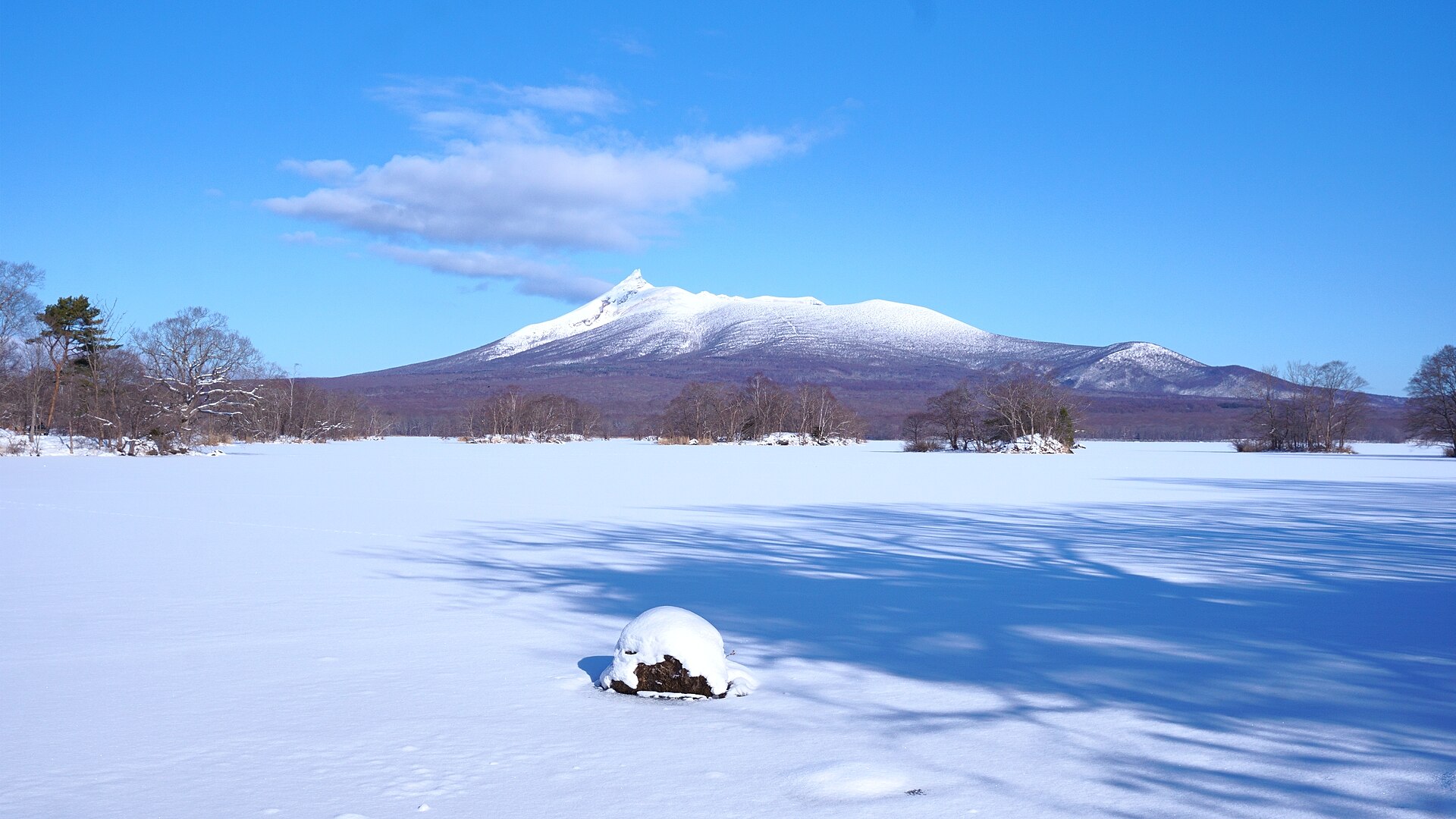
Hokkaidō — the Ainu homeland, renamed from Ezo within living memory of the land. <small>掬茶, CC BY-SA 4.0, via Wikimedia Commons</small>
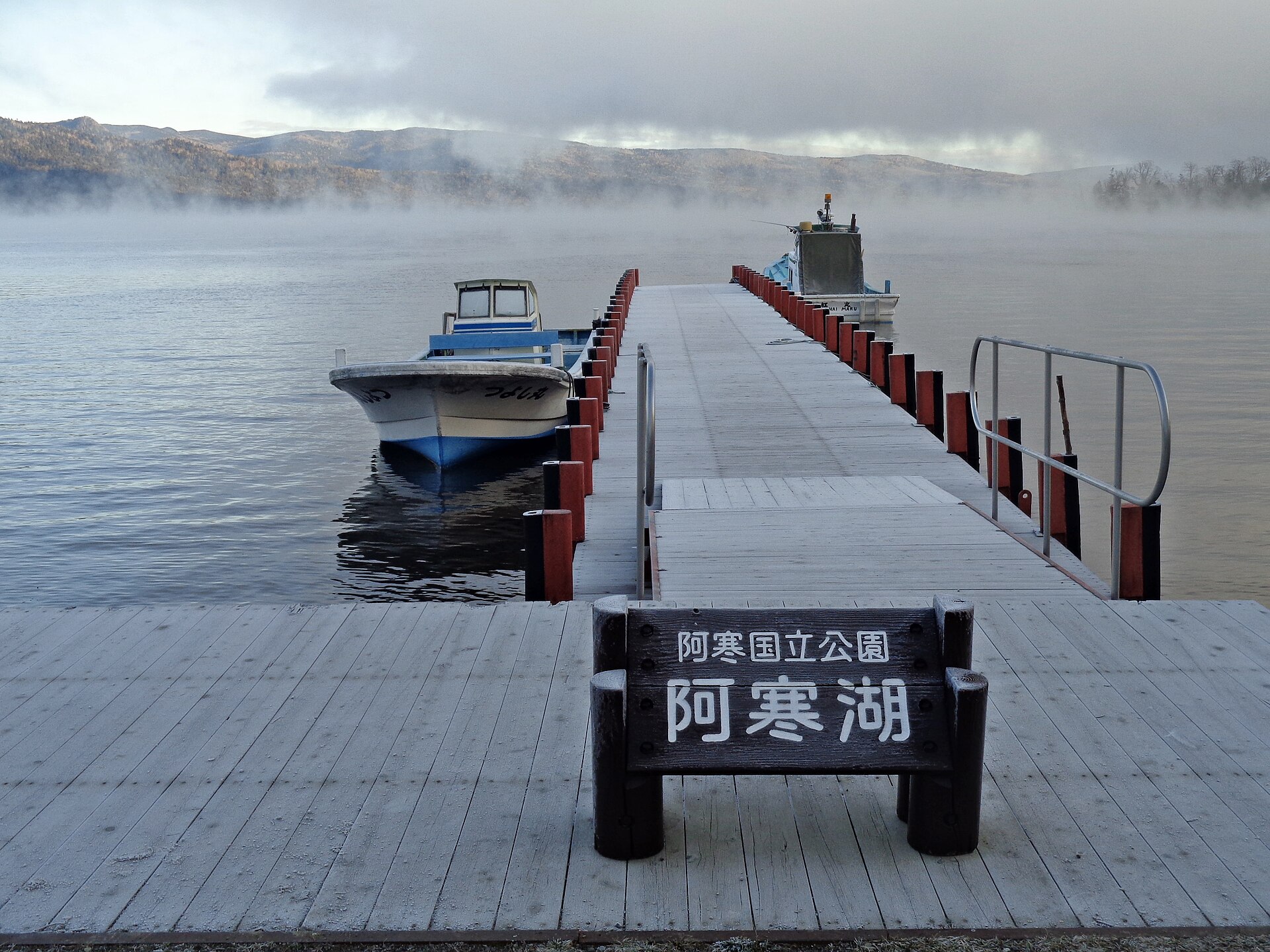
Lake Akan — one of the surviving Ainu kotan (community) homes. <small>ブルーノ・プラス, CC BY 4.0, via Wikimedia Commons</small>
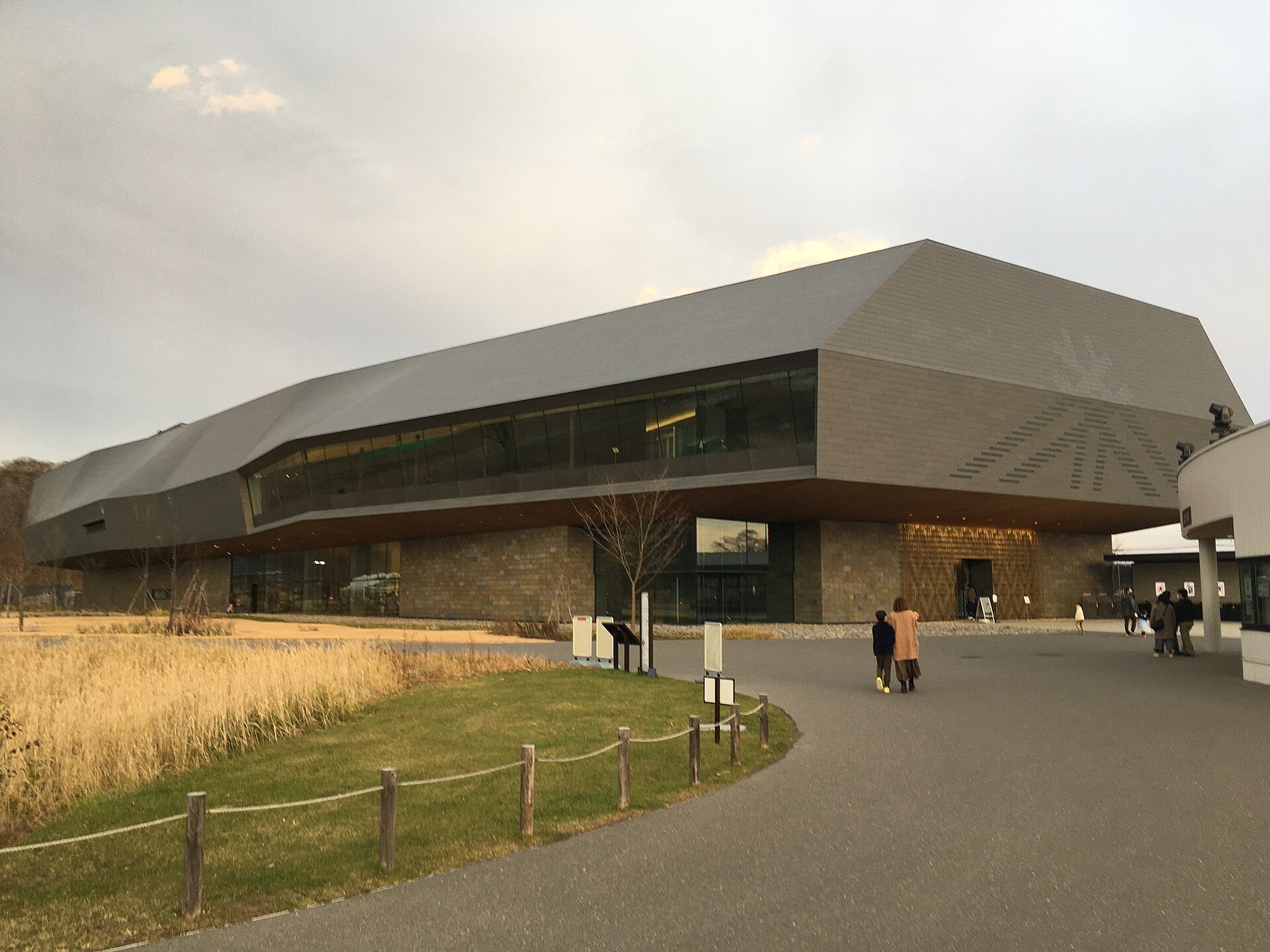
Upopoy, Shiraoi — Japan's first national Ainu institution (open the living-people question, not the glass case). <small>Higa4, CC0, via Wikimedia Commons</small>
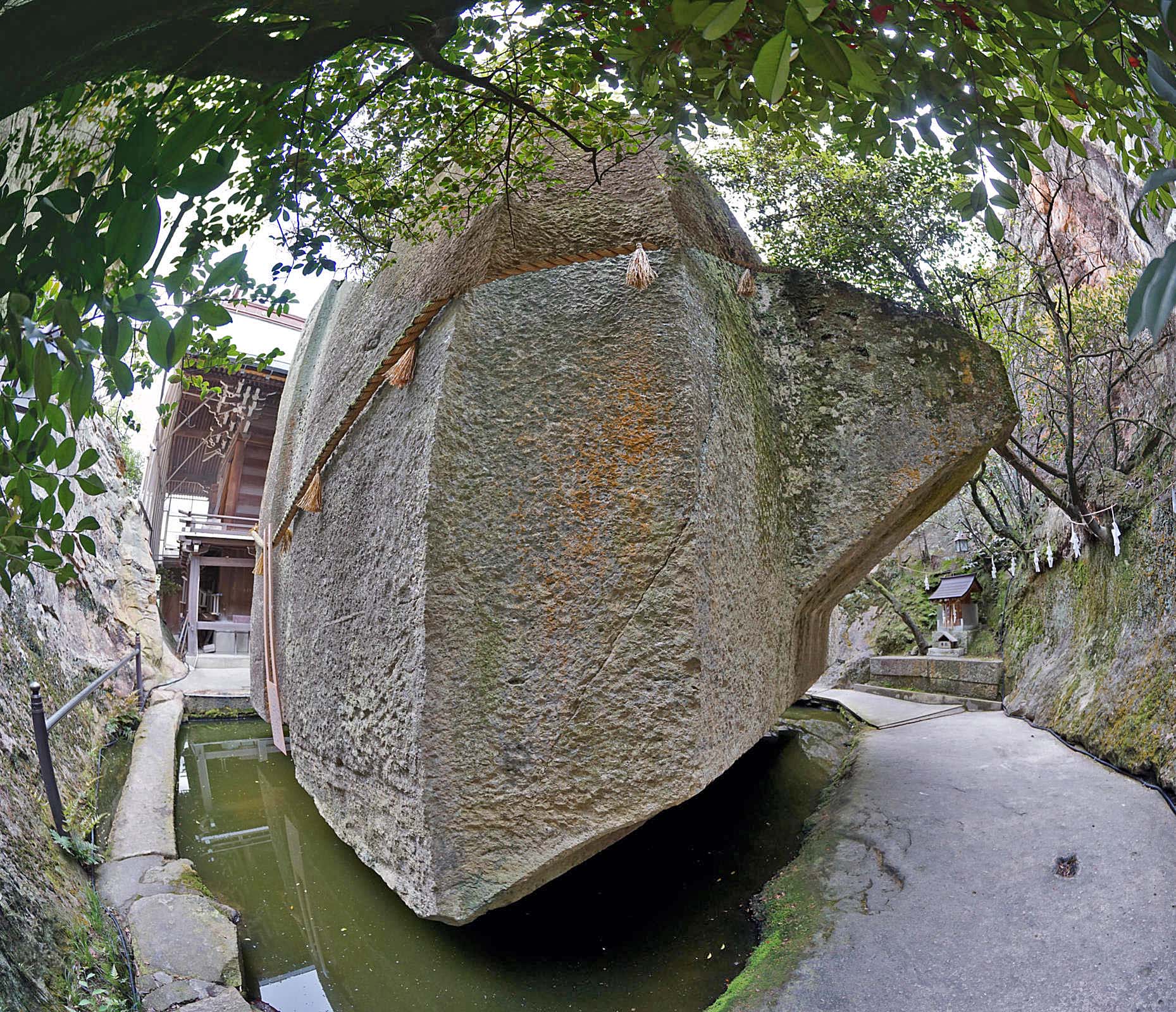
The Ishi-no-Hōden 'floating rock', Takasago — hand-cut from the bedrock, its makers unknown. <small>z tanuki, CC BY 3.0, via Wikimedia Commons</small>
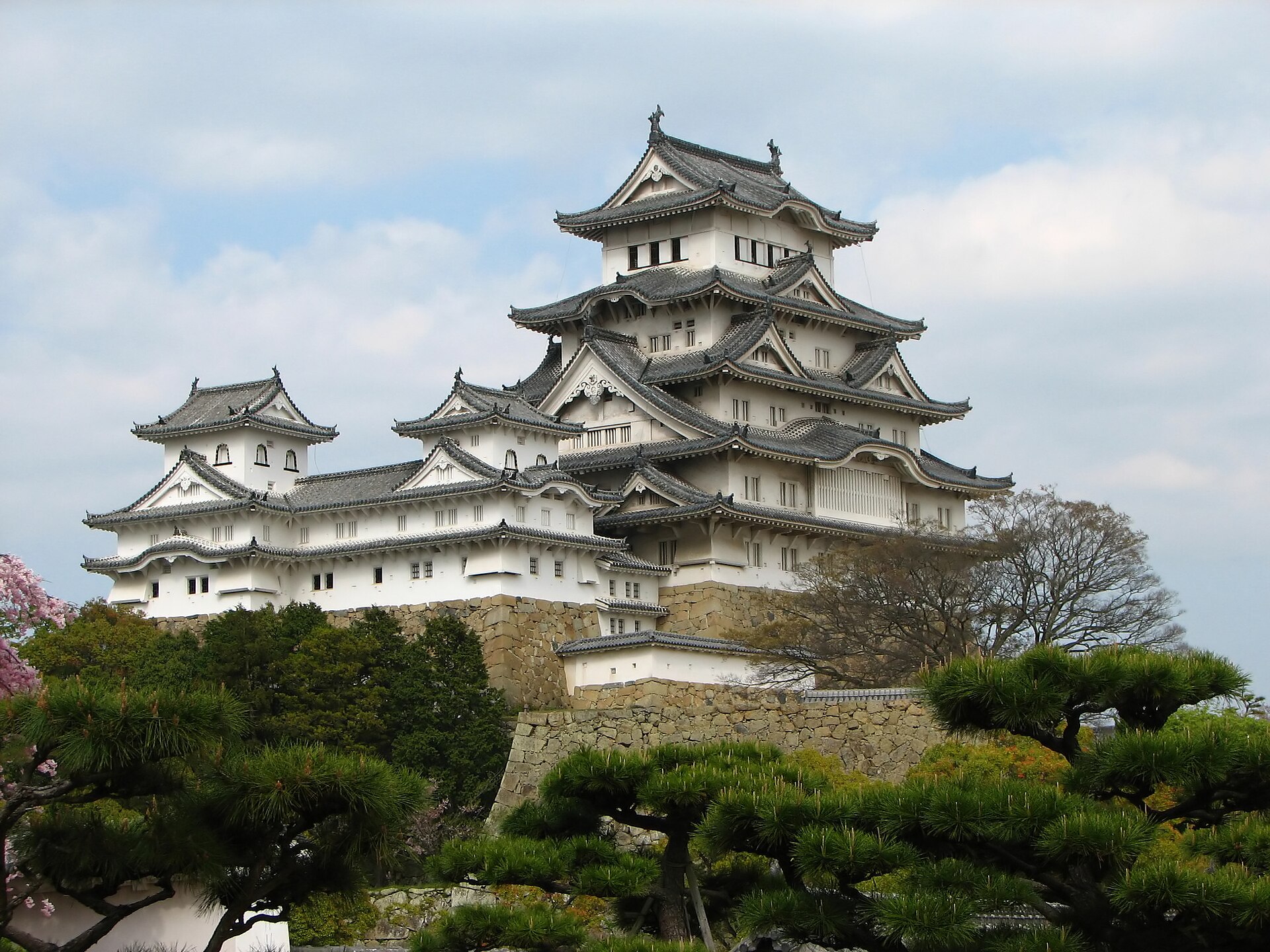
Himeji and Hōryū-ji — the celebrated wonders the unheard hands actually built. <small>Bernard Gagnon, CC BY-SA 3.0, via Wikimedia Commons</small>
Things of wonder (made by hand)
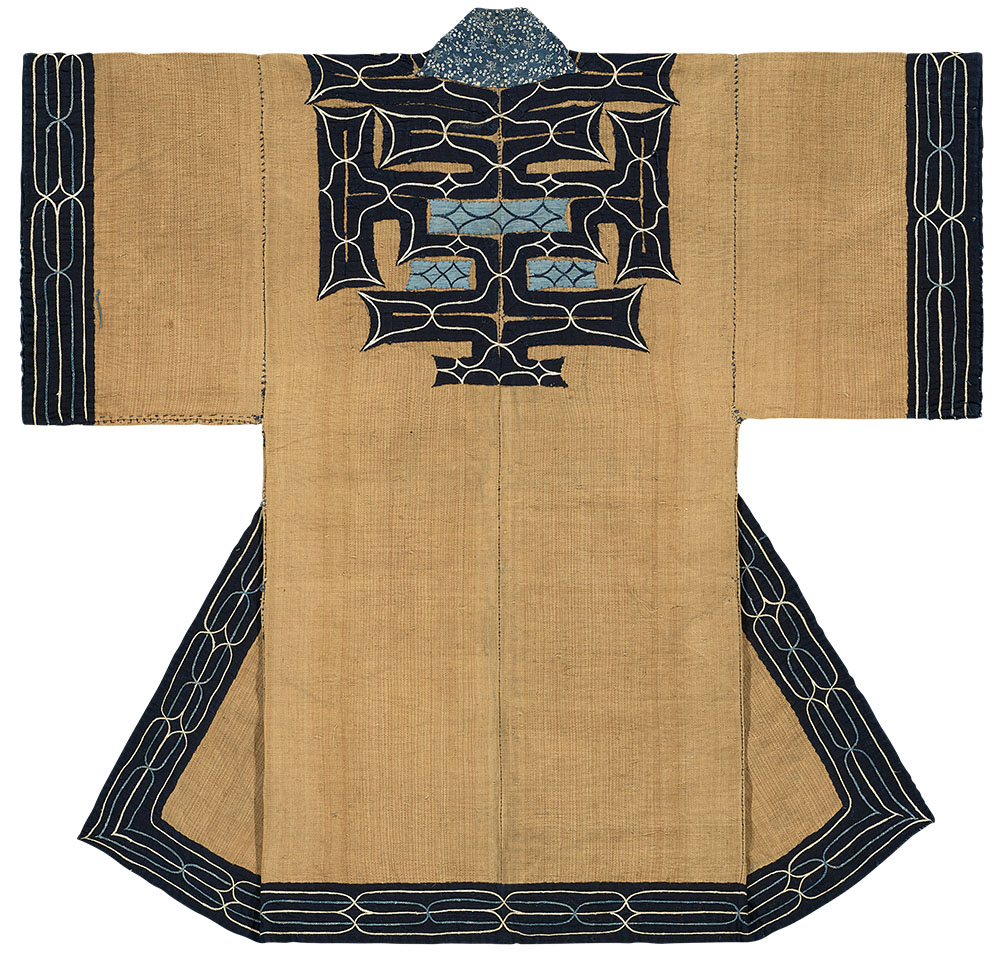
An attus elm-bast robe with moreu swirl appliqué — woven and cut by Ainu women. <small>Unknown Ainu artisan. Published in Hali magazine, Public domain, via Wikimedia Commons</small>
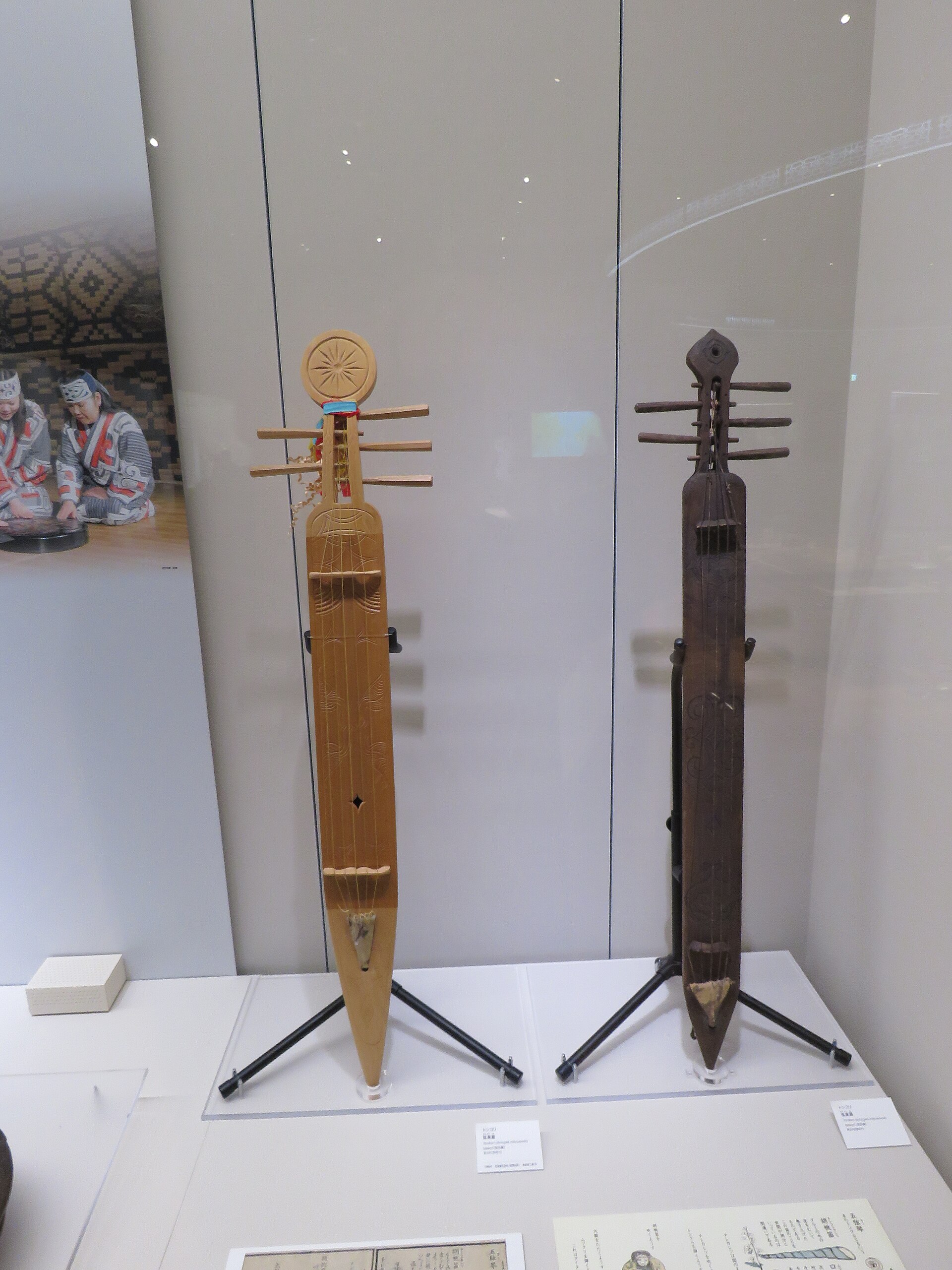
The tonkori (five-string zither) and mukkuri (mouth-harp) — Ainu voice and string. <small>Calistemon, CC BY-SA 4.0, via Wikimedia Commons</small>
Tamahagane and the hamon — clean sortable carbon, real metallurgy, never katana-mysticism. <small>Toby Manzanares, CC BY-SA 4.0, via Wikimedia Commons</small>
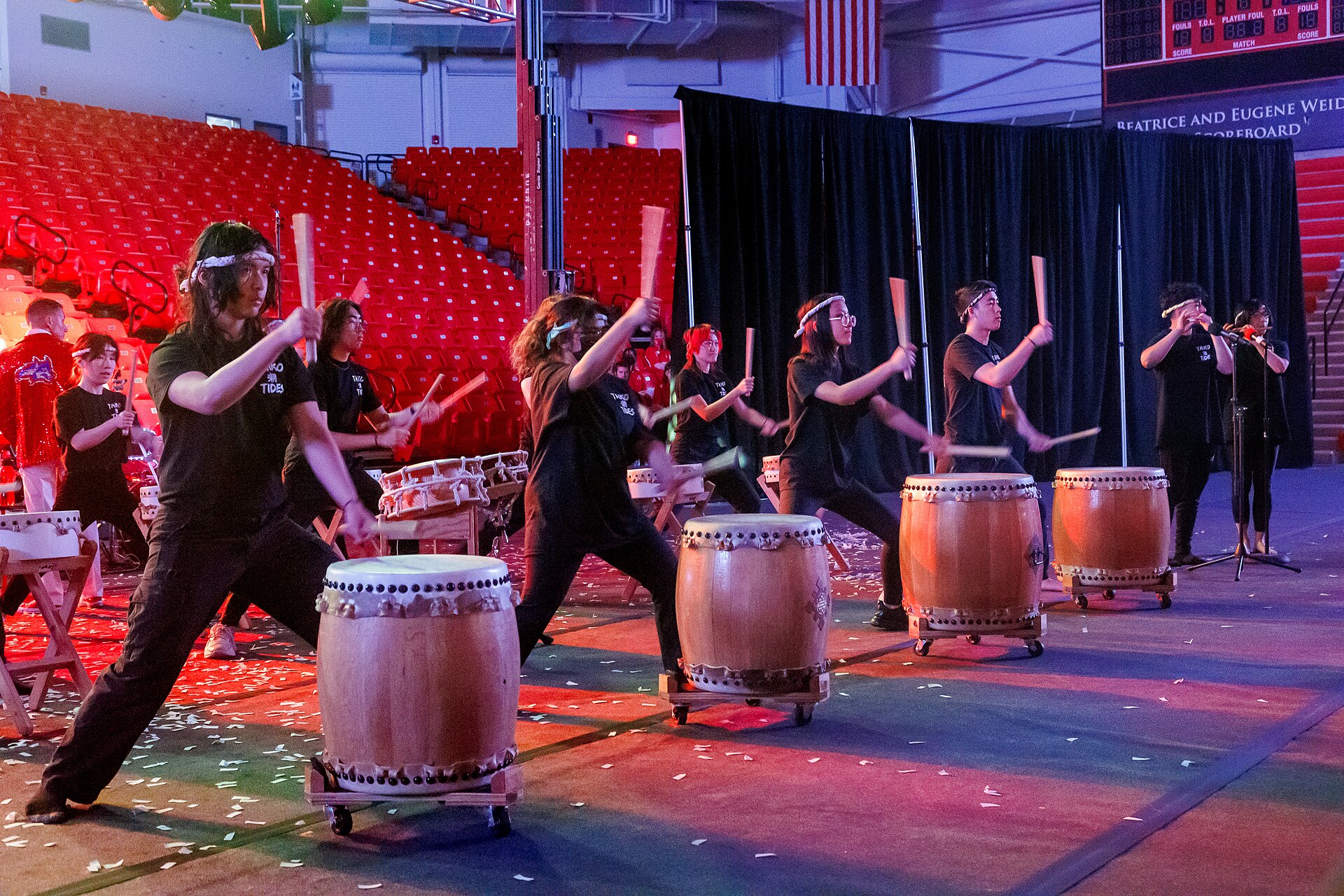
The taiko — there is no drum without the leather the outcast hands once tanned. <small>Kenneth C. Zirkel, CC BY-SA 4.0, via Wikimedia Commons</small>
Peoples, in their own dress
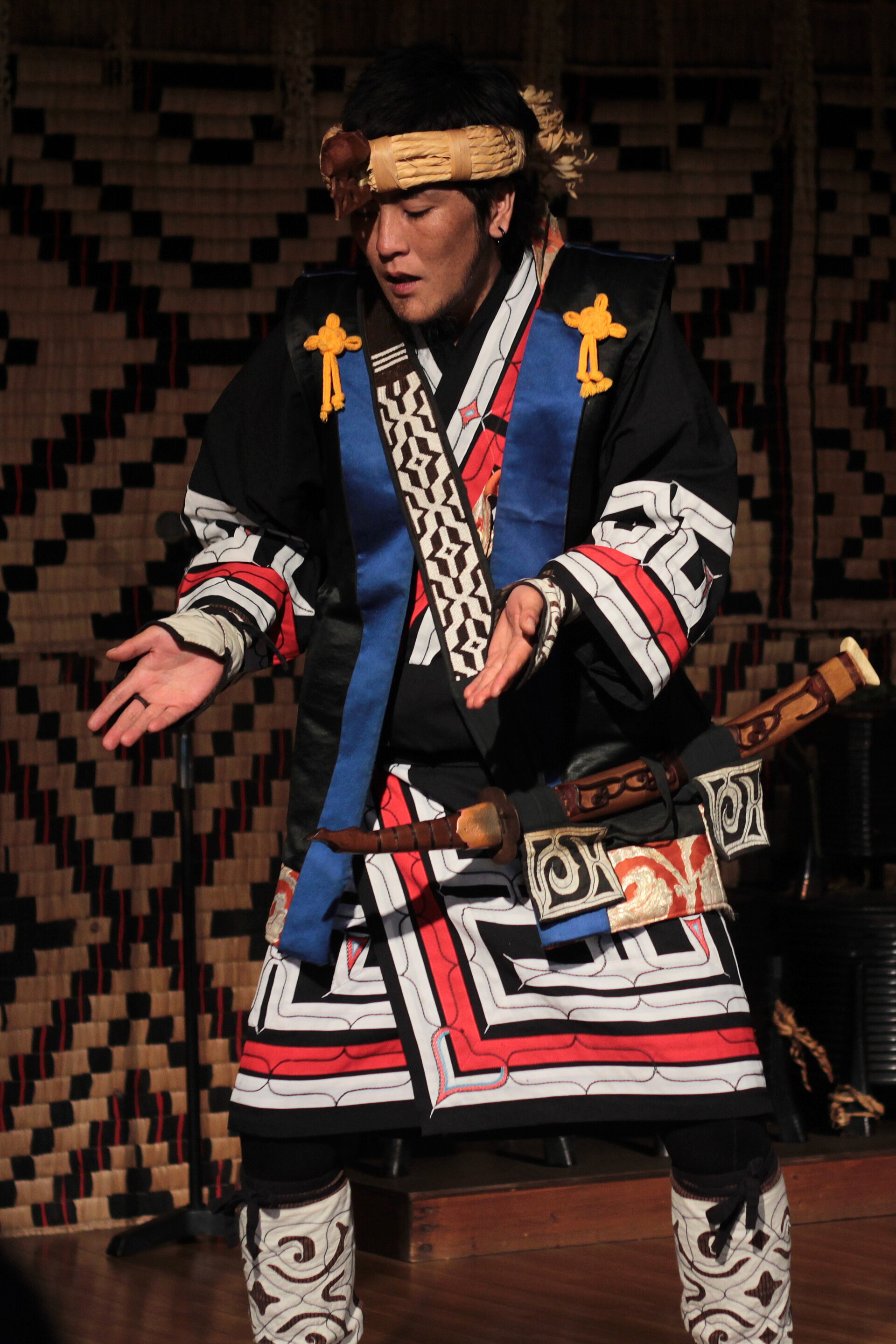
Ainu people in their own dress — a living culture, modern and self-determining, not a relic. <small>Japanexperterna.se, CC BY-SA 3.0, via Wikimedia Commons</small>
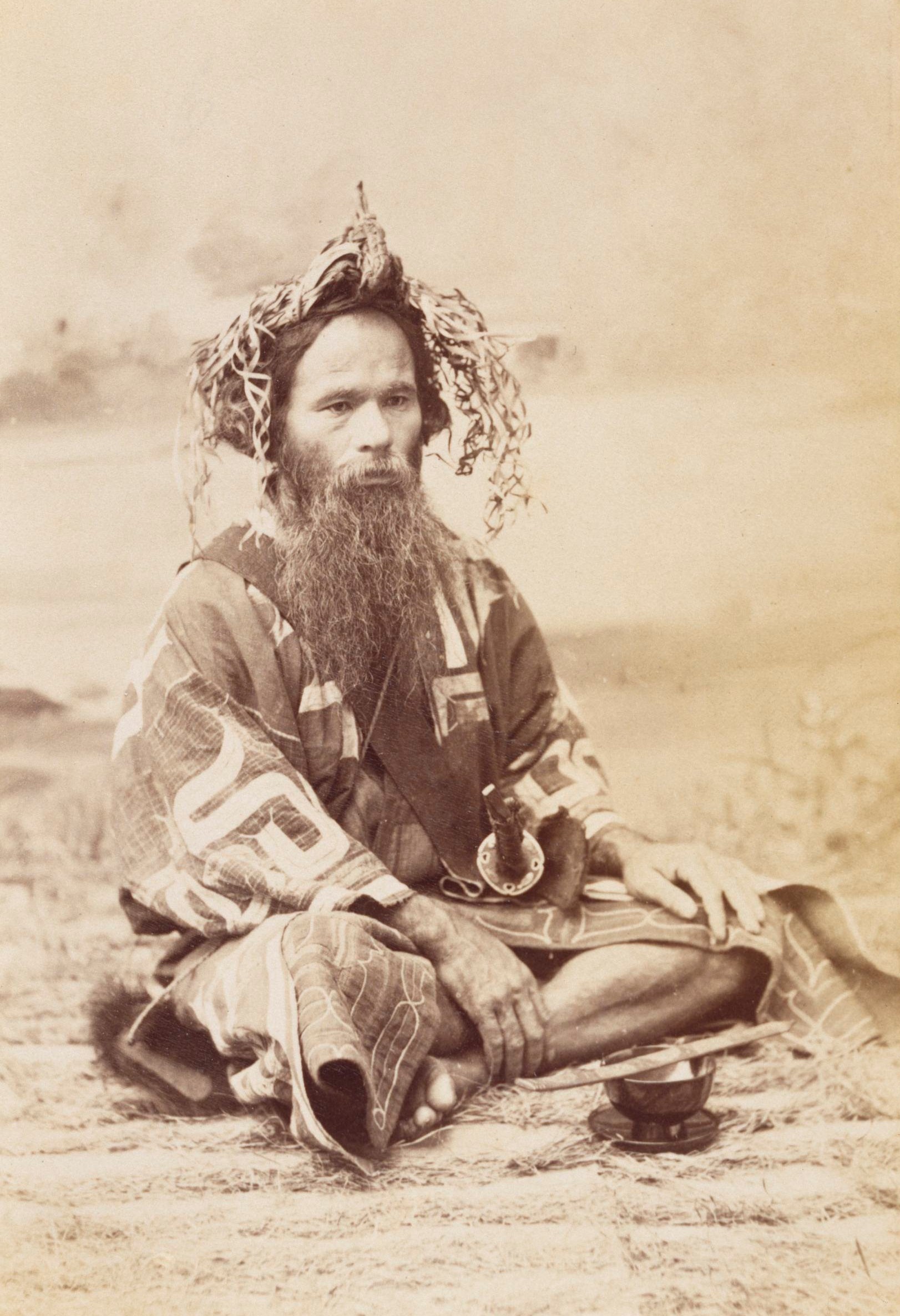
An Ainu elder — one of the keepers of a critically endangered language. <small>Tamoto Kenzō, Public domain, via Wikimedia Commons</small>
A yamabushi mountain ascetic — a near-extinguished living path, handed on, not graved. <small>Noah0812, CC BY-SA 4.0, via Wikimedia Commons</small>
<!-- END image-compendium-appendix -->