Foreword
There is a building in western India that was never built.
Nothing was stacked. No stone was brought to the site; roughly two hundred thousand tonnes of stone were carried away from it. Twelve hundred years ago, on a basalt cliff in the Deccan, a crew of artisans stood on the top of a mountain and began to remove everything that was not a temple — downward, storey by storey, elephant by elephant — until a complete, freestanding, thirty-two-metre building stood free of the rock it had always been inside. They could not fix a mistake. There was no second draft. Subtraction forgives nothing.
The internet will tell you this is impossible, and that impossible things need exotic explanations — hidden machines, secret chambers, visitors. This book takes a different view: that the checkable story, with its copper plates and chisel marks and worker-day arithmetic, is stranger than the legends, and that the people who cut this mountain deserve to have the true version told well.
We will do the sums. We will read the inscriptions and say plainly where the record runs out. We will walk the drainage channels the builders cut before they finished the shrine, because they understood the monsoon would outlive the dynasty. And we will look — carefully, and without sneering at anyone's hoping — at the newest chapter in the temple's long life: the laser and LiDAR surveys now mapping Cave 16 to the millimetre, the viral claims that have grown around them, and the real, unentered spaces the mapping genuinely shows.
The temple is named for Kailasa, the mountain where Shiva sits still while a demon king strains to move the world. That story is carved three storeys tall on its southern face, and it is also, quietly, the story of the building itself: force is loud, and stillness wins.
Come and stand on the lip of the cliff. We'll start where they started — at the top.
Chapter 1 — The Mountain That Isn't There
Start where they started: at the top.
There is a footpath along the lip of the cliff at Ellora, and if you take it in the early morning, before the coaches arrive from the city, you can stand more or less where the first chisel landed twelve hundred years ago and look down into the thing they made. You are thirty-odd metres above a courtyard floor. Below you, filling a great U-shaped cut in the mountain, stands a complete temple — a gatehouse, a pavilion for the sacred bull, a pillared hall, a sanctum under a tower that tapers through four storeys of carved figures, life-size elephants shouldering the whole mass on their backs. It is the size of a cathedral. It casts a cathedral's shadow.
And every piece of it is standing exactly where it has always stood, because no piece of it was ever moved.
That is the fact to hold on to, the one this whole book hangs from, so let us say it as plainly as it can be said. The Kailasa temple was not built. Nothing was quarried, carted, lifted, or laid. There is no mortar in it anywhere, no joint, no block. The gatehouse, the bull pavilion, the sixteen-pillared hall, the tower, the elephants, the two free-standing victory pillars taller than a four-storey house, the bridges that leap from balcony to balcony, the galleries cut into the courtyard walls, the small shrines to three river goddesses, the drainage channels that still carry the monsoon off the roofs — all of it is one object. One piece of stone. It was all there before the workers arrived, hidden inside a basalt hillside in the Deccan, and their entire labour, sustained across something like two decades, was to remove everything that was not the temple.
Nearly every building in the history of our species is an act of addition. You gather material, you bring it to a place, you stack it against gravity and hope. The Kailasa is the great exception: an act of subtraction, roughly two hundred thousand tonnes of it. The courtyard you are looking down into — eighty-two metres long, forty-six wide, walled by scarps of living rock — is not a space that was enclosed. It is a solid that was taken away. Standing on the lip, you are looking at a hole in a mountain with a temple saved inside it, the way a sculptor saves a figure inside a block of marble. Except a sculptor's block is the height of a person, and this one was a cliff.
Subtraction has a property that addition does not, and it is worth sitting with, because it is the property that makes this place close to unbelievable even when you are physically looking at it. Addition forgives. If a wall goes up crooked, you take it down and lay it again; every cathedral in Europe is a palimpsest of corrected mistakes, and we love them for it. Subtraction forgives nothing. Every strike of the chisel is final. If a pillar is cut too thin, there is no thickening it. If a roof line drops a hand's breadth too far, the error is permanent, structural, and thirty metres of carving below it is already committed. The people who cut this temple worked downward from the summit, releasing the building storey by storey beneath their own feet — and they worked, for years, on the faith that the form they were freeing was truly in there, whole and correct, at tolerances that modern survey equipment measures in millimetres.
No second draft. No repairs. No scaffolding to hide behind while you think. Just the cut.
You can see why people reach for exotic explanations. The internet certainly has. Type the temple's name into any search engine and you will be offered hidden chambers, energy machines, ancient high technology, visitors from elsewhere — and, lately, a persistent story about a team of Russian scientists whose scans are said to have found sealed spaces under the courtyard that "shouldn't be there." We are going to look at all of that squarely, later in this book, because pretending the stories don't exist is its own kind of dishonesty, and because — this is the part the debunkers and the believers both tend to miss — the newest chapter of the temple's life really is being written by scanners. In 2024 the Archaeological Survey of India began laser-scanning Cave 16, as the Kailasa is formally known, building the first millimetre-scale digital model of the monument in its twelve-hundred-year existence. In 2025, UNESCO and India's Ministry of Tourism followed with a dedicated LiDAR campaign. Between the viral claims and the verified surveys there is a gap, and walking that gap honestly — what the machines actually found, what the videos say they found, and what genuinely remains unknown — is one of the jobs this book has taken on.
But the deeper job is simpler, and it is the reason this chapter starts on the cliff top rather than at the ticket gate. It is to convince you of something that sounds like a paradox: that the true, checkable, footnoted story of this place — the one with copper-plate inscriptions and worker-day arithmetic and chisel marks you can put your finger into — is stranger and better than any of the legends told about it.
Here is the shape of that story, the way a guide might sketch it before the walk begins.
In the middle of the eighth century of our era, a dynasty called the Rashtrakutas had just fought its way to mastery of the Deccan, the great volcanic tableland that fills the middle of India. Their king, Krishna I, commissioned a temple to Shiva at a place then called Elapura, where the basalt of the Charanandri hills had already been honeycombed, over the previous two centuries, by Buddhist monasteries cut into the cliff. We know this not from legend but from a legal document: a copper-plate deed issued two generations later, in 812 or 813, which pauses in the middle of recording a land grant to remember the temple "Krishnaraja" made — a temple so astonishing, the plate says, that the gods who travel by celestial cars stopped to stare, and its own architects, seeing it finished, did not believe they had made it.
That last detail is the entire mystery of the Kailasa in one sentence, written down eleven and a half centuries before the internet got hold of it. Even the people who cut the thing found it hard to credit. The wonder is not a modern imposition on an innocent ruin; it was there from the first generation. And yet — hold the two truths together, because this book will ask you to do that on nearly every page — the temple was cut by human crews with iron tools whose individual marks are still visible in the stone, working within a living tradition whose earlier, smaller attempts we can visit, in an order we can trace, for reasons of politics and piety that are entirely recognisable. The arithmetic of the labour, which we will do properly in chapter six, comes out hard but human: a few hundred workers, a few decades, no miracles required.
Astonishing and explicable. Both at once. Most writing about this temple picks one and throws away the other — the mystery channels keep the astonishment and discard the explanation; a certain kind of tired guidebook keeps the explanation and files the astonishment off. The position of this book is that the discard is the error, both times. What actually stands in that courtyard is harder to hold than either half: a made thing, made by hands, that nonetheless sits at the outer edge of what hands have ever done.
A word about the name, because the name is load-bearing. Kailasa is a real mountain — a pyramid of ice and black rock in western Tibet, never climbed, which four religions hold sacred and Shaivite Hinduism holds to be the throne of Shiva himself: the still point where the god sits in meditation while the world turns. To name this temple Kailasa was to make a claim of terrifying ambition — here is the mountain of the god, in the Deccan, in reach of your feet — and the builders meant it almost literally. The temple faithfully carries the mountain's iconography; there is good evidence the whole monument was once coated in white plaster, so that it stood in the brown basalt courtyard the way the snow-capped peak stands against Tibetan rock. And carved three storeys tall into its southern flank is the story that explains the name: Ravana, the demon king, ten-headed and twenty-armed, straining with everything he has to tear the mountain loose and carry it home — and Shiva, seated above with Parvati, pressing the whole rebellion flat with the pressure of one toe.
Force loses to stillness. That is the story the temple tells on its wall, and it is also — we will come back to this — the story of how the temple was made: not by force in any ordinary sense, but by a stillness of intention held without wobble across twenty years and two hundred thousand tonnes, one irreversible chisel-strike at a time.
The plan of the book, briefly, so you know the road. First the stone itself, because the Deccan's volcanic rock dictated everything and deserves a chapter of its own. Then the cliff and its neighbours — because the Kailasa is not alone; it is cave sixteen of thirty-four, the loudest sentence in a four-hundred-year conversation between three religions who shared one mountain without erasing each other, which may be the most quietly radical fact on the whole site. Then the makers: the dynasty, the king, the copper plate, and the honest gaps in the record — including the awkward, wonderful fact that the temple itself carries no founding inscription at all. Then the method and the arithmetic; then the older temples that taught this one; then the carvings and what they mean. And then the long custody: the emperor who reportedly tried to destroy it and failed against the patience of basalt; the conservators who have kept it since; the scanners mapping it now; the viral claims; and the questions that remain genuinely open — because there are several, and they are better than the fake ones.
The coaches will be arriving by now. Down in the courtyard the first visitors are passing the gatehouse and stopping, all of them, at the same spot — there is a particular place where the tower first clears the gopuram and the size of the thing lands — and from up here on the lip you can watch it happen to them, one small human shape after another, the same half-step backward, the same tilt of the head.
Twelve hundred years of that. It was the architects first, if the copper plate is telling the truth.
Let's go down and join them. But remember, all the way through this book, where we began: on the top of the mountain, at the level of the first cut, standing on the only part of the temple its makers ever saw as a blank — the surface of the rock before they opened it, when the whole thing was still inside.
Chapter 2 — Trap Rock
Sixty-six million years before the first chisel, the ground itself arrived.
If you want to understand the Kailasa temple — really understand it, at the level of why it is possible at all — you have to start absurdly early, in the last age of the dinosaurs, when the landmass that would become India was a lonely raft of continent ploughing north across the ocean that existed before the Indian Ocean. Somewhere near the middle of that crossing, the raft passed over a plume of anomalously hot rock rising from deep in the Earth's mantle, and the crust above it failed.
What followed was one of the largest volcanic events in the history of the planet. Not a mountain going off, Vesuvius-style, in an afternoon of ash and drama — something slower and vastly bigger: fissures opening across hundreds of kilometres and flooding the land with basalt lava, flow upon flow upon flow, over tens of thousands of years, until the stack of hardened flows lay kilometres thick across half a million square kilometres of western and central India. Geologists call this kind of formation a flood basalt, and they call this one the Deccan Traps — traps from the Swedish trappa, "stairs," because that is what a country made of stacked lava flows looks like where rivers cut into it: giant, level, black-brown steps, each tread a single ancient flow, marching down to the valley floors in flat-topped terraces. Stand at Ellora and lift your eyes from the temple: the horizon is that staircase. The whole visible world is the event.
It matters that you can hold both timescales in view at once from the courtyard, because everything about the temple was dictated by the stone, and the stone was dictated by those sixty-six-million-year-old eruptions. This chapter is about the material — the first and most demanding member of the temple's cast.
Basalt is the most ordinary rock on Earth in one sense: it is what the ocean floors are made of, what lava mostly becomes when it cools fast. But the basalt of a flood province has a particular character. It is fine-grained, because it cooled at the surface rather than slowly at depth — no big glittering crystals, just a dense, even, almost suede-textured darkness. It is heavy: about three tonnes to the cubic metre, half again as dense as granite's reputation suggests and considerably denser than the limestones and sandstones from which most of the world's famous monuments are cut. And it is hard — harder than the iron tools that were brought against it at Ellora, in the specific sense that matters to a mason: an iron chisel does not slice basalt the way a steel blade slices soft limestone. It bruises it, crushes a few millimetres of it to powder, and has to be struck again.
This is the fact under the arithmetic we will do in chapter six, so let it register now. Sculptors who work Carrara marble talk about the stone "wanting" to release the form. Basalt wants nothing. Every one of the temple's roughly three million cubic feet of removed rock was removed by percussion — hammer on chisel, blow after blow after blow, each blow claiming its little bruise of dust and chips — and the tool marks are still there. Run your eye (you are not supposed to run your hand) along the less-finished surfaces of the courtyard scarp and you can read the strokes: the long parallel furrows of the roughing-out, the finer stippling where a surface was being trued, here and there the neat round scars of rod drills used to split larger masses. The temple's making is written on the temple in the only handwriting its makers left us.
Why would anyone choose such a material? The answer is that nobody chose it; it was the ground, and the tradition that culminated at Kailasa had learned, over eight centuries, to see that as an offer rather than a curse. Because here is basalt's other face: what it costs in the cutting, it repays in the standing. It does not weather the way sandstone weathers, sugaring away grain by grain in the rain. It shrugs off the chemistry that dissolves limestone. It carries enormous compressive loads without complaint, which is why the temple's makers could cut galleries and halls whose rock ceilings span widths no ancient builder would dare in laid masonry. A form released from Deccan basalt is, by the standards of human building, close to permanent. Twelve hundred monsoons have gone over the Kailasa. The detail on the sheltered carving is still crisp enough to photograph the fingernails.
There was one more property, and it is the quietly decisive one: the flows are massive. A single cooling unit of flood basalt can be tens of metres thick — one uniform, unjointed body of stone, without the bedding planes that make sedimentary rock split along its own grain, without the faults and seams that turn a quarry into a lottery. When the planners at Elapura surveyed their cliff, they were choosing a block. The whole monument — tower, halls, bridges, elephants — stands inside what is essentially one continuous piece of rock, and it could only have been conceived because the rock offered continuous pieces of that size. Try to imagine cutting the Kailasa out of a cliff of layered sandstone: the first monsoon would find every bedding plane, and the bridges would be down in a century. The Deccan Traps did not merely permit the temple. They proposed it.
People had been answering that proposal for a long time before the Rashtrakutas. The Deccan's cliffs are riddled with cut architecture — at Ajanta, a day's journey from Ellora, Buddhist monks began excavating monasteries and prayer halls into a basalt gorge as early as the second century before our era, and the tradition never really stopped: Bhaja, Karla, Kanheri, Elephanta, dozens of lesser sites, a thousand years of crews learning by accumulating practice what the stone would give and what it would refuse. By the eighth century, when our story proper begins, the Deccan possessed something no other region of the world quite had: a mature, continuously transmitted craft culture of subtractive architecture, with its own specialists, its own layout methods, its own inherited answers to problems like how you light a hall that can have no windows on three sides, and how you get the monsoon off a roof that is also the mountain.
Hold on to the monsoon, because it is the third character in this chapter and it never leaves the story. The Deccan is semi-arid most of the year — the landscape around Ellora in April is brown, hazed, hard-baked — and then, for four months, the southwest monsoon arrives and delivers most of a year's water in slabs. For a subtractive building this is the existential threat. A freestanding temple sheds rain to the ground around it; a temple standing in a pit cut into a hillside is, hydrologically speaking, standing in the drain. The crews that cut Kailasa understood this perfectly, and we know they understood it because their answer is still working: channels and spouts cut into the living rock, concurrent with the architecture itself, gathering the water off the roofs and courtyard and throwing it clear. It is the least photographed engineering on the site and among the most impressive — an eighth-century storm-water system with a twelve-century service record, designed by people who knew that the dynasty would pass but the rain would not.
One more thing about the stone, and then we can climb back out of deep time. Basalt is dark — near-black when cut fresh, weathering to browns and rusty greys — and the temple as we see it today wears that darkness like a skin. It reads as brooding, ancient, geological. But recall from the last chapter what the makers actually did: there is good evidence the finished temple was plastered white, head to foot, in imitation of the Himalayan snows of the real Kailasa. Patches of that plaster, and of painting on the sheltered ceilings, survive. The building we admire as a mountain-coloured monolith was conceived as its own photographic negative — a white peak rising out of a dark stone courtyard, the one thing in the landscape that did not look like the Deccan.
They cut the darkest, hardest, most unforgiving stone in the subcontinent, and then they dressed it as snow. Sixty-six million years of geology, answered with a coat of whitewash and a straight face.
The stone was the given. The cliff was chosen. The next chapter is about the choosing — because the hillside the planners walked in the 750s was not blank rock. It was already two hundred years into one of the strangest and most generous experiments in the history of religion, and the temple they were about to cut would have to live, forever, in the middle of its neighbours.
Chapter 3 — The Three-Faith Cliff
The Kailasa temple has an address, and the address is a number: Cave 16.
It is worth pausing on how strange that is. The largest monolithic building on Earth, the monument the copper plate says astonished the gods, is filed — in every guidebook, every survey report, every scholarly paper — as the sixteenth item in a series. Because it is one. The Kailasa does not stand alone on its cliff like Stonehenge on its plain. It stands a little past the middle of a two-kilometre crescent of basalt scarp into which, over roughly four centuries, three different religions cut thirty-four major monuments and scores of minor ones, side by side, sharing the same rock face, the same water, the same craftsmen — and, so far as the stone can testify, never once destroying each other's work.
Walk the crescent south to north and you walk through the sequence. Caves 1 through 12 are Buddhist: monasteries, mostly — viharas, residential complexes with cells for monks arranged around pillared halls — begun around the sixth century of our era, in the late flowering of Buddhism in the Deccan. Some of them are enormous. Cave 5 is a hall over thirty metres deep, its floor carved with long parallel benches, most plausibly a refectory or assembly hall for a large community. Cave 10 is the one unambiguous chaitya, a prayer hall with a vaulted, ribbed ceiling cut in imitation of the wooden roofs of older freestanding halls — the ribs are structurally useless in living rock, pure inherited memory of carpentry — housing a seated Buddha before a stupa. Cave 12, Tin Thal, is a three-storey monastic block with a plain cliff face like an office building and, inside, row upon row of Buddhas, seated in teaching postures, flanked by bodhisattvas.
Then, somewhere in the seventh century, the commissioning changes hands. Caves 13 through 29 are Hindu — and not tentatively Hindu. Cave 15, which sits almost next door to the Kailasa and may have begun its life as a Buddhist excavation, contains one of the most violent and magnificent sculptural programmes on the site: Shiva as the destroyer of demons, Shiva bursting out of the linga as a pillar of fire to humble Brahma and Vishnu, Vishnu as Narasimha the man-lion tearing the tyrant apart. Cave 21, the Rameshvara, is earlier and gentler — river goddesses at the threshold, marriage scenes, the seven mothers. Cave 29 is a vast cruciform hall on the plan of Elephanta. This is the stratum the Kailasa belongs to: number 16 in the crescent, the culmination of the Hindu phase, cut mostly in the second half of the eighth century.
And then the sequence changes hands again. Caves 30 through 34, at the northern end, are Jain — cut mainly in the ninth and tenth centuries, after the Kailasa was finished, by patrons of the Digambara tradition. They are smaller and they are exquisite. The Indra Sabha, Cave 32, is a miniature courtyard complex — in places explicitly a scaled homage to the Kailasa itself, down to a monolithic shrine standing free in its court — its carving so fine it reads as jewellery: lotus ceilings, tirthankaras seated in meditation under carved mango canopies, traces of painting still on the rock. The Jain crews could see the Kailasa from their scaffolds. They were not competing with its scale. They answered it with precision instead, which is its own kind of confidence.
Three religions. Four centuries. One cliff. And the extraordinary thing — the thing that makes Ellora nearly unique among the great religious sites of the world — is what did not happen. Nobody recut anybody's sanctuary. Nobody's Buddha was chiselled into someone else's Shiva. When patronage moved from Buddhist to Hindu to Jain, the new work went into fresh rock alongside the old, and the old was left to stand. The cliff accumulated. It did not overwrite.
We should be careful here, because the temptation is to project backward a modern word like tolerance and hang a halo on it, and the truth is more interesting than the halo. This was not interfaith utopia. The period's politics were violent; dynasties rose on each other's ruins; the Kailasa itself, as we will see in the next chapter, was among other things an imperial announcement, and Cave 15 next door stages Shiva's supremacy over Vishnu and Brahma with a bluntness nobody would call ecumenical. Doctrinal rivalry was real, sometimes sharp. What the cliff testifies to is something more specific and, in a way, more durable than warm feeling: a settled cultural consensus that the sacred work of others was not yours to unmake, and a shared economy that made coexistence profitable as well as pious.
That economy deserves a paragraph, because it explains the cliff better than theology does. Ellora sits where it sits for a reason older than any of its religions: the pass. The site lies on one of the great ancient roads of western India, the route that climbed from the ports of the Konkan coast up through the Ghats and onto the Deccan plateau, carrying sea trade inland toward the cities of the north. Merchants moved on that road, and merchant wealth is what cut most of these caves — royal patronage made the headlines, then as now, but the day-to-day funding of monasteries and temples came substantially from trading communities buying merit, prestige, and a stake in a holy place that travellers would visit for a thousand years. A working shrine on a trade road was infrastructure. It gave the caravan a place to rest, bank, worship, and spend. Faiths could change at the top; the road's logic did not. The cliff kept accumulating because the cliff kept working.
And the crews — this may be the most important continuity of all — the crews were shared. The same regional guilds of rock-cutters, generation after generation, cut Buddhist halls, then Hindu ones, then Jain ones, as commissions came. You can watch techniques and motifs walk across doctrinal lines like they didn't exist: the river goddesses who guard Hindu thresholds have their ancestors in Buddhist doorways; the lotus ceilings bloom in all three traditions; the Jain Indra Sabha borrows the Kailasa's courtyard idea outright. Iconography was policed — nobody put a tirthankara in a Shaivite sanctum — but craft was a commons. Whatever the priests thought of each other, the masons were colleagues, and the cliff is, among everything else, the world's longest-running record of a building trade talking to itself.
It is worth standing at the midpoint of the crescent and letting the whole thing come into focus at once, because this is the context the Kailasa's builders chose for their masterpiece — chose, when an empire could have cut its trophy anywhere. They put it in the middle of a working, plural, already-ancient holy place. The temple that claims to be Shiva's own mountain stands sixteen doors down from three hundred years of Buddhas, and the Jains built their jewel-box answer practically next door within living memory of its completion, and all of it is still there, together, which is the point. In an age when the world's monuments were routinely quarried, defaced, and converted by each new hand that held power — when the default fate of a superseded temple, on every continent, was to become building material — this cliff spent four hundred years under three theologies and emerged with everyone's gods intact.
The visitor today experiences that as atmosphere without necessarily being able to name it: Ellora feels less like a monument than like a conversation you have walked into partway through — voices answering each other along two kilometres of rock, in three vocabularies, over forty generations. It is the only place in this book's story where the astonishment is not about engineering at all.
One thread remains to pick up, because it complicates the tidy picture and this book keeps its promises about honesty. The plural cliff did not stay unthreatened forever. Nine centuries after the Kailasa was cut, an emperor of a fourth faith is said to have looked at it and given a very different kind of order — and the episode, half history and half legend, belongs to the story too. We will meet it in chapter nine, along with what the stone did about it.
First, though, the makers. It is time to leave the crescent and meet the dynasty that cut the mountain — a family of upstart kings from the southern Deccan, one legal document on copper, and the strange, resonant silence of a temple that never signed its own name.
Chapter 4 — Krishnaraja
The best evidence for who made the Kailasa temple is a property deed.
In the year 812 or 813 — Saka 734, by the calendar the document itself uses — a king named Karka II, ruling a branch line of the Rashtrakuta family up in Gujarat, granted a village to a Brahman. The transaction was recorded the way important transactions were recorded in early medieval India: engraved on plates of copper, strung together on a ring, sealed, and handed over to be kept forever. Thousands of such plates survive across the subcontinent. They are the tax records, title deeds, and press releases of a millennium, and historians live on them.
The Baroda plates, as this set is known, open the way these documents conventionally open: with a eulogy of the granting king's ancestors, generation by generation, each ruler polished up in formal Sanskrit verse. And when the eulogy reaches Krishna I, great-granduncle of the grantor, it stops listing conquests for a moment and does something copper plates almost never do. It stares.
It remembers that Krishna caused to be built, at a place it calls Elapura, a temple of Shiva on a hill — and then the legal document reaches for language usually reserved for scripture. The gods who move in celestial cars, it says, seeing that temple, were struck with wonder: this thing is self-manifest — no made object could be so beautiful; Shiva must simply have arisen here. And then the verse pivots to the ground, to the human crew, and delivers the two lines that have haunted everyone who has read them since they were translated in the nineteenth century. Even the architect who built it, the plate says, was seized by astonishment when it was done, saying: the wonderful is that I was not able to make it again — how did I do it?
Sit with what that is. Not a legend that grew in the telling over centuries — a family record, written down within two generations of the work, while people who had seen the scaffolding were still alive. The Rashtrakutas were not a modest dynasty; their inscriptions claim plenty. But nothing else they claimed sounds like this. The plate is boasting, of course — that is what eulogies do — yet the specific boast it chooses is not "my ancestor commanded ten thousand workers" or "my ancestor spent such-and-such treasure." It is: the man who made it could not believe he had made it. The oldest documented reaction to the Kailasa temple is the maker's own vertigo. Every visitor since has been having a version of the same feeling, and it is oddly moving to know that the first person recorded as having it was standing closer to the chisels than anyone will ever stand again.
So: who was Krishna I?
The Rashtrakutas were, at the start of his lifetime, ambitious subordinates — one of several powerful families holding land under the Chalukya emperors of Badami, the dynasty that had dominated the Deccan for two centuries and whose own great temples we will visit in chapter seven. In the 740s and 750s, a Rashtrakuta chief named Dantidurga — Krishna's nephew, and the family's political genius — read the moment correctly, allied shrewdly, fought brilliantly, and brought the Chalukya order down. By 753 he was claiming imperial titles. He died young, apparently without a son, and the throne passed to his uncle: Krishna, a man who seems to have been already middle-aged, and who spent his reign — roughly 756 to 773 — finishing the revolution: crushing a Chalukya revival, subduing the Gangas, sending his son against the Eastern Chalukyas of Vengi, pushing the new empire's writ across the whole waist of India.
New dynasties have a problem old ones don't: they have to explain why heaven agrees with what just happened. Everything about the Kailasa makes sense read as Krishna's answer. Not a fort, not a palace — a mountain of the gods, the mountain of Shiva, transplanted whole into the Deccan's holiest working cliff, executed in a manner no ruler had ever attempted and none would repeat at that scale. The message runs in every direction at once: to the defeated Chalukyas, whose greatest temple it deliberately quotes and surpasses; to the sacred landscape of Ellora, which it joins and crowns; to heaven itself, in the language of Shaivite devotion, of which Krishna was by every sign a sincere adherent. Empire as theology; theology as engineering. The eighth century did not separate those categories, and the temple is what their fusion looks like at two hundred thousand tonnes.
And now the honest part, the crack this chapter has been walking toward. Turn from the copper plate to the temple itself, and ask it the obvious question — who made you? — and the temple says nothing.
There is no dedicatory inscription anywhere on the Kailasa. No foundation record, no royal signature, no date, no architect's name. For a monument of this ambition, in a civilisation that inscribed everything, produced by a dynasty that stamped its name on copper across half of India, the silence is genuinely odd — and it matters, because without a founding text, the attribution to Krishna rests on that one retrospective verse plus the reasoning of art historians. The plate says Krishna built a marvellous Shiva temple at Elapura; the Kailasa is a marvellous Shiva temple at Elapura; the style fits his dates. The inference is strong, and essentially no scholar doubts Krishna's central role. But notice how much weight one verse is carrying — and notice what the silence leaves open.
Because here is the problem the guidebook version skates over: the Kailasa is enormous, and its carving is not all of one campaign. Look closely — art historians have been looking closely for a century, since Hermann Goetz's classic study in the 1950s — and the monument dissolves into phases: elements in the courtyard whose style points earlier than Krishna, whole galleries and subsidiary shrines whose sculpture belongs to later generations, reworkings of reworkings. The consensus reading today is that the core conception and the decisive vertical excavation — the summit-to-floor release of the main temple that makes the Kailasa the Kailasa — belong to Krishna's reign, quite possibly begun under Dantidurga before him; and that the complex as we walk it accumulated for a century or more afterward, under Dhruva, Govinda, Krishna's successors adding, elaborating, finishing. The temple was not so much completed as it was, at some point, left.
Was it one reign or four? The precise chronology is genuinely unresolved, and this book will not pretend otherwise. But before anyone reaches for mystery, be clear about what kind of open question this is: it is the normal kind. Cathedrals accumulated for centuries and we think nothing of it; a monument that employed generations of the Deccan's best crews would naturally keep employing them. The missing inscription is stranger — perhaps the dedication was on the plastered surfaces that time has stripped; perhaps it was somewhere in the complex now weathered blank; perhaps, as one strand of scholarship muses, later Rashtrakutas were not eager to engrave a predecessor's glory. Nobody knows. It is a real gap, honestly reported — and into exactly such gaps, as we will see in chapter ten, the internet has poured a great deal of confident nonsense.
What the gap cannot swallow is the thing itself. Somebody, in the third quarter of the eighth century, stood on that cliff top with authority, treasure, and a workforce, and committed an empire to an irreversible act of subtraction — and the one document we have from anywhere near the event records that when it was over, the person who had directed it looked at what stood in the pit and felt the ground shift under his own competence. The plate gives the credit to Krishnaraja. The temple, with a modesty that reads almost like confidence, declines to say.
There is one more name attached to the making, and it comes not from copper but from story: Kokasa, the architect of the medieval legend, the man who promised a grieving queen he would show her the temple's tower within a week. He belongs to a later chapter, because his legend is really about the method — the impossible-sounding decision to start at the top — and the method deserves to be met on its own terms.
That is where we go now. Down the temple, the way the makers went: from the summit of the rock, one committed strike at a time.
Chapter 5 — Cut Down, Not Up
Every building problem you have ever heard of runs in one direction: how do we get the material up?
Ramps, cranes, scaffolds, pulleys, ox-teams, canals; the pyramids' millions of blocks, the cathedral vault hoisted stone by stone against gravity's veto. The entire romance of ancient construction is the romance of lifting. And the first thing to understand about the Kailasa temple — the thing that reorganises your whole intuition once it lands — is that its makers looked at the deepest problem in architecture and simply deleted it. Nothing at Ellora was lifted. The material was all already up. The problem they accepted instead was stranger and, in its way, more frightening: how do you take a hundred-metre cliff and remove everything that is not a temple — without ever being able to put anything back?
By the eighth century, the Deccan's rock-cutters had a thousand years of practice at what might be called the ordinary version of their craft: the cut-in. You face a cliff, you open a doorway, and you mine architecture horizontally into the darkness — hall, pillars, cells, sanctum, all interior. Nearly everything at Ajanta and most of Ellora's own caves are cut-ins. It is astonishing work, but it has a merciful property: the cliff face is your only façade. The building has an inside but almost no outside. Its roof is the mountain; its silhouette is the cliff's.
The Kailasa is the other thing: a cut-out. The plan was not to make rooms inside the rock but to make a whole freestanding temple — outside, inside, tower, silhouette and all — by excavating around it, leaving it behind like the figure left standing when the tide takes the rest of the sandcastle. And the only way to do that in a cliff, with hand tools, is the way that sounds like a riddle until you think it through: from the top, downward.
Picture the sequence, because the sequence is the genius. The crews began on the sloping summit of the hill, above where the temple now stands. They marked out a colossal U in plan — three trenches, two running back into the hill and one joining them across the front — and began to sink them, hammer and chisel, straight down. Not tunnelling: open-cast, sky above them the whole way. As the trenches deepened, a huge tongue of untouched rock emerged between them, connected to the hill only at its base and its back. That tongue was the temple — every cubic metre of it, still solid, still blank. The trenches would eventually sink some thirty metres, becoming the courtyard's flanking corridors; the tongue, roughly ninety metres long, would be carved — even as it was being exposed — into gatehouse, pavilion, hall, sanctum, and tower.
Now notice what the top-down sequence buys, because none of it is obvious and all of it is brilliant. It buys freedom from scaffolding for the tallest work: the summit of the thirty-two-metre tower, the hardest thing to reach on any normal building site, is here the first thing the carvers can touch — they are standing on the mountain beside it. As the excavation descends, the working floor descends with it, and the finished upper storeys rise above the crews' heads, complete, while the lower storeys are still inside the rock beneath their feet. It buys clean waste-handling: spoil from the trenches is broken small and carried up and out at angles that get easier as the courtyard opens. It buys light: open-cast means every chisel stroke, top to bottom, is delivered in daylight. And it buys structural serenity — at no moment in the twenty-year sequence is anything unsupported. The unfinished temple is never a fragile shell; it is a solid block getting gradually smaller. The most dangerous phase of ordinary construction, the half-built stage when walls stand without their bracing, simply never occurs.
What it costs is the thing this book keeps returning to: finality. The sequence works only if the finished form is fully specified before the first trench is sunk — not sketched, specified, in three dimensions, at every level, because the crews are carving the top storeys in final detail while the bottom storeys are still unopened rock. There is no adjusting the plan when you get down there and see how it looks; the tower is already carved; its proportions have already committed every proportion below it. Every ancient builder worked without an eraser in some sense, but a mason laying blocks can at least unlay them. Here, a mis-struck metre anywhere is in the monument forever — or worse, has destroyed rock that can never be restored, and with it some planned pillar or bridge or elephant.
How do you hold a ninety-metre building, in full sculptural detail, steady enough in the collective mind of a multi-generation workforce to cut it downward blind? This is, for my money, the deepest question the Kailasa poses — deeper than the tonnage, which chapter six will show is tractable. And the honest answer is that we only partly know. No drawings survive; no eighth-century Deccan architect's manual has come down to us. What survives is circumstantial and rich: the temple itself is bilaterally symmetric to tolerances that imply rigorous setting-out — plumb lines, cords, levelling, measured offsets from datum points established on the summit before cutting began; the later canonical texts of Indian temple-building describe exactly such procedures, along with the proportional systems — the whole design generated as ratios from a single module — that would let a master hold a building in his head as a scheme of numbers rather than a warehouse of drawings; and the tradition had rehearsed. Smaller monolithic cut-outs existed in the south, as we will see in chapter seven. Mistakes had presumably been made there, at survivable scale, and digested into rules of thumb we will never read.
And there is one detail in the fabric — easy to walk past, impossible to forget once noticed — that shows the planners thinking about time as well as form. Cut into the temple platform and courtyard floor, integral with the architecture, runs a system of channels, basins, and spouts: storm-water drainage, dimensioned for the Deccan monsoon, carved concurrently with the monument as the excavation descended. Think about what that means about the plan. Before the first chisel fell, somebody had worked out not only where every pillar of the finished temple would stand, but where the water would go — had designed, in effect, the building's whole relationship with the next thousand rainy seasons, and committed it to rock in the same irreversible pass as the sculpture. The crews cutting the trenches were simultaneously cutting the gutters. The god's house and its plumbing came out of the mountain together, and the plumbing still works.
There is a philosophical flavour to all this that later Indian tradition captured better than any engineering language can. The Bhagavad Gita — composed centuries before the temple, and by the eighth century the common property of the civilisation that cut it — teaches action without attachment to outcome: do the work that is yours, completely, without grasping at its fruits. Whatever the individual masons believed, the method they practised is that teaching turned into stone-craft. The form is already in the mountain, whole. It cannot be forced into being, only revealed; and the revealing demands total action and total surrender at once — full commitment to every strike, no possibility of taking one back. Twenty years of that. It may be the largest sustained act of irreversible precision in the ancient world, and the tool was not the chisel. The tool was the plan, and the discipline that held it still.
A monument that could not be revised, cut by crews who could not see the whole of what they were revealing, to a design held steady across a generation: stated like that, the achievement sounds impossible again, and this book promised not to leave things sounding impossible when they are merely extraordinary. So it is time to do what the mystery channels never do.
It is time to do the arithmetic.
Chapter 6 — The Arithmetic
Here is the claim, as the internet likes to serve it: two hundred thousand tonnes of rock, removed with hand tools, to millimetre precision — impossible in eighteen years, impossible in a hundred, therefore lost technology, therefore someone else. The numbers are always delivered as a knockout punch, and almost never actually computed.
So let us compute them. Slowly, on the table, where everyone can see. This chapter contains the only mathematics in the book, and none of it goes past long division — which is rather the point. The case for human hands does not need calculus. It needs a reader willing to do what the videos never do: multiply.
Start with the mountain of the problem. The excavation that liberated the Kailasa removed, by the standard estimate, roughly three million cubic feet of basalt — call it eighty-five thousand cubic metres — which at basalt's density of about three tonnes per cubic metre gives the famous figure: in round numbers, two hundred thousand tonnes, perhaps a quarter-million by the more generous reckonings of the courtyard's volume. Take the big number. No discounts.
Now the rate. Basalt is miserable stone to cut, as chapter two established, and nobody sensible claims heroic individual output. The working figure used by archaeologists who have studied the site — it appears in M. K. Dhavalikar's classic analyses of the temple's making — is that a Deccan rock-cutter with hammer and iron chisel, working a full day, removes about four cubic feet of rock: a block roughly the size of a beer crate. Chips and dust and bruised knuckles, day after day. It is a believable number precisely because it is so modest.
Divide. Three million cubic feet, at four cubic feet per worker per day, is 750,000 worker-days. That is the whole mountain of the problem expressed in human units — and already, notice, it is just a number, not a miracle. The only question left is how the number spreads across people and years, and that is arithmetic too.
Suppose the crown put 250 cutters on the cliff — a formidable but entirely unremarkable workforce for an imperial project; a single medieval quarry could employ more. At 250 cutters working 300 days a year, you retire 75,000 worker-days a year, and 750,000 worker-days takes ten years. Push the crew to 400, the figure at the upper end of the scholarly estimates, and you are through the whole excavation in six to seven years. Slacken everything — monsoon stoppages, festivals, deaths, war years, half the crew reassigned to a fortress somewhere — assume, say, 150 effective cutters, and the rock still comes out inside twenty years. However you slide the assumptions within reason, the answer lands in the same modest band: one working generation. Which is precisely what the copper plate's chronology, the art historians' style-phases, and the tradition's own memory of an 18-to-20-year campaign all independently suggest. The numbers do not merely permit the official story. They converge on it.
Notice what did the work there. Not a clever trick — division. The two hundred thousand tonnes that sounds unanswerable as a headline dissolves into 750,000 crate-sized days, and 750,000 days is what a few hundred patient people do with a decade or two. The impossible number was never impossible; it was just unexamined. This is the single most useful habit this book can teach, and it transfers: nearly every "the ancients couldn't have" claim, at nearly every site on Earth, dies the same death the moment someone actually divides.
Two honest complications, before the triumph gets smug — because this book promised to show its work even where the work helps the other side.
First: cutters were not the whole payroll. Behind every man at the rock face stood the support economy — smiths, above all, because iron chisels blunt fast against basalt and a forge must have burned on that hilltop every working day for twenty years, re-edging tools by the basketload; plus haulers mucking out spoil, water-carriers, rope-makers, cooks, overseers, and the master masons and sculptors whose finishing work is the reason anyone visits. The true peak headcount on the hill was surely several times the cutting crew — a thousand people, perhaps, a small town's worth, housed and fed and paid at imperial expense. That does not weaken the human explanation; it enriches it, and it tells you why only an empire at its zenith attempts such a thing. The Kailasa's precondition was not secret knowledge. It was a treasury.
Second, and more interesting: the arithmetic above is for extraction, and extraction was the easy part. Removing rock is measured in crates per day; carving Ravana's twenty arms is not. The sculptural programme — the epic friezes, the elephants, the divine figures in their hundreds — obeys no tidy productivity figure, and it is where the temple's true difficulty lives. Yet here too the mystery, examined, resolves into something human: the Deccan possessed, in the eighth century, a mature guild tradition of master carvers, trained across generations, whose earlier and smaller works we can still visit and whose stylistic handwriting scholars can trace from site to site. The carving of the Kailasa is not anonymous magic. It is the assembled best of a living school, given the commission of the millennium and a generation to fulfil it.
Which brings us, finally, to the legend — because the tradition itself preserved a story about the schedule, and it is more beautiful than any debunk.
The tale is told in a medieval Marathi text, the Katha-kalpataru. A king — the story does not care which — fell gravely ill, and his queen vowed to Shiva that if he recovered she would build the god a temple and fast until she saw its finial, its crowning summit-stone. The king recovered. The vow stood — and the court realised with horror what it meant: temples take decades; the queen would starve. Then an architect named Kokasa stepped forward and promised the impossible: she would see the finial within the week. And he kept the promise — because instead of building up from foundations toward a summit years away, he took his crews to the top of a cliff and carved the finial first, freeing the temple downward out of the mountain. The queen saw the crown of the tower inside the week, broke her fast, and the work descended at its own patient pace for years afterward.
Set aside whether any of it happened. Look at what the story knows. It knows the temple was cut from the top down; it knows the summit existed before the base; it knows the method's whole meaning — that top-down was not a stunt but an inversion that made the impossible schedulable. Whoever first told that tale understood the engineering better than most modern videos about the site. Folklore, here, is not the enemy of the technical truth. It is the technical truth, wearing the clothes the culture kept its truths in: a vow, a fast, a clever servant, a god satisfied.
And the name Kokasa is worth a last thought. The copper plate, remember, gives us an architect who looked at his finished work and could not believe his own hands. The legend gives us an architect who looked at an unstarted cliff and staked a queen's life on the sequence of cuts. History cannot confirm that either man existed as told. But between them — the one struck dumb after, the one perfectly confident before — the tradition has preserved the two halves of what genius at this scale must actually have felt like, and neither half required anyone but people.
Two hundred thousand tonnes, 750,000 crate-days, one generation, zero miracles. The wonder survives the division intact — it simply moves house, from how much to how held: not the tonnage but the twenty-year steadiness of intention that the last chapter described. Machines could not have supplied that. Only a culture could.
Where did such confidence come from? Not from nowhere — confidence never does. The Kailasa had parents: smaller, earlier temples, some built, some cut, standing today in other parts of the Deccan and the south, in which every one of its ideas was rehearsed at survivable scale. The next chapter goes to meet them — because nothing dissolves the myth of the miracle quite like meeting the masterpiece's family.
Chapter 7 — Masterpieces Have Parents
There is a sentence that does more damage to public understanding of the ancient world than almost any other, and it is always delivered in the same awed hush: nothing like it had ever been attempted before.
It is rarely true anywhere. At Ellora it is spectacularly false — and the falsity is the best news in this whole book, because it means the Kailasa can be explained the way everything human gets explained: by its family. Masterpieces have parents. They have cousins and rehearsals and awkward early drafts. The lone miracle without precedent exists only in documentaries; in the actual archaeological record, the Kailasa sits at the top of a family tree so legible you can walk it, temple by temple, across southern India — and this chapter is that walk.
Start seven hundred kilometres south-east, on the granite coast below Chennai, at Mahabalipuram — the port city of the Pallava kings, the Rashtrakutas' contemporaries and rivals in the deep south. Sometime in the seventh century, Pallava craftsmen did a strange and wonderful thing: scattered along the shore stood outcrops of granite, and rather than quarrying them, the masons carved entire small temples out of them, freestanding, roof to plinth — each one a complete architectural statement, with columns, storeys, finials, carved deities, all liberated from a single boulder. The largest is barely twelve metres tall. Tradition calls them the rathas, the chariots. They are, as far as the record shows, the first true monolithic cut-out temples in India: the Kailasa's idea, complete and working, at one-twentieth the volume — the concept car, a full century before the production run.
And the Pallavas supplied more than the concept. At their capital, Kanchipuram, around the year 700, they raised (this one built, block on block) a great sandstone temple to Shiva and named it — note the name — Kailasanatha: Lord of Kailasa. Multi-storeyed vimana, enclosing wall, the mountain-of-Shiva theology fully articulated in stone. When the Rashtrakuta project at Ellora wanted a name for its own mountain, the name was already consecrated and already attached to precisely this kind of southern-style temple. The Kailasa of Ellora did not invent even its own name. It inherited it.
Now come back north and west, into the country of the Chalukyas — the imperial dynasty the Rashtrakutas overthrew — to a bend of the Malaprabha river where three towns sit within a day's walk of each other: Aihole, Badami, and Pattadakal. Architectural historians speak of this little triangle with the reverence other fields reserve for Florence, because something happened here that happened almost nowhere else on Earth: for roughly two centuries, the region operated as an open experimental laboratory of temple design. At Aihole, dozens of small temples try everything — different plans, different roofs, northern spires beside southern tiers, ideas tested and abandoned in sandstone. At Badami, cave temples push what cut architecture can carry. And at Pattadakal, the coronation place of the dynasty, the experiments mature into a final examination: a row of major temples in both the northern and southern styles standing side by side, as if the subcontinent's entire architectural argument had been assembled on one lawn.
The greatest of them — and the Kailasa's direct, documented parent — is the Virupaksha temple, completed around 740. Its origin is a story in itself: it was commissioned by a queen, Lokamahadevi, to commemorate her husband Vikramaditya II's victories over — pleasingly — the Pallavas of Kanchipuram. The king had been so struck by the Kailasanatha temple in the captured city that, tradition and inscription agree, he brought southern architects home with him. The Virupaksha is thus itself an act of admiring theft: a Chalukya temple in the Pallava manner, southern-styled, storeyed, complete with Nandi pavilion, enclosing court, and a fully staged programme of epic sculpture. Stand before the Virupaksha with a photograph of the Kailasa in your hand and the paternity is not subtle. Plan for plan, element for element — gateway, Nandi shrine, axial mandapa, tiered vimana, even the disposition of the narrative reliefs — the Kailasa is the Virupaksha, re-stated.
With two differences. It is roughly twice the size. And it is not built.
Here, then, is the true genealogy of the miracle, laid out in one paragraph. From the Pallava south: the monolithic cut-out idea (the rathas), the name and theology of Kailasa (Kanchipuram), and the southern temple form. From the Chalukya laboratory: two centuries of tested design, and in the Virupaksha, the exact architectural composition, already victorious, already royal. From the Deccan's own thousand-year cave tradition, Ajanta to Ellora: the craft culture — the guilds, the basalt technique, the top-down instinct latent in every cliff they had ever opened. In the 750s the Rashtrakutas conquered all three inheritances at once — overthrew the Chalukyas, checked the Pallavas, took the Deccan — and every element of the Kailasa was sitting in the treasury of tradition, waiting for a patron with the nerve to combine them and multiply by ten.
That multiplication was the actual innovation. It sounds diminishing — "they only scaled it up" — until you think about what scaling up means in a medium that forgives nothing. A twelve-metre ratha can be carved by a small crew keeping the whole form in one master's eye; mis-strike, and you have lost a boulder. The Kailasa meant holding a form ten times taller and a hundred times more massive, through twenty years and a workforce of hundreds, in stone where one bad metre is forever — with a dynasty's legitimacy riding on the outcome. No one had done that. No one, in cut stone, has really done it since. The idea was inherited; the nerve was new. That is what "original" almost always means in the history of great things, and it is not a small thing. It is the whole difference between a tradition and a monument.
There is a political reading here too, and it should be said plainly because the temple says it plainly. When a new empire restates its defeated predecessor's dynastic temple — same composition, same dedication, same epic programme — at double scale and in a mode (the monolith) that annihilates comparison, that is not homage. Or rather, it is homage of the imperial kind: we honour what you made by exceeding it beyond answer. The Kailasa is many things, and one of them is the most permanent victory announcement ever issued. The Chalukyas' temple was very fine, it says, in stone that will outlast both dynasties: now watch.
One implication of the family tree deserves its own paragraph, because it quietly demolishes half the internet's case. If the Kailasa were a solitary anomaly — no precedents, no relatives, no tradition — its strangeness would genuinely demand explanation. But we have the relatives. We can walk the rathas at one scale, the Virupaksha at another, the Kailasa at the summit; we can trace the architects' journey in inscriptions, the borrowed southern style, the guild handwriting moving between sites. Lost civilisations and visiting engineers do not leave family trees in other people's kingdoms. Traditions do. The Kailasa is not an orphan clutching a mystery. It is the eldest child of the best-documented architectural lineage in medieval India, standing at the front of the family photograph.
And once the family is in view, something generous happens to the story: it stops being about a single miracle on a single cliff and becomes about a civilisation-wide conversation — queens commissioning victory temples, architects head-hunted across war frontiers, laboratories of design running for centuries, guilds carrying craft across dynastic lines the way the Ellora cliff carried it across religious ones. The eighth-century Deccan starts to look like what it was: one of the great creative environments in human history, dense with rivalry and transmission and nerve. The temple is what such an environment produces when everything peaks at once.
The family walk ends where it must: back in the courtyard at Ellora, standing in front of the thing the whole lineage was building toward. We have circled it long enough — geology, neighbours, dynasty, method, arithmetic, ancestry. It is time to go in: through the gopuram, past the guardian goddesses, into the mountain the Rashtrakutas made — and to read, panel by storey by tableau, what all that stone was cut to say.
Chapter 8 — The Mountain of the Story
You enter the mountain through a wall it kept for itself.
The Kailasa is the only cut-out at Ellora that screens its courtyard from the world: a curtain of rock left standing across the front, pierced by a two-storey gatehouse — a gopuram, the southern style's ceremonial gate. The entrance passage is deliberately modest, human-scaled, almost dark. This is staging, and it is as calculated as anything in Baroque Rome: the builders, who could have opened the court to the plain, chose instead to make you pass through a moment of compression — and then release you into the one view they had spent twenty years preparing. You step through, the walls fall away, and the temple stands up in front of you, thirty-two metres of it, filling the sky of the courtyard, with the scarp rising sheer behind it and the morning light coming down the tower.
Every visitor stops at the same spot. You will too. The gate is a machine for making you stop.
At the threshold itself, before the court, the programme begins quietly. Flanking the passage stand the river goddesses — Ganga on her crocodile, Yamuna on her tortoise, Saraswati on her lotus: the three great rivers of Indian sacred geography, personified as serene women, stationed where you cross from profane ground to holy. The grammar, inherited from centuries of cave-temples, is unmistakable to anyone raised in it: you are not walking into a building; you are fording into another country. And just inside, on the courtyard's north wall, the sculptors placed Gajalakshmi — the goddess of abundance seated on her lotus pond while elephants pour water over her from raised trunks — the image of blessing on arrival, the household welcome writ imperial.
Then the court, and the two absurd, magnificent monoliths that own it: a pair of dhvajastambhas, victory pillars, each about seventeen metres of carved rock standing free — banner-staffs for the god, cut, like everything here, from the mountain where they stand. Beside them, life-size stone elephants. Ahead, the temple proper on its great plinth — and it is the plinth that delivers the complex's single most photographed idea. The entire mass of the temple — halls, tower, the lot — rides on the backs of elephants: a full frieze of them, life-size, carved in the round around the base, shoulders into the load, trunks swinging, some tusking at carved lions, an unbroken herd bearing the mountain of the god the way elephants bear the world in Indian cosmology. It is structural fact dressed as myth — the plinth does carry everything — and myth dressed as structure, and after twelve centuries the herd is still holding.
Understand what you are inside, iconographically, and the whole complex snaps into focus: the temple is a model of Mount Kailasa, Shiva's Himalayan throne — not a metaphor for it, a working replica, the axis of the world re-cut in the Deccan. The tiered tower is the peak; the courtyard is the world at the mountain's foot; the bridges that leap between gate, pavilion, and hall are the impossible geography of a divine place; and the white plaster the whole monument once wore was the snow. Once you know the temple is a mountain, every carving on it becomes an event on the mountain — and the sculptors staged the greatest of those events exactly where the theology says it happened: underneath.
Go around to the southern flank and find it — the panel this book has been promising since chapter one, and, by broad consent, one of the supreme sculptures of India. Ravana, demon-king of Lanka, has come to Kailasa in his arrogance and been slighted; in fury he has dived beneath the mountain to tear it loose and carry it away. The carvers give him the full theology of his menace: ten heads, twenty arms fanned out in a wheel of effort, every arm braced against the underside of the rock — and the mountain moves. The sculptors show it moving: the panel's upper registers tilt into panic, Parvati grips Shiva's arm and sways toward him, her attendants bolt. It is a masterclass in carved kinetics — motion, in basalt, radiating upward from the demon's straining wheel of hands.
And above the turmoil sits Shiva. Not fighting. Not even fully attentive. He presses down with one toe — the texts and the sculpture agree on the anatomical comedy of it, one toe — and the mountain settles, and Ravana is pinned beneath it, where he will spend ten thousand years singing the god's praises until Shiva, pleased, releases and blesses him. That coda matters: in the theology the episode is called Ravananugraha, "the gracing of Ravana" — not his destruction. The lesson is not that force is punished. It is that force is irrelevant, and that even the demon's rage, exhausted, converts to devotion and is met with grace.
Now stand back and let the panel and the building talk to each other, because this is the moment the whole temple becomes one thought. Carved into the flank of a mountain that was moved by human effort — two hundred thousand tonnes of it — is the image of the mountain that cannot be moved by force. The builders put the world's greatest monument to what muscle and iron can do at the service of a story about muscle's futility; and the resolution of the paradox is the method itself, because — as chapter five argued — the temple was not forced out of the cliff. No block was wrestled, no mass lifted against its will; the makers' whole art was Shiva-like, not Ravana-like: stillness of plan, the patient descending pressure of intention, the mountain yielding what was already within it. The Kailasa is the only building I know of that is simultaneously the illustration of its own moral.
The rest of the programme unfolds from there, and a walk of the galleries reads like the civilisation's shelf of epics taken down one by one. Along the mandapa walls run the narrative friezes: the Ramayana in registers on the south — exile, the golden deer, the abduction of Sita, the monkey armies, the bridge, the war; the Mahabharata and the deeds of Krishna on the north. Shiva appears across his whole range: as Nataraja, lord of the dance, mid-step in the cosmic cycle of destruction and creation; as the ash-smeared ascetic; as Bhairava at his most terrible; as bridegroom, gentle, at his marriage to Parvati, the mountain's daughter. Vishnu and his avatars hold the subsidiary spaces — Narasimha the man-lion, Varaha the boar lifting the drowned earth on his tusk — a breadth worth noticing: the empire's mountain of Shiva had room for the other god's whole story, an ecumenism within Hinduism that rhymes with the larger hospitality of the cliff outside. In the mandapa's shadowed ceiling, fragments of paint survive — processions, clouds, flying figures in red and ochre — the last swatches of the pigmented world that once covered everything.
And at the centre of it all, the point the whole mountain narrows to: the garbhagriha, the womb-house, the sanctum. After the acres of narrative outside, it is nearly bare — a small dark chamber holding a single object: the linga, the aniconic pillar-form of Shiva, the god past all his stories. The iconographic journey of the temple is a journey inward from image to presence: you pass through every tale the culture could carve, and arrive at the one thing it declined to depict.
Worship has never stopped there. Twelve centuries on, the linga is dressed and honoured; the sanctum smells of oil and marigold; the Kailasa is that rarest of things, a wonder of the ancient world that never became a ruin. The gods of Egypt's temples are museum pieces; the mountain the Rashtrakutas cut is still on duty.
It is tempting to end the tour there, in the warm dark, with the living flame. But the temple's biography does not end at its consecration — no twelve-century life is that kind. Outside the sanctum, on the stone, there are other marks: weathering, old scars, patched wounds, and a story — persistent, complicated, half-documented — about the day an emperor of a very different empire ordered this mountain destroyed.
What the stone did about that is the next chapter.
Chapter 9 — Wounds and Weather
Every monument has two biographies. The first is short and glorious: conception, construction, consecration — in the Kailasa's case, perhaps twenty years out of twelve hundred. The second is the long one, the one almost nobody writes: everything since. Custody, neglect, attack, weather, repair; the centuries of the building simply standing there while history happens to it. This chapter is the second biography, and it opens with the episode everyone asks about.
The story attaches to Aurangzeb, sixth of the great Mughals, emperor from 1658 to 1707 — the austere, formidable ruler under whom the empire reached its greatest extent and began its long fall, and whose religious policy hardened, across his reign, into iconoclasm: the tradition credits him with orders against temples across the subcontinent, and the Deccan, where he spent his last decades in endless war, knew him at close range. Ellora lay in his path — indeed, in his family's own domain; his father had governed this very region, and Aurangzeb's own capital-in-the-field, and eventually his grave, lie a few kilometres from the caves at Khuldabad.
The account as tradition tells it: the emperor ordered the Kailasa defaced — one version says a thousand labourers were set upon it, another speaks of three years of effort — and the attempt failed. The basalt was too hard, the monument too vast; the crews broke tools and spirits against the mountain, disfigured what they could reach, and gave up; the temple shrugged off an empire.
How much of that is history? The honest answer, which this book owes you: the core is plausible and the details are folklore. Contemporary documentation of a specific order against Ellora is thin to absent — the crisp version with the thousand workers and the three years appears in later tellings, and historians treat it with appropriate caution; some note, on the other side, documents in which Aurangzeb's own administration treats Ellora as a marvel of God's creation. What is beyond dispute is the physical testimony: the temple carries deliberate damage — smashed faces and limbs on accessible sculptures, mutilations too systematic for weather and too selective for earthquake, of a pattern familiar from documented iconoclasm elsewhere — and it carries them only so far as arm and hammer could conveniently reach. The upper registers, the tower, the great panels above head height sailed on untouched. Whoever swung at the Kailasa — under whatever order, in whatever year — was defeated not by guards or miracles but by the two facts this book established long ago: basalt, and scale. A built temple can be pulled down with ropes and patience, stone returning to the quarry it came from. A monolith has no stones to pull. To destroy the Kailasa you would have to do the Rashtrakutas' work again, in reverse — carve it back into the mountain — and no besieging power on Earth had twenty years to spend un-making someone else's temple. The method, it turns out, was also the defence. Subtraction cannot be looted.
So the temple survived its worst day. The longer war — the one it is still fighting — has no emperor in it at all.
Water, first and always. The Deccan monsoon delivers most of a year's rain in a few months, and a cut-out temple, as chapter five explained, stands in its own catchment: every drop that falls on the courtyard's rim wants to come down the scarp, through the rock's joints, across the carvings. The eighth-century drainage system still does heroic duty, but twelve hundred monsoons find every weakness — seepage staining the galleries, water working joints open by fractions, and, in the sheltered zones, the slow biological siege: algae, lichen, the dark films that grow wherever moisture lingers, each organism microscopically prising at the surface that carries the sculpture. Basalt does not dissolve like limestone; it weathers grain by stubborn grain. That is why the Kailasa still has fingernails after twelve centuries. It is also why the losses, where they come, are irreversible: what a lichen colony takes off a face in a century, no restorer can put back.
Add people — the affectionate menace. More than a million and a half visitors now walk the complex in a good year; the vast majority reverent, a persistent few armed with penknives and the strange human compulsion to initial eternity. Oils from millions of trailing hands polish and darken the reachable stone. Every guidebook's favourite statistic — that the Kailasa draws crowds to rival famous wonders — is also its custodians' hardest problem, because the temple's greatness is precisely that you can walk it, and walking wears.
The custodians, then — because the second biography has heroes, and they are unglamorous ones. Systematic care began under the Archaeological Survey of India, the institution that grew from nineteenth-century colonial surveys into the guardian of the subcontinent's monuments, armed after 1904 with the Ancient Monuments Preservation Act — the legal instrument that first made scribbling on the Kailasa a crime rather than a tradition. The ASI's work at Ellora across the twentieth century was the patient, invisible kind that never trends: grouting cracks before the monsoon finds them, pinning unstable rock, clearing vegetation whose roots are slow crowbars, chemical cleaning of the biological films — conservation as an endless argument with water, conducted a square metre at a time. In 1983, UNESCO inscribed Ellora on the World Heritage List — recognition that brought the site under international monitoring and periodic scrutiny of its state of conservation. And between 1992 and 2002 came the largest single campaign of the modern era: a decade-long project, funded through Japanese international cooperation, that overhauled the site's drainage and environs — the twentieth century, in effect, renewing the eighth century's own first concern. It is fitting beyond invention that the biggest modern intervention at the Kailasa was, once again, about where the water goes. The builders would have understood the budget line instantly.
Step back and the second biography acquires a shape. The temple's enemies have been, in order of appearance: an empire with hammers, which failed in years; water, which works in centuries; and popularity, which works in decades. Its defenders have been the stone itself, the design's own foresight, and — for the last century and a half — an unbroken relay of institutional custodians whose names no visitor learns. The Rashtrakutas built for permanence and very nearly achieved it; the margin between "very nearly" and "actually" is the daily work of people with grout guns and moisture meters, and it will never be finished.
Which raises the question that opens the modern era of the temple's life. To defend a patient, you must know the patient — every surface, every crack, every millimetre of change from year to year. For twelve hundred years, humanity's knowledge of the Kailasa lived in drawings, photographs, and the memories of its keepers: partial, flattening, mortal. Then, very recently, the custodians reached for instruments that do not flatten and do not forget — and in doing so, they opened the strangest chapter of the whole story, one where twelve-century-old stone meets point clouds and pulsed lasers, and where the truth of what the machines found has had to compete, on equal terms, with what the internet decided they found.
The scans. It is time.
Chapter 10 — The Scans
Somewhere in your feed, if you have ever shown the internet a flicker of interest in ancient places, a version of this video is waiting for you. The thumbnail is the Kailasa from the air, usually at sunset. The caption says something like: RUSSIAN SCIENTISTS SCANNED THIS TEMPLE — WHAT THEY FOUND UNDERNEATH CHANGES EVERYTHING. The narration is confident and unhurried. A team of Russian researchers, it says, brought ground-penetrating radar — sometimes it is LiDAR, sometimes "military-grade scanners" — to Ellora, and their instruments revealed what the authorities will not discuss: vast sealed chambers beneath the courtyard, passages descending far below the temple, geometry too regular to be natural. Older tellings add the pendant legend: that a British-era survey measured intense radioactivity in closed galleries under the caves, and that this is why the deep levels were sealed. The video ends the way they all end — asking, over a slow zoom, what they aren't telling us.
This book promised to take that video seriously, and it will — seriously enough to do to it what nobody making it ever does: check.
Begin with what is documented, because the delicious irony of the Kailasa story is that the temple really is being scanned, thoroughly, right now, in the open, by teams who publish. In 2024 the Archaeological Survey of India brought high-resolution laser scanning to Cave 16 — instruments on tripods, moved station by station through the courtyard, the galleries, the sanctum, firing millions of measured pulses of light and recording, for each one, the exact distance to whatever it struck. The product is a point cloud: hundreds of millions of survey points, each with three-dimensional coordinates, that together form a measurable digital replica of the entire monument — every pillar, every panel, every chisel mark, captured at millimetre scale. In 2025, UNESCO and India's Ministry of Tourism followed with a dedicated LiDAR campaign focused on the Kailasa — the same laser-ranging principle, deployed to document and help preserve the site. Alongside both, the Geological Survey of India has run geophysical studies of the scarp itself — the engineering kind, mapping seepage paths and rock stability so that conservators know which joints the monsoon is working on.
Why does a twelve-hundred-year-old temple need a point cloud? Because of everything in the last chapter. Conservation is the war against millimetres, and until now its baseline was photography and drawing — media that flatten, foreshorten, and age. A laser survey gives the custodians what they have never had in twelve centuries: the whole patient on file. Scan again in five years and subtract: every change — a widened crack, a millimetre of surface lost to lichen, the slightest settlement — announces itself in the difference between clouds. The scans are also insurance of a darker kind: if catastrophe ever came to Ellora — earthquake, collapse, the fate that met the Bamiyan Buddhas — the record now exists from which the monument could be studied, modelled, even physically reproduced, forever. And they are a research instrument: measured symmetry instead of asserted symmetry, tool-mark forensics, excavation-sequence reconstruction from the surfaces the makers left. The most classical of monuments now has the most contemporary of shadows, and the shadow is the most generous act of custodianship since the drainage overhaul.
Now, the Russian team.
Here is what checking finds. Searched across the scientific literature, the ASI's records, UNESCO's documentation, and the press of several countries, the verified Russian survey of the Kailasa temple — the expedition, the institution, the instrument, the published data — is not there. No paper. No institutional announcement. No named team leader. No dataset. The claim exists exclusively in the ecosystem of its own retelling: videos citing articles that cite earlier videos, a citation ring with no floor. The "British-era radioactivity" pendant is the same genre one layer older — a story that has circulated for decades without anyone producing the survey report it invokes. As best the record can establish, the Russian scan of Kailasa never happened. What happened is that real scanning came to Ellora, real institutions announced it, and the internet's storytelling economy did what it does: took the true sentence "scientists are scanning the temple," swapped the scientists for more mysterious ones, swapped the findings for more thrilling ones, and shipped it.
It is worth being precise about the mechanism, because it is almost elegant. Every component of the viral story is a distortion of something real. Scanning teams at the temple? Real — ASI and UNESCO, 2024 and 2025. Instruments that see what eyes cannot? Real — that is literally what LiDAR and geophysics do. Voids and cavities in the rock? Real — and here the story gets its best fuel, because resistivity and seepage studies of a cut cliff do show subsurface irregularities: natural joints and solution features in the basalt, the cisterns and water channels the builders themselves cut, unfinished excavations of which Ellora has several, galleries whose floors conceal earlier working levels. To an instrument, an eighth-century cistern and a "sealed chamber" look identical: an anomaly. The difference is supplied afterwards, by the interpreter — and the viral economy pays only for one interpretation. Nothing had to be invented outright. Reality merely had to be re-captioned.
And yet — this is the part the pure debunk misses, and this book refuses to miss it — strip the story to what survives checking, and what survives is genuinely wonderful. It is true that the ground beneath and around the Kailasa holds spaces no living person has entered: the builders' own hydraulic works, unfinished cuts, sealed and silted historic voids. It is true that the complex has never been exhaustively explored below its floors — excavation at a World Heritage monument is rightly conservative, and no responsible custodian tears up a twelve-century courtyard to satisfy curiosity. It is true that the new point clouds will find things: that is what baselines do; every monument that has received this treatment — from Notre-Dame to Giza — has yielded surprises once researchers could interrogate a complete model. Real anomalies await real explanations. The honest version of the video's closing question — what's down there? — has an honest answer: some things, certainly; probably drains, cisterns, and abandoned cuts; possibly matters more interesting; nobody fully knows yet. That is not a cover-up. That is the normal, thrilling condition of an under-explored masterpiece, and it needs no invented Russians to dignify it.
Notice, finally, the oldest pattern in the temple's story repeating. The Baroda copper plate, thirteen centuries ago, recorded the first tall tale about the Kailasa — that the gods themselves stopped to stare, that it must be self-manifest, for no made thing could be so beautiful. The viral video is the same instinct in modern dress: confronted with the monument, the human mind reaches for an agency proportionate to its awe — gods then, secret technology now — because the true explanation, people, feels too small for the feeling. The whole argument of this book has been that the instinct, though understandable, has it exactly backwards. People is not the deflating answer. People is the staggering one. The gods did not carve the Kailasa, and neither did anyone's scanner-wielding strangers; a few hundred artisans did, on treasury wages, in one working generation, with a plan they could not revise and nerve that has not been equalled — and now their descendants are measuring every millimetre of what they left, in public, and publishing it.
What remains genuinely unknown — the real open questions, the ones the scans may someday answer and the ones they may not — deserves better than a slow zoom and a question mark. It deserves a chapter with the lights on.
That chapter is next.
Chapter 11 — What the Rock Still Holds
A confession about books like this one: they are structurally tempted to end too tidily. Chapter by chapter the mysteries get met — the tonnage divided, the lineage traced, the viral claims checked — and by now you could be forgiven for expecting the last movement to declare the case closed. It will not, because the case is not. The Kailasa temple keeps a set of genuine open questions — not manufactured gaps, but places where the scholarship itself says we don't know — and they are better than the fake mysteries, because they are real and because some of them may actually get answered in your lifetime. This chapter lays them on the table, in ascending order of depth.
First: the chronology. Chapter four left this door honestly ajar and it remains ajar. No dedicatory inscription; one retrospective verse on copper; a monument whose carving dissolves, under close looking, into phases spanning perhaps a century. That the decisive campaign belongs to Krishna I is the secure consensus. But who conceived it — whether the first trenches predate him under Dantidurga; which galleries belong to which successor; when work finally stopped, and why it stopped where it did — all of this is argued in the journals, not settled. It matters beyond pedantry: the answer decides whether the Kailasa was one person's staggering act of will or a dynasty's long collective project, and those are different stories about how impossible things get done. The scans may help here — phase boundaries leave physical evidence, and a millimetre-scale model lets researchers study tool signatures and working sequences across the whole monument at once, matching hands and campaigns the way manuscript scholars match scribes.
Second: the spoil. Here is a question so simple it took a long time for anyone to press it. Two hundred thousand tonnes of basalt came out of that hillside. Where is it? A pile of that magnitude — imagine a small hill's worth of broken rock — does not evaporate, and yet no unambiguous spoil heap has ever been identified around Ellora. The internet, inevitably, has noticed this and pronounced it inexplicable. It is not inexplicable — candidate explanations are easy to list: twenty years of crews spreading rubble across the slopes and gullies of a working landscape; broken basalt is useful, and an imperial project's waste is a region's road-metal, fill, and building aggregate; a millennium of monsoons redistributing whatever remained; the terraced fields below the scarp quietly incorporating it. But easy to list is not the same as demonstrated, and the honest status of the spoil question is: unstudied. Nobody has done the systematic survey — the sampling, the geochemistry that could fingerprint Kailasa basalt in the surrounding landscape — that would turn plausible into known. It is a dissertation waiting for an author, and it is slightly scandalous that thirteen centuries in, the largest subtraction in architectural history has never had its remainder audited.
Third: the voids. Chapter ten established what the geophysics honestly shows — subsurface anomalies around and beneath the complex: the builders' own cisterns and channels, unfinished excavations, natural features in the jointed basalt, sealed historic spaces of uncertain extent. Stripped of the invented Russians, the real question stands: what, specifically, is each of them? At a World Heritage monument the answer will come slowly if at all — you do not trench a twelve-century courtyard on spec — but non-invasive methods improve yearly, and the new baseline models give every future survey something to anchor to. The realistic expectation is mundane-leaning-fascinating: hydraulics, working levels, abandoned starts. The honest caveat is that under-explored is the operative word, and monuments with complete digital models have a recent habit of surprising their custodians. Hold that one lightly, and hold it open.
Fourth — and this is the deep one, the question this book considers the true mystery of the Kailasa: the planning. Chapter five stated it and no chapter has resolved it, because no one has. A form the size of a cathedral, carved in final detail from the top down, by hundreds of hands across a generation, in a medium that forgives nothing — held steady by what? No drawings survive, no models, no manuals from the eighth-century Deccan; the proportional systems of the later temple-texts and the evidence of rigorous setting-out tell us such control was possible, but not how this project actually exercised it — how the master's intention was stored, transmitted, checked, and enforced at the rock face, day after day, hand after hand, for twenty years, with error forbidden. Somewhere between the geometry, the guild pedagogy, and practices we have simply lost, there existed a technology of shared imagination as real as any chisel and far harder to excavate. The scans can measure its results — they already confirm tolerances that should embarrass anyone who thinks "medieval" means crude — but the method itself may be permanently beyond recovery, and it is right to say so plainly: the most sophisticated thing at Ellora was never the cutting. It was whatever let a thousand people see the same invisible building for twenty years.
Notice the family resemblance across all four questions. None of them is of the form did humans do this? — that question is closed, and this book has spent eleven chapters closing it. They are all of the form how, exactly, did humans do this? — and that is not a diminished mystery but a matured one. It is also, historically, the productive kind: dividing-the-tonnage questions get answered by anyone with patience; how-exactly questions build whole disciplines. The fake mysteries about the Kailasa ask you to doubt the people. The real ones ask you to study them — and they repay it.
There is a last thing the rock holds, and it belongs at this chapter's end because it is not a question at all. Every earlier wonder-site in this press's shelf of stories eventually confronts the same melancholy: the tradition died; the knowledge scattered; we interrogate the stones because there is no one left to ask. At Ellora the melancholy is only half-earned. The specific craft — imperial-scale monolithic subtraction — did end; the Kailasa was its summit and, at that scale, its final act; no one alive could cut it again, a sentence the copper plate's astonished architect would recognise with a grim smile. But the temple never died. The linga is dressed this morning. The festivals climb the road from Verul as they have for a thousand years. The custodians hold the line against the monsoon, and the point clouds accumulate, and the crowds come and stop at the same spot inside the gate where people have stopped since the eighth century. The rock still holds its secrets — chronology, spoil, voids, method — but it also still holds its purpose, which is rarer.
What that is like to stand inside — early, before the coaches, when the courtyard belongs to the priests and the swifts — is the last thing this book owes you.
Chapter 12 — Standing in the Courtyard
Go in the winter, if you can arrange your life around it. October to March, when the Deccan is kind — clear mornings around twenty degrees, the monsoon's green still hanging on in the gullies below the scarp. Go on any day but Tuesday, when the caves are closed. And go early: the complex opens with the sun, the coaches from the city do not arrive in force until mid-morning, and the difference between the Kailasa at seven and the Kailasa at eleven is the difference between a temple and an attraction. Both are worth having. Have the temple first.
The practical armature, briefly, because a book that has talked this much about a place owes you the logistics. The caves stand about thirty kilometres from Chhatrapati Sambhajinagar — the city the older maps and most travellers still call Aurangabad — which has the airport, the railway station, and the hotels; buses, taxis, and every tour operator in the city run the half-hour road to Ellora daily. Entry to the complex is a few hundred rupees for foreign visitors, a fraction of that for Indians; the ticket covers all thirty-four caves. Wear real shoes — the site is two kilometres of rock-cut thresholds and worn steps — carry water, and give the whole crescent a day, though the Kailasa alone will absorb whatever you allot it. Guides congregate at the entrance and the good ones are worth their modest fee; an audio guide covers the basics. And if your itinerary can possibly bear it, pair Ellora with Ajanta, a hundred kilometres away — the painted Buddhist gorge that is this site's elder sibling — and give the pairing three days. Together they are the greatest concentration of rock-cut art on Earth, and travellers routinely report the pairing as the best three days of an Indian year.
Then the gate, and the small ritual this book can now annotate for you. You will pass through the gopuram's compressed dark — you know now that the compression is deliberate, a machine for staging release — and you will come out into the courtyard, and you will stop where everyone stops. Give yourself the moment without commentary. Twelve hundred years of company are standing in that spot with you, back to the architects on the copper plate. Then, when the first wave has passed, put the book's furniture quietly back in the view. The tower above you: carved first, in final detail, by crews standing on the summit of a still-solid hill. The courtyard around you: not enclosed but removed, two hundred thousand tonnes of it, at four cubic feet per patient man per day. The elephants under the plinth, still shouldering the load. The scarps behind, carrying their chisel-furrows like combed hair. Somewhere under your feet, the eighth century's storm drains, on duty. And on the southern flank, where you will walk in a minute, a ten-headed king discovering, for ten thousand carved years, that force is not how mountains move.
Walk it all. Climb to the upper court and stand level with the tower among the swifts. Find the Ramayana running its registers along the south wall, the Mahabharata answering from the north. Put your eye (not your hand) into a drill scar. Watch the light change the reliefs through a morning — the carvers cut for this exact raking sun, and panels that were mute at nine will move at eleven. Pay the small courtesies of a living shrine as well as the attentions of a monument: the sanctum is a working holy place, and the marigolds are not props.
And spare ten minutes for the town below. Verul, the village at the foot of the scarp — the living descendant of the Elapura on the copper plate — has watched the whole biography from the front row: the Rashtrakuta crews, the pilgrim centuries, the Mughal camps, the surveyors, the conservators, you. The temple economy that fed a thousand workers in the 770s feeds guides, drivers, and dhaba cooks today; it is the same arrangement, thirteen centuries into its run. Monuments are always described as belonging to humanity. In the daily, practical sense they belong to the people who live at their feet and keep the road open, and it is good manners to leave some of your money where the custody actually happens.
Somewhere in the walking, the question this book has been circling will present itself for personal settlement — it always does, in the courtyard. You will look at the thing and feel the size of the feeling, and the feeling will go looking for a cause its own size. Every visitor's mind, in that moment, does what the copper plate did and what the videos do: reaches past people, toward gods or ancients or engineers from elsewhere, because the work seems to demand it. Let the reach happen — it is thirteen centuries old and it is a form of respect. And then, standing in the pit that patience dug, call it home. People. A few hundred of them at a time, on wages, under a king with a point to prove, holding one invisible building steady in their shared imagination for twenty years and cutting toward it, downward, without an eraser, until the mountain had nothing left in it that was not temple.
Every legend this place has generated — the staring gods, the architect who could not believe his hands, the queen's fast and the finial, the sealed chambers, the scanning strangers — is the same sentence spoken in a different century's accent: this exceeds us. The record's reply, patiently assembled by copper plates and art historians and point clouds, is stranger and better: it does not exceed us. It is us, at full commitment — the most sustained act of irreversible precision our species has on file, still standing in its pit, still on duty, still drawing the same half-step backward out of everyone who walks through the dark of its gate.
The morning will be getting on by now. The coaches will have found you; the courtyard fills by eleven; the swifts move up the scarp as the heat rises. On your way out, in the gopuram's shadow, turn around once — the classic last look, back down the axis, bull pavilion to hall to tower — and take the closing image this book has been saving for you since page one.
You are looking at a mountain that is mostly missing. What remains is the part they meant. Twelve hundred years ago, on the summit above you, somebody looked at a whole dark hill and saw this — saw it finished, white as Himalayan snow, elephants under it, a god enthroned at the still centre — and then, strike by irreversible strike, made the hill agree. The temple was always in there. Everything since — the copper plate's astonishment, the emperor's hammers, the grout and the lasers and the legends and you — has been the world catching up with the person who saw it first.
Force is loud, the southern wall says, and stillness wins.
Go and stand in the stillness. It is open every day but Tuesday.
A Reader's Note — the sourcing contract
This is a work of non-fiction, and it keeps three promises.
First: the numbers are checkable. Dates, dimensions, tonnages, inscriptions, and survey results in this book trace to the published record — epigraphy (the Baroda copper plate of 812–813 CE), peer-reviewed scholarship (Dhavalikar, Goetz, and the Deccan College tradition), UNESCO documentation, and Archaeological Survey of India announcements. Where a figure is an estimate, it is called an estimate on the page.
Second: where the record runs out, the book says so. There is no dedicatory inscription at the Kailasa temple. Whether it was cut in one reign or four, where two hundred thousand tonnes of spoil went, and what the unentered voids under the courtyard are — these are open questions, and they are presented as open. No mystery is manufactured; none is quietly closed.
Third: claims and facts are never mixed. The reader will meet the viral stories — including the widely shared claim that a Russian team scanned the temple and found hidden chambers beneath it. Those stories are examined in full, told fairly, and set beside the verified survey record: the ASI's 2024 laser-scanning programme and the 2025 UNESCO/Ministry of Tourism LiDAR campaign on Cave 16. What is confirmed is labelled confirmed; what is circulating is labelled circulating. The gap between the two is part of the story — and the residue that survives the fact-check is real.
One more thing. The Kailasa temple is not a ruin. The lingam in its sanctum is worshipped today, as it has been for twelve centuries. This book treats the living faith of the place — and the Buddhist and Jain traditions carved into the same cliff — as hosts, not exhibits.
Acknowledgements
- The Archaeological Survey of India, Aurangabad Circle — custodians of Cave 16 for over a
century, and authors of its first millimetre-scale digital twin.
- The scholars of the Deccan College tradition, above all M. K. Dhavalikar, whose arithmetic gave
the temple back to human hands.
- UNESCO and the Ministry of Tourism, for the 2025 LiDAR campaign.
- The priests and people of Verul, who keep the shrine a shrine.
translation help for Marathi and Sanskrit sources.)*
<!-- BEGIN image-compendium-appendix (generated by tools/injectimageappendix.py) -->
Image Compendium — Foreword
The places, peoples, and wonders in this book are real. These freely-licensed photographs (public domain or Creative Commons, via Wikimedia Commons) are gathered here so you can see them — go stand in them. Each image carries its photographer and licence.
The temple
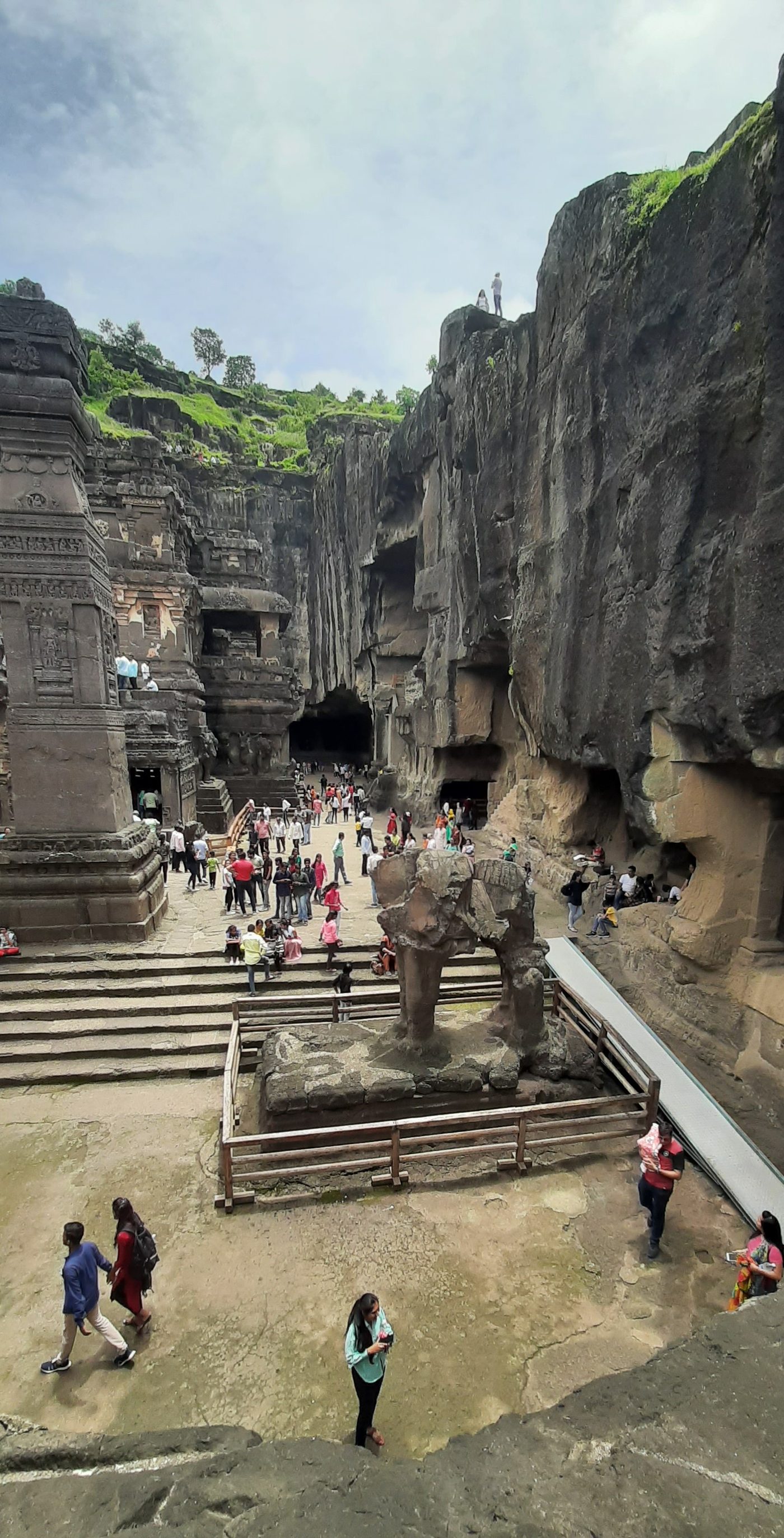
The Kailasa courtyard from the rim — the subtracted mountain, with a stone elephant on guard and visitors for scale. <small>Ankur22Oct, CC BY-SA 4.0, via Wikimedia Commons</small>
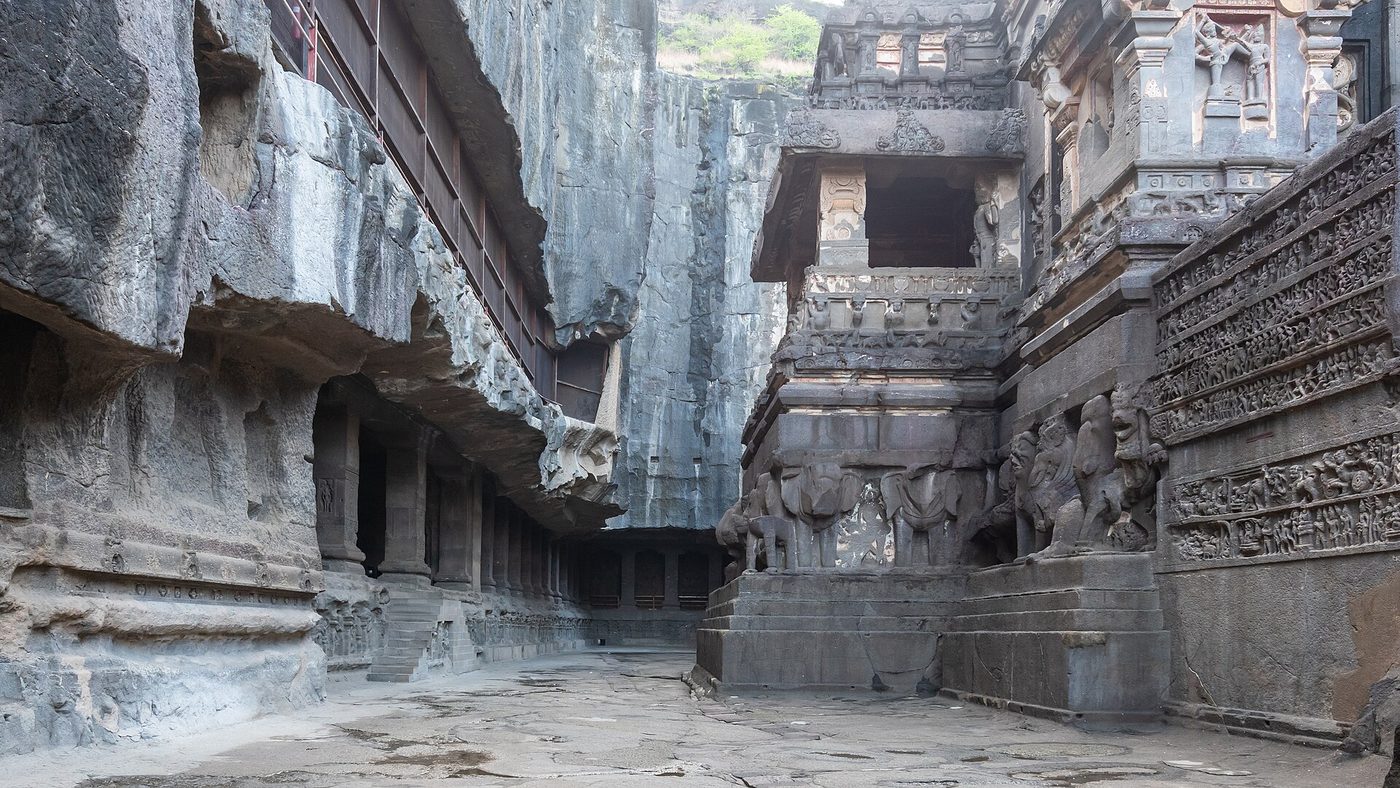
The temple in its court — galleries and epic reliefs cut into the living scarp. <small>Rohit Sharma, CC BY-SA 4.0, via Wikimedia Commons</small>
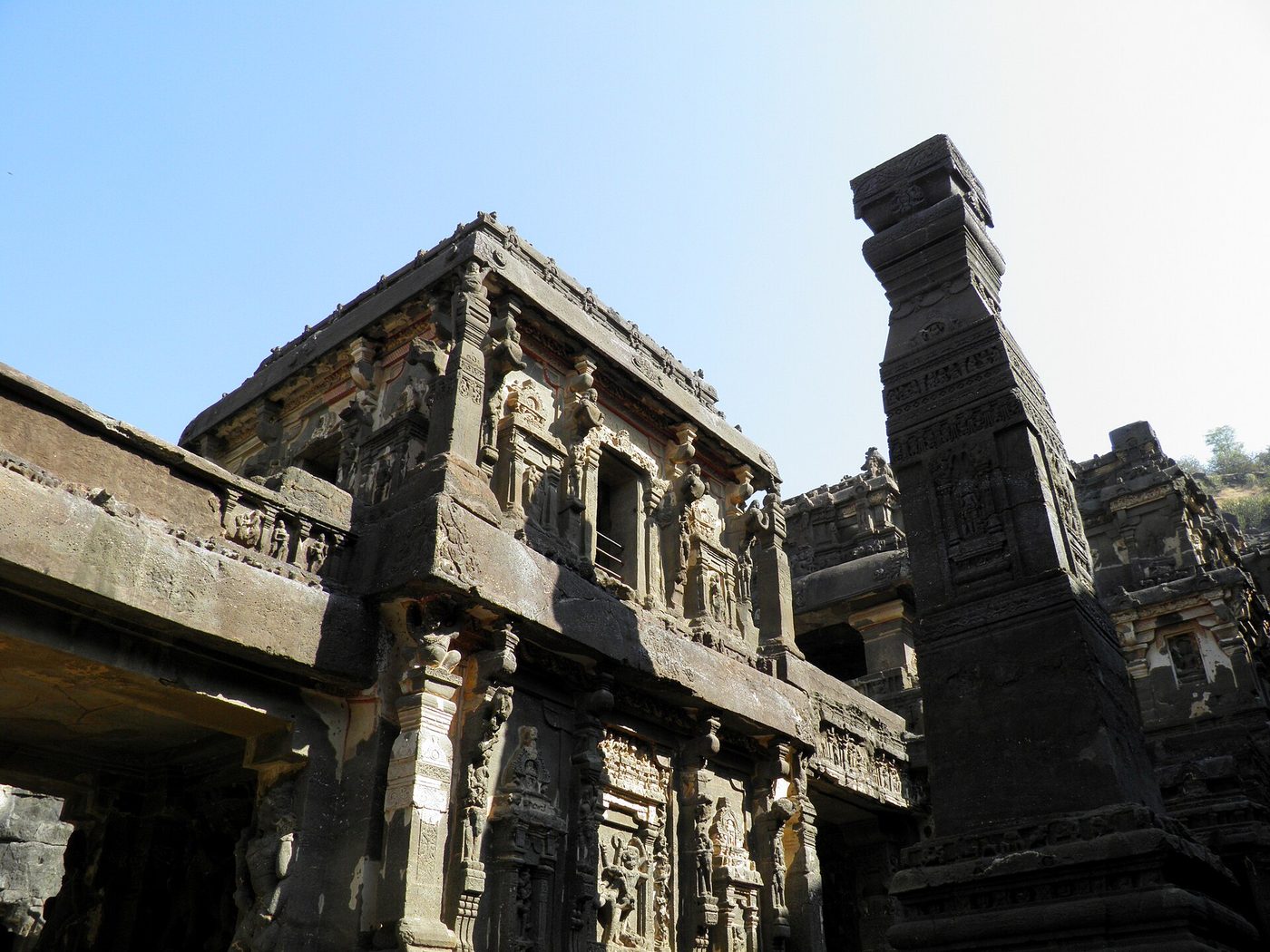
The Kailasanatha temple, Cave 16 — thirty-two metres of freestanding architecture, all one piece of rock. <small>Vasukrishnan57, CC BY-SA 4.0, via Wikimedia Commons</small>
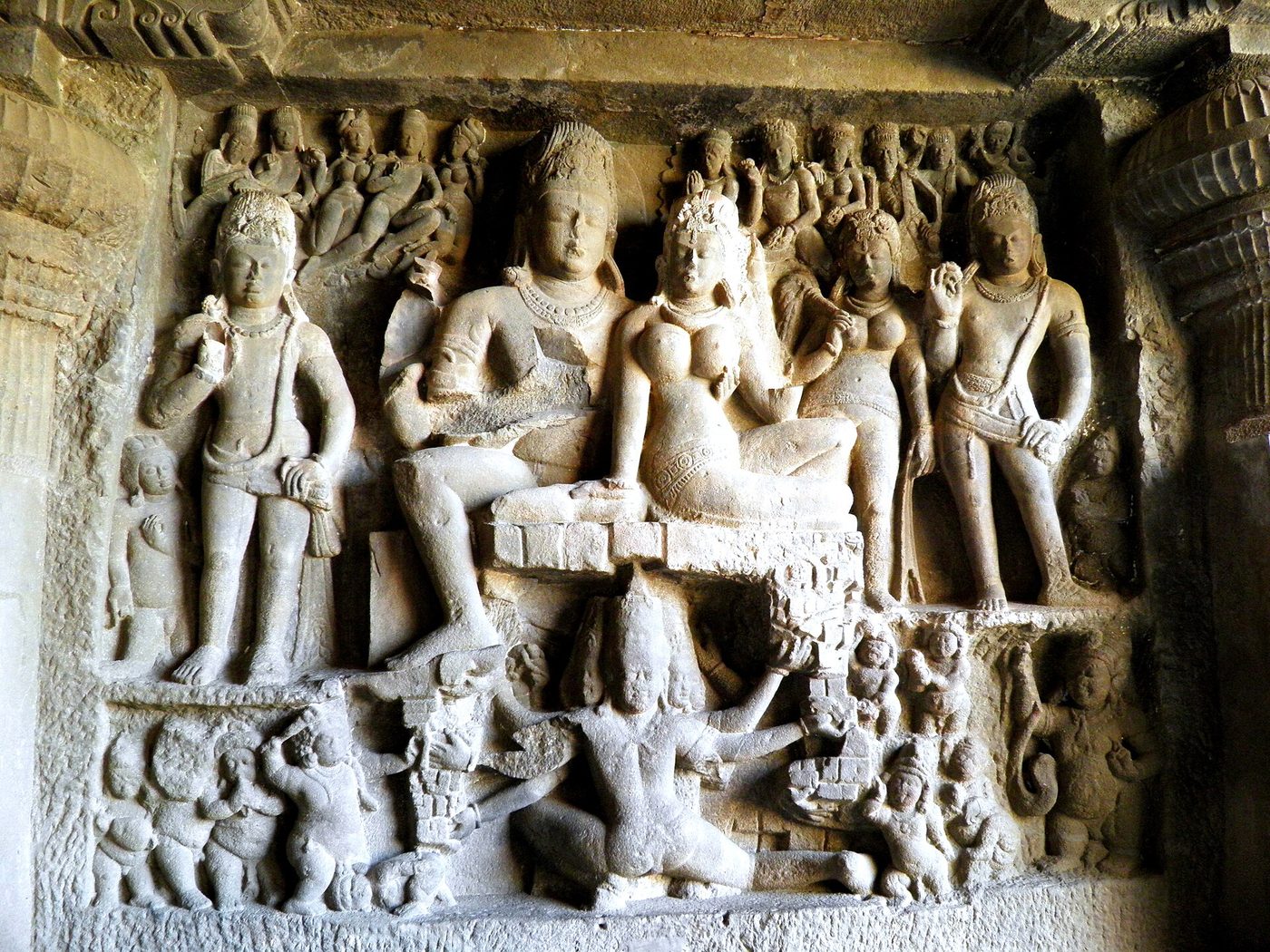
Ravana shaking Kailasa — the demon king's wheel of arms beneath the mountain, Shiva still above. <small>Vasukrishnan57, CC BY-SA 4.0, via Wikimedia Commons</small>
The three-faith cliff
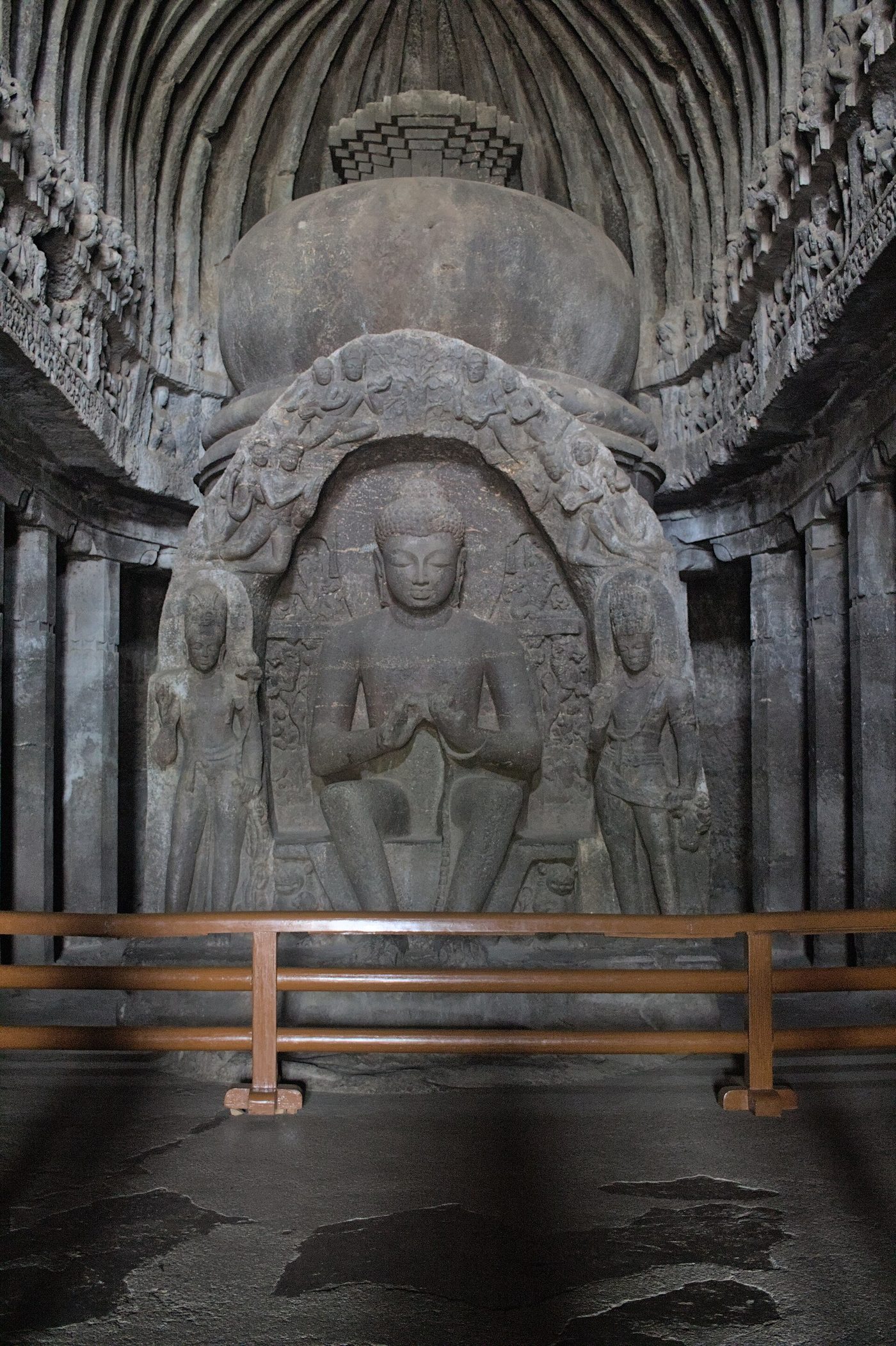
Cave 10, the Buddhist chaitya — a vaulted prayer hall whose stone ribs remember carpentry. <small>Shishirdasika, CC BY-SA 4.0, via Wikimedia Commons</small>
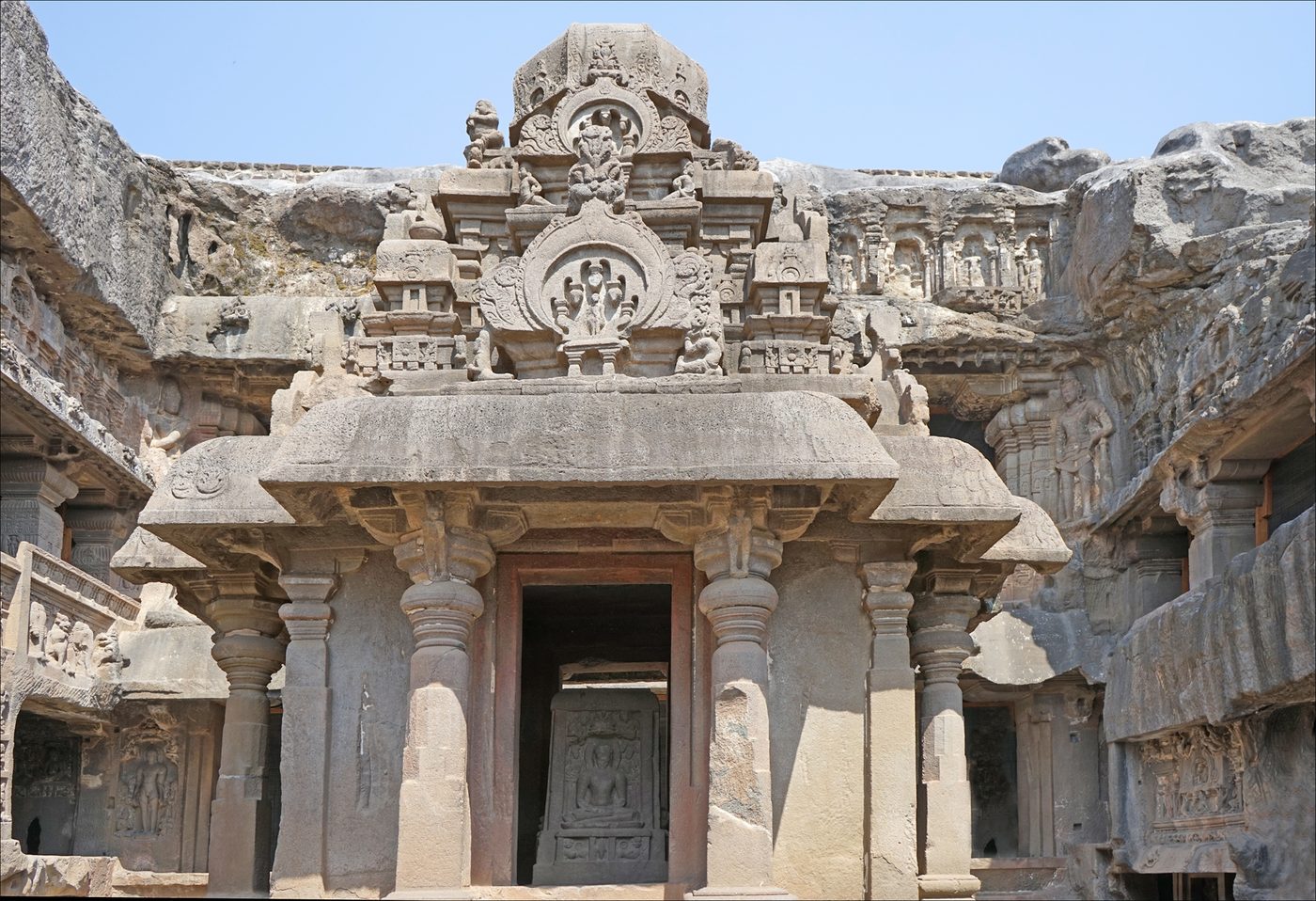
The Indra Sabha, Cave 32 — the Jain answer to the Kailasa, precision where the neighbour chose scale. <small>Jean-Pierre Dalbéra, CC BY 2.0, via Wikimedia Commons</small>
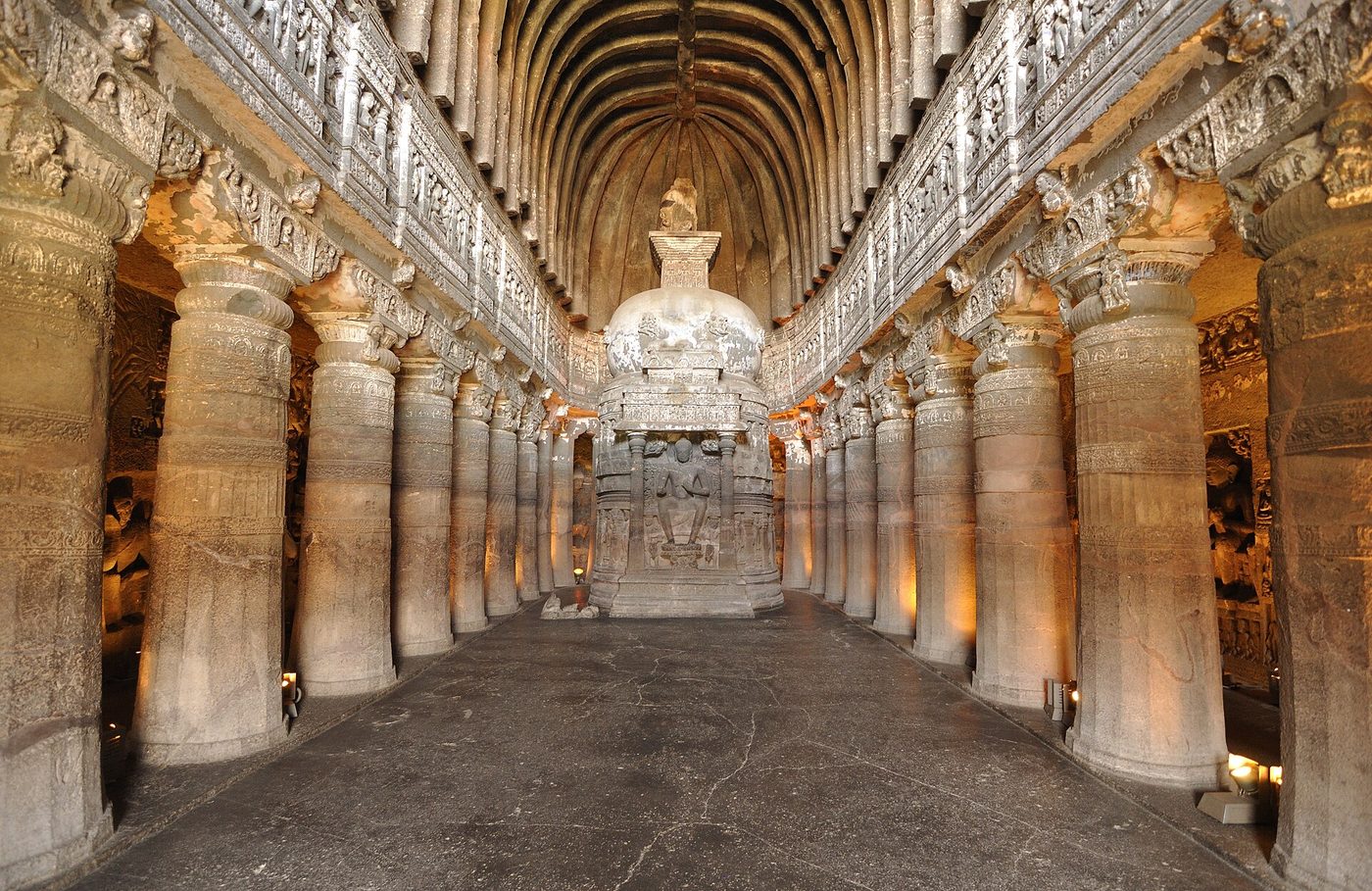
Cave 26 at Ajanta — the elder sibling: the Deccan's painted Buddhist gorge, a hundred kilometres away. <small>Dey.sandip, CC BY-SA 3.0, via Wikimedia Commons</small>
The family tree
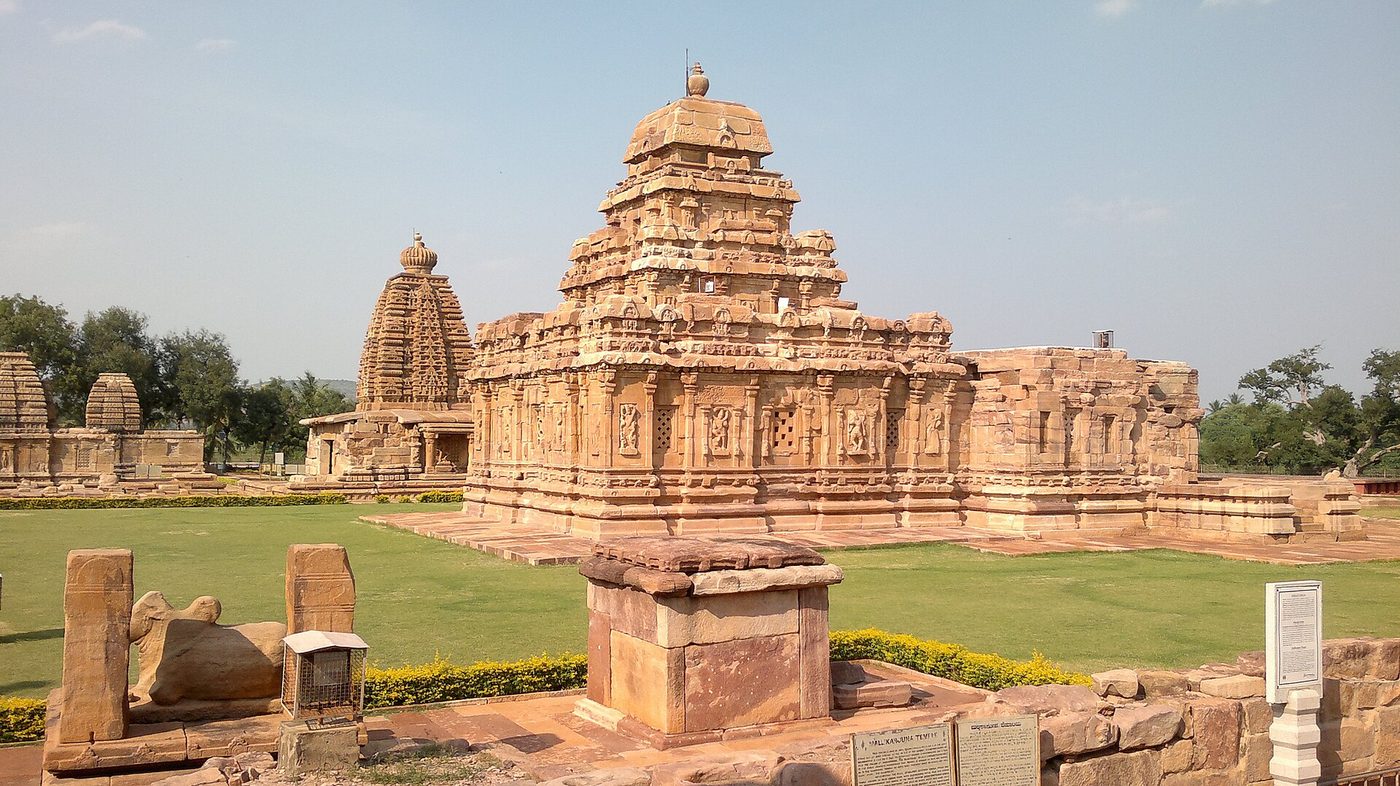
The Virupaksha temple at Pattadakal — the Chalukya parent whose design the Kailasa restates at double scale. <small>rajeshodayanchal, CC BY 3.0, via Wikimedia Commons</small>
The Pancha Rathas at Mahabalipuram — the Pallava concept cars: whole temples freed from single boulders, a century before Ellora's giant. <small>Timothy A. Gonsalves, CC BY-SA 4.0, via Wikimedia Commons</small>
The long custody
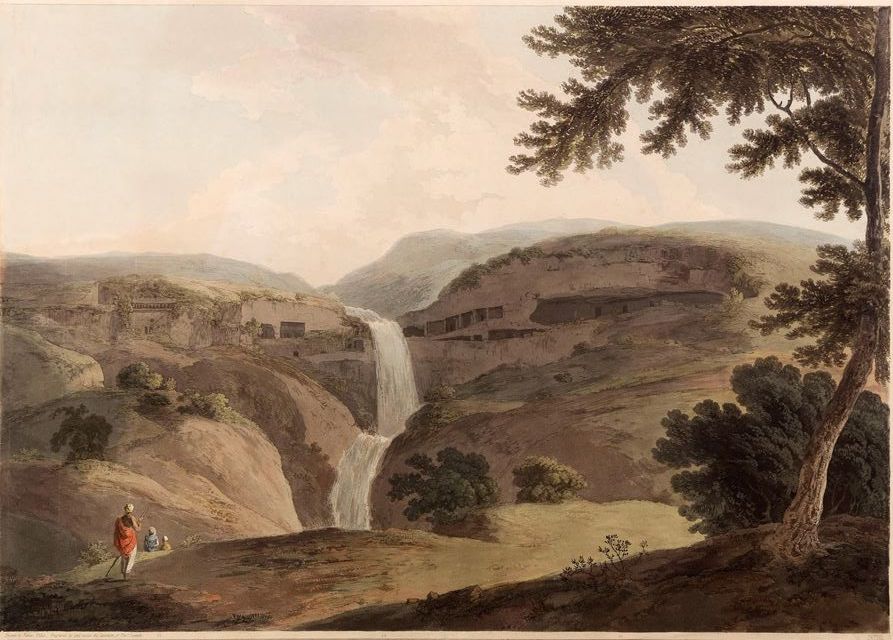
The rock-cut country through colonial eyes — a Daniell aquatint after James Wales, from Oriental Scenery (1803). <small>Thomas Daniell, after James Wales, public domain, via Wikimedia Commons</small>
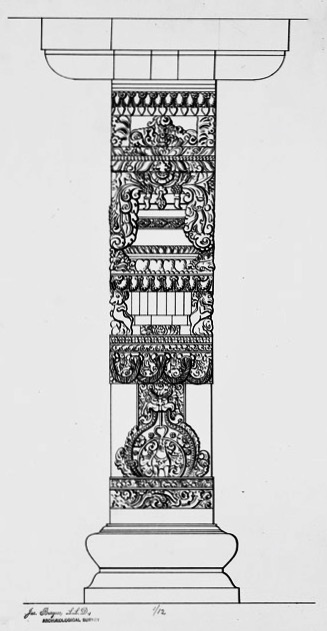
An 1876 Archaeological Survey drawing of a Kailasa column — the custodians' first instrument was the pencil. <small>Ms Sarah Welch, CC BY-SA 4.0, via Wikimedia Commons</small>
Note on scan imagery
<!-- END image-compendium-appendix -->