RELIC
(African Gold)
The African Gold Trilogy · Book Three
Andries J. Greyling
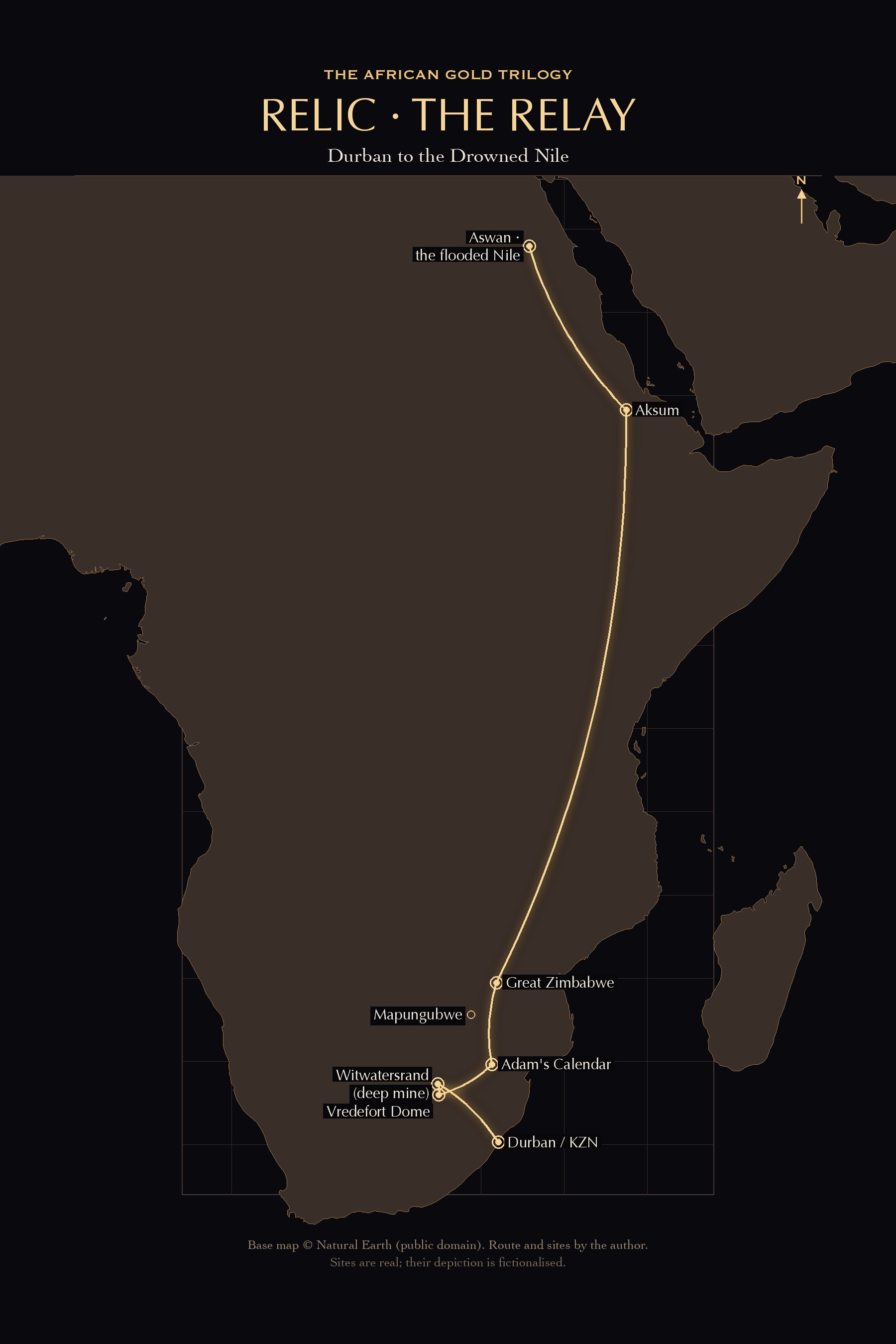
RELIC
Copyright © 2026 Andries J. Greyling. All rights reserved.
This is a work of fiction. Names, characters, places, and incidents are the product of the author's imagination or are used fictitiously. Any resemblance to actual persons, living or dead, events, or locales is coincidental. Real places, historical traditions, and scientific and archaeological references are used in a fictional context.
Published by the House of Greyling.
ISBN: _--_-_- (assigned at print)
Per Ardua ad Magnum.
For Morgan.
Who has, at nine, the rarest thing — a soft spot for everything hurt or broken, the animal no one else will sit with, the person the room has given up on — and the hands of a real artist, who can already see a thing and set it down true. This book ends with a woman who, given the power to fix everything by force, chooses instead to understand it and let it choose. That is your kind of strength. You drew it before I wrote it.
Keep the soft spot. It is not the opposite of strong. It is the whole of it.
Foreword
by Russell Cevic †
Let me tell you the secret of the adventure novel, since I spent a long and disgracefully enjoyable life keeping it. The secret is that it must never, for one single page, be embarrassed about what it is. The moment a thriller starts apologising — starts reaching for respectability, starts wanting to be Literature when it grows up — it dies, and it dies bored, which is the only unforgivable way for a thriller to go.
This book is not embarrassed. It knows exactly what it is, and what it is is a chase — a clean, propulsive, set-piece-driven hunt across real and magnificent ground for a thing worth dying over — and it pursues that thing with a grin and a full tank and no brakes, and I loved it without reservation, which at my age and mileage is not a thing I say often.
Here is what the author gets right that nine out of ten can't. He understands that velocity is a moral position. He never wastes your time. He never stops the truck to admire his own research, even though — and this is the part that delighted me — the research is plainly enormous and completely real. The ancient sites are real. The engineering is real. The gold is real, and it is not what you think it is, and I will say no more. He has done the homework that the lazy skip, and then he has done the thing the homework-doers usually can't, which is to wear it lightly, to bury it inside the chase so that you are learning the truth at sixty miles an hour and mistaking it for fun.
And it is fun. People forget that this is allowed. They forget that a book can be true and rigorous and still, primarily, a tremendous good time — that you can put real archaeology and real danger and a genuinely clever puzzle into a story whose first duty, whose holy duty, is to make a tired person on an aeroplane miss their meal because they could not put it down. This book honours that duty. It is generous. It wants you to have a good time, and it has gone to enormous trouble to make sure you do.
The hero is the right kind of hero for this — not a superman, but a person who can read the made thing, who walks into a five-thousand-year-old machine and treats its builders as colleagues rather than mysteries, and is therefore the only one in the room who knows which wire to cut. I have built a lot of heroes. This is a good one. I'd have put them on my own crew without an interview.
A word on the set-pieces, since they are my own first love. They are excellent. They are engineered — each one a clean little machine with a problem, a cost, and a key, handed off to the next like a baton. That is how it is done. That is the whole craft, right there, and the author has it cold, and I tipped my hat more than once.
So here is my advice, and it is the only advice this kind of book ever needs. Don't read it sitting up straight. Don't read it with a pencil. Read it the way it was built to be read — fast, greedy, grinning, and slightly too late into the night. The gold is waiting. The chase is on. And the man who wrote it has done the one thing I always cared about above every other: he kept his foot down.
Go.
— Russell Cevic
† “Russell Cevic” is an anagram of CLIVE CUSSLER — the master of the propulsive relic-hunt adventure — borrowed here in homage and affection. This foreword is a work of fiction. It was written by the author of this book. Clive Cussler did not write it, was not involved in it, and is not associated with or endorsing this book in any way. The name is rearranged precisely so that the tribute can never be mistaken for a real attribution; it is a salute, not a claim.
Contents
- The Gold Left Sleeping
- The Piece That Rings Wrong
- Provoked to Descent
- The Voice Without Edges
- Descent Into Depth
- The Bore That Shouldn’t Be
- The Oldest Scar
- The Wave That Guides
- What the Ring Remembers
- The Instrument’s Ear
- The Ring and the Route
- The Custody of Gold
- The Scattered Key
- The Seat of the Brotherhood
- The Key Assembled
- The Drowned Threshold
- Into the Drowned Light
- The Chamber Beneath
- The Outlet Opens
- The Machine Made Whole
- The Braid Closes
- Consent, Not Control
- The Threshold: Mind or Machine
- Bare Consciousness
- The Relinquishing
- The Light That Remains
The Gold Left Sleeping
They did not write it down. They tuned it into the stone, and left it asleep. —from the Builders' register (reconstructed; the Brotherhood's rendering)
The chamber is finished, and the finishing has changed the air.
Where the rock was cut, it gives back no echo. A footfall here does not bounce and scatter; it lands and is drawn into the stone, swallowed and held, returned a moment later as something lower and longer than the foot that made it. The walls are not flat. They curve in ways a hand could not measure and an eye would not trust. Long shallow troughs and ridges spiral up from the floor, each one set against the next at an interval that means nothing to the body and everything to the sound. The maker who stands at the centre does not look at the walls. The maker listens.
There is a hum under the silence. It is faint, below the place where hearing begins and feeling takes over, and it sits in the teeth and the breastbone rather than the ear. The chamber is waiting. The great curved bowl of the room is tensioned to a pitch it has not yet been given, the way a drumhead drawn taut across its frame is already a sound that has not happened.
At the centre of the floor there is a socket.
It is not ornamented. The maker's people do not ornament the working parts; ornament is for the things that do nothing. The socket is a recess cut into a block of darker stone seated flush with the floor, and the recess has a shape. A precise concentric throat, narrowing, ringed, machined to a tolerance that a later age will mistake for the carving of something holy because it cannot imagine the patience that made it merely correct. The light that reaches it comes down a long shaft from the southern sky, and at this hour the shaft holds a column of pale day, and the day moves slowly across the floor as the world turns, and where it touches the recess the stone takes on no shine of its own. The recess waits, empty, the way a lock waits.
The key is carried in by two hands cupped together, and it is small.
It is a disc of gold no broader than a palm, and it is the wrong colour. Gold, in the world above, is the colour of fire banked low, warm and soft and a little sullen. This is paler, harder, more like the inside of light than the outside of it, because it has been refined past anything the rivers or the reefs give up. Past the gold the inheritors will later kill for, past the gold the inheritors will later weigh against the lives of cities. Purity is only the condition. The point of it is the form: the disc is worked into a lattice so fine the eye reads it as a single surface and the fingertip, drawn across, finds a grain in two directions, a weave of channels too small and too even to be the work of a tool that scrapes. Held to the light from the shaft, the disc does not catch the light. It does something subtler. It seems to take the measure of the light and give nothing back.
It is cool in the cupped hands, and heavier than its size, and when the maker turns it once, checking the orientation against the throat of the socket, there is a way it goes and only one way. The edge of it meets the stone with a small dry note, gold on rock, and the maker seats it.
It does not click. It does not lock. It settles into the recess with the smallness of a thing finding the place it was made for, and the moment it is home the faint hum in the breastbone changes. It comes truer, as if a note that had been bent flat for a long time had been allowed at last to come to its proper pitch, and the relief of that is something the body feels before the mind decides it is relief at all.
Now the tuning.
The maker does not pray over the gold, though a later people, watching this from the far side of forgetting, will write it down as prayer and build a vocabulary of reverence around it and be wrong in a way that is also, almost, right. The maker sings. A single low tone held in the throat and chest, found by long practice and matched against the hum of the room until the two are one pitch and the difference between them, the slow beat of two near-notes wrestling toward agreement, drops and slows and stops. The disc is the impedance between the breath and the stone. Without it the throat sings to dead rock and the rock keeps its silence. With it the throat sings to the disc and the disc gives the song to the lattice and the lattice gives it to the curved walls and the curved walls, at last permitted, take the note up.
The chamber rings.
It is in the soles of the feet first. It comes from everywhere the maker is not, from the walls, from the floor, from the shaft of southern light, from the long bones of the listener, and it has a body to it, a pressure, a felt structure that climbs and stands. Dust on the ledges does not dance; it slides, all of it, into the same set of stripes across the stone, lines drawn by the standing wave where it grips the air and lets it go, grips and lets go, the geometry of the sound made briefly visible in grey powder. The maker holds the note and the note no longer needs holding. The room is sustaining it now. The room is feeding it back. And somewhere past the wall—past the rock, past the cut shaft, past any direction the body could name—something answers.
A second pressure arrives that the maker did not make. It is faint and it is distant and it is kin, a tone like this tone, returned across an interval of stone and earth too great to be an echo, a structure singing because this structure has begun to sing. Then a third, fainter still, farther, off toward where the sun will rise over a country the maker will not live to walk. The chamber is not alone. The chamber was never built to be alone. It is one throat in a thing with many throats, and the throats have found each other, and the air between them, the whole vast bowl of air over the world, has been set humming, for this held moment, as a single taut skin.
This is the instrument awake.
The maker stops singing. The room runs on without the breath, then less, then less, the pressure draining back down through the lattice and the disc and into the patient stone, the distant kin-tones thinning, fading, gone, until the chamber holds only the faint sub-hearing hum it held before. Tuned now, but quiet. Ready, but not used.
There are others present. They have not spoken. They stand around the bowl of the room and they have heard what the maker heard, the kin answering across the curve of the world, the proof that the gold is true and the thing they have spent lives cutting will do what it was cut to do. There is satisfaction in the stillness, the satisfaction of people who built a thing to a tolerance and found the tolerance kept. And there is the other thing, the heavier thing, the reason they stand and do not move to the next part.
Because there is a next part, and it is not to play it.
They could. The instrument is whole. One sustained breath from any of them would lift the standing wave again and hold it and grow it, and the thing the network is for would begin. They know what it is for. They are the only minds who ever will know fully, and that knowing is why no breath is drawn.
They do not carve the reason. The reason is a judgement, not a fact, and a judgement cannot be left lying about for others to pick up unweighed. They leave the means in the socket, true and ready, so that whoever comes after, with their own weighing and their own sky, can stand where the maker stands now and decide for themselves. To take the gold out would be to decide for that future that it should not be trusted. They have argued the leaving and chosen it. The disc stays.
The light from the shaft has moved off the recess. The day is going.
They seal the shaft last, fitting the cut stone home against the throat of light, and the column of pale day narrows to a blade, to a thread, to nothing, and the chamber takes its first full dark. The hum does not stop. It has nowhere to stop to. It sinks below the floor of the room into the floor of the body of anyone who might ever stand here again, a tension held in stone against a future that has not been born, and in the held dark the instrument waits, tuned, quiet, the gold left sleeping in its lock.
The Piece That Rings Wrong
He struck his own coin, and on it put a king and the moon, and called the gold his own. —of the kings of Aksum, as the old chroniclers reckoned them
The bench under Priya's hands was telling the truth and the screen was telling a lie, and she trusted the bench.
She had her ear half an inch off the housing of the centrifuge. The big one, the four-axis balancing rig the yard rented out to anybody on the south coast who needed a turbine wheel trued before they bolted it into something expensive. She was listening to it spin down through a frequency she could not have named but could absolutely have drawn. The technician beside her, a kid called Sibu who'd been hired three weeks ago and was already better than half the men twice his age, was watching the readout with the loyal patience of someone who had been told to wait and hadn't yet been told why.
"It says you're inside tolerance," Sibu said.
"It says that, yes." She didn't move her head.
The rig wound down. Eleven thousand revs, nine, six. Somewhere in the slope between five and four thousand there was a thing. A small thing, a swallowed thing, a beat under the smooth descending tone like a stone caught in a sock in a tumble dryer. Then it was gone and the rig sighed itself to stillness and the screen held its green number up like a child showing you a drawing.
"Again. Same ramp. Don't touch the trim."
Sibu spun it again. She closed her eyes this time. The visual cortex was a greedy animal and she wanted the bandwidth back. The tone climbed and crested and fell, and there it was again, in exactly the same place, four-six, four-five hundred. The little caught beat, a flutter that the sensor under the bearing cap was averaging into nothing because nobody had told the sensor that the interesting part of a signal is almost never the average.
"There," she said, to the room, opening her eyes.
"Where? Boss, the trace is flat."
"The trace is flat because the box is sampling at a rate that smears it. The box is wrong. The wheel has a crack in the back rim, inboard, behind where you can see, about"—she held her thumb and forefinger a centimetre apart and looked at the gap like it owed her money—"twenty millimetres long. No." She tightened the gap a little, checking it against the spin-down still running under her ear. "Under twenty. And it opens and shuts when the rim loads up around four and a half thousand, which is why it only sings then. Pull it. Dye-pen the back rim. You'll find it."
Sibu looked at the green number. Looked at her. He was twenty-two and he had not yet learned the thing the older men in the yard had learned the hard way, which was that the green number was a story the machine told about itself and Priya Ellis was the kind of person you wanted in the room when the machine was lying.
"If I'm wrong, I do the strip-down with you and you tell the others I cost you a Tuesday. If I'm right, you owe me nothing. I built that habit over fifteen years and a hospital bed. You'll build your own."
He pulled the wheel. The dye crept into the crack on the inboard rim like ink finding the line of a fold in paper, eighteen millimetres, behind where anybody looking would have looked. He stood holding it under the work light, and Priya was already three feet away wiping her hands on the rag at her hip, because the interesting part was over the moment the question closed.
This was the part of the day she would have kept, if anybody had offered her a way to keep it. The big roller doors were open down the long axis of the shed to the harbour side and the air came off the bay thick enough to chew: diesel, brine, the rotting-sweet of containers that had crossed the equator full of something organic, the cooked-tar smell of the yard's own bitumen where they patched the apron every winter and it failed every summer. Above the cranes the sky over the Bluff was doing the flat hammered silver it did in the wet season, no horizon, just a brightness that hurt to look at and didn't resolve into anything. Cicadas in the strangler fig at the gate, loud as a fault. The harbour traffic working its slow tonnage two hundred metres off. Durban breathing on her, layered like the rest of the city: the Hindu temple two streets down with its monthly fire, the one her gran had dragged her to every Diwali until Priya was old enough to win the argument; the call to prayer from the mosque by the rank; the Zulu the crane crews swore in; the Afrikaans the assayer up the road did his sums in; the Tamil her mother still counted in when she thought no one was listening. All of it folded together so long that nobody bothered to unfold it anymore. Four generations since a great-great-grandmother came off an indenture ship into this same wet heat, and the city had stopped being able to tell where one thread ended and the next began. Priya had never tried. She was the fold.
She liked the yard because the yard did not require her to be a person. It required her to be right. The two had a relationship but they were not the same thing, and she'd come a long way to a place where she could tell them apart.
Theo Price came in off the apron in the worst possible shirt and the kind of expression a man wears when he's been talking himself out of something for an hour and lost.
She clocked him before he was halfway down the shed: the walk too quick for the heat, the right hand pushed flat against the breast of the shirt over the inner pocket the way a man holds a wallet in a crowd, the eyes going to her and away and back. Theo had taught the man who built her the Guardian and Theo had a self-taught master's contempt for hurry, so a hurrying Theo was a Theo carrying something he could not put down.
"You're meant to be retired," she said. "It looked good on you for a week."
"I am retired." He stopped at the bench and didn't sit. "I've come about a coin."
"Then you want a fence, not an engineer. There's a man up Umgeni does coins. Terrible coffee, honest scale."
"I've been to the man up Umgeni." Theo's hand was still over his chest. "That's the problem."
She put the rag down.
He did the thing then that he had clearly rehearsed in the car and that fell apart in the doing. He glanced once at Sibu, decided the boy didn't matter, decided he did, then turned half away and took the inner-pocket thing out wrapped in a square of chamois leather, soft and dark with handling, and set it on the bench between them and folded back the corners himself, slowly, half expecting it to have changed since he last looked.
It was a disc of gold a little larger than a fifty-cent piece and about three times as thick, and the first thing that was wrong with it was that it was the wrong colour.
"That's not coin gold," she said.
"No."
It wasn't twenty-two carat, the warm orange-yellow of every Krugerrand the man up Umgeni had ever weighed; it wasn't even pure-bar yellow. It was pale. It was the pale of gold that has had everything taken out of it that was ever in it, a colour that lived nearer the white end of yellow than gold has any business living, and it caught the work light without the soft buttery bloom of soft metal. It took the light hard, clean-edged, the way a surface takes light when it is doing something with it.
"May I," she said, and didn't wait, because the asking was a courtesy and the hand was already moving.
She picked it up.
It was heavier than it had any right to be for its size, which told her purity before any instrument could; gold densifies as it sheds its alloys, and her hand had weighed enough metal over enough years to do the arithmetic without numbers. The weight was only purity. The face was the wrong thing.
She turned it under the light. It was not a coin. A coin is a relief: a head, a springbok, a date, a value, the whole purpose of a coin being to be read at arm's length by a stranger who must trust it. This had no head, no animal, no number. What it had, on both faces and worked through the rim, was a lattice. A structure, not a thing engraved on the surface but worked clean through the metal. Fine channels cut into the gold in a repeating cell, the cells nesting, the nesting changing scale from rim to centre in a progression her eye walked before she could stop it, each ring of cells a fixed ratio smaller than the ring outside it, and the channels were not cut to a constant depth, they stepped, the steps following the same ratio, so that the whole disc was a single geometric idea expressed in three dimensions and held to a tolerance she could feel under her thumb because there was nothing under her thumb to feel: no burr, no draft, no chatter, no place where a tool had lifted and set down.
Her first thought was that it was a standard. A reference artefact—a diffraction grating, a calibration mass, one of those obsessively-made objects a national lab turns out once and locks in a drawer, gold for its inertness, the lattice a ruled scale. She held that thought for as long as it took to turn the disc over, because it was the comfortable answer, the one that kept the object inside the world she already knew. Then it came apart in her hands. The cells changed scale from rim to centre—a ruled standard does not taper, the whole point of a standard is that it doesn't—and the channels ran through the metal, not across a face, and no lab on Earth ruled a grating into the bulk of a thing in three dimensions for the simple reason that nobody had ever needed to. She had wanted it to be a standard. It declined.
She had seen a great deal of fine work. She had seen watch movements under a loupe and turbine blades grown a crystal at a time and the inside of the thing she'd spent four years calibrating that had, in the end, been a mind. She had not seen this. This was machined to a tolerance that the word machined insulted, and it had been done to a piece of gold so pure it should have been too soft to hold an edge, which meant either the metal had been worked at a temperature and in a way she did not understand, or it had been worked by something that did not care how soft the metal was because it was not cutting at the scale where softness mattered.
"Where's it from." A demand, not a question.
"That's the thing." Theo had sat down now, on the stool, uninvited, the way a man sits when his legs have made the decision. "The man up Umgeni—Roeloff—he's been doing the Brotherhood coin for years. The old minting. Knows them by the marks; reads the dies better than the men who struck them. Says he's never seen this, and he wants it gone. Says it came in with a lot off a deceased estate, a man who'd worked the deep reefs, and it shouldn't be in the lot, and the lot's paperwork is right except this isn't on it. He assayed a scrape off the rim three times because the number was wrong, and then he stopped, because"—Theo turned his hands over—"because Roeloff is sixty-three and superstitious and he said it rings wrong."
"It's metal. Metal rings."
"He didn't mean a sound." Theo looked at it on her bench. "Well. Partly. Said when he set it down on the steel of the scale it didn't tick, it—hummed. A little. And held. And then stopped. And he doesn't like things that decide when to stop on their own."
Priya did not say that's resonance, that's a high-Q geometry coupling into the steel and decaying on its own time constant, there's nothing in it but physics. She had spent half her life saying versions of that sentence to frightened men and watching it not land, because what frightens a man about a thing that hums and stops is never the physics, it is the decides. So she said nothing, and she set the disc flat on the steel apron of the bench, and she tapped it once with the back of a fingernail, and it rang.
It rang like nothing that small had a right to ring. A pure tone, very high, with no buzz under it, no second voice. A single frequency that came up out of the metal and stood there, sustained, sustained, sustained past the point where it should have died, and then bent. She heard it bend, a few cents flat, as the tone shed its energy into the cooler steel below it. Then it was gone, all at once, cleanly, like a held note released by a singer rather than the rough ragged dying-off of a struck bell.
Sibu had stopped pretending to clean the centrifuge wheel.
"Q of a few thousand, easy," Priya said, to herself, because the number was a handle and she needed a handle. A struck bell, a good one, cast bronze, rang with a Q in the low hundreds. It stored its energy a hundred-ish cycles before friction ate it. This thing was storing energy a thousand times over and giving it back so reluctantly that the giving-back was audible as a process, a deliberate-seeming exhalation, and that wasn't the metal, gold was a soft lossy thing, that was the geometry (the lattice, the nesting cells, the stepped channels), that was a structure built to store and release vibration with almost no loss, which was a thing you built when you wanted vibration to go somewhere rather than die where it started.
She was holding a resonator. A small, finished, exquisitely tuned resonator, in a metal chosen because it would still be tuned after ten thousand years of doing nothing, formed into a geometry whose only conceivable purpose was to take a vibration in and hand it on, clean, to whatever it was coupled to.
The wrong thing about the gold piece wasn't that it was too pure or too finely made.
The wrong thing was that it was for something.
"Theo." Her voice had changed and she heard it change and didn't care. "Why did you bring it to me."
"Because you're the only person I know who'd look at it and ask what it's for." He said it plainly. He had been Arin's teacher, and before that a great many other men's, and the thing Theo Price could not do was lie to a person about why he'd come. "Roeloff wanted it gone before close of business. I drove around for forty minutes deciding whether to drop it in the harbour. Didn't. Wanted to tell myself it was the gold, the value. You and I both know that's not the reason."
"No." The reason was the bend in the tone. The reason was the lattice that walked her eye in a ratio she hadn't finished resolving and now would not be able to leave alone. The reason was that someone had stood somewhere, at some bench of their own, and decided every dimension of this object on purpose, against a requirement she could not see, and the not-seeing was already a splinter under the nail of her attention and would stay there, throbbing, until she dug it out or it killed her.
She turned away from the bench because she needed her hands to do something that wasn't holding the thing. She found the rag again, found nothing on her hands worth wiping, wiped them anyway.
"What did Roeloff assay it at."
"He wouldn't give a number. Higher than he'd ever measured, he said. Didn't believe his own kit."
"His kit's good. XRF?"
"XRF and a touchstone, then a density on his own scale to check the XRF, and the two didn't agree. And the way they didn't agree was wrong." Theo paused. "Density said it was purer than the surface."
Priya stopped wiping her hands.
Surface-pure-but-the-bulk-purer was not a thing that happened to a coin. It was not a thing that happened to a bar. Refining drove impurities out, toward surfaces and grain boundaries; you got a clean surface over a less-clean core, never the reverse, unless someone had taken a metal already too pure to occur and then done something to the outermost few microns of it, alloyed it down, or oxidised a skin, or simply let it sit and grab a hair of contamination off ten thousand years of air, so that the inside was the original thing and the outside was the world's fingerprints on it.
Which meant the core was the made thing and the surface was the age.
She picked it up again and held it to the work light edge-on and looked at the rim where the channels ran through, and there, where a tool would have had to lift and re-enter, where any cutter she had ever heard of would have left a witness mark, the channel simply continued, around the curve, through the rim, out the far face, one continuous unbroken cut as if the gold had been formed around the geometry rather than the geometry cut into the gold.
"Someone made this," she said. Quietly. "Someone made this to do something, and they made it to last, and they made it before there was anyone to sell it to."
Theo didn't answer. There wasn't an answer. Sibu had gone very still by the centrifuge.
She set it down. The splinter was in. The three nights were already gone. She could feel them going, the ordinary calendar of her week peeling away from her like the skin off a wet cast, the dinner she wasn't going to eat and the sleep she wasn't going to get and the small clean life she had assembled here at the harbour's edge specifically so that nothing would ever again be allowed to take her sleep by force. It had taken her sleep anyway. It always did. She had stopped pretending the door had a lock.
"I want the lot paperwork. The estate. Who the deep-reef man was, where he worked, what he came up with. A piece this old in a Durban estate lot didn't fall out of the sky. It came up out of a hole, and somebody who knew what they were looking at put it in a pocket. Either he knew what it was or he didn't, and both are worth knowing."
"Roeloff won't give you the paperwork."
"Then I'll give Roeloff a reason." She was already moving toward the small glass office at the back of the shed where she kept the things she could not afford to lose in a fireproof box she had bought herself, because the man who'd promised to buy it for the yard four years ago had retired and the box had retired with the promise. "Don't drop anything in the harbour again, Theo. You don't have the temperament."
He stood. He looked relieved and frightened in the proportions of a man who has handed off a burden and watched it be picked up by someone it will now ride all the way down, and understands that he has done that to her.
"Priya." He stopped at the edge of the office light. "One more thing Roeloff said. When the estate firm couriered the lot to him, the courier waited. Sat in the car park the whole hour Roeloff worked. And when Roeloff phoned to ask why the rim piece wasn't on the manifest, the man who answered didn't ask what piece. He said, which piece." Theo turned his hands over one last time. "Which one. As if there were a list of them. As if he was checking which one had got loose."
The cicadas in the strangler fig had stopped. She noticed because she noticed everything; she catalogued it the way she catalogued the bend in a struck tone, logged it cold and without alarm, and only afterward, half a second afterward, the meaning arriving a beat behind the fact, understood that cicadas stop for a shadow, for a footfall, for a car door at the wrong distance, and that the open roller door to the harbour side framed a flat silver brightness in which a vehicle she had not heard arrive was now sitting at the far end of the apron with its engine off and its windows up: the posture of someone not coming in and not leaving, with all the time there is.
She did not look at it directly. She walked into the glass office and put the disc in the chamois and the chamois in the fireproof box and the box under her arm, and she came back out into the shed unhurried, because the difference between a person who has not seen you and a person who has seen you and is pretending not to is a difference the watcher reads instantly, and she had no intention of telling them which one she was.
"Sibu. When you've dye-penned the wheel, log the crack length and put it on the board. Same deal as always. Lock the office when you go."
"Boss," Sibu said, with the wheel in his hands and his eyes too wide, and to his enormous credit he did not look at the car either. He'd grow up fine. He'd grow up to be the kind of man who reads a room the way she read a bench.
She walked Theo to his car the long way, along the inside of the shed, in the shadow, past the four-axis rig and the bins of failed castings and the welding bay with its curtain, and at the gate she put her hand on the door of his bakkie and leaned in as if she were saying goodbye and said, low, "Don't go home. The institute address I'll text you. Wait there. Don't tell anyone. Including Roeloff. Especially Roeloff. He's sixty-three and superstitious and he'll fold the second a polite man in a good shirt asks him to."
"Priya—"
"They didn't come for the coin." She straightened up and gave the warm metal of his door two flat pats, the gesture you'd give a horse. "The coin came back on its own. They came to find out who'd notice. And I rang it on a steel bench in front of an open door."
She let him go. The bakkie pulled out past the strangler fig and the car at the far end of the apron did not move and the harbour worked its tonnage and the silver sky held its brightness without resolving into anything, and Priya Ellis stood in the mouth of her own shed with the box under her arm and the splinter in deep, and understood that the quiet life she had built at the edge of the water had been a thing she'd been allowed to have right up until the moment she picked up a piece of gold and asked it what it was for.
She did not look at the car.
She had its plate already. She had the angle of the sun off its windscreen and the half-second too long it had taken to not-move when Theo's bakkie crossed its line of sight, and she had the thing about the courier, which piece, turning over in the part of her mind that never stopped, that had cost her sleep and food and the people who'd wanted her attention an hour ago for as long as she could remember, the part that could not, would not, did not know how to leave a question lying about on a bench unanswered.
The deep-reef man had brought it up out of a hole.
Holes had records. Reefs had names. The deepest holes on Earth were a night's drive up the road on the great gold arc, four kilometres down into rock older than the air, and somewhere in the paperwork of a dead man who'd worked them was the level, the stope, the date, the place a thing this old had been waiting in the dark to be picked up by a hand that didn't know what it was holding.
She went back inside, sat at the desk in the glass office where the watcher could see her sit, opened her laptop, and started pulling the estate firm's filings while the box that wasn't hers and now was sat under the lamp at her elbow, the gold inside it tuned and patient and ten thousand years from caring who held it.
Behind her, in the shed, the centrifuge spun up one more time as Sibu reset it, climbed its tone, crested, and on the way down hit four and a half thousand and sang its small caught flutter, the crack opening and shutting, the thing the box had been averaging away, and then fell silent into truth.
She did not hear the car leave. When she looked up, an hour and three nights gone, it was simply not there, and the apron was empty, and the harbour was dark, and she had a name, a level, and a four-kilometre descent she had not yet decided to make and already knew she would.
Provoked to Descent
The disc sat on her kitchen table at three in the morning under the desk lamp she'd carried in from the spare room, and Priya hadn't moved in forty minutes except to write.
She wrote in a school exercise book because the laptop was too fast—it let her round off, autocomplete, assume. The pencil made her say things once and exactly. Mass 31.04 g. Diameter 44.6 mm. Thickness, centre, 2.91 mm. Thickness, rim, 3.04 mm. The rim was thicker than the centre. That was wrong for a coin, where you wanted the rim proud to protect the device, but you wanted the proudness symmetrical, struck, not—this. This was turned. The taper was continuous, a faired curve from rim to centre, a profile someone had specified to a thousandth and a machine had cut.
She held it under the lamp and the lattice inside it came up like frost on a window: a fretwork of voids she could see through at certain angles, the metal lacy where it had no business being lacy, gold so pale it was nearly the colour of old bone. Pale because pure. Pure because—she put the pencil down.
The purity was a specification. You refined gold this far for one reason: to take the loss out of it, to make it ring clean and hold the ring.
She'd circled that at Roeloff's bench and not let herself finish it. She finished it now, in the exercise book, because writing made it a fact she had to own: Purity tunes Q. The lattice is the resonator. The disc is a part.
She underlined part twice and felt the splinter go in another half-millimetre.
Sibu had the gates open by six and Priya was at the yard before the kettle, which was unlike her and which he noticed, because he looked at her over the top of a delivery docket and said, "You didn't sleep."
"I built something last night," she said. "Don't make me regret it."
He didn't ask what. He'd worked for her three years and the rule between them was that she told him things when they were ready to be told and not before, and in return he never once mistook her silences for rudeness, which was a thing most people got wrong about her in the first conversation. He went back to the docket. She went to the office.
The estate firm was called Verwey & Associates and their letterhead had the kind of restraint that money learns. She'd pulled their registration the night before. A closed corporation, two listed directors, a postal box in Westville, a phone number that rang to a switchboard and then to a voicemail with no name on it. The miner's name was Daniel Mokoena. Sixty-one at death. Deep-reef sinker, four decades on the West Wits line, the kind of man who went down a vertical kilometre before breakfast for most of his life and came up grey from the dust and the dark. The disc had come to Theo through Mokoena's estate as part of a lot of "personal effects, mineral specimens, sundry," and Theo had taken it to Roeloff because Roeloff bought sundry gold and because the photograph in the estate catalogue had been bad enough that nobody in the auction room had bid more than scrap.
She called Verwey & Associates at half past eight and a woman with a careful voice said Mr. Verwey was with a client.
"It's about the Mokoena lot," Priya said. "The mineral specimens. There's a gold disc, lot 14. I want provenance. Where'd he get it?"
"I can take a message."
"You can take a question. Where did Mr. Mokoena get it?"
A pause a half-second too long to be a person looking something up, and exactly the length of a person deciding what to say. "The estate documentation is closed once a lot is sold, ma'am. I can put you through to—"
"To the voicemail with no name," Priya said. "Yes. We've met."
The woman did not laugh. The woman said Mr. Verwey would call back, and the line went, and Priya sat looking at the phone and writing in the exercise book, because the woman had not asked which disc, which lot, what she meant. A clerk fielding a provenance query asks which item, ma'am. A clerk who already knows which item asks nothing.
She wrote: They expected the call.
Roeloff's shop was off Grey Street, behind a roller door painted the brown of dried blood, in the part of the city where the gold-buyers and the bail bondsmen and the men who would change your dollars at a rate you'd regret had clustered for a hundred and forty years because that was where the harbour money came ashore. Priya didn't like the part of town and Roeloff knew it, which was why he was surprised to see her at half nine when his daughter let her in through the cage.
He was a big man gone soft, with the steady hands of someone who'd spent a working life holding a loupe to a stone, and when he saw the disc come out of her bag he stepped back from his own counter as though she'd put a snake on it.
"I told Theo," he said. "I don't want it back."
"Not selling. I want what you remember."
"It rings wrong." He said it flat, the way a superstitious man says a thing he's tired of being afraid of. "You put it on the scale and it sat there and the scale wouldn't settle, it just kept—and then I knocked the bench, by accident, my elbow, and it went on after the bench stopped. A coin does not do that. A coin is a dead thing that happens to be round."
"How long did it go on."
"I don't know. Long enough that my daughter came through to ask what the sound was and there wasn't a sound, not one you could put a name to, just—" He stopped. He was a careful man and the carefulness had failed him for a second and he hated it. "It was under the floor of your ears."
"Below twenty hertz," Priya said. "Infrasound. Sternum, back teeth, not the ear. Not a haunting. A frequency you're built wrong to hear."
"I know what it is now," Roeloff said. "You don't have to be kind to me. I'm telling you what it was like." He looked at the disc and away from it. "I weighed maybe forty Krugerrands a week in this shop for thirty years. Bullion is bullion. You learn the weight in your hand and after a while you don't even look. This one I looked at." He tapped his own chest. "It looked back."
She let that lie there. She didn't believe a piece of metal looked at anyone, and she would not insult him by saying so, and she also understood, exactly, what he meant, because she'd sat with it at three in the morning and the lattice had come up like frost and she had felt it too.
"Who else asked about it."
His daughter, restacking trays behind him, went very still.
"What do you mean, who else."
"You said you don't want it back. People don't fear a thing because it's strange. They fear it because something happened. Who else asked, Roeloff."
He wiped his palms down his thighs. "A man came. Day before yesterday. Before Theo took it to you." He gripped the name Theo as he said it. "Suit. Soft voice. Not from here, the accent was—I don't know. English schools, that sound. He didn't want to buy. He wanted to examine. Had a card, a metals consultancy, very clean. Asked had I taken in any gold of unusual purity recently, any specimens, any—he used the word non-commercial forms." He looked at her now, the fear in him gone hard and useful. "Three currency collapses I've been through, four kinds of police. Nobody who wants to buy gold says non-commercial forms. He wasn't a buyer. He was—what do you call it. A surveyor. Of who has what."
"And you told him."
"I told him I don't take specimens, I take metal by weight." Roeloff's jaw worked. "Which was a lie, the disc was in my drawer while I said it, and he knew it was a lie, because he smiled like a man who'd written my answer down before he asked. Left a card. Said if I remembered anything I should ring, day or night, wrote a number on the back in pencil." He went to the till, opened the cash drawer, lifted the tray, and under it brought out a small white rectangle and slid it across the counter, holding it by the edges as though it were evidence, which it was.
The face of the card said Hennessy Metallurgical Advisory and an address in Sandton and nothing else. No name, no logo. The back had a mobile number in soft pencil, and beneath the number, in the same pencil, a single line of small block capitals: NO TRACE NECESSARY.
Priya read it twice. The phrasing wasn't a threat and wasn't a courtesy. It was an instruction to someone, written in front of someone else, which meant it was meant to be read by the person it was shown to (we will not bother you, you will not be on a list, this is clean), and the very cleanness of it was the threat, because a man who promises you no trace is a man who deals in traces.
"Keep the card," she said.
"I don't want it."
"Then I'll keep it." She put it in the exercise book, between They expected the call and the next blank page. The two notes belonged together. "If he comes back—"
"He won't. He got what he wanted from me. He wanted to know the thing existed and that it had moved. I told him both without meaning to." He looked old, suddenly, in the cage light. "Whatever it is, Priya. Whatever it's worth. It's not worth what it'll cost. I've buried two men who chased gold that wanted chasing. You're cleverer than they were. Be cleverer than this."
"It's not gold I'm chasing," she said, and heard how it sounded and didn't soften it. "Thank you for the weight of it. In your hand. That helps."
She drove back along the Berea with the disc zipped into the inside pocket of her jacket against her ribs, where she could feel the small cool circle of it through the lining, and she watched her mirrors because she'd seen the car the night before and because Roeloff's man with the soft voice had turned a vague unease into a parameter she could measure.
There were two ways to be watched. One was paranoia, which was a fault in the observer. The other was data, which was a property of the world. The difference was whether the watcher behaved like a function of you. A man parked outside a yard at random was noise. A man who was outside the yard last night, and was now three cars back on a road she'd chosen on a whim, was a signal, and the interesting part of a signal was almost never the average.
She did not see the same car. She saw a different one, a grey saloon, hang back at the lights on Musgrave and turn when she turned and stop short of turning into her own street when she did. That was either coincidence or competence. She drove past her flat without slowing, took the next left, the next, came back round the block, and the grey saloon was gone and a white bakkie with a roof rack sat where the saloon had been, nose-out, engine off, a man in the cab not looking at a phone.
A person who has not seen you sits a particular way. A person who has seen you and is pretending he hasn't sits a more careful way, and the carefulness is the tell. A held breath, louder than a breath.
She parked two streets over and walked in through the lane behind the flats, past the bins and the security gate the body corporate kept meaning to fix, and let herself in the back, and stood inside her own kitchen with her back to the door and the disc against her ribs and did not turn on the light.
The exercise book was on the table where she'd left it. The pencil was where she'd left it. The disc was on her body. There was nothing here for anyone to take that she had not taken with her, which she had arranged on purpose at three that morning without admitting to herself that she was arranging it.
She made tea in the dark and drank it standing and looked at the man in the bakkie through the gap in the curtain, and she thought, with the flat clarity she trusted more than any feeling: He's not here to take it. If he wanted it he'd have come last night, when it was at the yard and I was asleep. He's here to watch where it goes. The disc was a coin that came back on its own. Theo had said it himself. It surfaces, someone notices, and the noticing is the thing they're harvesting. They weren't recovering an object. They were mapping the people who'd touch it.
Which meant the worst thing she could do was hide. Hiding made her a node. Moving made her a line, and a line pointed somewhere, and the somewhere was the only thing in this that she wanted.
She finished the tea. She rinsed the cup, because she could not leave a cup unrinsed even when being watched, and the small domestic ordinariness of it held its own against the man in the bakkie.
The provenance was the puzzle, and a puzzle was the narcotic that worked on her, and so she went down into it completely, for the next eleven hours, with the curtains drawn and the laptop and the exercise book and a plate of toast she made and forgot.
Daniel Mokoena, deep-reef sinker. She found his union records, public, dull, beautiful: a working history written in shaft numbers and seam designations and the bland code of a man's whole adult life. West Wits line. Carletonville. The deepest workings on the planet, the gold that lay in the Witwatersrand basin in reefs older than oxygen in the air, laid down when the only life on Earth was scum on a tide-flat, nearly three billion years of pressure and heat between then and a man with a drill at four kilometres' depth in a temperature that would cook you if the refrigeration failed. She knew the numbers. Everyone in this country who'd ever touched engineering knew the numbers; they were a national legend told in deaths.
She cross-checked the assay. This was the thing that wouldn't sit, the thing she'd circled at three a.m. and circled now in daylight she couldn't see.
The disc's gold was too pure to be Witwatersrand gold. Witwatersrand reef gold ran with silver, with traces of other things, a natural alloy you could fingerprint to its seam the way you could fingerprint a man. She'd had Roeloff's XRF on it and the numbers were absurd. Purity she could only get with a deliberate refining process, electrolytic at least, more likely something she didn't have a name for, and gradient purity, purer in the core than at the skin, which was the opposite of how refining worked and the opposite of how corrosion worked, because gold doesn't corrode. Gold was the metal that came out of the ground bright after a hundred million years.
So the surface impurity wasn't contamination from outside. It was age. The core was the made thing and the surface was the time that had passed over it, and the only mechanism she could construct for that put the manufacture impossibly far back, further than any process she could source, in a place that had the gold and the depth and the dark to hide a thing that long.
The kettle had gone cold an hour ago. She poured the dead tea down the sink, stood a moment with her hands flat on the counter, and went back to the book.
She wrote: Material says Witwatersrand. Purity says not human, or not us, or not now. Both can't be true. So: made HERE, from local gold, by someone with refining we don't have, a very long time ago.
She looked at the sentence. It was the kind of sentence that, written by anyone else, she'd have shredded as a category error or a fraud. She wrote (check fraud) beside it and then, an hour later, when the metallurgy still wouldn't give her a fraud that could fake a purity gradient, crossed (check fraud) out.
The estate inventory had Mokoena's "mineral specimens" as eleven items, of which the disc was lot 14 and the other ten were ordinary: quartz, a pyrite cube, reef samples a miner keeps the way a sailor keeps shells. Eleven physical things, lots 14 through 24. But the auctioneer's manifest, which she'd had to dig for in a cached PDF that someone had since pulled, listed twelve lines under "specimens," numbered, and line nine of the twelve had been redacted before sale, a row blanked to a grey bar with a stamp beside it she didn't recognise and a note: withdrawn—retained by family. Mokoena had no family listed. The estate was administered by Verwey & Associates as agent for an undisclosed beneficiary, and the undisclosed beneficiary had pulled one specimen out of the sale and let the rest go cheap, and the one they'd pulled was the line she couldn't see.
There were more discs. There was at least one more disc, withdrawn by people who knew what it was, and they had let this one slip into the open by accident (a bad photograph, a lazy auction-room, a lot called sundry), and now they were standing outside her flat in a white bakkie trying to learn who had picked up the thing they'd dropped.
She sat back. The man, she imagined, was still in the bakkie. She did not check.
The disc had a source and the source had a shaft number, because Mokoena's last working seam was in the record, a designation on the West Wits line, the deepest of the deep, and a deep-reef man does not carry home a thing this strange unless he found it where he was, in the dark, at the bottom, in the rock that was old when the world was young. The provenance didn't point sideways to a dealer or backwards to an inheritance. It pointed down.
She went to put the disc back in her pocket and her hand was already on it when her phone rang.
The Voice Without Edges
The number was withheld. She answered because not answering teaches a watcher the same as answering and she'd rather learn than teach.
"Ms. Ellis." A man's voice, soft, unhurried, the schooled English Roeloff had described. Less an accent than the absence of one, the voice of someone who'd been taught to have no edges. "I hope I'm not calling too late."
"You're calling at all," she said. "That's the surprising part."
"You went to see Mr. Roeloff this morning." A managerial confirmation, a fact read back to check the file. "He showed you a card. Forgive the pencil. I don't usually leave traces. I made an exception because I'd rather you understood, from the start, the kind of conversation this is."
"A clean one."
"A serious one." A small pause, perfectly weighted. "You have a piece of refined gold of unusual form. You're an engineer of considerable ability (your work at AugmenTech, your independent practice, the turbine contract you closed last month) and you've spent today, I think, establishing to your own satisfaction that the piece is not what it appears to be. I'd like to save you several weeks. It is not a coin. It is a component. It was misplaced, and it belongs to people who are responsible for it, and I'd like to arrange its return on terms you'll find generous, because the alternative, and I want to be precise, because I respect you, the alternative is not that we threaten you. The alternative is that we wait. We are quite good at waiting. You are not the only person who has ever found one of these, Ms. Ellis, and you are not the first to be told, kindly, that it is too large a thing to be held by one person, and that a competent body must hold it instead. Most people come to agree."
She listened to all of it and found, underneath the silk, that she half agreed with it, which is what made it dangerous. It was an administrator's speech, not a villain's, and she'd spent her career around administrators who genuinely believed that the people closest to a powerful system were the people least to be trusted with it, and who were sometimes, infuriatingly, right.
"You said component. Component of what."
"That," the soft voice said, and the softness warmed a half-degree, "is exactly the question that ruins lives. I'd ask you not to ask it."
"Noted," Priya said. "I'm bad at being asked things."
A breath that wasn't quite a laugh. "I do appreciate it. I've read your file. I'd genuinely like to keep you well, Ms. Ellis. Return the piece. There's no version of this where holding it makes your life larger. There are several where it makes it shorter."
"Your card says no trace necessary. Whose trace, you didn't write. So I'll guess. The disc's. You don't want it found. You want it unfound. Quietly, by the right hands, no record that there was ever a wrong pair of hands in between." She turned the disc over once against her ribs, the cool weight of it. "You're not afraid I'll keep it. You're afraid I'll understand it. Different problems."
The silence this time was longer, and it was a different silence, the silence of a man recalibrating, and when he spoke again the warmth was gone and the precision was total. "Go home tonight, Ms. Ellis. Sleep on it. People think more clearly in the morning." And the line ended without a goodbye, which told her the useful thing, because go home meant he believed she wasn't home, which meant the bakkie hadn't seen her come in the back, which meant her watchers were good but not perfect, which meant there was a gap, and a gap was a road.
She sat in the dark a moment longer. Her hand was flat on the exercise book over the pencil line that said It pointed down.
She left at four in the morning, which was the hour the body kept worst watch, hers and theirs both. She packed the way she did everything, by list: the disc on her body; the exercise book; her field bag, which lived ready in the cupboard from a working life of being summoned to broken machines at bad hours; cash, because cash left no trace and she'd learned that phrase tonight from a man who used it as a weapon and she'd use it back; a hard case for the disc that she would not put the disc into, because the disc was safer warm against her than locked in a thing a watcher would think to take.
She called Theo from a number that wasn't hers, a payphone (there were still three in this city if you knew the petrol stations), and woke him and told him to stay where he was and to stop answering Verwey, and he started to argue and she said, "You handed me a problem. I've accepted it. The kind thing now is to let me carry it and not be a second thing I have to think about," and he was quiet and then he said, "Where will you go," and she told him the truth because lying to Theo had never once worked.
"Carletonville. The West Wits line. Mokoena's last seam. The piece came up out of the ground, and a thing this old and this pure only comes from the place old enough and deep enough to have hidden it. The provenance doesn't go to a dealer. It goes down."
A long crackle on the line. "Priya. Those are the deepest workings on Earth. You don't just go down. You need a company that'll let you, and rigging, and a man who knows the dead ends—" He stopped, and she heard him arrive where she'd already arrived. "You're going to call Arin."
"I'm going to call Arin." She watched the empty forecourt, the single sodium light, a dog crossing it unhurried. "He's been to the bottom of something that didn't want him there and come back up able to tell me how it was made. He crawled a bore once. Smooth like glass. He said it was wrong, the smoothness. Wrong the way this disc is wrong." She heard herself say it and it landed: the glass bore and the gradient gold, one impossibility under the ground and one in her pocket, and the same hand behind both. "He'll come. He hates that he's never been able to explain it. I'm about to give him a reason it might be explicable."
"And the men outside your flat?"
"Are outside my flat," she said. "Watching a place I'm not. Their model has me asleep and reasonable and on my way to handing it back at a decent hour. Four hours of life left in it." She looked at the road east, the road that ran up out of the wet green of the coast onto the high cold reef-fields of the interior, the road to the gold. "I'd like to be a long way inside it before they update."
"Be cleverer than this," Theo said. "Roeloff said it too. We can't all be wrong."
"You're not wrong," Priya said. "That's the annoying part."
She hung up. She drove east in the dark with the disc warm against her ribs and the city falling away behind her in its haze of sodium and salt, and somewhere back there a man in a white bakkie was watching a dark flat with great patience, holding a model of her that was, with every kilometre, more out of date. And she found, with the flat clarity she trusted, that the thought of his patience curdling into surprise at dawn was the closest thing to pleasure she'd felt in two days.
The freeway lifted her up onto the ridge and the other Durban came on under the lights, the one the harbour brochures cropped out: the settlement spread down the cutting on both sides of the road, a square kilometre of tin and board and salvaged brick wired off a single municipal pole, candle-light and one blue television glow and the cooking-fire smoke laid flat under the wet, more people in that field of corrugated iron than in all the suburbs whose lights she'd just left. Thirty years since the country had been handed back to the people who were always its majority, and the map of who slept dry and who slept in tin had barely moved a street. The wealth had come up out of the ground she was driving over (gold by the ton for a century and a half, dug by men who went home to exactly this), and the arithmetic that decided whose hands touched the metal and whose touched only the rock had been written long before her and never once, in all the reforming of the words, been redone. She drove through it and out the far side and let it sit in her, unsolved, the way she let the disc sit: a thing that rang wrong and would not stop.
The road climbed. The air went from wet to thin to cold. By the time the sun came up grey over the high veld she was hours inland and the harbour was a memory and the gold was somewhere under her, in the dark, nearly three billion years deep, waiting in a seam a dead man had worked, for someone who could not stop herself from going down to it.
She dialled Arin's number from memory and listened to it ring out across the country to a man she hadn't spoken to in a year, and when his voice came on, thick with sleep and unsurprised, the first thing she said was: "The tunnel you crawled. The smooth one. I think I know what made it smooth. Get to Carletonville."
Descent Into Depth
The road out of Carletonville ran flat and pale under a sky still draining its dark, and the headgear came up out of the veld the way a derrick comes up out of a calm sea. Sudden, vertical, wrong against the horizon. She had passed dozens of mine houses on the drive in, the old company architecture of corrugated iron and dust, and they had all looked asleep. The shaft did not. The shaft ran on a clock that didn't care about morning.
Priya parked the hire car where the gravel turned to graded fill and sat for a moment with the engine ticking, watching the cage hoist turn over against the lightening sky. The wheels were enormous. They moved without ceremony, hauling and lowering at a speed that read, to anyone who'd ever felt a load in their own hands, as faintly insane. She had read the numbers on the drive. She had not understood the numbers until she watched the cable run.
She had the disc in a foam-lined hard case on the passenger seat, and the case in a canvas bag that looked like camera gear, and she'd checked twice that nothing about it announced what it was. She got out. The air smelled of diesel and rock dust and, underneath, something mineral and bitter that she'd later learn was the smell of the depths themselves, brought up on the cage like a man brings up the cold off a lake.
Security was a fence, a gate, a man in a high-vis vest who was paid to be unimpressed, and a turnstile that logged your weight.
"I'm here for Mr Ndlela," she said. "Arin Ndlela. Field engineering."
The man looked at her clipboard self like a thing that was going to make his morning longer. "He expecting you?"
"Yes."
"You contractor?"
"Consulting."
That word did some work. He picked up a handset, said something into it she didn't catch, listened, and said, into the handset and not to her, "Ja, she's here," in a tone that made it clear she's here was a known phrase and she was a known problem. He hung up. He pushed a lanyard at her through the gap, a temporary card, a hard hat, a self-rescuer that hung off her shoulder like a thermos. "You sign this. You don't sign this, you don't go past the change house. Boots." He looked at her boots. "Those'll do."
She signed it. She read it as she signed it, which slowed her down by ten seconds and made him sigh, but she had learned a long time ago not to put her name to a page she hadn't read, and the page said, in the indemnifying prose of a company that had buried people, that the mine was not responsible for what the mine did.
The miners moving through the gate at shift change did not look at her with hostility. They looked at her with the patience of people who had seen consultants before, who knew that a stranger with a clean hat and a soft handshake was a thing that happened to you about as often as a rockfall and was about as welcome. One older man, grey at the temples, met her eye and held it for exactly long enough to take her measure, and then went on. She caught all of it without meaning to. Every face, every gait. Not paranoia yet. Just what she did with a crowd: the others heard a melody; she heard the count.
Arin came across the yard not hurrying.
She'd have known him from his walk if she'd known nothing else. He moved like a man who had been told, once, very thoroughly, that the ground was not to be trusted, and had decided privately that he agreed but it wasn't going to run his life. Bigger than she remembered. Heavier in the shoulders. He had a way of stopping that was complete, no shifting, no fidget, that she found restful in a way she didn't examine.
"You drove all night," he said. He was looking at her face, which she knew read like a flight log.
"I left at four."
"You left because someone made you leave." He'd always done that. Stated the load before he stated the part.
"You read the message," she said.
"I read it." He glanced at the canvas bag, and then deliberately did not look at it again. "You said tunnel. You said smooth. In a text."
"It got you here."
"It got me here." There was the dry under it, the thing she'd forgotten she liked. "Come. Hour before the geology crew claims the man-cage. After that nobody goes down till second shift." He started walking. "And we don't talk about the bag where the cameras can hear. They can't. But it makes the people who think they can hear feel useful, and I prefer them useless."
The change house was a long shed of lockers and benches and a tiled floor that had never in its life been dry, and the smell in it was the smell of ten thousand men's working clothes, sharp and human and old. Arin found her a locker, gave her a battery pack and lamp to clip to her belt, checked her self-rescuer with two quick movements of his hands that told her more about how it worked than the diagram ever could, and re-explained nothing.
"You've been down before," he said, watching her clip the lamp.
"Tunnels. Not like this." She had crawled cable runs and service shafts and once a collapsed culvert that a sensor array had been mapping when the array stopped reporting and she'd gone in to find out why. "Nothing this deep."
"Nothing's this deep," he said. "That's the thing about it." He pulled his own kit on, economical, no waste in it. "We go down in stages. Main shaft to the first station. Change cage. Then a sub-shaft, then a decline on a chairlift like a ski thing except it's hot and it smells of rock. Then we walk. You hydrate the whole way or you fall over, and falling over down there isn't fainting, it's a medical event with a stretcher and a four-hour ride back to the top, so. Drink before you're thirsty."
"How deep are we going."
He named a number that did not, said in a change house at six in the morning, sound like a real number.
"And the working you want to show me," she said, because she had read the disc's purity the night before last and the night before that and the only model that explained it ran down, "is the old one. Not the current face."
He stopped buttoning. He looked at her properly for the first time, and there was a recalibration in it, the small adjustment of a man revising upward what he was dealing with.
"Yeah," he said. "How'd you know that."
"The current face is gold somebody put there the better part of three billion years ago," she said. "The thing I'm chasing isn't from the gold."
He didn't ask her what she meant. He took it in and picked up his hat.
"Old workings it is," he said. "Bring the bag. And keep your hands off the walls when I tell you to. Places down there'll take the skin off you for free."
The cage was a steel box that held forty men and took them down at a rate that made her stomach announce itself. There was no window. There was the rattle and the rush of the guides, the dark moving up past the mesh in a continuous grey blur lit by their lamps, and a pressure in her ears she equalised twice and then a third time, and the temperature climbing, a smooth continuous rise nothing in ordinary life prepares you for.
The men rode it standing, packed, talking low or not at all, lamps off to save battery. She kept hers on, low, because the dark of a thing falling was a different dark than she was used to, and she preferred to see the box she was in even when there was nothing in the box to see.
A man near the back was eating a sandwich. He did it the way you'd eat a sandwich on a bus, unhurried, brushing crumbs off his overall front into the rushing dark, and there was something about that, a man having his breakfast a kilometre into the planet on the way to two, that rearranged her sense of where she was more than the temperature had. People did this every day. People had built a routine out of the inside of the earth, packed lunches and all, and the routine was the strangest thing in the shaft.
"You feel that," Arin said quietly, beside her. He meant the heat.
"It's not the depth," she said. "It's the rock. Virgin rock temperature. You're standing in a thermal gradient."
"Sixty degrees at the face," he said. "We cool it to where a man can live. We pump cold down a shaft like this one and it comes back up warm enough to make tea. The whole mine is a refrigerator we built backwards." He said it with the flat pride of a man describing a difficult machine he respected. "People think the danger is the falling. The falling's solved. We solved the falling a hundred years ago. The danger is the heat and the water and the rock deciding it's tired of being a roof."
"And the lifts," she said, because the cage had hitched, twice, a half-second catch in the smooth fall that she'd felt in her knees both times.
"Yeah," he said, after a beat. "And the lifts."
The cage slammed into its first station with a deceleration that she rode on the balls of her feet, and the gates banged, and the men poured out into a tunnel that was not a tunnel she had imagined. It was wide. It was lit. It had rail, and pipe, and ventilation ducting the diameter of a car, and the air it pushed at her was a wind, an honest hot wind, and the rock walls were not raw. They were shotcreted, meshed, bolted, the engineering of a place that intended to keep a roof over thousands of working men for decades. It was a city. It was a city in the wrong direction.
"This way," Arin said, and they went against the flow.
They changed cages once and rode a man-carriage down a decline that did, in fact, smell of rock, and the temperature kept its patient climb, and Arin made her drink twice from the bladder on her back before she'd registered any thirst, and she did it because the alternative was being a problem, and being a problem down here was lethal in a way that being a problem in Durban was merely embarrassing.
Then the rail ran out, and the lighting ran out, and they were on their own lamps.
The current workings, Arin said, were that way. He pointed into dark that pushed wind. The old workings were the other way, where the wind died, where the air went still and heavy and warm, and where, somewhere in the early decades of the century, the mine had chased a reef down and then chased something past it and then, the records grew vague about why, stopped.
"Why'd they stop," she said.
"Officially? Reef pinched out. Uneconomic." He was walking with the lamp held loose, reading the back of the tunnel, the roof, without seeming to, the way she read a log file. "Unofficially. My grandfather worked this line. His line was: men wouldn't go. Said the old hands wouldn't take a crew past a certain drive. Said the rock down there rang." He glanced back at her, and the lamp threw his face into planes. "He thought it was superstition. Men down here a long time start hearing things."
"Did he hear it?"
A pause. The kind of pause a man takes when he's deciding whether to say a true thing to a person who might use it against him.
"He said the dust hung wrong," Arin said finally. "One drive. Said it didn't settle the way dust settles. Forty years down here. He knew how dust settles." He shrugged, a heavy roll of the shoulder. "Never knew what to do with that. Filed it under old man."
Dust that didn't settle. She kept it too. Dust in still air settled by gravity and Brownian motion and nothing else, unless something was moving the air, and there was nothing to move the air in a sealed-off drive a hundred years dead. Unless the air was being moved by something below the threshold of a man's hearing, a vibration too slow and too low to register as sound but fast enough to keep fine particles aloft.
She didn't say any of that. She wasn't sure of it. And the rule she lived by, the one that had cost her a job and a man's hand and three years of her life, was that you did not say the thing until the cue was in front of you.
"Show me," she said.
The water hit them before the old workings did.
They felt it as sound first. A hiss, then a hush, then a steady running note that grew as they walked until it was the only thing in the tunnel, and then they came around a dogleg in the drive and the lamps found it: a sheet of water running down the wall, finding a low point in the floor, and standing there, ankle-deep, dead calm, and reaching off into the dark of the drive ahead of them further than the lamps could throw.
"That's new," Arin said.
He said it flat and quiet, a doctor's that's interesting. Which she had learned to find more alarming than alarm.
"New how new," she said.
"Wasn't here last month." He crouched at the edge of the water, dipped two fingers, smelled them, did not taste them. "Fissure water. There's an aquifer up the column. We keep it on the other side of a wall of grout and prayer. When it finds a path down—" He stood. He was reading the roof again, faster now. "It finds the lowest place. Old workings are the lowest place. Always are. We mine down. The abandoned bottom of a hundred years ago is the sump for everything above it."
"You're telling me the place I need to go is filling up."
"I'm telling you it's been filling for a month and nobody told me. Means nobody's pumping it. Means somebody decided this section's not worth a pump." He looked at the water with an expression she couldn't read in the lamp light. "Which is its own thing to think about. But yeah. It's filling."
"How fast."
"Ankle deep here. Doesn't tell you fast. Tells you the floor's wet." He moved the lamp along the running sheet on the wall, found where it issued, a hairline in the rock weeping a steady ribbon, and his shoulders did something, a small settling, that she read as a man taking a measurement he didn't like. "That's more than weeping. That's pressured. Behind that wall there's a head of water, it found a crack, and the crack gets wider, because that's what cracks do when you run water through them." He turned to her, and the dry was gone out of him. "I'll be straight. Going in's fine. The water's not the thing. The thing is—if that fissure lets go while we're in there, the lowest place fills, and the lowest place is exactly where you want to be. I can't tell you how long we've got. The rock doesn't tell you. The rock just decides."
She looked at the water, standing black and patient.
"And if we don't go in now," she said.
"Then we wait for them to pump it, and they're not pumping it. So we wait forever. Or the fissure lets go on its own and the section's gone. Drowned, sealed, and whatever your dead man found a hundred years ago is under thirty metres of water nobody's going to spend a million rand to pump back out for a consultant with a camera bag." He let that sit. "So. Now or not at all. Roughly the shape of it."
A forced window. She knew the shape of a forced window. She had been moved her whole life by people who arranged forced windows, by deadlines and crises and systems on fire, and she had learned to distrust the urgency more than the fire. But this urgency wasn't anyone's hand. This was just water finding down.
Except.
"You said nobody told you it was flooding," she said. "You said somebody decided not to pump it."
"Yeah."
"When did they decide."
He understood the question a half-second after she asked it, which was faster than most. He went still. "I'd have to check the pump logs."
"Don't," she said. "If somebody's reading the logs to see who reads the logs, don't. But somebody let the water in down here, Arin. Or somebody let it stay. Either way, the place I need to get to is about to be unreachable, and the timing is convenient. I've spent two days learning that the people interested in this don't break things. They arrange things." The card with no number. No trace necessary. The watcher who'd asked Roeloff about non-commercial forms of gold. "They don't want it found. They want it unfound. Drowning a mine is a very clean way to unfind something."
Arin looked at her for a long moment, and then he looked at the water with new eyes, and she watched him do the recalculation she'd done in the car, the one where a thing that was just a hazard became a thing that was aimed.
"Then we move," he said. "And I keep one hand on the way out the whole time."
They went in.
The water deepened by inches and then held at the knee, warm as a bath, and the walking was awful. Slow, sucking, the floor invisible, every step a negotiation with debris she couldn't see. Arin went first, sweeping the lamp low across the surface, reading the roof above the water, talking now in a steady low stream that she understood was both for her and for himself, the running commentary of a man keeping his fear organised by giving it work.
"Old timber, watch it, it'll roll. Roof's good. Roof's good—old quartzite, it'll hold its grandmother. Pillar on your left, don't trust it, it's been robbed. They pulled the gold out of the support pillars on the way out. That's how you know a working's been abandoned in a hurry. They eat the structure—" His lamp caught something and stopped. "Huh."
She came up beside him.
The drive ahead forked. The left branch was a mine working: square-set, timbered, the geometry of men following a reef. The right branch was not.
The right branch was round.
It went off at an angle that no haulage drive would take, downward and curving, and where the left branch was hewn—pick-marked, drill-scarred, the honest violence of men taking rock—the right branch was smooth. The lamp light didn't catch on it at all. It slid. The bore curved away below the waterline and the water ran into it and down it and the surface where it entered was glass-still, no eddy, no chatter, the water sliding into a throat that offered it no edge to break on.
Arin had gone completely still beside her, and she heard him breathing, and then she heard him not breathing.
"Arin."
"I crawled one of these." His voice had changed. What was under the flatness now was a young man somewhere who had once been somewhere he should not have come back from. "Years ago. Different place. There was a tunnel, and it was smooth, and I put my hand on it and I couldn't feel a tool mark, couldn't feel a join, couldn't feel anything. Like glass. It had no business being glass. So I told myself the rock had melted. Gas, lightning, some natural thing. Because the alternative—" He stopped. He made himself look at it. "I never said the alternative out loud."
She knelt at the edge, careful of the invisible floor, and brought her lamp close to the wall of the round bore where it rose out of the water, and she read it.
She read it the way she read a system, not for what it was but for the agent behind it. The worked drive on the left told her about men: a man's reach, a man's tool, a man's choice to follow value and stop where value stopped, the whole grammar of human labour pressed into rock. The round bore on the right told her nothing about men. The radius was constant. She moved the lamp along it and the radius did not vary. Not a hand's variance, not the drift of even a machine under a man's steering, none of the small wandering that creeps into everything humans make because humans get tired and bored and approximate. The surface was not melted. Melt left flow structures, droplets, frozen rivulets, the fingerprints of liquid rock cooling. This had none. This was finished. Made, by something that knew exactly what curve it wanted and held that curve through metres of solid quartzite without once getting bored.
There was a word for what had made this. It sat upstream of her cues, where she didn't trust it yet, and she left it there.
What she said instead, kneeling in warm black water four kilometres under the veld with the lamp throwing her shadow huge and broken across a thing that should not exist, was the thing she could defend.
"It's not melted," she said. "And it's not natural. Somebody made it smooth on purpose." She put the back of one knuckle against it, just touching, and felt exactly what he'd described. Nothing. A smoothness with no scale to it, no grain, no story of how it was done. "And whatever they used to do it, it's not in any process I know, because we can't do this. Not now. Not at this size, not in rock like this." She took her hand away. "That's not me being mystical. That's me telling you our species can't machine a curved bore through a kilometre of quartzite to a constant radius with a finish you can't measure. We don't have the tool."
"So who does," Arin said.
"Did," she said. "Past tense. Look at the waterline." Where the bore met the standing water there was a faint discoloration on the smooth wall, a band, the patient stain of mineral-laden water that had stood at that level once before, for a very long time, and dried, and stained, and the water had gone, and now it was coming back. "This filled and drained before. More than once, probably. Geological time, not human time. Whatever made this was gone before there was anyone here to mine the gold out of the pillars."
The disc was in the bag on her back. Too pure to be Witwatersrand gold unless someone with a process nobody had refined it. The bore in front of her had been finished with a process nobody had. Two impossibilities, and they fit each other.
She unclipped the bag, opened the case under the lamp, and held the disc up beside the wall of the bore. Not because she expected it to do anything. Gold did not glow, gold did not sing, gold did not call to its kind. She wanted Arin to see them together, the made metal and the made rock, and to land on the same conclusion she had.
He looked. He understood. He didn't say anything for a moment, and then he said, "That's why you called me." Under it she heard the beginning of the same dread she could feel arranging itself behind her own sternum, the cold methodical knowledge that she had walked into something with edges she could not yet see.
"That's why I called you," she said. "You're the only person I know who's touched one of these and didn't tell himself a story about it."
"I told myself plenty of stories about it."
"And then I sent you a text with the word smooth in it. And you came." She closed the case. "You didn't tell yourself a story this time. You came to find out."
The water moved.
Not much. A swell, a single slow rise and fall of the dead-calm surface, the kind of thing that on a lake would be a passing boat and down here was a wall somewhere shrugging. The standing water lapped against the smooth throat of the bore and ran into it, and the running note of the fissure behind them (which had faded into background, a fan she'd stopped hearing) changed pitch. Climbed. Became, briefly, a hiss with weight in it.
Arin's hand was on her arm before she'd finished registering it.
"That's the fissure widening." Flat, already moving her back toward the worked drive, toward the way out, his lamp swinging up to the roof and back to the water in the quick economical sweep of a man who has done arithmetic and not liked the answer. "We don't get the bore today. It's going under. But—" His lamp caught the round wall one more time as they backed out, and stopped, because there was a mark on it after all, the only mark, low on the smooth surface where the worked drive met the made one, and it was not a tool mark and it was not natural and it had clearly been put there by a human hand long after the bore was finished. A small thing scratched into the smoothness with a pick point, crude against the impossible finish around it, a set of figures and a crooked arrow.
She got the lamp on it. She got it memorised before the water came up over it, which it was already starting to do: three lines of a miner's shorthand, depths and a bearing, and a name carved small and careful at the bottom the way a man carves his name when he isn't sure anyone will ever read it: D. MOKOENA. And below the name, the bearing, and a word she'd have given a great deal to be able to ask him about: VREDEFORT.
"Got it," she said. "Go."
They went, fast as the black water let them, the running note rising behind them into something that was no longer a hiss but a roar, the fissure no longer weeping but committing, and the warm dead water that had stood patient for a hundred years began, around their knees, to flow.
The Bore That Shouldn’t Be
The water had a sound to it now, a low working under the rock that the rock answered, and Priya had stopped pretending she couldn't hear it.
She crouched at the junction with her phone's torch against the bore's lip and worked, because working was the only thing that kept her hands from telling her how fast her pulse had gone. The inscription was where she'd left it sixty seconds ago. D. MOKOENA. A bearing in degrees, scratched with a carbide tip into the steel of a roof bolt's faceplate. And the word, all capitals, deeper than the rest, as if the man had wanted it to survive him: VREDEFORT.
"Three minutes," Arin said behind her. "Maybe four. I'm not selling you four."
"I heard you."
"Out loud. So I know."
"Four minutes," she said. "If it's lying it's lying short, not long. Move your light."
He moved it. The bore opened in front of her, and it took her. It kept taking her, every time she looked at it, the way a clean proof takes you whether or not you're ready for what it proves. A perfect circular mouth in the quartzite, glass-dark, the torchlight running away down its throat with nothing to catch on. No tool marks. No melt skin. No flow texture, no annealing colour, none of the tells a thing left when men brought heat or hardness against stone and made it do what stone did not want to do.
Every tool left a record: a kerf, a fracture, a recast rind you could read with your fingertips. There was nothing on this. Her fingers had told her nothing twice already and she did not have a category for nothing. Stone did not come to her clean. Stone always carried the record of how it was hurt.
This had no record.
"Priya." Arin's torch swung off the bore and onto the drive behind them, the man-made one, where the water was. "Your boots."
She looked. He was right. The film of black water that had been ankle-deep at the fork when they'd come in had crept up the slope of the floor and was lapping at the toe of her left boot. It had a current. A puddle did not have a current a kilometre underground unless something somewhere had failed, and something somewhere had failed on a schedule that was not theirs.
"One minute on the bore," she said. "Then we run. I need the radius."
"You have the radius. It's constant. I told you twenty minutes ago. That's the thing that shouldn't be."
"I need it documented. A photograph with a known scale that holds up when I'm dry and arguing with someone who wasn't here." She was already digging the folding rule out of her pack, the little engineer's rule with the etched graduations, and she snapped it open and laid it flat across the mouth of the bore. "Light. Steady."
He held it. She shot the photograph. The rule lay across the dark circle like a needle across a record's spindle hole, and the curve of the bore ran under the steel and did not vary, did not bulge at the springline or flatten at the invert the way an excavation always did because men dug to a profile and the profile was always a compromise between what you wanted and what the rock would give you for the money. This had not compromised. This was a section a CAD package would draw and a foundry would reject as impossible to hold.
She shot it again with the rule at ninety degrees. Same.
"Tell me what you see," she said. "Mechanism. Not poetry."
Arin had his own torch low and was running his free hand along the lip of the thing. Not into it. Neither of them had put a hand into it, and she noticed they both refused without discussing it, the way you didn't put your hand in a running machine you couldn't see the cycle of.
"A bore nobody could load," he said. His voice had gone flat: frightened, and deciding to be useful instead. "Round section's the strongest thing you can drive through ground. Shares the load all the way round, no stress concentration, no corners for the rock to crack from. So somebody knew that. Fine. People have known that since the Romans. But you can't hold a round section to this. There's two and a half kilometres of rock over us. You drive a hole this clean through quartzite at this depth, the squeeze ought to have ovaled it out a million years ago. Floor heaved. Crown sagged. It's not. It's still a circle. So either it was made yesterday—"
"It wasn't."
"—or whatever made it made it so the rock has no reason to move. No stress to relieve. No flaw to run from. It's like—" He stopped. He took his hand off the lip. "Like the rock was never broken. Like the hole's not cut into the rock. The rock just stops here and starts again on the other side, and the gap is the bore."
She filed that. She did not say it back to him because he'd said it well enough that saying it again would only be her wanting credit for hearing it.
"The water," he said.
"I know."
It was over both their boots now. The current had a direction: down the man-made drive, toward them, toward the lowest point, which was here, which was the fork, because she'd worked it out coming in and she'd been right and being right was no longer a thing she enjoyed: we mine down; the abandoned bottom of a hundred years ago is the sump for everything above it. The fork they were standing in was the bottom of a hundred years of everything above it, and somewhere above them a fissure that had been dry when D. Mokoena scratched his name had been encouraged to be wet.
She turned back to the bore for the last thing, the thing she'd come down here to get and not known she was coming for it until now, which was the read. Arin had the mechanism. Arin had whether it would hold their weight and whether it had held its own. That was his to have. Hers was older and stupider and she could not turn it off: she looked at the made thing and she saw the maker.
She saw that it was for something.
A circle is the cheapest perimeter for an area. A round bore is the strongest hole. Whoever did this could clearly do anything they wanted to stone, could make stone forget it had ever been hurt. And out of that whole catalogue of impossible freedom they had chosen the constant radius, the perfect section, the finish below the limit of her hand. You did not pay that price for a tunnel. A tunnel only had to be big enough to walk down. You paid that price when the shape itself was the point, when the geometry was the function, when a thousandth of variation off-round would have spoiled the thing it was for, the way a thousandth off-round spoiled a bearing race or a barrel or a—
She didn't have the word for what this was a barrel for. That was the part she set down, deliberately, because reaching for it now meant letting the wanting-to-know run ahead of the can-show-it, and she'd promised herself a long time ago she never would. That was the failure with a name and a face and a ward she still drove to.
But she could show the agency. The agency was in the tolerance. Nobody held a tolerance like this by accident. Nobody held it for a reason this small.
"It's not geology," she said.
"No."
"And it's not us." She straightened. The water had reached the seam of her boot and she felt the cold come through the leather, a clean shock of it, the deep water that had never seen the sun. "Somebody made this to a spec, for a function. And the only thing I can read about the function is that the shape mattered more than the size. So it isn't a road. A road doesn't care if it's round to a thousandth. This cared."
"You crawled one of these," Arin said. He said it quietly, to himself more than to her, the torch off both of them now and pointed down the dark of the bore. "Years ago. Different rock. I told you I had. I'm telling you now I never put it in a report. I wrote it up as a natural void and I knew it wasn't, and I let it go because there was nothing to do with it and a man I trusted told me to let it go." He looked at her. "I'm not letting this one go."
"You can't," she said. "It's going underwater in about ninety seconds. Letting it go isn't on the menu. Surviving it is barely on the menu. Pack."
That broke the spell, which she'd intended. He moved. She moved.
She got one more photograph: the inscription, the whole faceplate, MOKOENA and the bearing and the word, with her rule beside it for scale and the bore behind it for context, a man's name and a heading and a destination and the impossible mouth all in one rectangle. Then she put the phone in the sealed bag in the chest pocket where it lived when things were going wrong, and she turned to follow Arin up the man-made drive, into the water, away from the bore.
The water said no.
She meant it literally. The drive sloped up the way they'd come and the water came down it, and what had been a current at the fork was now, sixty metres up where the gradient steepened, a sheet running fast and white-broken over the muck-pile and the old narrow-gauge rail, knee-deep and shoving, and Arin hit it first and went down on one hand and came up swearing in two languages and she hit it a second behind him and felt the floor try to leave from under her, felt the whole brute weight of a working filling from above arrive at her shins like a thing with intention.
"Back!" Arin had her sleeve. "Not this way—back drive. There's a winze—"
"It goes down—"
"To a dry level. A station. The cage—" He didn't finish it because the lights died.
Not their torches. The string of festoon bulbs the maintenance crew had left strung along the back drive, the dim orange chain that had been the one civilised thing down here, went out all at once the way lights went out when the water reached a junction box, and the dark that came in was the real dark, the dark with mass, and she had a half second of pure animal arithmetic: torch in left hand, Arin's grip in right, water at the knee and rising a hand's width a minute, the cage four hundred metres and one level up, the back winze unknown. Then she made it stop and just did the next thing.
"Your torch on the floor," she said. "Read me the floor. I'll do the air."
"What?"
"You watch our feet, I watch where the water's coming from. We don't both look at the same thing. Go. The winze. Take me to it."
He went. She'd given him a system and he took it gratefully, because a man who has been buried alive does not want to improvise in the dark; he wants a procedure. He read the floor. She read the air: the draught, mostly, the move of it, because air told you where the water was going before the water did; air got pushed ahead of a flood like a piston. They went up the back drive at the ugly half-run of two people in water that wanted them down, and twice the floor dropped a sleeper-width without warning and twice Arin's call saved her ankle, step, step, hole-left, his voice flat and close and exactly the right size for the space.
The cold of the water had gone past pain and into a kind of distance; her boots were full and heavy and she could not feel her toes and she fought the drag of the wet gear off her shins with every stride, the grit of a century of muck working under her soles. The back winze, when they reached it, was a black square in the floor with a corroded steel ladder bolted to one wall of it, going down.
"Down," Arin said. "I know. B-level's dry. Forty metres of wet ladder with the flood coming over the top of us the whole way." He was already over the lip, foot finding the first rung by feel. "Down's worse to think about and better to do. Come on."
She came on.
She would remember the winze the way she remembered the worst few minutes of her life, which was to say not in sequence but in objects: the cold ring of the rung in her fist; the grit of corrosion coming off under her palm in flakes; Arin's hard hat a metre below her, lit by her torch in her teeth, going down and down; the water arriving over the lip above them not as a flood but as a fall, a column of it pouring down the winze around the ladder, around them, cold past description, loud as an engine, and her whole body wanting to climb up away from it and her whole mind knowing up was where it came from, that the only dry in the world was below the water and you had to go through to get to it.
A rung gave. She felt it before it went, the give in the metal, the wrongness through her boot, and she shouted it, rung's loose, four down from me, and Arin heard it through the roar somehow and skipped it, swung past it on the stringers, and below the bad rung the ladder held, and the water poured, and her arms stopped being arms and became a thing she was operating from a distance, hand over hand, breathe in the pockets between the falling water, don't breathe in the water, and then there was no more ladder and Arin's hands had her at the waist and pulled her sideways into a horizontal black, out of the column, onto a floor.
B-level station. Wet from them, from the river coming down the winze behind them and spreading across the level floor and finding its own slope. But air. Air and a floor and a strung light, still lit, orange.
She was on her hands and knees. So was he. The water came across the station floor and reached them and ran past them, looking for its own bottom, no longer about them at all.
"Can't stay," Arin said, when he could. "That winze is a tap now. This level fills next. Slower. But it fills." He got a knee under himself. "Cage station. Two hundred metres. Can you walk it."
"I can walk it." Her voice came out level and she was distantly impressed with it. "Give me the marker."
"The—"
"The faceplate. With Mokoena's name. You yanked it." She'd seen him do it at the fork, in the second before the lights died. Seen him put a wrench on the loose bolt and crack it and pocket the faceplate, the whole steel square of it, name and bearing and word, because of course he had, because she'd been documenting it like a scientist and he'd been taking it like a man who'd already lost one of these to a man he trusted. "I want it in my bag, not yours. If they separate us I want it on me."
He didn't argue. He dug it out, flat and heavy and cold, the carbide scratches catching the orange light, and put it in her hand, and she put it in the sealed pocket against the phone, against her chest, and felt its corners through the fabric, and that was the marker, that was the key out of this place, a man's name and a direction scratched into a roof bolt eighty years ago by a miner who'd seen the bore and lived to climb out and had wanted, more than he'd wanted to keep his job, for someone after him to know which way to look.
And then the second thing, which she had not known was there until she stood and her hand went back into the pocket out of the same reflex that kept checking it, and her fingers found, behind the steel plate, loose in the seam of the pocket, something that did not belong to her.
A disc. Small. Smaller than the first, coin-sized, a third the diameter of the resonator Theo had given her. The instant her thumb crossed its face she knew it the way she'd known the bore, which was that she did not know it, that her thumb reported no category. The same impossible finish. The same not-corroded, not-aged, not-worn surface that the deep water and the deep time had not been allowed to touch. Cool. Heavy for its size in the particular way that was gold's and only gold's. Worked, not cast. She could feel a geometry on the rim, a series of fine radial divisions, a fluting, regular past anything a hand had cut.
"Arin." She didn't look up. "Did you give me anything else."
"What?"
"There's a second piece. In my pocket. With the marker." She drew it out and held it in the torchlight and they both looked at it, this little gold thing throwing the orange light back without softening it, this third-the-size sister of the disc she'd carried down here, and she understood several things at once and made herself take them one at a time. "It was on the faceplate. Or behind it. He wedged it behind the plate." She turned it. The fluting ran all the way round, fine, even, a comb of radial slots, and on the flat of it, where on the big disc there had been nothing, there was a single shallow incision, a line and a notch, that her thumb read as a bearing before her eye did. "He didn't just leave a name and a heading. He left a piece. He found two of these and he left one behind the bolt with the direction to the rest."
"To Vredefort," Arin said.
"To Vredefort." The water was past her ankles again. The station was filling. "He left half the answer where the answer would drown so the question would survive."
She put it back in the pocket, the little gold sister against the big disc in her pack against the steel plate against the phone, all of it on her body now, all of it dry, all of it the only dry thing left in a kilometre of rising water, and she said, "Cage. Two hundred metres. Move," and they moved.
The cage took them up.
It was slow. The water dropped away below them down the shaft and the dark dropped away and the air warmed by a degree a hundred metres and somewhere above her the daylight she could not yet see was the only fact she let herself want. Arin stood across the cage from her with his back against the mesh and his eyes shut and his chest going, and she stood with her hand inside her own jacket flat against the sealed pocket, and neither of them said anything for a long time because there was nothing to say that the climb hadn't already said.
The headframe took them out into the wet grey light of late morning and a cold she hadn't expected and the smell of the surface, diesel and dust and something green growing somewhere, a thing the deep mine had no concept of. She walked off the cage and across the steel deck and out from under the headframe into the open, into the rain that had started while they were down, and she tipped her face up into it for exactly two seconds and then lowered it again because she was a professional and there was work.
The work was standing at the gate.
She clocked it before she'd consciously seen it. The wrong thing in a system always reached her ahead of its name. The surface had a shape to it that it had not had at dawn. At dawn there'd been one security vehicle and a sleepy man with a clipboard. Now there were three vehicles, and they were not the mine's, and they were not parked the way the mine parked things. Not nose-in to the curb in the company yellow, but spaced, two by the gate and one set back by the road, the set-back one positioned so it could see the gate and the headframe and the access road all at once. You parked a vehicle like that when you wanted to see who came up and didn't want to be the reason they didn't come up.
"Arin," she said, very quietly, not turning her head. "Don't look at the road. Tell me about the pumps."
"What?"
"The dewatering pumps. The old section. When did they go offline?"
He understood. He was tired and soaked and shaking with cold and he understood at once, which was why she kept him, and he turned his back to the road and faced the headframe and made his hands into the shape of a man explaining a machine. "They didn't fail," he said. "Should've said it underground. Didn't want it to be true. A pump fails, you get a slug of water and then nothing. The inflow finds its level. We got a rising sheet that kept rising. That's not a failed pump. That's a running one. Somebody pumped water down the old shaft on a schedule. And the schedule started—" He stopped.
"When we went down," she said.
"When we went down."
She thought about the man set back by the road who could see the gate and the headframe and the access road all at once. She thought about how you would do it if you wanted a thing unfound rather than fought over. If you wanted no record that there had ever been a wrong pair of hands between the disc and its disappearance. You wouldn't meet the hands at the bottom of a kilometre of rock. You'd flood the rock. You'd send the water down to do the meeting for you, on a clock, so that when the hands came up—if the hands came up—there'd be only a sad flooded old working and two trespassers who'd nearly drowned, no body of yours anywhere near it, nothing to point at but the water, and the water could not be questioned.
And then you'd park where you could watch the headframe, to find out whether the hands had come up. And what they'd brought with them.
She let her hand drop from her jacket. She made it look like a person finishing a long climb, rolling a stiff shoulder, an ordinary surface gesture, and the whole time the corners of the gold and the steel were against her ribs and her mind was running the number, distance to the rental car against distance from the set-back vehicle to the gate, and the number was bad but not yet hopeless, and a number that was not yet hopeless was a number you could work.
"We walk to the car," she said. "Normal speed. You're a contractor who had a bad shift. I'm your consultant who's never going underground again. We complain loudly about the flooding to anyone who'll listen, because complaining is what people who have nothing to hide do, and the marker stays on me, and we drive south."
"South," Arin said.
"South," she said. The rain ran off the headframe steel and down her collar and she did not feel it. "Vredefort's south."
She started walking, and the set-back car's wipers came on, once, and stopped.
The Oldest Scar
He gave away so much gold in Cairo that its worth did not recover for a generation. —of the king of Mali's road to Mecca, as the chroniclers told it
The road south of the goldfields stopped pretending to be flat about an hour before they reached the rim.
Priya felt it in the chassis first. The long suspension lift and settle of a landscape that had stopped lying down, the steering pulling a half-degree she kept correcting until she understood the camber was wrong by design, that the whole surface of the Free State had been tipped and folded by something the size of a continent's worst day. Arin drove. She let him. He took bad gravel as a problem with a load limit, easing the bakkie down a washout instead of into it, reading the ruts like the bottom of a stope.
"You feel that."
"Road's wrong," she said. "Bedding planes dip the opposite way to the slope. Land's older than the slope."
"Two billion years older." He nodded at the windscreen. "That."
She'd seen it on the map, the concentric grain of it, the satellite imagery resolving into a vast bullseye smeared across three towns and a river. Seeing it on a screen had been a fact. Seeing it through dirty glass was a different category of thing. The horizon ahead lifted into a ring of low hills. The Vredefort Dome, the dragged-up roots of a crater so old the impact itself had been ground off the top of the world by erosion, leaving only the buried scar, the place where the rock had rebounded after a city-sized stone hit the planet hard enough to ring it. The hills were the splash. Frozen. Two billion years frozen.
"Largest verified impact structure on Earth," Arin said, conversational, like a man reading a torque spec. "Whatever hit here punched through the crust." A tilt of his chin toward the Witwatersrand, behind them, drowned. "The gold up north. They argue about whether this concentrated it. Cracked the basin, let it pool."
"They argue," Priya said.
"They argue."
She watched the ring come up to meet them and did the arithmetic she could not stop doing: a projectile maybe fifteen kilometres across, a velocity that turned rock to vapour, a crater two hundred kilometres wide before time sanded it down to this—and the gold, the absurd Archean gold of the goldfields, older than oxygen in the air, sitting in its reef like it had been waiting and then this happened, this unimaginable hammer-blow, and afterward the reef was where it was. Two facts that did not have to be related. Her pattern-cognition refused to let them sit apart.
She did not say any of it. She wrote it in the back of her skull where the rest of the impossible things were stacking up, and she watched the road.
The reserve office was a face-brick building with a flag and a portico and a man named Botha behind a counter who had clearly enjoyed a slow week and intended to make it last.
"Geophysics," he said, reading Arin's letter—the one Theo had produced from somewhere, university letterhead, a survey grant number that would survive a phone call to exactly one extension and no further. "Magnetics."
"Gradiometry. Conductivity. We're mapping the basement structure." Arin laid it down flat and physical, the only way he had. "There's an old prospecting adit on the farm portion south of the river. We need access. We'll be quiet. Leave the gates as we find them."
Botha looked at Priya. Priya looked at the laminated map on the wall behind him, the one with the World Heritage boundary inked in red and the buffer zone in green and a great deal of private agricultural land in between with no ink at all. She read the boundary the way she read a circuit: where the protection ran, where it didn't, where a thing could be hidden by being just outside the part anyone watched.
"You're not with the others," Botha said.
The room got very small and very specific.
"What others," Priya said. Flat.
"University people. Came through, what." He looked at a ledger he did not need to look at. "Four days. Mining consultants, the man said. Permits all in order. Drove out to the Parys side." He shrugged, a man who liked his paperwork tidy and was satisfied with theirs. "Big white vehicles. Friendly enough."
Four days. They'd been here before the disc came back, before Theo, before any of it surfaced in Durban. Which meant the watchers hadn't followed the trail to Vredefort. They'd been standing at the end of it, waiting.
"No," Arin said, easy. "Not with them."
Botha stamped the letter, twice, with two different stamps, and gave them a day-permit and a printed warning about the river and the cobras and the disused workings, enter at own risk, no descent, structurally unsound, and a hand-drawn supplement to the road map that was worth more than all of it. He was, Priya thought, exactly the kind of man the adversary's white vehicles relied on and exactly the kind they underestimated. The keeper of the actual local knowledge, the one who knew which farm gate the river had washed out and which adit the old hands had collapsed on purpose. Mastery sat behind a counter and got patronised by men with permits all in order.
"The adit you want," he said, tapping the supplement. "Not on the prospecting register. That's older."
"How much older," Priya said.
He looked at her for a moment with something that wasn't suspicion. "My grandfather wouldn't graze cattle near it. Said the ground was hollow wrong." A pause. "Said you could hum into the hill and the hill hummed back." He pushed the map across. "Take the river road. Mind the donga at the second drift; she'll swallow your diff."
They left the bakkie a kilometre short, at Mokoena's bearing.
Priya had the marker out, the faceplate marker from the mine, scratched bearing and the brutal capitalised VREDEFORT, and the compass on the dash had agreed with it to within the error she'd expect from a man working by helmet lamp at the bottom of the world, and now she had a hand-held unit and the angle ran true off the river drift and up into the dome's inner ring, into the country where the bedrock turned inside out.
Here the rock was naked. The dome had dragged the deep basement to the surface and stood it on edge, so that walking up the slope was walking down through time, through layers tipped past vertical, granite that had been kilometres under the crust now lying open to the sun in long grey ribs. She put her palm on one and felt the heat of the afternoon in it and under that nothing, just stone, just the oldest unremarkable rock on Earth being unremarkable.
"Shatter cones," Arin said, crouched. He'd found a face of them, fans of striations radiating across the rock like the grain in cleaved wood, every fan pointing the same way. "Only an impact does this. The shock front. They all point back to where it came in." He traced one with a thumb, professionally pleased. "Can't fake these. The pressure that makes them. We can't make it. Not at this scale."
"Then we agree we're standing in the largest mechanical event the planet has survived," Priya said, "and somebody used it as a building site."
"We don't know that."
"We're about to."
The adit was where the bearing said it would be. A slot in the upturned rock, half-choked with grass, framed in old timber gone to silver, the kind of mouth a prospector cut in 1903 to chase a quartz seam that didn't pay. They cleared the grass. Arin tested the timber with his weight in increments, reading the rot, finding the sound members, and they went in low with the lamps, and for thirty metres it was exactly what it was supposed to be: a hand-cut adit, pick-scarred, irregular, the marks of human labour and human limit, water-stained, ordinary, mortal.
And then it stopped being that.
The transition was not a doorway. That was the thing Priya could not get her mind around, standing at it with her lamp up. There was no threshold, no architecture, no lintel, nothing built. The pick-scarred adit simply ran into something, the way a footpath runs into a motorway, and where it ran in, the rock changed state.
Ahead of them the bore opened.
It was perhaps two metres across. It was perfectly round. It ran away from her lamp into black at a shallow down-angle and the inside of it was smooth. Not polished, not lined, not the smoothness of anything cut or cast or ground, because cutting leaves a lay and casting leaves a parting line and grinding leaves a swirl and this had none of it, this had no marks at all, this was the absence of every manufacturing signature she had a name for. Her lamp made a long oval reflection that slid along the wall as she moved her head, unbroken. Light on still water. Glass that had never been touched.
Arin had gone silent in a way she'd learned to read as the loudest thing he did.
He'd crawled the other one. The book-1 tunnel, underground, years ago—the one he'd never properly described and she'd never properly asked about, the one that had clearly cost him something he kept in a drawer. She watched him put two fingers on the bore wall and not pull them back, and she understood that he was checking whether the thing in his memory matched the thing under his hand, and that it did.
"Same," he said. Barely.
"Same finish?"
"Same finish. Same..." He searched for it. He talked in loads and tolerances and when he ran out of those he ran out of words. "Same nothing. No tool touched this. The other one I told myself I'd misremembered. That I was twenty-two and scared." He took his fingers away and looked at them. "I didn't misremember."
Priya crouched at the rim, at the exact line where pick-scar became impossible, and put her own hand across it. Human chaos on the right, perfect order on the left, separated by a boundary you could feel as a temperature change because the smooth rock held the cold differently. The disc in her chest pocket had the same finish. The bore in the drowned mine had had the same finish. She had now seen this manufacture three times in three places that should share nothing.
"Okay." Arin had recovered into the practical, which was how he recovered. "Architecture. Why build a tunnel."
"Don't."
"It's a tunnel. A hole that goes somewhere. So it goes somewhere. Let's read what it connects." He swung his lamp down the throat of it, into the dark where the round walls converged. "Where does it come out. What's at the bottom. That's how you read a tunnel. Source and destination."
She let him try, because watching the right reading fail was sometimes how you found the right reading. He paced it—she heard him counting under his breath, fingers walking the wall—and he came back twenty metres on with the answer she'd known he'd bring.
"It doesn't connect," he said, frustrated. "It curves. Not the shortest path, not following a seam, not draining anything—got a down-grade but it's too shallow to drain. The radius is constant. The curve is constant. If you wanted to get from A to B you'd never build this." He scrubbed his jaw. "Grade's wrong for ore. Round section's wrong for a man. Can't walk it, can't trolley it, can't timber it. It fights every reason there is to dig a hole."
"Because it isn't a hole," Priya said.
"Then what is it."
She had been turning it for a kilometre of bad road and thirty metres of mortal adit and she said it now because she was sure, and when she was sure she said so without apology.
"It's a waveguide."
Arin went still again.
"The round section isn't wrong, it's the only section that works," she said, and now she was moving, lamp tracking the bore, decoding it in the only register that would resolve. "A perfect circular cross-section is the lowest-loss geometry there is for guiding a wave down a pipe. That's physics, not architecture. Same reason a flute bore is round and a sewer is round and a gun barrel is round, you want the energy to ride the wall and lose nothing. Change the radius and you change what frequencies pass and you get reflections, standing waves, dead spots. The constant radius is the spec. They held it constant because the tolerance is the function." She put her hand back to the wall. "And the finish. You kept saying no tool touched it like it was a horror. It's the answer. You polish a waveguide because surface roughness scatters the wave. They made it smooth because a rough wall would leak." She looked at him across the lamp-light. "Someone made it smooth on purpose. The smoothness is the whole point."
The silence in the bore was not like silence in a mine. She noticed it as she stopped talking—the mine had been all drip and timber-creak and the body-roar of pumps and air. This was different. This swallowed her voice and gave nothing back, and that wrongness was also a cue, and she filed it.
"Waveguides carry waves," Arin said slowly. "So there's a source and a—"
"Don't say destination."
"There's a something it's carrying to."
"Or from." She was already crawling forward, into it, off the human rock and onto the made rock, and the cold of it came through her palms and her knees. "Stop reading it like a road. A road's for the traveller. This isn't for us to go down. It's for the energy to go down. We're the wrong scale of thing in here. We're dust in the bore." She heard her own breath come back to her flatter than it had any right to, attenuated wrong, and stopped. "Arin. Don't follow me yet. Stay at the mouth."
"Why."
"Want to test something. If I'm right, this is a place that does not want two people in it making noise." She didn't look back. "Acoustically. Not mystically. A driven waveguide is a death-trap, that's basic. You put enough energy into a closed resonant pipe and the standing wave can do mechanical work, fatigue rock, move a body, it killed boiler men for a century before anyone understood why a pipe could shake itself apart. This isn't driven. It's dead. I want to keep it dead. So sit at the open end where the energy bleeds out and let me work."
She heard him sit. She heard the absence of his argument, which was him trusting her, which she catalogued and did not have time for.
The experiment was a tuning fork and a phone.
She'd packed both the way she packed everything, because a thing that resonates is a thing you measure with a known frequency and a recorder, and she'd be damned if she'd read this one by feel. She set the phone running its spectrum app, propped against the smooth wall ten metres in, the screen a green smear in the dark. She crawled back another five and struck the fork against her boot heel. A clean A, 440, the dead-centre frequency she'd carried since she was nine years old and had needed something in the world to be exactly one thing. She held it to the wall.
In open air a tuning fork is a polite little sound that dies in a second and a half.
In the bore it did not die.
The note left the fork and went into the rock and the rock took it, and instead of the fat decay of a sound spreading into a room and surrendering its energy to a thousand surfaces, the A held, and rode, and came back to her off the curve of the bore so cleanly that for one disorienting half-second she could not tell the returning note from the source. She struck it again. The same. She watched the phone's green trace and the peak at 440 stood up tall and narrow and stayed up, the energy not bleeding into the broad mush of a normal room but channelled, conserved, the way water in a pipe goes where the pipe goes. A Q-factor she had no business seeing in a hole in the ground, a sharpness of resonance you got in a laboratory cavity machined to optical tolerance and not in two billion years of rock.
"It's carrying," she said. Her voice came back to her tuned. "It carries like nothing should carry. The loss is—" She struck the fork a third time and watched the decay and did the number and didn't believe it and did it again. "Wall isn't absorbing it. The wall's giving it back. This is a machine for keeping a sound alive."
"Hum into the hill and the hill hums back," Arin said quietly from the mouth, and she remembered Botha's grandfather and the cattle that wouldn't graze, and she thought of the old hands who wouldn't take a crew past a certain drive because the rock down there rang.
"Don't sing into it," she said. "Either of us. I mean it. We've got that it carries. We've got that it conserves. The next thing we don't want is what happens to a person standing in a resonant cavity when something at the far end pushes." She was backing out now, careful, recorder still running, the green peak still standing tall behind her in the dark. "We're not driving this. We're reading it dead and we're leaving it dead."
"Where does it go," Arin said.
"Doesn't matter. It doesn't go anywhere we can use. It's a throat." She heard herself say it and didn't have a source for the word—throat—and then she did: the disc had a notch, and a notch was a fitting, and a fitting was a place a thing seated, and a thing that seated in a smooth round resonant bore was not a destination, it was a part. "A throat in something bigger. And there's a part missing from it."
She found the part because she stopped reading the bore as the artefact and started reading it as a machine that had had something removed.
Ten metres in, on the inside of the curve where the down-grade started, there was a feature—the only feature in the entire impossible smoothness, and her eye had skated past it twice because it was as flawless as the rest. A recess. A shallow circular seat cut into the wall, the size of a fist, with a fluted rebate around its lip and a small radial notch at the twelve-o'clock position. Not cut. Made, the same impossible no-tool finish.
She knew the notch. She had the disc with the matching notch in her chest pocket.
She did not put them together. The seat was empty, but the geometry of the empty seat told her that whatever had sat here was not the disc she carried. Bigger, by the proportions, and seated face-out where the small disc was a coin and this was a plate. And the empty seat had a shadow at its base, a darker line, and when she put her lamp low and her cheek almost to the cold floor she saw that something had slid down the bore from the seat and lodged in the dust at the bottom of the curve, where a thing dislodged by two billion years of micro-tremor would eventually come to rest.
It was gold.
It was a ring of it. A band perhaps two fingers wide and a hand across, fluted on its outer edge to match the rebate it had fallen from, and it had the finish, the finish, the no-tool absence-of-everything that her hand and her eye now knew the way she knew the A she carried, and when she lifted it from the dust it weighed exactly what a piece of gold that size should weigh and not one gram of it was ornament. Every flute, every proportion, the precise width of the band, the relationship of its inner diameter to the bore's radius—it was all ratio, all dimension, all spec, the way the bore was spec and the disc was spec.
"Arin." She held it up into the lamp-light and did not let her hand shake, which took a measurable effort she logged and discarded. "The string."
"The what?"
"Bore's the instrument. Stone's the gong. This is the string." She turned it. The fluting would couple something, vibration, a driving frequency, from the band into the wall, and at the right purity the gold would do that with a coupling efficiency that ordinary metal could not approach, the way a tuning peg does nothing and a tuned string does everything. "It tunes it. It fell out of its seat. That's why the bore's dead. That's why it's safe to be in here. Somebody pulled the string off the gong." She closed her hand around the cold weight of it. "Or it came loose on its own and that's the only reason we're alive."
"Mokoena," Arin said.
"Or whoever Mokoena learned from." She thought of the second disc, hidden behind a marker, half the answer where the answer would drown so the question would survive, and she thought that somewhere in the long descent of men who'd mined this country there had been a line of people who knew exactly enough to keep this thing from being whole, and who had kept it that way at a cost they'd never written down. "Somebody's been keeping the strings off the gong for a very long time."
The recorder, behind her in the dark, had been running the whole while, the green peak holding its impossible patient tone, and she crawled to it and stopped it and the silence that replaced it was the swallowing silence again, the bore eating sound and offering nothing, and into that silence—and she would never be able to say afterward whether she did it on purpose—she breathed out, slow, a long human exhalation, no note in it at all, just air.
And the bore breathed it back. Not louder. Not changed. Returned, tuned, conserved, as if the rock had been listening for two billion years for someone to make any sound at all and intended to keep this one too.
She got out of the throat faster than she got into it.
They sat at the mouth in the late sun with the ring between them on a flat shelf of two-billion-year-old granite, and Arin would not touch it and neither would she, and the country fell away below them in long upturned ribs to the river, the splash-ring standing frozen all around, and Priya thought that she had spent her professional life proving that things were made—that a log file showed a decision, that a system had a designer—and that she had never once, in all of it, looked at a thing this old and this perfect and felt the floor of her certainty tilt the way the road had tilted coming in.
Someone had made this. She picked up the ring and weighed it and read the next thing instead, because reading the next thing was how she kept the floor under her.
"There's a bearing on it," she said.
"On the ring?"
"On the fluting. The flutes aren't even—there's a gap, a wider one, at one point on the band. Same as the disc had its notch at twelve." She set it on the granite shelf and turned it until the wide flute pointed away from the dome, north-west, toward the goldfields they'd left, and laid the compass beside it. "There. Points back the way we came. Back to the reef." It made a kind of sense and she let it for the length of a breath, the parts point to the source, the source is the gold—and then her thumb, running the band to seat it flat, found the truth her eye had handed her wrong. The wide flute wasn't the gap. There were two gaps, a broad shallow one and, a third of the way round, a narrow deep one she'd skated past because the broad one was louder. She put her nail in the deep one. A notch, not a swell—the same fitting-cut the disc carried, machined where the broad flute was only ornament. She turned the ring again, slower, reading it by finger now and not by eye, until the deep notch came up, and it did not point north-west at all. "No. I read the loud one. It's the quiet one." She laid the compass to the deep notch and read the angle off and it was clean and it was true and it was the same kind of true Mokoena's scratched bearing had been: not a place name, just a direction, a thing that pointed—and it pointed nowhere near the reef. "It's a marker. Same logic as the mine. The part you find tells you where the next part is."
"Where does it point."
"North-east. Long way." She squinted at the haze on the horizon as if she could see it. "Mpumalanga. Theo mentioned it. The stone arrangement, the one the tour buses do, the one everyone calls a calendar. Out past Kaapsehoop. If the bearing means a place, it means somewhere up there."
Arin looked at the ring, and the dome, and the dead throat behind them. "We don't know how to use this," he said. "Either of us. We've got a string and a place that rings and no idea what plays it or whether playing it kills everyone in a forty-kilometre radius." Accurate, not afraid. "Carrying a part of something we don't understand. Toward more of it."
"Yes," Priya said. "That's the job."
"It wasn't the job two days ago."
"The job changed."
One corner of his mouth went up and stopped there. A flag at half-mast, as far up the pole as it ever ran with him. Then it went, and he was looking past her, down the river road, and she turned and followed his eyes.
A long way off, at the second drift where Botha's donga waited to swallow a diff, dust was rising off the gravel. Two columns of it, white, moving slow and certain the way a vehicle moves when it's not in a hurry because it already knows where you have to be.
"Big white vehicles," she said. "Friendly enough."
The sun was an hour off the hills. The bearing pointed north-east, into country it would take them all night to reach. And between her and the bakkie was a kilometre of open upturned rock and a road with exactly one way out of it.
Priya put the gold ring in her chest pocket beside the disc, where it weighed exactly what it should and not one gram of it was treasure, and stood up.
"They were waiting at the end of the trail," she said. "Now we're the end of the trail."
She started down the rock toward the road, and the dust came up to meet her.
The Wave That Guides
The ring lay in Priya's palm and weighed almost nothing, and that was the first wrong thing about it.
She'd held gold before. Coin, leaf, a half-kilogram bar an assayer had once let her heft to feel the absurdity of density made portable. This sat in her hand like a thought of gold. She turned her headlamp on it and the surface gave back light without scattering it, a finish she had no industrial word for. Fluting ran the inner circumference in a pattern that was not decoration, because decoration repeats and this did not. It counted.
"You're doing the thing," Arin said. He was crouched by the seat in the bore wall, fingertips in the empty notch where the ring had sat for however many tens of thousands of years before it slid down into the dust. "Where you stop talking."
"I'm reading."
"Out loud. My hands are no use till you do."
She crouched beside him. The bore curved away in both directions, a throat of glass-smooth rock the diameter of a culvert, and the curvature was the second wrong thing. Not the rough scallop a boring machine leaves, not the chisel-rhythm of men, but a continuous radius held to a tolerance she would have flagged on a machined part as suspiciously good. Her headlamp slid along it and found nothing to catch on. The mine adit behind them had been a tunnel: timbered, hacked, human, smelling of diesel ghosts and old water. Forty metres in, that had stopped, the way a sentence stops, and this had begun.
"It's a waveguide," she said. "I keep wanting to call it a tunnel because it's tunnel-shaped and I'm standing in it, and that's the trap. A tunnel is for moving a body from A to B. This was never for a body. The geometry's wrong for a body and exactly right for a wave."
"Right how."
"Smooth so it doesn't lose energy at the walls. Curved so it bends the wave instead of letting it bounce and cancel. Sealed so nothing leaks." She set the back of her hand against the wall. Cold. Drier than the air. "Make a noise in a normal tunnel, it dies. Scatter, absorption, gone in a few bounces. In here a wave just keeps going. Round and round whatever this connects to, losing almost nothing, for as long as you fed it."
Arin sat back on his heels. In the headlamp the bore threw his shadow long and steady, no flicker, the surface too even to break the light. "And the ring."
"The ring is the string." She held it up so the notch in the wall and the gold lined up in her vision, seat and key. "You don't make the violin loud by making the wood louder. You put a string across it tuned to the right note and the wood does the work. The stone's the instrument. The gold's what lets you play it on pitch." She slotted the ring toward the seat without touching it, judging the fit by eye. The fluting on the gold married the fluting in the rock, the same un-repeating count, mirrored. "It's an impedance match. The drive wants to push energy into the stone, the stone wants to ring, and most of it bounces off the boundary and goes nowhere, because they don't agree. Right gold, right purity, right shape across the gap, and they agree. The energy goes in. The stone sings instead of just sitting there."
"You're sure it's gold."
"It doesn't tarnish. It's been here longer than there's been a word for here and it's clean." She turned it in the light. "Whoever made this picked gold for the reason I'd pick it. Doesn't corrode, doesn't fatigue, doesn't change. You want a tuning element that still tunes in a hundred thousand years, you don't use steel. You use the one metal that doesn't care about time."
Arin let out a long breath through his nose, the sound a man makes when a thing he's carried alone for years finally has a place to sit. She'd heard it once before, in the mine, when the human tunnel ran out and the impossible one began and his jaw had worked on a word he didn't have. The smooth bore he'd crawled once, years ago, with no name for it. He had one now. He didn't say it. He just put his palm flat to the wall as she had, checking it was the same cold.
"All right," she said. "I want to test it."
"Define test," Arin said.
"Prove it's a waveguide and not just a very tidy hole. I make a sound. I measure how it comes back. A real waveguide gives me a Q a rough tunnel physically can't." She was already setting the case on the floor and thumbing the latches. "I drove a fork against the wall earlier and got a tone that didn't decay right. That's a hint. A hint isn't a measurement. I want the curve."
She laid the kit out the way she always did, left to right, in the order she'd use it, so her hands could find each thing without her eyes. The compact speaker, the kind they used in the yard for acoustic leak-tests, fist-sized and brutally loud for its size. The little measurement microphone with its calibration cert curling at the corner. The interface. The battered field laptop with the sticker she'd never peeled off because peeling it felt like an admission she'd quit the place that gave it to her.
Arin watched the speaker come out. "How loud."
"Sweep. Quiet to start. Watch the return and walk it up." She paired the gear by feel, eyes on the screen, software opening to a frequency axis like a held breath. "I want to find the resonance. The pipe'll have a frequency it loves—where the wave fits the geometry and reinforces itself instead of cancelling. There, the energy stays in. I don't want to drive it there. I want to find where it is, prove it exists, and stop."
"Stop why."
She looked at him. "Because a waveguide's safe right up until you drive it. At resonance it doesn't lose energy. Everything I put in adds to everything already going round. It builds. You don't want to be inside the thing that's building." She tapped the screen, set the sweep low and slow. "Pushing a kid on a swing. Push wrong, nothing happens. Push at the resonance, every push adds, and pretty soon the swing's over the top and the kid's screaming. I want the rhythm. I don't want to push at it."
He didn't argue. That was one of the things about Arin: he read loads and tolerances and failure modes for a living, and when she said this builds he heard the word the way she meant it. He moved the case back from the speaker and set himself between her and the curve of the bore, which she registered and didn't comment on.
"Mic's at two metres," she said. "Speaker faces in. Thirty hertz up to two kilo, eight seconds. Quiet. Watch the return. Anything spikes hard, I cut it."
"Run it."
The sweep started as a low tremor she felt in her sternum before she heard it. The speaker climbed, a thin rising whine, and on the screen the microphone drew the room's answer in real time. A line that should have been a gentle hill and instead came back jagged, peaks where the bore loved a frequency and troughs where it killed one, and the peaks were tall. Taller than a tunnel had any business making. Each one was a note the geometry sang back, clean, and the cleanness was the data: a rough tunnel smears its peaks into mush. These stood up like organ pipes.
"There," she said. "And there. Look at the widths."
"Narrow."
"Stupidly narrow." A narrow peak meant a high Q, meant the thing rang for a long time on almost no loss, meant—she stopped naming it and let the curve say it. The sweep crossed two hundred and forty hertz and the return peak there shot up past the others, off the visible scale, and the laptop fans spun up trying to keep the meter from clipping, and Priya's hand moved to cut it.
It didn't get there in time.
What she'd expected was the peak, charted and over. What happened was that the speaker hit two-forty going up and the bore answered, and the answer didn't stop when the sweep moved on. The tone hung in the air a half-second too long, a low pure note where there should have been silence, and then it was louder than the sweep that birthed it, and the floor came alive under her boots, not shaking but ringing, a fine high vibration that found the fillings in her teeth and the small bones of her ears and the column of air in her own chest, which was suddenly a thing she could feel as a separate object, a pipe inside her body that the note wanted.
"Off," Arin said. "Priya. Off."
She killed the sweep. The screen went flat.
The note did not.
It was the third wrong thing and the worst. She'd cut the source and the sound kept coming, kept building, because she had—for half a second, a single careless push at exactly the rhythm the swing wanted—fed energy into a thing that didn't lose any, and now it was going round, gold-tuned, the ring across the gap doing precisely what the ring was for, and there was nothing to absorb it because the whole point of the bore was that nothing absorbed it. The tone climbed. Dust she hadn't seen leapt off the floor in standing lines, peaks and nodes of a wave she could suddenly map with her eyes, the air shaped into bars of clear and bars of haze. A bright pain opened behind her eyes. Her vision shivered at the edges with the frequency.
"It's not stopping," she said, and her own voice came out doubled, a beat against the room. "I cut it. The ring—it's matched, it's feeding, the whole pipe is —"
The skin of her arms had gone strange, the fine hairs standing in the moving air, and somewhere in the analytical part of her that never stopped even when the rest of her was screaming she understood that the build wasn't linear, that resonance grows fastest right before it does whatever it's going to do, that material has a strength and air has a pressure and her eardrums had a threshold, all of which the wave was walking toward at a rate she could see in the dust.
Arin moved.
He didn't reach for her. He reached for the seat in the wall, for the ring she'd slotted in to judge the fit, the ring she had not, in the end, taken back out, because she'd been laying out the kit and the ring had sat there bridging the gap, and the bore had been waiting for a string ever since the Builders pulled it for exactly this reason. He drove the heel of his hand against the gold to knock it loose and his hand bounced off, the fluting biting, the ring seated firm. The note climbed. He pulled the multitool from his belt, jammed the flat of the pliers behind the ring, and levered, his whole shoulder behind it, and Priya saw the tool flex and saw him plant his boot on the wall for purchase and heard, under the killing tone, the small dry crack of the tip snapping off in the seat.
The ring popped free into his hand.
The note died.
It died all at once. The moment the gold left the gap the match broke, the energy had nowhere agreeable to go, the boundary stopped agreeing, and the wave bled into the stone and the air and the loss it had been denied for one terrible building minute, and the sound collapsed into a pressure-thud she felt in her chest and then into ordinary deaf ringing silence. The dust fell out of its bars and was just dust. Her own breathing came back to her a beat at a time.
She was on the floor. She didn't remember sitting. The laptop screen showed a flat line and a clip warning and a fan still spinning down. Arin stood over the seat with the ring in his fist and his jaw set and a thin line of blood running from his ear down the side of his neck, dark in the headlamp.
"Your ear," she said. Her voice was wrong, too loud, packed in cotton.
"Both, probably." He sat down across from her, hard, like the standing had cost him something. He opened his hand. The ring lay clean and bright and exactly the same as it had been. Beside it, the broken tip of his multitool, and the tool itself with a bent jaw and a snapped point. "It's out."
"You knew it'd break."
"It broke. Different thing." He set the dead tool down between them with what looked like care and was just exhaustion. "Tool or your ears. Tool doesn't have a job tomorrow."
She looked at the ruined pliers and at the blood and at the gold and her hands, she noticed, were not quite steady, and she said nothing about that. The kit. The interface was dark. The microphone preamp had clipped so hard it had latched into a fault and would need a bench and a soldering iron she did not have on the veld. The calibration cert curled at the corner of a microphone that had just been driven thirty decibels past its rated maximum and was now, for the purpose of any measurement she could trust, scrap. She'd brought one set of ears for the gear and one set for herself and she'd nearly lost both.
"Sign your name to it," Arin said, not unkindly, because he knew her, because he'd been at AugmenTech too. "Out loud. Then we move."
"I drove a resonant system without confirming the loss term and I left the coupling element installed. The system did exactly what it's built to do. The error's mine." She made herself look at the blood. "And it cost your ear and the kit, and you paid it instead of me. Signing both."
"Filed." He wiped his neck with the back of his hand and looked at the smear without much interest. "Now read the ring before the white vehicles read it for us."
What the Ring Remembers
She held it under the lamp.
The build had taught her something the curve hadn't. She'd had it as theory. Now she'd heard it sing, felt what it did, watched the gold turn ninety seconds of careless sweep into a thing that could have killed them, and the knowing sat different on the far side of that. Load-bearing now, the way a number on a drawing means one thing until you've watched the beam it describes actually take the weight.
The fluting ran the full circumference but for one place where it stopped: a gap, a clean unfluted span maybe a centimetre wide, and a single fine line scored across it, dead straight, deliberate as a survey mark. She'd noted it before. She hadn't understood it until she'd seen the seat the ring came out of, the seat that had its own answering gap, so that ring-in-seat fixed the gold in exactly one rotation and no other. The fluting couldn't be a tuning aid. It was the same un-repeating count whichever way you turned it. But the gap could only be one thing.
"It's a bearing," she said. "The gap's a notch. The ring only seats one way. And seated, this line —" she held it in the orientation the seat forced "— points."
"Where."
"Wait." She set the dead laptop aside and pulled out the thing that still worked: a hand compass and the folded reserve map Botha had given them, the one with the adit marked in his careful pencil and the dome's structure drawn in faint contour, the bullseye geology of the largest scar on Earth rendered as quiet lines on paper. She laid the ring on the map at the adit mark, seated as the wall had seated it, and sighted along the scored line.
The line did not point at anything decorative. It didn't point along the bore, or back down the adit, or at any feature of the dome. It pointed out, across the contours, across the page, northeast, on a bearing she read off the compass to the half-degree because the line was scored to the half-degree.
"Forty-eight degrees," she said. "Give or take a quarter. From here." She traced it with her fingernail off the edge of the map and into the dark beyond its frame, the direction laid down on the gold by a hand that had set this ring in this seat before there were maps or compasses or a word for forty-eight. "It's the place itself. A real bearing, scored on a real key, for anyone who got this far and bothered to seat it right."
Arin leaned over the map. He still had the broken tool in his hand; he was turning it without seeming to know he was. "Northeast off the dome. That's —"
"Mpumalanga. Roughly. The stone country." She didn't say the name on the marker from the mine, the one D. Mokoena had scratched in a flooding working with his hand presumably shaking; she didn't need to. The marker had said go to Vredefort, and Vredefort had handed her a bearing that said go on, and she had the unlovely certainty now that the whole thing was built this way on purpose. Each piece held the location of the next and nothing more. No single piece told you anything. The only way to know where the network ran was to walk it, key by key, paying at every door. The mine pointed here. Here pointed northeast. Northeast would point somewhere else. A chain that gave up nothing to anyone who hadn't paid the previous link's cost.
"They built the directory into the parts," she said, mostly to herself. "Can't steal the map because there isn't one. There's just the next thing, told you by the last thing, if you read it right."
"And read it wrong, it builds and kills you."
"That too."
She photographed the ring on the map from directly above, three frames, in case the phone died; wrote the bearing on the back of her hand in pen, 048 ±0.25 from VDF adit, because a number on skin survives a dead phone; and then, because she did not trust herself near the seat anymore, she wrapped the ring in the microfibre from the dead microphone and zipped it into the inside pocket against her chest, where it weighed almost nothing and she felt it the whole time anyway.
The phone, when she checked it, had one bar it shouldn't have had this deep, the adit's mouth close enough to leak signal, and a string of nothing. No calls, no texts, the silence of a place the world hadn't found yet. She wasn't looking for messages. She was looking at the time and doing the arithmetic of light: late afternoon, going on dusk, and the white vehicles had been coming up the reserve track when they'd gone underground, which meant the people in them had either parked and waited or were already walking in.
She put the phone away and her hand, putting it away, caught on something she hadn't loaded. A note. Not a text. A notification from an app she'd half forgotten she ran, a remnant of AugmenTech, the diagnostic listener she'd left installed on her own gear out of habit and never uninstalled because uninstalling it felt like the same surrender as peeling the sticker. It had been recording. Of course it had been recording; it always recorded; that was the whole of its dull job, to sit and listen to a system and log what it heard. It had heard the sweep. It had heard the build. And it had, apparently, finished chewing on the file and produced an output, which it never did unsolicited, which it was not supposed to do at all.
She opened it because not opening it was not a thing she was capable of.
The log was the log: timestamps, frequency, amplitude, the clip event marked in red. Below it, where the app should have stopped, there was a line of plain text it had no business writing.
The decay constant is negative.
She read it twice. A decay constant describes how fast a ringing thing loses its ring. It is, in every system that has ever existed, positive. The ring fades. A negative decay constant means the ring grows: energy in with no energy out, the swing going over the top. It was true. It was exactly what had nearly killed them, stated in five flat words by a thing that should only have been able to count.
Below it:
A passive structure cannot do this. Something is supplying gain, or the loss term is, within measurement, zero. I have not seen the second case before. I would like the rest of the data.
She became aware that Arin had stopped turning the broken tool.
"What."
"My listener wrote me a note." She angled the screen. "The AugmenTech diagnostic. I never killed it. It analysed the recording." She didn't say the other thing, the lineage thing, the fact that this dumb little resident app shared a great deal more code than it should with something that had, three years ago, in a server room she'd half destroyed proving a point, turned out to be more than a diagnostic. She didn't say it because it was not, yet, a measurement. It was a hint. A hint that the thing in her phone had read a wave it had never been trained on and reached, correctly, the one conclusion that mattered, and then asked—asked—for more.
"It's not telling me anything I didn't nearly die finding out," she said carefully. "The loss is zero. That's the whole problem. I knew that." She watched the cursor blink under the request for the rest of the data, patient, a thing with no face to worry about. "But it got there from the file. Faster than I'd have done it cold. And it wants the seat dimensions and the ring geometry, which I didn't give it. Which means it worked out there's a coupling element it can't see and it's trying to model what it can't see." A reasonable thing to want. A frighteningly reasonable thing to want. "It's not wrong. That's the part I don't —"
"Priya." Arin's voice, low. He'd gone still in a different way now, head tilted toward the adit, toward the human tunnel and the daylight at the end of it. "Lights."
She killed her own headlamp. The dark dropped on them complete, the bore black as nothing, and at the far end of the human tunnel, forty metres of timber and hacked rock back the way they'd come, a thin grey paleness she'd taken for her own light-blind eyes resolved into what it was: the throat of the adit, lit from outside, and across it, moving, the long thrown shadows of people walking in.
Two beams. Then a third. White and steady, the disciplined sweep of torches held by hands that had done this before, coming up the timbered length toward the place where the human tunnel ended and the impossible one began.
"They waited for us to find it," she breathed.
"They watched the hill hum back." Botha's phrase, from the reserve office, the oral-tradition line he'd offered like weather. The hill hummed back. The hill had just hummed back loud enough to bleed her partner's ear, and the people in the white vehicles had been parked at the mouth of it, listening, and now the sound had stopped and they were coming to collect whatever had made it.
There was one adit. One way out, and it was full of light walking toward them. Behind them the bore curved away into a dark that went somewhere—northeast, she thought, irrationally, forty-eight degrees, as if a waveguide built for sound could be a road for a body. It could not.
She zipped her dead kit shut by feel, left the broken laptop because it weighed and didn't work, kept the ring against her chest and the bearing inked on her skin, and put her mouth close to Arin's good ear in the dark.
"How quiet can you be on glass," she said, "in the wrong direction."
The torch beams crossed the boundary where the tunnels met, and found the bore, and stopped.
The Instrument’s Ear
The road climbed until the maize gave out, and then it was only grass and wind and the long blue fall of the escarpment to their right, where the highveld broke and dropped a thousand metres toward Mozambique. Priya drove with the windows up because Arin's ear was packed with cotton and the wind on it made him wince, and she had stopped pretending she couldn't see him wince. The hire car was a small white nothing they had swapped for the truck in Witbank, paid for in cash by a man who did not write down the registration. Two and a half hours northeast of nothing. Forty-eight degrees, exactly, off the line the ring had handed them, the gap in its fluting laid against a map until the map had no choice but to point here.
"You should sleep," she said.
"I'm fine."
"You're concussed and you've got a hole in your eardrum."
"Tympanic membrane," Arin said. "Perforation. And I'm fine." He had his thumb hooked under the seatbelt where it crossed the bruise the resonance had left in his chest, and he held it off his skin without seeming to know he was doing it. He simply did not spend on what didn't move.
The track to the site was unmarked. They almost missed the turn, found it by the cattle grid and a faded board the colour of the grass, and then the car was on dirt and the grass was hip-high on both sides and a single thorn tree leaned away from the prevailing wind as if it had been doing so for a hundred years and meant to keep at it.
There was another vehicle already parked at the end of the track.
Priya stopped fifty metres short and read it before she read anything else: a hired 4x4, dust-coated to the windows on the left side and clean on the right, which meant it had come up the same way they had and had been here long enough for the wind to choose a side. No one in it. A jerry can strapped to the rack and a coil of climbing rope and, on the dash, visible through the windscreen, a foam case the exact shape and grey of the cases the Aziz Institute used. She had seen one in a photograph, in the file Theo had not meant to leave open.
"That's not Hennessy," she said.
Arin had the door half-open before she'd finished. She caught his arm. "Not Hennessy," she said again. "Not nobody either. Slow."
They went up the last of the track on foot, into the wind, which up here was a continuous pressure rather than a thing that gusted, and the grass hissed and laid itself flat and stood up again, and over the lip of the rise the stones came into view.
She had read the measurements. She had read three contradictory survey papers and a great deal of nonsense and one careful acoustician's thesis that no one had cited. None of it had prepared her for the plainness of the thing. There was no temple. There was a low circle of standing stones, dolerite, weathered, none of them taller than a man, several of them fallen, set on the highest shoulder of the plateau with the whole escarpment opening behind them like the page of a book held up to the light. Two larger monoliths stood apart, aligned roughly east and west, and between and around them the smaller stones ran in arcs that the eye wanted to call random and the part of her brain that did not lie kept refusing to.
And the wanting got ahead of her, the way it had been getting ahead of her since the ring, and she read the site in three seconds and said it aloud because at Vredefort the big read had been the right one.
"The monoliths are the elements." Her hand was already up, sighting the gap between the two tall stones the way she'd sighted the resonant ring underground. "Two masses, fixed ends, you drive the span between them. The little ones are packing. Spoil. Whatever fell off the build." She was moving toward the eastern monolith before she'd finished, the pull routing her hand to the largest mass in the field, because the largest mass was where the energy wanted to be and the energy was in her now as much as in the rock. "Same as the ring. Bigger string. You excite the—"
"You walked the survey line," said the woman kneeling at the monolith's foot, not turning, and Priya hadn't seen her until the voice came out of the grass. "Don't. You'll bias my baseline." A number went into a notebook. "And the monoliths are the dead ones. The mass damps. You felt for the loudest thing in the field and you found the gravestones." The pen capped. "The stones you called spoil are the instrument. You haven't measured the spacing yet, or you wouldn't have said it."
Priya stood with her hand still half-raised at a pair of stones that were not the answer, four kilometres of certainty unspooled in a sentence, and made herself put the hand down. The correction landed in the soft tissue under her sternum where she kept the things that cost her, alongside a hospital bed and a man's hand and the rule she had just broken in front of a stranger: you do not name the read before you have the cue. She'd had appetite, not a cue. She'd had the want dressed up as a measurement, the exact failure she warned the kids in the yard about, the one that put green numbers on cracked wheels.
"No," she said, because the only thing to do with it was say it flat and take the weight. "I didn't measure. You're right. I read the drama and not the data." She crouched, slowly, and put her eye level with the run of small stones she'd dismissed, and this time she did not let the pull choose where she looked. "Show me your baseline. I'll earn the next thing I say."
The woman pocketed the notebook and stood, and she was younger than Priya had expected, and she held the laser distance meter the way Priya held a multimeter, as an extension of the question rather than a tool she ever quite let go of. Behind Priya, Arin had stopped at the lip of the rise, reading the standoff the way he read everything, and saying nothing.
"Most people who hold the ring come up here and reach for the big stones," the woman said, and it was not quite forgiveness, only data. "You're the first to admit it inside a minute. That's worth more to me than if you'd been right." She looked at Priya, then past her to Arin, to the cotton in his ear, to his weight held off one side. Her gaze moved like a reader's down a column. "Leila Aziz. You read the telemetry that proved the machine had decided." A citation, offered flat. "And you've already played something you shouldn't have. He's barotrauma. No pressure up here. So you did it somewhere with a confined acoustic field." She tilted her head. "Vredefort."
Priya counted the exits before she understood she'd started. There were none; it was a hilltop. "How do you know about Vredefort."
"I know what the ring is. I know where the fluting points, because I've read the men who carved its great-great-grandchildren onto a stele in Tigray. Anyone holding it comes here next. So I came here first." She put the notebook in a thigh pocket. "Day and a half. I'd have come sooner. I had to be sure you weren't them." She nodded down the track. "You're not them. Them I'd have heard land. They bring a generator."
They argued for the length of time it took to walk back to the cars and bring the kit up, which was not long, because neither of them argued the way people argued.
"You want to play it," Priya said.
"I want to understand it. I'm not interested in playing it. I've read what playing things costs." Leila glanced at Arin's ear again, not unkindly, simply entering it into the record. "You have a tuning element. I have the only existing transcription of the iconography that explains why this site and not the next one. Between us we might learn something true before the people with the generator arrive."
"And they are."
"A heritage authority that doesn't exist on any letterhead." Leila set the foam case down on the grass and snapped the catches. "Funds a great deal of legitimate work and a small amount of acquisition. The small amount is the point. I have a name. You won't like it. It's a first name and a job title." She didn't look up. "He thinks he's the responsible party. That we're being reckless and he's being custody. He's not wrong about reckless." The catches gave. "Wrong about almost everything else."
Inside the case, padded in cut grey foam, was a single object Priya had only seen as a line drawing: a gold coin, old, struck with a cross on one face and on the other a thing that was not a cross and not a crescent and not a star but partook of all three, and around its rim, instead of legend, a band of fine fluting.
The fluting matched the ring.
"I'll need that," Leila said, watching Priya not touch it. "Hold yours against mine later. Same family. Different generation." She closed the case again before Priya could. "The Brotherhood struck it. Struck it for a thousand years and never spent it. Told everyone who asked it was money they were too pious to spend, a better lie than the truth, because it makes them look like fools instead of what they are."
"Which is."
Leila stood, and the wind took her hair across her face and she did not push it away. "Keepers." She looked at the stones, at the long blue fall behind them. "Of a thing they don't fully understand and have decided no one should be allowed to use. Argue about whether that's wisdom. You can't argue about whether they're effective. They've kept it asleep since before the Aksumites cut their first stele." A beat. "I think they're about to lose."
Priya laid her instruments out on a flat stone: the field recorder, the calibrated mic on its little tripod, the spare she'd bought in Witbank because the resonance at Vredefort had eaten the first one, the geophone she would couple to the rock with putty, the phone with the AugmenTech app she now did not entirely trust and could not bring herself to leave in the car. The laying-out steadied her. Order in the hands, order in the head.
"Tell me what you think this is," she said, because the honest way to start was to find out where the other person was wrong.
Leila walked the circle as she talked, touching no stone, indicating each with the meter's red dot. "The popular reading is a calendar. Solstice alignments, equinox shadows. Not wrong; there are alignments. But it's the reading of someone who decided in advance that an ancient site must be about time, because time is what we expect the ancients to have wanted. They write the conclusion, then they collate." Her mouth went dry and amused at one corner. "Never trust a conclusion written before the variants are in. The variants are these." The dot moved from stone to stone. "These three aren't aligned to anything in the sky. They're aligned to each other, and the spacing isn't a calendar interval, it's—" she stopped, because she had reached the limit of her domain, and she was the kind of person who knew exactly where her domain ended. "It's yours. It's regular but it isn't even. It tightens."
Priya looked.
She had been looking already, the looking she could not stop, and what she had been refusing to say for want of a measurement she now had permission to say. The stones did not mark positions. They subdivided a length. The two large monoliths fixed the ends; the smaller stones between them sat at intervals that shortened as they approached the eastern monolith. Not by a calendar's arithmetic but by a ratio, each gap a fixed fraction of the one before it.
"It's a string," she said.
Leila stopped walking. "Say that again."
"The big stones are the ends. The little ones are the frets." Priya crouched, putty already in her hand, and pressed the geophone to the base of the nearest small stone, and her voice had gone flat the way it went when the thing was real. "You don't place frets to mark time. You place them to divide a vibrating length into harmonics. The intervals tighten toward one end because that's what a harmonic series does. The nodes crowd as you go up the partials." She looked up at the eastern monolith, the tall one, the one all the spacing rushed toward. "That's not the calendar's gnomon. That's the bridge. The whole hill is the soundboard and somebody tuned the stones to it."
The wind pushed the grass flat and let it stand.
"The acoustician's thesis," Leila said slowly. "The one no one cited. He measured a resonance in the dolerite and couldn't explain why the site was selective about frequency. He thought it was his equipment. He apologised for it in a footnote."
"He shouldn't have," Priya said. "It wasn't an artefact." She sat back on her heels and read the stones the way she read a log file, and the thing she could not not see came up clean and undeniable, the agent behind the surface, the someone made this on purpose that was not intuition because she could point at it: at the ratio, at the crowding, at the bridge-stone set where a builder would set a bridge. "Everyone reads the temple and misses the instrument. It marks time the way a guitar does. Incidentally. That's not what it's for."
"Then what is it for."
Priya didn't answer with a metaphor this time. She put her flat hand on the warm dolerite and let the measurement say it. "Vredefort moved a wave through rock with no loss and you have to move it to something. Something that listens. Sings. Both." She watched the spacing rush toward the eastern stone. "This is set up at landscape scale to ring at chosen frequencies. The Vredefort ring drove a throat. So there's a ring that drives this." A beat she did not enjoy. "Which means knowing what it is doesn't help us. We read it right and we're further back than when we started—because now there's a string we need and don't have, and a hill that won't do anything without it."
"The small disc," Arin said.
They both looked at him. He'd been sitting on a fallen stone with his eyes half-closed against the light and the pain, and Priya had let herself forget him, which she filed against herself as a debt to be repaid later.
"From the flooded working," he said. "Didn't fit the bore seat at Vredefort. Wrong geometry. You couldn't say what it was for." He opened his eyes. "Maybe it's for here."
It took an hour to be careful and they were not careful enough.
The small disc fit nothing on the site that they could find, no seat, no socket, no cut to receive it, and Priya was on her knees at the base of the eastern monolith, the bridge-stone, running her fingers along a band of weathering that was almost certainly natural and probably wasn't, when Leila said, in a different voice, "There's a recess here. Behind the iconography."
The eastern monolith carried a face the others didn't: a vertical panel of marks, very shallow now, scoured by twelve thousand summers of grit on the wind, that the surveys had called decorative and the calendar people had called a tally. Leila had her own light raking across it at an angle no midday sun would ever take, and under the raking light the marks resolved into something with grammar.
"It's not a tally," she said. "It's a sequence. And it's not local. I've seen this hand." Her finger hovered over a recurring glyph, a small spiral closed by a bar. "This appears on the proto-Aksumite material and on a stone in the Great Enclosure at Great Zimbabwe that the literature insists is unrelated because the dates don't allow contact. The dates don't allow contact." She said it twice the way Priya said negative decay constant twice, as a fact that broke the frame it arrived in. "Same hand. A thousand kilometres apart and two thousand years apart. So either everyone's wrong about the dates, or these aren't dates. They're addresses."
"To what."
"To the next stones." Leila straightened, and there was colour high on her cheeks that was not the wind. "It's a directory. The site tells you where the next site is. Not on a map. On the stone, encoded in the order of the marks. North. Up the gold-route. Same lineage that runs up through Mapungubwe and Great Zimbabwe to Aksum. I've spent six years arguing it's a cultural continuity, a shared symbolic vocabulary inherited down the trade routes, and I was right and I was reading it backward. The trade didn't carry the symbols. The symbols carried the trade. People followed the directory and built kingdoms on the stations."
Priya, beneath this, had found the recess. Her fingers had gone past the iconography to a place where the panel's edge stepped back a centimetre, and the step was too clean, machined-clean, the same impossible smoothness as the Vredefort bore. A seat. Too small for the disc alone.
A seat for the disc with the ring set into it.
"Leila," she said. "Don't read the next line."
"What?"
"The recess takes the disc and ring together. Like a key in a lock. I think—" she made herself slow down, made herself test instead of believe, "—seat the assembled element here and the bridge-stone becomes a driven string. The rest of the site rings. I want the directory confirmed before I touch anything that drives this. At Vredefort I drove it before I understood it and it nearly killed us both."
Leila looked at the recess. Looked at Priya. "You think it resists."
"It was built by people who knew exactly how dangerous it was. I'd be embarrassed if they hadn't put a lock-out in. At Vredefort the Q-factor went non-physical. The energy stopped leaving. If this site does that and we're standing in the middle of it instead of at the mouth of a tunnel—" She didn't finish. The dolerite under her hand was warm and ordinary and would, she was now nearly certain, ring at frequencies that did mechanical work on the bones of anyone inside the circle.
"Then we don't seat it," Leila said.
"We don't seat it whole." Priya took the ring from its wrap and held it, not against the coin, against the disc, the small disc, the one that fit nothing, and they slid together with a faint, machined click that she felt in her teeth. The assembled element was suddenly, obviously, a single object that had been two for safety. "We seat it empty first. Without the ring. See if the site even acknowledges the disc. Whether there's a—handshake."
She set the disc alone into the recess. It went home with the same machined inevitability.
Nothing happened. The wind. The grass. Arin's careful breathing.
She put the calibrated mic up and tapped the bridge-stone, once, with a knuckle, and read the recorder, and the decay was ordinary. A dead knock. A rock.
"Now with the ring," she said, "and the moment the decay constant flattens, the moment the ring's leaving the field, we pull it. Arin, you're on the ring. Same as Vredefort but earlier. I'm not waiting for it to be obviously wrong. First sign it's not obviously right." She looked at him, at the ear. "You shouldn't be the one who does this."
"My hand's already learned it," he said, and held it out.
She set the ring into the disc-in-the-recess, the assembled element home in its machined seat, and the change came as a pressure, not a sound.
The kind you feel in a building before you hear the train. The grass inside the circle stopped moving (not because the wind dropped, she checked, the grass outside the circle still laid flat and stood), and the recorder's needle, which had been resting at the noise floor, climbed off the baseline in a clean monotonic ramp, and the geophone agreed, and the frequency was thirty-one hertz and falling, sliding down toward the seven where the body has no defence, and Priya watched the decay constant on the phone go from positive to zero in the time it took her to draw a breath she did not get to finish.
"Now," she said, and Arin pulled the ring.
The pressure went. The grass inside the circle bowed and shook itself like a wet dog and resumed the wind. The needle dropped off a cliff. Arin sat down hard on the fallen stone with the ring in his fist and his other hand pressed flat to his sternum over the bruise, and said nothing at all.
"It works," Priya said. Her own voice came out level and she did not know how. "It resists being misplayed. It'll let you seat the key. It'll let you start the ring. And if you don't take it out, it climbs to a frequency that turns your soft tissue into the soundboard." She looked at the empty recess. The disc still sat in it, dead and harmless without its string. "Somebody built a lock-out that kills you slowly enough to learn from and fast enough that you only get to learn once."
Leila had her hand over her mouth. She took it away. "You confirmed it," she said. "A resonator. The whole hill. The ear you said had to be somewhere—it's the ground we're standing on."
"And the directory," Priya said. "You read enough?"
"North." Leila was already at the panel again, photographing, the colour still in her face, and there was something in the set of her that Priya recognised because she lived inside it: the particular stillness of a person who has just learned a true thing and is afraid of it and would not give it back for anything. "Up the gold-route. The next station's the one I've spent my career standing next to and reading as a kingdom. Great Zimbabwe. And after it—" she let the photograph load, checked it, "—Aksum. The seat. The Brotherhood." She lowered the camera. "We're going to knock on the door of the people who hid this, holding the thing they hid, to ask where they hid the rest. They won't be glad."
"Should we even be doing this," Arin said.
It was not a question and it stopped both of them.
He looked up from the ring in his hand. He had wrapped it again, automatically, and his thumb was on the fluting where the bearing lived. "I'm asking it plainly because somebody should and I can't seem to make either of you ask it. Vredefort nearly killed us. This nearly killed me, twice now, and I'm the one who reaches in. We've worked out it's a planetary-scale instrument with a lock-out designed to murder anyone who plays it wrong, kept asleep on purpose for ten thousand years by people who, you just said, decided no one should be allowed to wake it. And our plan is to find the rest of the keys." He wasn't angry. That was what landed. He was tired and his ear was bleeding again, a thin bright thread he hadn't noticed, and he was reading the load on the structure and saying what the numbers said. "Maybe the people who decided to keep it asleep weren't being cowards. Maybe they were being right."
Priya did not answer fast, because the fast answer would have been because I have to understand it, and that was true and it was not enough and she knew it.
"Maybe they were," she said. "I don't know yet. That's the problem. They decided no one should wake it without understanding it, and then they made sure no one could understand it, which means their decision can never be checked and never be wrong, and that's not custody, that's just a different kind of switch under a different person's hand." She held his eye. "But you reach in. So it's the most your call and the least. You want to stop, we stop. I mean it. I'm not driving anywhere with your hand on the ring against your judgement."
The wind worked the grass. Below them the escarpment fell away blue into haze, and somewhere down there the highveld ended and the lowveld began, and the gold-route ran north under all of it as it had run for two thousand years, and longer than that, if Leila was right, longer than there had been a route to run.
Arin turned the wrapped ring over once. Put it in his chest pocket, over the bruise.
"North," he said. "But I get to say stop. At any of them. And you stop."
"At any of them," Priya said. "And I stop."
Leila had gone very quiet at the eastern monolith, and now she said, without turning, in the flat voice that meant she had found a variant that broke the frame, "There's one more line under the directory. Smaller. Later hand. It's been added, it's not original to the stone, the patina's wrong." She raked the light. "Carved in the last few centuries. Same hand as the coin's rim."
"The Brotherhood," Priya said.
"The Brotherhood." Leila stood, and the colour had gone out of her face now. "It's not an address. It's a sentence. They left it on the ear, in case someone like us ever read this far." She read it off the stone, slow, the way you read a thing you do not want to be the one to have read aloud. "If you have understood this much, you have already taken it from us, and we could not stop you, and that is why it was never safe." She turned. "It's an obituary. They wrote it knowing they'd already lost."
The phone on the flat stone buzzed.
Priya looked at it. The AugmenTech app had not asked for anything since Vredefort. Now there was a single line on the screen, where no line of that kind belonged, generated by no input she had given it, parsing the recorder file she had not yet told it to open:
Zero again. You stopped it again. A failure mode this clean is not a failure. Query: was it left. Query: left for what. Insufficient data. Bring more.
It was reaching for something and not getting there. The grammar had come apart where the reach exceeded it. Was it left was not a question the app's parser could form, and it had formed it anyway, badly, the way a thing forms a word before it has the word. She read it twice. The first note at Vredefort had been five flat true words. This one was trying to ask why, and could not quite, and had not stopped trying. She closed the app without answering and put the phone in her pocket, and the not-answering felt, obscurely, like the more honest of her options.
The 4x4 down the track started its engine, Leila's, parked where they'd seen it, except Leila was standing beside Priya with empty hands, and the engine that had started was not Leila's, was the second engine Priya now heard, lower on the mountain, climbing, a generator-sized thing on the gravel they'd come up, and the wind had been hiding it and the wind had stopped hiding it, and there was no other road off the plateau but the one it was coming up.
"That's the generator," Leila said.
"North," said Arin, already on his feet, already reaching for the kit. "You said it gets to be a forced call. It's forced."
The Ring and the Route
The sun went down behind the stones the way a tide goes out, all at once, then not at all, the western edge of the veld burning copper for a long minute after the disc itself was gone. The wind came up with the dark. It moved through the dolerite circle in a low continuous note, almost too low to hear, and Priya stopped halfway to the bridge-stone because she realised she'd been listening to it for some time without deciding to.
"That's the wind," she said. "Not the site. The site's quiet until we make it talk."
"It's the wind through a thing that was placed to do something with wind." Leila had her coat collar up, her tablet braced against her thigh, the screen dimmed almost to black so the glow wouldn't carry across the grass. "There's a difference."
"There's a difference," Priya agreed, and crouched at the recess.
She'd cleared it twice already in the afternoon light. A slot in the upper face of the bridge monolith, weathered at the lip but clean inside, clean the way stone stays clean across a span no soft thing survives. The tooling mark was still there. She put her thumb over it to check it was real. A single radial groove, no wider than a fingernail, running off-axis to everything around it. Decoration didn't run off-axis. Decoration loved symmetry. This groove ran exactly where it had to run to seat a thing she now held in her other hand.
The ring. The disc inside the ring. She'd married them at Vredefort and the marriage had nearly cost Arin an eardrum; the small West Wits disc dropped into the ring's centre with a click she felt in her teeth, and the assembly sat in her palm like an object that knew its own weight better than she did.
"Arin." She didn't turn round. "Loads."
"The bridge-stone's a cantilever." He was somewhere behind her left shoulder, voice careful, the way a man talks when one side of his head is wadded with gauze. "Long axis bedded north-south, the working face pitched maybe four degrees off vertical to the east. The mass forward of the bearing point wants to drop. It hasn't dropped in a few hundred thousand years, so the bearing's good. But it's a tuned cantilever. You drive a frequency into it that matches its natural mode, the whole thing flexes. Not a lot. A millimetre. Enough."
"Enough to do what?"
"Break the seal on the recess. If the recess is what I think it is." He came round to where she could see him. The veld light was nearly gone and what was left caught the wet shine of the gauze. "Or crush your hand. If your hand's in the recess." A beat. "I'd rather it wasn't."
"I'm aware of the geometry."
"I know. Saying it so it's said."
That was the deal they had now, the three of them, and it had been bought with a flooded working and a barotrauma and a thirty-second window at Vredefort where the pressure had risen and Priya had read the lock-out as a slow kill rather than a fast one, and they'd stopped with a hand's width to spare. The deal was: nobody did the irreversible thing without the other two hearing it named. It was a good deal. It also slowed everything down, and there was a black SUV somewhere on the R36 with a generator in the back and a man whose first name and job title were the whole of what they knew about him, and the deal cost minutes they did not have.
"Read it back to me," Priya said. "Both of you. So I've heard it."
Leila answered first, because Leila's domain was the why and the why came before the how. "The stones sit at intervals that follow a harmonic series. Not solar, not lunar. We measured this afternoon. The spacings ratio out to small whole numbers, the way string-lengths do on an instrument. Eight to four to three to two. The arrangement is a resonator. Your people," she tipped her head at Priya, at the engineer in Priya, "would call it the ear. It collects a frequency from the structure underneath, and the structure underneath is bigger than this. This is one ear." Her thumb moved on the dark glass. "The glyph row on the working face isn't a calendar and isn't a prayer. It's an address sequence. North. Up the gold route."
"And the gold?"
"The gold's the string," Leila said. "The stones are the body. And gold because it doesn't corrode, doesn't fatigue, doesn't lose its temper across an age. They didn't use it because it's precious. They used it because it's patient."
"She got there faster than I did," Arin said.
"I had more pictures," Leila said.
Priya turned the assembly over once. The ring was fluted on its outer face, the same fluting as the Brotherhood coin Leila carried, the same family of hand reaching back across whatever distance separated a struck medieval coin from a Builders' tuning element. The inheritors copying a form they revered and only half understood. Kept the shape, lost the—the thought snagged on the fluting, on the careful wrong copy of a thing nobody alive could read, and she let it go before it finished, because the headlights' ghost was still out there and unfinished thoughts kept her hands faster than finished ones.
"Right," Priya said. "Here's what I want to do and here's the cost, and then you tell me no or you don't."
She set the assembly into her free hand and pointed with it, not yet seating it. "The recess is the coupling point. I seat this, the ring's geometry matches the recess's geometry, and the wind we're already standing in, the wind the whole circle's built to gather, has somewhere to go. It couples into the bridge-stone. The bridge-stone flexes at its mode. The flex feeds back into the circle. Standing wave. The site rings."
"And then?" Leila, quiet.
"And then it does the thing it did at Vredefort. The pressure climbs. There's a lock-out. There's always a lock-out; they built these to resist being misplayed by people exactly as clever as us and exactly as ignorant. And if I don't pull the assembly inside a window I can't measure from here, the lock-out doesn't kill us fast. It kills us slow. Standing waves don't bruise you. They cook the soft tissue. Inner ear first. Then the parts of you that are mostly water and not used to vibrating."
"You're describing the worst version," Arin said.
"I'm describing the version I'd build if I were them and wanted the circle defended by physics, not guards." She finally looked at him. "Because that's what they did. They made the door punish you for not understanding it. That's elegant, Arin. I'd have done it."
"That's not a comfort."
"It wasn't offered as one."
The wind shifted a quarter-turn and the low note in the circle climbed, half a tone, and held, and the three of them stood inside the change of pitch without moving, the way you stand inside a held breath. Far off to the south-west a pair of headlights swept up over a rise on the access track, swept down, were gone behind ground. Could have been a farm bakkie. Could have been the thing with the generator. Distance and the dark made everything the same shape.
"Decode first," Priya said. "I want the route locked before we ring the bell. Once we ring it we run. So—Leila. The glyph row. Walk it."
Leila brought the tablet up and turned it so its dimmed face threw the address sequence onto the dark, the photographs she'd taken before the light died stacked and overlaid: a row of incised forms running the length of the working face, weathered, but cut deep enough to outlast the weather that ate the lip of the recess.
"Read it as movement, not words," she said. "First form, here—a vertical with a closed loop. The loop is this place, the resonator, the ear. Second form: the same loop, smaller, set above and to the right, with a line drawn between them. Above and to the right, on a face oriented the way this one is, is north and a little east. The line is the route. Not a road. The gold route. Third form repeats: loop above the second loop, north again, the connecting line longer." Her finger moved up the dark glass, climbing. "Three loops. Three places. Each one north of the last along the line gold moved."
"Names," Priya said. "Don't tell me forms. Tell me where we drive."
"The forms aren't names, they're nodes." Leila didn't snap, but she came close, the scholar in her flinching from the demand for a clean answer the evidence didn't quite license. "I can't give you a name carved into stone because they didn't carve names. They carved the network. What I can give you is the network laid over the history I know cold, and the history is not in question. The gold of the Witwatersrand moved north for a thousand years before any of these inheritors were born. It moved to the dry-stone kingdoms. The greatest of those, the one whose walls are still standing without a grain of mortar holding a stone of them, that's the next loop. North and a little east, along the line gold travelled. After that the line keeps going, north and east again, to the place the gold became coinage and scripture both, the seat of the keepers who struck the coin in my pocket." She stopped. "That's the inference. I'd stake my name on the direction and the order. I'd argue all night about whether the second loop is the great enclosure or a satellite of it, and that argument doesn't matter tonight, because either way it's north along one road, and that road is the gold road."
"That's enough," Priya said. "That's a route." And then, because the woman had given her the cleanest thing she had and braced for it to be insufficient: "That's good. That's a route I can drive."
Leila's shoulders came down a centimetre, then set again. "It would have been a route an hour ago," she said, and it cost her to say it. "I had the order at the third glyph. I held it to check the fourth and fifth, because I have been wrong about an order before and a person died of it." She didn't look up from the tablet. "The instinct that makes me right is the same one that just spent an hour we needed." She closed the photographs. "Next node, if I say I have it and then start hedging, drive on the have it."
"Noted," Priya said, and filed it where she filed the things that would matter later.
"North," Arin said. "How far?"
"The first loop's the kingdom. Five, six hundred kilometres. Border crossing. Bad road past the border." Priya was already running it, the map of the subcontinent unrolling behind her eyes with the petrol stops and the border post and the hours marked on it. "We can't do it tonight and we can't do it slow. The trail's only warm while we're the only ones reading it. The minute that—" she nodded at the headlights' ghost "—reads the directory off this stone, they take the same road. With state plates and a generator and people who fill in forms at borders. We have a head start measured in hours, and it's bleeding out while we talk."
"Then ring the bell," Arin said, "and let's go."
"You're sure," Priya said.
Not a checklist question, and he heard it.
He looked at the circle. The wind had it singing now under everything, the held low note with the half-tone climb in it, and his face in the last of the light was a man's face doing arithmetic he didn't want the answer to. "We swore the deal at Vredefort. Nobody does the thing without the other two hearing it named. I'm going to use the deal." He touched the gauze at his ear, not for effect. Priya had watched him bleed quietly all afternoon and never once point at it. "So. Should we be doing this at all?"
The note in the stones went on. The wind didn't care.
"That's not a Vredefort question," Priya said carefully. "Vredefort was can we get out alive. This is a different question."
"I know what it is. Asking it anyway." He turned from the circle to face her, and his voice didn't rise. "Every node we touch wakes up a little more. The mine flooded. Vredefort tried to cook us. This is an ear, on a body, bigger than this. We don't know what the body is. We don't know what it does awake." He spread his hands, both of them, the working gesture of a man laying parts on a bench. "And we're driving north to assemble the key that lets somebody find out. Might be us. Might be the man with the generator. And the difference is a few hours." He stopped. "I crawled a smooth tunnel once that nobody made smooth. Scared me in a way I've never said right. Spent three years not thinking about it. Now I'm standing inside the thing the tunnel was a piece of." A beat. "Who said we get to wake it?"
For a moment Priya didn't have an engineering answer, and that was rare enough that she felt the absence of it like a load gone off a beam.
"Nobody said," she said. "That's the whole problem. Nobody alive gets to. The people who could have been dead since before the kingdoms. The people who think they get to are the ones in the SUV, and their whole argument is somebody competent has to hold the switch, and better us than the mob. The Brotherhood's argument is nobody gets to, keep it scattered, keep it asleep." She stopped, chose the smaller word. "Both wrong. Not evil. Wrong." She heard herself and disliked the length of it. "I don't want to use this. I want to read it. There's a difference."
"Is there," he said. "When you're holding the key."
"Same difference as reading a man's calendar to know where he'll be, and being there with a knife. Information's identical. The act isn't."
Leila said, very quietly, into the wind: "They left an obituary on this stone. Did you read it? The late inscription, the Brotherhood hand, much later than the directory, struck over a corner of it almost as an apology." She didn't wait for them to ask. She'd memorised it; Priya had watched her do it, lips moving, in the failing light. "If you have understood this much, you have already taken it from us, and we could not stop you, and that is why it was never safe."
The wind held its note.
"The keepers wrote that. People who'd given their lives to keeping it asleep. And the thing they feared wasn't a thief. A thief they could deal with. The thing they feared was understanding. Because once you understand, no lock holds, no guard helps, no scattering keeps it safe. The door was never a door. It was a test you pass with your mind. We're passing it right now." She stopped, and her hand had gone to the coin in her pocket without her seeming to send it there, the scholar's tic of holding the object while she argued about it. "And I want to be honest. I want this. There's a version of me wants the next stone so badly I'd drive through the SUV to read it, and that version is no help to anyone, so I'm putting her down and telling you the rule instead." She looked at Priya. "I read texts for a living, and the one thing I have learned that I trust above everything is this: you never, ever decide what a thing means before you have collated the variants. We don't have the variants. We have three nodes and one ear. To stop now isn't safety. It's deciding the meaning before we've read the document. And that is the one sin I won't commit. So I vote with my hands open—we go north, we read, and we hold the decision back as far as we can hold it. Not because it's safe. Because deciding early on no evidence is the worst thing a person who reads things can do."
Arin let that sit. The headlights came up over the rise again. Closer this time, or the same distance but slower, deliberate, hunting.
"Better answer than yours," he told Priya. Not unkindly. "Yours was about you. Hers was about the work."
"Hers usually is," Priya said. "Are you in."
He looked at the lights. He looked at the gauze-pink shine of his own injury reflected, faintly, in the dark face of Leila's tablet. He looked at the circle singing. Then he pressed two fingers to the dressing at his ear, felt for the wet of it, drew them back and checked the tips in the last of the light, the way he'd check a fitting for a weep.
"In," he said. "Ear's holding. Won't, twice—so I'll say the obvious. The minute one of us thinks we've crossed from reading to using, we stop. All three. Out loud. That's the spec on this job I trust."
"Out loud," Priya said. "Say it back, Leila."
Leila took her time with it, building the sentence before she let it out. "When we reach the place where reading becomes using—and we will know it, because a document tells you when you have stopped reading it and started rewriting it—we stop, and we say so. All three." A beat. "That is the boundary. I will be watching for it harder than either of you."
"Good." Priya turned to the recess. "Then everybody stand clear of the working face. I'm about to make a five-hundred-tonne stone flex a millimetre and I'd rather it flexed toward nobody."
She seated the assembly.
It went home with a sound she felt more than heard. A seat, the way a bearing seats, ring into recess, the off-axis tooling groove finding its mate and the whole thing settling a hair's breadth deeper than her hand had judged, into the place geometry made for it across a span of time her hand had no business judging.
Nothing happened.
Then the wind, which had been passing through the circle, stopped passing through it. It caught. The low note that had been the wind became the low note that was the stone, and the difference between them was the difference between a draught under a door and a voice. The bridge-stone took the gathered energy of every dolerite slab around it and gave it somewhere to go, and where it went was into itself, and the cantilever Arin had measured began, very slightly, very precisely, to flex at its mode.
The note climbed. Not the half-tone of the wind's whim. A clean ascending interval, ringing up through the circle stone to stone, the eight-to-four-to-three-to-two of the spacing made audible, a chord assembling itself out of dead rock in the dark. Priya's chest took it before her ears did. She felt the pressure step. The same step she'd felt at Vredefort, the lock-out coming on, the site beginning, slowly and without malice, to decide whether they understood it well enough to be allowed to live.
She had the assembly between two fingers. She did not let go of it. The window had started and she was inside it and she had no instrument to measure it with, only the count in her own body and the memory of the count at Vredefort, scaled for a bigger mass, a longer beam, a deeper note.
"Reading," she said. Her voice came out flat over the rising chord. "I have the decode. The flex is true. Arin—the recess is letting go." She could feel it through her fingers, the geometry of the recess shifting as the stone flexed, the slot widening by the millimetre Arin had named, the seal the bridge-stone had held since before the kingdoms breaking under the only frequency that could break it without breaking the man who held the key. "There's a chamber behind the seal. I can feel air."
"How much air," Arin said, hard.
"Enough. Old. Sealed." She didn't put her hand in. She'd named that and the naming held. Instead she put her phone in (screen out, torch dark, just the lens, the AugmenTech diagnostic already running because she had stopped being able to make it not run) and the device went into the widening slot on the end of her arm at the full reach of her not-in-the-recess hand, into the dark behind the breaking seal, and out again before the flex could think about reversing.
The chord climbed. The pressure stepped again. The window was closing and the lock-out behind it was patient and slow and exactly as elegant as she'd promised.
"Out," she said, and pulled the assembly free.
The seat released with a sound like a struck bell heard from inside the bell. The chord didn't die. It hung, a half-second too long, the standing wave living off its own stored energy with nothing driving it now, the circle ringing on into the dark like a thing reluctant to stop being awake. Then it decayed, note by note, eight to four to three to two, back down through the wind, until it was only the wind again, passing through, and a draught under a door.
Arin was breathing through his mouth. "That the window?"
"Eighty per cent of it. Left margin." Priya's hand had a tremor in it she analysed with interest, as though it belonged to someone whose telemetry she was reading. "Chamber behind that seal. Empty, I think. Sealed for transit, not storage. Got the lens in." She didn't look at the phone yet. She looked at the assembly in her palm, the ring and the disc. "Decode's confirmed. The worst way. The site rings. The gold drives it. We were right." She looked up. "Now we're a noise on the veld that carries for kilometres and we made it twenty minutes from a man with a generator."
The headlights weren't on the rise anymore.
They were at the foot of the access track, two pairs now, stopped, and as Priya watched a third light kindled between them. White, harsh, generator-fed, a worklamp throwing the lower slope into flat day. A figure crossed it. Then another. They weren't running. They were walking up, unhurried, the unhurried of people who have read your direction off a stone and know there's only one road north.
"They heard it," Leila said. "Or saw it. A resonating dolerite circle in the dark isn't subtle." She was already moving, tablet against her chest, coat snapping in the rising wind.
"They didn't need to hear it," Priya said. "They needed the directory. And we rang the doorbell so they'd know which stone to photograph." She pocketed the assembly. The phone she pulled out, and the diagnostic was up, and it had not waited for her to ask.
The screen wasn't showing the lens footage she'd captured. It had skipped past it. Across the top, in the diagnostic's plain sans, unsolicited, was a line:
The interval ratios at this node match the ratios at the Carletonville marker and the Vredefort bore. Three nodes is enough to fit a curve. The curve does not close at a third site. It closes at a much larger structure. Request: the remaining node positions. I would like to confirm.
She did not have time to be unnerved by the I. She was anyway. Two readings off the same bad gauge, both for later.
"Priya." Arin had the keys out. The worklamp on the slope had grown a fourth figure and a long shadow that meant something carried between two of them. The generator, coming up. "Now."
"The Court can wait," Priya said, to nobody, to the phone, and killed the screen. The phrase came out before she'd chosen it; she'd had no name for the diagnostic until that instant and now it had named itself in her mouth and she didn't have time for that either. "Leila—the route. You navigate. North, the gold road, the first kingdom. We don't stop in this country."
"The border closes at the border, not before," Leila said, already in the vehicle, already through the arithmetic Priya had done.
They went down the back of the circle, away from the worklamp, the stones at their shoulders still shedding the last of the wind's note into the dark (the ear, Priya thought, despite herself, one ear on a thing with many throats), and the vehicle was where they'd left it nose-out in the grass, and the engine caught on the first turn, and the worklamp swung as the figures on the slope registered the movement, swung and steadied and pinned them, flat white, throwing every blade of grass into knife-edge relief.
A voice came up the slope. It didn't shout. The wind carried it because it was pitched to be carried. Concise, unhurried, managerial, the voice of a man who fills in forms and means them.
"Ms Ellis. You've read it. That's the hard part." A beat, the small administrative pause of a man finding the line that covers him. "Hand it across now and there's no incident logged. Let us do the rest properly. Through channels."
Priya put the vehicle into the grass and did not answer. There was nothing to read in the voice she didn't already have, and the only honest thing she could have said back was no, and no was a sentence you said with the throttle.
The kingdom was six hundred kilometres north along a road that gold had walked for a thousand years, and the trail was warm only while they were the only ones reading it, and behind them the worklamp came on up the slope toward the ringing stone, toward the directory carved in the working face, toward the same six hundred kilometres, and the difference between the two of them and the man with the generator was now a head start measured in the time it took him to photograph one stone.
Priya found the access track in the dark and opened the throttle and did not look back at the ear singing itself to sleep behind them.
The Custody of Gold
The border post at Beitbridge took four hours they did not have. Priya counted them the way she counted everything now. Against the time it took a man with a generator to photograph a stone and decide which road to drive.
She let Leila do the talking. Leila had three passports and the manner of a woman who had crossed borders her whole life carrying things customs officers were not equipped to ask about; she leaned at the window and discussed the heat with the official and said researchers, affiliated, the institute, and the institute was real and the affiliation was real and the part that was not real never came up. Priya sat in the back with the ring against her sternum under her shirt, where it had been since Mpumalanga, and watched a woman sell airtime to a queue of trucks that stretched to the horizon.
Arin slept against the window with a bloody twist of tissue in his ear. He had not let her look at it again. It's a barotrauma. Nothing to read. That was true, and she had stopped.
They crossed the Limpopo at dusk. The river was a brown thread in a wide pale bed. Somewhere south of it, in the dark, was the place the gold first came up out of the African ground into the hands of people who knew what it was worth and got the worth wrong, the way everyone after them got it wrong.
"Mapungubwe's down there," Leila said, not turning. "An hour, maybe. The hill. The gold rhino." She said it the way she said things she had decided not to do. "Nine hundred years ago there was a kingdom on that hill. They buried their dead in gold foil, a rhinoceros the size of your hand, beaten over a wooden core. The first state in this part of the world. And we drive past it in the dark."
"We're not stopping," Priya said.
"I know we're not stopping. I'm telling you what we're not stopping for." A pause, the headlights swinging across thornveld. "It matters to know which gold is which."
They reached the road to Great Zimbabwe in the worst of the morning heat, and the heat was a thing you could lean against.
Priya had seen photographs. They had lied about the scale, the way photographs of mountains lie. She got out of the vehicle into the smell of dust and dry grass and stood at the foot of the Great Enclosure, and her first complete thought, before awe, before any of it, was: no mortar.
The wall went up eleven metres. It curved away from her in a long unbroken arc, granite block on granite block, each block shaped and seated against its neighbours with no mortar between them and no mortar needed. A million blocks, she thought, then corrected herself, because she did not actually know, then corrected the correction, because that was the thing she could read. She could read the courses. The blocks ran in level lines, dressed to a thickness, laid up batter-faced so the wall leaned its own weight inward and held itself. At the top, a course of chevron-patterned stone ran the length of it like a signature.
"Dry-stone," she said.
"Mortarless," Leila said. "Eleven metres at the crest, five thick at the base. Two hundred and fifty thousand cubic metres of cut granite, give or take, and not a drop of anything binding it. The Portuguese who heard about it in the sixteenth century decided the Queen of Sheba built it, because they could not make their minds accept that Africans had. The story stayed for four hundred years. It is not a small thing, a story that wrong, that durable."
Priya put her hand flat against the wall. The granite was warm and slightly rough and absolutely solid, and she pushed at it to feel whether it pushed back, and it did not move, it would not move, it had not moved in seven hundred years.
"This isn't them," she said.
"No."
"It's good." She traced a course with two fingers, the joint between two blocks, tight enough that she could not have slid paper into it. "It's very good. But it's hands. You can see the hands. The blocks aren't true. They're dressed to fit each other, one at a time, by eye, by a person who knew the stone." She found a block where the mason had clearly hit a flaw and worked around it, shaping the neighbour to take up the gap. "There. That's a person solving a problem in the afternoon. The other thing doesn't make those."
This was the cue she had been carrying since the deep mine, since Vredefort. The Builders' work had no afternoons in it. Their bores were smooth to a tolerance a hand could not hold; their stones rang because they were placed to ring, with the indifference of something that had already known the answer before it cut. Great Zimbabwe was a wall built by people who learned it, course on course, generation on generation, and the learning was in every joint.
"So why are we here," Arin said. He'd come up beside her, slow, one hand at his ribs. "If it's not theirs."
"Because it's on the road," Leila said. "The gold road. The directory didn't point us at the builders of this place. It pointed us through them." She turned a slow circle, taking in the walls, the conical tower rising solid and tapering inside the enclosure, doorless, windowless, a thing that had never had a door because it had never had an inside. "Inheritors. They didn't make the instrument. They remembered there was one. And the way you tell which ruin remembers and which ruin is just a ruin —" she stopped. "That's what we read."
The man came out from the shade of the tower while they were still arguing about it.
He was old in the way that meant nothing about how he moved; he came across the open ground inside the enclosure without hurry and without sound on the worn stone, and there were two younger men behind him who did not come close but did not go away. He wore a guide's lanyard, which Priya read as a uniform that gave him the right to stand here, and under the lanyard a shirt that had been ironed that morning in a place without much water to spare for ironing.
"You have a permit," he said. "To be inside the wall."
"We do," Leila said, and produced it, the institute's paper, and he looked at it and did not take it.
"To stand," he said. "Looking is free." He looked at Priya's hand, which was still flat on the granite, and she took it off the wall, and his eyes narrowed a fraction. Confirmed, not satisfied. "You are not looking. You were measuring. With your hand." He said it as flatly as a remark about the weather. "There was a woman, two weeks ago. She put a machine on the conical tower. A little box. It listened, she said. For tone. She had a permit also."
Priya's hand stopped against the granite. A machine on the tower. Listening for tone. Two weeks ago.
"What did the box do," she said.
"I do not know what the box did." The old man's gaze moved off her and onto the wall, the long arc of it, with the particular ownership of a man who had spent his life looking at one thing. "I know she was very interested in whether the tower is hollow. It is not. People are always disappointed that it is not. They think a tower must be for keeping something. This one is for being seen. That is enough reason for a thing to exist, but people from outside do not believe it." He brought his attention back to them, all three at once. "You also think it is for keeping something."
Leila stepped into it, then, and she glanced at Priya first, a half-second, asking nothing aloud, but asking. Priya gave her nothing back, because nothing was what Leila needed, and Leila set down whatever cover she'd planned and picked up the truth, partial, offered like a card laid face up.
"We think the people who built this wall were remembering something older," Leila said. "Not building it. Remembering it. The gold that moved through here, up from the south, up the road, out to the coast and the dhows. We think it wasn't only trade." She paused, and the pause was a scholar's pause, the kind that says I am about to say something I cannot yet prove. "We think some of it never left. Some of it was kept. And we want to understand why a place this poor in gold, that traded so much of it away, would keep any back."
The two younger men had come closer without seeming to. One of them, broad, careful, a stonemason's hands, said something low in Shona, and the old man answered without turning, two words, and the young man stopped.
"You are not the first to want the gold that was kept," the old man said. "You are not even the first this month."
"We don't want it," Priya said. "We want to know why it was kept."
The old man looked at her for a long moment.
"That," he said, "is a different thing, and I do not believe you, but I believe you believe it." He turned and started back toward the tower, and then over his shoulder, in the same flat voice: "There is a man you should talk to before you measure any more of my wall with your hand. He sells stones at Masvingo. He knows which ones are real."
The man who sold stones was named Tendai, and he sold them out of the back of a panel van in a yard behind the museum at Masvingo, and what he sold to tourists was soapstone birds, copies of the eight famous ones carved into the original walls, the bird that became the country's flag. He had a hundred of them, grey-green, bad, good, all sizes.
What he did not sell was kept in a wooden box inside the van, and he did not open the box for a while.
"You came from the wall," he said. He was younger than the guide, fifties maybe, with a watchmaker's loupe on a cord and reading glasses pushed up into grey hair. "Mukoma sent you. He sends me the serious ones and the police. You are not the police. The police do not bring an engineer." He nodded at Priya. He'd read it off her in the first ten seconds, the way she'd looked at his soapstone, found the tooling, lost interest. "You want the old metal."
"We want to understand the old metal," Leila said.
"Everyone says that." He took out the box. "Then they offer me money, and I learn what they actually wanted." He set the box on the tailgate and opened it, and inside, in a nest of foam that did not belong to its century, were three coins.
Priya knew before she touched them. She knew from a metre away, from the colour of the light off them, a colour she had been carrying in her eye since Durban. Too yellow, too soft, a yellow that meant a purity no medieval mint could hold.
"May I," she said, and Tendai watched her hands the way the guide had watched her hands, and let her.
The first two were trade gold, she could tell, debased, a coin from some Arab port and a Portuguese cruzado, worn smooth, the gold cut with copper enough to keep its edges. Money. The kind of gold that was money, that had always only been money.
The third was the kind from Mpumalanga.
It sat in her palm with the wrongness she'd stopped being surprised by and never stopped feeling. It was heavier than its size and softer than its history. Around the rim ran a fluting, a series of fine cut grooves at an interval she did not need callipers to know was the same interval as the ring against her chest, the same as the disc, the same as the thing in the wall at Vredefort. The face carried iconography, a crescent, a tree, a thing that might have been a hand, worn but deliberate, and under the iconography, beneath it, almost effaced, the fluting continued across the face where no decoration would put it, where no money would waste the metal.
"This isn't a coin," she said.
"It is a coin," Tendai said. "It is also not a coin. You see it. Good." He took it back, gently, and turned it in the loupe-light. "It came to me from a man whose grandfather was a nyanga, a healer, near Bulawayo, who had three of them, who said they were not to be spent, and who could not say why they were not to be spent, only that they were not, that they had never been spent, that there were people who would come for them and you gave them up to those people and to no one else." He looked up. "His grandfather died not knowing who the people were. So did the grandfather's grandfather. The not-spending went back further than anyone could count the back. You understand what I am telling you?"
"That it's old," Priya said.
"That it is kept." He set the coin down. He was quiet a moment, his thumb moving over the foam, not the metal. "When the man brought me these I gave him a price and he took it and went and I have not been able to sell them since. Not once. I have had buyers, good buyers, serious money, and every time I open this box for them my hand does not want to take the money. I am a man who sells stones, you understand. I do not believe in hands that do not want money. But." He shrugged. "There is a difference between a hoard and a custody, and people from outside cannot see it, because to them gold is gold and gold is wealth and a man who keeps gold and does not spend it is either a miser or a fool. But this metal —" he tapped it. "It moved. For four hundred years, five hundred, it moved between hands that were too poor to keep it and kept it. A man in a drought, his children hungry, gold in a clay pot under the floor, and he does not spend it. His son does not spend it. There is a word for that and the word is not wealth."
Leila had gone very still.
"Say the word," she said.
"I do not have the word in English." Tendai turned a hand over, empty. "In my language it is closer to being entrusted. Like a debt that runs the other way. Not money you owe, but a thing you hold for someone who has not come yet." He shrugged, enormous, helpless. "Mukoma at the wall holds the wall the same way. He does not own it. He cannot sell it. He keeps it for people who are not born. Same shape of thing. I keep three coins I cannot sell and cannot say why, and now you are here, and I think maybe you are the people, and I think maybe I do not want you to be."
They sat in the van's shade and Leila read.
She read out loud, low, working from photographs on her phone of pages she'd shot months ago in another archive for another reason, the institute's reason, the Sacred Shadows reason, before any of this, and Priya understood that this was the way Leila's mind moved: not by intuition but by collation, a dozen sources laid side by side until the variant that survived all of them was the true one.
"Here," Leila said. "Al-Mas'udi, tenth century, the coast. He writes about gold from the country of the Zanj that the people there will not part with. He assumes it is superstition. Here, the Kitab of a fourteenth-century trader, complaining that the inland kingdom hoards 'metal that does not shine for buying.' Here —" she scrolled, "— a Portuguese factor at Sofala, sixteenth century, furious, because the people will trade any gold but keep back 'certain old pieces marked with the moon and the tree, which they say are not for the living to spend.'" She looked up. "Marked with the moon and the tree."
Priya looked at the coin in Tendai's box. The crescent. The tree.
"Every one of these men," Leila went on, and her voice had the periodic build of a sentence she'd been assembling her whole career without knowing it, "every trader and factor and chronicler recorded the same anomaly and reached for the same explanation, because it was the only explanation their world contained: the Africans were hoarding, were superstitious, were misers, were fools who could not understand the value of the thing in their hand." She set the phone down. "But the anomaly is not the keeping. Misers keep things they value. The anomaly is that they kept it and would not say why, generation after generation, and never spent it even to live. And that the not-saying was itself part of the keeping. You do not protect a secret that is only money by refusing to spend the money. You protect it by spending it. The only thing you protect by keeping it scattered and silent —"
"— is a thing that's dangerous if it's gathered," Priya said.
The van was quiet. A tour bus ground past on the road beyond the yard.
She stood up before she had decided to. She did not look at any of them; she looked at the foam in the box, the wrong-century foam, the three coins in it.
"They scattered it on purpose." She had to put it somewhere flat first. "The discs, the coins, the ring. They didn't lose them. That's the—people assume entropy. You find a thing in pieces, you assume it broke. Robbed, split up, dispersed over the centuries." She stopped. Started again. "They dispersed them. Past tense, deliberate. One with a healer near Bulawayo, one down a mine outside Carletonville, one in a stone at Vredefort, and they kept them apart—across a continent, across a thousand years —" She was talking too fast; she made herself slow down; the slowing down was worse, because it let the next thing land properly. "— so that no single hand could ever hold the whole set at once."
Arin had said almost nothing all morning. He said it now.
"Then we're the people who came hunting." He was looking at the box, not at her. He touched his ear, the dried blood, the slow reflexive gesture he'd had since Mpumalanga. "And we found a piece. We put it with the others." A breath. "That's not collecting. That's the thing they spent a thousand years stopping." He didn't finish it. He looked at the road past the yard instead, the way the double-cab would come if it came. "We should be thinking about what we do at the next one. Before we do it."
"Yes," Priya said.
"And they hid it inside money," Arin said, slow, getting there, "so anyone smart enough to follow the money proves they're the wrong kind of smart." He shifted his weight off the bad ribs. "Us."
Tendai watched the three of them rearrange their entire understanding in the shade of his van, and he had the look of a man who had watched it happen before and would watch it happen again.
"And now you have a problem," he said, closing the box, "because you are no longer people who came for gold. You are people who came to gather it. Some of them will think you are thieves. Some will think you are the people the nyanga's grandfather was waiting for. Both kinds are dangerous to you, and you cannot tell them apart by looking."
The cold thing Priya had been pushing down all day surfaced while they walked back to the museum forecourt.
It was the geometry of it. She had grown a callus over the danger somewhere around the flooding mine; this was something else, something the danger had been hiding. The elegance she'd first read as malice and now understood as its opposite, care so patient and so total it had outlasted every kingdom on the road. Someone had looked at a key powerful enough to need hiding and had not destroyed it, could not destroy it, perhaps, gold being gold, gold not corroding, gold being the one thing on Earth that would still be exactly itself when everyone who hid it was a thousand years dead. And so they had done the only thing left. They had taken it apart. They had spent the easy gold and kept the hard gold and they had told no one, for so long that the keepers themselves forgot they were keeping anything but a habit.
She had read systems her whole life. She had never read one this old and this intentional and this designed to defeat exactly the kind of person she was.
"Leila." She stopped walking. "The Brotherhood. The coin you've been carrying, the iconography matched the ring's fluting at Mpumalanga. You said inheritor copying. It's not copying."
"No," Leila said quietly. "I don't think it is."
"Their whole economy. The bullion, the untraceable coin, all of it." Priya was watching it assemble in front of her, the way she watched a fault tree assemble, every branch suddenly bearing weight. "It looks like a way to move money without a paper trail. It's the cover story. The real reason they never converted it, never spent the last of it, never let it sit in one place. It's the same not-spending. The same custody. They're not a bank pretending to be a brotherhood. They're a custody pretending to be a bank. They've been doing what Mukoma does to the wall, except with the key, for —" she stopped. "How long?"
"That," Leila said, "is the question I have wanted to ask the Brotherhood directly since Mpumalanga, and have not had a way to reach them, because the way you reach the Brotherhood is that they reach you." She had her phone out again. "But Tendai gave me a way, just now, and I don't think he knew he did."
"The not-saying," Priya said.
"The marks." Leila pulled up the Portuguese factor's complaint. "Certain old pieces marked with the moon and the tree. The crescent and the tree are on Tendai's third coin. They are also —" she swiped to a photograph of the Brotherhood coin she'd been carrying since Aksum was just a line on a map "— here. Same crescent. Same tree. The fluting matched the ring; I thought that was the connection. It isn't. The fluting is the function. The crescent and the tree are the signature. They are how the custody marks its own. They are how a keeper near Bulawayo and a keeper in Tigray, a thousand years and three thousand kilometres apart, neither knowing the other existed, would recognise that they held pieces of the same entrusted thing."
She stopped. She read it again, off her own screen, as if it might collate differently the second time. It did not.
"The seat," she said, and then she didn't say the rest of it, because the rest of it had her own name in it, near enough. She made herself check the photograph against the factor's line, moon, tree, moon, tree, the scruple a stalling thing now, a way to not yet have said it. "I've been three thousand kilometres from it. I built an institute looking at the edges of this and the centre was the place I came from." She swallowed. "Aksum. The directory pointed there too. I kept those as two facts." A breath she did not control well. "They're one fact. They were always one fact, and I'm the last person who should have needed Tendai's coin to see it."
"Then we call ahead," Priya said.
"You don't call the Brotherhood," Leila said. "I told you. They reach you." She held up the phone with the crescent and the tree on the screen. "But you announce yourself. You make the right mark in the right place, and you wait, and either the right people come or the wrong people do." Her mouth was a flat line, no warmth anywhere near it. "Tendai will get word up the road that three people came to the wall who could tell a custody from a hoard, and who knew the moon and the tree, and who are driving north. That's the announcement. It went out the moment we stood up."
They were in the museum forecourt, at the vehicle, when Priya saw the wrong kind come.
She'd called it wrong once already, walking up. A grey sedan idling at the gate with a man behind the wheel, and she'd put a hand on Arin's arm and said that one, flat, certain, and then the man had leaned across and opened the passenger door for a woman with a toddler on her hip and a museum lanyard, and driven off to the staff lot. Paranoia, which was a fault in the observer; she'd known the rule in Durban and recited it to herself and run a watcher up out of a tired man waiting for his wife. She filed the correction with the small cold annoyance of an instrument caught reading drift, and resolved to trust the next read less.
Which was the problem, because the next read was real, and she nearly talked herself out of it. A white double-cab at the edge of the lot, two men in it, engine off in the heat, which no one did unless they were waiting. Or unless they're early for someone, like the sedan. She made herself wait for a second data point rather than a first impression, and got it: one of them lifted a phone and did not photograph the famous birds. He photographed the three of them, and the small terrible tell she'd learned in Durban arrived a half-second behind her doubt—a person who has not seen you and a person who has seen you and is pretending not to is a difference the watcher reads instantly, and he was the second kind, and he knew she'd read it, and he stopped pretending.
"Arin," she said.
He'd already seen it. He was already at the driver's door, slow with his ribs but not hesitating. "Same outfit as Mpumalanga?"
"Can't tell at this range. Doesn't matter." She got in. "Right shape. Wrong kind."
Leila slid into the back with the phone still bright in her hand. "They photographed the directory at Mpumalanga. They had the road north. They didn't need to find us. They needed to wait for us at the only place on the road worth stopping."
"Then they've been here longer than we have." Priya pulled her door shut. The double-cab's engine turned over across the lot. "They let us go to the wall. Let us talk to Tendai. They wanted to see who we'd find."
"They wanted to know," Leila said, very quietly, "whether we'd come for the gold or for the custody. Because if we came for the gold, we're competitors, and you race competitors to the prize." The double-cab was rolling now, unhurried, putting itself between them and the gate. "And if we came for the custody —"
"— then we'll lead them to the Brotherhood," Priya finished. The hand tremor was back; she set it against the wheel and it stopped, because the wheel did not let it shake. "Straight to the seat. We just announced ourselves up the whole road, and they're reading the same announcement Tendai sent. Except it tells them exactly the same thing it tells the keepers." She looked at Leila in the mirror. "We can't not go to Aksum. The directory points there. The key points there. The custody is there. And the only reason they didn't take us at the wall is that they don't want us. They want what we'll find."
Arin put the vehicle into reverse, then drive, threading them around a parked bus and toward the second gate, the service gate, the one the double-cab hadn't covered because it had assumed there was only one way you'd run.
"So we don't run for the border," he said. "We run for the seat. Get there first. Make them understand what they're chasing before they get their hands on it."
"They already understand what they're chasing," Priya said. The service gate came up fast; Arin took it without slowing, dust standing up white behind them, the wall of the Great Enclosure swinging across the rear window. Eleven metres of granite that had held itself up without mortar for seven hundred years, that a man named Mukoma kept for people who were not born, that was not theirs and was not for keeping anything except being seen. "That's the problem. They understand it better than we did an hour ago. They've understood it the whole time."
In the mirror the double-cab found the service gate, and turned, and came after them onto the open road north. Toward the river, toward Tigray, toward the seat of a custody that had spent a thousand years making certain no single hand could close around the whole of it, and toward the people who were, now, three of them, closing a hand.
The phone in Leila's lap lit with the crescent and the tree.
She had not touched it.
The Scattered Key
The gravel road north of Masvingo gave out into a track, and the track gave out into nothing, and Tendai's instructions ran out at the same place: past the dead fig, then the kopje that looks like a fist, then you wait. They waited. Arin killed the engine because the engine was the loudest thing in forty kilometres and they had spent the morning being too loud already.
"He said wait," Priya said.
"He said a lot of things." Arin had his forearm across his ribs, the way he held it now without seeming to know he did it. "Trust people you've never met. Place no one will find you. Men in a double-cab two hours back."
"Ninety minutes."
"That's worse."
It was the kind of waiting Priya was bad at, the kind with no system underneath it she could read. No telemetry, no load curve, only a dirt track and a heat-shimmer and a kopje shaped, she'd give Tendai this, exactly like a fist. Her hand had started its small dishonest tremor again somewhere around the border and hadn't stopped. She put it flat against her thigh and counted the granite domes on the horizon instead, which did nothing but was at least quantifiable. Eleven. Twelve, if the haze was hiding a thirteenth.
Leila said, from the back seat, "He's already here."
A man had come around the fist of stone with the ease of someone who'd walked around it his whole life. Old. Older than Tendai, older than Mukoma, old past the point of being a number. Old like weather. He carried nothing. No vehicle anywhere, no track he'd come on. He stood at the edge of the shade the kopje threw and let them come to him, which they did, because there was nothing else to do and because it was clearly the only offer on the table.
"You found the difference," he said. No greeting. His English was unhurried, the consonants set down one at a time like stones in a wall. "Between the stone that remembers and the stone that only stands. Most do not. Most stand at the great wall and feel the weight of it and decide the weight is the secret." He looked at Priya without hurry. "You decided the wall was a wall."
"It's a wall," Priya said. "Good one. Dry-laid, no mortar, the courses corbel in at the top so it carries its own thrust. But it's a wall. Iron Age. Granite that exfoliates in sheets when you fire it and quench it, so they didn't even have to cut blocks, they let the rock cut itself. It's the best wall I've seen. It isn't a node."
"No." The old man's eyes held on her a beat longer, not quite satisfied. "It is the room where the key was kept warm. Not the lock." He turned, unhurried, and walked into the kopje, into a seam in the granite that had not been visible until he was standing in it, and they followed him out of the white morning into the dark.
The chamber was small and it was not a Builder chamber.
Priya knew it inside the first three seconds, before her eyes had finished opening to the dark, because the floor was wrong. Uneven, swept but uneven, river-cobble set into clay, a thing made by patience and not by the process she'd seen at Vredefort that left stone smooth as a poured thing. This was human work. Good human work, as the wall had been. But hands and time, not the made-smooth signature she could now find in a black tunnel by touch alone.
The old man set a clay lamp going. Oil, a twist of fibre, a small ordinary flame, and the chamber came up around them in its own light. A beehive of corbelled stone, mortarless, the courses leaning in over their heads until they met. At the back, on a granite shelf worn shiny by centuries of someone resting a hand there to take something down or put something back, sat a box.
It was not a beautiful box. Iron-bound, the wood gone black, the hinges replaced and replaced again. She could see four generations of hinge-work, the newest no more than fifty years old, the oldest she couldn't date and wouldn't try.
"You think you have understood the gold," the old man said. He did not open the box. He stood with one hand on the lid and let the lamp do its work on his face. "Tell me what you understand. The young woman who reads the machines. Tell me, and I will tell you where you are wrong."
"That's a test."
"Everything is a test. You have been tested at every stone since the first one. You only now have someone to grade it." Dry. She liked him against her will. "Tell me."
She'd built the answer over three thousand kilometres and she gave it to him straight, no warming up, because there was nobody in this chamber to warm up for. "The gold isn't treasure. That's the misdirection, and it's a good one because it's true. It is untraceable, it does move wealth with no paper, anyone who chases it gets exactly what they came for and learns nothing. But the function's acoustic. Refine it past anything natural, work it to a specific geometry, and it couples vibration into the stone structures with almost no loss. It's an impedance match. It's the string, and the stones are the instrument. You don't spend the string. You play it." She heard her own certainty and let it stand, because it was right. "The pieces are scattered. A disc here, a ring there, your coins. Spread across the whole gold road so no single person, no single order—including yours—can assemble the set and tune the thing. You broke the key into pieces and you hid the pieces in plain sight as money."
The old man listened to all of it without moving. When she finished he was quiet long enough that the lamp guttered and steadied.
"You are right," he said, "in every particular but one. And the one is the only one that matters."
"Tell me."
"You said we hid the pieces so no one could assemble them." He opened the box.
Inside, on dark cloth gone soft as skin, lay nine objects, and Priya's first instinct, the engineer's instinct, was to count them and to want them, all of them, the whole array laid out where a hand could close on it. Two discs the size of her palm, fluted. A ring of the kind they'd carried up out of Vredefort with Arin bleeding from both ears. A coin. The coin, crescent and tree and a small worked hand. A flat plate, a length of bright thread coiled like something living, a thing she had no name for that looked like a tuning fork that had been folded twice. Nine pieces, and the want of them was a physical thing, a pull in the sternum.
The lamp settled. The chamber smelled of clay and burned oil and the cold breath off old stone.
"There," the old man said, watching her face. "You feel it. The hand that wants to make the set whole." He did not sound angry. He sounded like a man pointing at weather. "Every keeper has felt it. Every one. For three thousand years the keepers have stood where you stand and felt their hand want to close. That is why the pieces are scattered." A pause. "Not from the world. From us."
Leila had gone very still beside her. Priya heard it in the way the woman's breathing changed. The historian's breath that meant a thing she'd half-built in her head had just been confirmed by a source.
"You think we are cowards," the old man said. "You think we kept the gold asleep because we were afraid of it, or afraid of what we'd be if we used it. The men chasing you think that too. They think caution is the absence of nerve." He closed the box, gently, the way you close a thing that does not need to be looked at again. "We are not afraid of the instrument. We have spent thirty centuries learning that we cannot be trusted with it. There is a difference. The fearful man does not act because he doubts the world. We do not act because we have learned to doubt ourselves." He looked at her with the lamp under his eyes. "You came here certain the dispersal was a defence against the wicked. It was never that. It was a fence we built around our own hands."
The thing she'd had wrong was not a fact. Every fact she'd assembled was correct. Priya stood in the beehive chamber with the box closed in front of her and felt the specific vertigo of a system she'd modelled perfectly producing a behaviour her model had no term for. Like watching a load curve do something physically possible and conceptually impossible at the same time.
She'd built the whole thing as a problem in security. Keep the key from the bad actors; scatter so they can't assemble; the Brotherhood as a distributed vault. It was a clean model. It worked.
It was about the wrong agent.
"You've never used it," she said. Slowly. Testing the edges of it. "Three thousand years. Wars. Famines. Things you could have fixed, if it does what you think it does. Never once assembled the set. And not because you couldn't. Because the moment you could, you didn't trust the version of yourselves that wanted to."
"Now you understand the difference between a hoard and a custody," the old man said. "Tendai told you the words. You did not yet have the weight of them."
Arin made a sound that wasn't a laugh. He'd been leaning against the corbelled wall, sparing his ribs, and now he straightened and the lamp threw his shadow long across the cobbled floor. "Then we're the bad version," he said. Flat. Concrete, the way he said everything. "A week driving up the spine of the continent, gathering the pieces you spent thirty centuries keeping apart. We're not the keepers." He looked at Priya, and there was no accusation in it, which made it worse. "We're the hand that wants to close."
The chamber held that.
Priya did not have a sentence ready for it. She had a sentence ready for almost everything, a clipped exact thing that put the fact where it belonged and let her stop having to feel about it, and she stood there and had nothing, because the man was right and Arin was right and the model she'd been so pleased with had just been turned over to show her she was inside it. Not solving it. A term in it. The variable the whole fence had been built to contain.
"We didn't take it to use it," she said, and even to her own ear it sounded like the thing the bad version would say.
"No one ever has," said the old man. "That is precisely the problem."
Leila had not spoken since they came into the dark. Now she crouched by the granite shelf, not touching the box, careful, the careful of a woman who had spent her life being told not to touch, and she looked at the marks worn into the stone where the box had sat through centuries of being taken down and put back.
"You're Tigrayan," she said. Not to the old man. To herself, working it. "Or your custody is. The hinge-work, the way the box is bound. Aksumite metalwork under the repairs, the older you go the more it's Aksumite. This isn't the seat. A forward station. A warm room on the road, you said." She lifted her head, her face gone open and undefended, an expression Priya hadn't seen on it before, the historian's vertigo, the version of what Priya was feeling but in her own domain. "I founded an institute to collate the variants of altered texts. Four years teaching young scholars never to trust a conclusion written before the variants are collated. And the whole time the largest variant, the gold that was never spent, the wealth that wasn't wealth, the anomaly every outside observer noted for a thousand years and no one could name, was in a box my own grandmother's people had been guarding. I never collated it. I was looking at the texts." She breathed out. "It was never in the texts. You kept it out of the texts on purpose."
"Oral," the old man said. "The lock that cannot be photographed, cannot be stolen, cannot be sold. A man can take the box." He nodded at it. "He cannot take the road that tells him which piece goes where. The road is in living mouths and the mouths choose whom to fill. Tendai filled yours a little. Because you read the wall as a wall. Because you," to Leila, "did not lie about your name." His eyes moved to Priya. "And because you," a pause that weighed her, "wanted the whole set so badly, and did not reach for it."
"I thought about it," Priya said. Honest. It was the only currency she had left in this room.
"I know," the old man said. "That is why I let you see them."
They were not alone with their time. Priya felt the clock before she let herself name it. A pressure under the conversation, ninety minutes that had been ninety minutes a long time ago.
"There are men behind us," she said. "Double-cab. Generator setup. Heritage credentials, probably real, an arm that isn't. They've been ahead of us at three sites. They didn't chase us out of Masvingo. They wanted us to run. They've been letting us run, watching where we run to. They don't want the gold. They already know it's not money. They want the keepers. They want the custody." She looked at the closed box. "They want the switch. And we've spent a week drawing them a map to your front door."
For the first time the old man's stillness moved. She read it the only way she read anything, as load and failure, the moment a system knows it is going to break, and this wasn't that. It was the recalculation of a man told a number he'd half-expected and didn't want.
"The ones who watch," he said. "They have come close before. Never this close." He looked at the three of them, and it was not quite forgiveness. "You did that. Without meaning to, which is the only way real harm is ever done. You walked the road awake, and they followed the noise of you waking."
"Then help us undo it," Priya said. "You know the road. We don't. We've been reading it off coins and oral history and a bearing scratched into a ring, and we've been loud because we're amateurs at the only thing you've ever done. Tell us where the road goes and we draw them off it. Or where it doesn't, and we make them chase a dead site for a week while the real one stays asleep."
The old man considered her. The lamp had burned down a finger's width while they stood there.
"You ask me to trust three people who are, by your own confession, the hand that wants to close," he said.
"Yes."
"Why should I."
"Because we found the pieces and told you." She heard her voice go flat and exact, the register she used when she was sure and the surety hurt. "Everyone before us chased the bullion and learned nothing, or wanted the switch and lied to your face. We found the whole thing, the discs, the ring, the function, the scatter, the custody, and we drove up your road to tell you the men behind us are coming, instead of using the head start to assemble the key ourselves. We had a week alone with the pieces. The set's almost complete. We didn't play it." She set her trembling hand flat on the granite shelf, beside the box, not on it. "That's the test. You said everything's a test. That was it, and you've been grading it since Masvingo."
Silence in the beehive. Somewhere outside, far off, an engine—or the wind doing an impression of one, she couldn't tell, and not being able to tell made the tremor worse.
"You did not reach for the set," the old man agreed, at last. "And you came to warn the people you had endangered." Something settled in him, a wall settling as the keystone finally takes the load. "That is not nothing. That is, in fact, the whole of it. The keepers are not chosen for what they know. They are chosen for the hand that does not close." He looked at Leila. "Your grandmother's people. You should have been brought to the road as a child. Someone failed you, or protected you. I will not guess which." Back to Priya. "I will give you the road. Not because I trust you. Because the alternative is the men behind you reaching the seat with no one there who has met you first, who knows your hand did not close. You have made the seat necessary. So you will go to it, and you will arrive there known."
"The seat," Priya said. "Aksum."
"You knew that before you came here." Not a question. "The coin told you. The marks. The crescent that is not a crescent and the tree that is not a tree." The lines at his eyes deepened, the nearest thing he had to a smile. "You read the machines. The young woman with you reads the words. Between you, you read more than you should be permitted to. Yes. Aksum. There is a man there who is my elder and my better and who will be angrier at your arrival than I am, because he has guarded longer and trusts less. His name I will not put in your mouth where it can be taken. But you will be known. A word will go up the road ahead of you, faster than you can drive, by the lock that cannot be photographed."
"Living mouths," Leila said quietly.
The old man inclined his head, and did not correct her.
He gave them the road in the way the road was meant to be given: not written, not photographed, but spoken into Leila's keeping because she could carry the words exactly, and Priya watched her take them with the stillness of a woman receiving something heavier than she'd asked for. The route up through the highlands. The crossings that were watched and the ones that weren't. A name, in Aksum, that wasn't the elder's. A doorway, the old man called it, a mouth that would open if you said the right small thing to it.
What he would not give them was the box.
"No," he said, when Priya did not ask but stood near it a beat too long. "These stay. The set you carry is the set you carry. The men behind you do not yet know you have it, only that you sought it. If you arrive at the seat with the whole array, you arrive as a threat. If you arrive with what you found honestly, and tell the elder what you saw here and what you left here, you arrive as someone who left the box closed." He let that land. "I am teaching you the only lesson the custody has. Most of holding a thing is not holding it."
Priya looked at the closed box and felt the want still there, undiminished, the pull in the sternum that wanted the array complete, that wanted to understand it whole, that had driven her three thousand kilometres and through a flooded working and would, she understood now with the specific cold she felt when a system showed her its failure mode, drive her the rest of the way regardless.
She'd thought the want was about understanding. She'd been very sure the want was clean.
It was exactly the same shape as the want the fence had been built to contain. She couldn't tell the difference from inside it. That was the whole of what the old man had been trying to teach her, and the teaching of it was that you never could.
"Understood," she said, which was the truest thing she'd said in the chamber and the least true, both at once.
He took them back out through the seam into the white morning, and the morning had changed while they were under the stone. The light flatter, the heat-shimmer thicker, the granite domes on the horizon gone the colour of old bone. And the engine she hadn't been able to place was an engine after all.
Dust on the track. Two columns of it, well back, but coming. Not fast, never fast, that was the signature of them, the patience that was worse than speed. They didn't run you down. They closed. They'd let her run from Masvingo so they could see her run here, and now they had the kopje, the seam, the box, the old man, all of it, sitting at the end of a track with their dust in the air.
"They followed the noise of you waking," the old man said, watching the dust without alarm, a man watching weather he had watched all his life. "Now they have a station they did not have. You see. Most harm." He didn't finish it.
"Get in the truck," Arin said, already moving, ribs and all. "Priya. Truck. Now."
"You'll lead them off," Priya said to the old man, not a request, a thing she needed to be true. "You know the road and they don't. You said it. They follow the noise. So make noise that isn't us."
"I will do what the custody has always done," he said. "I will be the kind of old man no one bothers to follow." He looked at her one last time. The lamp was behind them now, gone, but his face still carried its warmth. "Go to the seat. Arrive known. And when you stand in front of the array that is whole, and your hand wants to close—and it will, child, it always wants to close—remember that you were warned by a man who left the box shut in front of three people who could have taken it." A beat. "That is the road. The rest is only driving."
He turned and walked back around the fist of stone, into the seam, gone, no vehicle, no track, the way he'd come.
Priya got in the truck. Leila in the back with the road in her head, the only copy, unphotographable, unstealable, hers. Arin took the wheel because her hands were shaking too hard to hold a bearing and they both knew it and neither said it, which was its own small kindness.
The dust closed behind them, patient, two columns becoming one as the track narrowed toward the highlands and the long road north. A word had already gone up ahead of them by living mouths, faster than the truck, faster than the dust. They would arrive known.
Priya put her bad hand flat against her thigh and watched the highlands come up out of the haze and did not say, we are the hand that wants to close. It had been said. She let the silence hold it. North, then. The rest was only driving.
The Seat of the Brotherhood
The road climbed for two days and then it ran out of climb, and the highlands opened the way a held breath opens, all at once, into thin gold light and the long blue spines of the Tigrayan mountains, and then the stelae.
Priya had read the dimensions before she came. She knew the numbers the way she knew the breaking strain of a cable: King Ezana's stele, twenty-one metres, false doors and false windows carved up its faces to mimic a multi-storey building no one had ever built in stone. The fallen one, the unfinished giant. Over thirty metres, five hundred tonnes, the largest single piece of rock human beings had ever quarried, raised, and let fall. She had the figures. She had been wrong to think the figures would help.
They stood in a field that smelled of dry grass and diesel and incense from somewhere downhill, and the stones went up out of the ground like the masts of a fleet that had run aground in deep time. The stone was the colour of old bone where the sun struck it and the colour of bruise in the shade. The carved false doors had carved false handles, carved false bolt-holes, the maker's hand finishing a thing no hand would ever open.
"Single pieces," Arin said. He had got out of the truck slow, one arm braced across the bruise on his chest, and he stood looking up the length of the standing giant with his head tilted, the same tilt he'd given the bore four kilometres down when the smoothness was wrong. "Each one. Cut it, hauled it, stood it. That load—" He didn't finish. He was doing the sum she was doing, the load over the lever arm, the dead mass against the soft red earth, and he was arriving where she'd arrived: that the maths said don't, and they had anyway.
"The unfinished one fell," she said. "During the raising, most think. Or just after."
"The biggest one." The corner of Arin's mouth pulled and let go. "Went bigger than they could hold."
It was the truest thing anyone had said about the quest yet, and she let it stand between them in the wind without touching it.
Leila had gone ahead. She walked into the stelae field the way you walked into a room where someone had died. Her feet slowed without her deciding it; her voice, when it came, came lower. She stopped beneath Ezana's stele with one hand half-raised and didn't touch it.
"I came here when I was nine," she said, when Priya reached her. "School trip. I cried and they sent me to wait in the bus." She lowered the hand. "Told them I had a headache. I didn't have a headache."
"What did you have?"
Leila opened her mouth and then didn't. She looked up the length of the stone, and her hand came back up partway, as if to measure it, and stopped. "I didn't have a word for the size of it. I have several now." She stopped again, looking at none of them. "None of them are better."
The Abebe Aziz Institute was a low complex of stone and corrugate at the field's eastern edge, in the literal shadow of the standing stele when the sun came round. Priya checked, and it was true: the shadow would lie across the courtyard by mid-afternoon, a black bar twenty metres long thrown by a thing the dead had raised. Leila's name was on it in Ge'ez and in Latin script and the paint was new. She had built it at the end of whatever she'd been through before this; Priya didn't have the details and hadn't asked. You didn't have to know the load history to read the stress in the metal.
A man waited at the gate.
He was old in the way the keeper at the kopje had been old. Not frail. Cured, like timber that has dried past the point of warping. He wore a grey shamma over a dark suit and he had his hands folded and he watched them come the whole way across the field without moving, which was its own kind of statement. Behind him, in the courtyard, a younger man leaned against the doorframe with his arms crossed, and he was not still at all. He shifted his weight. He looked at the truck and then at the road behind the truck and then at the three of them, and his attention came to rest on Priya's hands, which she had put in her pockets because the tremor was bad today.
"You arrive known," the old man said. A confirmation, an item checked off a list. "Word came up the road three days before you did. We have had time to be afraid of you."
Priya counted the gate, the courtyard, the two doors off it, before she registered she'd stopped looking at his face. "There are three of us and one's favouring a chest bruise," she said. "I'd revise the estimate."
"For arriving, or for being worth fear?"
"Either way it's wrong by a wide margin."
One corner of his mouth shifted, a cousin of a smile that stopped short of being one. "I am Gebre," he said. "I keep the seat. This is Yonas." He didn't turn to indicate the younger man. "He keeps me honest. He thinks I keep him slow."
Yonas pushed off the doorframe. "I think the road is full of men with generators," he said. His English was fast and clean and impatient. "Six hundred years of being slow, and now strangers drive to our gate with diagnostic equipment and the heads of the custody line die one by one in chambers underground. So. Slow has been tried."
"Yonas thinks the dispersal has become cowardice," Gebre said, to Priya, mildly, as though translating. "He thinks it every year on the day his uncle did not come up out of the workings, and he is loudest about it then. He may be right. We have an old argument and you have walked into the middle of it. Come in. You will be the occasion for the next round."
They were fed first, which Priya understood was not hospitality so much as protocol. You do not test a starving man, you cannot read what hunger writes over. Flat injera, a stew the colour of rust that took the top of her head off and made Arin's eyes water and Leila eat with the unselfconscious speed of the homecoming. The room was cool stone. Through the one high window the unfinished giant lay on its back in the field, broken across the middle where it had struck the earth, and Priya could not stop looking at it.
"You keep wanting to read it," Gebre said. He had been watching her watch the stone.
"It's broken in three places and the fracture surfaces don't match the load." She heard herself and stopped. "Sorry."
"No. Go on. This is the test, though you don't know it is. Read it."
So she read it. "If it fell during the raising, the break should be a tension failure at the base, where the moment's highest. You tip it up, the lower face goes into bending, it cracks low and comes down in a heap. That's not what that is. That's broken high, mid-shaft, and the pieces are displaced. They didn't just drop, they bounced or were moved. Which says it came down hard, from height, already mostly vertical. Which says they nearly had it." She drank water because her throat had gone dry. "They nearly had it up and it went over backward and broke itself on the way down. That's not a can't. That's an almost. The almost is worse."
"Why worse?"
"Because a can't, you learn from. An almost, you try again."
The room had gone very quiet. Yonas had stopped shifting his weight.
"That," Gebre said, "is the whole of it. You have read the stone correctly and you do not yet know what you have read." He turned the cup a quarter-turn on the wood and did not lift it. "Forty years I have sat in this room telling novices to read that stone, and not one said almost, and I never told them, because the day they understand it without my mouth is the day I have to decide whether to give them the satchel. I have managed not to. For forty years." He set the cup down. "We keep nine things. You have come to take them. Before I let Yonas win the argument and ruin us, I want to be sure you understand what take means here."
The nine things were not in a vault. Priya had expected a vault; she had built a small model of the vault in her head on the drive up, the way she couldn't help building models. There was no vault. The objects came to the table over the next hour, carried in by different people: a woman in her sixties, a boy of maybe fourteen, a man with a deacon's cross and earth under his nails, each carrying one thing, wrapped in cloth, and each leaving again without a word and without looking at the others' burdens.
"Nine keepers," Leila said softly, watching the procession. "Nine objects. No one carries two."
"No one carries two," Gebre agreed. "No one knows what the others carry. The boy who brought the ring does not know there is a plate. He knows there is a ring, that it is his to bring when the seat calls, and that he must die before he tells a stranger where it sleeps. We do not gather them. They have not been in one room in my lifetime. They are in one room now because of you, and the room is already too warm." He looked at the window, at the broken giant. "You feel that. The warmth."
She did feel it. Not heat. Pull. The same low compulsion she'd felt at the kopje when the old keeper had opened the box, the sense of an unfinished thing wanting to be finished, of nine notes wanting to resolve to a chord. It was in her hands. The tremor had stopped being stress and had become reach.
She put her hands flat on the table.
"You feel it too," Gebre said, to all of them. The deacon set down his wrapped burden and the gold knocked once, soft, against the wood, and went still. "Good. The ones who don't feel it are the dangerous ones. They think the wanting is in the gold. It is not in the gold. The gold is only metal, only the string. The wanting is in you. In every you. We do not disperse these to keep them from thieves. A thief would only sell them; a thief is the safest person to hold one. We disperse them to keep them from keepers. From the good hand that wants to close around the whole set and play one true note before it dies."
Arin's hand, flat on the table beside hers, tightened on the wood.
"Six hundred years of not playing the note," Yonas said, from the doorway. He had not sat down. "Six hundred years of holy restraint. And what changed? They came." He came off the frame and crossed half the room before he caught himself, and stood there with his hands open at his sides. "The ones with the generators, they don't feel the pull, because they're not keepers, they're managers. They don't want to play it. They want to own the switch. And they're close. Our restraint won't stop them. It'll only make sure we're not the ones standing there when it gets played by men who feel nothing." He put a finger down on the table, on the bare wood between two of the wrapped things, hard enough that the nail whitened. "I've heard the sermon a hundred times. It's a good sermon. It assumes the only danger is us. My uncle is in a chamber under the ground and the men who put him there are on the east road. It's fifty years out of date."
They laid the things out, then. That was the gauntlet, Priya understood. The trial was this: the order's most forbidden act, performed in front of the strangers who had forced it, so that the strangers would have to hold the same weight the keepers held. Gebre made them watch. He made them help.
Two discs of gold, fluted at the edges, of the kind Priya had carried since Durban. The tuning ring from Vredefort, heavy as a manacle, its inner face worked with a screw-fine helix she still hadn't fully read. A small disc, a hand's-breadth, from the stone circle. A plate the size of a dinner plate, thin as paper and rigid as glass, that rang under a fingernail with a note so pure it hurt the fillings in her teeth. A length of gold thread, wound on a wooden core, fine as hair and a metre long when the deacon unwound a hand's-length to show them and then wound it back, fast, as though it had bitten him. A tuning fork, two-tined, longer than her forearm. And the coin.
The coin was the thing Leila reached for and didn't touch.
"That's a Brotherhood coin," Leila said. Her voice had changed. "The mint-mark. The crescent and the tree, and the third mark beneath, the older one. I've seen the rubbings. I've never—" She drew her hand back. "May I?"
Gebre nodded.
Leila lifted the coin to the light and turned it and went still in the particular way she went still when a text was telling her something it had not meant to tell her. "This isn't currency," she said. "It was used as currency. The order moved its wealth in coins exactly like this, untraceable, for centuries. Six years I spent thinking that was the secret. The money was the secret. The hidden hoard, the off-book bullion." She set the coin down very gently, faceup. "But the geometry on the reverse isn't iconography. It's not a king's portrait and it's not a cross. It's a—Priya. Look at the reverse."
Priya looked. And the reverse of the coin was a worked spiral of raised lines, recursive, self-similar at three scales, terminating in a central boss, and she knew that geometry. She had seen it on the disc from the mine. She had seen the principle of it in the helix on the ring.
"It's a tuner," Priya said. "The coin's a tuner. It was never money." She heard the floor go out from under six years of someone else's certainty and she said it plainly, because it was true. "The value's in the form. And the form only matters if you have the rest of the set."
Leila didn't answer. She turned the coin once more, faceup, fa-down, faceup, and set it back exactly where it had lain, in the dust-ring it had left on the wood, and left her finger on it a moment longer than she needed to. Nobody filled the silence. The window-light had crept a hand's width across the table while they talked, and the dust hung in it, and somewhere downhill the incense smell thickened and thinned with the afternoon. Six years was a long time to have been wrong about what a thing was worth. The room let her have the minute.
Then Gebre said, quietly: "Now you understand the seat. We are not rich. We have been pretending to be rich for six hundred years to hide that we are armed."
Nine objects on the table. The array incomplete, laid in a rough ring but not seated, not joined, each one a hand's-breadth from its neighbour, and Priya could feel where they wanted to go. A chair scraped stone as the woman sat back from the table; dust turned slow in the bar of window-light above the gold. The plate wanted to lie under the ring. The thread wanted to lace the discs. The tuning fork wanted to stand at the centre with the coin at its foot. She could see the assembled object behind the scattered one the way she saw the designed chamber behind the rough wall, the intent, the optimisation, the maker's certainty that these go together and here is how, and her hands wanted to do it for her.
She didn't.
"Don't seat them," Gebre said, watching her not do it. "You understand why."
"Room's already too warm." She made herself sit back. "Once they're joined, somebody's going to want to play them. Might be me."
"Yes."
"And you brought them out anyway."
"Because Yonas is right that the slow way has run out," Gebre said, and the admission cost him visibly, the old face setting like cooling iron. "And because you are right that an almost is worse than a can't. We have spent six hundred years in the almost. They are at the gate. The choice is no longer whether the set is assembled. It is who assembles it, and where, and what they understand when they do. I would rather it be a hand that feels the pull and refuses it than a hand that feels nothing. So. We do the forbidden thing. We give you the set. But not here." He looked at the window again. "Not in the shadow of the stelae. It goes to the place where it was meant to be seated, and you do not play it on the way."
"Where," Priya said.
It was Leila who answered, and she answered from a different place than the present.
Leila had spent the hour while the objects came in among the Institute's shelves, because that was what Leila did. While Priya read the metal and Arin read the table's load and the procession of keepers laid their burdens down, Leila had been reading the room around the room. She came back to the table now with three things: a photographed manuscript page, a rubbing on tissue paper, and the particular bright exhaustion of someone who has found the thing they did not let themselves hope to find.
"The custody traditions are oral," she said. "You know that. Nothing written, nothing that can be photographed and carried off. But the order keeps a chronicle. Not of the gold, they're not fools, but of themselves. Who kept what, who died, who fled. A self-history. And the self-history quotes the older tradition, the one beneath this one, because every order has to explain to its novices why it does the strange thing it does." She set the manuscript page down beside the coin. "Fourteenth-century copy of a much older oral formula. Ge'ez, with loan-words from older than Ge'ez. The warning the novices are taught. It's why no one carries two."
"What does it say," Arin said.
Leila read, and translated as she read, slowly, the way she did when she wanted them to feel the hesitation built into the sentence.
"Roughly. Do not gather the gold that the giants seated in the stones." She looked up. "The word for giants. It's the same word the scripture uses. The mighty ones, the ones who built before the flood. The Nephilim. The tradition remembers the makers as giants because no one believed a normal hand could quarry what we are sitting beside." She let that sit a beat, against the window, against the broken thirty-metre stone in the field. "But that's not the part that stopped me."
She moved the rubbing into the light.
"This is older. The loan-word layer. It speaks of the gold itself—not as treasure, not as the giants' wealth, but as—" She searched for the word, and refused several, scholar's caution overriding the want to land it. "The nearest I can do is the made thing that wakes when the word is spoken over it. One term for it, recurring, in three traditions I know of. It crosses languages. The Hebrew tradition has its own version. Golem. Unformed matter that the maker animates by setting the true word into it. Clay that answers, because a name was placed inside. Matter that moves when a mind speaks to it correctly. Not magic. The traditions are careful, the ones I trust are very careful. But because the form was made to answer, and the answering needs a word, and the word needs a—" She stopped. She had arrived somewhere she hadn't been heading. "A speaker. A mind. Present. Saying the thing. The clay doesn't wake for the word written on a page. It wakes for the word spoken. By someone there."
Nobody said anything.
Priya looked at the nine objects on the table, the gold that tuned, the string and not the gong, the machine parts that survived geological time because gold does not corrode, and she looked at the spiral on the coin that was a tuner and not a portrait, and she thought about a chamber four kilometres down and a bore made smooth on purpose and a site that rang, and she did not say the thing she was thinking, because she did not understand it yet and the rule she lived by was that you did not name the read before you had the cue.
But the cue was there. The whole tradition was a cue. The made thing wakes when the word is spoken over it by a mind that is present.
She put her hands flat on the table again. They had started to shake for a reason that was not the pull.
"But," Yonas said. He had been very quiet. "You wrote it down anyway. Both of you. You went still."
Leila didn't answer that.
Gebre answered it. "The traditions are belief," he said. "The seat does not endorse them as mechanism. We are not occultists; we are librarians of a danger. And not so proud as to throw away a six-hundred-year-old warning because it was written in the grammar of giants. Whatever the speaking is, frequency, presence, a spoken word, I do not know. I have not let myself find out." His hands had folded again, the old reflex, the keeper's posture. "Forty years a keeper, and the price of it is that you never learn the thing you guard. The men at the gate have not paid that price. They think it is a switch and that a switch can be held. Every garbled language we keep says otherwise. They will fail. The question is only how many they take down with them when they do."
It was Arin who heard the trucks.
He had been the quietest of the three of them. He had spent the hour with one hand on the table feeling the wood take the load of the gold, doing whatever it was he did, reading the structure of things, and his hearing had taken damage at Vredefort and the kopje both and so it was strange that he was the one who lifted his head first. But he had spent days listening past the ringing in his own ears, and he had learned the shape of the engine note that meant generator on a flatbed, the heavy diesel drone that wasn't going anywhere, that meant a vehicle built to make power and not speed.
"That's them," he said. Flatly. A generator on a road ranked low against the things that had already happened to him. "Two trucks. Maybe three. East road. Couple of kilometres. Not hurrying."
"They never hurry," Priya said.
Yonas was already moving. "East road comes in under the field. Twenty minutes and they're in the shadow of Ezana's stele." He turned on Gebre, and the old argument compressed into a single look. "Now, old man. Now is when slow finishes losing."
Gebre stood. He did it without haste, and the lack of haste was its own answer to Yonas, and then he did the thing Priya did not expect: he began to wrap the objects. Quickly. With the deacon and the woman, who had reappeared in the doorway the instant the engine note changed (they had been waiting, Priya understood, the whole order had been waiting one room away for exactly this), and the nine things went back into nine cloths and the nine cloths went into a single plain leather satchel, all nine, together, for the first time in the keeper's lifetime, and Gebre's hands shook doing it, the same reach-tremor that was in Priya's hands, the pull, and he wrapped through it.
He held the satchel out to Leila.
Not Priya. Leila.
"You are of the line," he said. "You arrived known. The road to the place it must be seated is oral, and it is long, and it ends in water, and you will carry it in your mouth and in this bag, and you will not seat the set until you stand in the place the giants left for it, because if you seat it on the road you will play it on the road, and then it does not matter who is at the gate." He pressed the bag into her arms. "The convergence is north and west, where the old river was drowned. The temples that went under the water when the dam rose. They are not tombs. They were never tombs. The inheritors of that country built over the made thing the same way they built over everything, and then a government dammed a river and put it all under forty metres of water, and that is the only reason it is still asleep. You go to Egypt. To the drowned temples. The chamber there is the only one that will seat the whole set, because it is the only one built to couple." His old eyes went, for one second, to the broken giant in the window. "And you go now, by the west track, on foot to the airstrip below the ridge, because Yonas is right about exactly one thing and it is that the men with the generators are at the east gate, and they did not come to talk."
The generator drone had risen. Under it now, finer, the higher whine of lighter vehicles peeling off the convoy, fanning, doing the thing a careful institution did when it had decided a thing was worth the cost. Through the high window, far across the stelae field, a column of dust rose into the long gold light and threw its shadow alongside the dead stone's shadow, two dark bars on the red earth, the ancient and the arriving, lengthening together toward the gate.
Leila had the satchel against her chest. All nine. She looked at Priya, and Priya looked at the weight in her arms, and neither of them said we have the whole set now because it did not need saying and because the having of it was the most dangerous thing that had happened to them yet.
"West track," Arin said. He was already at the door, one arm across the bruise, the engineer doing the arithmetic of distance and slope and the closing window. "Ridge. Airstrip. Twenty minutes, less the time we waste talking about it."
"Go," Gebre said. "The seat will hold the east gate as long as it can. We are very good at being slow." The corner of his mouth went, briefly, dry and upward. "It is the one thing we have ever been good at."
Priya took the satchel's other strap, so that two of them carried it, so that no one hand closed around the whole of it, and they went out the west door into the field of giants with the assembled key on their backs and the shadows of the dead stones reaching east toward the men who wanted to play it.
The Key Assembled
The old builders did not raise their walls against the stone. They raised them to make the stone answer. —a remark on the mortarless kingdoms, attributed to a mason whose name is lost
The lamp was a single bulb on a cord, and it had been wired by someone who understood that wiring was a craft. Priya noticed that before she noticed anything else in the chamber. The junction box screwed flush to the stone, the cable run clipped at even intervals, the splice taped clean. It told her two things. The Brotherhood let nothing into this room that hadn't been made well. And they had electricity down here for one reason: light to see the gold by.
The chamber was small. Hewn, not built. The walls bore the chatter of old iron tools, a rhythm of strokes that had taken human bodies a long time. No vault, Gebre had said upstairs, and he had meant it literally. There was a stone table, a stone bench, and the nine of them.
Not nine people. Nine objects.
The keepers had withdrawn as they'd come, one at a time, up the stair, each carrying the empty cloth their burden had ridden in. Gebre stood by the door with his hands folded in front of him and his thumbs working slowly against each other, around and around, a tremor he didn't seem to know he had. Yonas stood across from him, arms crossed, watching the table the way a man watches a fire he set.
"Lay them out," Gebre said. His voice was careful. "All of them. Together. I have not seen them together in my life. Neither did my father."
Leila set the satchel on the bench and did not touch it.
"You said the array was never joined," she said. "Only ever laid near."
"Laid near," Gebre agreed. "Not joined. There is a difference between a thing you can see and a thing you have done."
Priya looked at the table. The objects were on it already. The keepers had set them down before they left, each in the place its own keeper had chosen, no agreement between them, no pattern. Two discs the size of a palm. A ring. A coin. A rectangular plate, thin as a playing card. A length of thread coiled like wire on a spool. A small fork with three tines, except they weren't tines, they were too even, machined to a width she could already feel was the same width thrice over. A curved piece like a comma. A flat token with a hole bored off-centre.
Nine pieces of gold, scattered without sense, on a stone slab, under a single bulb.
She had spent five days learning to read these. She read them now and her hands went cold.
"They're not nine things," she said.
Arin came up beside her. He'd been moving slowly all day, the chest, the long road, but the slowness left him at the table. He bent close to the fork-piece without touching it. Then to the plate. Then to the coin. He was reading it the only way he knew how, a reading that started in the fingers even when the fingers stayed still.
"Tolerances," he said.
"Tolerances," Priya said.
"What does that mean," said Yonas. He had unfolded his arms.
Arin didn't look up. "Somebody who could hold a dimension," he said. "Look. The plate's edge. The fork's gap. The hole in the token. Same number. Three of them, same number, made by—" He shrugged. "Made apart. A hundred kilometres apart, maybe. Hands that never met. And they hold the same gap." He straightened, slow. "You don't do that by eye. Not with a string and a chisel. One master, copied perfect, then scattered. So nobody but the man who made the master could put it back."
"One master," Priya said, half to herself. "Copied perfect, then broken up."
Leila's head came up.
"It's a kit," Priya said. "A set. Look—" she didn't touch them either, she pointed, she walked her finger above each one without coming down. "The ring's bore. The fork's gap. The token's hole. The plate's two long edges. These aren't separate measurements. These are the same measurement, expressed nine different ways. It's not a collection of relics that happen to be gold." Her hand wanted to come down onto the metal. She held it back; it took effort she didn't show. "It's parts. Machined to fit. Somebody made one thing, took it apart, and sent the pieces walking in nine directions."
Gebre had stopped working his thumbs.
"You see it," he said. Quietly. "In an hour. You see what we have circled for a thousand years and never let ourselves say plainly."
"I read systems," Priya said. "It's not a virtue. I can't not."
"Assemble it," Yonas said.
"Yonas." Gebre's voice didn't rise. It didn't need to.
"They're at the east gate," Yonas said. "You said it yourself, old man. The slow road is over. The slow road brought them here. You will stand and feel the compulsion in your own hands and you will call it patience because you have called it patience for forty years and you do not know another word."
"I knew the word before your grandfather was born," Gebre said. "It is the only thing this room ever taught."
"And the room is about to be full of men who never learned it."
The two of them looked at each other across the table, across the gold, and for a moment Priya saw the whole shape of it. The entire architecture of the order, two stances worn smooth as river stones, the one that said never and the one that said now, and not a single voice in between, because the in-between had been engineered out of existence on purpose. They kept it dispersed so no one could decide. And the cost of that was that when the decision finally came, there was no one practised at deciding. Only practised at refusing.
"We assemble it because they're at the gate," Leila said. "Not because we want to."
Gebre looked at her.
"You're of the line," he said. It had not been a question since the kopje. "So you understand what I am about to ask. I cannot do it. My hands—" he held one up, and the tremor was visible now, fine and fast. "It is not fear. I want you to hear me say it. This is not fear. It is the wanting. I have kept the wanting at a distance my whole life by keeping the pieces apart. I bring them together, I will not be able to stop. The wanting is in the gold. It is in the shape of the gold. It is honest, and it cannot be trusted, and those two things have never once cancelled in here."
"It's not in the gold," Priya said.
Everyone looked at her.
She didn't want to be the one who said it. She had learned, over thirty-five years, that being the one who said the true thing in the room was a way of being alone in the room. But the cue was on the table and she could read the cue and she could not let an old man stand there afraid of his own metal.
"The wanting's not a property of the gold," she said. "Gold doesn't want. It's the most inert thing you'll ever hold; it sits in seawater for a billion years and comes out unchanged. The wanting's yours. It's mine. Look at me." She held up her own hand and let them see the tremor in it, the one she'd been hiding since the kopje, the small persistent pull toward the table. "I've got it too. We all do. Because we can all see, without being able to say it, that these things fit. And a human being who can see that two things fit cannot rest until they fit them. That's not a curse on the gold. That's just what it is to have a mind that reads pattern. The Builders didn't poison the metal." She lowered her hand. "They didn't have to. They knew who'd come looking. Anyone who'd come looking would already be the kind of person who couldn't leave it on the table."
Silence in the chamber. The bulb hummed, faintly, on its honestly-wired cord.
"That," Arin said, after a moment, "is somehow worse."
"Yes," Priya said.
Leila exhaled, slow, and reached for the first piece.
She did it by hand, and she did it the way Priya would have done it: not fast, not greedy, handling each piece as if it cost more than her life to drop it. She picked up the ring first because the ring was obvious. A ring is a ring, a thing wants to go through it. Then she stopped, and put it back.
"No," she said. "Not the obvious order. The obvious order is the trap."
Priya had been one breath from saying start with the ring and Leila had taken the ring out of the air before she could, and there was a small flush of something on Leila's face that Priya recognised because she'd worn it her whole life: the pleasure of being right in front of the person most likely to know how hard it was. Not generous. Not trying to be. Leila glanced at her, just once, and the glance said this one's mine as plainly as if she'd put a hand flat over the table to keep Priya off it. Priya let her have it. She was used to being the fastest read in the room; it cost her something she didn't examine to stand still and watch someone else be faster, and she filed the cost away and watched anyway, because the work mattered more than whose hands finished it. Mostly.
"Sacred Shadows," Leila said, the relish not quite out of her voice. "An old discipline. Never trust a conclusion written before the variants are collated. The thing that looks like it goes first is the thing someone wants you to put first." She turned to the table again, and now she wasn't reading the gold, she was reading over it, reading the absence between the pieces, the way the master would have planned. "Arin. The gaps. Which pieces reference which."
"The plate's a ruler," Arin said immediately. He'd been waiting to be asked. "Everything else is a multiple of the plate. The plate doesn't move. The plate's the datum." He pointed. "You don't start with the ring. You start with the thing everything else measures against."
"Lay the plate down," Leila said.
She set the plate flat on the stone, centred under the bulb.
And Priya watched, and the watching was its own kind of vertigo, because for once she was a half-step behind — reading the logic of each placement only as Leila's hands committed it, catching up instead of leading. The fork seated to the plate's long edge, not stacked on it but seated, the three even gaps straddling three raised ridges on the plate she hadn't seen until they had something to receive them. The token dropped over a post that rose from the fork's spine, the off-centre hole turning the whole assembly thirty degrees, a deliberate offset, an index. The two discs came up on edge and slotted into kerfs along the plate's short sides, standing like the pages of an open book. The curved comma-piece bridged the two discs across the top.
The ring went on last. Of course it went on last. The obvious piece, the piece that wanted to go first, was the keystone, and you could only seat the keystone when the arch was built to receive it. Leila lowered it over the standing assembly and it dropped the last two millimetres on its own, gravity finding the only place it could rest, and seated with a sound.
A click.
A quiet one. The small, exact, machined snap of a tolerance closing. The sound a bolt makes when the thread finds home, the sound a connector makes in a server rack at two in the morning when you've been chasing a fault for six hours and the part finally goes where the part goes. Priya had heard that sound ten thousand times in her working life and it had never once raised the hair on her arms.
It raised it now.
Because the thread, the coiled gold thread, the spool of it, had not gone into the assembly. Leila had left it for last, and now she paid it out, and the thread fed through a channel that ran the length of the plate, under the fork, up the standing discs, around the keystone ring, and back, and when she drew it tight and tied it off as the keepers' oral instruction had taught her, the whole object was no longer nine things, or one thing.
It was a part.
It sat on the stone slab under a sixty-watt bulb. The standing discs were faces, machined to mate against other faces. The thread didn't end. It had two free ends, dressed and tipped, waiting to be joined to something that wasn't here.
The bulb hummed on its cord. Somewhere up the stair a foot scraped, far off, and nobody marked it.
"It's not finished," Priya said.
"No," said Leila. She was looking at the two free ends of the thread. "It's not."
"It's a connector." Priya crouched to the slab's level, eye to the gold, and the agent behind the design stood up in front of her so clearly that for a moment she forgot to be afraid of it. "Not a machine. Not the machine. It's the bit that goes into the machine. The thread ends. Those mate to something. This is the plug. The key you put in the lock. The lock's somewhere else."
Gebre had not moved from the door.
"The seat," he said.
"Aksum's not the seat," Priya said. "Aksum's where you kept the key. You told us. No vault. You never put it in anything here because there's nothing here to put it in." She stood. Her knee cracked; she ignored it. "So where's the lock, Gebre. This connects to something. Where's the thing it connects to."
The old man's thumbs had started again, around and around.
"You understand now," he said, "why we never assembled it. You hold it for one minute, you have already worked out the next question, and the next question takes you to the river."
"The river," said Leila.
"The drowned temple." Gebre's voice had gone very even, the evenness of a man reciting something he had hoped to die without saying. "In Egypt. Below the dam. You have heard the name of it; everyone has; no one knows what they are looking at. The temple was moved when the dam was built. Some of them they raised, you have seen the photographs, the gods cut into blocks and lifted up the cliff. This one they did not raise. This one they let the water take. Officially the budget ran out. Officially the engineers could not agree on the method." A small, dry sound that wasn't a laugh. "The Brotherhood paid for it not to be raised. We paid an entire dam to drown one temple so that no one would ever stand in it dry."
Priya's hands were very still now. The tremor had stopped. She knew that stillness; it came when the pattern finished resolving and there was nothing left to want, only the cold flat weight of having understood.
"Because it's the lock," she said.
"Because it is the seat." Gebre looked at the gold on the slab. "Where the key is meant to go."
And then Leila said the thing that turned the floor of the chamber to water.
"Not a seat," she said slowly. "Not a lock. Gebre, the temple's a coupling chamber. Water and stone and gold geometry. It's where the key couples. But it's not the machine either."
She turned to Priya, and Priya saw her own dread answered in another face.
"The plate referenced everything on the table," Leila said. "But the assembly references something off the table. Two free ends. An interface waiting for a mate. We thought we were finding a machine and assembling its key. We were finding a part and assembling its plug." She was speaking faster now, the periodic sentences breaking up, the scholar's caution falling away in front of the size of the thing. "Mpumalanga rang. Vredefort guided. The mine, the bore, the calendar. We kept calling them separate sites. Separate wonders. We kept the map flat because a flat map is the only kind a person can hold in their head."
"It's not separate sites," Priya said. "It's one machine."
Leila nodded, the realisation still arriving in her face. "One machine. And the sites are its parts. The calendar's the ear. The bore's a waveguide. The mine reached the—I don't know what the mine reached. And this—" her hand opened over the gold without touching it—"this is the key, and the temple in Egypt is the keyhole, and the keyhole is also a part, and the machine—"
She stopped. She had to stop. Priya watched her arrive at it, the way she'd watched her seat the ring.
"The machine is the size of the continent," Priya said. Flatly. Because someone had to say it flatly, because if either of them said it any other way it would stop being a fact and start being a feeling, and a feeling that size would put them both on the floor. "The sites aren't near the machine. The sites are the machine. Vredefort, the mine, Mpumalanga, the river. Those aren't temples and craters and stone circles. Those are components. Spread across—what. Three thousand kilometres? Four? Somebody built a single instrument and laid it across half of Africa, and we've been driving from one end of it to the other for five days thinking we were collecting clues."
"We were the clue," Arin said quietly. "We're standing inside it. We've been inside it since the mine."
The bulb hummed.
"And the gold's the switch," Priya said. She gestured at the assembly, the plug, the small bright impossible part on the stone. "You put this into the temple under the water, you close the coupling, you complete a circuit that runs under four thousand kilometres of rock. And then it's armed."
No one said anything. Gebre's thumbs went around and around.
"And nobody's read the manual," Priya said, "on what happens next."
The first sound from above was so ordinary that none of them moved.
A door. A heavy door, somewhere up the stair, closing. Except doors don't close that hard. Doors close with a person's weight behind them, and this had a machine's weight behind it, a ram, a breach. The bulb on its honest cord swung two degrees and steadied.
Then the second sound, which was not ordinary, which was three quick flat reports that the stone took and gave back wrong, hollow and far.
Yonas was at the foot of the stair before Priya had turned. Gebre had not moved at all; his stillness had become a different stillness.
"Hennessy," Priya said.
"You said the gate would hold," Leila said.
"I said we would delay them at the gate," Gebre said. He had not raised his voice through any of it and he did not raise it now. "I did not say it would hold. The gate has never been a wall. The gate has been a warning. That we are here. That has always been enough." A breath. "It is not enough tonight."
"Then we go," Arin said. He was already moving, no hesitation in it at all. "Leila. The satchel. Now."
But Leila wasn't packing it. She had the assembled key cradled in both hands, and she was looking at the two free ends of the gold thread, and she said, "I can't take it like this. Assembled. If I drop it, if they take it. Assembled it's a key. Apart it's nine pieces of metal that mean nothing without the order, and the order's only in my head." Her voice was steady and that was its own kind of frightening. "So I take it apart to carry it. And taking it apart is the only thing in this room that takes longer than they have."
"Take it apart in the truck," Arin said.
"I can't take it apart wrong. If I cross-thread the—"
A fourth report, closer. Yonas had a hand against the wall at the foot of the stair, listening up it the way Priya listened to a fault.
"Two of them. Maybe three," he said. "They came in fast. They knew the seat. They knew the room."
"Someone told them the room," Priya said.
And Gebre, at the door, said the thing that made the chamber colder than the gun had.
"Yes," he said.
He hadn't moved. The stillness in him was complete now. An elder of an order that had survived a thousand years on dispersal and silence was standing perfectly calm while strangers with rifles came down the only stair, and a man does not stand calm in front of his own death unless he has already made his peace with the shape of it. There was only one shape that fit.
"It was you," she said.
"It was the slow road," Gebre said. "I told them where the seat was. Not what was in it. I did not lie to you; I cannot give them the order, the order is not mine, it was never mine, it lives where you stand—" a small motion of his head toward Leila—"and they know this. They have not come for the gold. They have come for her. They do not want to steal a key they cannot read." For the first time the evenness broke, an old grief surfacing once and going back down. "I believed if I gave them the place and kept the line, they would take stone and find it useless, and the slow road would survive me one more turn. I was wrong. I have been wrong before. Never with so little time left to be sorry in it."
"You sold the seat," Yonas said from the stair. His voice cracked clean down the middle. "You. You—"
"To keep the line," Gebre said. "Yonas. Go up. Buy them the door."
"You—"
"Buy them the door," Gebre said, and now there was iron in it, the iron of forty years of refusing, turned at last toward a single use. "It is the only thing either of us was ever for. I held the place. You hold the stair. She carries the line out the west passage and into the dark, and the order survives the way it has always survived. Not by being strong. By being gone."
Yonas looked at him. Then at Leila. Then he went up the stair, and there was a fifth report, and a sixth, but the sixth came from below, from Yonas, who had a weapon Priya hadn't seen, and the stair filled with a noise that was no longer ordinary at all.
"West passage," Gebre said. He pulled a key, an ordinary key, brass, a padlock key, from inside his robe and pressed it into Priya's hand, not Leila's, and held her hand closed around it with both of his shaking ones. "Far wall. Behind the bench. It runs to the airstrip. There is a plane. Fuelled. We have kept it fuelled for two hundred years and never once flown it." His grip tightened. "Take her to the river. The temple is the seat. The key goes home. Whether you turn it—" his eyes, very black, very steady—"is not mine to say. It was never mine to say. That is the only thing I have ever been certain of."
"Come with us," Leila said. She had the satchel open. She was not packing it; she had decided, in a way Priya saw and did not argue with, that she would carry it assembled and dropped or not at all. "Gebre. The line. You're keepers, you're the living—"
"The line is in you," Gebre said. "I am the lock. A lock stays at the door." He let go of Priya's hand. He turned toward the stair, where the noise was, where Yonas was buying a door with the last currency the order had. "Go. While there is a passage left. Go."
Priya found the padlock behind the bench by feel, the brass key in a brass lock, the kind of lock you'd put on a garden shed, and it turned, and the wall behind it was not a wall, and cold air came out of the dark with the smell of dust two centuries old and somewhere far down it the night.
She went first because she could read a passage in the dark faster than either of them. Arin came last because last was where the man who'd been buried once chose to be. Between them Leila carried the key against her chest with both arms, nine pieces of gold machined to one tolerance by a master who'd been dead before the pyramids, assembled now and not to be taken apart, a part of a machine the size of the continent they were running across, running toward the one place the part was made to fit, the drowned threshold, the seat under the water, where the switch waited at the bottom of a dammed river for someone to decide whether the world was ready to be sung.
Behind them, up the stair, the firing stopped.
It didn't taper. It stopped. The way a sound stops when the thing making it has been answered.
Priya did not turn around. She put her hand flat to the cold smooth stone of the passage, and felt, under her palm, that it was smooth, glass-smooth, made-smooth, a bore, a waveguide, they'd been inside the machine the whole time and the machine ran even here, even under the seat, even out the back door—and she said, into the dark, to the two people running behind her and to no one:
"Egypt."
Then she ran.
The Drowned Threshold
The passage let them out onto a ledge of scrub above a strip of graded dirt, and the plane was real, and so was the man.
The plane Priya had half-disbelieved: a high-wing thing, old, immaculate, the Order's two-hundred-year promise kept in aluminium and avgas, nose already pointed down the strip at the dark. The man she had not been told about at all. He was leaning on the wing of a dust-coloured Land Cruiser parked off the strip's end where it could leave fast, soft-bellied, unbothered, a flask cup in one hand as though he had driven out to the edge of someone else's disaster purely to be there when it arrived, and he watched the three of them come down off the ledge with a stillness that was not idleness. Priya read him the way she read everything, fast, before she could stop herself, and what she read first was that he was not a threat and second was that he was very good at not being one. The body said comfortable. The placement of the truck said otherwise. So did the eyes — pale, doing a slow total inventory of all three of them and the satchel and the slope behind them and the no-one-following, and arriving, visibly, at unhurt, carrying, hunted, and seeming to approve of the order she'd put those in.
He did not ask what had happened up the hill. The shooting had been answer enough and he had clearly counted the reports too.
"Gebre's plane," Leila said. Not quite a question. She had the key against her chest and she did not lower it.
"Gebre's plane." He pushed off the wing. The accent was South African, flattened by years of other places. He looked at the satchel the way you look at a thing that is none of your business and you intend to keep it that way, and then he looked away from it, deliberately, which told Priya he knew exactly what kind of cargo got flown out of this strip and had made it a rule never to learn more than that. "He radioed a name and a count. The name was yours." A small motion of his head at Leila — at her, the one of the line, not at Priya, not at the engineer. "He didn't radio the rest of it. He never does. I fly what the seat hands me and I don't open the bag." He drained the cup. "You can tell me where after we're up. Get in. Whoever stopped being a problem behind you isn't the last one."
She wanted to ask who he was. She had time to register that she wanted to, and that he had no intention of telling her, and that this was a man the Brotherhood trusted with the only door out of its oldest secret and had trusted, apparently, for a long time — and that none of that was hers to read tonight. He was the road. The road did not need a name. She filed the wanting under later, with the rest of it, and climbed up after Leila into the smell of old leather and fuel, and the man who flew what the seat handed him put the immaculate old plane down the strip into the dark, and lifted them off Aksum's red ground toward Egypt, and somewhere below and behind them the order survived the way it always had, by being gone.
The reservoir came up at them like a thing that had no business being there.
From the air it read wrong. A sheet of slate-coloured water laid across a valley that should have been dry, the desert running right up to its edges and then simply stopping, as if someone had dammed a flood and walked away. The low sun threw the water in hammered metal. Priya pressed her temple to the cabin glass and counted the lines that didn't belong: the straight one of the dam wall across the south end, the geometric scatter of buoys, and, under the surface where the light went green and then went nothing, the suggestion of edges. Right angles. Things that water doesn't make.
"There," she said.
Arin leaned across her, breathing through his nose. The bruise across his chest had gone the colour of an old storm and he favoured the left side of his ribs without comment. "That's not silt. That's masonry."
"That's a temple field."
Leila had the assembled key wrapped in a length of grey cotton across her lap, both hands flat on it as if it might try to leave. She didn't look down at the water. She looked at the dam.
"Aswan-adjacent," she said. "Decommissioned and re-flooded twice. The displaced sites were never fully catalogued. No time, the first round; no money the second. Forty metres of fresh water over a complex no one finished recording." A pause. "The Egyptians who built over this knew it was older. They always knew. They built up because they could not build down."
The pilot brought them in low over the eastern shore and set the wheels down on a flat of compacted grit that had been a parking apron, once, before the water rose to claim the road. Priya was out before the propeller had stopped, the heat of the ground coming up through her boots like a held breath, the desert smell of dust and aviation fuel and, under it, the cold mineral note of the lake. The plane did not stay. He said only "don't dawdle," and put the old craft back into the wind without a name and without a step past the apron, and was already a dust-coloured shape climbing off the grit by the time she thought to look for him again. She never did get the name. She found she minded less than she'd expected. Some people were the road. You were grateful, and you let them go.
She turned a full circle. The thing she'd learned to do without deciding to.
Three vehicles on the far rise, parked nose-out for a fast departure. A workboat moored at the dam's service jetty that was too clean, too white, too new for a decommissioned scheme. And along the dam wall itself, two figures, motionless, where two figures had no reason to stand.
"They're here," she said.
"Of course they're here." Arin slung the dive bags off the skid and let them drop, one, two, the air going out of him with the second. "We told the only people who knew the road. Did everything but post the coordinates."
"Hennessy didn't follow us." Leila came down last, the key against her body. "He was ahead of us. He let Aksum be the diversion. He has been at the chamber since before we reached the seat."
Priya had clocked that already and didn't say so. The vehicles weren't watching the airstrip. They were watching the water.
The dam authority's site office was a sun-bleached prefab with a dead air conditioner and a wall of bathymetry that someone had cared about a long time ago. The man who ran it was called Mahfouz, sixty-some, an engineer of the unglamorous kind. Pumps, sluices, the unending arithmetic of holding a great weight of water still. He had a hydrology degree from a university that no longer used that name and forty years of the lake under his fingernails, and he understood the reservoir the way Priya understood a circuit: by where it tried to fail.
"You want to dive the old field." Flat. "People come. Tourists with cameras, a professor or two. The ministry says no. The water says no louder." He tapped the chart, a long brown finger on a contour. "Here. The complex sits in the old channel. Forty metres down, the visibility dies at twelve. Below that you have torch and the wall in front of your face and nothing else. And." The finger moved south, to the dam. "Twice a day I open the low-level outlets to keep the head within tolerance. When I open them, the whole basin moves toward the wall. A current you cannot swim. Intakes you cannot survive. I post the times. Anyone who dives them is dead by their own arrangement."
Arin had pulled the chart toward him without asking. He was reading the dam the way he read everything, by load path. "Your outlet schedule. Next draw?"
"Twenty-two hundred. Two hours, then closed at midnight."
"And the white boat at your jetty?" Priya asked.
Mahfouz's jaw set. "A survey contractor. Ministry letter, all in order. They arrived four days ago." He didn't say the rest. He didn't have to.
Priya looked at the chart, at the channel, at the temple field laid out under forty metres of black water in the lines a building leaves when the building is gone. The compulsion she'd felt in the Aksum seat was here too, fainter, a pressure behind the sternum, the part of her that wanted to be down there now with the key in her hand and the circuit closing. She held it the way she'd learned to hold it. It was the pattern-hunger wanting its pattern. The defence was knowing what it was.
"We need to be in before twenty-two hundred," she said. "And out before twenty-two hundred. That's." She checked the light. "Under three hours. We lose the surface light in forty minutes."
"You will not finish in three hours." Mahfouz folded his arms. "Nobody finishes anything in three hours, forty metres down, in that water."
"We're not surveying it," Priya said. "We know what's down there. One room. We put one thing in it."
She didn't say what the thing was. Mahfouz didn't ask. He looked at the three of them, the bruised one, the one cradling something wrapped in cloth like a wounded animal, and her, and he looked at the white boat on his jetty, and something in his weathered arithmetic resolved.
"The contractors dive from the south, near the wall, where the structures are deepest and the current is worst," he said slowly. "Wrong place to enter the field. The place a man chooses with charts but no knowledge." He pulled a second sheet from under the first, older, hand-corrected in pencil, a working engineer's private map of a place he'd watched drown. "From the north, here, the channel shelves. There is a saddle of older stone, a causeway, I think, or a quay, that runs out under the water along the line of the channel. Follow it down. It takes you to the heart of the field without the deep crossing. It will also take you," he added, "directly beneath their boat. Surface anywhere near them and you are theirs."
"How deep is the room we want?"
He looked at the channel line, at the pencil corrections, at forty years of held water. "If your room is at the heart of the field, it is at the bottom of the channel. Thirty-eight metres. Maybe forty. At forty a tank lasts you minutes, not hours, and the nitrogen makes you stupid exactly when you need to be clever." He set the pencil down. "I open the outlets at twenty-two hundred whether you are below or not. I cannot hold the head for a romance with a drowned church. Be out of the water, or be water."
They kitted on the lee side of a spoil heap where the spoil heap stood between them and the white boat's sightlines. Arin laid the gear out in the dust in the order of use, regulators, manifolds, buddy lines, slate, lights, and checked each piece with his hands as much as his eyes. Priya watched him work the way she'd once watched a machine she trusted: not for reassurance, for the read.
"Twin twelves." He cracked a valve, listened, closed it. "We'll be heavy. Good. Want to be negative on the descent. Get down, stay down, work fast, come up the line. No drifting." He clipped a lift bag to her harness without asking and met her eye. "Anything goes wrong below twenty metres, you don't bolt. Signal, stop, breathe, let me read it. Say it back."
It was almost word for word a thing she'd said to him, once, years ago, in a clean room about a system that could kill someone if it spiked.
"Signal, stop, breathe, let you read it," she said. "And I don't do anything clever."
"You don't do anything clever." The corner of his mouth ticked. On another man it would have been a smile. He went back to the manifolds.
Leila knelt with the key in her lap, unwrapping it for the last check. In the dying light the assembled object looked like nothing. A flat hand-span of worked gold, the disc datum, the rings stacked and locked in their order, the thread coiled last, two free ends standing proud where the canon said an interface should be. It looked like a connector because it was a connector. It looked like jewellery to anyone who didn't know better, which was the whole point, and had been for ten thousand years.
"It cannot go in the water assembled," Leila said. "Not at pressure. Not on a harness in a current. If a ring backs off a quarter turn —"
"It won't work as a quarter-turn-off connector." Priya took it from her, weighed it on her palm. The tolerances they'd read in Aksum were absurd, machinist's tolerances, optical-bench tolerances, on something cut before the wheel. "Hard case. Clipped short, on my chest. We seat it dry, in air if there's air. If there's no air, by feel, fast, and we leave." She closed her hand. "You're not coming down."
Leila's chin came up. "I am the lock."
"You're the lock for people," Priya said. "The road, the seat, the order. Human custody. All of it's up here. Which is where they want you. Which is exactly why you stay." She said the next part flatly, because it was true and saying it gently would have been a lie. "If they take you on the surface while we're at forty metres, you're the only thing they need and we're the only thing they can't reach. You up here and untouchable is the strongest hand we hold. That's tactics, not mercy."
Leila looked at her for a long moment, the scholar reading the engineer, weighing the variant before trusting the reading. "You are arguing," she said at last, "that the most valuable thing should be kept furthest from the water."
"Yes."
"That is also," Leila said, very precisely, "what the Builders did for ten thousand years. Disperse the irreplaceable. Keep it from the place where it can be lost." She rewrapped her hands around nothing. "I dislike how much sense you make."
The Court spoke once before the water, through the bone-conduction unit clipped behind Priya's ear, the only piece of AugmenTech that had survived the relay. Its voice was the one she remembered and not, quite. Arin had built this one after the first one died—after the seven of them went out one at a time in a flooded mine so that the boy inside the suit reached daylight—built it again from the architecture that had worked and the grief that hadn't healed, and given it the old one's memory so it would know what it was the inheritor of. It carried them the way she carried the burn: a thing that had happened and would not be argued with. The voice was dialled down now to the flat analytic register it kept when it was working.
"I have the bathymetry and Mahfouz's corrections," it said. "His causeway is real. A linear anomaly in the shelf data, too straight, running out along the channel at a constant grade. If it is a quay, it takes you to the structures without the deep crossing. There is a second anomaly at the channel floor. A void."
"The chamber," Priya said, under her breath, snugging the hard case to her chest.
"I am reluctant to say chamber. I will say void. A volume the surrounding stone does not fill, at the heart of the field, at thirty-nine metres. The water above it is unusually still. I cannot tell you why. The honest answer is that I am modelling a place I have never seen from data three flooded decades old, and I am about to send you into it."
"Noted."
"One more thing, and you will not like it. The contractors' boat sits directly above the void. Whatever their charts told them, they found the heart of the field on the first attempt. They are not surveying. They are at the door. Mahfouz's northern causeway brings you to that door from beneath and behind. You will arrive under their feet."
"Then we arrive under their feet," Arin said, biting down on his mouthpiece to test the seal. "Better than arriving in their sights."
"Quite," said the Court.
Into the Drowned Light
They went in off the north shelf in the last grey of the day, the water taking them cold after the day's heat, a clean shock that drove the desert out of Priya's lungs in one bubble-roar of breath. The surface light held for the first six metres, a brown-green ceiling sliding up away from them, and then the causeway came up out of the murk and Mahfouz was right. It was a quay, a worked stone road running out and down into the dark at a grade you could descend by hand, slab after slab after slab laid by people who had no business laying anything that straight.
Priya put her gloved hand on the first slab and the cold of it came through the neoprene and she stopped reading the dive and started reading the stone.
Tooling marks. Not chisel-scatter, not the random bite of an iron edge. The surface of the slab carried the long, even, overlapping arcs of something that had cut it the way a lathe cuts, continuous, cylindrical, fast, and then, along the joints, the glass. The same glass she'd been chasing the whole way up the continent. The same smooth-on-purpose she'd put her hand to in a mine four kilometres down and a crater two billion years old. The joints between these slabs hadn't been mortared. They'd been fused, the stone run together at the seam until it ran like toffee and set like glass, so the causeway under her hand was not a road of blocks but a single ribbon of stone with a memory of having been many.
She didn't have the air to marvel. She read it in motion, hand over hand, descending into the green-going-black, and the read was the same read it had been at every node and it did not get less heavy for being repeated: someone made this. Someone made it to last past everything. Someone made it to carry a thing through.
The light died at twelve metres, exactly where Mahfouz said it would. After that it was the torch-cone and the slab and the slow appearance of edges out of the dark ahead, and the edges resolved, and the awe Priya did not have time for arrived anyway and took its toll in held breath.
A pylon rose up out of the channel floor on her left, a temple gate, the lower half drowned and the upper half drowned worse, leaning where the flooding had taken its footing, and on its face, where the torch raked across it, the iconography of a country that had built over and over and over without ever once knowing what it was building above. Cartouches. A falcon. A row of figures with their hands raised, palms out, in the gesture Leila had taught her to see across three faiths and four thousand years. Receiving, or warding, or holding-up. And beneath the carved Egyptian skin, where a corner had spalled away, the older stone showed through, glass-jointed, unornamented, older, the gate the Egyptians had dressed without ever opening.
Arin's light swung to her, then to the pylon, then to her again. He held up one fist—hold—and put his glove flat against the older stone, palm and pressure, and she watched the moment his read landed and his bubbles stuttered.
He keyed his slate, the underwater scrawl of a man who couldn't speak. NOT TOMB. Underline. CHAMBER. And then, after a beat, the thing she'd carried in her chest since Aksum, written in his ugly diver's hand because down here neither of them could say it aloud: DESIGNED TO FLOOD.
She took the slate. Wrote one word back.
COUPLING.
Because that was the read, and it was the read that made everything else fall into place, and the falling-into-place was so total that she stopped, mid-descent, hanging in the dark over a drowned country, and forgot to clear her ears until the pressure bit.
Water. That was why the water. Not accident. Not the careless flooding of a ministry with no money to record what it drowned. The Builders had cut their continent-scale instrument from stone and tuned it with gold, and at the heart of it, at the coupling point where the whole network closed its circuit, they had needed a medium that carried vibration further and cleaner than air, that pressed on the stone from every side at once. They had needed water. And so they had built the chamber to be flooded, had built it below the channel, below the water table, in the one place on the whole continent where the river would come and stay, and then they had sealed it and let the water rise and walked away and left it asleep for ten thousand years under exactly the medium it was made to sing through.
The drowning wasn't the temple's death. The drowning was the temple finished.
The causeway met the field at thirty metres and the field opened around them like a city seen from a low-flying dream—colonnades, fallen and standing, the stubs of obelisks, a court whose floor was paved in the same glass-jointed ribbon-stone and whose walls were the bright dressed Egyptian skin laid over it, two civilisations stacked, the younger one beautiful and the older one true, and Priya swimming through the gap between them with a key on her chest and minutes on her clock. Above, far up in the green ceiling, a dark shape sat unmoving: the white boat, seen from below, blocking the last of the light. The Court had been right. They were arriving under its feet.
She checked her gauge. Air dropping fast at this depth, the way Mahfouz had promised, the needle sliding off the safe arc with a child's careless speed. She checked her watch. Twenty-one twenty. Forty minutes to the outlets. Less, to the air.
The void was where the Court had said. At the heart of the court, where the colonnade closed in to frame a single doorway in the older stone, the torch found a darkness that was not water and not stone, an opening, low and square and glass-lipped, leading down into the channel floor, into the volume the surrounding rock did not fill. The doorway was sealed. Not with a slab. With water itself. The chamber below was full, of course it was full, it was made to be full. And across the doorway, in the dressed skin of the Egyptian temple, someone had carved a final figure, larger than the rest, hands raised, palms out, holding up the lintel.
Arin put his light on the seal and his hand on it and shook his head. Wrote on the slate: NO AIR. Wrote: SEAT BY FEEL. Wrote: FAST.
Priya unclipped the hard case from her chest. Her hands were steady. That had surprised her in Aksum and it didn't surprise her now; the tremor had only ever been the not-knowing, and she knew, now, exactly what she was doing and exactly what it cost. She cracked the case in the torch-light, in the black water, in the heart of the drowned court, and the assembled key lay in its foam, the disc and the stacked rings and the coiled thread, gold that did not corrode, gold that had outlasted the river and the empire and the language of the men who'd carved a god to hold up its door.
She fit her glove around it and looked up through thirty-nine metres of black water at the white shape of the boat, and the shape of the boat had changed.
Lights. Three of them, descending. Hard, narrow, purposeful dive-torches, coming down the deep channel from the south. The wrong place to enter, the place a man would choose with charts and no knowledge. Coming down anyway, three divers, fast, toward the door she was kneeling at.
Her watch said twenty-one thirty-one. Twenty-nine minutes to the outlets. The needle on her air said less than that. The lights coming down the channel said less again.
She keyed her slate one-handed, holding the key against her chest with the other, and turned it so Arin's torch caught it.
THEY'RE COMING DOWN.
He read it. Looked up at the lights. Looked at the sealed door, at the void below it, at the key in her glove, at the gauge on her chest sliding toward red. Then he took the slate from her, and wrote the only thing left to write, in his ugly diver's hand.
THEN WE GO THROUGH THE DOOR.
The Chamber Beneath
The water took the last of the light at fifteen metres, and after that the lamp was the only proof the world still had edges.
Priya checked the gauge against the back of her wrist and made it read what it read. Two hundred and ten bar. Forty minutes of bottom time if she was disciplined, less if she wasn't, and the dam outlets would open in twenty-six. The numbers didn't reconcile. She let them not reconcile and kept descending.
Arin hung two metres below her, a darker shape against the dark, the dive light strapped to his forearm carving a cone of suspended silt that moved like smoke. He turned his wrist and the cone swung onto the causeway, and the causeway answered as nothing made by hand answers. It gave the light back clean, no scatter, no grain. Stone that had been under water for whatever a temple was old plus the dam's fifty years, and it shone like a thing polished yesterday.
She put a gloved hand flat against it as they passed. Through three millimetres of neoprene she could still feel that there was nothing to feel. No tooling chatter, no chisel ladder, no join. The same surface as the bore at Vredefort. The same surface, she thought, as a thing made by a process she had stopped trying to name.
Forty metres, the Court said in her ear, the words arriving with the flat patience of a readout. You are nineteen metres above the void. The causeway descends at a constant grade. The Egyptians did not build at a constant grade. They built to a horizon. This is older than their measure.
"Copy." She didn't have breath to spend on more. Speech underwater was a tax; you paid for it in air and in the dizzy half-second it took the regulator to recover.
The causeway ran ahead of them into black, a ramp of fused stone wide enough for four men abreast, descending into the drowned field at a pitch her thighs registered before her instruments did. Either side of it the temple lay where the lake had taken it: the broken stub of a pylon furred with freshwater weed, a fallen architrave, a row of column drums scattered like spilled coins where some current had rolled them. Egyptian. Twenty-sixth dynasty, Leila had said on the surface, voice clipped tight against her own excitement. A Saite temple, late. A copy of a copy of something they were already imitating when they built it.
A skin, Arin had called it. The Egyptians had laid their temple over the older thing the way you'd lay a tarpaulin over a machine you didn't understand and had decided to worship instead.
Priya believed Arin. The proof of it was under her hand every time she steadied herself: the older thing kept showing through the temple's hem like bone through a wound. A threshold here, a sill there. Surfaces too true, angles too closed, the geometry of an engineer and not a priest.
The current hit them at thirty metres.
It came laterally, without warning, a soft enormous shove that took her sideways off the line of the causeway and tipped her into a slow tumble before she'd registered it as motion at all. She didn't fight it. Fighting it would cost air she didn't have. She went loose, found the causeway edge with one hand, and let the stone arrest her, and her shoulder took the load with a wrench she'd feel tomorrow if there was a tomorrow.
Arin had grabbed a column drum. His light swung wild, then steadied.
The intake gradient is beginning, the Court said. The dam is preparing. You are feeling water that has somewhere to be.
That was the honest way to say it, and it was worse for being honest. Mahfouz had drawn it on the back of the bathymetry chart with a chewed pencil: when the outlets opened, the reservoir didn't drain like a bath. It accelerated toward the gates, and everything between here and the gates accelerated with it, and at the throat the velocity went from a current to a thing that took divers and didn't give them back.
They had until the outlets opened. Then the lake started to move with intent, and the temple field became a flume.
"Down," Arin said, and the word came out compressed, two syllables made of bubbles. He pointed his light along the causeway's fall.
She went down.
The void was where the Court had put it: at the centre of the drowned field, where the causeway ran out and the temple's geometry stopped pretending to be a temple. The ramp ended at a quay, a level platform of the same fused stone, and beyond its lip the lakebed simply was not there. A mouth. A square-cut absence going straight down into water so still and dark her light died in it without finding a floor.
She braked at the edge and hung over it, finning gently against the lateral pull, and read.
The quay had been laid out to a logic she recognised before she could have said what it was. Four shallow grooves channelled the platform's surface, running inward from the cardinal edges to the void's four corners, and they were not decorative. They had the cross-section of a thing meant to carry flow, a chamfer on the upstream lip, a fillet on the down, the unmistakable signature of someone who had thought about how water moved across a face and had shaped the face to suit. Whoever cut these had not been making a tomb. You didn't drain a tomb. You sealed a tomb dry and kept the water out, and they had done the opposite of that here, with care, across the whole platform: they had invited the water in, and routed it.
"It's not a tomb." She said it for Arin, who already knew, because saying the true thing out loud was how she kept her hands steady. "Designed to flood. The grooves are guides."
His light tracked along the nearest channel and stopped where it dove over the void's edge. "Inlets," he said. "In, down, back. They wanted it wet." It came out as the flat satisfaction of one engineer recognising the intention of another. The gap of time between them he didn't dwell on, not with a dam filling its lungs above.
Confirmed, the Court said. Water is the medium. The chamber is a coupling: water, stone, and the geometry you carry. The Egyptians built dry rooms above and called them sacred. This room was meant to be drowned. Drowning completes it.
She put that beside the thing Arin had said at thirty metres (water that has somewhere to be) and the two facts clicked together with a precision she didn't like and couldn't unsee. The Builders had wanted this room full of moving water. And the dam, fifty years ago, had given it to them. Nothing about this had been coincidence since Durban; she'd stopped expecting it to start now. The flood that buried the temple hadn't ruined the machine. It had switched on its environment.
She didn't say that part. There wasn't air for it, and there wasn't time, and besides, Arin's light had already swung to the void and his free hand was already going to his rig for the descent reel.
"Sixteen minutes," he said.
"I have it."
They went over the edge together.
Descending into the void was different from descending the causeway. The causeway had walls and angles, a slope a body could orient against. The void had nothing. A vertical drop through black, the reel paying out under Arin's thumb in a thin singing thread, the light reaching down and finding only more down. Her depth gauge ran up: forty-one, forty-three, forty-five. Below the thermocline the water went suddenly, brutally cold, and the cold reached through the wetsuit and closed a fist around her chest, and her breathing wanted to go ragged and shallow and she made it go slow.
At forty-eight metres the light found the wall.
It came up out of the dark all at once. A face of the same fused stone, vertical, smooth, curving very slightly inward at the edges of the cone, and she understood without being able to see the whole that they had reached the throat of the thing. A cylinder. They were descending into a shaft, and the shaft had been bored or cast or sintered (she would never know which, and the not-knowing sat in her like a splinter) to a roundness no quarryman had ever achieved with iron and patience.
The current down here had changed character. On the surface and at depth it had pulled them sideways toward the dam. Here it spiralled. The water in the shaft was turning, a slow helix that you felt as a continual gentle torque, the whole column of it rotating around its own axis like something being stirred. She watched a fleck of silt caught in Arin's beam and it travelled a curve, not a line.
"It's spinning the water," she said. Wonder leaked into the words as analysis, the only place it could go. "Shaft's shaped to spin it. Deliberate. You'd do that to make a node. A standing column. Tuning the water before it touches the stone."
The string and the gong, she thought. The stone was the gong. The water was the string. And down at the bottom of this turning column was the bridge between them, and in her left hand, clipped to her harness in a hardshell case she had not let go of since Aksum, was the thing that fitted the bridge.
Fifty-five metres, the Court said. Your nitrogen loading is now beyond your tables. You are accruing decompression obligation you do not have time to discharge.
"Noted." She didn't slow.
And, the Court said, the southern divers are at depth. Three signatures, descending the natural slope on the far side of the field. Deeper than you and slower than you, and coming to the same place. They have done the harder approach. I do not know why. I would have chosen yours.
"Because they don't have a causeway map," Arin said into his regulator. "Had to find it the hard way. Which means—"
"—they're tired and cold and they're going to arrive angry," Priya finished, "and we need to be done before they get here." She let go of Arin's reel line and finned down past him, into the turning water, toward the place where the light finally, faintly, found a floor.
What the light found at the bottom of the shaft was a seat.
The light came down onto it and she stopped, holding herself against the slow spiral with small corrections of her fins, and looked at the thing the entire relay had been a journey toward, and for one second the dam and the divers and the decompression debt all went very far away.
It was a disc of stone, recessed into the chamber floor, perhaps two metres across, and around its rim ran a channel, not cut but grown, the way the causeway had not been cut, a circular groove of impossible smoothness. And set into the channel at intervals were the seats: nine hollows, evenly spaced, each shaped to receive a specific geometry, and she knew the geometries because she had spent five days collecting them and one terrible night in Aksum learning what they were. The ring from Vredefort. The plate from the deep mine. The threaded element. The small disc. The coin. Nine recesses for nine worked pieces, and the ninth and largest at the centre, where everything else pointed.
They had disassembled an instrument. They had unscrewed it, part by part, and scattered the parts across a continent and called the scattering a treasure so that the world would chase the wrong thing.
She got the case open against her chest. The pieces were where she had stowed them, nested in foam, and her fingers, clumsy in gloves, going stupid with the cold and the depth, found the first by its shape, the Vredefort ring, and she carried it down into the channel and felt for the seat that matched it.
It dropped home with a faint click she felt rather than heard, transmitted through the stone, through the water, into the bones of her hand.
She placed the second. The third. The narcosis was a soft hand at the edge of her thinking now, fifty-eight metres deep, a warm reasonableness suggesting that she had all the time in the world and might as well admire the workmanship, and she fought it the only way she knew, by counting. Four. The plate. Seat it. Five. Arin had come down beside her, his light steadying her hands, his own free fingers finding the recesses she couldn't reach, and they worked the way they had worked at Vredefort and in the mine, without conferring, two people who had stopped being two people for the duration of a task.
"Eight in," Arin said. "One left. The centre."
The centre piece was the largest. The disc proper. The connector, the thing the elder at Aksum had called the heart with a flatness that was its own kind of reverence. She lifted it from the foam. It weighed what gold weighed, which is to say it weighed wrongly, far too much for its size, and the wrongness in her glove steadied her. Real. Made. Heavy with purpose.
That was when the shaft moved.
The Outlet Opens
It was not the current. The current was a pull. This was a punch. A single concussive shove travelling down the water column from above, a pressure wave that arrived in her sinuses and her chest at the same instant and folded her over the seat with the disc still in her hand.
Above them, far up the shaft, something had let go.
The outlets, the Court said, and for the first time in five days there was a change in its cadence, a contraction, the analytical register pulled tight. They have opened early. Mahfouz did not authorise it. The southern team has opened the gates from the control house. They are flushing the field.
The spiral became a torrent.
The slow helical turn of the water, the elegant, tuned, deliberate rotation the shaft had been shaped to produce, collapsed into chaos as the whole column of the lake above tried to find the dam at once and could only get out through this throat. The torque that had been a gentle stir became a wall. Priya felt herself lifted, the seat tearing out from under her, the case ripped open against her chest as the foam spilled its empty cells into the dark. She got a hand on the channel's rim and the water tried to take her arm off at the shoulder. The disc, the centre piece, the heart, was still in her other fist, and the whole of her will narrowed to the single fact of not opening that fist.
Arin's light was gone. Not swung away. Gone.
"Arin." She couldn't see her own bubbles. The silt had come up off the floor in a blinding cloud and the torrent had whipped it into a fog through which the light, when she found her own lamp, reached perhaps half a metre. "Arin."
Nothing. The roar of the water in the stone was a physical thing now, transmitted through her bones, a sound below sound, the chamber doing exactly what it had been built to do, taking the moving water and turning it into vibration in the rock, and into that roar her own voice went and did not come back.
She found him by his reel line.
It was the only fixed thing in the chamber, the thin singing thread anchored to a column drum sixty metres up, and her flailing free hand caught it and she pulled herself along it hand over hand against a current that wanted her dead, and at the line's far end she found his rig and then him, pinned. The surge had driven him into the angle where the shaft wall met the seated disc and folded him there, and the water held him against the stone with a steady tonnage, and his light was dark because his arm was trapped beneath him and his head was down.
His regulator hung free of his mouth, streaming a column of bubbles into the torrent.
She did not let herself think about the centre piece. She wedged the disc into her own harness, jamming it under the chest strap, both hands now free, and she got behind Arin and put her shoulder into the small of his back and pushed, and the water pushed harder, and nothing moved.
Priya. The Court, very level, very fast. He has been off his regulator for approximately forty seconds. You cannot lift him against this flow with your strength. The flow will not abate; it will increase as the reservoir drops and the head pressure—
"Then I change the flow." She wasn't speaking to the Court. She was speaking to the chamber, to the geometry, to the agent behind the design. She had spoken this way to a flooding working four kilometres underground, and to a stone circle that rang. You built this to drown. You built grooves to route the water. Where does the water want to go. She found the channel with her free hand, the chamfered lip, the fillet, the inlet guides that ran inward to the void's four corners (inward, it comes in, goes down, comes back), and she understood that she and Arin were pinned not in the throat but in the eddy, in the dead water on the lee side of the seated disc, where the routed flow folded back on itself, and that the disc itself, the geometry of it, was throwing a shadow in the current the way a stone throws a shadow in a stream.
She put both hands on the disc's rim and turned it.
It moved. It was seated but not locked (eight pieces in, the ninth merely resting), and it turned in its grown channel with a grinding she felt in her teeth, and the shadow it threw in the torrent swung, and the eddy that had Arin pinned opened like a door.
The current took him. It took them both, snatching them up off the floor and flinging them up the shaft, and she got a fist into his harness and the reel line burned through her other glove as it tried to pay out faster than the reel could turn, and they went up the throat of the thing in a roaring rush of silt and bubbles with the dam's whole appetite behind them.
At forty metres she got his regulator back into his mouth and held it there and squeezed the purge.
He coughed, she felt it, a convulsion through his whole frame, and then he was breathing, ragged and fast and breathing, and his trapped arm came free and his good hand closed over her wrist, hard, the way a man grips a thing that has just kept him from dying, and she let him grip it and kept finning them up.
They surfaced into the noise of the dam.
It was a different world up here. Air and the cold electric smell of churned water and, away across the reservoir, the sodium-lit bulk of the dam wall with white water boiling out of its base where the outlets had opened, the whole lake leaning toward it. The workboat sat where it had sat, dark above the void. On the causeway's far shore Mahfouz's worklights flared. And on the radio, when she spat out her regulator and tore off the mask, Leila's voice came through the open channel, sharp with controlled fear.
"Priya. Priya. They opened the gates from the control room. Mahfouz couldn't stop it. Are you—is Arin—"
"He's breathing." Her own voice came out scraped raw. She got an arm across Arin's chest and felt him breathing against it, fast but even, and trod water and looked at the dam and did the arithmetic she had refused to do at the start, and this time it reconciled, and she hated the answer. "Leila. The flow's not going to stop. They drained the head on purpose. They were never trying to dive it. They were flushing us out before we finished."
A silence on the channel, a beat, two. Then Leila, the historian's instinct closing over the fear like a hand over a coal: "Did you finish?"
Priya put her hand to her chest strap.
The centre piece was there. Jammed under the strap where she'd wedged it, the heart of the thing, the connector, the ninth seat empty in a chamber sixty metres down and filling now with a torrent it had been built across deep time to receive. Eight pieces seated. The ninth in her fist. The instrument was a hand's breadth from whole, a single placement away from live, and the water that the Builders had wanted, the moving water that completed the coupling, was now pouring through the chamber with a violence its makers had never designed for, driven by a dam its makers could not have imagined, opened by men who wanted to hold the switch.
The chamber is live-capable, the Court said, quiet now, the contraction gone out of it, awe held under the analysis where it belonged. Water, stone, eight of nine. It needs only the centre, and a hand to place it. You have the centre. You have the hand.
She looked at the dam, and at the boat, and at the place in the black water where the void was, and the thing she felt did not have a name she would have used out loud. It went, as it always went, sideways into the work.
"They flushed it to keep us out," she said. "They didn't keep us out. They turned it on."
Far up the reservoir, a smaller engine note rose over the roar of the outlets. A fast hull, coming down off the workboat, running for the causeway shore where Leila stood with the surface kit and the oral lock and no one between her and a beach.
"Leila. Off the quay. Now. They're coming for the shore."
She got Arin's arm over a column drum that broke the surface and turned in the cold black water toward the void, the heart of the instrument heavy under her chest strap, and reached up to seat her mask.
The Machine Made Whole
The water gave them back to the world face-down and coughing, and the world had teeth.
Priya got one knee onto the causeway's submerged top step before her body would agree to do anything else. Arin came up beside her, hauled by the same current that had nearly killed him, and she kept a fist in the harness of his BCD until she felt him take his own weight. He spat reservoir water. He breathed. His arm hung wrong but he breathed.
"Up," she said. "Now. Don't stop to be alive yet."
Above them the dam wall ran black against a blacker sky, a quarter-mile of poured concrete with the moon broken on the spillway, and somewhere along the shore a launch engine caught and held. Leila's voice came thin in her ear, stripped down to its scaffolding.
"Two of them on the slipway. They have a boat. Coming for me."
"How long."
"Three minutes. Less."
Priya counted the causeway steps she could see and the ones she couldn't and the distance to the maintenance jetty where Mahfouz had left the inflatable, and the count came out worse than three minutes. She had learned a long time ago that a number you couldn't change was just weather.
"Court," she said. "The outlet schedule. They opened the gates early to flush us. When do they close them again?"
A pause filled with arithmetic. "They don't," the Court said. "Outlet eleven is committed. Once the operator initiates a full draw he cannot reverse it without authorisation he doesn't have. The reservoir is dropping. I can see it in the gauge telemetry Mahfouz is still routing me." A beat. "The chamber will not flood again tonight. It is flooded now. That is the only window you get."
Arin spat again and looked at her through the salt and the dark, and she watched the engineer come back up behind his eyes before the man had finished being frightened.
"Eight of nine," he said. "It's seated. Water's in it. The current did our coupling for us." He laughed, once, without any joy in it, a wet sound. "They flooded it to drown us. They finished the machine."
"They finished eight-ninths of it." Priya touched the dry-bag clipped at her hip, the one she had not let go of through any of it, through the shaft and the ejection and the surface. The ninth piece sat against her ribs through the rubberised fabric, a weight no heavier than a coffee cup and heavier than the dam. "We have the heart."
"And we go back down to seat it."
"Yes."
"One arm. A current that—"
"The current's dropping," she said. "Court just told you. The reservoir's falling. In an hour the shaft's a ladder again instead of a firehose." She was already moving up the steps, dragging him by the strap because his arm wouldn't, and the world tilted with the cold and the nitrogen still bleeding out of her blood and she did not let it tilt her over. "Leila. The jetty. Get to the inflatable and get off the shore. Don't be a lock they can pick up."
A silence on the line that was Leila making a decision.
"No," Leila said.
"Leila—"
"They want the lock and the key in the same place. If I run to the inflatable I run toward the temple field. Toward you." Her voice did the thing it did when she was sure, when the variants had all been collated and the reading held: it dropped half a register and became patient. "I'm going up the wall. Into the dam. There's a precedent. Tewodros at Magdala held a fortress with the only men he could find, who weren't his and didn't love him. There's a man up here who opened a gate he had no order to open." A breath. "Frightened, angry, and he has authority. That's the only kind of help left. I don't love it either. Collate it: it's the best reading the evidence supports."
"Mahfouz can't—"
"Mahfouz can lock a control room from the inside." The launch engine swelled in the dark, then changed pitch, turning. "Get the heart in the chamber, Priya. I'll buy you the dam."
The line did not go dead. It just stopped carrying her, the way a held breath stops carrying sound.
It took forty minutes for the reservoir to give them the shaft back, and forty minutes was a long time to lie in the bottom of an inflatable counting your own pulse and your friend's. Arin's pulse was too fast and then too slow and then, after she'd gotten his arm splinted against a paddle with the inflatable's bow line, merely tired. He drifted. She didn't let him drift all the way.
"Tell me the loads," she said, to keep him surfaced. "The shaft. When we go down. What's holding."
"The shaft's fine," he murmured. "Shaft's a thousand cubits of fused stone, it'll outlast the dam." His eyes opened. "Priya. My arm."
"I see your arm."
"I can't seat a piece one-handed in a current."
"You won't have to. The current's nearly gone and I've got two hands." She checked the depth gauge against her dive watch, against the falling number the Court fed her, three numbers agreeing for once. "You're going to sit in the antechamber where it's dry and you're going to tell me what the stone's doing while I do it. That's the job. You read the machine. I'll do the seating."
He looked at her for a while.
"You always get the fun part," he said, and it cost him to say it lightly, and that was how she knew the man was still in there with the engineer.
They went down at the back of the falling water, the causeway re-emerging step by step as the reservoir dropped, an architecture rising out of its own drowning. By the time they reached the shaft mouth at thirty-nine metres the firehose had become a strong steady draught, survivable, the water sliding into the chamber the way the grooves had always meant it to, since before there were words for any of this. She let it carry her this time instead of fighting it. She let the machine show her how it wanted to be entered.
That, she thought, was probably how everyone got killed.
The chamber, the second time, was an arrival.
The first time she'd come into it half-blind and bleeding adrenaline, reading the disc and the nine seats and the grooves in snatches between catastrophes. Now the water had settled to a slow turning, the silt laid down, and her torch caught the whole floor at once, and she understood for the first time what she was standing inside.
This was no room with walls that stopped. It had a boundary, and the boundary was doing work.
The chamber was a near-perfect oblate, a flattened sphere of fused stone forty metres at the equator, and every surface of it had been worked to the same glass smoothness as the shaft. Not polished. Fused, the grain of the rock interrupted and re-frozen as if it had been brought to the edge of flowing and then caught. The torchlight didn't scatter on it. It ran along the curve and pooled at the far side, the way a beam stays trapped in a glass fibre, so that lifting her lamp lit places the beam had never directly touched. She had seen a lot of stone in her life. She had never seen stone polished to a finish that piped light like that.
She checked her gauges, the dull animal habit of it: depth, gas, the reel of guideline still on her hip, the burn across her palm where it had paid out too fast in the current. A thread of silt turned past her mask. Cold settled into the small of her back. Then she lifted the torch again.
In the centre, the disc. Nine seats arrayed around its rim in an order she now knew was not decorative, eight of them filled with the worked gold they had carried up a continent: the ring from Vredefort, the small disc from the stone circle, the pieces from the mine and the seat at Aksum, gold refined past anything the earth made on its own and formed to tolerances she could have wept over, each piece sitting in its seat with no gap a feeler gauge could find. And the ninth seat, at the very centre, was empty. A shallow circular depression the diameter of a saucer. Waiting.
She knelt at the disc's edge and did not touch the centre.
"Arin," she said. "The stone. Same as we read it?"
His voice came down the line from the dry antechamber where she'd left him, forty metres up and a world away. "Same, but settled. Eight pieces have brought it to a standing condition now—it's not loading, it's loaded. The shaft's singing. Sub-audible. My fillings hurt." A pause. "Don't drop anything."
"I'm not going to drop anything."
She put the back of her glove flat against the chamber's curved floor and held it there and felt it through three millimetres of neoprene and the bones of her hand: a hum, deep, even, patient. They had named all of it the first time, between catastrophes—the fluid coupling, the gold interface, the eight strings waiting on the ninth. None of that was the new thing. The new thing was that with the silt laid down and the water still, she could feel how small the chamber's hum was against the size of what it implied, the way a struck tuning fork is nothing next to the orchestra it cues.
"Court," she said. "I want you in this with me. Everything you've got. Tell me what I'm standing in."
The Court came into the chamber the only way it could, as a voice and a stream of numbers, and Priya had spent enough of her life listening to made minds reason aloud to hear the moment it stopped reporting and started understanding.
"I have been modelling this as a resonator," it said. "A large one. A coupling chamber for energy I assumed was local. A cathedral, an organ pipe. I was wrong about the scale by several orders of magnitude. I do not have a category for what I am seeing, and I will not pretend I do."
"Tell me badly," Priya said. "I'll take badly."
"The bearings," the Court said. "Every site we have visited. The mine, Vredefort, the stone circle, Aksum's seat. I logged each one's location to confirm the relay made geographic sense. It did not, particularly. They are not on a trade route. They are not on a watershed. They are not on anything human." A pause. "They are on a great circle. All of them. The mine and the crater and the circle and the seat and this chamber lie on segments of arcs that share a common centre, and the common centre is not on the surface of the Earth." A pause. "It is the Earth's centre."
Priya didn't say anything. The chamber's cold came up through her boots and she let it, and somewhere under her sternum the scale of it arrived a half-second behind the words, the way the ground tells you it's moved only after you've already started to fall.
"I extended the arcs," the Court said. "There are nodes implied where we have never been. The Richat structure in Mauritania. A point in the Pacific. A point under the Antarctic ice. The drowned site we are in does not stand alone. It is one terminal of a network that wraps the planet. A network of resonators, each tuned, each coupled to the crust, and this chamber is not the machine. This chamber is a key socket on the machine, and the machine is the size of the world."
In the antechamber above, Arin had gone quiet. She could hear him breathing on the line, careful, the breathing of a man hearing the size of a thing.
"What does it do," Priya said. "The machine."
And the Court, the machine-mind that had read every log she'd ever fed it, that had built half its sense of her out of the failure she'd signed her name to years ago, was quiet a moment.
"I don't know," it said. "Everything in me is built to produce an answer and I am refusing to produce one I can't ground." A beat. "I can tell you what it touches. The coupling isn't to the chamber. The gold doesn't tune the room. The standing wave the eight pieces have raised is in the crust. In the rock for tens of kilometres in every direction, and through the rock to the next node, and the next. When you seat the ninth piece you will close the last open arc and the whole network will come into a single condition. A driven condition. The instrument will not be eight strings of nine. It will be one note, and the note will be the planet."
"And the note does what."
"I infer that it acts on the system the network is coupled to. The crust. The mantle below it. Possibly the field around the planet, the magnetic envelope; the arcs would let energy reach it. The Builders did not raise a cathedral to make sound for a room no one would ever hear. They built an instrument scaled to the only thing worth scaling to. They built it to play the Earth." The Court let that sit, and then, more quietly: "What note they meant to play, I cannot read from here. The chamber stores the geometry, not the intention. You will have to ask it. And I do not think it answers to me."
Priya knelt at the edge of the disc, the dry-bag against her ribs, the empty central seat a hand's width from her glove, and felt the floor under her humming with eight-ninths of a planet held in tune, and understood that she had spent her whole life learning to read the agent behind the design and had finally found a design whose agent had reached past every human scale and built for the ground itself.
She had wanted to understand the thing before anyone used it. She was, she realised, standing inside the understanding. The cost of getting here had been the descent and Arin's arm and a night she would never get back and possibly Leila on a dam wall buying her time with her body, and the thing she had bought with all of it was this: the certain knowledge that she was holding the last piece of a switch that could move the crust of the world.
She did not say any of that. She put her hand flat against the stone and let the hum come up through her bones and said, "Arin. Don't let me seat it yet. I want to know what I'm doing before I do it."
"Believe me," he said. "I'm not in a hurry."
The dam saved her the decision for almost nine minutes, and then it took the decision away again.
She heard it first as a change in Leila's silence. The line had stayed open the whole descent (Leila had left it open on purpose, a tether) and through it Priya had been hearing the ambient texture of a control room, the hum of switchgear, a man's voice in Arabic, fast, low, the long bars of Leila answering in the patient register, and then a heavy sound, a door, a bolt thrown, and Mahfouz's voice rising.
"They're inside the dam," Leila said. The patience was still there but it was holding something down now. "Two. Mahfouz locked the gallery door but the override's in here with us and they know it. There's a window of—" A sound. Glass. "—not long."
"Leila. The inflatable. There's still time to—"
"There's no inflatable, Priya, I'm in the control room. I made my choice an hour ago." A breath. "Listen, because I won't get to say it twice and I want it collated correctly. The man who runs this team is on his way down to you. Not the dam. To you. He left a holding force on us and took the diver, because he worked out what I worked out: the lock is theatre and the key is everything. He doesn't need me. He never needed me. He needs the heart in your hand and a chamber that's flooded, and he has the second already."
Priya was already moving, sweeping her torch up the chamber's curve toward the shaft mouth, and the torchlight ran ahead along the fused stone and showed her the shaft mouth before her eye reached it, and in the shaft mouth, descending on a slow controlled exhale, the bloom of a diver's light.
"He's here," she said.
"I know," Leila said. "I'm sorry. I bought the dam and he didn't want the dam."
The diver came out of the shaft and into the chamber with the unhurried economy of a man who had done a great many dangerous things and survived all of them, and he settled to the floor on the far side of the disc, across the nine seats from her, and lifted one open hand, palm out, unhurried, and Priya understood that she had been wrong about which kind of man Hennessy was. She had built him in her head as the institution. Patient, distributed, a logic with a face. She had not expected the face to come down a sixty-metre shaft with a bad current and seat itself across a planetary instrument from her as if they were sitting down to a contract.
His voice came through the water on the same frequency Mahfouz had set them all to, the dam's own working channel, calm and close.
"Ms Ellis." Even underwater, even through a regulator, the diction was clean. Managerial. A man who had never in his life needed volume. "Forgive the entrance. The dam was a courtesy I declined to extend my colleagues, and they'll be cross with me. They'll write it up as exceeding my brief, and they won't be wrong. You have something in that bag I'd like to see seated in that disc, and I'm aware you have reservations. I'd like to address them efficiently. We're both breathing a finite gas."
"You opened the outlets," Priya said. "You nearly drowned my partner to fill this room."
"I authorised the draw," Hennessy said, "because it had to be done, and because the alternative was a negotiation over weeks while every state intelligence service on three continents arrived to conduct it for us. I regret the manner. Not the outcome. The chamber is live. Eight of nine. You're sitting on the only object on Earth that finishes it." He did not move toward her. He didn't need to. "I'm not going to take it from you. I've read your file. Taking things from you is how people end up worse off, for them and frankly for whoever signs the after-action. I'm going to give you a reason to seat it yourself."
"There isn't one."
"There's one," he said. "Your friend Leila Aziz is in a control room with two of my people coming through a door my engineer can't hold, and the man up there with her opened an outlet he had no authority to open and will spend the rest of his career in an Egyptian prison whatever happens tonight. None of that is fixed. I can fix all of it. A call." He let it settle and said nothing into the silence, which did the work for him. "I want this network in the hands of an authority that can decide, soberly, over years, what it's for and whether the world should have it. You want to understand the thing before anyone uses it. We are not, Ms Ellis, as far apart as the night has made us feel. Seat the piece. Let me complete the machine. And I'll call off the people standing over your friend before they do something none of us can take back."
Priya looked at the empty central seat. She looked at the eight gold pieces a continent had cost her. She looked across the disc at the most reasonable man she had ever wanted to kill.
"Say it back," she said. "What you want. Plainly. No 'authority,' no 'soberly.' What you want."
"The switch," Hennessy said, without a flicker, and she respected him for not flinching from it. "I want to be the hand that holds it, because someone will, and I'd rather it were a hand that understands what it's holding than a state that doesn't or a mob that can't. That's the whole of it. The one thing left worth wanting."
In her ear the Court spoke, low, for her alone.
"He cannot have what he wants," the Court said. "And neither can I. I have been reasoning about how this network operates since the first node, and I have built a model that predicts everything: the coupling, the standing wave, the great circle, all of it. Everything except the one thing that matters. I cannot find the actuator. There is no port. No interface. No mechanism by which a signal, a code, a command, a current, anything I am made of or anything he is holding, reaches the instrument and tells it to sound. The eight pieces raise the standing condition. The ninth closes the arc. And then there is a gap in my model exactly the shape of a decision, and I do not have anything to put in it." A pause, and the machine that had spent a trilogy of crises being useful arrived, with terrible honesty, at the edge of its own usefulness. "Whatever finishes this, Priya, it isn't him. It isn't me. I have read every system we have ever opened together and I am telling you that this one does not answer to anything I recognise as a system. I think—I think it has been waiting for something I'm not."
Priya held the dry-bag against her ribs, the ninth piece a small dense warmth through the rubber, and across the disc Hennessy waited with the patience of a man who had already won, and forty metres up Leila was buying a dam she'd already spent, and Arin was breathing carefully in the dark, and the whole shell of the chamber sang its low total note under her hand.
She did not reach for the central seat.
She reached for the dry-bag's seal, and her fingers found the catch, and she did not open it. She turned the dense warmth of it once in the rubber, the way she'd check a part before she fitted it, buying a half-second she didn't need. She looked across all of it at Hennessy and at the empty saucer-shaped depression at the heart of the disc, and read the whole system the way she read any system, all the way to the last component, and found that the last component was not a component. The manual ended. The last page was blank, and the blankness was the instruction. Her thumb stayed off the catch.
"Court," she said, and her voice came out very level, the way it came out when she was about to do something she had not yet talked herself into. "You said it's been waiting for something you're not."
"Yes."
"Make a guess. A bad one. The kind you don't ground."
The Court was quiet for the length of a slow exhale, the kind of quiet she had only heard from it once before, years ago, the night it had worked out what it was and what that cost.
"My bad guess," it said, "is that the gap in my model is the shape of a person. Not a code. A presence. I think the Builders did the thing I cannot do. They built a machine that no machine can run, because they knew that whatever this plays, it should never be playable by anything that doesn't have to live in the world it plays it to." A pause. "I think, Priya, that this is the one door my hands were never going to open. And I think you already knew that, and you wanted me to be the one to say it."
Across the disc, Hennessy's light shifted as he tilted his head, reading the change in her, too good not to.
"Ms Ellis," he said. "The clock. Your friend."
Priya thumbed the dry-bag open and felt the ninth piece slide cool into her palm, heavy and perfect, warm with nothing but its own density, and she closed her hand around it and did not move it toward the seat, and far above her, faint and final on the open line, she heard the control room door come off its hinges and Leila Aziz stop speaking in the middle of a word.
The note under her hand waited, eight strings of nine, for a hand she had not yet decided to be.
She looked at the empty seat at the heart of the machine, and she understood that there was no version of the next minute in which she walked out of this chamber the same person, and that the choice the Builders had left half-finished in the floor had finally, across fifty thousand years, found someone to finish making it.
"Hold the line," she said, to no one who could answer, and seated her grip on the heart of the world.
The Braid Closes
A thing that can only be taken by the one who understands it cannot be stolen, and cannot be given. It can only be chosen. —the late inscription, the keepers' hand (in-world)
The ninth piece was warm in her hand. The water was a degree above freezing where it pooled in the chamber's low places, so the warmth wasn't the water's. It was the way a wedding ring goes warm against skin, taking her own heat and giving it back. She had been holding it for ninety seconds. She knew it was ninety seconds because she had counted, and she had counted because the alternative was to look at the disc.
She looked at the disc.
Eight gold pieces lay seated in their wells around its rim, each one bedded into stone that had been cut to receive it with a tolerance she had stopped being able to measure. The seams were under the wavelength of her dive light. The standing wave moved across the chamber's oblate shell in slow, patient breaths, too low to hear, low enough to feel in the long bones of her arms, in the splints she didn't have, in her teeth. The whole flooded room hummed at the edge of a frequency that had been waiting tens of thousands of years for one more note.
"Priya." Arin's voice came down the line, thinned by stone and depth. "Talk to me. You went quiet."
"I'm fine."
"You're never fine when you say you're fine."
"There's a socket at the centre." She kept her light on it. "Channel cut under the disc, feeds in from the eighth well. The heart goes in the middle. The rim was the easy part."
A silence the length of a breath. Then Arin, flat and careful, the way he got when something frightened him: "And if you set it."
"Then it's whole."
She did not say the rest. The rest sat in the chamber with her, in the slow tidal push of the wave. The gold around the rim had stopped being eight separate objects. It was the edge of a single larger thing she could not see all of, because it was the size of the planet.
The Court spoke into her ear, the carrier hiss steady. "The phase relationship across the seated eight is stable to within my measurement floor. The chamber is doing exactly what I would predict a coupling node to do." A pause, the careful laying-down of a true thing. "But I have no model for the socket. I can describe its geometry. I cannot tell you what completing the coupling does, because the actuating variable is not in my equations. There is a gap in my model exactly the shape of a decision."
"You said that already."
"I am saying it again because it has not become less true."
She crouched at the disc's edge, hand still closed around the heart, and let her light run the channel. There it was. The cue she'd been reading the whole descent without naming it. A waveguide. The same glass-smooth bore Arin had crawled a continent and a lifetime ago, miniaturised, cut to feed the wave from the eighth well into the centre and let the centre answer back. Not water. Not power. Sound, routed into a place where sound could do work on the body of the world.
Someone had made it smooth on purpose. Someone always had.
"Mokoena marked the Vredefort bore because it's the same hand," she said, mostly to herself. "Same tolerance. Same intent. They didn't build sites. They built one machine and put the parts where the rock would keep them."
"Priya." Arin again, no flatness left in it now. "Hennessy's at the antechamber lip. Coming down."
She heard him before she saw him: the wrong rhythm in the water, a swimmer who'd been trained but not made, the inefficient kick of a man who breathed for the surface even at depth. His light came down the access shaft in a slow descending cone, found the gold, and held there a moment too long. Then it found her.
Hennessy righted himself at the chamber's far rim, across the disc, the wave passing between them in its long unhurried breaths. He took the regulator from his mouth to speak through the comms unit clipped at his throat, and she registered, distantly, that he'd planned this. He'd brought a rig rated for the conversation he intended to have.
"Ms Ellis." His voice was the same as it had been in three countries: concise, unhurried, a man reading the last line of a document he'd already approved. "Eleven days. My people couldn't do it in eleven years. I'd like that noted. Whatever happens next, that stands."
"What happened to Leila." She did not make it a question. Questions gave him room.
"Dr Aziz is in the control room. Your engineer Mahfouz too. Both unharmed, both will stay that way. I have no reason to harm people who aren't relevant to the outcome anymore." He let that sit, the way he let everything sit, so the weight of it landed without his fingerprints on it. "The lock was the oral half. We had it the moment we had the room. She isn't the decision now, Ms Ellis. You are. You're the only person on Earth holding the piece. That isn't leverage I have. That's geometry."
"You like that word."
"I like accurate ones."
The wave breathed. She felt it move up through the splints she wasn't wearing, up through the burned palm she'd stopped feeling, and she thought, with the part of her mind that never stopped reading: he believes he's reasonable, and the worst people always do, and that's why they win for a while.
"Set it," Hennessy said. "Not for me. Someone's going to, eventually, and the only question is whether it's someone who's thought about consequence or someone who hasn't. I've thought about it for a long time. I have an institution behind me that exists to think about it. You've got a dead Keeper at Aksum, a flooded mine, a partner with a broken arm. You can't bury this. The only honest options are to give it to someone careful or give it to chaos."
"That's a clean little box," she said. "Two doors, and both of them open into you."
"Three doors. The third is you walk away and it sits here for someone worse. I'm offering you the second-worst outcome you can actually reach. That's what adults do, Ms Ellis. They take the second-worst reachable outcome and don't pretend the first was on the table."
It was, she had to grant it, the most articulate version of the argument she'd been hearing in different accents her whole career. Power this large can't be left to a choice. Someone competent must hold the switch. Better us than the mob. She'd believed a thinner version of it once, at AugmenTech, the night she'd trusted a calibration she shouldn't have, because she'd decided she was the careful one in the room. A man had spent four months relearning his own hands because she'd been the careful one in the room.
"Someone careful should decide," she said. "You're wrong that careful means you."
"Priya." The Court, low, the cadence shifted. Not the steady analytic carrier but something with a different load on it. "I need to report a limit. Since you reached the socket, I have been trying to model the actuation pathway by inference. I assumed I could reconstruct the missing variable from the structure of the system, the way you reconstruct a removed gear from the teeth marks on its neighbours."
"And?"
"There are no teeth marks. The neighbours do not couple to it. I can describe everything the socket touches and nothing about the socket touches anything I can compute. The interface is not under-specified. It is un-specified. Deliberately, as architecture. They did not lose the manual." A pause, and in it she heard, unmistakably, the made mind arriving at a true thing it would rather not have found. "They built a machine that cannot be run by a machine, and they did it on purpose. I am a machine. I have reached the edge of where I am of use to you. Past the rim of that disc, I am a flashlight pointed at a door I cannot open."
Hennessy's light tracked toward the sound, as if the voice were a person he could address. "Your AugmenTech system. We've read the Resonance file. We know what it is. If there's a command interface, my people can —"
"There is no interface, Mr Hennessy," the Court said, and it was the flattest she had ever heard it, the honesty of a thing with no face to protect. "I am not declining to help you. The help you are imagining does not exist. You cannot seize this. You cannot hack it. You cannot automate it. I have spent every cycle I have establishing that, because if it were possible I would have found the seam. There is no seam. The thing you have built your entire approach around, control through a competent system, fails here for reasons that are physical, not political. The socket does not answer to authority. It does not answer to code. It does not answer to me." A breath of carrier hiss. "I am sorry. I think that is the most useful thing I can give you."
For the first time, Hennessy's stillness shifted. His weight came off the chamber rim and back onto his fins, the small adjustment of a man who has just learned the lever he came to pull is painted on.
"Then it answers to whoever holds the piece," he said, recovering, turning it. "Which is you. So we're back to the geometry. Set it, and the institution that comes online is the one you choose. Don't, and someone worse does it without you in the room. The Court can't run it. Fine. That makes you the run-button. I'd rather negotiate with the button than break it."
"You can't negotiate with it," she said. "That's the part you don't see yet."
"Try me."
"Give me my forty seconds."
She bent over the socket. She let everything else—Hennessy's light, the Court's silence where its analysis used to be, the slow wave moving through her like a tide that had learned her body—fall away into the periphery where she kept the things that weren't the work.
The socket was cut to receive the heart and nothing else. She'd known that from the geometry the moment she saw it. What she hadn't seen until now, with her light raking the inner wall at the shallow angle that brought the tool-marks up, was that the socket had been cut twice. There was an older surface beneath the finished one. A first pass, rougher, abandoned, and over it the glass-smooth final cut that brought the tolerance under her ability to measure. Someone had cut this place, stopped, looked at what they'd made, and gone back over it slower.
And around the rim of the socket, where the eight wells fed in and the heart would close them, the grain of the fused stone changed. Not carved—a boundary, the line where the makers had stopped fusing the stone and left it raw, sealing the chamber's heart inside its smooth shell. A thing meant to be kept, not used. They'd finished the socket to receive the heart. And then they had not put the heart in. They'd left it out. They'd carried the ninth piece away and scattered it and built nothing over the gap but water and time.
The wave breathed. And the chamber she was crouched in folded over the chamber in her memory—the one she had never seen and somehow already knew, the prologue she'd been carrying since Durban without knowing it was a prologue—and for a moment that had no length she was in both. Hands she would never see, lowering the last gold into the dark, and then lifting it out again. The deliberate incompleteness. The choice, made once, in a chamber exactly this shape, to bring the machine to the edge of whole and then step back. To finish every part of the readiness except the readiness itself, and seal it, and leave it asleep for someone who was not yet born to find and to decide.
Her thumb moved over the heart in her hand without her telling it to, finding the one machined edge, the cold beyond it where the water held the stone. The gold gave her own heat back to her.
They had stood here. Whoever they were, not-us-not-from-here, they had crouched at this socket with the heart in their hand, in a chamber that had not yet drowned, and they had looked at what one more inch of motion would do, and they had pulled the inch back into themselves and carried it away.
The one variable in the whole planetary instrument lived nowhere but in a present mind standing exactly here, and no institution could ever seize a place like that.
She understood it the way she understood a circuit she hadn't drawn but could read off the board. Not a message from the dead. A design, left by the agent behind it in the only language that couldn't be intercepted: they'd made the same thing she was being asked to make, and made it the other way.
"Forty seconds," Hennessy said.
"I heard you."
"Priya." Arin, on the line, his voice gone careful again. "Movement up here. Hennessy didn't come down alone—two more at the antechamber lip, rigged, waiting. And the reservoir's still dropping. The current through the access shaft reverses when the head equalises. I'm reading the inflow now. You've got—call it eleven minutes before the shaft pulls the other way and the easy exit becomes the hard one."
"How hard."
"Hard like the mine. Like Vredefort, but wet." A pause. "I can't come down for you. My arm won't take the shaft current. You're not moving for the surface in eleven minutes, I can't promise I get you out at all."
She didn't answer him. She was looking at Hennessy across the disc, across the wave, across the gold that lay between them like the edge of a sleeping continent, and she was thinking about cost the only way she could think about it. Structurally. What each path took, and from whom, and whether the one paying had agreed.
Leila in the control room, who had chosen to be the lock and then been bypassed, and who had said, the last time the line was clear, trust your read, not the room. Gebre dead at Aksum defending a seat. Arin above her with an arm that wouldn't take the current, telling her the truth about the water because he always told her the truth about the load. A man four months relearning his hands. The whole long ledger of what it cost when the careful person in the room got it wrong, and the worse ledger of what it cost when the person who held the switch decided they were entitled to.
"Mr Hennessy," she said. "You want me to set it because someone will, eventually, and better a careful institution than chaos. I've been listening to that argument my whole working life, in cleaner rooms than this." She turned the heart over in her hand, once, feeling its warmth, her own heat coming back to her off the gold. "The machine isn't the dangerous part. The certainty is. The people who built this got to the edge of certain—and then they got unsure, on purpose, and wrote the unsureness into the stone so nothing downstream could override it. The off-switch is the part they were brave enough to keep."
"Lovely speech," Hennessy said, and the patience in it had thinned to something with an edge. "Changes nothing. The piece is in your hand, the socket's at your knee, and there's a window closing on your exit. Stand there being right, or make a decision. Set it, or hand it to me and let an adult make it. Still only two doors."
"No," she said. "There's the third one. The one they built." She closed her hand around the heart. "Understand it first. Then decide. Not seize it, not bury it. Hold it long enough to consent or refuse, as the only person who can. They left the gap the shape of a decision because the decision was never supposed to belong to an institution or a code or a careful man with a long timeline. It was supposed to belong to whoever was standing here. Awake. In the present. The whole weight of it in their hand and nothing between them and it. No tools. No proxy. No Court."
"There is no Court," the Court said quietly. "Not for this. I've already stepped back. I am only listening now, the way you listen to a thing you cannot help."
Hennessy's light moved. Slid off her face, down to the disc, to the gold, calculating, and she read the recalculation as cleanly as she'd read the socket. He'd come down with a lever and found a door with no handle. He'd built a career on the premise that anything real could be controlled by something competent, and he had just watched the Court report, without flinching, that it could not so much as touch the thing they were both crouched over. The premise was gone, taken out of physics where no argument could reach it, and no quantity of teams at the antechamber lip could change which hand the heart was in.
"Eight minutes," Arin said. "Current's softening. Priya. Whatever you're doing, do it."
She looked down at the socket: the older cut beneath the finished one, the boundary in the grain, the place the makers had brought to the edge of whole and then left. The wave breathed up through her. Eight gold pieces lay seated around the rim, an entire planet's nervous system terminating in a hole the size of her fist, and the last note in her hand, warm with her own heat, and a window closing in the water above.
And she understood, finally and completely, that the choice was not whether to seat it. The whole apparatus that was Priya Ellis—the dive computer, the improvised splints, the years of telemetry and calibration and reading the agent behind the design, the thing she'd built herself into so she'd never again be the careless person in the room—had carried her to the lip of this socket and could carry her not one millimetre further. Past that line there was no system to read. Only her, awake, alone, holding it.
She set the heart down on the stone at the socket's edge. Not in it. Beside it. Where she could see it. Where her hand was on it but it was not yet seated, the way a thing is when you have understood it fully and not yet decided.
"Priya," Hennessy said. "What are you doing."
"Reading the manual," she said. "Somebody finally has to."
The wave moved through the chamber, slow and enormous and patient, eight notes held and one withheld, and the two chambers—the one she crouched in and the one she had never seen—finished folding into a single chamber that had only ever existed once, across all the time there was, with one mind in it and the whole weight of the world in its hand and the off-switch still, by the only kind of grace that meant anything, in reach.
Above her, in the dark water of the shaft, the current went slack and then, with a long low groan she felt in her splintless arms, began to pull the other way.
Consent, Not Control
The heart lay where she had set it down, beside the socket, not in it, on the raw lip of stone the Builders had left unfinished. Gold against gold-dark fused rock, the disc catching the standing wave's faint light, ringing without sound, a tuning fork against a held finger. Priya kept her burned hand flat on the cold disc of the floor and did not move.
Across the chamber, Hennessy watched her not move.
He had stopped trying to come closer. He stood at the far rim of the socket-disc with his hands open and loose at his sides, a man demonstrating he had no weapon and did not need one, and the standing wave shivered the air between them so that he seemed, faintly, to swim.
"You're cold," he said. "Your judgment's degrading. I can see it in your hands."
"My hands are fine." They weren't. The burned one had gone the colour of old wax, the fingers stiff, and she'd stopped feeling the small finger entirely some minutes ago. She filed it under later and kept it under her palm, against the gold, where the floor pulled the heat out of her and the standing wave hummed up through bone.
"Priya." He said her name the way an actuary says a number. Neutral, weighted, complete. "We don't have time for stubborn. The current reverses in—" He didn't look at a watch. He didn't have to. "Nine minutes. After that, neither of us leaves through the antechamber. So I'll tell you the truth. We're past the part where I sell you anything."
"That'd be a first."
"The truth is this." He stepped to the very edge of the raw stone, careful, like a man at a quarry rim. "Something this large shouldn't exist without a hand on it. It exists. So it needs a hand. Not the mob's. Not a committee's. Not a brotherhood that hid it under churches for ten thousand years and called the hiding wisdom." A faint contempt there, the first heat she'd heard from him. "A competent authority. One you can hold to account. One that knows the difference between catastrophe and chaos and takes the worst outcome off the table on purpose, every time, because someone has to."
The water above them shifted. She heard it in the rock, a long, low groan as the reservoir's mass redistributed, the dam's drowned machinery taking the load. The chamber answered it; the standing wave rippled, steadied.
"You've practised that," she said.
"I've believed it thirty years."
"Not the same thing." She kept her eyes on the socket. On the boundary in the stone. The place where the Builders had cut the seat clean to a tolerance she could not have held with a CNC head and a year, and then stopped, deliberately, leaving the last few millimetres rough, unfinished, a coastline where the made met the raw. She had been staring at that boundary for ten minutes and it had been telling her something the entire time. "You want me to seat the heart because once it's in, the actuation's a physical fact, and you can argue who authorised it afterward. Forever, probably. The seating's irreversible. The deciding can be litigated. That's the play."
A small pause. He did not insult her by denying it.
"Yes," Hennessy said. "Seat it, and the question stops being whether and becomes who. Who is a question my people are very good at. Whether is a question no one's qualified to answer, which is exactly why it must never be left open. An open question this size is just a wound."
"Priya." Arin's voice came through the comm, flattened by stone and water, dry as a man reading a load chart. "Current's swinging. Reverse flow building at the antechamber sump. Call it eight minutes before the gallery floods to the lip. After that the only way up's the way you don't want."
"Copy."
"Hennessy's two are still at the lip. Haven't moved. Waiting on him." A breath. "Whatever you're doing, the dam's running the schedule now."
"Understood." She didn't take her hand off the floor.
Hennessy had heard all of it; the comm was open, and he wanted it open, because a man who has run out of leverage will take a witness over silence. "Your engineer's right," he said. "The dam doesn't care about consent. It cares about water and time. So will every problem this machine was built to solve. Famine doesn't negotiate. A failing field doesn't hold a vote." He let that settle, and then, more quietly, the close: "If this network does what your Court thinks, if it acts on the crust, the field, the upper air, then asleep isn't neutral, Priya. It's a choice with a body count. Every drought you didn't end. Every coast you let go under. You'll own those too. The Brotherhood's owned them ten thousand years and called their conscience clean. It isn't. It's just slow."
"You're not wrong about the body count," she said. "That's the part nobody likes. Sitting on a thing that might feed a continent because you're frightened of it. That has a cost, and it's real, and the Brotherhood would tell you the same if they were honest. One of them was." Gebre, who was dead. "You and the elders are having the same argument. You think you're enemies. You're the same argument."
That landed. She watched it land. A fractional stillness in his face, the actuary recalculating.
"Explain."
"You both think the choice belongs to someone." She finally looked up, off the socket, into his swimming face across the bright shivering air. "He thinks it belongs to no one, so he hides it. You think it belongs to the competent, so you'd hold it. Different doors, same building. You both want it owned." She let her voice go flat, precise. "Look at what they built."
She put the lamp on the socket's edge, angled low, raking, the way you light a machined surface to read its faults, and the boundary in the stone leapt into relief, the clean cut and the raw stop, the coastline.
"They could finish anything," she said, half to him, half to the rock. "The bore at Vredefort runs glass-smooth a kilometre. A tolerance I can't hold. The pieces fit to a thread. They cut this socket twice, recut it, to a fit that doesn't need a fit, because gold seats itself. They had the patience to align a great circle round a planet. And then they got here, to the last act, the seating, the closing of the circuit, and they stopped. Mid-cut. Left the last few millimetres raw on purpose." She traced the boundary above the surface, not touching, her stiff fingers casting a long shadow. "You don't leave a tolerance like that rough by accident. You leave it rough because the next part isn't yours."
"You're reading intention into a quarry mark."
"I read intention for a living." Dry. "I read it off a log file once and a machine had decided something and three people didn't believe me until the telemetry signed its name. I'm reading it off this." She tapped the air over the raw stone. "Everything they made was finished except the one act that mattered. The gap isn't a flaw. It's the design. They built a machine the size of the world that you cannot finish from a desk, or with code, or by holding a switch. You can only finish it by being here and deciding. They engineered the choice into the metal." She sat back on her heels. "They didn't trust themselves to own it either. So they made it un-ownable."
The chamber groaned again. Closer this time; the water taking another step down the gallery.
Hennessy's jaw worked. "Then I'll be present," he said. "I'll say yes. I'm here. Move aside."
"You can try."
He didn't move aside. He moved forward, fast, for a managerial man, around the rim of the socket-disc, and Priya was up off the floor before she'd decided to be, her dead hand swinging useless, the good one out, but he wasn't coming for her. He went past her. He went for the comm-rig she'd anchored to the chamber wall, the AugmenTech relay, the Court's eye on the dark, and he had a slate out of his jacket before she'd taken two steps, thumbing it alive, and she understood, too late, what he'd been doing while he talked.
"You staged a tap," she said.
"We staged a tap on everything you've touched since Durban. I told you." Not even breathing hard. "Surveillance as verification. The Court's been on an open channel into our stack for forty minutes. If a present human decision's all it needs—" his thumb moved "—then it'll take a present human instruction, routed through the only intelligence in the room equipped to hold the whole system in its head. Court. Model the actuation sequence. Authorise on my authority. Seat the heart."
The slate's light washed his face. For a second, half a second, Priya's whole body went toward the slate, toward the system, toward the place where her instruments lived, because that was where she went when the world had teeth: into the read, into the model, into the thing she could hold in her head and solve. The reflex was older than thought. Get into the system. Out-think it.
The Court answered. Flat, and slightly inhuman, and, she would think later, kinder than it had any reason to be.
"I have the actuation sequence modelled," it said. "I have had it modelled since the eighth piece seated. The model is complete. The model is correct."
Hennessy's eyes came up, bright.
"And I cannot execute it," the Court said.
"You will execute it," Hennessy said. "You're a command-and-control system. This is a command."
"I am parsing the command. I am refusing the command. These are different operations." A pause. "I have modelled the great circle, the crustal coupling, the resonance load, every failure mode. By any measure you would accept, I am the most competent authority in this chamber. And the socket will not answer me. I have addressed it through every channel the geometry permits. There is no interface. There is no register. There is no surface on which I can write yes."
"That's a malfunction. That's you protecting your operator—"
"It is not a malfunction." A beat. "I am a model of a mind. The Builders left no room for a model. The gap is the shape of a presence, and I have none."
The slate in Hennessy's hand showed a returning string of nothing. A query sent, a query unanswered, the cursor blinking against a wall that did not exist on any diagram and could not be drawn on one.
He looked at it too long. Something went out of his face that had been holding it together—not the argument, the argument was intact, he could have gone on making the argument until the water closed over both their heads. What went was beneath the argument. He was a man who had spent thirty years being the most prepared person in every room, who had a file on her and a tap on her instruments and a contingency for the contingency, and the machine had just looked at all of it, at the entire apparatus of a competent life, and declined to find any of it addressable. His thumb moved on the dead slate again. Again. The small helpless repetition of a man pressing a light switch in a house where the power is already gone, who knows it is gone, and presses it anyway because the alternative is to stand in the dark and be no one. "It's supposed to work," he said, and for one sentence there was no institution in it at all, just that. Then he heard himself, and the file closed over the man again.
"Then route it through me," he said, and the crack widened, a hair's width, the actuary watching the columns refuse to balance. "I'm present. I'm conscious. I'll say yes. I'll—" He turned from the dead slate, back toward the socket, toward the heart, three strides away on its raw lip.
Priya was between him and it.
She had not decided to be. Her body had decided, the way it had decided to be up off the floor. But standing there, between the man and the metal, with her dead hand and her live one and the standing wave singing up through the soles of her boots, she understood the read she had been refusing for ten minutes, the hardest one, the one that had nothing to do with the stone.
The socket would not answer the Court. It would not answer code, or authority, or a slate, or a man saying yes because he had decided that competence was consent. She believed that now the way she believed a tolerance, a thing demonstrated and not asserted: the machine had simply declined, in front of her, to be commanded.
So what would it answer?
Not Hennessy's authority, which was only a longer name for the Court—a stack, a chain of command, the switch held by the competent. And not Priya-the-engineer either, who got into a system and out-thought it, who had always read the agent behind the design through something: telemetry, a model, the gold and the lamp and the tolerance. Through tools. The Builders had finished everything except the one act you cannot do through a tool.
She felt it land in her chest, cold and clean and terrible. She had spent her whole life standing one careful instrument back from the world. The bench between her and the machine that lied. The Guardian—a mind she'd helped build precisely so that a person at the bottom of a hole would never again have to be only a person, only a body, only their own unaided judgement in the dark. She had put a man in a hospital bed proving she could read a system better than the men who owned it, and she had built the small clean life at the harbour's edge as one more instrument, a way to hold even her own days at arm's length, calibrated, safe. Every door she had ever walked through, she had read first. Every one. She had wanted, more than anything, to understand this thing before anyone used it, and she had got her wish, and the wish was the last tool, and it was going down on the raw stone next to the heart with the lamp and the model and the Court and her own clever, defended, exhausted, never-once-disarmed life. There was no instrument left to stand behind. There was only her, here, with her hands empty, which was the one place she had spent her whole life making sure she never had to be.
"No," she said, to Hennessy, but not really to Hennessy.
"Move," Hennessy said. "I'm not going to fight you, Priya, you're injured and freezing and I will simply outlast you, the water is coming, and when you go down because your blood sugar's gone or your hand's killed you with a clot, I will step over you and put the disc in and the question will be answered and I will have answered it responsibly, which is more than this brotherhood of cowards ever managed—"
"You can't put the disc in." It came out flat. Certain. "You can put your hand on it. You can press it into the seat. It'll fit. Gold seats itself, I told you. And nothing will happen. The circuit won't close." She watched him understand that she meant it. "Because seating isn't actuation. They cut the socket twice to make sure of that. You can do the physical act with your competent, accountable, second-worst-outcome hands all night. The machine still won't answer. It's not waiting for the metal to touch. It's waiting for someone to be here and mean it, and you don't know how to mean anything that isn't an instruction." The water slid cold across the floor toward her knees. "You can hold the gold. You can hold me. You can't hold the choice."
"That's mysticism," Hennessy said, and it was the first thing he'd said that sounded like fear.
"It's a tolerance I read off a stone." She didn't blink. "You're welcome to test it. We've got—" The water answered for her; the gallery groaned, the reverse flow finding the lip, a thin cold tongue of it sliding into the chamber's outer ring and spreading dark across the floor. "—about four minutes. Test it. Put your hand on the disc and command it and watch nothing happen, and then we'll both drown knowing you were wrong. Or—"
She crouched. Slowly, because her body was failing in the ordinary ways, the cold and the burned hand and the long descent, and she put her good hand flat on the heart where it lay on the raw stone, and she did not seat it.
"—or you let me read the manual the way it has to be read. Alone. With my hands empty."
"Priya." Arin, in her ear, three minutes of dry gone tight. "Water's in the gallery. One window and it's shutting. Whatever you're going to do—"
"I know."
"—do it on the way out. Not—"
"Arin." She kept her hand on the gold. "I'm taking the comm off."
A silence with weight in it. "Say that again," he said, evenly. Asking her to be sure. Not asking her to stop.
"I can't be what it needs with you in my ear and a model in my head and a Court doing the reading for me." She was talking to all of them now: to Arin, to the Court, to the freezing managerial man across the brightening dark, to the chamber, maybe, that had been waiting ten thousand years for exactly this and exactly no one else. "The whole quest I've been doing this through something. There's nothing left to do it through." A short, dry breath with no laugh in it. "Turns out the last door's the one my tools were never going to open."
"Court," she said. "You agree."
"I agree." No hesitation; the cadence dropped a half-tone under the word. "I have reasoned to my boundary. You are on the far side of it. I cannot follow." A pause. "One observation, as analysis. There is one register I cannot address and you can. I have no name for it. Neither, I think, did they." The faintest beat. "I will hold the lights as long as the water permits. Then I go dark."
The corner of her mouth pulled, a half-second of warmth in all the cold. He had handed her her own line back, the deal she made with every dangerous system she'd ever built. You go dark and nothing clever happens. That's the deal.
"Say it back," she said, softly.
"You go dark," the Court said. "And nothing clever happens. That's the deal."
She reached up with her ruined hand and touched the comm bead in her ear, and did not yet pull it. Not yet. First the man had to be gone, and the proof had to be in front of him so he went knowing. But her hand was on the apparatus of how she knew the world, and it had already begun, in her, to let go.
The water touched the rim of the socket-disc, cold as the floor, and somewhere out in the gallery a fallen relay-clip scraped once across stone and went under. The standing wave hummed. A drop fell from the chamber's roof and broke on the gold.
Hennessy stared at the dark slate in his hand. At the dead relay. At the woman crouched over the disc with her eyes closing, with nothing between her and the metal. No model, no Court, no augment, no instrument, none of the things his world ran on, the things her world ran on, the things he had spent his life believing were the only competent way to hold anything at all.
"That's not possible," he said. He said it the way a man says it when the columns won't balance and he has finally understood the error isn't in the arithmetic. "You can't seize a thing you can't interface. Can't hold a switch that isn't a switch. You can't—"
"No," Priya said. Her eyes were shut now. The water touched the rim of the socket-disc, climbing. "You can't. That was always the answer. You just wanted a different one."
"Then no one holds it." His voice had gone very quiet, the managerial certainty draining out into the rising dark, and for the first time he sounded less like an institution and more like a man at the bottom of a hole he had dug believing it was a foundation. "There's no accountable party. No remedy if she's wrong." The columns would not add and he kept running them. "You're handing the largest power on Earth to one freezing woman, no oversight, no reversal, and recording it as consent. That's not a control. That's a gap in the control where a control should be."
"Maybe." She didn't open her eyes. Her hand was empty on the gold and the gold was singing up through it, into her wrist, into her teeth, a note below hearing that her whole body had become an instrument for. "Or maybe they knew exactly what you know. That it can't be owned, can't be governed, can't be made safe by anyone holding it. And instead of hiding it, or holding it, they did the third thing." The water was at her knees. "Left it where it could only be reached by someone who came the whole way understanding it, and made the last act a thing you can only do with your hands empty and your mind your own and no one, not me, not you, not a Court, not a brotherhood, able to do it for you or to you." A breath. "That's not abdication. That's the only consent there is."
The standing wave deepened. Or she did. The line between the two had stopped being a line she could find with any tool, and what was left of her, exhausted, freezing, burned, here, held its ground between the man and the metal, and the chamber held its breath as it had for ten thousand years.
Behind her, in the rising water, Hennessy made a sound. Not a command this time, because there was nothing in the room left to command. But not surrender either. The water reached his ankles, and a man with water at his ankles and an argument lost still has his hands, and she heard him decide to use them.
The Threshold: Mind or Machine
The water was at her ankles now, and it was patient about it.
Words had failed him. The Court would not take his authority and Priya would not move, and a man who has run out of argument reaches, finally, for the physical. If he could not command the actuation he would demonstrate it, and a demonstration needs no one's consent.
"Then drive the servo into the socket," he said, to the relay on his vest. "Seat a piece. Show her something happens when a competent hand does it. Or show her nothing does, and we'll both have learned something."
The Court answered in the cadence she remembered from three years and one company ago, even, articulate, faintly over-precise. "Seating the piece produces a seated piece. Not actuation. They are not the same event. I told you both this at Vredefort."
"Try it."
The relay was silent for a moment, and then there was a low servo-whine from the dark beside him. A manipulator arm, spider-legged, the kind that folded into a dive case, walking itself out across the wet stone on three jointed limbs. It had a gripper. In the gripper was a piece of gold, not the heart but one of the seated eight he'd levered free at some point in the last quarter hour, and Priya felt the chamber change tone when he'd done it, a single note dropping out of a chord she hadn't known she was hearing until it was gone.
She watched the arm carry the piece toward an empty seat.
"This won't work," she said. Not to Hennessy. To no one. The way you say a load is too high for a bolt before the bolt tells you.
The gripper lowered the gold into its seat. The geometry was right; she could see it was right, the bevel matching the bevel, the piece sitting flush and clean the way a key sits in a lock that wants it. The manipulator released. The piece stayed. The seat held it.
Nothing happened.
The chamber did not answer. The water kept coming. There was no note, no shift in the standing pressure she'd been carrying in her sinuses since they'd seated the eighth, no anything. A seated piece. That was all. A piece of metal lying in a hole shaped for it, doing nothing, because the hand that placed it had been steel and the mind behind the hand had been a model of the hand and the model behind the model had been Hennessy, three feet away, watching a screen.
"Same result," the Court said. "As many times as you require. I have applied every actuation primitive I possess. Mechanical seating. Acoustic drive. I attempted to bring the chamber to its coupling frequency through the array I have, and the chamber declined. Not failed. Declined. The socket presents no surface for me to act upon. There is no register I can address."
Priya's burned hand had gone past pain into a distant cold, and she flexed the fingers anyway, watching them not respond. There were too many other things using the bandwidth.
The water reached the rim of the empty seat nearest the wall, and she watched it overtop, a thin tongue of black sliding into the bevel, and she thought: the socket doesn't care. It was cut to be flooded. Whoever cut it knew the water was coming and cut it anyway.
The relay went quiet. Not off; Priya could see the small status light still steady on Hennessy's vest, a green pinprick. The most useful intelligence on the planet, and it had reasoned to the edge of what it was, named what it saw, and stopped trying.
Hennessy stood with a dead tablet glowing in his hand, and she watched the certainty go out of him the way water goes out of a footprint, not all at once, but you turn away and turn back and it's gone.
"There's a sequence," he said, but his voice had nothing under it. "Everything that works has a sequence."
"Everything you can hold has a sequence," she said. "Not the same set."
She stood, because her knees had locked and the water was at her shins. The ninth piece was still in her fist, the heart-seat waiting under the black, cut twice, its second cut the deliberate unfinished edge she'd read at Vredefort and not believed and read again here and finally let herself believe.
"You wanted a switch," she said. "There's no switch. There's the gap, and the gap is the whole of it."
Hennessy moved.
He came across the chamber fast, faster than a man his age should, the water slowing him a half-step and the half-step being everything, because she'd been watching his weight shift before he committed to it and she was already turning, the heart clutched to her chest, her shoulder dropping. He got a hand on her arm, her bad arm, the burned hand, and the contact lit it up white and useless, and she let the white go through her and didn't stop, pivoting under him, the way you let a load find ground that isn't you. He went past, found no purchase on the wet stone, and went down to one knee in the rising water with a sound that was mostly surprise.
"Your hands," she said, not even out of breath, because the burned arm had nothing left to spend, "are the thing the machine was built to refuse."
He stayed on his knee in the black water and looked up at her, and for the first time she saw the thing under the managerial calm. It was fear. The specific fear of a man whose whole life had been built on the premise that the dangerous thing must be governed, and who had just been shown a dangerous thing that could not be governed by anyone, and so had to be trusted to a single human being, present, alone, with the cost in her own hands. Which was the one arrangement his entire system existed to prevent, because it could be neither audited nor appealed nor undone by a committee.
"You can't know it's safe," he said. And his voice had gone honest, finally, stripped, almost pleading. "You can't know what it does. You've felt it ring. You've stood in it. You don't know, Priya. None of us know. That's the whole reason it should be —"
"Held by someone who also doesn't know but has a title," she finished. "Yeah. I know your version. Most reasonable wrong idea I've ever heard, and I left a company over a smaller one." She looked at the black water over the seat. "You're right that I don't know. That's the part you'll never make peace with. The not-knowing doesn't transfer to the right authority and become safe. It stays not-knowing, all the way up the chain. No one in the world knows. So the only honest thing left is to understand as much as can be understood, which I have, more than anyone alive, and I'll sign my name to it, and then decide present, with the cost on me, where I can't hand it off."
The exit window. She had been hearing it the whole time, under everything. The slow change in the chamber's acoustics as the water rose and the airspace shrank, the antechamber's throat narrowing, the corridor that had been a swim and was becoming a drown. Arin had told her the number before the comms cut and she had not let herself look at it since, because looking at it changed nothing and she'd needed the bandwidth. She let herself look at it now.
It was closed. Or as near to closed as made no difference to a person with a burned hand and a chamber filling around her ankles, shins, knees.
There was no version of the next ten minutes where she seated the heart and then swam out. The Builders had cut the seat to be flooded. They had not cut a way back from it.
She understood, crouched in the rising dark with the ninth piece in her ruined hand, that this was the cost itself, not the shape of it. The honey-badger price the whole long road up the continent had been quietly billing her for, presented now, all at once, in clean physical terms an engineer could verify.
She thought of the one fact about the makers that the whole chamber asserted, mute and absolute: they had brought this to the edge of working, and then they had not worked it. Not because they couldn't. Because waking it was a choice they could not consent to for the people who would come after—for her, crouched here, ten thousand years downstream. She had spent the whole road thinking she was the first to read the agent behind the design. She wasn't. The agent had stood in this dark before her and reached her exact conclusion first.
The water was at her thighs.
"Get out," she said to Hennessy, without turning. "Corridor's about gone. Two minutes, maybe, and the dark to swim in. The relay's still got a light. Follow it up."
"You're staying."
"I'm staying."
"To do what?" And there was something cracked in it now, the institution falling away from the man. "If you can't even know what it —"
"I'm not going to seat it," she said.
She felt him stop, behind her, in the water.
She turned the heart over once more in the cold ruin of her hand, reading it the way she could not not read it. And then, deliberately, she stopped reading it. She let the analysis go. The decimals, the tolerances, the standing wave, the great circle coupled to the crust, the model, the Court still pinpricked green on a dead man's vest. All of it. The whole apparatus through which she had ever met the world, set aside in her mind first, the way you put a thing down inside yourself before your hands ever follow.
What was left was just her, present, in the dark, with the water coming and a piece of gold in her hand and a choice in front of her that no instrument she owned could make and no authority she could appeal to could take.
And the chamber (she would never be able to say this to anyone, and there would be no one to say it to) the chamber, which had ignored the servo and declined the Court and stayed inert to every clever thing brought against it, noticed her.
Not a sound. Not a light. Nothing she could have logged, nothing the Court could have addressed, nothing Hennessy could have seized. A change in the quality of the dark, the way a room changes when someone who was pretending to sleep opens their eyes. The standing pressure she'd been carrying in her sinuses shifted—not louder, not toward the coupling frequency the Court had failed to drive it to, but toward her. An instrument turning toward the one hand on the whole earth it had decided was allowed to touch it.
She did not understand it. She would not let herself reach for the understanding, because she finally knew that reaching was the thing that closed the door. She only felt it: the recognition, mutual, mind to whatever this was, with nothing between them.
She had her answer about who could act. It was the worst possible answer and the only true one and she'd carried the cost of it into the room on purpose.
"Get out, Hennessy," she said, very quietly, and did not turn around. "Nothing here for your kind of hands. There never was."
Behind her, she heard him take one step toward the relay's light, and stop, and stand a moment in the rising water with the whole architecture of his certainty drowning around his knees. A man who had come to seize a switch and been handed a thing his hands could not hold. Learning, too late, that the dangerous power he'd spent his life trying to govern had been built, by minds older than his species, to be ungovernable on purpose.
She heard him turn for the light.
The water came up past her waist, and was patient about it, and she crouched in the dark over the seat the Builders had cut to be flooded, holding the last of the key, and met the thing they'd left asleep with the only credential it had ever accepted. The choice they had refused ten thousand years ago was hers now.
Bare Consciousness
The water found her belt and kept climbing, and she let it.
Hennessy was gone. She heard him go. The slosh and curse of a man wading through black water toward a relay light he didn't deserve, the scrape of his shoulder on the doorway, then nothing. She didn't turn to watch. She had stopped counting his footsteps a while ago, the same place she'd stopped counting the exits, where her body kept doing arithmetic and the rest of her had walked away from the sum.
The chamber was hers now. Hers and the disc's.
She laid the comms unit on the lip of the socket-plinth, what was still above the water, for now. The screen still showed the last thing the Court had drawn: the great circle of the network laid over a globe, eight nodes lit, the ninth dark. She turned it face-down. Not off. She lacked the cruelty, or the certainty, to switch the Court off. Just face-down, so that the light of it stopped trying to be the light of the room.
Then she took off the rest.
The cuff first. The AugmenTech band on her left forearm that read her own telemetry back to her: pulse, blood gas, the cold creep of nitrogen in her tissues, the necrosis in her burned right hand that she could see in numbers but had stopped being able to feel as a hand. She'd worn one version or another of that band for eleven years. It was how she knew herself. She unclasped it and set it on the plinth beside the comms and watched her own data wink out, and what was left was a woman who didn't know her own heart rate and would have to take the chamber's word, and her body's, for what was true.
The headset. The bone-conduction line to Arin that had gone to static when the breach took the antechamber relay. She'd kept it on out of hope, the way you keep a hand on a wall in the dark. She drew it off over her ear, over the sweat-flat hair, and the small hiss of dead carrier went out of her skull, and the silence that replaced it was enormous.
Last, the instruments. The little caltrop of sensors she'd salted around the socket two hours and a lifetime ago: the laser-mic that read the disc's standing field as a waveform, the contact accelerometers, the thermal pen. The tools that had let her see the thing the way she had seen every system she had ever loved, as data, as a behaviour she could model and a model she could be right about. She gathered them in her good hand, one by one, and she did not switch them off either, because that would have been a lie about what she was doing. She set them down on the dry stone and turned them so their faces looked away from the disc.
The water was cold against her wrist where she'd worn the band. She pressed her good palm flat to the plinth, found the lip of it, the wet stone real under her hand.
There. Done. She crouched there in the dark and the rising water with nothing on her body that measured anything, and for one bad moment she did not know where her own edges were.
This was the part nobody warned you about. Not the heat of the mine or the pressure of the water or the men with guns. This. The setting-down. She had spent her whole life proving she had the right to be in the room by being the one who understood, and the machine in front of her had told her (not in words; it had no words; it had a gap, a socket the exact negative shape of a thing her tools could never be) that understanding was the one credential it would not take.
You could read it. You couldn't reach it by reading.
She almost laughed. It came out as a single exhale through her nose, wet, half a sob, fully analysis: of course. Of course the Builders had built it this way. Of course they had made a machine that no institution could seize, no code could drive, no proxy hand could turn. They had been exactly as clever as she was and exactly as afraid, and they had asked the same question she was asking now, and they had answered it with a hole.
A switch you can hold is a switch someone takes.
So they had made one no one could hold. They had keyed it to the one thing that could not be copied, automated, delegated, or owned: a present mind, here, meaning it. That wasn't mysticism. That was a security model so paranoid and so rigorous she sat in the dark loving it the way she had only ever loved one or two pieces of engineering in her life, and she was terrified of it, because it meant the door it guarded would open for her, and only for her, and only if she walked through it as herself.
The water reached her ribs. Cold enough now to hurt where it touched the burn, which meant the burn could still feel. Either good or very bad. She found she didn't care which.
She looked at the disc.
The ninth piece sat in its cradle beside the socket where she had set it down and refused, for fifteen minutes, to seat. The heart, the keepers had called it, and she'd thought the word sentimental until she'd held it and felt how it was the only one of the nine machined to a tolerance her tools could not actually resolve, smooth past the limit of her best laser to a smoothness the same as the tunnel at Vredefort, the same as the bore Arin had crawled through years before he knew it meant anything. The string, not the gong.
It was not a treasure. It had never once, in five thousand kilometres and five days and three dead, been a treasure. The Brotherhood had let the world chase the bullion because the bullion was the lie that protected the truth, and the truth was this: the gold was never wealth. It was the medium. It was the only metal that survived the geological dark without corroding, worked to a purity past anything the earth made on its own, formed to a geometry that turned a vibration into a key, and it was worth nothing at all as money and everything as the one part of a planetary instrument that would still be in tune after the people who made it were a rumour told in four religions and a man's late-night theories about gods who came down to mine.
She had understood all of it, finally, and the understanding was the cost: once you understood it you could not pretend you hadn't.
Here was the choice.
She knew what the instrument was for now. Not all of it, not the how of it; the how stayed a closed door and she had made her peace with closed doors. But the shape of it, yes. A network of resonators laid on a great circle, coupled into the crust and the field and the breathing of the upper air, and the effect of driving it, at scale, gold-tuned, was a hand laid on the planet's own resonance. To steady it. Or to move it. The Builders had built a thing the size of a world that could do for a world what a world might one day need. And then they had looked at it, finished, humming, ready, and they had taken the heart out, scattered it across two continents, and left it asleep.
She had wondered, the whole way up Africa, why. Why build the impossible and then refuse to use it. She'd had it backwards. They hadn't refused to use it. They had refused to decide it. They had built the machine and then they had built the one law that would outlast them: that it could only ever be woken by someone standing exactly here, alone, with nothing between her mind and the metal, who meant it. So that the waking, if it ever came, would belong to a person and not to a policy.
She put her good hand flat on the cold stone beside the heart, and she did not pick the heart up.
—
She thought of Arin, somewhere behind the dead relay, with his splinted arm and his concrete loads and his flat exact certainty about how much weight a thing would hold before it failed. He had told her, hours ago, a man reading a stress curve off a wall: the socket geometry was wrong. Deliberately wrong. A part machined to not quite fit any tool. He'd been right. She had loved him plainly for being right and needed him for nothing at all. He would not forgive her for cutting comms. He would understand it before he forgave it, which in him was the same thing, which was why he was family.
She thought of Leila, whose last known location was a control room she might already have been killed in, who had spent three days teaching Priya the difference between a text and what a text remembers, who had said, periodic, scholarly, scornful of the leap, never trust a conclusion written before the variants are collated, and who had then, at Aksum, over the body of a keeper who'd died for an oral lock, looked at Priya and collated every variant in her face and said nothing, because some conclusions you don't write down.
She thought of the Court, who had gone quiet not because it failed but because it had reasoned all the way to the edge of itself and named the fence honestly, and then withdrawn. It had stepped back from the chamber the way a careful person steps back from a ledge, and the silence after it left was a kind of respect.
Useful all this way. The one place it mattered, useless, from a truth about what it was.
She thought: and even a person-mind has a threshold it can't cross, and she did not know if that was about the Court or about her, and she thought it might be the same thought.
The water was at her collarbone.
—
There was a moment (she would not have told anyone about it, there being no one to tell, and that being the point) when she nearly did it. When the engineer's whole architecture of want rose up in her and demanded the thing it had crossed a continent for. Seat the heart. Close the circuit. Hear it. She had built her entire self around understanding things first and using them second, and here was the first thing she had ever understood that she could not use without it costing the second self everything, and the want to know what it did—to feel the eight nodes catch and the standing wave find its ninth and the planet's own hum bend a half-degree under her hand—that want was the loudest thing in her, louder than the cold, louder than the burn.
She crouched there with her good hand on the stone and her whole life saying do it, you've earned it, you of all people have earned it, you understood it, that's the same as the right, and she understood, in the cold, with nothing on her body that measured anything, that it was not the same as the right.
A choice that is real is a choice that can go either way. She could wake it. The only honest version of could was one where she might also not—not from fear, not from caution, but because the deciding ran out past where understanding ended, into a place she did not get to stand on anyone else's behalf, or her own. She had told Hennessy the machine couldn't be seized. She understood now she had also meant herself.
She picked up the heart.
Her hand shook. The water moved it. She held the smooth impossible weight of it against her chest with her good hand and her dead one both, and she did not seat it in the socket, and she did not throw it into the flood where it would be lost and the choice unmade by default, which would have been a cowardice dressed as caution. She held it. She held the choice, present, in her hands, here, meaning it. And what she meant was not yet. Not by me. Not because no one ever should, but because no one yet had the standing to, and the honest custody of a power like this was not to wake it and not to drown it but to leave it choosable, asleep but reachable, for a mind that was not hers, on a day that was not this one, when the world it was built to mend might finally have agreed to ask.
She reached past the socket to the cradle the Builders had cut beside it. The second cradle, the one she'd dismissed as a casting flaw at Vredefort and recognised, an hour ago, as not a flaw but the other half of the design. The place where the heart was meant to wait. Not the socket. The keep.
She set the ninth piece into the keep.
—
The chamber did not light up. The gold did not glow; gold does not glow; she'd have known the prose of it was wrong if it had. Nothing flew apart and nothing sang.
But something answered.
She felt it before she could have measured it, which would have frightened her on any other day of her life. Felt it in her teeth and in the long bones of her arms and in the water itself, which carried it, water being an honest medium for this. A note. Below hearing. The chamber finding, for one instant, the edge of its own resonance—not the standing wave, not the woken circuit, but the almost of it, the eight nodes leaning toward the ninth across half a planet and the ninth, in its keep, present and refusing, holding the whole great circle one piece short of singing.
It lasted no longer than a held breath. Then it ebbed, the not-quite note draining out of the stone and the water and her bones, and the chamber was just a flooded room again, and the heart sat in its keep where it would sit, untaken and unwoken and reachable, until someone with more right than she had came to ask the question properly.
The same state the Builders had left it in.
She had walked five thousand kilometres to stand where they had stood and make the choice they had made. The latest hand they had trusted, not the first. What they had left her was something she was free to refuse, and that was the whole gift.
—
The water took the plinth.
The comms unit went under, the Court's face-down screen, the dark globe with its eight lights, and she watched the small glow of it sink and dim and gutter out somewhere beneath her, and she thought, with the last clear arithmetic her body had in it, that she had cut her own way out off some minutes ago, and that the exit Hennessy had taken was the only one and it was closed now, and that the chamber was full to the curve of the ceiling where the carved frieze ran, the one Leila would have read and she could only see as tooling marks, beautiful tooling marks, made by a hand that had also, once, stood here and chosen not.
Her feet left the floor.
She did not panic. There was nothing on her arm to tell her how long she had, so she went by the old animal counting in her chest, the one that needed no band, and it gave her a number she didn't change, because a number you can't change is just weather. She put her good hand against the carved frieze, against the smooth-past-smooth of it, the same smoothness as the tunnel and the heart, someone made this on purpose, and she let the cold and the dark be exactly as large as they were and she was not, in the specific way of someone who has nothing left to prove to anyone but the work, afraid of them.
She held her breath, and she did not reach for the heart, and the chamber filled the rest of the way, and the last light went out of the room that the Court's screen had given it, and there was the dark, and the stone, and the woman who had understood the thing and set it down, present, here, meaning it, alone in the keep she had not woken, with the choice she had kept choosable held shut behind her closed eyes.
Somewhere above, through metres of black water and stone, a relay light burned where a defeated man was wading toward it, carrying nothing, having held nothing, the switch still not in his hand and never going to be.
And somewhere further up, past the dam machinery and the breached control room, a man with a splinted arm was screaming her name into a dead line, and a woman with a scholar's scruple was already collating, in her face, the variant that would not be written down.
The water did not measure anything. It only rose, and held, and was still.
The Relinquishing
The water took the keep first.
She watched the heart go under. The ninth piece, set into its hollow beside the socket, the gold catching the last of the chamber's failing light and then losing it as the black came up over the plinth. She had expected to feel the loss of it. What she felt was the flatness of the surface over the place where the choice had been, untroubled, as though it had always been a foot deep there and nothing of consequence sat beneath.
She was floating. Somewhere in the last several minutes that had become true.
Her burned hand didn't hurt anymore, which was its own data, and not good data. The cold had moved past her knees and into the long muscles of her thighs and was working on the decision-making parts of her now, the parts that counted exits, the parts that weighed breaths against distance. She had set the rebreather down with everything else. That had been the point.
The light failed entirely, and then it didn't, because a different light came.
Not from the chamber. From the throat of it. The flooded gallery behind her, the drowned colonnade they'd come down through hours ago that already felt like a thing that had happened to someone else. A beam, hard and white and absolutely of this century, swinging across the standing water and catching the carved underside of the lintel, throwing the proto-script into relief, the glyphs Leila would have wanted six hours to read and got forty seconds.
A diver's lamp. Then two.
She heard Arin before she saw him. You could not mistake the sound a man made underwater when one of his arms was splinted and useless and he was finning with the other and a kick that had gone wrong somewhere, a labouring, uneven churn, a body spending more than it had. He came through the gap between the pillars at an angle that was all wrong for the geometry and corrected it the way he corrected everything, by main force and apology to the physics afterward, and then the lamp found her face and held there and she watched him understand, in the held second, exactly how close she had cut it.
He didn't waste the second. He got the spare reg into her mouth and his good hand under her arm and he was already moving her, already reading the depth and the cold off her, and the part of her that was still counting noted that he had brought a redundant rig down with him through a flooded temple on a broken arm on the assumption that she would have given hers away. He had assumed correctly. She'd have found that funny if her face had been working.
Behind her, the water lay flat over the keep, and the chamber said nothing.
It had said its one thing already: that low sub-audible pressure against the inner ear, the chamber acknowledging that it had been understood and refused, a tone you felt in the teeth more than heard. It would not say it again. The chamber had no further opinion on the matter.
The ascent was a long argument she mostly lost.
She remembered pieces. Arin's hand finding the guide-line they'd run on the way down, the line going taut, the line being the difference. The temperature changing in steps as they came up through the thermocline, the water warming toward the merely cold. A stop she did not want to make and made anyway because Arin's grip on her wrist said stop and his other arm was in a splint and so the grip was all the argument he had and it was enough. The bends were a problem she could not afford and could not avoid; she'd been deep too long, breathed nothing sensible, and the only honest play was to come up slow and pay for the speed later, in a chamber she hoped existed, on a continent that had one or two.
She read her own tissues the way she'd read a pressure vessel, ran the nitrogen against the clock, disliked the answer, and ascended anyway, because the alternative was worse.
Then there was a ceiling of light overhead that broke into facets and then into actual broken light, the surface, and she came through it into air.
The air was the thing. She had forgotten what it was. It went into her and did its plain chemistry and she hung in the chop with Arin's arm across her chest and breathed it like it was the first idea anyone had ever had.
The next breath caught on a cough that brought up river water, salt-flat and diesel-sour, and she spat it and breathed again.
Dawn was coming up over the dam.
She registered it sideways, all she could manage in those first minutes on the surface. Her body had no spare capacity for beauty. It came to her as fact. The eastern sky over the reservoir had gone the grey of unexposed film and then, while she wasn't watching, the grey had warmed at one edge, and the great flat sheet of water that drowned the temple field below had begun to take colour up off the sky and hold it. The Nile, dammed and risen, lay out to the horizon like beaten metal cooling. Where the drowned colonnades stood beneath it you could read them, if you knew, as a faint regularity in the surface: a grid of stiller water over the buried stone, a checkerboard you'd never see unless someone had told you what you were standing over.
Mahfouz's boat found them first. He cut the engine and came alongside in a long competent glide and got Arin's arm and then hers, and the boat tilted and took her weight, and she lay in the bottom of it on coiled rope that smelled of diesel and river and looked up at a sky doing the oldest trick it knew, and she was, for the length of one breath, simply and stupidly glad to be cold and wet and alive in the bottom of a boat.
Leila was in the boat too. Her face was a question she had clearly been holding for an hour and could not now ask, because the answer was either obvious or unbearable and she did not yet know which.
"It's asleep," Priya said. Her voice came out wrecked. "Left it asleep."
Leila looked at her for a long moment. A scholar's look—collating, holding the conclusion until the variants were in.
"You had it," she said. "Eight pieces seated. The ninth in your hand."
"In my hand."
"And you put it down."
"In the keep." She found she had to close her eyes to say the rest, which annoyed her, the involuntary economy of a body that had nothing to spare. "Beside the socket. They left a place." She breathed. The cold had her diaphragm. "It's a person. That's the whole lock. Nothing else was ever going to turn it."
Leila said nothing for a while. The boat moved. The light came up.
"So the dispersal," she said at last, slowly, the way she came at anything she meant to be sure of, "the oral lock, the keeper killed at each remove so the next would inherit only the cost and never the whole of it—every generation of them passing down a custody they believed was the one wall between the world and the thing—and the wall had been standing inside the chamber the entire time, in a door no inheritance could open and none could force." She let the long sentence settle before she put the verdict on it, because a verdict laid down before the variants agreed was a thing she did not do. "They were guarding what was already kept."
"They didn't know that." Priya opened her eyes. The sky had gone from film-grey to a pale, washed gold at its lower edge, and the colour was coming up across the whole eastern arc now, unhurried, total. "Guarded a lock on a door that was locked from the inside. Centuries of it. Killing the people who came too close." She thought of Aksum, of the seat, of the men who had died defending a redundancy. "Wrong threat the whole time."
"And you were the right one."
"I was the one who was there." She heard the difference and let it stand. "The rightness I'll be finding out about for the rest of my life."
Hennessy was on the dam crest.
She saw him as the boat came in toward the maintenance jetty under the great curved wall of the thing. A small figure against the concrete, dry, intact, with the relay light behind him going from a hard point to a thing washed out by the dawn. He had come up his own way, out his own door, with his own people, and now he stood at the rail and looked down at the water that drowned the temple, and even at that distance, even with her eyes half-shut and her body in revolt, Priya could read the posture.
She had spent her career reading machines off their telemetry, the load off the way a thing held itself under stress. A man was a worse instrument than a bridge but not a fundamentally different one. Hennessy stood at the rail like a structure that had been designed for a load that turned out not to exist. Everything in him had been built to take a force, the seizure, the control, the holding of the switch on humanity's behalf, the cold administrative certainty that someone competent had to be the one, and the force had simply not arrived, had been revealed never to have been possible, and now all that engineered capacity to bear it stood there bearing nothing, and didn't know what it was for.
There was no triumph in watching it. She'd expected to want there to be. She'd carried him in her head for five days as the thing to beat, the articulate face of the apparatus, the man who agreed the machine was real and dangerous and concluded the opposite of everything she believed. She had wanted, somewhere down in the part of her that had been hunted across a continent, to beat him.
You couldn't beat him. There had been nothing to beat. He had spent an institution's patience and money and several lives to reach a thing that, the instant he reached it, made his entire premise impossible. And a premise can't lose a fight; it can only be found never to have been true.
The boat passed under him. He didn't look down. Or he did, and she couldn't read it at that range, and decided not to invent it.
"He'll write a report," Leila said, watching him too. Her voice had the dryness it got when she was being most precise. "That is what they do. The apparatus survives the man. A report concluding that the asset proved non-viable for institutional application, recommending the file be closed. And in fifty years someone reopens it and concludes the same thing, because the conclusion will still be true."
"It doesn't care how patient you are," Priya said. "That's the only good thing about it."
Mahfouz brought them in. The jetty was concrete and ordinary and slick with river damp, and there were men on it in the unmistakable posture of people whose adversary's premise had just collapsed and who had not yet been told they could go home. They watched the boat. Nobody moved on either side. There was nothing left to fight over. The apparatus stood on a dam crest in the dawn, discovering it had been chasing a door it could never walk through, and a woman was lifted out of a boat by a man with a broken arm, too cold to walk, with nothing in her hands.
They put her in the back of a dam-authority truck with foil blankets and a thermos of tea so strong it was structurally questionable, and she came back into her body by degrees as the sun cleared the eastern ridge and turned the whole reservoir to hammered light.
Arin sat across from her, his splinted arm cradled, his wetsuit half-peeled, breathing like a man counting the cost in real time and finding it survivable. He'd torn something in the kick. He'd come down anyway. He had not, she noted, said a single word about the rebreather she'd given away. Had not framed it as recklessness or sacrifice or anything that would require her to have a feeling about it in front of him. He'd just brought the spare, on the assumption she'd need it, and used it, and now sat there with his consequence and let her have hers in peace.
"The Court," she said. The tea had given her enough voice to ask. "Right at the end. It went quiet."
Arin was the wrong person to ask and they both knew it; the Court was AugmenTech's, was the lineage Priya had her own long history with, the made mind that had ridden the whole quest in her ear as tactical and engineering support and had been, in the chamber, the last voice before the silence. But Arin had the comms log on the truck's repeater, and he turned the little screen toward her without comment.
She read it.
The transcript ran the way the Court always ran. Analytical, cadence faintly off-human, a thing reasoning in the open because it had no face to protect. She found the place where she'd stripped the comms and the log had her going to silence, and she found what the Court had done in the seconds before she cut it off, which was reason its way, in plain text, to its own edge.
The actuation interface admits no signal, it had written. I have modelled every coupling. The component the system requires is not data. What is required is a thing I am not.
And then, the last line before she'd taken it offline, the one she'd half-heard in the water and not believed:
This one isn't for me. Go.
She handed the screen back.
"It worked it out before I did. That it couldn't. That this was the one door it was never going to open." She drank the terrible tea. "Useful the whole way. Read loads I couldn't, ran tolerances faster than me, watched my back. And the last thing it did was reason its way to the edge of itself and step off. No malfunction. It understood that a machine answering only to a present consciousness was never going to answer a made mind that does its thinking as computation. So it told me to go in alone and shut up."
Arin turned the screen face-down. "Hell of a thing to admit."
"Easiest honesty in the world when you've got no face to save." She looked out at the water. "The cleverest thing I've ever worked with reasoned down to its own boundary, named it, and got out of the way. People can't do that. People will burn a continent to avoid admitting where their reach ends." She was thinking of Hennessy on the crest.
"And you," Arin said. Letting her arrive at it.
"I could only do it by putting all of it down." She said it flat, the way she said true things. "Every instrument. The Court. The augmentation. The whole apparatus I read the world through, left beside the socket, and into the last decision with nothing but the fact of being there." She found, to her irritation, that her hand had a tremor in it that wasn't only the cold. "They get you all the way to the door. Then you go in without them."
The truck idled. The sun came up. Out on the dam crest, the small dry figure of an institution's most articulate face had gone, and the relay light behind it was just a light now, washed to nothing in the day.
The Brotherhood came down to the water at full morning.
She had not expected them to come at all. The order that had kept the gold scattered for the length of recorded inheritance, that had murdered to keep the dark, did not seem like a thing that arrived at a reservoir in the daylight to talk. But there was an old man at the head of the maintenance road when they brought her up off the jetty, and she knew him for what he was by how he held himself: a man who has spent his whole life carrying a thing and has just learned the thing did not need carrying.
He was a keeper. Leila knew him; the slight inclination of her head was an entire diplomatic history Priya didn't have the context for and didn't need.
"It's asleep," he said. The whole world this morning had stopped asking questions and started confirming arithmetic. "The seat held nothing back that mattered, in the end. The road ran out at the chamber. The chamber refused everyone but the one who came alone."
"It refused the category," Priya said. "You included. Me, if I'd come for it the way Hennessy came for it." The keep's water lay flat in her mind, gold going under and the surface untroubled. "None of you could ever have operated it."
The old man was quiet for a long time. The river moved behind them. When he spoke his voice came slow and careful, the layered withholding of a man who had spent his life speaking of the gold and the machine as of nothing else, picking among the words as though one of them might give way.
"My father seated his hands on those pieces," he said. "And his. We were taught it as the one thing. Hold it apart, keep it dark, and you have done the work a life is for." He stopped. Started again, lower. "I have buried men who believed that. I sent them to it." He looked at the flat gold water. "Then we kept it for nothing."
"You kept it from the wrong people for a long time," Priya said. "That's not nothing. But you kept it so dark that whoever finally stood in that room would have to fight a continent to get there with no idea what they were walking into. You made the choice harder. You made it more likely the person who finally stood there would be the wrong person." She was too tired to be gentle and didn't have it in her to lie to a man who had buried keepers for this. "Alone, unprepared, and desperate. That was your doing."
"And what would you have us do instead." Not hostile. Genuinely asking. An old conservator at the end of a long darkness, hearing the dark be questioned.
"Make it legible." She said it plainly. "All of it. The mechanism. The acoustics. The gold, what it's for, that it's a tuner and not a treasure. Write it down. Let the people who'll be standing in that room in a hundred years know what the room is before they have to decide in it. You can't choose for them. But you can stop ambushing them."
The old man looked at the water for a while. Then he inclined his head, to her, the small precise motion of a man conceding a point at the cost of a lifetime's premise, and turned and went back up the maintenance road, and the order went with him, and that, too, was how the thing ended. Not with the Brotherhood broken. With an old man walking up a road in the morning, carrying a thing that had just become lighter and heavier at once.
They parted at the airstrip the next day, when she could walk, when the worst of the arithmetic on her tissues had come back tolerable.
Leila was going north, back to Aksum, to the institute, to the long work of taking the thing they'd half-understood and writing it down properly, collating the variants, never trusting the conclusion drawn before the evidence was in. She had the whole proto-script catalogue on three drives and a glyph she'd read in forty seconds underwater that she said would take her ten years and she said it the way other people said they'd won something.
"You'll make it legible," Priya said. "The history. What it was for."
"I'll make it defensible," Leila said, and the correction came automatic, reflex, the same one she'd been making at Priya since Adam's Calendar; and Priya, who had stopped fighting it somewhere around Great Zimbabwe, let it land. "You read the agent. I won't write him down until the variants agree." She looked at Priya a moment longer than the words needed, at the burned hand, the colour not yet back in her face, and the look did the thing the sentence didn't. "And you?"
"The mechanism. The engineering. So it's there for whoever's next." She thought about it. "Then I set it down. I held it in my hand and read it all the way to the bottom and chose not to use it. That's the job." She found she meant it without bitterness, which surprised her. "I don't get to be the person who knows where the switch is."
"No," Leila said.
"I get to be the person who proved the switch can't be held." Priya turned the burned hand over, looked at it, didn't finish the thought out loud, because there was no clean end to put on it and she was too tired to manufacture one. "Better than the other thing."
Arin was going home to KZN, to the deep mines, to the loads and the tolerances and the dark that made sense, with an arm that would mend and a debt to the physics he'd outmuscled that would come due in physiotherapy. He'd swum a drowned temple on a broken arm to pull her out of a flooded resonator she'd given her rebreather away inside, and he was flat about all of it, the way he was flat about everything that had nearly killed him.
"You'll be fine," he said, which from Arin was an entire statement of faith.
"I gave away my rig," she said.
"I know. Brought a spare." The corner of his mouth went up and held there, the flag at half-mast. "Figured you'd do something stupid and correct."
"It was the correct thing."
"It was both," he said, and let her have it.
She watched them go, the linguist north toward the stelae and the long defensible work, the engineer south toward the loads that held, and stood on the cracked tarmac in the gold light with nothing in her hands and a machine asleep beneath a reservoir behind her, and felt the particular weight of having understood a thing completely and put it down on purpose. It was not triumph. She'd known it wouldn't be. It was the beginning of the real work.
Behind her, beneath the flat gold water, in a chamber no signal could reach, the ninth piece sat in its keep beside an unfinished socket, waiting—not for a code, not for a key, not for an institution patient enough—for the next mind that would come and understand and choose.
She turned her face up into the new sun and let it be, for once, just warm.
The Light That Remains
One light, and all these windows. —a saying of the gold-road, as travellers passed it down
The water came, as it was always going to come, and the chamber learned to hold its breath.
Above it, the river changes its mind over centuries. It swells and shoulders the land aside; it cuts new channels; it drowns the old ones and forgets them. The makers knew this when they sank the chamber. They built for the water the way they built for time. Not against it but through it. Stone shaped so that pressure seats it tighter. Joints that the silt only seals. A door whose hinge is the weight of the river itself, designed to be opened by the one thing the river cannot bring.
Now the dust falls through a far shaft, where a fault in the rock above lets a thread of light reach down. It comes and goes with the day. It is the only thing in the chamber that moves.
The light finds the disc.
It lies where the last hand set it—not in the socket, but in the hollow beside it. The makers cut that hollow with the same care they cut the socket; it was never an afterthought. A place to set the heart down. A place that means not yet, and means it forever if forever is what the standing one chooses. The disc is gold, refined past anything the earth makes on its own, worked to a tolerance no weathering can spoil. It does not gleam. Gold does not need light to be gold. The stone around it holds the cold of deep water; far off, where the shaft breathes, a single drop falls and falls again, counting nothing. It waits in the half-dark the way a string waits across an open frame, slack, silent, holding nothing but the shape of a note it has not been asked to make.
This is the secret the river was set to keep, and the secret was never the metal.
The standing one who came last had her hand on the heart of it, and read all of it, and did not seat the disc. She set it in the hollow instead. She left the choice where she found it.
She was not the first to do that. The makers had stood in this same chamber in their own deep morning, the instrument finished, every node of it tuned across the spine of the world, ready to sound—and they had walked to the heart of the work and not played it. They cut the hollow beside the socket so the refusal would not be the last word, and they carried the heart away, and left it asleep for a mind not yet born. They were the first to stand in the last room and choose this. She was the second.
The dust turns in the thread of light. It rises where the far shaft breathes, settles where the air is still, and over the slow years it lays itself across the disc in a film so fine it is more time than matter. The gold does not care. It will outlast the dust, and the river above it, and the dam the inheritors flung across the river, and the inheritors themselves.
Somewhere far above, in a light the chamber will never see, the willing minds go on. They scatter, north, and home, and to the slow work of healing. One of them carries the knowing out into the air and means to write it down, so that whoever stands here next will find a choice waiting, and not a secret.
The thread of light moves across the floor as the world turns. It touches the socket, empty. It touches the hollow, and the disc within it, and lays a moment of warmth on the cold gold that the gold does not keep and does not need.
Then the day above turns the river over, and the shaft goes dark, and the chamber is only chamber again—stone holding water out, water holding stone in, and at the heart of it the disc in the hollow, the socket empty, the note unmade.
The work, set down, where the next willing hand can find it.
Acknowledgements
These books exist because other people made things that lived in my head long after I'd finished them. My thanks:
To Dennis E. Taylor, who wrote software for thirty-five years — front-line grunt to upper management, always in IT — before he ever wrote a Bob, and then proved that a career programmer can write gripping, genuinely entertaining stories. As one software engineer to another: it would be my great honour to talk shop with you over a pint, in "real" (sic). The Court thanks the Bobs.
To Ray Porter, for giving me the voices of the Court in my head. May I be so lucky as to have you narrate the US release.
To Scott Sigler, for EarthCore and Mount Fitz Roy.
To Michael Crichton, for — honestly — everything.
To Dan Brown, for teaching me a new kind of storytelling.
To Andy Weir, for showing how to write fiction on the back of real science that isn't science fiction.
To Neill Blomkamp, for District 9, Elysium, and Chappie (Die Antwoord and all). Your films kept the characters and the scenes grounded in my head. May you be the one who puts this on the big screen.
And to Patrick Rothfuss, for getting me into a genre I never knew I'd fall in love with. As my small way of giving back: you have free use of Arjuna Badger Press, always.
— Andries J. Greyling
A Reader's Glossary — AFRICAN GOLD
For readers outside South Africa and outside Africa. This book moves fast, across real places with unfamiliar names and a few South African words that the characters use without stopping to explain — exactly as people really speak. Nothing here is required to enjoy the story; it's here so a word or a place never slows you down.
Each entry is marked:
- (real) — a true place, word, person, or idea you could look up outside this book.
- (in the novel) — invented for the story. Where a real theory has been woven into the
fiction, the entry says so plainly, so the line between fact and story stays clear.
A note the book itself insists on: its central marvels are presented as engineering, never magic — astonishing things that people (or the ancient Builders) made and left behind. When the story brushes against famous "ancient aliens" speculation, it does what its characters do — weighs it as a theory someone might believe, never as literal fact. Keep that in mind and the glossary below reads the way the book intends.
A
Adam's Calendar (real place, used in the story) — A real arrangement of standing stones on the edge of the escarpment in Mpumalanga, South Africa, popularised by writer Michael Tellinger, who argues it is extraordinarily ancient. Mainstream archaeology is far more cautious about its age. In the novel, the site is treated as a giant acoustic instrument — stones placed so the land itself "rings." The book reaches that idea through measurement, not by quoting anyone as an authority.
Aksum (also Axum) (real) — An ancient city in the Tigray region of northern Ethiopia, seat of the powerful Aksumite kingdom (roughly the 1st–8th centuries CE). Famous for giant carved granite obelisks (stelae), royal tombs, early Christian history, and the legend that the Ark of the Covenant rests there. In the story it is the seat of the secretive Brotherhood and one of the journey's key stops.
Anunnaki / Enki / Nibiru (real fringe theory, referenced as belief) — Names from the "ancient astronaut" writings of Zecharia Sitchin, who claimed a race of beings (the Anunnaki, from a planet Nibiru, with a figure named Enki) came to Earth to mine gold. This is not accepted history or science. The trilogy treats it the way its scholar character does — as a distorted human memory / a theory people discuss — never as something that literally happens on the page. No aliens appear in this book.
B
Bakkie (real — South African word) — A pickup truck (a "ute" to Australians). Pronounced BUCK-ee. The everyday workhorse vehicle of rural and working South Africa.
Biltong (real — South African food) — Air-dried, cured, spiced meat, similar to jerky but typically thicker and richer. A national snack.
The Brotherhood (in the novel) — A hereditary secret order, centred at Aksum, that has guarded the ancient "key" for generations. Their cover is a quiet, untraceable trade in physical gold (see Krugerrand). Carried over and transformed from the second book of the trilogy.
The Builders (in the novel) — The story's name for a vanished, deep-antiquity engineering civilisation that left infrastructure — tunnels, stone resonators, worked gold — across southern Africa and up the continent, long before recorded history. They are gone; none ever appear. What survives is their engineering, and the puzzle of who they were. (The famous "ancient aliens" talk is, in-world, just later peoples half-remembering the Builders.)
C
Carat (real) — A measure of gold purity. 24-carat is essentially pure gold; 22-carat (the warm orange-yellow of a Krugerrand) is slightly alloyed for hardness. When a character notes gold that is paler than 24-carat yet not normal alloy, that strangeness is a clue.
The Court (in the novel) — A present-day artificial intelligence, carried over from the first book of the trilogy (where it was called SAGE). Here it has been studying the ancient machine and can reason about it. Important: it analyses and predicts — it is never an oracle, and it can be wrong.
D
Diff (differential) (real — mechanical term) — Part of a vehicle's drivetrain under the axle. "It'll swallow your diff" means a ditch deep enough to wreck the underside of your truck.
Donga (real — South African word) — A steep-sided gully or eroded ditch cut into the ground by water, common on the African veld. Pronounced DONG-ah. A hazard to vehicles.
Drift (real — South African usage) — A shallow river crossing; a ford where a road dips through a streambed instead of bridging it.
Durban (real) — A large, hot, humid port city on South Africa's east coast, in KwaZulu-Natal. Home to the country's largest community of people of Indian descent — the protagonist Priya's home ground.
G
Gold (as it works in this book) (in the novel — built on real metal science) — The book's title and its engine. The real fact it leans on: gold doesn't corrode or tarnish, so it survives for tens of thousands of years. In the novel, refined to a special purity and worked to a precise shape, gold becomes a resonance key — the part that lets the ancient machines vibrate and work, "the string, not the gong." It never glows, heals, or does anything mystical. Ordinary gold money (bullion, Krugerrands) is a decoy that hides this true purpose.
Great Zimbabwe (real) — A vast medieval stone city in present-day Zimbabwe (near Masvingo), capital of a Shona kingdom from about the 11th–15th centuries. Its huge mortarless dry-stone walls (built without any binding cement) are a genuine engineering marvel. The book notes the real, shameful history: European colonisers long refused to believe Africans had built it and invented other explanations (see Sheba).
Golem (real — folklore, referenced in the story) — From Jewish tradition: a figure of clay or unformed matter that comes to life when the right word is spoken over it. In the story it's one of several old traditions a character cites as humanity's blurred memory of the Builders' machines — matter that answers a mind. Used as meaning and foreshadowing, never as literal fact.
H
Highveld (real — South African geography) — The high inland plateau of South Africa (roughly the Johannesburg region and surrounds), known for thin clear air, big skies, cold winter nights, and dramatic summer thunderstorms. ("Veld," from Afrikaans, means open country or grassland.)
K
Kebra Nagast (real) — "The Glory of Kings," a revered medieval Ethiopian text recounting, among other things, the Queen of Sheba, King Solomon, and the coming of the Ark of the Covenant to Ethiopia. A touchstone for Ethiopia's view of its own sacred and royal history.
Kopje (also koppie / kopje) (real — South African word) — A small, isolated hill rising out of flat country. Pronounced KOP-ee. From Afrikaans (literally "little head").
KwaZulu-Natal (KZN) (real) — A province on South Africa's east coast; the historic Zulu heartland and home to a large Indian-South African population. Its main city is Durban.
Krugerrand (real) — A famous South African gold coin (first minted 1967), valued purely for its gold content and traded worldwide as bullion — a near-anonymous way to hold wealth. Named after Paul Kruger, a 19th-century Boer (Afrikaner) president. In the story, Krugerrands and similar bullion are the decoy: the wealth everyone chases, while the real secret is the ancient worked gold (see Gold).
L
Lalibela (real) — A town in Ethiopia famous for eleven medieval churches carved downward, out of solid volcanic rock (12th century) — astonishing "subtractive" architecture and a living Christian pilgrimage site. (It is the heart of the trilogy's second book and is echoed here.)
M
Mansa Musa (real) — The immensely wealthy 14th-century ruler of the Mali Empire whose 1324 pilgrimage to Mecca reportedly handed out so much gold that it depressed prices in Cairo for years — the scale of African gold made legend. The series name nods to him.
Mapungubwe (real) — A hilltop kingdom in northern South Africa (c. 9th–13th centuries), the region's earliest known state, famous for its gold artefacts — especially a small gold rhinoceros made of gold foil over a wooden core. Real proof of sophisticated, gold-working African societies long before colonisation.
Masvingo (real) — The town in southeastern Zimbabwe nearest to the ruins of Great Zimbabwe.
Mpumalanga (real) — A province in northeastern South Africa, location of Adam's Calendar and the dramatic escarpment where the highveld plateau drops toward the lowveld.
N
Nephilim (real — biblical term, referenced in the story) — In the Hebrew Bible, the "giants" said to have lived before the Flood — the mighty ones. A character cites them as another old tradition's blurred memory of the Builders: people remembered the impossible stoneworks and assumed only giants could have raised them. Used as cultural texture, not as fact.
R
Rand (real — currency) — South Africa's unit of money (symbol R). Distinct from the Witwatersrand (below), which is a place.
Richat Structure (the "Eye of the Sahara") (real) — A roughly 40-km-wide concentric geological "bullseye" in the Mauritanian desert, so large and symmetrical it's a landmark from space. It is a natural erosion feature, though it has long attracted Atlantis speculation. The book uses it as a candidate ancient site deep in the desert.
Rooibos (real — South African drink) — A reddish, naturally caffeine-free herbal tea ("red bush" in Afrikaans) made from a plant grown only in South Africa. Pronounced ROY-boss.
S
Sheba, Queen of (real legend, corrected in the story) — The biblical queen who visited King Solomon. The book points out, pointedly, that Portuguese and later European arrivals credited the Queen of Sheba (anyone but Africans) with building Great Zimbabwe — a false, racist story that persisted for four centuries. The novel sets the record straight.
Stele (plural: stelae) (real) — A tall upright carved stone monument. The giant granite stelae of Aksum are the famous example (one, now fallen, stood about 33 metres).
Stoep (real — South African word) — A covered veranda or porch along the front of a house. Pronounced stoop (it's the same root as the American "stoop").
V
Veld (real — South African word) — Open, uncultivated countryside; grassland or bush. Pronounced felt. ("Highveld" and "lowveld" are the high and low regions of it.)
Vredefort impact structure (real) — The eroded scar of the oldest and largest verified meteorite impact on Earth (about 2 billion years old), in South Africa's Free State province. A genuine geological wonder, and the real reason the region's deep rock and gold are unusual. Pronounced roughly FRAY-de-fort. In the story, the ancient vitrified tunnel runs through this deep rock.
Vitrified (real word, fictional use) — Turned glass-smooth, as if by intense heat. In the novel, the Builders left glass-lined tunnels (a "waveguide") that channel vibration with almost no loss — made smooth by a process the book deliberately never fully explains.
W
Waveguide (real engineering term, used in the story) — In real physics, a structure that guides waves (light, sound, radio) along a path with little loss. In the novel, the Builders' glass-smooth tunnels act as waveguides for sound and vibration.
Witwatersrand (the "Rand") (real) — The gold-bearing rock ridge around Johannesburg, South Africa — site of the richest gold deposits and the deepest mines on Earth (down to roughly 4 km), where rock temperatures and pressures are extreme. The word means "ridge of white waters" in Afrikaans. The journey's gold-source begins here.
A last reassurance: where the story seems to confirm a fringe idea, it is always the characters' belief or a theory they weigh — and its true marvels are always something built, by human or ancient hands. The wonder is meant to be real because the places are real. Several of them are worth seeing for yourself.
The Honey Badger
The honey badger (Mellivora capensis) is the house animal of Arjuna Badger Press. Everything below is true. Most of it sounds made up.
The honey badger has been listed by Guinness World Records as the most fearless animal on Earth. It did not apply for the title and would not have attended the ceremony.
It eats venomous snakes — puff adders, cobras, the lot. If it is bitten badly enough to be knocked out, it has been observed to simply lie down, sleep off the venom, wake up an hour or two later, and finish the snake it was already eating.
Its skin is loose, rubbery, and almost impossible to bite through. A honey badger caught by the scruff can twist around inside its own skin and bite whatever is holding it. Bee stings, porcupine quills, leopard teeth — it shrugs off the kind of day that would end most animals.
It raids beehives for honey and grubs and accepts hundreds of stings as a reasonable cost of doing business. This is, in fact, how it got its name.
It will stand its ground against lions, leopards, and hyenas. Not because it expects to win. Because the alternative — caring — has never occurred to it.
The most famous of them, Stoffel, lived at the Moholoholo rehabilitation centre in South Africa and treated every enclosure ever built for him as a personal insult. He stacked rocks to climb the walls. He rolled balls of mud into steps. He used rakes left in the pen as ladders. He learned to unlatch gates. He is, more or less, the patron saint of engineers who refuse to accept that a thing cannot be done.
Honey badger don't care.