Foreword
by Sandor Valenputers †
I went into the Kalahari as a young man looking for the oldest people on earth, and I came out an old man understanding that I had been looking, all along, for the oldest way — the way of telling, the way of remembering, the way a people who own almost nothing can carry the whole of their history in the mouth, and hand it across a fire from one generation to the next without losing a single word.
This book understands that way. It is a small miracle that it does, because the way is nearly gone, and the men who knew how to write about it without sentimentalising it are nearly gone too, and I had rather assumed the door would close behind us. It has not. Here is a younger hand that has stood at a Kalahari fire and listened — really listened, which is the hardest thing a modern person can be asked to do — and has come away with the one truth that justifies the whole of my own long, flawed, well-meaning life's work: that the recitation is the inheritance. That a story, told right, is not entertainment laid over the world but the world itself, held in trust.
I must be honest, as the author is honest. I spent my life perhaps loving the San too much and seeing them too clearly through my own longing — making of them a mirror for what my own civilisation had lost. It is a tempting error and a kindly one and it is still an error, and I am glad to report that this book does not make it. Its San are not a symbol. They are people — funny, exact, unsentimental, in possession of a debt and a grace and a way of settling both that left me, an old believer, freshly humbled. The author has done what I tried and only sometimes managed: he has let them be themselves, and found that they are more than enough.
And he has set among them a stranger — a hard, quiet, capable man of the modern world — and watched what the recitation does to such a man when he is finally still enough to receive it. That is the engine of the book, and it is the truest thing in it: not the desert, not the danger, but the long slow opening of a closed man under the patient pressure of an older story than his own. I have seen that opening happen to real men around real fires. I never thought to see it caught on a page.
The Kalahari in here is the true Kalahari — the one that is not a wasteland but a fullness, the one the first people read the way you and I read a library. The author knows that the desert is not empty. He knows it is written, and that the people who can still read it are holding, in their failing hands, a text older than any scripture. He treats that knowledge with the reverence it is owed and not one ounce more, which is exactly right, because reverence past its proper weight becomes a kind of theft.
I am at the end of my road, and I have spent it telling the world that the oldest people had something we had thrown away and badly need back. Few believed me, and those who did often believed me for the wrong, soft reasons. This book makes the case better, and harder, and without me, and I lay down my own long argument beside it gratefully, the way an old man hands the telling, at last, to a younger and a steadier voice.
Sit down by the fire. Be still. Listen. The story is about to begin, and it is older than all of us, and it is true.
— Sandor Valenputers
† “Sandor Valenputers” is an anagram of LAURENS VAN DER POST — the chronicler of the Kalahari and the San — borrowed here in homage and affection. This foreword is a work of fiction. It was written by the author of this book. Laurens van der Post did not write it, was not involved in it, and is not associated with or endorsing this book in any way. The name is rearranged precisely so that the tribute can never be mistaken for a real attribution; it is a salute, not a claim.
Chapter 1 — The Litany
I must not fear.
He had the words on his arm in a script he could not read, and he said them to himself the only way he knew them, the boy's way, the English way a paperback had handed him in a Free State bedroom thirty years ago. Fear is the mind-killer. The Cruiser ran south and west into country that emptied out by the hour, and Jakobus said the litany under his breath the way other men hummed, for the rhythm and the company and not for the fear. He had made a study of fear and decided most of it was a waste. Out here a man took his company where he found it.
He was past forty and knew it in the mornings. The bush had given him a thing he hadn't had at twenty, which was the ability to sit still, and he had been sitting still for the better part of a year now, in a way that frightened the people who loved him. A man who spends his whole life unable to stop and then suddenly can is a man who has either found peace or given up, and from the outside the two looked the same.
He had found peace. That was the truth of it, though not the whole of it, because peace turned out not to be a place you arrived at and stayed. You had to keep it. The Kalahari had pressed it into his hands like a parting gift, people who owned almost nothing handing him the one thing he could never take or earn, and for a while the calm had held on its own. Then it had started to thin. A few days each side of the full moon at first, then more. The old restlessness turning over. The noise finding the gaps.
So he had looked at the map of the continent on his wall — Africa, the shape of it inked small on his other forearm, the only church he had — and his eye had gone north and west, to the great blank, to the desert the paperbacks of his boyhood had promised him.
The Fremen. God help him, the Fremen. He could laugh at it now, alone in the cab, and he did. A white boy in the highveld grass who couldn't spell and couldn't sit still and couldn't work out why the other children came pre-assembled while he'd been handed a box of parts and no picture on the lid — that boy had read about a desert people who wasted nothing, who held their strength in reserve, who earned a stranger a place among them by respect and never by conquest, and something in him had stood up and said there. those are my people. It hadn't mattered that an American who had never been thirsty in his life invented them. The thirst in them was real even if the man was not, and the boy had carried it for thirty years — through a war, through a bush, through everything — and now the man was driving toward the only desert big enough to be the one in the book.
It was foolish. He was clear with himself about that; you did not get to be his age in his old line of work by lying to yourself about your own reasons. He was a middle-aged man chasing a children's story across a continent because the children's story was the last clean thing he had. The cure for the noise had always been the same — go to the people who own nothing and are not afraid, and learn to be still next to them — and the deepest version of those people, in his boyhood imagination, had always lived in the sand.
I must not fear, he said, to the empty road, half a joke against himself, and not entirely.
The Cruiser smelled of dust and old biltong and the faint resin of the firestarter strand woven into the cord on his wrist. He had filled every jerrican he owned at the last town with a name, and bought more, and lashed them to the roof until the old truck sat low and grumbled on the corrugations. The war and the bush had agreed on exactly one thing about the desert, and it was water.
He had told no one where he was going, because he didn't exactly know. There was a region a man had spoken of, years ago, in a port — spoken of the way other men spoke of a woman they had loved and lost. The deep desert, where the Arabic-speaking people of the sand still moved with their animals. Tent-schools older than any university in Europe, where children learned a whole holy book by heart off wooden boards washed clean and begun again. A place where a guest was given water before he was given a single question, because the law of it was older than any government.
He wanted to see that. He could not have told you why, beyond the litany on his arm and the noise in his head. He was not a religious man. He had no religion at all, if you wanted to be technical, and he was technical about most things. But he had spent his life among people who did have one, all the different ones, and he had learned to take from each what was true and leave the rest at the door without insulting the people who lived inside, and he had a hunch — the kind he trusted more than any argument — that there was something out here he was missing.
He drove until the tar gave out, and then the graded gravel, and then there was only the track, and then there was only the desert and his own judgement of it. His judgement was good. He was about to find out it was not as good as he thought.
The sun went down enormous and red behind a dune the colour of a lion, and the cold came up out of the ground, and Jakobus made a small fire and set a tin of bully-beef on the coals and sat against the wheel and looked up.
The stars came out too many and too close, in no pattern a city had ever taught him. He had lain under stars like these on the worst nights of his life, and then they had been an empty sky, an operational sky, a sky with nothing in it but the absence of cover. He looked at them now and felt the old emptiness reach for him and not quite close its hand.
I must not fear, he said, and ate his bully-beef, and banked the fire, and slept the thin sleep of the full moon.
Chapter 2 — Out of Road
The real desert, as opposed to the one in the book, did not care that you respected it.
Jakobus learned this on the third day, when the track he had been following — faint, two ruts and a memory — stopped meaning anything. It did not end. That would have been a mercy. It frayed. It became one of a dozen suggestions of a track braided across a pan of cracked clay, and then the clay gave way to soft sand that the Cruiser fought through in low range with the diff-lock in and the temperature needle climbing, and beyond the soft sand there were no ruts at all. Only the wind's own corduroy across the dunes, and his own tyre-marks behind him already softening. Already being eaten.
He stopped. He did not panic; he had bled panic out of himself a long time ago, and the bush had taught him that the calmest man in any situation governs it, even when the situation is only himself and the sand. He got out. He climbed the nearest dune on foot, slipping, the soft slope taking back two of every three steps, and stood on the crest with his shades off and turned a slow full circle.
It took him two turns to admit what the first had already shown him. There was no track. There had not been one for a day. He had been following a story the land told its own people, and reading it as a road because a road was what he needed it to be. Shame was for later, around a fire, if he lived. He had come too far on a hunch and a children's book. The track had been made by people who carried the whole map of the desert in their bodies and did not need it to be a track, because they could read water and wind and the lie of the land. He had followed their road as if it were a road. It had been, to them. To him it was a sentence.
The fuel was the problem. Not the water — he had been disciplined about the water, the war and the bush screaming the same lesson, and he had enough for a week if he was careful and ten days if he was the kind of careful that hurt. But the soft sand had drunk diesel at a rate that turned his arithmetic ugly, and the arithmetic did not care about his feelings. It said he had perhaps a day of driving left and no idea which direction held people and which held four hundred kilometres of nothing.
He stood on the crest and did the sum twice and got the same answer both times.
I must not fear, he said, and for once it did not feel like a joke. He had quoted those words for thirty years and never once been in the situation they were written for. The book had handed him the words as armour against a fear he had never actually had to spend. Now the bill was coming.
Here is what he did, because he was who he was.
He did not burn his last fuel on a guess. That was how tourists died, and he was not a tourist; the old ways said that when you are lost you become small and patient and let the country tell you. He drove slowly, along the line of the dunes rather than across them, because travel along the grain is cheaper than travel against it, and he watched the ground for the one thing that mattered more than any map. He watched for water and for people, which in the desert are the same sign, because people are only ever where water has been.
He found nothing the first day. He made a cold camp and did not light a fire — a fire spends fuel of a different kind, and he had begun to think about being seen. The desert at night was so silent that his own heartbeat was a sound. He lay under the hard stars and ran his mind over his kit the way he did when sleep would not come: the cord on his wrist, four metres of it, the red strand that would burn; the knives; the multitool; the stones in the waistcoat that he carried for no reason he had ever explained to anyone, smooth and cool and full of a continent. He held one in the dark and it steadied him. There had been a river here once. There was always a river, once. The desert is a thing that water left behind.
On the second day he found the bones of a camel, old, sun-bleached, half-buried, and his heart did a complicated thing — not hope exactly, the cousin of it — because a dead camel meant a route, and a route meant people, even a memory of people. He read the ground around the bones the way he would have read a contact site, and found, faint and scoured, the suggestion of a path that animals and men had used and might use again. It ran off toward a horizon that looked like every other horizon and was, his judgement said, very slightly more likely to hold life.
He followed it, because following something beat following nothing, and because the fuel gauge had stopped being a number and become a clock.
The Cruiser died at noon, on a long red slope, with a cough and a shudder and then the enormous silence of an engine that will not start again. He sat with his hands on the wheel a moment. He did not swear. A man does not curse a thing he saw coming for a day.
He took the water, all of it, across his body and a pack, because the truck was now a landmark and a shade and a coffin and no longer transport. He took the cord and the knives and the multitool and the stones, because a man takes what is his. He wrote his direction and the date in the dust on the bonnet with a finger, in case anyone ever found the truck and wondered which way the fool had walked. Then he looked at the litany on his arm, the script he could not read, and he said the words, and he set out on foot.
He walked through the afternoon, then into the cool of the evening, because walking in the heat was a way of dying and walking in the cool was a way of living, and the difference between the two was the only decision he still controlled. He was good at walking. The army had made him good at it and the bush had made him better — the long patient distances, the body as a tool, competence earned with the body and not with the mind that failed him on paper. He was, even here, enough.
He saw the first goat at dusk on the third day of walking, and he stopped, and stood very still.
A goat. A single goat, brown and indifferent, picking at a thorn bush that had no business being alive where it lived. A goat did not happen. A goat was kept. A goat meant a herd, and a herd meant a child to watch it, and a child meant a fire, and a fire meant water, and water meant the thing the man in the port had told him about, the law older than governments.
A guest is given water before he is given a single question.
He started walking toward the goat.
Chapter 3 — Water Before a Question
The boy found him before he found the boy.
That was correct, and Jakobus knew it even half-dead on his feet. A herding child who could not find a six-foot stranger crossing his country in the open would be a child who lost goats, and these were not people who lost goats. The boy was perhaps ten, in a long faded robe the colour of the sand it was made to vanish into, and he came over a low rise with a stick and the stillness of a person who reads the land for a living and has never once thought of it as a skill. Jakobus had seen that stillness in the small quiet man in the war, and in the trackers' children in the Kalahari. It crossed every barrier of language and place.
The boy stopped a careful distance off. He looked at Jakobus. He looked at the empty country behind Jakobus, where there was no vehicle, no companion, nothing that explained how a man came to be here on foot, and his eyes widened — and the fear in his face was not for himself. It was for Jakobus. The boy had done the same arithmetic Jakobus had done, faster, and the answer frightened him on the stranger's behalf, and he was already turning, already calling out toward a fold in the land Jakobus could not see, a word Jakobus did not know, the same word twice, urgent.
Help. Quickly. A man. Jakobus understood the shape of it without the meaning.
He sat down. His body had been waiting for the boy the way a man holding something heavy waits for somewhere to set it down, and now there was somewhere. He sat down in the sand with his back straight, because some pride is bone-deep, and he did not reach for his own water, because his own water was almost gone and because something older than thought knew the next few minutes were not his to manage. For the first time in a long time Jakobus Swart was not the most capable person in the situation. He was the situation. He was the problem to be solved, and he made himself sit still and be solved.
They came out of the fold in the land. Three of them, then more, and the first to reach him was a man perhaps his own age, lean and dark and unhurried even at speed, a length of indigo cloth wound about his head in a fold Jakobus's eye caught and filed without quite parsing. The man crouched in front of him and said the words that open every door from the Atlantic to the Indus — as-salaamu aleikum — and Jakobus had enough left to give back the only answer to them he had carried in for thirty years off the pages of a novel.
"Wa aleikum es-salaam," he said.
Something shifted in the man's face. The white stranger dying in the sand had given the reply a Muslim gives a Muslim — and upon you, peace — and the man took it gravely, completely, and put a hand flat on Jakobus's shoulder. And then he did the thing the man in the port had promised, all those years ago, the thing Jakobus had carried and not quite believed.
He did not ask Jakobus who he was. He did not ask where he had come from, or what he was doing, or whether he was a soldier or a spy, all of which Jakobus had been in his life. He called for water, and a child ran, and what came was not water but milk — camel's milk, in a wooden bowl, cool from a skin, sour and astonishingly alive — and the man held the bowl to Jakobus's mouth himself, his own hand steadying it, and said one word that Jakobus would learn meant drink. Jakobus drank, and his eyes stung, and he told himself it was the salt.
Only after the milk, and the water, and more milk, and a handful of dates pressed into his hand, and a place made for him in the shade of a low dark tent that had appeared the way the desert's homes appear, woven, out of nothing — only a long time after that, when the sun had moved and his body had stopped its high thin singing, did the man sit across from him and begin, gently, to ask.
And even then it was not who are you. It was the desert's two questions, the only two that mattered, the two the man in the port had laughed about so that Jakobus had not believed him.
The man asked him for news.
And the man asked him where he had left water.
He stayed because there was nowhere else to go, and then he stayed because he did not want to leave.
They sent two young men with a camel and his scrawled bonnet-map to find the Cruiser, and they found it, of course they found it, finding things in the sand was simply what they did, and they did not strip it. They covered the engine against the sand and noted the place in their bodies the way other men note an address, and came back with his jerricans and his recovery gear and the fat hessian water bag that had hung weeping off the Cruiser's flank, sweating itself cold in the worst of the heat, and a quiet new respect for the fool, because a fool does not carry that much water. A man who carries that much water and still walks out of his own truck is only a man who ran out of road.
The man who had held the milk to his mouth was called Sidi. The tent was his, and his mother's, and his wife's, and a shifting uncountable number of children's, some his and some not, the distinction of no interest to anyone. His mother was old and small and sharp-eyed and ran the place completely, without ever appearing to, and she looked at Jakobus on the second day with a long flat assessing stare he knew from a farm kitchen in the Free State — the stare of a woman deciding whether you were worth the trouble. He held still and let her decide. Whatever she decided she kept to herself, but the milk kept coming.
The boy who had found him was called Brahim. He attached himself to Jakobus with the total certainty of a child who has personally rescued something and now owns it, and it was Brahim, more than any of them, who taught Jakobus his first real words, by pointing at a thing and saying its name and laughing without cruelty when the big slow stranger got it wrong, which at first was always.
Sand. Tent. Fire. Goat. Milk. Star.
And one more, the one Brahim said most. The boy said it when the wind came up at dusk and the light went gold and a man's voice somewhere in the camp began, without warning, to sing — a long rising falling line of sound that was not quite singing, that stood the hair up on Jakobus's arms the first time and every time after, that stopped the whole camp where it stood and turned every face the same direction across the sand.
Brahim said the word, and pointed at the sound, and Jakobus did not understand it yet.
The recitation.
Chapter 4 — Useful
A guest is fed for three days and asked nothing. After three days, in every desert Jakobus had heard of, the question quietly changed — not who are you but what are you: a man who takes, or a man who gives. There was no room for a third kind out here. There was not enough margin in it.
Jakobus had spent his life being useful, because being useful was the one form of belonging that had never failed him, and so on the fourth day, before anyone could wonder, he made himself useful. He did it without announcement, by picking up the nearest broken thing.
The nearest broken thing was the pump.
There was a well — the camp was where it was because the water was where it was, the whole geography of these people a quiet argument about water that Jakobus was only beginning to read — and at the well there was a small diesel pump, Indian-made, ancient, beloved, and dead. It had been dead a month. They had gone back to drawing by hand and by animal in the meantime, which they could do, which they had always been able to do, but it cost a child half a day. Jakobus watched two children spend that half-day. Then he walked to the pump and crouched in front of it.
He could not read. The letters slid off him, always had, the curse paired with the gift. But he could read this. A machine was a kind of country, and he could read country. He took out the multitool and the folding knife and did not ask permission, because asking permission to fix a thing is a way of making it about yourself, and he took the pump apart in the sand with the children gathering, and then Brahim, and then Sidi standing back with his arms folded and his head-cloth bright against the sky, watching the stranger's hands.
It was the fuel line. It was almost always something stupid, in his experience, and people loved a complicated story for a simple failure. Sand had got in where sand always got in, and a seal had perished, and Jakobus had a strip of the right rubber in the Cruiser's box of necessary nonsense and a way of cleaning a jet that a man now dead had taught him. He worked through the heat of the day with his shirt off and the sweat running, and in the late afternoon, with no ceremony, he bled the line and turned it over and the pump caught and coughed and ran. Water came up out of the ground into the trough, and the children made a sound Jakobus would not forget.
Sidi did not thank him, and Jakobus was glad of it. An effusive thanks would have made it a transaction, squared the account, ended the thing. Sidi looked at the running pump and looked at the white stranger sitting back on his heels with grease to the elbow, and said something to his mother. And the old woman — her name was Mariem, and Jakobus had privately and with enormous respect filed her as the most dangerous person in the camp — looked at him for a long flat moment, and then the corner of her mouth moved, once, and went still again.
The milk that night was better than the milk before it. He was fairly sure he did not imagine it.
In England, years ago, a country had baffled him by fussing a working knife and waving through a screwdriver that could do worse, because the screwdriver read as innocent. He had decided, half a joke and half a creed, to spend his life becoming the screwdriver — so good at the innocent uses of himself that even he forgot, most days, what the other hands could make of him. The desert took the joke and made it true, and made it gentle. Out here a man was only what he could do. A man who could fix the pump and clean a wound and read the sky for tomorrow's wind was worth the water he drank, and the things Jakobus had been did not come up, because nobody asked. The desert took him at the speed of his hands. He had never been anywhere that rested him more.
He fixed other things. A solar panel some agency had left and nobody had wired right. A radio. The hinge of the one good chest. He re-tensioned the guy-lines before a wind he could feel coming and they could feel coming too, and there was a small courtesy in that, two kinds of knowing meeting at a rope, and he let them lead. He fixed what he was shown and did not come in like a verdict.
Mariem noticed that he let them lead. He saw her notice it.
He thought of the bush more than once — the band who had laughed his ego flat, who taught him that what you have is asked for and given, and that the giving is the bond. He found the same law here, in a harder country, with God's name on it where the San had simply lived it. He did not say so. The San were the San and these people were these people, and the disrespect would have been in the blurring.
And five times a day, the work stopped.
It stopped for the thing Brahim had pointed at, the long rising sound at dusk and its brothers at dawn and noon and afternoon and dark. The first few times Jakobus simply went still where he was, the way he had gone still for the trance-dance in the Kalahari that was theirs and not his to enter. He watched them wash with sand when there was no water to spare. He watched them face the same direction, all of them, the camp turning like a flower toward a city none of them had seen, across more sand than a man could picture. He watched Sidi lower his forehead to the ground he made his whole life on, and get up lighter than he had gone down.
He did not pray. He wanted to be clear with himself about that. He did not kneel and he did not pretend and he did not let anyone think he had, because a man who fakes a faith to be liked is the lowest kind of man. He only watched, and stayed still, and let the sound move through him, and waited — patient, for once — to be told what it was.
Brahim told him, in pieces, over many days. It was the recitation of the Book. The whole Book, the boy said, with the matter-of-fact pride of a child stating that the sun is hot — every word of it, carried in the chests of men, recited from the inside, never read because it did not need to be read, because it lived in them. There was a school, Brahim said, his eyes going serious. In the next valley, where the children learned it. Where Brahim himself went, when there was no herding. Where — the boy looked at him sidelong, already plotting — the big slow stranger who had fixed the pump and could not read his own arm might, if he was good and very patient, be allowed to come and watch.
Jakobus said insha'Allah, because he had learned that much, and Brahim laughed and ran to tell his grandmother that the stranger was learning, and Jakobus sat by the pump he had fixed and listened to the water come up out of the old dead ground.
Chapter 5 — The Call
The thing nobody told you about prayer five times a day was that it was mostly about time.
He had expected the heart of it to be belief — the leap, the assent to the impossible — and maybe it was, for them, in a place he could not go. But what he could see, what was visible to a man who watched for a living, was that the five prayers cut the day. They laid a rhythm across the enormous featureless ocean of desert time that otherwise had no shape at all.
He knew about that. He had spent his whole life laying rhythm across time that wanted to swallow him: the loud bass through the seat of the Cruiser, the thin hand-rolled cigarette after the work was done, the cigar after a job, the naked graceless splash into every new ocean. The rituals a wired man builds to keep himself inside his own skin. He had half-believed he was the only one who needed them.
And here was a whole people who had built the scaffolding into the day itself. Five times. Allahu akbar, the voice would go, and the work would set itself down — not abandoned, set down, with the full intention of picking it up again — and the men and the women in their own places would wash, with water or with sand, and stand, and bow, and put their faces to the ground, and then get up and pick the day back up where they had left it, except that something had been bled off.
He kept that behind his teeth. To say what a sensible technique would have been to do to their faith exactly what the white professors did to the San dance and the Khoi reverence — to reduce a living holy thing to a clever mechanism, to explain it small. He had spent his life refusing that. So he let the prayer be what it was to them, a turning toward God, and he let it also be, privately, a thing he recognised in his own bones. Both were true. He had always been able to hold two true things at once.
The recitation got past his guard.
The praying he watched from a respectful distance, an outsider at the edge of someone else's sacred. But the recitation came to him whether he wanted it or not, on the wind, at the appointed hours and at others — a man reciting to himself as he mended a girth, an old woman murmuring it over a sick child, Brahim and the others chanting their day's portion in the next valley so that the sound came over the dunes thin and high and ragged.
He could not understand a word of it. But he could hear the architecture. He had spent his life shut out of the written word and built a whole self out of the things you learn by ear and eye and hand instead, and that exile turned out, in this one place, to be a strange gift. He heard the rhyme and the long held vowels and the places where the reciter's voice broke open like water finding a channel, and he understood, without a single word of meaning, that it had been made to be heard. That it had been carried in the mouth before it was ever carried on a page.
He thought of the old sangoma far to the south, whose oral memory the Order treated as a primary source and not as folklore. He thought of the small quiet man reading the sand. He had spent his whole life among peoples who carried their truth in their mouths, because the people who wrote things down had spent a few hundred years deciding only written things were real. He himself, the boy the letters slid off, had been on the wrong side of that line his whole life and felt like a failure for it. Out here the line did not exist. Out here the man who held the Book in his chest held it most truly of all.
It was the first time in his life that the way his own mind worked had not felt like a wound.
He said this to no one. There was no one to say it to, and the few words he had were not enough for it. But Mariem watched him one evening at the maghrib hour, when the light went and the voice rose and the stranger went still with his shades off and no lie left in his eyes, and she said something low to Sidi.
Sidi came and sat by him afterward, in the dark, and they shared the silence the way men do. Then Sidi said, in his slow careful Arabic pitched to the size of Jakobus's small vocabulary: My mother says you hear it.
Jakobus did not have the words to explain that he heard it and would never kneel to it, that he was an empty man being filled with something he had no name for and no intention of turning into faith. So he put his hand flat on his own chest, over the litany, over the heart, and said, in Arabic, badly: I hear it.
Sidi nodded, as if that were enough. As if that were even, perhaps, the point — that you did not have to believe a thing to hear it, and that God, if Sidi's God was the kind his mother said He was, would not turn away a man who only listened.
"Insha'Allah," Sidi said. Jakobus had stopped hearing it as if God wills and started hearing it as a man setting something down.
The stars came out, and the camp slept, and Jakobus lay awake and listened to the desert, and was not afraid.
Chapter 6 — The Fold
Sidi taught him the head-cloth on a morning the wind was up.
Jakobus had been winding the indigo length around his head for weeks the way a tourist would, the way the films had taught him, and it had been working about as well as everything a film teaches works in the real article — it came loose, it let the sand in, it sat on him like a costume. Sidi watched this for a while with the patience of a man watching a child tie a shoe, and then on the windy morning he stepped in, unwound the whole thing with two flicks, and started again, slowly, his hands big and certain, naming each turn.
There was more to it than keeping the sand out. The fold told other men what kind of stranger you were before you opened your mouth. This fold said you had been taught by these people, and so you were under these people, which in a country where a stranger's origin was the difference between hospitality and a grave was not a small thing to be given. Sidi was not teaching him to dress. Sidi was wrapping him, literally, in the camp's name, and Jakobus held still and let himself be wrapped, and understood the size of the gift, and said only thank you.
He thought of the screwdriver in the airport, all those years ago. He had spent his life learning to read what a thing announced about itself before it spoke. Here was a whole grammar of it, wound around his own head by another man's hands, and he the slow student for once and glad of it.
The wind took the sand off the dune behind Sidi in a long bright banner, and his head was bound, for the first time, in a fold that said to any stranger who met him on the track: one of ours, more or less, for now.
The tea was a country of its own, and he learned its borders the hard way.
Three glasses. Always three, and you did not refuse them and you did not rush them and you did not, God forbid, leave after one as if you had somewhere better to be, because the entire point was that you did not have somewhere better to be, that you had made of this hour a small kingdom of attention and you would not be the one to break it. The first glass bitter, the last sweet, the proportions a statement about the whole of life that nobody would ever say out loud because saying it would ruin it.
He took to it the way he took to anything with a discipline in it. He had run on austerity his whole life — the one ritual, the controlled fast of a man who could go without everything except his morning rite — and here was austerity made warm, made social, made into a way of holding three people still in the same place for the length of three small glasses. He loved it without reservation. It cost him almost nothing.
The thing that cost him came with the tea.
There was an evening when men came from another camp — kin of Sidi's, travellers with news and a dispute that wanted a wise head, and Mariem's head was the wisest within a hundred kilometres and everyone present knew it, the visitors included. And when the men gathered to the fire and the talk that mattered, Mariem withdrew. She did not leave the matter — Jakobus watched Sidi go to her at the tent's edge twice, three times, low and quick, and come back and say to the circle of men, in effect, my mother says, and the men nodded, because what my mother says was the deciding weight in the room. But she said it through her son, from the dark at the edge, and she did not sit at the fire, because the visiting men were not her household and the form of the place did not seat her there.
It landed in Jakobus like a stone going into a well — a long time, and then the small far sound of it hitting bottom.
He had spent the back half of his life as a man who could not bear a person being penned. The whole architecture of him was built against the cage. And here was the sharpest mind for a hundred kilometres in any direction, ruling on a serious matter, and giving her ruling from behind a curtain to men who were not fit to fetch her tea, because that was the shape of the world she had been born into and would die in.
He said nothing. That was the discipline, and it was the hardest discipline the desert asked of him, harder than the thirst. It was not his world to fix and he was a guest in it, and a guest who arrives and starts reordering the furniture of a thousand-year-old house is not a liberator, he is a vandal who flatters himself. He had learned that lesson in other people's countries with a rifle in his hands and learned it again with no rifle at all, and it never stopped costing.
So he held it. He held the contradiction of a woman he revered being seated where he would not have seated a dog, and he did not pretend it was fine, and he did not blow up a household that had saved his life to make himself feel clean. He drank the three glasses. He kept his face still.
But later, when the visitors had bedded down and the fire was embers, he carried a fourth glass of tea — sweet, the last of the pot — across the dark to the edge of the tent where Mariem sat in the cooling sand, and he set it down beside her without a word, and he sat himself a respectful distance off, facing out at the night, the way a man sits with someone rather than at them.
Mariem looked at the glass. She looked at the big foreign fool who had fixed her pump and could not read his own arm and had just, wordlessly, paid her the only respect that was his to pay.
She picked up the tea. She drank it. And in the dark, where no circle of men could see her do it, the old woman said something to him in Hassaniya too fast and too quiet for his few words — and then, seeing he had not caught it, she reached over and tapped him once, hard, on the knee, the way you would a grandson who had done a thing right at last.
He understood that fine. That crossed every border there was.
Chapter 7 — Ḥassāniyya
The language came in slowly, through the work and the jokes.
Jakobus had a soldier's ear for it, trained in a dozen places where not understanding the men around you was a way to die, and he had the particular hunger of a man who had been locked out of his own written language and so learned to take everything else in through the ear. He could not have conjugated a verb if you paid him. But he could sit in the circle and follow the shape of an argument, and feel the exact half-second before a joke landed, and laugh in the right place, which is a kind of fluency the grammarians never count and the people themselves count above all others.
Hassaniya, their Arabic was called, the desert Arabic of the Bidhan, full of words for sand and camel and water and weather that the classical tongue did not bother with. He learned it the way Brahim taught him everything, by pointing and naming and laughing, except that now the things being pointed at were not sand and tent and goat but harder things, the words for patience and enough and shame and guest and God willing, the words a people uses to say what it actually believes when it thinks it is only talking about the weather.
He learned that they shared as a law and not as a kindness. A man who had meat gave meat; a man who had none was given some; and the giving was not generosity, for which you might be thanked and so be made superior, but obligation, which levelled everyone and bound them. He had met this exact thing before, far to the south, in a band who owned nothing and laughed at any man who tried to keep more than his hands could hold. He did not say so. The likeness was his to feel and not to announce; to tell these people that their faith reminded him of someone else's life would be to make them an example of something instead of themselves.
He learned the joy in them, which surprised him, because the films had sold the desert as a grim place and the news had sold these people as either victims or fanatics, and they were neither. They were funny. Mariem was savagely funny, once he had enough words to catch it, a dry merciless wit that took no prisoners and least of all spared Jakobus, who she had decided was hers to improve. The children were funny. Sidi had a slow deadpan that took Jakobus a month to recognise as humour and after that undid him regularly. They were bored, sometimes, the way all people are bored, and they gossiped and bickered and loved each other and got sick of each other, an ordinary family of human beings who happened to live where almost no one could.
This was the thing he could never explain to anyone at home, later, when he tried, which was seldom. They thought he had been somewhere strange. He had been somewhere a family just calls home.
It was Mariem who decided he should go to the school.
She decided it the way she decided everything, which was to announce a conclusion she had clearly reached days before and let everyone discover they had agreed with her all along. Jakobus came back from the well one evening and found her waiting, and she had in her lap a thing he had seen the children carry — a wooden tablet, a lawḥ, smoothed by hands and washing, the kind they wrote their daily verses on in reed-pen ink and then washed clean to write the next.
She held it out to him.
He took it. It was light and old and warm from her lap, and he turned it over and ran his thumb across the faint ghost of writing that washing had not fully taken, and he felt the old familiar shame come up — the letters, the sliding, the wall he had hit in every classroom of his childhood — and he opened his mouth to tell her, in his broken words, that she had the wrong man. That he could not read. That whatever she was offering, he was built without the part it needed.
Mariem watched him struggle toward the confession with her bright flat eyes, and before he could get it out she said a sentence he mostly caught, and would catch the rest of later.
She said: nobody at the school reads, at the start. She said: the Book does not go in through the eyes. She tapped the tablet, and then she tapped her own chest, over the heart, and said the word he was beginning to understand was the largest word these people had.
She said it goes in here.
And then the old woman looked at the foreign fool she had decided to keep, and told him that in the morning he would go to the maḥẓara and sit with the children and the cheikh, and learn the Book by heart, the only way anyone ever had — not because he would believe it, she did not ask him to believe it, but because a man who could hear what he heard at the maghrib hour and not go and find out what the words were saying was a man wasting the one ear God had given him.
Jakobus held the tablet a long time after she had gone.
In the morning, he went.
Chapter 8 — The Mahadra
The school was a tent and a tree and a patch of swept sand, and it was older than most of the libraries of Europe.
It moved with the water, the way everything out here moved with the water, and just now it sat in the next valley by a seep where a single thorn tree had made a life. Under the tree, on mats, sat children of every age and a few grown men, each with a lawḥ across the knees, each rocking very slightly, each reciting — not together, not in unison, but each his own portion at his own pace, so that the whole made a sound like rain on a tin roof, a hundred separate streams of the same water. At the centre of it, against the trunk, sat the cheikh.
Cheikh Lemine was old in a way that had stopped counting. He was thin and very still and his eyes had the particular depth of a man who has carried a hundred and fourteen chapters of a book inside his own skull for sixty years and consults them the way other men consult a shelf. He did not get up. He looked at Jakobus a long time — at the foreign clothes worn the desert way, at the head-cloth folded in Sidi's fold, at the grey in the beard, at the eyes — and then he said, in classical Arabic, slowly, so the stranger could chase it:
"Sidi's mother sent you."
Jakobus waited.
"She is not often wrong," the cheikh said. "It is her worst quality." A child near him snorted and was stilled by a look. The old man turned back to Jakobus. "You cannot read."
"No," Jakobus said.
"Good," said the cheikh. "Neither could the Prophet, peace be upon him, when the angel said recite. And neither could most of the men who carried this Book across the world in their chests for the first hundred years. You are in old company. The pen came late and thinks too much of itself."
Jakobus, who had spent forty years being told by the pen that he was less, let out a slow breath through his nose and said nothing.
So he sat with the children, a grey-bearded killer cross-legged on a mat among six-year-olds, and he learned the way they learned, which was by the ear and the mouth and endless patient repetition.
The cheikh would recite a short verse. A child would recite it back. The cheikh would correct a single vowel, a single lengthening, with a precision that never wavered and never raised its voice, and the child would do it again, and again, until it was exact, and only then move on. Jakobus could not read the marks the children copied onto their boards. But he could do the other thing, the thing he had been doing his whole life because the reading was shut to him — he could hear a sound and hold it and give it back true. His memory, freed of the page that had always failed him, turned out to be enormous.
He learned the opening. Seven short lines that the cheikh said were the heart of the whole Book, recited in every prayer, the first thing every child learned. Jakobus learned the sound of it long before he learned the sense, and the sense came after in pieces, the cheikh feeding him a word at a time on the days he stayed behind: the Merciful. the Compassionate. the path. those who have lost the way. It opened by naming God not as the mighty or the terrible, which Jakobus had expected, the God of armies he had been threatened with as a boy, but as the Merciful, the Compassionate, twice over, before anything else was said at all.
Mercy first. He turned that over for a long time. He had known a God of mercy only as a thing his mother quietly hoped for and the men in the pulpits seemed to have mislaid. Here it was the first word, the door you could not enter the Book without passing through.
He came back from the school changed in a way he could not have described and did not try to. Brahim met him at the edge of the camp each day, desperate to know what he had learned, and Jakobus would recite his day's small portion to the boy in his bad accent, and the boy would correct him, ten years old and correcting the grown stranger, exactly the way the cheikh corrected the children, and there was a rightness to it that needed no remark.
He was learning the Book by heart, a man who would never kneel to it. He could not have told you why it did not feel like a lie. It felt like the opposite of a lie. It felt like listening to someone tell you the truth in a language you were only beginning to have, and staying to hear the end of it because leaving would have been the lie.
The cheikh watched him learn, and said little, and missed nothing.
And one afternoon, in the slow heat, with the children gone to the goats and the recitation stilled, the old man looked at the writing on the stranger's forearm — the script the stranger could not read, on his own skin — and asked him, mildly, what it said.
Chapter 9 — The Ink
"It is a kind of prayer," Jakobus said, "from a story. Not from your Book. I want to be clear about that."
He said it carefully, in his slow Arabic, because he had been dreading and wanting this conversation for weeks, ever since he understood enough to understand what he was wearing into a place like this. The cheikh waited. So Jakobus told him, as best he could with the words he had, about the book — a story, a made-up story, from his own country and his own boyhood, about a desert people who were not real, written by a man who had never been thirsty. And he told him what the words said, the litany, the thing he had recited to himself for thirty years.
I must not fear. Fear is the mind-killer. I will face my fear. I will let it pass through me. And when it is gone, only I will remain.
The cheikh listened to the whole of it with his eyes half-closed. When Jakobus finished, the old man was quiet for a while. Then he said:
"Two things. The small one first." He nodded at Jakobus's arm. "The marking of the body — among us, most would say it is not permitted. The body is given to you to give back, and you do not carve the loan. I tell you so you know it, not so you cover your arm. You did this as a boy in another world, to no god of ours. I am not your judge, and neither is any man here. But you asked to sit in this school, and a man in this school should know the floor he stands on."
"I understand," Jakobus said, and he did, and he was grateful for the plainness of it, the thing named and set down without weight.
"And it is well," the cheikh went on, "that it is not from the Book. You did right to say so quickly. To carry the words of God on the skin, where they go to the bath and the grave and the unclean place with you — no. The other thing, your story-prayer, that is only a man's words, and a man may carry a man's words wherever he likes." A dry flicker at the corner of the old mouth. "Even on his arm. Even badly spelled. The boy who put it there could not check the letters, I think."
"No," Jakobus admitted. "He could not."
"Mm." The cheikh almost let it go. Then he did not.
"That is the small thing," he said. "Here is the large one, and then I will leave you in peace with your arm. You may take it or leave it where it lies. I am an old man and I give too much advice; it is the tax you pay for my tea."
Jakobus waited.
"Your prayer says: I must not fear. It says: I will make the fear pass through me, and stand it down, and then I will be the only thing left standing." The cheikh picked up a handful of sand and let it run out of his fist as he spoke, slow, watching it go. "It is a soldier's prayer. I have heard soldiers pray it in other words. It is the prayer of a man clenching his hand around a thing." He showed Jakobus the empty fist, the last sand gone from it. "And a clenched hand holds nothing. It only gets tired. Then the thing it feared comes while the hand is tired, and the hand cannot open in time."
Jakobus said nothing. The desert was very quiet around the tree.
"I will not tell you the better prayer," the cheikh said, and opened his hand flat, palm up, empty, resting on his knee. "You are not ready to hear it and I am not sure I have the words for a man who carries another man's desert on his skin. But I will tell you that there is one, and that it is not far from where you are standing, and that you will most likely not find it by trying harder. You have been trying harder for forty years, I think. Look at your arm. It has not worked."
He smiled then, fully, an old man's complete and gentle smile, and reached over and patted Jakobus once on the knee exactly the way Mariem had, so that Jakobus understood they had discussed him, the two old people, the way old people discuss the young.
"Recite me your portion," the cheikh said, the subject closed. "From the start. And lengthen the aaa — you cut it like a man in a hurry. There is no hurry. That is almost the whole of it, if you want the lesson for nothing: there is no hurry, and the fist does not work. Now. Bismillah."
Jakobus recited. He lengthened the vowel. And under the recitation, in the part of him that worked on things while the rest of him was busy, something had begun, very quietly, to turn over — the suspicion that the words on his arm, the words he had leaned on for thirty years, might have been pointed the wrong way the whole time.
He did not chase it. He had been taught, lately, not to chase. He let it sit, and recited, and let the long vowel run out of him like sand out of an opening hand.
Chapter 10 — The Same Stories
The names came up out of the recitation one at a time, like familiar faces in a foreign crowd.
He had not expected that. He had expected the Book to be wholly other, a strange thing from a strange people, and the strangeness was the point of coming. Instead, as his words grew and the cheikh fed him the sense behind the sound, he kept meeting people he already knew.
Ibrahim. It took him a week to hear it as Abraham. Musa, who was Moses. Maryam, who was Mary, with a whole chapter to her name, more than his mother's church had ever given her. And Isa — Jesus — born of Maryam, spoken of with a tenderness that startled him, a prophet, beloved, though not what his mother's faith had made him.
He sat under the thorn tree and listened to a desert holy man recite the story of Abraham and the son and the knife and the ram, the same story, the very same, that a dominee had told him in a cold stone church in the Free State fifty years ago while his father sat beside him smelling of last night's brandy. The same story. A different language, a different desert, a thousand years and four thousand kilometres apart, and the same man climbing the same mountain with the same terrible obedience.
He thought of the dead man. He thought of him the way he had learned to, without flinching and without sentiment, an old grief gone to bone. A soldier on the other side of a war that had stopped making sense to Jakobus somewhere in the middle of it, dead on the ground between them, and in the man's breast pocket, over the heart, a small black Bible swollen with sweat. The same Bible Jakobus's mother had read at the kitchen table. The whole war, the whole machine of it, had wanted Jakobus to believe that the man on the ground was something other than himself, and the small black book over the dead heart had said, quietly, in the only voice that ever told him the truth: no. the same. you have been killing yourself.
He had carried that a long way. He had carried it into a bush and let a band who owned nothing lift some of the weight of it. And now he sat in a third desert and heard the same stories again, in a third tongue, told by people the news at home wanted him to fear, and the small black book spoke up again from wherever it lived in him, and said the same thing it had always said.
The same. It is all the same. You were lied to about who was other.
"You know these stories," the cheikh observed. He had been watching Jakobus's face.
"My mother's book has them," Jakobus said. "The same ones. I did not know they were here too."
"They are not here too," the cheikh said, gently correcting, the way he corrected a vowel. "It is one telling, given more than once, to more than one people, because the first peoples kept losing it or marking it up to suit themselves. So it was sent again. That is what we believe. You do not have to believe it." He lifted a shoulder. "But you can see it is the same wells. Whoever dug them."
The same wells. Jakobus held that. A man who had spent his life navigating by water heard it land.
"There is a line," the cheikh said, "that the young men who go wrong forget first, so I will give it to you, who are not even one of us, to keep for them." He recited it, and then he gave Jakobus the sense of it, slowly. There is no compulsion in religion. No forcing. The truth had been made plain, the old man said, and a man walked toward it or he did not, on his own feet, and a faith driven into a man at the point of anything at all was not faith. It was only fear with faith's name written over it.
"That is why," the cheikh said, "no one here has asked you to kneel. You have noticed that no one has asked you to kneel."
"I have noticed," Jakobus said.
"We will not ask. It is not ours to ask. You came to the water; you may drink or not drink. The well does not chase a man." He looked at Jakobus with the old depthless patience. "But I think you have been drinking for some time, and telling yourself you are only watching."
Jakobus did not answer that. There was no honest answer to it that was not yes, and he was not ready to say yes, and the cheikh, mercifully, did not make him.
He recited his portion instead. The names came up out of it one by one — Ibrahim, Musa, Maryam, Isa — old friends in the mouths of strangers who were not strangers, and had never been, and that the whole world had spent its blood pretending otherwise.
Chapter 11 — Sabr
The rains failed.
They were supposed to come, in the way the rains were ever supposed to come out here, which was as a rumour the old people read in the wind and the young people half-believed. There would be a greening, brief and violent, the desert throwing up flowers and grass for the animals in a few mad weeks, and the year would turn on it. Jakobus had heard about it all season, a festival on a date no one would name. And then the wind changed and did not change back, and the clouds built on the wrong horizon and walked away, and the old people stopped talking about the rain, which was how he knew.
He felt the whole camp tighten. These were not people who panicked; they had buried too many dry years for that. What came instead was a drawing-in, a counting, a quiet that settled over the work. The animals would thin. Some would die. The margin that was always thin out here would go to nothing, and they would live on the nothing the way they had before, because the alternative was to leave, and leaving had its own arithmetic of death.
And Jakobus, the fixer, the man who had spent his whole life being the one who could do something, found that there was nothing to fix.
This was the worst thing the desert had asked of him, and it asked it without raising its voice. He could mend a pump. He could not make it rain. He could carry water and ration diesel and re-stitch a girth and set a bone, and not one of those competences touched the actual problem, which was the sky, which was God's, which was simply not his to move. He felt the old thing rise in him, the thing the bush had quieted and the war had carved — the unbearable wrongness of being stuck, penned, held still against a wall he could not break or climb or shoot his way through. Every instinct he had said do something. move. you do not sit and take it. His whole life had been built on never sitting and taking it.
He went to Sidi, half out of his skin with it, and asked — clumsily, with his hands as much as his words — what they did. What a man did, when there was nothing to do.
Sidi looked at him for a while. Then he said one word, the word Jakobus had been hearing all season without understanding the weight of it.
"Sabr."
He had thought it meant patience, and it did, the way the sea means water. The cheikh gave him the rest of it, later, under the tree, with the dry wind going over them.
Sabr was the patience of the man who cannot change the thing and stays anyway. It was endurance with the running taken out of it. You stood in the hard thing with your eyes open and your hurt unhidden, and you felt the whole weight of it, the fear and the grief and the helplessness entire, and you did not bolt and you did not go numb and you did not smash something to make the feeling stop. You stayed where you stood while the thing did what it was going to do.
God is with the patient, the cheikh recited, and gave him the sense of it. Not God will fix it for the patient. Not a bargain. Just: in the staying, you are not alone. Whatever else is true, you are not alone in the staying.
And Jakobus, sitting in the dust of a dying year, finally understood the words on his own arm, and understood that they had been wrong his whole life.
I must not fear. He had carried it as a wall against the feeling — feel nothing, let it pass through and out, and stand there empty and undefeated at the end. He had spent thirty years trying to be the only thing left standing after the fear was gone. But the fear did not go. It never went. He saw that now, plainly, in the dry wind. You did not get to make it pass through you and leave you clean. The clenched fist only got tired, exactly as the old man had said.
There was a different way, and the desert had just handed it to him. You let the fear come, the whole of it, and you held still under the weight and let it be as heavy as it was. You set it down where you stood, and you stayed standing, and the fear was still there and so were you. That was all. That was the whole of it.
He stayed. The year died around them and he stayed, and carried water, and buried two camels, and sat with the thing he could not fix and did not bolt from it, and it was the hardest work of his life and it left no mark anyone could see.
One evening, near the end of it, Sidi sat down beside him in the dark and they watched the dry stars. After a long time Sidi said, in his slow flat way, not looking at him: "You wanted to go. The first week. I saw it." A pause. "You stayed." Another pause, longer. "Now you are one of us. Before, you were a guest who was good with his hands."
Sidi said it as if remarking on the weather, and got up, and went to bed.
Jakobus sat a while longer. He put his hand over the litany on his arm, the boy's wall against fear, and for the first time in thirty years he did not need it, and did not take it off either, because a man does not throw away the thing that got him as far as the place where he could put it down.
Chapter 12 — The Mercy
The camel broke its leg in the worst part of the dry, and it fell to Jakobus to end it, because he was the one who could do it cleanly, and because Brahim loved the animal, and a child should not have to watch the alternative.
It was a young camel, one of Brahim's favourites, and it went down a slope of scree that should have held and did not, and the leg went under it with a sound Jakobus felt in his own teeth. There was no setting it. There was no carrying it out. There was no truck and no vet and no version of the world where the animal got up again, and it lay in the heat with its long neck working and made the sound that animals make, and Brahim stood at the top of the slope with his hands over his mouth.
Jakobus had done this many times, in many forms, to many things, and a few of those things had been men. He had a steady hand for it that he did not enjoy having. He sent Brahim away — not unkindly, but with the flat authority that brooked no argument, go to your grandmother, this is not for you — and he waited until the boy was over the rise, and then he knelt by the animal's head in the scree.
He did the thing he always did, that he had never explained to anyone, that he had done over a dying man between the lines once and would have been court-martialled for the tenderness of it if anyone had seen. He put his hand flat on the animal's neck and he stayed there a moment, with it, in it, not hurrying. He let it not be alone. And then, with the knife, fast and exact and merciful, he ended it, in one movement, the way you do a thing you respect too much to do badly.
He stayed kneeling a while after. His eyes were wet, and he let them be. He had killed cleanly and grieved fully with the same two hands and the same one minute, and he had stopped, a long time ago, being ashamed of the combination, because the men who could kill without grieving were the ones you actually had to fear.
When he came back up the slope, Sidi was there, and the cheikh, who had walked over from the school, and Brahim held tight against his grandmother's side. None of them said the thing that English people would have said, the sorry, the it-had-to-be-done. They watched him come up wiping the knife in the sand, and they saw his face, and the cheikh said one word, quietly, naming what he had seen.
"Raḥma."
Mercy. Jakobus knew the word; it was the first name of God, the one the Book opened with, twice, before all the others. But he had not until that moment understood what the cheikh kept telling him about it, which was that the word came from the root for womb — that the mercy the Book named first, before justice, before power, before everything, was the particular fierce protecting tenderness of the thing that carries life inside it and would die for it and sometimes, terribly, must end it to spare it.
"You think mercy is the soft thing," the cheikh said, walking back slowly beside him, leaning on the stranger's arm now, the years on him. "The young men who go wrong think so too. They think mercy is weakness, a thing for women and old fools like me." He was quiet a few steps. "But you just gave that animal the hardest mercy there is. The knife was the mercy. A weak man would have walked away and called it kindness and let it lie there three days screaming." He stopped, and made Jakobus stop with him, and looked up at him. "God is like that. Not soft. The strong one who does the hard kind thing Himself, and does not look away while He does it, and weeps. That is the first word of the Book, and you have never read a line of it."
Jakobus could not speak for a moment. The thing he had carried his whole life as a private shame — that he could cull and weep in the same breath, that the tenderness and the violence lived in the same hand — the old man had just named as the first attribute of God.
"I do not believe in your God," Jakobus managed, because the honesty mattered more than the comfort, because he would not steal a faith he had not paid for.
"I know," said the cheikh, entirely untroubled, and patted his arm. "You do not have to. He is not short of believers. He has only ever been short of mercy, and you brought some today, and where it came from is His business and not mine." The old man started walking again. "Besides. What you believe is the smallest thing about you. I stopped asking men what they believe. I watch what they do on the slope when the child has gone over the hill."
That night Brahim came and sat against Jakobus in the dark without a word, grieving his camel, and Jakobus put an arm around the boy and let him grieve, and did not tell him it was for the best, and did not tell him anything, and the boy slept there eventually against the side of the big foreign man who had given his camel the hard mercy with his own hand.
Chapter 13 — The Night the Door Opened
It was an old rifle that did it, which Jakobus would have found funny if it had happened to anyone else.
Sidi had a rifle, a battered bolt-action that lived wrapped in oiled cloth for the once or twice a year a predator came at the herd or a man needed meat. It had jammed, and Sidi brought it to Jakobus the way he brought everything that was broken, with the quiet faith that the stranger's hands would know. And the stranger's hands did know. They knew it too well. They stripped the bolt and cleared the obstruction and cleaned the action and reassembled it in the dark behind the tent without Jakobus's mind being consulted at any point, the hands doing it on their own, the way they had done it ten thousand times in another life, and when it was done and the rifle sat whole and oiled across his knees, Jakobus was not in the desert anymore.
He was nine years old.
He was nine years old in a shed on a farm in the Free State, and his father was teaching him the rifle, and his father had been drinking, and the lesson had gone the way the lessons went, which was that a boy who could not read and could not do the thing right the first time was a boy who needed the lesson driven home, and the rifle was heavy and the boy's arms shook and the shaking was a failing and the failing was punished, and somewhere in there a boy decided that he must not fear, that he must never again let a man see him shake, that he would make himself into something that could not be made to shake by anyone ever again.
He came back to himself with the desert dark around him and his face wet and his hands, his steady terrible competent hands, shaking on the stock of Sidi's rifle for the first time in forty years.
Sidi was there. Jakobus did not know how long he had been there, sitting a little way off in the dark, not touching him, not speaking. He must have come to collect his rifle and found the stranger gone somewhere behind his own eyes, and instead of leaving, instead of fetching the others, instead of any of the things a lesser man would have done, he had sat down in the sand to wait, the way you sit with a man who is somewhere you cannot follow, so that he is not alone when he comes back.
Jakobus did not explain. He did not have the words for it in Hassaniya and he would not have had them in his own tongue either; he had never said it aloud to a living soul. But the door had come open, the one he kept shut, and one true thing had come through it into the dark between them, and there was no shutting it fast enough to pretend it had not.
"My father," he said, in his bad Arabic, which was maybe the only language he could ever have said it in, a language too small to make it a speech. "Taught me this." He moved his hand on the rifle. "He was not a kind teacher."
That was all. That was the whole of it, the most he had ever given anyone, four broken sentences in a borrowed tongue.
Sidi was quiet for a long time. He did not say he was sorry. He did not say the man was wrong, though he was, or that it was long ago, though it was, or any of the things that close a wound over before it has drained. He let it sit in the dark and be true.
Then he said, in his flat slow way: "Mine also." A pause. "Hard men. They think they are making us hard. They are only making us afraid in a way that looks like hard." He let that sit too. "You found out the difference. It took you long. But you found it." He nodded at the rifle, at Jakobus's hands, gone still now. "A hard man could not have given that camel the mercy. You are not what he made. You carry him on your back, that is all. A camel carries salt to market. It does not turn into salt."
Jakobus sat with that. Out on his arm, in the dark, the litany he had written over the nine-year-old's terror lay quiet. He had carried it out of that shed thirty years ago and held it up ever since, and it had kept the boy alive and kept the man alone, and tonight, with another hard man's son sitting beside him asking nothing and fixing nothing, he found he could lower his arms.
They sat until the cold came up. Then Sidi stood, and took up his rifle, whole and clean, and put a hand once on Jakobus's shoulder — the same hand, Jakobus thought, that had held the milk to his mouth the day he came in dying — and went to his bed.
Jakobus stayed out under the stars a while longer, in no hurry, the way the cheikh had taught him. There was no hurry. The door had opened and nothing had come through it but the truth, and the truth, it turned out, you could survive.
Chapter 14 — The Men at the Edge
The news came the way all news came out here, late and by mouth, carried in on a cousin with a radio and a hard set to his jaw.
There were men at the edge of the country. Not soldiers, not government, though the government was somewhere far off doing its own version of nothing. These were the other men, the ones with the rifles and the flags and the slogans, the ones who had taken the name of God and hung it over what they did. They had come down out of the north and the east, out of the broken places, and they moved through the desert like a sickness moving through a body, and where they came they made the people choose, and the choosing was never really a choice.
Jakobus listened to the camp talk about them and learned the most important thing he would learn that whole season, which the news at home had never once told him.
These people were terrified of those men. And these people hated those men. And these people were the ones those men killed.
Not the West. Not some distant infidel. These men, the men at the edge, came first and hardest for exactly the kind of people who had taken Jakobus in — the marabouts, the old scholars like the cheikh, the Sufi teachers with their saint-tombs and their gentle recited dhikr and their fourteen hundred years of patient mercy-first faith. The gunmen burned the shrines. They shot the elders. They forbade the music and the recitation that was not their recitation, and they whipped the women into shapes the desert had never asked of them, and they called all of it Islam, and the actual Muslims — these ones, Sidi and Mariem and Cheikh Lemine and Brahim — lived in terror of the day the dust on the horizon turned out to be them.
Jakobus had spent his life being told, gently and ungently, that the faith on the cheikh's lips and the rifle in the gunman's hands were the same thing. He sat in the camp and watched the people of the faith grieve a murdered marabout three valleys over, a man like their own cheikh, killed by men who claimed the same God, and he understood that the thing he had been told was not just wrong. It was the gunmen's own best weapon, handed to the West free of charge, and the West had picked it up and used it on the very people the gunmen were busy killing.
He did not say any of this. There was no one to say it to who did not already know it far better and more bitterly than he ever could. But he did the one thing he could do, which was the thing he had spent a lifetime learning.
He went to Sidi, and to the few younger men, and he taught them. Not to fight — he was very clear, with himself and with them, that he was not going to turn this camp into a militia, that men who learn to fight start finding reasons to, that the worst thing he could leave behind him was a handful of half-trained boys with the idea that they could stand. He taught them the other half of his old trade, the half that had kept him alive longer than any weapon. He taught them how not to be found. How to read a dust plume and know its speed and its number. How to move a camp fast and leave nothing. Where to cache water against a bad day. How to put distance and emptiness between your children and a truck full of armed men, because the desert was the one ally these people had that the gunmen did not understand the way the people did, and a family that knew how to disappear into it could outlive an army that did not.
Evasion. Not war. He gave them the running, and made them swear to use it, because the running was survival and the standing was a grave, and he had stood in enough graves to know.
Sidi understood exactly what he was being given, and why, and what was being withheld and why. "You could teach us the other thing," he said one evening, testing it, watching Jakobus's face. "The fighting."
"I could," Jakobus said.
"You will not."
"No."
Sidi nodded slowly, and did not push, because he was a wise man and he had heard the whole of the answer in the single word. A man who would not teach them to fight, who had so obviously once been very good at it, was a man telling them something about fighting that all his stories could not. They let it be.
But Jakobus lay awake that night and felt the old machinery in him turning over for the first time in a long time, oiled and quiet and ready. He did not like that he could feel it. He had come a long way to leave it behind, and here it was, awake before he was. He did not sleep much.
Chapter 15 — The Cost
They came on an ordinary morning, which is how these things always come.
Two trucks, the technical kind, with the heavy gun mounted on the back of one and four or five men in each, and they came not fast and screaming but slow and certain, rolling up to the well with the casual ownership of men who have never been refused. Jakobus was at the pump when the dust resolved into them. He had time to put one thought through his mind, clean and cold: here it is. Then he made himself a different kind of man.
He had a choice in the first three seconds and he made it in one. He could be what he was, and some of these men would die and so, very quickly after, would everyone he had come to love. Or he could be the screwdriver. He could be the slow harmless foreign fool at the pump, useful, beneath notice, a thing the desert had washed up and the household tolerated. He put his hands where they could be seen and he let his shoulders go round and his face go open and stupid, and he became, in the space of a breath, no one worth shooting.
The men got down. Their leader was young, younger than Jakobus expected, with good boots and a bad light in his eyes and a rifle held the way men hold a rifle when the rifle is most of who they are. He looked at the camp, at the women drawing back, at the children gone still, at the old cheikh who had walked over from the school and now stood very straight by the tree, and at the big grey foreigner blinking by the pump.
The talk went the way Jakobus had feared. They wanted water, which was nothing, take the water. They wanted to know who the foreigner was, which was dangerous. And under it, in the young leader's eyes, they wanted the other thing these men always wanted, which was to find a reason — a reason to make an example, to plant the flag in someone's fear, because fear was the whole of their power and they had to keep feeding it or it died.
Mariem moved to make tea. Of course she did. She looked at a truck full of killers and did the thing the desert had always done, which was to make a guest of even this, to wrap even this in the form, because the form was older than the guns and stronger than them in a way the young man with the rifle was too young to understand.
Jakobus made the tea with her. He knelt at the small fire beside the old woman and he made the three glasses, slow, unhurried, his big harmless hands doing the unhurried harmless thing, and he carried the first glass to the young leader himself, eyes down, a fool serving his betters, and the young man took it because a man does not refuse the tea, not even this man, not even now, the form had him too.
It nearly held. It would have held, if not for the boy.
Brahim — ten years old and full of a child's blazing certainty about right and wrong, and grieving still the marabout three valleys dead — said something. Jakobus did not catch all of it and did not need to. The tone was enough. The boy had said a true thing to a man with a gun, the way only a child or a fool will, and the young leader's face changed, and he set down the tea and stood, and the rifle came off his shoulder and into his hands, and he took a step toward the boy.
And Jakobus, kneeling at the fire, read it the way he read everything that mattered, fast but not clean, the picture coming in pieces and his body already moving before the last piece arrived — the step, the muzzle starting to come round, the distance to the boy, the distance to the man, the half-second he did or did not have. The whole banked machinery of him stood up inside him and offered itself, and it would have been so easy, it would have been three seconds of work and a lifetime of practice, and the young man and possibly two others would be on the ground before the tea was cold.
He did not do it. It cost him everything he had not to do it, every cell of the animal screaming to end the threat to the child, and instead he did the harder thing, the thing the camel on the slope had taught him and the dry year had taught him and the old man's open hand had taught him.
He stood up slow, between the man and the boy, empty hands loose at his sides, and he looked the young leader full in the face for the first time, and he let the man see, for exactly one second, what was actually standing in front of him. Not the fool. The other thing. He did not move and he did not threaten and he did not say a word. He just stopped being the screwdriver for one second, and let his eyes be his real eyes, and let the young man with the rifle look into them and understand, in the wordless way one predator understands another across a clearing, that the foreigner at the pump was a place he did not want to go.
The young man stopped. Something in him recalibrated, the bravado falling a notch as the math rearranged itself behind his eyes. He was young and he was cruel but he was not, underneath, stupid, and the not-stupid part of him had just felt the floor move. He covered it with a sneer and some words for the boy and a hard look for them all. But he picked his tea back up, and drank it down, and that was the tell — he had taken the off-ramp Jakobus's stillness offered him, and they both knew it, and only they knew it. He gathered his men with more noise than he needed and they filled their water and they took two goats they did not need to take, to leave with something, to call it a victory. And they drove away into the dust they had come out of.
The camp breathed. The children cried. Mariem's hands shook over the fire, now that it was done, the iron old woman shaking exactly as Jakobus had shaken over the rifle in the dark.
And Jakobus knelt back down by the cold tea and understood the other thing.
He was the reason they would come back.
A foreigner at a desert well was a story, and stories travelled, and a young man who had been faced down in front of his men would need that story to end differently next time. As long as Jakobus stayed, the camp was not safer for having him. It was a target for having him. The most useful thing his hands had ever done for these people was the pump, and the most useful thing he could do for them now was the one thing every cell of him refused, the thing he was worst at in all the world.
He had to leave.
Chapter 16 — The Leaving
He told Sidi first, at night, away from the others, and Sidi did not argue, because Sidi had already done the same arithmetic and reached the same answer and had only been waiting, out of love, for Jakobus to reach it himself.
"I know," Sidi said. That was all, for a while. Then: "My mother knew before you did. She said it the night they came." A pause. "She is angry about it. Not at you. At that it is true."
They sat with that. The leaving sat in the dark between them, a thing neither of them wanted and both of them had agreed to, and there was a grief in it as clean as the grief on the slope with the camel, the grief of a hard right thing.
"You will take the truck out the way you came," Sidi said, practical now, because the practical was a mercy and they both reached for it. "The young men will go with you to the road. After that—" He lifted a shoulder. The after-that was the desert's, and God's, and not theirs to plan.
The cheikh he told the next day, under the thorn tree, with the children's recitation going on around them like rain.
The old man heard it and nodded, unsurprised, and was quiet a while. Then he said: "You came to learn the Book. You did not learn it." Jakobus started to answer and the cheikh raised one finger, not finished. "You learned it. You did not finish it. No one finishes it. I have had it in my chest sixty years and I find a new well in it every dry season." He looked at Jakobus with the depthless patience. "You took what a guest can carry. It is not the whole. You know it is not the whole. That is the difference between you and the men in the trucks, who took one verse and thought they had the whole of God in their fist." He opened his hand, the old gesture, palm up and empty. "You hold a corner of it, and you know it is a corner, and you bow your head about the rest. That is more than most men who pray five times a day. Go in peace. The corner you hold is real."
"I don't believe—" Jakobus began, the old honesty.
"Yes, yes," said the cheikh, waving it off, almost cheerful. "You have told me many times. You are the most religious unbeliever I have met, and I have met a few." The dry flicker at the mouth. "God and I will manage your unbelief between us. It is not as large as you think it is."
Mariem he could not find the words for at all, so he did not try.
He went to her at the tent's edge in the evening, where she sat as she always sat, and he carried her a last glass of tea, sweet, the way he had the first night of the visiting men, and he set it down beside her and sat a respectful distance off, facing out at the dark. She drank it. They did not speak. There was nothing his small Arabic could carry that was the size of the thing, so he let the silence carry it instead, and she let him, and at the end she reached over and tapped him once, hard, on the knee, the way she had the first time, the grandson who had done a thing right. And then she held her hand there a moment, which she had not done before, an old hand on his knee in the dark, and that was her whole goodbye and it was enough.
Brahim was the hardest, because Brahim was a child and children do not do the arithmetic, they only feel the subtraction.
The boy was furious. He cycled through it all in an afternoon — disbelief, rage, bargaining, the works — and Jakobus let him, did not defend himself, did not explain the danger because the danger was the point and the boy was too young to be made to carry it. He simply absorbed the boy's fury the way the desert absorbs everything, and waited, and at the end of it, when Brahim had cried himself empty and sat against the truck wheel with his arms around his knees, Jakobus gave him the thing he had decided to give him.
He gave him the book. The paperback. The Dune, thirty years old, swollen and split and held together with tape and faith, the boyhood key to the whole desert, the false map that had somehow brought him to the true country. He had carried it across a continent over his heart, where a man keeps the thing he cannot afford to lose, and now he pressed it into the hands of a ten-year-old who could not read a word of English and would have to grow into it the slow hard way, the only way that ever stuck.
"It's not true," Jakobus told him, in his bad Arabic, kneeling so they were level. "The people in it aren't real. A man made them up who never came here." He closed the boy's hands around the book. "But he was reaching for something true. And it brought me to you. So." He did not have the words for the rest, so he tapped the book, and then he tapped the boy's chest, over the heart, the gesture the cheikh used for where the Book lived. "Carry it there. Find out what's true in it. Wash the rest off the board."
Brahim held the book against his chest and looked up at the big foreign man, and the storm went out of his face, and what came instead was the boy's whole heart laid open, and Jakobus almost smiled, the way his mother almost smiled, the family flicker that was as far as either of them ever let it go.
He left at dawn.
The camp came out to see him off, which they did not do for everyone, and Mariem stood very straight and Sidi held his shoulder a long moment and the cheikh raised one hand in a blessing Jakobus did not share the God of and bowed his head under anyway, because the blessing was real even if the rest was the old man's business. The young men mounted up to ride out with him to the road.
He looked back once from the cab, at the well and the pump and the thorn tree and the low dark tents and the small fierce family the desert had handed him out of nowhere, the way it had handed him the milk before the question. The fire that he had come out here a year ago to feed, the dwindling thing he had driven into the sand half-mad to keep alive — he took stock of it now and found it banked and high and steady, wood stacked against a long winter, enough and more than enough. He had come out to beg a coal off these people. He was leaving with the woodpile full.
He put the truck in gear. Do not forget, Sidi had said the night before, the desert's whole creed in three words, where there is water.
He would not forget.
Chapter 17 — Where There Is Water
The young men left him at the road two days later, at the place where the track remembered being a track and ran off toward a town with a name.
They did not make a thing of it. They were desert men and the desert does not make a thing of partings, because out here you are always leaving someone for the last time and you would never stop weeping if you let yourself start. They filled his water. They checked his fuel. The eldest of them, a serious boy of nineteen who had learned the evasion drills faster than any of them, gripped his hand and held it and said the words you say, and Jakobus said them back, and then they turned their camels and were gone into the shimmer before he had finished watching them go.
He drove on alone, the way he had come.
The litany was still on his arm. He looked at it at a fuel stop, the script he still could not read, the words a frightened boy had carved over a deeper fright thirty years ago. I must not fear. He did not hate it. It had been true for the boy; it had kept the boy alive and made the soldier and got the man as far as a desert well where an old man with an open hand could finally tell him it was the wrong shape. He thought about having it cut off, or covered, and decided against it. You did not erase the map that got you to the country, even a false one. You let it stay, and you carried the true thing alongside it.
He carried the true thing in the only language he had ever really owned, which was not words. He carried the milk held to his mouth before a single question. The three glasses and the hour they made. The fold wound around his head by another man's hands. The long vowel he had learned not to cut short, because there was no hurry, because there had never been any hurry. The dry year he had not run from. The animal on the slope and the word the old man gave it. The rifle in the dark and the son of another hard man sitting beside him asking nothing. He carried all of it the way the cheikh carried the Book, in the chest, where the things that do not need reading live.
He had not converted. He never would. He had told them so to the end and they had loved him anyway and let him go without it, because the well does not chase a man, and because the corner he held was real, and they had bigger faith than to need his. He took out of their world what an honest guest could carry and he left the rest where it belonged, with them, whole, theirs.
Far to the south, a long time ago and a different desert, a band who owned nothing had taught him to be still. He had thought, leaving them, that he had the whole of it. The bush had given him the stillness, and the Sahara had given him the harder half, the part that holds when the year goes dry. Two deserts. Two peoples who owed him nothing and gave him everything.
He drove toward the town and the road beyond it and the rest of a life he could not yet see the shape of. He had no plan past the next tank of fuel, which was new for him, and did not frighten him, which was newer.
At a rise where the desert made its last stand against the green coming up from the south, he stopped the truck and got out and stood a while in the evening, the way the old man had taught him, in no hurry. The light went gold. Somewhere behind him, impossibly far, at a well he would carry in his chest for the rest of his days, the voice would be rising now into the maghrib hour, the long line of sound that had got past his guard and never left.
He could not hear it. But he stood still for it anyway, facing back the way he had come, an unbeliever with his head bare and his eyes open and his fear, at last, set down in the sand where he stood.
Then he got back in the truck, and drove south, toward water.
Acknowledgements
In the desert, the Book is not read so much as remembered — carried in the body, recited at every turning of the day, taught to children on a wooden board washed clean and begun again. I came as a stranger and was given water before I was given a single question, because the law of that place is that the traveller is owed shelter. I did not take their faith, and they did not ask me to. They let me sit at the edge of it and listen, which was more than I had any right to, and is the reason for this page.
To the people of the deep desert who carry the recitation, and who suffer most at the hands of those who claim it falsely: this book learned a little of what you live by, and gets much of it wrong, and is the better for having tried. The errors are mine. The mercy is yours, and was always yours.
To Stephen McGown, and to Tudor Caradoc-Davies, who with him wrote Six Years a Hostage — the account that showed many of us what the desert can do to a man's fear, and what faith can look like when it is carried in the body and not shouted from a truck. This novel is not that story: Jakobus is a guest, never a hostage, and the faith in these pages belongs to the people who honoured him, not to the men who trade on fear. But the debt to McGown's book — the tonal door it opened — is real, and I name it here with respect.
— Andries J. Greyling
<!-- BEGIN image-compendium-appendix (generated by tools/injectimageappendix.py) -->
Image Compendium — Foreword
The places, peoples, and wonders in this book are real. These freely-licensed photographs (public domain or Creative Commons, via Wikimedia Commons) are gathered here so you can see them — go stand in them. Each image carries its photographer and licence.
Places of awe
The deep Sahara — the real desert behind the paperback's romance. <small>Seriouslyfab, CC BY-SA 4.0, via Wikimedia Commons</small>
The Adrar — stone, sand and the long light. <small>Radosław Botev, CC BY 3.0 pl, via Wikimedia Commons</small>
Chinguetti — a desert town of mud-brick and memory. <small>Dr. Ondřej Havelka (cestovatel), CC BY-SA 4.0, via Wikimedia Commons</small>
Things of wonder (made by hand)
Chinguetti's manuscript libraries — the Word kept in the sand. <small>Ji-Elle, CC BY-SA 3.0, via Wikimedia Commons</small>
The lawḥ — the washed wooden tablet a child learns the recitation on. <small>Salihen edrees, CC BY-SA 4.0, via Wikimedia Commons</small>
A Sahelian mud mosque — the day shaped around prayer. <small>Adam Jones, Ph.D., CC BY-SA 3.0, via Wikimedia Commons</small>
Peoples, in their own dress
Ḥassāniyya dress — the household that takes the stranger in. <small>Ferdinand Reus from Arnhem, Holland, CC BY-SA 2.0, via Wikimedia Commons</small>
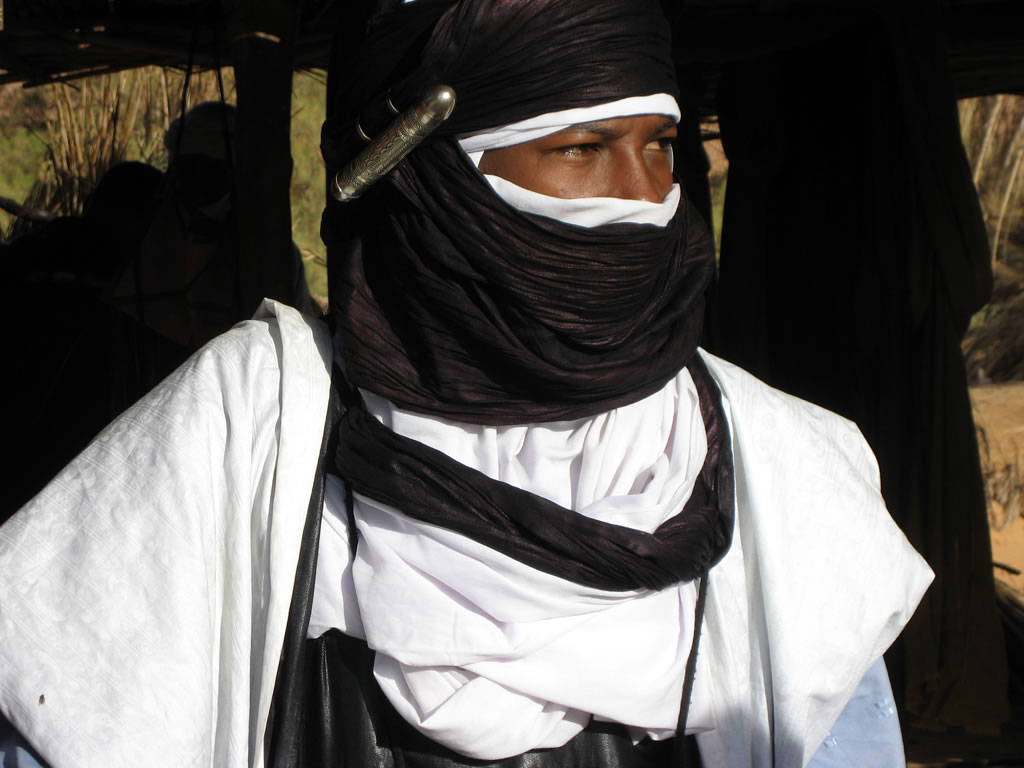
The Tuareg veil — the desert's own people. <small>David Stanley from Nanaimo, Canada, CC BY 2.0, via Wikimedia Commons</small>
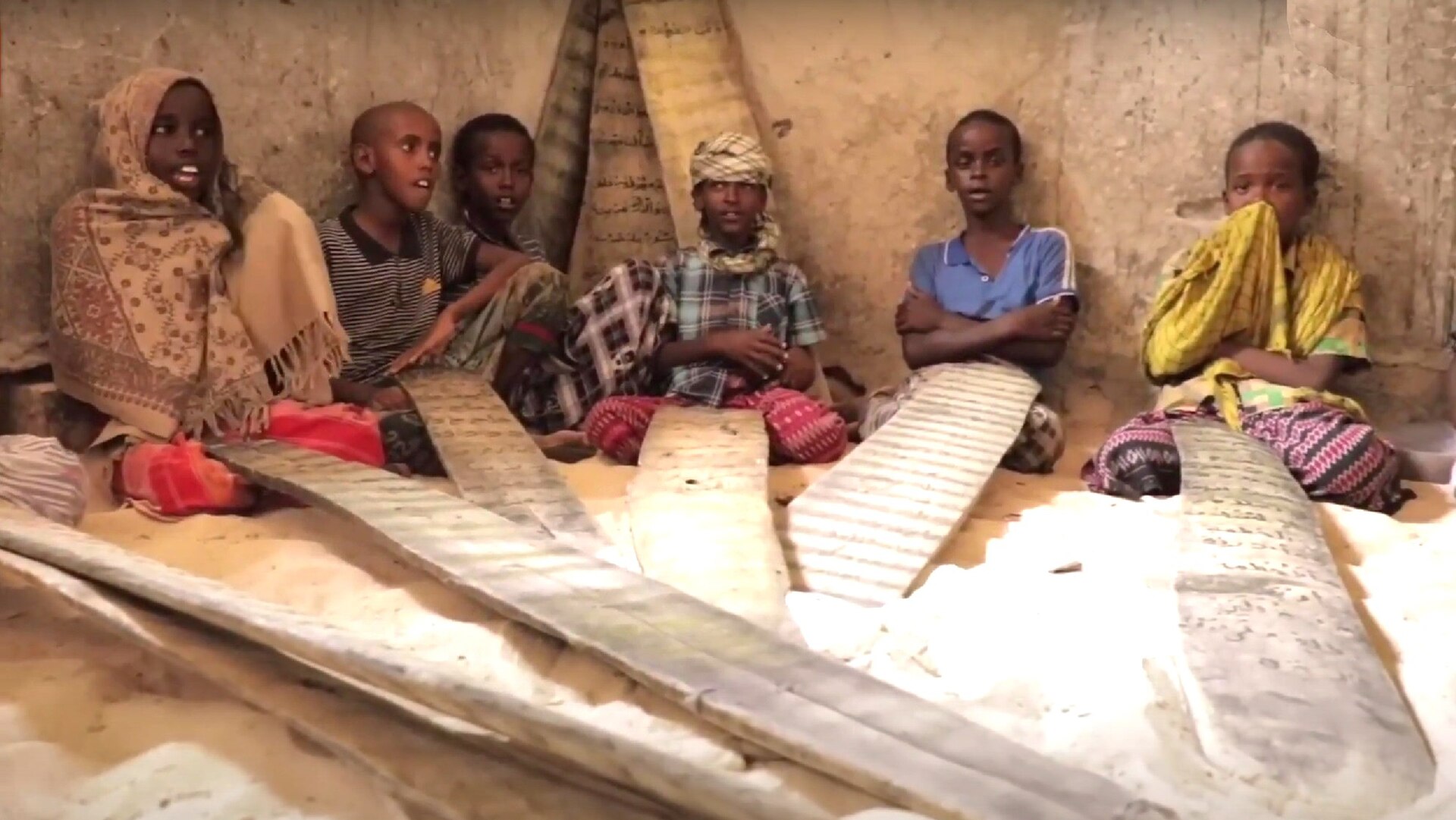
The mahadra — children at the recitation, Jakobus's small mirror. <small>Somfany, Public domain, via Wikimedia Commons</small>
The melḥfa — women of the western Sahara. <small>European Commission DG ECHO, CC BY-SA 2.0, via Wikimedia Commons</small>
<!-- END image-compendium-appendix -->