Dedication
For my brother Hannes —
my only full-blood brother, and a finer artist than I will ever be a writer. He can design and cut and stitch a wedding dress; he can paint a face into anything; the best in the world fly him across oceans to make a bride beautiful for a single morning. He turned a craft into an art and an art into a life, and he did it as himself — out, young, and unapologetic, never once the thing the world expected him to be.
He was very small when he heard the hardest story I have ever had to tell, and I thought it had gone over his head. It hadn't. He had been carrying it the whole time, the way he carries everything — quietly, and without complaint, and more bravely than I knew.
There are two things I have never managed to say to him out loud, so I am saying them here, in print, where I can't take them back: I am sorry for what you carried. And I have never, for one second, been anything but proud of you.
The shore remembers. So do I. This one is yours.
Foreword
by Anita Iran †
The sea remembers. That is not a metaphor on the coast where this book is set; it is a fact the fisherfolk will tell you flatly over the mending of a net. The water keeps what the land forgets. It holds the drowned village, the lost temple, the shoreline that stood a thousand years ago where now there are only waves, and it gives these things back — a carved stone in a trawl, a pillar at low tide, a god's face looking up through six feet of green — to anyone patient enough, and humble enough, to be out there when it decides to speak.
I have spent my writing life on that coast and in that humidity and among those people, and I came to this book braced, the way every Indian writer learns to brace, for the outsider's version of us: the heat as exotic, the faith as colour, the poverty as backdrop, the deep south of India as a spice-scented stage for someone else's awakening. I have read that book many times. I did not enjoy reading it.
This is not that book, and I knew it was not within a few pages, and the relief of it brought tears I was not expecting.
Because the wisdom here is Tamil wisdom, and the genius is Tamil genius, and the teaching the whole story is built to carry is the one the Song gives at its hardest and most beautiful: act, but do not grasp the fruit of the action. Do the work for the work's sake; release the outcome; let the result belong to the sea and the gods and the long time, not to your hungry little hands. It is the most difficult thing a human being can be asked to do, and it is the secret of every craftsman on that coast who builds a thing well and lets the tide have it, and the author has understood it so completely that he has built the very shape of his story out of it — a hero who does the right and costly thing and then, deliberately, lets go of the credit, the way the people of that shore have always let the water take what they made.
He does not come to my coast to find himself. He comes to be taught, and to defer, and to hand the telling to the people whose shore remembers. A woman reads the lost temple in the surf and she is not a clever foreigner solving a riddle; she is a daughter of the place, recovering an inheritance, and the outsider's only job — which this author performs with a grace I did not think the genre capable of — is to carry the water and stand back and let her speak.
There is adventure, and it is salt and fast and full of the real sea; you will read it with wet feet. But underneath is the quiet, devastating instruction of the Gita, embodied and never preached: that the doing is yours and the fruit is not, that to act well and release the result is the only freedom there is, and that the shore — patient, vast, unattached — has been demonstrating this to anyone who would watch for longer than there have been names for it.
Read it by the water if you can. And when the tide turns, remember that it is carrying something back to someone, the way this book carried my own coast back to me, told at last by a hand that knew to hold it lightly and then let it go.
— Anita Iran
† “Anita Iran” is an anagram of ANITA NAIR — the novelist of South India — borrowed here in homage and affection. This foreword is a work of fiction. It was written by the author of this book. Anita Nair did not write it, was not involved in it, and is not associated with or endorsing this book in any way. The name is rearranged precisely so that the tribute can never be mistaken for a real attribution; it is a salute, not a claim.
A Stranger in Strange Lands
Grok means to understand so thoroughly that the observer becomes a part of the observed — to merge, blend … lose identity in group experience. … You cannot hate anything unless you grok it, understand it so thoroughly that you merge with it and it merges with you — then you can hate it. … But this implies that you love it, too, and cherish it, and would not have it otherwise. — Robert A. Heinlein, Stranger in a Strange Land (1961)
grok /ɡrɒk/ v. (Martian; coined by Heinlein) — to take a thing in so completely that knower and known are no longer two; literally, to drink. It has no true English equal. The nearest word in any tongue may be Zulu: Sawubona — I see you. Both name the same act — to receive another whole — and the rare kind of person who lives by it: at home with everyone, and a stranger in every land.
Chapter 1 — The Two Drowned Things
The seventh pillar was where she had left it last March, lying the way it had lain for thirteen hundred years, and Meena put her gloved hand on its broken end and felt the small private relief of a thing that had not moved.
Below twelve metres the Bay of Bengal kept its own weather. Up top the surface was doing whatever the surface did — chop, glare, the dive boat slapping against its own wake while Selvam smoked and pretended to watch the line. Down here it was green going to brown, the light arriving used and secondhand, and the only sounds were the boom of her own regulator and the thin tick of her bottom timer counting her honestly toward the surface. She liked it the way some people liked a library. Nobody could reach her. Nobody could ask her to believe anything.
She unclipped the slate from her harness and checked the pillar against fifteen years of herself.
Grid square D-7. The drum sections were dressed granite, each course a hand-span proud of the silt, and they ran in the broken line she knew by heart — not where a wall fell but where a wall had been set, which was a distinction her whole field still managed to fluff. A fallen colonnade scatters. It throws its drums downslope and lets the current sort them. This one didn't scatter. It marched. Six identical sections in a dead-straight row and then the seventh lying off the end like a full stop, and the spacing between them was the spacing a mason chose, not the spacing the sea made.
She fanned the silt off the joint with the flat of her hand and let it bloom and clear.
The mortise was still empty. Of course it was. She wrote D-7 clean, no movement, joint open on the slate in pencil that worked underwater because she had stopped, years ago, trusting anything that didn't, and she let herself look at the cut for exactly the few seconds she allowed herself. A blind dovetail, sunk into the end of the drum, the kind you only carved if you meant the stone above to lock down onto the stone below and never lift. The granite around it was worked so clean the tool marks read like a signature she couldn't quite make out in this light. She had measured that mortise enough times to know it to the millimetre. She had never once let it mean anything to her beyond a number.
That was the trick. You measured. You did not feel. The instant you started to feel about a site, you started to see what you wanted, and the sea did not care what you wanted; the sea had drowned this place and would drown the Shore Temple too, course by carved course, with the patience of a thing that owned all the time there had ever been.
Her timer ticked. Eleven minutes of bottom time spent, and she had a hard stop at twenty, because she was forty and she dived like she was forty, which was to say she came up alive. She finned the length of the marching row once, slow, reading the spacing the way she read everything she trusted — by the body, by the eye, by the part of her that had been gridding chaos into order since she was twenty-two and certain the world could be made to hold still if you only measured it carefully enough.
D-7. D-8. The gap to D-9 where the line ran out under a ridge of sediment that her department had never funded her to clear, because her department had filed all of this, in 2009, with a stamp and a smile, as Site MMP-04: submerged remains, Pallava-period port facility. Of local heritage interest. Nothing older. Nothing under it. A drowned harbour from the age of the Shore Temple, charming, finite, closed. She had argued it once, in a seminar room in Chennai, that the foundation course read older than the dressed stone above it, and a man with two more publications than her had explained to the room, kindly, that sediment was tricky and enthusiasm was natural in early-career divers, and she had been thirty-one and had not been an early-career diver, and she had learned the thing the water teaches better than the faith ever could: keep your conclusions to the depth your evidence will bear, and not one centimetre shallower.
So she measured. She did not argue. She came down four or five times a season on her own time, on Selvam's boat, with her own slate and her own grid, and she wrote no movement and she went home, and the marching pillars kept their secret and she kept hers, and the arrangement suited her.
The timer ticked to seventeen. She clipped the slate, gave the broken end of the seventh pillar a last look she would have called affection in anyone else, and started up the line into the brightening brown.
The surface hit her like a switched-on television. Light, noise, the diesel cough of the boat, Selvam's grin and his hand and the smell of his cigarette over the salt.
"Anything moved?" he asked, because he always asked, because he had been carrying her down to this grid for nine years and had decided somewhere in there that the dead city was a person they were both fond of.
"Nothing's moved," she said, and meant it as the good news it was, and spat the reg, and let him haul her tank.
He helped her out of the rig and handed her the flask of coffee gone lukewarm and over-sweet the way the boat crews made it, and she drank it because it was wet and because refusing kindness on a small boat was a thing only fools and foreigners did. The coast was a green-grey line. Somewhere along it, north, the Shore Temple stood up out of the haze, a single black tooth in the surf, the last of the seven the legend said the sea had eaten — and she looked at it the way she always did, with the flat professional fondness of a woman who knew exactly how a sea eats a temple and was not going to be told a god did it out of envy.
"You're not coming Sunday," Selvam said. Not a question. He knew her week before she did.
"I'm not coming Sunday." She tipped the dregs over the side. "There's a kumbhabhishekam in Kanchi. My father's set the form."
Selvam, who was a Catholic from Nagapattinam and treated all of it — her temple, his church, the Nagore dargah his wife took her headaches to — with the same easy coastal shrug, nodded as if she'd said she had a dentist. "Big one?"
"They're all big," Meena said. "He's eighty-one. He thinks they're all the last one."
She did not say the rest of it, which was that her father had set the form for a temple's stones twenty years before she was born and would set it now with hands that shook over tea and went still as stone the instant they touched stone, and that she would stand at his shoulder in the dark before dawn and do everything he asked of her flawlessly and feel exactly nothing, and that this was the oldest grid in her life, the one she had never managed to make hold still.
Kanchipuram smelled of the inside of her childhood: wet granite dust and jasmine and the particular hot-metal sweetness of bronze. They had been up since three. By four the new sanctum was full of smoke and lamp-flame and the low collective drone of the priests, and the air was thick enough to lean on, and her father stood in the heart of it small and upright in his unbleached cotton, and the whole apparatus of the consecration turned around him the way it had turned around men of his line for longer than anyone could prove.
She knew her part the way her hands knew the regulator. That was the cruelty of it — there was nothing in here she could not do beautifully.
She passed him the cord at the moment he reached, before he reached, because she had read the reach off his shoulder the way she read a stone's grain or a fisher's mood. She held the plumb while the garbhagriha was checked square to the eight directions, and her eye told her it was true before the cord confirmed it, true to within a width of thread, and a small mean pride rose in her that she pushed back under the water where it belonged. She poured what was to be poured. She said the responses she had said since she was six, the old Tamil rolling out of her mouth round and exact and empty, a beautiful currency she had stopped believing the bank would honour. When the priest faltered on a measure she gave it to him under her breath without thinking, and her father heard her do it — she felt him hear it — and something in the set of his shoulders eased, and that, the small relief in an old man's back, was the only thing in the whole long dark hour that touched her at all.
The Agama said a temple is not built. The Agama said it is revealed — that the form lives already in the stone and in the proportions and in the directions, complete, and that the sthapati is not a maker but a hand, the god's borrowed hand, and that his whole art is to set the conditions and remove what is not the form and then to get out of the way and let the thing that was always there come forth.
Her father believed that the way Selvam believed the sun would come up. It was not, for him, a thing you argued; it was the ground you stood on to argue anything else. She had watched him, her whole life, lay his certainty under his work like a foundation course, and she had watched temples rise off it that made grown strangers weep, and she had stood inside her own competence and felt the cold clean truth of herself: that it was poetry. That it was a story craftsmen told so they could bear to raise the chisel on a cut that could never, ever be taken back — because you cannot add stone back to a thing you have carved away; the form you reveal is the form you are stuck with; and the terror of that, the sheer no-revision terror of it, would unstring any honest hand unless the hand could tell itself the cut was not really its own.
She understood the lie completely. She just couldn't make herself need it. She had gone into the sea precisely because the sea did not require it of her — because down there a thing was where your instrument said it was, at the depth your instrument said, and no one asked you to believe the drowned city wanted to be found.
The lamps were carried up. The first grey came into the high openings, and the new god took the light, and the priests' drone lifted, and the families pressed forward weeping and laughing, and her father turned from the sanctum he had revealed and his eyes found her in the smoke.
"Meenakshi," he said. Not Meena. He had never once, in the field or out of it, called her the name her grandmother gave the child who would not leave the water. He called her by the goddess. The fish-eyed warrior of Madurai, native to her own ground, married to a god — the name he had laid on her like a foundation she had spent her life building sideways off of.
"Appa," she said.
He looked at her for a moment with the patient unfooled tenderness of a man who knew exactly what his daughter did and did not carry, and had grieved it, and had decided long ago not to chase her about it across the few mornings they had left. "Your hands were clean today," he said, which in his vocabulary was the highest thing one sthapati said to another, and which she understood and could not answer in kind, because her hands had been clean and her chest had been empty, and he knew it, and loved her, and let it be.
"The southwest corner was a thread out," she said instead, because it was true and because it was the only register in which she could reach him. "Before the cord. I could see it."
"I know you could," her father said. The smallest smile. "You always could." And he turned back to the families, and the temple, and the god he had let come forth, and left her standing in the lamp-smoke holding the one thing she had ever been able to do for him and the one thing she could never give him, which were, infuriatingly, exactly the same thing.
She walked out into the courtyard while it was still dark enough for the bare bulbs to matter.
The dust of a thousand years of working granite was in the air here too, the way it was in her hair and her father's lungs and the cracks of her own knuckles, and somewhere behind her in the lanes a workshop was already awake, the snick — snick — snick of a chisel finding the grain, somebody's son or somebody's daughter carving down toward a form they swore was already in the stone. The whole city did it. The whole city built its gods by carving away everything that was not its gods and called the leftover the divine.
Her phone had four missed calls. A Chennai number she didn't know, twice; the department, once, which could keep; and Selvam, once, at an hour Selvam was never awake, which was strange enough that her thumb was already moving.
The text under it was from him, and it was short, and it was not about a tide.
Madam. Two men came to the boat tonight asking about your dead city. Not police. One had a paper map of your grid. Your grid, madam. Better you call.
Meena stood in the courtyard with the consecration drone still rising behind her and the chisels waking ahead of her, the two drowned things and the two living ones, and read it again, and felt — for the first time in a very long time, and not at all where she expected to feel it — the small electric stir of something she would have to be careful, very careful, not to mistake for hope.
Chapter 2 — The Line Runs South, and Then It Goes Under
The woman who came down the coast for her had been in the country two days and had not yet been south of Chennai, and she said so the way another person might apologise for the weather — as a fact she had no intention of doing anything about.
"I keep wanting to call it home," Priya Ellis said. She was looking out the window of the taxi at the Old Mahabalipuram Road sliding past, the glass towers of the IT corridor and then, abruptly, a man selling jackfruit off the tailgate of a bakkie, and her face did the small recalibration of someone who had expected one thing and was filing the other without complaint. "My grandmother's people left from this coast. A port a little further down — Nagore, they think, or Madras itself, nobody wrote it where we could read it. So part of my head keeps trying to make the place mean something. And it just — doesn't. It's a road. It's a very nice road." She turned from the window. "I'm told that's progress. I made my peace with it about a year ago."
The man beside her was older, neat, with a folder on his knees he had not opened, and he watched the engineer talk with the patience of someone who had learned that she got where she was going faster if you let her drive. He was the one the Order had sent ahead, the one who had spent a fortnight in Hyderabad and a week before that in the Deccan, and he had told Priya, in the airport, that the part of this she would be good at was the part he could not do at all.
"You read the rock," he had said.
"I read what people build," she had corrected him, "which is mostly machines. The rock was the machine, that time. It won't be, here."
Now she had a tablet open on her knee, and on the tablet was a line.
It came down out of the Deccan in a series of survey points — basalt-cut, cliff-cut, the geometry a man named Arjun Desai had finally let himself believe a fortnight ago in a courtyard carved out of a mountain. It ran south and a little east. It crossed the coastal plain. It touched the sea at a stretch of granite shore an hour below the city, where seven temples were said to have stood and one still did, and there, at the waterline, it stopped.
Priya put her finger on the place it stopped.
"That's the whole thing," she said. "That's why I'm here and not still arguing with my own life in Jaipur. The line is clean. It is the cleanest thing I have ever seen and I have spent a long time looking at clean lines. It runs eleven hundred kilometres and it does not wobble. And then it hits the water and we lose it, because what reads it from here, none of us can read." She looked up. "He can do the rock. I can do the made thing on land. Past the surf it's somebody else's instrument, and that somebody has been down there fifteen years and doesn't know yet that she's been mapping the far end of it the entire time."
The older man finally opened his folder. Inside was a single printed page — a survey abstract, a name, a doctorate, a list of seasons on the same patch of seabed going back to when the woman was a graduate student with borrowed tanks.
"You'll like her," he said.
"I like almost nobody," Priya said, with great warmth. "But I'll know her in about four seconds. People who go down to the same wreck for fifteen years are running from something on the surface. I'd recognise the gait anywhere." She closed the tablet. The line went dark, but it was still there, behind her eyes; she had the kind of mind that kept a line once it had it. "We don't tell her what it's for. We can't. We don't know what it's for. We show her her own data and we let her see what she missed, and then we get out of the way and let her be cleverer than us. That's the whole job."
The taxi came over a rise and the Bay of Bengal opened out flat and grey-gold to the horizon, and a long way off, small and black and patient in the surf, stood a single temple the sea had been eating for thirteen hundred years.
Priya Ellis looked at it without sentiment, the way she looked at everything.
"There she is," she said, and meant the sea.
Meena had said no on the phone.
She said it again now, in person, in the cramped back office of the dive operation at Saluvankuppam where the air conditioner dripped into a paint tin and the walls were furred with charts she had drawn herself, because saying no to people's faces was a courtesy she extended even to people she had not invited.
"I survey a Pallava-era port," she said. "Seventh, eighth century. It is the most boring extraordinary thing in marine archaeology and I have built fifteen years on saying so honestly. Walls, steps, a few dressed blocks the 2002 team found, the lion the tsunami uncovered, the wall the navy mapped in 2005. It is real. It is documented. It is not a mystery, and the people who keep wanting it to be a mystery are the reason my funding takes eleven months to clear every year." She pushed the printouts back across the desk without looking at them. "So whatever you're selling — the Atlantis people, the channel people, the my-ancestors-had-spaceships people — I've had them all in this chair, and I'll save us both the afternoon."
The man did not push the papers back. He left them where they fell, half across her own charts, and that was the first thing that bothered her, because it was the move of someone who knew she'd pick them up.
The woman did not argue at all. She had taken the spare chair and turned it slightly away from the desk, toward the wall of charts, and she was reading Meena's bathymetry the way Meena read it herself — not the legend, not the depths first, but the grid, the survey lines, the way the order got imposed on the chaos. Her eyes went left to right along the 2011 transect and stopped where Meena's own eyes always stopped, at the corner.
"What's this," Priya said. Not really a question.
Meena did not answer for a second.
It was a notation she had made nine years ago and explained away eight times since. A dressed corner, ninety degrees true, sitting in the lee of the long wall at a depth the sediment models said should be open seabed. She had logged it. She had photographed it. She had argued, in print, that it was a fallen block from the Pallava layer that had come to rest at a tidy angle, because the alternative — a placed corner, a foundation, below and therefore older than the port she had built her name describing — was the kind of claim that ended marine careers, and she had watched it end one. A man she had trained under had found something like it off Poompuhar and said the wrong word about it at the wrong conference, and they had not buried him, they had simply stopped citing him, which was worse.
"It's a fallen block," Meena said.
"At ninety degrees."
"Stone falls. Sometimes it falls neatly."
"How deep?"
"Below the port layer."
"So it's older than the thing on top of it," Priya said, in the flat, friendly, devastating way of a person stating arithmetic, "or it fell uphill."
The air conditioner dripped into the tin.
Meena looked at her own corner on her own chart, the corner she had spent nine years calling a coincidence because the truth was professionally radioactive, and something cold and familiar went up the backs of her arms — the exact feeling she had at depth when a shape resolved out of the silt and was, against all the odds and all the sediment models, worked.
"You took a sediment core off that corner," Priya said. She had the abstract now, the printed page, her grandmother's coastline forgotten entirely; this was the thing she was actually here for and you could see her narrow to it. "Season eleven. You logged the core and then you never published the date."
"The date was contaminated."
"Was it."
"It read old." Meena heard her own voice and disliked it. It was the voice she used on her father, the careful one, the one that argued a thing she half-knew to be a lie. "It read older than the layer above it, which is impossible, so it was contamination, so I parked it. That's how the science works. You don't publish an impossible date. You get a clean core or you say nothing."
"You got two cores," the older man said quietly, from the corner.
Meena went still.
She had told no one that. She had pulled a second core, off-book, on her own air and her own time, three seasons after the first, because the first had bothered her so much she could not leave it — and the second had come up reading the same impossible old, and she had carried both dates around in a notebook for six years and shown them to absolutely no one, because two impossible dates is not a contamination, two impossible dates is a fact, and she had not known what to do with a fact she could not afford.
"Who are you," she said.
The man did not give her a name and a logo. He gave her a folder, opened it, and laid a single page over her charts, and the page was a line.
She knew lines. She read them the way her father read grain. This one came down the country in survey points she half-recognised — Deccan basalt, the Kailasa courtyard, places she had no reason to know and a quiet shock of recognition in the proportions anyway, the gathering curve of them, the rhythm — and it ran south and a little east, and it crossed the plain, and it came to her shore. To her exact shore. And where her own grid sat, where her own corner sat below the port that wasn't supposed to have anything below it, the line on the page did not stop.
It went under.
It ran out past the surf, dead straight, west-by-southwest reversed — out to sea — and the bearing of it, when she laid her own remembered transect against it without meaning to, with the part of her brain she could not switch off, lined up through her corner and her two impossible dates and the long placed wall and out across the open water toward a horizon with nothing on it but more water.
"You've been mapping the far end of it your whole career," Priya said. She had not moved. She said it without drama, which was the only reason Meena did not throw all three of them out. "You've been down there fifteen years measuring the most boring extraordinary thing in marine archaeology. You measured it perfectly. You logged the corner and you pulled the cores and you kept the dates because you're too good not to, and then you talked yourself out of every one of them, because the true thing would cost you the career you built describing the false one." A small pause, almost kind. "I know the shape of that. I spent a long time being a very precise person about a thing I didn't want to be true."
Meena did not pick up the page.
She did not have to. It was already behind her eyes, the way a line gets once you've truly seen it.
"Even if I believed you," she said — and she was not going to say what she had nearly said, which was I already half-believe you, I have half-believed you for six years in a notebook I don't show my father — "you understand what you're asking me to do. You're asking me to go back into the water and look for a foundation older than the port, and find it, and say so, in public, with my name on it. There's a man who said something one tenth as mad about Poompuhar and he's been a footnote for twenty years. There's a phrase for what you're describing and the phrase ends grants." She leaned back. The chair complained. "I don't dive on faith. That's the entire point of me. I went into the water to get away from people telling me the answer is already in the stone and I just have to stop arguing and see it." She heard it as she said it, and it landed wrong in her own chest, because it was almost exactly the thing her father said over a chisel, and she hated that it was, and she said the rest anyway. "I measure. I don't believe. Find someone who believes."
"We don't need you to believe," the older man said. "We need you to measure the thing you've already measured and stop calling it contamination."
It should have been easy to answer. It was not.
Because the truth — the cold, private, six-years-in-a-notebook truth — was that she had measured it, twice, and it was not contamination, and the only thing standing between Meena and the most important corner in marine archaeology was that she had decided, a long time ago and on purpose, that she would rather be safe than be the woman who got laughed out of the field for telling the sea's secret out loud.
The dive boards on the wall ticked in the moving air. Outside, faintly, came the diesel cough of a fishing boat going out, and under it, further off, a thread of sound she had stopped hearing years ago because it was always there — a woman's voice from the little shrine by the slipway, an old Murugan song, no priest, no temple, just a fisherman's wife singing the spear-god of the hills down to the shore before the men went onto the water, the way it had been sung on this coast for longer than any of them had a date for. Meena had heard it ten thousand mornings and filed it, the way she filed everything she could not measure, under things this place does that I don't.
She picked up the page.
She told herself it was to refold it and hand it back. She did not hand it back. She turned it to the light and laid her own grid against it in her head one more time, the corner, the wall, the two dead-old cores, the line running clean off her shore into deep water with no wobble in it at all, and the engineer across the desk watched her do it and did not say a single helpful word, which was the cleverest thing anyone had done in that office in years.
"The tide's wrong this afternoon," Meena said at last, to the page, not to them. "And the visibility's been brown all week off the wall. Surge."
"But," Priya said.
"But there's a window the day after tomorrow. First light. Slack water, an hour either side, if the surge lays down." She set the page on her own charts, lined the bearing up with her transect with one fingertip, squared it true, the sthapati's reflex she had never once thought of as her father's, and left it there. "I'm not saying you're right. I'm saying I have a corner I've called a fallen block for nine years, and I've never once gone back and looked at it as if it were placed. I owe the corner that. Not you. The corner."
She stood up. Her knees cracked. Fifteen years of cold water did that.
"Bring your own gear or rent decent gear, I don't care which, but I check every reg myself before anyone gets wet, and if your engineer's never been below ten metres she stays on the boat and reads my screen, which is where I'd want her anyway." She looked at the wall of charts she had drawn, the boring extraordinary port, the corner she had spent nine years not believing, and the cold went up her arms again and did not leave. "Day after tomorrow. First light. We go down, and I'll look at my own seabed the way I was taught not to, and we'll see what's actually under there."
Out past the office window the Shore Temple stood black in the gold, patient, fifteen years of her measurements and thirteen hundred of the sea's, and the sea moved against it the way it had every morning of her life, keeping whatever it was keeping, in plain sight, waiting for someone to come down and read it as if it had been placed.
Chapter 3 — Subtractive
The Shore Temple was being eaten, and Meena had come at dawn to watch it happen.
She stood where the wet sand went hard, far enough up the beach that the spent waves only reached her ankles, and she did the thing she had done a hundred times and never once tired of: she let the light arrive. The sea was the colour of a gun barrel. Then it wasn't. The grey thinned from the east and ran gold along the tops of the swells, and the two towers of the temple, which had been a single black shape against a slightly less black sky, separated into stone — the tall one and the shorter one, the vimanas stacked in their diminishing tiers, thirteen centuries of weather rounding every edge the carvers had cut sharp.
The Bay of Bengal took it one grain at a time. You couldn't see it go. You could only know it. Salt in the wind, salt in the spray that the onshore breeze carried two hundred metres and laid down on the granite like a slow acid; the surf working the seawall the engineers had thrown up to buy the temple another fifty years; and the stone itself, which her father would have said was patient and which she knew to be merely soluble at the rate of a few molecules a tide. A lion stood guard at the temple's foot, its mane gone soft, its face nearly licked away. In another four hundred years it would be a smooth knuckle of rock and the tourists would still photograph it.
She found that she did not mind. There was an honesty in a thing that admitted it was leaving.
"You always come stand here like you owe it money."
Selvam had walked up the beach without her hearing him, which was a skill she'd stopped being surprised by. He was a Mahabalipuram man, born four streets back from where they stood, and he moved on sand the way she moved on the deck of his boat — without thought, without effort, reading it through his soles. He had two flasks of coffee and handed her one. The steam tore sideways off it in the wind.
"It's the only one left," she said. "The others are out there." She tipped her chin at the water.
"Six of them. Indra got jealous." He said it the way you'd report the weather. Selvam's grandfather had told him about the seven pagodas, and his grandfather before, the whole drowned city the gods had pulled under out of envy, only the one temple spared to stand in the surf and remember the rest. It was a beautiful story and Meena had spent fifteen years not believing it, the same way she did not believe a great many beautiful things, and the same way she had stood on the deck two years ago with the multibeam sonar painting a line of dressed stone across her screen — a wall, seventy metres of it, a clean straight man-made line where the seabed should have been nothing but slump and silt — and felt the hair go up on her arms anyway. The legend was wrong about the gods. It was right about the city.
"Drink your coffee," she said. "We've got a tide window."
But she did not move yet, and Selvam, who knew her, didn't push. She was looking at the temple, and she was, for the first time in fifteen years, looking at it wrong — which was to say, looking for the thing she had been trained, gently and all her life, not to see.
The Five Rathas sat half a kilometre inland, behind a fence and a ticket booth and a stand of casuarina trees that hissed in the wind. The keeper unlocked the gate for her himself, because she was Sthapati and her family had been coming here since before there were tickets, and because she'd dived the man's nephew out of a current rip the previous monsoon and that was the kind of debt this coast kept properly.
The early light came in low and gold under the casuarinas and the five carved temples stood up out of the sand exactly as they had for thirteen hundred years, and she stopped at the edge of the cleared ground the way she always stopped, because the thing about the Rathas never got smaller no matter how many times you saw it.
They were not built. That was the whole of it, and people walked past it every day without it landing. A built thing was laid up — block on block, course on course, mortar and lever and the patient addition of part to part until a wall stood where there had been air. Every temple she had ever helped raise had been built that way; she had set the foundation stones herself, had felt the satisfying down of a dressed block finding its bed. You could fix a built thing. You set a stone wrong, you lifted it and set it again.
The Rathas were carved. Each of the five had been cut, whole and entire, from a single living boulder of granite where it lay in the ground — cut downward and inward, the way you freed a figure that was already inside the stone, the way you took away everything that was not the temple until only the temple was left. There was no adding. There was no setting-again. A boulder the size of a house, and somewhere a man had stood with a chisel and a plan in his head and begun to remove, and every stroke he made was final, because you cannot put granite back.
She walked the line of them. The Dharmaraja Ratha first, the tallest, its tiers stepping up to a finished crown. Then the Bhima, long and barrel-roofed, a different grammar of building entirely, as if the carvers had wanted to prove they could speak every dialect of temple in the same stone. The Arjuna, the Draupadi small and perfect beside it. Each in its own style, each a separate argument, all of them subtracted out of the earth within sight of each other by people who could not, by any reckoning she could make as a working architect, afford a single mistake — and had made none that showed.
She put her hand on the flank of the Arjuna Ratha. The granite held the night's cool still; in two hours it would be too hot to touch. She read it the way she read all stone, without deciding to, the way Selvam read sand. This grain runs there. This is where it wanted to break and they didn't let it. Here the chisel came in at a flatter angle — a different hand, or the same hand tired. The pink-grey crystal of the Coromandel granite, hard as anything the planet made cheaply, worked to a corner you could have laid a straightedge against.
Her father could have told her the order of the cuts. He'd taught her to read them when she was nine, his thumb on the stone — first you take the corners, Meenakshi, you free the block from the mass, then you come down into the form — and she had learned it the way she learned everything, completely and fast, and had stored it next to the proportions of the garbhagriha and the mantras you said while casting bronze, in the part of her that did the craft perfectly and meant about a third of it.
She came to the last one and stopped, because the last one was not finished.
It sat at the southern end, lower than its siblings, and most visitors gave it a glance and moved on, because there was less of it to see. Meena had been giving it a glance and moving on for thirty years.
She did not move on now.
It had been begun the same way as the others — corners freed, the top tier roughed out, the shape of a temple announcing itself in the boulder. And then it had simply stopped. Not collapsed, not abandoned to ruin; stopped, mid-act, the way a sentence stops when the speaker is called away. The lower courses were still raw boulder. The transition from finished to unfinished was not a ragged break but a working edge — here the form, there the matrix it was being freed from, and between them the live line of the cut, exactly where the last chisel had come away.
And the marks were there. That was the thing. Thirteen hundred years of monsoon and salt wind and they were still there, because granite kept what you did to it: the parallel scoring of the points working down a face, the cleaner sweep where a flat chisel had dressed behind them, and — low on the left, where the stone curved in toward what would have been a niche — a single stroke that ended in nothing. The point had been driven, the granite had spalled the chip away, and the next stroke had never come.
She crouched. She put two fingers in the groove. It fit her fingers. A man had made that mark with a tool in his hand and the intention of making the next one a hand's breadth along, and something had happened — a death, a war, a king's coin run out, the Pallava court's attention turning to the next marvel — and the next mark had not been made, and so the temple inside this stone had stayed inside it forever. You were looking at a decision frozen one stroke before its consequence. The form that the carver had seen, that had been there, real, in his head and halfway out of the rock, would now never come the rest of the way out. And nobody, no sthapati living, no machine she could name, could finish it. Because to finish it you would have to know the form he had seen — not approximately, not a temple-shaped temple, but that one, the exact one, the niche where his fingers had been about to cut — and that had died with him. The stone could not be added to. It could only have been revealed, by the one mind that already held what it was.
She heard her father's voice, not as memory this time but as if he were crouched on the other side of the boulder. The thing he said over every cut, the thing she had recited at consecrations with her mouth and filed, privately, under poetry he needs and I don't: that the temple is not built by the architect. That it is revealed through him. That he is only the hand. That the form is already in the stone and the maker's whole art is to remove what is not it, without grasping, without forcing, without the vanity of thinking it is his — because the moment you think it is yours, your hand tightens, and a tight hand on a chisel in granite makes the cut that cannot be undone.
She had always heard that as a craftsman's prayer against terror. A story you told yourself to bear the weight of a stroke you couldn't take back — make it the god's, not yours, so that if it goes wrong it isn't your wrong. Comfort. Poetry. Not physics.
Crouched in the gold light with her fingers in a dead man's last groove, she understood for the first time that it was a specification. It was not metaphor. It was the literal operating requirement of subtractive work at this scale: you must see the whole form before you raise the chisel, you must not revise, you must not grasp, you must remove and let the form be there — because the medium gives you exactly one attempt and remembers everything. The Agama wasn't asking the maker to be humble. It was telling him the only way the work could be done at all. Her father wasn't comforting himself. He was reading the manual aloud, and she had spent thirty years deciding it was a lullaby.
The wind moved in the casuarinas. A tour group's voices started up at the far end, by the great stone elephant.
She stayed where she was, and a cold clean thought arrived, the kind she trusted, the kind that came as geometry and not as feeling.
She had been reading the drowned site wrong for fifteen years. Not the data — the data was good, the survey lines were honest, the seventy-metre wall was where she'd put it on the chart. She had been reading it as an additive site. A port. A city laid up block on block, courses and foundations and toppled pillars, the ordinary archaeology of a place that men had assembled and the sea had then taken apart. That was the model in her head every time she went down: find the blocks, plot the blocks, reconstruct how it was put together. It was the model her whole field used. It was the model the man with the permits and the flag and the foundation-pour was counting on the world to keep using, because a drowned Pallava port could be photographed, branded, and concreted over inside a monument to one people's glory without anyone thinking to look under it.
But the makers' work — if there were makers' work down there, the older layer, the thing the bearing said was there — would not be additive. The Rathas weren't. The chamber wouldn't be. It would be revealed, not assembled. Carved down to, not built up. And you do not find a subtracted thing by hunting for the blocks it's made of, because it isn't made of blocks; it's made of the absence around a form. You find it by reading the stone the way she had just read this Ratha — by grain and temperament, by where it wanted to break and didn't, by the order of the cuts — and you find it by asking not how was this put together but what is the form, and what has been removed to free it.
She had the eye for that. She had had it since she was nine, with her father's thumb on the granite. She just had never once turned it on the seabed, because she had gone into the water precisely to get away from everything her father's thumb stood for.
The escape had been pointing her home the whole time. She found she did not have the energy to be angry about it. There was a tide.
She walked back through the casuarinas faster than she'd come, and Selvam read her stride before she reached the gate and was already screwing the cap onto his flask.
"You found something," he said.
"I found nothing. That's the point." He gave her the flat look that meant explain or don't, but pick. She picked. "We've been gridding the site to find where the blocks fell. I want to re-run the south line and not look for blocks at all. I want to look for cut faces. Worked corners in the bedrock itself — places where the rock didn't fall, where it was taken away. If there's an older floor down there, it won't be lying in pieces. It'll be carved into what's already there, and we've been swimming straight over it for fifteen years calling it seabed."
Selvam thought about it the way he thought about weather and currents, which was the only way he thought about anything, with his whole attention and no hurry. "The bedrock shelf off the third marker," he said. "Where the visibility goes to nothing. You always tell me to mark it and stay off it because it's just rock."
"Because I thought it was just rock."
"My grandfather's cousin speared fish off that shelf his whole life. He said the rock had steps in it." Selvam shrugged, a man relaying something he'd never had reason to weigh. "We thought he was old."
Meena looked at him for a moment. Out past the casuarinas the Shore Temple stood in its slow surf, leaving by molecules, and somewhere under the brown water past the third marker a shelf of bedrock she had crossed a hundred times might have steps cut into it by hands that knew you could only remove, never add.
"Rig the boat," she said. "Twin set each. We're going to read the floor."
She was halfway to the truck when she realised her own hand, swinging at her side, had curled as if around a chisel — and she made it, deliberately, let go.
Chapter 4 — The Floor They Swam Over
The boat left the slipway at first light with four tanks lashed amidships and a woman on the bow who had never been below ten metres, and Meena watched the engineer be wrong about exactly one thing.
Priya had insisted on coming out. She had said it without arguing — I won't get in your water, I'll read your screen, but I want to be on the boat when you go down — and Meena had allowed it because the alternative was leaving her on the beach, where she would have stood at the tideline doing arithmetic at the sea, and that was somehow worse. So the engineer sat braced against the gunwale with the laptop in a dry bag on her knees, and she looked out at the chop the way she looked at everything, like a thing she was solving, and the one place she was wrong was that she thought the boat would be the hard part.
"It doesn't go in a straight line," she said, when the bow came off a swell and slapped down and the whole rig shuddered. She did not say it as a complaint. She said it as data she resented. "The road went in a straight line. Eleven hundred kilometres. This goes sideways the entire time."
"The sea negotiates," Meena said. "Stone doesn't. That's the trade."
Selvam, at the tiller, said nothing, because Selvam was reading the water, which this morning had laid down the way he'd promised it would two days ago, in the office, before any of them knew what they were looking for. The surge had gone. The brown was thinning. There was the long slow heave of an offshore swell with no chop riding it, the surface burnished and slick under a sky still more grey than gold, and the Shore Temple stood off the port quarter where it always stood, patient, the last of the seven, leaving by molecules while three people went out to read the floor it had been left to remember.
The third marker was a faded orange float Selvam had set himself, years back, off a snag of bedrock he'd told her a hundred times to stay clear of because there was nothing on it but rock. He brought the boat up on it now and killed the engine and let her drift the last few metres, the way he always did, so the prop wash wouldn't tear at whatever lay below.
"Here," he said. "The shelf. My grandfather's cousin's fish-shelf." A small, private grin under his moustache. "If he was right, you owe a dead man an apology."
"I'll buy him a fish," Meena said, and checked her gear.
She checked it the way she always did, which was completely, because she was forty and dived like she was forty. Twin set, both first stages, both second stages purged and breathed and breathed again. The wing. The weights. The slate clipped where her hand went without looking. The big lamp and the small backup. And the computer on her left wrist, the new one, the one she'd bought after the old one fogged at depth two seasons back and she'd had to come up on a watch and a guess and had sworn never again. It woke at the touch of the water sensor and showed her the surface interval and the gas she'd told it she was breathing, and she set it to mind the things she had decided, long ago, never again to mind by feel: depth, time, the slow accumulating debt a body takes on at pressure and has to pay back on the way up, breath by breath, at the speed the sea allows and not one fin-kick faster.
"Twenty minutes," she said, to Selvam and to the computer both. "Hard stop. I'm not chasing anything past twenty on the first look."
"You always say twenty," Selvam said.
"And I always come up. Notice the connection."
She sat on the gunwale with the weight of the twin set pulling her shoulders back, found Priya's eyes once — the engineer gave her a small nod, the nod of one precise person to another, go and be cleverer than me — and rolled back into the Bay of Bengal.
The surface closed over her and the world went quiet and honest.
She vented the wing and let herself sink down the marker line into the brown, hand over hand, and the light did what it did off this coast, arriving secondhand and green and then browner, the particulate hanging in it like dust in a shuttered room. At ten metres the line ran on into murk. At fifteen the bedrock came up at her out of the gloom, and she put a hand on it and stopped, neutral, breathing slow, and looked at the thing she had crossed a hundred times and never once looked at.
It was rock. Of course it was rock. The shelf ran off into the dark on her left, a low ridge of the same pink-grey Coromandel granite the whole coast was bones of, furred with weed and the small life that takes anything solid in moving water, and her first and oldest instinct — fifteen years deep, department-stamped, Site MMP-04, nothing older — said seabed, said natural, said mark it and stay off it, the way it had said it every season of her career.
She made herself not listen to the instinct. She listened to her hands instead.
She had told Selvam, on the beach, that she wanted to look for cut faces, and saying it had been the easy part. Now she was at fifteen metres in failing light with her glove on cold granite and she had to actually do it — read this shelf the way she'd read the unfinished Ratha yesterday, with her father's voice crouched on the other side of the boulder. There were no courses here, no joints, no toppled drums marching in a mason's spacing; that was exactly why she'd always written it off. Her whole field swam looking for what men had laid up. Nothing here had been laid up.
So she asked the sthapati's question instead, the one she'd been able to ask since she was nine and had never once turned on the sea. What is the form. What has been removed to free it.
She finned slow along the face of the shelf, a body's length off it, lamp low and raking across the grain instead of flat into it, because you don't read a worked surface by lighting it square — you light it from the side and let the shadow show you the tool. Weed. Slump. A natural fracture where the granite had parted along its own grain a long age ago, ragged, the way stone breaks when nobody is asking it to break anywhere in particular. Her own bubbles climbing past her mask in a slow silver chain. The tick of the computer at her wrist, honest, counting.
And then the shadow changed.
She stopped. She backed up half a metre with a small reverse kick and brought the lamp back the way it had come, low and raking, and held it there.
The fracture she'd just passed didn't break the way the others did. It went straight. Not nearly straight — straight, a clean horizontal line running into the murk and out of her lamp's reach, and below it the rock dropped away a hand's depth to another flat, and below that, another. The weed softened the edges and the silt had filled the inner corners the way silt fills any corner the sea will let it, but the shadow her raking light threw was the shadow of a riser and a tread, and a riser, and a tread.
Steps. The rock had steps in it.
She hung there and breathed and did not let the cold thing up her arms turn into anything she couldn't trust. Measure. Don't feel. She put the back of her glove against the lowest riser she could reach and felt along it, and the granite under the fur of weed was not slumped, not fractured, not the rounded subsoil shape of a natural ledge worn by current — it was flat, worked flat, and where it met the tread it met it at a corner, and the corner was a corner the way her own foundation stones were corners, the way the Arjuna Ratha was a corner: a deliberate ninety, cut, where the sea and the grain between them would never on their own have made anything but a curve.
She got the slate off her harness and wrote in pencil that worked underwater because she had stopped years ago trusting anything that didn't. Shelf S of 3rd mkr. Steps cut in bedrock. Not fallen. Cut down into. Her hand was steady. She made it be steady. She wrote the depth the computer gave her and the time it gave her and she did not yet let herself think the word floor.
She finned along the lowest tread, reading it, and it ran. Five risers she counted, going down and in, each one a hand-depth, the whole flight cut into the living shelf the way you'd cut a stair into a hillside — except you do not cut granite the way you cut a hillside, granite gives you one attempt and remembers everything, and somebody had stood here, or hung here, in air that this coast had not held over this rock for a very long time, and had taken the steps out of the stone, downward and inward, removing what was not the stair until the stair was there.
At the foot of the flight the shelf opened into a flat. And in the flat, where her lamp caught it raking, was the corner.
It sat sunk into the bedrock, not laid onto it.
That was the whole of it, and it took her a moment with her gas ticking down to let it be true, because her training had a name for a worked corner on the seabed and the name was fallen block — a dressed stone toppled from the port above and come to rest at a tidy angle, the thing she'd called her own corner for nine years because the alternative ended careers. A fallen block sat on the floor. You could find the line where the made thing rested on the unmade thing beneath it, and that line was the whole argument: it told you the corner had come from somewhere else.
She fanned the silt off the inner angle and let it bloom and clear in the slow water and put her lamp low along the base, looking for that line, the seam that was always there — and it was not there. The corner did not sit on the rock. The corner was the rock, cut down into the shelf the way the steps had been, two worked faces meeting at a true ninety and the third dimension going not up into a block that could fall but down, into the living granite, part of it, freed from it, never for one second a separate stone the sea could have carried.
You cannot drop a thing into bedrock. There was one way a corner like this came to be, and it was the way the Rathas had: somebody had seen a form already in this shelf and removed everything that was not it, downward, without revision, because the medium gave them one attempt — and what they'd freed was this, a worked corner of a worked floor, sunk into the rock she'd been taught all her life was just rock, exactly where Selvam's grandfather's cousin had speared fish his whole life over steps an old man swore were there while everyone who could read a chart smiled at him.
He had been right. The rock had steps. And he had never once thought it impossible, because nobody had taught him a model in which the floor of the sea couldn't be a floor.
She knelt on the flat — actually knelt, on a floor, fifteen metres under the Bay of Bengal, in the posture you take on stone that means something — and she put both gloves flat on the worked corner and read it. The grain ran where the makers had let it run and stopped where they'd told it to stop. The faces were dressed flatter than the Pallava work above; this was finer, older, the way the cleanest cut on the unfinished Ratha was finer than the rest, the work of a hand that did not need to come back and correct. And the corner was the corner of something. It ran. The two faces ran off into the silt and the dark, north and west, and where she fanned along them they kept being faces, kept being floor, a subtracted geometry going on under the sediment in both directions, and she understood — with the cold clean certainty that came as geometry and never as feeling — that she was kneeling on the edge of a floor that ran out, under the long sediment ridge her department had never funded her to clear, in the exact direction the line on Priya's page had pointed when it left the surf and did not stop.
Below the port. Older than the port. Carved, not built. Running out toward the deep water and the wall the navy had mapped in '05 and called, with a stamp and a smile, further submerged structures within five hundred metres.
She had swum over this for fifteen years calling it seabed.
She reached for the slate again and her hand, going for it, had curled into the shape it made around a chisel, and she noticed, and she let it go, and this time she did not have to make herself. She wrote: Corner cut INTO shelf, no bedding seam, faces run N + W under ridge. Subtractive. Older layer below port. Floor continues toward —
And the computer at her wrist began to scream.
She had not heard it move from a tick to an alarm because she had not been listening, and that was the whole of the lesson, delivered in the one language the sea had ever spoken to her in cleanly: a number.
She looked at the wrist and the number was wrong. The ascent rate was flashing, a small ceiling marker had come up beside the time that had not been there when she descended, and the running minutes said twenty-six. Twenty-six. She had set a hard wall at twenty — I always come up, notice the connection — and she had knelt on a marvel with her instincts switched off and over-run it by six, while her tissues quietly took on the debt a body takes on at depth, the debt that does not forgive enthusiasm and does not care what you found.
The computer had stopped asking her to come up. It was telling her she now had a stop to make on the way — a ceiling she could not swim straight through, a depth she had to hang at and pay the debt before the surface would have her — and it was screaming because she'd drifted up half a metre toward it without noticing, reading the corner. The sea negotiates with the boat and the swell and the tide. It does not negotiate this. There is no version of the conversation where you explain to your own blood that the floor was important.
The spike of it went through her — not panic; she did not do panic; the cold clean part of her took the gas and the depth and ran the sum in the half-second it took, the way she ran a grid. Gas: enough. Ceiling: six metres, a few minutes. Cost: the margin and the comfort, not the dive. She vented a touch from the wing to kill the drift, clipped the slate, made her fins go slow, and did the thing the sea required, which was to leave the floor she had waited fifteen years to find before she had read a tenth of it.
She went up the way you go up when the sea has reminded you who sets the terms — not fleeing, which kills you, but obeying, fin-kick by fin-kick, her eyes on the computer now and only the computer, the floor and its corner sliding away below into the brown until they were a paler shape and then a guess and then nothing, gone back to being seabed to anyone who didn't know. At six metres the ceiling held her and she hung on the marker line in the green murk with the surge starting to nudge at her from the swell overhead, and she paid the debt, minute by minute, breathing slow and even and furious, while the computer ticked the screaming down to a number and the number down to zero and finally, grudgingly, cleared her to surface.
She broke into the light and the noise and Selvam's hand was already on her tank.
"You're late," he said. Not a question. He'd been watching her bubbles and her absence and the second hand of his own cheap watch, and his face under the moustache had the particular stillness it got when he'd been about to do something about it.
She spat the reg. She lay back against the gunwale with the twin set's weight pulling at her and let the sun be on her face and breathed.
"I over-ran it," she said. "Six minutes. Had to hang a stop." She heard her own voice and it was steady and it was ashamed, in the exact proportion both things deserved. "I switched off the timer in my head. Fifteen years and I switched it off like a graduate student."
Selvam said nothing for a moment. He hauled the tank straps loose. Then: "What's down there that's worth that, madam? You never over-run. Not once, nine years."
Priya had not moved from the gunwale. The laptop was open on her knees, the dry bag pushed back, and she was looking at Meena with the flat attention of a person who already knew the answer and only wanted to watch Meena say it, because saying it was the thing that mattered now.
Meena looked from one of them to the other, the Catholic boatman who'd carried her down to a dead city for nine years and the diaspora engineer who'd come eleven hundred kilometres down a line that didn't wobble, and she told them the truth, which she had not yet told the sea or her father or herself in words, only in pencil on a slate clipped to her harness.
"There's a floor," she said. "Under the port. Cut into the bedrock, not built on it. Steps, a worked corner, dressed faces — taken out of the rock the way the Rathas were taken out, downward, no joints, nothing that could ever have fallen or been carried. It's older than the Pallava layer. It's older than anything I've put on a chart." She wiped salt off her mouth. "And it runs. The faces go north and west, under the sediment ridge, out toward the deep water." She turned her head and looked past the bow at the flat burnished swell heaving slow toward the horizon where there was nothing to see, and where the navy's sonar in 2005 had drawn a wall seventy metres long that nobody had ever funded anybody to swim. "It runs the way your line ran," she said to Priya. "Off the shore and out. It points deeper. It points at the wall."
Priya closed the laptop. The line on it went dark, but it was still there, behind her eyes, and now it had a floor under it that ran the same way.
"Then that's the next dive," Priya said. "Deeper."
"Deeper," Meena agreed, and the word landed in her chest with the small electric stir she'd learned, on a dark courtyard, to be careful not to mistake for hope.
Selvam started the engine. The Shore Temple stood off the bow in the strengthening gold, leaving by molecules, the last of the seven left to remember the floor the other six had gone down to — and Meena sat in the moving boat with the sea's first warning still ringing in her wrist, and did not look back at it, because she was already gridding the deeper water, and reading the floor they had all swum over, and not arguing with it for the first time in her life.
Chapter 5 — Older Than the Stone Above It
At eighteen metres the corner was where she had not left it, because she had never been to it before, and Meena hung in the brown water above the thing she had crossed a hundred times and made herself look at it the way she had refused to all her working life.
It was not a fallen block. She had spent the descent telling herself it would turn out to be a fallen block — a tidy one, a coincidence of slump and angle, the same lie she had filed under the same drawer for nine years — and the lie had survived all the way down the line and to within arm's reach of the shelf, and then it had died, the way a thing dies when your fingers close on it. Because a fallen block sits on the seabed. It has a shadow line under it, a gap where the current works, silt drifted against its upstream face the way snow drifts a wall. This had none of that. This came up out of the bedrock. The granite of the shelf ran flat and grey and slumped and natural, the ordinary floor she had been swimming over since she was twenty-five, and then — without a join, without a seam, without one millimetre of the gap that says two stones met here — the floor stood up at ninety degrees and became a wall.
There was no setting. That was the whole of it, and it took the air half out of her. You could not have set this. To set it you would need a join, and there was no join, because it had not been added. It had been taken away. Someone had stood in a quarry that was now eighteen metres of brown water and had cut downward and inward into the living rock — freed the corner from the mass, the way you freed a Ratha, the way her father's thumb had taught her on the granite when she was nine, first the corners, Meenakshi — and had removed everything that was not the corner, and left this. A right angle that the planet does not make on its own. The planet makes slump and joint and conchoidal fracture; the planet does not make a flat face two metres on a side and a second flat face square to it to within the width of the silt she fanned off with her glove.
She put two fingers against the cut, the way she had put two fingers in the dead carver's last groove three days ago and a dry kilometre away, and the granite was cold and clean and dressed, and she read it without deciding to — this grain runs there; here it wanted to spall and they did not let it; the tool came in flatter along the bottom, the same hand tired, the same hand — and the cold went up the backs of her arms inside the wetsuit and stayed.
Her bottom timer ticked. She had eleven minutes of the twenty she allowed herself, because she was forty and she dived like she was forty. She unclipped the core tube from her harness and seated it against the cut face — not the sediment beside it, the lazy core, the one that could be argued; the face itself, the worked granite and the skin of mud sealed against it where the cut went down into the floor — and she drove it, and felt it bite, and capped it, and clipped it, and gave the corner one more look that she would not have called anything in anyone else.
Then she went up the line into the brightening brown, with three days of telling herself it was a fallen block dissolving behind her like silt that would not settle.
The surface hit her the way it always did, all light and diesel and noise after the library quiet of the deep, and Selvam's hand was there, and behind his hand was a thing she had not had on her boat in fifteen years, which was an audience.
The Order man sat amidships where she'd put him, neat and patient, the unopened folder of three days ago now opened, weighted against the wind with a wrench. And forward, in the lee of the console, out of the spray and out of the way exactly as Meena had ordered her to be, the engineer sat with the sonar tablet on her knee and her whole self gone down into the screen.
Priya Ellis had not looked up when Meena's head broke water. She did not look up now, while Selvam hauled the tank and Meena spat the reg and sat heavy on the gunwale with the harness still on her, dripping, the core tube a cold weight against her ribs. The engineer was watching the live return paint itself across the tablet — the multibeam swathe Meena had run that morning before she dressed in, the shelf off the third marker rendered in false colour, slope and depth and the hard bright line of bedrock — and her stillness was the specific stillness of a person who has found the thing she came eleven hundred kilometres and a flooded career of her own to find, and is being very careful not to scare it.
"Don't," Priya said, to nobody, to the screen. "Don't talk yet."
Nobody talked.
Meena got the harness off. She drank the coffee Selvam put in her hand because refusing kindness on a small boat was a thing only fools and foreigners did, and it was wet, and over-sweet, and she barely tasted it. She was watching the back of the engineer's head and she was waiting, and she did not let herself name the thing she was waiting for, because she had spent fifteen years not naming things on this boat and the habit had kept her solvent.
"All right," Priya said at last, and turned the tablet so Meena could see it, and her voice was flat and friendly and absolutely without mercy. "Come and look at your seabed."
Meena came and looked at her seabed.
The swathe was good — her own work, honest, the third-marker shelf in the cool blues and greens of bathymetry, the bedrock line standing out hard. And there, where Meena had told her to mark it and stay off it for nine years because it was just rock, the engineer had drawn a single thin straight white line across the false-colour floor, from the upper edge of the frame to the lower, and the line ran through the corner. Not near it. Not past it. Through it — square through the worked face, through the dressed angle eighteen metres down that the planet does not make, and out the bottom of the frame toward open water.
"That's not the survey grid," Meena said. Her own grid ran north–south and east–west, the orthogonal cage she imposed on chaos. This line ran neither.
"No." Priya did not elaborate. She reached over and laid a second image beside the first, smaller, and Meena knew it before her eye finished crossing the screen, because she had seen it in the office three days ago and a line, once truly seen, does not leave you. The Deccan. The basalt points coming down out of the highlands. The bearing. The cleanest thing the engineer had ever seen, eleven hundred kilometres of it, no wobble.
"I overlaid it," Priya said. "Your live return, this morning's swathe, and his bearing off the rock." A small motion of her head at the Order man, who had not said a word. "I didn't fit it to anything. I didn't slide it around until it landed. I put the Deccan vector on your seabed at the coast point where it meets the water — the one place it can go, the only fixed end it has — and I let it run." She put one fingertip on the white line, at the corner. "And it does this."
The line came down out of the dry country, out of the cliffs a man named Arjun Desai had finally let himself believe a fortnight ago. It crossed a plain. It touched the granite shore where seven temples were said to have stood and one still did. It went under the surf, west-by-southwest reversed, out to sea — and eighteen metres down, half a kilometre off her own third marker, it passed dead through the centre of a corner that had been cut, not set, into the floor of the Bay of Bengal by a hand that knew you could only remove and never add.
And kept going. Out the bottom of the frame. Into deep water. Toward a horizon with nothing on it but more water.
Meena looked at it for a long time. The boat slapped its own wake. Selvam, who knew her, said nothing and busied himself with the second tank.
"It threads it," she said finally, and heard how stupid the words were and could not find better ones. "It runs eleven hundred kilometres over land none of us can read and it hits the water and it threads my corner like a — " She stopped. She had nearly said like a needle, and that was the wrong register, that was a story-word, and she did not deal in story-words. "It's within the error," she said instead, which was the true thing, the cold thing, the thing she could put her name to. "It's within the survey error. There's no slack in it. A bearing that long has a cone of uncertainty by the time it reaches here, and the corner sits inside the cone, near enough the axis I can't tell the difference with this instrument. That's not a coincidence I can wave off. I've waved off coincidences for nine years. This isn't one."
"No," said the engineer. "It isn't." She did not say it kindly and she did not say it unkindly. She said it the way a person reads a gauge.
Meena straightened. She put the tablet down on the console, carefully, the way you put down something that is not yours.
"That's geometry," she said. "Geometry isn't a date. A line that lands on a worked corner tells me the corner was placed with intent, by someone who knew where the bearing went — it tells me it's part of a system, it tells me it's not random rubble. It does not tell me it's old. I could build you a corner today on that bearing if I had a barge and a year." She was arguing, and she knew she was arguing, and she recognised the voice she was doing it in, because it was the voice she used on her father — the careful one, the one that argued a thing she already half-knew to be true, to make whoever was holding the truth do the work of forcing it on her, so that the cost of knowing would be theirs and not hers.
She reached into the dive bag and took out the core tube.
"This is a date," she said.
The deck went quiet in a different way.
She had two already. She had carried two impossible dates around in a notebook for six years and shown them to no one, the first off this corner nine years gone and the second three seasons after, off-book, on her own air, because the first had bothered her so badly she could not leave it — and both had come up reading older than the Pallava stone of the port that sat above them, which is impossible, which is contamination, which is a thing you park, because you do not publish a date that says the foundation is older than the building. Two impossible dates she had spent six years calling contamination, because two of a thing could still, if you were tired and frightened and forty and wanted very much to keep your grants, be argued into a coincidence of two.
This was the third. She had pulled it ten minutes ago off the face — not the loose sediment, not the lazy core, the worked granite itself and the mud sealed against the cut. There was no argument left in the geology of it. If this read old, it read old from a sample that could not have been disturbed, sealed against a surface a hand had dressed.
She turned the tube in the light. The sediment column inside was banded, clean, undisturbed, the skin of the worked face a pale line at the base where the mud met the granite the makers had freed from the floor.
"I can't date it on a boat," she said. "I need the lab in Chennai. AMS, three weeks, maybe four with the way they're funded. So I can't stand here and tell you what it says." She set it upright in the rack, gently, between the spare regs. "But I can tell you what it's going to say. It's going to read the same as the other two. I knew it the second the corner came up out of the floor without a join."
"You hid the other two," Priya said. It was not an accusation. It was the engineer establishing a value. "For six years."
"For six years."
"Why pull a third, then. You knew."
Meena looked at the core in the rack, and at the white line still glowing on the tablet, threading her corner and running out to a sea with nothing on it.
"Because two is a thing a frightened woman can argue with," she said. "Two, I could live next to. Two, I could keep in a notebook and call contamination and go home and do a consecration and feel nothing and dive on Sunday and not have to act." The salt was drying tight on her face. "Three I can't. Three off the face, sealed, on the bearing — three isn't a number you argue with. Three is a fact." She heard her own voice and it was very steady, which was how she knew the floor had gone out from under her. "I pulled the third so I'd stop being able to pretend. I think part of me wanted to be made to."
She had not meant to say the last sentence. It had come up the way the cold came up the backs of her arms, from somewhere she did not manage.
Priya Ellis looked at her then, for the first time since she'd surfaced — turned the whole of that precise, unsentimental attention on her — and did not offer her anything soft, which was, again, the cleverest thing anyone had done on that boat in years.
"Yes," the engineer said. "I know the shape of that exactly." And then, because she was who she was and could not help it: "It'll read old. You're right. I'd put money on it and I don't gamble."
It should have felt like vindication. Some cold clean part of her had imagined, in fifteen years of not arguing in seminar rooms, what it would feel like to be right — to lay the dates on the table at last and watch the man with two more publications than her, the one who had explained to a roomful of people that sediment was tricky and enthusiasm was natural in early-career divers, stop talking. She had thought it would feel like winning.
It did not feel like winning. It felt like the deck had tilted and not come back.
Because the corner was real now. That was the thing the geometry had done to her that the geometry could not undo. For nine years the corner had been a coincidence she chose, a thing she could put down. Now it was a worked face on a bearing with three old dates under it, and she could not put it down, and the moment she could not put it down she understood, with the flat clarity she trusted because it came as geometry and not as feeling, exactly what it had just cost her.
The man at Poompuhar. She had trained under him. He had found something one tenth as mad as this and said the wrong word about it at the wrong conference, and they had not buried him, they had simply stopped citing him, which she had decided long ago was worse. She had built her whole working life — her funding that took eleven months to clear, her honest boring reputation, the boring extraordinary port she had described so carefully and so safely — on being the marine archaeologist who did not say the mad thing. On keeping her conclusions to the depth her evidence would bear and not one centimetre shallower.
And now her evidence bore a foundation older than its building, threaded by a line that ran to another continent. Her evidence bore the mad thing. The depth her evidence reached and the depth that would end her career were, it turned out, the same depth, and she had just driven a core into it with her own hand because she had got tired of being able to pretend.
She looked at the coast. The green-grey line of it, and north, small and black and patient, the Shore Temple standing in its surf, leaving by molecules, the last of the seven the legend said the sea took out of envy. The legend was wrong about the envy. She had known that for fifteen years. She was only now beginning to understand how badly it might be right about the rest.
"You've gone somewhere," Selvam said. He had finished with the tank. He handed her the flask again, refilled, and his flat dark gaze did the thing it did, which was to read her the way he read the water — without hurry, with his whole attention. "You found something. Properly, this time. Not the kind you can write no movement about and come home."
"I found something I can't put back," Meena said.
He nodded as if she'd reported a current. Then, because he was a Mahabalipuram man whose grandfather had told him about the seven pagodas and whose grandfather had told him, and who treated the drowned city and his church and the dargah his wife took her headaches to with the same even coastal shrug: "My grandfather's cousin. The one who speared fish off that shelf. He said the rock had steps in it." A pause. The wind tore the steam sideways off the flask. "We thought he was old. Maybe he was just the only one who'd looked at it as if a person made it."
Meena drank the coffee and said nothing, because there was nothing she could put her name to.
The engineer had gone back into the tablet. She was not gloating — Meena was learning that this one did not gloat, that the win for her was the line landing, not the having-been-right of it — but she had the focus of a person already three problems past the one just solved, and after a while she said, without looking up, in the flat way she said everything:
"It threads the corner. Good. That tells us the corner's on the system and the system runs to sea." She turned the tablet a few degrees, frowning at the line where it ran out the bottom of the frame into deep water. "But the corner's the door handle. It's the surface of it. There's structure under that — there has to be, you don't run a bearing eleven hundred kilometres to land it on a single right angle and stop. The corner's the readable face of something with a shape, and the shape is what the bearing is actually pointing through, and that — " she tapped the screen once, lightly, the deep water past the corner where the false colour went featureless and blue — "that I can't get. Not from this. The multibeam gives me the floor and the corner and the line. It does not give me the geometry of the thing the corner belongs to. The proportion of it. Why this angle and not another. Where the next face would be if I went down and looked, and at what depth, and why."
She looked up, and she looked at Meena, and she put the problem down between them on the console like a tool she did not have the hands for.
"That's not a sonar problem," Priya said. "I can map a wall all day. I can't tell you the intention in a worked stone — what the maker saw before he raised the chisel, the order he'd have cut it in, the rule he was building to. That's a different instrument. I read machines. The rock was a machine, that time, in the Deccan. This isn't. This is somebody's craft, and craft has a grammar, and I don't speak it." A small, dry, exact pause. "You do. You've been speaking it your whole life and pretending it was only your hands."
Meena did not answer.
She was looking at the deep blue past the corner, the featureless water where the line ran out of the frame, and she was hearing — not as memory this time, but as if he were crouched on the other side of a boulder eighteen metres down — her father's voice over every cut he had ever made. The form is already in the stone. You must see the whole of it before you raise the chisel. You cannot add back what you cut. You are only the hand. The thing she had recited at consecrations with her mouth and filed, privately, under poetry he needs and I don't. The thing she had crouched over three days ago with her fingers in a dead carver's last groove and understood, for the first time, was not a prayer but a specification — the literal operating requirement of subtractive work at this scale, because the medium gives you exactly one attempt and remembers everything.
To read the shape the corner belonged to, she would have to read it the way the maker built it. By the discipline. By the grammar her hands knew and her mind had spent thirty years calling a lullaby. And she had nobody to learn the grammar from cold, on a boat, off a sonar return, because the one place on earth that still spoke it as a living language — the unbleached cotton, the snick of the chisel finding the grain, the certainty laid under the work like a foundation course — was a workshop four streets back from a temple in Kanchipuram, where an eighty-one-year-old man set forms by the Agama with hands that shook over tea and went still as stone the instant they touched stone, and called her by the name of a goddess, and had grieved, quietly, for thirty years, that his daughter could do the craft flawlessly and mean a third of it.
She had gone into the water precisely to get away from him. The water had just handed her back to him, sealed in a core tube, threaded on a line to another continent.
She found she did not have the energy to be angry about it. She had used that up nine years ago, calling a corner a coincidence.
"Selvam," she said. "Take us in." She picked the core tube out of the rack and held it, the cold weight of the third fact, the one she could not pretend about. "I have to go to Chennai with this, and then — " she heard herself say it, the thing she had not said out loud to anyone in a very long time, and was surprised by how level it came " — then I have to go home. There's a part of this I can't read off a screen. There's a man who can, and I've been not-asking him for thirty years."
Priya Ellis closed the tablet. The line went dark, but it was still there, behind both their eyes now, threading the corner and running out to a sea with nothing on it.
"Good," the engineer said. "Then we don't tell you how to read it. That was never the job." She tipped her chin, the smallest motion, at the coast coming up green and dust-gold over the bow — the workshops waking inland, the chisels finding the grain, a whole city carving its gods by removing everything that was not its gods. "We get out of the way and let you be cleverer than us. Same as the water did."
The boat came round and took the swell on its shoulder and ran for the slipway, and from the little shrine by the landing, faint over the diesel, came a woman's voice — a fisherman's wife singing the spear-god of the hills down to the shore before the men went onto the water, no priest, no temple, the way it had been sung on this coast for longer than any of them had a date for. Meena had heard it ten thousand mornings and filed it, the way she filed everything she could not measure, under things this place does that I don't.
She held the core against her ribs, and she listened to it the whole way in, and she did not file it anywhere at all.
Chapter 6 — The Man Who Loves It Too
The car was waiting for her on the slipway before she had her tank off.
She knew it was for her the way she knew weather — by the wrongness of it sitting where it sat. A white Fortuner, mud-free, parked at the top of the ramp where the fishers backed their trailers, and two men beside it in pressed shirts and good shoes standing on the working part of the beach as if the working part of the beach were a foyer. Selvam saw them the same second she did. He did not stop coiling the shot line. He coiled it slower, which on Selvam was the equivalent of another man reaching under the dash.
"Those are the ones," he said. He didn't say from the boat that night. He didn't have to. He'd carried her down to her grid often enough to know which faces belonged on this beach, and these didn't, and one of them she half-recognised from a phone screen Selvam had held up two nights ago — a face that had stood off his transom in the dark holding a paper copy of her grid and asking, politely, whose city it was.
She unclipped her harness and set the rig down on the gunwale with both hands, the way she set everything down, because you do not drop a thing that keeps you alive even when you are angry at the people watching. Eleven minutes of bottom time still in her ears. She'd gone down that morning and read her own seabed the way she'd told Priya she would, as if it had been put there on purpose, and it had answered the way she'd dreaded — worked, deliberate, older than the port lying on top of it. She had surfaced with that in her chest, and now there were good shoes on the slipway, and she understood with the flat certainty she trusted that the two facts were one fact arriving from two directions.
"You don't have to go up there," Selvam said.
"They came to the boat once already." She wrung the salt out of her hair with one fist. "I'd rather meet a thing on the beach than wonder about it in the dark."
The nearer man came down the ramp to meet her halfway, picking his footing on the wet sand with the care of someone who had bought the shoes recently.
"Sthapati-amma." He said it correctly — the title, the respect-suffix, the small bow of the head that her father got in Kanchipuram and that she, in the field, in a wetsuit, dripping, never did. "I'm sorry, we've timed this badly — you've only just come up. Mr. Varadhan asked me to bring you to him, if you'd allow it. He's just up the hill. He'd come down himself, but his knee won't take sand. He admires your work. He's read all of it."
"All of it," Meena said.
"The 2009 report. The transect papers. The piece on sediment dating that the conference didn't like." The man said it as a list of things he'd been told to know, without any edge, and that was worse than an edge. "He says you're the only person on this coast who reads the bottom instead of guessing at it."
Behind her, Selvam set down the shot line entirely.
She looked up the hill. She had been looking at that hill for fifteen years without seeing it — the long low rise of red laterite north of the slipway where the casuarinas thinned — and at some point recently it had grown a skin of survey markers. She could see them from here. White-topped pegs in a grid too regular to be anything but engineering, a line of orange flags snapping in the onshore wind, and at the top, where the ground commanded the whole sweep of the bay, a site office and a tall hoarding she couldn't read at this distance.
She had a grid in the water. Someone had laid a grid on the land directly above it.
"Half an hour," she said.
She made them wait while she changed, not out of spite but because she would not meet a man holding her own survey papers while standing in a wetsuit. Selvam handed her the truck keys and held her eye.
"I'll be on the water," he said. "Phone in your pocket. You call, I'm at the slip in four minutes."
"It's a developer, Selvam. Not pirates."
"My grandfather's cousin sold his net-shed to a man with good shoes," Selvam said. "He got a fair price and a feeling in his stomach. The feeling was right and the price wasn't." He didn't smile. "Phone in your pocket."
The Fortuner took her up a graded track that hadn't been there last season, and the closer they came the quieter she got. She had been picturing the usual coastal land-grab — a resort, a wedding lawn, some gated nonsense with a fountain — and what she climbed out into was the staked footprint of something the size of a temple town. The pegs ran in bays and courts across the whole crown of the hill, hundreds of them, surveyed dead true; she read the survey in a glance the way she read a chart, and it was good survey, the bearings clean.
A scale model stood under a canopy on a trestle. She walked to it before the man could steer her, because she could not not read a plan.
It was a complex. A central tower, immense, a vimana in the Pallava grammar but six or seven times the height of anything the Pallavas had raised, rendered in pale gold. Around it, courts — a museum wing, a meditation hall, a thousand-car park in tiny grey rectangles, a sound-and-light amphitheatre facing the sea. And below it all, down the seaward slope where the model showed the land falling to a strip of rendered blue, a broad flat apron of pale grey, terraced, monumental, running from the foot of the tower out to the line of the surf. A viewing terrace over the water. Poured.
She found the contour that matched the slipway and walked her eye down from it, out into the little acrylic sea, and laid her remembered grid over it — the corner, the marching wall, the line running clean off the shore — and the pale grey terrace sat directly on top of all of it like a thumb pressed on a photograph.
"It's beautiful, isn't it," said a voice behind her, "and it's also exactly what you think it is. I find it's better to admit both at once."
Rajan Varadhan was smaller than his hill. That was her first read of him, and she kept it. He stood by the corner of the site office with a stick he plainly hated, a heavy-shouldered man going soft in his sixties, in a cream kurta that cost more than it looked and a shawl against a wind that wasn't cold, and he had the stillness of a man who had spent thirty years making others come to him and had stopped needing to perform it. When he looked at her there was none of the smile his man had worn on the beach. He'd kept that for the beach. Up here he gave her her own register.
"You're angry," he said. "Good. I'd have lost respect for you if you'd come up charmed. Come sit. As far as my knee allows, which is about forty metres, and then you can tell me to go to hell with the sea behind us, which is the only proper place to tell anyone anything on this coast."
She stayed at the model. "Your terrace is on my site."
"I know exactly what's under my terrace," Varadhan said. "That's why the terrace is there." He let her take it, and there was nothing sly in it; he had simply decided not to insult her by pretending. "Give me the half hour, Doctor. I'm more interesting than you've decided, and so is what I'm offering you."
Two plastic chairs faced the sea at the edge of the cleared ground. From them the whole bay lay open — the slipway small below, Selvam's boat a white chip on the brown water, and away to the south the Shore Temple, black and patient in its surf. Varadhan lowered himself into a chair with the care of his bad knee and, for a moment, didn't talk to her at all. He looked at the temple.
"My grandmother was born in a village that's under that water," he said. "Not the famous water. The ordinary water — the sea took the headland her people farmed, a metre a decade, the way it takes everything here. She used to point at the surf and say our fields were out there. I thought she was being sentimental. I was forty before I understood she was reading me a survey." He turned the stick in his hands. "This coast loses itself. It always has. And nobody, in my whole life, has built one thing to say: people stood here. They were not small, and they were not waiting for anyone to come and discover them."
Meena said nothing. It was, line for line, true.
"You know the histories better than I do," he went on. "The Pallavas couldn't have carved the Rathas — must have been Persians, must have been Greeks. The bronzes were too fine, so the technique came from elsewhere. Always elsewhere. A hundred and fifty years of careful men explaining, kindly, that the people of this shore made their miracles by accident or imitation. You wrote a paper once, and a man with two more publications told you your dates were enthusiasm." He looked at her sidelong. "He was wrong, you were right, and you let him win because the alternative cost too much. I'm not judging. I know the shape of the thing that beat you, because it has beaten this whole coast for two hundred years, and I built all of this to beat it back."
"By pouring a slab over the thing itself."
"By giving it a body people will travel a thousand kilometres to stand inside, instead of a footnote three divers and a navy frigate know about." He said it without heat. "What's down there now? A wall the sonar found in 2005. Some dressed blocks. A lion the tsunami bared and the sea is taking back. Real and invisible and dying, a grain a tide, exactly like that temple. I can put it at the centre of the largest pilgrimage site in the south — make every child in this country know that here our people built wonders before the men who wrote the textbooks could cut stone. I can make the world look."
"And own it."
"Steward it." Something hardened in him, a patience that had run out. "I'm tired of the word own. I've heard it from every foreign-funded committee that flew in to lecture us about our own ancestors — they guard the past so carefully no one is allowed to feel anything about it. I'd rather it belonged to a hundred million people who weep when they see it than to a journal that files it under local heritage interest." The anger went out of him as fast as it had come, and what was left was the thing she'd feared since the first true smile on the beach: he meant it. He loved the thing he was describing.
"You're not wrong about any of it," Meena said slowly. "That's the trouble with you. The looting, the condescension, the men in the room — you're right, all the way up to the last step."
"And the last step?"
"You think theirs means yours." She said it to the sea. "You'd take a coast that's been Shaiva and Vaishnava and Jain and Buddhist and Muslim for longer than there's been a word for any of it, and pour a slab over all of it, and call it proof that one people were always the greatest." She shook her head. "That's not giving it back."
The wind worked the orange flags. Down on the water Selvam's boat had not moved.
Varadhan, to her surprise, smiled — slow, a little sad. "You see," he said, "that's exactly why I want you, and not one of the willing ones."
He told his man to bring tea, and made his offer over steel tumblers.
"Fund your survey," he said. "Properly. Multibeam time, a sub-bottom profiler, your own vessel for a full season instead of begging your friend with the dive boat. A coring rig that doesn't break. Two post-docs and a lab budget. You map the whole thing to a standard no one has applied to that water, you publish under your own name, and I put it at the heart of the complex. A glass floor over the chamber, if you like — I've seen it done. You become the woman who proved what's under the Bay of Bengal, instead of the woman who spent her career too frightened to say it out loud."
It was, she noted with clinical horror, a genuinely good offer. It was the offer she would have wept over at thirty-one.
"And the date," she said. "There's always a date with a man who has a launch model under a canopy."
"There is." He set the tumbler down. "The pour is the eleventh. The minister lays the first stone, cameras from Chennai and Delhi, ten thousand people on this hill. The seaward terrace goes in first — it's the retaining structure for everything above it — as one continuous pour over three days. Six weeks from today." He watched her do the arithmetic he'd already done. "After that, the survey happens through the glass, on my terms, with my name on the building. Before that, it happens on open seabed, on yours, with mine on the cheque. I'd prefer the second. It's the better story. But the minister's diary doesn't move for a wall the navy mapped in 2005."
Six weeks. She turned it over and it did not get larger.
"Why me," she said. "You could buy a compliant marine unit out of Chennai in a week. People who'd map what you told them and date it however you needed."
"I don't want a survey I paid for. I want one that's true, done by someone the next two hundred years will believe, because the entire point is that it be real. I'm furious, my whole life, at the lie. I want the truest reading of the truest wonder, set where everyone can see it." He spread his hands. "That you despise my tower doesn't make your survey less true. It makes it more. I'll take the cost of your contempt and bank the credibility."
And there it was — the thing that made him dangerous and not merely rich. He didn't need her to agree with him. He needed her to be honest, and he'd built a frame in which her honesty became the foundation stone of the thing she'd come up the hill to refuse.
"And if I say no," she said. "Here. Today. With the sea behind us, like you wanted."
He was quiet a moment, looking out at the Shore Temple, and when he spoke his voice had gone gentle, almost regretful, and the gentleness was what told her the next thing would be the blade.
"Then you say no, and I find someone who says yes, and the pour happens on the eleventh exactly as scheduled. The only difference is that the survey under my glass floor is a worse one done by a smaller person, and your fifteen years stay in your own notebook — where, forgive me, quite a lot of your best work already lives." He let it land softly. "Two cores, Dr. Sthapati. Off the placed corner. Season eleven and season fourteen, both reading older than the layer above. You've shown them to no one. Not even your father, I'd guess, though I gather he's the one you'd most want to and least be able to."
The wind. The flags. Selvam's boat on the brown water, not moving.
She kept her face exactly where it was, because the alternative was to give him the satisfaction, and she'd have walked into the sea first. But her chest had gone cold and still in the way it went at depth when a shape came out of the silt and was, against all the sediment models, worked — that same cold, arriving now from the dry land at the top of the hill, because there was only one place those two dates lived, and it was a notebook in a drawer in a flat in Chennai, and he had read it to her over tea.
"How," she said. Flat. An instrument-reading, not a plea.
"It doesn't matter how." Not unkind. "What matters is I know what you have, what it would cost you to say it in public without my name behind it, and I know about Poompuhar." He said the word and watched it find the nerve. "The man you trained under. He found something one tenth as strange off that coast, said the wrong word at the wrong conference, and they didn't burn him, they just stopped citing him. You watched it happen, and you've spent your whole career making sure it never happened to you — bought your safety one careful paper at a time. I'm offering to make it permanent. Or you can spend all of it at once, on a refusal that changes nothing except that you become a footnote on purpose." He picked up his tea. "I'm not threatening you. Check it later; I want you to find it true. I don't have to do anything to you. I'm telling you the cost of what you came up here to do, because you struck me as a woman who'd rather have the real cost than a comfortable lie."
He hadn't been wrong about anything. That was the whole problem with him, and she understood now that he knew it was, and had built his entire pitch on it.
She stood. Her knees cracked. He didn't.
"You read me well," she said. "The papers, the silences, the notebook I don't show my father. You built an offer with all the pegs in the right places, and you're sitting up here certain I'll take it, because every move I've made for fifteen years says I will." She looked down at him, the heavy tired intelligent face, the stick he hated, the genuine grief for a drowned headland under all of it. "But you read me the way the world reads this coast. Off the top. The part above the water."
"And below it?"
She didn't answer. She looked at the model one last time — the gold tower, the grey terrace pressed over her grid, the eleventh of next month sitting in it like a fuse — and put her hands in her jacket pockets so he wouldn't see that one of them had curled, by itself, around the shape of a chisel that wasn't there.
"Thank you for the tea," she said. "And the half hour. You were more interesting than I decided. Have your man drive me down. I've got a tide."
Selvam was on the slipway before the Fortuner had stopped. He read her face as she got out, didn't ask, and handed her the flask.
Priya was waiting by the truck, arms folded, having watched the whole choreography from the slip with the patience of a woman who collected behaviour. She'd been on the boat that morning, reading Meena's screen while Meena read the corner, and she had the look of someone who'd already done most of the arithmetic.
"He offered to fund you," Priya said. Not a question.
"He offered to fund me, vindicate me, put my survey under a glass floor in the middle of a temple the size of a small city, and pour a slab over everything by the eleventh of next month." Meena finally drank the coffee. Over-sweet and lukewarm and exactly right. "And he's read my notebook. The cores. Poompuhar. All of it."
Priya's eyebrows went up a fraction, which on Priya was alarm. "How?"
"He says it doesn't matter how. He's not wrong about that either." She turned the flask cap in her fingers. "He has it, the date is real, and I can't out-spend him or out-shout him, and I certainly can't beat him in front of ten thousand people and a minister by waving a notebook two divers believe." She looked at the model on the hill, small now, the gold tower a glint under its canopy. "He read me perfectly."
"But," Priya said — the same flat but she'd left hanging in the office two days ago.
Meena looked south, past the slipway and the casuarinas, inland, to where the road ran up off the coast into the granite country, toward a city of a thousand temples and a workshop full of half-cut stone and an old man who set the form and believed every word she couldn't.
"But he read what's built," she said. "The career I assembled course by course, the safety I laid up, the offer he stacked peg by peg. He's better at that than I am and he's holding my notebook, so I can't beat him there." She handed the flask back. The cold was up her arms again, and this time it wasn't the corner. "The thing down there isn't built. The Rathas aren't built. You don't beat a man like him at a thing you assemble — you beat him at the thing you can only read by going inland, to the one place that still knows the craft in its hands and not its head. The place I went into the water to get away from."
Priya watched her and didn't say a helpful word, which was still the cleverest thing anyone did around her.
"Rig the boat for the morning," Meena told Selvam. "Then leave it rigged. I'll be gone a few days." She was already turning the truck keys over in her hand, the bearing reorienting in her chest the way it did, off the top of the water and inland now. "I'm going home."
She got in the truck. The Shore Temple stood in its surf, black and patient, leaving by molecules, and the orange flags snapped on the hill above her grid, and she drove up off the coast into the granite country with six weeks on the clock.
Chapter 7 — The City of a Thousand Temples
She came into Kanchipuram by the back road, the way her grandfather had always come, past the tank where the dhobis still beat cloth on the steps and the lanes narrowed until the bus could not have followed even if there had been a bus, and she felt the city take her the way it always took her — by the lungs first.
Granite dust. You could not see it but you could taste it, a faint mineral dryness at the back of the throat that no other town in the country had, because no other town in the country had spent fifteen hundred years turning rock into gods. Under it the wet green smell of the silk being dyed in the streets behind the big temples, vats of it, indigo and a red that stained the gutters pink. And under that, threaded through everything, the hot sweet metal smell she would have known blindfolded at sea — bronze, molten or cooling or being filed, the breath of a foundry somewhere close, a smell that meant her father was an hour's walk away in a shed full of fire and that she had been putting off the walk for two days.
She had told herself it was the work. There was a reason to be in Kanchi that had nothing to do with the old man, and it was a good reason, and she clung to it the way she clung to a depth gauge: the line she had carried up out of the brown water off Saluvankuppam did not close.
That was the plain fact of it, and it had brought her four hours inland with sand still in her gear. She had gone down on the bedrock shelf past the third marker the way she had promised herself she would — looking not for fallen blocks but for cut faces, for places where the rock had been taken away rather than thrown down — and Selvam's grandfather's cousin had been right and the department had been wrong, because the shelf had steps in it. Not many. Not dramatic. A run of risers worked into living granite at a depth and an angle the sea could not have made, going down into the silt where her air and her nerve had both run out at the same time, which was how she liked to arrange it. She had photographed what she could. She had laid her tape along three of the cut faces and read the proportions off them on the boat with cold fingers, and the proportions were the thing.
They almost resolved. That was what she could not let go of. The risers were not random. They held a ratio — riser to going, going to the dressed width of the shelf — and the ratio was familiar, it sat just at the edge of a thing she knew, the way a tune you cannot name sits behind your teeth. She had measured a thousand temples' worth of those ratios in her life. She knew the Agama numbers the way she knew her own pulse. And these were almost them, and the almost was the whole problem, because an almost in geometry is not a near-miss; it is a key cut to the wrong blank. Either the makers below the port had worked to a proportion her tradition still carried — in which case she could read the rest of the floor the moment she had the right ratio in her hand — or they had not, and the resemblance was the sea playing the trick the sea always played on people who wanted a thing to be true.
She needed the numbers exact. Not approximate. Exact. And the exact numbers — the live ones, the ones nobody had written down because you did not write down a thing you carried in your hands — lived in one place she could think of, in the head and the thumbs of an eighty-one-year-old man who set the form by them before every temple he had ever raised.
So she had come to ask her father a technical question. She was very clear with herself that this was all she had come to do.
The looms found her before the foundry did.
She had meant to go straight to the shed, and her feet had taken her instead down the weavers' lane, the way they always did, because a child who grows up in Kanchi grows up half in the silk. The street was a corridor of sound — the great clack-and-thump of the pit looms, dozens of them, each one a man sunk to the waist in a hole in the floor of his own house with the warp running out the door into the light so the women could check the colour. Six thousand threads to a sari, her grandmother had told her once, and you set them one at a time, and if you set the four-hundredth wrong you did not find out until the cloth came off the beam and by then there were five thousand six hundred good threads strung off the bad one.
She stopped at a doorway she had stopped at as a girl. The weaver did not look up. He was running a pattern of temple gopurams in gold thread along a border the deep blue-black of a Kanchi pattu, and the gold went in on the jacquard with a small percussive certainty, pick after pick, the pattern building out of nothing one line at a time, and the thing she had always loved about it and had never had a word for was that you could not see the gopuram while he made it. He could not see it. It came up under the working edge a millimetre at a time, present in his hands and his cards and the count in his head and nowhere on the cloth yet, and the only way to make it was to know it whole before the first pick and then trust the count and not look for the picture until the picture was there. Look for it too soon, doubt it, pull a thread to check — and you broke the line.
A woman swept past her into the house with a tray of coffee and gave her the frank up-down of the lane, whose daughter, what does she want, and then placed her, because the lane placed everyone eventually. "Sthapati's girl," she said, not unkindly, the way you'd say the doctor's son. "He's at the shed. Casting today. They poured at first light." She looked at the sand-coloured cargo trousers and the salt-stiff hair and the face that had been at sea since dawn the day before yesterday, and something in her softened and sharpened at once. "He's been asking is it the eighth or the ninth. The Brahmotsavam. He keeps asking. You should go."
"I'm going," Meena said.
She did not go. She stood in the lane another minute and watched the gold come up under the weaver's hands, and she thought about six thousand threads and the four-hundredth one, and about a run of steps under brown water that almost held a ratio, and she felt the old vertigo of this place, which was that everything in Kanchipuram was the same argument made in a different material, and the argument was one she had spent her life refusing to hear.
The foundry was a low shed of brick and corrugated iron with the doors thrown wide and the heat coming out of it like a held breath.
She smelled the burnt clay before she reached it — the investment moulds, the cattle-dung-and-clay shells they built around the wax and then baked till the wax ran out and the hollow stayed, the lost-wax casting her family had done in the Swamimalai way for more generations than the line bothered to count. Cire perdue, a French examiner had called it once, in the viva where she'd defended her doctorate, and she had nodded and not said my people have a different word and we have been doing it since before France.
Inside, the floor was earth, swept hard. A clay furnace squatted in the centre, glowing at its throat, and three men worked around it with the unhurried economy of people doing a thing they had done ten thousand times and could still get killed by. The morning's pour had already gone; the moulds sat in their pit cooling under ash, and what was happening now was the slow part, the patient part, the part the tourists never saw because there was nothing to photograph — a man at a bench with a small chisel and a hand-file, bent over a bronze that had come out of its broken mould the day before, chasing it, working the rough cast skin away to find the form underneath.
Her father was not the man at the bench. Her father was sitting on a low stool against the wall in the heat, in his unbleached cotton, watching the man at the bench, with the stillness she had been seeing her whole life and had never managed to inherit. His hands lay open on his knees. They shook a little, the way they shook over tea now. He had not seen her yet.
The man at the bench was a boy. Seventeen, eighteen. And he was working on a Nataraja.
She came in out of the glare and stood inside the doors and let her eyes adjust, and the first thing they adjusted to was the bronze.
It stood perhaps knee-high, still rough, still grey-skinned where the cast had not yet been chased, and even rough, even half-finished, it had the thing. The god danced in his ring of fire on the back of the dwarf of forgetting, one foot lifted, four arms thrown into the four directions, the drum of making in one hand and the flame of unmaking in another, and the whole impossible torsion of it — a man bent backward into a circle and somehow at rest, all that motion and not one ounce of strain — sat balanced on the earth floor of a shed in the heat as if it had walked in off the street. She had seen a thousand Natarajas. She had seen the great Chola ones behind glass in Chennai and London with the guards and the climate control. She had never once stopped feeling it, the way the figure made a claim with its body that no words around it ever improved: that the dance and the stillness were the same thing, that the making and the burning were one gesture, that this was not a statue of a god doing something but a thing built so beautifully that the beauty was the whole of what it had to say.
The boy did not know she was there. He was sweating, and frightened, and trying not to be, and his chisel was poised over the lifted left foot of the god — the foot of release, the raised one, the foot — and he was not cutting.
"You're holding it like it owes you money," her father said, from his stool, not loudly.
The boy flinched. "Aiya, the flash here, the seam—"
"I can see the seam. Everyone can see the seam." Her father did not get up. "Show me where you mean to take it from."
The boy laid the edge of the chisel against the bronze, at the join where the two halves of the mould had left a fin of metal up the back of the calf. His hand was tight. Meena, twelve feet away in the doorway with sand still in her boots, could see from there that the hand was tight, and her own hand, hanging at her side, twitched in a small unbidden sympathy, loosen it, boy, you'll dig in.
"And if you cut there and you are wrong?" her father said.
"I—" The boy swallowed. "I file it back. I dress it down further till—"
"You cannot file it back." Her father said it without heat, the way you would tell a child a stove is hot, a thing that is simply true and that the world will enforce whether or not you believe it. "Bronze you can dress down. You can take more. You can never give back. You take that fin off and you take a hair of the calf with it that should not have gone, and that hair is gone, and there is no putting bronze back onto a finished cast, there is only taking more, and now you are chasing the mistake down the whole leg trying to make the rest match the place you cut too deep, and you will chase it into the ankle and the ankle is wrong and you will start on the foot and—" He stopped. "Where does it end?"
The boy said nothing.
"It ends," her father said, "when you have filed a god down to a stick trying to fix one stroke you should not have made. One." He held up a finger that shook. "So. You do not cut to fix. You cut to find. The foot is already there. He is already dancing. You are not making the foot, thambi, you are taking away the clay-skin and the seam and everything that is not the foot, until the foot that is already inside the bronze is standing in the air where everyone can see it. You see it whole, here—" the shaking finger touched his own temple "—the whole god, finished, before you raise the chisel. And then your hand is only the hand. It is not your foot. It was never going to be your foot. So your hand is loose, because what is there to grip? You are not forcing anything out. You are letting it be seen."
He sat back against the wall.
"Now look at it," he said. "The whole of it. Not the seam. Look until you can see the foot already finished. And when you can see it, your chisel will know where to go and you will not be able to do it wrong, because you will not be doing it. Look."
The boy looked. The shed was very quiet under the tick of cooling metal and the furnace's low breath. And Meena, standing in the doorway, found that she had stopped breathing too, because she had heard this her whole life — heard it crouched in the gold light at the unfinished Ratha three days ago with her fingers in a dead man's last groove, heard it at every consecration with the old Tamil rolling empty out of her mouth — and she had filed it, always, under the lullaby, the beautiful thing craftsmen told themselves to bear a cut they could not take back.
She watched the boy's shoulders come down. She watched his hand, on the chisel, ease — not because anyone had told the hand to ease but because the looking had done it, the hand following the eye the way her own hand followed her own eye over a stone's grain without consulting her. He breathed out. He set the chisel and made one stroke, clean, certain, off the metal, and a curl of bronze skin came away and the foot under it was a hair nearer to standing in the air, and the boy made a small involuntary sound, and her father, against the wall, closed his eyes for a moment like a man hearing a note land true.
It was not a lullaby. She had known that since the Ratha. But she had known it as a specification — cold, in her own head, in the geometry-register she trusted. She had not, until this moment, seen it done, in living hands, in a frightened boy's wrist coming loose, and the difference between knowing the thing and watching it happen went through her like cold water finding a gap in the wetsuit.
You could not add back what you cut. The whole city was built on it. The looms knew it and the granite knew it and the bronze knew it, and the only way any of them made anything was to see the form whole before the hand moved and then to stop owning it, to stop gripping, to let the hand be only the hand. She had spent thirty years calling that her father's faith. It was the casting floor's plain physics. And the steps under the brown water — if they were the makers' work, if the almost-ratio was a real ratio — would have been made the same way, because there was no other way to make a thing you could not correct, and she had been trying to read them like a port, like something assembled, like blocks she could plot and put back, when they were the other thing entirely.
She knew the read-key now. She could feel its shape. See the form whole; take away what is not it; do not grasp. It was the discipline, and the discipline was the proportion-system, and the proportion-system was the exact numbers her father carried in his thumbs.
She just had to ask him for them.
"Meenakshi."
He had seen her. He was looking at her across the heat and the cooling moulds, and he had not gotten up, and his face had done the thing it did — the patient unfooled tenderness, the look of a man who knew exactly what his daughter did and did not carry. He did not say you came. He did not say it has been a year. He looked at the boots with the sand on them and he knew where she had been, and he looked at her hands, the way he always looked at her hands first.
"Appa," she said.
They did not embrace. They never had, in the field or out of it; the line did its tenderness in other registers. He sent the boy to bank the furnace and he made her sit on the second stool and he gave her water in a steel tumbler, and for a while neither of them said the thing, and the Nataraja stood between them on the earth floor, half-found, dancing.
"You've been in the water," he said.
"Two days ago."
"Long dives. Your eyes." He meant the burst vessels, the red she got after a hard week below. "You dive like a young woman still. You are not a young woman."
"You set form like a young man. You're eighty-one."
The smallest smile. It was the closest the two of them came to affection out loud, this trading of you should look after yourself in the only grammar they shared.
She had rehearsed the technical question in the truck for four hours. She had it clean and narrow and safe, a question one professional asked another: the riser-to-going proportion in the Agama, the foundation ratios, the exact ones, not the published approximations — I need them for a survey. Survey. She would say survey, and he would give her numbers, and she would take them back to the brown water and lay them against the cut faces, and the thing would close or it wouldn't, and either way she would have asked her father a question about arithmetic and nothing more would have happened. That was the plan. It was a good plan. She had built her whole self out of plans like it.
"I have a problem of proportion," she said. "In the survey. Off the coast." She heard her own voice do the careful thing, the one she used on him, the one she'd used in the back office on Priya. "There are cut faces underwater I can't read. The ratios are nearly something I know and I can't close them. I need the exact figures. The foundation proportions. The live ones, the way you set them — not what's in the printed shastra."
He was quiet. He turned the tumbler in his shaking hands.
"You want me to give you a number," he said.
"Yes."
"For the water." He looked at the Nataraja, and then at her. "So you can measure your stones and keep me on the boat with your engineer."
It landed exactly where he had aimed it, which was somewhere under the breastbone, and she understood she had been a fool to think she could walk into this shed and take one clean thing out of it and leave the rest sealed. She had forgotten what he was. He was the man who could see the whole form before the chisel rose. He had seen hers across the heat the moment she came in the door.
"I'm not—"
"You have wanted a number from me your whole life," her father said. He did not raise his voice; he never raised his voice; that was somehow the worst of it. "A number, a figure, a ratio. The proportion of the garbhagriha. The directions. The cubits. You learned them faster than any child I taught and you learned them the way you learn the depth of the sea — as a fact that is true whether or not you care about it. And you have never once let me teach you the other thing. The thing the numbers are for. You take the figure and you leave the rest on the bench." He set the tumbler down on the earth. "I could give you the riser proportion. It would not help you. You would lay it against your stones and it would be almost, and you would never close it, because the proportion is not the key, Meenakshi. The proportion is the door. The key is the hand that knows not to grip it."
"That's exactly the thing I can't use," she said, and heard the old anger come up in her, thirty years of it, fast, before she could put it back under the water. "That's the thing I went to sea to get away from. See it whole, don't grasp, let the god do it — I can't dive on that, Appa. I can't put let go on a slate and bring it up to a peer review. I need a number. You have the number. Just—" Her hand had curled at her side. She felt it curl and did not, this time, make it let go. "Just give me the number and let me do my work."
"Your work." He said it gently, and that was when the wound opened, properly, the old buried one, because he said it the way you'd say the name of someone who had died. "You took the eye I gave you — the best eye I ever put into a child, better than mine, you could see a corner a thread out of true before the cord — and you took it into the sea and you turned it on dead stone, and you left the rest of me on the bench like that boy's fin of bronze. You file off everything that is not measurement. And I have watched you do it for thirty years and I have let you, because what was I going to do, chase you, grip you, force the form? You would have cracked. So I let go of you, Meenakshi. I have been letting go of you since you were nineteen. It is the hardest thing this craft ever taught me and I learned it on my own daughter." He looked at his open, shaking hands. "And now you come into my shed with sand on your boots and you want the one piece of me you have always been willing to take, the number, and you will leave the rest on the bench again and go back to your water. And I will give it to you. Because that is also the craft. You take away what is not the form and you do not grip what is leaving."
The furnace breathed. The boy had gone very quiet in the corner where he was banking it, the way the young go quiet when the old say true things to each other.
She had no answer. She had come for a number and he had named her whole life in four sentences and not once raised his voice, and the worst of it, the thing that sat in her chest like a swallowed stone, was that he was right, in the exact way Priya had been right in the back office — the flat, friendly, devastating arithmetic of a person stating a thing that simply added up. You file off everything that is not measurement. She had built a career on it. She had built a self on it. She had gone into the water precisely so that nobody would ask her to surrender control, and she had called it rigour, and her father had been standing on the casting floor the whole time watching her dress a god down to a stick.
"I can give you the proportion," he said again, into her silence, and there was no triumph in it, only a great and terrible patience. "But it will be almost, and you will come back, because the sea will not let you close it with a number. And when you come back—" he stopped, and for the first time his voice was not quite steady, and it was not the age "—when you come back, you could let me teach you the rest. Not the figures. The figures you have. The other thing. How to see the form whole and take away what is not it and not grip. You have the hands for it. You have always had the hands for it. It is only the rest of you that will not come into the room."
He picked up the tumbler again, to have something for his hands to do.
"You have refused that room for thirty years," he said. "I am eighty-one. I am asking you, while I am still here to ask, to come into it. Not for the god. Not for me. For the thing under your water that you cannot read — because the only way you will ever read it is the way the boy will dress that foot, and you know it now, I saw it on your face when you came in the door. You saw him let go and you felt it in your own hand."
She looked at the Nataraja. The lifted foot. The one a frightened boy had eased a hair nearer to standing in the air, the moment he stopped trying to make it and started letting himself see it.
She did not say yes. She could not; thirty years does not turn in a shed in an afternoon, and she was not a woman who lied to her father in his own grammar, the grammar of the clean hand, the true corner, the thing said straight. But she did not say no, either, and she had always said no — on the phone, in the office, in every register of her life she had said no to exactly this, to the room, to the rest of him, to the surrender the craft asked and she could not give.
The not-saying sat between them on the earth floor, beside the dancing god, and her father watched it the way he watched a pour, to see what shape it would take as it cooled.
"The Brahmotsavam," she said at last, because it was the only true thing she could reach, "is the ninth. Not the eighth. You keep asking. It's the ninth."
Something in the old man's face eased — not the question answered, but the daughter, in the only register she could manage, telling him she had heard him asking. He nodded. He set the tumbler down.
"Stay tonight," he said. "There is a pour at first light. You can hold the form square for me, the way you do." A pause. "And then we will talk about your stones. The numbers, if that is all you will take." The smallest, oldest smile, the one that knew her to the millimetre. "Or the rest. While I am still here to give it."
Outside the wide doors the granite dust hung gold in the late light, and somewhere down the weavers' lane the looms thumped on, six thousand threads at a time, each man building a temple he could not see under his own moving hands, trusting the count, not pulling the thread to check. Meena sat on the low stool in the heat beside her father and the half-found god, with the read-key she needed in his shaking thumbs and the price of it a door she had bolted at nineteen, and for the first time in thirty years she did not get up and go to the water.
She stayed where she was, and she looked at the lifted foot, and she let herself, for one long breath, not decide.
Chapter 8 — Your Hands Already Know
Her father was casting the day she came home, which meant the workshop had been awake since some hour of the night that had no number, when the furnace was lit and the wax was warmed and the men who poured bronze began the long unhurried argument with metal that you could not rush and could not, once begun, take back.
Meena stood in the lane outside the gate of the house she had been born in and did not go in for a moment, because the smell came out to meet her first. Wet clay. Charcoal. The hot mineral reek of molten bronze, which was not like any other smell on earth. Under it the street smells of Kanchipuram, the ones that never changed — frying oil, marigold going over in the heat, the dust of granite worked for a thousand years that hung in this town the way salt hung in hers. One bag over her shoulder held her clothes. The other held a laptop and fifteen years of survey grids and, since two days ago, a thing she had no name for that her own seabed had handed her below the third marker, and could not read, and that had sent her here — to the one place she had spent her adult life leaving.
Selvam had run her up from the coast and not asked why she was going inland with her dive computer instead of her good clothes. You go find out how to read it, he'd said, of the cut floor off the shelf — as if the place you learned to read a drowned thing was a workshop full of living men, as if her father, who had never been wet past his knees, held the key to the bottom of the Bay of Bengal.
She went in.
The casting yard was at the back, open to the sky under a roof of woven palm that let the heat out and the light down in long bars, and they were at the most dangerous part of it when she came through the inner door, so nobody looked up — and that was the first mercy of the place: here she was a pair of hands before she was a daughter or an apostate or a woman with a problem, and the work did not care which.
The mould stood in its pit, packed round with earth to the lip, a tall clay belly with its mouth open and its breath shimmering. Two of the younger men worked the bellows in a rhythm that had no edges. Her father stood at the crucible with the long tongs, and his hands — which shook over a tumbler of tea, so that she poured it for him now without either of them naming it — his hands on the tongs did not shake at all. They had gone to stone the instant they took the weight. She had seen this her whole life and it undid her every time, and she had stopped letting it show.
She set her bags against the wall, rolled her sleeves, and went to the bellows side without being asked, and the boy there — sixteen maybe, with the over-serious face of someone who still believed every word of it — made room for her on the pole. She found the rhythm in under a breath. Of course she did. Her body had been finding this rhythm since before it could spell.
The bronze came up to its heat. Her father read it with his eyes — the colour of the surface, the way the skin of light moved on the melt, the read her instruments did with a number, done in him with thirty thousand mornings instead — and at the moment it was right, a moment no clock could have found, he tipped the crucible and the metal went into the mould in one continuous pour, gold-white, alive. There was no pausing it, no correcting it, no second attempt. Whatever the night's wax had decided was decided now, and you could only let it.
It was over in fifteen seconds. The yard let out a breath it had been holding for hours. The boy beside her was grinning at the metal, at his own forearms, and Meena realised her own chest had done a thing it had not done at a consecration in twenty years, which was lift — and she filed it, the way she filed everything she could not measure, and noticed for once that the drawer was getting full.
Her father set down the tongs. He looked at the mould and not at her.
"You came inland with your machines," he said. Not a question.
"I came to ask you something."
"Mm." He wiped his hands on the cloth at his waist, slow, the way you let metal cool. "Ask the bronze first. It'll set by the time the light's off the wall. Then I'll show you the thing you actually came to look at, which is not in any of your bags." And he turned and went to see to the younger men breaking down the furnace, and left her standing in the bars of light with her question still in her mouth and the suspicion, old and familiar and infuriating, that he had read the reach off her shoulder before she'd made it.
He took her to the half-cut stone in the cool of the afternoon, when the casting was set and the yard was sluiced and the apprentices had gone to eat, and the light came in low and amber the way it had at the Rathas, and she understood without being told that he had been saving it.
It was a Nataraja, three feet of it, granite not bronze — a commission for a Chettiar family's new shrine, begun by his own hand because the family had asked for his, and at eighty-one he gave it to them the way you give a thing you know is among the last. The god danced inside the stone. The ring of fire was roughed in, one leg free to the knee; the lifted foot, the abhaya hand, the matted hair flying were still inside the boulder, announced, not yet released. And where his chisel had been working, low on the right where the demon of forgetting would be crushed under the dancing foot, the live edge of the cut sat exactly as it had at the unfinished Ratha: here the form, there the matrix, between them the bright raw line of the last stroke, waiting.
He did not explain it. He sat on the low stool and took up the point and the iron and he simply went back to work, and Meena stood and watched her father's hands do the thing her mouth had recited at consecrations for thirty years and called poetry.
He did not measure. That was the thing she had never let herself fully see, all the years she had stood at his shoulder being faster and more exact and more credentialled and more empty. He had a plumb and calipers in the kit at his feet and he did not touch them. He looked at the stone a long time before each stroke — not deciding where to cut, she realised, but seeing where the form already was, reading the demon's shoulder out of the rock the way she read a dressed corner out of silt — then set the point and struck once, cleanly, and a chip came away and the shoulder was a half-millimetre nearer the surface it had always had, and he could not put that chip back, and he did not hesitate, and his hand on the iron was not tight.
That was the whole secret, and there was nothing mystical in it. A tight hand on a chisel makes the cut that overshoots, the half-millimetre past the form and into it, the error you cannot add stone back to undo — she knew it in her own wrists, had spalled a finished edge once at nineteen by gripping in fear. He is only the hand. She had heard it ten thousand times as a man comforting himself against terror; watching him, she heard it at last as an instruction for the wrist. Not theology. Tendon and granite, dressed over the centuries in the only words big enough to make a frightened man's hand let go.
"You're holding your breath," her father said, not looking up, striking again.
She was. She let it out.
"You did that at the bellows too," he said. "You always did, as a girl. The pour comes and you stop breathing, as if the metal could hear you." A chip fell. The demon's arm came a little freer. "Your grandmother said you'd drown one day, holding your breath at the wrong thing." The smallest dry pause; she had her dryness from somewhere. "She was nearly right about the direction."
Meena said nothing, because something was happening and she did not want to step on it.
It was happening in her hands. She had been standing with her arms folded, and at some point her right hand had come loose and curled, the way it had outside the Rathas, around the ghost of a chisel — and this time she did not make it stop. She let it hold the imaginary tool and watched her father release a stroke, and her hand, with no permission from the part of her that measured and disbelieved, made the small answering motion of a hand that knew exactly how that stroke should go: the loosening at the wrist at the instant of contact, the not-grasping, the let-it. Her hand knew. It had always known. It had cast bronze and held plumbs and freed edges in granite for thirty years while her mind stood off to one side calling the whole thing a story, and the knowledge had never once been in her mind.
She did not say I understand now. She would have bitten her own tongue first. Her father did not say you see? He cut the demon's elbow free of the matrix, blew the dust from the groove, and went on working, and the not-saying was the most they had managed to share in fifteen years.
"The thing in your other bag," he said at last. "The drowned thing. Bring it tomorrow. Not tonight. Tonight you're tired and your hands aren't quiet." He set down the iron. He looked at her then, finally, with the patient unfooled tenderness she had walked away from at the consecration. "You came home to read a stone, Meenakshi. You've been able to read stone since you were nine. You only ever needed to stop being angry at who taught you."
It was as close to the wound as he had come in years, and he had come at it sideways, the only direction she would let anyone come, and it landed — not as agreement, she did not agree, she still believed the maker carried the form and the discipline was a discipline of the wrist and not a god's borrowed hand — but it landed anyway, a single clean stroke against a wall she had built and patrolled for thirty years, and the wall did not fall, but it cracked, audibly, the first true crack, and through it came nothing she could name and everything she had been refusing, and she had to look at the Nataraja a while before she could trust her face.
"Tomorrow," she said.
"Tomorrow." He went to wash. At the door he stopped. "Krishnaswamy came by. Asking after you, he said." A weight under it she didn't catch the shape of yet. "He's had visitors too."
She read the survey that night anyway, because she had never in her life been told not tonight and obeyed it.
She sat on the floor of her childhood room with the laptop's glow on the old lime-washed walls and opened the offshore grids — the seventy-metre wall, the placed corner, the two impossible cores, and the new thing, the cut floor off the third marker, worked bedrock where she'd charted seabed, steps and a long shallow dish carved into the living rock, subtracted, not laid up. She had been staring at it as a marine archaeologist for two days and getting nowhere, because a marine archaeologist looks for how a thing was assembled, and this thing had not been assembled.
So she stopped being one. She made her hand loose around its ghost chisel and looked at the floor plan the way her father had looked at the granite — not for the blocks, there were no blocks, but for the form, and what had been removed to free it. She laid the garbhagriha proportions over it, the ones in her hands, the ratios of the inner sanctum she had set true to a thread's width since she was six and recited and never once thought functional — the sacred square and its subdivisions, the proportion system the Agama called the body of the building — and set the module of it against the carved dish on her screen, the way you set a plumb you already trust, expecting nothing.
It fit.
Not approximately. The dish was the garbhagriha square. The steps were its standard descent. The long shallow channel off the southwest face that she had read as a slump scar was a watercourse cut to a gradient she knew, because she had cut its like into temple floors and the Agama gave its angle. And where the channel left the dish, the bedrock had been worked into a seat, a socket, a dressed mouth shaped to take something no longer there — and the proportions of the socket were the proportions of a thing the texts in her hands named and her mind had filed under ritual: the place where the form continues past where the eye can follow it. She had been reading the absence as damage. It was design. The seabed off her own shelf was a sanctum carved downward into the floor of the world by people who could only remove and never add, and it was not finished where her grid ended. It ran on, under the ridge of sediment her department had never funded her to clear, and the socket pointed the way it continued, dead level, out. The chamber past the silt began at last to resolve out of fifteen years of just rock, and the hair went up on her arms in her dead mother's house, and she breathed out on purpose, and made her hand let go of the chisel it wasn't holding.
But the geometry, resolving, also showed her where it ran out. The socket was a mouth, a coupling, shaped to take a precise volume of something the dry land could not give it, and where the inland proportions ended the next leg began: the sea-floor distance, the drowning-level the sanctum was sited to meet — the part of the maker's work no temple-builder had ever held, because it was not written in the Agama of the land. It was written in the water. In the trade-wind and current and ocean-floor knowledge of people who read the sea the way her father read granite, and there was only one such lineage left on this coast the bearing could mean, and it was not hers, and it was not Hindu, and it was three hours south at a green-lit shrine in a Marakkayar port where she had once left her sandals at the threshold of the Nagore dargah without thinking it the least bit strange, because on this coast you didn't.
A keeper of the water. The Order's man had said the name once and she had not been listening; she went back through her memory for it the way she went back through a transect, and found it. Kader Marakkayar. He reads the sea-leg. He won't give it to outsiders, and to him you're as inland as a stone. The land had handed her as far as the land could go. The rest was under the water, in a keeping that was not her family's, and she would have to go and earn it.
She did not sleep, and a little after first light, when the workshop was waking to its furnace, she walked out to find her father and found Krishnaswamy instead, in the front room, drinking her father's coffee.
She had known him her whole life. A master of the next yard over, her father's friend and rival of sixty years, hands nearly as good and a pride that ran a little hotter — a man who had carved gods for half the new temples in the district and felt, with some justice, that the world had paid him in respect what it owed him in money. He stood when she came in, which he had never done, and that was the first wrong note.
"Meenakshi-ma." Warm. Too warm. "You've been in the water, I hear. Finding things." He smiled, and the smile had something underneath it that she recognised because she had felt it herself, in seminar rooms, the look of a man who has been offered the thing he was owed and has not yet decided what it will cost him. "You should meet the people building the new complex on the coast. Varadhan's people. They came to me. They want sthapatis — real ones, lineage hands, not contractors — to design the temple over your drowned city." He spread his hands, and they were beautiful, scarred, eighty years of granite in them. "A monument to what we built before anyone gave us credit for building anything. Do you know what they are paying? Do you know what it would mean — for the craft, for our families, for the boys, to have the world finally come and kneel at what our people made?"
And the terrible thing, the thing that went cold up her arms worse than any dressed corner, was that he was not wrong. He was not a villain in her front room. He was an old proud honest master who had watched foreigners credit everyone but his ancestors for the stones those ancestors cut, who wanted his grandsons to have what sixty years of genius had not bought him — and the man with the money had come to him and agreed, accurately, that the genius was theirs, and was using that one true thing to buy the right to pour ten thousand tonnes of concrete over the proof of it. Krishnaswamy could not yet see that the agreement was the trap, because it was the first true respect anyone with money had ever shown him.
"What did Appa say," Meena asked.
"Your father." Krishnaswamy's smile thinned. He set down the coffee. "Your father has always been able to afford his principles. Not all of us were born able to refuse what we're owed." He picked up his bag. At the door he paused, and the warmth came back, and it was real, which was the worst of it. "Come and look at the plans, ma. Before you decide it's the enemy. You of all people should want the world to come and see what's down there." He went out into the bright lane and the granite dust, an honest man with the trap already half-closed on him, partly right, which was exactly what made the whole thing dangerous.
Meena stood in the room she was born in, her dead mother's lime on the walls, the furnace waking in the back, the offshore chamber resolving behind her eyes and the one leg of it she could not read pointing south — down the coast, to a green-lit threshold and an old man of the water who would think her a stone. She went to find her father, and the bag with the drowned thing in it. It was tomorrow now. Her hands were quiet at last, and the bearing ran on into water she could not read alone.
Chapter 9 — The Green Light
They came into Nagore in the last of the light, and the town announced itself the way it had announced itself to mariners for a thousand years: by smell, before the eye had anything to hold.
Salt first, which was every coast. Then dried fish, racks of it, the silver gone to leather in the sun. Then diesel and frying oil and the wet-rope smell of a working harbour. And then, threading up through all of it as the car turned off the trunk road into the lanes, something Meena had no professional file for at all — a sweetness, dense and resinous and old, that got into the back of the throat and stayed. Attar. Rosewater and sandalwood and the oils they sold in stoppered bottles outside the dargah, rubbed into the wrists of the living and the cloth over the dead and the lintels of doorways by people who wanted the saint's hand on their houses. Selvam wound his window all the way down and breathed it in like a man arriving somewhere he was allowed to be tired.
"Home," he said, which surprised her, because in nine years on his boat she had filed Selvam as a Mahabalipuram man.
"You said you were from here."
"Nagapattinam. Twenty minutes." He tipped his chin at the lanes sliding past, the green-painted gates, the men in white caps unhurried in the dusk. "But my mother came to the dargah every Thursday of her life. Headache, money, my brother's lungs, my own bad marriage before it was a marriage." He said it without weight, a Catholic from a fishing town reporting where his mother had taken her troubles, and there was nothing in it for him to explain because there was nothing strange in it to explain. "She lit her lamp at the church Sunday and her lamp at the saint Thursday and she'd have lit one for your Murugan too if the queue was short. The saint doesn't check your forms at the door. That's the whole point of the saint."
Meena looked out at the green light coming on over the shrine.
It was real, the green — not a thing the brochures invented. As the sky went purple the dargah's minarets and the long line of its outer wall lit, string after string of small lamps, and the dominant colour of all of it was a deep wet green, the green of the saint's banners, the green of the cloth the pilgrims carried, until the whole quarter of the town glowed with it like something seen through fathoms. She had spent her life in water that turned light green by stealing everything else out of it. This was the opposite. This was a town deciding, on purpose, what colour the dark should be.
She had been here before. Of course she had. You did not grow up on this coast and not have been brought, once, a dozen times, to the threshold of the Nagore dargah — for a cousin's vow, for a fisherman's safe return, for the simple reason that it was there and it was theirs, this coast's, as much as any gopuram was. She remembered being small and being lifted so she could tie a thread on the grille. She remembered her father — the sthapati, the man who built Shiva's houses by the Agama — standing at the saint's threshold with his shoes in his hand and his head bowed, perfectly at ease, because on this shore a man could do that and it took nothing from his own god to do it.
She had filed all of it, the way she filed everything, under things this place does that I don't have to decide about. The plurality of the coast had never once cost her a thought. It was the water she swam in. She had spent her energy disbelieving her father's particular metaphysics and had never had a gram left over to be surprised that a Hindu craftsman and a Catholic boat-skipper and a Muslim saint shared a coastline without anybody finding it remarkable. It simply was. It was the least remarkable thing about her whole life.
What she had not understood, until tonight, was that someone here had been keeping the sea.
The man who reads the water came out to the car himself.
She had expected — she examined the expectation afterward and did not like it — she had expected to be received. To be taken through corridors to some inner room, kept waiting, made to feel the weight of access. The Order had that flavour to it sometimes; the older man who had come south with Priya had it, the patience that was its own kind of power. She had built a defence against it on the drive down, the way she built a dive plan, every contingency mapped.
There was no inner room. There was an old man in a white cap and a green-checked lungi standing in the open gate of a house two lanes back from the shrine, leaning on a stick that was clearly a habit more than a need, watching the car the way a man watches the sea for the boats that are late.
"Kader Marakkayar," Selvam said, low, getting out first, and then he did something Meena had never seen him do for anyone — he stooped, took the old man's free hand in both of his, and touched it to his own forehead. Vappa. Father. The word went around the lanes here for elders the way it went nowhere else, and Selvam used it without performance: "Vappa."
"The diver's boatman," the old man said, and his Tamil had the particular roll of the deep coast, the consonants softened by salt and Arabic and four hundred years of his family minding the same harbour. "I knew your grandmother's people. They fished the Vedaranyam flats." His eyes — pale, the corneas going milky at the rims, but the look behind them entirely present — came past Selvam and found Meena where she stood by the car, and stayed.
"And you," he said, "are the one who has been reading the far end of it for fifteen years and calling it a Pallava port."
"That's what it is," Meena said. "There's a documented Pallava-period port off Mahabalipuram. The 2002 survey, the 2005 sonar. It's real."
"Yes," he agreed, pleasantly, and turned to go in. "And the floor of your kitchen is younger than the rock the house stands on, and both are real, and only a fool builds his kitchen and thinks he has understood the rock." He paused at the dark mouth of his own doorway. "Come and drink something. You have come a long way to be suspicious of an old man, and I would not want to waste your suspicion before you are at least sitting down."
Selvam, behind her, made a small sound that in another man would have been a laugh.
The room he took them to was at the back, and its one window gave onto the harbour, and the green light of the dargah lay over the water in a long unbroken band that the swell broke and remade and broke again.
There was no electricity-and-glory in the room. There were charts. That was the thing that took her professional breath: the walls were charts, the way her own office walls were charts, but not bathymetry and survey grids. These were the other record, the one her whole discipline had never thought to hold. Hand-copied wind roses, the petals of the monsoon labelled in Tamil and in Arabic script she couldn't read. Tables of stars and their setting-points along the rim of the year. A long scroll, glassed against the salt air, of soundings and bearings and the words for water taken at landfalls she half-recognised by their old names — the Maldives, the Lakshadweep, ports down the Swahili coast worn round in Tamil mouths until they were almost songs.
"My family carried cargo to Aden and rice to Malacca when the Cholas were still a navy," Kader Marakkayar said, lowering himself onto a mat with the care of a man whose hips kept their own counsel now. A boy — a great-grandson, she guessed — brought glasses of something pale and sweet and cardamom-thick, and withdrew. "We did not carry it on faith. We carried it on this." He gestured at the walls, at the wind roses, at the worn scroll. "The land scholars kept the stone. Good. The stone is worth keeping. But the stone stops at the waterline, child. Everything your Pallavas and your Cholas knew about the sea — where it runs, when it turns, how deep it lies on this reef and that, what it means to drown — none of that is written in any temple. It was written in men. And the men gave it to their sons. And here, on this coast, for reasons that go back further than my family or yours, a great deal of it was given to us to keep."
"Us," Meena said.
"The keepers of this shore." He sipped. "Your friend's order has a word for it. We are older than the word. We were keeping the water-side of the makers' road before anyone thought to make a society of it. The dargah is four hundred years old. What is under it, and what we kept here before there was a dargah, is not four hundred years old. You of all people should be comfortable with that idea — a younger holy thing standing on an older one."
She was, in fact, extremely comfortable with that idea. It was the corner under the port. It was the foundation course that read older than the dressed stone above it, the thing she had been right about and afraid of for nine years. She felt the familiar cold go up her arms and pushed it down where it belonged.
"What I came for," she said, "is navigational. The line off my shore runs dead straight, west by southwest, past anything I can survey. I need the rest of it — the depths, the run of the floor, the drowning-level the makers worked to. Priya says you hold the sea-leg of the bearing. So. I'm sitting down. Show me the charts."
The old man looked at her for a long moment with the pale milky eyes that missed nothing.
"No," he said gently. "I don't think I will. Not yet."
It landed in her chest like a missed stop on a dive plan — the wrong number where a known number should be.
"You called me down here."
"Your friend's order brought you down. I agreed to receive you." He set his glass on the mat with both hands. "There is a difference, and you will need to learn it before you are any use to me. I have kept this for sixty years. Before me my uncle kept it for fifty. We do not give it because someone has driven a long way and is in a hurry and has good instruments. We give it to a person who will not turn it into a weapon, or a career, or a certainty." The word came out with the smallest edge. "And I have been listening to you for ten minutes, and you have not yet stopped fighting me."
"I haven't said three sentences."
"You have said them all the same way." He was not unkind. That was the maddening thing; there was no triumph in him, only an old patience that felt unbearably like another old patience she knew. "You say navigational. You say survey. You say show me the charts. And under every word is a person braced against being asked to believe something. You came into this room with your defences already built, the way you say you build a dive plan — every contingency, nothing left to chance. You looked at my wind roses and my star tables and you have already, somewhere behind your eyes, sorted them into data I can use and the old man's superstition I will be polite about."
She opened her mouth.
"Do not," he said, "tell me I am wrong. I watched your face when you came past the shrine. I have watched a great many faces come past that shrine, child. Yours was the face of a woman walking past something she has decided, in advance, costs her nothing because it means nothing. The same face, I would wager every chart on this wall, that you turn on your father over his chisel."
The harbour breathed in the window. The green band on the water broke and remade itself. Somewhere out in the dargah quarter the qawwals had started, the harmonium first and then the drum and then a voice climbing up over both of them, and the words were Tamil and Persian braided together and she did not understand them and she felt them anyway, the way she had felt them lifted up small at the grille, the way you feel a thing that the people around you are pouring their whole hearts into whether or not you have decided it is true.
"That's not fair," she said, and heard how thin it was.
"It is entirely fair. I am old and I am allowed." He let it sit. Then, more quietly: "I am not asking you to believe in my saint. I do not require it, and he does not require it, and your boatman's mother lit her lamp here every Thursday and the Holy Family did not love her one grain less for it. I am asking something harder. I am asking you to stop hearing me as your father."
She went still.
"You think you came down this coast running from his god," the old man said. "You did not. A god you can argue with. You came down this coast running from the thing he does — the way he stands over a stone and says the form is already there and his hand is only the god's borrowed hand and he must not grasp at it. You have called that poetry your whole life. A lullaby. And here is an old Muslim on a different shore with a different book telling you that the sea, too, must be read and not forced, that the men who drowned a city did it the way your father carves — by seeing the whole of it first and then letting it go under — and your ears have already filed me next to him, under the same heading, the heading that says the mysticism I outgrew." He spread his hands, the knuckles swollen, the palms a chart-reader's calloused. "And as long as you hear me as your father, I cannot give you the sea. Because the sea will sound, to you, exactly like the thing you ran from. And you will measure it, and you will not hear it, and you will get someone killed."
"I don't do faith," Meena said. It was the sentence she had said in the dripping back office to Priya, the sentence she had built a whole self on, and it came out of her now smaller than she had ever heard it. "That's the entire point of me. I went into the water to get away from — exactly this. From being told the answer is already there and I just have to stop arguing and see it."
"I know," Kader Marakkayar said, and for the first time there was something in his voice that was not patience but grief, the grief of a man who had watched the same wound walk through his door in many bodies over sixty years. "You went into the water because under the water a thing is where the instrument says, at the depth the instrument says, and no one asks you to surrender." He nodded slowly. "And the instruments brought you to my door anyway. To an old man who is going to ask you to surrender. The sea has a sense of humour, child. It is the only thing I am completely certain of about it."
There was no key that night. She understood that, walking out into the green-lit lanes with Selvam silent and respectful at her shoulder and the qawwals still climbing somewhere behind the walls.
He had not refused her, exactly. He had done something she had no professional word for, which was to refuse to let her win the way she always won — by reducing the thing in front of her to a measurement and then mastering the measurement. He had sat in a room papered with the one record her whole field had never learned to read, and he had told her, with terrible gentleness, that she could not have it until she stopped doing the only thing she knew how to do.
A pilgrim family was tying threads on the outer grille as they passed, a grandmother lifting a child the way Meena had once been lifted, and the child's small fingers fumbled the knot and the grandmother's steadied them, patient, unhurried, here, like this, you cannot pull it tight, you must let it sit. And Meena, who had been re-reading every surface of her life for three weeks as if it had been placed and not fallen, heard it land in her like a stroke of a chisel one breath before its consequence.
The unfinished Ratha. The dead man's last groove that fit her fingers. The form that could only be revealed and never forced, by the one mind that already held it. Her father saying your hands were clean today, and meaning and your heart was empty, and I know it, and I love you anyway.
And under all of it, with a cold clean dread that had nothing of measurement in it, the suspicion that the old man behind the green wall might be right — that the thing she had spent her whole life refusing was now the only door left, that no instrument she owned could open it, and that she had absolutely no idea how to stop being the woman who measured and start being the woman who let go.
Out past the harbour mouth, beyond the broken green band on the water, the bearing ran on into the dark, dead straight, west by southwest, toward a horizon with nothing on it but more water — and on the far side of all that water, a coast and a chamber and a stranger she would never meet, waiting for someone to come down and read what had been placed.
"Vappa says come back in the morning," Selvam said quietly, beside her. He had been speaking to the great-grandson at the gate while she stood lost in the lane. "Early. Before the heat." A pause, the longest she had ever heard from him. "He says to come on foot. And to leave the slate on the boat."
Meena stood in the green light with the attar in her throat and the singing behind the wall, and did not answer for a while.
Then she said, "Tell him I'll come."
And meant, for the first time in a very long time and entirely against her will, to come with her hands open.
Chapter 10 — The Drowning Was the Design
She came on foot in the grey before dawn, and she left the slate on the boat.
It cost her more than she would have told anyone. The slate held nine years of transects and a backup of the backup, and walking away from it down the dark jetty felt like leaving a building with the alarm still going off in her chest — the animal panic of a person who keeps her certainties in a device and was being asked, this once, to keep them in her body. Selvam had reached out at the last to turn it face-down on the engine cowling, the way you cover a thing you don't want staring at you while you're gone, then walked her to the edge of the dargah quarter and stopped, because the keeper had said come on foot, and a man who had touched the old man's hand to his forehead understood that alone was part of the price.
The town was not asleep. She'd thought of a shrine-town as a place that switched on for pilgrims and off after, and it was nothing of the kind. The lanes were full of the small industry of devotion — a man sweeping the threshold stones with a broom worn to a stub, women carrying brass pots with the unhurried balance of people who had carried water their whole lives, a stall going up that sold nothing but green cloth and rosewater and foil packets of rock sugar you fed the saint and got back blessed. The attar was already in the air; it had probably never left it. She walked toward the green wall going grey at the top as the sky paled, and her hands, at her sides, were open, and she made herself leave them that way.
Kader Marakkayar was at his gate, as if he had never gone in.
"You left the slate," he said. No question, and no approval, which she was obscurely grateful for; approval would have made it a test she'd passed, and she'd have hated him for grading her.
"You told me to."
"I told you many things last night. You chose which to obey." He turned and went in, and this time she followed him into the dark of the house without the defence she'd built on the drive down — because the defence had been a dive plan against a man she'd expected to be like the Order, patient and withholding and pleased with himself, and he had turned out to be like her father instead, which no plan covered.
The chart room was different in the dawn. At night it had been walls of paper lit green from the harbour, a thing she'd read as atmosphere. Now the low sun came in level off the water and lay along the scrolls, and she saw the room the way she saw a site when the light finally let the worked stone separate from the natural — saw, with a small professional vertigo, that it was no museum but a working office: scrolls annotated in three hands across two centuries, a depth struck through and re-sounded, a landfall's old name crossed out and the new one written above it small. Somebody had been using this, keeping it current the way she kept her grids current, against a coastline that moved.
The keeper lowered himself to the mat. The great-grandson brought the cardamom-thick glasses again and withdrew, and the old man let the quiet sit until it became a room two people were working in. Then he took down the long glassed scroll she'd noticed first the night before — soundings and bearings worn round in Tamil mouths — and laid it across the mat, one swollen-knuckled hand flat on the glass as if to keep it from blowing away in a windless room.
"You came for the sea-leg. Now you understand why I would not give it to you with a slate in your hand. A slate copies. I am not afraid of you copying. I am afraid of you measuring before you have seen — of you laying these numbers into your grid and getting, at the end, a perfect chart of the wrong thing." His pale eyes came up. "Because the men who made this did not measure the sea the way you measure it. They measured it the way your father measures a stone."
He had said it gently and it went in like cold water all the same.
"Show me," she said. And then, because the morning and the empty hands had loosened something in her: "Please. I left the slate. I'm trying."
The old man's face slackened around the eyes — not a smile, nothing so cheap, but the look of a man setting down a weight he'd carried so long he'd stopped feeling it as weight, only as the shape of his own shoulders. "I know you are," he said. "That is why we are sitting on the floor."
He read her the wind first, because everything on this coast began with the wind, and he did not lecture, which was the thing she'd braced for and did not get. He laid one finger on a wind rose — a flower of directions inked faded red and black, the petals labelled in an Arabic-Tamil script she couldn't read and named aloud for her in Tamil she could — and talked about the monsoon the way Selvam talked about a tide window: a thing with a temperament and a schedule and no patience for the man who got it wrong. The southwest that drove the loaded ships to the head of the bay; the retreating northeast that carried the homeward leg. He drew the gyre of the bay's current with one finger above the glass, the great slow wheel that turned clockwise half the year and shrugged itself the other way the rest, and she watched the shape of it lift off the scroll and felt the small electric lurch she'd had below the third marker — because she had known this as a set of vectors in a hydrographic model and had never once seen it as a road. The makers had read this wheel of water the way you read the grain of a granite block, and cut with it.
"Your land scholars kept the stone," he said, "and the stone does not move, and so they came to believe the world does not move. The sanctum faces where it faces until the sun burns out." He turned the wind rose a few degrees, so the red petals swung. "But we kept the crossing, and on the crossing nothing holds still. The star you steer on sets a finger's width south of where it set when your father was a boy. The reef that was nine fathoms is eight now, because the sea is not finished with this coast and never was." He let the rose settle where it wanted. "We did not keep facts, child. We kept how to read a thing that is always becoming something else. You have been doing it underwater for fifteen years and calling it survey. The difference between us is that you think the answer is the chart. We always knew the answer was the reading."
She thought about the corner under the port, about fifteen years of laying a grid over chaos and trusting the grid, and said nothing, because he was right and she was not yet able to say so, and he did not need her to.
Then he opened the floor. He simply moved his hand from the wind to the soundings, from the surface of the sea to its bottom, and the second record began — the one her whole discipline had never thought to hold. Not the depths a ship keeps off the rocks, but the depth of the floor itself, the long submerged ground that ran out under the bay, sounded and re-sounded across two hundred years by men dropping lead on a line in the dark.
"Here is your shelf," he said, and his finger found a place, and her breath snagged, because she knew it in her body — the break of the slope off Mahabalipuram where her grids ran out of funding. "And here is the line you came about. The line that runs out of your sanctum on the floor, dead level, west and a little south." His finger moved along it; the soundings beside it were the oldest of the three hands, round-worn, in fathoms. "Your scholars stop here, at the shelf, because past here is no port and no temple and nothing a man builds a god a house on. So they say: a Pallava harbour, drowned, finished. But we sounded past the shelf. We always sounded past the shelf, because past the shelf is where you go. And the floor past the shelf does not do what a drowned coast does."
"What does a drowned coast do," Meena said, in the dive voice, the one that asks the buddy the number that matters.
"It drowns by accident." Flat. "The land sinks or the sea rises, and the shore goes under at whatever depth it happens to, and the slope of it is the slope the land already had — ragged, a river-mouth here, a hill there, the sea taking it as it finds it. I have read a hundred of them on this scroll. That" — his finger went back to the dead-level line — "is not one."
He took a breath, and for the first time there was something in him that was not the patient keeper but a man about to say a thing his family had said only to its own for longer than the dargah had stood. "That floor was cut to a level. The way a temple floor is cut to a level. It is a slope a maker chose — fallen away to one exact depth and held there, the soundings the same fathom from the shelf clear out to where even we stopped dropping the lead. A coast drowns the way it falls. This one was brought down flat. To a line a man decided on, the way your father decides where the floor of the sanctum sits before he cuts one stone of it."
The hair went up on her arms in the dawn light, and she did not push it down this time. She let it stand. Because she had seen it — two days ago, on her own screen in her dead mother's house: the cut floor off the third marker, the garbhagriha square carved down into the living rock, the watercourse cut to a gradient she'd known in her own hands, the socket shaped to take a precise volume of something the dry land could not give it. She had read the absence as damage and it had been design. And here was the old man telling her the design did not stop at the socket — that the socket was a mouth, and the mouth was the start of a leg, and the leg was a floor, cut level and drowned level, running west and a little south under more water than she had ever dived.
"The drowning," she said slowly, and her voice surprised her, because it had no skepticism left in it. "It wasn't the disaster."
"No."
"It was the last operation." She was seeing her father tip the crucible, the bronze going into the mould in one continuous pour, filling the form by displacing its own held breath, no pausing it and no correcting it. "They built it dry. The floor, the chamber, the channel, the socket — all of it, dry, to the form — and then they let the sea in. To a level. On purpose. The water wasn't what ruined it. The water was the last material. They were waiting for the sea to rise to a mark they'd already set, and when it did, the thing was finished." She looked up. "The Seven Pagodas. The city the sea took. That's not a flood that drowned a temple. That's the memory of people standing on a shore watching the sea finish a building — come down a thousand years as a curse, because by the time anyone was telling it the only word left for the sea swallowing a city was a sad one."
The slackening around his eyes had become something close to grief, the good kind, the kind that comes when a thing you've carried alone is finally held by another set of hands. "My uncle told me the legend was the wound of it. That the people who first told it were not mourning — they were remembering an instrument being switched on. The drowning was the design. The sadness is only what's left when the makers are gone and the children inherit a marvel and have no word for it but loss." He pressed his palm to the glass. "You are the first person not of my family I have ever heard say it before I could."
She wanted, then, the working principle, and the old man gave her exactly as much as he had — the shape of it, and the edge where the knowing stopped, and not one inch past.
Stone, he said, and a precise volume of water, and geometry. Those three. The chamber was cut to hold one exact body of water — not a chamber that happened to flood, but a vessel whose every dimension was the dimension of the water it was made to contain, the way a bell is the shape of its own note. The level the sea was brought to was not a flood-line; it was a tuning — fill the vessel to here and not a finger higher, and the stone and the water together would ring at a pitch the floor of the ocean could carry, the way a struck bowl carries its note across a still room. The channel cut to its gradient was not drainage. It was the throat. The socket was the mouth, where the note left the chamber and went into the floor and ran, dead level, west and a little south, to wherever the next vessel sat waiting to be filled to its own mark and to answer.
"How does a note run along a sea-floor for —" she stopped. She had been about to say for that distance, and she did not yet know the distance, and found she did not want to interrupt him to ask.
"That is the place I stop. And the place my uncle stopped, and his uncle. We kept the wind and the floor and the level and the throat. We never kept how the floor speaks to the floor. Either the makers never gave it, or it was lost before my family was given the rest, or" — the smallest dry pause, and she heard her father in it, the dryness she'd gotten from somewhere — "or it is the kind of thing that cannot be kept on a scroll, only done. I have made my peace with not knowing. That is a discipline too, and a harder one than yours. You think the unmeasured thing is the enemy. I have lived sixty years next to a thing I keep and cannot explain, and never once been tempted to invent an answer to fill the hole, because a made-up answer is a worse keeping than an honest gap." He took his hand off the glass. "The makers left a hole in the middle of their own record on purpose, I think. The way your father leaves the stone he has not cut. You get to know enough to do the work, and to hand it on, and not pretend the rest is yours."
It should have frustrated her — an instrument she could describe and not explain; the old Meena would have worried at the hole like a tongue at a broken tooth. But she was sitting on a floor with her slate face-down on a boat and her hands open, and what she felt instead was close to relief: to be told, by a man she'd decided in the lane cost her nothing and meant nothing, that there was a way to hold a thing you could not finish, and it was not failure, and not faith either. Just keeping. Doing the work to the edge of what you were given, stopping clean, not lying about the dark past it.
"West and a little south," she said. "How much south."
He read the bearing off the worn scroll in the oldest hand — west by southwest, a figure in the old notation that she converted in her head and would carry from now on in her body and never write on any slate — and the line of it ran off the edge of the glass and off the edge of the bay and off the edge, she understood, of everything her field had ever surveyed: out across the whole floor of the Indian Ocean, dead level, toward a horizon that held nothing but water, and somewhere past all of it a coast she would never see and a chamber she would never dive and a stranger who would have to come down and read what had been placed.
West by southwest. Toward Africa — toward, the old man said, lower now, watching her face, where the same record said the makers had gone for the gold; and past the gold-coast, further, to a delta where a great river met a sea, where his family's oldest soundings spoke of a drowned bay that was the twin of this one. He did not say Egypt. He had the older words, the worn ones — the river, the delta, the drowned twin. But she heard it land, and felt the floor of the bay run all the way under the ocean to it, ringing, and sat very still with the dawn going gold on the charts and let herself feel the size of the thing without trying, for once, to measure it.
It was past mid-morning when Selvam came for her, and she knew before he reached the gate that something had gone wrong, because he was walking the way a man walks who has bad news and is choosing the words on the way. He came in, touched the old man's hand to his forehead — Vappa — and stood, and the silence off him was worse than the lane the night before.
"They were on the boat," he said. Meena was on her feet without remembering standing. "After we left. Three men came down the jetty an hour ago — good shoes, a clipboard, very polite. From the port authority, they said. A survey of unlicensed vessels." He said survey with a twist she felt in her own teeth. "Veeramani went to ask their business." The boy who minded the boats at that end, sixteen, cousin to half the harbour. "They put him off the jetty. One held him under with a boat-hook while the other two went through the boat." His jaw worked. "He's all right. He swims like a fish; they couldn't have drowned him in a week of trying. But they meant him to be afraid, and his mother is, and the whole harbour is, and that was the point." He looked at her, and there was something in his face she'd not seen in nine years on his boat — not fear for himself, fear of something. "They took the slate."
The room went very quiet.
The slate. Nine years of transects, the offshore grids, the placed corner, the two impossible cores, the cut floor off the third marker — the garbhagriha square in the seabed, the socket, the watercourse, the resolving chamber. Set face-down on the cowling with her own hands and walked away from, because the old man had told her to come empty, and she had come empty — and the one thing she'd been too proud or too frightened to leave behind after all was her certainty, and they had lifted it off the boat while she sat on a floor learning to need it less.
"Varadhan," she said. Not a question.
"They gave no name. They didn't have to." Selvam's voice was flat. "Krishnaswamy was in Nagapattinam yesterday. Looking at a granite supplier, he told my cousin. For the complex." He let it sit — the old proud honest master who had drunk her father's coffee, who was no villain in her front room, who had a grandson's future in his hands and a man with money agreeing, accurately, that the genius was theirs. "He didn't put the boy in the water. But somebody he had a coffee with knew exactly which boat to come down the jetty to, and exactly what was face-down on the cowling."
She stood with the dawn long gone to glare on the harbour and felt the two costs at once and could not have said which was worse: a sixteen-year-old held under the water on her account, by men who wanted his whole town to see how easy it would be to do it again — and everything she knew about what lay under the sea off her own shore now in the hands of the one man on this coast who would pour ten thousand tonnes of concrete over it and call it a temple. She had spent her life trusting the measurement over the meaning. The measurement was gone, and what she had left was the meaning — the wind and the floor and the level and the throat, the bearing west by southwest, the hole in the middle she'd been told she didn't get to fill — held now in nothing but her own open hands and an old man's sixty-year keeping.
"He has my data," she said slowly, working it the way she worked a transect, looking for the dressed corner in the silt. "The offshore grids, the chamber resolving, the line running out to sea. He has everything except —" and she stopped, because she'd found the thing they had not taken, because it had never been on the slate to take.
She turned to the keeper. "He has the line. He has where it runs. He does not have where the chamber is. The exact site. The exact depth. The drowning-level." Her mind was moving fast and cold and clean now, but it was her father's kind of cold, the steady hand on the iron, not the old grasping kind. "The sea-leg gives me the bearing and the level and the throat. But a bearing is a direction, not a place. To put my finger on the chamber I need a second line — one fix from the land, crossed against your line from the sea." She heard herself, the marine archaeologist and the sthapati both at once and finally not at war. "Triangulation. Two bearings, one point. He has my offshore grid. He does not have the inland anchor."
The old man's pale eyes sharpened. "And where is your inland anchor?"
She knew. She had known, she realised, since the line ran west and a little south off the worn scroll — known it the way you know the name of a thing the instant before it's said, the cold clean dread of it standing the hair on her arms again. The bearing's land-end did not point at Mahabalipuram, or at Kanchipuram, or at any place she had chosen for herself. It ran inland to the deep south, to the old Pandya geometry, to a temple that had measured true since the Sangam poets sang, to a city built around the proportion she'd have to lay across his sea-line to find the one point where they crossed — to her own name, the fish-eyed goddess of the great temple, the warrior-queen native to that land, the woman whose name her father gave her and whose city she had spent her whole life not going home to.
"Madurai," Meena said.
And out past the harbour mouth, past the broken green band on the water gone hard and bright in the noon, the bearing ran on into the dark under the ocean, dead level, west by southwest, ringing on a pitch the floor of the sea had carried for longer than there were Tamil mouths to wear the old names round — toward a coast she would never see, and a man on her own shore who would bury it all if she was slow, and the one inland place left that could tell her exactly where, under all that water, the makers had finished their building by letting the sea come up to a mark.
Chapter 11 — Meenakshi's City
The bus came down out of the dry country in the last hour before dark, and Madurai announced itself the way the Pandya country had always announced its capital — not by smell, the way Nagore had, but by colour, lifted up over the flat roofs where the eye expected only more flat roofs: the gopurams, four of them and then the rest, rising out of the city in tiers of figures painted every colour there was, gods and beasts and dancers stacked a hundred feet into a sky going from white to brass to the deep bruise of a Tamil dusk. From the road they did not look built. They looked like weather. They looked like a range of small painted mountains that the city had grown up around the feet of, the way a town grows up the feet of a hill because the hill was there first.
She had the sea-leg in her bag now. That was the difference between this arrival and every other one of her life. Three days at Nagore, and she had walked out of the green-lit lanes on the last morning with her hands open and a number she could not have got anywhere else on earth — the drowning-level, the run of the floor, the current geometry the land scholars had never held, copied off a glassed scroll in a back room in a script she could not read while an old man read it to her in the rolling Tamil of the deep coast. The water-leg of the bearing. The half of the makers' road that was written in men and not in stone. She carried it inland now the way you carry a core sample, sealed and labelled and not yet understood, and she had come to the one place left that could close it.
She had not let herself name what the place was. She had filed it, on the bus, under the inland anchor — a Pandya site, deep-south geometry, the Sangam layer she needed to triangulate against. A node. She had a whole vocabulary for not naming it, and she used all of it, and somewhere past the third hour the gopurams had come up over the roofs and the vocabulary had stopped quite working.
The streets around the temple ran in squares, she saw at once — concentric, the old town laid out in rings around the sanctum the way a section drawing is laid out around its centre, the prakaram made into a city. She knew the plan before she walked it. Her hands knew it. You did not grow up setting garbhagriha proportions to a thread's width and fail to recognise the same logic blown up to the size of a town, the lotus opened outward ring by ring until the petals were streets and the streets were full of people selling jasmine and brass and bangles and cloth in colours with names older than the country.
She went in on foot at the east tower because the crowd went in there and she let the crowd carry her, which was itself a thing she did not do — surrender her footing to a current she had not gridded — and told herself it was efficient. She left her sandals at the great stack of them by the steps, a boy giving her a wooden token, and the stone of the threshold was warm under her bare feet from a day of sun, and she crossed it.
Inside, the colour did not stop. It came down off the gopurams and into the corridors. The pillared halls ran away in every direction, lit gold and smoke-dim, and every pillar was a god or a god's mount or a yali, that lion-dragon the Pandyas loved, and the ceilings were painted, and the air was camphor and jasmine and the particular wet-stone cool of a place the sun never fully reached, and somewhere ahead a bell was going and a drum under it and, threaded through both, a voice singing, no priest's recitation but a woman somewhere in the crowd singing to herself as she walked, an old song, the way Meena's own coast sang Murugan down to the water without anyone arranging it.
She found a pillar to stand against, out of the river of pilgrims, and got the tablet out, because she had come here to work and the work was the thing that kept the other thing at arm's length.
The geometry was everywhere, once she looked for it the way her father looked at granite.
She had the offshore chamber resolved as far as the land could take it — the carved sanctum on the seabed off her own shelf, the dish that was the sacred square, the socket that was a mouth shaped to take a precise volume of something the dry land could not give it, the watercourse cut to a gradient she knew in her wrists. And she had the sea-leg from Kader now, the drowning-level and the run of the floor west-by-southwest. Two halves of one road, and between them a gap she could not close, because the chamber's module — the unit the whole thing was set out from, the one measure the maker had carried in his head — she did not have. The seabed gave her ratios. It did not give her the base figure the ratios were ratios of. Without it she had a shape and no scale; she could say the chamber is this proportion but not the chamber is this big, at this depth, here.
The Pandya south had it. That was what the bearing had been pointing her inland to find. The deep-south builders had set their work out from a measure that ran in this country before the Pallavas, the old Sangam module, and it was standing all around her, cut into pillars and plinths and the spacing of the painted mountains overhead, if she could read it clean.
She walked the long hall slowly, counting. Not the gods — the spacing. Pillar to pillar. Plinth height to plinth height. The module of the place, recovered the way a marine archaeologist recovers a dimension from a ruin, by measuring what survives and dividing back to the unit that all of it was a whole number of. Her thumb moved on the tablet. The figures came. The Nayaka builders had added their own grand vulgar centuries on top, the colour and the thousand pillars and the height, but under it the bones were Pandya and the Pandya bones were laid to the old measure, and it surfaced out of her counting the way the dressed corner had surfaced out of the silt — slowly, and then all at once, true.
She had the module. She stood in the painted hall with the bell going and the figure clean in her hand at last, and she did the thing she had come a thousand kilometres to do: she laid it against the chamber.
Against the dish on the seabed. Against the socket-mouth. Against Kader's drowning-level and the run of the floor. The base figure went into the offshore ratios and the ratios stopped being ratios and became metres. The shape became a size. The proportion became a place. And the place resolved out of fifteen years of just rock and three weeks of everything since, exact, sited, the chamber's centre fixing itself on her own remembered seabed to within a span — not off the shelf where her grid ended, but past it, under the ridge of sediment her department had never funded her to clear, at a depth that made her breath go shallow because it was the drowning-level, exactly, the level the sanctum had been sited to meet, which meant the sea had not taken the chamber.
The sea had been invited. To that depth. On purpose. The makers had cut the room and set the mouth and built the whole of it to be drowned to a calculated line, and the line was here, in her hand, closed at last between a number off a Marakkayar scroll and a number off a Pandya pillar, and she stood very still in the temple of her own name and let the cold go up her arms and did not, this time, push it down where it belonged.
It was done. The inland anchor had locked. She knew the site and she knew the depth and the water-leg of the makers' road was, from end to end, fully mapped, and there was a thing down there past the silt off her own shelf that she could now go and find before a man with a launch model poured ten thousand tonnes of concrete over the top of it on the eleventh of next month.
She should have felt only that. She had spent her whole life building a self that felt only that — the number, the fix, the clean close. She stood in the painted hall and felt, instead, watched.
She put the tablet away.
She did not decide to. Her hand put it away the way her hand had curled around a chisel that wasn't there, and she let it, and she walked deeper, in toward the sanctum she had no business at, past the men selling offerings and the families and the bell, into the shrine of the goddess this whole stacked painted mountain of a city had been raised around.
She did not go to the threshold of the inner sanctum; that was not hers, and she would not have crossed it any more than she would have crossed an excavation grid she had not laid. She stopped at the outer hall, where the carvings of the goddess ran along the wall in the smoke-gold dark, and she looked at them the way she had not let herself look at anything since the bus came down out of the dry country.
The fish-eyed one. The carvings told it without a word and she found, standing there, that she did not need the word. A girl born to a Pandya king who had no son and prayed for one and got, instead of a son, a daughter who came out of the sacrificial fire already three years old and already a warrior and already wrong — born with three breasts, and a voice from the sky that told the frightened king to raise her as the heir he wanted, crown her, give her the army, and not to fear the third breast, because it would vanish on the day she met the one she was made to meet. So he raised her a king. The carvings showed it: the girl-queen grown, the conqueror, the spear in her hand and the directions of the world going down before her one after another, the whole earth subdued by a woman who would not yield an inch of it to anyone — north, south, east, the kingdoms falling, the goddess of letting nothing go, holding the conquered world in her closed hand and reaching for more.
Until she came to the silver mountain in the north and met the one who waited there, and the third breast vanished, the way the sky had said it would, and the conqueror who had never in her life surrendered a single thing —
The carving did not say surrendered. The carving showed her hand. That was all. The goddess who had held the whole world in a fist, her hand open.
Meena stood in front of it in the dark with the camphor and the bell and the woman somewhere still singing, and did not move for a long time.
She knew exactly what was being done to her and she could not stop it being done. She had spent three weeks having her whole life read back to her — by Priya in the dripping office, by her father over a chisel that did not shake, by an old man on a green coast who told her she could not have the sea until she stopped hearing it as her father. They had all said the same thing in different rooms. You will not open your hand. And she had taken it from each of them, flinching, sideways, and gone on holding, because holding was the self she had built and the alternative had no floor under it. And now there was no one in the room saying it at all. There was a wall. There was a girl-king with the world in her fist, and then with her hand open, and not one word, and it went into Meena under the place where words could be argued with, the way the qawwals had gone into her at Nagore though she had no Persian, the way the unsubtitled thing goes in, because the grammar of it needed no language: she held everything, and then she let it go, and that was not her defeat. That was the moment she became the goddess they built the mountain for.
No one had asked her anything. She felt herself asked anyway. By the stone. By her own name on the wall.
She walked out a different way than she had come, through halls she had not mapped, and let herself be lost in them, which was its own small surrender and she knew it and did it anyway.
She passed a pillared court where a knot of people had gathered, sitting on the flags, and a woman was telling a story to a circle of children and grandmothers and a few tired men come in off work, telling it the old way, with her hands and her whole body, and Meena stopped at the edge of the light because she caught a single name in it — Kannagi — and that one she did know, the way every Tamil child knew it, in the marrow before the mind.
The woman told it and her hands made it and the children went still. The wife wronged. The honest husband come to this very city to sell his wife's last anklet and start their life again, and the goldsmith's lie, and the king's court, and the king — the great Pandya king of this great city — who did not look hard enough, who took the easy answer, who put an innocent man to death for a theft he did not commit because a king in a hurry is a kind of tight hand on a chisel and the cut cannot be taken back. And the wife coming to the court with the second anklet, the matching one, the proof, the truth arriving one stroke too late. The storyteller's hands opened the broken anklet and the rubies spilled where the king's had held pearls and the lie stood naked in the air and the king died of his own injustice on his own throne, and it was not enough, it was not nearly enough, and the wife went out into the streets of the city that had murdered her husband and she did the thing the carving of the other goddess had only shown as an open hand —
She tore off her breast and cast it down and gave the city to fire.
The storyteller's voice went up and the children did not breathe and Meena, who had read the Silappathikaram in school and filed it under literature, felt the heat of it for the first time in her life come off the flags of the actual city it had burned — the wronged virtue turned to flame, Madurai going up street by street, the fire sparing the righteous and the children and the old and the cattle and the true, and taking the rest, because a woman who has been refused justice and will not, will not let it go, is the most dangerous force in the created world, and the city that wrongs her learns it too late.
The story ended. The storyteller's hands came to rest in her lap. The circle let out its breath the way the casting yard had let out its breath when the bronze went home, and a grandmother wiped her eyes and laughed at herself for it, and a child asked for it again, and the woman said enough, enough, smiling, another day.
Meena stood at the edge of the dispersing light and understood, with no one having said a word, why the bearing had brought her here and not to some cleaner Pandya ruin where the module could have been read off a plinth with nobody watching. It had brought her to the two of them. The girl-king who conquered the whole earth and won everything the day she opened her hand. And the wife who would not open hers, who held the wrong done to her in a closed fist all the way to the end, and was right, entirely right, righteous as fire — and burned a city to the ground for it.
The same gesture. The open hand and the closed one. The whole question of her life, set in painted stone and told to children on the floor of the city of her name, and not one syllable of it aimed at her on purpose, and all of it landing in her anyway, because she had finally come to a place that did not measure her and could not be measured back.
Outside, the gopurams stood black now against a sky gone fully dark, their painted hundred-foot crowds invisible, only the shapes of the mountains left, and the city went on around their feet, jasmine and brass and bells.
Meena found her sandals by the wooden token and put them on and stood on the warm steps with the sea-leg closed in her bag and the chamber sited to a span in her head — done, locked, everything pointing now back to the water and the eleventh of next month and a descent she would have to make before a slab went down over the top of it. The work was finished. She had what she had come a thousand kilometres for.
And she stood on the steps of the temple of the fish-eyed one and could not make her hand close around the win the way it always closed, because somewhere in the smoke-gold dark behind her was a wall that showed a conqueror's open palm, and a story of a fist that burned a city, and her own name over the door of both, asking her the one thing in the created world she did not know how to give — and she was going to have to learn it under sixty feet of brown water, in the dark, with the tide turning and the air running out, or she was not going to come up at all.
She went down into the bright loud street to find a place to sleep, and the bearing ran on under everything, west by southwest, out past the surf and the painted mountains and the burned and rebuilt city, toward a drowned room that would not open for a closed hand.
Chapter 12 — The Woman Who Burned a City
Madurai came up out of the plain the way nothing on her coast ever did — not from the sea, not by smell, but all at once and from a great way off, the gopurams of the goddess's temple standing over the city like painted mountains that had decided to be buildings.
She saw them first from the train, an hour out, when the deep south was still flat and dry and the colour of a lion, and there they were on the horizon, four of them, then more, rising sheer and tiered and impossibly bright above the low brown sprawl, so saturated with figures that even at this distance they did not read as stone. They read as crowds — armies of gods stacked rank above rank into the white sky, dancing and warring and blessing, painted in colours the desert had no business holding, turquoise and rose and a hot mineral green and a yellow like the inside of a flame. She knew the numbers. Fourteen towers; the tallest near to fifty metres; the Nayaka kings who finished them four centuries gone, on a city older than that, two thousand years of people praying and trading and burning and rebuilding on the same dry ground. The numbers did not cover what came up off the plain at her. Somebody had decided, and gone on deciding for two thousand years, that the way you told the truth about the divine was to make a thing this enormous and this drenched in colour that a tired woman on a slow train would forget, for one held breath, to disbelieve in it. She let the breath out and made herself a marine archaeologist again, because that was the work, and the work was the only thing she could still entirely trust.
"You've gone quiet," Selvam said, across the compartment. He had the seat by the corridor and a paper cone of roasted gram and the settled patience of a coastal man a long way from his coast. "You go quiet two ways. One way you're working. The other way the place got in."
"Working," she said.
He cracked a gram between his teeth. "Mm," he said, in a way that meant the other one, and let her have it.
She was not here for the goddess. She had to keep saying it to herself, in the auto from the station, in the heat that came up off the streets in a solid wall, in the crush of the old town where the lanes ran like spokes toward the temple at the hub and the shops sold flowers by the basket and bangles by the gross and gods by the shelf. She was here for a number.
Kader Marakkayar had given her the sea, in the end — three mornings of it, on foot, with her hands open and the slate left on the boat, the run of the deep channels and the trade-wind geometry and the long bearing dead straight west by southwest into water no survey of hers would ever fund. And at the last chart he had set the sea-leg down and told her it was true but it was a leg, and a leg needed a hip.
Two points make a line, child, he'd said. You have one out at sea and you have one off your own shelf and a line is a guess. The makers did not guess. They sited the mouth of that chamber the way I site a landfall — off two bearings that cross. The water gives you the one. The land gives you the other. And the land's bearing is not in your father's city, and it is not in mine. It is in the deep south, in the old measure, where the Pandyas set the heart of their world. You will know it when the two lines cross. You will not be able to argue with where they put it.
So. Madurai. The third point — the old Pandya measure under the temple, the deep-south geometry the Sangam city had been laid out on before the gopurams, before the kings. She had the precinct surveys on the laptop, the published plans, the lidar a heritage body had flown and never properly read because nobody had thought to ask the stones a navigator's question. Lay the sea-bearing across the old land-grid, find the crossing, read off in metres the exact site and the drowning-depth of the chamber's mouth off her own coast. She would do it tonight, with the door shut and the air-conditioner failing and her hands quiet.
That was the plan, and it was a good plan, and it survived until the evening, when Selvam said there was a thing she should see first, in the temple, before the place shut its inner doors, and she went — to be polite, she told herself, to a man who had given up his coast for her — and the place got in.
It was the hour the lamps came up.
They went in barefoot through one of the lesser gates, the granite threshold worn into a shallow river-bed by a thousand years of feet, and the temple swallowed them into a dark that was the opposite of her sea's. Her dark stole the colour out of things. This one was full of it — carved pillars going up into shadow, colonnade running into lamplit colonnade, the air thick with camphor and jasmine and hot ghee and the press of bodies who knew exactly where they were going and were in no hurry to arrive. And the noise: bells, the long brass shudder of them; a nadaswaram climbing somewhere ahead over its drone; the slap of feet; a priest's voice in the old liturgical Sanskrit and, threading under it, the Tamil of the people who had not come for the priest at all, who tied their threads and made their circuits and asked the goddess directly, no priest required, the way the poets had taught this coast a thousand years before.
Selvam took her off to the side, into a pillared hall where a crowd had settled on the stone floor, and Meena understood that they had walked into a performance. Her first reflex was the old one — tourist theatre — and her second, looking at the crowd, was to drop it, because there was not a tourist in the place. Old women with their saris hitched and their knees up. Men still in the dust of their work. Children asleep across laps and children rigid with attention. And at the front, near the singer, the absolutely still rows of people who had come for exactly this and nothing else.
The singer was a woman. Sixty, maybe more, in a deep ochre sari, sitting very straight on a low dais with a tambura player behind her and a man with a small drum at her side, and she was not beautiful in any way the word usually meant and she was the most commanding thing Meena had seen since the gopurams came up off the plain. An Oduvar, Selvam breathed, or the women's version of one, a carrier of the old songs; and then he stopped explaining, because the woman had begun, and explanation became absurd.
She did not sing the goddess. That was the thing Meena would try, later, to hold on to and could not quite — that the woman, in the goddess's own temple, on the goddess's own night, opened her mouth and sang instead about a merchant's wife.
The Tamil came fast and old and metered and Meena did not catch one word in three, and it did not matter, it did not matter at all, because the woman sang the way the gopurams stood — all at once and from a great way off, drenched in a colour the plain had no business holding — and the story came up off her the way the towers had come up off the horizon: already enormous, already burning, a thing you only had to lift your eyes to see.
There was a city. The singer made the city with her hands and her straight back and the climb of her voice and you could see it, the old Pandya capital, this very ground, rich and proud and certain of its own justice. There was a young wife in it, married into a merchant family, and the singer gave her in three notes — the patience of her, the steadiness, the long quiet love that does not announce itself. There was a husband who strayed, and lost their wealth on a dancer, and came home at last ruined and ashamed; and the wife — the singer's voice did this, Meena would swear it, did this without a word Meena understood — the wife took him back without a word of reproach, and gave him the last thing of value she owned, a pair of anklets, gold, heavy, the metal of them filled with gem, to sell so that they might begin again.
The drum had gone soft. The whole hall had gone soft, leaning in.
And the city killed him for it.
The singer's voice changed and the temperature of the hall changed with it. A goldsmith — the singer made him small and oily and afraid, a man protecting his own theft — had stolen an anklet of the queen's, gold, heavy, the metal filled with gem, and when the husband came to that same goldsmith to sell his wife's anklet, the goldsmith saw his chance and ran to the king and said the thief is found. And the king of this proud and certain city, this city that stood on its justice the way the gopurams stood on the plain, did not look. Did not weigh it. Did not send for the woman whose anklet it was. He gave the word, fast, careless, a king secure in his own rightness, and his men took the merchant's ruined ashamed innocent husband into the street, and they killed him there, for a crime that was not his, on the strength of a frightened liar and a king who could not be troubled to look twice.
A woman two rows ahead of Meena made a sound, low, the sound you make at a death you have somehow not seen coming though you have known the story since you could walk. The children were not asleep now.
The singer let the husband lie in the street a long moment. Then she brought the wife to him.
What the woman did with her voice then, Meena had no file for, in any language, in any discipline. She had spent her life among instruments built to measure things precisely, and there was no instrument for this, for what came up off a sixty-year-old woman in an ochre sari on a stone floor in the goddess's temple — the grief of the wife finding her husband dead in the street, killed by the city for her gift to him, and then, rising up through the grief and burning it off like the sun burning fog off the morning sea, the wrath.
The singer did not raise her voice. She concentrated it, until every petition and bell and reed in the great temple seemed to have stopped to listen, until the air in the pillared hall stood absolutely still, and the wife — Kannagi, the name went round the crowd in a breath, Kannagi, half a prayer — the wife walked through the proud city to the gate of the proud king with her dead husband's blood on her and the other anklet of the pair in her hand, the mate of the one they had killed him over, and she stood before the king of Madurai and she did not beg.
She proved it.
The singer made this the hinge of the whole thing, and Meena, watching, understood why — the wronged woman did not curse first and ask questions never; she brought evidence. The queen's stolen anklets were filled with pearl. The merchant-wife's anklets were filled with ruby. And before the king and his whole court she broke her anklet open on the stone of his own hall, and the rubies ran out red across the marble, and the king of the proud just city saw, in one instant and far too late, that he had killed an innocent man on a goldsmith's lie because he had not troubled to look — and the singer gave the king his ruin in a single dropped note, the king who understood, at last, what he had done, and whose own heart stopped in him there on his throne from the pure weight of his injustice, dead before his queen could reach him.
And it was not enough. That was the thing the singer drove into the hall like a chisel. The unjust king was dead of his own shame and it was not enough, because the city had stood by, the city had cheered its justice, the city had let it happen — and the wife, the wronged wife, the steady patient woman who had taken back a husband who ruined her and asked nothing, stood now in the ashes of every quiet thing she had ever been and she let go of all of it, every restraint, every patience, every small good ordinary hope of a life, and she tore her left breast from her own body and cast it down upon the city of Madurai, and she called the fire.
The singer's voice went up into the carved dark and the drum came back like a heart, and the hall — Meena felt it, the hair lifting on her arms in the goddess's own temple the way it lifted over a dressed corner on the sea-floor, the same cold, the exact same cold, no defence ready because she had not known she would need one — the hall saw the city burn. The singer burned it for them. The fire took the streets the wife had walked, ward by ward, the goldsmith's lane first of all, the proud certain city going up in a heat that had nothing of wood or oil in it: one woman's violated virtue made physical, walking the streets like a god. And it spared. It knew the righteous, the singer sang — the honest, the truthful, the helpless, the cattle — and parted around them, burning what had earned burning and not one thing more, until the proud city of the deep south was ash and one woman walked out of it alive into legend with her terrible work behind her and her whole self spent in the doing of it.
The singer let the last note go. The drum stopped. Nobody moved.
For a moment the great temple held its breath around them, all of it, the bells and the reed and the thousand petitions suspended, and Meena sat on the worn stone with her arms gone to gooseflesh and her professional life a very long way away and her eyes, to her absolute fury, wet.
She got up too fast when it broke, and went out, and stood in a colonnade where the lamps did not quite reach, with one hand flat against a carved pillar because her legs had opinions she did not share.
It was the cold that had done it. The tears she could explain — anyone with a heartbeat would have wept, the woman was a master, and grief needs no subtitle. She could file the tears. It was the cold up the arms she could not file. She knew that cold. It was the cold of the corner under the port, of the foundation course that read older than the stone above it; she had felt it on the sea-floor when the absence resolved into design, and in her dead mother's house when the garbhagriha square lay down over the carved dish and fit. It was the body's old alarm, the one her instruments were built to replace, going off in a temple over a song about a woman who had never lived, and she could not make it stop, and she could not make it lie.
There was no merchant's wife who burned this city. It was a poem two thousand years old, made by her people the way her father made gods out of granite. She knew that the way she knew the depth of her own shelf. And her arms had gone cold all the same — the same cold, the true cold — and standing in the colonnade with one hand on the worn stone she understood with a kind of vertigo that her body had quietly stopped sorting the sea-floor and the song into separate drawers, and that it was not going to start again because she asked it to.
"You said you'd gone quiet two ways," she said, when Selvam came and stood near her, not too near.
"I did."
"It got in."
"I know," he said. "I watched your face. Same face you make at the seabed when the thing you found is older than the thing you were looking for." He said it the way Kader had said things, the way her father said things, sideways, the only direction she would let anyone come. "My mother used to say a song like that is a temple you can carry. You don't have to believe it to be in it." A pause. "She lit her lamp at the church and her lamp at the saint and she'd have sat right down on that floor for Kannagi and wept like the rest of them. The story doesn't check your forms at the door either."
Meena took her hand off the pillar. It had left the cold of the stone in her palm, and the carving, a small dancing figure worn smooth by other hands, had left its shape.
"I came here for a number," she said.
"You did."
"I'm going to go get my number."
"There she is," Selvam said, with great satisfaction, and followed her out into the lamp-lit night.
She got it at half past two in the morning, on the failing air-conditioner's last cold breath, with the laptop's light on the guest-house wall and the city finally quiet outside.
She laid the sea over the land. Kader's bearing — the long dead-straight line west by southwest, anchored at the mouth she had found off her own shelf, the socket cut to take a precise volume of water, the drowning-level the makers had sited it to meet. And against it the old Pandya measure, the deep-south module, the heart-of-the-world geometry the Sangam city had been set out on before the gopurams stood — not the published precinct plan, which was Nayaka, which was four centuries young, but the older grid under it, the one the lidar held and nobody had asked the right question, the one she found the way her father found the demon's shoulder in the rock, by reading what had been removed, by laying the proportion system in her hands over the chaos until the form she already half-knew came clear.
The two lines crossed.
Not approximately. She ran it three times, because thirty years of being the woman who checks did not switch off because a wall had cracked, and three times the bearing from the sea and the bearing from the old land crossed at one point off her own coast, past the ridge of sediment her department had never funded her to clear, at a depth she could read off to the metre — the exact site, the exact drowning-level, the precise place where the makers had set the mouth of the chamber to meet the sea they knew would rise to take it. The water-leg of the relay was whole. Every leg of it. The corner under the port, the cut sanctum carved downward into the floor of the world, the socket pointing out, the long line into the deep, the drowning-depth, the crossing fixed at last by a city's oldest stones — all of it resolved into a single point on a single chart, and the point was underwater, and it was hers to go down to, and past it the bearing ran on west by southwest under all that water toward a coast and a stranger she would never meet.
She sat back. Her arms were cold again, and she let them be.
Then she opened the second message, the one she had been not-reading since Nagore, the one from the colleague at the institute who still owed her a friendship more than he owed Varadhan a favour. The coastal authority had granted the foundation clearance. The launch was set. There would be a ceremony on the beach above her drowned city — cameras, the chief minister maybe, garlands, a man with a true grievance and a false cure standing where the sea came in, blessing the first pour of ten thousand tonnes of concrete over the actual proof of everything he claimed to honour. Eleven days.
Eleven days to go down to a point on a chart and read what had been placed there, before it became the floor of a monument to a claim about itself.
She closed the laptop. The room went dark. Out beyond the city and the lion-coloured plain and the long road north, beyond the green light on the harbour, the sea ran on in the dark to the place where the two lines crossed, and the chamber waited there exactly as it had waited to be drowned — for someone to come down with their hands open and their mind, at last, out of the way. Meena lay in the failing cold and did not sleep, and for once did not try to. She had eleven days, and a crack in a wall she had kept whole for thirty years, and a long way still to walk.
Chapter 13 — Two Tamil Women
Madurai came up out of the plain in the last hour of the drive as a thing that should not have been possible, and Meena, who had spent her life refusing to be impressed by anything she had not measured, sat forward against the seatbelt without meaning to.
The gopurams. She had seen them on calendars and biscuit tins and the tailgate of every third lorry on the trunk road her whole life, and the photographs had taught her nothing, because a photograph flattened the one fact that mattered, which was that they were taller than the town. Two hundred feet of carved and painted figures stacked storey on storey into the haze — gods and demons and dancers and beasts in colours no granite coast had ever shown her, ultramarine and wet-leaf green and a red that was almost violent, the whole tower swarming with thousands of small bright bodies caught in the act of every human and divine thing at once, and the town pressed up to its feet the way the sea pressed up to her Shore Temple, as if the building had been there first and the people had only gathered at the base of it to be near.
She had come for the inland key, and she kept that clear in front of her the way she kept a depth on a slate. The triangulation Kader's sea-record needed had a last leg buried in the deep-south geometry, the Pandya layer, the old Sangam mathematics that survived only here; Priya had gone ahead and texted one line — they have the proportions. come. — with a full stop she'd clearly added on purpose, which meant it mattered. So this was work. The last triangulation and then back to the water. She told the gopurams that through the windscreen, and did not let herself think about the name the loudspeakers were already saying as the car nosed into the lanes, the name a priest somewhere inside was singing to a goddess who had been native to this red plain a thousand years before any ancestor of hers had thought to leave it.
Meenakshi. The fish-eyed one.
She got out a street short of the east tower, where the lanes became a river of people, and stood a moment in the noise and the marigold heat with her bag on her shoulder and her sandals already coming off in her hand from a reflex thirty years deep — and was, for the length of one breath, nine years old and walked into this place by a grandmother whose hand she could still feel, with not one instrument on her that could read what was happening in her chest.
Priya found her at the east gate, which was so exactly like Priya that Meena nearly laughed.
She did not wait inside where it was cool. She did not text a meeting point. She stood at the edge of the gate-shadow with her back to a pillar and her arms folded, watching the crowd with the particular still attention of someone reading a system, and she clocked Meena from forty feet out across a moving sea of pilgrims and lifted two fingers off her own elbow in greeting, the smallest signal that would do the job.
"You took the coast road," Priya said when Meena reached her. Not a question. "You're an hour later than the inland road and you've got salt on you. You went via the boat."
"I went via the boat."
"Of course you did." Priya's mouth did something dry at one corner. She was shorter than Meena had remembered, more compact, and she held herself like a person who had spent a long time being looked at wrong and decided, somewhere clearly behind her now, to stop caring how. Grey at her temple she'd not bothered with. The same flat directness she'd had on the dive boat the first day, reading Meena's survey grids upside down across the table and finding, in under a minute, the column Meena's whole department had argued about for two years. Engineer's eyes. They went over Meena once, quick, complete, the way Meena's own went over a dressed corner.
"You haven't slept," Priya said.
"I never sleep before a key."
"No. Me neither, the whole of last year." She unfolded her arms. "The archive people are gone till six tomorrow. So we have tonight and nothing to do with it, which I've decided is the point." She tipped her chin back toward the dim enormous interior, the corridors going away into incense and lamp-dark. "Come and see the tank. I've been three times. I keep going back to it and can't tell you why, which is annoying."
She said it the way another person might admit to a symptom. Meena understood the tone completely.
The Porthamarai Kulam lay at the heart of the temple like a held breath — a great rectangular tank of green water sunk below the pillared corridors on all four sides, the steps going down to the waterline in long worn flights, the golden lotus at its centre a small gilded shape on a stem of stone. The water was the green Meena knew, the green of every still water that had given up its other colours, the green of her own working dark; and seeing it here, framed in painted pillars under the towers, pilgrims sitting all round its edges with their voices gone low the way voices went low near deep water, did a thing to her the gopurams had not quite managed.
They found a clear stretch of step on the west side, below a corridor whose ceiling was painted with a thousand-petalled lotus gone soft with lamp-smoke, and sat. The stone held the day's warmth. Across the tank the south tower stood black against a sky going the colour of the inside of a shell, and the loudspeakers had stopped, and from somewhere deep in the temple a single voice was singing, unhurried, a Tamil so old and so worn smooth that Meena caught maybe one word in five and felt the rest the way you feel a swell lift the boat before you see it.
For a while neither of them said anything, and that was not uncomfortable, which surprised Meena, who found most silences a problem to be solved.
"My great-great-grandmother left from a coast like this," Priya said at last. She was looking at the water, not at Meena, her voice in the register of a woman reporting a sounding. "Somewhere on this coast. We don't know where. That's the whole of it — we don't know where. There was a ship and a depot and a number, and a contract she put her thumbprint to because she couldn't write, for five years cutting cane on the other side of an ocean she'd never seen, and the village she came from and the name she was born with and whatever she'd have been able to tell me about a place like this —" she lifted one hand a few inches off her knee and set it down again, a quantity put aside "— went into the water. People say lost. It wasn't lost. It was taken out, by the crossing, on purpose. You went in one person and came up the other side a labour unit with a number, and your grandchildren's grandchildren grew up Indian in a country that spent a hundred years telling them they weren't really from there either, and not one of them could have stood where I'm standing and said this. here. this is the step my people walked down."
She said all of it flat, evenly, in the voice she used for a column of figures, and that was what made it land. There was no grief performed on top of it. The grief was in it, the way the cold was in the green water — structural, load-bearing, and entirely without complaint.
"That's why you're here," Meena said.
"That's why the Order thought I should carry the bearing south, yes. Convenient story." Priya's mouth went dry again. "I told myself it was the machine. It's always the machine. I stood on your beach at Mahabalipuram at dawn and watched the sea eat that little temple one grain at a time, and I waited to feel — found. Returned. The thing they put in the films." She paused. "I felt the wind. It was a nice beach. And I stood there waiting for the place to tell me who I was, and it just didn't. It owed me nothing. It had never heard of me."
There was no bitterness in the side of her face. If anything there was something close to amusement at her own expense, a person who had walked a long way toward a door and found, arriving, that she had not needed to open it.
"That sounds like it should have hurt," Meena said.
"Two years ago it would have ended me." Priya turned and looked at her, the full flat attention, and behind it was the thing Meena had been not-quite-seeing all evening — a settledness, a person occupying the whole of herself with no part left over for the question. "I spent most of my life needing a place to tell me what I was. Too Indian for where I lived, braced to be too foreign for where I came from. I came here sure that either it would claim me and I'd finally be from somewhere, or it wouldn't and I'd be from nowhere, and I'd built my whole self around which it was going to be. And somewhere up north, in front of a thing I can't really explain to you, I worked out it was the wrong question. The place was never going to be the thing. I'm not the village or the ship or the ocean my great-great-grandmother crossed. None of that was ever the part of me that — looks. That part doesn't carry a passport. It took me forty years and a machine to find that out, and now I can stand on the step my people walked down and feel almost nothing and it's fine, because I wasn't here to get my self back. I never lost it. I only lost the address."
The old voice was still singing somewhere inside the temple.
"You'd think I'd have come and stood on this coast and grieved the village," Priya said. "And I did, a bit, on the beach. But mostly I came down here and met you."
"Me."
"The other half of it." Priya said it without weight, the way Kader said us, a thing too plainly true to dress up. "I'm the one whose people got pulled out of the water and lost the specific — the name, the craft, the exact step. You're the one whose people never moved and kept the whole of it, unbroken, the chisel your grandfather held, the proportions in your hands, the goddess up that tower you were named for. I'm the erasure. You're the keeping. And I came across an ocean to find my roots and learned I didn't need them, and you've spent your whole life standing in the middle of yours pretending they're someone else's."
Meena went very still.
"I'm not pretending anything," she said.
"Aren't you." Not unkind, not even a challenge — the flat friendly arithmetic of a person stating a sum. It landed in the same place under the breastbone that her father landed, that Kader landed, the tone of someone who could see the whole form before the chisel rose and would not be polite about a corner a thread out of true. "I watched you take your sandals off at the gate, watched your hand know how. You walked into the temple of the goddess you're named for and your whole body knew the way, knew to go quiet, and your face the entire time was a tourist's, deciding she won't be taken in. I know the face. I wore it forty years. Mine was about a place I was scared wouldn't claim me. Yours is about a thing you're scared would."
Meena did not answer for a while. The sky had gone from shell to grey to the deep blue that was almost the green of the water, and the lamps were coming on round the corridors, small flames doubling in the still tank. She had spent the evening watching this woman walk straight through her careful wall without seeming to notice it was there, and the part that sat in her chest like a swallowed stone was that Priya had no stake in the wall, no campaign — she had only named what she saw because naming what she saw was the whole of how she was built, and the naming had cut clean, the way the truest cuts did, by a hand not gripping at the outcome.
"My hands believe it," Meena said at last, and was surprised by the words; she had never once said the sentence aloud, had barely said it to herself. "The whole thing my father carries — the form's already there, you take away what isn't it, you don't grasp or you ruin it. My hands have done it my whole life. Cast the bronze with the prayers, set the proportions to a thread, performed the whole of it perfectly at a hundred consecrations." She turned her right hand over on her knee and looked at it in the lamplight, the calluses, the chisel-scars, the diver's nails. "And my mind has never believed one word of it. I thought it was a beautiful story craftsmen tell so they can bear cutting a thing they can't take back. Poetry, to get a frightened man's hand to let go. I went into the sea so that nobody would ever ask me to believe the rest of it — because under the water a thing is where the instrument says it is, and the depth is the depth, and no one asks you to surrender."
"And now the sea's handed you the thing you ran from," Priya said. "As data. Kader told me. The drowned floor reads to the proportions in your hands."
"The thing I called my father's superstition is down there in the seabed, built, working, measurable, older than anything above it. The escape was a homecoming. I went into the water to get away from the faith and the water is made of the faith." She shook her head once. "Two people. That's how I've carried it. The one who builds by faith and means none of it, and the one who measures by proof and trusts nothing she can't check. I've kept them in separate rooms my whole life and never let them meet, because the day they meet I lose the wall, and the wall is —"
She stopped.
"The wall is the part of you that's in charge," Priya said quietly. "I know. I had one too. Mine was I don't need anyone and I'm not from anywhere and that's strength. Yours is I don't do faith and I only trust what I can measure and that's rigour. Same wall, different brick. It's a good wall. It probably saved your life a few times. Mine did." She looked out at the doubled lamps on the water. "But you can't read the thing under the sea as two people. You said it yourself — the chamber's both at once, a maker's discipline made of measurable stone and water. It needs the whole of you, and you've spent your life refusing to be a whole of anything."
The singing inside the temple had stopped. In the new quiet Meena could hear the water lap, very faintly, at the worn steps — the smallest possible swell in a tank that had no business having one, made by nothing she could see, a breath of night air, a pilgrim's foot somewhere across the green, the building settling a hair into its own enormous age. She had spent her whole life listening to water. Even held still inside walls and roofed against the sky, it moved; it would not hold to a shape; it ran on under whatever you built over it.
She did not say I understand. She would have bitten her tongue first; she came by that from somewhere. But she felt the wall do what it had done in her father's shed, the audible crack, and this time something came through it that she did not push back down — because Priya was sitting beside her not watching for it, not waiting to be proven right, simply there in the lamp-light with the grey at her temple and the whole of herself present and no part held back.
"You came home," Meena said. "By not needing the place."
"I came home by stopping the search," Priya said. "Which is the most irritating possible answer and I've made my peace with it. I just had to stop holding so hard." She turned her hand palm-up on her knee, an unconscious echo, and Meena saw it and felt the cold go up her arms that had nothing to do with measurement. "You'll have to stop holding too. Whatever's down there. You won't read it by gripping harder. I'd put money on it, and I don't gamble."
They sat until the temple began, in the slow way of very old places, to close around them — a custodian moving along the far corridor putting out the day's spent flames, pilgrims rising in ones and twos and touching the worn stone of the steps before they left, the great south tower going to a deeper black against a sky full of stars the colour of the lamps. Across the tank a young couple lifted their child so its small hand could touch the cool green surface, and the child laughed, and the sound carried clean across the still water.
She did not feel converted, and she wanted to be exact about that, because exactness was the one tool she had never put down: she still did not believe the form lived in the stone before the maker, or that her father's hand was the god's borrowed hand. She believed what she had believed in his shed — tendon and granite, a loose hand cuts true and a tight hand overshoots, the discipline real whether or not the god was. None of that had moved a thread. What had moved was that the woman who believed that and the woman who measured the sea no longer had to be two people. One tired woman on a warm step beside a green tank, named for a goddess she didn't pray to, holding a craft she didn't believe and could do perfectly and a science that had just handed her the craft as fact — and when she went looking for the wall between them she could not find it, and she went looking twice, to be sure.
"Six o'clock," Priya said, getting to her feet, brushing the warm stone off the back of her trousers, entirely herself again, the moment over and unmarked exactly as she'd left the beach unmarked. "The grandson brings the live proportions, not the printed shastra. You lay them against Kader's depths and the inland leg, and if it closes you've got the chamber's exact site and drowning-level by breakfast. And then you go back to the water." She looked at Meena, dry, complete. "With all of you this time. It'll read."
"It'll read," Meena said, and believed it, which was the strangest part. Not as faith. As the kind of thing she'd write on a slate.
They walked out together through the emptying corridors, past the spent lamps and the painted ceilings going to smoke, past a side shrine where an old priest was singing the last of the night to a small bright goddess Meena did not look away from this time — the fish-eyed one, native to this red plain, married to the dancing god whose foot a frightened boy had eased free of the bronze in a Kanchipuram shed a week and a lifetime ago. Out under the great tower the street was loud and warm and full of stars, the lorries going by with gopurams painted on their tailgates, the town pressed in close to the feet of the thing it had gathered round. And out past the plain and the coast and the dark green water the bearing ran on, west by southwest, toward a horizon with nothing on it but ocean — waiting, patient as stone, for one whole maker to come down and read it.
Chapter 14 — A Tide and a Pour
The hoarding went up overnight, and that was how she knew it was real.
She had half-expected it to come slowly, the way bad things in her professional life always had — a memo, a stamped reclassification, a man with more publications explaining the seabed to her in a seminar room. Instead it came the way the sea came: all at once, in the dark, while she slept. By the time Selvam phoned her up the coast and she got herself onto the early boat and around the headland, the beach south of the Shore Temple had become someone else's. A blue-and-saffron printed wall ran the length of it, taller than a man, and across it, fifty metres at a time so that you read it the way you read a thing too big to argue with, ran the artist's render of what was coming: a tower of pale stone climbing out of the surf where the seventh pillar lay, lit gold against a manufactured dawn, and under it, in a script designed to look older than it was, the name of the thing. The Pride of the South. A monument to what we built before the world would look.
Behind the hoarding, the machines were already there.
She stood on the wet sand at the waterline, outside the wall, where the public was still allowed to stand, and counted them the way she counted drum-sections on the bottom. Two excavators. A line of tipper trucks nose-to-tail up the new graded track. And the thing she had not let herself believe until she saw it with her own salt-stung eyes: the batching plant, squat and grey and already plumbed, the cement silo standing over the dig like a second, uglier tower, and beside it the pump, the long articulated boom of it folded for now but unmistakable, the machine whose whole purpose was to take liquid stone and put it exactly where a man pointed and hold it there until it set and could never, ever be taken back.
"They poured the test slab yesterday," Selvam said, beside her, low, not looking at the wall. He had taken his cap off, which he did at the dargah and did not do anywhere else, and was turning it in his hands. "On the high ground, by the road. To see the mix set in this heat. My cousin drives one of the trucks. He didn't know what it was for. He thought it was a temple." A pause. "It is a temple, madam. That's the whole trick of it. Nobody driving a truck to it will ever think they did a wrong thing."
Meena said nothing. The boom of the pump, folded, pointed inland, away from the water, but she had cut enough channels and set enough foundations to read the geometry the way she read a mortise: the pad they had graded, the fall of the land, the reach the boom would have when it unfolded. It would reach the surf. It would reach past the surf. They had not built a monument near the drowned city. They had sited the foundation to come down on top of it — on the shallow remains the tsunami had bared, the lion, the half-finished elephant, the near edge of her marching pillars — and from there the mass of the thing, ten thousand tonnes of it and the apron and the sea-wall they would have to throw up to protect it, would seal the whole shelf under a skin of concrete the sea itself could not get back through in ten thousand years.
She had spent her life learning exactly how a sea eats a temple. She was looking at the one thing a sea could not eat.
"When," she said.
"The launch is in three days." Selvam put his cap back on. "The minister is coming. The television people are already at the resort. There will be a crowd, a stage, the lamps." He said it flatly, a man reporting a weather front. "And the pour — Varadhan's man told the panchayat it would be at the start of the launch. The foundation goes down while the cameras watch. The minister presses a button, the first concrete comes, the whole country sees the new glory begin on the very stone." He finally looked at her. "He has chosen the day for the tide, madam. Spring tide. The water goes out furthest. He wants the old lion bare on the beach behind him when he speaks, so everyone can see what he is honouring. He will stand on the drowned city to bless the thing that buries it."
The wind came off the sea and took the printed wall and made it breathe, the gold tower bellying and slackening, and behind it the silo stood unmoved.
Three days. A spring tide. A pour staged for the cameras over the exact shelf where, fifteen years ago, she had put her gloved hand on a broken end and felt the small private relief of a thing that had not moved.
They met that evening in the back room of the dive shed at Saluvankuppam, because it was hers, and because it was the one room on this coast with no window onto the new wall.
The keeper had come up from Nagore. She had not expected that; the drive was four hours and his hips kept their own counsel, and yet there he was on the mat against the charts when she came in, Kader Marakkayar in his white cap, his stick across his knees, his pale milky eyes finding her the way they had found her in the green-lit lane. He had brought the sea-leg with him in a flat cloth-wrapped bundle she knew by now not to reach for, and he had brought something else, which was simply himself, an old man who had decided this was worth four hours of a body that did not enjoy cars.
Priya was already there, sitting on an upturned crate with a mug of the over-sweet coffee she had stopped pretending to dislike, her laptop open on her knees and the offshore grids glowing on it — Meena's fifteen years, and the keeper's soundings laid over them, and the inland anchor from Madurai locked in last, the three records finally one map. She had a way of going very still in front of a pattern that Meena had recognised the first day as a cousin of her own, two women who read the world by where the lines wanted to fall and trusted nothing they couldn't check. Priya looked up when Meena came in, and there was no greeting in it and none needed; she just turned the laptop a few degrees so Meena could see the screen, and let the screen do the talking.
The chamber resolved out of the deep water past the third marker the way a dressed corner came clear of silt — except now it was whole. The sanctum carved downward into the floor of the world; the watercourse cut to its gradient; the socket, the dressed mouth shaped to take a precise volume of something the dry land could not give it; and running off the socket, dead level, the bearing — west by southwest, out past anything she had ever been funded to survey, out under all that water toward a horizon with nothing on it. Sediment-dated older than the Pallava stone above it. Sited, the keeper's soundings said plainly now, to a drowning-level the sea was always meant to reach. Built to go under. The submersion was the design.
"Depth at the socket," Priya said, "by your bathymetry and his soundings agreed, is thirty-one metres. Plus the descent to the chamber floor, plus the run to the far mouth." She did not editorialise. She gave Meena the numbers the way Meena gave a stone its grain. "Bottom time to read it, set it, and get out — you'll know better than me. But thirty-one metres on air, alone, off a small boat, with no chamber on this coast inside three hours if it goes wrong—" She stopped. "I'm not the diver. I'm telling you what the map says, not what to do with it."
"It says past my limits," Meena said.
"It says well past your limits."
Nobody softened it. That was the kindness in the room, and she felt it as kindness — that none of them, not the keeper who wanted the bearing kept, not Priya who had carried it down the country, not Selvam who had hauled her tank for nine years, reached for the lie that would have made it bearable. The drowned shelf was thirty-one metres of cold dark current, and she was a woman of forty who dived like a woman of forty, which had always meant she came up alive, and the only way to read the chamber before the concrete came down on it was to dive it once, deep, past every margin she had built her survival on, on the same spring tide Varadhan had chosen for his cameras — because the same furthest-out water that would bare his lion for the minister was the only water slack and clear enough, for one short window, to let her get down to the socket and back.
A tide and a pour. The two clocks were the same clock.
"You understand what you are about to spend," the keeper said.
He had not spoken since she came in. He spoke now into the quiet the numbers had made, his salt-rolled Tamil unhurried, and he was not looking at the laptop. He was looking at her.
"I understand the dive," Meena said.
"I did not say the dive." He moved his stick a fraction off his knees and set it down, the way a man puts aside a thing he will not need for this. "I have watched the sea take careful men. The dive is the smallest of what you are spending, and you know it, which is why you have not said the rest of it out loud in this room full of people who love you." His milky eyes did not leave her. "Say it. You will dive better having said it."
She felt the old reflex rise — to make it a measurement, to give them the depth and the gas and the surface interval and let the numbers stand in for the thing. She felt Priya not look at her, deliberately, the way you give a diver room on a ladder. She felt Selvam by the door with his cap in his hands again.
"If I'm wrong," she said, "I'm wrong in front of the whole country."
The room held still.
"For fifteen years there is a paper with my name on it that says there is nothing under the Pallava port. Filed. Stamped. Of local heritage interest. I argued the foundation course read older once, in a room in Chennai, and a man with two more publications than me explained to everybody, kindly, that sediment is tricky and young divers get excited, and I was thirty-one and I was not a young diver, and I learned to keep my conclusions to the depth my evidence would bear and not one centimetre shallower." Her voice was very flat. She heard how flat it was and did not try to fix it. "I called the placed corner a fallen block in my own field notes for nine years because a fallen block was what my evidence would bear, and I could not bear to be the excited diver twice. And now I am going to go to the press, and to the heritage board, and to whatever cameras Varadhan hasn't already bought, and I am going to stand up and say that the thing I filed as a fallen block is the near edge of a structure older than the Pallavas, that the sea was built to reach, that runs west by southwest toward Egypt — and I am going to say it three days before a minister pours concrete over it, with no peer review, on the strength of a dive I'm not certified to make and one that, if it kills me, will read in the papers as exactly what they always said I was. An excited woman who went past her limits chasing a thing that wasn't there."
She made herself stop.
"My licence is for thirty metres of work I can document. I am going to thirty-one and past it on a site I'm filing an objection to claim, which the board will read as a conflict, which it is. If the objection fails — and it can fail, the permits are real, he did the paperwork, that's what makes him dangerous — then I have spent my licence and my name on a dive that buried both under his concrete anyway." The flatness cracked, once, and she let it. "I am staking everything I have ever measured on a corner I myself wrote down as fallen. There is no version of this where I get to be careful. I went into the water thirty years ago precisely so I would never have to do a thing like this."
Selvam, by the door, said nothing, because there was nothing in it for him to make easier and he knew it. Priya turned her mug in her hands and did not offer a number. And the keeper, after a long moment, nodded slowly, the way a man nods at a sounding that has finally come back true.
"Good," he said. "Now you have said it, and it is the truth, and it has not got any smaller for being said." He folded his swollen hands in his lap. "I will tell you the only thing an old man of the water knows that your instruments do not. You cannot do this dive holding on to it. You are going down to spend your name; if you carry the name down with you — if every breath at thirty-one metres is a breath about being believed, about the man in the seminar, about the paper with your name on it — you will grasp, and your air will go, and the current will have you, and you will die down there proving him right." He said it without cruelty, the same terrible gentleness from the green-lit room. "You know this. Not from me. You watched your father carve. The tight hand makes the cut that overshoots. The frightened hand spalls the finished edge. You have spalled an edge yourself, in fear, at nineteen, and wept over the face you ruined, and the only defence against the tight hand was never to need the outcome to be yours." His eyes held her. "Down there, you must do the thing your hands have always known and your mind has spent thirty years refusing. You must read the stone, and set what it asks, and let the rest go — the name, the paper, the cameras, whether the board believes you, whether you come up at all. Not because the saint requires it. Because the sea requires it, and the stone requires it, and the dead men who drowned a city on purpose built the lock that way. It will not open to a woman who is holding on."
She wanted to tell him that was the one thing she did not know how to do. She had said it to him in the green room — that's the entire point of me; I went into the water to get away from exactly this — and it was still true, and the chamber on Priya's screen did not care that it was true.
"I don't know how to dive without needing to come up," Meena said.
"No," the keeper agreed. "I don't suppose you do. You will find out at thirty-one metres, which is a terrible place to learn anything, and the only place this lesson has ever been taught." He almost smiled. "The sea has a sense of humour. I keep telling you."
They checked the gear in the last of the light, on the floor of the shed, because there was nothing else left to do and because the checking was the one thing in the whole impossible business that was entirely within her hands.
She did it the way she had done it ten thousand times and the way she would do it if it were the last time, which it might be, and the sameness of that was its own strange steadiness. Twin cylinders, because there would be no second boat and no chamber and no one to share air with at the bottom of the Bay of Bengal; she analysed both, wrote the numbers on the tape on the tank in the waterproof pencil she had stopped, years ago, trusting anything that didn't work wet. A pony bottle slung and rigged for the long stops she would have to make coming up slow, because going down was a falling and coming up was a negotiation and the sea collected on every shortcut. She laid out the deco gas. She checked the cutting tool twice, because a current that ran a place this hard ran lines and nets and her own shot-line into snarls, and a diver who could not cut free at thirty-one metres was a diver the sea already had. Two torches, then a third, because below the shelf the green would go to brown would go to a few hand-spans of nothing and she would be reading dressed stone by a cone of light the size of her own two palms.
Selvam went over the boat. The shot and the lift bag. The slate — and then he set the slate aside, deliberately, on the bench, and looked at her, and she understood: he said to leave the slate. The keeper had said it in Nagore, the first night, the thing she had not understood then. Come on foot. Leave the slate on the boat. She had thought it a test of humility. She saw now it was a practical instruction from a man who read the water: you do not go down to that lock with your hand already full of the instrument you use to master a thing. You go down with your hands open, because your hands are what knows, and the slate is what your mind reaches for to keep from having to let them.
She left the slate on the bench.
Priya was the last thing. She came out to the jetty in the dark while Selvam ran the final checks on the boat and the keeper sat wrapped against the sea-cool, and the two of them stood at the water's edge where the public was allowed to stand, the new hoarding a pale smear up the beach and the Shore Temple a black tooth in the starlight beyond it, and there was, as the bible of this whole strange family seemed to insist, no speech.
"My people came off this coast," Priya said at last, looking at the dark water and not at Meena. "On a ship. They lost the village, the caste, the name — all of it, dissolved in exactly this, the kala pani, the black water. I came here thinking I'd find the specific thing they lost and I'd be able to give it back to them somehow." She was quiet a moment. "There's nothing to give back. The ocean took the particulars and it doesn't return them. I made my peace with that in the north, mostly. And then I came down here and met you — somebody whose family never moved, whose hands carry the unbroken thing mine had taken out of them — and I thought it would hurt more than it did." She turned, finally, and in the starlight her dry precise face was doing something Meena had no professional file for. "It doesn't hurt, watching you. It's the opposite. Go and read the thing they were taken from. That's enough. That's more than enough." A beat, and the dryness came back, mercifully. "Come up, though. I didn't carry that bearing down four hundred kilometres to write your obituary."
Meena looked at the two drowned things she had carried her whole life — the family faith in her hands, the drowned city in her maps — and at the woman beside her who carried a third, the lost specific the ocean kept, and could not have said which of them ached more, and did not try.
"Tell my father," she started, and stopped, because she did not know how to finish it, and because the keeper was right and the name and the cameras and even this had to be set down before the morning or she would carry them to thirty-one metres and they would drown her.
"You'll tell him yourself," Priya said. "After."
The spring tide drew the sea out at dawn the way the legend said the god had, all at once and impossibly far, and along the bared shelf to the north the old lion stood up out of the wet sand exactly where Varadhan wanted it for his cameras, and up the beach the silo and the folded boom waited for the button and the minister and the crowd that was already gathering by the new stage.
Meena went the other way, south and out, on Selvam's boat, over the marching pillars she knew by heart, to the shot-line above the third marker where the shelf fell away into the deep dark water that the same furthest-out tide had, for one short slack window, turned clear and still.
She sat on the gunwale with the twin cylinders heavy and familiar on her back and the open water at her shoulders and the keeper's words where the slate used to be. Behind her, far off, a country was assembling to watch a man stand on a drowned city and bless the thing that would seal it. Below her, thirty-one metres down and older than all of it, a lock waited that would not open for a hand that held on.
She put the regulator in her mouth. She made her right hand loose, the way it had come loose in the workshop with no permission from the part of her that measured, around the ghost of a tool it had always known how to hold. She breathed out, on purpose, the way she always had at the wrong thing.
Then she rolled back off the gunwale into the cold and the green and the going-down, with her hands open, and let the water take her toward the thing she had spent her whole life refusing to need.
Chapter 15 — The Drowned City
They went out before light, on Selvam's boat, against the tide and against the law, while three kilometres up the coast a man with a microphone and ten thousand tonnes of concrete prepared to bury the thing they were going down to read.
She could hear the ceremony already, even at this distance, even over the engine. Varadhan's people had built a stage on the new groyne, a white tent the size of a wedding hall lit so bright it threw a dome of haze into the dark, and the sound carried the way it carries over flat water at four in the morning — the nadaswaram first, the long temple-trumpet climbing and climbing, and under it the syrup of a man's amplified voice telling a crowd that today their ancestors would finally be honoured. He was not wrong about that part. He was almost never wrong about the part he led with. He meant to honour the makers by pouring a continuous foundation raft across the whole near-shore shelf — a temple to the drowned city, raised on top of the drowned city, sealing it under enough concrete to outlast the language that named it. He had the permits and the cameras and the crowd. They had a boat, four hours of tide, and however much air Meena could carry on her back.
"First barge moved at two," Selvam said, reading the swell off the bow the way her father read a stone, his hand light on the wheel. "Tug took it out to the pour-line and dropped the skirt. They start the pump when the priest finishes." He spat over the side. "Krishnaswamy's up there. On the stage. I saw the cars."
She did not answer. There was nothing to do with it. The old master had carved gods for sixty years and been paid in respect what he was owed in money — and a man had finally come with the money, agreed that the genius was his ancestors', and bought with that one true sentence the right to bless the burying of the proof. He could not see that the agreement was the trap. He could only see that it was the first time anyone with a chequebook had knelt.
The tent fell behind them. Selvam ran without lights, off the marker line, by a chart that was mostly in his head, and the engine settled to the low working note it made when he had stopped performing for anyone and was simply doing the thing he was best on earth at. Meena sat in the dark on the gunwale beside the rig she had checked four times and made herself breathe slow and even, the way you breathe before a deep one, banking calm the way you bank air.
The bearing ran out ahead of them into water with nothing on it. Dead straight. West by southwest, off the end of every grid she had ever drawn, past the seventy-metre wall and the placed corner and the cut floor off the third marker, down the long level the old man at the green shrine had finally given her — the drowning-level, child; the makers built it to meet the sea, not to escape it — to a depth her instruments said was there and her whole field said was empty.
She ran the dive in her head one more time. Down the shot to the shelf, find the socket, follow it down the slope to where the floor stepped off into the deep channel. Forty metres, give or take — deeper than she had any business diving on air, a depth where the water would put its hand into her thinking and start, gently, to lie to her. She had the gas. She had everything except the one thing the dive was actually for — the thing the old man and her father had both, in their different shores' words, told her she did not have and could not buy, and which she still, with the tent's glow going down behind her, had no idea how to do.
"Window's four hours," Selvam said. "Then the tide's against you on the floor and I can't hold position over the channel. And the pump—" He didn't finish. They both knew about the pump.
"I know the window."
"I know you know." He cut the engine. The boat slewed and settled. In the sudden quiet the sea slapped the hull and the far-off nadaswaram came back, thin and high and unhurried, blessing the concrete. "Meenakshi." He almost never used it. He used it now, the long name, her father's name for her. "You don't have to open anything. You hear? You go down, you read it, you film it, you come up. You put the thing under the water that the man on the stage can't argue with. That's enough. That's the whole job."
She fitted her mask and did not tell him that it might not be — that the old man had been very clear, in the back room papered with wind-roses, that the floor would not give up its last secret to a camera, that the chamber answered a maker and not an instrument. She had carried that sentence south to Madurai and stood in the temple of her own name and not been able to make it mean anything she could use. She rolled the regulator in her mouth, drew a slow breath that tasted of metal and rubber and her own fear, and put her hand on Selvam's forearm for one second the way he had once, years ago, put his on hers when a current nearly took her off the wall.
Then she went over the side, into the black, and the sea closed the surface over her like a door.
The first ten metres were only dark and her own bubbles and the steel of the shot-line cold in her fist. She went down it hand over hand, equalising, breathing, watching the small green numbers come up out of the gloom while the surface light failed behind her, stolen by degrees, blue then grey then the brown-green nothing of the deep Bay, until the only light in the world was the torch on her wrist and the two faint stars of her gauges.
The shelf came up at twenty-six metres, exactly where fifteen years of herself said it would be, and the small private relief of that steadied her more than anything Selvam had said.
She finned along it slow, the torch making a tunnel of swimming particles, until the silt floor gave way to the worked rock she knew now by heart — the cut step, the long shallow dish of the garbhagriha carved downward into the living bedrock, the watercourse running off the southwest face on the gradient her own hands could have cut. She put her glove on the dressed lip of it for a moment, the way she'd put it on the seventh pillar a hundred times, and felt the same thing she always felt: tool marks under her fingers, clean and deliberate and old, a maker's signature she could read with her skin if not with her eye.
And then, where her grid had always ended, she did not turn back.
The socket was where the geometry had promised — the dressed mouth at the end of the watercourse, the seat shaped to take a thing that was no longer there. She had read it on a laptop in her dead mother's house and called it, finally, a coupling. Down here it was not a word on a screen. It was a throat in the rock, a metre across, perfectly round, and beyond its lip the worked floor ran on and down, stepping into the dark on a level bearing, dead straight, west by southwest, past the reach of her torch.
She checked her gas. She checked her time. She checked her depth — thirty-one metres, and the small lie of it already starting, a faint warm looseness at the edges of her attention, a sense that everything was fine, more fine than it had any right to be. The narcosis. Exactly the symptom, and exactly why she distrusted it. She set her jaw, took a long slow breath off the reg, and followed the bearing down into the channel.
At thirty-eight metres the floor levelled, and the makers' chamber came out of the dark.
She had braced for it for fifteen years and the bracing did nothing. Her torch found a wall — not a fallen wall, not laid blocks, but a single dressed face curving away into the brown on either side, carved, subtracted, the whole vast thing cut down out of the bedrock the way her father cut a Nataraja out of a boulder. No joints. No mortar. No courses. Nothing here had been built; there was only the rock, and what had been taken away to leave this. The face ran up past her torch and down past her fins and out past her light in both directions, and her diver's eye, trained to read scale off the things it knew, gave her a number she could not unsee. This was not a room. This was a structure the size of the Shore Temple, carved whole, drowned on purpose, on the floor of the Bay at a depth no Pallava ever worked — and at its foot, where she finned down and put her glove and read it the way only she on this whole coast could read it, a sediment line that ran under the carved face. The rock the chamber was cut from was older than the port above it. The port was older than the Shore Temple. This was older than the port.
The cold went up her arms inside the suit, the old clean dread that had nothing of measurement in it, and she breathed out on purpose and made her gloved hand stop pressing the stone and made herself work.
She filmed. She ran the little camera along the carved face, narrating nothing, holding it steady — the sediment line, her own arm in frame for scale because no one would believe it otherwise, the impossible continuous unjointed sweep of stone. The watercourse where it entered the chamber's foot. The bearing: she swam the camera out along the level floor until the wall curved away and the floor ran on west by southwest into water her torch couldn't fill, and held it there, on nothing, on the dark the bearing pointed into — because the dark was the evidence. The thing ran on, dead straight, off the edge of everything, and did not stop.
That was when she heard it.
Not with her ears. With her chest, and her teeth, and the small bones behind her sinuses. A tone — low, so low it was almost only pressure, a single sustained note she felt before she could have sworn it was there at all, rising out of the carved face and the floor and the water itself as she came in close. The way she had felt the qawwals' drum through the wall at Nagore. A thing the body knows before the mind will sign for it. She went still in the water and let it come. It steadied as she steadied. It was in the chamber, in the flooded volume of it, water and stone holding one note between them the way a struck glass holds one — except nothing had struck it; it simply sounded, had been sounding, she understood with the hair standing up all over her, for longer than there had been anyone to hear.
She got her slate. Her hand was not as steady as she wanted. She held the camera's little hydrophone to the carved face and watched the readout climb to a frequency and hold there, dead level, the way a thing holds a number only when something is keeping it there, and she wrote it down in pencil that worked underwater — the number, the depth, the time. A flooded cavity, holding pitch, on the floor of an ocean. Tuned. Kept.
She checked her time. Two hours of her window gone. She had not felt them go.
She found the gold where the tone was loudest.
It ran in the stone. That was the thing she would never be able to make anyone understand who had not put a glove on it forty metres down: it was in the carved face, a hair-fine line of metal threaded through it — except laid into was wrong, because there was no join, no setting, no place where the stone stopped and the metal began. The groove and the thread were one continuous worked thing, the way her father's chisel-stroke and the form it revealed were one thing. She followed it with her torch. It did not wander. It ran the carved face in a geometry her hands knew before her mind did — the garbhagriha proportion, the sacred square and its subdivisions, the body of the building the Agama gave, drawn not in stone but in a line of metal so pure it caught her torch and threw it back gold and unclouded after however many thousand years in salt water. No gold she had ever seen had any business doing that.
And where the geometry closed — where the lines of the metal came together at the point the proportion system called the heart, the brahmasthana, the place the form is set true to before anything else — the thread ran into a panel of the carved face that was not like the rest.
The rest was wall. This was a door. Not a door with a hinge. A door the way the unfinished Ratha was a temple: a form announced in the rock, dressed and waiting, a rectangle of worked face set proud of the wall around it by the width of a fingernail, with the gold geometry running into it and stopping, and at its centre — she brought the torch close, she brought her own faceplate close, her breath loud and ragged in her ears — a single dressed depression, palm-sized, shaped to take a hand.
The tone was loudest here. She could feel it in the bones of her own hand before she lifted it.
She lifted it.
She put her glove to the hand-shaped depression and pushed, and nothing happened.
She had not really expected it to. She pushed anyway, harder, bracing her fins against the floor, shoulder into it the way you lean on a jammed hatch, and the door did not move, did not give, did not so much as shift the column of water in front of it. It was not a door that pushed — she knew that the way she knew a fallen wall from a placed one. It was set into the living rock. There was nothing behind it to push into. The whole structure was one carved piece, and she was leaning on the side of a mountain.
She made herself stop. She made herself breathe. The water leaned back on her and told her, gently, warmly, that she had all the time in the world and that pushing again would surely work; she did not believe it. She backed off the door and hung in the dark with the tone in her teeth and made herself think.
It was a coupling. The old man had said it, and the geometry had said it: this chamber was built to be joined to something — to take a precise volume of what the dry land could not give it, to speak across the level floor, west by southwest, off the edge of the world, to the far end of a thing she could not see. It was the near end of a road. And a road has a key.
Her data. She had her data — fifteen years of survey and the old man's sea-charts and Madurai's inland anchor and the whole bearing locked to within a thread, the most complete reading of this floor any human being had ever assembled, carried the way she carried everything, a thing she had measured and mastered and owned. It was a tuned cavity; it answered to resonance; it wanted its frequency. So she did the only thing fifteen years had taught her to do, which was to turn the measurement into a tool.
She hummed it.
She felt foolish and did it anyway, alone in the dark with her regulator in her mouth — shaped her throat to the note she had read off the stone and pushed it down into the water, the exact frequency, the chamber's own pitch handed back to it perfectly, the way you hand a lock its own key. Here. This is yours. I measured it, I matched it. Open. She held the depression with her glove and waited for the door that answered resonance to answer the resonance she had brought.
Nothing happened.
She did it again, longer, surer, leaning the note into the stone, and the chamber held its own note serene and unbroken under hers and did not so much as flicker. The door sat proud of the wall by the width of a fingernail. The gold ran into it and stopped. The dressed depression took her glove and gave back nothing at all.
She tried the proportion next. If it would not answer the pitch it might answer the geometry — she traced the gold thread, found the brahmasthana and pressed her palm flat to it and completed the figure the way you close a survey, every line accounted for, the whole proportion solved and offered up. I have read you. I have all of you. I have left nothing to chance. The tone did not change. The door did not move.
She checked her gas.
It was the number that meant the dive was over, whatever else was or wasn't true. She had a hard turn coming — the long way up the channel and the slope and the shot-line, deco she could not skip at this depth — and she had spent her air the way she had spent everything in her life: fighting the thing in front of her, certain it could be made to yield if she only brought enough force and cleverness to bear.
Above her — far above her, through forty metres of black water — a different sound reached the chamber.
The nadaswaram had stopped. She understood, the cold clarity arriving one breath ahead of the dread, what it meant that the trumpet had stopped: the priest had finished. The blessing was given. A moment later it came down to her through the water, not heard so much as felt in the same bones that held the chamber's note — a new vibration, mechanical, rhythmic, enormous, a deep wet shuddering hum with no holiness in it at all. A pump the size of a house, three kilometres up the coast, drawing the first slurry of ten thousand tonnes of concrete out of a barge and beginning to lay it down over the drowned city course by course, with the patience of a thing that owned all the time there had ever been.
The pour had started.
She hung in front of the sealed door, forty metres down, her gas gone to the turn, the chamber holding its single serene note against the rising shudder of the pump. The gold geometry ran into a stone that would not open to her pitch, her proportion, her shoulder, or her perfect complete owned data — to anything she had, to anything she knew how to be. The clock she had cut to the bone ran out under her hand. She had to go up, with the door shut and the concrete coming down, having brought the makers everything she had and found that it was not the thing the door was waiting for.
She put her glove flat on the dressed depression one last time, not pushing now, just resting it there, the way she had rested it on the seventh pillar a hundred times and called it nothing.
Then she turned, and started up the bearing into the dark, away from the door, toward a surface with a tent on it and a pump in the water and her boatman holding position against a tide that was about to turn against them both — and behind her, unbroken, the chamber went on holding the one note it had held since before there was anyone to hear it, waiting, the way the stone had always waited, for a hand that knew how to stop grasping at it.
Chapter 16 — Let It Go
The chamber would not open for her, and above her the sea had begun to remember it was a clock.
She felt it through the water before she heard it — a low thudding pressure against her chest and her eardrums and the bones behind them, spaced too regular to be surf, too patient to be panic. The grout barge had started its pour. Twenty metres up and a hundred and forty along the bearing, under a launch tent full of cameras and marigolds and a man who believed every word he said, the first of the concrete was going down the tremie pipe into the cofferdam they had sunk over the northern apron of the dig, and the sound of it reached her here as a heartbeat that was not hers, settling course by liquid course onto the drowned city, beginning the work that could not, once set, be taken back.
She had eleven minutes of bottom time left on the plan and she had stopped believing the plan twenty minutes ago.
The chamber sat in front of her exactly as the geometry had promised, and that was the unbearable part: she had been right. Fifteen years right. The garbhagriha square cut down into the living bedrock, not laid up but revealed, steps descending into a dish of worked granite the colour of a bruise in her torch; around its lip the tuned-metal inlay ran unbroken, too pure to be ornament, formed to a function her instruments could read and her mind could not name — the gold thread the old man at Nagore had said she would know when she saw it, and she had known it the way you know your own face is wrong in a photograph. And the mouth. The dressed socket on the southwest face, the coupling, shaped to take a precise volume of something the dry land could never give it, and through it the bearing ran on, dead level, west by southwest into water there was no bottom to.
She had gridded it and photographed it and laid the module of the inner sanctum against it on the slate at her hip and watched it fit to a thread's width, and none of it mattered, because the chamber was sealed and she could not make it open.
She had triggered it once, by accident — finned too hard across the dish so the displaced water slapped the inlay, and the whole chamber had answered with a note she felt in her fillings, a single tone climbing up out of the stone like something waking. Her heart had nearly stopped. Then it had died, because she had grabbed for it: spun in the water and finned back hard to make it come again, to get it, to pin the frequency and own it, and the chamber had gone silent and stayed silent. For twenty minutes since she had thrown everything she had at it. Pressed her hands flat to the inlay to warm a current into it. Hummed into her own regulator at the pitch she'd felt, stupidly, like a woman tapping a dead microphone. Measured the lip a fourth time in case the fourth time held what the first three hadn't. She had done the only thing she had ever known how to do, which was take the thing in front of her, reduce it to a quantity, and master the quantity — and the chamber answered quantities the way the sea answered the men who tried to dam it.
The thudding overhead changed pitch. Thicker. The mix going down was getting its body.
Her air was at ninety bar and falling, and the current along the apron at the turn of the tide had begun to lean on her, a slow cold hand easing her off the dish a centimetre at a time so that she had to fin to hold station, which spent air, which she did not have. The maths laid itself out with the brutal clarity the water always gave her: perhaps fifteen minutes before the current and the gas and the pour between them decided this was over. Fifteen minutes to open a thing she did not know how to open — or come up empty, and watch them seal the proof of the makers under ten thousand tonnes of a monument to a claim about the makers, and never be believed again, and let the bearing die here, under the Bay of Bengal, three hundred metres of black water short of the only thing it was for.
She hung in the cold with her hand on the lip of the dish and understood that she was going to fail.
It was a strange thing to be certain of. She had failed at examinations and at a marriage and at being the daughter her father had earned, but she had never once failed at reading a thing, because reading a thing was the whole of her, the part the water had let her keep when she'd given everything else up. And here was a thing she had read perfectly, down to the metal and the volume and the angle of the mouth, and it would not open, and the reason it would not open was not in the geometry. The geometry was complete. She had checked. The reason was somewhere she did not have an instrument for.
You will measure it, the old man had said, in the green-lit room with the harbour breathing in the window, and you will not hear it, and you will get someone killed.
She had thought he meant a warning. She understood now, with the cold clean dread that had nothing of measurement in it, that he had meant a description. Of her. Of the next hour. Of exactly this.
She made herself stop finning.
It cost her — the current took her at once, easing her off the dish, and she let it, because holding station was spending the air she would need to come up alive and there was no version of the next ten minutes in which holding on helped. She let the cold hand move her, a slow drift back across the worked granite, and she made her right hand, which had clamped white-knuckled to the lip, come loose.
She did not decide to do it — that was the thing she would try, afterward, and fail, to explain to the few people she ever told. She did not reason her way to it, did not think the chamber answers a maker who lets go and then heroically let go. She had no faith to fall back on; she had spent it to nothing at every consecration of her life. What she had was the drift of the current and the count of her gas and the heartbeat of the concrete and the bottomless exhaustion of a woman who had met every locked thing for thirty-eight years by gripping it harder — and in the gap that exhaustion opened, with no plan and no belief and no time, her hand did the thing her hand had always known.
It curled. Around the ghost of a chisel. The way it had outside the Rathas in the amber light, the way it had a hundred times she'd never let herself notice, the way it had in her dead mother's house with the survey glowing on the wall. And this time she did not make it stop, and she did not make it perform, and she did not try to feel anything holy. She let the hand be a hand that knew, and she let her eyes do over the dish what her father did over the granite — find the form that was already in it.
She stopped trying to make the chamber answer her.
She looked at it the way she had looked at the southwest corner of her father's last consecration — the thread-out she had seen before the cord, a true thing waiting to be set true. The dish was the sanctum. The held water was the medium. The metal was the circuit. She was not the one who would make it speak; she was the hand, and the form was already in it, complete, the way the demon's shoulder was already in the boulder.
So she stopped adding. That was what her grip had been, all twenty minutes of it — pressing, humming, forcing a current, forcing a note, forcing herself onto the thing. A tight hand on a chisel makes the cut that overshoots, the half-millimetre past the form and into it, the error you cannot add stone back to undo. The defence against the tight hand had never been more strength. It had been to not need the outcome to be hers.
She thought of the dead diver's last groove that had fit her fingers, of her father's hand on the iron, not tight, at the moment of the cut. She let her own hand open all the way, and she let the chamber be a thing that had never been hers to open, that she had only ever been sent down here to do well and then release — and she finned, once, gently, across the dish.
Not to make the note. Not to get it. She made the small clean motion her body had been making at consecrations since she was six, the one that asked for nothing, the displacement a hand makes when it pours what is to be poured and then lets go. The water moved across the inlay the way water was meant to move across it. She did not grab for what came next.
What came next was the note.
It rose out of the stone unhurried and enormous and entirely indifferent to whether she was ready — the single tone she'd felt in her fillings, then under it a second, and a third, the held water finding its voices, the metal singing the circuit, the whole dish blooming into a chord she felt in the long bones of her arms and the plate of her sternum and the wet meat of her heart. It was not loud. It went through her the way the qawwals had gone through her at the green wall, the way a thing goes through you that the people around you are pouring their whole hearts into whether or not you have decided it is true. And she did not reach for it. She held her hand open in the cold and did the hardest thing she had ever done with a body that had spent its life doing hard things in the water, which was nothing. She let it happen. She let it not be hers.
The granite under her opened.
Not violently. No door, no slab grinding back, none of the machinery the surface would want. The dish simply resolved — the standing water that had filled it for nine thousand years drew down through the singing mouth in a slow silver braid, drawn by no pump she could find and no pressure her gauges could explain, a column moving sideways and downward into the coupling along the bearing, west by southwest. Where it drew down it left the dish dry to her torch for the first time since the sea had risen to meet it: dry worked granite, the metal circuit gleaming, and set into the floor where the water had stood, the thing the makers had left for the one mind that could reach it without grasping.
She would spend the rest of her life trying to describe what was cut into that floor, and she would never do it, and she would come to understand that the failure was the point — that some forms can only be revealed and never carried up, the way you cannot add stone back to what you have cut away. It was the bearing. Not a number, not an arrow; a geometry, a form held in worked granite and tuned metal, a thing her hands read the way her hands read a garbhagriha, complete and exact and pointing — west by southwest, dead level, across water there was no bottom to — at a coast she would never see and a chamber that was the twin of this one and a stranger who would have to come down, on the far side of all that ocean, and read what had been placed.
The chord held. The chamber sang the bearing into the bones of her, into the marrow, into a place below where she kept the things she could measure, and Meena hung in the dry-floored sanctum nine metres down with the concrete heartbeat thudding overhead and wept into her mask, which you must never do at depth, and did it anyway, because she had finally done the thing she had refused her whole life and it had worked, and her father had been right, and the right of it cost her nothing and everything at once.
She had read it. Now she had to leave it — and the chamber made her choose which way.
The sea was already leaning back in. The column of drawn-down water had begun, slow, to refill the dish, the note thickening and lowering by grains; an opened thing on this coast did not stay opened against the sea, and above her the pour kept coming down. She had time for one thing, and the maths laid itself out cold and honest to the depth her evidence would bear.
She could carry the slate up. The dressed corner, the older foundation, the tuned metal, the garbhagriha fit — fifteen years of grid, enough at last to bring an injunction down on Varadhan's cofferdam and drag him through the slow machinery of proof. She could win that fight. It would take a year, or two, and the chamber did not have a year, because the form on the floor was already going under, and the next time anyone came down here — past the lawyers and the cofferdam and the man with the flag — it might not open at all. It had not opened for the prepared and the certain. It had opened for her exactly once, in the one gap in her whole life when she had stopped trying to make it hers.
So: the data, or the bearing. The fight she could win, or the thing the fight was for — the form she could read down into herself right now while the chamber still answered her open hand, and surface with, and never prove. A story no department would stamp, an early-career fantasy from a woman with a known enthusiasm. The makers had sent her for the bearing. The sea would take the proof either way.
She thought of the old man's vow at the green wall. We do not own the past. We keep it safe, and we give it away — because the only thing you can hold is the thing you have already let go of. She had thought it poetry. It was an instruction, as practical as a loosened wrist.
So she let the slate go.
She did it with her hand, deliberately, unclipping it from her harness and watching fifteen years of grid drift down into the corner of the dish, into the rising water, where the silt would have it by morning — not thrown away, exactly, but set down, the way you set down a finished edge you must not touch again — and she put both her open hands flat on the worked granite where the form was cut, and she let the chamber teach her the bearing while it still would, the chord pouring up through her palms and into the long bones and the marrow, west by southwest, dead level, the geometry going into her below the place where proof lived, fixing there, becoming the one thing she would carry up. And the water rose around her wrists, and the note went under, by grains, by degrees, and she did not grab for it, and she did not measure it, and she let it go.
The chamber closed the way it had opened, without machinery, the dish filling, the form going under the standing water, the chord lowering and lowering until it was only the boom of her own regulator and the thin thudding of the concrete and the cold hand of the current at her side. She knelt in the refilled dark with her hands on stone she could no longer read and her gauge in the red and her face wet inside the mask, and she had lost the proof and the place and the fight, and she had the bearing, and she could not have said, kneeling there, whether she had won.
She came up the line into the brightening brown with nothing in her hands and the form of the far coast cut into her marrow, and she surfaced under a sky full of cameras pointed the wrong way.
The launch tent was a roar of marigold and loudspeaker and the smell of wet concrete, and Rajan Varadhan stood at the centre of it the way her father stood at the centre of a consecration, small and upright and entirely certain, the apparatus of his triumph turning around him. He saw her come over the gunwale of Selvam's boat in her dripping rig, salt-blind, empty-handed, and something crossed his face that she would think about for a long time — the wary recognition of a man who knows the one person on the beach who could ruin his morning, and has decided she has nothing left to ruin it with.
He was right that she had nothing. No slate, no proof, a story no department would stamp. And she had a thing she had not had three weeks ago, walking past the green wall with her face shut: she had stopped needing to win.
So she did not go to the magistrate. She did not, that day or ever, stand in a courtroom and unmask Rajan Varadhan as a monster, because he was not a monster, and the wall was the thing to bring down, not the man. He was right that this coast was a marvel the world had stepped over, right that his people had cut these stones and crossed these oceans and been credited for none of it, right about the looting and the condescension and the centuries of they couldn't have built it. He was wrong about the one small terrible last step — that the way to honour what his people made was to pour it full of concrete and hang one flag over it and call the wonder his.
So she did what the chamber had taught her. She made it nobody's. She gave it away.
She came up onto the beach in front of the cameras Varadhan had brought to film his own glory, in her dive rig, dripping, and she told them what was under the water — not as her find, not as her vindication, but as the coast's, a thing that belonged to everyone who had ever stood on this sand at dawn and watched the sea, and to no one, which turned out to be the same thing. She named the dressed corner and the older foundation and the tuned metal in plain Tamil, artifact first, the way her field and her father and the old man at Nagore had all taught her — the witnessable thing before the wonder, so the claim arrived already standing on its own legs. She did not say the makers. She did not have to. She put the facts on the sand and let the people of the place conclude, the way she had once stood on her own seabed with the sonar in her hand and the hair up on her arms and concluded — and she gave them the door and not the room, the bearing she would carry and not the outcome at the far end of it.
It would not stop the pour that afternoon. She knew that. But a thing given to everyone, in front of cameras, in plain words, on the coast that owned it, cannot be quietly poured over — too many hands are on the grille now, and you cannot pull a thing tight that too many hands are holding loose. By evening the footage was on every screen in the state. By the next week the heritage bodies that had filed her site in 2009 with a stamp and a smile were on the beach with their own divers, the magistrate Varadhan owned had found the limits of what a flag could buy with the whole coast watching, and the cofferdam sat half-poured and going nowhere. Varadhan would fight it for years. He would not win, and he would not be destroyed, and somewhere in the losing he might even come to see — she let herself hope it, the small uncertain hope that was the only kind worth having — that the wonder he loved was bigger than the wall he had built around it, that theirs had never meant his.
She had not unmasked him. She had out-shown him. She had set the true thing true in front of the whole coast and then, the hardest part, taken her hands off it.
The Order's word came two days later, through the old man at Nagore, through Selvam, the way everything on this coast came — sideways, by water, father to son. She was to carry the bearing forward. The relay closed on the far side of the ocean, and she would never see the country, never meet the stranger who would go down on that distant coast, never take it on anything but the word of an old man and the form cut into her own marrow.
She would never learn what it opened. That was the whole of the instruction, and she understood it now the way she understood the loosened wrist: pass the bearing, not the outcome; do the work, and let the result belong to a stranger and an ocean and a future she had no instrument for. She, who had built a whole self on never trusting a thing she could not check, was to hand the most important reading of her life across the curve of the Earth to a person she would never meet — and her hands, which had always known this and only waited on her mind to stop arguing, did not clutch at the far end of it.
She sat with her father in the casting yard in the amber end of the afternoon, the Nataraja a little freer in its boulder than the last time she'd watched him at it, the demon of forgetting nearly clear of the matrix under the dancing foot, and she did not tell him what had happened under the water, because there were no words she trusted enough and because the not-saying was still the most they had ever managed to share. He took up the point and the iron and went back to work, and she watched his hand on the metal, not tight, at the moment of the cut, and she let her own right hand curl around the ghost of a chisel and made the small answering motion of a hand that knew, the loosening at the wrist at the instant of contact, the not-grasping, the let-it.
Her father saw it.
He did not stop working. He cut the demon's elbow free of the matrix and blew the dust from the groove, and he did not say you see? and she did not say I understand now, and neither of them touched the thing that sat between them in the amber light, warm and unbearable, for fear of breaking it the way you break a finished edge. But she felt him see it — in the set of his shoulders, the small relief she had only ever managed to give him by reading a thread-out corner before the cord, except this was the other thing, the thing she had never been able to give him, given now without a word. His hand on the iron eased. A chip came away, and the god came a half-millimetre nearer the surface he had always had. He went on revealing the form he could not add back to, in the dust of a thousand years of his own people's hands, beside a daughter who had finally, in deep water, with no time and no proof and everything to lose, stopped being two people and become one maker.
Out past the workshop, past the coast, past the half-poured cofferdam going green at the waterline, the bearing ran on into the dark, dead level, west by southwest, toward a horizon with nothing on it but more water — and on the far side of all that water, a coast and a chamber and a stranger she would never meet, waiting for someone to come down and read what had been placed. She carried it in her marrow and she did not reach for the far end of it, and for the first time in her life her hands, holding nothing, were not empty.
Chapter 17 — The Shore That Remembers
The sea gave the Shore Temple back to the morning the way it had for thirteen hundred years, stone by stone out of the dark, and Meena stood on the wet sand below the high-water mark and let it.
She had come down to the beach before light, the way she always had, but not for the same reasons, because the reasons had changed under sixty feet of brown water nine days ago and were not going to change back. The tide was a long way out. The surf came in low and tired and broke white over the black tooth of the temple where the last of the seven stood up out of its own ruin, and the sun came up the colour of beaten brass behind the haze, and the boats went out, and the gulls did what gulls did, and none of it knew. The coast did its enormous ordinary thing and did not know that the floor of the world had shifted a span to the west and that everything was different now and everything was exactly the same.
There were people on the beach already. That was different. There had not been people on the beach at this hour before; there had been Selvam, and fishers, and her, and the dead city under the water that the three of them were fond of. Now there were people — a knot of them down by the temple wall with a camera on a tripod, and a man in a fluorescent vest unspooling a tape along the high-tide line, and two women from the institute crouched over a total station, and beyond them, where the dunes had been levelled and the access road cut and the first great rebar cage had stood waiting for its ten thousand tonnes of concrete, there was nothing. There was a hole in the ground full of rain. There was a sign, already weathering, that said the words protected and survey in progress and the name of a coast that had got its drowned city back.
Meena watched the man with the tape and did not go to help him, which was its own kind of new. She put her hands in her pockets and watched other people begin to learn the thing she had spent fifteen years knowing alone, and found that she did not mind. That she did not, in fact, want it back. The grid was not hers any more. It had never been hers. That was the whole of it, and it had cost her everything she had to learn, and she stood on the sand and let other hands lay the tape.
It had not been a victory the way the films would have built it.
Varadhan had not been unmasked. There was no moment, no crowd gone silent, no flag pulled down. He had stood on his own staging on the morning of the launch with the garlands and the cameras and the chief minister's chair empty beside him because the chief minister, in the end, had read the room and stayed in Chennai, and he had given his speech about glory and theft and the genius of a people the world had condescended to for a thousand years, and every word of it had been true, and Meena, watching from the back with her arms cold, had hated how true it was. He was not wrong. That was the thing nobody warned you about a man like him. He was right about the wound. He was only wrong about the cure, and the wrong was so small and so total that you could not point to the seam where the one became the other; it was the difference between theirs and his, three letters, the whole world.
What had beaten him was not a better speech. It was the footage.
They had brought it up out of the chamber on the last dive before the tide turned and the law caught up with everyone, and they had not hidden it and they had not sold it. They had given it away. The institute had it, and the heritage body had it, and three universities in three countries had it within a day, and a fisher's nephew with a phone had it, and by the time Varadhan stood on his staging the whole coast had seen the dressed corner under the silt and the carved sanctum cut downward into the floor of the world and the foundation course that read older than every certainty stacked on top of it, and they had seen the survey numbers laid plain beside the wonder, the way you were supposed to, the artifact first and the marvel after, so that nobody had to be told what to feel. Nobody had to be told. They had stood on their own beach and felt it, the cold up the arms, the body's old honest alarm going off a hundred thousand times at once, and a thing that belongs to a hundred thousand people cannot be poured under a slab to prove it belongs to one.
He had not been defeated. He had been out-shown. The wonder had simply been let out into the light where he could not own it, and a wonder in the light owns itself, and he had stood on his staging in front of the thing he genuinely loved and watched it stop being available to be his, and there had been a moment — Meena had caught it, from the back, the one human moment — when his face had done something complicated and almost grieved, because a part of him, the part that was right, had wanted exactly this and had never been able to see that this was what it would cost him. He had wanted the world to know. The world knew. It just would not kneel.
The pour had not happened. The clearance was suspended, then withdrawn; the cameras that had come for a triumph stayed for a scandal and then for a marvel; and the hole in the ground filled with rain. He would be back, in some form, for some other thing — men like him always were, and the grievance that fed him was real and would not stop being real and the book of him was not closed. But the drowned city was protected, and given to everyone, and that part was done.
She had not been able to dive the second day.
She told the institute it was the schedule and told Selvam it was nothing and told herself it was the cold, and none of it was true. The chamber had cost her the thing she had gone into the water to keep. She would not go down again — not to that depth, not to any depth; the doctor in Chennai had been kind and exact and final about the pressure and the years and the one dive too many made under a tide she should never have let herself make it under, and she had nodded the way she nodded at examiners, and walked out into the loud bright street, and understood somewhere past the third block that the sea was closed to her now the way the temple's inner sanctum had always been closed, a threshold she would stand at and not cross.
She had thought it would break her. She had built her whole self on the water — on the one place the family faith could not follow, where a thing was where your instrument said it was and no one asked you to believe. She had given fifteen years to a grid only she could read and a depth only her body could reach, and now her body could not reach it, and the grid was everyone's, and by every measure she had ever trusted she had lost.
She stood on the beach in the brass light and waited to feel the loss, and what she felt instead, to her continuing surprise, was her hands. Quiet. Open. The cut was made and could not be taken back and she was not, it turned out, going to die of it. You could not add the years back any more than you could add stone back to a thing you had carved away. The form she had revealed was the form she was stuck with, and the form was a woman who had let the deepest thing in her life go in order to do it right, and who was still standing here in the morning, breathing, with the sea running on in front of her toward a coast she would never see, carrying a number she had handed to a stranger.
Her father would have called that clean hands. She had not, until now, understood that he was describing a wound.
"You're up early for a woman with nothing left to measure."
She knew the dryness of it before she turned. Priya had come down the beach the quiet way, in last night's clothes and bare feet, with the look of someone who had also not slept and had also stopped pretending it was strange to be out before the light, and she stopped a little way off the way the careful ones did, leaving the space, and looked at the sea instead of at Meena, which was, Meena had learned over three weeks, how this particular woman said I see you.
"There's plenty to measure," Meena said. "There's just other people to do it now."
"Mm." Priya watched a boat. "Does it itch?"
"Like a phantom limb."
"Those don't stop, you know. The phantom ones." She said it without weight, the flat clinical kindness of a woman who knew exactly which truths were load-bearing and refused to soften them, because softening them was its own small lie. "You just get used to reaching for the thing and the thing not being there. It stops being grief and starts being — geography. A place that used to be there."
Meena looked at her. Priya Ellis had come out of the north three weeks ago with the bearing in a sealed tube and a voice like cold water and no idea, she'd said, why the Order had sent her of all people to hand it on, except that someone had looked at a map and at her name and decided it had to be her. She had stood in the dripping office that first night and read Meena's whole life back to her in four dry sentences and then apologised for it, which no one else had. She was the only person on the coast who was from here and not from here at all, whose people had gone out across the black water from this exact shore four or five generations back and lost the village and the caste and the name in the crossing, dissolved into the water the way the makers had dissolved a city into it, on purpose or not nobody could now say. The diaspora daughter, come back to the shore they were taken from, standing on the sand with a native daughter who had given the sand everything and could no longer go into the water off it.
"You came all this way," Meena said, "to a place you've got no claim on."
"None at all," Priya agreed, pleasant. "It's restful. Nobody here is mine and I'm nobody's. I went up to Kanchi yesterday, actually. Walked the lanes. Stood in a workshop and watched a boy carve a foot, just a foot, a god's foot, for about an hour." A pause. The boat reached the line of the swell and went over it. "My great-great-grandmother might have walked those lanes. Or might never have come within two hundred kilometres of them. I'll never know which. There's no record. The record is the point of the record being gone." She said it without self-pity, the way you'd state a tide. "I used to think that was the worst thing that could happen to a person — to have the specific taken out of you and only the general left. To be Tamil and not be able to say from where, or to whom, or whose hands these were." She turned her head and looked, finally, at Meena. "And then I came and stood next to you. You've got all of it. The unbroken line, the craft, the name over the temple door, the father who set the form before you were born. Every specific thing the ocean took out of my family, you've carried the whole way without dropping one."
"I dropped the water," Meena said.
"You did." Priya's mouth moved, not quite a smile. "And I never had it to drop. And here we both are at six in the morning on the same sand, looking at the same sea, and I'll tell you the thing I came here and didn't plan to learn." She looked back at the water. "It's the same sea. That's all. The one that took my specific and the one that took your city and the one that's about to take that temple stone by stone whatever any of us does. I came here thinking I'd find the place I was from, and the place I'm from is gone, and standing on it I finally stopped needing it to not be gone. You spent your life in that water because it didn't ask you to believe anything. I spent mine looking for a shore that would tell me who I was. Neither of those was ever going to hold still." She shrugged, the small dry shrug of a woman entirely at home in herself. "The self isn't a place. I worked that out a while ago, the hard way, in a worse spot than this. I just needed to come and stand on the actual place to be sure it was true."
Meena said nothing. There was nothing to say that would not be smaller than the silence. Two Tamil women on the same sand, one who had lost the specific and made her peace with the general, one who had kept the specific her whole life and just lost the one thing she'd built it on — and the gap the ocean had made between them, four generations and a black-water crossing wide, narrowed to nothing at all in the brass light, because they were both, this morning, exactly the same distance from a thing they could see and not have.
"There she is," Priya said, after a while, to no one, watching the boat, and Meena laughed before she could stop it, because that was Selvam's line, and Priya had clearly heard him say it and filed it, the way she filed everything, and used it now with perfect aim.
Her father came at the slack of the tide.
She had not expected him. He did not travel; he was eighty-two and his hands shook over tea and the road from Kanchi was four hours of heat and he had not, in her memory, ever once come to the water, because the water was the place she had gone to get away from everything he was. But there was the institute's jeep, and there was the driver helping him down from it onto the soft sand with the careful comedy of a young man handling something he has been told is precious, and there was her father in his unbleached cotton with a stick he did not lean on so much as consult, coming down the beach toward the sea he had let her flee into, looking at it the way she imagined she had looked at the gopurams of his city — all at once, and from a great way off, and unprepared.
She went up the sand to meet him because his knees were not going to make the last of it, and took his arm, and he let her, which he did not always do, and they stood together above the tide line and looked at the black tooth of the temple in the surf.
"It is being eaten," he said. Not a question. He had known how a sea eats a temple before she was born; she had only learned to measure the rate.
"Course by course," she said. "Faster now. The groynes the government built up the coast changed the sand. It'll be gone in two hundred years. Maybe less."
He nodded, satisfied, the way he nodded when a cut went the way the grain promised. "Good," he said. "It was made to be given back. They knew. The men who carved it." He lifted the stick a few degrees toward the temple, the smallest gesture, the way he aimed a chisel. "You do not raise a thing in the surf line by accident, child. You raise it there to say a thing. It is not ours to keep. They carved it where the sea would take it so that no king could ever stand in front of it and call it his forever." A pause. The surf came in and drew back. "Same as the unfinished one. The Ratha with the chisel still in the cut. You think they could not finish it?" He made the small dry sound that in him was a laugh. "They finished a hundred others. They left that one open on purpose, to show the thing being revealed, caught in the act, so a man eight hundred years later would understand that the form was already in the stone and the maker only the hand. They built the lesson into the things they would lose. That is the whole craft. That is the only thing I ever had to teach you, and you would not take it, and I stopped trying, and I was wrong to stop, and I am too old now to start again." He said all of it in the flat sideways register, the only direction he had ever been able to come at her from, and the only one she had ever let him. "So I will say the one thing instead, and then we will have tea, because I did not come four hours to teach a woman her own coast."
Meena waited. The gulls. The low surf. The institute's people small and busy down the sand.
"They told me what you did," her father said. "The ones from the institute. The young woman with the cold voice told it best, because she did not decorate it." He was not looking at her; he was looking at the temple, which was how she knew this was the thing. "You went down to a room that would not open, and you could not measure it open, and you could not force it open, and there was no time and no certainty and no way to control what came of it. And you stopped trying to control it." His voice did not change. The hand on the stick did not shake, the way it had never once shaken on stone. "You set the form, and you took your hands off it, and you let it be revealed. And it opened."
"It's not — " She stopped. The old reflex, the wall, measurement on the one side. She let it stand there a moment, and then, for the first time in her life, she did not finish the sentence the way she had finished it for thirty years. "I don't believe a god did it, Appa."
"I know you don't."
"I think the chamber answered a — a state. A way of doing the work. With the mind out of the way. I think the makers built it to test for that, the way you'd build a lock to test for a shape of key, and the shape of key it tests for happens to be the shape your Agama describes, and I did the thing the Agama describes, and it worked, and I still don't believe a word of the metaphysics under it." It came out of her in a rush, the whole careful caveat, the conclusion kept to the depth her evidence would bear and not one centimetre shallower. "I did what you do. I don't believe what you believe. Those are different things and I can't make them the same thing even now."
Her father turned, then, and looked at her, with the patient unfooled tenderness she had spent her life unable to answer, and she braced for the gap to open again, the old infuriating gap between the hands that could do everything and the chest that could not mean it.
It did not open.
"Child," he said, gently, and there was something in it she had never heard, something that was almost laughter and almost grief and was, she understood with a slow cold turning, recognition — the cold up the arms, here, on dry land, from her own father's face. "You think I built temples for fifty years because I was sure?" He shook his head, slow. "I set the chisel on a cut that cannot be taken back a thousand times, ten thousand, and every single time some part of me did not know if the form was in the stone or if I was an old fool with a story. The story is not certainty. The story is the thing that lets you take your hand off the work without certainty. That is all faith ever was. Not knowing. Acting anyway, and letting go of the result." He lifted his free hand, the one that shook, and it did not shake now, and he laid it flat against her cheek, salt and stone dust and eighty-two years of it. "You did the thing. Down there in the dark with no certainty and no control and everything to lose, you took your hand off the work and let it be revealed. You did not need to believe in my god to do it. You only needed to stop believing you were the one in charge." The smallest smile, the one from the consecration, the one she had built sideways off of her whole life. "Your hands were clean, Meenakshi. Cleaner than mine have ever been. And now you know why I could never explain it to you. There is nothing to explain. There is only the doing of it, and you have done it, and I have lived long enough to see it. That is enough. That is more than a man should ask."
She did not cry, quite. Her eyes did the thing they had done in the temple in Madurai, against her will and her whole training, and she let them, and she put her hand over the shaking hand on her cheek and held it there, and they stood above the surf line, the maker who believed and the maker who could not, who had finally, at the bottom of the sea, in the dark, with the tide turning, done the same thing — and there was no agreement in it at all, and no need for any, because the work had never required them to believe the same thing, only to do it the same way, and they had, and he had seen it, and that was the whole of what either of them had ever wanted from the other.
"Tea," her father said, after a while, in the ordinary voice, reclaiming the morning. "Your friend from the institute, the cold one. She is from here?"
"From here and not from here."
"Mm." He considered the sea, where Priya stood a little way off with her bare feet in the wet sand, not intruding. "There is a lot of that on this coast," he said, comfortably, as if it were the most natural arrangement in the world, which on this shore it was. "Bring her. I want to ask whose workshop her people came from. There are records, sometimes. The lineages keep them. Longer than the government does." And he turned, and let Meena turn him, and went up the sand toward the jeep and the tea and a question he had no reason to think anyone could answer, on the chance that someone, somewhere in an unbroken line, had kept the specific that the ocean took — because that was the other half of the craft, the half nobody put in the books: you carved the lesson into the things you would lose, and you kept the records of what was lost, so that a stranger four generations later might come back across the black water and find one true thing with her name still on it.
The tube was on the table in the guest-house room, where it had been since Nagore, sealed and labelled and now, at last, full.
Not the same tube Priya had carried south. That one had held a bearing that stopped at the waterline. This one held the other end of it — the reading she had brought up out of the chamber before it closed behind her for good, the long line that ran on from the mouth of the drowned room west by southwest under all that water, the vector the makers had cut into stone and water and tuned metal so that it would still be pointing, after the sea took everything above it, at the place the road went next.
She had not opened the chamber to read it. She wanted to be clear with herself about that, sitting on the edge of the bed with the tube in her hands. She had opened the chamber by letting it go, and the bearing had been the gift it gave for that, the way the form is the gift the stone gives the hand that stops grasping at it. And the bearing pointed across an ocean to a coast she would never stand on, and a chamber she would never see, and a person she would never meet, who would come to the far end of it the way she had come to this one — sideways, refusing, carrying a craft they didn't believe and a map they didn't understand, both leading to the same drowned room.
She did not know what was at the other end. That was the thing. She turned the tube in her hands in the failing light and understood, fully, for the first time, the size of what she was about to do, which was to send the most important number of her life to a stranger and never learn what it opened. Every instinct she had ever trusted, every reflex of the woman who checked, who ran it three times, who kept her conclusions to the depth her evidence would bear — all of it screamed to follow the line. To find out. To know. She had spent her whole life unable to let go of the result, and the result was right here in her two hands, and all she had to do to keep it was nothing, was hold on, was be the woman she had always been.
She thought about the girl-king with the world in her fist, and then with her hand open. She thought about the wife who would not open hers, who was right, entirely right, righteous as fire, and burned a city to the ground holding on. She thought about her father's shaking hand gone still on her cheek, and the chamber opening in the dark the instant she stopped trying to make it.
Priya knocked, and came in, and there was an Order courier with her, a quiet young man she had never seen and would never see again, with a way of standing in a doorway that said he had carried more important things than this a long way and asked no questions about any of them. The Order did not own the past. They remembered it, and kept it safe, and handed it on, and never held it; she understood the whole of their vow now, holding the tube, in a way no one had ever managed to explain to her and no one had needed to.
"You don't have to send it tonight," Priya said. The dryness was gone out of her voice; she of all people knew the weight of a thing handed across water to a place you'll never see. "There's no clock on it now. The pour's dead. You could sit with it. You could read it first. Nobody would —"
"No," Meena said.
She held the tube a moment longer. Then she set it down on the table and slid it across the worn wood to the courier, the way Kader had set the sea-leg down, the way her father took his hand off the cut, the way a thing is given back, and she took her own hand off it, and left it lying there, full and sealed and no longer hers.
"It goes west by southwest," she said. "Across the Indian Ocean. There's a coast at the other end of it, and a drowned room, and someone who'll know what to do with it the way I knew what to do with what came down to me. Tell whoever carries it on — " She stopped. There was nothing to tell them. There was only the doing of it. "Tell them nothing," she said. "Just take it. Don't tell me what it opens. I don't want to know."
The courier inclined his head, and took the tube, and was gone into the dark with it, west, toward the harbour and the sea and a coast and a stranger and an ocean's worth of not-knowing, and the door closed, and the most important number of Meena Sthapati's life walked out of her hands forever, and she sat on the edge of the bed in the failing light and did not get up, and did not chase it, and did not, to her own slow astonishment, mind.
She had let it go. The work was done, and it had never been hers to keep, only hers to do, and to give away, and she had done it well, and she had given it away, and out beyond the room and the city and the long pale curve of the shore that remembered everything and held on to nothing, the sea ran on in the dark toward the next thing, carrying the bearing and not the outcome, and Meena lay back at last in the warm dark and slept, dreamlessly, the deep clean sleep of a maker with her hands open and the cut behind her, the way the sea sleeps over a city it was always going to take, and was given, and let go.
The Real Places in This Book
A note from the author, and an invitation.
Everything in this novel is made up. And almost none of it is.
If you have come the long way round through these books with me, you will know that sentence by now, and you will know it is the truest thing I can tell you about what you have just read. Meena is invented. Selvam, who hauls her tank and reads the boat, is invented. The keeper at Nagore — Kader Marakkayar, with his milky eyes and his stick and his salt-rolled Tamil — is invented, and of everything in this book he is the one I was most afraid of getting wrong, because to invent a Marakkayar elder and put the deepest secret of a Hindu-temple coast into his Muslim hands is to make a claim, and I wanted the claim to be made with love and not with a lecture. Varadhan is invented, and I will come back to him at the end, plainly, because of everything I made up for this book he is the one I most needed to think hardest about. Priya's return at the start and again on the jetty in the dark is mine, though if you have read the second book you will know I did not invent her so much as bring her home.
But the places are real. Every one of them. Above the waterline and — this is the strange gift of this particular book — below it too. You can buy a ticket and a bottle of water and go and put your hand on the warm Pallava stone, and then, if you are a different kind of brave, you can put on a mask and go and put your hand on the stone the sea has kept. I hope, more than I hope anything else about this book, that one day you do both.
Here is what is real, what is genuinely debated, and what I invented. You deserve the difference. That honesty is the whole point — and on this coast it matters as much as anywhere I have written, because the sea here keeps real secrets, and I will not muddy them with mine.
Mahabalipuram — Mamallapuram (Tamil Nadu). Real, and the heart of the book, and you must go before you die. A small town on the Coromandel coast south of Chennai, it was a great port of the Pallava kings, and the open-air gallery they left in its granite is one of the wonders of the world and somehow one of the least crowded. The Shore Temple is real — a slender structural temple of dressed stone, not cut from a cliff but built up, raised around 700 to 728 CE under Narasimhavarman II, and it has stood at the very edge of the water with the surf at its feet for thirteen hundred years, the salt eating its carvings soft, a building that has spent its whole life watching the sea decide when to take it. The Five Rathas — the Pancha Rathas — are real: five free-standing shrines, each carved downward and outward from a single living outcrop of granite, each in the shape of a different chariot or temple form, and one of them deliberately, gloriously unfinished, the chisel-marks still on it, the form half-let-out of the stone — which is the whole argument of this book standing in a field where you can walk up and touch it. Arjuna's Penance, also called the Descent of the Ganges, is real and is the largest open-air rock relief on Earth: an entire cliff-face of gods and sages and elephants and a wonderful lean ascetic standing on one leg, with a natural cleft down the middle that, in the old days, ran with channelled water so that the carved river truly flowed. What's real: all of it, exactly as I have described, a UNESCO World Heritage Site you can walk through tomorrow, the unfinished Ratha included. What I invented: that Meena reads the no-revision discipline of the subtractive carve as the key to a drowned machine. The discipline is real, and it was theirs, completely — you cannot add the granite back; you must see the form whole before the first chip comes off, and release it. Go and stand in front of the unfinished Ratha and you will feel, in your own hands, the thing she spent the book refusing to believe.
Kanchipuram (Tamil Nadu). Real, and the city of a thousand temples, and you should go for the stone and stay for the silk. One of the seven sacred cities of old, a Pallava and later Chola capital, Kanchi is a working temple-town where the deep tradition is not a ruin but a job somebody is doing this morning. The Kailasanathar temple is real — an early-eighth-century Pallava sandstone temple, older than the great granite ones, its weathered shrines still carrying traces of the original paint, a quieter and more intimate thing than its fame suggests. The living sthapati tradition is real: temple architecture in the Tamil country is a hereditary craft carried in particular families, governed by the Agama and Shilpa texts, and there are working sthapatis today whose hands hold an unbroken line of knowledge a thousand years long — Meena's coolness toward her own father's craft is invented, but the craft she is cool toward is utterly real, and you can commission a bronze or a shrine from its living masters. The silk is real and world-famous — the Kanchipuram sari, its heavy mulberry silk and real-gold-thread zari, woven on handlooms by weaver families whose skill is its own kind of temple-building. What's real: the temples, the sandstone, the living sthapatis, the silk, the gold thread, the whole unbroken hand-to-hand of it. What I invented: nothing here but Meena's particular family and her quarrel with what they carry. The point of Kanchi in this book is the thing that is not invented: that the makers of the deep past are not gone. Their descendants are at the loom and the chisel right now. Go and watch.
Nagore (Tamil Nadu). Real, and the truest thing in the book, and the place I most want you to go to with an open heart. A coastal town near Nagapattinam, Nagore is the site of the Nagore Dargah — the shrine of the Sufi saint Hazrat Syed Shahul Hamid, a five-towered complex some four centuries old, its tallest minaret raised, by tradition, with the gift of a Hindu Maratha king. What's real, and what I will say plainly because the world keeps getting it backwards: Islam on this coast is not an import and not an intrusion. The Marakkayar are Tamil Muslims, a trading community of the Coromandel shore whose roots run back through the Indian-Ocean trade for many centuries — they were here, speaking Tamil, before a great many of the world's nations existed. The Nagore dargah is venerated across faiths — Hindus and Christians come to it as readily as Muslims, tie their threads, make their vows, light their lamps — and no one local finds this strange, because it isn't. That is the most important sentence in this book and I did not have to invent a word of it. What I invented: the keeper himself, and the sea-side of the makers' record that he holds. What is real is the shore that made a man like him possible: a coast where the deepest custodian of a Hindu-temple sea could plausibly be a Marakkayar elder, and nobody blinks. Go and stand at the threshold of the dargah, where everyone is welcome, and feel how old and how settled the welcome is.
Madurai (Tamil Nadu). Real, ancient beyond easy reckoning, and the place where this book reaches furthest back. One of the oldest continuously inhabited cities in India, the old Pandya capital, Madurai was a seat of the Sangam — the legendary academies of Tamil poets — and the Tamil literary tradition centred here is among the oldest continuous literatures on Earth, older than I can make you feel in a sentence. The Meenakshi Amman temple is real and is one of the great living temples of the world: a vast walled complex whose towering gopurams rise in tier upon riotous tier of painted figures, thousands of them, gods and demons and dancers in colours that hit you like a struck chord — a temple to the goddess Meenakshi, the fish-eyed queen, and to Sundareswarar her consort. What's real: the temple, the gopurams, the colour, the Sangam past, the Pandya history, the sheer antiquity of Tamil as a classical language with its own literature owing nothing to the north. The story of Kannagi is real as literature — she is the heroine of the Silappatikaram, the Tale of the Anklet, one of the great Tamil epics, a wronged wife whose virtue, when justice fails her, burns the city of Madurai to the ground: a Tamil epic with a woman's justice at its centre, sung and known on this coast for more than fifteen hundred years. What I invented: nothing here but the use my characters make of the place. The colour on those gopurams is not decoration and never was; it is azhagu, beauty offered on purpose as a claim about what the divine is — and you have to stand under it to understand. Go and stand under it.
And now the part you will most assume I made up — and made up least: the drowned structures off Mahabalipuram. Here I have to be more careful than anywhere else in any of my books, because this is the rare place where the legend, the survey data, and my invention all sit close together, and you deserve to see exactly where one ends and the next begins.
The legend is real as legend: sailors and locals have spoken for centuries of the Seven Pagodas — a tradition that the Shore Temple was one of seven, and that the other six stand drowned beneath the waves offshore, their gold finials once visible to ships. For a long time the outside world filed this as a charming story.
Then the divers went down, and the data is real. Around 2002, a survey off Mahabalipuram by India's National Institute of Oceanography, working with England's Scientific Exploration Society, reported structures on the sea floor — courses of stone, what looked like walls and steps, at a depth and arrangement that did not look like nature. Then the sea itself opened a door: in December 2004, in the drawback before the great Indian Ocean tsunami, the water pulled far out along this coast, and witnesses on the beach saw — and photographers caught — a long straight row of stonework, and afterward, when the sea came back and then settled, it had scoured the sand off a carved stone lion and a half-finished rock elephant on the shore that had been buried for who knows how long. Then, in 2005, the surveyors returned in force: a joint effort involving the Archaeological Survey of India and the Indian Navy used sonar to map the near-shore floor, and reported, among other features, a long wall-like structure — on the order of seventy metres — and scattered stone remains, consistent with a built site now under the sea.
I want to be honest about the temperature of all this. The interpretation is debated — how much is dressed and built versus suggestively shaped, how old it is, how it relates to the Pallava town above water. Cautious archaeologists urge caution, and they are right to. But the bones of it are not a hoax and not a legend: divers and surveyors have actually been down there, with sonar and with their own gloved hands, and have mapped real stone on the floor of the Bay of Bengal off this shore, and the tsunami really did bare a lion and an unfinished elephant that you can go and look at today. That much is documented, and it is wonder enough on its own. What I invented sits on top of those real soundings, and I want it labelled cleanly: the coupling-chamber with its sanctum cut downward into the sea floor; the water-physics of a socket shaped to take a precise volume the dry land cannot give it; the idea that the submersion was the design and not the disaster; and the bearing that runs from that chamber west by southwest across the ocean floor toward Egypt. Those four things are story. The drowned stone is real. The thread I have strung from it across an ocean is mine.
On the bigger ideas, and the pillar this whole series stands on. This book, like its brothers, plays for the sheer joy of it with theories from the edges of history — that deep antiquity was more capable than the textbook allows, that a discipline of making was carried hand to hand across the world and even across the sea. I love these ideas; they are why I write these books, and I keep my eyes open while I love them. I also owe you the truth that mainstream scholarship does not accept most of them, and that the whole "lost advanced civilisation" tradition drags an old poison behind it: the racist reflex that insists the ancestors of brown and black peoples couldn't have built their own marvels, so somebody else must have. Read these pages and you will find me in flat refusal of that poison. The Pallava masons who let temples out of granite, the Pandya poets, the bhakti singers who said a thousand years ago that you need no priest and no caste and no temple, only your own living devotion, the weavers and the sthapatis and the Marakkayar sailors of this shore — this was their genius, theirs completely, nobody else's, and it still belongs to the living cultures that made these places and have kept them ever since. The experts in this book are not a clever outsider arriving to explain; they are a Tamil woman whose hands carry the unbroken craft, and a Marakkayar elder who carries the sea. That is not decoration. It is the architecture.
And let me set down, without a character to hide behind, the four things this book most wanted you to carry out of it. The Tamil genius is the source — not a regional flavour of someone else's achievement, but the thing itself. Tamil Nadu is its own civilisation — its language among the oldest classical tongues alive, its literature, its gods, its architecture, its sea-history owing nothing to the north; "Indian" is not a race and "Hindu" is not one religion and Tamil is not a subset of either. Islam is native to this shore — older here than most nations, woven into the coast so deeply that its holiest local shrine is venerated by everyone, and the deepest keeper in my story is a Muslim, and nobody finds it strange because it isn't. And the one that runs under all five of my books and under this whole series: the deep past belongs to everyone — which is exactly why it was never any one nation's to wall off, and why the man who would pour concrete over a drowned wonder to make it a monument to his own people's greatness had, in that very act, stopped being its keeper and become its thief.
On Varadhan, and the danger this book is built around, I want to be as plain as I know how. He is invented, and his monument and his pour and his spring-tide cameras are invented, deliberately, as a fictional dramatization of a real category of danger. He is not wrong that this coast is a marvel the world long ignored, nor that Tamil and Indian genius was condescended to and looted — I gave him a true grievance on purpose, because the comfortable version where the villain is simply a monster is a lie, and lies are the one thing this book cannot afford. His sin is the next step: taking a true wound and turning it into a wall; hoarding the shared past for one people; flattening the plurality — erasing the Marakkayar coast, the many-stranded faith of this shore — and burying the actual wonder under a monument to a claim about it. This book is pro-heritage and anti-erasure, and those are not in tension; they are the same thing. Its target, from the first page to the last, is an ideology of purity and erasure, and it is never a faith and never a people. The genius was theirs and the deep past belongs to everyone, and the moment you make it proof that your people alone were great, you have become the thief. Meena does not defeat him by unmasking a secret monster. She defeats him by letting the wonder be seen — by giving it to everyone, which is the one thing a man who wants to own it cannot survive.
Go — and where to spend your money. If this book makes you want to fly to Chennai and drive down the coast road — and it should; that is the whole mission — then go, and when you go, put your money in Tamil hands. Hire local licensed guides. Buy a real Kanchipuram sari from the weavers, not the import stall. Eat where the town eats, off a banana leaf, with your fingers. Choose Tamil-run dive operators if you take to the water off Mahabalipuram. The wonders of this coast have made money for a great many people who were not from here; the least a visitor can do is make sure some of it, this time, goes home to the descendants of the people who made the marvels in the first place.
So: go. Walk among the Five Rathas in the morning light and lay your hand on the unfinished one and feel the chisel-marks and the form still half inside the stone. Stand under the burning gopurams of Madurai and let the colour argue with you. Cross the threshold of the dargah at Nagore, where everyone is welcome, and feel how old the welcome is. Watch a sthapati's family at the chisel in Kanchi and understand that the makers never left. You do not need a secret order, or a bearing struck across an ocean floor, or a chamber the sea was built to drown.
You just need to go and see. And then, when you have stood on the beach at Mahabalipuram at dawn and watched the spring tide draw the water impossibly far out — the way the old story says a god once did — and seen the wet shelf gleam where the drowned stone lies just under the surface, do the last thing this book has been asking of you the whole way through.
Get in the water.
Nandri. Shukriya. Thank you, in two of this coast's own tongues, for sharing the shore.
Vanakkam, and sawubona.
— A.J.G.
<!-- BEGIN image-compendium-appendix (generated by tools/injectimageappendix.py) -->
Image Compendium — Dedication
The places, peoples, and wonders in this book are real. These freely-licensed photographs (public domain or Creative Commons, via Wikimedia Commons) are gathered here so you can see them — go stand in them. Each image carries its photographer and licence.
Places of awe
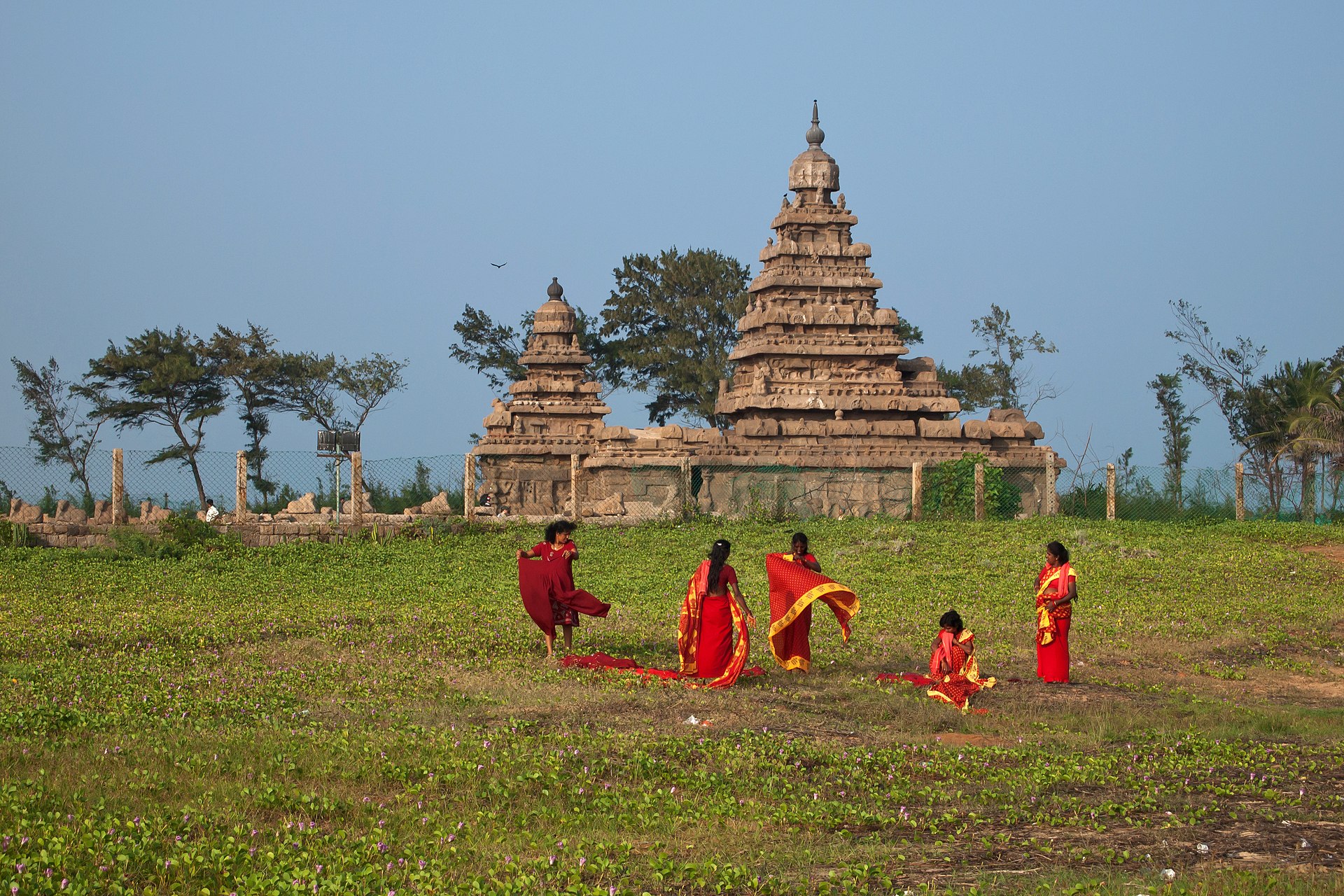
The Shore Temple — granite in the surf for thirteen centuries. <small>Vyacheslav Argenberg, CC BY 4.0, via Wikimedia Commons</small>
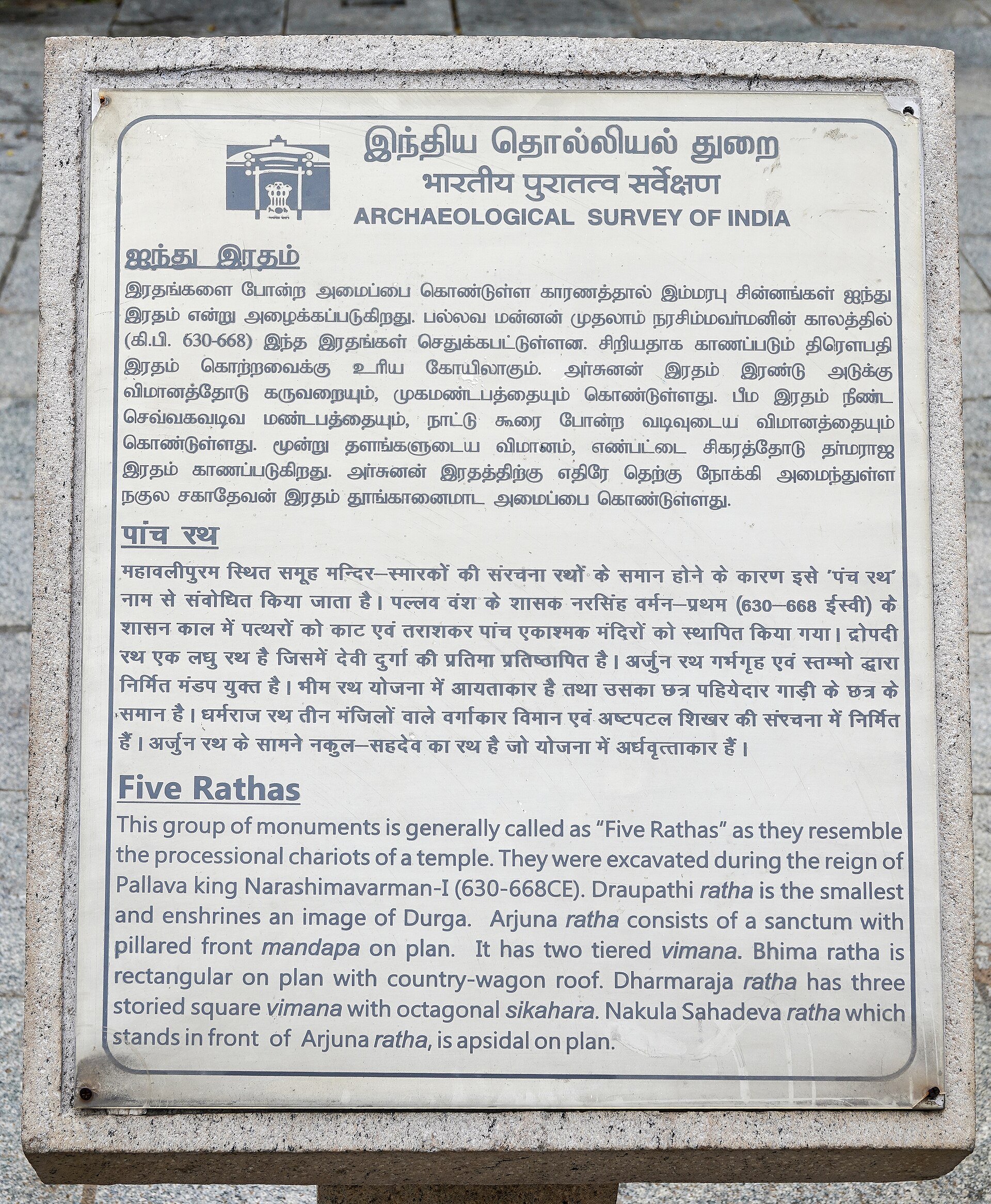
The Five Rathas — each carved whole from one boulder; several unfinished. <small>This Photo was taken by Timothy A. Gonsalves. Feel free to use my photos, but please mention me as the author. I would much appreciate if you send me an email tagooty@yahoo.com or write on my talk page, for my information. Please contact me before commercial use. Please do not upload an edited image here without consulting me. I would like to make corrections only at my own source to ensure that the changes improve the image and are preserved.Otherwise you may upload an edited image with a new name. Please use one of the templates derivative or extract., CC BY-SA 4.0, via Wikimedia Commons</small>
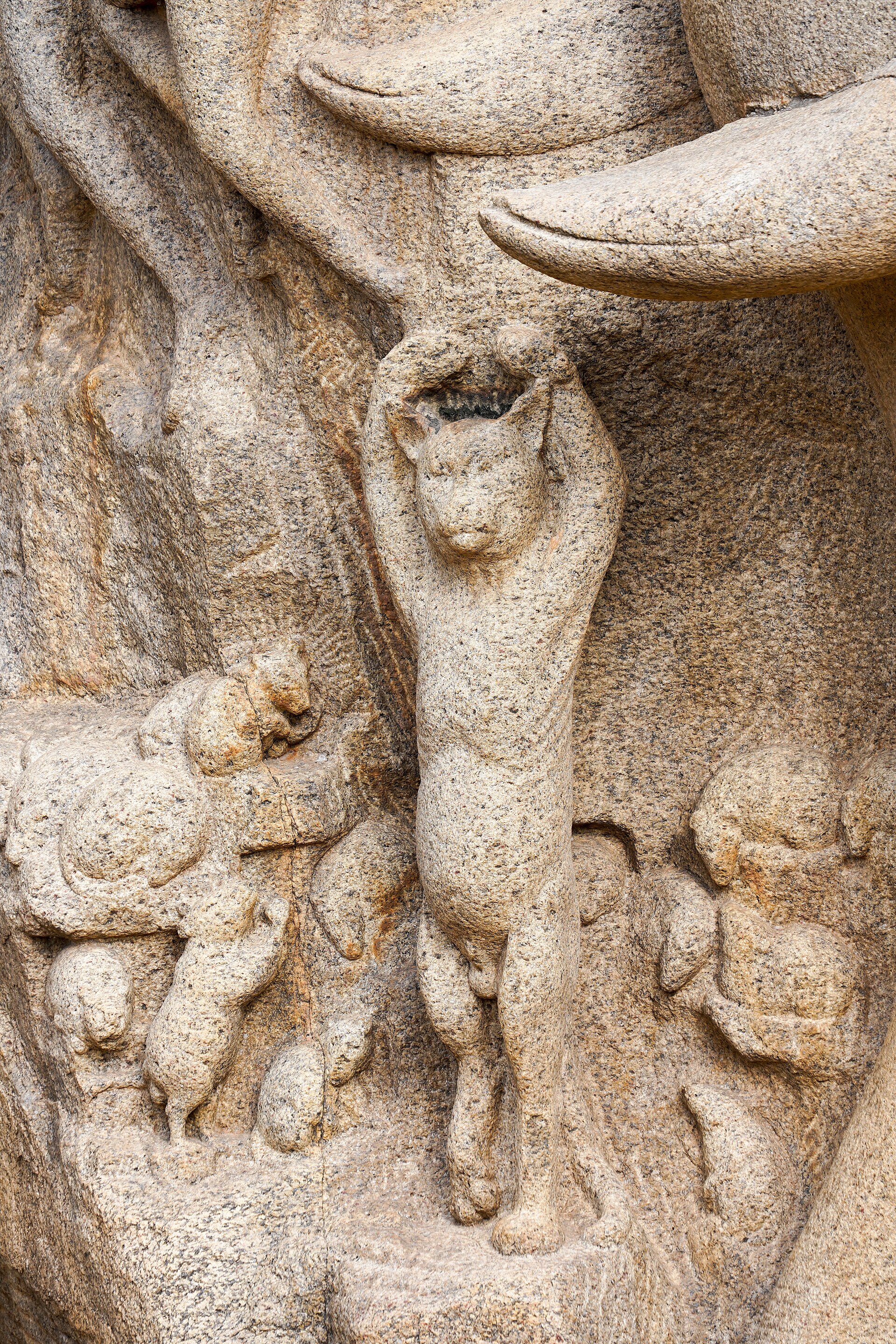
Arjuna's Penance — one of the largest open-air bas-reliefs on Earth. <small>This Photo was taken by Timothy A. Gonsalves. Feel free to use my photos, but please mention me as the author. I would much appreciate if you send me an email tagooty@yahoo.com or write on my talk page, for my information. Please contact me before commercial use. Please do not upload an edited image here without consulting me. I would like to make corrections only at my own source to ensure that the changes improve the image and are preserved.Otherwise you may upload an edited image with a new name. Please use one of the templates derivative or extract., CC BY-SA 4.0, via Wikimedia Commons</small>
Things of wonder (made by hand)
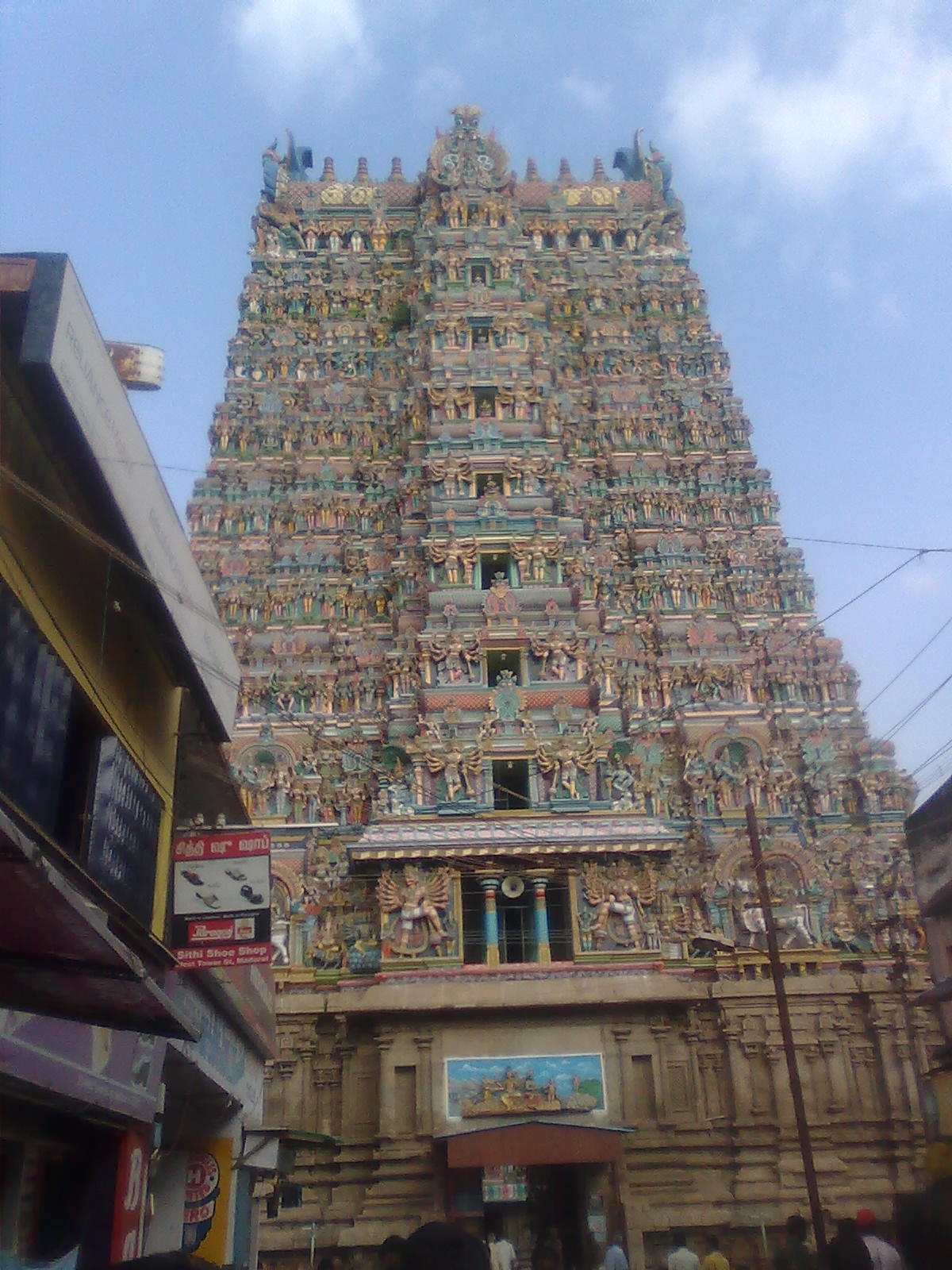
Madurai's Meenakshi temple — Meena's namesake; Kannagi's city. <small>user:deadrat, CC BY-SA 3.0, via Wikimedia Commons</small>
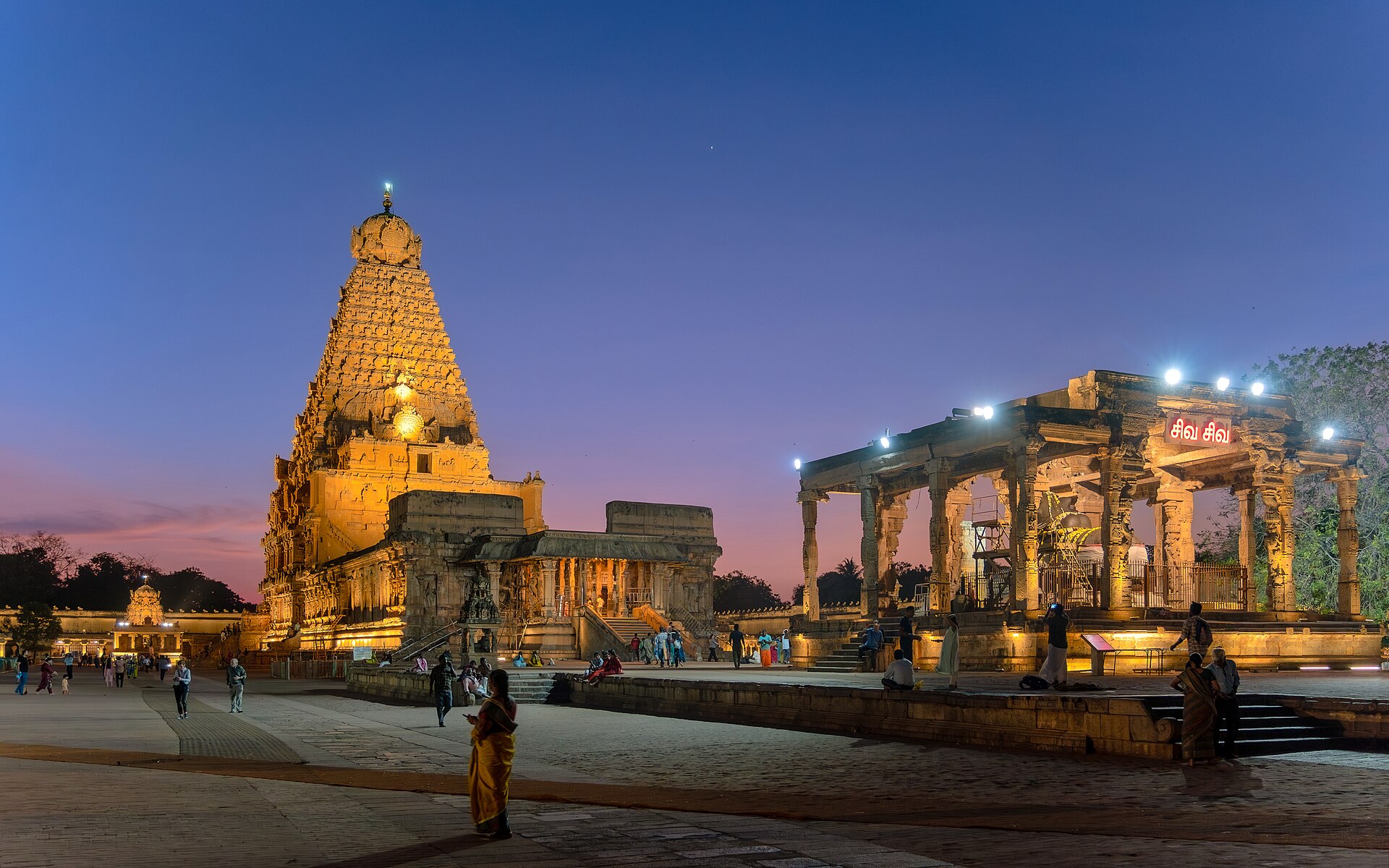
The Big Temple, Thanjavur — the Chola imperial masterwork. <small>Original: Rainer Halama Derivative work: UnpetitproleX, CC BY-SA 4.0, via Wikimedia Commons</small>
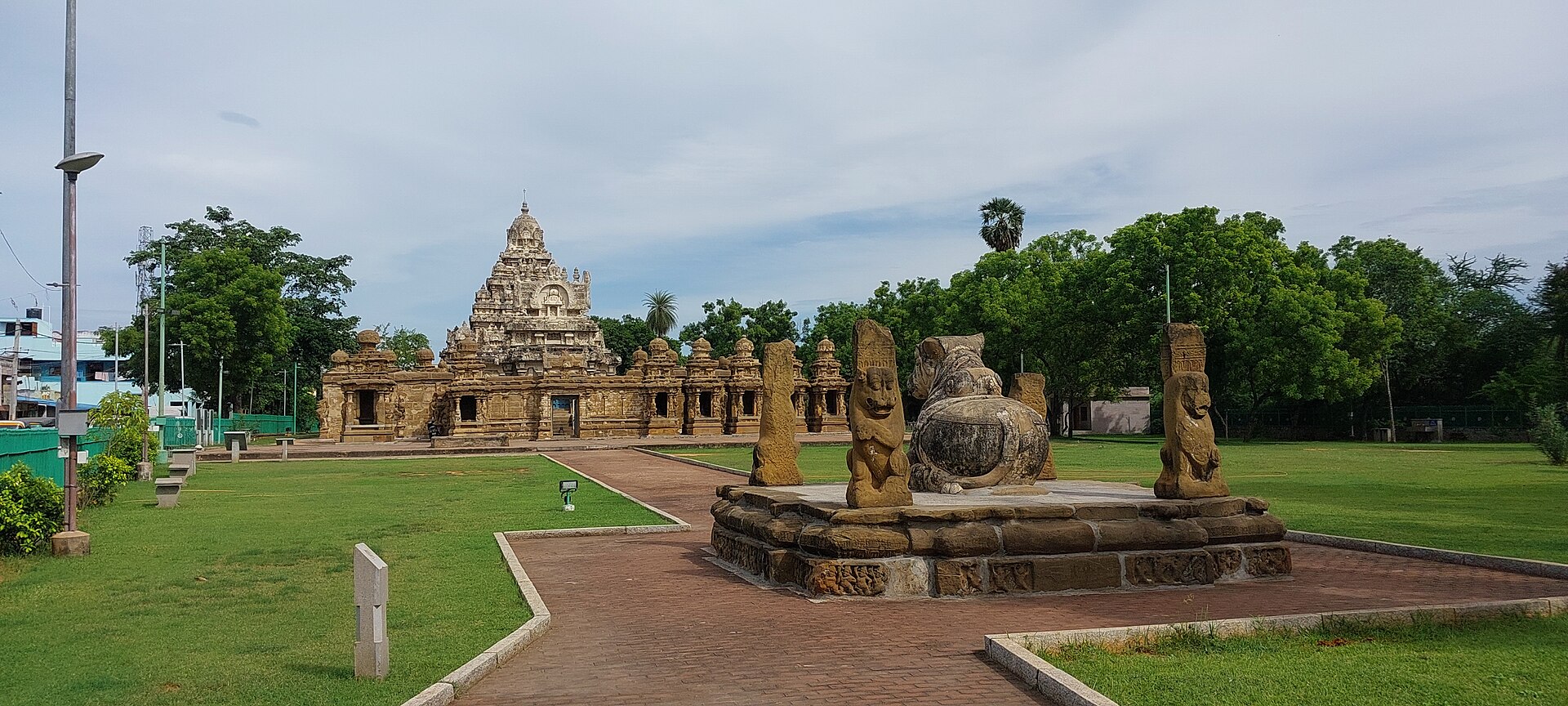
Kanchipuram's Kailasanathar — early Pallava sandstone. <small>Pinakpani, CC BY 4.0, via Wikimedia Commons</small>

The Nagore Dargah — Islam native to the Tamil shore. <small>Samad Faize, CC BY 4.0, via Wikimedia Commons</small>
The living looms of Kanchipuram — craft handed down, not displayed. <small>McKay Savage, CC BY 2.0, via Wikimedia Commons</small>
Peoples, in their own dress
Tamil dress — jasmine and silk. <small>Adam Jones Adam63, CC BY-SA 3.0, via Wikimedia Commons</small>
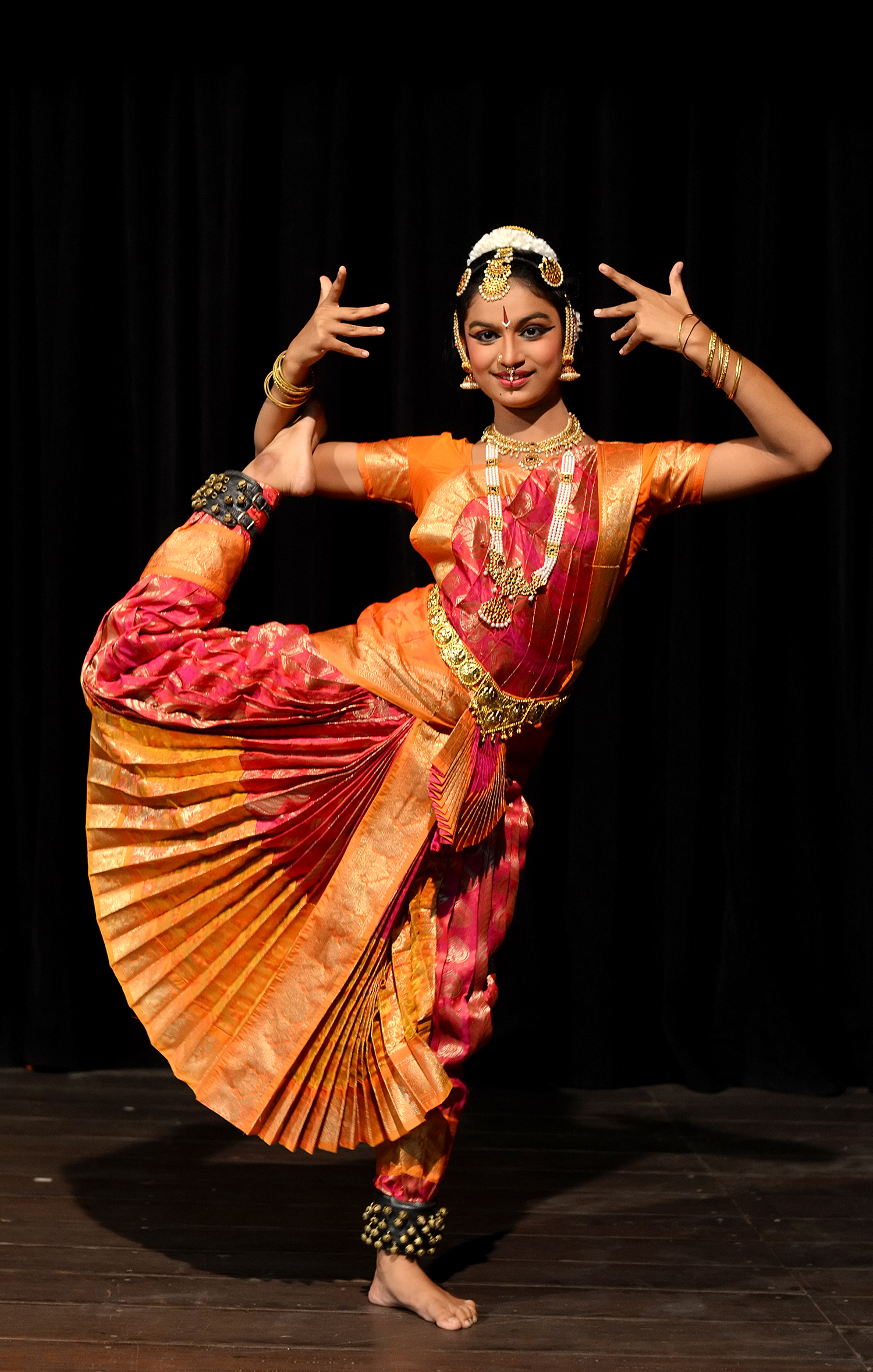
Bharatanatyam — the body as instrument. <small>Augustus Binu/ facebook, CC BY-SA 3.0, via Wikimedia Commons</small>
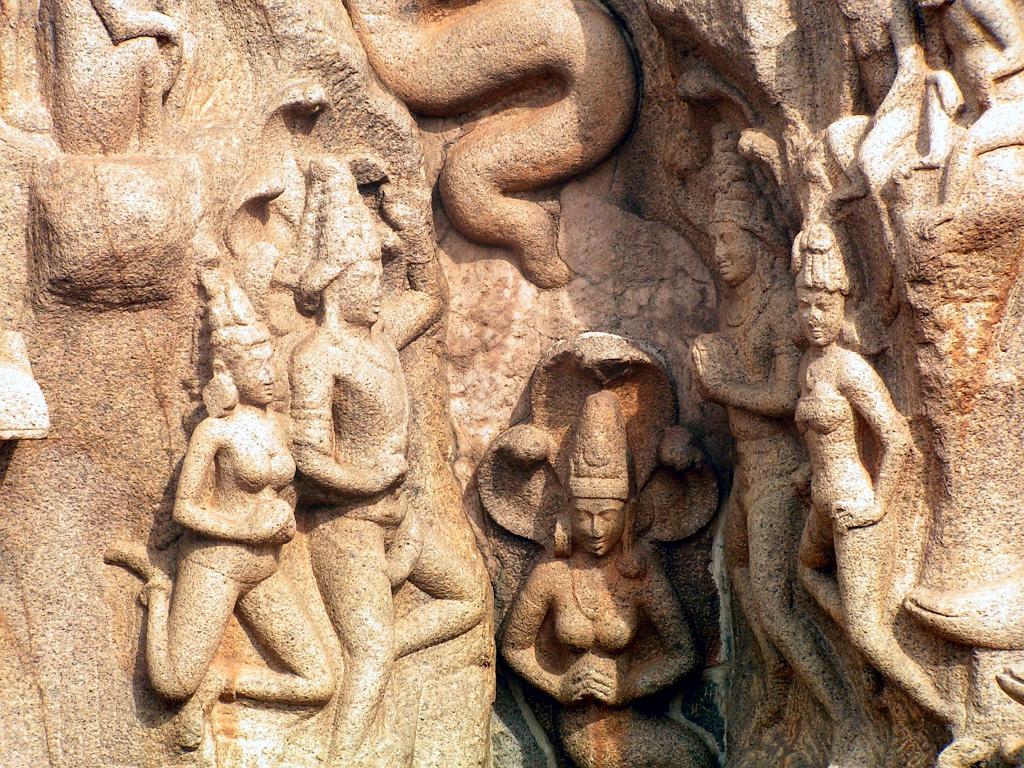
The sthapati tradition — the temple-builder's living hands. <small>Nicholas.Iyadurai, CC BY-SA 3.0, via Wikimedia Commons</small>
<!-- END image-compendium-appendix -->