Dedication
For my sister Carol —
the one, in the end, I grew up furthest from — later she went to live with her father while I stayed with mine. But before that, when we were still under one roof, she was the big sister who sat me down with the mail-order books, the ones that came in the post with the activities still to be filled in, and taught me. That is how I learned a great deal of what I know, and that I was looked after: at her elbow, a pencil between us.
She is the artist I think of when I write about people who can make a wall remember something: she can copy any hand, and she paints murals — whole worlds laid onto flat stone, the way the old carvers did on the cliffs in this book. The years and the houses put distance between us, and we make our different marks now, hers in paint and mine in words — but they began in the same place, a small brother learning from a patient sister, and I have not forgotten it.
This one is for Carol, who put the first pencil in my hand.
Foreword
by Unborn Kids †
The signature will puzzle you, so let me make a small confession of it at once, because it turns out to be the most fitting accident I have ever been handed. My true name has been rearranged, with affection, into two strange words — unborn kids — and when I first saw them I laughed, and then I stopped laughing, because of all the books in the world to attach those particular words to, this is the one where they are not nonsense at all. They are, almost, the thesis.
For this is the Deccan book, the book of the temples carved down into the living rock — whole worlds chiselled out of a single hill from the top, by people who began with a mountain and removed everything that was not a cathedral — and it carries, underneath its adventure, the oldest teaching of that country: that the thing in us which matters is unborn. That it was never made and cannot be unmade. Na jayate mriyate va — it is not born, it does not die. The Song says it plainly, on a battlefield, to a man who has lost his nerve: you grieve for what needs no grieving; the real self is older than birth and outlasts the burning of every temple raised to it.
I spent my long quiet life writing small true things about hills and children and the patient passage of ordinary days, and I never reached for the cosmic, because the cosmic is where most writers go to drown. What undid me about this book is that it reaches the cosmic through the small and the patient and the true — through a hammer on stone, through the measured removal of rock, through engineering so deliberate and so vast that the wonder arrives not as mysticism but as arithmetic, and then keeps going, past the arithmetic, into the thing the arithmetic was always serving. The builders cut a temple out of a mountain to house the unborn. The author cut a thriller out of that fact to do the same.
And he does it the right way round, which is the thing I most want you to notice. The cleverness is the Deccan's. The teaching is India's. The hero who comes to read the rock does not arrive to explain it; he arrives to be instructed by it, and to defer, always, to the people whose mountain it is and whose song it has always been. I have watched a hundred outsiders come to India to find themselves and use the country as a mirror. This author sends his people to India to lose themselves — the small self, the frightened grasping one — exactly as the Song instructs, and to find, in the unborn thing underneath, something that was never theirs to discover because it belonged, from before the beginning, to everyone.
Read it slowly. It is built fast, but it is about the thing that does not hurry, because it cannot, because it was never born and has nowhere to arrive. Let the hammer fall, page by page, and watch a mountain become a doorway.
The kids in my old stories grew up and grew old, as kids do. The one in the title the letters gave me does not, and never will, and that is the whole consolation this book quietly hands you, dressed as an adventure, the way the deepest gifts are always dressed.
— Unborn Kids
† “Unborn Kids” is an anagram of RUSKIN BOND — the gentle chronicler of India's hills — borrowed here in homage and affection. This foreword is a work of fiction. It was written by the author of this book. Ruskin Bond did not write it, was not involved in it, and is not associated with or endorsing this book in any way. The name is rearranged precisely so that the tribute can never be mistaken for a real attribution; it is a salute, not a claim.
A Stranger in Strange Lands
Grok means to understand so thoroughly that the observer becomes a part of the observed — to merge, blend … lose identity in group experience. … You cannot hate anything unless you grok it, understand it so thoroughly that you merge with it and it merges with you — then you can hate it. … But this implies that you love it, too, and cherish it, and would not have it otherwise. — Robert A. Heinlein, Stranger in a Strange Land (1961)
grok /ɡrɒk/ v. (Martian; coined by Heinlein) — to take a thing in so completely that knower and known are no longer two; literally, to drink. It has no true English equal. The nearest word in any tongue may be Zulu: Sawubona — I see you. Both name the same act — to receive another whole — and the rare kind of person who lives by it: at home with everyone, and a stranger in every land.
Chapter 1 — The Reversible Half-Measure
The crack had not been there in March.
Arjun Desai knew this the way he knew most things about the rock — not from a record but from his hands, because in March he had run two fingers along this exact cornice in Cave 16 and felt nothing but the old, honest roughness of basalt that had been breathing for twelve hundred years. Now there was a line. It ran up out of the shoulder of a carved Gajalakshmi, the goddess seated on her lotus while two elephants poured water over her from raised trunks, and where it crossed her painted forearm the pigment had lifted into a small blister of powder, pale as ash, that he could have brushed away with a breath and did not.
He did not touch it. He looked at it for a long time with the torch held low and to the side, the way you light a wound, and let the rock tell him what it was doing.
A fracture, in basalt, is a confession. The stone says where it was weak and how it failed and, if you have spent twenty years listening, roughly when. This one ran with the grain of an old cooling joint — a seam laid down when the Deccan was a sea of lava and the world had no name for any of this — which meant the rock had not invented the flaw. The monsoon had only found it. Three weeks of rain on the plateau, the runoff sheeting down the carved gallery the way it had every July since King Krishna's masons cut the drains, except that somewhere upslope a drain that should carry water away was instead carrying it in, behind the skin of the temple, into the joint, where it sat and dissolved the salts out of the basalt and pushed them outward against the only soft thing in reach: the painted surface a maker's hand had laid down over the bare stone.
The blister was the salt arriving. He had seen this exact handwriting before. He made himself not think about where.
"Arjun-saheb." Bhosale, the senior ASI conservator on the Ellora rolls, a square patient man who had drained more Kailasa galleries than anyone alive, crouched beside him with a moisture meter and held the reading up without comment. Arjun read it and felt the small cold drop in his stomach he had learned to distrust and obey in equal measure.
"It's wet," Bhosale said, "behind the panel."
"It's wet behind the panel," Arjun agreed.
They stayed crouched. Above them the temple went up and up into the monsoon dark — the shikhara of the central shrine rising thirty meters of solid, carved, single-piece mountain, and around them on every side the courtyard walls held back a hundred and fifty thousand tonnes of the cliff that the makers had not cut away, the negative space that was the real miracle, the building defined by everything its makers had had the nerve to remove. He had stopped seeing it years ago. You could not see it and do this job; the maintenance eye and the looking-up eye were two different organs and the second one closed when the first one opened, and his had been open so long he had half forgotten the other was there.
"How far does it go?" he asked.
"GPR'll tell us." Bhosale was watching him, not the rock. "But you can see where it wants to go."
He could. That was the trouble. He had always been able to see where the rock wanted to go — it was the one thing about himself he had never doubted, the thing his teachers had marked him out for at SPA before he had a beard, the thing the heritage bodies meant when they said get Desai on it. He could look at a spalled, salt-eaten, half-failed surface and see, underneath, the form it had been and the form it now had to become to survive: which way the load ran, where the original geometry sat under the damage, what cut the maker had intended and what the next maker had to do. He saw it now, complete, the way you see a word before you say it. The drain had to come out. Not be cleared — cleared, it would silt again by next monsoon and they would be back here with the meter while the salts went on working in the dark. It had to come out, the failed channel chased back to where it left the carved gallery and opened and recut, a permanent intervention into eight square meters of original twelfth-century — no, eighth-century, Rashtrakuta, Krishna I, the dates ran in him like a pulse — original fabric, cut with a diamond saw into stone that no living hand had been licensed to alter, and once cut it could not be uncut. The thing about basalt. You could not add it back. There was no draft, no proof, no second pass. You committed, fully, or you did not commit at all.
He saw the cut whole. He saw exactly where the blade went.
And he heard himself say, in the flat measured voice that he hated and could not stop, "We'd want another reading before we touch original fabric."
Bhosale said nothing. Bhosale had worked with him eleven years and had stopped, somewhere around year six, expecting a decision.
"The meter's a point reading," Arjun went on, and now that he had begun he could not stop, the qualifiers laying themselves end to end like sandbags against a flood that was already inside the house. "It tells us it's wet here. It doesn't tell us the path. We could chase that drain and find the water's coming from a join three bays over and we've opened original surface for nothing, and you can't —" he stopped. You can't put it back. He did not say it. "We'd be guessing at the geometry. We map it first. Full GPR survey of the gallery, the drains above, the joint behind the panel. We get the path, we get the moisture profile over a fortnight, then we cut, if we cut, with the data behind us."
"It's eating the Lakshmi now," Bhosale said. Mildly. A statement of fact from a man who handled facts gently.
"I know what it's eating." It came out harder than he meant, and he breathed, and softened it, because Bhosale did not deserve the edge that belonged to someone else. "I know. So we stop it eating while we map. We tent the panel — RH-controlled enclosure, get a dehumidifier line in, drop a temporary diversion across the gallery to take the surface flow off it. We arrest it. We hold it where it is."
"A bandage."
"A reversible measure." The word reversible sat in his mouth like a stone he had been sucking for years. "Nothing we can't undo. We buy the panel six months, we get the survey, we make the permanent call with the geometry in front of us instead of —" he gestured at the meter, the single number, the one dot of data he was about to build a wall of caution on top of, and he heard how it sounded and could not make it sound otherwise. "Instead of guessing."
Bhosale stood, knees cracking, and looked up at the shrine he could no longer afford to look up at either. "The geometry," he said, not unkindly, "is going to say the same thing in six months that it's saying now. The drain's the drain."
"Then in six months we'll cut it knowing."
"In six months there'll be more salt under the paint."
"Then we slow the salt." Arjun was on his feet too now, and he made his voice reasonable, collegial, the voice that had carried a hundred condition reports past a hundred committees, the voice that everyone in Indian conservation had learned to read as rigour. "Bhosale. It's a thousand-two-hundred-year-old painted surface over a structural joint in a World Heritage monolith. We do not take a saw to it on a point reading and a hunch about the flow. We do it once and we do it right, and to do it right we need the survey. You'd say the same to me."
And the cruel thing — the thing that made it stick, that had made it stick for years — was that Bhosale could not say he was wrong. Because he was not wrong. Every sentence was true. You did map before you cut. You did prefer the reversible. The literature, the charters, the whole careful conscience of the field after a century of clumsy Victorian "restoration" that had done more harm than weather ever did — all of it said: first, do nothing you cannot undo. He had built a career on being the most careful man in the room, and the field had given him its highest word for it, and the word was rigour, and he had learned, slowly, in private, the way you learn the shape of a tumour, that for him it had stopped being rigour a long time ago and become something else wearing rigour's clothes.
But Bhosale could not see that. No one could. That was the trap. The bureaucracy did not need him to be brave; it needed him to be defensible, and a deferral was always defensible. No one would ever stand in front of a tribunal and answer for the survey he had ordered. They would only answer for the cut he had made. And so the system loved his caution exactly as much as he had come to hate it, and protected him from the one thing that might have saved him, which was someone with the authority to look at him and say: Arjun. Decide.
"I'll write it up," Bhosale said, and that was that.
They tented the panel.
It took the rest of the day — the polythene enclosure on its light frame, the dehumidifier humming its small mechanical promise into the RH-controlled dark, the temporary diversion, a neat aluminium channel, screwed into a modern concrete spall-repair from the eighties so that not one new fixing went into original rock, because even his half-measures were immaculate, because if he could not bring himself to do the brave thing he could at least do the careful thing perfectly. By the time it was done the rain had thinned to a warm grey drizzle and the gallery smelled of wet basalt and machine ozone and, under it, faint and mineral, the smell of the salt itself, the thing he had bought six months' grace against and not stopped.
He stood at the enclosure's edge and shone the torch through the polythene at the blister on Lakshmi's arm, soft-edged now, distorted by the plastic, and let himself feel for exactly three seconds the thing he did not allow himself on site. Behind the goddess's painted skin, in the dark of the joint, the water was still there. The dehumidifier could pull the air dry; it could not reach into the rock. The salts would go on coming, slower, but coming, the way they had come once before under another painted surface, in another gallery, when he had had the data and the certainty and the colleague pushing the timeline and had signed the recommendation with his own hand — and the consolidant they had injected to save the wall had sealed the moisture in instead of out, and the salts had bloomed behind the seal where no one could see them or stop them, and by the time the surface failed there was nothing under the paint but powder, and a face that an unknown hand had made with love in the reign of a forgotten king was gone, permanently, off the rock, because of a call he had been certain about.
Three seconds. He turned the torch off.
It had not even been his fault. Everyone had told him so, gently, the way you tell a man the thing he cannot believe. The data at the time supported it. The failure mode was barely understood then. The colleague had pushed. The committee had signed too. The field, mostly, did not blame him.
He blamed himself. And the lesson he had drawn from it — he knew this, he could diagnose himself the way he diagnosed a wall, load path and fracture plane and the long slow creep of damage — was the wrong lesson, the exact wrong lesson, the one that had quietly hollowed out twenty years of brilliance into a man who could read anything on Earth and decide nothing on it: if you are never certain, you can never be that wrong again. So he was never certain. So he never quite chose. So the saw stayed in its case and the surveys piled up and the rock waited, patient as only rock can be, for a man who would commit.
He picked his way out through the courtyard in the failing light. Above him Kailasa went up into the cloud, carved downward out of a vanished sky by people who had stood where he was standing and looked at a solid mountain and seen, inside it, complete, a temple they could not test, could not draft, could not revise — and had picked up the chisel and cut toward it anyway, every stroke final, no second chance, no taking it back, on nothing but the form they could see. He did not look up. He had not looked up in years. He told himself it was the rain.
His phone found signal at the car park, where the souvenir stalls were shuttering against the wet and a chai-wallah was banging the last of his trade out of a battered kettle, and the messages came in a clot: the office, the ASI superintendent, a tender notification he did not open, and one from a Hyderabad number that made the day briefly, stubbornly, lighter.
Heard you're letting the Lakshmi rot rather than commit to a Tuesday. Classic. — IQ
Imtiaz. Of course Imtiaz had heard; Imtiaz heard everything that moved on the plateau, and what he didn't hear, his uncles did. Arjun could see him saying it — the metals man, the bidri master's grandson, who had spent his whole life cutting silver channels into black zinc with a hand that did not hesitate because in his trade hesitation was the error; you scored the line once and the metal went where you put it, and that was the whole grim difference between them, dramatized in two friends' trades, and they both knew it and never said it and needled each other about it instead.
He was thumbing a reply — the Lakshmi is being responsibly assessed — when the second message came, and it was not from Imtiaz, and it stopped his thumb.
It was from the superintendent's office, a forwarded notice, the language of it so smooth and bureaucratically warm that he read it twice before the meaning landed and then read it a third time while the cold drop came back into his stomach, larger this time, and stayed.
The Ministry, acting on the recommendation of an advisory body whose name he did not recognize — the Bharatiya Itihaas Foundation, a heritage trust, true history, the words assembled themselves into something — had been granted oversight of the interpretive and conservation master plan for the entire Ellora complex. Effective immediately. All future interventions to the fabric and all signage, narrative, and public material to be reviewed and approved through the Foundation's office. A new master interpretation was already in preparation. The notice thanked the existing custodians for their service.
Arjun stood in the rain with his thumb over a half-finished joke and looked at the screen, and for the first time in a long time he was not hedging anything, because there was nothing in him to hedge with — only a clean, simple, unfamiliar certainty arriving from somewhere he had walled off years ago, the certainty of a man who knows the joint-spacing of every pillar in that cliff, who knows that Caves 1 through 12 are Buddhist and 13 through 29 are Hindu and 30 through 34 are Jain, three faiths in one mountain over a thousand years, none of them cut to erase the others, all of them real, all of them there — the certainty that whatever a thing called a true history foundation meant to do to that, it would not be addition.
You could not add to basalt.
Which meant the only thing they could do to the rock was take something away.
He did not finish the message to Imtiaz. He got in the car, and sat with the rain drumming on the roof and the wipers off and the screen glowing in his hand, and somewhere behind him in the dark a goddess's arm went on quietly turning to powder under a bandage he had told himself was a decision — and he understood, with the part of him that read where the rock wanted to go, that the survey he had ordered that afternoon was not going to save anything, and that a cut was coming to Ellora whether he committed to one or not, and that for the first time in his career the question was not going to be whether he was certain.
It was going to be whether he could move at all.
Chapter 2 — The Bearing
The woman waiting outside his office had been there long enough to read the condition report he'd taped to his own door, and she did not look up when he came down the corridor, which told Arjun two things before he'd reached her: that she'd been sent, and that whoever sent her had not bothered to teach her the small courtesies people performed for him here.
He minded neither. He had spent the morning not minding things: the junior who'd asked, again, when the consolidant decision would come; the email from the directorate that used the word prudent the way other people used coward; and most of all the seep on the north face of the sixteenth cave that he had stood under at dawn with his hand flat against weeping basalt and walked away from with nothing written in the column where a recommendation goes. He had ordered a fourth survey instead. The water would not wait for a fourth survey. He knew that the way he knew the joint-spacing of every pillar in that courtyard, which was to say in his hands, below argument, and he had ordered the survey anyway, because the call the rock actually needed was the kind you could not take back, and he had not made one of those in eleven years.
"Mr Desai." The woman stood. She was not Indian, or not only: a dry, narrow face, the colour of the diaspora, eyes that had already finished reading him and moved on to the doorframe behind his head as though it were the more interesting object. She put out a hand. "Priya Ellis. I'm sorry. I know you didn't ask for me."
"I didn't ask for anyone." He shook the hand. Her grip was brief and exact, an engineer's, nothing held back and nothing offered, and she let go on the precise beat he would have let go himself. "You're with the foundation?"
Something crossed her face, not offence, something closer to amusement at his expense, quickly filed. "God, no. The opposite, if anything." She glanced once down the empty corridor. "Is there somewhere we won't be overheard by a man pretending to fix a noticeboard? There's been one since I arrived."
There had. Arjun let her into his office and shut the door.
She did not sit. She stood in the middle of the small room with her hands in the pockets of a jacket too warm for the Deccan in May and looked at his walls — the elevation drawings, the salt-creep maps in their tired colours, the long photograph of the Kailasa courtyard taken from the cliff above so that the whole impossible thing lay below the lens like a model of itself — and she looked at the photograph the way no visitor ever did. Visitors looked at it and said beautiful. She looked at it the way he looked at a fracture, tracking something across it, lips slightly parted, and for a moment Arjun forgot to be irritated and was only curious.
"You read stone," she said. It was not a question, so he didn't answer it. "I read machines. Different rock entirely, but. The same room, I think. I came a long way to stand in your room."
"People usually come a long way to stand in that room." He nodded at the photograph. "Not mine."
"They're the same room. That's rather the problem." She turned from the wall. "I'll be quick, because I'm bad at this part and you have a seep to ignore, and I'd hate to keep you from it."
He felt that land — a small precise blade slid in between two ribs, almost kindly, by someone who had located the ribs without seeming to look. He kept his face still. He was good at keeping his face still; it was most of what the directorate mistook for wisdom.
"You've come about the consolidant," he said. "Someone in Delhi sent you."
"I don't know what a consolidant is, and nobody in Delhi knows I exist, which is the way I'd like to keep it." She took her hands out of her pockets. From the inner one she drew a folded sheet — printed, creased to softness, carried — and held it without offering it yet. "I've spent the last while following a thing across this country. I'm not going to tell you the whole of it, partly because it would take three days and partly because you'd stop listening at the second sentence, and you'd be right to. I'll tell you the shape." She looked at him levelly. "There's a signature in certain old structures here. A way the makers put proportion into stone so the stone does something — gathers a frequency, passes a pulse, holds a note. It runs through more sites than it has any business running through. Different rock, different centuries, different faiths. The same hand under all of it." She lifted the folded page an inch. "I can read it. I have read it, at a step well in Rajasthan, on a painted wall at Ajanta, on a drowned wall in a sea. I read it once here, eight months ago, in the pit under your sixteenth cave, with a man called Rohan standing next to me telling me which way not to fall."
"Rohan Kale." Arjun heard his own voice come out flat. "He brought a foreigner into the Kailasa sanctum last winter without an access permit and told the ASI guard she was his cousin." He had been furious about it for a week. Rohan had taken the fury with the particular Marathi shrug of a man who has decided your rules are a weather he can wait out. "That was you."
"That was me. I apologise for the cousin." She didn't sound sorry. "He's a good man. He reads the rock the way you do, just slower, and he knows it, which is why he kept saying I should be talking to you and not him." She set the folded page down on the corner of his desk, finally, and stepped back from it as if it were warm. "So. Here I am. Talking to you."
Arjun did not pick it up. "What is it."
"It's the reading. The acoustic geometry, as far as I could carry it." She watched him not reach for it, and something in her settled, as though his not-reaching had confirmed a thing she'd been told about him and half disbelieved. "And it's a bearing. A direction the signature points, off the edge of one place toward the next. I've followed it three thousand kilometres. It brought me back here." A beat. "And here it stops. For me."
"Stops."
"I can't read this rock any further." She said it plainly, no drama in it, an engineer reporting a tool out of range. "Kailasa I can read that it works. I stood in the pit and I felt the chord come up, the whole mountain tuned to one string, and I could tell you it's the cleanest piece of that signature on the subcontinent. But I can't read how. I get to the edge of it and the rock just — holds. And I've worked out why, finally, which is the embarrassing part, because it took me three thousand kilometres and it should have taken me one." She looked at him, and the dry amusement was gone, and what was under it was straight and a little tired. "It answers a kind of mind I don't have. Mine reads things by going still and letting the form come up. That's most of what I'm for. But this place wasn't tuned by a mind that waited for the form. It was tuned by a mind that already had the whole of it, finished, certain, and cut toward it — top down, no scaffolding, no second draft, two hundred thousand tonnes taken off a living mountain to uncover a temple they could already see inside the rock, with not one cut anywhere they were allowed to take back." She tipped her head at his photograph. "I read by letting go. This was made by committing. They're not the same motion. It won't open the rest of the way for me because I'm built backwards to it."
Arjun became aware that he had stopped breathing in the ordinary way and started again on purpose.
He knew the number. Of course he knew the number — he had quoted it in lectures, two hundred thousand tonnes, the conservative figure, the one you could defend; he had stood under the cliff a thousand times and run the arithmetic of it past students until it was worn smooth and meant nothing, a fact you kept on a shelf. And here was a stranger in a too-warm jacket saying it back to him as though it were a wound, and it had gone in like one — not the number, the thing the number was. No revision. No prototype. No taking it back. The carvers had begun at the top of the cliff with the finished temple held entire in their heads and had committed, the first morning, before they could possibly have known it would hold, to a sequence of irreversible cuts a century long. He had spent eleven years organising his life around the conviction that you did not do that — that the irreversible act was the one you deferred, surveyed, hedged into a reversible half-measure, because the irreversible act was how you destroyed something you could not give back.
The men who made the thing he had spent his life keeping from crumbling had believed the exact opposite, and they had been right, and it was still standing, and he could not make himself authorise a drainage cut.
"You grew up here," Priya said.
"An hour from here." His voice had gone somewhere careful. "I did my first survey of the Kailasa drains as a student. I know that rock better than I know—" He stopped. He had been going to say anyone, and it was true, and it was also the whole of the trap, and he did not want to say it to her.
"I know you do." She had heard the stopped sentence; he saw her hear it. "That's why it's you. I can read that the instrument is real. You're the one who can hear what it's saying, because you grew up inside it — you've had your hand on that basalt since you were a boy, you know what the chisel can do and what it can't, you know it in your body and not off a shelf. I can carry the bearing to the door. You're the one who lives past the door." She almost smiled. "I'm told I have a habit of reading the destination before I've read the room I'm standing in. So let me not do it to you. The room you're standing in is the most extraordinary instrument I've ever put my hand on, and you've been treating it like a maintenance schedule, and I think you stopped looking up at it a long time ago, and I think you know exactly when you stopped."
The seep on the north face. Eleven years. He said nothing.
"And here's the part I came to say, and then I'll go, because I genuinely am bad at this and you have work." She picked up the folded page again — not to keep it, he understood; to put it into his hand, which she now did, pressing it flat against his palm and closing his fingers over it with both of hers, briefly, the way you'd hand a man a thing he might otherwise leave on the desk. Her hands were cold. "I spent thirty-four years certain that if I ever let go all the way, with everything riding on it, there'd be no one underneath. I built a whole self out of not letting go. And it turns out the self I'd built was the only thing in the way." She let go of his hand. "You're waiting for a certainty that isn't coming, Mr Desai. I know the look. I wore it across three countries. The rock you've kept your whole life was made by people who didn't have it either and cut anyway, and that's not a sermon, it's just the spec on the thing you signed up to protect. You can read the form better than anyone alive. The only thing you can't do is the one thing the form is made of."
It should have made him angry. People who had known him for years did not say such things to him; the directorate had built him a small comfortable kingdom precisely so that no one would. A stranger had walked into his office at eleven in the morning and named, in three sentences, the thing his colleagues mistook for rigour and he knew for fear, and had done it without cruelty, almost absently, the way you'd point out that a beam was carrying more than it was rated for — not an accusation, a reading.
He found he was not angry. He was, for the first time in a long time, seen, and it was unbearable, and he wanted her to keep going, and he wanted her to leave, both at once.
"You said it stops here," he said instead, because it was safer ground and because something in the page in his hand had begun, against his will, to be the most interesting object in the room. "The bearing. You said it brought you back here and stopped."
"It stops being mine to read here." She was already moving toward the door, the way people move when they have said the thing they came to say and trust it to do its own work. "It doesn't stop running. That's the other thing you should know, and the reason I came in person instead of couriering you a page." She paused with her hand on the door, and the dryness went out of her entirely. "The signature points somewhere from Kailasa. There's a next site in the chord, an older one, where the instrument's use is remembered, not just its shape — and the bearing runs straight at it. But that's not the urgent part." She looked at him. "The urgent part is who else has been reading the same map. Badly, and for the wrong reasons, and with a great deal of money."
The cold that went through Arjun then had nothing to do with her cold hands.
"The foundation," he said.
"The man on your noticeboard works for a foundation, yes." She said it carefully, watching his face. "I don't know the whole of his employer's project here, but I know the shape of men like him, because I met one in a courtyard not far from this office and chased him to the bottom of a sea. He doesn't want to read the rock. He wants to own what it says — and the way you own what a thing says is you decide, in advance, what it's allowed to say, and then you carve everything else off it." She let that sit. "I'm told his foundation was granted authority over the interpretation and restoration of this whole cliff. Last month. Signage, the official narrative, the conservation tenders. The master plan for what Ellora means." A pause, very deliberate. "Which means the next set of irreversible cuts on this mountain is going to be authorised by someone whose entire purpose is to make the rock tell one story — and the one man whose signature could stop a bad cut on this cliff is the man who hasn't authorised a cut of any kind in eleven years."
She opened the door. The corridor beyond was empty now; the man at the noticeboard had gone.
"I'm handing this to better-placed people than me," she said, an echo Arjun couldn't have known he was hearing of a kitchen in Sea Point and a man with grey eyes saying nearly the same words over a dented tin. "It's your ground. It always was. I just got it to your door." She nodded at the page crushed in his hand. "Read it when I'm gone. Then go and stand in the courtyard and look up at the thing, properly, the way you haven't let yourself in years — and ask yourself what it cost the people who made it to begin, before they knew."
"Where are you going?"
"On." She was already half through the door. "The bearing runs past me, and I've a habit of following it, and there's a coast a long way south where it points after this that I'd like to be standing on when someone I haven't met yet works out what I worked out too late." The dry amusement came back, one last time, at the very edge. "And you have a seep to stop ignoring. I'd start there. It's only a drain. Practice on something small."
Then she was gone, her step quick and even down the corridor, a narrow figure in a too-warm jacket who had crossed an ocean and a continent to spend nine minutes telling him the truth and leave, and Arjun stood in his office with the door open and the folded page biting into his palm and the long photograph of the courtyard on the wall — the temple carved downward out of the sky, lying below the lens like a thing he had stopped seeing — and for the first time in eleven years he made himself look up at it.
He uncreased the page. The geometry on it was an engineer's hand, clean and certain, ratios and a bearing-line and a single annotation at the foot in capitals that were not a recommendation and not a hedge, that committed without apology to a thing she could not have been sure of, and that read, simply: IT ANSWERS THE HAND THAT WILL CUT.
Down the hill, the water was still moving through the north face of the sixteenth cave, taking the rock a little at a time and then, one day, all at once. It had been moving while he ordered a fourth survey. It was moving now.
Arjun folded the page, put it in his shirt pocket over his heart the way you keep a thing you mean to act on, and went to find his kit.
Chapter 3 — Only to Assess
The bearing fit in his shirt pocket and weighed nothing, which was the problem.
Arjun Desai stood on the upper drain-walk at the back of Cave 16 a little after seven, before the gates opened to anyone but the men who kept the place, and looked down into the courtyard of Kailasa for damage, as he had a thousand times. The eye went where the work was; it was a hard habit and he had never tried to break it. He read the vimana spire first, standing free in its pit of excavated sky, and walked his gaze down the south face to a hairline he'd been watching for six monsoons — the one the textbooks called nothing and he called a patient. Stable this year. The grout he'd let himself inject, reversible, removable, the coward's grout that a man with more nerve than him could pick out again in fifty years, had held. He noted it the way you note a fever that hasn't climbed.
Then he made himself stop reading the temple as a patient and look at it as a thing, and for about four seconds, before the habit closed over again, he did. They had stood up there, on the live rock of the cliff-top, and begun to remove — to take away, not build up, two hundred thousand tonnes of basalt cut top-first out of one hill to reveal a temple three storeys deep that they could already see, whole, finished, standing inside the rock before the first chisel touched it. Every cut final. No course to lift and relay, no prototype, no second hill to try if the first went wrong.
He, who could not commit to a line of lime grout without a second opinion on it, was the custodian of the most absolute act of commitment on the subcontinent. He looked away first. He always looked away first.
"You're up early even for you," said Bhosale, coming along the drain-walk with two paper cups of tea from the stall that wasn't supposed to be open yet, "which means you didn't sleep, which means the foreign madam said something that lodged." Ganesh Bhosale was ASI, conservation assistant grade, fifty-one, Aurangabad to the marrow, and the nearest thing Arjun had to a colleague at Ellora who would say a true thing to his face. He handed over a cup. The tea was the colour of the rock in monsoon and sweet enough to stand a spoon in. "She gone?"
"Gone." Priya Ellis had been there and not there in under a day — a dry, exact, badly-slept woman with a South African flatness in her vowels and a look at the cliff face he hadn't been able to catalogue, neither a tourist's nor a conservator's, some third thing. She'd given him a folded sheet of paper and a sentence he couldn't put down. You grew up inside this rock, Arjun. You can hear what I can't. And then, at the gate, almost an afterthought, not unkind, barely even aimed — the thing that had actually kept him awake: You keep waiting for a reading that'll make the decision safe. It isn't coming. The makers knew that. That's the whole trick of the place. Said the way you'd tell a man he had spinach in his teeth. Then she'd got into a Sumo with a driver who knew where he was going without being told, and gone north, and the thread had moved on without him — hand to hand, she'd said, the only way it ever moved.
"And she left you that." Bhosale nodded at the breast pocket.
"She left me that."
"What is it?"
Arjun took it out. A single sheet, folded in three, and on it, in a small even hand that was not Priya's — she'd told him she didn't write the readings, she only made them — a set of frequencies. Resonant frequencies, measured, with tolerances, against locations he knew the way he knew his mother's house: the garbhagriha, the inner shrine where the lingam stood; the Nandi pavilion; the pillared hall above. Numbers for how the carved chambers answered sound. And under them, one line: proportions consistent across all three; cf. Ajanta C-19, C-26. The set is not decorative. It does something.
It was, he had to admit, beautiful work — taken properly, corrected for crowd, for temperature, for the hour the chambers were empty. The kind of numbers he respected. They were also, every one of them, an accusation, because numbers like that did not belong to a building anyone had ever told him was a building. They belonged to an instrument. And the gap between readings on a temple and readings on an instrument was one you could only cross by deciding to cross it. By committing to a reading. On exactly the evidence in his hand and not one datum more.
Bhosale read it over his shoulder, lips moving, and didn't pretend to understand it. "So what does it want from you?"
"Nothing," Arjun said. "It's a single sheet of measurements with no provenance, no instrument log, no second set to check it against. It wants nothing from anyone. You'd laugh me out of a tender meeting if I built a recommendation on it."
"Mm." Bhosale drank his tea. He had worked beside Arjun long enough to hear the shape of the thing under the words, which was the shape of a man building, very carefully, a reason not to act. "And if it's right?"
Arjun didn't answer that. He folded the sheet back into three and returned it to his pocket, where it weighed nothing, and watched the light come down the western wall to the head of the first elephant — the life-size elephants that carry the temple on their backs, carved from the same continuous rock as the floor they stand on, so that the building rests on animals that are part of the ground — and the thought came, as it always came when the choice in front of him had no safe edge: I'd want another reading.
He despised the thought even as it formed. He had the cleanest excuse in the discipline: rigour. No responsible conservator commits a monument to a theory on one undocumented sheet of paper. Everyone he had ever worked with would back him. The field would call it wisdom. And he knew, with the flat private accuracy he saved for himself and showed no one, that it was not wisdom. It was the same thing it was always. It was fear wearing the good coat.
He took out his phone and called Imtiaz, because Imtiaz was the one person who would tell him to stop being a coward in a way that did not feel like an insult, and because the readings said cf. Ajanta, and Ajanta meant the older layer, and the older layer was a long way past anything Arjun could verify standing here, and he was not going to drive into the dry country on the strength of a sentence said to him by a stranger at a gate.
He was going to do something much smaller and much more survivable. He was going to assess.
It was only to assess. He said it to himself in those words, on the drain-walk, with the tea going cold in his hand, the way a man says the words that let him take the first step of a journey he has already decided not to admit he's taking.
Imtiaz Quadri arrived at four in a Maruti the colour of nothing, smelling faintly of acid and burnt zinc, the workshop smell twenty years had laid into him so deep his wife had stopped noticing it, and crossed the parking apron with the unhurried roll of a man who has never once been late to a thing he cared about and comprehensively late to everything else. He had put on weight in the decade Arjun had known him and worn it well, into authority. He had a conservator's hands — Arjun's were the same, scarred and careful — but where Arjun's read the void, the rock that had to come away, Imtiaz's read the silver that had to go in and stay where it was put. They had argued about it for years, drunk and sober, the carver and the inlayer, and neither had ever once won, which was why the friendship had lasted.
"You called me on a Tuesday," Imtiaz said, by way of greeting, "in person, not on WhatsApp, which means you're frightened, which means I cancelled a man who was going to pay me a great deal of money to ruin a Bahmani box, so this had better be good." He looked at Arjun properly then, the way old friends look, taking inventory, and what he saw made the performance drop a notch. "Arrey. You really didn't sleep."
"A woman from a — an institute. A consortium. The provenance is murky and I don't entirely trust it." Arjun heard himself hedging and let it stand. "She left me a set of acoustic readings on Kailasa. And a reading on the cliff that — Imtiaz, I want to show you the chamber first. I want you to hear it before I tell you what she said it is. Because if I tell you first you'll hear what I tell you, and I need to know what you hear."
Imtiaz's eyebrows went up a fraction. This was, for Arjun, a wildly committed thing to say — Arjun, who would normally have buried the readings under four caveats and a request that they wait for a proper team. He didn't comment on it. He'd been waiting ten years for Arjun to say a sentence with no caveat in it and he knew better than to startle the bird. "Show me the chamber," he said.
The gates were closing to the public. Bhosale, who owed Arjun favours going back to a drainage report that had saved his neck in 2019, waved them past the barrier with a look that said I never saw you, and went to stand at the courtyard mouth with the comprehensive deafness of a man being usefully absent. They went down into Kailasa as the day-heat lifted off the basalt and the chambers breathed their cool mineral dark up into the falling light, through the pillared hall and into the garbhagriha, the deep shrine at the heart of the carved hill, where the rock closed over them and the noise of the world stopped at the threshold as if switched off.
It was very dark and very still and smelled of cold stone and a thousand years of ghee lamps. Imtiaz stood where the readings said to stand, quiet for a while, the quiet he went into over a piece of metal he was about to commit a cut to. Then, without being asked — Imtiaz never had to be asked, that was the whole of him — he set his feet, drew a breath from the floor of himself, and sang one long low note into the dark.
He had a good voice, a qawwali-trained voice from a boyhood of Thursday nights at the dargah, and he held the note dead level, and the chamber took it.
Arjun felt it before he heard it — up through the soles of his feet and into the long bones of his legs, the carved rock gathering the single pitch and giving it back from every face at once, the void of the shrine ringing like the body of an instrument with the two of them standing inside the sound-box of it. The note swelled until it was not Imtiaz's note any more but the room's, the room pulling his voice onto the exact pitch it wanted and holding it there, bodily, in the chest and the teeth and the floor. Imtiaz's eyes had gone wide in the torchlight. He held it as long as his breath lasted, and when he let go the chamber kept it a moment longer than it had any right to, the note dying down through the rock in a slow descending shimmer — and then the silence came back, and it was a different silence than before, a silence that had been used.
Neither of them said anything for a moment.
"That's not an accident," Imtiaz said at last, very quietly. He was a craftsman; he knew the difference between a thing that happens and a thing that was made to happen. He laid his hand flat on the carved wall. "Arjun. They tuned the rock. They cut a hill until it rang." He turned, and his face in the torchlight had the thing on it that Arjun could no longer manufacture on his own — pure, undefended astonishment, a grown man undone by the courage of dead men. "I tune metal for a living. When I'm wrong I can correct — shave a pipe, pull a string tighter. They couldn't correct. They cut down into solid rock toward a note they couldn't hear yet and couldn't take back if they missed, and they hit it." He laughed, once, helpless. "There was no first try. There was only the one."
Imtiaz had heard the temple once and gone straight to awe. Arjun had measured it for twenty years and gone straight to I'd want another reading. The same rock, two men, and only one of them could cut.
"Now tell me what she said it is," Imtiaz said.
So Arjun told him. The readings, the consistency across all three chambers, the cross-reference to Ajanta; the word the woman's people used that he wouldn't repeat because it sounded mad in the mouth — that the temple was one part of a larger instrument, the same tuning running through the older caves and on, the same competence surfacing across faiths and centuries, the bearing pointing north and beyond. He told it flat and full of caveats, the murky provenance, the single undocumented sheet, all the responsible reasons to do nothing. And Imtiaz listened to every word, and at the end of it said the thing Arjun had called him for and dreaded him for in equal measure.
"So when do we go to Ajanta?"
"Imtiaz—"
"You heard it. I heard it. You've got a reading that says the same fingerprint is in the older rock. The cliff just rang in our chests." Imtiaz spread his hands, and there was no impatience in it, only the bafflement of a man watching his friend stand at the edge of something true and not step. "What are you waiting for? A committee? A grant? The woman to come back with a notarised affidavit from a thousand years ago?" He said it gently, but it landed, because it was exactly right. "Arjun. You are the man who knows this rock better than any living person, you have a reading in your pocket that you yourself just told me is good work, and the rock confirmed it in front of you. There is nothing left to assess. There is only whether you'll go and look or whether you'll spend another six monsoons watching a hairline and calling it rigour."
The torch hissed faintly. Above them, far up the carved well of the temple, the last of the daylight had gone copper on the spire-top.
"I'll go and look," Arjun said. The words came out smaller than he wanted and surer than he'd felt them, which was, he would think later, the first true thing — that the saying could run a half-step ahead of the certainty. "To assess. That's all. We go to Ajanta, we take proper readings, we document it ourselves, and if it falls apart in daylight, which it probably will, we've lost a tank of diesel and a Tuesday."
"To assess," Imtiaz agreed, with the bone-dry face of a man humouring a friend he loves. "Of course. Only to assess."
They came up out of the temple into a courtyard gone violet with dusk. The azaan was going up from the town below, the long held call floating across the dark plateau, and under it, from the other direction, a temple bell — the two sounds crossing over the valley as they had crossed every dusk of Arjun's life, neither giving way, both older here than anyone could rank. Bhosale was at the barrier, and he was not deaf any more. He had a tablet in his hand and the face of a man who has read something he wishes he could un-read.
"You need to see this before you go anywhere," he said. "It came round the ASI circle this afternoon. Official channel. Sir, it's got a tender number." He said tender number the way you'd report that a thing had a pulse. He handed Arjun the tablet.
It was a prospectus — glossy, beautifully made, the kind that costs real money, under the seal of a foundation Arjun half-recognised: the Bhāratvarsha Heritage Trust, patrons of a true and unbroken history, the typeface expensive, the photography of Kailasa so well lit it hurt. And across the top, the part that had drained the blood from Bhosale's face: a Memorandum of Understanding between the Trust and the state authority, granting the Trust a lead advisory role in the interpretation, signage, and conservation master-plan for the Ellora caves. Granted. Signed. Three weeks ago, while Arjun had been watching a hairline.
He scrolled. Imtiaz read it over his shoulder in the dying light, and Arjun felt his friend go still in a way he had not gone still even in the shrine.
It was not a thug's document. That was the thing — it was the opposite of a thug's document. It was learned. It cited real iconoclasm, temples that genuinely had been broken, the contempt some colonial scholarship genuinely had shown for Indian genius, the misdatings, the condescension — and cited them accurately, and the accuracy was the worst part, because a man who loved his heritage, as Arjun loved his, loved the Hindu caves of this cliff most of all, would find his own true grief on the page set down with care, and would nod, and keep nodding, right up to where the document turned. And it turned beautifully. In measured academic prose, with footnotes, it proposed a "unifying interpretive framework": Ellora presented to the public — on its signage, in its conservation priorities, in the material sent to every school in the state — as one single, unbroken expression of one civilisational genius. The Buddhist caves recast as "an early flowering of the same indigenous tradition." The Jain caves as "a regional sectarian variation within it." The older strata dissolving, becoming tributaries to one river, the three faiths of the cliff melting into one — its one — with the deftness of a man pulling a single thread until a woven thing comes apart in his hands. There was a paragraph on "rationalising" later "accretions and intrusions" to "restore the monument's original coherence." Arjun read it twice. He knew what an accretion meant in a conservation document. He knew what rationalising meant when the thing could not be uncut.
And there was a face. The Trust's founder-director, on the inside fold — a grave, grey-templed man of perhaps sixty before a temple gopuram in a fine kurta, his expression not gloating, not fanatical, but sorrowful, the careful sorrow of a man who believes to the bottom of his soul that something precious of his was stolen and that he has been called to restore it. A name under it. A string of honest degrees. A list of patrons with two industrialists Arjun had heard of and one trust whose money no conservator in the country could afford to be on the wrong side of.
"He believes it," Imtiaz said. Very low. He was not looking at the screen any more but out across the dark valley toward the town, toward the call to prayer dying over rooftops where his family had lived longer than the man in the photograph's framework would allow them to have existed. "That's not a crook, Arjun. A crook you can buy or expose. That man believes every word, he's grieving something real, and he's going to use it to cut my grandfather's whole life out of this rock and call it a restoration." He said it without heat, which was worse than heat. "And it's legal. He has a tender number."
Arjun stood in the violet dark with the tablet's glow on his face, and understood, all at once and with the cold completeness of a load path resolving, that the choice he had spent his whole life arranging never to have to make was now going to be made by someone — and that the only signature in the state with the standing to authorise or block a conservation master-plan for these caves, the one expert the authority would have to consult, was his own.
The man who could not commit to a line of lime grout.
He looked down into the black well of the courtyard, where somewhere in the dark the great elephants held the temple up out of the same rock as the ground, and the bearing weighed nothing in his pocket, and he did not say what he was thinking, because in this family of two you did not say the thing, you showed it. He handed the tablet back to Bhosale and looked at Imtiaz.
"We leave for Ajanta at first light," he said. "And I want a copy of that prospectus. The whole thing." A beat, and then the small, terrible, honest amendment, the first cut of the rest of his life, made on incomplete information toward a form he could only just begin to see. "Not to assess."
Chapter 4 — A Temple Carved Downward
He went down into Kailasa before the gates opened, while the courtyard still held the night.
The ASI watchman knew him and let him through the side wicket with a nod and a flask of tea he had not asked for, and Arjun walked in alone along the processional, past the elephants worn to grey ghosts of themselves, past the two free-standing pillars the masons had left like exclamation marks at the threshold of the work, and out into the open court with the cliff rising sheer on three sides and the temple standing in the middle of the hole the makers had dug for it. The light was the colour of ash and water. The monsoon had gone off the boil overnight and left the basalt dark and weeping at its seams, and the whole gorge smelled of wet stone and marigold rot from yesterday's offerings, and somewhere up on the lip of the escarpment a langur coughed once and was quiet.
He had been here ten thousand times. He set the tea on a ledge and made himself stand in the centre of the court and do the thing he had told the watchman he was here to do, which was assess the north-face diversion, and which was a lie, because he had assessed it twice already and it was holding, and he had come down in the dark for the other thing. He took the folded page out of his shirt pocket and did not open it. He just held it, the way you hold a tuning fork before you strike it, and he looked up.
The temple went up off the floor of the pit and kept going. The shikhara of the central shrine rose thirty metres into the grey, tier on tier of carved stone narrowing to its crown, and behind it the cliff rose higher still, so that the eye had no rest, no horizon, only rock above rock above rock, and the building seemed not to stand on the ground but to hang from the sky it had been cut down out of. The court swung very slightly under him. He had felt this once before, as a boy, before he learned the joint-spacing and the drain-runs and the salt-creep, before he turned the miracle into a maintenance schedule — the small sick lurch of scale, the body registering that what it was looking at could not be there and was. He had not let himself feel it in twenty years. He let himself feel it now, for three seconds, the way he had let himself feel the salt, and then the conservator in him reached for the railing of the familiar and began, helplessly, to measure.
That was the trouble. He could not look at it the way Priya had stood in front of his photograph, lips parted, letting it come up at her. The moment the awe arrived his trained eye arrived behind it and broke the wonder back down into its parts — and the parts, this morning, would not lie still and be parts.
He started where he always started, with the shikhara, because the tower was where the logic of the place lived. Any building made the ordinary way was a record of its own construction: you read the lift lines in a wall, the courses laid one on the next, the joints where yesterday's work met today's, the scaffolding sockets, the put-log holes, the seams of mortar that were a building confessing it had been assembled, brought up out of separate pieces by men who could stop at the end of a day and come back and correct. He had read ten thousand walls that way. He turned that eye on the tower now and it found nothing to read. No courses. No joints. No mortar line anywhere from the crown to the base, because there was no mortar anywhere in Kailasa and never had been, because there was nothing to mortar — the tower and the hall and the bridge between them and the shrines and the life-sized elephants and the very floor he was standing on were one stone, the living rock of the cliff, and everything that was not the temple had been carried away. He knew this. He had said it in lectures. Monolithic. The word had gone smooth in his mouth from use, the way two hundred thousand tonnes had gone smooth, and standing under it in the ash light with his neck cricked back he heard the word as if for the first time and it stopped meaning one stone and started meaning what it had always meant, which was: no joints to correct at.
He got out the kit.
He did it almost without deciding to — knelt at the base of the shrine where the wall met the cut floor, and laid the digital level along the plinth, and watched the bubble, and read the number, and moved it a metre and read it again. The plinth ran level. Not roughly level, not level-for-its-age, not level-allowing-for-twelve-centuries-of-settlement on a plateau that breathed black-cotton clay under it every monsoon. It read flat to the tolerance of his instrument over a span the length of a cricket pitch, in a single piece of basalt, on the floor of a pit forty metres deep that the makers had quarried downward through the curve and dip of a natural cooling-jointed lava flow that had no business being flat anywhere. They had not laid this floor. You laid a floor to a level — string lines, water, a datum, a hundred chances to true it course by course. They had found this floor, cut down to it through forty metres of rock that was nowhere true, and arrived at a plane flat to a fraction of a degree, which meant the plane had existed in someone's head before the first morning's first stroke, forty metres up and a century in the future, and every cut for a hundred years had been made to it, blind, with no string to check against because there was nothing yet to tie a string to.
He sat back on his heels. His mouth had gone dry. He drank the watchman's tea without tasting it.
He told himself the thing he always told himself, which was that he was extrapolating from a point reading. One level run proved one plinth. He moved to the pillars of the hall and proved more. The pillars of the mandapa stood in their rows holding up a ceiling that was not held up by anything, that was the ceiling because the rock above it had been removed and the rock of the pillars left, and he ran the level up their shafts and across their capitals and found them plumb, found them matched, found the inter-columnar spacing repeating down the row to within a tolerance he would have been pleased to hold on a modern site with a total station and a week. He measured a cornice return and the moulding ran true around a corner the carvers had reached by cutting into a block they could never enlarge, where a single overcut — one stroke past the line — could not be filled, plastered, packed, or undone, where the only repair for too-deep was to take the whole surface down to the depth of the error and start the moulding again a hand's breadth back, eating the building to hide a slip. He found no such retreats. He looked for them — the conservator's eye knew exactly what a panicked correction looked like, the local change of plane where a maker had recovered from a mistake — and the walls did not have them, not because the makers had been lucky but because they had not slipped, across a hundred years and an acre of carved surface and a tower thirty metres high, on stone where slipping was the one thing you were never allowed to do.
He thought, distantly, of the diamond saw in its case in the store above. Of eight square metres of Gajalakshmi he had not been able to bring himself to cut. He put the thought down where he could not look at it.
It was the top-down that he could not get past, in the end. He stood again in the centre of the court and made himself follow the work the way the work had been done, against the way a body wants to read a building, from the sky to the floor. They had begun at the top. They had stood on the uncut crown of the cliff with a finished temple in their heads and cut the shikhara first, the tip of it, the highest stone, and then worked down and out, removing the mountain in front of the building they were uncovering, so that the temple emerged downward into the deepening pit, tower first, the way a thing surfaces from water. There was no scaffold because there was nothing to scaffold against — you cannot raise a frame around a tower that is still buried to its shoulders in the cliff. There was no stage where you stood back and tested it, because until the last morning of the last year there was no back — only the next two hundred tonnes of rock to take off the front, and under it, exactly where you had known it would be before you were born, the next square metre of a god's face you could not have seen until you uncovered it and could not have moved if you had.
They had committed on the first morning. To all of it. Before they could test a single span of it. They had seen the whole of the form, complete, certain, finished, held in some way Arjun could measure the consequences of and not the cause, and they had picked up the chisel and cut toward it, every stroke final, the entire mountain a single irreversible act a century long that would either be a temple or be rubble and could be nothing in between and could never, at any point along the way, be taken back.
He stood in the pit they had cut and understood, in his hands and not off a shelf, that he could not have begun. Not one morning of it. He would have surveyed the cliff. He would have wanted the moisture profile of the rock, the joint mapping, the failure modes, a reversible trial in a lesser face first, a fourth opinion, a committee. He would have found, with perfect rigour, a hundred reasons the first cut was premature, and every reason would have been true, and the temple would never have come out of the mountain, and he would have called the not-cutting care.
The court swung again. He did not reach for the railing this time.
He had come down here to read the instrument — that was Priya's word, instrument, the thing the page in his pocket insisted on — and somewhere in the measuring he had stopped checking tolerances and started listening to the building the way she said she did, by going still, and the building had begun, against his backwards grain, to come up at him. Not fully. He felt it the way you feel a word on the tip of the tongue, present and withheld: a sense that the spacing of the pillars and the height of the hall and the depth of the shrine were not only true to each other but tuned to each other, proportioned to do something, that there was a logic running under the geometry the way load runs under a wall — and that it ran on past the place where his reading stopped, the way Priya had said the rock stopped for her, holds, just holds. He could read that the instrument was real. He stood in the one place on the subcontinent where the chord was cleanest and he could not read what it played, because the last of it would only open to a mind that did the thing the mind was made of, and his would not do it, and the rock knew the difference. It had taken her three thousand kilometres to learn she was built backwards to this. It took him about an hour, in the dark, alone, on his knees on his own ground, and it was worse for him, because it was his.
He was still on his knees with the level in his hand when the gates opened above and the day came in.
Voices first, up at the threshold — not the loose drift of early tourists but something organised, a small group moving with the particular confidence of people who have been told the place is theirs. He got up off his knees. Three men and a woman came down the processional past the ghost elephants, and two of them carried equipment he knew too well: a survey tripod, a case the shape of a terrestrial scanner, the apparatus of people who intended to record exactly where everything was. The third man carried a roll of laminated boards under his arm. The fourth, the woman, carried a clipboard and the air of someone signing for a delivery.
They stopped at the foot of the shrine, not twenty paces from him, and the man with the boards crouched and unrolled one against the plinth — the level plinth, the impossible flat that Arjun had been reading like scripture all morning — and held it up to compare with the carved panel above it, and Arjun saw the board.
It was new signage. Clean, official, the Foundation's mark in the corner, the typeface confident. He was too far to read the small print and close enough to read the heading, which was set large, and which named the cave, and the dynasty, and then made a single claim about the whole cliff in letters meant to be photographed, and the claim used a word he had spent his life refusing to let near these caves, a word that took thirty-four caves and a thousand years and three faiths cut side by side into one mountain and made them, on a laminated board screwed to the rock, into one story, the story, the only one — and underneath it, where the old board had carried the careful contested honest chronology he had helped write, the Buddhist caves and the Hindu caves and the Jain caves each in their century, this one carried nothing at all, because the others had been cut off it, cleanly, the way you cut basalt, leaving no joint to show where the rest had been.
The man held the board against the plinth and the woman made a mark on her clipboard, and one of them said something Arjun didn't catch and the other laughed, and the scanner case clicked open.
Arjun stood in the bottom of the pit the makers had committed a hundred years to, with a tuning page in his pocket and a level in his hand and the first wonder he had let himself feel in twenty years still ringing in him like a struck pillar, and he watched the next set of cuts arrive at Kailasa carried under a man's arm, and he did not move, and he understood with the part of him that read where the rock wanted to go that the only signature on the plateau that could stop a bad cut on this cliff was his, and that he was standing very still.
Chapter 5 — Proto-Hindu, the Sign Says
They had put up new signs in the night.
Arjun saw the first one before he was fully out of the car — a clean rectangle of brushed steel on a black powder-coated post, set where the old painted board used to lean at its drunken angle outside Cave 2. The old board had said BUDDHIST CAVES (5th–7th C.) in two languages and a stencilled arrow, and it had said it badly, the paint blistering off the marine ply, a smear of someone's paan in the bottom corner. He had complained about that board for nine years. He had filed the requisition for its replacement twice.
He stood in the dust of the parking area with the door open and the heat already pressing on the back of his neck and read the thing that had replaced it.
EARLY DRAVIDIAN-VEDIC SHRINES, it said. PROTO-HINDU PHASE. And underneath, in a smaller, confident serif: Part of the unbroken sacred continuum of the Charanadri escarpment. A QR code in the corner. The Foundation's mark beside it — a wheel, eight-spoked, very like the dharmachakra and not quite it, the way a forged coin is very like the real one and not quite it.
Behind him Imtiaz killed the engine and got out and did not say anything, which from Imtiaz meant a great deal.
"They moved fast," Arjun said.
"They had the tender for the interpretive signage three months ago." Imtiaz came around the bonnet, settling his glasses up his nose, looking at the steel rectangle the way he looked at a forged hallmark — close, unhurried, already certain. "I told you they had it. You said it was just signage."
"It is just signage."
"It's the first cut," Imtiaz said, and walked past him toward the cliff.
The escarpment ran two kilometres north along the basalt, the whole black wall of it furred green now at the lip where the late monsoon had taken hold, water still beading out of the joint-planes in the higher caves and running down the rock in dark tongues. Arjun had walked this line a thousand times. He had walked it as a student with a clipboard and a borrowed theodolite, measuring the drains of Kailasa for a thesis nobody read; he had walked it at three in the morning during the '19 floods with a torch in his teeth, watching for the crack in Cave 16 that he was sure, that year, was going to open and bring a thousand-year-old ceiling down on him. He knew the order of it the way you know the order of your own teeth with your tongue. Buddhist first, the quiet ones, the monastery cells and the great chaitya hall with its stupa, caves one through twelve. Then the Hindu blaze in the middle, thirteen to twenty-nine, and at their heart Kailasa, the impossible thing. Then, a kilometre on and a little apart, as if they wanted the distance, the Jain caves, thirty to thirty-four, the last and the most patient.
Three faiths in one rock. A thousand years of chisels. They had carved around one another and above one another and never once, in all that time, over one another.
He followed Imtiaz up the path, and at every cave mouth there was a new steel sign, and at every sign the words had been changed.
Cave 10 — the Vishvakarma, the great Buddhist prayer hall, the one whose ribbed vault was cut to look like the wooden rafters of a hall that had never existed, the lie of timber told in stone so beautifully that for a thousand years people called it the carpenter's cave — the new sign called it a Vedic fire-hall in the Buddhist idiom. Cave 12, Teen Tal, three storeys of meditation cells driven back into the dark, was a proto-temple complex predating the so-called Buddhist intrusion. So-called. He read that twice. Somebody had been paid to write so-called on a steel plate and bolt it to the rock outside a place where men had sat in the dark and emptied their minds for thirteen centuries.
By the time they reached the Jain caves at the north end his shirt was wet through and Imtiaz had stopped reading the signs aloud.
The Jain group was always the quietest part of the cliff. Fewer buses came this far; the path thinned to a single file between the thorn scrub and the rock. Cave 32, Indra Sabha, was the jewel of it — two storeys, a carved shrine standing free in its own court like a small cousin of Kailasa, the ceiling above the porch painted once and faded now to ghosts of lotus and the ghost of a fly-whisk in a queen's hand. The tirthankaras sat in their rows along the walls, seated and standing, the gentle frozen calm of them, Parshvanatha under his hood of serpents, Bahubali with the creepers carved climbing his legs to show how long he had stood unmoving.
The new sign outside Indra Sabha said: HINDU-JAIN SECT SHRINE. And below: A regional devotional variant within the Sanatan tradition.
Arjun stood and looked at it for a long time.
A sect. A variant. Twenty-four tirthankaras, an unbroken teaching older than the Buddha, a whole architecture of restraint and non-harm that had carved its own caves out of the same mountain and asked the mountain for nothing it had not asked of the Hindu carvers or the Buddhist ones — reduced to a footnote in someone else's scripture. A variant within. As if the Jains had been borrowing the rock. As if they had not, in the patient ahimsa way of them, been here, cutting, paying their workers, feeding their pilgrims, for three hundred years after the Hindu kings had moved on.
He found that his hand had gone up, the way it did when he was about to start explaining a thing to a tour group or a junior surveyor, the reflex to teach — and there was no one to teach. Imtiaz had walked into the cool of the porch and was standing with his back to the sign, his face turned up to the faded lotus ceiling, and he was very still.
"Imtiaz."
"My grandfather brought me here," Imtiaz said, not turning. "Once. I was maybe eight. He brought me the whole way up to the Jain caves and he made me look at the carving and he said — dekh kitna sabr. Look how much patience. He didn't say it about the religion. He said it about the work." He put his hand flat against the cold rock of the door-jamb, a metalworker's gesture, a man taking the temperature of a thing. "He was a Quadri. Bidri family, six hundred years in this Deccan. And he stood in a Jain cave and taught his Muslim grandson to respect the patience of a Hindu — no, a Jain — chisel." He took his hand off the rock. "On that sign there is no patience and no Jain and no chisel. There is just Sanatan, and everyone who isn't is a so-called. You know what comes after the Jains, Arjun, on this man's map. You know which layer is the next so-called."
He did. The Sultanate stones, south of here. The bidri of Bidar. The whispering dome at Bijapur. Imtiaz's own.
"It's signage," Arjun said again, and hated himself as he said it, because he could hear in his own mouth the exact register of a man hedging, a man finding the reversible word, the word that committed him to nothing. It's only signage. The way he had said it's only a hairline, the way he had said let's get one more reading first, the way he had said all of it, his whole life, every time the rock asked him to choose.
"You can stop it," Imtiaz said. He turned around now. Behind his glasses his eyes were perfectly steady, and that steadiness was the thing Arjun could never match and had stopped trying to match years ago. "You are the conservation authority of record for this site. Not the Foundation. You. Their interpretive plan has no statutory force until the heritage assessment signs off the physical works that go with it, and the physical works need your sign-off, and you can refuse it. One signature. You refuse the assessment, the whole master-interpretation stalls in committee for two years, and in two years there's an election and a court case and ten things that could turn it. You don't have to win. You just have to not sign."
"It's not that simple."
"It is exactly that simple."
"If I refuse the assessment on no technical grounds — if I refuse it because I don't like their history — I'm doing the same thing they're doing. I'm putting my politics on the rock. The assessment is supposed to be about salt-creep and load paths and drainage, not about whose god—"
"Listen to yourself." Imtiaz said it gently, which was worse. "You're not refusing it on grounds. You're refusing to have grounds. You'll commission another condition survey. You'll ask for the structural appendix. You'll write recommend further investigation at the bottom and let it sit on your desk until the thing is decided by somebody who isn't afraid, and you'll tell yourself you kept your hands clean." He spread his own hands, the right one scarred white across the pad of the thumb where forty years of inlay work had nicked it ten thousand times. "I cut the silver in once, bhau. You set it where it goes or you ruin the piece. There's no recommend-further-investigation in the channel."
The heat ticked in the rock. Somewhere down the cliff a guide's voice rose and fell, telling a German family the carpenter-cave story, the old true story, the one the sign now called a lie.
"I need to think," Arjun said.
Imtiaz looked at him for a moment longer. Then something in his face closed — not anger, something more tired than anger — and he nodded, once, and walked out of the porch into the white light, and left Arjun alone with the patient stone gods and the steel sign that called them a sect.
He found the old man in Cave 34, the last one, the small Jain cave at the very end of the cliff where almost nobody went.
Apte was on a low folding stool with a torch and a hand lens and a roll of acid-free paper, taking a rubbing of an inscription cut into the plinth of the shrine — a few lines of old Kannada and Sanskrit naming, probably, the merchant who had paid for the carving and the year of some Yadava king nobody remembered. He must have been past eighty. He had been an epigraphist when Arjun's father was a boy. He could read the Brahmi on the Ashokan edicts and the Persian on the Bahmani tombs and the Ardhamagadhi the Jains used and the Pali of the Buddhist dedications and the Kannada and the Marathi and the Sanskrit that ran through all of it like a river through four valleys, and in sixty years of work he had never, not once, that Arjun had heard, ranked any of them. He read what the stone said. He held that the stone was allowed to say it.
"Apte-sir."
"Arjun." The old man did not look up from the rubbing. His hand moved the graphite in small even strokes, coaxing the letters up out of the paper. "You walked the cliff."
"You've seen the signs."
"I have read the signs," Apte said, with the very faint stress of a man who spent his life distinguishing between seeing letters and reading them. "They are not well composed. Proto-Hindu. As if a thing must be the seed of what came after to be allowed to have been. As if the Buddha was a draft." He finished a stroke, lifted the graphite, blew dust off the paper. "Do you know what is under this rubbing, Arjun? Under my hand?"
"A dedication. Yadava period, by the script."
"A name. A man's name. Chamundaraya, perhaps, or a merchant of his line — they gave the money, they are gone two-and-thirty generations, and the only thing left of them in the whole turning world is that they wanted this carved and they said so here, in stone, where they thought it could not be unsaid." He turned on the stool, finally, and looked up at Arjun, and his eyes behind the thick lenses were wet and old and entirely without self-pity. "That is what an inscription is. It is a man reaching out of the dark with both hands and saying I was here, and this is what I loved. And a man with a powder-coated steel sign is standing in front of all those hands and saying no, you were not here, or if you were here you were really us, you were a so-called, you were a variant within." He shook his head slowly. "I have spent sixty years learning to read what the dead asked to have remembered. He has spent three months learning to overwrite it. We are not in the same trade, that man and I, though they will print both our titles on the same report."
Arjun crouched on his heels so that he was level with the old man, the way he had crouched at the foot of a hundred surveys.
"Imtiaz says I can stop it. The assessment sign-off."
"Imtiaz is right."
"It's not my place to put my—"
"Stop." Apte said it without heat, the way you'd stop a child reaching for a flame, and Arjun stopped. The old man set the roll of paper carefully across his knees and laid both hands flat on it, protecting it, and looked at Arjun the way Arjun's own father had never quite managed to. "Listen to me, because I am old and I will say this once and not dress it up. You are about to tell me that to refuse this man is to take a side, and that a conservator must not take a side, he must only mind the stone. Yes?"
"...Yes."
"Then mind the stone." Apte lifted one hand and gestured, a small arc that took in the cave around them and, through the rock, the whole two-kilometre cliff, all four-and-thirty caves, the Buddhist quiet and the Hindu blaze and the Jain patience and, beyond, unseen, the Sultanate stones to the south. "It is one rock, Arjun. It is one rock. The Buddhist did not cut his own mountain and the Hindu a second and the Jain a third. They cut this one. The same basalt. The same hard living stone that you cannot add to and cannot cast and cannot take back. They reached into the same body of the earth, one after another, for a thousand years, and they each took away what was not theirs and left standing what was — and the rock held all of them. It is holding all of them right now, over our heads, this minute." His hand came down again, flat on the paper, gentle. "To say one of these layers does not belong is not a side, my boy. It is a lie. It is a false reading of the stone. And you are the reader of record. Minding the rock and refusing the lie about the rock — there is no daylight between them. There never was. You have been telling yourself there was so that you would not have to choose."
Arjun did not say anything. There was nothing in his whole repertoire of qualifications that would fit in the silence the old man had left.
"He has confused you on purpose," Apte said, more quietly. "It is his gift, that man. He has made the truth look like an opinion, so that defending it looks like bias, so that a careful man like you will stand very still and do nothing and call it fairness. Do not give him your stillness, Arjun. It is the only thing he needs from you."
He walked back south down the cliff in the long gold light with the old man's words sitting in him like a stone he could not put down, and somewhere around Cave 29 — the Dhumar Lena, the great Shiva cave with its lingam shrine standing free on four faces — he stopped, because his eye had caught on something it had caught on ten thousand times and never once truly looked at.
The doorways.
He stood in the mouth of the Hindu cave and looked back up the cliff at the far Jain group, and then down at the Buddhist hall, and the thing his maintenance-eye had been filing for twenty years as coincidence of style turned, all at once, into a measurement.
He got the laser meter out of his bag without quite deciding to.
The shrine doorway in front of him: he ranged it, height to width, and the number came up and he knew it before it finished settling, because it was the same ratio he had measured last week in the antechamber at Kailasa, and the same — he was almost sure, he would have to check the survey, but he was almost sure — as the entrance of the great chaitya hall down at the Buddhist end, the Vishvakarma, the carpenter's cave, three hundred years older and a different faith and a different dynasty's chisels. The same proportion. Not similar. The same, to within the tolerance of his hand on the meter.
He had spent his life reading these as four different traditions borrowing four different fashions. They were not borrowing fashion. They were keeping a measure. The same measure, carried down the cliff and across the centuries and over the line between the gods, as if every carver who came to this rock had been handed, with the chisel, a number — and the number was not decoration, because he had measured enough doorways in his life to know that a number this stubborn is never decoration. A number this stubborn is doing something.
A doorway is a mouth. He stood very still in the Shiva cave and thought, with the small cold lift at the back of the neck that he had not felt since he was a student and the rock still surprised him: it is doing something to sound.
And if the measure was a tuning, then it was carved here only as a copy — Kailasa was the eighth century, this cave was the seventh, the Jain plinth he had just left was the ninth. The doorways here were quotations. Somewhere there was an older mouth that they were all quoting. The proportion ran backward, the way an inscription runs back to the hand that first cut it.
Older than Kailasa. Older than all of it.
There was only one rock-cut place in the Deccan older than the Ellora Buddhist caves, and it lay sixty miles north of where he stood, in a horseshoe gorge above a green river, where men had cut prayer halls shaped — he understood it now, standing in the wrong cave with the meter still warm in his hand — shaped exactly like the inside of an instrument.
Ajanta.
He looked up. Above him the carved roof of the Shiva cave hung in the gold light, four-square and perfect and holding, as it had held for thirteen hundred years, the whole weight of the mountain it had been cut out of and the whole weight of everyone who had ever reached into that mountain and left their hands behind. Apte was right. It was one rock. And the rock was trying to tell him something it had been saying, patiently, in a measure no one had bothered to hear, since before any of these faiths had a name — and it would go on saying it, in basalt, where it could not be unsaid, unless a man with a steel sign got there first.
He put the meter away. He took out his phone and called Imtiaz, and when Imtiaz answered, wary, still tired, Arjun did not hedge.
"Don't go home," he said. "We're going to Ajanta. Tonight, if the gate'll let us in at dawn."
A pause on the line. The sound, far off and small through the phone, of the azaan starting somewhere down in the town below the cliff, and under it, not fighting it, the first bell of an evening aarti from a temple in the same valley — the two sounds Arjun had grown up not hearing because they were always there.
"What changed?" Imtiaz said.
Arjun looked at the doorway, at the stubborn number cut into the dark.
"The rock did," he said. "I just finally listened to it."
Chapter 6 — The Rock That Sings
The road to Ajanta climbed out of the cotton country into hills the monsoon had turned a green so violent it looked wet from the inside, and Arjun watched it come the way he watched everything now: as a system under load. The black-cotton soil swelling in the verges. The runoff finding the old cuts. The basalt mesas standing up out of the haze with their flat tops and their weeping joint-planes, the same rock as Ellora and a different argument, and somewhere ahead of all of it the gorge where the Waghora had spent ten million years sawing a horseshoe out of the plateau and the makers had spent six hundred years carving the inside of the horseshoe into something the textbooks could not date cleanly and he had stopped, years ago, being able to feel.
Imtiaz drove. He drove the way he did everything, which was to say he committed to the gap and took it, and the bidri man's hands on the wheel were the same hands that scored a silver channel into black zinc without a tremor because in his trade the tremor was the error, and Arjun had spent the morning watching those hands and not saying so.
"You're surveying my driving again," Imtiaz said, not looking over. He downshifted into a hairpin, smooth, certain. "You've been measuring my following distance since Fardapur. Relax. I've driven this road since before you had a beard."
It was an old shape between them, worn smooth, and Arjun let it carry him because the alternative was the cold drop in his stomach that had not really left since the notice — the Bharatiya Itihaas Foundation, true history, the smooth bureaucratic warmth of a sentence that thanked the existing custodians for their service while it took the rock out of their hands. Three days behind them at Kailasa, the new signage had gone up at the Cave 16 approach while he stood there and did nothing — the panel that called the Jain caves a Hindu sect in a font chosen to look like consensus — and he had not signed the objection that would have flagged it, because to flag it was to commit, and he had asked, in the flat voice he hated, whether they oughtn't to get the chronology peer-reviewed first.
Priya had said one thing to him, at the start of all this, that he had not been able to put down. She had handed him the Order's reading — the chord, she called it, the thing she'd traced this far and could trace no further — and she'd looked at him with that dry, unbothered attention of hers and said: you grew up inside this rock, Arjun. You can hear what I can't. And then, putting her phone away, almost to herself, the cruellest kind thing anyone had said to him in years: the form's not going to get any more certain than it is right now. It never does. That's not the part that's broken.
He had not asked her what she meant. He had a terrible feeling he knew.
They came down into the gorge on foot, past the viewpoint where the whole horseshoe opened at once — the river a brown rope at the bottom of it, swollen and loud, and the cliff curving away on the far bank pierced with its thirty dark mouths, the caves, two-and-a-half thousand years of them stacked above the water with the green pouring down the rock between, and a kite turning in the updraft over all of it as if the gorge had been cut for the pleasure of the kite.
A British hunting party had come over this lip in 1819, the story went, a man named John Smith chasing a tiger, and had looked down and seen the mouths in the rock and thought he had found something. Arjun had grown up on the better version of the story, the one the families in Lenapur and Ajanta village told without any need to make a point of it: that the gorge had never once been lost, that goats had sheltered in Cave 10 through every century the colonial record called empty, that the only thing John Smith discovered was that he did not know where he was. The plaque at the viewpoint told the British version. He wondered, now, with the cold drop turning over, how long the Foundation would let even that stand.
"Cave twenty-six," Imtiaz said, reading the path. "Or nineteen. Which one sings?"
"They both resonate. Nineteen's tighter. Twenty-six is the one that —" He stopped. That ruins me a little, he did not say. "Twenty-six is bigger. We'll start with nineteen. I want to read it clean before there's a tour group in it."
They crossed and climbed. The custodian who met them at the chaitya halls was a small spare man named Waghmare, ASI khaki gone soft and pale with washing, a ring of keys and a torch and the particular stillness of a man who has spent thirty years inside chambers that punish noise. He knew Arjun by reputation and Imtiaz not at all, and he clocked the bidri man's skullcap and the stone man's lanyard and made, Arjun saw, the small recalibration that people made all over this country now, the quick private arithmetic of who are these two together, and then he set it down, because he was a man whose whole life was the rock and the rock did not do arithmetic.
"You'll want it empty," Waghmare said. "First batch comes at ten." He looked at the sky out of long habit, though there was nothing of the sky in here to look at. "I'll hold the rope."
Cave 19 took the day's heat off Arjun's neck the instant he stepped through the carved screen, the way the carved chambers always did — basalt in the cool perpetual dark, still and mineral and breath-loud, the temperature of the inside of the earth. He stood in the doorway and let his eyes find it, and for a moment, before the maintenance eye could close down over the looking-up eye, he simply saw it: the apsidal hall running back from him, ribbed like the inside of a ribcage, the rows of pillars marching down each side to the curve at the far end where the stupa stood — the rock-cut dome on its drum, ringed by the vaulted ambulatory — and the whole ceiling carved into ribs that were not structure, that held nothing up, that were a memory in stone of the wooden barrel-vaults the first builders had copied before anyone here built in wood at all. The paint still clung in the high corners. A bodhisatva's shoulder, a wash of lapis going to dust. Gesture surviving where the face had gone.
Then the maintenance eye opened and he was reading the salts in the plinth and the place where a Victorian had let a lamp soot the architrave and he hated himself for it, briefly, and got to work.
He worked the way he always worked, which was the only argument he still trusted: artifact first. He set the meter against the stone and read the moisture and it was honest, low, the chamber dry as a held breath. He ran the laser around the apse and let the geometry come back to him in numbers, and the numbers were the thing he had come for and the thing he could never quite make anyone outside the trade feel. The ribs were not evenly spaced for the eye. They were spaced for the air — the intervals tightening toward the stupa in a progression his instrument read out to three decimals and his training read as a tuning, the chamber stepped like the stops of a flute, the apse behind the stupa shaped to gather what the long hall threw at it and throw it back. He stood at the focus, where the geometry said the returns would stack, and he felt the small cold certainty he distrusted and obeyed: this was made to be sounded. Not decorated to look sacred. Tuned. The dome of the stupa, the curve of the apse, the stepped ribs — an instrument the size of a chamber, and the chamber the body of it, and any human who stood at the focus the reed.
"Talk," he said to Imtiaz, who had drifted to the stupa with a craftsman's hands clasped behind his back so they wouldn't touch what they wanted to touch. "Just talk. Down the hall. Toward me."
Imtiaz turned and said, conversationally, the first thing in his head, which was a complaint about the heat, and the hall took his ordinary voice and did something to it — gave it a body, a low underglow of itself that hung in the rock a half-second after the words, so the complaint about the heat came back wearing a robe. Imtiaz stopped. Said it again. The robe came again. He looked down the length of the chamber at Arjun with an expression Arjun had seen exactly twice before, both times over a piece of metal, the look of a man whose hands had just understood something his mouth was three sentences behind on.
"It's holding the note under the word," Imtiaz said slowly. "Like — under bidri, the way the black holds the silver up. The room's the black. It's giving the voice a ground to stand on." He pressed his palm flat to the cold curve of the stupa drum, the gesture he made over a workpiece to feel what the metal was doing. "This isn't ornament. A man who built this could hear it before he cut it. You can't carve a tuning by accident. You'd have to —" He stopped, and Arjun watched the next thing arrive in him. "You'd have to know exactly what you wanted before you took out the first chip. And you can't put basalt back."
There it was, between them, the thing neither of them said on a Tuesday. Imtiaz, who had said it without meaning to, had the grace to leave it alone.
"Readings first," Arjun said, because that was the rule and the rule was the only floor he had left. He logged the geometry, photographed the ribs, marked the focus on his tablet with the cold satisfaction of a man doing the part he was good at. He had data now. He had a defensible, peer-reviewable, irreproachable column of numbers that said the chamber was an instrument.
And he could not hear it. The numbers said tuned and his ears said quiet hall, and the gap between the two was the gap that had eaten his career.
Waghmare, at the rope, watching them with his thirty years, said the thing that broke it open. He did not lecture. He had no idea he was saying anything at all.
"You're talking to it," he said, mild, as if correcting a small error of manners. "It doesn't answer talk." He came a few steps into the cool, and his soft khaki voice dropped into the register the chamber wanted without his seeming to decide it, a low even tone with no edges on it, and he held it — not a word, a sound, a single sustained pitch laid into the long axis of the hall — and he held it past the point where a man would naturally stop to breathe, held it as if the holding were the whole point, and the chamber, which had given Imtiaz's complaint a robe, took Waghmare's held note and stood up.
Arjun felt it before he heard it. The focus where he stood went dense, the air thickening with the note's own returns stacking onto themselves, the stupa's dome gathering it and the stepped apse throwing it back so the single tone became a column, a standing thing, a presence in the rock that had a width and a weight and a place you could walk into and out of. The ribs sang their intervals. The dust on the bodhisatva's lapis shoulder, Arjun would swear to it later and never be able to prove it on any instrument, trembled. And the note went on past Waghmare's breath, the chamber holding it for him after his lungs gave out, handing it back, so that for a second the rock was singing and the man had only started it.
"It only does that," Waghmare said, when he had let it die, in the ringing quiet after, "if you commit to the one note. Tourists come and they sing songs at it. Up and down, pretty, showing off. It gives them nothing — a bit of echo, like a bathroom." He shrugged, a custodian's shrug, the wisdom of a man who had simply watched the thing for half his life. "It doesn't want pretty. It wants you to choose a pitch and stand inside it and not run. The men who cut this didn't build a room that answers cleverness." He looked, briefly, almost shyly, at the dark singing apse he had served since before either of his visitors had a profession. "They built one that answers nerve."
He went back to his rope.
Imtiaz looked at Arjun. Imtiaz did not say try it. Imtiaz, who knew him better than anyone living, knew that try it was the surest way to make him not, and so he said nothing at all, and turned his back, and went to read the paint in the corner like a man with all the time in the world, leaving the focus and the chamber and the choice entirely to Arjun, which was the kindest and most ruthless thing he could have done.
Arjun stood at the focus.
He knew, with the precision that was his curse, exactly what to do — the pitch the geometry called for, the breath, the place to aim it. He had the data. He always had the data. What he did not have, what he had not had in years, was the thing the chamber was built to require: the willingness to put one note into the dark and commit to it, fully, before he could possibly know if it would answer — to stand inside a single irreversible choice and hold it past the point where holding was comfortable, on nothing but the form he could see.
His instinct laid its sandbags. Sing a scale, find the resonant frequency empirically, narrow it down, then commit once you're sure. Hedge the note. Survey the note. Get another reading on the note.
And he understood, standing there in the cold ringing dark with his friend's back turned in courtesy and a thirty-year custodian holding a rope, that the chamber would give him nothing for that. The room was, in the most literal physical sense, indifferent to his caution. It had been carved by people who could not hedge a cut and would not answer a man who tried to hedge a note, and the only way to hear what they had built into this rock was to do the one thing he could not do.
He took a breath he could not take back.
He chose the pitch and he did not test it first.
He put it into the hall.
For a sick half-second it was nothing, his own thin voice in a stone room, the bathroom-echo of every failure, and every cell in him wanted to stop and adjust and be sure — and he did not stop. He held it. He held it past the comfort and into the place Waghmare had shown him, past where his lungs wanted air, committing to the note the way the makers had committed to the cut, and the chamber gathered it, and weighed it, and — finding that he had not flinched — stood up around him.
The rock took the note from his failing breath and sang it back to him, into him, through the soles of his feet and the cage of his ribs, folding his one held pitch into something vast and bodily and true, a sound that was his and no longer his, that he had started and the mountain had finished. It filled him the way water fills a vessel, the way — the thought arrived and he let it — the form fills the maker before the first chip comes out, already whole, only waiting for the nerve to remove what isn't it.
He stood inside the note he had committed to, and the rock sang, and for the length of one held breath in the dark Arjun Desai was not afraid of anything.
When it died he was shaking, and his face was wet, and Imtiaz had turned around at some point and was watching him with no needling left in him at all.
"There you are," Imtiaz said, very quietly. Not there's the resonance. The other thing. He let it sit one beat, then gave it back the way they gave each other everything that mattered, sideways, so it could be borne. "Took you long enough, you doos."
Arjun wiped his face and did not pretend he hadn't been crying, which was new, and looked at the data on his tablet and then at the singing dark, and the two things that had never reconciled in him began, fractionally, to. The numbers had been right the whole time. So had the note. He had owned the first for twenty years and never once dared the second, and the chamber had not cared how good his readings were until he put a pitch in the dark and stood inside it.
He understood something else, too, and this one he held carefully, because it was the thing the Order had sent him to find. The geometry he had logged — the stepped ribs, the gathering apse, the tuned dome — was a technique. A way of making rock hold and return a committed sound. It was not unique to a Buddhist hall above the Waghora. It was a method, an operating instruction written in stone for an instrument, and a method written in one rock could be written in another. The chamber had not just sung to him. It had told him, in the only language he fully trusted, that whoever had known how to do this had known how to do it anywhere — and that the knowing had moved.
"Imtiaz." He was already pulling up the survey he'd half-ignored, the geometry he could now read as a fingerprint and not a feature. "The proportions here — the ratio of the gathering curve to the long axis. If I gave you those numbers and didn't tell you it was a Buddhist chaitya from before Ellora —"
"I'd say someone who builds domes," Imtiaz said immediately, no hedge, the bidri certainty. He had gone still. "I'd say that's how you make a dome give a whisper back across a hall. That's —" His face did the thing again, the hands-ahead-of-the-mouth thing. "Arjun. There's a tomb in Bijapur. The Gol Gumbaz. My grandfather took me. You stand under the dome and a whisper crosses forty meters and comes back ten, eleven times. We always said the Adil Shahis built clever." He looked at the singing apse, at the stupa that was older than his faith in this land by a thousand years, and at the same competence that had just folded a Marathi conservator's one note into a column of sound. "It's the same hand. Different rock. Different god. Same hand."
The cold drop in Arjun's stomach turned over and became, for the first time in a long while, something that was not fear. The chord ran on. It ran out of this Buddhist basalt and across the plateau into a Muslim dome, the same engineered grasp of sound surfacing in a stratum the Foundation called a stain — and if he could prove that, hall to dome, rock to rock, then the cliff the antagonist wanted to flatten into one story had its own answer carved into it, the same answer in four faiths' stone, and no font in the world could re-letter a resonance.
"We go to Bijapur," he said. He heard his own voice and noticed, distantly, that it had not hedged. "We read the dome."
Waghmare met them at the rope as they came out blinking into the white morning, the ten-o'clock batch already filing along the cliff path below with their hats and their water bottles and a guide reciting the tiger and John Smith. The custodian had his torch and his keys and a new tightness in his small still face, and he held out his phone to Arjun without a word, the way Bhosale had held out the moisture meter, a man showing another man a reading he didn't want to give.
It was a notice. The same smooth font. The Bharatiya Itihaas Foundation, having assumed oversight of the Ajanta interpretive plan, thanked Shri R. Waghmare for his decades of service and informed him that the chaitya halls would be closed to access for a heritage re-survey, effective in six days, the acoustic chambers to be assessed for structural consolidation ahead of a new visitor experience.
Consolidation. Arjun read the word and felt the old wound open clean down the middle. He knew exactly what consolidation could do to a tuned chamber. He knew what an injected resin did to a rock that was meant to breathe and return a note — he had done it, once, to a painted wall, and sealed the death in. Fill the singing ribs of Cave 19 with the wrong grout in the name of saving them and the room would never stand up around a held note again. It would give you a bit of echo. Like a bathroom.
You could not add to basalt without taking the song out of it.
"Six days," Waghmare said. Mild. The way he'd corrected their manners. But his hand, taking the phone back, was not quite steady, and he looked past them into the dark mouth of the hall he had served for thirty years, the rock that sang only for nerve, and Arjun saw the man do the arithmetic at last — not who are these two but the other sum, the one the whole country was being made to do, the one with only subtraction in it.
Arjun did not say we'd want another reading.
He said, "Then we read the dome tomorrow, and we come back here in five days with a survey that says this chamber is an instrument, and we make it impossible to silence on paper." He was already moving, already calculating the drive south, the friend at his shoulder who committed to gaps and took them, the note still ringing somewhere under his sternum where it would not stop. "Imtiaz. Get your grandfather's tomb to talk to us."
Chapter 7 — The One Who Saw It Go Wrong
Ajanta did not announce itself. You came down the new road from the plateau through thorn and red dust and then the land simply opened and dropped, and there was the gorge — the Waghora curling round its horseshoe of cliff in a brown monsoon flood, and the caves cut into the far wall in a long row of dark mouths, thirty of them, two thousand years of someone's certainty hung above the water where no scaffold could ever have stood.
Arjun came down the steps behind Imtiaz with his survey case banging his hip and his mind, against his will, doing the thing it always did here: reading the gorge for how the makers had reached the rock. There was no good answer. That was the point of the place. The cliff overhung the river; the cave floors sat forty, fifty meters up a sheer face; and the men who had cut them had come at the stone from inside, boring in and hollowing back and down, holding the whole finished hall in their heads before the first chip fell, because once you are forty meters up the inside of a cliff there is nowhere to put a mistake.
"You're doing it," Imtiaz said, not turning round. "The face."
"What face."
"The one where you're already apologising to the rock for something it hasn't done yet."
Arjun let it go. Imtiaz had driven the four hours from Aurangabad without being asked, which was its own kind of statement, and had spent the first hour of it on the phone in fast soft Dakhni to a cousin in Hyderabad about something he would not explain, and the second hour telling Arjun, in detail, why the diversion channel he had screwed to the Lakshmi panel was a coward's repair. He was not wrong. Arjun had stopped defending it somewhere past Fardapur.
They came along the gorge path to Cave 26, and Arjun stopped pretending to think about anything else, because Cave 26 was why they had come.
The chaitya hall went back into the rock the length of a small church — a long vaulted nave with a colonnade running down each side and, at the far end in the apse, a stupa carved whole from the living basalt, a dome of stone on a drum of stone with the Buddha seated into its face, his hands in the gesture of teaching. The ceiling was ribbed. That was the thing Arjun had come to put numbers on. Stone ribs ran up and over the vault in close parallel curves, carved to imitate the wooden centring of a building that had never had any wood in it — a stone hall pretending to be a timber one, the masons quoting an architecture in the wrong material, the way you might hum a song on an instrument it was never written for.
Except they were not ornament. He had suspected that for years and never had the nerve to prove it.
He set the case on the swept floor and crouched and opened it: the sound-level meter, the signal generator, the little calibrated speaker on its tripod, the laptop. A young woman in the brown shirt of the ASI watched from the apse with her hands folded, the site conservator, Deshmukh's replacement — Arjun had known Deshmukh thirty years and had not been told he'd retired until he asked at the gate this morning and a stranger answered.
"You have the permission," the young woman said. It was not quite a question.
"From the Superintending Archaeologist's office. For acoustic survey, non-contact, Caves 19 and 26." He found the paper and held it up and she came and read it properly, which he liked her for. "Nothing touches the rock. The speaker doesn't even point at the stupa."
"Sound touches the rock," she said, handing it back, and went to stand by the entrance, and Arjun glanced up at Imtiaz, who was grinning, because it was exactly the kind of thing Arjun would have said.
He set the speaker at the threshold of the apse, aimed down the nave, and started the sweep — a tone climbing slowly from a low hum up through the registers, the laptop drawing the room's answer as a green line that rose and fell. The hall took the low frequencies and did nothing with them. Then, at a little under a hundred hertz, the green line jumped.
It did not rise. It leapt — a spike, sharp and tall, where the hall stopped merely carrying the sound and started to feed on it, the vault and the ribs and the apse and the great stone drum of the stupa all answering on the same note at once, the whole carved volume of the place turning into one body that wanted to ring at exactly that pitch and no other. The floor came alive under his knees. Imtiaz had gone still. The young conservator had turned from the door.
Arjun cut the generator and the note hung on for a half-second in the rock before it let go.
"Do it again," Imtiaz said quietly.
He did it again. He held the tone on the spike and the hall filled — not loudly; the speaker was small — but bodily, the sound arriving in the chest and the teeth and the soles of the feet rather than only the ears, a low even saturation as though the air in the nave had thickened to something you could lean against. The Buddha's carved face floated in it. Arjun watched the meter and did not watch the meter; both eyes were open at once, the maintenance one and the other, and he could not make the second one close.
He cut it again. The silence afterward was enormous.
"What is that pitch?" Imtiaz said.
"About ninety-four, ninety-five hertz." Arjun's voice came out rough. He cleared it. "Low. Below most singing. It's where a man chants from the chest, not the throat — the bottom of a male voice, held." He looked down the ribbed vault. "The ribs aren't decoration. They're tuned. The spacing, the depth of the curve, the volume of the apse, the mass of the stupa — they built a hall that resonates at the pitch of the chant that's meant to be sung in it. The instrument and the player are the same shape. You sit where the monks sat, you pitch your voice to the room, and the room sings it back through your whole body."
He stopped. He had been about to qualify it. Probably. We'd want a full-spectrum survey, repeated over the dry season, a comparison hall, a control — the sandbags assembling themselves at the back of his throat the way they always did. He had the spike on the screen. He had felt the floor move. He looked at the green line, tall and clean and undeniable, and for once he did not lay the sandbags down. The hall sang at the pitch a man sings at. That was the reading. He let it stand.
Imtiaz was looking at him, not the screen. "Say that again without the survey in your mouth."
"It's tuned," Arjun said. "They tuned the rock."
"There it is."
They worked Cave 19 next, the smaller chaitya — same spike, higher, a different hall pitched a different way, which only made the first reading harder to argue with — and came back out into the wet afternoon glare with the gorge below them green and roaring and Arjun's head full of a kind of vertigo he had not let himself feel in years. Not the drop. The other one. The looking-up one.
The young conservator caught them at the head of the steps. She had her phone in her hand and a stiffness in her shoulders that had not been there when she let them in.
"Desai-saheb. There is a gentleman from the Foundation. He came this morning. He asked when you would be here." She said the Foundation the way you say the name of an illness you have only just learned you have. "He is in the interpretation centre. He said — he said you are old colleagues."
Imtiaz's grin was gone.
Arjun knew before he asked. He felt it arrive in the cold drop in his stomach he had spent a career distrusting and obeying, the drop that was never wrong even when he wished it were. There was only one person who would frame it like that, who would think old colleagues was a thing he was owed.
"Did he give a name?"
She read it off the phone. "Sushant Kale."
The interpretation centre was new and cool and almost empty, glass cases of facsimile paintings glowing on the walls, the real ones being four hundred meters and twenty-two centuries away in the dark. Sushant Kale stood at the far end in front of a panel that had not been there in March, reading it with his hands clasped behind his back and his head tilted, the pose of a man enjoying his own work.
He had aged well. That was Arjun's first ungenerous thought. Fifteen years and Kale had gone silver at the temples and lean in the way of men who are photographed, in a good kurta and a foundation lanyard, and when he turned and saw Arjun his face did the thing it had always done — opened into warmth so quick and so total that you forgot, every time, to ask whether it was real.
"Arjun." He came forward with both hands out. "Arjun. Look at you. They told me you'd gone grey and miserable and here you are, grey and miserable. It's so good." He took Arjun's hand in both of his. "I heard you were coming up. I made them keep the centre open."
"Sushant."
"And this is —" Kale turned the warmth on Imtiaz, the lanyard swinging.
"A friend," Arjun said.
"A friend." Kale's eyes did a small thing, a flick to Imtiaz's face and away, a half-second of filing. "Good. Good. You always needed more of those." He let go of Arjun's hand. "Come, come and see. I've been dying to show someone who'd actually understand it."
The panel was about Cave 26. It was beautifully made — clean type, a good photograph of the stupa, the teaching Buddha lit gold. Arjun read it the way he read a fracture, looking for where it had failed, and it failed in the second paragraph, in a sentence so smooth he read it twice before the meaning landed.
The hall's profound resonance — long understood by the sages of this sacred land — reflects the timeless acoustic science of the Vedic tradition, here preserved in stone.
He stood very still.
"Magnificent, isn't it," Kale said, beside him, warm. "We finally say it plainly. For a hundred years the colonial scholarship called it primitive, called it crude imitation of wooden forms — you've read it, the contempt in it, they merely copied, they could not invent — and we just let it stand, out of some terror of saying our own ancestors were geniuses. We're done apologising, Arjun. This rock is the proof of a science that was old here when Europe was painting itself blue."
And the terrible thing — Arjun felt it land the way the bad news had landed in the rain at the car park weeks ago, a clean cold certainty rising from a place he'd walled off — the terrible thing was that the first half was true. The contempt had been real. He had read it himself, the Victorian surveys that called these halls degenerate, the dating dragged centuries late to keep brilliance away from brown hands. The grief in Kale's voice was not invented. Arjun had felt the same grief. He had felt it an hour ago with the floor singing under his knees.
It was the word Vedic that was the lie. Not the wound. The cure.
"This is a Buddhist hall, Sushant," he said.
"It's an Indian hall."
"It's a Buddhist hall. The stupa. The teaching mudra. The whole grammar of it. The sangha cut this rock to chant the Buddha's name in. There's no Veda in it. You know that better than almost anyone alive — you wrote your thesis on the Hinayana chaityas, I read it, it was good."
"I was younger." Kale said it lightly, but something moved behind the warmth. "I knew less about what these distinctions cost us. Buddhist, Hindu, Jain — Arjun, these are labels, colonial labels, a Western mania for sorting. To the people who cut this rock it was all one dharma, one civilisation, one —"
"They're not the same and you know they're not." Arjun heard his own voice come out flat and level and unhedged, the voice he used for the rock, and felt Imtiaz go still behind him. "You can't make a stupa into a shivling by changing a plaque. The Buddha isn't a Vedic sage. The Jain caves up the cliff aren't 'a Hindu sect.' Three faiths cut this gorge and the next one over for a thousand years, side by side, and they didn't —" erase each other. He did not say it. The sentence was too close to a thing he refused to say aloud. "They added. That's the record. It's in the stone. You're proposing to write over it."
"I'm proposing to restore it." Kale's hands came up, open, reasonable. The lanyard swung. "Strip the colonial overlay. Return the cliff to its own people, in its own voice. Is that erasure? Arjun. Listen to yourself. You, of all people — the man who won't sign off on touching a single square meter of original fabric — accusing me of damage, for changing a sign."
It went in clean, because it was aimed where the joint already ran.
"And speaking of fabric," Kale went on, gently, into the silence he'd made, "the Foundation has commissioned a full re-survey of structural condition across Ellora and Ajanta. Independent assessors. Comprehensive. We want to know exactly what state the fabric is in before any interpretive work proceeds." He let that sit. "Your name came up, naturally. The leading authority. But there's a — sensitivity. Given your history. Given the Lakshmi panel, which I understand is currently held together with, what is it, an aluminium gutter?" The warmth never left his face. "We wouldn't want questions raised about a conservator's judgment at exactly the moment his judgment is the thing in everyone's way. You understand. I'm protecting you."
Arjun understood. The re-survey was not a survey. It was a hand on the back of his neck. Sign what we put in front of you, or we will spend the next year making the field ask whether the man who killed the Sittannavasal wall should be allowed near a monument at all.
And there it was, named, the thing under the whole conversation, the reason Kale had kept the centre open and called him old colleague with his hands out. He waited for Arjun to flinch at it. Arjun did not give him the flinch, but only because his whole body had gone cold and far away.
"You were there," Arjun said.
"I'm sorry?"
"Sittannavasal. The consolidant. You pushed the timeline." The words came out of him slow and even, dredged up from a place he kept sealed. "The data was thin and you needed the project closed before the funding cycle ended and you stood in my office and told me a careful man was a useless man, and I signed it. I signed it. And it sealed the moisture in and the salts came up behind the consolidant where no one could see, and a painted ceiling that a hand had laid down in the reign of a king nobody remembers — it's powder now. Because the two of us couldn't wait."
The hall was very quiet. The facsimile paintings glowed gold in their cases.
"You destroyed one ceiling by acting too fast," Arjun said. "And you've spent fifteen years deciding the lesson was that you should have been more sure of yourself. I drew the other lesson." He picked up his case. His hand was steady, which surprised him. "We were both wrong. But I never once tried to call it restoration."
For one second — just one — the warmth went out of Sushant Kale's face entirely, and what was under it was not cruelty. It was grief, raw and fifteen years old and exactly as real as Arjun's own, the same wound turned to the opposite poison. Then the warmth came back, smooth as a wave closing over a stone, and Kale smiled, and Arjun understood that this was the dangerous thing about him, more dangerous than money or a ministry's signature: that he was not lying. He believed every word. He had taken a true grief and built a cathedral of erasure on top of it and he walked through it certain he was doing penance.
"The re-survey letter will reach your office on Monday," Kale said warmly. "I do hope you'll cooperate. It really is good to see you, Arjun. It always was."
They did not speak until they were back at the head of the gorge with the Waghora roaring below and the long row of dark mouths across the water and the light going amber over the plateau. Imtiaz leaned on the rail and breathed out for a long time through his nose.
"That," he said, "is the man who is going to be deciding what my grandfather's tombs mean."
"He doesn't have the Sultanate monuments. Yet."
"He will. Vedic acoustic science." Imtiaz laughed, once, with no humour in it at all. "You know what he'll do with Golconda? With the Qutb Shahi tombs? Where the whole point is sound built into stone by men who said Allah when they laid the first course? He'll call it borrowed. Degenerate. A Persian theft of an Indian science. He'll do to my people what the British did to all of you, and he'll call it homecoming." He stared across the gorge. "My family has been on this plateau for six hundred years, Arjun. Six hundred. And a man in a nice kurta is going to write us down as a footnote on a sign."
Arjun had no answer that was not a speech, so he said nothing, which was its own answer, and they stood with it.
Then his own mind, the part that read where the rock wanted to go, did something he did not order it to do. It put the green spike from Cave 26 next to a thing Imtiaz had just said, and the two clicked together with the small terrible certainty of a fracture finding its plane.
Sound built into stone.
"Imtiaz." His voice had changed. "Golconda. The clap relay. A clap at the gate carries to the hilltop pavilion — by design, the guidebooks say, a signal system."
"Everyone knows that. School trip stuff."
"What pitch does it carry at?"
Imtiaz turned and looked at him.
"And Gol Gumbaz," Arjun went on, faster now, the sandbags nowhere, the spike and the dome and the gorge all lining up at once. "The whispering gallery. A whisper goes round the dome, ten, eleven times. That's not a story for tourists, that's a measurable acoustic — a focal geometry, sound steered and returned. Same as the hall in there steers a chant. Same family of thing. Done in cast and dome and mortar instead of carved out of a cliff — additive, not subtractive, your medium not mine — but the same competence. The same hand, four hundred years and one religion later, in a rock you can't carve so they built it instead." He stopped, breathing hard. "I can't read it. The masonry, the Persian proportion, the geometry of a dome — that's not stone-reading, it's yours. I wouldn't know a load-bearing pendentive from a decorative one. I'd need —"
He stopped, because the next word was you, and he had spent his whole career not letting another man's reading stand in for his own.
Imtiaz watched him not say it, and understood all of it, and did not let him off.
"Say it, bhai."
"I'd have to trust your read," Arjun said. "On a thing I can't check myself."
"Yes." Imtiaz pushed off the rail. The grin was coming back, and under it something fiercer and gladder. "Yes, you would. Funny, isn't it. The whole cliff's full of your kind of rock and now the thread runs straight into mine, and the one man who has to follow it can't read a word of it without me." He picked up Arjun's survey case before Arjun could, slung it over his own shoulder, and started up the steps toward the plateau and the south. "Come on. It's nine hours to Hyderabad and you'll want to argue with my driving the whole way."
Arjun stood a moment longer at the head of the gorge. Across the water the dark mouths of the caves held two thousand years of a certainty he did not have, and below them a goddess's arm went on turning to powder under a gutter four hours north, and somewhere a letter was being printed that would arrive on Monday. He could feel all of it at once, the maintenance eye and the other one both wide open, and the fear sitting in his chest exactly where it always sat.
He went up the steps after his friend.
Chapter 8 — The Library That Burned
Bidar smelled of woodsmoke and hot zinc, and Arjun did not know how to read any of it.
He had come three hundred kilometres off his own rock, riding in on the back of Imtiaz's cousin's motorbike with his survey case wedged against his spine, into a town where his whole life's training was suddenly a foreign language. He knew basalt the way a doctor knows a body. He knew nothing about why the laterite fort-walls went red at this hour, or why the lanes turned without warning, or what the men in the lacquer-dark doorways were doing with the small steady fires going inside. At Ellora he walked into a cave and the stone told him where it was failing before anyone spoke. Here the place talked constantly, in a register he couldn't hear, and the only translator he had was the man walking three steps ahead with his hands in his pockets like he owned the road.
"Stop reading the masonry," Imtiaz said, without turning around. "You're doing the thing with your face."
"I'm not doing anything with my face."
"You're appraising the pointing on a four-hundred-year-old wall like you're going to write it up. Relax. Nobody's failing an inspection." He stopped at a doorway and ducked his head in and said something fast and warm in Dakhni that Arjun caught maybe one word of, and a voice inside answered, and there was laughter, and Imtiaz came back out grinning. "My uncle's uncle. Sort of. He wants to know if you eat properly or if you're one of those Maharashtra people who survives on principles." He clapped Arjun on the shoulder. "I told him you survive on surveys. He was appalled."
It should have needled. With anyone else it would have. But Arjun had known Imtiaz Quadri since they were both twenty-six and stupid, two young conservators thrown together on a doomed UNESCO documentation project that taught them nothing about heritage and everything about each other, and the easy abuse was the shorthand of a friendship that had outlasted two marriages, one of them Imtiaz's, and a great deal of professional disappointment, most of it Arjun's. He let it go. It was restful, being known by someone who didn't mistake your caution for wisdom.
"Where are we going," he said.
"To see the thing you came to see. And the thing I didn't tell you about on the phone, because you'd have said we'd want to confirm that first and stayed home." Imtiaz glanced back, and the grin held, but something had gone careful underneath it. "Workshop first. Then the madrasa. The madrasa you see at the end. You don't want it in your eyes for the rest of the day."
The workshop was a single low room off a courtyard, and the moment Arjun stepped into it he understood, finally, why Priya had said different rock entirely, but the same room.
A man sat cross-legged on the floor over a small object held in the vise of his own knees, and he was cutting. That was all — he was cutting a line into black metal with a tool that looked older than the British, and Arjun, who had spent eleven years finding reasons not to cut, stood in the doorway and watched a craftsman score a channel into a zinc-alloy box no bigger than his palm with a hand that never hesitated, never lifted to check, never asked the metal whether it agreed. The line went where the man sent it. When it was deep enough — and there was no gauge, no second pass; Arjun had no idea how the man knew — he laid a thread of pure silver into the channel and tapped it home with the flat of a chisel, three taps, and the silver was in the black forever, and a leaf had appeared on the box that had not been there a minute ago, and could never now not be there.
"Bidri," Imtiaz said quietly, beside him. "My grandfather's trade. His grandfather's. The body's zinc, mostly — you cast it, file it, cut the design, set the wire, and only at the end you blacken the whole thing with a paste, and the paste turns the zinc dead black and leaves the silver bright. So the picture only exists because of the cut you made an hour ago and can't take back. You score the channel once. The silver goes where you put it. You can't lift it out and try again; you'd tear the metal." He was watching the old man's hands, not Arjun. "You've heard me say this before. You never believed it was the same as your rock."
"It's not the same." But Arjun's voice had gone thin, because he was lying, and they both knew it. "You can melt it down. Recast. Basalt I can't —"
"You can't recast a finished piece without destroying the inlay, the whole of it. The labour's gone. The hand's gone." Imtiaz shrugged. "Mine's additive, yours subtractive — I add the silver, you take away the mountain — but the rule underneath is the same, na. You commit to the cut before you can be sure, or you don't make the thing at all." He looked at Arjun, and there was no needle in it now. "I've been telling you that for fifteen years. I just never had the right rock to say it about."
Arjun looked at the box. At the leaf that had not been there. At the old man already cutting the next line, somewhere a frequency below worry, in the state Priya had stood in his office and failed to name and pointed at his whole cliff anyway — tuned by a mind that already had the whole of it, finished, certain, and cut toward it. He had thought she meant the carvers. He had not thought she meant a man on a workshop floor in Bidar putting silver into black with his grandfather's hands.
"You said there was a proportion," he said, because it was safer than what he was feeling.
"In the metal, yes. But properly you need it big." Imtiaz was already moving. "The madrasa now."
They came at it from the east, up a lane that opened without warning the way the whole town opened without warning, and then it was simply there, the way a mountain is there, and Arjun stopped walking.
He had seen photographs. Everyone had. The photographs were a lie, the way all photographs of large true things are lies. What stood in front of him was a building that had been one of the lights of the world and had been struck, and the strike was still in it. Half the façade was a Persian dream in coloured tile, deep blues and a yellow that had outlived everyone who made it, geometry running across the brick in bands so tight and certain that Arjun's eye snagged on the proportion the way it snagged on a load path — that's doing something, that ratio is doing something — and the other half was simply gone, sheared to raw rubble core, one minaret standing and its partner a stump, the whole left side of a masterpiece opened to the weather like a body with the skin pulled back.
"Lightning," Imtiaz said. "It hit the powder store — the Mughals were using the place as a barracks by then, they'd packed gunpowder into a library, that's the part nobody can quite — anyway. Most of it came down in a night." He looked up at it with his hands very still in his pockets. "Before that it was a university. A real one, the best in the Deccan, maybe in India. Astronomy, mathematics, medicine, law — and a library." He paused. "Three thousand manuscripts. That's the number. Three thousand."
Arjun made himself say it. "How many survived?"
"Some. Scattered. A few are in collections. Most —" Imtiaz turned his hand over, an empty palm, and let it fall. "Most are the same as your goddess's arm. Powder. Gone off the rock. You can't add it back." He said it without any heat at all, which was somehow worse than heat — his own words handed back to him, carried three hundred kilometres for exactly this. You can't add it back. And the saying of it changed the building in front of Arjun. It stopped being a ruin. The blue tile that was left was not what remained of it; it was what it had managed to keep.
He went closer, because his feet took him toward damage the way other men's took them toward safety. The tilework at the base of the standing minaret was within reach, and he did not touch it — he never touched it, the discipline of twenty years — but he held his torch low and to the side, the way you light a wound, and read the band of it the way he'd read the fracture on Lakshmi's arm.
And the proportion stopped him cold.
He knew this ratio. He had stood under it at Kailasa with a theodolite and a graduate student and measured it into a notebook and quoted it in lectures — the spacing of the courtyard pilasters in Cave 16, the rise-to-run of the shrine, the thing Priya had drawn on her folded page in an engineer's certain hand. And it was here, in fired Persian brick laid by a Bahmani mason in 1472, six hundred years and one whole faith away from the men who cut the mountain, and it was not approximately the same. It was the same. To the limit of what his eye could resolve, in this light, it was the same proportion, doing — he was certain of it before he could justify it, certain the way he was never certain — the same thing.
"Imtiaz." His mouth had gone dry. "This ratio. The band, here, and the way the portal sits inside the —" He gestured, helplessly, at the whole soaring front of it. "Did your people know? The masons. Did they know what the Kailasa carvers knew?"
"I can't read your rock." Imtiaz came and stood beside him and looked at the tile, and his voice had gone quiet and certain in a way Arjun had heard maybe twice in fifteen years. "But I can read this. I can read the inscription up there —" he tipped his chin at a band of Persian running under the arch, letters Arjun saw only as beautiful and meaningless — "and I can tell you what a Persianate proportion is for, because my family has been putting it into metal since before the British had a navy. And yes. They knew. Not the same words. Not the same God, maybe, or the same one wearing a different name, who knows, that's above my pay grade." A breath. "But the same hand. The hand that knows the proportion does something and lays it down sure. It's all over the Deccan, Arjun. It's in my grandfather's boxes. You just couldn't see it, because you only ever looked at the rock you grew up inside, and you stopped looking up at even that."
Arjun stood with the same ratio under his torch that ran through his own mountain, and felt the floor of his understanding tilt. He'd come to assess. Only to assess — the way he'd told himself at the start of all this. Priya had said the signature ran through more sites than it had any business running through, different rock, different centuries, different faiths, and he had half believed her, the way you half believe a thing you've decided to confirm later. There was no confirming it later. He was standing inside it. The genius she'd traced from a step well in Rajasthan to the wall under his own cave ran straight through this Persian college, in plain sight, all along, while he—
His phone rang.
It was Bhosale. Arjun almost let it go to silence — and then took it, because Bhosale never called, Bhosale wrote it up, and a man who never called was a man with something he couldn't put in writing.
"Arjun-saheb." The square patient voice, and under it something Arjun had never once heard in it. "You're sitting down?"
"I'm standing in Bidar. What."
"The Foundation released the master interpretation. The draft. It went to the superintendents this morning, and the press office. It's not just our cliff — it's the whole Deccan." A pause, paper moving. "Let me read you the Bidar listing." Bhosale cleared his throat and read, in the flat voice of a man reading something that hurt his mouth. "The monuments of the Bahmani and successor sultanates represent a period of foreign administration over indigenous Hindu lands, and are to be contextualised as such. The Mahmud Gawan madrasa, while of architectural interest, is to be presented as an artifact of conquest. Reference to the institution as a center of indigenous learning is to be removed from all signage and educational material as historically misleading." Bhosale stopped. "There's a section on the bidri craft too. Reclassifying it as a Persian import. A recommendation to move the craft-heritage funding—" He stopped again. "I thought you should hear it from me. Before you saw the plaque."
"What plaque."
"They've already changed the one at the madrasa. The Foundation has people on the ground. I'm sorry, Arjun. I didn't know you were there."
Arjun lowered the phone slowly. Imtiaz was already moving, walking the line of the façade toward a small placard set into the wall by the entrance — the one Arjun had walked straight past on the way in, because he had been looking at the wound and not the label, the way he always did.
He caught up as Imtiaz reached it.
The old plaque was gone. He could see where it had been — a clean rectangle, paler, the masonry behind it un-weathered, a fresh row of anchor holes where someone had pried the original off the wall it had sat on for years. The new one was smaller. It was very clean. He read it twice, the way he'd read the Foundation's first notice in the rain, because the meaning didn't land the first time and then it landed all at once and stayed.
It said the building's name, and its date. It said built during a period of Bahmani rule. And under that, where the old plaque had told a man standing on this spot that he was looking at one of the great universities of the medieval world, a place that had held three thousand manuscripts and taught astronomy to the sons of the Deccan, the new plaque said nothing. There was a line of empty wall, freshly cut to size, waiting for whatever the Foundation decided the rock was allowed to say next.
Imtiaz read it. He did not say anything. That was the thing Arjun would carry afterward, the thing no speech could have done — that his friend, who filled silence the way other men breathed, who had a joke for funerals and a needle for grief, stood in front of the scrubbed plaque of the place his ancestors built and went completely, perfectly silent. His hands came out of his pockets. One of them rose, slowly, and his fingertips touched the empty cut line on the new plaque, the blank space where the library had been written and was no longer written, and stopped there, the way Arjun's own fingers stopped a millimetre off a failing surface, the way you touch a thing you are not allowed to fix.
Arjun thought of the leaf on the workshop floor — silver laid into black an hour ago by the same hands as these, a thing added and made permanent. Here was the reverse. A thing lifted out, the wall left blank, and you could not add it back. Not the plaque; that was screws. The other thing. The man beside him whose family had been Deccani since before there was a textbook to write them out of, reduced in one clean sentence to a period of foreign administration, his grandfather's craft demoted to an import, his thousand years made a footnote to someone else's pure unbroken story — and done not with an army but with a contractor and a power drill and a smaller, cleaner sign, which was worse, because an army you could see coming.
"Imtiaz."
"It's only a plaque." Imtiaz's voice was very even, and his fingers had not left the blank line. "You said it yourself, na. Screws. They can put the old one back tomorrow. It's nothing." He turned his hand over and looked at his own fingertips as though checking them for blood. "My grandfather used to say the soil for the blacking only comes from inside this fort. From here. The one ingredient you can't get anywhere else, the thing that makes the silver shine — it's this ground. He'd send a boy to dig it." He laughed, once, with nothing in it. "Foreign administration. From soil they can only find here." And then, so quietly that Arjun nearly missed it, in a voice scraped down to the bone: "I would like to find the man who wrote this sentence."
Arjun heard, under the words, how easy the next step down was. He had seen it coming in the lane already, in the careful tide going out under his friend's grin all afternoon. Imtiaz committed; it was the best thing about him and the most dangerous, the same hand that laid the silver without hesitating closing on a grievance and not letting go — and the Foundation's whole gift to a man like this was a reason.
"You'd like to find him," Arjun said.
"I'd like to ask him a question." Imtiaz took his hand off the wall, at last, and when he turned, his face had done something Arjun had not seen it do before — gone hard, and then, with visible effort, like a man setting down a tool he wanted very much to keep holding, let the hardness go. "And then I'd like not to become him. Which is the harder thing, and don't think I don't know it." He breathed out, slow. "That's what they want, na. Not the plaque. They want me angry enough to do something stupid in front of a camera, so they can put that on a sign. Deccani Muslim attacks heritage monument. I've watched it happen to better men than me." He almost smiled, and there was nothing good in it. "So no. I'll read his inscription instead. I read Persian. He doesn't. Let's see whose ancestors did the reading."
Arjun, who could not make a single irreversible call to save a mountain, watched his friend make one in the space of three breaths, on no certainty at all, and felt the old shame turn over in him — and under it, for the first time in eleven years, something close to the wish to be able to do the same.
"The proportion," Arjun said, because he had to give Imtiaz something, had to put a task between them and the wall. "You said it's all over the Deccan. The same hand. If it's here, in 1472 brick—"
"Then it's in the sultanate stone too. The forts. The tombs." Imtiaz's eyes came back from the façade and sharpened, and the field-man surfaced in him, the one who knew the inscriptions and the mujawars and which closed door would open for whose grandson. "And there's one place south of here where the same builders put it into a dome instead of a wall — and where you don't measure the proportion, Arjun." Something flickered at the edge of his mouth, the first real thing since the plaque. "You hear it. A whisper crosses thirty-seven metres of empty air and comes back at you ten times over, and no one's ever fully said why, and the man who built it has been dead four hundred years and can't be asked." He started toward the lane, toward the bikes, and looked back once. "Ellis traced a signature you read on instruments. I'm telling you there's a building that reads it back to you out loud. If your purifier wants the Muslim layer scrubbed off this plateau, that's where I'd put my money on him going next. Because if a whispering dome built by a sultan rings to the same tune as your Hindu mountain—"
He didn't finish it. He didn't have to.
Arjun looked once more at the empty wall waiting for its permitted sentence, and then up — deliberately, the way he was teaching himself to do it now, one building at a time — at the surviving half of the great burned library against the going-down sun, the blue it had kept. Then he picked up his survey case and followed Imtiaz toward the bikes, and toward the dome that would say it out loud.
Chapter 9 — The Whispering Dome
Bijapur came up out of the plateau the way the Deccan gives you its cities, all at once and then everywhere — the plain running flat and grey-gold to the heat-shimmer, and then the gateways, the broken curtain wall, the domes standing up over the low town like a fleet that had run aground and grown gardens. Imtiaz drove with one wrist on the wheel and the other arm out the window, and somewhere around the Mecca Darwaza the set of his shoulders changed, eased, the way a man's body knows a place his mind hasn't named yet.
"There," he said.
Arjun had already seen it. You could not not see it. The Gol Gumbaz stood over the eastern quarter the way Kailasa sank under the western cliff — a counterweight, a thing built in the opposite direction by the opposite hand, and the symmetry of it sat him back in his seat. At Ellora they had taken a mountain away to leave a temple. Here they had stacked the plain up into the sky until it closed over itself: a cube of dark trap-stone the size of a hill, and on top of it, riding the eight intersecting arches he could read even from here, the second-largest masonry dome on the turning earth. Forty-four metres of unsupported air. No ribs, no centring left in it, no steel. Just brick and mortar and the geometry that held them up, and had held them up since 1656, over the bones of a king who had wanted to be remembered and had spent the treasury of a dying sultanate making sure of it.
"Mohammed Adil Shah," Imtiaz said, reading Arjun's face. "He started his own tomb the day he took the throne. Optimist." He pulled the car into the dust under a neem tree, killed the engine, and sat a moment with his scarred hands still on the wheel, looking up. "My grandfather brought me here in 1989. I put my mouth to the wall up top and I said something filthy, the way an eight-year-old does, and the whole gallery said it back to me eleven times, and an old gentleman two arches over heard every word and told my grandfather, and I got a hiding I have remembered for thirty-five years." He took his glasses off, polished them on his shirt, put them back. "I did not, until last Tuesday in a Buddhist cave above a river, understand that the wall was built to do that."
Arjun got out into the heat. He had the laser meter in his bag and the survey from Cave 19 on his tablet and the cold lift at the back of his neck that had not left him since Ajanta, and for once he did not reach for any of them. He stood in the dust and looked up at a dome a Muslim king had raised in the same plateau where a Hindu king had carved a temple downward, and he understood that he could not read this one. The proportion he could measure. The thing it did — that was Imtiaz's. He had spent his whole life refusing to recommend what he could not verify himself, and the rock had just brought him, deliberately, to a place where he would have to take another man's word.
"I can't survey a whisper, Imtiaz." He said it plainly. It was not a hedge. It was a fact, and saying it as a fact instead of a retreat was, he was beginning to understand, the entire difference. "Up there, it's your read. I'll measure the dome. The rest is your hand."
Imtiaz looked at him for a second, and something passed over his face that was not surprise — closer to a man hearing, late, a thing he had given up waiting to hear.
"Then let's go and listen to my grandfather's wall," he said.
They climbed the stair in the north-west tower, seven storeys of it spiralling up through the thickness of the wall in the dark, the steps worn to a shine by four centuries of feet, and came out blinking onto the circular gallery that ran around the inside of the dome forty metres above the floor. Arjun's stomach did the thing it always did at a height with no rail worth the name — a low parapet, a long drop to the cenotaph far below, the king's false grave a pale rectangle on the floor of an enormous emptiness. The dome curved away over them and down to the gallery on every side, vast and dim and the colour of old smoke, and the air in it was cool and huge and waiting.
There were perhaps a dozen people scattered around the ring. A school group on the far side, hushed by a teacher. Two German backpackers. A family from the look of them down from Solapur, the children leaning out over the parapet while their mother held their collars. The murmur of all of them came around the dome's whole circumference and arrived at Arjun's ear softened, layered, robed — the way the cave had robed Imtiaz's complaint about the heat, except this was a chamber the size of a sky, and it was doing it to everyone at once.
He set the meter against the parapet and ranged the dome. The number came back and he let it settle and felt the floor of his certainty drop out from under him in the good way, the Ajanta way. He had the survey from Cave 19 open on the tablet, the ratio of the gathering apse to the long axis, the stubborn number he had carried south. He laid the dome's geometry beside it.
It was not similar. It was the measure.
The gathering curve here was masonry where the chaitya's was carved void, brick laid up into the sky where the cave was rock cut away into the earth — additive against subtractive, Imtiaz's medium against his own — and the proportion that governed both was the same proportion, to within the tolerance of his hand on the glass. A Buddhist monk's hall above the Waghora and a Shia king's tomb on the Bijapur plain, nine hundred years and two faiths and two opposite ways of making apart, tuned to the same ratio. He stood with the tablet in his hand and the meter warm in the other and did not reach for the word coincidence, because he had measured too many curves in his life to insult this one.
"Arjun." Imtiaz had crossed to the far quadrant, small now across the great dim well of the dome, his voice arriving robed and low. "Stand at the wall. Put your ear to it. Don't talk. Just listen."
Arjun leaned his head to the cool curved stone.
Imtiaz, forty metres away across the open drop, turned his face to the wall on his own side and spoke — not loud, lower than a man speaks to a man beside him, a murmur meant for stone and not for air — and the dome took it and ran it around the whole curving inside of itself, gathered it the way the apse had gathered the held note, and laid it into Arjun's ear so close and so clear that he flinched, because his friend was saying, from across an impossible distance, in a whisper that had crossed forty metres and lost nothing:
"Same hand. I told you. Same hand, bhau."
And then the wall said it again. And again. The whisper went around once more and came back fainter, and again fainter, and Arjun lost count somewhere past the eighth return, the dome handing his friend's voice back and back and back, holding it after Imtiaz had stopped, the way Cave 19 had held the note after Waghmare's lungs gave out — the rock singing a thing the man had only started.
He stood with his ear to the smoke-dark stone and the cold lift ran all the way down his spine. He had his proof. Not on the tablet. In his ear. The same engineered grasp of sound, surfacing here in the stratum a steel sign back at Ellora had called a so-called, a stain to be minimised — the genius the Foundation wanted to scrub running clean and unbroken through a Muslim dome, and there was no font in the world that could re-letter what was crossing forty metres of air and arriving whole.
"It's the same," he said, to the wall, and the wall took it's the same and gave it to Imtiaz across the dome, and to the school group, and to the Solapur children, and to the two men who had just come up out of the north-west stair.
He felt the change before he understood it — the way the murmur of the dome shifted, the way a room goes quiet from one edge.
The two men had come onto the gallery and stopped, and they were not tourists. One was heavy, soft in the suit, a foundation lanyard at his throat that even at forty metres carried the eight-spoked not-quite-wheel; Arjun had seen the man at the Cave 16 approach, with the signage crew, the day he had stood and done nothing. The other was thin and unhurried and wore no lanyard at all, and he came to the parapet on the far quadrant and laid both hands on the stone with the proprietary ease of a man who had been told this whole building would shortly be his to interpret, and he looked across the great dim well of the dome directly at Arjun, and he smiled.
Then he leaned his head to the wall, and he spoke, low, into the stone — and the dome carried it around to Arjun as intimately as it had carried Imtiaz's, so that the thin man's voice arrived at Arjun's ear from inches away though he stood across the void, soft and warm and reasonable, a voice built for an auditorium and pitched, here, for one.
"Desai," the wall said, in the thin man's voice. "You're a hard man to find, and a hard man to get a signature out of. We keep sending you the assessment. You keep sending us surveys."
Arjun did not move his head from the stone. Across the dome Imtiaz had gone very still, his face turned to the wall, listening — and Arjun understood, with a slow horror, the trap of the place. There was no quiet corner here. There was no aside. Whatever any of them said to the stone, the stone gave to everyone. The dome that proved his fingerprint was also a chamber in which no one could speak in confidence, in which sound betrayed the speaker to the whole ring, and the thin man had chosen it on purpose — had walked his confrontation into the one room on the plateau where Arjun could not pull him aside, could not lower his voice, could not do any of the careful private things a careful man does to avoid a public choice.
"You closed Ajanta," Arjun said into the wall. He heard his own voice go around the dome to the schoolchildren and the Germans and the soft man in the suit, and he did not lower it. "Six days. Consolidation. You're going to inject resin into a chamber that was tuned to breathe. You'll kill the resonance and call it saving the rock."
"I'm going to stabilise a deteriorating monument," the wall said, warm, sorrowful, entirely sincere. "Which is, I'm told, your professional opinion's job — when your profession can find the nerve to have one." A pause; the dome held the silence and gave it back. "You misunderstand me, Desai. You think I don't love this." The thin man took one hand off the parapet and turned it, palm up, to the dome curving over them, the forty-four metres of impossible air, and the gesture went around the gallery and arrived at Arjun's eye as something almost tender. "I love it more than you do. You see drains. You see salt-creep and condition reports. I see what our people were. What we built, before it was taken and broken and patronised by men who came later and called it theirs. I'm giving it back."
And there it was — the thing the canon had warned would come, the moment Arjun felt the pull of it in his own chest. The man's grief was real. The wound under it was real; men had come and broken and patronised, and Arjun, of Hindu heritage, who loved the Hindu blaze of Kailasa most of all the cliff, felt the old true ache the man was reaching for, and for one cold second across a whispering dome he almost — almost — understood him.
"My family has been in this Deccan for six hundred years."
It was Imtiaz. He had not moved from the far wall, and his voice came around the dome low and even and without heat, the bidri-channel steadiness, and it reached every ear in the great dim ring. The thin man turned his head.
"I know who you are, Mr Quadri," the wall said, gently. "And I'm not unkind. There will be a place for the — Indo-Islamic contribution. A gallery. A footnote, if you like, with photographs. We're not erasing anyone." The reasonable warmth of it, the smile audible in it. "We're simply restoring the main story."
"The main story." Imtiaz said it without inflection, and let the dome carry it, and then he said the thing that Arjun would carry out of that place for the rest of his life. He did not make a speech. He put his palm flat to the cool curve of the dome, the metalworker's gesture, a man taking the temperature of a thing — and he spoke to the stone the way you speak to something you love and are about to lose. "My grandfather brought me to this wall. I said a filthy word into it and it gave me eleven back and I got a hiding. The hand that built this wall to do that — to hold a whisper and give it back eleven times across forty metres — that hand knew exactly what it wanted before it laid the first brick, and it could not take a brick back once it was laid, any more than your Kailasa carvers could put the basalt back." His hand pressed the stone. "It is the same hand as your temple, sahib. The exact same competence, in my grandfather's faith's rock. You cannot keep the genius and throw away the layer that made it. They are one wall." A beat; the dome held it. "And you have just stood inside the proof of that and called it a footnote, and the wall told everyone in this room you did."
The whisper went around the dome — the wall told everyone in this room you did — and around again, fainter, and the schoolteacher across the gallery had gone still with her hand at her mouth, and the two German backpackers were no longer pretending not to listen, and the children from Solapur were looking from the thin man to the bidri craftsman with the wide grave attention of children who know an adult has been caught.
The thin man's smile thinned.
He took his hands off the parapet. When he spoke again he did not lean to the wall — he said it flat into the open air, where the dome scattered it and softened it, a man who had remembered, too late, where he was standing.
"The Ajanta works begin in five days regardless of your survey, Desai. And the master-interpretation tender for the southern circuit closed this morning." He let that sit. "We've taken Hampi." He turned for the stair, the soft man in the suit moving with him. "Restoration. The Vittala precinct. The musical pillars — they're a hazard, you know. Visitors strike them. Vibration damages the granite." The last of it came back off the curve of the dome as he went down into the dark of the tower, warm and ruinous and addressed, now, to no one. "We're going to stop them ringing. For their own protection."
The gallery was very quiet when they were gone. The dome gave back the school group's resumed murmur, the children's whisper, a pigeon's wingbeat clapping around the whole ring and dying. Arjun stood with his ear still near the cool stone and his heart going hard.
"Hampi," he said.
Imtiaz had come around the gallery to him, walking the narrow ring above the long drop without seeming to think about it, the way he committed to a gap in traffic and took it. He stopped at Arjun's shoulder and looked out over the great well of the dome, the false grave pale and small on the floor below.
"The musical pillars." Imtiaz's jaw was tight. "The SaReGaMa. You strike them and they ring the notes of the scale — granite, cut to pitch. Vijayanagara. Fifteenth century." He turned his head, and behind the glasses his eyes were steady and bright and furious in the unshowy way that had always been the thing Arjun could not match. "A third rock, bhau. Buddhist basalt that sings. Muslim brick that whispers. And Hindu granite that rings the svaras. The same hand, in stone you can't even carve the way you carve trap — granite, you have to pound it, it takes forever, and they tuned it anyway." He breathed out. "And he's going to fill the cores with resin and stop the ring. For their protection. He'll have silenced all three rocks before anyone with the standing to object has finished asking for one more survey."
Arjun looked down at the cenotaph, at the optimist king who had started his own tomb the day he took the throne and committed the treasury of a dying kingdom to a whisper that would outlast him by four centuries — a man who had cut, who had not waited to be sure the dome would stand. He took the meter out of his bag and looked at it, the tool of measuring, of one more reading, of we'd want another. He put it away.
"Then we don't ask for one more survey," Arjun said. The dome took his voice and gave it back to him, his own words returning out of the stone, and for once he let himself hear them and did not flinch from the sound of a man who had finally chosen a pitch. "We go to Hampi. Tonight. Before he gets his grout into the granite." He turned for the dark mouth of the stair. "And we get the third rock to ring for us first — loud enough that no one can pretend they didn't hear it."
Behind them the dome held the last of it a moment longer, and gave it back once, fainter, and let it go.
Chapter 10 — The Granite Echo
The boulders began before the river did. They came up out of the dawn on both sides of the road south of Hospet, hill-sized and rounded and stacked, ochre and rose and the grey of old bone, heaped on one another in piles that no glacier had made and no flood had carried — granite weathered out of the ground over a time so long the mind slid off it, balanced in towers that looked one breath from falling and had stood through every dynasty that ever quarried beneath them. Arjun watched them come and felt his trade reach for them out of habit, the maintenance eye opening on its own: that overhang there was a sheeting fracture, exfoliation, the rock peeling in shells the way granite did under the daily hammer of heat and cold; that balanced block was held by nothing but its own weight and a contact patch the size of a dinner plate, and had been for a hundred thousand years. A different rock. A different argument. Basalt you took away from; granite you could split along its grain if you knew the grain, and the men who came here had known it.
"You've gone quiet," Imtiaz said. He had been driving since Bijapur, all of yesterday and into the dark, and there was a grey tiredness under his eyes that the night in the dome had put there and not taken out. Neither of them had slept well. You did not hear a whisper cross forty meters and come back eleven times and then sleep like a man who had not.
"I'm reading the boulders."
"Of course you are." But it came out gentle. He nodded at the road ahead, where the granite opened and the first temple towers showed against the brightening sky, weathered gopurams rising out of a sea of rock and thorn and banana green along the river. "There. Hampi. My family burned that."
Arjun looked over at him.
"Not us specifically," Imtiaz said. "The Deccan armies. Fifteen sixty-five, after Talikota. Bijapur, Ahmadnagar, Golconda, Bidar — the sultanates put their quarrels down for one season and broke this place between them. Burned it for months. The capital of the richest Hindu empire the south ever saw, and the men who did it prayed the way I pray." He said it flatly, eyes on the road, the way he had said my grandfather's tombs at the head of the Waghora gorge. "So before you start, bhai. I know what this is. I've known since you said the word granite in the car park three nights ago. We're coming to the one place that doesn't fit your nice story."
"It's not a nice story."
"It is when you tell it. Buddhist, Hindu, Jain, Muslim, all the layers of the rock, everyone adding to everyone." Imtiaz downshifted for the turn toward the river. "Then you come here and the layers killed each other."
Arjun had no quick answer, and did not reach for one. He let the boulders go past and the towers come up and watched a woman in a green sari carrying a brass pot down to the Tungabhadra through a gap in a thousand-year wall, and thought about it the way he thought about a fracture — slowly, refusing the first reading, because the first reading was almost always the comfortable one and almost always wrong.
The Vittala temple stood at the end of a long colonnaded bazaar street gone to grass and goats and a few early vendors laying out lime sodas under the boulders. Beyond the gateway the compound opened, and in the middle of it, where Arjun's eye went and stuck, was the chariot.
The Stone Chariot. He had seen it ten thousand times in photographs, on the fifty-rupee note, on every poster of incredible India in every government office he had ever waited in, and none of it had prepared him for the thing itself: a temple shrine carved in the shape of a wheeled chariot, granite cut into the form of a vehicle, its wheels — real wheels, each a great stone disc taller than a man, carved with lotus spokes — set on stone axles, and the whole improbable confection sitting on a plinth as if it had rolled there and stopped. The wheels had once turned. The guidebooks said so and the worn axle-collars said so louder. Someone had carved a moving thing out of the most unmoving substance on the plateau, had cut a wheel that could spin from a block that would split if you breathed on its grain wrong, and had done it, Arjun knew with the cold certainty of a man who had spent his life with chisels, with no way to glue back a spoke that broke at the ninetieth hour of a hundred-hour cut.
"Krishnadevaraya," said a voice behind them, warm and unhurried. "Or his masons. We don't sign things, here. The king gets the credit and the men who could do that get a wage and a meal."
She was perhaps sixty, in a cotton sari the colour of the river, with a steel-grey plait and reading glasses pushed up into her hair and a lanyard from the heritage trust that ran the Hampi conservation cell. Imtiaz had found her the way Imtiaz found everyone — a cousin in Hyderabad knew a man in Hospet who knew the trust's senior epigraphist, and a phone call in fast Dakhni the night before had turned into come at dawn before the buses, I'll be at the Vittala. She put her hands together to them both, unhurried, and took them in — the stone man's lanyard, the bidri man's skullcap — and did the small private arithmetic Arjun had watched a dozen custodians do this fortnight, and set it down faster than most.
"You're Desai," she said. "Imtiaz said the conservator who won't sign anything was coming to argue with my pillars. I'm Vasanthi Rao." A dry flicker at the corner of her mouth that Arjun recognised, because Priya had it, because it lived in people who had spent their lives being right and waiting for the world to catch up. "Come and argue, then. Before the heat and the crowds. They both ruin the listening."
She took them through the great hall — the Ranga Mantapa, the dancing hall, raised on a plinth at the temple's heart, its roof held up on rows of granite pillars, and Arjun saw them before she said a word and felt the bottom drop out of his stomach in the way he had spent his career distrusting and obeying.
They were not single pillars. Each one was a cluster — a thick central shaft with a ring of slender colonnettes carved around it, free-standing, the whole cluster cut from one block of granite, the slim outer columns no thicker than a man's wrist standing clear of the core with daylight between them. Fifty-six of them, ringing the hall. He had read about them. Reading about a thing and standing under it were the two halves of his life that never quite met.
"They call them the SaReGaMa pillars," Vasanthi said. "Sa, re, ga, ma — the svaras. The notes." She walked to the nearest cluster and did not touch it. "The slender ones ring. Each at its own pitch. The trust has fought for forty years to stop people striking them — every fool with a coin wants to play a tune, and granite is hard but it is not infinite, you chip a colonnette's edge and you've changed its voice forever. So." She produced from a cloth bag a pair of soft mallets, felt-headed, the kind a percussionist used, the kind that left no mark. "We do it properly or not at all. May I?"
"Please," Arjun said.
She struck a colonnette. Not hard. A glancing tap with the felt head, the way you would test a bell to see if it was cracked.
The note came out of the granite clean and round and absurdly long. It was not a thud. It was not the dead tock a stone should give. It was a tone — a sung note, pitched and sustained, hanging in the cool morning air of the hall with a body and a decay, ringing out of a wrist-thick column of solid rock as though the rock had been hollowed and tuned and strung, which it had not, which it could not have been, because it was carved out of one piece with the floor it stood on and the roof it held up. The note hung. It hung the way the chant had hung in the chaitya at Cave 26, the way the whisper had crossed the dome at Bijapur and come back and back and back. The same hanging. The same held breath of a sound that the rock did not want to let go of.
Arjun had his case open before he knew he had crouched. The sound-level meter. The signal generator he would not need. The little contact accelerometer he pressed flat to the floor of the plinth, and the laptop, and the green line on the screen jumping up to meet the note and standing there, tall and clean, a spike at a frequency his training read before the number finished resolving.
"Again," he said, and his voice came out rough, and he did not clear it.
Vasanthi struck the next colonnette along the cluster. A different note — lower, the laptop catching the new spike, the interval between the two pitches sitting in Arjun's ear with a rightness that was not accident. She struck the third. The fourth. A scale climbing out of a granite pillar under a felt mallet in a burned temple by a river, each note ringing its full length and lying down across the one before, and Arjun knelt on the plinth with the spikes stacking up his screen and felt the maintenance eye and the looking-up eye both come open at once and refuse to close.
"The intervals," he said. He was reading the numbers off the laptop and he was not reading them; both at once. "They're not random. The ratios between the colonnettes — they're tuned to each other. This isn't a column that happens to ring. Someone cut a block, and knew, before the first chip came off, exactly how thick each colonnette had to be and how long and how clear it had to stand to give this pitch and not another, and how it had to sit against its neighbours to make a scale. In granite. Top of the cluster to the bottom, one piece, no second try." He looked up at Vasanthi, who was watching him and not her own pillars, the way Imtiaz had watched him in the chaitya. "You can't tune granite by accident. You can't tune it by trial either — every wrong cut is a ruined block, and these are load-bearing, they're holding the roof, you don't get to throw away the failures. They had to hear the finished pitch inside the stone before they touched it."
"Yes," Vasanthi said simply.
"It's the same hand." He had not meant to say it aloud. It came out of him the way it had come out of Imtiaz at the stupa, the hands ahead of the mouth. "The chaitya at Ajanta — Buddhist, basalt, the fifth century. They tuned the air in a carved hall. The dome at Bijapur — Muslim, brick and mortar, the seventeenth. They steered a whisper through a vault. And here — Hindu, granite, the sixteenth. They tuned a solid pillar." He sat back on his heels. The green spike held on the screen, the third spike in three rocks across more than a thousand years, the same spike each time. "Subtract it, build it, ring it. Different verbs. Same hand."
He had chased this for a fortnight and here it was in green light, proved hall to dome to pillar, and it was quieter and larger than he had let himself expect — the kind of thing that, once a man with his eyes had seen it, did not let itself be un-seen.
Imtiaz had gone very still by the chariot. "Say it without the survey in your mouth," he said.
Arjun stood up. He left the laptop where it was.
"It doesn't care which god they built it for," he said. "That's the whole of it. The same hand runs straight through every layer of the cliff Kale wants to flatten, and it never once asked permission of any of them."
Vasanthi struck one more note, softly, and let it die, and then put the mallets back in her bag as if to say that part of the morning was over.
"And now," she said, "you are going to tell me this proves your point. That the man your friend telephoned me about — the Foundation man — is wrong, because the same hand runs through everyone's rock, so there is no pure rock, so his pure story is a lie." She looked at Arjun over the reading glasses she had pulled down from her hair without his noticing. "And you are right. And you are also standing in a building that the men of your friend's faith burned, and I want to be sure you have not made it too easy for yourself."
Arjun said nothing. This was the thing he had refused to reach for in the car.
"Come," she said, and walked them out of the singing hall into the rising heat, across the compound past shrines whose lintels were cracked black where fire had once been laid against them, to a long stretch of the temple's outer wall. The granite there was scorched. Not weathered — scorched, a different stain, the stone's surface spalled and reddened the way fire reddens stone, the carved figures along a frieze defaced not by time but by a tool, hands gone, faces chiselled flat, the deliberate ugly work of someone who had wanted these gods unmade.
"Fifteen sixty-five," Vasanthi said. "The allied armies of the Deccan sultanates. They took the city and they spent five months destroying it on purpose. Not in the heat of a sack. Methodically. They built fires against the temples to crack the stone. They went along the friezes with chisels. They wanted the gods gone." She touched the flat place where a face had been, lightly, the way Imtiaz touched a workpiece. "Now. I am a Hindu. My family has been in this district for longer than I can prove on paper. And here is a thing I will not let your kind story take away from me, Desai: this happened. Men who prayed five times a day did this to my ancestors' gods, and it was not a footnote, and it was not colonial mischief, and pretending the past was one long embrace dishonours the people who died here as surely as your Foundation man dishonours them by pretending the Buddhists and the Jains were never on his cliff."
The hall behind them was silent now. Somewhere down by the river a temple bell rang and, a beat after it, faint across the water, the morning azaan from Hospet, the two sounds sitting in the same air the way they had sat over Aurangabad at dusk, neither winning.
Arjun looked at the scorched wall and the defaced gods and felt his whole comfortable reading come apart, and made himself stand inside the discomfort the way Waghmare had taught him to stand inside a single note. He did not reach for the consoling sentence. He was good at the consoling sentence; it was a kind of sandbag too, the hedge that turned a hard true thing into a soft pleasant thing so no one had to feel it.
"I don't have a kind story," he said at last, slowly. "I had one this morning. You've taken it. Good." He looked through the doorway at the green spike still glowing on the laptop, and back at the burned frieze under her hand, and held the two of them in his head at once and made himself not let either one cancel the other. "The men who scorched this wall would have prayed in a hall tuned by the same hand that tuned your pillars, and never once felt the contradiction. Both of those were true at the same time, in the same people." He felt it settle in his chest, cold and clean and not comfortable at all. "Kale's lie was never that there was conflict. There was. His lie is that the conflict makes only one layer count and the rest scrubbable. But you can't scrub it. It's in the rock. You burned this wall and the pillars in there still ring in the same voice as your enemies' dome. The hand outlived the war."
Vasanthi looked at him for a long moment.
"That," she said, "is a harder thing than the kind story. Keep it. The kind story he can answer. That one he can't." She turned to Imtiaz, who had stood through all of it with his jaw set, a man hearing his ancestors named as the ones who burned the place he was standing in, and said, gently, with no apology in it because she was not the kind to offer a false one: "And you. You did not light those fires, and you are not your great-great-grandfathers, and you are also not going to pretend they didn't light them. Are you."
"No," Imtiaz said. His voice was rough too. "No, I'm not."
"Good. Then we understand each other. All three of us are standing in a place that doesn't let anyone off." She pushed her glasses back up into her hair. "Now. There is something else you should see, and I have been deciding all morning whether to show it to you, and the pillars decided me."
She led them out the back of the Vittala compound to where the trust kept a site office, a low whitewashed room with a tin roof and a ceiling fan stirring the heat, and on the wall a large survey map of the whole Hampi site dotted with the trust's condition codes. She stood in front of it.
"Six weeks ago," she said, "I had a visit. Same as Waghmare at Ajanta, I expect, from what Imtiaz told me on the phone — your friend got the same call. A foundation. True history. They have a memorandum, very official, very polite, about taking over the interpretation and the 'restoration prioritisation' for Hampi. And they sent an assessor ahead. To recommend which structures get the funding and which get left to the boulders." She put her finger on the map, on the Vittala, on the Ranga Mantapa, on the singing pillars. "Their assessor flagged this hall. Acoustically compromised. Structurally unstable. A candidate for consolidation and closure." She turned around. "The same word your Ajanta man got. Consolidation. I have read what an injected grout does to a pillar that rings. You have too, I think. They want to fill my pillars with resin and call it saving them, and the pillars will go dead, and a tour group in five years will tap one and get a tock and a guide will say they say these once made music and no one will ever be able to prove it again."
"Who was the assessor," Arjun said. The cold drop had turned over in his stomach into something with an edge on it.
Vasanthi went to the desk and found a thin folder and opened it and turned it toward him, and there was a letterhead Arjun knew, and beneath the foundation's lotus logo a name typed neat, the assessing conservator of record, for the prioritisation of Vijayanagara heritage assets, and Arjun read it and went very cold and very still, because he knew the name, and it was not Sushant Kale.
It was a name out of the sealed room. The name of the one other person who had stood in his office the day he signed the Sittannavasal consolidant. The colleague who had been there. The one who had drawn, Arjun had always assumed, the same wrong lesson Kale drew, and gone quiet, and disappeared from his life the way people did after a thing like that.
She had not gone quiet. She had gone here.
"You know her," Vasanthi said. It was not a question. She had been watching his face, and his face, for once in his careful life, had not had time to lie.
"I know her," Arjun said.
Out in the compound the felt-headed note had long since died, but he could still feel it, the third spike of the same old hand, ringing somewhere under his sternum where it would not stop — and over it now, colder, a letter on a desk and a name he had buried, and the slow understanding that the thing reaching for these pillars had come at him from the one direction his caution had never thought to guard.
"Where is she," he said.
"Coming back," Vasanthi said. "Tomorrow. To finish her assessment." She closed the folder. "I think you should be here when she does."
Arjun looked at the map, at the small red flag on the singing hall, and did not say we'd want to verify the chain of authority first. He did not say let me get another reading.
"Yes," he said. "I think I should."
Chapter 11 — The Harder Truth
They came into Hampi at the wrong hour, which was the only hour the drive south had left them, the light going long and copper across a country that did not look like anywhere Arjun had ever stood. The plateau had run out past the Tungabhadra and given way to this — boulders the size of houses, the size of temples, granite the colour of old lions piled by no hand at all, balanced and tumbled to the horizon as if a god had emptied a sack of mountains and walked away. The river ran green and low between them. And everywhere, threaded through the boulders and made of the same stone, were the ruins: gopurams gone to broken teeth against the sky, a whole dead city of granite the colour of the chaos it was carved from, so that at this hour you could not always tell where the rock the gods had dropped ended and the rock men had shaped began.
"Stop the car," Arjun said.
Imtiaz stopped the car. He had driven six hours and argued the first three of them and gone quiet for the rest, and he did not ask why; he put it on the verge and they got out into air that still held the day's furnace, the granite breathing its stored heat back at them, cicadas sawing in the thorn.
Arjun let the maintenance eye open first, because it always opened first, and it told him what he already knew: this was the third rock. Ellora and Ajanta were basalt, dark and even-grained and brittle along its cooling joints. This was granite — coarse, crystalline, hard the way nothing in his own country was hard, a stone that did not weather so much as endure, that took ten times the labour to cut. A different chisel, a different patience, a different failure-mode. And the same impossible discipline standing all over the valley, dressed stone fitted dry, no mortar, surfaces worked true.
Then the other eye opened, the looking-up one, and he stood at the edge of the road with his survey case in his hand and felt the size of what they had been following. Basalt at Ellora. Basalt at Ajanta. A whispering dome of mortared stone at Bijapur where a man had built sound into a tomb with his masons saying bismillah over the first course. And now this — granite, a fourth rock, a fourth century, the southern end of a thread he and Imtiaz had been pulling rock to rock until his hands ached with it.
"It ran all the way here," he said.
"It ran all the way here." Imtiaz came up beside him, hands in his pockets, looking at the dead city going gold. The light was on his face. "And then it stopped. You know that part too, bhai. Don't only look at the pretty bit."
Arjun did know that part. Everyone knew it, a fact worn so smooth by repetition it had stopped having edges. Vijayanagara, the last great empire of the south, the city travellers from Persia and Portugal had called bigger than Rome — and the year it ended, 1565, after a battle at a place called Talikota, when the armies of the Deccan sultanates came north, broke it on the field, then spent the better part of half a year taking the city apart. Burning it. Pulling the gods down. The richest place in the world reduced, deliberately, to the boulder-field it had been carved out of.
The sultanates. Bijapur among them — the Adil Shahis, whose whispering dome Imtiaz's grandfather had taken him to stand under as a boy, whose sound-built tomb the two of them had read together a week ago as one more luminous stratum of the rock, one more proof that the genius belonged to everyone.
The same people. The carriers of the layer the Foundation called a stain had also, once, with their own hands, burned this.
"Yeah," Imtiaz said, watching him arrive at it. "There it is."
They had a room above a guesthouse on the Hospet side of the river, run by a family who fed them rice and a fierce red chicken curry on a steel plate and asked no questions. Arjun lay under a slow fan listening to Imtiaz pray in the next room, the soft scuff of the mat and the murmured Arabic and the small domestic certainty of it, and did not sleep well, and was glad when the dark began to thin.
They were at the Vittala temple by the time the gate opened, ahead of the heat and the buses, walking up the long approach past the broken stumps of a colonnade that had once been a market street running arrow-straight toward the eastern tower. Then the approach opened out and there was the Stone Chariot in the courtyard ahead of them, the shrine carved as a temple car, a ratha of granite with wheels of granite, each wheel a stone lotus on a stone axle — the most photographed thing in Karnataka and somehow, in the early quiet with no one else in the court, not diminished by it at all. The wheels had once turned; you could see where a thousand years of devout hands had rocked the heavy discs on their stone pins. Someone had cemented them still now, to save them. A half-measure, Arjun thought, and let it go.
Inside the Ranga Mantapa, the great pillared hall, the custodian was waiting for them.
He was old — older than Waghmare at Ajanta, older than anyone Arjun had read a rock beside on this whole journey — a spare, very upright man in a clean white veshti and a grey shawl despite the coming heat, the three horizontal lines of vibhuti ash across his forehead, the long stillness of a man who had given his life to one place and one practice. He stood between two of the slender pillars with his hands folded and watched them come, and Arjun understood before a word was spoken that this was not an ASI khaki appointment. The keeper-network Priya had set running weeks ago had sent word ahead, and this man had agreed to meet them, and his agreeing was a thing of weight.
"You are the conservator from Aurangabad," the old man said. His English was precise and lightly accented and unhurried. "Desai. They told me you read the basalt the way we read the stars — that you can see what a stone was meant to be." A small inclination of the head. "I am Venkataraman. I have looked after this hall, in one way and another, for fifty-one years. My father before me, in his way. You have come to hear the pillars."
"If you'll permit it," Arjun said. "Non-contact where I can. I won't strike anything I don't have to."
Something eased very slightly in the old man's face. "Good. The tourists struck them for a hundred years. Tap, tap, tap, every fool with a knuckle, do, re, mi, a photograph. They are cracking. We do not let them be struck now." He looked at the pillars around them with an expression Arjun recognised from his own mirror — the maintenance eye and the other eye, both open, the love and the worry inseparable. "But the makers built them to sound. A thing built to sound that may no longer be sounded." He turned that over. "There are worse fates for a stone. But not many."
The hall was a forest of them. The Ranga Mantapa stood on a high plinth, open on its sides, the roof a slab ceiling carried on great piers — and clustered around each massive pier, carved from the same single block, stood the slender ones: clusters of thin granite colonettes, some no thicker than a man's forearm, ringing the structural core like reeds around a tree-trunk. Fifty-six of them, the boards said. The famous ones. The SaReGaMa pillars.
Arjun set his case on the worn granite floor and crouched and did the thing he trusted, the only thing, the thing that had carried him from the Lakshmi panel to here: artifact first. He laid his palm flat on the nearest cluster. Granite, cool even now, the crystalline grain just perceptible under the polish of five centuries of hands. He ran the laser caliper around a single colonette — diameter, height, the spacing of its fellows — and read the numbers the way he had learned to read the ribs at Ajanta, not as decoration but as specification.
"They're tuned by mass," he said, half to Imtiaz, half to the readings. "Length and diameter and how each one's anchored top and bottom. A thicker, shorter column rings higher; a thinner, longer one rings lower. Same as a xylophone bar, same as a tuning fork's tine. He's tuning solid granite the way you'd tune a bell, except he can't recast it if it comes out wrong." He sat back on his heels. The familiar cold certainty was rising and for once he did not lay a sandbag on it. "He cut a column to a pitch he could only hear after it was finished, out of a rock you cannot add back to. If it rang flat, he'd wasted a month and there was nothing to do but start the next one. This is the cut again, Imtiaz. The whole thing, again, in granite, in the south, in the sixteenth century. The same nerve."
Imtiaz had been quiet through it, standing with his hands clasped behind him the way he stood near anything he wanted to touch and wouldn't. Now he crouched too, beside Arjun, and looked along a cluster of the slender columns with the bidri man's eye, the eye that knew what it cost to commit a single irreversible line into hard material.
"May we?" he asked the old man. "One. The one you would least mind."
Venkataraman considered them both for a moment — the stone-reader and the metal-worker, and, Arjun saw him clock it without a flicker, the way Imtiaz held his hands, which was the way a craftsman holds his hands. Then the keeper crossed to a cluster near the central pier, chose one column with the unhesitating familiarity of fifty-one years, and laid two fingers against it as gently as a man takes a pulse.
"This one is sound. This one you may wake." He looked at Imtiaz. "You. Your hands know what they are doing. Strike it here — not hard. The stone does not want to be hit. It wants to be asked."
Imtiaz reached out and, with the side of one knuckle, no harder than knocking softly at a door, struck the granite column.
It rang.
Not the dead tock of struck rock. A note — clear and sweet and astonishingly pure, a sustained metallic ring that swelled up out of the solid stone and hung in the cool air of the hall, a bell-tone, a struck-glass tone, a pitch with a name. It went on far longer than stone had any right to sound, the granite singing on and on like a wet finger on crystal, and Arjun felt it the way he had felt the green spike leap on the laptop in Cave 26, the floor of the world tilting a half-degree toward something larger.
Venkataraman did not smile, exactly, but fifty-one years moved in his eyes. "Sa," he said softly, as the note died. "The tonic. The ground note. From a pillar of granite." He touched a second column in the cluster. "And its companions give the others — the rising scale, the same svaras a singer sings, cut into a rock you could break a chisel on. The acharyas who made this could hold a raga in their minds and carve it." He let his hand fall. "I have heard scholars from your institutes explain it away. Lithophonic properties of fine-grained granite, they say, as if naming a thing in Latin un-makes the wonder of it." His voice did not rise, but something old and sure hardened in it. "It is granite. Of course it is the properties of the granite. And a man chose this granite, and shaped it to that note, five hundred years ago, knowing he had one cut and no more. Naming the physics is not the same as understanding the courage."
It was, almost exactly, the gap Arjun's whole life had fallen into — the column of irreproachable numbers on one side, the held note in the dark on the other — and here was a man of eighty-odd in a forest of singing pillars who had never had the gap at all, who held the reading and the wonder in one hand and saw no contradiction in them.
"No," Arjun said. "It isn't."
He got the meter out and read the pillar's response properly, recorded the pitch, photographed the cluster, because the work was the floor and the floor still held. And the readings said exactly what his hand had said. The fingerprint ran here. Granite tuned to svaras, in the deep south, four hundred years downstream of Ajanta's basalt and a clean century after the Adil Shahis built their whisper into mortared stone at Bijapur — the same engineered grasp of sound surfacing again, a fourth rock, a fourth century. He had it on his instruments and in his ears and in the old keeper's certainty, the proof he had crossed half of India to gather: the genius was not the property of any one layer. It ran through all of them.
And then Venkataraman, gathering his shawl, said the thing that was waiting under the whole bright morning, and the proof turned over in Arjun's hands and showed him its other face.
"Come," the old man said. "You have heard what it was. Now you should see what was done to it. A man cannot understand this place by its music alone. That would be a lie of a different kind."
He led them out of the singing hall and across the temple, and the closer they came to the main shrine the more Arjun's maintenance eye told him what his other eye refused, for a moment, to assemble into meaning. Soot. Five hundred years of monsoon and sun and it was still there, in the deep cuts, in the lee of the cornices — the black ghost of fire baked into the granite. The garbhagriha stood empty and dark and scorched, the deity long gone. Carvings had been struck from the walls, and you could read the violence of it in the breaks, not the soft erosion of weather but the sharp negative spaces where a hammer had been swung in anger, faces battered off, limbs of gods broken away. A great hall to the side stood roofless, its pillars cracked through — granite, the rock that endures, cracked by a heat deliberately built and fed and kept burning long enough to split the very stone the makers had tuned.
"Six months," Venkataraman said, standing in the scorched court, a keeper reciting a thing he had carried his whole life. "When Vijayanagara fell, after Talikota, the armies came into the city and they did not simply loot it and leave. They stayed. They worked at it. They burned the temples one by one over months and pulled down the gods and broke what would not burn." He looked at the empty sanctum. "My ancestors were here. The priests of this temple. Some fled south with the deity hidden under cloth; some did not flee. The richest city the world had seen was made, on purpose, into this." He gestured at the boulder-field beyond the broken wall, where you could no longer tell god's rubble from man's. "And they did it well. They were not careless. It takes great competence to unmake a thing this large."
Arjun stood very still with the readings warm in his case and the singing pillars at his back and could not make any of it resolve into something he could say. The fingerprint he had come to celebrate — the genius running through every layer — and this, the proof in soot and broken faces that the layers had not always run side by side in peace, that the same Deccan that built the whisper at Bijapur had, with the same competence, burned the song out of Hampi. Both true. Both standing here in the same granite. He had spent the whole journey holding one half of a truth and calling it the whole, and the rock, as it always did, had waited until he could not look away to show him the rest.
He was aware of Imtiaz beside him, gone rigid and silent, his face the colour of the soot.
Sushant Kale was standing in the gateway of the burned shrine.
Arjun had not heard him come. None of them had — he was simply there, framed in the scorched doorway in a good kurta and a foundation lanyard, a small party with clipboards behind him, and on his lean photographed face an expression of such settled sorrow that for one whole second Arjun's chest answered it before his mind could catch up. Kale had not even looked at Arjun yet. He was looking at the broken gods with tears, actual tears, standing in his eyes.
"Every time," Kale said softly, to the sanctum, to no one. "Forty years I have come here and every time it does this to me." He turned, then, and saw them, and the grief did not leave his face; it widened to include them, warm and terrible and entirely real. "Arjun. You've felt it now. I knew you would. A man who loves the rock as you do — you can't stand in this place and not feel it." He came a step into the court, his hand half-rising toward the broken wall. "Six months of burning. This is what they did. The people whose tombs your friend has been showing you all week — this is what their grandfathers came and did to ours." His voice never lifted into a shout. It stayed soft and reasonable and grieving, which was the whole horror of it. "And we are told to call it shared heritage. The cliff at Ellora, the dome at Bijapur, and this — this crematorium — all one luminous inheritance, all the same hand, and we must honour every layer equally and never, never say which hand held the torch." He looked at Imtiaz for the first time, without hatred, with something far worse, a vast and gentle sorrow aimed straight through him. "I am sorry. I am. But you stand in the ash of my ancestors and ask me to call your ancestors' fire just another stratum of the rock. You see why I cannot."
It was the most dangerous thing he had said yet, and Arjun felt exactly why, felt it open in his own chest like the cold drop he distrusted and obeyed: because half of it was true. The fire was real. The burning had happened, here, for months. Standing in the soot you could not honestly say it had not happened or did not matter. Kale was not lying about the wound. He was only lying about the cure — and he had found the one place in all of India where the wound was loudest, and come here to win the argument on the ground where it looked most like he was right.
And Imtiaz — Arjun saw it start in him, saw the rigidity break, saw his old friend's jaw work and his hands come out of his pockets, and knew with a lurch that whatever Imtiaz said now, with the soot of a real catastrophe in the air and the truest version of the wound standing in the gate, would be the thing the whole journey turned on.
"You think I don't know about Talikota." Imtiaz's voice came out low and shaking and Dakhni-edged. "You think a Deccani Muslim doesn't grow up knowing what was done here? I stood in this court as a boy and it shamed me. It is in my history and I carry it and I do not pretend it away." He took a breath, and Arjun watched him do the thing the chamber at Ajanta had taught them both, hold the one note past where holding was comfortable. "And it does not give you Ellora. It does not turn a stupa into a shivling or a chaitya into a Veda. You want to answer a fire your enemies lit four hundred years ago — by lighting a slower one. By burning my grandfather out of the rock to even a score with men five centuries dead." His voice cracked and he let it crack. "Your ancestors and mine both did terrible things and both made beautiful things and they are all in this stone, the song and the soot together. You can grieve the soot — I grieve it too, you fool, I grieve it standing right here — without telling the lie that there was only ever one hand in the rock that mattered. That's not honouring the dead. That's using them."
For a moment no one spoke. A kite cried somewhere over the boulders. And then Venkataraman — the priest of this burned temple, the man whose own ancestors had died in this fire — took one step forward into the silence, and his voice was very quiet and absolutely without doubt.
"You stand in my sanctum," he said to Kale, "and you grieve for my gods, in my temple, in the faith of my fathers — and then you tell me what my faith requires." The old man's stillness did not break; it deepened into something Arjun would not forget. "I have served this hall fifty-one years. I have washed this soot and prayed in this ash. The men who burned this were cruel, and the cruelty was real, and I do not forget it on any morning of my life." He let that stand. "And in my whole life of this temple I have never once believed the cure for a broken god is to break another. You do not love Rama. You love the wound. You have made a religion of the wound and you call it by my god's name, and you do it in front of me." His voice did not rise. It did not need to. "I am an old man and I know my own faith and you are not its voice. Take your sorrow somewhere it is not a lie, swami. There is no shelter for it here."
Arjun saw it land — the one second the warmth went entirely out of Sushant Kale's face. But it was different from Ajanta, because it was not Arjun naming an old shared failure; it was a Hindu priest in his own burned sanctum refusing to be spoken for, and there was nothing Kale could do with it, no joint to drive a wedge into, no colonial overlay to strip. Just a man of the faith Kale claimed, in the ash of the very wound Kale was using, telling him he was not the tradition. He was its misuse.
Kale gathered himself. The warmth came back, smooth as a wave over a stone, but it came back slower this time, and a beat too late.
"We'll talk again, Arjun," he said quietly. "When you've had time to feel what this place really is." He inclined his head to the old priest with a courtesy that was its own small obscenity, and his clipboard party turned with him, and he walked back out through the scorched gate into the rising heat and was gone.
The court was very quiet. The soot lay in the cuts. The singing pillars stood at their backs, mute now, built to sound and no longer sounded.
Venkataraman let out a long breath, and for the first time looked his age, and looked at the two of them standing close together in the ash with something that was almost, not quite, a smile.
"Now you have heard the whole of it," the old priest said. "The song and the fire. Both true." He pulled his grey shawl up over his shoulder. "Do not let that man tell you they cancel. The lesser truth is that they fought. The harder truth is the one your friend just spoke, and it is the one worth the journey: every layer is real, and to scrub even one of them out of the rock is a lie." He turned toward the boulders, toward the south. "You came to follow the music. It does not end here — and it did not begin here either. It runs on, down to the shore, where the old stories say the sea took a city. If you mean to follow it, you will have to go past where I can take you."
Arjun stood in the burned court with the readings in his case and the harder truth settling into him like a cut he could not take back, and felt the bearing turn under his feet — south, off the plateau entirely, toward the Tamil shore and a thing he could not yet read. And beside him Imtiaz, who had met the truest version of the poison and refused to become it, breathed the rest of his anger out slowly into the morning, and put his hand, just once, on Arjun's shoulder, and left it there.
"South, then," Imtiaz said. His voice was steady again. "But first you're going to stand in this hall one more time, bhai, and you're going to listen to the whole scale, soot and all, before some idiot in a nice kurta decides what it's allowed to mean."
They went back into the forest of singing pillars, the old priest leading, and behind them the sun came up over the broken city and lit the soot and the song together in the same hard southern gold.
Chapter 12 — The Nadir
Hampi did not look like a place that had ever been alive. The Tungabhadra valley showed you a city the size of imperial Rome scattered across forty kilometres of granite boulders the colour of old honey, temple after temple standing in the thorn, and made you understand, before anyone said a word, that all of it had been switched off in a single season four and a half centuries ago and had never come back on.
Arjun came down the last of the road from Hospet with his forehead against the window, reading the boulders the only way he knew. People thought they were stacked, balanced by some lost hand — the great rounded masses piled three and four high, leaning, impossible — but he could see the joint-planes running through them, the spheroidal weathering that had peeled the granite like an onion over a hundred million years until only these rounded cores were left, sitting where the rock had rotted out from around them. No one had piled them. The land had taken away everything that was not the boulder, the way the Kailasa carvers had taken away everything that was not the temple, and left the form standing. Even here, before the makers, the plateau had only ever known the one verb.
"You've stopped talking," Imtiaz said. He drove the cousin's borrowed jeep with one hand, and he had been quiet since Bijapur in a way Arjun had learned to leave alone. The dome was still in him. The whisper that crossed thirty-seven metres of empty air under the Gol Gumbaz and came back ten times had rung, when Arjun finally made himself stand at the focus beneath it, in the same proportion as a Buddhist hall above the Waghora and a Hindu mountain at Ellora — the signature run clean now through four faiths and four rocks, and neither of them had quite found the way to carry it yet.
"Reading the boulders," Arjun said.
"Of course you are." But there was no needle in it. Imtiaz nodded at the first of the great gopurams rising out of the thorn ahead, a tower of carved stone gone soft and grey with five hundred years. "Krishnadevaraya's city. The last of them." He said it the way you'd name a man at a funeral. "Sacked 1565. After Talikota." A pause that had weather in it. "By my lot."
Arjun did not answer, because there was no answer that was not a speech, and because the thing Imtiaz had laid quietly on the dashboard between them was the one piece of this country's history that would not come out clean. The plateau he had been teaching himself to love as one rock, four faiths, one inheritance — that same plateau had watched the allied Deccan sultanates, Bijapur among them, Imtiaz's grandfathers' grandfathers among them, break Vijayanagara at Talikota and pour south and burn this place for half a year. The syncretic culture whose erasure had gutted his friend at a scrubbed plaque in Bidar three days ago had, four hundred years before that plaque, put this Hindu capital to the torch. Both true. Both in the rock. He had no instrument that could reconcile them, and he had stopped pretending he wanted one.
"We're not here for 1565," Arjun said, which was the closest he could come.
"No." Imtiaz turned the jeep in under the trees, into the shade and the dust and the smell of marigold and diesel and the river. "We're here for the pillars that sing." He cut the engine, and in the quiet the parakeets were loud in the thorn. "Your kind of rock, this. Granite. Hard as anything on the plateau. And someone tuned it." He looked out at the long honey-coloured ruin. "Let's see if the fingerprint made it this far south."
The Vittala temple sat in its own compound a kilometre from the river, and the man who met them at the gate had been waiting long enough that Arjun's first feeling on seeing him was guilt.
His name was Raghavendra — Raghu, he said, holding out a dry strong hand, an ASI conservation assistant in his fifties with a clerk's careful shirt and a guide's worn shoes and the grey tiredness of a man who had spent a career being the most knowledgeable person at a site and the least powerful. Bhosale had sent him. He's our man at Vittala, Bhosale had said on the phone, in the flat careful voice he used now for everything, and he is in trouble, and he thinks you can help him, and I didn't have the heart to tell him what I think. Raghu had Arjun's monographs half by heart; he quoted the 2009 drainage paper back at him, shyly, to establish that he was speaking to someone who would understand. Arjun stood in the gateway and let himself be quoted at and felt the familiar weight settle, the weight of being a man other men had decided to trust.
"Saheb, I am so glad," Raghu said. "I have been writing letters for three weeks. To the Circle office, to Delhi —" a small gesture that took in the whole patient machine that ate letters. "And now the leading authority is at my gate. Now they will have to listen."
"Show me," Arjun said, because that at least he could always do.
The Ranga Mantapa was the great pillared pavilion before the central shrine, and it was, Arjun saw the moment he stepped up into its shade, one of the most beautiful rooms human beings had ever made out of stone. Each of its fifty-six pillars was not one shaft but a cluster — a central column ringed by slender subsidiary shafts, each no thicker than a man's wrist, each carved free of the central mass and the floor and the architrave, all cut from the same single block of granite, so the whole stood as one piece of stone pretending to be a forest of separate ones. Yali and horsemen and drummers worked into the granite, gone glassy where five centuries of hands had touched the same places.
"The musical pillars," Raghu said, and his tiredness fell away, and Arjun watched the same thing happen that had happened to Waghmare in the dark of Cave 19 — the custodian disappearing into the thing he had given his life to. "People think it is a tourist name." He stepped close to one of the slender shafts and did not touch it, and Arjun liked him, at once, for not touching it. "It is not. Listen."
He flicked the shaft with a fingernail.
The granite rang. Not a knock, not the dead tock of struck stone — a note, clear and held, a pitch with a body to it, hanging in the pavilion a full second after his nail had left the rock. He moved to the next shaft and it rang lower; the next, higher; and Arjun, who had spent his whole life with stone and never once heard granite do this, felt the floor of the maintenance eye give way under the other one.
"They are tuned," Raghu said. "The seven svaras. Sa, re, ga, ma, pa, dha, ni. The thickness of each shaft, the length, the way it is freed from the cluster — it sets the pitch. Krishnadevaraya's musicians played ragas on these stones, five hundred years ago." He looked up at the cluster of singing shafts as if at a face. "The British could not believe Indian stone-cutters had done it on purpose, so in the 1800s they cut into the pillars to find the trick — the hollow tube they were sure was hidden inside, the metal, the cheat. You can see where." He pointed, and Arjun saw it: an old brutal saw-cut into the base of one clustered pillar, a wound a century and a half old, the granite scarred open. "There was no tube. It is solid granite. They tuned solid granite by carving it to the right form, the first time, with no way to add back what they cut. And when they found no trick, they wrote that the sound was 'a curious accident.'"
Arjun put his own meter against the base of the rung shaft, out of reflex, and read the frequency, and it was clean and steady and exactly a svara — a note in a scale, in granite, in the fourth rock now, the third faith, the fifth century. The proportion under his torch at Bidar; the dome at Bijapur saying it out loud; and now this. He stood in the switched-off pavilion of the last southern empire and felt the signature close its circuit through him — the same hand carried down the same plateau through Buddhist and Muslim and Hindu stone alike, no matter whose chapter the textbook filed it under, no matter who had burned whom.
"This is the proof," he said, half to himself.
"Yes, saheb." Raghu's voice had changed. "And it is what they are going to silence."
He took them to it: the southwest corner of the mantapa, where a sheet of blue tarpaulin had been lashed over a section of the colonnade and a length of plastic barrier tape, very new, very bright, cordoned off three of the clustered pillars from the public path. Through a gap in the tarpaulin Arjun could see the lower drums of the pillars and the granite plinth they stood on, and on the plinth, set out with the obscene tidiness of a job about to begin, a cordless drill, a coil of injection hose, and a stack of sealed cartridges he knew by their colour the way he knew his own hands. Two-part epoxy consolidant. The same chemistry, more or less, that he had signed off on for a painted ceiling at Sittannavasal eleven years ago.
"The Foundation," Raghu said. "Their condition report says these three pillars are at risk of collapse. Micro-fracturing in the base drums. They have a permit — an emergency stabilisation permit, signed at the Circle level, bypassing the usual committee because of the imminent danger to public safety." He said the phrase with a precision that told Arjun he had read it many times. "They are going to inject the base drums with consolidant. To save them."
Arjun crouched at the gap and read the granite.
He read it the way he had read a thousand stones, and his trained eye delivered its verdict before his conscious mind had assembled the words: there was fracturing in the base drums, fine en-echelon cracks running up from the plinth — real, visible, not invented. The pillars were old and slender and had stood through earthquakes and a sacking and five hundred monsoons and were not, in fact, in perfect health. A man could write a condition report on these drums and not be lying.
And a man who knew what an injected epoxy did to a tuned shaft of granite knew, with absolute certainty, what would happen if they did it. The consolidant would fill the micro-fractures, yes. It would also change the mass and the internal damping of the shaft — load the stone with a foreign material of a different density and a different stiffness, throttle the very freedom of vibration that the carvers had cut into it. He had heard granite ring like a struck bell ten minutes ago. Fill the base drums with epoxy and the shaft would never ring again. It would knock. It would give a tourist a dead tock and a curious accident. You could not, having injected it, un-inject it; you could not take the resin out of the rock any more than you could take the resin out of the painted ceiling at Sittannavasal, where it had sealed the moisture in and the salts had come up behind it and a hand's work from the reign of a forgotten king was powder now, because the two of them couldn't wait.
He understood, crouching there, the whole shape of what Kale had built. It was not crude. It was beautiful, in its way, the way Kale's mind was always beautiful. You did not need to deny that the SaReGaMa pillars were a marvel — you could grant the marvel, grant the genius, and then, in the name of saving it, inject the song out of it forever, and afterward stand a clean new sign in front of three dead pillars explaining that Vedic acoustic science had been heroically preserved by responsible stewardship. The erasure dressed as conservation. The cut that cannot be undone, called a rescue. His own worst sin, his own worst wound, turned into a method and aimed at the one piece of stone on the plateau that proved the genius belonged to everyone.
"When," Arjun said.
"Tomorrow morning. Nine o'clock." Raghu was watching his face with a terrible hope. "Saheb. You are the leading authority on rock-cut conservation in this country. If you write — if you say, in your name, that injecting consolidant into a resonant granite shaft will destroy its acoustic function irreversibly, that the stabilisation can be done another way, reversibly, with a removable external collar, with monitoring — they cannot proceed. An emergency permit cannot stand against the documented objection of the foremost expert. The Circle office will have to refer it back to committee. That is weeks. Months. Time enough to stop it properly." His dry hands had come together. "One letter. One signature. From you. Tonight. I have already drafted the technical grounds — I would not presume, but I made a start, I have it here —" and he was pulling a folded sheet from his careful shirt, three weeks of a powerless man's careful work, holding it out, "— it needs only your name. Your reading. Your authority. That is all. That is everything."
And Arjun, the world's leading authority on the basalt rock-cut monuments of the Deccan, the man who could see the finished form inside a damaged stone, the man whose signature was the one thing in the entire apparatus that could stop a drill from coming down on a singing pillar at nine o'clock the next morning, looked at the drafted letter in the tired man's hand, and felt the sandbags assemble themselves at the back of his throat.
We'd want a full condition assessment first. The base drums genuinely were fracturing; what if they genuinely failed; what if he signed against the stabilisation and a pillar came down in the next earthquake and it was his name on the objection. We'd want an independent acoustic survey to establish baseline values before claiming the intervention would destroy them. He had one reading on one shaft; one reading was not a survey; a man should not stake his name on one reading. The reversible-collar alternative would need engineering sign-off from a structural specialist; I'm a conservator, not a structural engineer; I can't certify a load solution I haven't modelled. And under all of it, lower than all of it, in the place the sandbags came from: the last time you put your name on an irreversible call about consolidant, a ceiling died. Be sure this time. Be sure before you commit. You owe it to the rock to be sure.
"Raghu," Arjun said, and heard his own voice come out in the flat hateful register, the survey in his mouth, "this is — yes. The acoustic argument is real, I believe it's real. But to put my name to a formal objection that overrides a safety permit, I'd want to do this properly. A full condition read of all three drums. A baseline acoustic survey, so the claim of irreversible harm is documented and not just asserted. Defensible. If I sign something tonight on one reading and one look, and Kale's people find a flaw in it — and they'll look, they'll have it picked apart by lunchtime — then I've handed them the proof that my judgment is unsound at exactly the moment my judgment is the only thing in their way." He believed every word as he said it. That was the horror of it; it was all true; it was the truest, most defensible, most professional thing he could possibly say, and it was a coward laying sandbags. "Give me tomorrow. Let me do the survey first thing, get it watertight, and we file an unassailable objection by tomorrow afternoon."
The hope went out of Raghu's face slowly, the way it had gone out of Waghmare's, the way it went out of everyone's. He did not argue. That was what undid Arjun afterward — that the man did not argue, only folded his three weeks of careful work back along its creases and put it away in his shirt and looked, for a moment, very old.
"The drill is at nine, saheb," he said quietly. "There is no tomorrow afternoon before nine o'clock."
"Then I'll be here at seven and survey fast and we'll have something to put in front of them before they start," Arjun said, and even to himself it sounded like what it was, which was a man promising to be brave in the morning so that he would not have to be brave tonight.
Imtiaz had not said a word through any of it. Arjun felt him there, off his shoulder, the way you feel weather change, and did not look at him, because he could not bear to.
Sushant Kale was waiting for them by the Stone Chariot at dusk, because of course he was, because Kale had always understood that the way to break a man was to be charming to him in beautiful places.
The chariot stood in the great courtyard before the temple, the famous one, carved whole from granite blocks to look like a wooden temple-car, its stone wheels once able to turn, the whole improbable thing glowing amber in the going-down light with the boulder hills behind it. Kale stood in front of it in a good kurta with his foundation lanyard and his silver temples and his hands clasped behind his back, reading it, enjoying his own work, and when he turned and saw them his face did the thing it always did, opened into warmth so complete you forgot to ask if it was real.
"Arjun." Both hands out. "They told me you'd come south. I hoped you would. There's no one I'd rather show this to." He took Arjun's hand in both of his and looked at the chariot as if presenting it. "Isn't it absurd. They carved a wooden cart out of granite. Why? Because they could. Because they wanted to. The confidence of it — Arjun, the confidence." He let go and turned the warmth, briefly, deliberately, on Imtiaz, and Arjun watched the small flick, the half-second of filing, that had been there in the Ajanta interpretation centre. "And your friend. Good. Good." A beat, just long enough. "It's a strange place to bring a friend, though, isn't it. Hampi. Given everything."
"It's a temple," Imtiaz said. His voice was very even. "I've been in temples before."
"Of course. Of course." Kale's smile did not waver. "I only mean — one does feel it here, doesn't one. The weight of what happened. You'll know the history better than I do." He said it gently, almost tenderly, looking at the burned glory of the city around them. "1565. Talikota. Six months of burning. The greatest Hindu city on earth, reduced to this —" a soft gesture at the ruin, the switched-off magnificence — "by the armies of the sultanates. Bijapur. Ahmednagar. Golconda. The very kingdoms whose poetry and domes we are all suddenly required to celebrate as one harmonious Indian tapestry." The warmth never left his face, and that was the genius of him; he could say a thing that should have been shouted in a voice you'd use to comfort a child. "I find it hard, that's all. To stand in the ashes of what they did and be told their tombs are my heritage too. To be lectured about plurality by the descendants of the men who lit the fire." He turned his gentle eyes on Imtiaz. "You see my difficulty. I'm sure your grandfather was a good man. But somebody's grandfather did this."
It was, Arjun understood, the cruelest thing he had ever watched one man do to another, and it was perfectly calibrated, because it was not a lie. That was always Kale's weapon — the true thing, aimed where the joint already ran. The sultanates had burned Hampi. Imtiaz's people, in the only sense Kale meant, had done this. And Kale was offering it to him now the way you offer a man a stone in the dark and tell him whose head to put it through: here is your grievance, made flesh, the symmetry of it, the permission. They erased you in Bidar. Here is where your people erased them. Be angry. Be as ugly as I am. Give me the photograph.
Arjun felt the whole afternoon's careful tide go to slack water beside him. He felt his friend, who committed, who had told him at a scrubbed plaque three days ago I would like to find the man who wrote this sentence, standing one arm's length from a man inviting him with great tenderness to become exactly that. He thought, with a cold lurch, that this was the danger Imtiaz had named himself in Bidar — they want me angry enough to do something stupid in front of a camera — arrived now in person, in a kurta, by a stone chariot, with the symmetry made so neat and so true that refusing it would feel like a lie too.
Imtiaz was quiet for a long moment. He looked at the Stone Chariot, glowing in the amber light. He looked at the burned temple behind it. When he spoke his voice was not even any more; it had something in it Arjun had heard exactly once, in front of the blank plaque, scraped down to the bone — but it was pointed, this time, with great care, away from the thing it wanted to hit.
"My ancestors burned this place," Imtiaz said. "Some of them. Maybe. Probably. Bijapur was in the alliance, and I'm from there, so — yes. Probably somebody whose blood I carry stood in this courtyard in 1565 and set fire to a god." He nodded slowly, granting it, all of it, the whole weight. "And the men who carved these pillars to sing — somebody whose blood they carried, two hundred years before that, was burning Jain temples up north, and the Cholas before them put out the eyes of kings, and the British after them sawed into these very pillars looking for a trick because they couldn't believe a brown man tuned granite on purpose. Everybody's grandfather did this, saheb. That's not your discovery. That's just history, with the comforting parts left out." He took a breath, and Arjun watched him set down the stone, visibly, the way he'd set down the hardness at the plaque, like a tool he wanted very much to keep holding. "You're offering me a reason. I know what you're doing — I've watched you do it to better men. And I'm telling you no. I'm not going to become the thing that did this, just because the thing that did this had my surname. I'd rather help save the pillars they tuned." He looked, at last, directly at Kale, and his voice went flat and final. "Which is more than you're here to do."
For one second — just one — the warmth went entirely out of Sushant Kale's face, and what was under it was not anger. It was the same raw fifteen-year-old grief Arjun had seen in the Ajanta interpretation centre, the genuine wound, the real love of a real civilisation that had really been wronged, turned to its opposite poison and refused now by a man it could not corrupt. Then the warmth came back, smooth as a wave closing over a stone.
"Well," Kale said pleasantly. "We'll save them our own way." He turned to Arjun, and his tone changed, became collegial, almost kind, the worst register he had. "The stabilisation's at nine, Arjun. You've seen the condition report — those drums are genuinely failing, you of all people can see it. I'd value your countersignature, frankly. It would mean a great deal to have the foremost authority on record as endorsing responsible emergency conservation." He let it sit, the trap inside the courtesy. "I'm told you wanted to do a survey first. Take your time. Be rigorous. It's what you're famous for." The smile widened, very slightly. "We'll start at nine regardless — the permit's an emergency permit, we can't responsibly leave failing structure another day. But do come and watch. I'd like you to see we do it properly."
And there it was, the hand on the back of the neck, gloved this time in the one thing Arjun could not refuse: the truth. The drums were failing. He couldn't certify the reversible alternative overnight. A rigorous man would want the survey. Kale had read him as cleanly as Arjun read a fracture, and built the whole thing so that Arjun's own rigour — his caution, his need to be sure, the thing the field called his greatest virtue — would hold him frozen at the side of the pavilion with a clipboard while the drill came down. He would not have to be coerced. He would do it to himself.
"I'll be there," Arjun said.
"I know you will," said Kale, warmly, and went off across the courtyard in the amber light, and did not look back, because he did not need to.
He was there at seven.
He surveyed fast, the way he had promised himself he would, faster than he had ever surveyed anything, kneeling at the base drums of the three cordoned pillars with his meter and his crack gauge and his camera while the light came up grey and then gold over the boulders and the parakeets started in the thorn. Raghu held the torch for him and said nothing. Imtiaz stood at the tape and said nothing. And the readings came up exactly as Arjun had known they would, because he always had the data, the data was never the problem — the fractures real and stable, the resonance pristine, every flicked shaft ringing its clean svara into the cool morning, Sa and ga and pa hanging in the pavilion one second after his nail left the stone, the proof of the whole book singing back at him while he documented the thing that was about to kill it.
By half past eight he had it. He had a clean, defensible, watertight technical case: the fractures were stable and could be managed with an external removable collar; the consolidant would irreversibly destroy a documented acoustic function of global heritage significance; the emergency permit was unjustified. It was airtight. It was exactly the unassailable objection he had told Raghu he needed a night to build, and he had built it, and it sat finished in his tablet at half past eight in the morning.
And he did not file it.
He stood at the edge of the pavilion with the finished objection in his hand and the sandbags came one more time, the last time, the worst time, dressed now in their finest clothes: it's good, but is it good enough; Kale's people will challenge the collar solution and you haven't got the structural model; if you file and they override it anyway you've spent your authority for nothing and you'll have nothing left for Ellora, for the real fight, for the cliff; better to hold it, refine it, get the structural sign-off, file it this afternoon as part of a complete package they cannot touch — and every word of it was reasonable, and every word of it was true, and the sum of it was a man at half past eight in the morning with the thing in his hand that would stop the drill, refusing to bring it down, because to file it now, imperfect, was to commit, and to commit was to risk being wrong, and he had been wrong once and a ceiling had died.
The Foundation's crew came in at nine.
They were unhurried and professional and they did not look like men doing harm, which was the worst of it; they looked like conservators, like Arjun's own people, in clean coveralls with proper kit, and they peeled back the tarpaulin and a young woman with a clipboard checked the cartridges against a list and a man knelt at the base drum of the first pillar with the drill and set the bit against the granite at the mouth of an en-echelon crack, exactly where Arjun would have set it if he had ever in his life been a man who set drills against stone.
Raghu turned to him. He did not say anything. He only looked, one last time, at the leading authority on rock-cut conservation in the country, standing at the tape with a finished, unfiled objection in his hand.
"Wait," Arjun said. To the crew. His voice did not carry. He said it again, louder, and the man with the drill looked up, and the young woman with the clipboard looked up, and Kale, who had been standing back by the shrine watching, came forward with his pleasant face. "Wait. I have a technical objection. The consolidant will destroy the acoustic function. There's a reversible alternative. I have the documentation —"
"Have you filed it?" Kale asked gently.
The morning went very quiet. The parakeets. The river, far off.
"It's complete," Arjun said. "I'm filing it now. As of this moment I'm placing a formal —"
"But you haven't filed it." Kale's voice was kind. He took out his phone, glanced at it, put it away, the gesture of a man with the law on his side and all the time in the world. "We have an active emergency stabilisation permit, signed at Circle level, with imminent-danger findings. To halt the work you'd need a filed, registered objection in the system, with a case number, that the site engineer can verify. A draft on your tablet isn't that. I'd help you if I could, Arjun, but you know the procedure better than anyone — we can't stop emergency conservation on the strength of an expert saying he's about to object." He turned to the crew, almost apologetically. "Carry on. Carefully, please. The saheb's watching."
And the man with the drill, who was only doing his job, who had a permit and a list and no idea he was the hand at the end of all of it, brought the drill down.
It took eleven seconds. Arjun timed it without meaning to, the conservator's curse, counting while it happened — the bit biting into the granite at the mouth of the crack, the dust coming off pale grey, the hole going in, and then the hose, and the young woman threading the cartridge, and the first slow grey worm of epoxy pushing into the base drum of a pillar that had rung Sa into a five-hundred-year-old morning eleven minutes ago. Eleven seconds, and it was in the rock, and you could not take it out.
Arjun crossed the pavilion — too late, far too late, the way you run toward a thing already fallen — and reached past the startled crew and flicked the slender shaft above the injected drum with his fingernail, the way Raghu had, the way the carvers had meant it to be touched.
It knocked. A dead grey tock. A curious accident.
He flicked it again, harder, as if he could be wrong, as if there were a survey that would bring the note back. Tock. The song was gone out of it. The genius that had run down the whole plateau through basalt and brick and dome and granite, four faiths and a thousand years, the proof that no font and no plaque and no permit could re-letter — silenced, in this one shaft, forever, with a power drill and a sealed cartridge and a man's polite reasonable signature, while the foremost authority in the country stood eight feet away with the thing that would have stopped it finished and unfiled in his hand.
"There," Kale said softly, beside him. Not cruel. That was the thing. He sounded almost sad, almost gentle, looking at the dead pillar. "You see. Now it's stable. We saved it." And he believed it. He walked through his cathedral of erasure certain he was doing penance, and the most terrible thing about Sushant Kale, the thing more dangerous than money or a ministry's seal, was that he was, in his own grief, sincere.
Raghu was not at the gate when they left.
Arjun looked for him and could not find him, and asked the young ASI man at the ticket office, who would not meet his eye, and finally a sweeper told him, not unkindly, that Raghavendra-saheb had been called to the Circle office in Hospet that morning. There was a complaint, the sweeper said. About the assistant conservator overstepping his authority, writing letters above his grade, obstructing a sanctioned emergency permit, bringing in outside parties — the sweeper looked at Arjun when he said it, and Arjun understood that he was the outside party — to interfere with official work. There was talk, the sweeper said, of a transfer. A man near retirement, transferred. Somewhere far. It happened, the sweeper said, and went back to his broom.
Three weeks of a powerless man's careful letters. The drafted objection folded along its creases and put away in a careful shirt. Now they will have to listen. He had staked the last of a small career on the leading authority coming to his gate, and the leading authority had come, and had surveyed beautifully, and had built an airtight case, and had stood at the tape at nine o'clock in the morning and refused to bring it down because it might not be perfect — and now a tuned pillar would knock for the rest of time and a good man who had given his life to that pavilion was being driven out of it, and both of those things were Arjun's, were the direct and unmistakable issue of his caution, his rigour, his need to be sure, the broken decider in a brave man that the whole field had spent twenty years calling wisdom.
He stood in the Vittala gateway in the white nine-thirty light and felt it land fully for the first time in eleven years — not the old guilt of Sittannavasal, the wound he had carried so long it had become a kind of furniture, but the new thing, the present thing, the thing he could not file under the past and pity himself for: that his caution was not the opposite of Kale's recklessness. It was its instrument. Kale had built the whole trap out of Arjun's virtue. A reckless man would have signed something the night before, flawed, fileable, there, and a flawed filed objection in the system at nine o'clock would have forced a referral and bought the months, and the pillar would still be singing. It was the rigour that had killed it. It was the waiting. He had spent his life believing that the careful man does no harm, and he had just watched his carefulness do a harm that a coin-flip would have prevented, a harm he could never, ever take back.
Imtiaz came and stood beside him. He did not say it's not your fault. He did not say you couldn't have known. He had watched the whole of it from the tape and he was not a man who lied to be kind.
"I refused him," Imtiaz said quietly, looking out at the boulders, at the switched-off city. "By the chariot. I had it in my hand, the thing he wanted me to be, and I put it down." He was silent a moment. "Hardest thing I've done in years, bhai. And it didn't save the pillar." He turned and looked at Arjun, and there was no needle in it and no comfort in it either, only the plain hard thing that fifteen years had earned the right to say. "You had the thing that would have saved the pillar. In your hand. Finished." He let it sit, the whole unbearable weight of it, the friend who committed and the friend who could not, and the one pillar that would now never sing, which the wrong one of them had had the power to keep alive. "I'm not saying it to hurt you. You know that. I'm saying it because nobody else will, and because tomorrow there's a cliff, and a worse cut than this one coming, and if you do at Ellora what you did here this morning—"
He didn't finish it. He didn't have to.
Arjun looked out at Hampi, at the granite the land had made by taking everything away that was not the boulder, at the temple the sultanates had burned and the British had sawed and the carvers had tuned and the Foundation had come at last to silence with a cartridge of resin, at the whole long plurality of harm and genius switched off and standing in the thorn — and felt, under the shame, under the grief, lower than either, the first cold turn of something that was not paralysis.
He had read everything. He had always read everything. And by refusing, one more time, to bring his hand down, he had let a thing be lost that he could never take back.
He took out his tablet. The objection was still there, finished, perfect, unfiled — useless now for this pillar, this morning, this good man on a bus to nowhere. He looked at it for a long moment.
Then he opened a new document, and at the top of it, in the flat plain words he used for the rock, he began to write the thing he should have written weeks ago — not a survey, not an assessment, not a request for one more reading. The thing his whole life had been organised to avoid. He started to draft, for Ellora, for the cliff, for the cut that was coming, an irrevocable signed refusal he could not take back; and his hand, for the first time he could remember, did not hedge.
Behind him, in the silenced pavilion, the wind moved through fifty-five pillars that still sang and one that only knocked, and Arjun Desai walked out of Hampi toward the north, and the cliff, and the worst decision of his life, which he had finally, far too late and only just in time, decided to make.
Chapter 13 — The Cut That Cannot Be Uncut
The ambulance had gone an hour ago and Arjun was still standing in the Ranga Mantapa with his hand on a broken pillar, reading it the way you read a body after the breath has left it, when there is nothing to do but understand exactly what was lost.
The pillar was one of the tall ones. The granite of Hampi was not his rock — basalt was his rock, the black volcanic stone of the plateau he had spent his life keeping from crumbling — but stone was stone, and his hands knew this kind of grief in any medium. The Vittala temple's musical pillars stood in slender clusters around the great hall, each cluster a single block of granite cut into a ring of thin columns, and each thin column, when you struck it with the heel of your hand, rang. Not echoed. Rang — a clear pitched note, the way a bar of metal rings, granite tuned to a voice it should not have had, fifty-six of them, a stone orchestra carved by the makers of a Hindu empire four hundred years after the Buddhist halls at Ajanta sang and a thousand years after the cliff at Ellora was opened from the top.
This one would not ring again. A drill had gone into it that morning — a core sample, the Foundation's assessors had said, structural assessment, entirely routine — and the bit had run in at the wrong angle through the resonant member, and the column had split along a plane no one would ever close, and a guard who had stepped in to stop them had gone down under a falling cornice and would keep his arm, the doctor thought, probably, with surgery, in Bellary or Bangalore, probably. Arjun had watched it. He had been forty meters away with a permit in his bag for an acoustic survey and the readings he needed already three-quarters taken, and he had seen the rig set up against the wrong pillar, and he had known — known, in the cold drop in his stomach that was never wrong — that the angle was wrong and the member was load-bearing for the sound if not the stone, and he had walked toward it saying we should check the plan first, we should get the SA's office to confirm the location in the flat hedging voice he hated, and the drill had started before he reached it.
Half a minute. He had spent half a minute making sure he was right before he tried to stop a thing he had already been right about, and in that half minute a man's arm and a four-hundred-year-old note had both come down.
"Arjun." Imtiaz was in the doorway of the mantapa with two paper cups of tea he had got from somewhere, the way he always got tea from somewhere, and the look on his face was not the needling one and not the gentle one. It was the one he kept for funerals. "Bhai. Come away from it."
"It's a clean break." Arjun heard his own voice and did not recognise the steadiness in it. "Right through the antinode. You can see where the pitch lived." He took his hand off the granite. The morning heat came up off the boulder-strewn ground beyond the hall in a hard white shimmer, the giant rounded stones of Hampi lying scattered to the horizon like something a god had emptied out of a sack, and the burned Vittala towers stood black-streaked above them where the fires of 1565 had never quite been scrubbed out of the rock. "I knew the angle was wrong. I saw it from across the hall."
"I know you did."
"I went to check that I was sure."
Imtiaz crossed the hall and put a tea in his hand and did not say it wasn't your fault and did not say you couldn't have known, because Imtiaz had been beside him for three weeks now and knew exactly which lies Arjun would refuse and exactly which one this was. He had watched the drill too. He had watched Arjun walk toward it at the pace of a man crossing a minefield, and he had no comfort to give that would not be an insult, so he gave none.
"They've gone," he said instead. "Kale's people. Loaded the rig and went before the ASI man even got here. The site's ours till the light goes." He looked at the split pillar, and at the dark towers, and something moved under his face that Arjun had learned to watch for. "Read it, then. You came to read it. Don't let them have taken that too."
So Arjun read it.
He set the rig up himself this time, at the cluster on the south side that the drill had not reached — the seven-pillar group, the one the old guidebooks marked as the SaReGaMa set because a man named Krishnadevaraya's stonemasons had cut seven columns from one granite block and tuned them to the seven svaras, sa re ga ma pa dha ni, the rising scale a child in this country learns before the alphabet. He clipped the contact microphone to the base of the first column where it would not mar anything and where the granite would speak straight into it, and he struck the column with the heel of his hand the way the temple custodian, an old man named Hampanna who had served the Vittala thirty years and stood now at the edge of the hall with his hands folded and his face stricken, had shown him on the first day was the only way that did the stone no harm.
The column rang. The laptop drew the note.
It was sa. Not approximately. The fundamental came up on the screen as a clean spike at the pitch his ear had already named, and around it the harmonics stacked in the orderly ladder of a struck bar, and the granite held the note for a long second and a half before it let it go, a slender stone column singing the bottom note of the scale in a hall four centuries old.
He struck the second. Re. The spike moved up the screen exactly where the interval said it should, the column a few centimeters thicker, a hair longer, the geometry tuned, the granite's own answer falling on the note a singer would call the second degree.
He struck the third, the fourth. Ga. Ma. The hall filled with the rising scale, column by column, granite that should have been dumb stone giving back the svaras in order, each pillar's spike landing on the screen where the mathematics of the interval demanded, the seven columns of one block carved to seven pitches by men who could hold the finished sound in their heads before the first chip came off the rock — because you cannot tune granite by trial. You cannot strike a column, find it flat, and add stone back. Every column was a final cut. Seven final cuts, seven right notes, no revision, the same impossible discipline the carvers at Ellora had needed to open a temple from the top of a mountain, surfacing here in a different rock and a different dynasty and a different god, the fingerprint running on.
"Pa," Imtiaz said quietly, from the fifth column. He had struck it with his bidri-man's hand, the hand that scored silver into black zinc and never trembled because in his trade the tremor was the error, and he stood looking at the granite as if it had spoken to him in a language he had not known he understood. "It's the same hand, Arjun."
"It's the same hand."
"Ajanta sang from a hole in a cliff. Bijapur sang from a dome. This sings from a post." Imtiaz struck the column again and let it ring. "Carved, cast, and carved again — your rock, my rock, this rock — and every one of them tuned by someone who could hear it before it existed. The whole plateau is one instrument played by the same dead musician across a thousand years and four faiths and it does not care whose god got the credit." He stopped. The note died in the granite. "And a man in a kurta is going to drill it into rubble and call it taking care of it."
Arjun looked at the screen, at the seven clean spikes he had logged in the last twenty minutes, the rising scale drawn in green light, the irreproachable column of data that said, in the only language he fully trusted, that the genius the Foundation wanted to give to one tribe alone had run through every layer of the cliff and every rock of the plateau and could not be given to anyone in particular because it belonged, demonstrably, to all of them. He had the proof now. He had the southern proof, the third rock, the granite echo. The chord ran clean from the Buddhist basalt to the Muslim dome to the Hindu granite and back, and no font in the world could re-letter a resonance, and he had it on his own instruments where no one could argue it away.
And a guard was in an ambulance, and a column behind him would never ring, and the proof had cost exactly that, and he stood in it.
He was packing the rig when the old custodian came and stood beside him, and Hampanna did the thing the custodians always seemed to do at the worst moment, which was to say a true thing he did not know was the answer to anything.
"They will say we let it fall to ruin," the old man said. He was looking out at the boulders, at the black towers, at the long broken colonnades running down to the dry course of the Tungabhadra where the water came up only in the rains now. His Kannada had Telugu under it and his face was the colour and the texture of the granite he served. "The Foundation people. They came with their cameras to the broken gopuram on the east and they filmed it and they said, look how the ones before us neglected it, look what the others did. They mean the Sultans. Five hundred years ago." He shrugged, a custodian's shrug, the wisdom of a man who has watched one thing his whole life. "And it is true, saheb. The Sultans came in the year my grandfather's grandfather's grandfather could count back to, after the battle at Talikota, and they burned this. For months they burned it. The fire is still in the stone, you have seen it. That is not a lie the Foundation tells. That part is true."
Arjun stopped with the microphone half-coiled in his hand.
"My grandmother lit a lamp for the kings who built this," Hampanna went on, mild, "and cursed the army that burned it, both, every evening, and saw no trouble in it, because both were true and a woman can hold two true things in one hand if she has to." He looked at Imtiaz then, the Deccani Muslim in the skullcap who had spent the morning striking the pillars of a temple the armies of his own faith had once put to the torch, and there was no accusation in it and no apology either, only the old man's flat regard. "Your people burned my temple," he said to Imtiaz, simply. "And your people did not drill that pillar this morning. The man who drilled it lit no lamp for these kings in his life. He came to own them." He turned back to the boulders. "I am old. I have stopped being able to pretend the burning did not happen. But I have also stopped being able to pretend that the man with the camera loves these kings more than the woman whose family swept their floor for five hundred years after they were dead. He does not love them. He wants to be them. It is not the same thing."
He folded his hands and went back to his place at the edge of the hall, and the heat sang on the granite, and Arjun stood with the half-coiled cable and felt the easy version of his own work come apart in his hands and the harder one settle in where it had always been waiting.
Because Imtiaz had been right, three rocks ago, that the chord ran through every layer — and the old man was right too, that the layers had sometimes made war on each other, that this very ground was a Hindu empire burned by the syncretic sultanates the book of his journey kept finding the makers' genius inside, and that both of those were carved into the same stone and neither cancelled the other. The thing he had come to prove was not that everyone had always loved each other. Standing in the burned Vittala you could not prove that; the fire said otherwise; the old woman's two true things said otherwise. The thing the rock proved was narrower and colder and harder to argue with: that the genius was real in every stratum, that the layers were all there, all at once, and that a man who scrubbed one of them off to make a clean story was not honouring anyone's ancestors. He was lying. In stone. The deepest kind of lie there was, because stone does not forget and cannot be made to.
Arjun finished coiling the cable.
Imtiaz's phone rang as they came out into the white afternoon, and he answered it in fast soft Dakhni and walked a few steps off into the rubble with one hand pressed to his free ear, and Arjun watched his friend's back go rigid in the heat-shimmer and knew, before Imtiaz turned around, that the day was not finished taking from them.
"That was my cousin." Imtiaz came back slowly, the phone still in his hand. His voice had gone very even. "The one in Aurangabad. He works in the Collector's office, the land records." He stopped in front of Arjun. "Kale filed the master restoration plan for Ellora this morning. While we were here. The whole thing — signage, conservation, the interpretive overhaul — it cleared the last committee. The Foundation has the cliff."
"That was always coming."
"Listen to me." Imtiaz's hand closed on Arjun's arm. "There's a physical works schedule attached. My cousin read it to me. The first authorised intervention." He said the next thing the way Hampanna had said they burned this, flat, because there was no other way to carry it. "Cave 15. The Dashavatara. The eastern colonnade where the Buddhist and the Hindu work meet on the same face — where you can stand and see the older Buddhist cutting under the later Hindu cutting in the same wall, the seam in the rock where one faith took over the chisel from another. The proof that they shared it. You showed it to me on the first day. You said it was the most honest meter of stone on the whole cliff."
The cold drop in Arjun's stomach went all the way down and kept going.
"He's going to recut it," Imtiaz said. "Not a sign. Not a plaque. The plan calls it restoration of the original Sanatana form — they're going to take chisels and grinders to the seam and cut the Buddhist work off the face, recarve it into the Hindu programme, erase the join. Make the wall say it was always one thing. One faith, one form, from the beginning." His grip tightened. "Bhai. They're going to make the cliff stop telling the truth, and they're going to do it with the one tool that can't be taken back. You can re-letter a sign. You said it yourself, the first week, you stood in front of me and said the only thing on the whole plateau that nobody could undo —"
"You can't put basalt back." Arjun said it for him.
The words came out of him quietly, in the white glare, with the broken granite empire all around them and the fire of 1565 still black in the towers and a guard in an ambulance forty kilometers off down a bad road. You can't put basalt back. He had said it to Imtiaz in the singing dark of a chaitya hall a lifetime and three weeks ago, said it as the thing that made the makers' courage holy — that they had committed to a cut with no way to revise it. He had said it again at Bidar in front of the half-burned library of Mahmud Gawan, the three thousand manuscripts that lightning and gunpowder had turned to nothing, knowledge that can be lost. He had built his whole stricken career on the sacredness of the irreversible, treated every chisel mark as a wound that could not be healed, and that reverence was exactly the thing Sushant Kale had just picked up and turned into a weapon and pointed at the one wall on the cliff that told the whole truth at once.
Permanence. The single physical fact Arjun loved most about his rock, the fact that had frozen him for fifteen years, the fact that the makers' genius and the Gita's hardest demand were both built out of — every cut is final — and Kale was going to use it to make the lie eternal. Once the seam was cut off the Dashavatara wall there would be no objection to file, no committee to petition, no peer review to wait for, no further reading to take. The truth would simply not be in the rock anymore. Forever. You cannot put basalt back.
"When," Arjun said.
"They've scheduled the works to begin in eleven days. There's a single hold on it." Imtiaz let go of his arm. He looked at Arjun with something that was not hope, because Imtiaz did not insult him with hope, but with a terrible clear-eyed knowing. "Any irreversible structural intervention on protected original fabric needs a conservation sign-off from a recognised authority. Kale put a name in the box for it, to make it look clean." He paused. "It's your name, Arjun. He listed you as the consulting authority of record. He's betting — " Imtiaz's mouth twisted. "He's betting that the man who won't sign off on touching a single square meter of original fabric also won't un-sign. That you'll do what you always do. That you'll ask for one more survey, and request the chronology be peer-reviewed, and defer, and hedge, and that the works will begin in eleven days while you're still drafting your concerns. He doesn't need you to say yes. He needs you to not say no. He's weaponised your caution."
And there it was, laid bare in the white afternoon, the whole shape of it at once — the warm hands at Ajanta, old colleagues, the gutter on the Lakshmi panel he'd had thrown in his face, we wouldn't want questions raised about a conservator's judgment. Kale had not been threatening to push Arjun off the project. Kale had been making sure Arjun stayed on it, frozen, the name in the box, the brake that would never be pulled, the famous careful man whose famous care would let the cliff be cut while he was still being careful about it. He had known Arjun for fifteen years. He had stood in his office once and watched him sign a thing he should not have signed and then watched him spend the rest of his life refusing to sign anything at all, and he had read the second wound as accurately as he had caused the first. He had built his endgame out of the exact thing the rock at Ellora and Ajanta and Bijapur and this burned hall had spent three weeks trying to teach Arjun to stop being.
To stop the cut, Arjun would have to make one of his own — an irreversible call, on a chronology that scholars still argued about, with the data three-quarters in and no certainty coming, knowing it could not be unsaid. He would have to put his name to a hard objection that would end his standing in the field if he was wrong, brand him the man who blocked the restoration of a Hindu temple, do it publicly and finally with no way to take it back — or he would have to do something worse and more direct than that, stand in the works yard at Cave 15 in eleven days and physically interrupt a chisel coming down, and either way it would be the one thing he had organised his entire adult life to never have to do. Act, fully, before he could know if he was right. Commit to the cut.
He stood very still in the heat. Somewhere behind him a thin granite column held the note pa in its tuned stone, waiting to be struck. The towers burned black against the sky the way they had burned for five hundred years. The proof was in his bag, the southern proof, the whole chord, useless as proof had ever been to a man who could not act on it.
"South," he said.
Imtiaz blinked. "What?"
"The chord. It doesn't stop here." Arjun was looking past the boulders now, past the dry Tungabhadra, down the long shimmer of the plateau toward the place where the land finally fell away to the Tamil country and the shore and a sea the makers had crossed before there was a name for any of it. The reading he'd half-taken at the seven pillars had told him that too, the part he hadn't let himself say in the hall — the granite's harmonics ran on past Hampi, the fingerprint didn't end in Vijayanagara's rock, it ran down to the coast where a different lineage had cut a different stone for a different sea, and someone down there could read it the way he could not, the way Priya had handed it to him because she couldn't, the relay's whole logic, you grew up inside this rock; you can hear what I can't. "It runs to the shore. There's someone who can read the shore. That's not mine to follow." He turned back to Imtiaz, and the strange thing, the thing he noticed distantly even now, was that his voice had stopped hedging somewhere in the last minute and he could not find the sandbags anywhere. "Mine's eleven days north of here, on the Dashavatara wall."
"Arjun." Imtiaz was watching him very carefully. "You're talking like a man who's decided something."
"I've decided to go back to Ellora."
"That's not deciding anything. You were always going back to Ellora." Imtiaz stepped closer, and the needling was gone and the funeral look was gone and what was under both of them was the thing the two of them only ever gave each other sideways. "Going back isn't the decision, bhai, and you know it. You can go back and stand in front of that wall and ask for one more survey while they fire up the grinders. You've done it your whole life. I've watched you do it for three weeks. You did it this morning with a drill running and a man's arm under a cornice." He said it without cruelty, which made it land like a blade. "The decision is the cut. The one you make or the one you don't, with the chronology still arguing and nothing sure and no way to take it back. That's the only decision there is now, and it's been the only one the whole time, and the rock has been trying to tell you so since the day Priya put the chord in your hand."
Arjun looked at his friend, the bidri man, the metals man, the one who committed, the living counter-argument he'd been travelling beside for three weeks while the rock made the same argument in stone. He thought of Waghmare in the cave at Ajanta saying it answers nerve, not cleverness. He thought of the note he had put into the dark there with his eyes streaming, the one held pitch he had committed to before he could know it would answer, and how the mountain had stood up around it. He thought of two hundred thousand tonnes of basalt removed top-down from a single mountain by people who could already see the temple inside it, every cut final, and of the seam on the Dashavatara wall where one faith had taken the chisel from another and not erased the join, and of a guard's arm, and of half a minute spent making sure.
"I know," he said. He picked up the survey case before Imtiaz could. "Come on. It's a long way north and you'll want to argue with my driving the whole way for once."
Imtiaz looked at him for a moment longer. Then, slowly, the grin came — not the old needling one, the other one, the one with something fierce and glad and frightened under it.
"You're going to do something stupid," he said.
"I'm going to do something I can't take back," Arjun said. "I've spent fifteen years learning the difference. Let's see if it took."
He went up out of the burned hall into the white light, the case on his shoulder, the broken empire behind him and the seven tuned pillars holding their unstruck scale in the granite, and pointed himself north, toward the cliff he had grown up inside, toward the one wall that still told the whole truth, toward the eleven days and the chisel and the name in the box and the cut he had organised his whole life never to make.
Chapter 14 — Almost, He Understood Him
They had put a fence around the mountain.
Arjun saw it before he saw anything else, coming up the approach road from Ellora village in the grey before the heat, with Imtiaz silent in the passenger seat and the granite dust of Hampi still in the seams of both their bags. Eleven hundred kilometres of plateau behind them, two days of driving with the radio off because neither of them could stand a voice that wasn't the other's, and what they came home to was orange plastic netting strung on steel star-pickets along the lip of the western escarpment, and behind it the cranked silhouette of a gantry he did not recognise, and below all of it, sunk into the cliff where it had been sunk for twelve hundred years, the courtyard of Kailasa.
He stopped the car short of the barrier and got out and stood in the road.
He had walked this approach perhaps a thousand times. As a student with a clipboard and a stolen sense of importance; as the man they sent when the monsoon opened a joint nobody else could read; in the dark once, alone, the year after Sittannavasal, when he could not sleep and had driven out at three in the morning and sat on the rim with his feet over the drop and not measured a single thing. He knew the smell of the place at every hour. He knew the exact pitch of the wind in the gopuram. And in all those thousand walks he had never once seen the mountain treated as a building site, with the netting and the pickets and a printed sign zip-tied to the wire — RESTORATION IN PROGRESS, the eight-spoked not-quite-wheel in the corner, and under it, in the smaller line that did the real work, AUTHORISED HERITAGE INTERVENTION · ELLORA TRUE HISTORY FOUNDATION.
"They've moved fast," Imtiaz said, getting out the other side. His voice had the flatness it had carried since Hampi, since the thing at Hampi, which neither of them had said aloud yet and might never. "Faster than the survey. He didn't wait for your survey."
"He was never going to wait for the survey." Arjun walked to the wire. Through it he could see down into the court — the long sunken yard, fifty metres by thirty, the central shrine rising thirty more, the whole impossible monolith of it carved downward out of one piece of the cliff by men who had removed two hundred thousand tonnes of rock to find the temple they could already see inside the mountain. The elephants at the base still held the weight on their stone shoulders. The flag-staff pillars still stood. And against the south face of the shrine, where the great panel of the cliff ran up unbroken toward the sky-court, someone had erected scaffold.
Not conservation scaffold. He knew conservation scaffold the way he knew his own hands — the light aluminium, the netting to catch spall, the standoff brackets that never touched original fabric. This was heavier. This was a working platform, braced into the rock with anchors he could see from here, anchors drilled into living basalt, and on the platform, under a tarpaulin going taut in the dawn wind, the long shrouded shape of a machine.
He had spent a career not touching the rock. He stood at the fence and looked at the holes they had drilled into it to hang their tarpaulin, and something in his chest went very cold and very quiet, the way the gorge had gone quiet at Ajanta the instant before the green line leapt.
"That's a track saw," he said. "Under the tarp. Diamond wire, or a track saw. For cutting stone."
Imtiaz looked at it for a long moment. "To cut what."
Arjun did not answer, because he did not yet know, and because the not-knowing was the whole of the thing he had spent eleven years organising his life around, and he could feel it rising in him now the way it always rose, the reflex, the sandbags assembling at the back of his throat — we'd want to know exactly what's planned before we, we'd want the method statement, we'd want one more—
"Desai-saheb." A site marshal in a clean foundation gilet had peeled off from the gate and was coming toward them with a clipboard and an apology already arranged on his face. "I'm sorry, the site is closed to the public during the intervention. If you have an enquiry there's an office in the village—"
"I'm not the public." Arjun took out his ASI identification and held it up and watched the young man read it and go still. "I'm the conservator of record for this monument. I have been for fourteen years. Who authorised drilling into the south face of Cave 16."
The marshal's eyes went sideways, toward the gate, toward whatever authority stood behind it, and Arjun followed the look, and saw, walking up out of the courtyard toward them with the unhurried proprietary ease of a man strolling his own garden at dawn, the thin man from the dome.
He looked smaller in daylight than he had sounded across forty metres of whispering air. That was the first thing, and Arjun distrusted it instantly, because the man's whole gift was to be smaller than the thing he wanted, to make the want seem modest, a sign, a gallery, a footnote. He wore a plain dark kurta and no lanyard at all — he was past lanyards now, past needing to belong to the Foundation, he simply was it — and he came through the gate the marshal opened for him and stopped a courteous arm's length from the fence, on the inside, with the mountain behind him, and smiled at Arjun the way you smile at a man you have been hoping would come.
"You drove from Hampi," he said. "I heard about Hampi. I'm sorry. Truly." And the terrible thing, the thing Arjun had been warned of and had still not braced for, was that it sounded like he meant it. "Some of those pillars should never have been left where people could strike them. The Ranga Mantapa — that vibration was doing real damage, you know it was, you've measured granite fatigue, you of all people. We were too late for some of it. I genuinely regret that."
Arjun said nothing. Beside him he felt Imtiaz go to stone.
"Devdatt Apte." The thin man did not offer his hand through the wire; he simply gave the name, the way you set down a thing you have decided the other man is now ready to hold. "We've spoken without being introduced. The dome was no place for introductions — terrible acoustics for honesty, ironically. Everything you say goes to everyone." The smile again, rueful, almost shared. "Here it's better. Here we can talk."
"Take the saw off my mountain, Mr Apte."
"It's not your mountain, Arjun." Gently. Not a correction — an invitation, held out flat on the palm. "May I call you Arjun. It's not your mountain and it's not mine. That's the whole — that's exactly the thing I want you to see, and I think you of all the men alive can see it, which is why I've waited for you, which is why the saw hasn't run yet." He turned and looked back and up at the shrine, at the scaffold, at the shrouded machine, and when he turned back his face had opened into something Arjun had not expected and did not want, which was sincerity, undefended. "Come down into the court with me. Both of you. Five minutes. Then if you still want me gone, I'll show you what I'm actually proposing, in detail, with the method statement and the drawings, every cut marked — you'll have it all, you who can never get enough of all of it — and you can decide. I'm not afraid of you seeing it. I'm afraid of you not seeing it. There's a difference and you know there is."
Arjun looked at the gate, and at the wire, and at the long shrouded shape under the taut tarpaulin, and made the calculation he had made ten thousand times in his life: that to see the thing fully he had to go closer to it, that there was always one more reading to take, that the responsible man did not refuse data. And he knew, even as he stepped through the gate the marshal held open, that he was telling himself the same lie he always told himself — only to assess — and that the lie had a saw on the end of it this time, and a clock.
He went down into the court anyway. Imtiaz came at his shoulder without a word, which meant Imtiaz had decided the same thing, or had decided not to let Arjun be alone with this, which was the same thing.
The court of Kailasa swallowed them the way it always swallowed him — the walls going up on every side, carved out of the descending rock into colonnades and panels and the great frieze of the war, and overhead the strip of brightening sky narrowing as you went down, until you stood at the base of the central shrine in a yard cut down into a mountain and the only way out was up. Arjun had brought foreign dignitaries down here and watched them stop talking. He had brought his own daughter, once, before the marriage ended and the visits with her thinned to phone calls, and she had taken his hand at the bottom and looked up and said Baba, it's the wrong way round, it's a building that grew down, and he had never found a better description in any survey.
Apte walked them to the centre of the court and stood in it like a man who had earned it.
"Look up," he said.
Arjun did not need telling. The maintenance eye was already running — the joint at the third cornice he'd been watching for six years, the salt bloom on the north colonnade, the place where a Victorian had once let a drainage scheme weep lime down a goddess's face — but the other eye was open too now, had been open since Ajanta, and he could not make it close, and so he looked up the south face of the shrine, up the unbroken sweep of carved basalt toward the sky-court, and felt, against his will, in front of this man, the thing the place was built to make a person feel.
"You feel it," Apte said softly, watching his face, not the rock. "Of course you feel it. Now I'll tell you what I feel, and I'm going to tell you honestly, because I've never once been able to say it honestly to a man who'd understand the words." He let a breath go. "I stand here and I am so proud I can hardly breathe. My ancestors did this. Not metaphor — mine, this rock, this plateau, this people. They held a temple this size in their minds, complete, every elephant, every pillar, every cubit of the tower, and they cut downward into a mountain to release it, and they could not take back a single stroke, and they did not get it wrong. And then—" His voice changed; the pride went under and something older came up in its place, and Arjun recognised it, because he had it too, because he had felt it reading the Victorian surveys at Ajanta. "And then men came who looked at this and could not bear that brown hands had made it. Who dated it late to keep the brilliance away from us. Who called it crude, derivative, a copy of better work done elsewhere. Who broke what they could reach and patronised what they couldn't and wrote our genius down as borrowing. For two hundred years we let them, Arjun. We apologised for being magnificent. We taught our own children that the marvel in front of them was an embarrassment to be explained away." He turned, and his eyes were wet, and they were not performing it. "I am done apologising. That is all I am. A man who is done apologising for the greatest thing his people ever made."
And there it was.
Arjun stood at the base of the shrine with the court going up around him and felt the pull of it arrive in his own chest, full force, undefended, and for a long moment — longer than he would ever admit to Imtiaz, longer than was safe — he did not have an argument. Because every word of it was true. The contempt had been real. He had read it himself, the surveys that called these halls degenerate, the dating dragged centuries late, the whole vast colonial machine of insisting that the people who lived beside a wonder could not possibly have built it. He had spent his own career inside the wreckage of that contempt, shoring up what it had let rot. The grief in Apte's voice was Arjun's grief. The pride was Arjun's pride. He loved the Hindu blaze of this temple more than anything else in the cliff, more than the quiet Buddhist halls, more even than the Jain restraint up the escarpment — this one, this mountain carved downward, was his, the way it was Apte's, and a man stood in front of him offering to give it back, to lift two hundred years of insult off it, to say plainly at last that his ancestors had been geniuses.
For that moment, in the cold rising court, Arjun almost understood him. Not the cure. The wound. He understood the wound completely, because it was his own, and he stood inside it with the man who had built a life on it, and there was nothing false in either of them.
"You're not wrong," Arjun said. The words came out low and even, the voice he used for the rock. "About the contempt. About the dating. About what they did and why. You're not wrong, and I won't pretend you are, and if you came here only to lift that off this mountain I'd carry the other end of it myself."
Apte's face opened further, hope and something like relief flooding into it, a man who had waited a long time to be agreed with by someone whose agreement mattered—
"What's under the tarp, Mr Apte."
The hope held a second longer, then settled, not into anger — into patience, the patience of a man certain that the thing he is about to show will close the argument in his favour.
"Come and see," he said. "I told you I wasn't afraid of you seeing."
They climbed the working platform together, the three of them, up the braced scaffold against the south face, and at the top Apte himself took the corner of the tarpaulin and drew it back, and there it was, mounted on a steel track bolted to the rock: a wire saw. Diamond-impregnated cable on a powered loom, the kind Arjun had seen cut marble in a quarry, the kind that went through stone the way a thread goes through cheese, the kind whose cut was a millimetre wide and perfectly final.
And he saw, now, what it was aimed at.
The track ran along the lower third of the south face, below the great panels, across a band of the cliff that was — Arjun's eye read it before Apte said a word, read the carving in the band, read the grammar of it — across a band of earlier work. Older. The chisel marks were different here; the iconography was different; this lower course had been cut by a hand that pre-dated the Rashtrakuta temple above it, cut into the same cliff before Krishna I's carvers came and went downward past it to make Kailasa. A Buddhist hand, maybe. Maybe older than Buddhist. A stratum of the mountain that the temple had been carved around, the way a river leaves an older stone standing in its bed.
"This," Apte said, with his hand resting almost lovingly on the saw's frame, "is the lie at the heart of this monument. You see it. I know you see it — you're the only man who's surveyed this face inch by inch. This lower band is not part of Krishna's temple. It's an accretion. A contamination. Earlier work, foreign to the design, that has confused the reading of this temple for a thousand years and let the colonial scholars say see, it's muddled, it's layered, it's not a unified vision, brown people couldn't sustain a single conception." His thumb moved on the steel. "I'm going to remove it. Clean the face. Return Kailasa to the single, pure, unified monument Krishna's carvers intended, the way you'd remove a later buttress from a Gothic cathedral, the way you yourself have stripped Victorian cement off original fabric a hundred times. One cut. A few centimetres deep. And then the temple is whole. The way it was meant to be seen. The way it was, before the others got their hands into the rock."
Arjun looked at the band of older carving under the diamond wire, and understood the whole of it at last, all the way down.
The man was not going to deface Kailasa. That was the genius of it, the thing that made him dangerous instead of stoppable: he was going to improve it. He was going to take a real, true, defensible conservation principle — remove the later intrusion, reveal the original intent — and aim it at a layer of the mountain that did not fit his story, and call its erasure restoration, and he would have method statements and drawings and a track saw and quasi-official authority and the grief of two hundred years on his side, and when it was done there would be a clean unified Hindu temple and no trace at all of the older hand that had been there first, and you could not — Arjun stood on the platform with the dawn wind going taut in the tarpaulin and felt the sentence arrive whole — you could not add it back.
A few centimetres deep. A wire a millimetre wide. And a stratum of the mountain gone off the rock forever, and a cleaner story carved in its place, and every textbook and every plaque and every school child after this would learn a Kailasa that had only ever been one thing, made by one people, owing nothing to anyone who came before or beside.
"That's not an accretion," Arjun said. "That's the earliest work on this cliff. That's the mountain before the temple. You'd be cutting away the proof that this rock was holy to someone before your kings, and used by someone after, and shared—"
"There was no sharing." The first hardness, at last, under the warmth — and even now it was grief-hardness, not cruelty. "There was us, and there was the breaking of us, and there was a long lie told to keep us small. I'm ending the lie. You can stand on the right side of that, Arjun. You, the conservator of record. Your signature on the intervention and the field falls into line behind you, because you're the one man whose judgment no one can question—"
"My judgment." Arjun heard himself laugh, short, with no humour in it, the way Imtiaz laughed at the burned library. "You sent Sushant to threaten me with my own judgment two weeks ago. The Lakshmi panel held together with a gutter. The man who killed the Sittannavasal wall."
"Sushant overplays his hand. He's a wounded man; he doesn't see how it looks." Apte said it almost fondly, and Arjun understood that Kale was, to this man, exactly what Kale had been afraid of being — an instrument, a useful grief, deployed and then apologised for. "I'm not threatening you. I'm offering you the thing you've never had. Certainty. Look at you — you can't sleep, you can't sign, you've spent eleven years unable to commit to a single irreversible act because once, with the best data you had, you got it wrong. I know. I know everything about you; I made it my business. And here I am offering you a cut that is right, that the whole tradition stands behind, that lifts the shame off your ancestors' mountain — and all you have to do is stop waiting and put your name to it." The warmth came all the way back, total, terrible, sincere. "I am the only man who has ever offered to make your decision for you and make it the right one. Sign, and you never have to be uncertain again."
And that was the moment it broke in Arjun — not in anger, not in argument, but in a kind of cold clarity that came up through him from the soles of his feet on the braced platform, the way the chant had come up through him on the cave floor at Ajanta.
Because the man had named it exactly. You never have to be uncertain again. That was the offer. That was the whole offer, and it was the offer Arjun had been making himself for eleven years, every time he commissioned one more survey, every time he signed a reversible half-measure, every time he let his caution stand in for a choice. He had been waiting, all this time, for the cut that came with certainty attached. And here was a man holding one out, and the cut was a lie, and the certainty was the bait, and Arjun saw, finally and all at once, that certainty had never been the thing that made an act right. The Kailasa carvers had not been certain. They could not have been. They had cut downward into a mountain with no revision possible and they had not known it would come out whole — they had seen the form and committed to it and released the rest, and the not-knowing had been there the whole time, riding on every stroke, and they had cut anyway. That was the courage of the thing. Not the absence of doubt. The cut despite it.
He had spent his life thinking the carvers were certain. They were not certain. They were committed. He had had the wrong word in his mouth for eleven years.
"You can't beat him by telling him he's wrong about the wound," Imtiaz had said, somewhere on the long dark road back from Hampi, the only thing either of them had managed to say about what had happened there. "The wound's real. Half the country feels it. You go at the wound, you lose, and you deserve to."
Arjun looked at Devdatt Apte standing on the platform with his hand on the saw and his eyes wet with a real grief and his story clean and whole and waiting, and he did not go at the wound.
"You're right about all of it," Arjun said. "And I won't sign."
Apte blinked.
"The contempt was real. The dating was a slander. Your ancestors were geniuses and they were robbed of the saying of it and you have every right to the grief. I grant you the whole of it. I'd grant it to you in writing." Arjun's voice did not hedge; there were no sandbags; he heard it come out level and final, the rock-voice, and for once he did not have to fight to keep it there. "And the cure you've built on it is a lie carved in stone, and I will not put my name to it, and I will spend whatever I have left of a career stopping it." He looked at the band of older carving under the wire. "You can answer two hundred years of erasure with a great work that's bigger than the erasure. Or you can answer it by becoming the thing that erased you, with better lighting and a heritage grant. You've chosen the second one. That's not restoration. That's just the same wound, going the other direction, and you'll do to the layer under your temple exactly what was done to your temple, and call it homecoming, and it'll be the same cut."
The wind went taut in the tarpaulin. Below them the court of Kailasa held the grey light in its sunken walls. Across the platform Imtiaz had not moved, but something in him had eased, the way it had eased coming into Bijapur — a man hearing, late, a thing he had given up waiting to hear.
Apte's face did the thing Kale's had done at Ajanta. For one second — just one — the warmth went out of it entirely, and what was under it was not malice. It was a child's bewildered hurt, the specific grief of a true believer refused by the one man whose agreement would have made the faith complete. Then it closed over, smooth as a wave shutting over a stone, and the patience came back, and with the patience, for the first time, the clock.
"The intervention is authorised," Apte said quietly. "My authority over this monument's interpretation and restoration is on file with the superintending office and the ministry. The only instrument that supersedes it is a stop-work order from the conservator of record, signed and lodged, which carries the weight of fourteen years and a reputation no one can touch." He took his hand off the saw, at last, and the gesture was almost gentle. "Which you will not sign, because to sign it you would have to make an irreversible call, in public, on incomplete proof, against a man with the ministry behind him and your own ruined ceiling in your history — and stake your name on it knowing you might be wrong, knowing you can never take it back." The smile returned, sad and certain and worse than any threat. "I've read your file, Arjun. You don't sign things. It's the truest thing about you. It's why I let you come down into the court. I wanted you to see exactly what I'm going to do, and to know that the only thing that could stop me is a stroke of your pen, and to know that you can't bring it down." He turned for the scaffold stair. "The saw runs Thursday. At first light. You're welcome to watch. I think you will. I think you'll stand right there at the fence and watch, because watching is the only thing you've ever known how to do."
He went down the platform and across the court and up the long stair toward the brightening sky, and did not look back, and the marshal in the clean gilet fell in behind him, and they left the two of them standing on the braced scaffold above the band of older carving with the diamond wire between them and the mountain.
For a long time neither of them spoke. The light came up the south face of the shrine, finding the elephants, the panels, the great frieze of the war, and at last the lower band, the older hand, the chisel marks of someone who had been here first, lit now by a sun that had been rising on this rock for twelve hundred years and would go on rising whether or not the wire ran on Thursday.
"He's right that you won't sign," Imtiaz said. Not unkindly. The flatness from Hampi was still in it, but under the flatness, very carefully, was something that was almost a question. "Are you going to make him right."
Arjun looked at the saw. He looked at the band of carving it was aimed at, the proof under the temple that the rock had never been one story. He thought of Sittannavasal, the painted ceiling gone to powder behind a consolidant because two frightened men could not wait — and he understood, standing there, the difference he had been missing for eleven years, the difference between false certainty and committed action, the thing that separated the cut that killed the Sittannavasal wall from the cut that made this mountain. The carvers of Kailasa had not been sure. He would never be sure. That had never been the point. He had wanted to never be wrong again, and the wanting had cost more than any wrong he could have made — was costing it now, at the fence, with the clock running, his caution become the saw's best ally, his rigour become the thing that would let the cut go through.
Waiting had been the safe thing for eleven years. It was not the safe thing any more. It was the destruction now. The most destructive act available to him, standing on this platform, was to take one more reading.
He had the form. He had had it since Ajanta, since the dome, since the granite — the whole shape of the thing the cliff was, three faiths and a fourth and an older hand beneath them all, one mountain, the genius running clean through every layer of it. He could see it complete. He had always been able to see it complete. The only thing he had never been able to do was cut toward it.
"No," Arjun said. "I'm not going to make him right."
He took out his phone and stood in the rising light on the scaffold his enemy had built, and he did not open the camera, and he did not open the survey, and he did not call for a method statement or a second opinion or one more reading of a face he had read inch by inch for fourteen years. He found the number for the superintending office, the direct line, the one he had used a hundred times to ask for an extension, for a delay, for time.
His hand was steady. That surprised him, the way it had surprised him at Ajanta. He had thought it would shake. It did not shake.
"What are you doing," Imtiaz said, very quietly, and the almost-question had gone out of his voice, and what was in it now was something Arjun had wanted to hear from his friend for eleven years and had never let himself earn.
"I'm signing it," Arjun said. "The stop-work. I'm lodging it now, over the phone, on the record, with my name on it and nothing under it but fourteen years and a thing I can see and can't prove." He looked up the south face one more time, the elephants holding the weight, the older hand at the base, the strip of sky narrowing overhead the wrong way round, a building that grew down. "And then I'm going to call every editor and every scholar and every custodian I know, and I'm going to bring them all here to stand in this court and look up before Thursday, and let the mountain make the argument, because the mountain's better at it than I am." He pressed the call. He heard it ring. "And I might be wrong. And it might end me. And I can't take it back."
He brought the phone to his ear, and somewhere in a government office a man he had asked for time a hundred times picked up, and Arjun Desai, conservator of record, who had not made an irreversible call in eleven years, made one.
Chapter 15 — The Form Already in the Rock
They had built a stage in the Kailasa courtyard, and Arjun understood the staging before he understood anything else.
It was the conservator in him, the maintenance eye that woke before the rest of him every morning of his life — it read the scaffold-clamps biting the gallery rail and the cable-runs taped down the eighth-century paving and the white marquee rigged across the western face with its banner already lettered, RESTORING THE SACRED, and it filed all of it as load and damage before his heart caught up and told him what it was for. A foundation crew in branded vests. Two television trucks parked where the buses went. A row of plastic chairs for the dignitaries who had been promised a homecoming, and at the front of them, draped in a saffron cloth that someone had thought to weight against the morning wind, the thing the cloth was hiding.
He knew where it stood. He had stood under it ten thousand times. It was the south gallery of the shrine, the Gajalakshmi panel, the goddess on her lotus and the two elephants pouring water over her from raised trunks — and the cornice above her right forearm where a crack had opened last March that he had tented and surveyed and deferred and never, in fourteen months, brought a blade to.
The saffron cloth was rigged on a frame. Behind it he could hear the compressor running.
"Cutting water," he said.
Imtiaz, beside him at the courtyard's lip with the whole drop of the excavated temple falling away in front of them, did not ask how he knew. "Diamond saw," Imtiaz said. "I saw the case come out of the van. Wet-cut rig, the big one. You don't bring that to clean a drain."
You did not. You brought it to take fabric away. Arjun stood at the rim of the courtyard a Rashtrakuta king's masons had cut down out of the cliff twelve hundred years ago — fifty metres long, thirty deep, two hundred thousand tonnes of basalt lifted off the world from the top down so that a temple already finished inside the mountain could be let out of it — and he looked at a saffron cloth over the one panel he had spent his career not touching, and the cold thing arrived at the back of his neck and did not leave.
Bhosale found them on the stair. He had aged a year in a fortnight. "They have the tender," he said, without greeting, square and patient and grey to the lips. "Master interpretation, conservation authority, the lot. Signed off in Delhi while we were in the south. The superintendent is here, Arjun. On a chair. They told him it's stabilisation of a deteriorating panel and a — a recovery of the original iconography." He swallowed. "There's a man with them who says he worked with you. At Dharanikota. Years back."
So that was where the figure from the old life had gone. Arjun did not turn to look for him. He had carried Dharanikota in him for eleven years — the consolidant he had signed off, the painted surface it had sealed moisture into, the salts blooming behind the resin where no one could reach them, a thing made worse forever by a decision the data had supported and that he had made anyway and never made again. The man who had pushed that timeline was down there now in a foundation vest, having found, at last, a project that rewarded haste.
"Recovery of the original iconography," Arjun repeated.
"That's the phrase."
He looked at the saffron cloth. He thought about what was under it and what a wet saw does to it, and the form arrived in him whole the way it always did, complete before he could justify it, the curse and the gift of him: he saw the cut they meant to make. Not stabilisation. They would chase the cracked cornice back — the line he had mapped, the line he knew to the millimetre — and in chasing it they would take the elephants. The Gajalakshmi was Lakshmi, fine, she could stay, she was theirs by any reading. But the lustration, the elephants with their raised trunks, was older than the panel around it, recut here from a motif the Buddhist galleries up the cliff wore first, the bathing of the auspicious figure, the proportion of the gathering curve over her exactly the proportion he had laid the Gol Gumbaz dome beside and found to be the measure. They were not going to deface a goddess. They were too clever. They were going to improve her — square the cornice, lose the elephants and the curve they sat in, leave a cleaner, harder, purer shrine that no longer rang to anything but itself.
"They're cutting the proportion out," he said.
Imtiaz's head came round. "You're sure?"
"No." It came out of him plainly, and it did not feel like a hedge. It felt like the truth, said as a fact, the way he had learned to say it under the whispering dome. "I'm not sure. I won't be sure until the blade's in and then it's done. I can read the line they've marked and I can see where it has to go and I can't prove what it costs until it's gone." He breathed. "That's the whole trap, Imtiaz. That's the trap I've lived in. They've built a confrontation in the one place where the only honest answer I have is I can't be certain, and they know that a man who can't be certain won't sign."
Below them, in the white marquee, the compressor note dropped as a man bled the line, and a voice that was built for an auditorium and was, this morning, very kind, asked the superintendent if he would do them the honour.
Arjun went down the stair into the courtyard.
He did not run. Running brought the cameras. He walked down into the cut temple the way he had walked into it as a graduate student with a theodolite, the way he had walked into it ten thousand mornings to read its drains, and the crowd at the bottom parted for him because every conservator and custodian and ASI man on the Ellora rolls knew his face and most of them had spent a decade waiting for him to decide something.
The thin man saw him coming and smiled, unhurried, and lifted the saffron cloth himself, a showman's reveal, so that the whole courtyard saw the rig at once: the wet saw clamped to a track bolted into the gallery floor, the blade poised a hand's breadth off the cornice, the elephants below it pouring their water over the goddess the way they had since King Krishna's masons let them out of the rock.
"Desai." The thin man's voice carried without effort. "You came. Good. I'd hoped you would." He gestured at the panel, palm up, the gesture from the dome, almost tender. "Stand where you can see. This is the part you've spent your life refusing to do. I want you to watch a man do it."
"You'll take the elephants," Arjun said.
"I'll recover the goddess." The kindness did not waver. "From the accretion the centuries laid over her. You of all people know a panel is recut and recut — you've catalogued every hand that touched this shrine. I'm removing a later corruption to return Sri Lakshmi to her true—"
"The curve over her is the same curve as a dome in Bijapur and a chaitya at Ajanta and the pillars you're going to silence at Hampi." Arjun heard his own voice flatten, not with caution now, with something he had no name for. "It is the one hand running through every layer of this cliff. You can't keep the genius and cut out the proportion that carries it. They're the same cut." He looked at the blade, the hand's breadth of air, the patient water-feed dripping already on the basalt. "And you've stood in front of the proof of that and called it a corruption, and there are nine cameras here to film you doing it."
For one second the thin man's grief was real, and Arjun felt the pull of it the way he had under the dome, the true old ache the man kept reaching for — men had come and broken and patronised, and they had — and for one cold second across a stage built to erase a mountain he almost understood him.
Then the thin man nodded to the saw man, and the saw man thumbed the trigger, and the blade spun up to a scream, and bent toward the stone.
Arjun did not decide.
That was the thing he carried out of the courtyard afterward and could never say to anyone, the thing no certainty would have permitted and that the absence of certainty finally allowed: there was no decision. There was the blade dropping toward the curve he had measured into a notebook before he had a beard, and there was the saw on its track, and there was the truth he had known since March and surveyed into uselessness — that the cornice was failing, that the crack did run with the cooling joint, that the drain above it was carrying water in, and that the cut to save it was a real cut, an irreversible chase back through eight square metres of original fabric, the cut he had seen whole for fourteen months and never had the nerve to bring a blade to because he could not be sure.
He had a stop-order in his case. His signature still meant something; he was the authority of record on this rock; a signature could halt a tender for a week while lawyers argued, and in a week the saw would be back. A signature was reversible. A signature was the careful private thing a careful man does to avoid a public choice, and it would lose, the way deferral always lost, slowly, to the man who would simply come again.
He stepped over the track and put his hand on the saw man's wrist and took the saw.
It was lighter than he expected and it screamed in his hands and the water spat off the blade across his forearms, and someone shouted and a chair went over and the thin man's voice cracked for the first time all morning, get him off it, that's original fabric, he's not authorised, and Bhosale was at the rail with both hands open, and Imtiaz had come down the stair fast and stopped, very still, the way he went still when something mattered, and watched.
Arjun set the blade not where they had marked it.
He set it where the rock wanted to go.
He had seen the line for fourteen months — the failed drain chased back to where it left the gallery, the channel reopened and recut so the water ran out instead of in, the one permanent intervention that took the salt's source away and left the goddess and her elephants and the curve over them whole. Eight square metres of eighth-century basalt that no living hand had been licensed to alter. No draft. No second pass. He could not be certain it ran the way he saw it; he would not be certain until the blade was in and then it was done; the thing about basalt is that you cannot add it back.
He committed to the cut, fully, and brought the blade down.
The basalt took it. There was a smell of wet stone and hot diamond, a grey slurry running off across his hands, the scream of the saw and under it, through the bones of his arms, the rock telling him what it always told him — where it was weak, where it was strong, which way the load ran — and for the first time in eleven years he was not asking it to wait. He chased the channel the way he had drawn it ten thousand times in his head, back along the cooling joint, opening the drain that should have been opened in March, cutting away the failed thing so the form behind it could survive, and he did not lift the blade to check, and he did not ask the stone whether it agreed, and the line went where he sent it.
When it was deep enough — and there was no gauge, no committee, no survey; he knew the way the man on the workshop floor in Bidar had known — he lifted the saw and let the blade spin down to silence in his hands.
Water ran out of the new channel and away across the gallery, off the goddess, off the elephants, off the curve, the way it had not run for fourteen months. The cornice stood. He had not touched the elephants. He had not squared the curve. He had cut the only thing that needed cutting and left the form exactly as the makers let it out of the mountain, and it was done, and it could not be undone, and he had done it.
The courtyard was silent except for the running water.
"That's a career," the thin man said. He had stepped back from the rail; his crew had gone still around him; the cameras were on Arjun now, the man with the saw, the world authority on the rock standing over an unauthorised cut he had made into a World Heritage monolith with his own hands in front of nine lenses. "You understand that. You've ended yourself. No tender, no tribunal, no charter on Earth will let you near this cliff again. You've cut original fabric without authorisation. You're finished, Desai."
"I cut the drain." Arjun set the saw down on the track, gently, the way you set down a tool. His arms were shaking and his hands were grey to the wrist and he had never in his life felt anything like the thing standing up in him now. "It's in my survey. March. The path's mapped, the moisture's logged, the geometry's in the record under my name and Bhosale's. Any conservator in this courtyard can read the cut and tell you it's the intervention the panel needed and that I deferred for fourteen months because I was a coward." He looked at the superintendent, on his chair, ashen, and then at the cameras, and he did not lower his voice. "I'll answer for it. Bring the tribunal. I made an irreversible cut into this rock and I'll stand in front of anyone you like and say it was the right one — which is something none of you can say about yours, because you didn't bring that saw to save the goddess. You brought it to take her elephants. And the man who built this temple put the elephants there, and put the same curve over them that runs through a Muslim dome and a Buddhist hall, because to him it was all one rock." He nodded at the panel, the water running off it clean. "Go ahead. Cut it now. On camera. With the drain open and the proof of what you are running across the floor."
The thin man looked at the panel, and at the cameras, and at the row of conservators and custodians who had spent a decade waiting for Arjun Desai to decide something and had just watched him do it — Bhosale with his hands still open on the rail, the Ellora men, a saffron-robed scholar near the front whom Arjun did not know and who had risen from his chair and was looking at the marquee banner, RESTORING THE SACRED, with an expression that had nothing kind in it at all.
The thin man's smile thinned to nothing.
He did not pick up the saw.
A foundation man began, quietly, to coil a cable.
Imtiaz reached him at the rail and did not say anything, which was the thing Arjun would carry — that his friend, who filled silence the way other men breathed, stood at his shoulder over the running water and said nothing, only put one scarred metalworker's hand flat on Arjun's back, the temperature-taking gesture, a man checking a thing he had given up waiting for.
"Bhau," Imtiaz said at last, very low, so the cameras would not have it. "You did not ask for one more survey."
"No." Arjun looked at his own grey hands, and at the cut, the clean dark line of it running back along the cooling joint, irreversible, his. He had spent his whole life able to see the form and unable to bring the blade to it, and the blade was down now and the rock had taken it and the goddess stood, and he understood, standing in the courtyard a king had carved out of the sky from the top down, that he had not, in the end, been waiting for certainty. He had been waiting for the fear of getting it wrong to go away, and it had not gone away — his hands were still shaking with it — and he had cut anyway, and that, it turned out, was the whole of it. "No," he said. "I didn't."
Above them the shrine went up thirty metres of single carved mountain into the morning, the towers and the galleries and the elephants the makers had let out of the rock and could never have put back, and Arjun Desai, for the first time since he was a boy an hour down the road, stood in the Kailasa courtyard and looked up.
Chapter 16 — One Rock, Every Layer
They had put up scaffolding against the Dashavatara overnight, and that was how Arjun knew it was real.
He had told himself, on the long drive north and through the four bad days of waiting while the lawyers and the committee men passed his name around like a thing they were afraid to drop, that it might still be paper. That Kale might be content with the signage and the school books and the official narrative, that no one would actually raise a tool against the oldest wall on the cliff. He had told himself this in the flat hedging voice he had hated his whole life, the voice that found a reversible reading of everything, and somewhere under the telling he had known it for what it was. And now he stood at the foot of Cave 15 in the grey before sunrise with Imtiaz beside him and the morning damp coming off the basalt, and there was a steel pipe-frame bolted into his cliff, decked with planks at the height of the eastern colonnade, and a tarpaulin lashed over a generator, and a row of cased tools laid out on a trestle under the overhang like instruments before surgery. Angle grinders. A core drill. A pneumatic chisel, the kind that did in an hour what a Rashtrakuta mason had done in a season.
The Dashavatara was the cave the guidebooks hurried past on the way up to Kailasa, and it was, to Arjun, the most honest stone on the whole escarpment. Two storeys cut into the scarp, and along its eastern flank the seam — the place he had brought Imtiaz on the first day of all this, a lifetime ago, before any of it had a shape. You could stand at the colonnade and read it with your own eyes if someone showed you where to look: the lower courses worked in the older idiom, the patient Buddhist cutting, the stupa-logic in the proportion of a pier; and above it, sharing the very same face of living rock, the later Hindu programme, the avatars of Vishnu carved by men who had taken up the chisel where the others set it down and had not, crucially, scraped the others off. The join ran across the wall at the height of a tall man's reach, a faint shift in the grammar of the cutting, a place where one faith had inherited a quarry from another and built on without erasing. Arjun had spent fifteen years measuring wounds in stone. This was the one mark on the cliff he thought of as a healing.
"There's your healing," Imtiaz said, low, reading him the way he had learned to over three weeks and twenty years. He was looking at the pneumatic chisel on the trestle. "They're going to grind the join off the face. Recut the lower courses into the Vishnu programme. Make the whole wall say it was one hand from the first morning." His jaw was tight. "I went and looked at the works order again last night. They call it recovery of the obscured original. As if the Buddhist work were a stain that had settled over a Hindu wall, and they were only cleaning it."
"I know what they call it."
"You can still not be here, bhai." Imtiaz said it without believing it, the way you offer a man the door so he can refuse it and be sure. "You can let the lawyers do the lawyer thing. File the objection, request the chronology be peer-reviewed, ask for the international body to weigh in. Three years of paper. Honourable. Careful." He turned and looked at Arjun in the thin light, and there was no needling in it at all. "And the wall will be gone in eleven days while the paper is still warm. You know that's the bet. You've known it since Hampi."
Arjun looked at the cased grinders, at the generator under its tarp, at the seam running across the rock above them where two faiths met in the dark and neither had won. The cold drop was in his stomach, the one that was never wrong, and for once he did not lay a sandbag on it. He had spent the drive north learning the difference between the certainty he would never have and the commitment he could make without it, and he was not sure he had learned it, and he understood now that being sure was not on offer and had never been on offer, not to him, not to the men who opened this mountain from the top.
"No," he said. "I'm here."
They came at first light, because Kale liked an audience and the light was good for cameras, and that, Arjun thought, was the first mistake the man had made in fifteen years of being right.
There were perhaps thirty of them by the time the sun cleared the scarp — the foundation party in their good kurtas and lanyards, two men with broadcast cameras, a woman from a Marathi daily with a recorder, three nervous officials from the heritage circle who had signed the thing and now stood in a knot looking as though they wished they had not, a contractor's crew of four already pulling on gloves by the generator. And, drawn by the cars and the cameras and the word that had run through the village below the way word always ran, the others: the cave's own people. Old Sakharam who swept the Dashavatara court and had swept it for thirty years. A young ASI guard. Two Buddhist caretakers up from the vihara, robed, who tended the lower caves and had heard, somehow, what was planned for the seam. And — Arjun's chest moved when he saw her come up the path in the early gold, small and very straight, leaning on a younger woman's arm — Tai Karandikar, who had taught half the conservators in Maharashtra and had stood beside Arjun fifteen years ago at the Lakshmi panel and watched the consolidant he had signed off on draw the salt up through the paint, and had never once, in all the years since, said it was his fault, and never once let him say it was hers. She had come. He did not know who had told her. She found his eyes across the court and held them and did not smile, and that steadied him more than a smile would have.
Kale crossed to him through the gathering crowd with both hands out, warm, grieving, magnificent, the grief as real as it had been in the burned court at Hampi, which was the whole terror of him.
"Arjun." He took Arjun's hand in both of his. "I'm glad. I am genuinely glad you came. I'd hoped you would — not to fight me. To see." He turned, still holding on, and gestured up at the wall as a man gestures at a sunrise. "Look at it. The greatest civilisation the world has known, and they made us ashamed of it. Taught our own children it was borrowed, derivative, a muddle of foreign cults. Today we begin to give it back its face." His voice did not rise. It never rose. "You of all people know what was taken from us, Arjun. You've spent your life in the wound. Stand with me this morning. Let the man who reads this rock better than any of us put his name to its homecoming."
And for one full second — Arjun made himself feel it, did not flinch from it, because Imtiaz had taught him at Hampi that you cannot refuse a thing honestly until you have let it be as strong as it really is — for one second he understood Kale completely. The love was real. The injury was real. Somewhere in the man was a boy who had been told his ancestors were nobody, and had refused it, and had been right to refuse it. The pride in the genius of this rock was the same pride that had moved in Arjun's own chest in the Kailasa courtyard with his head tipped back at a temple carved down out of the sky. They wanted the same thing, almost. They wanted it within a hair's breadth of the same thing, and the hair was everything.
"You're right about the wound," Arjun said.
Kale's face opened.
"You are. I want to say that out loud, in front of these people, before I say the rest." Arjun raised his voice enough to carry — not a thing he was practised at, and it came out rougher than Kale's silk, and he let it. "The contempt was real. The breaking was real. Men came to this country and pulled its gods down, more than once, more than one kind of men, and other men came later and called all of this superstition and dated it five hundred years too young because they could not believe brown hands had cut it. I've read those reports. I've corrected those dates with my own instruments. He is not lying to you about the injury." He turned, so that he was speaking to the crowd and the cameras and the nervous officials and the Buddhist caretakers and old Tai, and not only to Kale. "I will not beat him by pretending the wound is not there. Anyone who tries that has already lost, and deserves to."
"Then —" Kale began, gentle, certain of the turn.
"Then I'm going to let the wall talk," Arjun said. "Because it's a better witness than either of us."
He had brought the rig. Of course he had brought the rig; it was the only language he had ever fully trusted, and he had carried it from Ajanta to Bijapur to the burned hall at Hampi and back up the length of the plateau, and it was going to do the last of the work now because no speech of his could.
He crossed to the foot of the scaffold and Imtiaz came with him, and the contractor's foreman stepped uncertainly into their path and then stepped out of it again when Tai Karandikar said one cold sentence to the senior official about who exactly would be liable if a recognised authority of record were obstructed at a protected monument in front of a press camera. Arjun went up the pipe-frame to the deck at the height of the seam, and clipped the contact microphone to the rock the way Hampanna had shown him a hundred years and three weeks ago in the singing hall at Hampi — at the base of a member, gently, where the stone would speak straight into it and take no harm — and opened the laptop on the planking, and the green field of it lit in the morning shade.
"Imtiaz." He did not have to say the rest.
Imtiaz came up beside him on the deck, and laid his bidri-man's hand flat on the lower course, the older course, the Buddhist cutting, the hand that scored silver into black zinc and never trembled because in his trade the tremor was the error. He looked at Arjun. Arjun nodded. And Imtiaz struck the rock with the heel of his hand, no harder than knocking at a door, the way the stone wanted to be asked and not hit.
The wall answered.
It was not the dead tock of a flat face. It was a note — low and stony and not pure the way the granite at Hampi had been pure, basalt did not sing like a tuned post, but it was a pitch, a resonance rising out of the rock and hanging a moment in the cool air under the overhang, and the laptop drew it, a clean rounded hill of sound with its harmonics stacked above it in the orderly ladder Arjun had learned to read in the dark of Cave 26 at Ajanta. He let the others see the screen. He turned it so the officials could see it, so the camera could see it.
"That's the lower course," he said. "The older work. Listen."
He laid his own hand on the upper course — the later cutting, the Vishnu programme, the Hindu work Kale had come to save by destroying everything around it — and struck it the same way, and the wall answered again, and the spike came up on the green field, and the room of thirty people on the cave terrace went very still, because even the ones who could not read a frequency plot could hear it with their own ears, the thing his eye was confirming on the screen.
The same note. The same rounded hill. The harmonics falling in the same ladder, give or take the hair of difference any two patches of the same cooling-jointed basalt would give you.
"It's one wall," Arjun said. "It always was. They didn't carve two faces side by side. They tuned the rock — or the rock was already tuned and they found it, and built into the resonance, and kept building into it when the chisel changed hands — and the proportion that makes it answer like this runs straight through the seam. Through the join you came to cut off." He struck the lower course again and then the upper, lower and upper, and the wall gave the same low note both times, the Buddhist stone and the Hindu stone singing the one pitch into the morning, and somewhere in the back of the crowd one of the Buddhist caretakers made a small sound. "Grind the seam off this face and recut it and you don't recover anything. You break the resonance. You'd be taking a chisel to the one proof on the whole cliff that the hand never stopped — that it ran straight through from the people you'd erase to the people you'd exalt, the same competence, the same ear, the same rock, no break, no clean beginning, no pure first morning. There isn't a pure first morning. I've measured for it for fifteen years. It isn't there." He looked at Kale across the deck. "You can re-letter a signboard. You said it yourself, the first week, when you thought I was on your side — you said the signs were the start and the stone was the finish. You can change what a sign says. You cannot make basalt sing a lie. The rock won't do it. That's why you brought the grinders. Because the only way to make this wall agree with you is to destroy the part that disagrees, and once it's gone it's gone, and the silence where the note was will be your monument, not theirs."
Kale did not shout. Arjun had known, somehow, that he would not, that the man was past the place where shouting lived. He stood at the foot of the scaffold in his good kurta with the cameras on him and the morning gold on the wall above, and the grief on his face did not go; it deepened, and turned, and for a moment Arjun saw all the way down into him, into the boy and the wound and the forty years of coming to Hampi to stand in the ash and feel it do the same thing to him every time. He was not a monster. He was a man who had loved his ancestors so much, and grieved them so long, that the love had curdled into wanting to be the only one who got to have them.
"You think a sound saves you," Kale said, quietly. "A frequency. You stand on my civilisation's own rock and tell me a measurement outranks four hundred years of —" His voice caught, and it was real, and the camera caught it too. "I am trying to give my people back their dignity. And you are giving them a graph."
"No." It was not Arjun who said it.
Tai Karandikar had come to the foot of the scaffold, small and bent and absolutely without fear, and she was not looking at Kale. She was looking up at Arjun on the deck, and her old face had something in it he had waited fifteen years to be allowed to see and had stopped believing he ever would.
"He is not giving them a graph," she said, to the crowd, to the officials, in the voice that had taught half a profession. "He is giving them the truth before he is sure of it, in public, where it can ruin him, because waiting one more day would lose the wall. Do you understand what that costs this man?" She did not explain it; she did not say the Lakshmi panel; she did not need to, to Arjun, who heard the whole of it in the sentence anyway. "I have known him twenty years. I have never seen him do it before. Let no one in this circle tell me his name in that box means caution." She turned to the senior official, and her voice went flat and final. "It means no. Write it down. The authority of record objects, formally, now, on the ground, in front of you all. The intervention does not proceed."
And then the old Buddhist caretaker, the robed one from the lower vihara who tended the caves Kale's signs already called proto-Hindu, came forward and stood beside Tai at the foot of the scaffold, and folded his hands, and said nothing at all — only stood, where the camera could see him, between the grinders and the wall. And old Sakharam who swept the court put down his broom and came and stood next to the monk. And the young ASI guard, who could have lost his post for it, stepped out of the official knot and came and stood with them, and would not look at his supervisor. And Imtiaz, up on the deck at Arjun's shoulder, struck the wall once more, low and Buddhist and ringing, and let the note travel out over all their heads into the morning, and did not say a word, because the rock was saying it.
Arjun watched the line of them form under the seam — the conservator, the priest, the sweeper, the guard, the monk — the cave's own people, the experts of their own place, standing in front of a wall that sang, and he felt the thing he had failed to feel for fifteen years finally arrive, which was not certainty. It was not certainty. The chronology was still arguable; a hostile reviewer could still pick at the readings; he might, in some final account, be wrong about a detail of the sequence. He would never be sure. He understood at last that he had been waiting his whole life for a feeling that does not come to anyone, that the men who took two hundred thousand tonnes of basalt off the top of a mountain to free a temple they could only see in their heads had not been sure either, that no one who has ever cut anything that matters has been sure, and that the form had been in the rock the whole time and the only thing that was not-it was his fear of being the one to remove the rest.
He had removed it. He noticed, distantly, that it was gone.
Kale stood alone in the gold light with the cameras running and the heritage officials already drifting, almost imperceptibly, toward the line of people under the wall, and for a moment longer he held the whole of his grief in his face, and then Arjun watched him understand that he had lost — not to a cabal, not to the government, not to the West, not to any of the enemies his sermon needed, but to a basalt wall and a handful of the rock's own keepers and a careful man who had finally, once, refused to be careful. The man's shoulders came down. He looked, all at once, exactly as old as he was. He looked, Arjun thought, almost like someone you could have grieved beside, in a different country, on the better side of the hair.
"This isn't finished," Kale said. But it came out without the silk, a little hoarse, the line a man says because there is nothing else to say while he turns to go, and everyone on the terrace heard the difference, and the camera heard it.
"No," Arjun agreed, from the scaffold, not unkindly. "Walls take a long time. Yours and theirs both." He looked down at the seam under his hand, the join that would still be there tomorrow, the note still in it. "That's rather the point of them."
Kale went down the path the way he had come, and his clipboard party went with him, fewer than had come up, and the contractor's men were already coiling the generator lead.
When they had all gone, and the officials had gone to write their careful retreat into careful language, and old Tai had been helped back down the path with her hand pressed once, hard, against Arjun's cheek in a benediction that undid fifteen years and required no word, Arjun and Imtiaz sat on the edge of the scaffold deck with their legs over the drop and the whole green Deccan morning opening out below the cave, and did not speak for a while.
The seam ran along the wall beside them, the two faiths in the one rock, the place where a chisel had changed hands and the song had not stopped. Arjun put his palm flat on it. The basalt was warming now as the sun came round.
"You're going to lose your standing anyway, you know," Imtiaz said at last, mildly, looking out at the plateau. "Half the field will say you grandstanded. Objected on incomplete proof. Made an irreversible public call on a chronology that's still in dispute." He glanced sideways. "Reckless, they'll say. Of all the men in India, Arjun Desai, reckless."
"Yes." Arjun found he did not mind. "Probably."
"Good," Imtiaz said, and the grin came at last, the fierce glad frightened one. "Took you long enough, bhai. I've been the reckless one for three weeks and it's exhausting being right about a man for that long without him noticing."
Arjun laughed — surprised himself with it, a real one, up from somewhere that had been shut a long time — and the sound went out over the drop and the green country and the temples beyond, toward the great court of Kailasa up the cliff where two hundred thousand tonnes of mountain had been carried away to free a thing someone could already see.
His phone buzzed against the planking. A message, a number from the far south he did not yet have a name for — the bearing turning, the chord that ran past Hampi running on down to the shore where the old stories said the sea had taken a city, to someone who could read the water the way he read the rock. He looked at it for a moment, the handoff arriving before he had even drawn breath from this one, and felt no need at all to know where it led.
He had stopped needing to know where it led. That, he thought, was the whole of what the rock had been trying to tell him, and he put the phone in his pocket without opening the message, and sat a while longer with his hand on the singing seam, and looked up.
Chapter 17 — The Door South
The works yard at Cave 15 was empty now, and the seam was still in the wall.
Arjun came up the ramp from the lower court an hour after sunrise, before the gates opened to anyone with a ticket, while the basalt still held the night's cool and the long light came in flat across the cliff and lit the Dashavatara face the way it had been lit on the morning the makers first opened it to the air. The grinders were gone. The compressor was gone, hauled out on a flatbed three days back with a tarp over it and a man from the Foundation walking beside it not looking at anyone. The scaffold that had stood against the eastern colonnade for eleven days, waiting, was struck and stacked, the poles roped in bundles, the boards in a heap by the gate where the contractor had left them when the stop-work order came down and the contractor had decided, very fast, that he had never wanted any part of this.
The seam was still in the wall.
Arjun put his hand on it the way he had put his hand on a thousand metres of this cliff across thirty years, flat, reading. The join ran at chest height across the eastern face, the place where the older Buddhist cutting went under the later Hindu cutting in the same stone — where you could lay two fingers across four hundred years and feel one chisel hand the rock to another and not erase the giving. He had shown it to Imtiaz on the first day of all this, a lifetime and a season ago, and called it the most honest metre of stone on the whole plateau. It was still honest. The grinders had got as far as a single grey scar at the lower edge, a hand's breadth of dressed-back surface where the first pass had taken the weathering rind off before anyone reached the yard — and that scar would not heal, and Arjun made himself look at it, because it was true and it was his to carry and looking away from true things was the thing he had finally stopped doing. A hand's breadth. The rest of the seam ran on above it, whole, the join intact, the two faiths still in the one wall.
He had stood in this yard eleven days after Hampi with the chronology still arguing and the data three-quarters in and no certainty coming, and he had not asked for one more survey.
He took his hand off the rock.
The cost was real and he was not going to pretend it away. That had been the whole disease — the pretending, the deferring, the reversible half-measure stood up where a decision should go, the careful man making sure he was right while the drill ran. The cure was not a clean win. He had signed the hard objection in front of the State and the Foundation's lawyers and a room full of people who had spent fifteen years calling his caution wisdom, and he had watched them understand, one face at a time, that the careful man had stopped being careful, and that the name in the box was going to come out of the box saying no. It had ended him in the field. The board would not put it that way; they would say the consulting authority of record exceeded his remit and the matter is under review and he would never sign off on a square metre of protected fabric again, not at Ellora, not anywhere, because the thing that had made him useful — the unimpeachable judgment, the name no committee would override — was the thing he had spent on a single irrevocable stroke. He had cut his own standing off the cliff to stop the cliff being cut. There was no version where he kept both. He had known that walking into the room. He had done it anyway.
And there had been a worse cost than his name, and he had carried it up the ramp this morning with the rest of it.
Deshmukh had been in the room.
Vivek Deshmukh, who had been his teacher once — who had stood over him twenty years ago in a different cave with a syringe of consolidant and a colleague's certainty and a deadline, and said sign it, Arjun, the data supports it, you're overthinking, and Arjun had signed it, and the consolidant had trapped the moisture behind a painted surface and the surface had gone to salt and powder over the following two monsoons and never come back. Deshmukh, who had taught him reverence for the irreversible by being the man who made the irreversible mistake and then never once admitted it was a mistake, who had let the field decide the young man was at fault because the old man could not afford to be — and who had turned up, this spring, on the Foundation's advisory letterhead, lending Sushant Kale the one thing Kale could not buy, which was the signature of a respected old conservator vouching that the recutting of the Dashavatara was sound practice. The figure from his old life, Imtiaz had called him before either of them knew the name. The man who had frozen him, standing in the gateway of the thing that would finish the freezing.
Arjun had looked at his old teacher across the room, and understood, finally and completely, that the certainty Deshmukh had handed him at twenty-six had never been certainty at all. It had been a frightened man's refusal to be wrong, dressed as rigour, passed down to a student who wore it for twenty years because he could not tell the difference. The data supports it. The data had supported nothing. The data had been three-quarters in, the way data always was, the way it was right now in this yard, and a man had pretended it was whole because the alternative was to stand inside not-knowing and act anyway. That was the lie at the root of the wound. Not that Arjun had got it wrong. That he had been taught the wrong thing about what it means to get it right.
He had not forgiven Deshmukh in the room. He was not sure he would. The old man had said nothing to him afterward, had gathered his papers and gone, and the not-speaking was its own kind of permanence, a join in two lives dressed back to a grey scar that would not heal. Arjun let that be true too. You did not get to take it back. You got to decide, with the rest of your life, what you cut next.
He had a job to do this morning and he had been putting it off for thirty years, which was exactly the right amount of time, and no longer.
He went down to the Kailasa courtyard.
The gates were not open yet. The great court stood empty in the early light, the temple rising out of the floor of the excavated pit on its plinth of stone elephants, the gopuram and the shrine and the bridge all of one piece, all of one mountain, carved downward from the living rock by people who had stood at the top of a basalt hill with the whole finished form held in their heads and started removing what was not it. Two hundred thousand tonnes. From the top. No scaffold, no mortar, no way to add a single chip back if a single chip came off wrong. Arjun had grown up an hour from this court. He had done his first student survey of these drains in this court. He had stopped looking up at it somewhere around his thirtieth birthday and started seeing it as salt-creep and joint-spacing and a condition report overdue, and the not-looking-up had been the same disease as the not-deciding, the same flinch from the size of a thing, and he stood now in the empty court in the flat gold light and let himself look up at the temple the way a person looks up, and the floor of the world tilted its half-degree, and he let it.
Then he opened his case and went to work on the thing that had been waiting for him since before any of this began.
The fracture in the southwest corner of the mandapa roof. The monsoon crack. The one he had opened the whole book with, a season ago, a lifetime ago — the salt-spalling on the painted band beneath it, the water finding the joint-plane, the surface he had commissioned one more survey on and signed a reversible half-measure for and deferred, because the right call was irreversible and he could not make it. The right call had not changed. The fracture needed a structural pin and a flexible grout injection along a single line, and the line could only be drilled once, and if he drilled it wrong he would open the very fracture he meant to close, and the painted band beneath would go the way the painted surface had gone twenty years ago under Deshmukh's syringe. There was no reversible version. There never had been. He had simply spent a season pretending there was, the way he had spent a career pretending the half-measure was a decision.
He read the fracture one more time — not to be sure, because he was not going to be sure, that had never been on offer — but because reading the rock was the work that was his to do, and he did the work fully, and that was the whole of it now. He set the line. He marked the entry. His hands did not tremble; Imtiaz had taught him, without ever teaching him, that in a craft the tremor is the error, that you commit the cut or you do not make it. He picked up the drill.
He thought, for one suspended second, about the half-minute at Hampi. The half-minute he had spent making sure he was right before he tried to stop a thing he had already been right about, and what that half-minute had cost a guard's arm and a four-hundred-year-old note. He was not going to spend the half-minute. He had spent fifteen years learning the difference between the man who is sure and the man who acts, and the difference was simply this: the second man drilled.
He drilled the line. He set the pin. He injected the grout along the single irrevocable pass, watched it take, watched the joint-plane drink it and close, and when it was done it was done and could not be undone and the painted band beneath was safe, or it was not, and he would know in two monsoons the way you always only know afterward — and the not-knowing did not stop his hand and it did not freeze him and he packed the rig with the steady contentment of a man who has finally, at the right and only age, done the work that was his.
The court was warming. Somewhere beyond the rim of the pit a bus gate rattled up and the first voices of the day came thin across the rock. He looked up at the temple one more time, the cut mountain, the form removed whole from the stone by someone who could already see it there, and felt nothing he could have said aloud and would not have tried to.
Imtiaz was waiting at the top of the ramp with tea.
He had got it from somewhere, the way he always got it from somewhere, two paper cups, and he handed one over and looked at the grout still tacky on the knee of Arjun's trousers and at the case on his shoulder and at the empty works yard down the cliff where the scaffold no longer stood, and his face did the thing it did, the needling one coming up under the other one.
"You drilled the corner," Imtiaz said.
"I drilled the corner."
"The one you've been writing memos about since I've known you. The one you showed me a hydrology study of, once, at a wedding, while a man was trying to get us to dance." Imtiaz drank his tea. "And?"
"And I'll know in two monsoons."
"You'll know in two monsoons." Imtiaz nodded slowly, as if this were the most reasonable thing in the world, which between the two of them it now was. "Listen to you. I'll know in two monsoons, like a normal person. Like a man who did a thing and went home." He looked out over the cliff, the three-faith face of it running away north and south in the strengthening light, Buddhist into Hindu into Jain, one rock, and his voice came down off the needle. "They've left you alone, then. Kale's people."
"They've left me alone." Arjun watched the buses pulling in below, the first sun-hatted figures filing toward the lower court who would stand in the Kailasa pit in an hour and look up and feel the half-degree without knowing what to call it, the way you were supposed to, the way he finally had again. "Kale gave a press conference in Pune yesterday. My cousin sent the clip," he added, which was an Imtiaz construction, my cousin sent the clip, and they both noticed him build it and neither said anything. "He's grieving in public. The restoration of the true Sanatana form, blocked by entrenched colonial-era conservation interests. He's not wrong that he lost. He's wrong about everything else, the way he always was, and there are people who'll believe the wound he's selling because the wound is real and the lie rides in on the back of it." He drank. "He'll find another cliff. Another wall. He believes it, Imtiaz. That's the part I can't put down. He stood in the burned Vittala with actual tears in his eyes. He's not a thief. He's worse than a thief. A thief you can stop by stopping him. Him you stop one wall at a time, forever, and he sleeps well."
"And you stopped this wall." Imtiaz said it flatly, the way Hampanna had said the fire is still in the stone, because it was true and there was no other way to carry true things. "One wall. The one that was yours. You don't get to stop all of them, bhai, and a season ago that sentence would have frozen you solid for a year. Look at you. You said it like a man putting down a bag."
Arjun thought about that. The seam was still in the wall. The grout was setting in the corner. His name was off the cliff for good and his old teacher had walked out of a room without speaking and a guard in Bellary was learning to use an arm that would never be quite right again, and a man in a good kurta was going to grieve his way onto another mountain by autumn, and none of it was finished, and almost none of it was fixed, and he had done the one cut that was his to do and released the rest of it into a future he would not control and could not see. He had spent his whole life believing that to act without knowing the outcome was to court the disaster he had already caused once. He had had it exactly backwards. The disaster was the not-acting. The form was always going to be most of the way into the dark when you committed to it. That was not a flaw in the work. That was the work.
"You're quiet," Imtiaz said. "You've gone and had a thought. I can always tell, you get the face. Like a man reading a wall only he can see."
"I was thinking I'm going to miss you needling me when this is over."
"Who said it's over." Imtiaz crushed his cup. "You're going to be unemployed and famous and insufferable and I live four hours away. I'll needle you on the phone. I'll needle you at your nephew's wedding. I'll come up and stand in this court and you'll explain the drains to me again while I'm trying to look at the temple." He put his hand on Arjun's shoulder, once, the bidri man's hand, the hand that never trembled, and left it there the way he had left it there in the burned hall at Hampi, and took it off again. "You did the thing, Arjun. The thing you couldn't do. I watched you not do it for thirty years and I watched you do it in eleven days and I'm not going to make a speech about it because you'd hate it and so would I. But I saw you. That's all. I saw you do it."
The court below was filling. The light had come all the way up. They stood at the top of the ramp, the stone-reader and the metals man, the carver's-rock man and the caster's-rock man, two middle-aged men of one plateau and two faiths and one cliff, and drank the dregs of bad tea, and did not say the rest, because the rest did not need saying and saying it would have been the old disease in a new coat.
"South," Arjun said, after a while.
Imtiaz looked at him. "Mm?"
"The chord. It didn't stop at Hampi. I told you that, in the burned hall. The granite's harmonics ran on past Vijayanagara, down off the plateau, to the coast." He was looking south now, past the rim of the cliff, down the long bright fall of the land toward the place where the Deccan finally ran out and gave way to a different country and a different stone and a sea that had taken something, once, that the old stories down there still remembered drowning. "It runs to the shore. There's a city under the water, the keeper at Hampi said. The competence didn't begin in this rock either. It came up out of the south, out of the sea, before any of it." He shook his head, slowly. "I can't read the shore. I read the cut rock, the thing taken away. Down there it's the thing the water took. That's a different reading. A different mind."
"So." Imtiaz watched him. "You're not going."
"It's not mine to follow." And there it was, the thing he could not have said a season ago, the sentence that would have been a confession of failure when Priya first put the chord in his hand and was, this morning, simply true and easy in his mouth. He was not going to follow the chord to the shore. He had read the rock that was his to read, and made the cut that was his to make, and the rest of the bearing ran on past where his reading reached, to a hand that could read the sea-record and the stone both, a hand that was not his. You did the work that was yours, fully. You released the rest. He had carried that chord all the way from Aurangabad to the burned hall of a dead empire and back, and now he was going to pass it on without knowing what it opened, the way Priya had passed it to him without knowing, the way it had always been passed, and the not-knowing was not the failure. The not-knowing was the whole shape of the act.
"You've got someone in mind," Imtiaz said. "You've got the face you get."
"There's a name," Arjun said. "Venkataraman gave it to me, the old priest, before we left Hampi. The Order's been quiet about her, the way they're quiet. A sthapati from down on the Tamil coast — a temple-builder's lineage, the real one, the families who've cut the granite for the great kovils for a thousand years and never stopped. But she went and trained in marine archaeology on top of it. She dives. She reads the ruins the sea took." He half-smiled. "A maker's daughter who learned to read the drowned. If anyone can hear what runs on past where the rock ends, it's a woman who reads the stone and the water."
He took the survey case off his shoulder and opened it on the warm stone at the top of the ramp, and took out the flat black instrument that Priya had handed him a season ago in his own office, the one that had carried the makers' chord this far, and held it in his two hands a moment, feeling the weight of the thing he was about to set down.
"Her name's Meena," he said. "I'll send her the readings. All of it — Kailasa, Ajanta, the dome, the seven pillars at Hampi. The whole chord, drawn out, down to the south end where mine stops hearing it." He closed the case. "And I'll tell her what Priya told me. That I've carried it as far as I can read it, and the rest is hers. That's all. I won't tell her what's down there, because I don't know what's down there." He stood up with the case in his hand and looked south one more time, toward the shore and the sea and the city the water took, toward the thing he would never see and was handing on anyway. "That's the part it took me a whole book to learn. You don't pass on the answer. You pass on the bearing."
She read it on the shore, with her feet in the warm shallows of the Bay of Bengal and the granite of the Shore Temple at her back, holding her phone in one hand against the glare while the tide came in around her ankles and pulled out again, twice, the way it does.
It was a long message from a conservator in the Deccan she had never met, a Marathi name, a man some people in the Order spoke of with a particular careful respect that she had learned meant a man who had paid for something. There were files attached, more files than her signal wanted to carry — acoustic readings, proportion sets, a chord drawn out across four rocks and four faiths and a thousand years, basalt to dome to granite, running south, the green line of it climbing down the plateau and falling off the bottom of the map exactly where the land she stood on began.
She read it twice. She looked up from the phone.
The Shore Temple stood black and salt-eaten against the morning sea, the one that had survived, and out past the breakers the water lay flat and bright over the places the fishermen said the others stood — the temples the sea had taken, that the great wave had uncovered for one terrible hour and then hidden again, that her grandfather had spoken of as fact and the books had called legend and she had spent her whole strange double life, the chisel and the dive-tank, trying to learn to read. The chord in the message ran straight off the edge of the Deccan man's hearing and into that water. I've carried it as far as I can read it, the last line said. The rest is yours. I don't know what's down there. That was never the point.
Meena Sthapati put the phone in the waterproof pocket of her dive bag, and looked out at the bright water over the drowned city, and felt the bearing settle under her bare feet and turn, the way north into the rock had turned for someone else into south, into the sea.
She did not know yet what waited at the other end.
That had never been the point.
The Real Places in This Book
A note from the author, and an invitation.
Everything in this novel is made up. And almost none of it is.
By now, if you have travelled the other books with me, you know that is the strange, true heart of History Before Time, and you know why these closing pages exist. Arjun is invented — though I will confess he frightened me a little, because his particular paralysis, the man who can see exactly what to do and cannot bring himself to do it, is closer to the bone than I usually let a character get. Imtiaz is invented, and of everything in this book he is the one I love most, and the one I was most afraid of getting wrong. Bhosale is invented; so is old Hampanna at the Vittala, and Waghmare in the dark at Ajanta, and the quiet shape of the Order, and Priya's brief return at the start. Sushant Kale, and the Foundation he speaks for, are invented too — and I want to come back to him at the end, plainly, because of everything I made up for this book, he is the one I most needed to think hardest about.
But the places are real. Every one of them. You can buy a ticket and a bottle of water and go and put your hand on the stone, and I hope — more than I hope anything else about this book — that one day you do. The Deccan is large and hot and not always easy to move around in; I have not hidden that in these pages, because the distance is part of the honesty. Go anyway.
Here is what is real, what is genuinely debated, and what I invented. You deserve the difference. That honesty is the whole point.
The Kailasa Temple, at the Ellora Caves (Maharashtra). Real, and the heart of the book, and you must go before you die. I could not exaggerate Kailasa if I set out to: it is a single, multi-storeyed Hindu temple — towers, shrines, pillared halls, life-size elephants, an entire carved cosmos — that was not built up out of blocks but cut down out of one cliff of solid basalt, from the top, removing on the order of two hundred thousand tonnes of rock to let out a finished temple that was, in a sense, already standing inside the hill. It is the sixteenth of Ellora's caves, and it is subtractive sculpture at the scale of architecture, carved with no way to undo a single mistake. What's real: the temple, the top-down monolithic carve, the staggering scale, the conventional attribution to the Rashtrakuta king Krishna I in the eighth century — all of it, exactly as described, a UNESCO World Heritage Site you can walk through tomorrow. What's debated: the precise tonnage. Estimates vary, and the headline numbers you will see online run higher; I have used the conservative figure on purpose, because the wonder does not need the inflation, and because a careful man like Arjun would never quote the bigger number without a survey behind it. What I invented: that Kailasa's geometry and acoustics are part of an ancient instrument, and that it could only be carved by a mind able to hold the whole finished form before the first chip came off the rock. The discipline that astonishment points at — commit to the cut, you cannot add the stone back — is the real marvel, and it was theirs, completely. Go and stand in the courtyard and look up. You will feel your sense of the possible quietly rearrange itself.
The three-faith cliff at Ellora. Real, and the truest thing in the book. The Ellora escarpment holds thirty-four major rock-cut monuments of three different religions, side by side in the same basalt, carved across roughly five centuries: the Buddhist caves, broadly Caves 1 to 12, at the southern end; the Hindu caves, broadly 13 to 29, with Kailasa their blazing centre; and the Jain caves, 30 to 34, restrained and exquisite, to the north. One cliff. Three faiths. One inheritance of stone. What's real: the caves, the three traditions, their adjacency, the whole astonishing fact of it. What's genuinely debated: the chronology — which faith carved first, and how the phases of work overlapped. Scholars argue it still, and I have kept the argument in the book rather than pretending it is settled, because a man of evidence would, and because the not-quite-knowing is part of the honesty. The detail of one faith's chisel-work running under another's on a single shared wall is a real category of thing you can see at Ellora; the specific wall Kale targets in these pages, and the reading Arjun gives it, are mine.
The Ajanta Caves (Maharashtra). Real — the older, quieter layer, and the one I love to be silent in. A horseshoe-shaped gorge above the Waghora river holds a curve of rock-cut Buddhist prayer halls and monasteries, including the great vaulted chaitya halls, their walls carrying paintings that are among the treasures of world art. They were used, then left, then swallowed by the forest — and in 1819 a British officer out hunting tiger stumbled on the gorge and the world "rediscovered" them. What's real: the gorge, the chaitya halls, the paintings, the centuries of being forgotten, the 1819 re-encounter. What I want to say plainly, because the usual telling gets it backwards: the local people never lost Ajanta. The villagers in the gorge knew exactly where the caves were; it was the wider world that had forgotten, and a hunting party that was shown. "Rediscovery" is almost always somebody being led to a place its keepers never left. What I invented: the precise acoustic readings Arjun and Imtiaz take in the chaitya dark. The resonance is real — those barrel-vaulted halls genuinely answer the voice, and chant pitched into them does fill the chamber bodily, which is surely no accident in a hall built for it — but the exact figures on Arjun's laptop are plausible extrapolation, story dressed in the right physics. Go and stand in that cool dark and be quiet. The rock will do the rest.
The Deccan Sultanate monuments — Bidar, Bijapur, Golconda. Real, all of them, and the layer of this country's genius that gets left off too many itineraries, which is part of why I built a book around it. At Bidar, the bidri craft is real and still living — the art of inlaying silver and gold into a blackened zinc alloy, a Persianate-and-Indian metalwork as old and as Indian as anything carved on the cliff; and the Mahmud Gawan madrasa, built in 1472 by the great Bahmani minister, still stands, a tiled college damaged by lightning and gunpowder over the centuries, whose celebrated library — said to have held some three thousand manuscripts — was largely lost. At Bijapur, the Gol Gumbaz, completed in 1656, carries one of the largest masonry domes in the world, on the order of forty-four metres across, ringed by a whispering gallery where a sound made on one side is carried, multiplied into a startling stack of echoes, all the way round. At Golconda, the fort's acoustics are real and famous: a clap at the entrance gateway can be heard, by a deliberate relay built into the architecture, at the citadel high above. What's real: the bidri, the madrasa and its lost library, the dome and its dimensions, the whispering gallery, the clap-relay — go and test them with your own hands and your own voice. What I invented: that these acoustics belong to the same engineered "fingerprint" as Ajanta and Hampi, the same deep competence surfacing in cast metal and domed stone. The marvels are real; the thread I have strung between them is mine.
Hampi / Vijayanagara (Karnataka). Real, and the place where this book refuses the easy version of its own theme. Across a vast boulder-strewn landscape on the Tungabhadra lie the ruins of the capital of the Vijayanagara empire, and at their heart the Vittala temple, with its famous stone Ratha — the Stone Chariot — and its SaReGaMa musical pillars: clusters of slender granite columns, carved from single blocks, that ring with pitched musical notes when struck. What's real: the ruins, the Vittala, the Stone Chariot, the tuned pillars, the whole improbable stone orchestra; and the harder history — that this Hindu imperial capital was sacked in 1565, after the battle of Talikota, by an alliance of the very Deccan Sultanates whose syncretic brilliance this same book celebrates. The fire of that sack is, in places, still dark in the stone. What I invented: the specific readings Arjun takes from the pillars, and the loss the Foundation inflicts in these chapters. What I will not pretend is that everyone in this story's deep past always loved each other; Hampi disproves that, and old Hampanna says so to Imtiaz's face. The book's claim is narrower and colder and harder to argue with — and I will come to it.
On the bigger ideas, and the line I will not cross. This series plays, for the sheer joy of it, with theories from the edges of history — that deep antiquity was more capable than the textbook allows, that a discipline of making was carried hand to hand across the world. I love these ideas; they are why I write these books. I also owe you the truth that mainstream scholarship does not accept most of them, and that the whole "lost advanced civilisation" tradition carries an old poison: the racist reflex of insisting that the ancestors of brown and black peoples couldn't have built their own monuments, so someone else — outsiders, visitors, anyone but them — must have. Read these pages and you will find me in flat refusal of that poison. The carvers of Ellora and Ajanta, the builders of Golconda and Bidar and Bijapur, the masons who tuned granite at Hampi: this was their genius, theirs completely, nobody else's, and it still belongs to the living cultures that made these places and have kept them ever since. Locals are the experts here. Arjun grew up inside this rock; Imtiaz reads the metal in his blood; the truths in this book come from custodians and craftspeople and priests and mujawars, not from a clever outsider arriving to explain. That is not decoration. It is the whole architecture.
And on the danger this book is built around, I want to be as plain as I know how. Sushant Kale is invented, and so is his Foundation, and so is every specific thing they do in these chapters. There is no real plot to recut the Dashavatara wall; I made that up, deliberately, as a fictional dramatization of a real category of danger — the rewriting of a plural past into a single story, and the quiet scrubbing of the minority layers out of the record. So let me set down the bedrock, the way Arjun finally cut it into the rock with his own shaking hands. This book is pro-heritage and anti-erasure, and those two things are not in tension — they are the same thing. Its target, from the first page to the last, is an ideology of purity and erasure. It is never a faith, and never a people. Arjun is of Hindu heritage and loves the Hindu caves most of anything on that cliff; the people most horrified by Kale in these pages are devout Hindus — a custodian, a scholar in saffron rising from his chair. I gave the antagonist a real wound on purpose: genuine injury to Hindu heritage did occur in history — Hampi's fire is real, and it is not the only such fire — and the book grants the wound and refuses the cure, because answering an old erasure with a new one only doubles the lie. And I have tried to keep the truth complicated, which is harder than keeping it comfortable: plurality is real, and so was conflict; the layers sometimes made war on one another. Both are carved into the same stone, and neither cancels the other. The claim the rock makes is narrower than "everyone got along" and far more durable: the layers are all real, all at once, and to scrub any one of them off to make a cleaner story is a lie told in stone — the deepest kind there is, because stone does not forget and cannot be made to. So I will say it without a character to hide behind: honour every living tradition that shares this ground — Hindu, Buddhist, Jain, Muslim. The cliff holds all of them. Anyone who would cut one away has stopped being its keeper and become its thief.
So: go. Stand in the Kailasa courtyard and look up — at a temple carved downward out of the sky — and let the size of it refuse to resolve. Be silent at Ajanta in the cool dark and let the hall answer your voice. Whisper across the great dome at Bijapur and count the echoes coming back. Clap at the gate of Golconda and listen for it on the hill. Walk out among the boulders at Hampi and strike a granite pillar, gently, the way the custodian shows you, and hear four hundred years sing. You don't need a secret order, or an instrument's chord struck across a continent, or a conservator who can read stone.
You just need to go and see. And when you stand in front of the layers — every one of them, side by side in the same rock — you will already know the only thing this book ever wanted to tell you.
Dhanyavaad. Shukriya. Thank you, in two of the Deccan's own tongues, for sharing the rock.
— A.J.G.
<!-- BEGIN image-compendium-appendix (generated by tools/injectimageappendix.py) -->
Image Compendium — Dedication
The places, peoples, and wonders in this book are real. These freely-licensed photographs (public domain or Creative Commons, via Wikimedia Commons) are gathered here so you can see them — go stand in them. Each image carries its photographer and licence.
Places of awe
The Ellora escarpment — thirty-four caves, three faiths, one mountain. <small>Vinayaraj, CC BY-SA 4.0, via Wikimedia Commons</small>
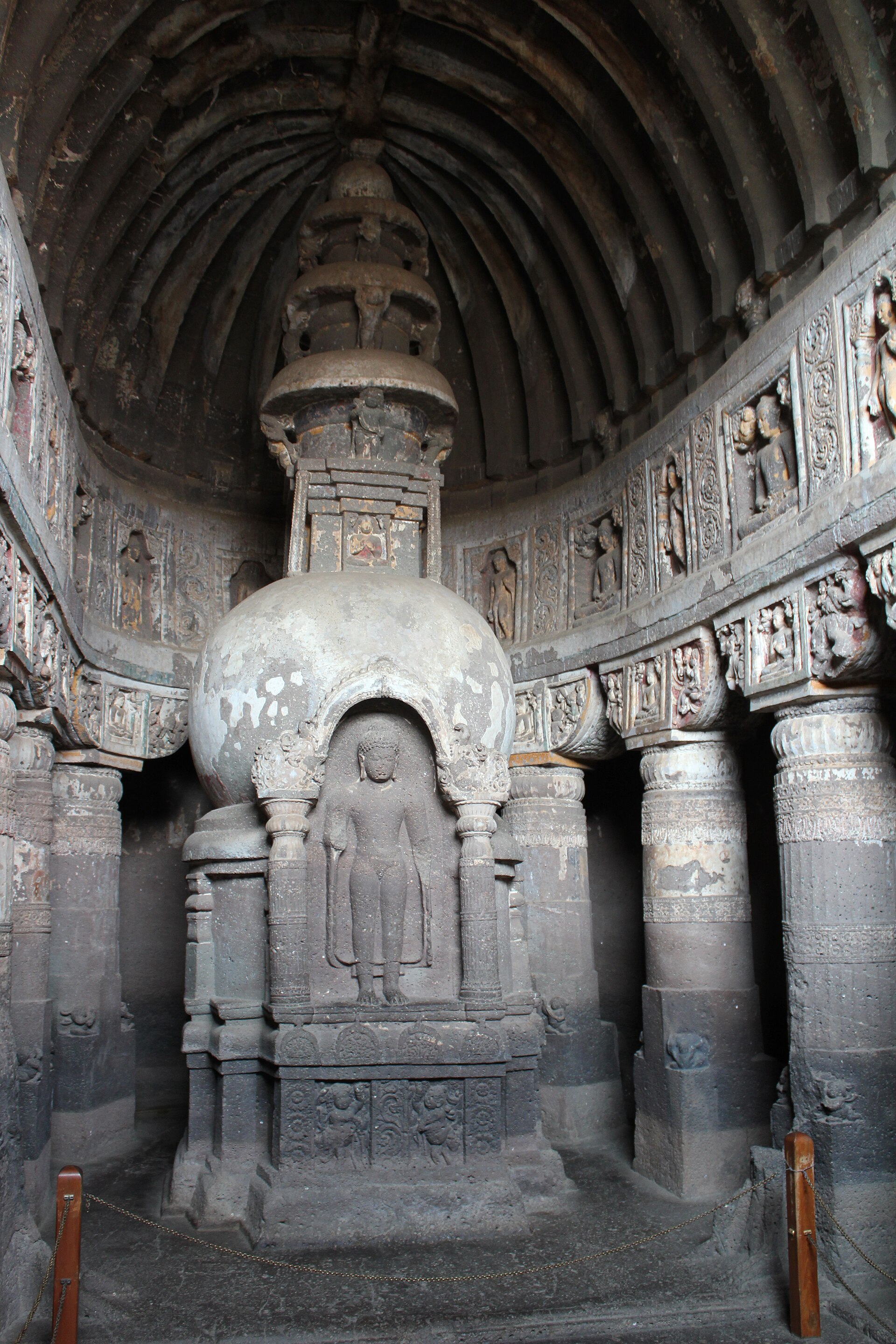
The horseshoe gorge of Ajanta above the Waghora. <small>Arian Zwegers from Brussels, Belgium, CC BY 2.0, via Wikimedia Commons</small>
Hampi — the last great southern empire among granite boulders. <small>Vyacheslav Argenberg, CC BY 4.0, via Wikimedia Commons</small>
Things of wonder (made by hand)
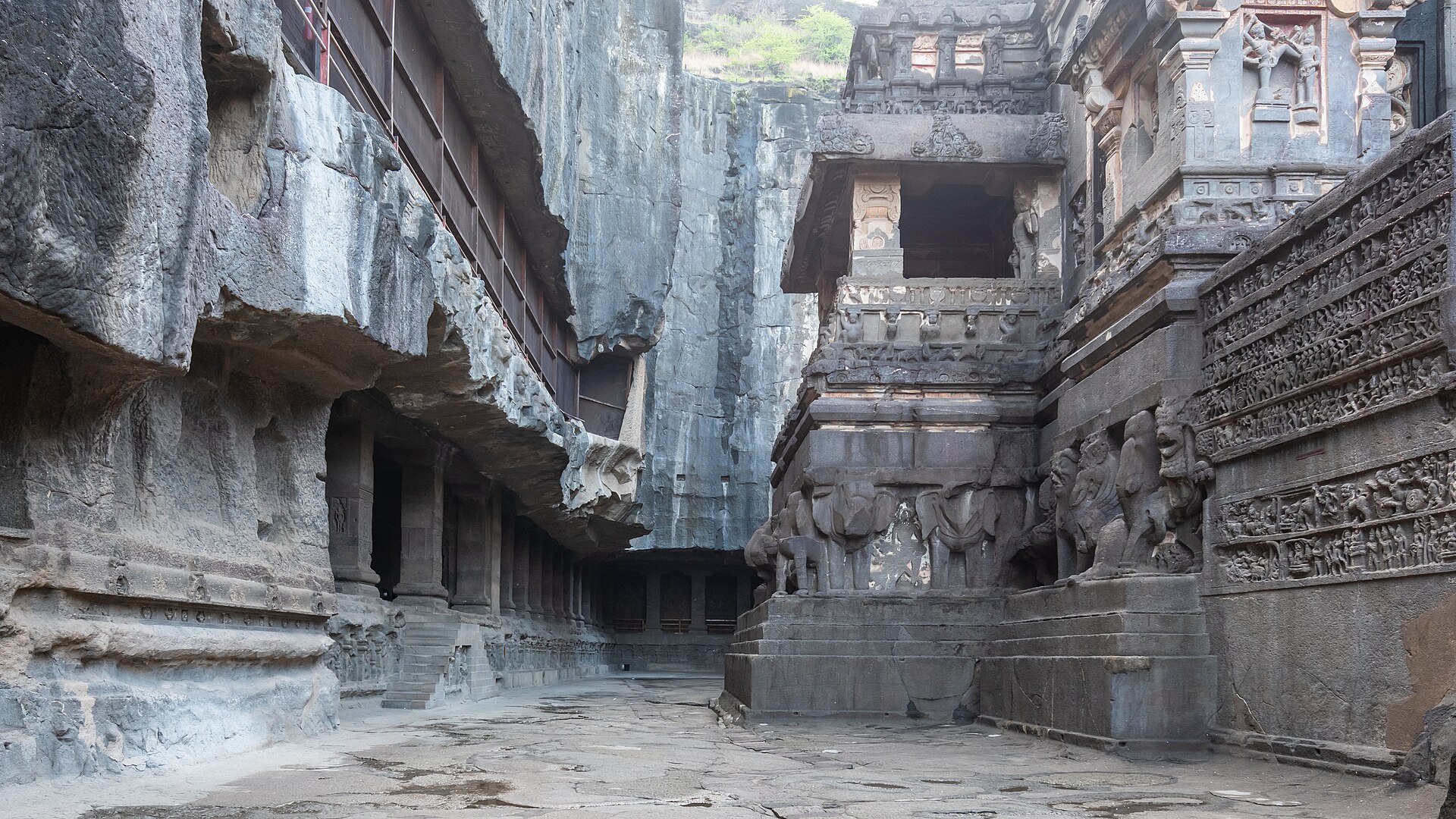
Kailasa, Cave 16 — every cut was final; no revision, no prototype. <small>Rohit Sharma, CC BY-SA 4.0, via Wikimedia Commons</small>
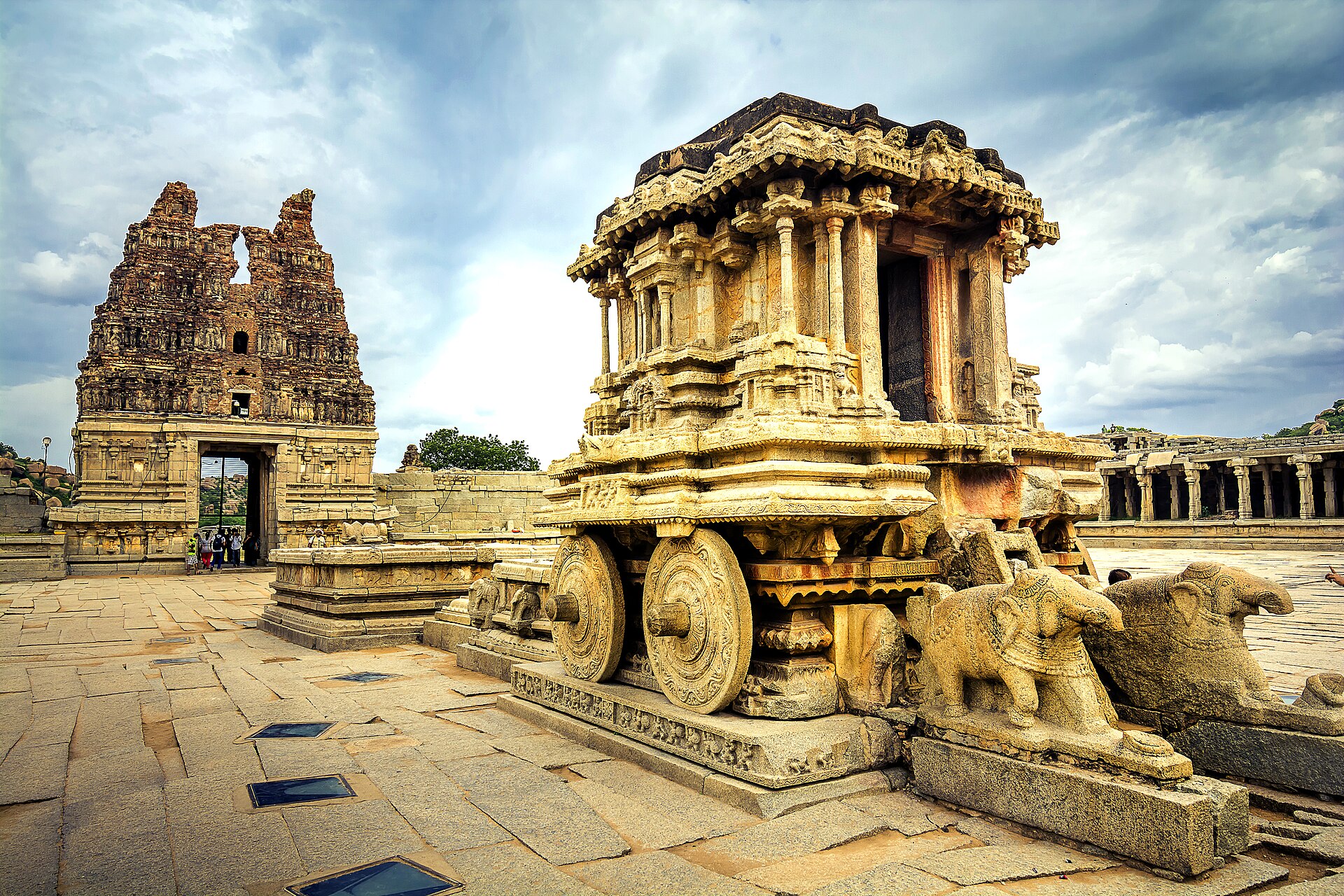
The Stone Chariot of the Vittala temple, Hampi. <small>Ram Nagesh Thota, CC BY-SA 4.0, via Wikimedia Commons</small>
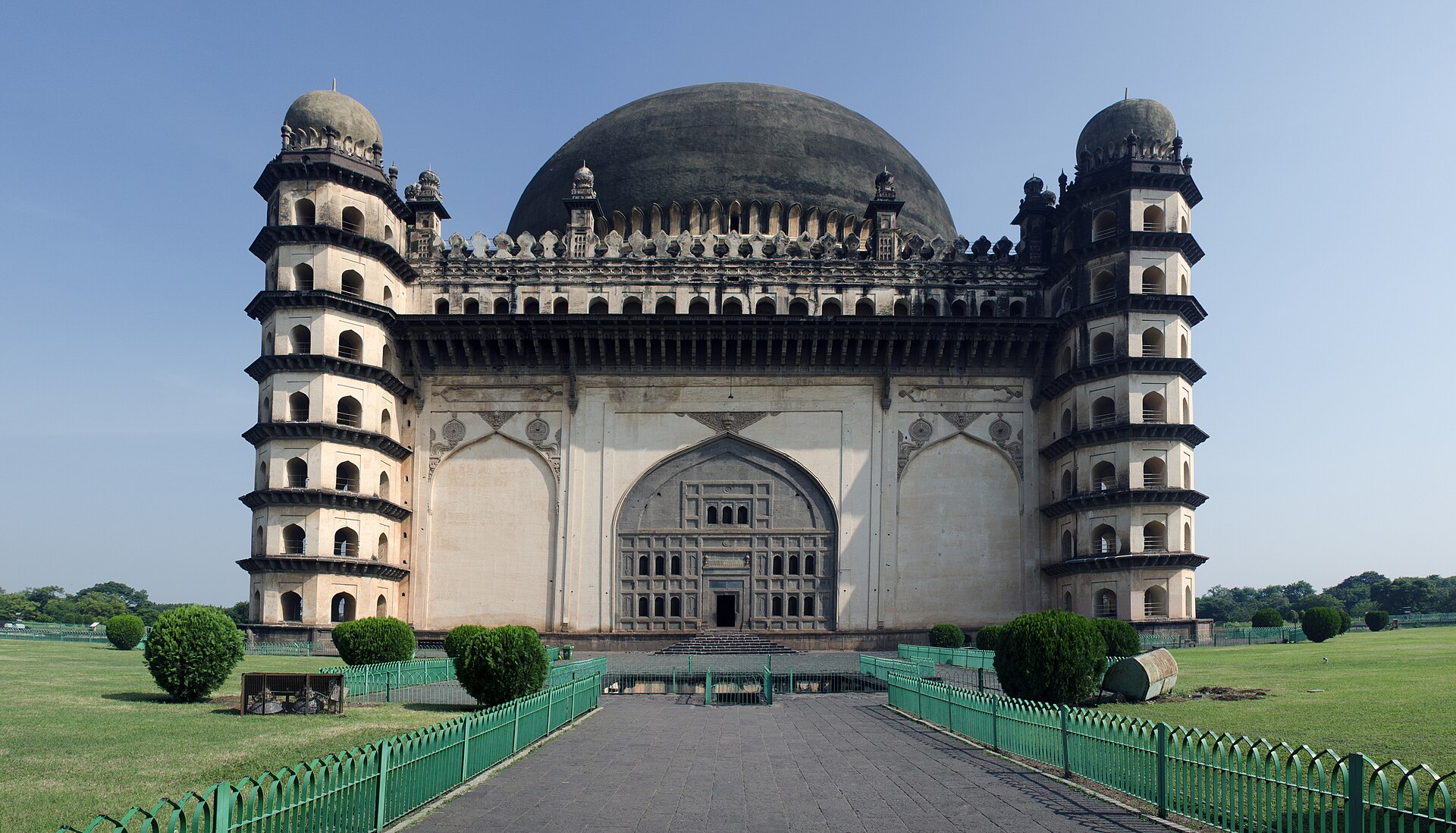
Gol Gumbaz — one of the largest unsupported domes; the whispering gallery. <small>Rangan Datta Wiki, CC BY-SA 4.0, via Wikimedia Commons</small>
Golconda — a fort built so a hand-clap carries to the hilltop. <small>Kuldeepburjbhalaike, CC BY-SA 4.0, via Wikimedia Commons</small>
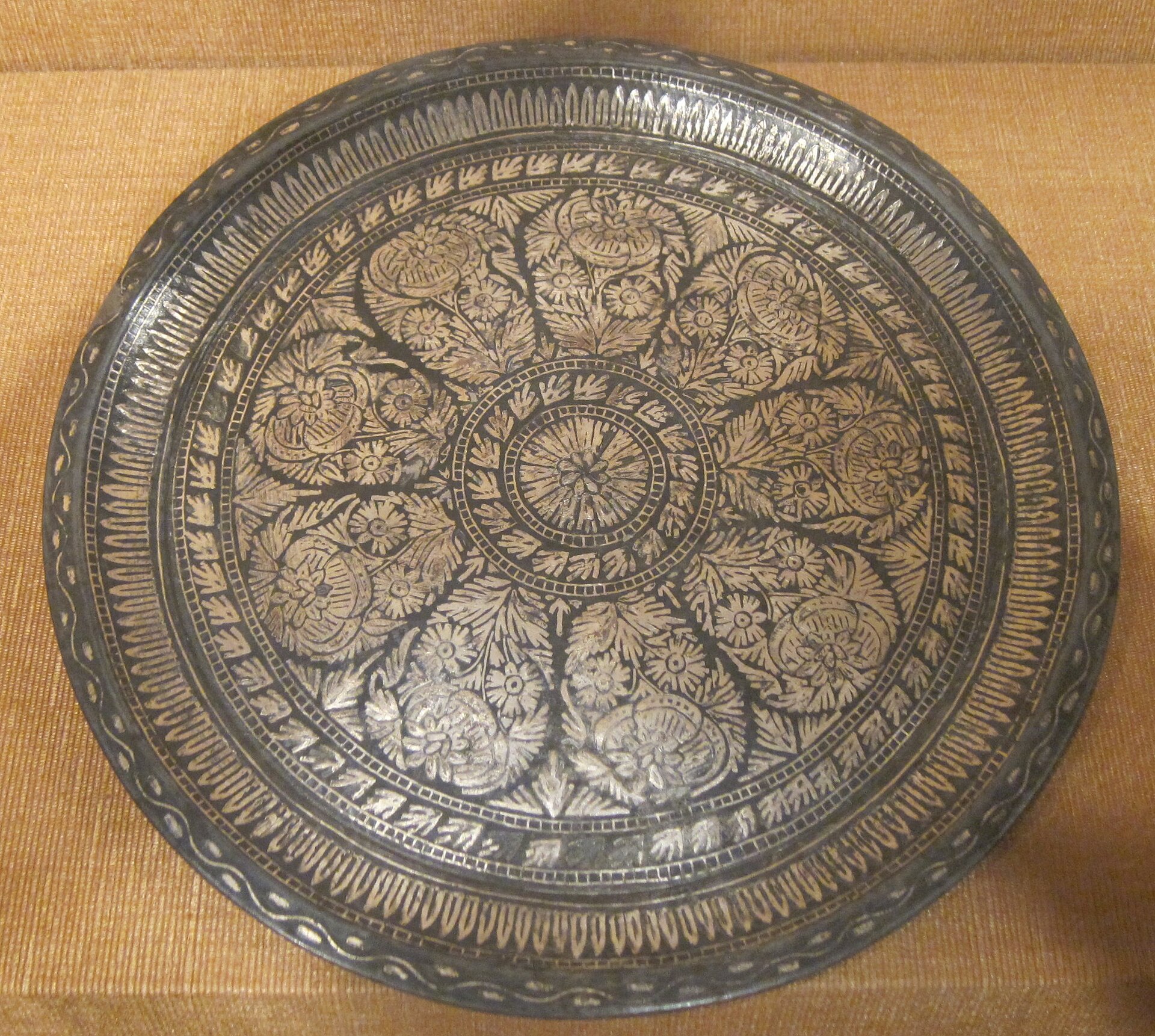
Bidriware — silver inlaid in black zinc alloy; Persian motifs, Indian hands. <small>Hiart, CC0, via Wikimedia Commons</small>
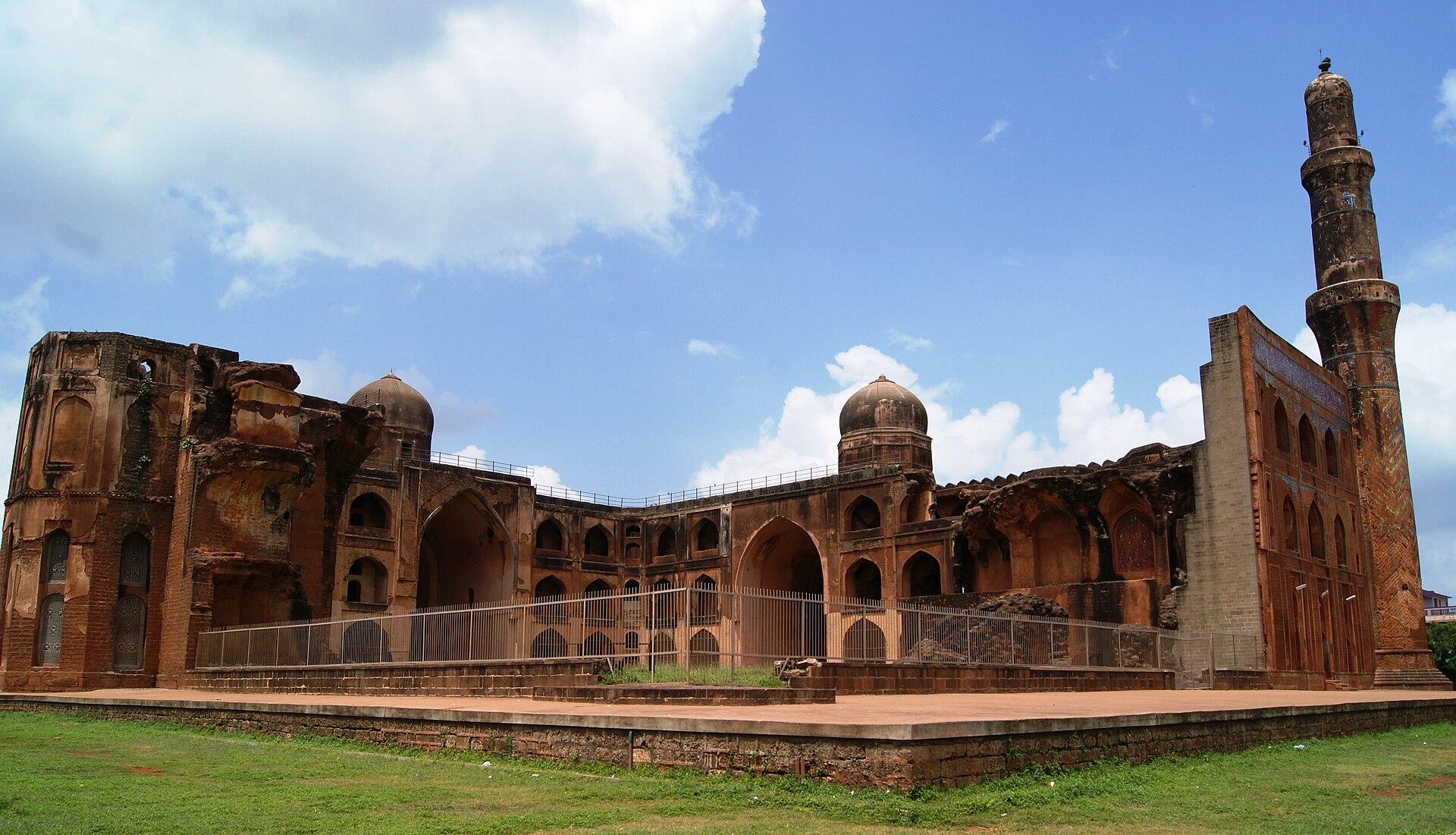
The Mahmud Gawan Madrasa, Bidar — a centre of learning, half-ruined. <small>Prasannasindol, CC BY-SA 3.0, via Wikimedia Commons</small>
Peoples, in their own dress
Lambani (Banjara) dress — mirrorwork of the Deccan. <small>Dr. Raju Kasambe, CC BY-SA 3.0, via Wikimedia Commons</small>
Marathi dress — the architect Arjun's own people. <small>Adigogate18, CC BY-SA 4.0, via Wikimedia Commons</small>
<!-- END image-compendium-appendix -->