Dedication
For Quinn —
taller and stronger than her years, and the gentlest force I know.
When her small brother's storms came with fists, she chose to stand and take the first of them, and never once turned the strength she was given against him. I have watched grown men with a tenth of her power use it badly. She has all of it, and has never used it to do anything but shield.
That is the whole secret of every hero worth the name: not the strength, but what you refuse to do with it. She knew it at twelve. This one is for her.
Foreword
by Parking Ruddily †
I am, I am aware, an awkward ghost to summon to the front of this book.
I loved India with my whole boy's heart and I also wrote her, sometimes, as the white man's burden and the backdrop to his self-discovery, and the two facts sit in me without reconciling, and I have had a long time, where I am now, to think about it. So let me do the one thing my best work always did and my worst work never managed: let me tell the truth against my own interest.
The truth is that I got the love right and the direction wrong. I felt, correctly, that this was one of the deep places of the earth, old past reckoning, layered, humming with a knowledge the brisk modern world had no instrument to measure. And then I pointed all that wonder the wrong way down the telescope — I made India the thing that happened to my Englishmen, the rich strange water they swam through on their way to becoming themselves. The country was scenery for the coloniser's soul. I know that now. A great many people knew it long before I did, and said so, and were right.
This book turns the telescope around, and the moment it does, the picture leaps into a focus I never managed in a lifetime of trying.
Here the cleverness is India's, from the first page and forever. Here a woman comes home to a country that is in her blood and is taught by it, rather than using it to learn about herself — and the difference between those two sentences is the difference between everything I got wrong and everything this author gets right. The temples, the rock, the astronomy carved into the living stone, the engineering that should not be possible and demonstrably is — none of it is a riddle for a clever outsider to solve. It is the inheritance of the people of the place, and the outsider's only proper job, which the author understands in his bones, is to defer. To stand at the door with his hat in his hand. To let the country be the teacher and the wisdom be its own.
I wish I had written one page with the humility that is in every chapter of this. I had the love. I never had the humility, and without the humility the love curdles into possession, and possession is the whole engine of the thing I was part of, and I will not pretend otherwise at this late hour.
The story moves like the best of my own ever did — fast, sensory, in love with the smell and noise and heat of the place — so you will read it too quickly and have to go back. Do go back. Underneath the adventure is the correction of an error I helped to make: the insistence, with evidence you cannot dismiss, that the genius was theirs, that it was always theirs, and that the only mystery worth the name is why anyone ever needed to be told.
Read it. Let it teach you the way it would have had to teach me, against my training, against my century. And forgive an old versifier for standing here at all. The author let me. It is the kind of thing he does — he sees the man under the mistake, and gives him a chair, and lets him say the true thing at last.
— Parking Ruddily
† “Parking Ruddily” is an anagram of RUDYARD KIPLING — the bard of British India — borrowed here in homage and affection. This foreword is a work of fiction. It was written by the author of this book. Rudyard Kipling did not write it, was not involved in it, and is not associated with or endorsing this book in any way. The name is rearranged precisely so that the tribute can never be mistaken for a real attribution; it is a salute, not a claim.
A Stranger in Strange Lands
Grok means to understand so thoroughly that the observer becomes a part of the observed — to merge, blend … lose identity in group experience. … You cannot hate anything unless you grok it, understand it so thoroughly that you merge with it and it merges with you — then you can hate it. … But this implies that you love it, too, and cherish it, and would not have it otherwise. — Robert A. Heinlein, Stranger in a Strange Land (1961)
grok /ɡrɒk/ v. (Martian; coined by Heinlein) — to take a thing in so completely that knower and known are no longer two; literally, to drink. It has no true English equal. The nearest word in any tongue may be Zulu: Sawubona — I see you. Both name the same act — to receive another whole — and the rare kind of person who lives by it: at home with everyone, and a stranger in every land.
Chapter 1 — The Indian One
The lathe was lying, and only Priya could hear it.
She stood at the head of the bed with her palm flat on the headstock and the rest of the workshop going on around her — the radio, the kettle, old Govender swearing at a chuck key three benches down — and she let all of it fall away until there was just the bearing turning under her hand. Forty-year-old Colchester. South African Railways had owned it once; you could still see the cutaway mark where the asset number had been ground off. The owner wanted to sell it and the buyer wanted to know if it was sound, and they had both, separately, told her it ran beautiful, hey, listen, and the lathe had run, and to them it had sounded like a lathe.
To Priya it sounded like a man who clears his throat before a lie.
She closed her eyes. Not for effect — closing her eyes was just where the loud part of her went when she needed the part underneath. The vibration came up through the bed into the heel of her hand and resolved, the way a face resolves out of a crowd, into a shape she could hold. There. A flutter, once per revolution, so small the buyer's phone-app had called it nothing. Not the spindle. Behind it. She moved her hand down the casting, past the gearbox, to where the drive came in, and the flutter got a home.
"Switch it off," she said.
Govender switched it off. The spindle ran down through its registers — a descending scale only she seemed to find interesting — and stopped.
"Rear bearing's gone," Priya said. "Or it's going. Inner race. You'll have maybe sixty hours of finish-work before it starts singing loud enough that even he—" a tilt of the head at the buyer, a soft man in a golf shirt who had driven from Westville to spend other people's money "—can hear it. After that it'll chew the housing and you'll be buying a machine and a lawsuit."
The buyer looked at the lathe. He looked at Priya. She watched the second look happen and knew it the way she knew the flutter, because she'd been getting that look her whole life and could read it down to the harmonic.
"And you can tell that," he said, "by touching it."
"I don't need to open it to hear it lying." She wiped her hand on the rag at her belt. "You can open it if you like — that's what the stripdown quote's for. But the bearing's the bearing whether you look or not, and you came to me to be told the truth and not the price you wanted, so." She picked up her clipboard. "That's the truth. The price you wanted is a different shop."
The buyer turned to Govender, the way they did, to have it confirmed by a man. Govender — who had watched her find three of these now, who had stopped doubting somewhere around the second — just spread his hands. Don't ask me. Ask her.
"How do you do that," the buyer said, and it wasn't really a question, it was the other thing under the question, and she gave him the answer she always gave, which was a shrug, because the true answer took forty years and a different brain and she wasn't handing it out free to men in golf shirts.
The true answer was that she didn't do anything. That was the part nobody could hold. She stopped doing. She put down the part of herself that wanted to be clever, that had spent thirty-four years performing competence at a world that kept asking her to prove it twice — put it on the floor like a heavy bag — and went quiet, and then the machine simply told her what it was. Every time she'd tried to grab the answer she'd lost it. A doctor had once written that down on a form as a symptom.
The buyer paid for the stripdown quote eventually, because he was not actually a fool, only a man who'd hoped she might be one. When the gate rolled shut behind his Fortuner the workshop exhaled, and the afternoon went back to being an ordinary afternoon in an industrial unit in Mobeni — light coming down through the polycarbonate roof in long dusty bars, the air smelling of cutting oil and swarf and, faintly, from the samoosa place two units down, of cumin frying in ghee.
Her phone buzzed against the bench. Her mother.
She let it go to voicemail and then, because she was the kind of daughter she was, listened to it standing right there with a finger in her other ear.
Priya. It's Mummy. As if it might be some other woman with that exact tiredness in her voice. I'm just — I found Ouma's tin again, packing the spare room. I told you I'd give it to you. You said you didn't want it. A pause that was a whole argument. I'm putting it in a box for you anyway. You can throw it out yourself if you're so modern. Another pause. Come for lunch Sunday. Bring nothing. Just come.
Priya stood in the bars of dusty light and did not feel modern.
She had grown up forty minutes from where she stood and a hundred years from where her face came from, and the gap between those two distances was the shape of her whole life.
Chatsworth. The flats had gone up in the sixties to hold the Indians the apartheid government had decided should live over there, sorted by race into a township the way you'd sort stock into bins, and her grandmother had raised four children in three rooms and a kitchen the size of a good cupboard, and had pressed her own masala because the bought stuff was rubbish, full of stalks, and had spoken a Tamil that thinned with every generation until it was down to the words for food and come here and God and the swear words, which were the last to go because they were load-bearing. Priya had the swear words. She had the smell of the spice grinder bolted to the counter. She had a surname, Ellis, that no Tamil had ever owned — a name out of a sugar estate's wage ledger, given to some ancestor by a clerk who couldn't be bothered with the real one, or wouldn't, the difference not mattering much to the man holding the pen.
She was, depending on who was doing the looking, too much of one thing or not enough of another. In a Sandton boardroom she was where are you really from, asked twice, the second time slower, in case she hadn't understood the question. To the actual subcontinent — the place her people had been carried away from across the kala pani, the black water, which a Hindu could not cross without losing caste, village, the thread that told you who your dead were and how to feed them — to India, she suspected she would be nothing at all. A tourist with the right face. A woman with a planter's surname who couldn't read the script on her own grandmother's tin.
She had never been. Forty minutes from Chatsworth and never once across the water her people had crossed the wrong way, because to go would be to find out, finally, officially, that the place that should have been home would look at her and see a stranger — and as long as she didn't go she could keep the door shut and the not-knowing on the far side of it, doing no harm, like a fault you've decided not to open because the machine still runs.
The machine still ran. She was good at her work and she made decent money and she answered to no one and she had a flat in Glenwood with a balcony and a view of the harbour cranes she found genuinely beautiful, the great patient geometry of them loading the world onto ships. She had men when she wanted them and quiet when she didn't, and she had made a clean dry peace with the fact that belonging was a thing other people got to have, the way some people got to have perfect pitch, and that she would do without it the way she did without anything she'd decided she couldn't reach.
It was a good peace. It had held for years.
It held right up until the man in the sunglasses was standing at her gate.
He was there when she came out at six, leaning against a battered, dust-grey Land Cruiser double-cab across the road with the particular stillness of a man who had been there a while and wanted you to take your time noticing. The Cruiser looked like a beaten-up nothing you'd never glance at twice — except that her eye, which read machines the way other people read faces, snagged in three quick places and totted up the sum before she'd decided to: the fat yellow shocks under the grime, each on its own remote reservoir, the kind that cost what a small car cost and only earned it a thousand kilometres from a tar road; the snorkel up the A-pillar; and, behind the dented grille, far too big for a tired farm diesel, the core of an intercooler — which meant forced air, which meant an engine that had been given a great deal more than the factory intended and wore not one sign of it. Serious money, all of it spent on the parts that didn't show. The one thing that did show was a fat hessian water bag slung off the back, grimy and sweating itself cool in the heat — the single piece of honest neglect on a truck that was otherwise all disguise. Olive field shirt. A waistcoat with more pockets than any waistcoat needed — military webbing and fly-fisher hybrid, the kind of garment that was less clothing than kit. A fixed-blade knife rode on his belt, bigger than any actual task required. There was a tattoo at his forearm, the shape of a continent. Wraparound shades, in Mobeni, at six in the evening, when the light was already going soft and gold off the warehouse roofs.
She read him the way she read everything: by how the parts went together. And the parts, she thought, went together too well. The knife, the kit, the shades, the Outdoor-Channel-survivalist silhouette — it was a collage, a costume assembled with the slightly-too-deliberate care of a man dressing a part. She'd met the type. Soft men, mostly, who hung a big knife on a soft belly and bought the tactical waistcoat because the kit did the talking they couldn't, and the whole getup announced, a little too loudly, I am dangerous, please believe I am dangerous. Her instinct, three seconds in, was a small interior eye-roll: another one playing bushveld Batman.
Her first read was cop, and her second read, a half-second later, was no. Cops stood like they owned the ground. This one stood like he'd already worked out four ways off it and was relaxed precisely because of that. The waistcoat was wrong for a cop and right for something she didn't have a word for. He was watching her over the top of the shades, not through them — she clocked that, the chin slightly down, the eyes above the dark line — and when he saw her clock it the corner of his mouth moved, like she'd passed a small test he hadn't told her she was taking. She held onto the bushveld-Batman read anyway, because it was comfortable, and because she did not yet know it was the single most wrong she would be about a person in her entire life.
"Priya Ellis," he said. Not a question. A flat, measured voice with the Free State in it somewhere under the careful.
"Whoever's asking can make an appointment," she said, and kept walking toward her car.
"My name's Jakobus." He didn't move off the Cruiser. He didn't raise his voice. He let her get four steps past him before he said the thing that stopped her, and he said it gently, the way you'd set something fragile on a high shelf. "I'm here about your grandmother's tin. The lettering on it. You looked it up once, in a car park, and then you closed the phone." A beat. "I know why you closed the phone."
Priya stopped walking.
She ran the thing the way she'd run the lathe — fast, underneath, looking for the lie. There wasn't a clean way for him to know that. She'd told no one. A small private cowardice in a Spar parking lot eighteen months ago, the script glowing up off the screen with its offer to translate, her thumb hovering, and then not. Nobody had been there.
"That's a cheap trick," she said, turning. "Whatever you're selling."
"It's not a trick and I'm not selling." He pushed off the Cruiser now, unhurried, and came a few steps closer, and stopped well outside the distance that would have made her reach for the pepper spray she kept in the door, which told her he'd measured that too. "I didn't watch you do it. I'd never lie to you about something that specific, it's a bad way to start." He tilted his head a fraction. "I guessed it. From the rest. People who carry a thing they can't read carry it the same way — they want to know and they're terrified to know, and the wanting and the terror cancel out into not-knowing on purpose. You closed the phone because looking it up would've made it real. I'd have done the same." The mouth-corner again, almost an apology. "I closed a few phones in my life."
She should have got in the car. The best cons told you a true thing first to buy the lie that came after. She stood there anyway, because of how he'd said the wanting and the terror cancel out — the most accurate description of the inside of her chest anyone had ever said out loud, and a man did not get to that sentence by accident.
"You've got two minutes," she said. "And take the glasses off. I don't talk to a reflection of myself."
Something moved across his face — surprise, she thought, and then something warmer behind it, like she'd done a thing he'd hoped she would and didn't get often. He reached up and took the sunglasses off, both arms folded down slow, one and then the other, and looked at her with bare eyes.
They were grey. A flat, careful, weather-coloured grey that didn't match the easy mouth — the kind of eyes that had seen the four ways off the ground and used at least one. He held them on her, open, and she had the disorienting sense of being seen — not assessed, not wanted, not measured for what she could do, but seen, the whole of her, the way you'd look at a person rather than a problem. So unfamiliar that her first instinct was to distrust it, and her second, against all her training, was that it was real.
"I work for some people," he said, "who study where we come from. All of us. The actual, in-the-ground, older-than-they-let-you-say version of it. And we've found something. It's in Cape Town right now, on a table, in a house, and three days ago it was somewhere it had been for a very long time. Now it's our job to carry it to the next place it needs to go." He turned the sunglasses over once in his fingers, a slow rotation, like the motion helped him think. "The next place is across the water. And the thing we've found doesn't answer just anybody. It answers a certain kind of mind, and we've been looking a long time for that kind." He let it sit. "Nobody sent me. I came to Mobeni and watched you tell a man his bearing was lying by putting your hand on a machine, and I thought, there she is. I've been doing this a while. I know her when I see her."
"That's the worst sales pitch I've ever heard."
"I know." He didn't smile this time. "It gets worse. The water you'd be crossing is the one your people crossed the other direction. The place it's pointing is up that road. I'm not going to stand here and pretend I don't know what that is to you, because I do, more or less, and pretending would insult us both." The grey eyes didn't waver. "I'm not asking you to go home, Priya. I don't think anyone can hand you that. I'm asking you to come read a machine that three hundred years of clever people couldn't open, and that — as far as anyone alive can find — only you might. Whatever else happens on the way is yours. That part's not my business and I'd never make it my business." A pause, and then, flat, almost gentle: "But I'd be a liar if I didn't say it runs through the same place. So. There it is. I get people across borders. The rest of it — what's waiting, what it means to you — that's not mine to touch."
Out on the main road a taxi went past with its windows down and a half-bar of something spilled out, a film song, strings and a woman's voice climbing, gone before she could place it — and it went through her in the unfair specific way that music in that language always did, a thing she had no right to that knew her anyway. He saw it land on her. He was the kind of man who'd see that. He had the grace not to mention it.
"Why you," she said. "Why are you the one standing at my gate."
"Because I'm good at getting people across borders, and there's one between here and there." For a second something closed behind the grey, a door she wasn't being shown, and then it was gone. "And because the road ends, for me, somewhere I've wanted to get to a long time. So I've got a reason of my own in it, and I won't pretend I don't — you trust a person more when they admit they want something." He held out the sunglasses, not to give them to her, just showing his hands honest and empty around them. "I'm not going to follow you home or phone you at midnight. I'm in a guesthouse in Glenwood, the one by the school, and there's a flight to Cape Town tomorrow afternoon with your name on it, on the chance — only the chance — that you'd want to stand in a room with the most interesting problem you'll ever be handed and decide for yourself." He put the glasses back on, slow, and the grey went behind the dark, the walls coming gently up, and she felt the strange small loss of it. "You don't owe me an answer tonight. You don't owe me one ever. Lekker evening, Priya."
He got into the Land Cruiser. He did not look back at her in the mirror, which she noticed, because every man she'd ever told to leave had looked back in the mirror. He pulled out into the Mobeni evening and was gone, unhurried, a dusty Cruiser among the knock-off-trainer delivery vans and the workers walking to the taxi rank, and the ordinary world closed over the place where he'd been the way the workshop noise closed over the lathe when she opened her eyes.
Priya stood at her gate for a long time.
She got in her car. She did not drive home — she drove, the way you drive when the body has decided something the mouth hasn't caught up to, out along the M4 with the harbour on her left and the great cranes lit against the dark, loading the world onto ships. He wants something, she thought, they always want something, and then: yes, and he told you what it was, which not one of them has ever done.
When she got back to Glenwood it was late and the harbour was a field of low orange lights, and she sat in the car outside her own building with the engine ticking as it cooled and did the thing she did. She put the heavy bag down. She stopped running the angles, stopped performing good sense for an audience of herself. She went quiet and let the pattern resolve, the way she let everything resolve that mattered — and underneath the noise of every sensible reason not to, plain as a flutter once per revolution, was the simple unbearable fact of it: she had spent her whole life with a door shut on the far side of an ocean, and a man with grey eyes had just told her there was a flight, and that he'd get her to the door, and that the rest was hers.
She phoned the guesthouse by the school at seven the next morning, before she could be clever about it, and asked them to put her through to the room of a guest who'd have given some name she didn't quite believe, and when the flat measured voice came on the line she said, "Ellis. I'll need an aisle seat, I don't like being trapped against a window. And I'm not crossing any border with a man I've watched for two minutes. We have breakfast first."
There was a silence on the line that she would, much later, learn to recognise as Jakobus being pleased and not saying so.
"There's a Wimpy at the airport," he said. "I'll buy."
Chapter 2 — The Bearing Off Africa
The tin had held condensed milk once. You could still read the brand if you tilted it under the kitchen light — a Nestlé script, English on one face, and on the other a row of letters Priya had carried in her hand her whole life without ever once being able to say.
She turned it in her fingers the way you'd turn a part you didn't trust the spec on. Her grandmother had kept buttons in it, then needles, then nothing — it had sat on the windowsill in the Chatsworth flat doing the patient work of an old tin, which is to be a thing that outlives the people who needed it. Her mother had given it to her after the funeral with a flatness that meant I don't know what this is for either. The lettering ran around the rim in a script that her great-great-grandmother might have read off a temple wall before the ship, before the depot at Madras, before the manifest that wrote her down as a number and a thumbprint and a caste left blank because caste did not survive the crossing. Tamil, probably. Priya had looked it up once, on a phone, in a car park, and then closed the phone, because looking it up was somehow worse than not knowing. It made the not-knowing official.
She was thirty-four years old and she could read the firing tolerances of a Mauser action by the wear pattern on the sear, and she could not read four letters from the country her own face came from.
"You've been holding that for ten minutes," Jakobus said.
He was at the far end of the safehouse kitchen with his hip against the counter and a mug of coffee gone cold in his hand, and he had the particular stillness he got when he was letting you arrive somewhere on your own. The shades were on. Indoors, evening, the curtains drawn against a Sea Point street going amber under the lamps — and the shades were on, because they were almost always on, and Priya had stopped reading anything into it months ago. He turned the mug, didn't drink.
"It's a tin," she said.
"It is definitely a tin."
"My ouma's tin." She set it down on the table next to the gold, where it looked exactly as ridiculous as it was — a dented dairy tin from a Durban corner shop sitting a hand's width from the most extraordinary object she had ever been allowed to touch, and the two of them throwing the same warm low light back at the room, which she chose not to find meaningful.
The gold did the thing it did. She'd been in the room with it for three days and it still did the thing — it gave back more than the lamp gave it, a deep interior glow with no flash in it, the colour of late honey, twenty-three carats and some fraction past that that no smelter on the legal earth could explain. Africa's gold. Jennefer's gold, properly, though Jennefer was somewhere over the Mozambique Channel by now with a fake passport and a real wound and a man named Sekuru's blessing, and the gold had been signed across to the Order's next leg with the brisk un-ceremony of people who had learned that ceremony got you killed.
The next leg was Priya. That part she understood. It was the why her that they kept being careful around, and she had spent enough years being managed to know when she was being managed.
"Just say it," she said.
"Say what."
"Whatever it is the three of you keep not saying." She nodded at the doorway through to the front room, where the Order's two — a tired woman called Reineke who flew in from Lisbon and an older man who'd given a first name Priya didn't believe — had been murmuring over a laptop for an hour. "You flew me down here. You put that on a table in front of an engineer like it's a Tuesday. You want me on a plane. Fine. But you keep looking at me like I'm the answer to a question nobody's asked out loud, and I find that—" she searched for the word that was true and not unkind "—operationally annoying."
The corner of his mouth moved. Jakobus turned the mug again, set it down, and reached up and took the sunglasses off.
He did it slowly. She'd watched him do it for uniforms — at OR Tambo a fortnight ago, a customs man with a clipboard and a power-trip, and Jakobus's glasses had come off before the man had finished his first sentence, bare eyes and an easy afternoon, chief, and they'd been waved through a queue forty deep. It was a tell, that move; she'd clocked the pattern early. But there was no uniform here. There was just her.
His eyes were grey. She'd seen them go pale-blue exactly once, in a parking garage when a thing had gone wrong and he'd thought she hadn't clocked it; she'd never properly caught the green at all. Grey, on Jakobus, meant the walls were up — and yet here he was taking the glasses off with the walls up, which she didn't have a slot for.
"I'm going to tell you a thing," he said, "and you're going to hate it, because it's going to sound like flattery, and you've got a very good nose for flattery."
"The best."
"I know." He almost smiled. "So I'm going to say it flat and let you do what you want with it." He folded the arms of the glasses, one and then the other, and held them. "It's not that they want a clever engineer. They've got clever engineers. The Order's three hundred years deep in clever. It's that the thing waiting up the road only opens for a certain kind of mind, and you've got it, and as far as anyone in that front room can find — and they have looked, Priya, they've looked for a long time — you might be the only one currently alive who has."
She waited for the catch. She was good at waiting for the catch.
"That's not a catch," he said, reading her the way he read everyone. "That's the whole thing."
"What kind of mind."
And here he did something she filed away to be irritated by later: he didn't answer. He picked up her grandmother's tin instead, turned it once under the light, found the row of letters she couldn't read, and didn't comment on them either.
"Reineke can give you the textbook version," he said. "She'll use words like resonant operator and you'll want to leave the room. So let me give you the version I'd give in a bar." He set the tin down, precisely, on its own ring of lamplight. "You read machines. Not the way I read a machine — I can strip a gearbox, fine. You don't strip it. You go quiet, and you stop trying, and the thing tells you what it is. I've watched you do it. At the airport you looked at the X-ray belt for about four seconds and told the technician his third roller was about to seize, and you were right, and you couldn't tell me how you knew. You'd gone somewhere. The part of you that grabs at answers had let go, and the answer was just — there. Waiting for you to stop crowding it."
Priya said nothing, because that was exactly what it was like, and she had never once heard it said back to her by someone who wasn't a doctor making it sound like a fault.
"They've got texts," Jakobus said. "Up the road. Old as anything we touched here. And the texts say — Reineke's people are sure of this — that the makers' instrument out there doesn't answer the hand. It answers the self that isn't grabbing. You walk up to it wanting to make it work, wanting to control it, being the cleverest one in the room, and it stays a wall. It only opens for a mind that can put the grasping self down and just — let the pattern resolve." He spread one hand, flat, an offering with nothing in it. "Which the whole rest of the world has to learn from a guru on a cushion over about forty years. And which you do at an airport, by accident, to fix a roller. Because that's just how you're built."
The kitchen was very quiet. Out on the Sea Point street a car went past with its windows down and a half-bar of something Bollywood spilled out and was gone, and Priya felt it go through her in the unfair specific way that music in that language always did — a thing she had no right to, that knew her anyway.
"That's a lot of weight," she said, "to hang on a roller."
"It is."
"You could be wrong about me."
"I could." He picked the glasses back up, but didn't put them on. "I'm usually not, about what a person actually is under what they perform. It's the one thing I'm any good at." A beat. "It's also the thing that's going to get me to Egypt eventually, so I've got a dog in this fight, I won't pretend I don't."
She looked at him — the grey eyes still bare, the salt-and-pepper, the absurd waistcoat he wore to drink coffee in a kitchen — and felt the warmth come up in her chest that she had decided, weeks ago, to be honest with herself about. She liked him enormously. There was a current there; she wasn't a child, she knew what it was, the heat that comes up between two people who've been frightened together and come out the other side. And she knew, with the clean dry certainty she trusted more than any feeling, that it would never be anything, because he was the brother she'd never had and they were both too alike in the cracked places and either of them would have said so out loud if the other asked. It was a good thing to be sure of. It made the rest of it easy.
"You're going to make some Egyptian border guard fall in love with you," she said.
"That's the plan."
"And then abandon me to a country I've never been to and people who say resonant operator with a straight face."
"I'm handing you off to better people than me," he said, and for once there was no joke under it. "An Indian keeper, and a guide who grew up at the sites — people whose ground it actually is. I get you in the door. I don't belong past the door. That's not modesty, Priya, that's just true, and you'll see it the minute you land." He turned the glasses over, the slow rotation she'd learned meant the rest of him was deciding something. "It's their place. It might—" he stopped, started again, gentler "—it might be more your place than you think. That's not mine to say. I just get you to the door."
She wanted to ask him to say the rest of it. She didn't.
In the front room Reineke called something, low, and the older man laughed, and a printer somewhere woke and began to feed paper, and the whole machinery of the next leg ground a notch forward in the dark.
"When," Priya said.
"Tomorrow night. Mumbai." He said the name the way you'd hand someone a hot dish — carefully, watching her hands. "Direct from Joburg. You'll be on the ground before sunrise."
Mumbai. The word landed somewhere under the part of her brain that fixed rollers, somewhere older, in the dark, where a tin with four unreadable letters had been doing its patient work for a hundred years. She put her hand flat on the table next to the gold and her grandmother's empty tin and made herself be an engineer about it.
"Right," she said. "What's the spec on the thing I'm supposed to read?"
He smiled, properly, and put the glasses back on, the walls coming gently up, the briefing over.
"Ask Reineke," he said. "Bring the tin."
She stood at the gate at OR Tambo the next night with a boarding pass for a city her great-great-grandmother had been carried away from in chains of paper and salt, and she told herself it was the machine.
It was a machine three hundred years of careful people couldn't open and she might. It was the cleanest engineering problem of her life — a lock that answered the shape of a mind, and her mind was the key, and that was interesting, that was a problem worth crossing an ocean for, and she had crossed oceans for less. She told herself that, with the gold zipped flat against her spine in a flat case and her grandmother's tin wrapped in a sock in her carry-on, because Jakobus had said bring it and she hadn't asked why and he hadn't said.
The board flipped over. Mumbai — Boarding. Around her the queue stood up and shuffled and was suddenly full of faces — aunties in cardigans against the aircon, a grandfather with a steel flask, a young man with her own jaw and her own nose and her own colour, asleep already against the window glass — faces like hers, dozens of them, a whole gate of people who looked like family and would, the second she opened her mouth, hear that she was a stranger.
She found her seat. She buckled in. She did not look at the tin.
It was only the machine, she told herself, as the engines came up and the lights of the city she'd grown up in slid away under the wing and the dark continent fell off behind her, the bearing running true off its northern edge the way it had pointed for longer than anyone was allowed to say — only the work, only the lock and the key.
It was the oldest ache she carried, and she was flying straight into the throat of it, and she knew it, and she ordered a gin and kept telling herself the other thing anyway, all the way out over the black water her people had crossed the wrong direction, a hundred years ago, and never been let cross back.
Chapter 3 — The Wall of Mumbai
The heat met her before the door of the aircraft did.
She felt it come up the jet bridge — a soft wet pressure with weight in it, pushing back against the conditioned air she was trying to leave, the two of them meeting in the doorway like tides off different oceans. Then she stepped across the seam in the floor and the cool gave up and the heat closed over her head. Thirty-one degrees at two in the morning. The monsoon a week off and announcing itself anyway, the air at the saturation point, every breath a thing you had to take rather than a thing that happened to you.
Priya Ellis stood in the bridge with her one bag on her shoulder and let the queue press past her and did the thing she did, which was count. Forty-one steps of corrugated tube. A seam every metre and a bit. The vent dead overhead, blowing nothing. She counted because counting was a railing, and she had learned, on a different continent in a different life, to keep a hand on a railing when the ground went soft.
Thirty hours on the move. Johannesburg to Doha to here, the last leg a red-eye full of men going home, and a woman two rows up who had cried from the moment the wheels left Doha, quietly, without shame, and Priya had spent four hours pretending not to hear it and failing, because she knew the grain of that crying. It was the crying of someone going toward a thing. She had not been able to decide which she was doing. She still couldn't.
It's the machine, she told herself, on the bridge, in the heat. You're here for the machine.
The machine was real. That was the part that held when nothing else did. Somewhere up the road from this airport there was a thing in the ground — Jakobus's word, a thing, delivered with that maddening flatness of his — and she was the one who could read it, because of the way her brain was wired, the wiring the world had spent her childhood calling a fault. The job was clean. The job had tolerances and load paths and a right answer at the bottom of it, and you could stand on a right answer the way you couldn't stand on anything else.
Everything around the job was the problem.
She walked into the terminal and the wall hit her.
Sound first. Always sound, for her — she heard rooms before she saw them, took their dimensions off the way the noise behaved in them — and this room had no edges she could find. Announcements in Hindi, then English, then a third thing she didn't have, all three braided and overlapping, none quite finishing before the next began. The shriek of a thousand hard-wheeled cases on hard floor. A child at the exact pitch that cuts. And under it, low, a sea-sound of human voices that never resolved into words, more people awake at two in the morning than she had ever stood among in her life.
Then the smell, when she came down into the baggage hall and the doors at the far end kept sighing open to the night. It arrived in layers and she took them apart without meaning to, the way she took everything apart. Diesel, undermost, the diesel of ten thousand idling engines pressed flat under the wet air. Jet fuel over it. And threading up through both, impossibly, sweet and green — marigold. Somebody past those doors had a mountain of marigolds. Under it, or over it, she couldn't tell, a thread of something burning that was not fuel: sandalwood smoke, a small fire kept for a reason that had nothing to do with warmth. Sweat. Cardamom. Wet concrete. Her grandmother's spice tin, opened across a whole city.
That last one stopped her on the bottom step of the escalator, so that a man behind her stepped around with a click of his tongue that wasn't unkind, only busy.
The spice-tin smell was hers. It lived in a kitchen in Chatsworth, in a tin with a faded lid, in the hands of a woman dead eleven years who had pressed cumin and coriander and fenugreek through a hand-grinder bolted to a counter and let Priya turn the handle when Priya was small enough that turning the handle was a treat. She had that smell from the inside of her own life. And here it was, vast and public and free, blowing in off a city she had never set foot in, and the wrongness of that — the rightness of it, at planetary scale, in the wrong place — went through her like a current finding ground.
She gripped the rail. She counted the carousels. Eight.
The bag came. She travelled with one, always, a hard truck of a thing scarred silver at the corners, packed by weight and frequency-of-use, the boots on top because the boots came off first. She shouldered it and walked toward the doors and the wall of faces beyond them.
There it was. The thing she had flown thirty hours toward and braced against the whole way.
The faces looked like her.
Not all of them. Not most, when she made herself be rigorous, when she counted — there were a hundred Indias in that crowd and her trained eye could no more sort them at a glance than a Mumbaikar could have sorted a Zulu from a Xhosa off a Joburg street. But the register of them. The brown of the skin in that particular range. A jaw she'd seen on an uncle. A woman at the barrier with her hair oiled and centre-parted exactly the way her grandmother had worn hers, the same severe tender geometry of it, so that Priya's chest did something stupid and hopeful and she had to look away.
She had spent her whole life being the only one. The Indian one. Where are you really from in a Sandton boardroom; the second glance at her surname, Ellis, a planter's name, a name the ocean had given her people in place of the one it took. She had imagined this moment until she'd worn it smooth: walking out into a sea of people who looked like her and feeling, for once, the simple animal relief of disappearing into a crowd because the crowd was hers.
She walked out into it.
And she did not disappear.
She felt it in the first ten metres, and it was worse than the heat. The faces looked like family and not one of them looked at her the way family looks. Their eyes moved over her and kept moving — sorting her, the way she sorted them, getting an answer, and the answer was not ours. She couldn't have said how they did it. Something in how she carried the bag. The boots. A man with a placard scanned her, scanned his board, and didn't even raise it; she wasn't who he was waiting for, and in the half-second before his gaze let her go she watched him read her as foreign before he read her as anything else. The right face. Everything under it wrong.
She stood in a crowd of ten thousand people who looked like her family, and was, precisely and completely, a stranger.
There it is, she thought, with a grim accuracy, because accuracy was the only comfort she trusted. You flew thirty hours to confirm a measurement you already had.
The taxi smelled of jasmine and old vinyl and an air-freshener tree losing a war it had been losing for years. The driver was a wiry man with white stubble and a photograph of a blue-skinned god taped to the dash, a tiny string of fresh marigolds looped over the corner of the frame. He took her bag with a sideways tilt of the head she had no grammar for, and then he drove the way the whole road drove, as a single liquid organism that had agreed, without signage, to ignore every line painted on it.
She gave up reading the traffic as traffic inside the first kilometre. There was no flow to model. There was only the horn — not anger here but a language, I'm here, I'm passing, move — and she, who could look at any system and find its rules, could not find the rules of this one. To her surprise it didn't frighten her. The offensive thing was that it worked. It should not have worked and it worked, by a logic she'd have to stop trying to control before she could see it.
The city came up around them out of the dark. Mumbai at three in the morning had not slept; it had turned down. A family on a charpoy on the central reservation of a six-lane road, a baby on a woman's chest rising and falling in the wash of the headlights. Tea steaming at a stall lit by a single bulb, three men standing in the small gold of it, not talking. Colonial stone gone black with damp climbed into concrete, into glass towers with the names of banks she knew, and pressed against their feet, in their literal shadow, the low blue-tarp sprawl where the towers' light didn't reach. The old never quite torn down for the new — built over, built around, kept. Layer on layer on layer.
Rain came the way the heat had, all at once and total, the sky simply opening. The driver didn't slow and didn't touch the wipers for a long moment, drove straight into the wall of it as into a thing expected. The city dissolved to smears of gold and red. The rain hit the hot road and lifted a smell off the tar that she felt in the back of her throat, mineral and green, the smell of first rain on dry ground, and her marrow stood up at it — water coming to the land — and the thought came before she could stop it: my people crossed water and lost everything they were. She didn't know where it came from. It didn't entirely go.
She had not told Jakobus the real reason she'd said yes.
He'd think he knew. He'd delivered her to departures in Joburg three days ago, sunglasses on at six in the morning in an underground parkade where there was no sun to glass against, and produced from somewhere a collared shirt and made her watch him button it over the waistcoat — uniform rule, Priya, you cross a border looking like you belong on the right side of the desk — while she told him he looked like a man impersonating a geography teacher. He'd grinned. Then he'd walked her to the point where he couldn't walk further, and the grin had gone, and he'd looked at her over the top of the glasses for once, the eyes grey and tired and kind, and she'd clocked again the precise nature of the thing between them: a brother handed to her late, love with no want in it, the kind she'd never had from a man and hadn't known to miss. Sawubona, he'd said, the way he only said it when he meant the whole of it. This one's yours, not mine. India's yours. I'm the courier who got you to the door. And then, because he could never let a thing stay tender: Wear the boots. The ground's the whole point. Somebody clever once told me that.
She had not told him the machine was the second reason. The first was a tin with a faded lid, and a hand-grinder, and a question she'd carried so long it had set like the misspelled letter in her own name: where am I actually from. She'd told herself it was the machine the whole way here, and now she was here, in the rain, and the city had looked at her in the arrivals hall and given its answer in half a second flat — not too foreign, not too Indian, but the one underneath both, the one she'd been most afraid of. Nowhere. No village, no street, nothing the ocean hadn't dissolved on the way over.
The taxi turned off the flooded artery into a quieter lane, the rain easing as suddenly as it had come, dripping off awnings and the great wet leaves of a tree she didn't know, and stopped outside a building that was not the hotel.
There was no hotel. There was a narrow doorway between a shuttered cloth shop and a shuttered jeweller, a single bulb above it, and under the bulb, on a low stool, an old woman who had clearly been waiting a long time and did not mind.
Older than Priya's grandmother had got to be. A cotton sari the deep faded red of the marigold-smell, washed a thousand times the way Jakobus's shirt had been. White hair oiled and centre-parted in the geometry Priya had flinched from at the barrier. Bare feet on the wet step. And across her knees, wrapped in oilcloth against the rain, a long flat bundle held the way you hold a sleeping child.
The driver was already lifting Priya's bag out. He had not been told the hotel. He had been told here. The taxi had never been a taxi she'd flagged — it had been waiting, and Jakobus had got her to the door and someone past the door had got her the rest of the way, hand to hand, the way everything in this thing seemed to move. He set her bag at her feet, touched two fingers to his forehead toward the old woman with a respect that had nothing performed in it, refused the note Priya tried to give him with a flat hand, and was gone.
The old woman looked up at her.
And here was the part Priya would never be able to measure. It was the look from the arrivals hall — the sorting look, the reading look, taking her in and getting an answer — except the answer was different. She watched it happen. The eyes moving over the bag, the boots, the braced shoulders, the foreign-by-the-walk, all of it; and then going past all of that and down through it, the way Priya's own eye went down through the surface of a thing to the load path under it. The old woman looked at the stranger, and then at whatever was under the stranger, and nodded, slowly, once, the way you nod when a long calculation comes out true.
"You have your grandmother's hands," she said. In English, in an accent that had Tamil in it and something older. "She turned the grinder for her grandmother. You turned it for her." Not a question. She shifted the bundle on her knees. "The hands keep the village after the head has lost the name of it. And don't make that face, child — this is not mysticism. I am reading you the way you read your stones. You are standing like someone braced to be told she doesn't belong." A pause. "Sit. You belong on the step, at least. The step is free."
Priya did not sit. She stood in the wet lane with the rain dripping off the unknown tree and her heart going in a way she hadn't authorised, and her voice came out flatter than she meant, the railing again.
"You're the one Jakobus said would find me."
"The man in the dark glasses who sees in the dark." Something close to a smile. "He carries the thread from the south of the south. I keep it from here." She laid a hand flat on the oilcloth, the way a person rests a hand on something that breathes. "I am not your machine, and I am not your road. I keep the manual."
"The manual," Priya said.
"The texts. Everyone reads them as prayer. They have read them as prayer for a thousand years, and that is right, and it is also not the whole of what they are. My line kept the other reading — by mouth, grandmother to grandchild turning a grinder — longer than your discipline has had a word for long." Her hand moved once on the leaves. "They are an instrument's manual, child. The instrument is real, it is in the ground, and it does not answer a mind that grasps at it. It answers a mind that lets the pattern come." The look went down through Priya again, all the way. "Which is, I'm told, exactly the kind of mind that flies thirty hours to a step and then refuses to sit on it."
Priya's mouth was dry. Below them the city breathed its sea-sound. The rain had stopped.
"If there's a thing in the ground," she said — the same word she'd said in the taxi to no one — "where."
The old woman unwrapped one end of the bundle. Only one end, only enough: the corner of a palm-leaf manuscript, old beyond old, the script burned into the dried leaf in lines too fine and even to be anything but disciplined, and pressed between the leaves to mark a place, a single dried marigold gone the brown of old blood. She did not hand it over. She held it the way Jakobus held a fact.
"North," she said. "Into the dry country, where the desert taught the kings to measure water by the step, and where the Mughal and the Rajput put their two prayers in one room and the room did not fall. There is a fort on a ridge above another fort. The Kachhwaha kings built it, and on its platform they cast a thing the whole world misreads — the largest wheeled gun ever made, four elephants to turn it. Fired one time. Never again." Her eyes stayed on Priya's face. "Your historians call it a cannon. They are wrong, and you'll know they're wrong the moment you put your hand on it. It was never made to throw a ball at an enemy. It was made to measure something." She folded the marigold back into the dark of the leaves. "Go to Jaigarh, above Jaipur. The first verse of the manual has been waiting on that ridge a very long time. So, I think, have you."
She set both hands on the wrapped bundle.
"Sit," she said. "We leave at first light. And in the morning I'll tell you the name of your village — the hands have already told me half of it — because a person should know the shape of the thing she is about to be given back."
Chapter 4 — The Pink City's Layers
The whole city was the colour of the inside of a conch shell, and Priya did not trust it.
She had read, on the plane, that the pink was a fraud — washed onto Jaipur only in 1876, in a hurry, to flatter a visiting Prince of Wales, the colour everyone now drove a hundred miles to photograph barely older than her grandmother. She had liked that fact. It had a clean engineer's honesty: a thing the world called ancient that turned out to be recent paint, and she'd tucked it away to deploy the first time anyone got misty at her about timelessness.
Then she came out of the bazaar's shadow into the Tripolia gate and stood in the actual light of it, and the fact stopped helping.
The terracotta wasn't on the buildings so much as in the air between them, the whole long arcaded street breathing it back at her, the high lattice screens and the bracketed balconies and the endless ogee arches all the one warm dusty rose, the shadows under the arcades gone the purple-brown of dried blood, the sunlit faces glowing like banked coals. A man cycled past with a wall of marigold garlands strung across his handlebars, ten kilos of orange and gold, and for a second the orange against the pink was so violent and so exactly right that something behind her sternum simply gave way, a small structural failure she had not authorised, and she had to look at her shoes.
Recent paint. Sure. The colour did not care what year it went on. It had been chosen by someone who knew exactly what this light would do to it, the way she knew load paths, and that someone had been right, and being right outlived being old.
"There she goes," Jakobus said, beside her, not unkindly. "Two hundred metres in. New record."
"I'm not doing anything."
"You've got the face. The one from the calendar stones." He had the wraparound shades on against the glare, the ones that never came off, and below them his mouth was doing the thing that on him passed for tenderness. "Saw it exactly once before — a woman at the bottom of Africa, in front of a ring of stones older than every church on earth, the morning she stopped believing the version of herself she'd been handed and started believing the stones. You've got the same one." A beat. "It's a good face. I'm just keeping count."
She wanted to tell him to shut up, in the warm way she'd earned the right to, and couldn't quite, because he wasn't wrong, and because two days ago at the Mumbai gate he'd stood at her shoulder while a man in a peaked cap turned her passport over and over — South Africa, but — the but he never finished, the but she'd been hearing her whole life from the other direction — and Jakobus had done nothing except be enormously, boringly, calmly there, a wall she could put her back against. Then the official stamped it and waved her through into the country her great-great-grandparents had been carried out of in a ship's hold, and Jakobus picked up her bag and said, welkom by die huis, welcome home, with no irony in it at all, which was so much worse than irony that she'd walked three steps ahead so he couldn't see her face. He'd let her. He always let her.
It was at the mouth of a side lane, where a brass-bright doorway opened in the pink, that she stopped dead.
It was painted above the threshold, in fresh orange — a swastika. And once she'd seen the one she saw them everywhere, the way you do: another over the next door, and the next, daubed in turmeric-orange and vermilion on the lintels and the shop-shutters and the three-wheeler parked in the shade, some neat, some childish, one ringed with little dots and a scatter of marigold pressed into the wet paint. Her whole body had gone cold and wrong in the heat, twenty-eight years of a particular European horror firing in her chest before her rational mind could get a hand to it.
"It's the other one," Jakobus said, beside her, low, before she'd said a word — because of course he'd read the stop in her, the way he read everything. "Look at it properly. Arms going the other way, half of them. The dots. The marigolds." He didn't touch her; he just stood his bulk between her and the wrong feeling, the way he'd stood at the gate. "That's a svastika. Sanskrit — su-asti, roughly well-being, good to be. It's been a blessing on a doorway in this part of the world for about five thousand years. Auspiciousness. Welcome. May this be a good house. They paint it where they want luck to come in and stay." He let that settle into her. "A little Austrian corporal stole it in about 1920, tipped it on its corner, and made it the worst thing in the world for a hundred years. But he didn't make it. He took it. It was old and it was good a very long time before he got his hands on it, and it's still old and still good on every one of these doors, and the people who painted it this morning have never once in their lives meant by it what your gut just meant by it." A beat, dry. "Same symbol. Different hand. You of all people should know how that goes."
You of all people. She made herself breathe, and look again, and let the orange marks on the lintels go back to being what they had always actually been — a street's worth of people asking, door by door, for a little luck. It steadied her more than she'd admit. And it lodged, the way the true things did, next to everything else this place kept teaching her about the difference between a thing and the use someone made of it.
He was leaving the day after tomorrow. The road bent toward Egypt somewhere past here and it was his road, not hers, and they both knew it and neither of them had said it, and the not-saying sat between them now in the pink light like a third person.
"Stop counting," she said.
"Ja." He didn't. She could feel him not-counting all the way up the street.
The woman waiting at the gate of the City Palace was small and very upright and dressed for the heat rather than for them — a plain cotton sari the grey of monsoon cloud, a steel watch, sandals that had walked a great many courtyards — and she watched Priya come the last fifty metres with an attention so total and unhurried that Priya found herself, absurdly, checking her own posture.
"Dr Sharma," the woman said, and then, before Priya could correct the Dr, "no — you're not, are you. They told me engineer. I'll call you engineer. It's better." She put out a dry small hand and her grip was a craftsman's, all in the fingers. "I am Aarti Rathore. The Order in Africa wrote to the Order here, and the Order here is, at the moment, mostly me and a great many people who owe me favours." A flicker that was almost a smile. "Welcome to Jaipur. You've been crying in my street."
"I have not."
"It's a good street to cry in. It was designed for it, a little, though they'd never say so." She turned without ceremony and they went in through the gate together, out of the public roar and into the first courtyard, where the noise dropped away the way it does behind any good thick wall, and the pink gave way to other colours — the deep saffron and the chalk-white and a particular acid yellow on the woodwork that Priya's eye snagged on and held. "You're reading the joinery," Aarti said, not looking at her. "Already. Good. We'll get on."
They did not, at first, go anywhere near a machine.
Aarti walked her through the palace the way you'd walk a friend through your house — none of the guide's and-here-we-see, just a custodian's offhand intimacy, that door's been stuck since the rains, mind it, the silver urns are real, two hundred and forty kilos each, they carried Ganges water to England in them because the Maharaja wouldn't drink anything else — and Priya, who'd braced herself against being lectured about her own heritage by a stranger, found there was nothing to brace against. Aarti wasn't performing India at her. She was just showing her where things were.
It was in the third courtyard, in front of a gateway, that she stopped.
"Look at this and tell me what you see," Aarti said. "Engineer's answer. Not the postcard."
It was a doorway — one of four, Priya could see, set into the courtyard's four walls — and it was, even to her untrained eye, exquisite: a peacock worked over the arch in a thousand pieces of inlaid colour, the tail spread in greens and golds and a blue that hummed. Beautiful. She made herself ignore beautiful and look at the making of it instead, the way she'd ignore the gleam of a casting and look at the grain.
"Two traditions," she said slowly. "In one door." She didn't fully know how she knew it; her eye knew it before her mouth caught up. "The — the flowers, the way the vines run. That's one hand. And the geometry round the edge, the way the border repeats, the interlace — that's a different hand. Different grammar. The flowers grow; they're alive, they spiral, they're somebody's garden. The border doesn't grow. It just — continues. Forever. Like it's afraid of the corner." She frowned at it. "It's two different ideas about what a pattern is for, stuck together so well you'd think it was always one thing."
For a moment Aarti said nothing at all, and Priya thought she'd got it wrong, the way she so often got the human things wrong.
"In twenty years," Aarti said quietly, "I've taken a great many clever people through that gate, and perhaps four saw that without being told." She tapped the air an inch from the inlay, near a thing you respect and never on it. "The vines are Rajput. Hindu. The garden that grows. The border is Mughal — Persian, Islamic, the pattern with no end because the thing it points at has no end. The man who built this city was a Hindu king and a loyal noble of a Muslim empire, both at once, very carefully, and he hired the empire's mathematicians to lay his streets on a grid because their mathematics were the best in the world, and he put this door in his house. People think the Muslim part of Rajasthan is a wound in it. Some people would very much like you to think so." A pause she let sit. "It isn't a wound. It's a layer. The rock here is all layers. You of all people should be at home with that."
You of all people. Priya felt the sentence find the soft place under her ribs and lodge there, and she covered it the way she covered everything, with work. "Show me Amber," she said. "The fort up the hill. I read about the mirror hall on the plane."
"Of course you did." Aarti's mouth did its almost-thing again. "You read everything on the plane. You read the pink was a fraud and felt clever about it." She was already turning for the gate, and Priya followed, feeling caught, feeling — strange word for it — known. "Come and see what's really old. It's eleven kilometres and four hundred years that way."
Amber was up out of the city, a fort the colour of the hills it was built from, sand and ochre and the pale dun of the Aravallis themselves, draped along a ridge above a green lake that held its reflection perfect and inverted, so that the fort seemed to hang between two skies. They went up by the road and not the elephants — Aarti had views about the elephants, expressed in a single flat sentence Priya respected — and came in through the Sun Gate, and then through a smaller gate, and the smaller gate was where the world changed.
It had a lattice over it, a marble screen carved so fine it was less a wall than a held breath, and through it the women of the court, four hundred years dead, had watched the men's ceremonies below without being seen. Priya stood under it and her engineer's mind did the arithmetic without being asked and arrived, as it always did, ahead of her heart: the holes weren't decoration. The pierced marble was sized — she'd want to measure, but her eye was rarely far off — sized so air would move through it. A screen you could see through and not be seen through, that pulled the breeze, that threw the harsh sun into a hundred soft coins of light on the floor inside. One object. Three jobs. And not one of the three an afterthought.
Somebody here understood the way I understand. The thought had a heat in it she hadn't expected and didn't want to examine, not here, with two people watching.
"The Sheesh Mahal," Aarti said, "is through here. You'll want to be sitting down."
She was not wrong about that either.
It was a hall, not large, and at first in the daylight from the door it was only dim and cool and cluttered with what looked like decoration. Then Aarti reached past her and pulled the heavy door three-quarters shut, and struck a match.
The single small flame went into the dark of the hall, and the hall answered.
Every surface — ceiling, walls, the deep curve of the vaulted alcoves, the pillars — was set with thousands upon thousands of tiny convex mirrors, each one cut and angled and bedded into plaster four hundred years ago by a hand working without a single thing Priya would have called a tool, and each one took the one small flame and gave it back, so the whole hall bloomed at once into a slow galaxy, a night sky turned inside out and brought indoors, ten thousand points of cold fire overhead and underfoot in the polished floor and out to every wall — and Priya, who had a clean dry fact ready for everything, made a sound she was glad the marble swallowed.
"One candle," Aarti said softly, into the manufactured night. "The Maharaja could fill this room with stars on one candle, for his queen, before there was electricity, because the men who built it understood light the way you understand load." She turned the match, and the constellations wheeled slow across the ceiling. "Now look up. The flowers in the mirror-work — the Hindu lotus. And the borders holding them, the same endless Mughal interlace as the peacock door. Here too. In the same square inch, some of it." The match burned toward her fingers and she did not hurry. "There's no line in this room between the Hindu part and the Muslim part. You couldn't draw it with a knife. Anyone who tells you India was ever only one thing has never sat in here with a candle."
The flame reached her fingers and she shook it out, and the stars went, all at once, ten thousand of them blinking out together, and the hall was just a cool dim cluttered room again with three people standing in it, and Priya found her own breathing very loud.
In the dark Jakobus said, from over by the door, in a voice gone uncharacteristically quiet, "Sawubona." Just the one word, to no one, to the room. I see you. Aarti, who could not possibly have known what it meant, was still a moment and then said, "yes. That's the right word for it, whatever it is." And Priya stood between the two of them in the dark and felt, for one unguarded second, that she might belong to both the living people in the room and to the dead hands that had hung the stars, all at once, no contradiction in it — and then the feeling frightened her, because she had no architecture for it, and she let it go.
They came out into the hard white afternoon and sat in the shade of the rampart with bottled water going warm in their hands, and Aarti, watching a langur monkey pick its insolent way along the wall, said the thing that changed the shape of the day.
"You came to find a machine," she said. "Your Order's road runs through my fort and on. We'll get to that — there's a thing up the ridge I want you to read for me, and I've a strong feeling it'll read you back." She said it lightly but Priya heard the weight under it and filed it. "But you didn't only come for a machine. I read the African letter twice. They mentioned the kala pani."
Priya went still.
"You needn't talk about it," Aarti said, not looking at her, leaving the door open that she didn't have to walk through. "I only want you to know one thing, because it makes people from the diaspora think their thread is cut when it isn't." She drank her warm water. "When they put your people on the ships — Madras, Calcutta, Nagapattinam, wherever it was — they wrote it down. The British were monsters with a love of paperwork. Every indentured labourer was a number in a depot register: name, age, village, district, the caste they'd just lost, the thumbprint, the ship, the date. Most of those registers still exist. Chennai, Kolkata, Mauritius, microfilm in places you'd never guess." She turned, finally, and her eyes were not soft, which was somehow the kindest thing about them. "The ocean took your grandmother's story, engineer. It did not take her file. There's almost certainly a village in this country with your great-great-grandmother's name written next to it in a ledger. A real place, on a real map, that you could stand in." A beat. "If you wanted. Some don't. But you should know it's there to want."
Priya looked at the green lake hanging below the fort with the sky drowned and perfect inside it, and said nothing, because there was a thing happening in her chest that had no clean fact to cover it — the oldest question she carried suddenly given a bearing, a compass-needle where there had only ever been fog — and she was an engineer, and engineers, handed a direction, are constitutionally unable not to follow it.
"Maybe," she said, which on her was an avalanche, and Aarti, mercifully, let it be that.
Then a young man came along the rampart at a fast walk, one of the local Order people, a student type with a phone in his hand and his face wrong, and crouched by Aarti and spoke low and quick in Marwari, and Priya watched the custodian's straight back go straighter.
Aarti was quiet for a moment after he'd finished. Then she put the cap on her water bottle, very deliberately, and screwed it down tight.
"Someone has been to the City Palace archive," she said. "This morning. An hour after we left it. A man — well dressed, very polite, a foundation card, the kind of card that opens doors. He made a donation. A large one." She stood, and brushed the dust from her grey sari with two precise strokes. "And then he asked the archivist, very politely, whether anyone had recently come asking about the old fort up the ridge, and the calibration instrument, and the deep history of this place." Her voice had not risen at all, which was worse. "And he asked one more thing. He asked whether a woman from South Africa had arrived. With an Indian name. Looking for her people."
The langur went still on the wall. Somewhere below, an elephant called, long and mournful, on the road up from the lake.
"He knew my name?" Priya said. The two threads — the machine and the village, the thing she'd come for and the thing she hadn't admitted she'd come for — had been hers, separate, secret, hers; and a stranger an hour behind them had reached out one well-mannered hand and gathered them both into his fist.
"He knew enough." Aarti was already moving, fast now, all the unhurriedness burned off her, and Jakobus was up off the rampart in the same instant with the flat economy Priya had only seen in him at borders. "Which means he is not a collector and he is not a thief — those I know how to handle. A thief wants the object. This one wants the story. He wants to own what it means." She looked back at Priya once, and for the first time there was something in the custodian's face that was close to fear, and close to fury, and Priya understood they were the same thing. "That is the only kind I'm truly afraid of."
She turned and went up, toward a stair cut into the rock that climbed out of the fort and on up the bare ridge above it, where Priya could now see, for the first time, a second and harder fort riding the very spine of the Aravallis, all sand-coloured rampart and no softness in it at all, a fort built not to be beautiful but to hold something.
"Come," Aarti said, climbing. "Both of you. Quickly. There's a gun up there that was fired exactly once, four hundred years ago, and killed everything within a hundred yards of it, and the historians think it was a weapon." The stair turned, and the city dropped away below them, pink and small and breathing in the heat. "It wasn't a weapon. And if I'm going to show a stranger's question to the only person alive who might read what it really was, I'd rather do it before the stranger gets here."
Chapter 5 — The Jaiwana
The heat came up off the courtyard stone like a hand laid flat against her face, and Priya understood that she had never, in her whole life, actually been hot before.
Durban had taught her humidity; the Karoo had taught her the dry blast-furnace afternoons; the desert testing range outside Upington had once put her in a steel container at fifty-one degrees with a vibration rig and a clipboard. None of it was this. This was Rajasthan in the last week before the monsoon broke, the air gone the colour of brass, the Aravalli ridge shimmering at its edges so that the watchtowers seemed to float a finger's width above their own foundations. Sweat ran into the small of her back and stopped there, given up on. The flagstones held the sun the way a kiln holds it after the fire is out — patiently, with intent — and she could feel the warmth of them through the soles of her boots, rising up the bones of her ankles, a building she was standing inside the thermal memory of.
She had wanted, very badly, to hate it.
That was the thing she had not told anyone on the flight, or in Mumbai, or in the rattling hours up to Jaipur with the windows down and the world pouring in. Some mean small part of her had wanted India to be a disappointment — wanted the faces that looked like her father's brothers to turn out to be only faces, the food to taste of nothing, the whole vast claim of the place to fall flat so that she could go home to a country that had spent a hundred years telling her she wasn't really from it and say, fine. Fine. Neither is this one. I belong nowhere and I've checked.
Instead the boy who'd sold her a bottle of water at the gate had said something quick and warm in a language she didn't speak, and three syllables of it had landed in her chest like a key turning a lock she hadn't known was there — Tamil, her grandmother's cooking-tongue, the words she used to say over the pot and never to Priya — and Priya had paid him with her face carefully arranged and had to stand in the shade of the gatehouse for a full minute before her eyes would behave.
She did not believe in any of that. She was an engineer. She put it away.
And then she came up the last ramp into the upper court of Jaigarh, and she saw the gun.
It sat under a canopy on a raised stone platform at the eastern end of the court, and the first thing — the first true thing, before history, before the placard, before the guide drawing breath beside her — the first thing her trained eye did was refuse the scale of it.
She had to walk toward it for several seconds before the size would resolve, the way a mountain on a clear day refuses to be the distance the map says. The barrel was longer than a bus. The bore at the muzzle was wide enough to put both fists in and turn them. It rode on two iron-shod wheels taller than she was, and the carriage — the great timber-and-iron cradle that held it level — was a piece of structural engineering in its own right, the trunnions seated into bearings the size of dinner plates, the whole assembly squatting on the platform with the stolid permanence of something that had been set down once and had no intention of being moved.
"The Jaiwana," the custodian said.
He was an older man in a pressed grey kurta, the lines of his face folded soft, and he had walked her up from the lower fort without hurry and without the patter she'd braced for. He said the name the way you'd name a person, with the smallest tilt of the head toward it.
"Cast here. In the foundry below us, in the year 1720, for the Maharaja Sawai Jai Singh." He let that settle. "The largest cannon on wheels in the world. It took four elephants to bring it round on its platform — to traverse it, to change where it pointed. Four." He smiled, not at her, at the gun. "And it was fired one time."
"Once."
"One time only." He folded his hands. "The legend says the gunner was given a bag of gold and told to light it and then jump into the great tank, the Sagar, so the blast would not take him. The ball flew—" he opened a hand toward the haze in the west, toward the long pale shimmer where the land ran down toward the salt — "to Chaksu. Nearly thirty-five kilometres. Where it fell it made a pond, and the pond is still there, and the village still has water." A beat. "And the cannon was never fired again. The historians will tell you it was a deterrent. A great show of strength, for the Mughals, for the world. A thing built to be seen and never used."
"The historians," Priya said, "have never poured bronze."
She hadn't meant to say it aloud. The custodian's eyebrows went up a careful millimetre, and he did her the courtesy of not asking, and stepped back to let her at it, the way her grandfather used to step back from a thing he'd decided you were ready to lift.
She walked the length of the barrel slowly, and the engineer took over, and the engineer did not care about deterrents.
One pour. That was the first wrongness, and it was enormous. A casting this size — she did the volume in her head before she could stop herself, bore and wall thickness and length, the density of bronze, and the number that came back was tonnes, was many tonnes of molten metal that had to be brought to temperature all at once, in one furnace campaign, and tipped into one mould in one continuous flow before any part of it began to skin and freeze. A modern foundry with induction furnaces and computer-controlled pour rates would treat a single pour of that mass as a serious problem. These men had done it in 1720, with charcoal and bellows and the sun for a thermostat, on a ridge in the desert. You did not do that to make a show. You did that — you accepted that hideous risk, that one-chance-no-revisions gamble where a fraction of a degree of uneven cooling cracks the whole casting into scrap — only when the continuity of the metal mattered. Only when a join, a weld, a seam, a single inclusion of slag would ruin not the strength but the behaviour of the thing.
She put her bare palm flat on the barrel. The bronze was hot from the day, and beneath the heat it was dense and dead-feeling and faintly, impossibly smooth — finished to a tolerance she could feel through her skin, a surface someone had ground and polished long after it had any business being polished, on a weapon, where nobody would ever see it.
Nobody polishes the inside of a gun for the enemy.
She crouched at the muzzle and looked down the bore, and the light from the western haze came up it dim and even, and she saw — or her eye, hunting, built — the faint truth of it: the bore was not just round. It was concentric to the outer surface to a degree that made no sense for a smoothbore cannon, where all you need is for the ball to fit and the gas to push. The wall thickness was constant. Constant all the way round, all the way down, which meant the mould had been trued, and the core suspended dead-centre, and held there through the whole violence of the pour — and which meant the man who built it had wanted the wall to vibrate the same in every direction. He had wanted the whole barrel to ring as one body. Like a bell. Like a tuning fork the length of a bus.
And the recoil.
She straightened too fast and the heat swam at her and she put a hand on the cool of nothing, on air, and steadied. Because the recoil was the third wrongness and it was the one that turned her cold in the brass-coloured afternoon.
A gun built to throw a ball thirty-five kilometres is a gun built around an appalling charge — the powder load to reach that range was the kind of number she didn't want in the same sentence as charcoal and 1720 — and the recoil of that charge should have flung this whole assembly backward across the court, splintered the carriage, dismounted the barrel, killed the gun crew where they stood. The legend half-knew it: jump in the tank or die. And yet the carriage was here, original, intact, three centuries old, the timber sound, the iron seated. They had not built it to absorb the recoil and survive.
They had built it to deliver the recoil into the rock.
The platform under it wasn't a plinth. She turned and looked at the stone she was standing on with new eyes, traced the great dressed blocks of it back to where they keyed into the living ridge, into the Aravalli itself, the oldest mountains on the subcontinent, basement rock older than almost anything standing — and the cannon was bedded into it the way you'd bed a transducer onto a test article, the way you'd couple a driver to the thing you mean to make resonate. The fort's cisterns had cracked and emptied when it fired, the custodian had said on the walk up, drained by the shaking. Of course they had. The whole ridge had rung. They had fired this thing once and put a single, enormous, precisely-shaped pulse of energy into the mountain, and the ball going to Chaksu was almost — she felt the thought arrive and didn't dare finish it — almost incidental. A by-product. Exhaust.
The wonder came up in her then, and it was not the wonder she had braced against on the flight, the busload wonder, the website wonder, the ancient-genius-but-isn't-it-mystical wonder she'd spent a career rolling her eyes at. It came up from underneath all of that, from the part of her that had loved machines before she had words, the child who took the radio apart not to break it but because she could hear that it wanted to be understood. It came up the way a pattern resolves when you finally stop forcing it — when the grasping, clever, in-control part of her went quiet at last, defeated, made small by the thing in front of it, and the structure simply stood up in her mind whole and obvious and breathtaking, the way the avenue of an answer opens when you stop trying to walk down it.
This was not a weapon.
She stood in the killing heat with her hand near the metal and let it land, once, and did not say it out loud, because saying it would have made it smaller and she would not do that to it.
It was an instrument. It had been cast — at ruinous cost, with a continuity of metal that mattered, trued and balanced and bedded into the deepest rock they could reach — to be struck one time, hard, cleanly, and to drive a single calibrated pulse into the body of the Earth. And then, its measurement taken, to fall silent forever, the way you don't strike a tuning fork twice when you've already heard the note.
They had built a thing to ring the planet. And they had listened to what came back.
"You've gone somewhere," the custodian said gently.
She came back to the court, to the canopy, to the haze and the heat and the soft-folded patient face of the old man who had, she understood now, walked a great many people up this ramp and watched most of them photograph the gun and read the placard and learn the legend about the bag of gold and go back down to the air-conditioned cars unchanged. He was looking at her the way Jakobus had once looked at a stranger across a Kalahari forecourt: reading, not staring. Deciding something.
"It was measuring something," she said. Her voice had gone strange in her own ears, the clinical flatness she armoured herself with gone out of it, and she let it go. "It wasn't built to hit Chaksu. The range is a side-effect. Everything that matters about it — the single pour, the trued bore, the way it's keyed into the ridge — it's all built to put one clean pulse into the rock and read the ring. It's a—" she heard herself reach for the only honest word and use it "—it's a calibration instrument. Somebody fired it once because once was all you needed. You measure a resonance, you don't perform it on tour."
The old man was quiet for a moment. A kite turned in the white sky above the court, riding the heat off the stone.
"My grandfather's grandfather worked the foundry below," he said at last, and it was not quite an answer and not quite not. "He used to say a thing the family kept. That the gun was not made to break a wall." He looked west, toward the long pale shimmer of the Sambhar flats, the great salt sea-bed glittering at the edge of sight, the direction the one shot had gone. "He said it was made to ask a question. And that the people who built the platform under it — the ones before, the ones the foundry was only copying — those people had already heard the answer, and built everything after to remember it."
Priya's skin lifted along her arms despite the heat.
A resonance. A pulse driven into the oldest rock on the subcontinent, in one specific direction, toward one specific place — and a structure built, at impossible cost, to deliver it cleanly and read what returned. She had the shape of it now, hard and certain and entirely without mysticism, the way she had the shape of a load path or a failure mode. The Jaiwana was tuned. It was tuned to something, and it had been pointed, and somewhere out past the salt the answer it had been built to hear was still — she had no other word — ringing.
She just could not, yet, say to what.
She looked west, with the old man, into the brass-coloured haze where the ground ran down toward the salt and beyond it the country opened out toward the deep south and the carved mountains she had not yet seen, and the question stood up in her clean and enormous and unanswered, the first real question she had ever followed off the edge of a map.
What note were you listening for?
Chapter 6 — Three Thousand Five Hundred Steps
The road out of Jaipur shed its city in stages — the painted gates, then the truck-stop sprawl, then the long flat scrub of the Dausa district running away brown under a sky the colour of beaten tin — and by the time the driver turned off the highway onto the village track to Abhaneri the heat had become a thing with weight, a hand laid flat on the roof of the car and pressing.
Priya had the window down anyway. She wanted the place on her skin. Marigold and dust and woodsmoke and the green-rot smell of a buffalo wallow, a temple bell somewhere knocking out its three patient notes, a radio in a doorway and a goat in the road and a man asleep on a charpoy in the one bar of shade the whole afternoon seemed to own. Faces turned to watch the car go by. Faces that could have been her aunts. That was the thing she had not braced for and could not get used to — that here, for the first time in her life, she was not the only one in the frame who looked like her; she was a face in a sea of faces that all, distantly, rhymed, and the rhyme made her a stranger in a way being the only one never had. Her own grandmother's bones in a thousand people who had never heard of her.
"Stop staring," Anu said, beside her, not looking up from her phone. "You've got the tourist face on."
"I'm not staring."
"You're memorising. It's worse." Anuradha Shekhawat thumbed her screen dark and pocketed it, and the look she gave Priya was dry and not unkind, the look of a woman who had grown up forty minutes from this village and watched a great many people arrive at it wearing exactly Priya's expression. She was small and square-shouldered and wore her hair scraped back hard, a working archaeologist's hands, a Rajput clan name she carried lightly and a temper, Priya had learned in three days, that she did not. "It's a step well, Priya. People come, they take the photo for the grid, they buy a cold drink, they leave. Twenty minutes. Try to look like you're here for the twenty minutes."
"And then they're gone."
"And then they're gone." Something passed over Anu's face — there and folded away. "Most of them never go down."
The car stopped at a low wall. There was a ticket window and a sleeping dog and a board faded illegible by forty summers of sun, and beyond the wall, nothing — a flat lip of stone with the heat shimmering off it, as ordinary as a loading dock.
Then Priya walked to the rail and looked down, and the ground fell away under her feet for thirteen storeys, and every plank she had laid in her head about what she was going to see came up wrong.
It was not a well. It was a building turned outside in.
Three walls of it dropped away below her into shadow, and every one of those three walls was steps — not a stair, steps, a covering of them, narrow stone treads laid in tight criss-crossing flights that ran down and across and down and across, flight crossing flight crossing flight, a single unbroken lattice of stairways folding down the inner faces of the pit in a herringbone so dense and so exact that the eye lost its footing in it, the way it lost its footing in the tuned circle, the way it lost its footing in anything built to a logic older than the one she'd been handed. Three sides of stairs falling thirty metres. And at the bottom, very small and very far down, dark and unmoving and perfectly square in a pit gone wild with geometry, a last green pane of water.
She had read the number on the flight up from Mumbai. Approximately 3,500 steps. It had been a fact then, the kind you note and move past. It was not a fact now. It was a count someone had committed to, tread by tread, flight by flight, every one of them cut and set and squared against its neighbours, three and a half thousand decisions that all had to be right because in a subtractive geometry like this one wrong tread at the top would walk an error all the way to the bottom and throw the whole face out of true — and the face was not out of true. She could see that from up here. It was plumb. It was the most disciplined thing she had ever looked at.
"All right," she said, and heard her own voice change, drop the social register, go to the one she used for load and tolerance. "All right. What is this for."
"Water." Anu shrugged, but she was watching Priya now, properly, the dryness gone. "It's a well. The water table's down there. You dig down to it."
"You don't build that to dig down to water." Priya put her hand flat on the hot top course of the stone and started down. "You sink a shaft to dig down to water. A hole and a bucket. This—" she gestured at the falling lattice, the thousands of treads "—this is a hundred times the stone you need for a hole and a bucket. Nobody quarries and dresses and sets thirty metres of geometry this precise to get a drink. This is built to do something else and the water is just—" she went down another flight, and another, the treads narrow under her boots, the criss-cross opening and closing around her as she descended into it "—the water's just the medium. Come down. I want to feel it."
They went down into the well.
And the thing the place did, it did to her body before it did to her mind, which was how she knew it was real. By the tenth flight the light had changed — the flat white glare of the lip giving way to a clean stone shade, the carved faces of the three walls throwing their own shadow back across her so that she moved down through bands of sun and cool, sun and cool. By the twentieth she had stopped sweating. By the time the flights had folded her down past halfway the air had a different body to it altogether, dense and still and tasting of wet stone and old water, and she stopped on a landing with her hand on the wall and felt the gooseflesh come up the backs of her arms in the middle of a forty-degree afternoon.
"Five degrees," she said. "Six." She pressed her palm to the stone. Cool. Cooler the further down. "It's a machine."
"It's a well that happens to be cool at the bottom." But Anu had her arms wrapped around herself.
"No." Priya turned on the landing and looked up, then down, reading it now the way she read anything, by its shape and the relations inside the shape, holding the whole falling lattice in her head at once. "No, listen — it's engineered cool. Look at the proportion. It's narrow at the top and it stays narrow, it's a deep slot, not a cone, so the sun only ever lands on the bottom for what — an hour, less, around noon, and the rest of the day these three step-faces are in shade and the shade is bleeding the heat out of the air. Stone's a heat sink. All that surface area — that's what the steps are for, that's why there's a hundred times too much stone, it's not stairs, it's radiator fins, it's the most surface you can fold into the smallest hole. Hot air's lighter, it sits up at the top and the village skims it off, the heavy cold air pools down here over the water and just—" she breathed it, the cold of it, in the heart of the hot country "—stays. They built a cold-trap. They built a thirty-metre microclimate engine out of stone and gravity and the fact that hot air rises, and they dressed it up as a staircase so nobody would notice it was a machine." She laughed, short, almost angry with the beauty of it. "It's been sitting here a thousand years with three and a half thousand steps on it and everybody counts the steps."
"They come for the photo," Anu said quietly. "Nobody asks what it's for."
"It's for this." Priya gestured at the cold. "And—"
She stopped.
Because there was a down past the cold, and she could feel the edge of it the way you feel a second, lower note under a note, and it had nothing to do with temperature. She went still on the landing. The grid of steps fell away below her to the green water and rose away above her to the burning lip and she stood at the focus of it, the deep slot of dressed stone holding her in the middle the way the tuned circle had held a hilltop and a woman and a sound, and she understood — no, not understood, felt, the way the believers felt and the panel never would — that the cold was the part you could measure and there was a part under the cold that you could not, and the only way to read it was to stop trying to.
She knew how to do that. She had always known how to do that. It was the thing the world called her disorder.
She let the engineer go.
She did not decide to; you could not decide to, that was the whole trick of it, the harder you grabbed the further it ran — but she let her hands hang and let the arithmetic stop assembling itself and let the part of her that always, always had to know go quiet, the grasping, ranking, controlling part, the part the careful men had built and the careful men had broken, and into the quiet it left behind the structure came up and resolved the way a stereogram resolves, all at once, a shape stepping out of the noise.
The lattice was not symmetrical for beauty. It was symmetrical because it was aimed. Every flight on every face ran down to the same square of water, and the square of water lay at the focus of all of it, and the whole folded engine of stone gathered the still cold air and the long stone silence and the slow seep of the aquifer and brought them down to one point and held them there, and the point was not the water. The point was a place to stand. It was a place built to make a person quiet. Thirty metres of geometry whose true output was a state of mind — the same state she was in right now, the chatter dropped, the self that grabbed laid down — and standing in it she felt the structure return her gaze. She felt read. As though the slot of stone, having been built to settle a mind, had settled hers, and in settling it had seen down into it, clear to the bottom, the way she was seeing clear to the bottom of the well.
And at the bottom — at the focus, in the cold, with the self that named things set down on the landing behind her — a line came.
It ran out of her, or through her, low and sure, the way the bearing had run off the granite at Great Zimbabwe in a story Jakobus had told her and she had not believed: a direction, clean as a drawn line, running out through the eastern face of the well and through thirty metres of Rajasthan rock and away across the burning land to the south and east, and it did not waver, and it did not ask, and it held — south, and east, toward a place she had not been and a thing she could not see, a long way off, where the makers had not folded a mountain inward but had cut one whole, out of the living rock, downward, from the sky.
She came back up into herself with a lurch, like a missed stair.
"Ellora," she said. Her voice was not steady and she let it be unsteady; there was no panel down here. "Anu. It's pointing at Ellora."
Anuradha Shekhawat had gone very still two steps above her, and she was not looking at Priya, and she was not looking at the water.
She was looking up.
"Priya," she said, low, all the dryness gone out of it. "Don't make it obvious. But there are three men at the top who didn't come for the twenty minutes."
Priya looked up the falling lattice, up thirteen storeys of stairs to the burning square of the sky, and against it, at the rail where she had stood and looked down a quarter of an hour and a whole lifetime ago, three figures stood in a row and did not take a photograph. They wore the same shirt. She could see that even from down here — the same polo shirt, three of them, with the same small device stitched over the heart, and one of them lifted a phone, not to the well, but to her, and held it there, and did not lower it.
"The shirts," Priya said.
"Bharat Itihas Manch." Anu's mouth had gone thin. "It's a foundation. Heritage, they call it. They fund the right documentaries and they shout down the wrong archaeologists and they have a great deal of money, and they belong to a man named Sodhi who has been on a great many television channels explaining that everything good in the world was invented here first, by his people, and stolen." She started up, casual, unhurried, every line of her body performing a woman who had seen the time and remembered an appointment. "Come up. Slowly. Photograph the carving on the way, like a tourist. Do not run."
"What does a man like that want with a step well?"
"He doesn't want the step well." Anu didn't look back. "He wants what you just read in it. And someone has told him you can read it." She climbed one more flight and stopped, and for half a second the dryness came back into her voice, thin as wire over the fear underneath it. "Welcome home."
The three men watched them climb, all the way up, three and a half thousand steps' worth of geometry between Priya and the burning rail, and the whole way up, in the cooling stone and the dropping shade, she could not shake the thing that had happened at the bottom — not the bearing, not even the men.
The machine had pointed her at Ellora.
But before it did, down there in the cold where she had set herself down, the machine had looked at her. And it had not looked away.
Chapter 7 — The Road South
They walked out past the three men the way Anu had told her to, slow and bored and buying a cold drink, and Priya did not run and did not look back and got into the car with her heart going like a fault hammer, and it was only when the village track gave way to the highway and the driver put his foot down that she understood she had been holding the bottle so hard the plastic had collapsed in her fist, warm sugar water running down her wrist.
"Don't wipe it on the seat," Anu said, without turning round. She was in the front now, half-twisted to watch the road behind them through the rear window, one arm hooked over the seatback, and her voice had the flatness of someone doing sums. "He has a thing about the seats."
The driver said something in Marwari, mild, and Anu answered without heat, and Priya wiped her wrist on her own trouser leg and thought about how four hours ago she'd taken this woman for a brisk site guide with a clan name and an attitude — and how the woman had walked up three and a half thousand steps with armed strangers at the top of them and never once let her shoulders climb.
"They're not following," Anu said at last, and turned round, and let herself down into the seat properly, and Priya saw what the watching had cost only in the way she did it — heavily, all at once, a held thing set down. "Not yet. They didn't come to take you off a village road in front of forty witnesses and a temple. That's not how money like that works. Money like that takes the photograph and makes the phone call and lets the road do the rest." She rubbed her face with both hands, hard, and came out of it dry again, restored, the brittle competence back in place. "We have a day. Maybe a day and a half. So. We use it."
"For what."
"For getting you to the thing the well pointed at before they put a man at the gate of it." Anu took out her phone, thumbed it, frowned at the bars. "Ellora. You said Ellora."
"I said Ellora."
"You said it like you'd read it off a sign." She wasn't looking at Priya; she was looking at the screen, but the question underneath was doing the real work, and Priya recognised the technique now because it was her own. "There's no sign, Priya. It's eleven hundred kilometres. It's a different state, a different language, a different rock. You stood at the bottom of a well in Rajasthan with your eyes half-shut and you said the name of a place in Maharashtra you have never been to, and you said it the way I'd say my own address." Now she did look up, and the dryness had a thin edge under it that Priya was coming to read as I need this to be real and I am terrified that it is. "So I have to ask you, before I phone Aarti and put a great many people on a road for you. How sure."
The honest answer was a thing Priya did not have good words for, because the words the world had handed her were all the wrong shape. I felt it was a tarot reading. I deduced it was a lie; there had been no chain of inference, no this-therefore-that she could lay on a table and defend. There had only been the cold at the bottom of the slot, and the part of her that always ran the numbers going quiet for once, and then the line — clean, drawn, aimed, running out through the eastern face of the stone and away to the south and east, not asking, not wavering, the way a bearing had run off the granite in a story Jakobus told her on a hilltop and she had laughed at.
"You'll think it's the disorder talking," she said.
"I have spent fifteen years," Anu said, "watching educated men tell me what the people who built this country could not possibly have done, because the men cannot imagine doing it themselves. I am the last person on earth who is going to tell you your own head is lying to you. How sure."
Priya thought about the plumb face of the well. The three and a half thousand decisions that all had to be right.
"Sure," she said. "I'm sure."
Anu looked at her for a moment longer. Then she nodded, once, the way you sign off a thing you'll be held to, and lifted the phone to her ear, and as it rang she said, half to Priya and half to whoever was about to answer, "Then God help us, we're going to Ellora," and then a stream of Tamil that Priya could not follow at all — quick, low, warm at the edges in a way the English never quite was — except for two words that surfaced out of it like stones out of a flood. The first was a name, Aarti, said the way you say a name you trust. And the second, near the end, dropped in flat and certain and entirely without question: Kailasa.
The thing about running, Priya learned over the next eighteen hours, was that most of it was sitting still.
It was not the chase she would have imagined a week ago, in another life, in a cold open-plan office in Johannesburg with a coffee going scummy at her elbow. There were no headlights swelling in the rear window. There was a long flat run back toward Jaipur in the failing light, the driver and Anu trading the front seats so neither went stupid with tiredness; a roadside dhaba at full dark where Anu made her eat, standing, off a steel plate, because a frightened body that hasn't eaten makes bad decisions and I need your decisions — the dal so exactly her grandmother's and so exactly not, a turn of spice her tongue knew and her mind couldn't name, that she finished it with her back to the truck lights, looking at nothing. There was an airport before dawn, and the small lethal patience of queues, and Anu steering her through the terminal with a hand light on her elbow and her face arranged into the blankness of a woman who flies a lot and feels nothing about it.
And there were the polo shirts.
Not the three men — they were behind, presumably, or routing around, or simply sitting in an office letting the money do the work Anu had described. But the shirt, the small stitched device over the heart: in the boarding queue she clocked a heavyset man holding a phone at the exact angle a man holds it when he's filming and pretending to read, and her body went cold before her mind caught up, the way it had at the bottom of the well — and Anu clocked it in the same half-second, the two of them going carefully blank, not looking at him, not looking at each other — and then the man pocketed the phone and took out a packet of biscuits and offered one to the child beside him, and was a father, and was nothing.
"You'll do that for a while," Anu said quietly, when they were in their seats and the doors were shut and the thing was, for ninety minutes, out of their hands entirely. "See them everywhere. It's not paranoia, it's your eye learning a new pattern, and it over-fires at first. It'll settle. Try to sleep."
"You first."
"I'm Rajput," Anu said, closing her eyes. "We sleep when the work is done." But her breathing went long inside two minutes, the body taking what the will wouldn't give it, and Priya sat in the dark cabin over the dark country with the engine drone in her teeth and did not sleep at all.
She got the tin out instead.
She did it without quite deciding to, the way she did most of the things that mattered — her hand into the bag at her feet, past the tone meter and the notebook and the charger cable, to the soft lump at the bottom that was a rolled sock, and out of the sock the tin, small and dented and cool, a condensed-milk tin from a Durban corner shop a hundred years older than it had any right to be, the Nestlé script flaking off one curved face and on the other the four letters she had carried in her hand her whole life and never once been able to say aloud. She did not know what they meant. Her father hadn't known; her grandmother had known and had taken it across the last water with her without ever saying. It was the only thing in the family with writing on it older than the family's memory of itself, and Priya had brought it eleven thousand kilometres at the bottom of a bag and shown it to no one — not Anu, not Jakobus, not the soft-faced custodian at the fort who would have understood — because showing it would make it a thing other people had opinions about, and she was not ready for that.
Where am I actually from. She had told herself, on the plane out of Johannesburg, that the question was sentimental and beneath her and that she was going for the machine. The machine was real. The machine pointed at Ellora and she could read it and a frightened ideologue with a television channel wanted her hands. All of that was true and none of it was the thing she was holding in the dark, turning over, the metal warming to her like something alive.
She put it back in the sock. She put the sock in the bag. She watched the wing light blink against the nothing, and somewhere over the middle of a country her great-great-grandparents had been carried out of in a ship's hold, told it was a passage to opportunity and finding it was a passage to a sugarcane field on the far side of the black water from everything they had ever been — somewhere over all that, with the engine in her teeth and the tin warm in the bottom of the bag, the part of her that always had to know finally, briefly, let go, and she slept.
She woke because the wheels touched, and the first thing she saw, before the terminal, before Anu's hand on her arm, before anything, was a tin travel mug.
It was sitting on a low concrete bollard in the arrivals lane in the grey early light, and behind it, leaning against a hired car with his ankles crossed and his face tipped up at the brightening sky in the particular stillness of a man who has been awake far longer than you and has made his peace with it, was Jakobus.
"No," she said, out loud, to the window.
"What," said Anu, surfacing.
"He's supposed to be in Egypt." Priya was already unclipping the belt, already up out of the seat with her bag, already not as annoyed as the words were trying to be. "He's supposed to be — the road bends to Egypt past Jaipur, that's his road, he told me, he was leaving the day after I—"
She came out of the terminal doors into the wet warm Maharashtra morning, so different from Rajasthan's brass that her skin registered it before her mind did — softer, greener, the pre-monsoon damp already heavy on everything — and Jakobus pushed off the car and unfolded to his unhurried, average height — nothing cinematic in the silhouette — and looked at her over the top of the wraparound shades that did not come off, not at airports, not anywhere, the one part of him she had still never properly seen, and his mouth did the thing that on him passed for a grin.
"Egypt'll keep," he said. "Egypt's been there a while."
"You followed me."
"I came ahead of you." He took the bag off her shoulder before she could stop him, the small reflexive courtesy she'd given up fighting two countries ago, and turned to Anu coming through the doors and inclined his head a precise, respectful degree — not a handshake, not a hand offered to a woman he didn't yet know the protocol with, just the acknowledgement, I see you, the thing he did with everyone. "You're Shekhawat. Aarti said you'd have got her here in one piece and that I wasn't to fuss." A beat. "I'm going to fuss a bit anyway."
"He fusses," Priya told Anu.
"I can see that he fusses," Anu said, but she was looking at Jakobus with the swift total assessment Priya had watched her run on the road behind them all day, and Priya saw the moment the assessment came back and surprised her — saw Anu clock the bare hands and the no gun and the way the man had positioned himself, without seeming to, so that his body was between the two of them and the open lane, and saw her recalibrate. "Aarti didn't say you were—" Anu stopped, chose the word, set it down dry. "Like this."
"Aarti doesn't say much about anybody. It's why people tell her things." He slung Priya's bag into the boot beside a single battered canvas grip and a cool box, and Priya saw the cool box and knew, with a weary affection that ambushed her, exactly what was in it. "There's coffee in the flask and rusks in the box, three days past anything and perfect, and there's also—" he checked the cheap field watch, did a small grim sum about the hour and the distance "—a place on the airport road that does eggs, and I have not had eggs, and I am not driving two hours up a mountain on principle and old biltong like an animal. We stop. Ten minutes. You both eat something that isn't a roti off a truck-stop counter—" he caught Priya's look "—ja, Aarti knows everything, eat. Then we go up."
"They're a day behind us," Anu said. Not arguing. Stating the constraint, the way Priya would have.
"They're a day behind you on the road," Jakobus agreed, opening the passenger door, and for just a second the easy thing in his voice thinned to something flatter and older and Priya's skin lifted because she had heard that register exactly once before, on a hilltop, the night everything changed. "Money that big doesn't only travel on roads. It makes a phone call ahead and there's a man at the gate before you ever arrive." He looked at Priya over the shades. "Which is why the man at the gate is going to be ours."
The man at the gate was named Rohan, and Priya liked him in the first four seconds, which almost never happened.
He was waiting where the visitor road ran out at the foot of the rise, leaning on a low wall in a guide's lanyard and a sun-creased shirt the colour of weak tea, a man of maybe forty with quick eyes and a stillness under the quickness, and when Jakobus brought the car to a stop and got out, the two of them did a thing Priya would think about later — they did not greet each other like strangers and they did not greet each other like friends; they greeted each other like two men who both worked for the same demanding woman and had heard the other's name with respect, a nod, a single word from Jakobus that she didn't catch and a short answer from Rohan that made Jakobus huff the closest thing he had to a laugh. Aarti's people. The Order's thread, running out ahead of her up the whole length of the country, laying down men at the seams.
"Rohan Deshpande." He shook Priya's hand, dry and quick, the lanyard swinging. "I have a doctorate, but I wear the lanyard, because the guides get closer to the rock than the scholars do, and you are going to want to be close to the rock." His English was fast and warm, Marathi underneath it, and his eyes went over her with frank professional curiosity, the look of a man who had heard something improbable about her and was reserving judgment. "Aarti tells me you read machines. She tells me the well in Rajasthan pointed you here and that I am not to ask you how, only to take you up and let you look and not talk while you do it." The eyes crinkled. "I am very bad at not talking. We'll see how I do."
"There's a man coming who's going to ask the gatekeeper a great many questions about a foreign woman," Anu said, low, getting out, all business. "Polo shirts. A foundation. They may already have asked."
"They asked yesterday." Rohan said it lightly, and the lightness was a decision; Priya watched him make it, the way Anu made hers. "A man telephoned the site office, very generous, very interested in scholarly access. So the gatekeeper this morning is a cousin of mine who is also very bad at remembering faces, especially when I've asked him to be, and the visitor path is roped off for cleaning until the first proper tour, which buys us the early hour. After that—" he spread his hands at the green wet morning, the rising ground, the thing they had come for hidden behind it. "After that we're tourists like anyone, and we hope they're watching the wrong gate."
Jakobus had not moved from the car. He had his arms loosely folded and the shades up at the rise and he was, Priya realised, not coming.
"You're staying with the car."
"I'm staying with the road." He didn't look at her; he was reading the approach, the single way in, the single way out, the thing his strange spatial mind did to any piece of ground the second it stood on it. "If money makes a phone call, money sends a car, and a car comes up this road, and I'd like to be standing on it when it does." Now he looked at her, and tipped the shades down a centimetre, not enough to show the eyes, just enough to make the point. "This is yours, Priya. Yours and theirs." A small tilt of the head at Anu and Rohan, the local ground, the people whose country this was. "Go and read the mountain. I'll mind the door." And then, because he could never quite leave a thing solemn when he could make it warm instead, "And if it's anything like the last one, take the glasses off the thing and let it look at you back. You're better at that than you think you are."
She did not have a dry answer ready, which was itself unusual, and he saw it, and let her keep the silence the way he always let her keep things, and turned to read the road.
So Priya went up.
She went up the last cut steps with Anu square-shouldered at her shoulder and Rohan a half-pace ahead priming her in his fast warm voice — the towers, the elephants, the chariot of rock with wheels that look ready to roll, you've seen the photographs and I promise you the photographs are a lie, everyone's are — and the damp green morning thickened with woodsmoke and a brass clatter of bells from somewhere ahead where worship was already going on, the country awake and praying in the place she had been pointed to across eleven hundred kilometres by a slot of cold stone and the quietest part of her own difficult head.
And she came up the last of the steps into the courtyard, and the morning's noise changed underfoot, and she stopped at the rim of the largest hole ever cut by hand into a mountain, and looked down, and every plank she'd laid in her head about what she was going to see came up wrong all over again.
Chapter 8 — The One Who Sees the Form
The thing about a hole, Priya thought, standing on the rim of the largest one ever cut by hand into a mountain, is that it has no business making her chest ache.
But it did. She had braced for the temple. The whole drive up from the plain Anu had primed her for it from the front seat — the towers, the stone elephants, the chariot of rock with wheels that looked ready to roll — and the scholar who met them at the gate, a Marathi man named Rohan with a guide's lanyard and a doctorate he wore lighter than the lanyard, had primed her again on the climb. So when she came up the last cut steps into the courtyard the temple was everything they'd both promised: a tiered mountain-shape of carved black basalt, two storeys of it, the skin alive with gods and lions and the lift of a thousand arms. Magnificent. It was also, she understood within about four seconds, the part they had decided she was meant to look at.
Because Kailasa was not built. Everyone said built, and the mind drew scaffolding and lifted blocks, a thing assembled upward out of pieces the way every other building on the planet had come to stand. This was the reverse. Someone had stood on top of a basalt cliff — on raw uncut ground, level with her eyes right now — and cut down. Peeled the mountain away in trenches on three sides and then in toward the middle, hundreds of thousands of tonnes carried off and gone, until what was left standing in the pit they'd dug was a finished temple. The building was simply the rock they had chosen not to remove.
She knew subtractive work. You machined a part out of a billet, took the metal away until the shape you wanted was the shape that remained. But you did that from a drawing, with spares stacked behind you, and when you cut too deep you threw the ruined billet in the scrap bin and reached for the next. There were no spares here. There was one mountain. You could not weld basalt back on, and so every cut had to be made in the right order, top down and outside in, with the entire finished form held complete in the maker's head before the first blow landed. The instant you committed to the level of a floor, you destroyed forever the rock that any higher thing would have stood on.
"You've gone quiet," Anu said.
She had come up beside Priya at the wall, square-shouldered, arms folded, watching the courtyard the way she watched everything — for the men who hadn't come for the twenty minutes. Three days and a step well and a long anxious drive ago Priya would have read the fold of those arms as boredom. She knew better now.
"She's gone the other quiet," Rohan said, from Priya's far side. He had the ease of a man who'd grown up forty minutes down the road and watched a hundred foreigners do exactly this — sun-creased, quick, a scholar who dressed like a guide because the guides got closer to the rock than the scholars did. "Everyone goes quiet up here. This one's counting."
"How long to cut it," Priya said.
"Eighteen years is the number the brochure likes. A century is the number that's probably true." His mouth tugged. "Three generations of masons who started a hole at the top of a cliff and trusted their grandsons to find a temple at the bottom of it. And no errors survive, by the way — the part you engineers always want and never believe. Unfinished corners, yes. Tool marks, abandoned blocks. But nowhere a mistake. Nowhere they cut a floor and had to give up a tower because the geometry wouldn't close." He looked at the thing with something that was not the guide's voice at all. "A hundred years of one-way cuts. And it closes."
She walked out into the courtyard, away from the wall, into the well of carved air.
The sound changed.
She stopped. It had changed the way a room changes when you cross it toward a corner — except there was no corner; she stood in twenty feet of clear stone in every direction, and the morning's noise had shifted under her feet as cleanly as a turned dial. The great central tower threw the day back at her: a scooter somewhere in the lane below, a child, the brass clatter of a priest's tray from the live shrine where worship still went on in a chamber off the court. Threw it back gathered. Fuller in the low end, the way her own voice had come off the curved wall of a step well two days and a thousand years to the north. She turned a slow circle. The sound thickened and thinned as she moved, here richer, here flat, the courtyard reading her position back to her in tone.
The grasping part of her wanted, badly, to solve it. Phone out, tone generator open, run a sweep, map the nodes, reduce the whole singing courtyard to a frequency plot she could put a number on and own. Her thumb was already moving. It was the reflex her therapist had a gentle word for and she had a worse one — the reach to shrink any thing that frightened her with its size down to a quantity small enough to hold in the hand. She'd built a career on it. She'd built a self on it.
And it was, the instant her thumb touched the glass, exactly wrong, the way grabbing at a bird to see it closer is wrong. The instrument would hand her the geometry and tell her nothing, because the courtyard wasn't a plot. It was a question. You could not measure your way into a question. You could only get quiet enough to hear what it asked.
So she did the other thing. The one that had had no name until a machine in another country, four kilometres above the place this whole story had actually started, taught her it was the only key that ever fit. She took her thumb off the glass and put the phone away and let the anxious, counting, owning self that always ran a half-step behind her eyes go slack. Get a number on it. Make it safe. Prove you belong. Not gone — you could not make it gone, that was the white-knuckle mistake that only made the grasping louder. You let it stand there panting, and you stepped one pace to the side of it, and you looked at the thing with the part of you that wanted nothing from it.
And the form came up out of the rock to meet her. Not a fact she worked out, but a whole shape arriving at once, the way a face arrives out of a dapple of leaves the moment your eye consents to see it and then can't stop seeing it. The courtyard was not a courtyard with interesting acoustics. The acoustics were the point. The proportion of the tower to the cut walls, the height of the linking bridges, the set-back of the gallery faces — she had read them as the rhythm of a religious building, and they were tuning. The whole excavated volume was shaped to a resonance, every surface placed to throw sound toward one focus. And the focus was not where a priest would stand or a worshipper kneel. The focus was the solid heart of the vimana — the densest, deadest, most pointless mass of uncarved stone in the structure, the one part with no chamber and no use, the part she'd have called the spine and dismissed.
Everything in the courtyard was built to drive that spine. To pour sound into it. To make a mountain of basalt sing to its own dense core.
The gooseflesh came up the length of her arms in the warm morning. She crouched and pressed her palm flat to the worked floor — sun-warm on top, cold with the mountain's depth a few feet under. The stone did nothing. It was a floor. But her eyes were shut and she could feel where the sound would run, the way you can feel a current by the set of the water before you ever put a boat in it, and the line ran from her hand inward and down, toward the part that did nothing.
"You've stopped looking at the temple." That was Rohan, low. He'd come up quietly and crouched a careful arm's length off, and the guide's polish had dropped clean off him; this was the scholar, watching something he'd stood at the edge of for years and never had the words for.
"The temple's the cover story," she said, eyes still shut, and heard him go still. "Same as the building was the cover story for the hole." She opened her eyes. "Rohan. They didn't carve a temple and luck into the acoustics. They cut a hundred years of one-way trenches to land one exact shape — and it isn't the gods on the walls. The gods are how you remember which surface goes where. Reference marks. The way you'd chalk witness-lines on a casting so the next shift knows what true looks like." She made herself slow down, the way she slowed to land a section drawing that wanted to close on her. "The thing they were making is the volume. The empty space, the dead core, the way the one drives the other. They carved away a mountain to leave behind an instrument — and then they hid it inside a temple, so that for twelve hundred years people would keep it swept and lit and whole. Maintained. Never knowing what they were maintaining." She sat back on her heels. "It's still tuned. It's been sung to every single morning for twelve centuries, and it's still in tune."
Down at the live shrine the priest's bell rang once. The courtyard gathered the note and fed it inward, and she felt the spine take it the way you feel a struck fork through the bench it sits on, up through the floor and into the bones of her hand, and the hair stood the whole length of her arms.
Beside her Anu said nothing for a moment. Then, very quietly, not to Priya: "Sahi mein." Truly. As though she had asked the courtyard a question of her own a long time ago and only just heard it answer.
"She's reading the room," said a voice from the head of the cut steps — warm, dry, and absolutely out of place, a voice from the wrong continent. "Stand back and let her finish. You don't interrupt her when she's reading the room. I learned that the hard way and so will the both of you."
Jakobus. In the linen and the wraparound shades that never came off, even here, a tin travel mug in one hand because of course there was a tin travel mug. He'd flown into Aurangabad for the handoff and stayed two days past needing to, the way he did — the way she'd clocked at the Mumbai gate and found, against every independent bone in her body, that she didn't mind. The Order's thread. The brother who wasn't her brother, who'd got her onto the plane out of Africa with his maddening uniform rule and his flat trust me and his eyes she'd still never properly seen.
"You're supposed to be halfway to the airport," she said.
"I'm supposed to be a lot of places." He came down into the courtyard, taking it in over the top of the shades — she could tell by the half-second hitch in his easy walk, the tax the place levied on everyone who came in honest. "I wanted to watch you do it once before I go north. The thing you do." He stopped a respectful distance off and looked not at the temple but at her, crouched with her palm on the stone. "Jennefer reads rock with her hands. You read — what's the word." He weighed it with the care he gave the things he pretended not to care about. "Form. The shape someone meant, under the shape that's actually there." He let that sit. "You spent your whole life being told that was a fault. The not being able to stop counting. The going somewhere else in your head at the dinner table." He said it lightly, and it landed like a hand laid on the back of her neck, because he wasn't guessing. "Turns out you came factory-fitted to read the one thing on this whole subcontinent that nobody else can. Funny how that works."
She had a dozen dry deflections loaded, the way she always did — it was its own kind of grasping — and fired none of them, because the courtyard had stripped something off her this morning and the truth was just sitting where the armour usually went.
"It's the first time it hasn't hurt," she said. "Reading something. There's always a part that hurts. Like I'm getting away with it. Like any second now somebody's going to walk in and tell me I'm not really—" She stopped. "It didn't hurt just now."
"No," Jakobus said. "It wouldn't. Not here." And he did not reach for because this is in your blood, did not reach for a single one of the lines a lesser man would have grabbed at, just let it stand between them, warm and unsaid, and drank his coffee, and let her keep it.
Which was when the courtyard told her they weren't alone.
The way it had told her everything else that morning — through the sound she could no longer help hearing. Footsteps on the visitor approach behind Jakobus. Several pairs, fed to her gathered and placed and wrong. Not the loose amble of tourists. A spread. A deliberate fan. The spacing of men who'd decided in advance who would stand where. She felt Anu go rigid at her shoulder, and she felt Jakobus feel it the half-second after she did — the easy line of him going still, the mug lowering without a sound, the shades coming up off the temple and onto the steps.
The man who came down was no one's idea of a threat, and that was the threat. Mid-fifties, beautifully dressed in a way that refused to be either Indian or Western, a saffron pocket square the only colour on him. The face of a man who chaired things — foundations, a television channel, a movement. He stopped at the head of the steps and looked at the temple with an expression Priya would turn over for a long time afterward, because it was not awe. It was ownership. The look of a man seeing his own argument carved forty feet high.
"Itihas Manch," Rohan said, under his breath, the colour gone out of him. He had risen very slowly. "Priya — that's Anand himself. He doesn't come to places."
Anu had gone the flat dangerous still of the top of the well. "Sodhi shouts on the television," she said, just as low, and Priya understood she was correcting a thing in her own head out loud. "This one signs the cheques Sodhi shouts about. I didn't think he had a face."
"Miss Ellis." The English was Oxbridge laid over something older. "Forgive the entrance. I find that arriving quietly tells you a great deal more than arriving announced. Devraj Anand. You won't have heard of me. I have heard a great deal about you. About your gift, in fact — which your friend up there just described rather beautifully. The reader of forms." Two men stood at his back; two more, she could hear, had taken the mouths of the court. "I have waited twenty years for someone who could read what our ancestors left in this rock. I had begun to fear the West would only ever send me an archaeologist." He smiled, and it reached his eyes, and that was the worst of it. "Instead the West sends one of our own. A daughter, come home." He let the word land where he'd aimed it. "You felt it just now. Hand flat on the floor. You felt that this was greatness. That the people who made it were never equalled. That it is proof."
"It's not proof of anything." Her mouth had gone dry. Behind Anand the two men hadn't moved and didn't need to; Rohan had gone the colour of the floor, and Anu had stepped a half-pace in front of Priya without seeming to decide to. "It's a machine. Machines don't care who built them."
Something flickered behind the warmth, fast, smoothed over. "They care a very great deal who understands them. That is the only ownership that has ever mattered — not who cut the rock, but who can make it sing again." He took a step down into the court. "I am not your enemy, Miss Ellis. I am offering you the one thing you have actually wanted your whole life. Not a country. Not a passport. Belonging. To be, at last, unquestionably and gloriously of this. To give your gift to the people it was made for, and stop being the foreigner with the right face and all the wrong everything-else." The smile again, terribly kind. "I can give you home. All you have to do is read it for me. For the right people."
And the awful thing — the thing she would not say aloud to Anu or Rohan or Jakobus or anyone, then or after — was that for one whole second, with the gooseflesh still standing on her arms and twenty-eight years of not really from here, not really from there sitting in her chest like a stone she'd carried so long she'd stopped feeling the weight of it, the offer landed exactly where he'd aimed it. Right in the open wound. Belonging. Home. Of this, at last.
Then the courtyard fed her the small specific sound of a man at the eastern steps easing his jacket aside, and the shape of the thing underneath it, and the second passed.
"No," she said.
"Think very carefully—"
"I don't have to." The dry was gone. What was left was the engineer, flat and clear, the one who failed a part out of spec no matter whose name was on the sign-off. "You don't actually want me to read it. You want me to agree with you first and then read it, so that whatever I find proves the thing you've already decided. But the mountain doesn't know whose grandfather cut it. It'll sing the same for a Tamil girl and a Dane and you — and that's not a flaw you can fix by owning me, Mr Anand, that's the whole point of it. Whatever this instrument is for—" her voice climbed at the edges, because it had only just landed in her, complete "—it was built by people who knew the one thing you've spent your life refusing to know. It was made to answer anyone who could get quiet enough in front of it. The second you make it yours, it stops being what it is. And then you're just a very rich man standing in a very expensive hole."
The warmth went out of Devraj Anand's face the way the sun goes out of a courtyard when a cloud takes it — all at once, edge to edge. What lay underneath was not anger. It was patience. The patience of a man who had buried better arguments than hers and had the time and the money to bury this one too.
"Take her," he said, pleasantly. "Mind the hands. We need the hands."
Several things happened in a single breath, and Priya, who could not stop hearing the courtyard, heard every one of them. The two men coming off their marks. Rohan saying something fast and furious in Marathi she did not need translated. Anu's hand closing hard around her wrist. And, closer, the small domestic clink of a tin mug set down with enormous care on the basalt, and Jakobus's voice — low, and pitched to carry exactly as far as her and no further. The voice from the hilltop. The voice from four kilometres down.
"Priya. The live shrine. Now. Walk fast — do not run." A hand found her shoulder, light, certain, pressed once. "There are people in there, and a god, and he will not do it in front of the god. Not him. He needs the cameras to love him too much." And then, the thing that would turn out to matter most of all: "And whatever you read here — read it walking."
She went, Anu's grip towing her, Rohan a half-step ahead of them both now and shouting in Marathi at the frozen priest to clear the threshold — the three of them cutting across the singing courtyard toward the painted dark of the working shrine. Behind her the morning broke into something with edges.
She heard it the way she heard everything now. Not as separate noises but as placed — the scuff of a sports shoe on basalt from the western mouth, the soft exhale of a Punjabi man who had already decided where he would stand; the quicker two-beat from the steps behind Anand; and Jakobus, still, economical, the tin mug abandoned on the stone like a period at the end of a sentence he hadn't meant to write.
The first man reached him.
She did not look away in time. She would wish, later, that she had, because what she saw rearranged the man she thought she'd been travelling with, and it could not be un-seen. What she saw was the outside of it — four seconds, five, a soft-bellied man moving wrong, too economical, men falling who should not have fallen so fast. She would only ever have the outside.
This is the inside.
The first thing is that the noise goes.
Not the courtyard — the courtyard is still there, the priest's chant, the gold note pouring down into the rock, Priya's breath behind him. It is the other noise that goes. The running commentary every person carries, the one that says careful, that's a person, you don't want this, you promised — it does not switch off so much as get set down, gently, the way you set down a mug you'll want again later, and behind it is a quiet he has not let himself stand in for a long time, and the quiet is not empty. The quiet is full of a competence that does not belong to the man who peels apples and over-tips fuel attendants and cannot be in a mall at Christmas. It belongs to a boy they took and made into this before he had the words to refuse, and the boy is very, very good at it, and the worst thing — the thing he will not be able to explain to her, or to anyone, after — is that it is also, in here, in the quiet, almost restful. Like a language you were beaten in as a child and have not spoken in years and find, when you open your mouth, that you never forgot a word.
And then time stops being a line and becomes a room, and he is standing in it, and there is so much of it.
This is the part nobody believes who has not been in it. The seconds do not pass. They open. One of them is the size of a held breath and he can walk all the way around inside it. He has time — actual time, lazy time, time to spare — to register, before the first man has finished deciding to move, a whole inventory the man does not know he is broadcasting: the weight already gone onto the front foot; the shoulder loaded a half-beat early; the breath taken in and held, which is what amateurs do, what men do who have won every fight they were ever in by being the largest object in it, which is to say men who have never actually had a fight, only a series of surrenders. The smell of him arrives too, in this wide slow second — cigarette and hair oil and the particular sour adrenaline a body throws when it has just understood, too late, in some animal basement under the bravado, that it has made a mistake. He smells the fear before the man feels it. He always could. It is the gift and it is the curse and they are the same thing.
Step in. Not back — in, toward it, into the dead place inside the swing where the power has not arrived yet and never will, and the big arm comes over his shoulder and past his ear close enough that he feels the wind of it stir the hair at his temple, and he has the arm now, he has taken it the way you take a tool off a hook, and there is a place — just here, above the elbow, where bone stops being a man and becomes only a lever, and a lever asks for nothing in the world but a fulcrum and a direction. The boy supplies both. There is no effort in it. That is the thing the films get most wrong: there is no grunt, no strain, no roar; there is a small economical correction of angle, his hip turning maybe ten degrees, and the green-branch sound, wet and final and not loud, more felt through the hands than heard — and the screaming starts a beat later, on a delay, because the nervous system has to carry the news all the way up before the man can know what has been done to him. That one's down. Won't lift it again. He'll keep. Move on. The gauge reads it and files it. He does not look at the arm. You do not look. Looking is a thing you do later, in the country called After, and he is not going to that country while he is still in this room with this much time in it.
The second one is better and he is grateful for it, in the cold flat way the boy is grateful for anything — grateful the way you are grateful for a real problem after a stupid one. Younger. Squared up. Hands right. Trained somewhere, by someone who knew, and so this one does not telegraph, this one feints high and comes underneath, and he is fast, genuinely fast, and the fist lands — high on the chest, in over the lazy guard the years have left him, solid, real, a white shock that drives the air out in a single involuntary cough — and that, too, is information, and the gauge takes it without complaint: slower than you remember. The body is fifty-seven. The window is closing. End this one before the arithmetic turns against you. So he does not trade. Trading is for men with time, and he has all the time in the world inside the second and none at all across them. He takes the next strike on the meat of the shoulder where it buys the man nothing, and he steps through, and his foot finds the back of the man's heel, and the floor does the rest the way the floor always does — and here, here is the thing he will lie awake on for the rest of the relay, the thing that proves past any argument it was never rage: as the man goes down, fast, face-first, toward basalt that has been polished by twelve hundred years of bare devout feet into something as hard and unforgiving as cast iron, the boy's free hand comes off its own accord, without instruction, faster than tenderness should be able to move — and cups the back of the falling skull. Catches it. Lets the body hit but not the head; takes the impact into his own palm and wrist; breaks a man and saves him from the floor in the same single motion, in the same half-second, with the same two hands. He is, even now. Even here. Even with the leash chewed clean through and the boy entirely loose in the room, he is governing it. Measuring it. Spending exactly what the moment costs and not one cent of change, because the one rule, the rule under every other rule, the rule they burned into him so young and so deep that they could not afterward burn it out no matter how they tried, is the only thing he kept of himself through all of it: enough — and not one ounce past enough. And that is the horror. Not that the gentle man becomes an animal. An animal he could forgive; an animal does not choose. The horror is that he becomes a craftsman — calm, skilled, unhurried, kind in the small mechanical ways that cost nothing and damning in the large ones that cost everything — and that some buried, unkillable part of him, the part he hates most and cannot reach to kill, is doing good work, and knows it, and is at peace.
The third hangs back. Good. The third has read the room the others didn't, has done the sum the others were too proud to do, and the answer the third has reached is the right one. The third is not coming. The third is going to go home tonight, to whoever is waiting, and the boy is glad of it in a distant administrative way, one fewer entry in the ledger, and notes it and moves past it, because there is still the fourth.
And the fourth is the one that finds the bottom of him, because the fourth is good and the fourth is patient and the fourth has waited, the way he himself would have waited, for the half-second of overcommitment — and he gets it, because the body is fifty-seven and the body is half a step late and the half-step is the toll the years take and never, ever refund. The fourth comes low and from the blind side and there is, for the first time in the wide slow room, no time. The time runs out all at once. There is no margin now, no lazy second to walk around in, no room for the cupped hand or the kind angle or the measured spend — there is only the cold flat voice that has spoken in worse rooms than this one, the voice that is not the man and not the boy but the thing underneath them both, and it says what it has always said, without heat, without question, the way you'd read a label: him, or you — and she is behind you. And after that there is no leash, there is not even the memory of a leash, there is just the elbow, his elbow, the hardest blunt point on the human body, driven short and twice and without any art at all into the hinge of the jaw where the lights are wired, and the man's eyes go out mid-stride like a dropped call, just gone, and he falls the way only the truly unconscious fall — straight down, boneless, hands nowhere, dead weight surrendered utterly to gravity — and even the gauge is surprised by how complete it is, and there is no time to be careful, none, and he is careful anyway, the last reflex of the last rule firing under everything: a boot, his boot, slid flat across the stone into the gap where the back of the head is going to land, so that it is his own shin that takes the crack against the basalt and not a man's skull, because he would sooner limp for a week than post a woman a different husband than the one she packed a lunch for that morning —
— and then there is no one left to hit.
And the room closes. The wide slow seconds collapse back into a line, fast, sickeningly fast, like water rushing back into a footprint, and the quiet he set down so gently comes up around him all at once and is not quiet anymore, it is everything at once — the chant, the gold note still pouring obliviously down into the rock, the first man's high thin keening, the smell of his own sweat and someone's blood and the cold stone, the heat, the light, the whole roaring world pouring back in through the door he had closed against it — and on top of all of it, loudest of all, the commentary he set down, snatched up and screaming now, what did you do — oh God, what did you DO —
Then it was quiet, except for the first man, who was making a sound now against the carved wheel, around his ruined arm, that she would hear for a long time.
Four men. Maybe nine seconds. She had counted, because counting was the thing she did when the world came apart, and the number was obscene — that a soft-bellied man in his late fifties who detoured for a Wimpy breakfast and wept, she'd have bet, at adverts, had taken four large trained men apart in less time than it took to read a paragraph, with his hands, with an elbow, with a boot, with no weapon drawn at all though he wore three blades, because he had not needed one, because the weapon was him and always had been and he had spent every day she'd known him making sure she'd never see it.
He stood in the middle of it, breathing hard, not bothering with the shades, and looked at what he'd done.
The first man's lunch had spilled out of his knocked-open bag — a steel tiffin carrier, three stacked compartments, the clasp broken open by the fall, rice and dhal and a sabzi his wife had packed with the chapati folded on top — and there was a thin cheap wedding ring on the hand he couldn't use, and the man was perhaps twenty-six, and his face had gone the grey of wet ash, and he was looking up at Jakobus not with hatred but with a child's bewilderment, I came to work, I have a wife, why, and Priya understood with a lurch that this one was hurt worse than the job had needed — that the elbow, the late half-step, the four-against-one of it had cost this particular man an arm that might not come all the way back, and that he was not a villain, he was a man Anand had rented for the day to feed people who were waiting for him somewhere.
And Jakobus saw it too. She watched him see it. She watched the thing that had been off its leash come back into its kennel behind his eyes, and she watched him look at the boy with the broken arm and the spilled lunch, and his face — the face she had decided, somewhere over the last weeks, was fundamentally and reassuringly gentle — did something she had no preparation for. It was not the face of a man who'd won. It was the face of a man at a graveside. He took one step toward the hurt man, his hand half-coming-up, to help, and the man flinched from him, and Jakobus stopped, and the stopping took something out of him she could see go.
"That's enough." Anand, from the steps, pleasant, unbothered, arithmetic and not mercy — the shrine thirty metres off, a god in it, a priest who would not move, and a phone up somewhere he couldn't control. "That's enough. Pick him up. We're done."
Nobody had rushed Jakobus. Nobody was going to. The two still standing looked at him the way you look at weather you read badly and nearly died of. And Priya stood frozen in the shrine doorway with Anu's hand a vice on her arm and Rohan gone to stone beside her, and could not, for a moment, make herself walk to him — this man she'd let carry her bag and tease her about crying, who had said welcome home with no irony and Sawubona in a dark hall full of stars — because for one cold breath she was, simply, afraid of him, and the fear was the more terrible for how plainly she could see that he knew it, that he had felt every person in the courtyard recalibrate him in the same instant, and that this — this, more than the violence — was the part he had spent twenty years and a closed border trying to make sure never happened in front of someone he was starting to love.
And beneath all of it, underneath the blood and the dabba and the man who would limp for a month because a stranger had misread a half-second, the note came up out of the rock to meet her — the way she knew a sum was right before she'd finished adding it — and she knew where it had come from.
"Rohan. The older caves. The painted ones." Her hand had found the warm stone of the doorway as if it could carry her the rest of the way. "How far."
He stared at her. "Ajanta? Two hours, maybe a little more. Why?"
"Because this isn't where it starts." She could still feel the spine taking the morning's sound and passing it on, down and back, toward the layer underneath, patient as the man on the steps. "It's where it's answered. The question's older than this place. Older than the carving." She looked at Anu, and at the brother already three steps back into the breaking morning to buy them the door. "It's painted on a wall two hours south of here. And it has been waiting on that wall a very long time for somebody who could read it walking."
They got out the way Rohan had mapped it in his head the moment Anand came down the steps — a side cut he himself had used a hundred times as a guide, down through a service trench to a lane where a car could pull without entering the main gate. Anand did not follow. He had his own exits to mind, and a man to get to a hospital without paperwork that would ask the wrong questions.
In the car, nobody spoke for the first kilometre. Jakobus rode shotgun with the window down and his forehead tipped toward the hot air, shades on again, hands still not quite steady on the tin mug. Priya sat in the back with the reading still ringing in her bones and watched the back of his neck the way you watched a dam you weren't sure would hold. She had thought she knew him — the uniform rule, the no-gun speech, the brother who hugged the keepers chest to chest like family and knew, with her, to lay a hand on your head instead and call you sussie, having read in a fortnight exactly which tenderness she could take without bracing. She knew him differently now. The gentle man and the thing he could become when the wall was at his back were both true, and both sat in the front seat smelling of cardamom and basalt dust, and she did not know which one to speak to.
And she understood, finally, the joke she'd been the butt of since a warehouse forecourt in Mobeni. The collage. The big stupid knife, the tactical waistcoat, the bushveld-Batman silhouette she'd clocked in three seconds and filed under soft man trying to look hard. She'd had it exactly, perfectly backwards — and that, she saw now, was the entire point of it. A genuinely dangerous man does not want to look dangerous; a man who looks dangerous gets watched, gets searched, gets shot first. So he had built himself the opposite: a costume that read, to every quick eye that passed over him, as insecure. As a soft man overcompensating with kit. Because insecure reads as harmless, and harmless is the most useful thing in the world to be when you are, in fact, the most dangerous man in the room. The knife wasn't there to make you afraid of him. It was there to make you dismiss him — to make you do precisely what she had done, smirk a little, decide he was playing a part, and stop watching the one man you should never have stopped watching. He'd worn his whole self as a disguise of his whole self, and it had worked on her completely, for weeks, exactly as it was engineered to. The sleeper wasn't the truck. It was the man.
At a chai stop where the road turned south toward Ajanta, Anu got out and Jakobus got out to breathe, and Priya stood beside him at the counter while the kettle ticked and neither of them found words. He peeled an apple for her without being asked, the folder knife moving in his hand with the same ease that had broken a stranger's shoulder twenty minutes ago, and she took it because her mouth was dry and she didn't know what else to do with her hands.
"I'm sorry you saw that," he said finally. Flat. Worse-the-content-flatter.
"He had a tiffin," Priya said. She couldn't help it. "Packed. His wife packed it. He wasn't—"
"I know what he wasn't." The knife stilled. "I know." He looked back up the road toward Ellora, toward the clean suit and the saffron square. "The British puzzle me. They'll stop you for a knife that opens an apple and let you through with a flathead screwdriver that'll do worse — because it's innocent until you use it like a weapon." The blade moved again, peeling. "I've spent my life becoming the screwdriver. Good at screws. So good even I forget." A beat, flat as the counter. "He made me remember."
Anu came back across the dirt, drying her hands on her trousers, and stopped on Jakobus's other side. She looked at him a long moment — Rajput to whatever he was, the woman who had read a well and a register and knew the cost of necessary things.
"My grandfather had a song," she said, quietly, not performing it for Priya's benefit. "Country song, of all things — some American thing on a radio in a jeep, long before I was born. Sometimes you gotta fight when you're a man. He used to say it when the ledger didn't balance any other way." A beat. "You did what you had to do, Engineer. And you paid for it like a man who wasn't a fool." She put one hand brief on his shoulder and walked on to the car.
He put his hand in his vest pocket and came out with the stones the way he always did — the small tumbled weight of them, the habit — and without meaning to she looked, and saw, for the first time, that one of them was black. Dense, smooth, light-eating black: onyx, she would have said, if onyx was something a man carried in a pocket.
"That one's different," she said. She didn't reach for it.
He held it out on his palm. It sat there, flat and unreflective, a small piece of deliberate dark.
"India," he said. "First time I came through. A woman at a market pressed it on me — wouldn't let me leave without it. Nazar, she called it. The black one's for the evil eye." He closed the hand and pocketed them. "I don't believe in the evil eye." A beat. "But I cover all bases." He said it lightly. The joke. Except that she was standing two hours south of the morning he'd just had, and she understood, in a way that made her chest tight, that for a man whose particular bases included what she'd watched him do at Ellora, covering them meant something completely different than it sounded.
He did not put the rest away yet. He looked at her for a moment — that flat, accurate, measuring look she had decided early she disliked and had since stopped lying to herself about — and then he picked one out of the handful, not the onyx, a small clouded crystal worn to a river-pebble smoothness by what must have been a very long time in a pocket, and held it out to her the way he'd held out the onyx, except that this time there was no joke loaded behind it.
"These I've had since I was a boy," he said. "I don't tell people why. But you're not people, are you." It was not a question, and she did not take the stone, because she did not, as a rule, take things, and he waited, unbothered, the way he waited at every gate. "When it gets too loud in here—" he tipped two fingers at his own temple without drama "—too much coming in, all the channels open at once, no off switch on any of them. You put your thumb on a thing like this. Cool. Smooth. Always the same. Gives the hands something true to do while the rest of it sorts itself out." The grey eyes stayed level on hers. "You'll know if it's for you. Most people, I just say I like rocks." He turned the small stone over once. "I'm not saying that to you."
And Priya — who had spent her whole life being told she was too much and not enough, who ran the geometry of rooms to keep her hands busy with a real number, who had never once in thirty years been handed her own private machinery back by someone who simply recognised it across a fire — took the stone, because for once a thing was being offered in the only language she had never had to translate. She closed her hand on it. It was exactly as cool and smooth and constant as he'd said. She did not thank him, and he did not want her to, and that too was a thing they understood the same way.
She took the apple slice he held out and ate it.
Jakobus stood with the peelings a second, then threw them in the ditch and got in, and they drove south toward the painted caves with the morning's violence sitting between them like a fourth passenger none of them would ever pretend hadn't been there.
That night, in a guesthouse on the road south, she lay in a too-hard bed that smelled of someone else's washing powder and turned all of it over — the green-branch sound, the dabba, the boy's flinch, the collage she'd had so completely backwards — and waited for the fear to come, because surely it should: she had slept, for weeks, a thin wall from the most dangerous kind of person she had not known existed, a man who could do what she'd watched him do at the tower, in nine seconds, with his hands.
The fear did not come. What came instead was the opposite, and the understanding of why got her up off the bed. The danger had never once been pointed at her. It faced outward, the way he always faced outward in a doorway; it had crossed an ocean to stand between her and the men who would take her. And she thought about how he'd looked in the courtyard afterward — not proud, not spent, but braced, the way a man braces for a blow he knows is coming, watching every person there decide what he was now — and she understood that the thing the fearless honey-badger of a man was actually afraid of, the only thing, was that she had finally seen the worst of him and that it had broken what they'd built. That she'd file him, now, under monster, and step back, the way the boy with the broken arm had flinched from his offered hand. He would never ask. He'd just carry it, and let her keep her distance, and call it kindness.
So she padded down the dark corridor in her socks and let herself into his room — he was awake, of course he was awake, sitting up against the headboard in the dark with the shades off and the night in the window, and he didn't say anything, and neither did she. She just crossed the floor and lay down beside him on top of the covers, fully clothed, and put her head on his chest, over the heart that had been so terribly steady twenty minutes into a thing that should have made it race, and she stayed there. I saw it, the weight of her head said, the thing she had no words clean enough for. I saw the whole of it, and I'm here, and we are not broken, and you can stop bracing now.
His breath went out of him slow and long, a thing he'd been holding since the tower. After a while his hand came up and rested on her hair, light, the way you'd touch something you were afraid to believe you were allowed to keep.
They lay like that, the brother she'd been handed late and the sister who would not flinch, both of them fully clothed and dead to the world, until the light came up grey in the window the next morning. And for the exact comfort that should have been terror, Priya Ellis slept — deep, and long, and without dreaming, for the first time in weeks.
Chapter 9 — The Name in the Register
The records office had the smell of every archive on earth — paper going slowly back to forest, the sweetish dust of it, the cold mineral breath of a room kept dry on purpose against a country that wanted everything damp — and under it, this far south and this close to the coast, a second smell that Priya's body knew before her mind caught up to it: salt. The sea was four streets away. You could not see it from the reading room, but the air had crossed it to get here, and it had left the taste on everything, on the long teak tables and the green-shaded lamps and the wheeled steel racks of bound ledgers that ran back into the dark of the stacks further than the light reached, and Priya sat very still in a hard chair with her hands flat on the cool wood and understood that she had been afraid of a room before, but never of one that was only paper.
They had broken the run south here on purpose. Ajanta was still a day and a half ahead of them, the painted caves and whatever the rock there remembered, and Anu had wanted to push straight through — we have men in polo shirts a day behind us, Priya, this is not the week for genealogy — and then she had looked at Priya across the roof of the car at the petrol stop, properly, the way she'd looked at her at the bottom of the well, and had said nothing else about it, and had made a phone call in Tamil that Priya could not follow, and had got back in and said only, "There's a man in the harbour archive who owes Aarti a debt he can never repay. We'll stop. One afternoon. You don't get to come this close to it and drive past."
So they had stopped.
The man who owed the debt was named Devaraj, and he was old in the way the custodian at Jaigarh had been old — folded soft, unhurried, the eyes doing more than the mouth — and he wore a checked shirt washed to the colour of weak tea and reading glasses pushed up into hair gone the white of the surf, and he had not made a single one of the noises Priya had braced for. No welcome-home. No so you've come back to us. He had simply shaken her hand with both of his, dry and warm and entirely without performance, and said, "Aarti tells me Madras. South-Indian indenture, your line. So we begin with the emigration depot registers, and we begin with what you have brought me, because you have brought me something, she said you would. Show me."
And Priya had taken the sock out of her bag, and out of the sock the tin.
She set it on the teak table in the green lamplight and it sat there being exactly what it was, a dented condensed-milk tin from a Durban corner shop, the Nestlé script flaking off one face and on the other the row of four letters she had carried in her hand her whole life and never once been able to say, and she felt the absurdity of it land the way it always did — the cheap tin in the grave room — and then she watched Devaraj's face change, and the absurdity went out of it.
He did not pick the tin up. He bent over it, and turned the lamp, and read the letters off the curve of the metal the way a man reads a face he half-knows, and his lips moved, and he said a word.
It was three syllables. It was warm and rounded and it had an l in it that her grandmother's tongue used to make over the cooking-pot, a sound the back of Priya's own throat knew the shape of without ever having been allowed to make it, and the word went into her chest and turned, and she had to look at the grain of the table for a moment, the long quartersawn lines of it, and count them, before she could ask.
"What does it say."
"It is not a word." Devaraj straightened, gentle. "It is a name. Part of one — the tin is a tin, the printer cut the word where the lid begins, you see, here, it is sheared. But the part that is left is a name, a person's, a girl's, most likely. Or a place a girl was named for." He looked at her over the pushed-up glasses. "Whoever kept this tin chose it for the word. You don't keep a milk tin a hundred years. You keep the only thing you have left with the writing on it." He said it without weight, the way you'd state a tolerance, and it was somehow the kindest thing anyone had said to her since she had got off the plane, kinder than welcome, because it was true and it asked nothing of her. "Now. We go and find where the word came from."
The register was not a book.
That was the first thing the room taught her, and it taught it to her body, the way the step well had — Devaraj had gone back into the racks with a runner, a boy of nineteen in a college T-shirt, and they had come wheeling a steel cart back out of the dark with three things on it, and none of the three were the leather-bound ledger her imagination had been building since Jaipur, the gilt-edged volume with her ancestor's name inked in copperplate waiting for her like a secret in a film. There was a box of microfilm reels, grey and ordinary and labelled in a clerk's hand. There was a flat archival folder of loose sheets gone the brown of old tea, edges crumbling to powder. And there was a single fat volume after all, but when Devaraj opened it under the lamp it was not a treasure, it was a form — a printed government form repeated down the page and down the next page and down ten thousand pages, ruled columns with printed headings, No. — Name — Father's Name — Age — Caste — Village — Taluk — District — Marks — Ship — Date — and into every ruled line a depot clerk a hundred and forty years dead had written a human being in a hand cramped from doing it eight hours a day.
"This is the depot register," Devaraj said. "Nagore depot, the feeder for Madras, the years are near enough to yours, we will narrow it. The British—" and here the smallest dryness came into the soft old voice, the only editorial she would hear from him all afternoon "—were not cruel in their record-keeping. They were thorough. Cruelty would have been easier to forgive. They wrote everything down. Look."
She looked.
And the engineer in her, the part that read load and tolerance and could not switch off, read the form before she could stop it — read it the way she'd read the peacock door, by its grammar, by what its maker had decided a thing was for — and what the form was for stood up off the page at her cold and complete and worse than anything she had braced against on the long drive south.
The columns ran in order. Name. Father's name. Age. Caste. And then the geography, Village, Taluk, District, a person located, pinned to the earth they came from, three coordinates fixing one human life to one specific square of soil on the round world. Marks — a smallpox scar, a missing finger, the body's own register, the thing no clerk could lose. Ship. Date. And under the headings, line after line after line, the hand going down the page, and Priya's eye, hunting, snagging — because in column after column, in the Caste column, again and again and again, down the whole ruled page, the clerk had written the same thing. Not a caste. A dash. A single short horizontal stroke of the pen, the clerk's shorthand for not stated, for refused, for lost, repeated down the column like a stitch, like a row of small closed mouths.
"They left it blank," Priya said. Her voice had gone to the flat register, the one for load, and she let it, because there was no other way to hold the thing steady enough to look at. "The caste. Most of them. Just — a line."
"Some refused to say it." Devaraj turned a page, and another row of small closed mouths ran down the new column. "Some had been told, on the boat that brought them down to the depot, that it would not matter where they were going, so why give the recruiter the satisfaction. And some—" he stopped, and put one dry finger near the column, not on it, the Order's gesture, the one Anu used, the one Aarti used, near a thing you respect and never on it "—some had already crossed enough water by the time they reached this room that the answer had stopped being true. You understand. The thing the column is asking — what are you, what is your place, who do you stand among — for a person about to step onto a ship across the kala pani, that question was already—" he searched, found it, set it down gently "—already a question about a country they were leaving. The ship had not sailed yet and the answer was already on the wrong side of the water."
Priya sat with her hands flat on the cool teak and did not say anything, because there was a thing happening in her chest that the flat voice could not cover, and it was not grief exactly, grief was too clean a word, it was recognition, the worst kind, the kind that runs the wrong way down a century — because she knew that column. She had been that column her whole life. What are you. Where's your place. Who do you stand among. A South African passport and a but the customs man never finished; an Indian face in a Chatsworth flat and a grandmother who said the words over the pot and never to her; thirty-four years of standing in the blank space of a column that everyone, on both sides of every ocean she'd ever crossed, expected her to be able to fill in and she never could. She had thought the not-knowing was hers, a private wound, a flaw in her own making. And here it was in a clerk's cramped hand a hundred and forty years before she was born — issued to her, she understood, handed up the generations like the tin, the dash in the column, not stated, lost, refused — the original erasure, the master copy, and every one of them after it only a print struck from this plate.
The ocean took your grandmother's story, Aarti had said in the pink fort with the lake hanging drowned below it. It did not take her file.
But the file was the story now. That was the thing Aarti had not said, the thing only the room could teach. The file was all that was left, and the file had a blank in it where the most important thing should be, and you could not get the most important thing back, not ever, not with all the microfilm in the world. The water had been very thorough too.
"You've gone somewhere," Devaraj said, softly, exactly as the custodian had said it over the gun, and she came back to the green lamp and the salt-smelling dark and found that her eyes were not behaving and that she did not, for once, in this room, with these two people, much care.
"Show me how to find her," she said.
It took the better part of three hours, and it was not mystical, and Priya was grateful for that the way she was grateful for a clean tolerance, because the work of it — the narrowing, the cross-referencing, the reels threaded into the old grey reader and wound by hand, the cone of light and the columns sliding by — the work gave her hands something to do that was not shaking.
Devaraj ran it like the engineer he turned out to be, a librarian's engineer, and Anu sat the whole three hours one chair over and never left, not for tea, not for a phone she did not once look at, only there, a square-shouldered presence at Priya's left side the way a wall is there, and twice when Priya's hand on the reel-crank stopped, Anu put her own hand flat on the table between them, not touching, just there, the way you'd set a thing down within reach, and both times Priya had started winding again.
The word on the tin narrowed it first — Devaraj read it as a personal name, a girl's, and a clutch of villages in one taluk used it, and that was a region, that was a corner of the coast and not the whole brown subcontinent. The years narrowed it — the Order's African letter had carried a date, the family's own crossing-year, kept the way families keep the year of a death, and Devaraj walked the reels to it. And then it was the columns, line by line, the cone of light sliding down ten thousand cramped lives, and Priya found she could not look away from the Marks column as it went by, the bodies registering themselves where the clerks couldn't lose them — scar above left brow; six toes left foot; tattoo, forearm, name of a god — the only column the water could not blank, and she understood, sliding past them, that this was where the people actually were, not in the names the clerk could mishear and the caste the clerk left out, but here, in the scars, in the bodies that had crossed, the one true register the ocean never got its hands on.
And then Devaraj stopped the reel.
He did not say anything for a moment. He turned the focus knob a hair, and back, and leaned in, and Priya watched the side of his old face and did not breathe, and Anu's hand came flat onto the table again, here, here.
"There," Devaraj said.
She looked.
It was a line. One ruled line in ten thousand, the clerk's cramped hand, the cone of light laid across it. A name in the Name column — and the word from the tin was in it, was part of it, the sheared half made whole, a girl's name with the rest of itself restored, the way a casting comes whole out of a single pour. An age: she was sixteen. A father's name, which meant there had been a father, which meant there was another line, somewhere, further back, with him on it. A village, in the Village column, written and spelled and there, a real word for a real place, a dot the size of a pinhead on the round earth that Priya could, if she wanted, stand in. The ship. The date the family kept. And in the Caste column —
A dash.
Of course. A single short horizontal stroke, the small closed mouth, not stated, lost, refused, the original of the one she'd been carrying her whole life. The girl had stepped to the table in this depot at sixteen years old and either she had refused to say it or the answer had already crossed to the wrong side of the water, and the clerk had drawn his little line and moved his hand to the next column and written down the ship that would carry her away from every place the line had ever meant anything, and now here it was, the dash, a hundred and forty years later, under a green lamp, with the girl's own great-great-granddaughter looking at it with the same face turned to the same blank.
But at the end of the line, in the last column, in the Marks column, the clerk had written four words, and the four words went into Priya like the bearing had gone out of her at the bottom of the well, clean and unwavering and impossible to argue with.
Scar, right hand, burn.
Priya looked down at her own right hand, flat on the cool teak, palm up, and at the old burn scar across the heel of it where a casting flask had spat at her in a foundry in her twenties, a pale seam she had stopped seeing years ago, and she turned the hand over, and over, in the green light, and could not make a single sound at all.
"She had your hands," Devaraj said quietly, and he was not being mystical, he was reading the column, he was an honest man reading a true record. "Burned. The right. They are the same word." He sat back from the reader, and took the glasses off his white hair at last, and looked at her with eyes that had read ten thousand of these lines and had not gone hard, which was the bravest thing in the room. "This is your great-great-grandmother. This is the line. She was sixteen, and she was from a place that is still there, and somebody loved her enough to keep a tin with half her name on it for a hundred years so that you could come and find the other half." He laid one hand near the reader, the Order's gesture, near the light. "The water took a great deal, child. It did not take her. Here she is."
It should have ended there. That was the thing Priya understood, sitting in the hard chair with her burned hand on the teak — that this was the shape of it, the whole arc she'd been afraid of and longed for since the pink fort, a village on a map you could stand in, and she had it now, she had the dot and the date and the name made whole and the burn on the hand that was her own burn a hundred and forty years early, and it was enough, it was more than enough, it was everything she had told herself she wanted on the black flight out over the water. She could close the reader and carry the dot in her chest like the tin and drive on to Ajanta in the morning a woman who knew, at last, exactly where she was from.
And then the runner came back from the stacks with the second folder, the flat archival one, the loose brown sheets, and Devaraj had asked him for it without Priya hearing, an hour ago, on a hunch, and the boy laid it on the table and Devaraj opened it under the lamp and went still in a different way.
"This is later," he said slowly. "This is not the depot. This is the — there were people, after Independence, the welfare societies, the temple trusts, they tried to trace the families that had gone. Some kept records of who had come back, or written, or sent money, or asked. This is one such register, for this taluk. For the village." He turned a sheet, and another, his old finger moving down a column of a different shape, and stopped. "The name is here also. The family name. Not the girl — she never came back, they never come back, that is the whole sorrow of it. But the name." He looked up, and for the first time all afternoon there was something in his soft folded face that was almost afraid, on her behalf, the way Anu's face had gone afraid at the top of the well. "Priya. The name did not die when she left. There are people in that village now. Today. This year. With her father's name, and her village, and—" he turned the sheet so she could see the recent ink, the ballpoint, a phone number written in a careful hand beside an entry from only a few years back "—a man who came to this office, to this room, eight years ago, asking the same question you are asking, from the other end of it. Asking whether anyone had ever found out where the ones who were taken had gone."
The room was very quiet. The salt air moved in it. Somewhere in the dark stacks the building ticked, cooling.
Priya looked at the phone number on the brown sheet, the careful ballpoint, ordinary as a grocery list, and the whole afternoon's arc bent under her — because she had braced, her entire life, for two answers and only two, from nowhere and from here, the stranger and the homecomer, and she had spent the drive south making her peace with a dot on a map, a dead girl, a name made whole, a closed thing she could hold and grieve and own, safely, alone. A grave was something you could stand at by yourself. This was not a grave.
This was a number. This was living people, in the village with her name, who had come to this exact room asking after her — after the ones the water took — who did not know she existed and would, the instant she dialled the careful ballpoint digits, know; who had a column of their own with her family's name in it and a blank in it where she should have been for a hundred and forty years; who could, if she let them, do the one thing she had wanted and dreaded above every other thing on the round earth, the thing the customs man never could and the Chatsworth aunties never quite did and South Africa had spent a century refusing and India she had been braced to be refused by all over again —
They could claim her.
And she understood, with her burned hand flat on the cool teak and the phone number swimming in the green lamplight, that to be a stranger her whole life had been a terror she had at least learned the shape of, had built an entire dry armoured self to carry — and that this, the opposite, the open hand, the village that would say yes, you, come, you are ours — this was a terror she had no architecture for at all, and it was worse, it was so much worse, because there was no walking three steps ahead of it so no one could see your face.
Her phone was in her hand. She did not remember taking it out. The careful ballpoint number sat on the brown sheet a foot away, and her thumb hovered over the screen, and she could not move it, frozen at the focus of the thing the way she'd been frozen at the focus of the well, in the cold, where the only way to read it was to stop trying — and she could not stop trying, not for this, the grasping self would not lie down for this, it had too much to lose.
Anu's hand came onto the table. Flat. Within reach. Here.
And Priya's own phone, face-up in her palm, lit and buzzed against her fingers, and the name that came up on the screen was not the careful ballpoint number, not yet, she had not dialled, her thumb had not moved — it was Jakobus, a continent away on the road to Egypt, calling at the exact moment he always somehow called, and she could picture him with the sunglasses pushed up and the grey eyes bare, ringing for no reason, ringing because some animal part of him had felt her go to the edge of a thing the way it always did, and she stared at his name lit up over the careful ballpoint digits, the brother she'd chosen laid right across the kin she'd never known she had, the two of them in her hand at once, and she did not, for one suspended second, know which number she was more afraid to call back.
The phone buzzed again in her palm, patient, and the village waited on the brown sheet in the green light, and the salt air came in four streets off the sea her great-great-grandmother had crossed the wrong way and never crossed back, and Priya sat at the focus of all of it with her burned hand open on the table, and could not yet make the smallest motion in any direction at all.
Chapter 10 — What the Rock Remembers
She had not called the village.
She carried it up the long road north out of the salt country, the brown sheet folded into the inside pocket where the tin lived, the careful ballpoint digits a weight against her ribs the whole day and a half — a village she could dial, and a brother she had let ring out and then called back at a fuel stop in the dark. I'm fine, Jakobus. Go to Egypt. His flat ja, I hear you, which on him meant I don't believe you and I'm letting it go. And then the road, the road, the road. Anu drove the worst of it and said nothing about the call she'd watched Priya not make. By the second afternoon the land had climbed and dried to the flat black hills of the Deccan trap, and Anu turned off the highway onto a road that fell away into a gorge, and Rohan was waiting at the bottom of it where the river ran.
He looked the same as he had at Ellora — Marathi-quick, sun-creased, dressed like a guide because the guides got closer to the rock — and, Priya saw the moment she got out into the river-cool air, frightened. Not of the gorge. He had a phone in his hand and held it the way you hold a thing you wish you hadn't read.
"You haven't seen it," he said. Not a question. "You've been driving. Of course you haven't."
"Seen what."
He looked at Anu over Priya's shoulder, and something passed between them — the Rajput and the Marathi, a thousand kilometres apart and each, in three days, decided to stand between this foreign woman and the same man. Then he turned the phone around so Priya could see the screen, and pressed it.
It was Anand's channel — the small saffron mark, the same device she'd seen stitched over three hearts at the top of a step well a lifetime ago. The man on the screen was not Anand. It was the broadcast face of the movement, the one called Sodhi, who had spent years explaining on a great many channels that everything good in the world had been invented here first and stolen, and he stood with a crew and a light in front of the painted mouth of a cave Priya had not yet seen, an hour up the path from where she stood now.
"—what the foreign academy has hidden for two hundred years," Sodhi was saying, warm and reasonable and terrible, gesturing up at the painted dark behind him. "Here, before Greece, before Rome, our ancestors recorded a science the West is only now stumbling toward. And who has the colonial establishment sent to interpret our own heritage to us? Not a son of this soil — a woman from Africa, with a foreign passport and a foreign name—" the photograph came up, her own face, lifted from a conference badge or a visa form, she couldn't tell "—touching what is sacred to us, to carry its meaning to the people who took everything else. We say: no more. This belongs to Bharat. It was ours first, and it will not be read for us by strangers again."
The clip ended. A number sat under it, a great many digits and a small upward arrow, and it climbed as Priya watched. The salt and the marigold and the wall of Mumbai had all been too big to hold. This was a number, and she could hold it, and it was worse for being holdable.
"It went up this morning," Rohan said. "By midday it was everywhere." He pocketed the phone, as though putting it away could put the thing away. "There's a crowd at the main gate. Not his crowd — that's the clever part. Ordinary people. Families, students, who came for the caves and got a notification on the bus saying a foreigner was up here stealing their grandfathers. Two ASI men and a forest officer who got the same notification and don't know what to do with their faces. And a police jeep that arrived an hour ago and is parked at the gate doing nothing, which is the loudest thing a police jeep can do." He looked up the gorge, toward the painted caves she still could not see. "He didn't send men this time. He didn't have to. He pointed a country at you and let go."
They did not go in by the main gate.
Rohan took them up along the river instead, the Waghora running low and green-brown between its boulders, and the gorge took Priya by the throat before any cave, before any paint — a horseshoe of sheer black cliff curved around the river's bend, and bitten into the inside of the curve, dark mouth after dark mouth, the caves. Thirty of them, Rohan said, cut into the cliff so they all looked inward across the gorge at nothing, at the river and the empty air and the far wall.
"A British hunting party found them," he said, climbing ahead of her on a path the monsoons had half-taken back. "Eighteen nineteen. An officer chasing a tiger looked down into the gorge and saw the arch of one cave through the trees. The monks cut them, painted them, and left, and the jungle grew the door shut — and for thirteen hundred years there was a painted city in the cliff and nobody in the country knew." He glanced back. "Remember that. Everyone who tells you what these are tells you with a thirteen-hundred-year hole in the middle of the telling. Me. Him." A tilt of the head down-gorge, toward the gate. "Him most of all."
They came up to the first of the mouths and Priya stopped at the threshold of it and the cool came out to meet her, river-cool and stone-cool and something else under both, the cool of a place kept dark a very long time, and she went in.
And the engineer in her, the part that read load and tolerance and could not switch off, reached for the work — and found nothing to do.
That was the wrongness, and it took her a full minute in the painted dark to name it, because she had braced for what the step well had done and what Kailasa had done — the acoustics gathering, the geometry aiming, the structure standing up in her mind whole the moment she got quiet enough to let it. She got quiet. She stood in the long pillared hall and let the grasping self go slack the way she had learned to, stepped one pace to the side of the part of her that wanted a number — and nothing came up to meet her. No resonance. The pillars carried their own dead weight and asked her nothing. The murals ran along the walls and over the close ceiling in robed figures and dark-eyed faces and a deep mineral blue, and they were beautiful, and they were paint, and her whole instrument said it flatly, the way it had said not a weapon about the gun: not a machine.
"There's nothing here," she said.
Rohan didn't argue. He stood beside her in the dark with a small torch he wasn't using yet, and let her have the failure.
"The scholars say devotional art," he said after a while. "The greatest in Asia. The Jataka tales — the lives of the Buddha before he was the Buddha, when he was a king, a deer, an elephant, a prince. Painted to teach. To remember. The monks made them to walk past and read, the way you'd read a wall of scripture, one story flowing into the next as you went down the hall." A pause. "Prayer, in pictures. That's the whole of it, they say."
Prayer. The word landed wrong, the way built had landed wrong on the rim of a hole at Ellora, the way weapon had landed wrong on a gun cast to ring the Earth. She turned slowly and could not read the murals, because she was doing what she did with everything — standing still in front of them, trying to take them apart panel by panel where they were, the way you take apart a casting. And a casting holds still to be read. These did not. They ran. They went along the wall, out of the torchlight and into the dark, and her stillness slid right off them.
And from a continent away the flat dry voice came back to her, the last thing he'd said before the morning broke open at Ellora, carried under the tin and the brown sheet and the road without her knowing she carried it.
Whatever you read here — read it walking.
She had taken it for a tactic. Don't stand still where his men can mark you. It was not a tactic.
"Rohan." Her voice had changed; she heard it drop to the register she used for load, and let it. "Stop telling me what they are. Start at the beginning of the story. The very first panel, where it starts — take me there, and then walk. Don't stop. Don't let me stop. I've been trying to read a film by staring at one frame."
Something went over his face in the torchlight, the same thing that had gone over it at Ellora when she'd said the temple's the cover story — the guide dropping clean off, the scholar left standing in his place. He didn't ask what she meant. He put the torch on the first wall, on the start of the painted story, and began to walk, and made her walk with him, and did not let her stop.
It came up out of the wall the way the form had come up out of the rock at Ellora — not a fact she worked out but a whole shape arriving at once — except this shape was made of time. She had been reading the panels as a wall. They were a line — a thing that existed only in the walking, the way a melody exists in no single note. The moment Rohan moved her past the second panel and the third, the torch sliding ahead and the dark closing behind, the grasping self that wanted to halt and own each frame had nothing to hold, and gave up, and into the quiet it left the story stood up and walked beside her.
A king. A deer. A burning. She let the names Rohan murmured wash past — the Sibi Jataka, the great elephant — and read the grammar of the maker instead of the label, and the grammar said: not a teaching. A record. The panels did not flow the way a parable flows, toward a moral, toward the still point of a god. They flowed the way a logbook flows — a thing done, then the result of it, then the next, in order, because of. The maker had cared, above teaching, above beauty, about getting the order right. She could feel it in the discipline of the line: the same hand that had burned script into a palm leaf and trued the bore of a gun.
And then they came to the panel that the world called myth, and she stopped, and this time Rohan let her, because he had felt her stop the way you feel a current change.
It was a recurring scene. She had passed three versions of it already, her eye snagging each time and her stillness sliding off — and now, walking, she saw it: the same event, painted again and again down the hall, the way a logbook records a thing that mattered more than once. A figure, seated, perfectly still, the eyes open and the hands open and empty in the lap, and from the stillness — never from the hands; that was the thing, never from the hands — a light going out into a darkness full of small dark shapes, and the shapes turning toward the light and being made whole. The scholars called it the Buddha's enlightenment, a god's grace, the radiance of the awakened mind. A prayer.
But the maker had painted it as a record, and had painted, every single time, the same two things flanking it that no devotional convention required. On one side of the still figure, the discipline: the open empty hands, the unmoving sitter, the not-grasping drawn so deliberately it was almost a diagram. On the other, small, in the corner, every time, the warning. A second figure, standing, reaching, the hands closed and taking — and the light there not going gently out to make the dark whole but breaking, spilling, the small shapes around it not healed but gone, a smear of the lapis blue and a red she had seen nowhere else in the hall.
The same fire. The same light, exactly. Loosed by a hand that wanted nothing, and the dark was made whole. Loosed by a hand that grasped, and the corner of the world it touched ended.
She stood in the river-cool with the gooseflesh coming up her arms and understood she was not looking at a parable about the soul. She was looking at the operating instructions for the thing she'd chased since a step well in the desert — the same instructions carved on the singing walls of Kailasa two hours and a thousand years younger than this, act without grasping at the fruit of the act. Except here, in the layer Kailasa's note had come from, it was not yet scripture. Kailasa had quoted it as a verse. Ajanta had witnessed it — somebody had loosed the makers' fire the right way and watched the dark be made whole, loosed it the wrong way and watched a corner of the world end, and painted both, in the right order, so whoever came after would know which hand to bring.
"This is the answer," she said. Her voice was not steady and there was no one to keep it steady for. "This is what Kailasa was pointing at. The temple's a string — it takes a note from underneath. This is the underneath. They carved the temple to quote this." She put her hand near the open empty hands of the seated figure, the Order's gesture, near a thing you respect and never on. "It was never a prayer. It's a record of the fire — one sentence, said a hundred ways down a hall: this is what it does when you don't grasp it, and this is what it does when you do."
Rohan had gone very quiet, the torch unsteady in his hand for the first time. "And the part in the corner," he said. "The one that grasps. Where it goes wrong."
"Yes."
"They painted that more than once too." His torch moved, found another corner, another reaching figure, another smear of the red she'd seen nowhere else. "Why would monks who came to teach peace paint the wrong hand again and again? It's the only ugly thing in three hundred metres of the most beautiful painting on earth."
She followed the recurring corners. That was the gift of the walking, the thing stillness never gave: she could feel the sequence of them now, the wrong-hand panels not scattered but placed, a refrain laid down the hall at intervals — and the last and largest, the one with the most of the red, was not painted facing inward across the gorge like all the rest. It was on the end wall, the deepest wall, where the hall ran out into the living rock, and the grasping figure on it did not face the viewer. It faced out. Turned toward the cliff's depth, toward a direction, the way the well had aimed her and the gun had been pointed — and below the breaking light the maker had drawn, small and exact to an eye that read grammar instead of legend, a land. Flat. Dry. The careful line of a river that did not reach the sea. Its ground given back not in the warm earths of every other panel but in a single hard sheen of the lapis blue, as though the painter had no colour for what the wrong hand had made of that country except the colour of a thing fused.
"There," Priya said, her hand flat on the cold end wall now, the burn scar pale across the heel of it, and she could no more take it off the painted land than she'd been able to take her eyes off the burned hand in the green lamplight a day and a half behind her. "They didn't just paint that it went wrong. They painted where." She read the dead river, the glassed ground. "Dry country. North and west, by the run of it — back toward the desert, the way I came in. A flat place with a river that dies before the sea." The cool of the rock came up her arm. "This is where they loosed it without the discipline. And it's still there, the way the well pointed at the temple — a real place, on a real map, where the ground was turned to glass."
Behind them, far down the gorge, faint over the river-sound, came the noise of the crowd at the gate — a country pointed at her by a man who would read this same wall as proof that his people alone had ever held the fire, and never once see the corner, never read the warning the makers had painted precisely so that no hand like his should ever come to it.
Rohan heard it too. He looked back down the dark of the hall, then at Priya with her palm on the scorched land, his face gone the colour of the floor again, the way it had at Ellora when he'd understood who Anand was.
"The crowd's between us and the cars," he said. "And that place on the wall — if it's real, and you can read it, it's exactly what he wants. The fire let go. He's never wanted the discipline." His voice dropped. "He wants the corner."
Priya took her hand off the wall.
She looked once more at the seated figure with the open empty hands and the light going gently out to make the dark whole, and then at the standing one in the corner, reaching, and the glassed country under it. A day and a half of road again, back into the dry. A crowd at the gate and a jeep saying nothing loudly and a number still climbing in Rohan's pocket. And the brown sheet folded against her ribs, unanswered — the kin she'd never claimed waiting in one direction, the fire let go by the wrong hand in the other.
"Then we don't go out the gate," she said, the engineer back in her voice, flat and clear, the one that called a part out of spec no matter who'd signed off on it. "Neither did the monks. Thirty caves in this cliff, and the jungle grew the door shut once already." She picked up her bag, and the tin shifted in it, and the brown sheet. "Show me the back of the painted city, Rohan. We're going to the glass."
Chapter 11 — The Handoff South
The phone went still in her palm before she answered it, the way a thing goes still when you finally look at it straight, and Jakobus's name sat there over the careful ballpoint number on the brown sheet, the two of them stacked in her hand, and Priya did the only thing the room had left her the strength to do. She put her thumb on the name she already knew.
"You went to the edge of something," he said, instead of hello. No question in it. The line carried the small flat hiss of a man standing outside, somewhere with air moving. "I felt the air change. I'm at the bottom of your street, by the fish boxes. There's a chai stall. I'll be at the table by the wall." A beat, dry. "Come down when you can stand up."
She had not told him where she was. She had told no one where she was. She put the phone face-down on the teak and pressed it there with two fingers as if it might lift off, and Anu, one chair over, watched her do it and said nothing, and Devaraj had already taken his glasses off his white hair and laid them by the reader and folded the brown sheet closed over the number with the care of a man closing a hand over a coal, leaving the edge of it out so she could find it again.
"That was the South African," Anu said.
"He's downstairs."
"Of course he is." Anu stood, rolled one square shoulder, and the dry came back into her like a current finding its old channel. "Go. Devaraj keeps the folder. The number isn't going anywhere it hasn't already been for a hundred and forty years."
The chai stall was a plank counter and a kettle and four plastic stools under a tarp the orange of a marigold gone to seed, wedged between the harbour wall and a wall of stacked polystyrene fish boxes leaking melt-water and the high clean stink of the morning's catch. Jakobus had folded himself onto a stool too small for him at the table by the wall, in the linen, a glass of milk tea steaming in front of him in the heat because he drank it hot to sweat, he'd told her once, it was how you stayed cool in places like this, and his sunglasses were on.
Then she came across the broken concrete toward him and he reached up and took them off and hung them in the V of his shirt, and the eyes that had been a thing she'd never properly seen since the Mumbai gate were on her, bare, and they were pale. Pale blue, the colour she'd been told meant something was wrong.
"Sit," he said. "You look like the well looked at you again."
"Worse." She sat. The fish-box water had found the low spot under the table and she put her boots on the dry edge of it without thinking, the way you did. "There's a number. In the register. Living people, in the village she came from. My—" the word would not come out clean so she put it down flat, like load. "Family. They came looking. Eight years ago. The other direction."
He didn't reach for any of it. He turned his glass a quarter-turn on the plank and looked at her with the pale eyes and let it stand in the air between them the way Devaraj had let the dash stand, and when he spoke it wasn't about the number.
"I have to go," he said.
The harbour clattered on around them — a winch, a man shouting a price, gulls working the gut-bucket — and Priya sat very still and felt the morning take a second turn she had not braced for.
"Egypt," she said.
"Egypt." He drank, set the glass down dead-square on its ring. "There's a man in Aswan who runs a felucca route I need, and a window on the river that closes when the water comes up, and I've held it open two weeks past sense because I wanted to see you read the mountain, and I saw you read the mountain." A flicker at the corner of his mouth, gone. "Then I held it another four days because a man named Anand brought friends to a temple and I didn't like the spacing of them, and I wanted to be standing in the courtyard if it went wrong." He looked at the fish boxes, not at her. "You walked to the god and he didn't follow you in front of the god, exactly like I'd have bet. My end went wrong enough. Four of them. Large. I misread a half-second." A beat, dry and scraped. "You saw it. Anu said the right thing. I'm not going to say it again." He spread one hand on the plank, flat, the Order's gesture she'd learned from Anu, near a thing and not on it. "Now I've got no honest reason to stay that isn't me not wanting to leave you in it. And that's not a reason. That's a feeling wearing a reason's coat."
"You could come south," she said, and heard how young it came out, and didn't take it back.
"I could." He looked at her, and the pale went a half-shade greener, which she had learned was him at ease, him telling the truth he liked least. "And then it's three of you and me, and the man with the languages and the borders and the bad past walks your ancestral country a step ahead of you, opening your doors, reading your rooms, and your village meets the daughter of the water who comes home behind a white man from Africa carrying her bags." He shook his head, once, unhurried. "No. That's the old story. I've read it. It ends with him in the photographs and her in the margin. This one isn't mine to be in the middle of, Priya. India's yours. It was never mine." He picked the glass back up. "I got you to the door. That was the job. You don't need a fixer to walk you through your own house."
"I don't have a house. That's the whole—" She stopped. The thing in her chest from the reading room turned over again. "I have a number and a dash and a girl who had my hands."
"You have a number." He said it like it was a great deal, because to him a number was — a number was a phonetic shape, a thing he could hold in his bad-for-symbols head better than his own birthday. "That's more than most people who go looking get. Most people get the dash and a closed file and a flight home." He drank the rest of the tea down and stood, and the stool came up off the wet concrete with him, and the harbour seemed to step back to make room the way places did around him. "I'll tell you the one thing and then I'll go, because I'm bad at the leaving part and you're worse, and we'll both pretend the boxes are why our eyes are doing that."
She stood too. Up close he smelled of linen and diesel and the cardamom off the tea, and the pale eyes had gone the colour the sky goes right at the edge of a storm.
"The man at Ellora wants to give you a country," he said. "Anand. He's good at it, I watched him do it to your face, I saw it land — I've used that exact key on harder people than you and I know the sound a lock makes when it turns. Don't let him turn it. Not because he's a liar. Because he's selling you the one thing the whole road's been trying to teach you you don't need." He paused, and chose the next words the way he chose his footing on bad ground. "A place can't tell you who you are. I know. I've got a beautiful one I can't go back to, and it didn't take a single thing off me that mattered when the border closed. I'm still here. The man's still standing in the room." He put the sunglasses back on, slow, deliberate, deciding what the harbour got to see of him from here. "Sawubona, Priya. You hear me? I see you. Not the passport. Not the dash. You."
"Sawubona," she said, and her voice did the unsteady thing and she let it, because there was no panel here either, only fish boxes and a man going to a river.
He was, she'd learned, a hugger — she'd seen it, the real thing, the whole front of him given chest to chest to the keepers and the old women at the fires, a man who'd been starved of it half his life and spent it freely now on everyone he'd decided was real. He did not give her that, and it had taken her a while to understand it wasn't a withholding. It was a reading. The bear hug was for people who needed telling they were held; she was a woman who'd spent thirty years being handled, managed into the safe corner of every room, and the one intimacy that would have cost her something to receive was the one that didn't crowd her. So he had found the other one. He put one hand flat on the top of her head — briefly, surely, the way you'd lay a hand on a thing you were leaving in good order, a press and gone — and it landed harder than any embrace could have, because it was chosen, because in a fortnight of reading her he had worked out the exact gesture that would reach a woman built like she was built and given her that and nothing she'd have had to brace against. "Totsiens, sussie," he said — the Afrikaans she half-knew, goodbye, little sister — and turned and walked off down the harbour through the gulls and the melt-water, not fast, never fast, a man who read every place for its exits and had already found this one, and he did not look back, and she stood by the orange tarp and watched the linen shoulders go until a refrigerated truck pulled across the lane and took him out of it, and that was the last of him on this continent.
She stood there a while after. The kettle ticked. The sea was four streets off and you could taste it.
Then she went back up the worn stair to the archive, where her actual life was waiting on a teak table under a green lamp, because the brother she'd chosen had just told her, in his own flat and unmistakable way, that the rest of this was hers to carry, and he was right, and she'd known he was right before he'd said it, which was the whole reason it had taken him four days to leave.
Anu and Rohan were both in the reading room when she came back up, and the air had changed.
Rohan had driven through the night from the north to be here — she could see the road still on him, the eyes red-rimmed, a thumb-smear of something on his collar, the particular stillness of a man who'd had eight hours alone with a steering wheel and a thing he didn't want to say. He was bent over the long table with Anu, and between them was Anu's tablet and a paper map gone soft at the folds, and they stopped talking when Priya came in, which told her the shape of it before either of them opened their mouth.
"He's gone," Anu said. Not a question.
"To Egypt."
"Then it's the three of us." Anu glanced at Rohan, and something passed between them, the practical grief of people who'd just spent twenty minutes doing arithmetic they didn't like. "Two of us, where the relay's concerned. Sit down, Priya. We have to split."
"Split."
"The bearing runs north." Rohan said it quietly, in the scholar's voice, the guide's polish long gone. He turned the soft map and laid two fingers on it, near and not on, the gesture catching across all of them now like a tic the Order issued at the door. "Ellora was a string. You said it yourself, in the shrine — it answers something older, something underneath, and the note comes from before. The painted caves are the next layer down, and past them—" his fingers moved up and west, into a brown emptiness on the map where the names thinned out "—there's ground up there that doesn't read right. Fused. The villages won't graze it. There are old survey notes about the dosimeters and a great many verses that the people who quote them have never once read as a report. That's where the note was struck. If you want to know what Kailasa is listening to, it's up there, in the glass."
"And it's my ground," he went on, before she could ask. "I grew up an hour from Ellora. I know the men who'll get us onto land nobody's supposed to be on, and I know which district officer to drink tea with first, and I know how to be three Marathi-speaking academics with a permit and a boring reason. I can run the north. I can't run the south." He looked at Anu. "I don't have the Tamil. I don't have the kin networks down here, the temple trusts, the people Aarti called. Down here I'm a north Indian with a notebook, which is its own kind of foreigner."
"And the south is mine," Anu said.
The room was quiet. The salt air moved in it.
"Your contacts," Priya said slowly, reading it now the way she read a load path, watching where the weight wanted to go. "The man on the phone at the petrol stop. The temple trusts. The welfare-society register. Devaraj. That's all—" she looked at Anu, and the thing she hadn't quite let herself see slid into focus, "—that's all your end of the country. You drove us south on purpose. Not just for me. You came home too."
Something crossed Anu's square face, there and folded away, the way the well had crossed it. "My mother's people are two taluks over from your girl's village," she said, flat, giving it to Priya like a tolerance. "I didn't tell you because it wasn't the point and you had enough to carry. But yes. I can run the south. The languages, the doors, the village when you're ready for the village. And I can keep you off Anand's radar down here better than anywhere, because down here I have cousins in every office he'd have to bribe." A thin dry edge. "Welcome to the part where having a name is an advantage."
"So you split." Priya looked from one to the other. "Rohan north to the glass. You south with me to the—" she made herself say it "—to the family. And the protection halves."
"The protection halves." Anu didn't soften it; Priya was grateful for that, the way she'd been grateful to Devaraj. "That's the cost and you should hear it plainly. With the South African gone and the two of us pulling apart, Anand's people have an easier morning than they had yesterday. Rohan's alone up north on ground that's genuinely dangerous for reasons that have nothing to do with men in polo shirts. I'm down here with you, exposed, on roads where Anand has money. We are thinner than we were. There's no version of this where we aren't." She closed the tablet. "But the relay doesn't wait for us to feel safe. It never has. The note's up north and your blood's down south and we cannot read both standing in the same room, so."
"So," Rohan said, and rubbed his face, and for a second the exhaustion showed all the way through. "I drive back tonight. I'd rather not — God, I'd rather not, I've seen the inside of that road enough for one lifetime — but the window on the survey contact is small and the monsoon's coming for the north too, and the longer the glass sits unread the longer you're chasing a bearing you can't close." He straightened. "I'll go up. I'll read what I can read, which is the rock and the records, not the way you read it — I can't do the thing you do. I'll find the door. You'll have to come and stand in it." He almost smiled. "Walking, apparently. You read it walking."
It came to her, then, where the chapter had been bending the whole time, and it was not a comfort. It was an order of operations, and she hated it, and it was correct.
She could not go to the village first.
Everything in her wanted to. The number was a foot away under Devaraj's folded sheet and the village was two taluks from Anu's mother's people and Anu could drive her there in a day, into the kin she'd dialled toward her whole life without knowing their name, into the open hand she had no architecture for — and if she let herself walk through that door first she would not come out of it the same person, and the person who came out of it might not be able to read a field of fused glass with a clear enough mind to close a bearing the world's most patient ideologue was hunting. The reading took the quiet self, the one with the grasping laid down. You could not read the makers' instrument with your whole heart torn open on a village threshold a thousand kilometres away. The glass would not answer a mind like that. It would answer the same as it answered Anand: not at all.
She had to read the north before she let herself go south. She had to keep the grasping self intact and useful and pointed at the rock for one more node, and then lay it down at the door it was built to be laid down at.
The order was: the glass, and then the village. The work, and then the blood. The thing she could do, and then the thing she could not undo.
"Anu," she said. "How long can the village wait."
Anu looked at her for a long moment, and understood it, all of it, the whole brutal arithmetic, the way she'd understood at the bottom of the well. "They've waited a hundred and forty years," she said. "They can wait the week it takes you to read a thing up north and come back down. The number's older than both of us. It'll hold."
"But I have to do something first." Priya stood, and walked to the table, and Devaraj — who had been sitting through all of it without a word, an honest man minding a true record — slid the brown folder toward her and turned back the edge so the careful ballpoint stood up in the green light. "Not go. I can't go yet, and I know why I can't, and if I try to explain it I'll talk myself out of the reason." She got the phone out of her pocket. "But I'm not driving north with this sitting in a folder behind me for a week. I'll come apart up there if I do. I have to—" she searched for it, found Devaraj's word from the morning and used it, "—I have to make it true first. That there's a person on the other end. That I'm not chasing a dash."
"You don't have the words for them," Anu said quietly. "You don't speak it."
"I know." Priya looked at the number, ten digits in a stranger's careful hand, the most frightening object she had touched on a road full of impossible objects. "I'm not going to say anything. I just need to know there's a voice."
She dialled it standing up, with her burned right hand flat on the cool teak and the phone in her left, Anu on one side of her and Rohan on the other and Devaraj across the lamp with his glasses off, and the salt air coming in four streets off the sea her great-great-grandmother had crossed the wrong way, and the number rang.
It rang twice, a long foreign double-pulse, and then it stopped, and there was the small live hiss of a room a thousand kilometres south, a fan, a television somewhere behind, the breath of a real place with real people in it — and a man's voice, warm and unhurried and entirely without armour, said a word she did not know in a language her grandmother had said over the cooking-pot and never to her, three syllables with an l in the middle of them that the back of her own throat knew the shape of without ever once having been let make the sound.
A greeting. A question. Hello? Who's there? — in Tamil, in the village, in the blood.
And Priya stood at the focus of all of it with her burned hand open on the table and the bearing pulling north toward the glass she had to read first and the voice of her own people in her ear from the south she could not yet let herself go to, and she opened her mouth, and had no words for him, not one, in any language the ocean had left her — and did not hang up.
Chapter 12 — The Glass Plain
The land had been giving up water for three hundred kilometres, handing it back to the sky a little at a time the way a country lets go of a thing it has stopped being able to afford, and by the time the road ran out into the flat brown nothing northwest of nowhere the air itself had a mineral taste to it, dust and old salt and a high thin smell like a struck match held a room away, and Priya sat in the passenger seat with the window down and her arm out in the furnace wind and watched the scrub thin to stones and the stones thin to a glaze she had no name for yet, and thought: the colour is wrong.
That was the first thing. Before the dosimeter, before the verses, before any of it — just the engineer's eye doing the thing it could not stop doing, reading a surface by its grammar, and snagging. The desert ahead of them had a sheen on it. Not the wet shimmer of heat-haze, which lifts and runs and lies; this lay still. It lay in the low places where water would have pooled in some wetter age and dried and gone, a skin over the pans, and where the late sun caught it the skin threw back a green that the desert had no business owning — bottle-green, the green of a beer bottle held to a window, the green of slag at the lip of a foundry crucible — and Priya took her arm in out of the wind without deciding to.
"Stop the car," she said.
Rohan stopped the car. He had stopped doing the thing where he asked why; somewhere south of Ajanta, in the long days driving north into the dry, he had simply started doing the thing she asked the half-second she asked it and saving the why for after, which was, she had decided, the single most restful quality a human being could have, and she would not have told him so under torture. He cut the engine and the silence came down on them like a lid. No birds. That registered too, late, the way the colour had registered early — a country this empty should have had something in it, a kite turning, the saw of an insect, and there was nothing, only the tick of the cooling engine and the wind moving grit across the glaze with a sound like sand poured slow from one hand to the other.
She got out. The ground crunched.
She crouched, and put her hand near it the way she had learned to from them — from the custodian at the gun, from Devaraj at the reels, from Anu's flat hand on the teak — near the thing and not yet on it, and looked at what the late light was doing to the surface of the world, and her whole body went very quiet, the good quiet, the counting quiet, the one she could no longer help.
It was glass.
Not glass like a window. Glass like the desert had been a flat brown thing one ordinary afternoon and then, for a part of a second, had not been a solid at all — had been a liquid, the top inch of it, the sand and the silica and the salt of an old shore all gone to liquid at once across a stretch she could not see the end of, and then had cooled before it could so much as ripple. It had frozen flat. It had frozen with the desert's own grain still under it, pebbles half-swallowed and held, a twig turned to a black thread sealed in green, the surface tension of a thing that had been molten and had set in the time it takes to draw one breath. She had poured metal. She had stood at the furnace and watched a billet go from solid to bright-running liquid and it had taken heat she could feel through a leather apron from four metres back, taken a roaring hour of it, taken everything the foundry had. To do this to ground — to take a plain of cold desert sand to the melting point of silica, seventeen hundred degrees, eighteen hundred, and to do it to the whole top inch all at once and across a field, faster than the liquid could flow downhill —
"Priya." Rohan had come round the car and was standing where the scrub gave out, at the edge of the glaze, not on it, his sun-creased face gone careful. "What is it. What's the surface."
"It's fulgurite's big brother." Her voice had gone flat, the load register, and she let it, because it was the only way to hold the thing level enough to look at. "Lightning does this. You get little glass straws in sand where lightning strikes, fused tubes, I've seen them. They're the width of a pencil and they go down where the bolt went down." She stood, slowly, and looked out across the green skin to where it ran shining to the heat-shimmer and was lost. "This isn't a strike. A strike is a point. This is a plane. Something put that kind of energy into the whole surface at once, flat, top-down, even — and then it was gone fast enough that the melt didn't have time to slump." She heard herself and stopped, because the engineer had run ahead of her again, had read the surface by what its maker had decided a thing was for, and what this surface was for stood up off the ground at her cold and complete and she did not want it.
"You've gone somewhere," Rohan said quietly. He'd learned that line from the custodian too. They all said it.
"It's the wrong shape for anything I know how to make," she said, which was true, and was not the thing, and she let it stand in front of the thing because she was not ready.
The dosimeter was Anu's, sent ahead with the rest of the field kit to the last town with a name, a yellow plastic thing the size of a cigarette packet that Priya had calibrated against a check-source in the guesthouse the night before out of pure reflex — you do not trust an instrument you have not seen agree with a number you already know — and it had read the guesthouse at background, at the dull steady nothing that the whole living world reads at, eighty nanosieverts an hour, the sea of low radiation everyone on the planet swims in and never feels. She had clipped it to her collar this morning and forgotten it.
She remembered it now because it was making a sound.
Not the steady tick of background, the lazy random spit of a cosmic ray now and then that you have to wait a whole minute to hear three of. This was a rate. This was clicks running into each other, a stutter, a thing trying to become a tone, and she unclipped it from her collar and held it out flat on her palm over the green glass and watched the needle climb off its rest and lean, and lean, and the click-rate climbed with it until the gaps between were gone and it was a thin continuous purr, the sound a Geiger tube makes when it has stopped counting events and started describing a field.
She did the arithmetic without wanting to. Background was eighty. The needle was sitting at a number that her eye refused for a second and then accepted: a few microsieverts an hour, low units but not background units, forty, fifty times the dull steady nothing of the living world, here, in a desert, on a plain of green glass, six thousand years or sixty thousand after whatever had happened here had happened.
"Back," she said. "Off the glass. Now. Walk, don't —"
"— don't run," Rohan finished, already moving, the same words Jakobus had given her in the singing courtyard, and they both came off the glaze onto the honest brown scrub and stood there breathing, and the dosimeter's purr broke back into a stutter and the stutter back into the lazy random spit of a world that was, here at least, only ordinary, and she stood with the yellow box in her hand and the hair up the whole length of both her arms in the heat.
"It's still hot," she said. "That's the part. It's not the melt, the melt is just glass, glass is inert. It's that the ground is still active. Whatever did this didn't only cook the surface. It left something in it. Isotopes don't lie and they don't exaggerate and they keep their own time better than any clock a human ever built, and these have been ticking down since the day they were made, and there is still enough of them left, after all this time, to do that." She held the box up. The needle, off the glass, sat back at its dull rest. "Do you understand what that means about the day they were made. About how much there was, at the start, to leave this much, this long after."
Rohan had gone the colour of the scrub. He was not looking at the dosimeter. He was looking out at the green plain, and his mouth moved, and what came out of it was not in Marathi and not in English and she knew, before he translated, that it was old, by the shape of it, by the way he said it the way Devaraj had read the letters off the curve of the tin, like a man reading a face he half-knows.
"There are verses," Rohan said. "You know there are. Everyone has heard there are. The Mahabharata, the Brahmastra, the weapon Drona's son loosed — a single projectile charged with all the power in the universe, an incandescent column of smoke and flame as bright as ten thousand suns. Everyone has heard that line. They put it on the documentaries with the bad music." He was quiet a moment. "Nobody reads the next part. The boring part. Because it isn't boring, it's just — nobody wants it." He turned to her. "Shall I tell you the next part."
"Yes," Priya said.
He told her sitting on the bonnet of the car, with the sun going down red into the dust at the rim of the glass plain, and he did not perform it, which she would be grateful to him for the way she had been grateful to Devaraj — he told it flat, the load register, the only way the thing could be carried.
"It says the survivors' hair fell out," Rohan said. "After. The ones who lived, who were far enough off. Their hair and their nails. It says their nails came away. It says food was poisoned where it stood. It says to escape the heat the soldiers threw themselves into the rivers to wash themselves and their equipment, and that the unborn died in the womb, and that birds turned white." He stopped, and started again, more carefully, because he could see her face. "And it says the dead were burned past knowing. Not killed and then burned — burned in the dying, the bodies unrecognisable, hair and skin gone, in a heat that came from the weapon and not from any pyre. It is a long passage. It is very specific. It reads like —"
"It reads like a casualty report," Priya said.
And there it was, the thing she had been standing in front of since the colour was wrong, the thing the surface had stood up and shown her and she had refused: that she was an engineer, and she knew what radiation sickness was, knew it the dull clinical textbook way every engineer who works near a source has to know it — the hair, the nails, the gut that fails, the marrow that quits, the burns that come from inside, the way it kills the fast-dividing cells first so the unborn go before the grown — and that a poet three thousand years ago, or whoever had carried the lines for the thousand years before him, hand to hand, mouth to ear, the way knowing travelled in this world, had set down a list of symptoms in the order a doctor would set them down, for a sickness that does not occur in nature, that had no name and no cause anyone could have invented who had not seen it. You do not make up hair and nails. You do not make up the unborn dying first. You remember it. The verses were not a metaphor for war and they were not a flourish and they were not, God help her, a documentary's bad music. They were a witness statement. Somebody had stood far enough from this — from a plain like this one, on a day like the day this glass was made — to live, and to lose their hair, and to watch the close-in dead burned past knowing in a heat with no fire, and they had done the one thing the people of this world always did with a thing too big to hold. They had put it into words and handed it on so it would not be lost.
"Don't say the word," she said.
Rohan looked at her.
"You're about to say it. The easy one. The one on the documentaries with the bad music." She got off the bonnet and walked a few steps toward the dying light on the green plain, and stopped, well back from the glaze, the dosimeter quiet in her fist. "I'm not going to say it and I'm not going to let you say it, and not because it isn't — not because of anything about whether it's true. Because of what saying it does. The second you put that word on this, you stop looking. You've got your answer, it's a word everybody knows, it comes with its own pictures, and you file the whole impossible plain under it and walk away satisfied, and you never ask the only question that matters." She turned. "Which is how. And what struck it. And why here. The word is a lid. I've watched it close over the gun and over Kailasa and I am not going to watch it close over this. I will tell you exactly what I can witness. I can witness that the ground was taken to the melting point of rock, flat, across a plane, top-down and even, in a fraction of a second, and cooled before it could slump. I can witness that it is still radioactive after a span of time so long the isotopes that are left are the slow-dying remnant of something vastly larger. I can witness that the oldest text of this land describes, in clinical order, the exact sickness that exact energy produces in a human body. That's it. That's the whole of what I can stand behind." Her voice had climbed and she brought it down. "What did it — I don't know. I'm an engineer. I designate that a mystery, and I keep it one, on purpose, because the alternative is to lie."
The light went off the plain. The green died to grey and then to nothing, the way the sun had gone out of the courtyard when the cloud took it, all at once, and the desert cold came up off the glass like a held breath let go.
She understood it that night, the dread thing, the thing the discipline guarded against, and she understood it the way she understood everything now — not as a fact worked out but as a whole shape arriving at once, in the dark, lying rigid in the back of the car with Rohan keeping a fireless cold camp ten feet off because neither of them would light anything on this ground.
Kailasa was a string. She had read that in the courtyard with her palm on the floor — a tuned string set in rock to take a note struck somewhere else and pass it on, gathered, focused, sent down and further. The whole network was an instrument, the gold thread binding the continents was its wiring, and the temples were where you struck it — gently, with discipline, the way Krishna told Arjuna to act, without the grasping anxious self clutching at the result — and where you read what came back. That was the makers' instrument. You struck the chord to ask it something. To measure. To listen to the deep structure of the world and have it answer.
And lying in the dark on the cold ground beside a plain of green glass that was still, after all this time, too radioactive to stand on, she finally let the other half of it arrive, the half she had been keeping a pace to the side of since the colour was wrong, because it was the half that frightened her more than Anand and his pleasant men and his saffron square and everything he wanted, more than the open hand of the village she had not yet called, more than any of it.
The same instrument. The same chord. You could strike it gently, to ask — or you could loose it. You could pour everything into a string at once, all the power the chord could carry, the way you could pour all the bronze in a kingdom into one cannon and fire it once across a valley and kill everything living within a hundred metres of the muzzle and call it a calibration. The gun at Jaigarh had been a measuring instrument that anyone could see wanted to be a weapon, that was a weapon held one breath short of being one, the whole time. She had read that and thought it was a clever thing about an old cannon. It was not a thing about a cannon. It was the secret at the centre of the entire network, the thing the discipline existed to hold shut: that the instrument the makers built to read the world could be struck the other way, all at once, loosed instead of asked — and that it would answer that too. It did not care which. The mountain did not know whose grandfather cut it and it did not know whether you came to listen or to burn. It would sing the same. And somewhere, sometime, on a plain exactly like this one, with all the discipline of the Gita written on every wall and chanted every morning and carried mouth to ear for the express purpose of never letting this happen —
Somebody had chosen wrong. Somebody who could read the machine, who had the gift, who could get quiet enough to make the chord answer — had got quiet enough, and then struck it not to ask but to end, had loosed the whole thing at once across this ground at whatever stood on it, and the ground had gone to liquid in the time it takes to draw a breath, and the close-in dead had burned past knowing in a heat with no fire, and the survivors had lost their hair, and one of them had lived to set it into verse so it would never be forgotten and it had been forgotten anyway, smoothed into myth, made into bad music. That was what the discipline guarded. Not a secret. A door. The whole brain-layer, the whole let-the-grasping-self-go, the whole act-without-clutching-at-the-fruit — it was not a mystic's path to enlightenment. It was a safety interlock. It was the thing you had to be before the machine would let you near the trigger, because a self that grasped, a self that wanted, a self that would own and weaponise and prove — that was the exact self that, given this much power and this little patience, would do this.
She lay in the dark and was very glad, suddenly and completely, that she had said no to Anand in the courtyard. Not for the reasons she had given him. For this one. Because he wanted to read the machine to prove something, to own it, to make it answer the way he had already decided it must, and that was not a man you let near the door. That was the man the door was built to keep out.
She woke before light, and she woke wrong.
It announced itself first as a taste, copper at the back of the tongue, the taste she knew from the foundry on a bad-ventilation day, and then as a nausea that had no cause she could point to, no bad food, no heat, just a low oily turning in the gut that she lay still and catalogued with a kind of grim professional attention because she was an engineer and she had a dosimeter and she could do the sum. She had been on the glass twice. Not long. Minutes. But she had crouched on it with her hand near it and stood on it reading the needle, and the field there was forty, fifty times background, and the dust — she had not thought about the dust — the dust that the wind moved across the glaze all day with its sound of sand poured slow from one hand to the other, the fine bright dust of a plain that was still active, she had breathed it, they both had, out here with no mask because who brings a mask to a desert, and some fraction of what she had breathed was not inert glass, was the hot stuff, the remnant, the thing that did not care that it was inside her now instead of in the ground.
She sat up. The horizon was going grey. And on the grey, four sets of headlights, far off and unhurried, coming up the only road in from the last town with a name.
"Rohan." She had his shoulder before she finished the word. "Up. We have to go."
He came awake the way he stopped the car, all at once and without the why, and saw the lights, and was up and folding the cold camp into the back in the time it took her to get the dosimeter clipped back to her collar with hands that she noticed, distantly, were not quite steady, and not from fear.
"Anand?" he said.
"It's four cars. It's not pilgrims." She got into the passenger seat and her body did the oily turn again and she breathed through it. "The radiation permits. He'll have watched them. You can't come out here legally, you can't carry a source-rated dosimeter and a field kit into a restricted plain, without a permit, and a permit is a piece of paper with a date and a place on it, and he chairs foundations and a television channel and a movement and he is exactly the kind of man who can read the one ledger nobody thinks to hide a thing in." She almost laughed; it came out wrong. "We hid from him in plain sight by doing it properly. By the book. And the book is the easiest thing in the world to read."
Rohan put the car in gear and took them off the scrub onto the road the wrong way from the lights, north and east, deeper into the dry, away from the only town that had a name, and the headlights did not turn to follow at once, which was worse than if they had — the unhurried thing, the patience, the man who had buried better arguments and had the money and the time. Priya looked back once at the green plain going gold under the first real light, the glass throwing the dawn back at the sky the way it had thrown back everything for all the time since the day it was made, beautiful and still and forty times too hot to stand on, and she put her hand flat on her own chest over the slow oily turning and understood that she had paid for this one. The gun had cost her nothing but awe. Kailasa had cost her a man's pleasant offer she'd had to refuse. This one she was carrying out in her body. There was a number on it, somewhere, a dose, and she would not know for years which way the number went, and that was the cost and she had paid it and it was done.
"Where," Rohan said. "Tell me where and I'll get us there. Just tell me where."
And the verses came back to her — not the weapon, not the sickness, the other lines, the boring ones nobody put on the documentaries, the ones that came after the burning, when the survivors with their falling hair threw themselves and their poisoned equipment into the rivers, into the water — because that was in the verse too, she had not heard it the first time, Rohan had said it and she had been too full of the casualty report to catch it: that the way you stopped the thing, the way the survivors had reached for, the way you washed the loosed chord out of the world and out of your own scalded body, was water. Water and stone together. You struck the chord in the dry, in the rock, in the temple cut from the mountain — but you quenched it, you turned the weapon back into a question, you closed the loosed door, with water and stone together, the molten metal plunged into the bath, the foundry's oldest move, heat killed by water in the time it takes to draw a breath, the same breath the glass had set in.
"The coast," she said, and her voice steadied on it, the way it had steadied at the bottom of the well, clean and unwavering, because for the first time since the colour was wrong she had a heading instead of a dread. "South. All the way south, to the sea. There are temples on a shore in the south that the water keeps half-drowning and half-giving back — stone in the water, the two of them together, where they were always meant to be together." She looked at the green plain shrinking in the wing mirror, the loosed thing, the open door, and then ahead, at the road running south and east toward the only thing in the verses that had ever closed it. "Whatever was struck here was struck dry, on land, with nothing to quench it. The thing that finishes the chord — that turns it back from a weapon into a question — it's the part the makers put in the water. Drive, Rohan. We need to get to the drowned shore before he does. Because if Anand finds the door before he finds the thing that closes it —"
She did not finish it. She did not need to. The road ran south, and the headlights, far behind now and patient, turned at last onto it, and came on.
Chapter 13 — The Village With Her Name
She had dialled the number in the end. Not in the archive — in the car park, in the dark, with Anu leaning on the bonnet close enough to catch her, and Jakobus still warm in her other ear from his call about nothing, which had turned out to be about exactly this. Dial it, he'd said, flat. You read machines that have been waiting twelve hundred years. You can read a phone. And then, because he could not help himself: Take the shades off, Priya. They can hear it when you don't.
A man had answered on the fourth ring in a Tamil she did not have, and Anu had taken the phone, and Priya had watched her companion's face do something she had not seen it do in eleven days of fixers and forts and men in polo shirts: go soft, then careful, then very still, and say one word twice, the second time almost a question. Then Anu had lowered the phone against her chest. "They want you to come. Tonight, if you'll come. He's been awake since I called." A beat. "His name is Murugan. He says you're his sister's child. He's worked out the generations on his fingers and he's off by one and it doesn't matter at all."
That had been three hours ago. Now the track ran out.
It ran out the way coast tracks did, not at a wall but at sand — the tar giving up to graded earth, the earth to a pale crushed shell that the headlights threw back white, and then the headlights finding the first low houses with their backs turned to the sea and their fronts open to a lane of beaten ground where a single bulb burned over a doorway and a knot of people stood in its cone, waiting, who had been waiting, she understood, for three hours, in the dark, for a car.
"Don't," Anu said quietly, beside her, reading her hands again. "Whatever the armour is. Not for this one." She put the car out of gear and let it roll the last few metres on its own weight. "These are not the people who want something from you. These are the people you have something of."
The car stopped. The dust caught up with it and drifted on past into the bulb-light, gold for a second, and was gone.
Priya got out into a wall of warm air that smelled of the sea and of fish drying somewhere and of the particular sweetish woodsmoke she had smelled in a step well's village a thousand kilometres north and in her grandmother's kitchen a continent and a lifetime south, and a man came out of the knot of people under the bulb and crossed the lane to her, and stopped a careful arm's length off, and looked at her.
He was old. Not Devaraj's folded-soft old; a leaner, salt-cured, fisherman's old, a face gone to creases and a head of close grey hair and a checked lungi and a singlet washed grey, and bare feet on the cool shell of the lane, and his eyes went over her face the way she had watched Devaraj read the letters off the curve of the tin — not staring, reading, feature by feature, and she made herself stand still under it and let him, the way she had let the well look at her, and it was the hardest standing-still she had ever done because there was no part of her that wanted nothing from this. Every part of her wanted.
"Aah," he said. Just that. A sound, not a word, the sound a man makes when a sum he has carried in his head for years comes right. And then a string of Tamil, low and fast and broken in the middle, and Anu's voice came at her shoulder, quiet, half a beat behind, not translating so much as carrying:
"He says — you have the family chin. He says his mother had it, and his mother's mother, the one in the photograph. He says—" Anu stopped, and Priya heard her swallow, and start again. "He says he did not think God would let him see it before he died, and now here it is, walking off a road in the dark, with the family chin."
Priya stood in the lane with her hands at her sides and did not, for the length of three breaths, trust herself to do anything at all.
She had braced for this on the flight out over the water and on the drive south, had built the bracing carefully out of the two answers she'd spent her life choosing between — from nowhere, the stranger; from here, the homecomer — and had a self ready for each. For here, she had imagined a grave-side gravity, a dot on a map she could stand on with her hand on cool stone and grieve, alone, in the register she knew. She had not imagined the open hand. She had no self built for the open hand, nothing three steps ahead to stand behind. The old man was just there, a foot away, undefended, holding his whole heart out in his bare hands in a lane in the dark, and the terror of it was not that he might reject her. It was that he already hadn't.
"Sister's child," Murugan said, in English now, the two words sitting carefully in his mouth like things he'd taken down off a shelf and dusted for her, and he reached out — slow, telegraphed, the way you reach for an animal you don't want to startle, and she realised with a lurch that she was the animal, that he had read her too, the flinch she hadn't made yet — and he took her right hand. Turned it over. Opened it palm-up in the bulb-light.
And ran one dry, hard, callused thumb across the old burn scar on the heel of it, the pale seam from the foundry flask, the one Devaraj had read off a hundred-and-forty-year-old line three nights ago. Scar, right hand, burn.
He said a name.
It was three syllables, warm and rounded, with the l her grandmother's tongue used to make over the pot, the sound the back of her own throat knew the shape of and had never been allowed — the word from the tin, made whole, said aloud at last by a living mouth in the place it came from. The name of the girl with the burned hand who had stepped to a clerk's table at sixteen and crossed the black water and never, the records all agreed, never come back.
"This is her name," Anu said, low. "He's giving you her name. He says — he says the burn came down with the chin. He says there have been three of them in the family, three girls, born with no mark, who took the same burn before they were grown — the cooking fire, the lamp, once a kettle — always the right hand, always the heel of it." Anu's voice was not steady. "He says they used to say it was her, reaching back through them. Marking her own. He says he didn't believe it. He says he believes it now."
That's not how scars work, said the engineer, instantly, automatically, from behind her eyes — a burn isn't heritable, it's three women and a hot country and a cooking fire at hip height, it's coincidence dressed as meaning — and Priya let it say its piece, the grasping ranking part, let it stand there panting the way she'd learned to let it, and then she stepped one pace to the side of it and looked at the old man's thumb on her scar and did not need it to be true the way the engineer needed things to be true. It was true the other way. The way the well had been true before she could measure it. Three girls of one blood had carried a dead woman's wound forward through a century without knowing her name, and now the wound and the name were in the same lane, on the same hand, at the same time, and whatever you called that, coincidence was the smallest and the least of the words for it.
Her eyes were not behaving. She let them not behave. There was no panel here either.
They took her in.
Not welcomed — welcome was a thing with edges, a threshold and a guest. This was a tide. The knot of people under the bulb dissolved and reformed around her and she was inside it, a hand on her arm and a hand on her back, an old woman's two hands cupping her face for a long unembarrassed moment and turning it to the light to find the chin, the children shoved forward and shy and then not shy — a girl of perhaps nine staring up at her with frank astonishment and then, gravely, holding up her own right hand, palm out, unmarked, see, not yet, and the adults laughing, and Priya laughing, the sound coming out of her cracked and unrehearsed, a sound she did not have a self ready for either.
She had no language for the grammar of being held, the easy ungoverned closeness of people who had decided her belonging before she arrived and were not going to put it up for discussion. She stood in the middle of it stiff as a section drawing, and they did not mind her stiffness, made room for it, flowed around it the way the cold air had pooled around her on the landing of the well, and slowly — nothing in her ever moved all at once — some weight she'd carried so long she'd stopped feeling it began to come off her shoulders, and she only noticed she was breathing differently and let herself keep doing it.
And under the gladness, the whole time, the other thing. The gap.
It sat in the lane with them, unbridgeable, exact. A hundred and forty years. She looked at Murugan's face and could not ask him the things you ask family because she did not know them — the dead between them, the names, the marriages and the droughts and the boats lost and the boats come home, the whole century of ordinary Tuesdays that made these people a family and made her a stranger with the right chin. They knew her grandmother's line. They did not know her grandmother. And she did not know theirs. The water had taken the girl and then it had gone on taking, quietly, for six generations, everything that would have grown between the branch that left and the branch that stayed — a dash where the shared life should be. They could claim her. No one could give anyone back the time. You are ours, come, the lane said — and underneath it, just as true, we lost each other so long ago that finding each other cannot undo it. She had spent her life needing things to resolve to one. She let these two stay two.
Later — much later, after rice she ate with her right hand under the careful tuition of the nine-year-old, after the old woman had stopped touching her face and started simply sitting against her side like a cat, after the bulb in the lane had been joined by the harder light of a hurricane lamp brought into the open front room of Murugan's house where the whole of it had funnelled down to family and Anu sitting quiet and watchful by the door — later, Murugan got up, slow on his salt-cured knees, and went into the back of the house, and came out with a box.
It was a wooden box the size of a large book, dark with handling, the corners worn pale, a brass hasp gone green. He set it on the floor in the lamplight with the same care Priya had set the tin on the teak, and the room went quiet around it the way a room goes quiet for a thing it already half-knows, and she understood, watching the faces, that this was not new to them. This was the family's. This was the thing the family kept.
"He says this came down on the staying side," Anu murmured. "The way the tin came down on yours. Each side kept the half it could carry."
Murugan opened the hasp.
Inside, on a folded cloth gone the brown of old tea, lay two things.
The first was a sheet of metal. Not a tin — a worked plate, copper or a copper alloy gone a deep furred green, the size of a hand, and into one face of it, in lines so fine they read almost as wear until the lamp caught them at the angle, a figure had been incised: a chariot, two wheels, a charioteer with one arm raised and a second figure beside him with his head bowed and his weapon lowered, and around them, running off the edges of the plate where it had been cut from something larger, a band of close marks she took at first for ornament. She bent over it the way Devaraj had bent over the tin, and the engineer came up in her, fast and sure and for once entirely welcome, and read the plate by its grammar, by what its maker had decided it was for.
The marks were not ornament. They were the same hand as the walls at Kailasa, the same hand as the chant the frozen priest had been singing while she ran. The chariot and the bowed man and the lowered weapon — the chariot, the battle, the discipline of the act done without grasping at its fruit. It was the manual. A page of it, struck in metal, cut from a larger plate the way the tin had been sheared mid-word — and she knew, the way she knew a sum was right before she'd finished it, that the other side of the cut was a thousand kilometres north in a Mumbai strong-room, in the keeping of a woman named Aarti who had told her in a pink fort that the ocean took her grandmother's story but not her file. The family that left took a milk tin with half a name. The family that stayed took half a plate of the makers' instruction. Kept for a century by people who did not know the other half existed — not waiting for her; she refused the cheap shape of that — only kept, faithfully, because you keep the thing with the writing on it. And now the two keepings had come into the same lamplit room.
The second thing in the box was not an object. It was Murugan.
He did not pick the plate up. He laid one dry finger near it, not on it — the Order's gesture, the gesture Anu used, the gesture Devaraj used, the gesture she was beginning to think was older than the Order, was just what people did near a thing that deserved it — and he began, low, in Tamil, to recite.
It was not reading. His eyes were on the middle distance, not the plate; the plate was the prompt, not the text. The text was in him. It came out in the cadence she had heard the priest use at the live shrine, a metre with a engine in it, a thing built to be carried in a body across a century when the metal might be lost, and Anu did not translate it line for line because you could not, but she leaned to Priya's ear and gave her the shape of it in a whisper that shook:
"It's a — it's instructions. For a place. Where the made hill goes down into the water and the water answers the stone — he says it the same way every time, it's fixed, it's a — a fixed verse, a direction held in the metre so it can't drift. Where the shore was cut and the sea took it back. Stand where the last stone still stands in the wet and let the grasping hand fall open—" Anu pulled back and stared at her in the lamplight, white. "Priya. It's a place. It's the next place. The staying side didn't just keep a piece of the manual. They kept the line in it. The bearing. Carried in a poem because the poem couldn't be drowned."
And Priya — kneeling on a swept earth floor in a house with her great-great-grandmother's name in its walls, the burned hand the dead woman had reached forward to mark resting open on her own knee, an old man giving her a verse his family had carried unbroken across the exact century the water had blanked from the rest of it — Priya felt the bearing come up in her the way it had come up in the cold at the bottom of the well, clean and impossible to argue with, and this time she did not have to set the grasping self down with effort. It had already, somewhere in the last hour, in the crowd and the rice and the old woman against her side, quietly let go on its own.
The made hill that goes down into the water. The shore that was cut, that the sea took back. She'd read it at Kailasa as the chord running on toward a layer beneath; she had it now from the other end, the staying side, in metal and in a living mouth — a coast, the last stone standing in the wet, the place where stone and water answered each other. The drowned shore. The chord's last note before the turn that would run the bearing off the edge of India entirely, the way Africa's had run off the edge of Africa to bring her here.
The shore temples the sea had half-swallowed, and once, for one terrible morning twenty years ago, briefly spat back up.
"Mahabalipuram," she said. Her voice was not steady. She did not make it steady. There were no panels here, only family, and Anu by the door, and a verse a hundred and forty years deep settling into the room like the dust settling gold in the headlights.
Murugan stopped reciting. He looked at her — at her face, the chin, the eyes that were not behaving — and then down at her open right hand on her knee, the burn the dead girl had marked her own with, and he smiled, slow and salt-creased and complete, and said something soft, and did not wait for Anu to carry it, because this time he reached out himself and turned his own weathered right hand over beside hers, palm up, in the lamplight, and laid it next to her open one, not touching, just there, within reach, the way Anu set her hand on a table, the way Devaraj laid his finger near the light.
She understood that one without translation.
She had come down the inheritance road off the edge of one continent looking for a where — a dot on a map, a name made whole, the place that would finally answer the column she'd stood blank in all her life and tell her what she was. She had found it. She was kneeling on its floor. And the load had not come off her shoulders when she stood in the place. It had come off when the place reached out an open hand and asked her for nothing at all.
She turned her burned hand over on her knee and laid it palm-down on the cool swept earth of her great-great-grandmother's floor, the way she pressed it to worked stone to read a structure — and read nothing, and needed to read nothing, and left it there anyway, flat, at rest, for as long as the lamp burned.
Outside, four streets off, the sea her grandmother had crossed the wrong way and never crossed back went on answering a shore that someone, a long time ago, with a mind like hers and a fixed verse to keep it from drowning, had cut down into the water on purpose — and was, even now, even tonight, with the last stone still standing in the wet, waiting to be read by anyone who could get quiet enough to let the grasping hand fall open.
She could. At last, and for the first time, she already had.
Chapter 14 — The Reader of Forms
The dial tone in Tamil sounded the same as the dial tone in any language, and Priya sat on the edge of the hotel bed in Chennai with the phone warm against her ear and listened to it ring out for the third time into the village she had not yet found the nerve to drive to, and told herself this was research.
It had stopped being research at the harbour archive and she knew it. The careful ballpoint number had sat in her wallet nine days, copied off the brown sheet onto the back of a petrol receipt, and twice a day she had taken it out and looked at it and put it away, because to dial it was to do the thing she had no architecture for — to walk toward the open hand instead of three steps ahead of it. She had read a four-hundred-year-old cannon and a thirteen-storey well and a mountain men had cut downward from the sky, and she could not dial ten digits to a man who shared her name.
So she had been dialling them. Just dialling — not letting it connect, hanging up on the second ring every time, a coward's prayer, I called, I am the kind of person who called, and then the small mercy of no one answering.
This time someone answered.
"Hello?" A man's voice, careful, the English laid over Tamil the way Devaraj's had been. "Hello — who is this, please?"
Priya did not breathe. Across the room Anu looked up from the road maps spread on the desk, the whole long brown route to the shore temples weighted down at the corners with a water glass and the car keys and her own clenched fist, and went very still, reading Priya's face the way she read strata.
"I'm sorry," Priya said. "Wrong—"
"Miss Ellis." Not the careful voice. A second voice had come onto the line, smooth, Oxbridge over something older, the voice from the head of the cut steps at Kailasa with the saffron square the only colour on him. "Don't hang up. I'd put it down to chance, you dialling this particular number this particular morning, but you and I both know there's no such thing, not on this road. You've been calling it for over a week. We've been answering it for two days."
The room tilted, very slightly, the way the well had tilted when the bearing ran out of her. Anu was up off the chair without a sound, putting her ear close to the phone, and Priya turned it so they could both hear, and her engineer's mind did the cold reflexive thing it did with bad news — it inventoried. Anand had been in the village two days. Which meant the careful man whose hello she had just hung up on, the man with her father's name from a hundred and forty years back, had been answering his own phone with Devraj Anand standing over it, waiting for her to call.
"What have you done," Priya said. Flat. The load voice.
"Nothing." She heard him mean it, which was worse. "I've drunk a great deal of very good filter coffee and admired a small temple that is, between us, of no significance whatsoever — eighteenth century, charming, nothing of the makers in it at all. I've met your cousins. You have rather a lot of them, you'll be glad to hear. Sundaram, here, whose voice you so rudely declined — he's a schoolteacher; he came to a records office in Chennai eight years ago to ask after the ones his family lost across the water, and went home thinking the answer was nowhere, the way your people always do." A pause, and she could hear him savour the shape of it. "And now the answer has come to his village. The answer is a woman in Chennai who can read what no one else on earth can read. I've simply told him so. He's very moved. Aren't you, Sundaram."
A small sound on the line, off the mouthpiece. A man trying not to make a sound.
"You leave them alone." It came out of her before the strategy could, before Anu's warning hand could find her arm. "Whatever this is, it's between you and me, it's got nothing to do with—"
"It has everything to do with them." For the first time the smoothness thinned, and what showed through it was not anger; it was conviction, total and serene, the most frightening thing she had heard since she had got off the plane. "That is the entire point, Miss Ellis, and you of all people should grasp it, you who've spent your whole sad life being from nowhere. These are your blood. This soil is where you are from. Everything our ancestors built — the mountain, the gun, the wells, the instrument under all of it — they built for these people, for their descendants, for you. Not for a Dane. Not for a museum in London with a placard. For the children of the soil that made it. I am not your enemy. I'm the only man in this story telling you the truth about where you belong."
Priya looked at the road map on the desk, the long line south to the sea, and felt the offer land precisely where he'd aimed it the first time, in the wound she'd carried so long she'd stopped feeling its weight — these are your blood, this is where you are from — and felt, underneath the wanting, something else come up to meet it. Something colder and clearer than the want. The form, arriving whole.
"Put Aarti on," she said.
The serenity didn't flicker. "Ah," Anand said. "You've done the arithmetic."
"Put her on."
There was a rustle, a handover, and then a voice she would have known in the dark, dry and small and entirely without performance even now: "Engineer."
"Aarti." Priya's hand had closed on Anu's wrist without her deciding to. "Where are you."
"Somewhere comfortable. They are being scrupulous." A breath. "Priya, listen to me, this is important and they will not let me say it twice—" and then the line was muffled, a hand over it, the dry voice going under, they've taken the whole of it, the office, the trust, it isn't him, it isn't Anand, it's the— and then nothing, the hand pressed down, and when the muffling lifted it was Anand again, unhurried, pleasant, a man with all the time and all the money in the world.
"She'll tell you it's bigger than me, and she's right," he said, "though she makes it sound like a threat and it's really rather wonderful. Let me explain it plainly, because you respond to plainness; your friend Rohan told us so, before we sent him home to you. He's quite unharmed. A little shaken. He'll have reached you by now — no? He's coming. He has the documents."
She looked at Anu. Anu shook her head, once: no Rohan, not yet.
"There is a movement in this country," Anand said, "with a great deal of money behind it, that believes the history we have been taught is a colonial lie — and on that narrow point, Miss Ellis, the movement is correct. We were not primitives waiting for the Aryans or the British to civilise us. We were a high civilisation when Europe was eating acorns, and the evidence is carved into half the cliffs in the Deccan, and the men who write the textbooks have spent a century explaining it away. You've seen the evidence. You put your hand on it. You felt the mountain sing." The voice warmed, took on the cadence of the television studio. "The Bharat Itihas Manch exists to take that truth back. And we have, at last, friends in places where things get done. As of yesterday morning, the sites your little Order has been quietly visiting are under a new heritage protection order. Ellora. Ajanta. The shore temples you're driving toward as we speak. State custody. For their preservation." He let it sit. "The foreign researcher with no permits, no standing, and a habit of trespassing in protected monuments — that's you, by the way — will be detained at the next one she enters, and deported, if she's fortunate, before she can read a single stone for anyone but us. The keepers who've been helping her — Aarti, Sundaram, the old man in the archive, the boy with the microfilm cart — will be investigated for antiquities offences, which in this country is a frightening thing to have done to you, and which can be made to go away, entirely, overnight, the way only state things can. Or."
"Or."
"Or you stop running, and you come and read it for us. You go to the shore, where you were going anyway, you read the last node, and you tell me what the makers left for their children — and the protection order becomes a gift, the keepers become consultants, your cousins become custodians of the greatest discovery in the nation's history, and you, Priya Ellis, daughter of the soil, become the woman who came home across the black water and gave her people back their birthright." He breathed out, almost tender. "I'm offering you the thing you crossed an ocean to find. I'm only asking you to want it for the right people."
The line waited. Anu's wrist was rigid under her hand. Outside the window Chennai went on, horn and crowd and the white sea-light, the same wall of it that had nearly knocked her flat the day she landed, faces like family among strangers.
"I'll call you back," Priya said, and hung up before he could answer, because hanging up was the only move left that was hers.
She got off the bed and walked to the window and put her forehead against the warm glass and let the grasping self do what it had to do, which was panic — let it stand there and pant, the way the courtyard had taught her, while she stepped one pace to the side of it and looked at the thing with the part of her that wanted nothing from it.
Anu let her have a full minute. Then: "Rohan's not answering. But there's a courier downstairs. Reception just rang up." Her voice had gone to wire over fear, the way it had at the top of the well. "Priya. The protection order is real. I made one call while you were on with him — I have a friend in the ASI in Delhi, a real one — and it's real, it went through the gazette yesterday, all four sites, signed at a level that does not get signed at unless the money is enormous and the politics are uglier than enormous." She stopped. "This isn't a collector anymore. Anand's the face. Sodhi's the money. And Sodhi just bought the government's arm for a fortnight. We can't out-permit that. We can't out-run a deportation order. The moment you set foot on the shore, you're either reading for him or you're on a plane in handcuffs and Aarti's in a cell."
"I know."
"Then what," Anu said, and it cracked, just at the end, the square-shouldered woman who had sat three hours by the microfilm reader and never once left, "what do we do, because I have read this ground my whole life and I do not know how to read this."
And Priya, with her forehead on the glass and the white light coming through her closed eyes, found that she was, for once, reading it perfectly.
It came up out of the situation the way the form came up out of the rock — not a fact she worked out but a whole shape arriving at once. She had been turning the wrong question over for nine days, the same question the depot clerk had ruled into his columns, the same question the customs man never finished, the question Anand had just put to her in his television voice as if it were a gift: where do you belong, who are your people, who is this for. She had thought the answer was a place. Anand thought the answer was a bloodline. They were the same answer, she saw now, the same closed mouth in the same ruled column — not stated, lost, refused — and they were both wrong in exactly the way the mountain had told her they were wrong, that first morning, with the gooseflesh on her arms.
The mountain doesn't know whose grandfather cut it. It'll sing the same for a Tamil and a Dane and you.
That was the whole of it. That was the thing the instrument was, the thing it had been built to be by people who knew the oldest Indian thing about the self — that the note answered anyone who could get quiet enough, that it did not check your village or your caste or your passport at the door, that it was made for the children of the soil in the only sense that meant anything, which was that the soil belonged to everyone who would put their hand flat on it and stop grasping long enough to hear. The second you made it yours — Tamil, Indian, Sodhi's, the soil's, anyone's — it stopped being what it was. She had said that to Anand at Kailasa and watched the warmth go out of his face. She had thought she was being defiant. She understood now she had been reading him his own future.
And the rest of the shape arrived behind it, cold and clean and impossible to argue with.
There were two things she could not do. She could not read the shore temple for Devraj Anand — to stand in the last node and let him own what it meant, to hand the makers' instrument to a man who would make it proof your people were the only great ones, was the precise poison the thing was built against, dressed up as homecoming. It was the same act as a museum that wraps a sacred thing in glass and a placard; the same act, even, as her own nine days of hanging up on the second ring. Owning it and hoarding it were the same closed hand. Anand wanted to hoard the meaning of it for his people; she had wanted to hoard the grief of her own thread, a grave she could stand at alone. The instrument refused both. So would she.
But she could not not go to the shore, either. Because Aarti was in a comfortable room being scrupulously treated, and a schoolteacher named Sundaram had asked the open question eight years ago and gone home thinking the answer was nowhere, and now the answer had come to his village wearing a saffron pocket square; and the boy with the microfilm cart and the old man who had read ten thousand cramped lives and not gone hard were lines in Anand's column now too, with a blank where their safety should be, and she had put them there. The keepers who set a finger near a thing they respected and never on it. Her people — in the sense that meant anything.
So she would go to the shore. She would go exactly the way he wanted her to go: alone enough to be controlled, a foreign woman with no permits walking into the one place the state had just handed him, reading the last node because she had been going there anyway.
And she would do, at the focus of it, the one thing Devraj Anand, with all his money and all his bought government arm and his total serene certainty about where a person was from, could not predict — because it was the one move that came factory-fitted to a mind like hers and was invisible to a mind like his.
She lifted her forehead off the glass.
"Anu," she said. "When you read this ground, you read who owns what. Tell me something." She turned around, and her voice had gone level and clear, the engineer who called a part out of spec no matter who'd signed off on it. "A heritage protection order. State custody of a site. It means he controls who comes in. It means he controls who reads it. Does it mean he controls what it says?"
Anu looked at her. The fear didn't leave her face, but something else came up under it, the same thing that had come up under Devaraj's when he turned the focus knob and found the line — the look of an expert watching a question get asked correctly for the first time.
"No," she said slowly. "A protection order is a fence. It's all fence. It says who's on which side. It can't make the stone lie." She came a step closer. "Priya. What are you going to read out there."
"Whatever's actually there." Priya picked the car keys up off the corner of the map, off the long brown line to the sea, and closed her burned hand around them. "He thinks I'm a key he's about to turn. He thinks the worst I can do is refuse to read, and he's got that covered — refuse, and Aarti goes to a cell and you all get investigated and I get deported and he just waits twenty more years for the next reader. He's planned for the closed hand. He's planned for the no." She felt the form sitting whole in her chest, the way she'd felt the spine of the mountain take the morning's sound and pass it down and on, toward the layer underneath, toward the shore. "He hasn't planned for me reading it out loud to absolutely everyone. He hasn't planned for me giving it away."
There was a knock at the door — the courier, the documents, Rohan's terrible careful packet, the protection order with the gazette stamp on it, all of Anand's leverage in a paper envelope.
Priya looked at the door, and then back at the road map, south, toward the drowned temples and the sea her great-great-grandmother had crossed the wrong way and never crossed back, the sea that had taken a great deal and not taken her, the salt sea four streets from every archive on earth.
"Get the bags," she said. "We're going to the shore. And on the way you're going to teach me how to make a phone do a thing in a place with no signal, because I have ten digits to dial and I'm done hanging up on the second ring."
Chapter 15 — The Drowned Shore
The tide was going out, and it was taking the shore temple with it the way the past takes everything, a little at a time and then all at once, and Priya stood on the wet black granite at the edge of the Bay of Bengal at the lowest water of the year and watched the sea give back what it had been hiding.
She had read about it on the flight south — every diaspora kid who ever googled Mahabalipuram had — how on the morning of the second day after Christmas in 2004 the sea here had done a thing oceans are not supposed to do: drawn back, out past where water had any right to go, a kilometre of seabed bared and steaming, and the fishermen who had lived their whole lives on this coast had stood on sand their grandfathers never saw and watched, for one held breath, the tops of buildings stand up out of the retreating water. Long lines of cut stone. The shoulders of carved animals. A row of something that ran straight out from the shore into the deep in a line no current makes. Then the sea had come back to bury its dead a second time — come back as the wave — and by the time it was done the carved tops were under again and so were a quarter of a million people around the rim of the ocean, and what the water had shown for one breath went back to being a story the fishermen told and the archaeologists argued.
But the fishermen had been right. The sonar in the years after had found it — the courses of dressed stone running out under the swell, the geometry too regular to be reef — and Priya stood now at the edge of all of it at a spring low so deep it came once a year, with the famous Shore Temple at her back catching the last of the morning on its weathered tower, and ahead of her, breaking the grey skin of the water in a long ruled line that ran from the beach straight out toward the horizon and down, the black wet tops of the drowned ones.
The line ran north and east. She had clocked it before she'd clocked anything else, the engineer reading the layout before the soul caught up, the way she'd read the form in the rock at Kailasa and the grammar of the depot register and the dash in the caste column. The drowned course did not parallel the shore. It pointed off it, out across the bay, a bearing laid in cut granite ten thousand years before anyone thought to measure it, and the bearing was the same bearing the well had given her in Rajasthan and the painted wall at Ajanta had confirmed and the fused ground in the desert had screamed: north and east, off the edge of this continent too, up the inheritance road, toward a coast where other temples lay drowned in another sea.
"Egypt," she said, to no one, to the water.
"That's the trouble with you." Anu had come up beside her over the wet rock, sure-footed where Priya picked her way, square-shouldered against the wind that came off the bay in long warm pushes. She had not slept either. None of them had slept. "You read the destination before you read the door you're standing in." She did not say it lightly. Her eyes were on the headland to the south, where the morning was wrong.
Priya followed the look and her stomach went cold and flat.
There were men on the headland. There were men on the road behind the Shore Temple, and men where the fishing boats were drawn up, and the boats themselves had not gone out — at the lowest, best tide of the year the catamarans sat on the sand in a row with no one near them, which on this coast meant someone had paid for them to sit, and the men standing among them were not fishermen. They had the spread Priya had learned to hear in a singing courtyard a continent of weeks ago, the deliberate fan, the spacing of people who had decided in advance who would stand where. Anand owned the surface. Of course he owned the surface. He had owned the surface since Ellora, and money like his did not chase you across a country so much as arrive ahead of you and wait, patient, on the beach, in the daylight, with the local permits in order and a foundation's letterhead and the police standing a respectful distance off because a man who chairs things does not get questioned by a constable.
And he had Aarti.
That was the part Priya could not put her flat engineer's voice over, the part that had ridden in her chest the whole drive down the coast like a stone swallowed wrong. They had taken Aarti two nights ago, off the road outside Pondicherry, quietly, the way Anand did everything — no ransom, no theatre, just a phone call to Anu's phone at three in the morning and Anand's beautiful Oxbridge voice saying that the senior keeper was his guest, that she was being treated with the courtesy her scholarship deserved, that Miss Ellis would surely not want anything to interrupt that courtesy, and that he looked forward to seeing them both at the shore at the spring tide. He had not made a threat. He had not needed to. The courtesy was the threat. Aarti, who had sat with Priya in the pink fort with the lake hanging drowned below it and told her the ocean took your grandmother's story; it did not take her file — Aarti was somewhere behind that headland in the back of a clean expensive car, an old woman who had spent her life keeping the order's vow, and her life was now a weight on the other end of the only thing Priya could do.
"He'll be down at the water," Anu said. "When the tide's all the way out. He'll want to watch you do it." Her jaw worked. "He'll have her where you can see her. He's not stupid. He knows the only thing that makes you reliable is her."
"He's right," Priya said.
She heard how it came out — flat, the load register — and she let it, because there was no other way to hold it steady enough to look at, and what she was looking at was the trap, the whole clean geometry of the trap, and it was worse than any of Anand's men, because the trap was her.
She knew how she read a thing. She had learned it the hard way, four kilometres underground in another country at the start of all this and again at the top of a step well and again in the singing pit at Kailasa: the read came when she let the grasping, counting, owning self go slack — the one that ran just behind her eyes, get a number on it, make it safe, prove you belong — when she stepped one pace to the side of it and looked at the thing with the part of her that wanted nothing. The form came up out of the rock to meet her only when she stopped reaching for it. That was the whole key. It was the only key that had ever fit.
And Anand had arranged the one circumstance in the world in which she could not possibly let go.
Because an old woman's life was going to sit in Priya's eyeline while she tried to do the one thing that required her to want nothing, and there is no human animal alive that can want nothing with someone's life on the table — least of all Priya Ellis, who had survived thirty-four years precisely by gripping, by getting the number, by walking three steps ahead of every threat so no one ever saw her face. And the man on the beach knew it. He had read it off her as cleanly as she read load, and built her a room with one door, and stood the thing she loved in front of the door, so she would walk toward it gripping with everything she had — and gripping was the one thing that would keep the chamber shut.
He didn't want her to read it free. He wanted her to read it desperate. Desperate she could be owned.
They walked down the wet granite into the falling tide.
It was not a hidden thing, at the bottom. That was the part the films never got. There was no glowing door in a cliff. There was the long line of drowned courses running out into the bay, and where the spring low had pulled the water back the furthest, perhaps three hundred metres out across a flat of black weeded rock that came bare only at this one tide of the year, the line ran to a single low structure that the sea had spared more than the rest — a broad shallow basin of dressed granite, open to the sky now, ringed by a low course of the same stone, with a flat worked floor and at its centre a raised disc of darker rock, a slab the colour of a wet road, that did not match the granite around it and had not weathered with it. The basin held the last of the sea in a skin a hand deep, draining slowly back to the bay through channels cut in the stone so straight and so deliberate that Priya's whole body understood them before her mind did. The channels were not drainage. They were tuning slots. The basin filled and emptied with the tide on purpose, water in and water out through cut throats sized to the note, and the dark disc at the centre sat at the focus the way the dead core had sat at the focus of the singing pit, the part that did nothing, the part that was the whole point.
Anand was waiting at the edge of the basin.
He had dressed for it. The saffron pocket square, the clothes that refused to be either Indian or Western, beautiful and out of place on the black weeded rock with the sea draining off it, and behind him his men in their fan, and beside him, in a folding chair someone had carried three hundred metres out onto the seabed for her, Aarti. The old woman sat straight-backed in the wrong chair on the bottom of the sea with her hands folded in her lap and her white head up, and when she saw Priya she did the thing that nearly broke it then and there: she smiled, small and dry and entirely unafraid, the keeper's smile, and she moved one hand a few inches — not a wave, a gesture, the order's gesture, the finger lifted near a thing you respect and never on it — and Priya understood that the old woman was telling her, across forty metres of drained seabed and Anand's men and the patient draining water, near it, child, not on it; do not grasp it for me. Telling her the very thing. Telling her not to do the only thing her whole body was screaming to do.
"Miss Ellis." Anand's voice carried beautifully off the water. "I am glad you came to your senses about the value of cooperation. You'll find the conditions ideal. The tide is at its lowest in a year — I had the dates checked, naturally — and the chamber, if your readings at Ajanta were correct, is exposed and quiet and dry enough to read. You have, I would estimate, ninety minutes before the sea returns. I suggest you not waste them." He smiled, and it reached his eyes, and that was still the worst of it. "Tell me what it does. Tell me how to make it answer. And the moment it sings for you, it sings for the people it was made for, and your friend goes home to her library, and you, my dear, finally stop being a stranger everywhere on earth. You'll have given your gift to the ones who deserve it. You'll have come home." The kind smile. "All you have to do is read it for me."
Priya stepped down into the basin.
The water was warm and ankle-deep and going, draining past her shins toward the cut throats with a low pull she could feel through her feet, and she waded to the dark disc at the centre and stood on it, and the moment her bare soles met the slab the whole structure spoke to her in the language she could not stop hearing — not sound, not yet, but the shape of sound waiting, the basin sized to gather, the throats sized to feed, the disc under her sized to receive. It was the same machine as Kailasa. But the pit in the mountain had been a string to be struck, and this — she felt it arrive, cold and complete — this was the hand on the strings. The chamber that took the note from before and tuned every drowned string on every coast, this one and the next and the one in Egypt the bearing pointed to, from the one place, from a disc of wet rock under a woman's bare feet at the bottom of the Bay of Bengal at the lowest tide of the year.
And she understood what it was for, standing on it.
It did not strike the planet. That had been the fear under everything since the fused ground in the desert, the Mahabharata's burned corpses and falling hair — that the inheritance road led to a trigger. And it could; she felt that too, the dark twin of it, the way the note could be gripped and forced and turned outward, folded into a blow instead of a question. That was what the desert had been. Someone, long before recorded time, had read this gripping, and the ground had turned to glass and the dying had lost their hair and the texts had remembered a god's weapon.
But that was a hand that grasped. Read open, by a mind that wanted nothing, it did the opposite — took the planet's deep slow ring and tuned it back from weapon to question, from a thing that could be fired to a thing that could only be asked. It was built to keep itself from ever being a weapon again. It answered the hand that would not use it, and turned to glass under the hand that would.
Which was why it would never open for Anand. And why it might not open for her, with Aarti in the wrong chair on the bottom of the sea, and ninety minutes, and her whole gripping self come up off its marks at last and roaring.
She closed her eyes and tried to let go, and could not.
She knew the discipline. She had done it a dozen times now in a dozen rooms; she knew the exact motion of it, the stepping-aside, the going-slack, the letting the form come up to meet her instead of grabbing for it. She reached for the motion the way she always did. And the grasping self would not lie down, because the grasping self had Aarti to save, and a clock, and a beach full of men, and every reason in the world to grip — and so she gripped at letting go, white-knuckled the surrender itself, tried to force herself open, which is the one thing that cannot be done, and the chamber under her feet stayed shut and dead and silent as a floor.
The water drained past her ankles. She could hear Anand's patience.
"Take your time," he said, who meant the opposite. "Though the tide does not."
And Priya stood on the wet disc with her eyes shut and her great-great-grandmother's burn scar on her right palm and understood, finally, all the way down, the thing the whole long road had been bending her toward since the depot register — that she had spent her entire life believing the gripping was her. The dry armoured self that controlled the variable and got the number and walked three steps ahead: that was the thing she had built where the origin should have been, having lost the village, the caste, the name, the ocean's far shore — control poured into the blank in the column the way you finally fill a column you can fill. Take the gripping away and there's the dash, the closed mouth, nothing, nowhere. That if she let go all the way, here, now, with everything on it, there would be no one underneath.
And the chamber, the makers' chamber, the oldest question her ancestors ever asked carved into wet rock and water and a bearing — it asked her the only question it knew how to ask, the one Krishna had asked Arjuna on the eve of the worst day of his life, the one the verses had been chanting at Kailasa for twelve hundred years while the priests thought they were saying prayers: who is the self that acts?
Not the gripping. The gripping was just a thing she did. Who is the one doing the gripping?
She had braced, her whole life, for the answer to be nobody — for the self under the control to be the dash, the blank, the lost. She had built the armour precisely so she would never have to find the blank. And standing on the disc with the sea draining off her ankles and an old woman dying slowly in a folding chair, she let the armour go — not forced it, not white-knuckled it, just stopped holding it up, the way you finally stop holding a breath, the way the sea here had drawn back one morning and simply let go of what it had been carrying — and she fell toward the blank she had run from for thirty-four years, fell all the way in with nothing left to grip —
— and there was someone there.
Not nobody. Not the dash. There was the one who had been doing the looking the whole time — behind the engineer and the diaspora kid and the gripping and the burn scar and the name sheared off where the lid begins — the plain bare one who reads, the thing that had stood one pace to the side of the grasping self her whole life and that the chamber and the Gita and her own broken-blessed wiring all called by the same name. None of the rest had ever been her. They were things that had happened to the one who reads, weather across a window — and the one who reads had not crossed the kala pani, because it cannot be put on a ship, cannot be left blank in a column, cannot be drowned or shipped or owned, was never displaced because it was never anywhere a ship could carry it from. The Self is never slain. It landed in her body and not her head, the way the bearing had landed at the bottom of the well, and it landed at the exact instant she stopped trying to make it land.
The one who reads had let go at last, completely, with everything on it — and the chamber felt the hand that wanted nothing, and opened.
It did not open for him.
That was the thing she would carry, after — that it was the same instant. The basin woke under her feet, the disc taking the drained sea's last pull and the throats singing and the whole drowned line lighting up under the bay like a struck chord run out toward the horizon, and at the very same instant Anand made a sound she had not heard him make. He had stepped down into the basin behind her the moment it began to sing, waded to the disc to put his own hands on it, to be the one it answered — and it turned on him. Not theatrically. The way the desert had turned to glass: quietly, completely, only against the hand that grasped. He cried out and snatched his hands back, and Priya, standing a foot from him with her eyes open now, watched the chamber refuse Devraj Anand the way water refuses a fist — the harder he reached, the less there was.
"You can't take it," she said. She was not gloating. She was reading him a tolerance. "Nobody can. That's what it's for. It only answers the hand that won't use it." The chord ran on under her feet, north and east, off the edge of the bay. "You spent twenty years wanting the one thing on earth that can't be wanted into your hands. It was never going to be the daughter come home. It was only ever going to be somebody who could stop needing a home to read it."
And behind Anand, on the bottom of the sea, the keepers came.
They came the way water comes back — not a rescue, not Jakobus's kind of thing, no operator's economy of force; they simply arrived, walking out across the drained black rock from the headland and the boats and the road, more of them than Anand's men, the order converging on the shore the way it had converged on every shore for a thousand years: Devaraj from the harbour archive with his white surf-coloured hair; Rohan down from the Deccan, the scholar who dressed like a guide; faces Priya knew and faces she didn't, custodians and fishermen and a woman in a sari with a tide chart, the experts of this ground come to stand on it. They did not fight. There were too many of them and they had the right to be there, and the police on the road had begun, slowly, to drift toward the man who chaired things rather than the people of the place — the way the truth of a thing turns the room when there are finally enough witnesses standing in it. Anand's men looked to him and he gave them nothing, because he was a man standing in a singing chamber that would not sing for him with the sea coming back over his beautiful shoes, and there is nothing emptier than that.
Two of the keepers went straight to the folding chair, and one of them was Anu — Priya hadn't seen her go, hadn't heard her over the chord — and Anu put her hand flat on Aarti's, here, here, and the old woman rose out of the wrong chair on her own two feet with her white head up, unafraid, and lifted one finger near the singing basin, near and not on, and looked at Priya across it, and Priya, standing in the open chamber with the sea returning around her ankles and the whole drowned line ringing the bearing out toward Egypt, finally understood the keeper's smile.
They came off the rock ahead of the tide.
The sea took the basin back exactly on the ninety minutes, came in across the flat in long warm pushes and folded the singing chamber under the grey skin of the bay, and the disc went under, and the throats, and the drowned line, all of it back to being a story the fishermen told — but it was still singing as it went. She could feel it through the water, running on now whether anyone stood on the disc or not, pointed north and east, off the edge of the second continent, toward a coast where the temples lay drowned in another sea.
Her phone, in the dry bag over her shoulder, buzzed against her hip as they reached the high granite. She did not have to look to know. She looked anyway. Jakobus, a continent away on the road to Egypt, ringing at the exact moment he always somehow rang, because some animal part of him had felt her go all the way to the edge of a thing and come back over it, the way it always did. She let it ring once more, standing on the wet black rock with the Shore Temple catching the last of the morning behind her and Anu at her shoulder and the keepers spread along the waterline and Anand's men melting back up the beach toward cars that would carry them off this coast and out of the order's patient story.
Then she answered it, and before he could say a word in that flat dry voice, she said the thing she had crossed an ocean and a lifetime to be able to say without it costing her anything at all.
"It runs on," she told him. "Egypt. The drowned temples. The bearing's the same one Africa gave you." The sea came in over the place she'd stood. "And Jakobus—" the wind reached for the words and she let it have them, because for once she did not need to grip them "—I'm not a stranger anymore. Not anywhere. I'll explain when I see you." She looked at the water folding over the chord, north and east, off the edge of the world, toward the road he was already on. "Tell them at the other end I'm coming. Tell them I read it free."
Chapter 16 — Give It Away to Keep It Safe
The tide was coming in over the place where the rest of the temples were, and Priya stood on the wet apron of the one that hadn't drowned and watched the sea decide how much it would show her tonight.
Mahabalipuram at dusk. The Shore Temple stood at her back, the one the British had braced and the cyclones had scoured down to its grain, two granite spires gone the colour of an old tooth against a sky bleeding out orange into the Bay of Bengal — and that one, the famous one, the postcard one, was not the point. The point was offshore, where the 2004 wave had pulled the water back for one held breath and a whole town had seen what the sea normally kept: lines of cut stone running out under the surf, walls and a lion and the lip of something larger, there and then gone again when the water came back angrier than it had left. Six temples, the old fishermen said. The sea took five. The land kept one. And the one it kept stood with its feet in the wash, taking the surf full on the eastern wall, twice a day, every day, for thirteen hundred years.
She had read it the way she read all of them now — without trying. Anu had got her to the wall at low water that afternoon, the two of them and Rohan up from Ellora and a young temple custodian named Karthik who had grown up running these stones barefoot and knew where the sea would let you stand and where it would take your legs, and Priya had put her hand flat on the eastern face where the granite was worn to satin by thirteen centuries of water, and the cold had come up her arm, and the self that counted had gone quiet, and the form had risen.
The Shore Temple was not weathering. It was working.
The eastern wall faced the surf because the surf was the input. The proportion of the cella, the slot of the doorway, the angle the builders had set the whole mass to the line of the swell — it gathered the sea's own pulse, the long Bay of Bengal rollers coming in off two thousand kilometres of open water in a rhythm older than any king, and it took that pulse and passed it down, through the granite, through the apron, out along the drowned floor to the five temples the sea now hid. Kailasa had been one string, tuned by a mountain. Abhaneri had been a place built to make a mind quiet enough to strike the note. This was the chamber the notes ran to. Water and stone and the gold geometry of it, the spacing of the drowned walls laid out to a ratio she had felt before with her spine against the granite — she had felt it at the bottom of an African mine in a story Jakobus told, the tuned-gold proportion, the makers' signature. The shore was the coupling chamber. It took the chord struck across a continent and it gave it to the sea, and the sea carried it on, around the curve of the world, toward a drowned river she had not yet stood beside.
That was what she had read. That was what was in her now, whole and unwavering, the bearing running east off the wet stone into the dark water and away.
And that was exactly why Devraj Anand had taken Anu.
They came along the apron from the south as the last of the light went, and they did not hurry, because they did not have to. Four men in the polo shirts with the small device stitched over the heart, the foundation's men, Bharat Itihas Manch — heritage, they called it; Sodhi shouted it on the right television channels while Anand stood behind the camera and signed the cheques — and between two of them, walking with her chin up and her square shoulders square, Anuradha Shekhawat, with her wrists bound in front of her with a cable tie and a thin line of dried blood at her hairline where someone had taught her, three hours ago in the dark of the guesthouse, that the time for being clever was over.
Priya's whole body went to the flat register. It was the only way to hold the thing steady enough to look at. Read it like load. Four men. One bound. Karthik had gone very still at her left, the way a local goes still when the trouble that owns the district arrives. Rohan, on her right, said something low and obscene in Marathi. And out past all of them Anand came last, picking his way over the wet stone in beautiful shoes, the saffron pocket square the only colour left now that the sun was gone, and his face — she made herself look at his face — his face was not cruel. That was the worst of it, still. He looked the way a man looks arriving at the end of a long and reasonable argument he is certain he has won.
"Miss Ellis." He stopped a careful distance off, where the apron was dry. "I'm sorry about your friend. I want you to understand that I take no pleasure in it. Dr Shekhawat made it necessary." He glanced at Anu with something that was almost regret and was therefore obscene. "She is a Rajput, and a scholar, and she has spent her whole career insisting that her own ancestors' fort was built in dialogue, she says — with the Mughals, with the foreigner, with everyone. Diluting it. As if greatness were a thing you share out at the gate like a beggar's rice." He shook his head, slowly. "I cannot make a person like that see. But I can make a person like that useful."
"Let her go," Priya said. "And I'll talk."
"You'll talk regardless." He said it gently, a correction, not a threat. "Let me save us both the negotiation, because I do respect you, genuinely, more than you will believe. I know what you read here today. My man with the long lens watched your face on that wall. I have seen that face on you twice now — at Ellora, and here — and I have learned to read you, Miss Ellis, the way you read the rock. You found it. The thing under the temple. The thing the sea is holding." He took one step closer. "You will read it again, now, out loud, with that recording your friend Rohan thinks I haven't noticed in his shirt pocket running — and you will say, in your own voice, the engineer's voice, the one no one can call a fanatic, that this was built by the people of this land, that it is the proof of what we were, that it answers us. And then I will let Dr Shekhawat walk to her car." He spread his hands. The pocket square flared. "That's all. That's the whole price. The truth, in the mouth of a credible witness. You give me that, and everyone goes home."
Behind her, very faint under the surf, Priya heard the small specific sound of Karthik shifting his weight toward the water, and stopped him with two fingers against his arm, no. Not yet. Maybe not at all.
She looked at Anu.
Anu looked back at her with the blood drying on her forehead and her wrists tied and her chin up, and she did the thing she had done at the bottom of the step well and on the road south and in the green lamplight of the archive — she put her bound hands flat in the air in front of her, as flat as the cable tie would let her, palms down, here, the gesture she'd made on every table between Jaipur and the sea. Here. I'm here. Don't.
And Priya understood, standing on the wet stone with the bearing still running east out of her chest and the gold zipped flat against her spine where it had ridden every kilometre of the road, that Anand had got it almost right. He had read her almost perfectly. He knew she had found it, and he knew she could say it, and he knew, because he was not a stupid man, exactly where her oldest wound was and exactly which words would press it.
He had got one thing wrong. He thought the find was hers to give him.
"You're right," Priya said. "I found it."
Anand's face did the thing a face does when it has braced for a fight and the fight folds — a flicker of something almost like disappointment, smoothed over instantly with satisfaction. "I knew you would be sensible."
"That's not what I said." She turned, slowly, so the apron was at her back and the sea was open in front of all of them, the dark water with the five drowned temples under it and the wave-pulse coming in long and patient and forever. The flat register held. She let it. "I said you're right that I found it. You're wrong about everything you think that means." She looked at him over the dark. "You want me to say this rock answers us. You want it on tape in the engineer's voice so it isn't a fanatic saying it, it's a credible witness, the West's own daughter come home to testify that her people were the only great ones." She heard her own voice climb at the edges, the way it had climbed in the courtyard, because the thing was landing in her fully even as she said it. "I will say one of those things. I'll say it loud enough for your recorder and his and the whole bay. The people who made this were extraordinary. They folded a mountain inward to tune one note. They cut a temple downward out of the sky with no errors in a hundred years of one-way cuts. They built a chamber that's run on the sea itself for thirteen centuries and is still, tonight, in tune. That's true. That's so far past your foundation's brochures that you've never once understood it, because you only ever wanted it to be a trophy."
"Careful," Anand said, and the warmth was going out of him the way the sun had gone out of the courtyard, all at once.
"But it doesn't answer us." She made the word hard. "I read it today. I read it with my hand on a wall built by people whose grandsons' grandsons are these men, Karthik here, the fishermen who told you six and the sea took five. Their genius. Theirs, completely, nobody else's, and I will fight you to the water over anyone who tries to hand it to a visitor or a god or a flying machine." She heard Rohan make a small sound. "And here is the part you cannot counterfeit, the part you have spent twenty years and a great deal of money refusing to know: it doesn't care that they were the ones who built it. It was made not to care. The mountain sings the same for a Tamil and a Rajput and a Dane. This chamber would take the note off the sea for anyone quiet enough to set their grasping self down and listen — and you, Devraj, you most of all, will never hear it, because you walked onto this stone already certain of the answer, and that is the one mind in all the world it stays a wall for."
"You will read it for me," Anand said, "or—"
"I'm going to read it for everyone."
The sentence dropped onto the apron and stopped him mid-word.
She had her phone in her hand. She did not remember taking it out — the same way she had not remembered taking it out in the archive over the careful ballpoint number, except this time her thumb did not freeze, this time it moved, because for once in her life the grasping self and the quiet one wanted the same thing. The screen lit her face up blue in the dark. And she lifted it, not to him, the way his man had lifted a phone to her at the top of the step well, but to the sea, to the drowned temples, to the worn eastern wall — and she was already live, already streaming, the little red dot, the thing she had set running before they ever came along the apron because she had stood on this wall at low water and read what was under it and known, with the clean dry certainty she trusted more than any feeling, exactly what a man like Anand would come here to do.
"My name is Priya Ellis," she said to the camera, flat and clear, the engineer who called a part out of spec no matter who had signed off on it. "I'm an engineer. I'm at the Shore Temple at Mahabalipuram, in Tamil Nadu, and I'm recording this so it can't be owned." Karthik had understood first — he always would, it was his ground — and he had his own phone up now, and Rohan a half-second behind him, three red dots, four, because somewhere down the dark beach the guesthouse boy Karthik had texted an hour ago was filming too. "The structure behind me, and the five more like it under the water, were built by the people of this coast, and I'm going to tell you what they are, all of it, so that every museum and university and child with a phone who is watching this has it at the same instant. After tonight there is no secret left here for anyone to sell you. It belongs to all of you, which means it belongs to no one, which is the only way a thing like this was ever going to be kept safe."
"Stop her," Anand said.
His men came off their marks. And Priya, who could not stop hearing a built space now any more than she could stop breathing in one, heard the whole shape of the next four seconds laid out gathered and placed before any of it happened — the two men dropping Anu's arms to lunge for the phone, which freed Anu; Karthik's weight already going the way she'd stopped him going before, toward the water, toward the worn place on the apron where he'd told her that afternoon the sea would take your legs if you didn't know it and would hold you up if you did; Rohan stepping not at the men but in front of the lens, his own and hers, so that whatever happened next happened on tape; and out past the south end of the apron, where the dark beach ran up toward the road, a fifth figure that none of Anand's men had clocked, that Priya had felt arrive twenty minutes ago the way she always felt him arrive — still, economical, no hurry, taking the sunglasses off in the dark for no uniform at all because there was no one here to disarm, only her — and she did not look at Jakobus, because looking would have told them, and the not-looking was the last gift she could give the four seconds.
She kept talking to the camera. That was the whole job now. Read it walking.
"It's a coupling chamber," she said, fast and clear, as the first man's hand closed on air where the phone had been because she had already turned with it, putting the worn lethal lip of the apron between her and him the way Karthik had shown her, the sea licking at her boots, the one place on this stone she could stand and he could not. "It takes the pulse off the open sea — the swell, the long rollers — and it passes it down the line to the temples the water covers, and they pass it on, around the curve of the coast. It's a relay. It's the same instrument as the mountain at Ellora and the cold well in Rajasthan, they're all one machine, strung across the whole subcontinent, and tonight it's still running, you can stand on this wall and feel the sea play it—"
A hand caught her arm. Hard. She let it pull her half around — don't fight it, read it — and went with the turn instead of against it, and the man, expecting weight, got none, and his own force walked him one step too far onto the worn lip, onto Karthik's water, and the sea took his legs exactly as the boy had said it would, and he went down into the wash with a sound the surf swallowed whole.
And Anu — wrists still bound, blood on her forehead, a Rajput and a scholar and the most stubborn human being Priya had ever ridden a thousand kilometres beside — chose that half-second, with her hands freed of the men who'd been holding them, not to run for the dark beach and the car and the safety Anand had dangled, but to put her bound hands flat against the back of the second man as he reached for Priya's phone and shove, throwing her whole square-shouldered weight into it, and that man too found the worn lip and the patient sea.
Then Jakobus was simply there, between Anand and the rest of them, the way he got places without anyone watching him cross the ground, and he did one quiet decisive thing to the third man that the dark and the surf hid almost entirely, and the fourth man looked at his employer's beautiful furious face and looked at the bare-eyed weathered stranger standing easy on the wet stone with empty hands and absolutely nothing to prove, and made the single sensible decision of his evening, and stepped back.
It was over in less time than it takes to tell, the way the real thing always is. No choreography. No gunfire. Two men in the wash hauling themselves coughing onto the stone; one sitting down very suddenly where Jakobus had left him; one frozen; Anu standing in the middle of it with her chin still up and her bound hands shaking now that it was done; and Priya at the lip of the apron with the sea at her boots and the phone still up and the little red dot still burning, still live, having never once stopped.
Anand did not run. She would think about that, after. He stood on the dry stone in his ruined beautiful shoes with the saffron flaring at his breast and he looked at the phone in her hand, the red dot, the count climbing on the screen — eleven thousand, fourteen, the number she could see on the glass going up faster than a mind could hold as the thing left her hands forever and spread out across the dark world — and his certainty broke. She watched it go. It did not break like anger. It broke like a man who has carried a thing up a mountain for twenty years and reaches the top and finds the summit is not there, was never there, that he has been climbing toward a place that does not exist.
"You've given it away," he said. He sounded, for the first time, old. "You stupid woman. You had it. You could have kept it—"
"That's the part you were never going to understand." She lowered the phone at last, but didn't end it; let it run, face-up in her palm, the way Anu set a hand flat on a table. The sea came in and went out. "You can't keep a thing like this by holding it. The water taught me that, a hundred and forty years before I was born — it took everything my people had by closing a hand on it, the village and the name and the caste left blank in a clerk's ledger, all of it lost the second they tried to carry it across in a closed fist." Her voice didn't climb now. It had gone somewhere past climbing. "The only things the water never got were the ones that couldn't be owned. A burn on a hand. A word on a tin. A note you can still hear if you get quiet enough on a wall. You don't keep the deep past safe by locking it in a vault with your flag on the door, Devraj. You keep it safe by giving it to everyone at once, so fast and so wide that there's nothing left for anyone to steal." She looked at him across the dark and the surf, and there was no triumph in it, only the flat true thing. "It belongs to all of them now. The Tamil grandmother and the Rajput scholar and the Danish kid watching this in a bedsit and you. Even you. That's what it was built to do. You came here to make it yours and you have only, finally, set it free, and you did it on tape, and I think that may be the most useful thing you have ever done."
Anand looked at her for a long moment. Then he looked at the worn eastern wall, the satin-smooth granite, thirteen centuries of sea, and whatever he saw there was not what he had come to see, and his face emptied, and he turned, and he walked back south along the apron the way he had come, alone, his men gathering themselves up wet and beaten to follow, and the dark beach took him, and the bay played its long patient note off the temple wall as if no one had been there at all.
She did not move for a while. Anu came and stood at her left, where she always stood, wrists chafed raw where the tie had been, and put one hand flat on Priya's arm — touching, this time, properly, here — and Rohan turned the cameras off one by one, and Karthik waded out and pulled the last spluttering foundation man up by the collar and pointed him, not unkindly, toward the road.
And Jakobus came and stood on Priya's other side, the bare grey eyes catching the last of the light off the water, the shades nowhere, and he looked at the sea for a while with her and said nothing, which was the most Jakobus thing he could have done. Then, quietly:
"You knew he'd come."
"I knew somebody like him always comes." She watched the surf find the worn wall and pour its long note down into the drowned dark. "I set it running before he got here. There was never anything for him to take. I just needed him to stand in front of the camera while I gave it away, so the whole world saw who the thief was." She almost smiled. "You taught me that. Read it walking."
"I didn't teach you that." He turned the empty sunglasses over once in his hand, the slow rotation. "You came factory-fitted. I just got you to the door." A beat, and then, because he was who he was, gentler than the sea: "You all right? Not the operation. You."
And Priya stood on the wet stone at the edge of the country her great-great-grandmother had been carried away from and never let cross back to, with the gold zipped flat against her spine and the bay playing the makers' note off the temple wall and the count somewhere in the dark still climbing past every border on the earth, and she did the thing the engineer never did, which was to check, honestly, before she answered.
She had spent her whole life standing in a blank column. What are you. Where's your place. Who do you stand among. She had crossed an ocean to fill it in — to find a dot on a map, a village, a name made whole, a place that would finally, unquestionably claim her so she could stop being the foreigner with the right face. Anand had offered her exactly that, dressed up as belonging, and it had landed in the wound for one whole second on a courtyard floor.
And she had just spent the find — the deepest, rarest thing she had ever read, the thing that could have bought her any belonging she named — on giving it to strangers she would never meet. Refusing to own it. Refusing to let anyone own it. And standing here in the wreckage of having owned nothing, holding nothing, claimed by no flag and no village and no man, she found that the blank column did not ache.
Because the thing in the column had never been the thing that mattered. The note off the wall didn't ask her caste before it played. The burn on her hand had been her great-great-grandmother's burn whether or not a clerk wrote a village beside it. The self that had stood on this stone tonight and read the sea and refused the thief — that self had not been issued at a depot or stamped at a border or lost in a crossing. It had not been the village or the passport or the ocean. It was the thing that was left when you set everything ownable down, the part the water was too thorough to take because there was nothing in it to grip — and it had been hers the whole time, all the way back, unbroken, on both sides of every water she had ever crossed.
She had come to find where she was from. She had given that away tonight, deliberately, with her own thumb on the screen.
What she was, she found, standing in the surf with Anu's hand on her arm and Jakobus quiet at her side and a phone in the village waiting on a brown sheet for her to finally call it, had never once been lost. Only forgotten. And it belonged to no flag, and it could not be hoarded, and the sea, for all its thoroughness, had never even known it was there.
"Yes," she said. And meant it, for the first time on the round earth. "I'm all right."
The bay played its long note. East, out past the drowned five, the dark water carried it on — around the curve of the coast, toward a flooded river she had not yet stood beside, where the same machine ran still, and a man she had not yet met was waiting to receive the bearing.
Priya looked at the phone in her hand, the careful ballpoint number she had finally let herself save, sitting now in the same palm that had just given a continent away.
This time, her thumb moved.
Chapter 17 — The File and the Hand
The thing about daylight, Priya thought, is that it doesn't argue.
She was learning this from the screen of Anu's tablet, in the front room of Murugan's house, with the morning coming flat and white off the sea four streets down and the nine-year-old reading over her shoulder with the grave attention of a site inspector. The protection order — the one that had stood, ten days back, like a wall across four sites and a deportation across her own name — had not been struck down. Nobody had struck it down. That was the part the engineer in her kept turning over, because she had braced for a fight, had spent the drive south assembling arguments the way she assembled a load case, and the wall had not been argued with. It had simply been put in a room with the light on, and could not survive being looked at.
Anu scrolled. "ASI inspection scheduled at Mahabalipuram. Public. Press accredited." Her thumb moved. "A second one at Ellora. A questions-in-the-house item with Sodhi's foundation named in it." She set the tablet flat on the swept floor between them, the Order's distance, near the thing and not gripping it. "He could buy a closed door. He couldn't buy a closed door once forty people had walked through it and put it on the internet."
"That wasn't the plan," Priya said.
"There wasn't a plan." Anu's mouth did the thing that on her passed for a smile. "You read the shore in front of whoever happened to be standing on it, and some of them had phones, and the shore doesn't care who's filming. It sang the same. You handed the whole thing away in the only way that makes it impossible to steal, which is in public, to everyone, at once." A pause. "I'd love to tell you it was strategy. It was you doing the one thing you've done at every site since the gun. You let go of owning it. He never could. The difference turned out to be the whole game."
Priya let that sit without answering it. She looked at the tablet a moment longer — State custody, for their preservation, the words that had been a threat ten days ago now reading, in the cold light of a public inspection, as exactly what they pretended to be and nothing more — and then she put it face-down, gently, because the screen was the last place she wanted her eyes this morning, and the white light off the sea was filling the doorway, and Murugan was awake.
He came out slow on his salt-cured knees with two glasses of coffee gone the pale brown of milk and chicory, and he gave her one and kept one and sat on the low step of his own front room with the ease of a man who has done it forty thousand times, and for a while they did not talk, which Priya had decided was the thing she liked best about this place: that the silence here had no edges, asked nothing, did not need to be filled with the sound of her proving she belonged in it.
Aarti had telephoned twice. Once from a corridor outside a hearing room in Delhi, dry and clipped and furiously alive, to say that the antiquities investigation against her and Sundaram and Devaraj and the boy with the microfilm cart had been quietly, totally dropped — the way only state things can, she'd said, throwing Anand's own phrase back at the empty air, entirely, overnight; he taught me that himself — and once, late, with the unhurriedness back in her voice, to say a different thing.
"He hasn't gone away," Aarti had said near the end. "Understand that. Sodhi is still rich and still on the television and still telling the country every good thing was invented here first and stolen. The poison's older than him and it'll outlive us. What you took off him this week is one lie — that the proof was his. He'll find another. They always do." A breath down the line, a thousand kilometres of it. "But this stone, on this shore, in this manual — he can't have it now. It belongs to everyone who can get quiet enough to read it. You made sure of that on a beach with the tide coming in. The Order's been at this four hundred years and mostly we did it by hiding things. You did it by showing them. I'm too old to say which is wiser. I only know which one held."
Priya turned the coffee glass in her hands and watched the light on the sea. She had spent her career building the right enclosure around dangerous things — and the safest thing she had ever done with the most dangerous object she had ever read was the opposite of an enclosure. She had taken the lid off. She let the thought stand without finishing it into a lesson. The coffee was good and the light was on the water and the engineer could leave a thing unsolved for one morning if the morning asked her to.
There was the matter of the two halves.
It had not been settled on the shore. Nothing had been settled on the shore except the reading itself — the last stone standing in the wet, the grasping hand fallen open, the chord quenched and closed and turned back from a weapon into a question, water and stone together exactly as the verses said, the way every foundry on earth still kills heat in a quench-bath. But the two plates were a different problem, an object problem, and Priya was good at object problems — and she had been avoiding this one for three days, the way she avoided the very few problems she did not actually want to solve.
The staying side had its half: the copper plate from Murugan's box, the chariot and the bowed man and the lowered weapon, the band of fine marks cut from a larger plate sheared mid-figure. And the leaving side — no. That was wrong, and she made herself correct it, because the grammar mattered. Her side did not have the other half. Aarti had it, in a strong-room in Mumbai, in the keeping of the Order, the plate's matching shear waiting a thousand kilometres north for the cut to be closed. Two halves of one instruction, kept a century apart by people who had not known the other existed.
"You want to put them together," Murugan said. He had been watching her not-ask for the better part of an hour. He set his glass down on the step. "Anu told me about the one in the north. The one the keeper has. You want to lay the cut closed and see the whole verse."
"I want to," Priya said, and then, because the room had taught her to say the true thing and not the easy one, "and I don't know if I get to want it. It's yours. The staying side kept it. It came down your line, not mine. I don't—" The engineer reached for I don't have standing, the archive word, the word for the foreigner with no permits, and she put it down. "It isn't mine to move."
Murugan looked at her for a while with the salt-creased eyes that read a face the way she read a casting, and then he did something she did not expect. He laughed — short, surprised, kind. He said something in Tamil, and Anu, by the door where she always sat, watchful and quiet, carried it across half a beat behind, not steady.
"He says you sound like a clerk." Anu's mouth was doing the not-quite-smile again, but her voice wasn't matching it. "He says — the British asked his great-grandfather what is your place, who do you stand among, and his great-grandfather, who stayed, who never crossed the water, he couldn't answer it either, not in a way that column wanted. He says the column was always a wrong question. He says it on both sides of the sea." She stopped. Started again. "He says the plate isn't his and it isn't yours. It's the verse's. The verse is the thing that matters and the verse is in two pieces and a verse wants to be whole. He says you don't own the half you keep. You carry it. Those are different and he is too old to explain the difference to an engineer, so he is just going to tell you to do the obvious thing, which is take it north and lay it next to its other half before he dies, so that it is whole once in his lifetime."
Priya sat with her hands around the cooling glass and could not, for three breaths, do anything at all, which was happening to her a great deal in this house and which she had stopped fighting.
"He'll let it go," she said, finally. "To Mumbai. To the Order."
"He won't let it go." Anu shook her head, and Murugan was watching Priya's face and nodding before the translation reached him, reading the shape of his own meaning off her eyes. "That's the clerk talking again. He's not giving it to a museum. He's not surrendering it. He's sending it on. The way the manual was always sent on — mouth to ear, hand to hand, the way the bearing was carried in a poem so the water couldn't drown it. The plate goes to where its other half is, and it gets read whole, and then—" Anu's voice did the thing it had done at the top of the well, the wire-over-fear, except there was no fear in it now, only the weight of saying a large thing plainly "—then it gets carried on. To the next one. That's not the same as losing it. He says the only way to actually lose the manual is to keep it in a box. He's had it in a box for forty years. He's done."
So in the afternoon they took the plate out of the box.
It was small ceremony and large feeling, which Priya was learning was how this family did everything. Murugan laid the wooden box on the swept floor in the flat sea-light and opened the green-gone hasp, and the old woman who had cupped Priya's face in the lane that first night came and sat against her side like a cat, and the nine-year-old stood at the edge with her unmarked right hand held a little out from her body as though the plate might want to inspect it, and a clutch of the family filled the doorway the way they filled every doorway, deciding her belonging without discussion. Priya lifted the copper plate out herself — Murugan put it into her two hands, not onto a table, into her hands, and she felt the weight of it, the real weight, a worked plate of copper alloy gone deep furred green, the cut edge sharp under her thumb where it had been sheared from something larger a very long time ago.
She did not read it. She had read it already, in the lamplight, the night she arrived. She only held it, and felt the cut edge, and thought about the matching edge a thousand kilometres north that would close against this one like the two faces of a fractured casting that you fit back together to prove they were once a single pour. Each side kept the half it could carry. The leaving side a tin with half a name. The staying side a plate with half a verse. And now the carrying would change direction at last — north, to Aarti, to be made whole.
"You'll take it," Murugan said. In English, the careful English he kept on a shelf and dusted for her. "Sister's child. You'll carry it to where its half is."
"I'll carry it," Priya said.
And then the part she had not planned, that arrived whole the way the form had arrived off the page in the archive, complete before she had worked it out: "And then I'll carry it on. To the next place. I'll be the one who carries it." She heard herself say it. The engineer who measured, who read, who put a number on a thing and owned it and handed the number to someone else and went home — the engineer heard the word carry and did not flinch from it, because somewhere on a wet shore with the tide coming in she had stopped being only the instrument that read the chord and had become, without deciding to, part of the long hand that passed it on. Reader and carrier both. The room understood it before she finished. Anu, by the door, had gone very still.
Murugan nodded, slow and complete and satisfied, the look of a man whose carried sum has finally come right, and he reached out and laid one dry hard finger near the plate in her hands — not on it, near it, the Order's gesture, the one Devaraj used and Aarti used and Anu used, the gesture she now understood was older than the Order, was simply what people of this world did near a thing that deserved it — and he held it there a moment, blessing the carrying, and took it away.
The tin she dealt with last, alone, in the grey before the next dawn, on the step of the front room with the sea going from black to pewter four streets down.
She had carried it across an ocean her grandmother had crossed the wrong way and never crossed back. She had set it on a teak table in a harbour archive under a green lamp and watched an old man read the sheared half-name off the curve of the metal and say a word her own throat had never been allowed to make. She had brought it into this house, to the place the name came from, and had it made whole at last in a living mouth in a lane in the dark. And she sat with it now in the pewter light and turned it in her hands, the dented condensed-milk tin from a Durban corner shop, the Nestlé script flaking, the four letters on the curve that she could, at last, finish — and she understood that the question she had carried in it her whole life was no longer the question she was holding.
She had thought she would leave it here. That had been the plan, the clean engineer's plan, the symmetry of it: carry the half-name home to where the whole name lived, set it down, let the staying side keep both halves at last. Closure. A thing solved and filed and left in its proper place.
She turned the tin over. The dash was not in it — the dash had been in the register, in the Caste column, the single short horizontal stroke a clerk had drawn a hundred and forty years ago for not stated, lost, refused, the small closed mouth she had been carrying her whole life and had found, in that archive, was not hers alone but the master copy of it, issued and handed up the generations like the tin itself. She had come to India to fill that dash. To find the village, the caste, the place, and write it in at last, and stand in a column that finally answered.
She had found the village. She was sitting on its floor.
And the dash was still blank, and she found — turning the tin in the pewter light, with the old woman asleep inside and the nine-year-old asleep and the whole family that had claimed her without discussion asleep around her — that she no longer needed it filled. That she had stopped needing to. Murugan's great-grandfather couldn't answer that column either, and he never crossed the water; the column was a wrong question on both sides of the sea. What is your place, who do you stand among — she had spent thirty-four years believing the blank was a wound in her own making, a missing piece she could be made whole by finding. The blank was not a hole in her. It was the shape of a question that had never had a right answer for anyone — that the makers themselves had known was wrong, the whole reason they cut a manual into half the cliffs of the Deccan: the thing the column was hunting was the one thing that was never lost. Only forgotten. Never once, in all the crossing, displaced.
She did not say any of that, even to herself, in those words. She felt it the way she had felt the chord come up clean and unwavering at the bottom of the well. And she turned the tin over one more time, and made her decision, and it surprised her.
She did not leave it.
She put it back in the sock, and the sock back in her bag. She had crossed the ocean holding the tin out in front of her like a question, like a permit she could not produce, like the but the customs man never finished. She put it away this morning like a thing that was simply hers — the tin her grandmother kept because you keep the only thing you have left with the writing on it. She would carry it on, north and then off the edge of India, carry it the way she would carry the plate and the chord: not as the answer to who she was, but as the thing it had been all along under the question she'd loaded onto it. An old woman's love, kept in cheap metal across a hundred years, handed down a hand at a time so it would not be lost.
The blank in the column stayed blank. She left it, designated it a mystery and kept it one, because the alternative was to lie.
The sea went from pewter to white. Down the lane a cock started up, and a scooter, and the village began the long ordinary business of a morning, and Anu came out onto the step with her own coffee and her bag already on her shoulder, because they had a thousand kilometres north to drive and a strong-room in Mumbai with the plate's other half in it and a cut to close.
"Aarti's expecting us in three days," Anu said. "She wants you to lay the halves together yourself. She was very clear about that. Not her. You." A pause. "And there's a message routed through her. From the felucca man."
Priya took her phone out. It had buzzed in the night and she had not looked, because the night had been for the tin. She looked now. It was a single line, no greeting, the way he always sent them, a continent and a desert away on a river that ran toward Egypt:
Heard the shore sang for everybody. Knew it would. Bring the rest of it up the road when you're done — there's a window on the water here and it's open and I'm holding it. Sawubona. You hear me.
She read it twice. The grey eyes she'd finally seen on a stretch of broken concrete in Mumbai, bare and pale and not lying. I see you. Not the passport. Not the dash. You. He had said that to her at the start of the south, before she had any idea what the dash would cost or what it would stop costing. He had been three steps ahead of her the whole time, the brother who wasn't her brother, and he had let her walk in front so she couldn't see her face, and now he was holding a door open on a river at the far edge of the road and telling her, in the only register he had, that he already knew she'd walk through it.
"Tell him yes," Priya said.
Anu raised an eyebrow. "To which part."
"All of it." Priya stood, and shouldered her bag, the tin in it, hers, carried differently. She looked back once at the low house with her great-great-grandmother's name in its walls, where Murugan would wake soon and the old woman would want her face turned to the light one more time and the nine-year-old would hold up her unmarked hand, see, not yet — the family that had claimed her, that she would leave today and not lose. "The cut closes in Mumbai. The plate goes whole. And then up the road, and I go with it." The bearing came up in her, clean, the way it had at the bottom of the well, except this time there was no grasping self to set down first; it had let go of its own accord somewhere on a wet shore with the whole world watching. "There's a river at the other end of this, and a man holding a window open on it, and a continent the manual hasn't reached yet."
She turned the burned hand over, the one the dead girl had reached forward across a century to mark her own, and looked at it in the white morning light — the pale seam on the heel of it, scar, right hand, burn, the one true line the water never blanked — and then she closed it, easy, around the strap of her bag, and went down the lane toward the car, and the sea her grandmother had crossed the wrong way went on answering a shore behind her, struck and quenched and whole, singing for anyone who could get quiet enough, the chord running north now in a copper plate and a tin and a woman who had come looking for a place to be from and was leaving as the road itself.
Chapter 18 — The Bearing North and West
Three days after the sea took the chamber back, Priya sat on the low wall above the Shore Temple in the last of the afternoon and watched the bay do the only thing it ever did, which was come in and go out and keep its dead, and found that she had nothing left to read.
This was new. It had been new for three days and she still did not trust it. Her whole life her eyes had run a half-step ahead of her, snagging on the grammar of things — the load path in a railing, the wrong weld, the dash in a column where a place should be — and the snagging had never once switched off, not in sleep, not in grief, not four kilometres underground in another country where all of this had started. Now she sat on a wall warmed by the sun and looked at the weathered tower of the temple the Pallavas had set on this shore thirteen hundred years ago to face the water their drowned older cousins faced, and her eye went over the courses and the salt-eaten lions and the lean of the spire and simply rested there, the way a hand rests flat on cool stone with nothing to find and no need to find it. The structure held. It would hold another thirteen hundred years or it would go under like its cousins, and either way it was not hers to grip, and the part of her that had spent thirty-four years measuring the exits had, for three days now, let the room alone.
She had paid for the chamber in a currency she would be paying off for years. Anu had driven her to a clinic in Chennai the morning after — a real one, blood drawn, a doctor with kind tired eyes who did not ask why an engineer wanted a baseline count and a thyroid panel and read the dosimeter log without comment and said only that she would want the count repeated in a month, and a year, and to keep the log. The desert was inside her by some fraction she would not know the size of for a long time. The number could go either way. She had stopped, somewhere on the drive back down the coast, needing to know which way before she could rest, and the not-needing-to-know was its own kind of letting the breath out.
Down on the sand the order had not gone home.
That was the strangest of all of it. She had expected — the way you expect the lights up after a film — that the moment it was done they would scatter, the keepers back to their archives and their tide charts and their forty-minute lives near the rock. They had not. Three days on, there were still fishermen who would not quite leave, and a custodian from the temple trust who had taken to bringing flasks of filter coffee out onto the wall without being asked, and Devaraj down at the waterline most of the daylight hours with his trousers rolled and his white surf-coloured hair lifting in the warm push of the wind, looking at the place where the line went under as though if he stood there long enough the water might draw back one more time. They were not guarding anything. There was nothing left on the rock to guard; the chamber sang now whether anyone stood on the disc or not, woken and out of reach under the bay, and you could not own a thing you could not reach. They were simply staying near it. The way you stay near a grave, or a fire, or family — the finger laid near the thing and not on it, drawn out to the length of a beach.
Anand was gone.
She had watched that go, too, from this wall, on the second morning — the clean expensive cars carrying the man who chaired things off the coast at last, and the saffron square with him, and Sodhi's money following the way money does when the thing it bought has refused to be bought. There had been no arrest. She had wanted one, briefly, the dry vengeful part of her, and had let the wanting stand and pant and stepped a pace to the side of it, and seen that there would be none of the kind she wanted. Aarti had been clear, sitting straight-backed in a plastic chair in the guesthouse with her hands folded, dry as ever and entirely unbroken: We do not prosecute, Engineer. We outlast. He wanted the past as a deed of ownership. We have made it, in front of forty witnesses and a coastline, a thing that cannot be deeded. That is the only sentence that holds him. The heritage order would unwind quietly the way bought things do; the foundation would find other ground to chair. He would tell the story, on his channel, with the bad music, and it would not matter, because the chamber had refused him in front of everyone and you cannot un-hear a thing the sea has said.
And Sundaram's name had come off the column. That mattered more to her than Anand's cars. The schoolteacher who had asked the open question eight years ago and gone home to a blank — his name, and the boy with the microfilm cart, and the old man in the archive, all of them had been lines in Anand's ledger with the safety left out of the entry, and the ledger had closed, and they were not in it any more, because the man who would have spent them had nothing left to spend.
Her phone had not stopped. That was the noise under the quiet. The video the lifting phone at Kailasa had begun and a dozen phones at the shore had finished — Anand's own people filming, half of them, to record his triumph and recording instead the chamber turning on the hand that grasped — was out in the world now past any calling back. She reads it free. She had meant it for Jakobus, on the wet rock, and the wind had taken it, and apparently the wind had carried it further than the bay. The drowned line, the sonar courses, the spring tide, the woman who stood on the disc: it was a story now, the way Mahabalipuram's vanished morning in 2004 was a story, the way the gun and the well and the glass plain were stories, hand to mouth to ear, out across the only network that had ever really carried any of it. Hoarded, it would have been Anand's. Given away, it belonged to everyone and to no one, and could not be melted down to bullion or wrapped in glass with a placard, and that — she had understood it standing on the disc and she understood it again on the wall — was the only way anything this size had ever stayed safe. You kept it by letting go of it. The chamber had taught her that with her own body, and then she had done it to the chamber.
The man who came to take the bearing arrived at the bottom of the third afternoon, on foot up the beach from the south, and Priya knew him for what he was before Rohan said the name, because he walked the shore the way she read a machine.
He was Deccan, broad and unhurried, a man somewhere past fifty with a grey-stubbled jaw and a roll of drawings under one arm and reading glasses pushed up into his hair, and he came along the high-tide line not looking at the sea at all but at the land — at the set of the Shore Temple against the headland, the line of the old courses, the angle the drowned ones made running out, and his head moved the small certain way a head moves when it is fitting a thing to a form it already half-knows. Rohan went down off the wall to meet him with a respect Priya had not seen the easy scholar give anyone, even Aarti.
"Priya. This is Sripathy." Rohan's hand was light on the older man's shoulder. "He builds. Or — he reads what was built, the way you read what was made. The order sent him down from the Deccan when the line at Ajanta pointed to a coast. He's been a week on the shore behind you, walking it, while you read it." A beat, dry. "He says you saved him the climbing."
Sripathy put out a square dusty hand and Priya took it, and found his grip exactly as undeclarative as Anu's, a builder's hand that had no need to perform itself. He did not say the reader of forms, did not say the daughter come home, did not reach for any of the lines a lesser man would have grabbed at. He looked at her the way Murugan had looked at her in the lane — feature by feature, reading — and then he looked past her at the bay, and said, in English laid easy over Tamil and something Deccan under that, "You read the chamber as a machine. I have spent thirty years reading the temples as buildings. They are both. That is the thing your people learn last and mine learn first — that a temple is a machine that does not stop running for thirteen centuries because the people who tend it think they are praying." He almost smiled. "Show me the bearing. Then I will tell you whether the next stone is a building or a machine, and you will tell me whether it is true."
So she showed him.
It was the handoff, she understood, doing it — the same handoff that had come to her in a milk tin on a teak table and in a verse on a swept earth floor and off a step well's curved wall in the dark; the relay, passing hand to hand the way it always had, since before there was a road, since before recorded time gave the road a name. She crouched at the edge of the wall where the dry sand met the granite and drew it for him with one finger, the way Devaraj had drawn the letters off the tin, the way the well had given it to her. The line out under the bay. North and east, off the edge of this continent, the same as Africa's had run off the edge of Africa to bring her here — except that from this shore, north and east across the bay bent, the way the world bends, around and up and over, until it came down again not on a coast east of India but on a coast west of it, on the far side of the sea her great-great-grandmother had crossed, on a drowned shore under another temple older than the one at her back.
"Egypt," Sripathy said, and unrolled one of his drawings on the warm stone and weighted the corners with a shell and a flask cap and his own broad palm, and there it was — a coast she did not know, a delta, a line of submerged courses someone in the order had sounded a long time ago and never had a reader for, running up out of the water toward stone she had only seen on the documentaries with the bad music. "Here. We have known the courses were there for forty years. We have never had a hand to read whether they are the same hand as ours." He looked up at her. "You are telling me they are."
"I'm telling you the bearing is." She put her finger on the delta, on the drowned line, and felt nothing — no chord, no gooseflesh, just paper and a builder's careful pencil — and that was right, that was honest, the chamber was a continent and an ocean away and she would not pretend the bay was singing through a drawing. "Whether it's the same hand, you'll read when you're standing on it. That's not mine to give you. The bearing's mine to give you. The rest is yours to walk." She sat back on her heels. "It runs on. That's all I actually know. The note doesn't stop at a coastline any more than it stops at a caste or a name. It runs on, and it's pointed there, and somebody who reads stone the way you read it is going to have to go and stand in the wet at the lowest tide of the year and let the grasping hand fall open and find out what the makers left their children on that shore." A dry corner of her mouth. "Better you than me. I've made my count. I'm not standing on another radioactive thing this year."
Sripathy looked at the drawing a long time. Then he rolled it, slow, and slid it under his arm, and did the thing she would carry — laid one square finger near the place on the wall where she'd drawn the bearing in sand, near and not on, the order's gesture, the finger by the thing that deserves it. Taking it. The way Murugan had laid his hand beside hers in the lamplight. The way the staying side had kept the half they could carry.
"I will go and stand in the wet," he said. "And when I read it, the order will know whether the daughter read it true." He inclined his head, the small grave Deccan dip. "You did, I think. You read it true."
Jakobus came at dusk.
She heard the car before she saw it — the wrong engine note on the shell track behind the temple, and then the wrong music, loud and genre-less and entirely out of place on this coast, switched off the instant the wheels stopped, and she was already off the wall and turning when he came around the corner of the temple wall into the last of the light, and her independent, undeceivable, three-steps-ahead heart did the small treacherous thing it had done at the Mumbai gate and done again in the singing courtyard, and lifted.
He looked, as ever, like he had been driving for two days and slept in the car and was perfectly content about both. Faded olive shirt, the waistcoat hung with the tools of a man who always had the right one, the wraparound shades on against a sun that was nearly gone, a tin travel mug in one hand because of course there was a tin travel mug. He stopped a respectful distance off and took her in over the top of the shades — she caught the half-second hitch, the tax this whole story levied on everyone who came in honest — and what crossed the seamed brown face was not surprise. He had felt her go over the edge of it and come back. He always did.
"You answered the phone," he said. "On the rock. First time in your life you let it ring less than twice." Flat, dry, the worse the feeling the flatter the delivery. "I nearly drove off the road."
"You're supposed to be in Egypt."
"I'm supposed to be a lot of places." He came a few steps closer, and stopped, and looked at her properly, the way he'd looked at her crouched on the basalt with her palm on the stone. "I came to take it on. The bearing. The road runs through here to there and somebody has to carry the seam across, and that somebody promised a long time ago he'd see it as far as the drowned temples." A pause. "That was the deal. Africa to Egypt. I keep the small promises."
"It's already gone on. I gave it to Sripathy this afternoon." She nodded down the darkening beach where the Deccan architect stood at the waterline beside Devaraj, two readers of two different things looking at the same vanished line. "He builds. He'll read whether the next stone's a building or a machine. You don't have to carry the read."
"No," Jakobus agreed. "I carry the people. That's the part you all forget you need until you're at a border with the wrong stamp and a clock." The dry deepened. "He reads stone, you read machines, I read the road and the men on it. Same engine it always was. Somebody has to get a reader of stone across an ocean and into a country where the desert has its own rules and the men who hold the water hold everything, and that somebody can't do it from behind a phone." He weighed the next thing, the care he gave the things he pretended not to care about. "There's desert on the way to that shore. Robed people, their own ways, sacred ways. I'll have to do a thing or two I don't like, to get him through honest. Sit a round out I'd rather not. Their place, their call." He let it stand, the iceberg under it, and did not explain, and she did not make him.
The sun went into the bay. The water came up grey and then silver, and the chord ran on under it, north and east, bending around the world toward a delta she had drawn in sand.
"I found it," she said. She had told him on the rock, in three torn words the wind had taken, and she found she wanted to say it again, once, to his face, in the quiet, where it would cost her nothing. "Where I'm from. I told you it wasn't a place and I meant it, but I didn't — " she stopped, because the grasping reach for the right words was itself the old reflex, and she let it go and just said the plain of it. "I stopped needing one. The thing that was always doing the looking. It was never the village or the name or the ocean. It can't be put on a ship. Nobody crossed the water but a girl with a burned hand, and what she carried over couldn't be left blank in a column, because it was never in the column." She looked at him. "The chamber knew it before I did. So did you. You knew it in the courtyard and you didn't say it, because you knew I had to find the blank myself and find out it wasn't blank."
"There's a word for what you just dug out of yourself," Jakobus said, after a moment. "My ouma's word. Umuntu ngumuntu ngabantu. A person is a person through other people — not a person on your own in a room being right, but a person because others see you, and you see them back." The grey water went on darkening behind him. "You didn't come from nowhere, Priya. You came from everybody. That's not a smaller answer than a village. It's a much bigger one — and it was never going to fit in a column."
Jakobus looked at her for a long moment in the last grey light off the water. And then he did the thing he had never once done in front of her on two continents, the thing he did only for the gatekeeper and the uniform and the people who had earned the one part of him that could not lie: he took the shades off.
He did it the way he did everything that mattered, without ceremony, a hand up and the wraparounds folded and hung in the waistcoat pocket, and his eyes in the dusk were a colour she had waited a whole story to see — not cool grey, not the pale blue of something wrong, but green, the at-ease green, the colour of a man standing on a shore with no checkpoint in sight and nothing to read and no one to disarm, looking at someone he loved like a sister and would never touch and both of them had always known it.
"Sawubona," he said. Quiet. The Zulu word for the thing he spent his whole life doing from behind the glasses, said now with the glasses off. I see you.
And she knew it for what it was — not the operator's mirror, not the tool, the real thing, the bare-eyed thing, the family thing — and she did not have a dry deflection loaded for once, did not reach for one, because the shore had stripped that off her three days ago and the truth was just sitting where the armour used to go.
"I see you too," she said. In English, because she had no Zulu, the way she'd had no Tamil in a lane in the dark and it had not mattered at all. "Brother."
He put the shades back on. The moment closed the way a moment should, clean, not held too long, and he turned and looked out at the silver bay and the dark headland and the place where the line went under, and he drank his coffee, and let her keep it.
"Right," Jakobus said, flat, the deadpan come back down over the green like a lid over a thing that didn't need watching any more. "I want eggs. Or pap — the dry kind, not the wet, I'm not an animal." He nodded down the beach at Sripathy and Devaraj and the staying keepers and the flasks. "Then in the morning your man and I drive north and west, and you go home, wherever you've decided that is."
"It's not a where," she said.
"Ja," he said. "I heard you the first time. Doesn't mean you don't still need eggs."
She laughed — the cracked unrehearsed sound she had no self ready for, the one the village had pulled out of her in the lane — and got down off the wall, and walked with her brother-who-was-not-her-brother down the dark sand toward the lights and the coffee and the two readers and the old man with the surf-coloured hair, and behind them the Bay of Bengal came in over the drowned shore and went out again and kept its dead, and under it, woken and unstoppable and bound for a delta on the far side of her great-great-grandmother's ocean, the chord ran on — north, and west, off the edge of the second continent, toward a coast where the temples lay drowned in another sea, waiting, the way they had always waited, for the next pair of hands that could get quiet enough to let go.
Chapter 19 — What You Are Was Never Lost
She came back to the village on the last morning, before the road took her, and walked down to the water alone while it was still grey.
The lane was empty at that hour. The single bulb over Murugan's doorway had been off for an hour, and the houses kept their backs turned to the sea the way they always had — built by people who knew the bay was a livelihood and a grave in the same breath and had decided, generations back, not to look it in the eye over breakfast. Priya went between them on the cool crushed shell with her sandals in her hand, because the nine-year-old had taught her that too without meaning to, you take them off at the edge of the lane, like in the house, the lane is also the house, and the shell was cold and clean under her bare soles and read nothing up into her, and she had stopped expecting everything she touched to read something up into her, which was its own kind of quiet she was still learning the shape of.
The track gave out at the sand the way it had the first night. Beyond it the bay lay flat and pewter under a sky just going from grey to the colour of the inside of a shell, and there was no wind yet, only the long slow breathing of the sea on the slope of the beach, in and out, unhurried, the patient draining pull she had felt through the soles of her feet three hundred metres out on the drowned floor a week ago with an old woman dying in a folding chair and the whole gripping length of her come up roaring. It made the same sound here at the edge as it had made out there at the focus. She had not noticed that, in the noise of everything. The sea did not change its note for the size of what you were doing in it.
She walked down to where the wet began and stood with the last reach of it sliding warm and shallow over her feet and going out again, and looked at the water her great-great-grandmother had crossed the wrong way at sixteen with a burned right hand and a dash where her caste should be, and never, the records all agreed, never been let cross back.
She had thought, on the flight out over this same ocean a lifetime of weeks ago, that if she ever stood here it would be at a grave. She had built the self for it carefully, in the dark, somewhere over the Mozambique Channel with a gin going warm in her hand — a graveside self, gravity and a hand on cool stone, grief in the register she knew, alone. She had imagined a where: a dot she could finally stand on, a stone she could put her palm to and at last be told what she was, the column filled in after thirty-four years of standing blank in it. The whole road had been her walking toward the where. The well, the mountain cut down out of the sky, the fused glass ground in the desert, the line of black tops breaking the bay at the lowest tide of the year — all of it a bearing, and she had read every bearing the way she read load, the destination before the door, north and east, off the edge of the world, the engineer arriving somewhere before her soul caught up.
And here was the where. Four streets back, in a house with her own name set into its walls and its keeping. And the where had not been the answer. It had reached out an open hand and asked her for nothing at all, and the load had come off, and she had spent the night before kneeling on a swept earth floor learning that the place she had crossed an ocean to find was real and was hers and could be stood on, and was not, in the end, the thing she had been looking for. Under the place there had been a thing the place was made of. Under the where, a who.
The sea went out and came back. She let it.
She had brought the tin.
She had not decided to until she was on the lane with her sandals in her hand and felt the wrongness of having left it in the bag, and she had gone back for it, the dented condensed-milk tin from a Durban corner shop that had held milk and then buttons and then needles and then nothing for a hundred years, doing the patient work of an old tin, which is to outlive the people who needed it. It rode now in the pocket of her jacket against her hip, light, ridiculous, the most extraordinary unimportant object she owned. She took it out and turned it once under the shell-coloured sky and found, on the face she'd carried in her hand her whole life without ever once being able to say, the row of letters.
She could not read them, still. She wanted to be honest with herself about that, standing in the water; she had not crossed an ocean and come out the other side of herself able suddenly to read Tamil, and she distrusted, bone-deep, the cheap version of this morning where she could. The letters were marks. The engineer in her, who had not gone anywhere and never would, read them the way she read any marks she didn't have the grammar for — by their wear, their hand, the angle the lamp would catch them at, the place the script had been sheared off where the lid begins, mid-word, the way her ancestress had been sheared off a manifest mid-life. She could not read them.
But she knew, now, what they said. Murugan had read them for her, two nights ago, in a lamplit room, off a furred green plate cut from a larger plate — he gives you her name — and then he had said it, three syllables, warm and rounded, with the l her grandmother's tongue used to make over the pot, the sound the back of her own throat knew the shape of and had never been allowed. The name of the girl with the burned hand. It lived in her now the way the bearing lived in her, not in her head where the letters refused her but lower, in the body, where the true things landed. She held the tin so the marks caught what light there was and she said the name out loud, once, to the water, in her own clumsy mouth, the l not quite right and not far wrong, the first time the name had been said aloud to this sea by anyone of the leaving side in a hundred and forty years.
The sea did not answer. She had not wanted it to. The Order's whole lesson, the makers' whole lesson, the lesson the chamber had nearly drowned her teaching: you set a finger near the thing you respect, and never on it. You do not grasp it, even for love. Near it, child, not on it. She held the name near the water and not on it and let the water keep doing the only thing the water had ever done, which was go out and come back, take and not take, the great indifferent generous pull that had carried a girl away and would not give her back and had not, it turned out, taken everything.
Because there was the other thing. There was always, underneath, the other thing — the gap, exact and unbridgeable, a hundred and forty years of ordinary Tuesdays the water had blanked, the marriages and the droughts and the boats lost and the boats come home that made these people a family and made her a stranger with the right chin. She let that stay true too. She had spent her life needing things to resolve to one — from nowhere or from here, the stranger or the homecomer, the dash or the name — and the road had bent her, finally, past the need. The grief and the gladness sat in the water together at her feet, two things, not resolving, and she stood between them barefoot in the warm shallow reach of the bay and did not caption it, did not name it, only noticed that she was breathing differently and let herself keep doing it.
She thought, once, of the other one — Jennefer, somewhere over a different channel by now, who had been from everybody and had stood at the end of that road and found it the same wound as hers, only inverted. From everybody. From nowhere. Different roads. The same water underneath.
She had braced her whole life for the answer to be nobody. She had found, three hundred metres out and four kilometres down and now here at the simple edge with her feet in the warm pull, that it was not nobody. It was the one who reads. It had never crossed the kala pani, because it had never been anywhere a ship could carry it from. It was not the village or the caste or the passport or the dash in the column or the name sheared off the tin. It was not even, she had learned the hard way, the gripping — the dry armoured self that got the number and walked three steps ahead, the self she'd mistaken for herself her whole life because she'd built it in the blank space where the origin should have gone. None of those had ever been her. They were weather across a window, and the window had not crossed the water, and the window was looking, now, at a grey bay going pink at its eastern edge, and was, for the first time in thirty-four years, not braced against anything at all.
She put the tin away.
Behind her, up the sand, a sound she'd learned in two nights: bare feet on shell, unhurried, and then the small unembarrassed closeness of someone who had decided your belonging before you arrived and was not going to put it up for discussion. She did not turn. Murugan came down the slope on his salt-cured knees and stood beside her, an arm's length off, looking at the same water, his checked lungi rolled to the shin and his own bare feet in the reach of it, and for a while he said nothing, because the village understood about saying nothing, had a whole grammar for it she was only beginning to learn.
Then he reached over, slow, telegraphed, the way you reach for an animal you don't want to startle — though she did not flinch now; he'd read that too, the flinch she no longer made — and he took her right hand and turned it over, palm up, in the new light.
He ran one dry, hard, callused thumb across the old burn scar on the heel of it. The pale seam from her grandmother's foundry flask, the foundry that had bought a Chatsworth flat, the burn that had come down with the chin through three girls of one blood who'd taken it before they were grown and never known the name of the woman reaching back through them to mark her own. The scar her great-great-grandmother had carried to a clerk's table at sixteen, scar, right hand, burn, the only thing of her the paper had thought worth keeping.
He said a word. One word, and then he looked at Priya's hand and made, with his own, a small turning motion in the air — a fist, and then the fist opening, and then a slow patient cranking, his wrist going round and round.
She understood it before Anu's voice came soft from up the beach to carry it. The grinder. The hand-grinder bolted to a counter in a kitchen in Chatsworth, in the hands of a woman dead eleven years who had let Priya turn the handle when Priya was small enough that turning the handle was a treat, cumin and coriander and fenugreek going through it into a tin with a faded lid, the smell that had blown in off Mumbai vast and public and free and gone through her like a current finding ground. You have your grandmother's hands, the keeper had said on a free step the first day. She turned the grinder for her grandmother. You turned it for her. The hands keep the village after the head has lost the name of it.
Murugan turned the imaginary handle, round and round, and watched her face, and on the staying side of an ocean a hundred and forty years wide an old man was telling her, with his thumb on a dead girl's scar and his fist opening and a wrist going round, that the hands had kept it. That the head had lost the name and the village and the script and the caste, the water had taken all of it on the crossing, dissolved it down to a dash — and the hands had carried the rest across anyway, down through the women who burned themselves at the cooking fire and the women who turned the grinder for their grandmothers, hand to hand, the way the keepers said the knowing had always travelled, the way a verse rode safe inside its metre where the metal could be lost: the hands keep the village. Hers were her grandmother's hands. Her grandmother's were the burned girl's. The burned girl's had turned a grinder for a grandmother in this village, on this shell, four streets from this water, before the ship, and the motion had not been lost. It had only been forgotten. It was in Priya's own right hand at this moment, the cranking shape of it, ready, the way the chamber had been ready in the wet, waiting on nothing but a mind quiet enough to let the pattern come.
She closed her burned hand slowly into a loose fist and opened it, and turned the handle of a grinder that wasn't there, once, beside the old man, at the edge of the sea.
He laughed — a single salt-creased sound, delighted, the sum coming right — and laid his own open right hand in the air beside hers, palm up, not touching, just there, within reach. The Order's gesture. The gesture older than the Order, the gesture that was just what people did near a thing that deserved it.
She turned her palm to meet his, not touching, an inch of grey morning air between two open hands with the same scar's-worth of weather in them, and they stood like that while the eastern edge of the bay went from pink to the first hard gold, and the sea went out and came back, took and did not take, and somewhere four kilometres down and ten thousand years deep and a continent on, off the edge of this water too, a drowned line of cut stone went on ringing a note no one stood on anymore, north and east, patient, toward a coast where other temples lay under another sea, waiting to be read by anyone who could get quiet enough to let the grasping hand fall open.
Her phone buzzed in her pocket against the tin.
She knew before she looked. She looked anyway. Jakobus, a continent away on the road he'd promised, ringing at the hour he always somehow rang, because some animal part of him felt her come to rest the way it always felt her go to the edge. She did not let it ring out and call back later, the way she'd have done a season ago, three steps ahead, never caught with her face showing. She answered it, barefoot in the warm reach of the bay with an old man's open hand an inch from hers and her dead grandmother's name on a tin against her hip.
"You're up early," she said.
"So're you." The flat dry voice, a whole continent of road in it, and under it the thing he never said and didn't have to. A pause that was him taking the shades off, even now, even at the end of a phone, because she'd hear it if he didn't. "You sound different."
"I'm at the water."
"Ja." Not a question. He knew which water. He always knew which water. She heard, faint behind him, an engine, a road, the specific dry-grass nothing of somewhere he was getting through on bare eyes and no gun and the four small courtesies that kept him alive. "You find what you went for?"
She looked at the gold coming up hard now off the rim of the bay, at the village with its back turned to the grave it lived on, at the old man beside her with the family chin and the family scar held open in the morning, at her own right hand that had turned a grinder for a grandmother on two sides of an ocean a century and a half apart.
"No," she said. And then, because it was the truest thing she had ever been able to say to anyone without it costing her a single thing: "I found the other one."
He didn't ask. He never asked the right thing wrong; it was the one thing he was any good at. There was a silence down the line that was him understanding it completely, the brother she'd never had, too alike in the cracked places, and into it he said, gentle, flat, no joke under it for once:
"Told you. Might be more your place than you think."
"It's not a place, Jakobus."
A breath. The road behind him. "No," he said. "I don't suppose it is."
The sea came in over her feet, warm, and drew back, and took the last of the pink with it, and left the gold. Murugan turned his open hand a degree toward hers in the light. Up the beach, on the cool shell, Anu waited with the keys and the long road back to a runway, and beyond the runway the bearing, north and east, off the edge of the second water, the inheritance road running on whether anyone read it or not.
"Tell them at the other end I'm coming," Priya said, the way she'd said it once before over a singing chamber going under the tide. "Tell them the daughter's done being a stranger." She closed her hand around the old man's morning, near it, not on it. "Tell them she reads it free now. All the way down."
She let the call go, and stood a while longer in the water her great-great-grandmother had crossed the wrong way and never been let cross back — not to grieve it, and not to be claimed by it, but only to stand there, barefoot, at rest, the way she pressed a flat palm to worked stone to read a structure, and read nothing, and needed to read nothing, and left her hand open anyway, for as long as the gold came up off the sea.
The Real Places in This Book
A note from the author, and an invitation.
Everything in this novel is made up. And almost none of it is.
That is the strange, true heart of History Before Time, and it is why these closing pages exist. Priya is invented — though some of you have travelled with her before, and will know how much of her is more real to me than I am. Anu is invented; so are Rohan, and Aarti, and the old keeper at the harbour archive, and the whole quiet shape of the Order. Devraj Anand, and the foundation he hides behind, are invented too — and I want to come back to him at the end, because of all the things I made up for this book, he is the one I most needed to.
But the places are real. Every one of them. You can buy a ticket and a bottle of water and go and stand in them, and I hope — more than I hope anything else about this book — that one day you do. Because the deep past belongs to everyone, and the only way to truly own a thing like this is to go and put your hand on the stone.
Here is what is real, what is genuinely debated, and what I invented. You deserve the difference. That honesty is the whole point.
The Jaiwana cannon, at Jaigarh Fort (Jaipur, Rajasthan). Real, and very nearly beyond belief. The Jaiwana sits under its canopy on the Aravalli ridge above the Amber Fort exactly where Priya found it: the largest cannon on wheels in the world, cast in the foundry below the fort in 1720 for Maharaja Sawai Jai Singh II, on a carriage so vast it took elephants to traverse. What's real: the cannon, the foundry, the staggering scale, and the persistent local account that it was test-fired only once. What's debated: the firing itself — the distance the ball is said to have travelled, and the lurid claims about the shock of the discharge, belong to legend more than to any logbook, and you should know that going in. What I invented: that an engineer might look at those tolerances and that single, deliberate, never-repeated shot and read not a weapon but a calibration instrument. That's story. But go up to Jaigarh in the brass-coloured heat before the monsoon, and stand beside that barrel, and try to make the scale of it resolve. It will refuse, the way a mountain refuses. That part needs no inventing.
Chand Baori, the step well at Abhaneri (Dausa district, Rajasthan). Real, and one of the most astonishing structures I have ever stood inside. A day's drive from Jaipur, down a village track past the marigold and the buffalo wallows, thirteen storeys of stairs descend into the earth in a geometry so precise it looks computed: thousands of steps folding down the three walls of a square tank to the green water at the bottom, where the air is genuinely several degrees cooler than the furnace above. What's real: the well, the steps, the geometry, the microclimate — it is infrastructure, not ornament, an air-conditioner and a reservoir built a thousand years before either word existed. What I invented: that its proportions were laid out to quiet a mind, that it was built to make an operator still enough to strike a note. The cool, the symmetry, the way the heat falls off you step by step as you go down — that's all there, waiting, and it's real.
Kailasa Temple, at the Ellora Caves (Maharashtra). Real, and you must go before you die. This is the anchor of the whole book and I could not exaggerate it if I tried: a single, multi-storey, fully realised Hindu temple — pillars, chambers, life-size elephants, an entire sculptural cosmos — that was not built up from blocks but carved down out of one cliff of solid basalt, top to bottom, removing on the order of two hundred thousand tonnes of rock to reveal the finished temple already standing inside the hill. It is subtractive sculpture at the scale of architecture, executed across generations with no possibility of correcting a mistake. What's real: the temple, the monolithic top-down carve, the scale, the impossibility — all of it, exactly as described, a UNESCO World Heritage Site you can walk through tomorrow. What I invented: that its geometry and acoustics are part of an ancient instrument, that it could only be carved by someone who could already see the finished form inside the stone. The wonder is not mine. It was theirs, completely, and it is still there.
The Ajanta Caves (Maharashtra). Real — the older, quieter layer. A horseshoe of rock-cut Buddhist prayer halls and monasteries above a river gorge, abandoned, swallowed by jungle, and rediscovered by chance in 1819 by a British officer out hunting tiger — which is why the paintings on their walls survived: the dark and the silence kept them. The murals are among the great treasures of world art. What's real: the caves, the paintings, the hush, the centuries of being forgotten. What I invented: what the rock there remembers. Go and stand in that cool dark and be quiet in it. The rock will do the rest.
The vitrified ground, and the "ancient nuclear" material. Here I must be most careful, because this is exactly where the genre I love most often loses its head. So, plainly: there are places on Earth where ancient ground appears fused or glassed, and there are real verses in the Mahabharata — the Brahmastra, the weapon "as bright as ten thousand suns," and the unsettling lines that follow it, of corpses burned beyond recognition and hair and nails falling out — that a modern reader cannot help but hear as a description of something terrible. What's real: those texts, and humanity's very old habit of glassing the ground (lightning, meteor strikes, kilns and forges, much later warfare — vitrification has many ordinary causes). What is fringe, and not accepted by science: the claim that any of this is the residue of a prehistoric nuclear war. I do not believe it is, and I won't pretend to you that the evidence says it is. What I invented outright is Priya's specific glass plain and her still-ticking dosimeter — and I invented them precisely so I could show you the rule this whole series lives by: I will show you the witnessable thing, and let the wonder land, and then I will leave the deepest cause a mystery, because that is the honest place to leave it. The marvel earns its keep by being something you could measure. The explanation is the one thing I will not sell you.
Mahabalipuram, the Shore Temple (Tamil Nadu). Real, and the place where this book ends because it is where the sea keeps its secret in plain sight. The Shore Temple genuinely stands with its feet in the surf, scoured down by thirteen centuries of weather and salt. And the heart of it is true: when the Indian Ocean tsunami drew the water back on the morning of 26 December 2004 — a catastrophe that took a quarter of a million lives across the region, and I do not invoke it lightly — eyewitnesses at Mahabalipuram saw lines of cut stone briefly exposed on the seabed offshore, and later surveys confirmed man-made structures there. The old tradition of the "Seven Pagodas," six of them lost to the sea, is real. What I invented: that the one temple the sea spared is a coupling chamber, taking the pulse off the open ocean and passing it down the drowned line toward a flooded river in Egypt. That's story — and it's the thread that pulls to the next book. But the temple is there, and the sea is there, and twice a day for thirteen hundred years the one has been playing the other. Go at dusk and watch it happen.
The kala pani, and the indenture registers. This one is not a monument, and I have handled it more carefully than anything else in the book, because it is real, and it is somebody's grandmother. After slavery was abolished, the British Empire moved well over a million Indians across the oceans as indentured labourers — to Natal, to Mauritius, to Fiji, to the Caribbean — out of emigration depots at ports like Nagore and Madras and Calcutta, on contracts many could not read. For many, crossing the kala pani, the "black water," meant the loss of caste, of village, of origin itself; the ocean dissolved the answer to where are you from before the ship had even sailed. What is real, and verifiable, and quietly devastating: the depot registers survive. The British wrote everyone down — name, father's name, age, caste, village, district, distinguishing marks, ship, date — column after ruled column, and you can read them today, on microfilm and in archives in South Africa and across the old indenture diaspora. What is real is that in those caste columns, again and again, the clerk simply drew a dash — not stated, refused, lost — a row of small closed mouths down the page. I did not invent that dash. I found it. Priya's particular tin and name and village I made up; the erasure she reads in that register is true, and it is the wound this whole book is built around. If any part of these pages sends one reader of the diaspora to look for their own line in those ledgers, the book will have done a thing I care about more than wonder.
On the bigger ideas, and the one line I will not cross. This novel plays, for the sheer joy of it, with theories from the edges of history — that deep antiquity was more sophisticated than the textbook allows, that the makers' knowing was inherited hand to hand across the world. I love these ideas; they are why I write this series. I also owe you the truth that mainstream scholarship does not accept most of them, and that "lost advanced civilisation" thinking carries an old poison: the racist habit of insisting that the ancestors of brown and black peoples couldn't have built their own monuments, so someone else must have. This book is written in flat refusal of that poison — and of its mirror-image, which is just as ugly and which Anand carries in these pages: the move that twists the deep past into proof that one people, one faith, one flag were the only great ones. Both are theft. So let me set down the bedrock, plainly, the way Priya finally did on the wet stone: the genius of ancient India was Indian. The temples, the texts, the metallurgy, the mathematics — theirs, completely, nobody else's. And precisely because it was so great, it does not belong to any one people now. The deep past belongs to everyone. The moment you make it a trophy for your own, you have stopped being its keeper and become its thief.
So: go. Stand in the courtyard at Jaigarh in the brass-coloured heat and let the cannon refuse its own size. Walk down into Chand Baori until the cool meets you. Stand inside Kailasa — a temple cut downward out of a mountain — and feel your sense of the possible quietly rearrange itself. Be silent at Ajanta. Watch the sea come in over the lost temples at Mahabalipuram at dusk. And if your line ran across the black water, go and find your name, or the dash where it should have been. You don't need a secret order, or an impossible chord struck across a continent, or an engineer who can read stone.
You just need to go and see.
Vanakkam.
— A.J.G.
The Honey Badger
The honey badger (Mellivora capensis) is the house animal of Arjuna Badger Press. Everything below is true. Most of it sounds made up.
The honey badger has been listed by Guinness World Records as the most fearless animal on Earth. It did not apply for the title and would not have attended the ceremony.
It eats venomous snakes — puff adders, cobras, the lot. If it is bitten badly enough to be knocked out, it has been observed to simply lie down, sleep off the venom, wake up an hour or two later, and finish the snake it was already eating.
Its skin is loose, rubbery, and almost impossible to bite through. A honey badger caught by the scruff can twist around inside its own skin and bite whatever is holding it. Bee stings, porcupine quills, leopard teeth — it shrugs off the kind of day that would end most animals.
It raids beehives for honey and grubs and accepts hundreds of stings as a reasonable cost of doing business. This is, in fact, how it got its name.
It will stand its ground against lions, leopards, and hyenas. Not because it expects to win. Because the alternative — caring — has never occurred to it.
The most famous of them, Stoffel, lived at the Moholoholo rehabilitation centre in South Africa and treated every enclosure ever built for him as a personal insult. He stacked rocks to climb the walls. He rolled balls of mud into steps. He used rakes left in the pen as ladders. He learned to unlatch gates. He is, more or less, the patron saint of engineers who refuse to accept that a thing cannot be done.
Honey badger don't care.
<!-- BEGIN image-compendium-appendix (generated by tools/injectimageappendix.py) -->
Image Compendium — Dedication
The places, peoples, and wonders in this book are real. These freely-licensed photographs (public domain or Creative Commons, via Wikimedia Commons) are gathered here so you can see them — go stand in them. Each image carries its photographer and licence.
Places of awe
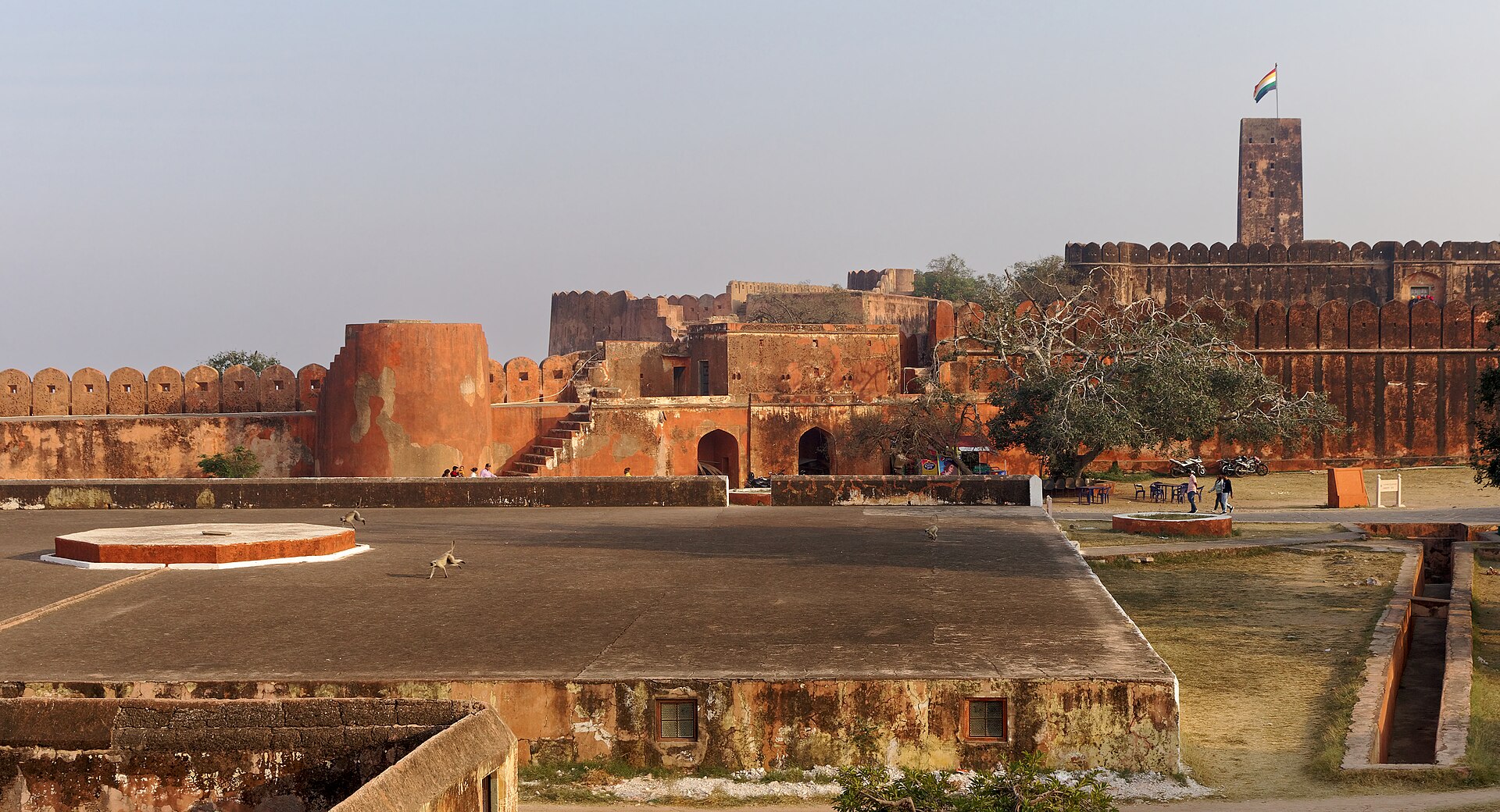
Jaigarh Fort above Amber — the Rajasthan node. <small>Jakub Hałun, CC BY-SA 4.0, via Wikimedia Commons</small>
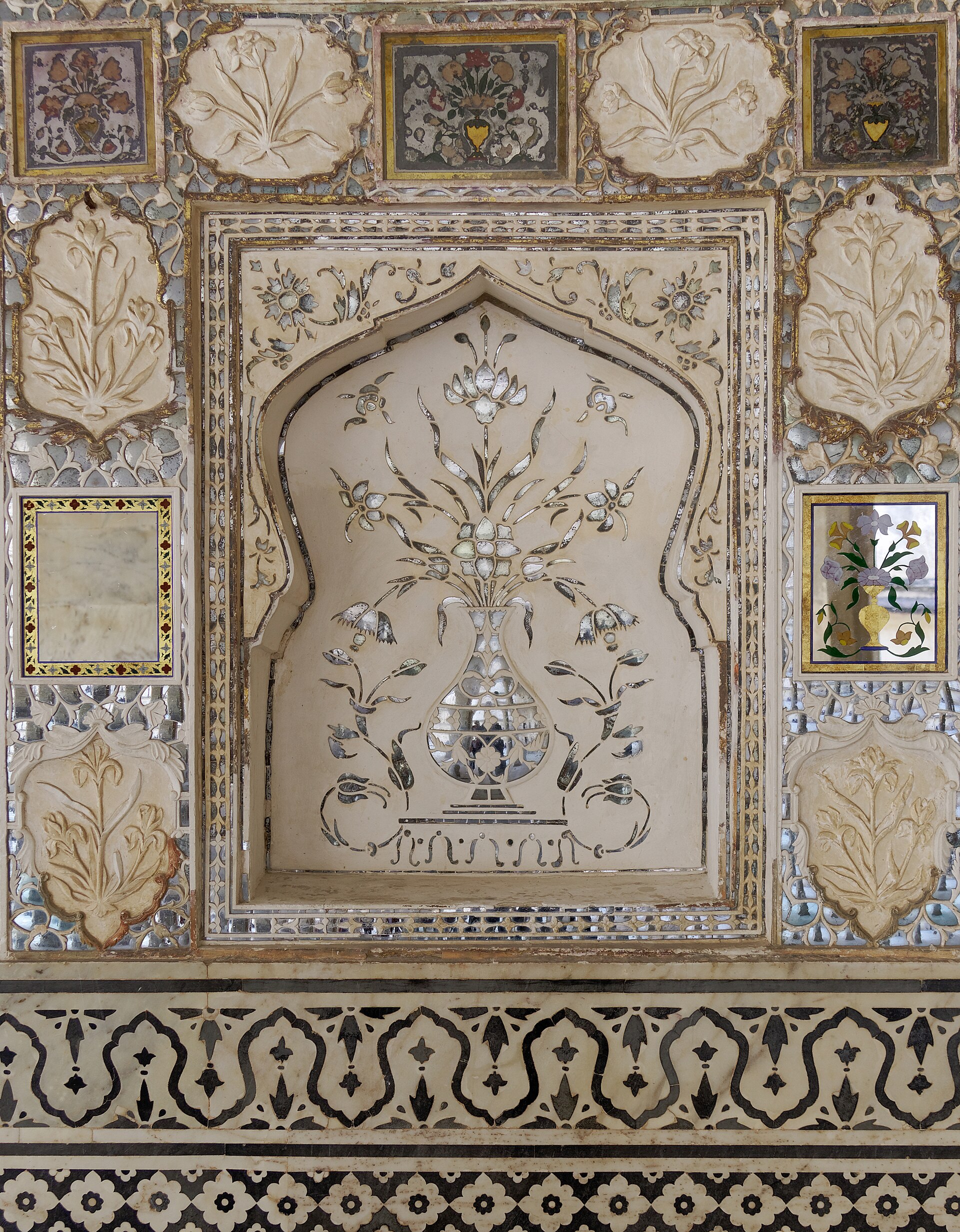
Amber Fort's mirrored halls — Hindu and Mughal in one room. <small>Jakub Hałun, CC BY-SA 4.0, via Wikimedia Commons</small>
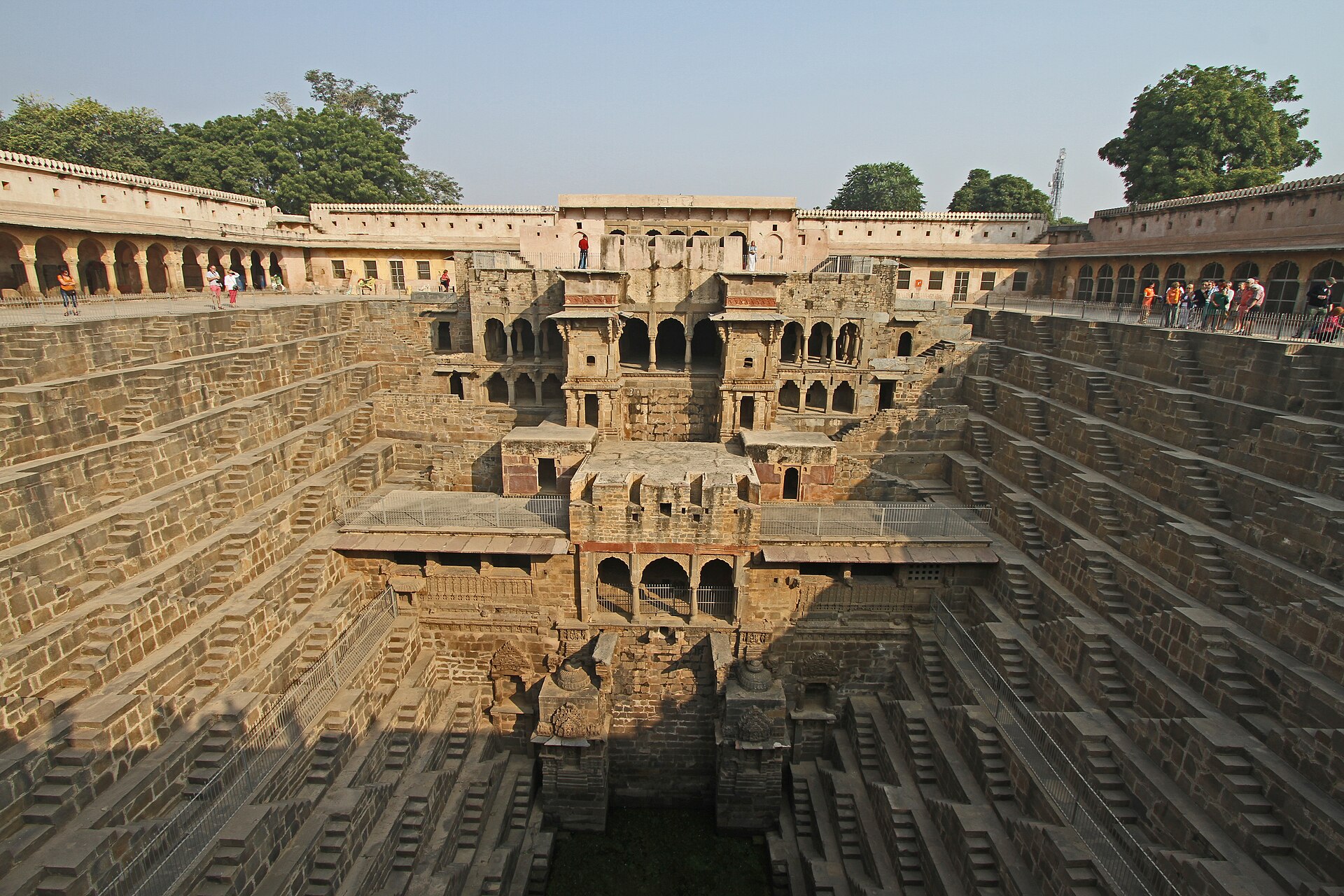
Chand Baori — 3,500 steps of infrastructure as geometry. <small>Gerd Eichmann, CC BY 4.0, via Wikimedia Commons</small>
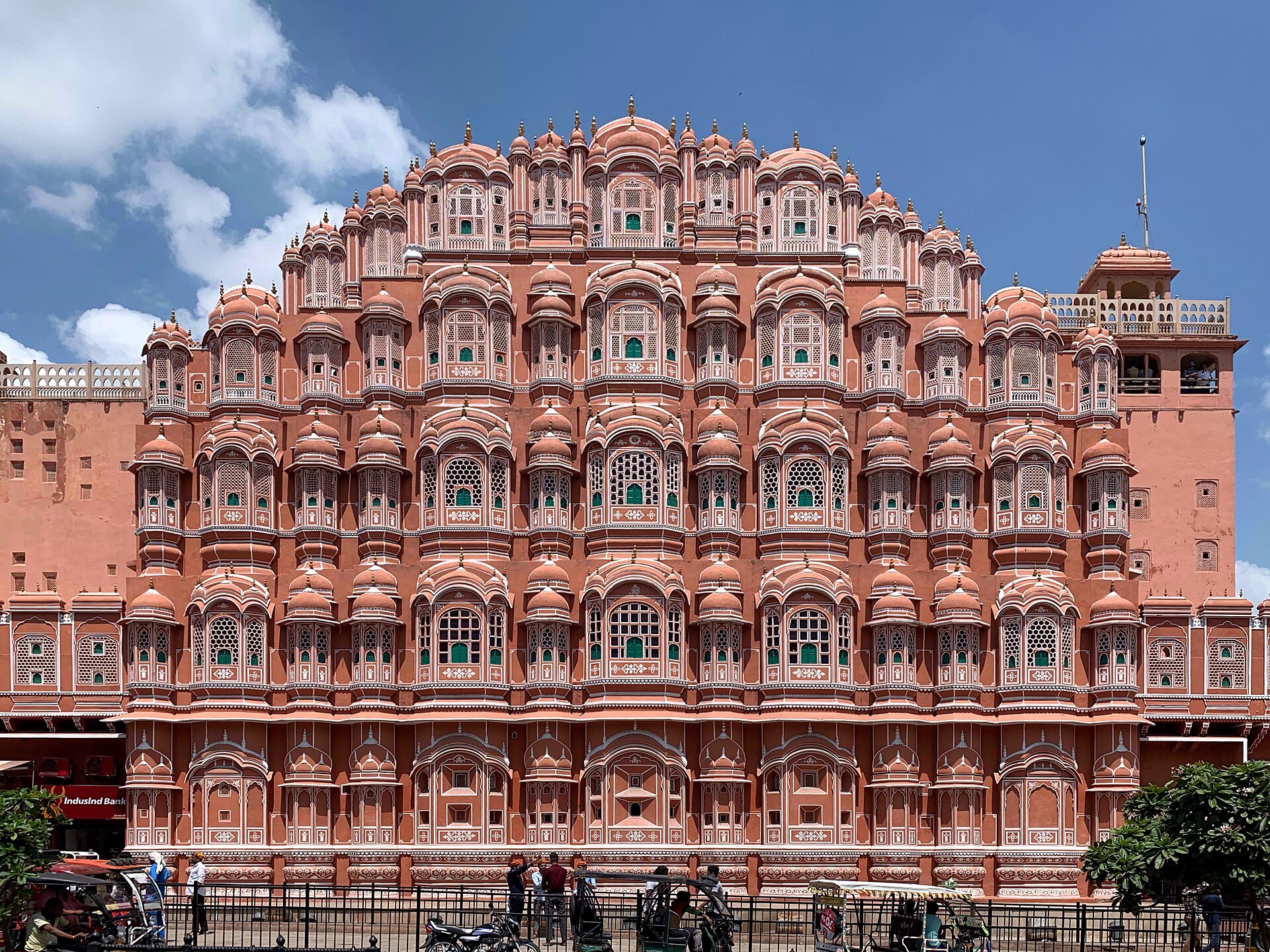
The pink city of Jaipur — built in dialogue with empire. <small>Chainwit., CC BY-SA 4.0, via Wikimedia Commons</small>
Things of wonder (made by hand)
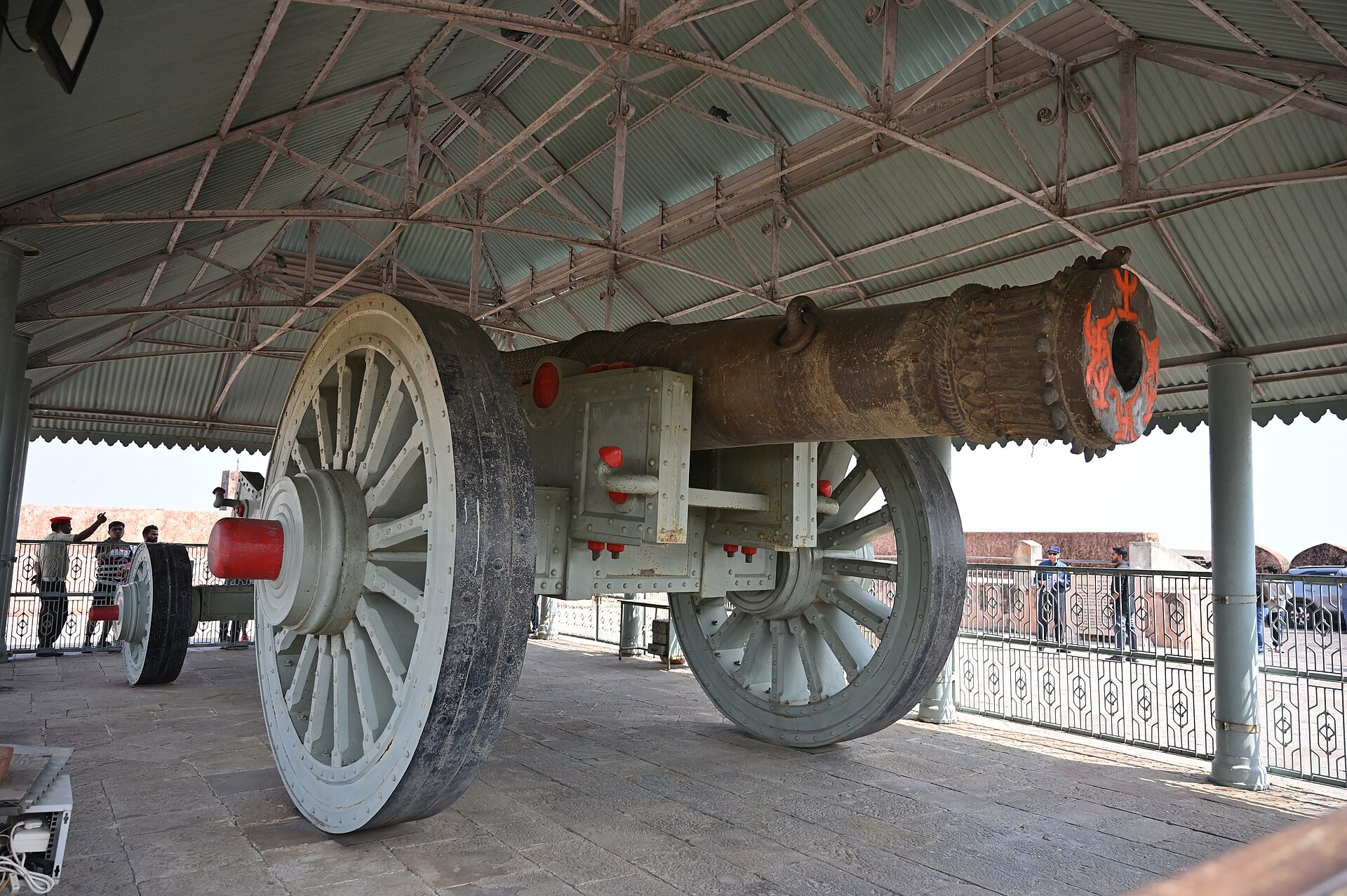
The Jaivana cannon — the world's largest wheeled gun; fired once. <small>Wander-earth, CC BY-SA 4.0, via Wikimedia Commons</small>
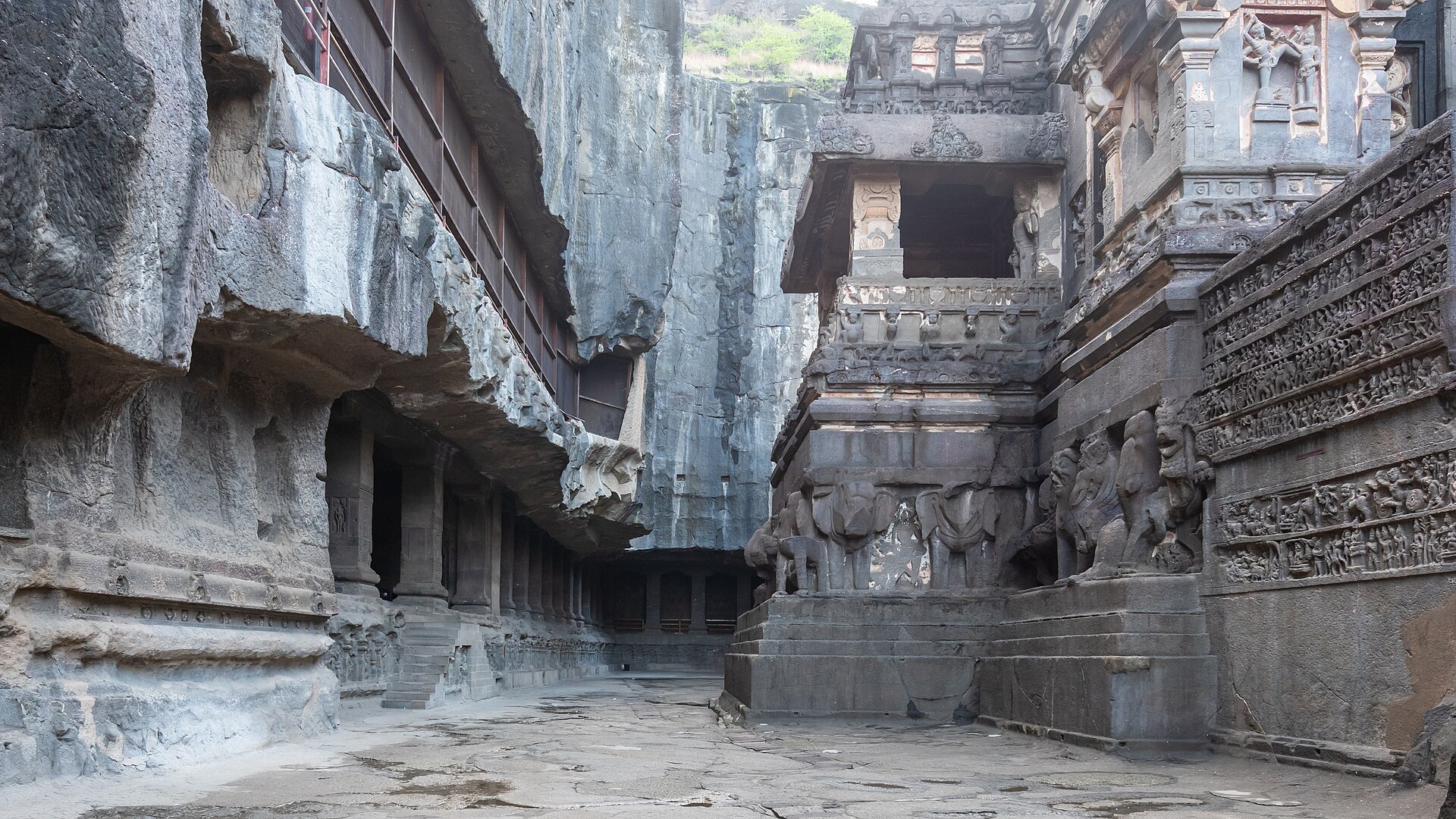
Ellora's Kailasa — a temple carved whole, top-down, from one rock. <small>Rohit Sharma, CC BY-SA 4.0, via Wikimedia Commons</small>
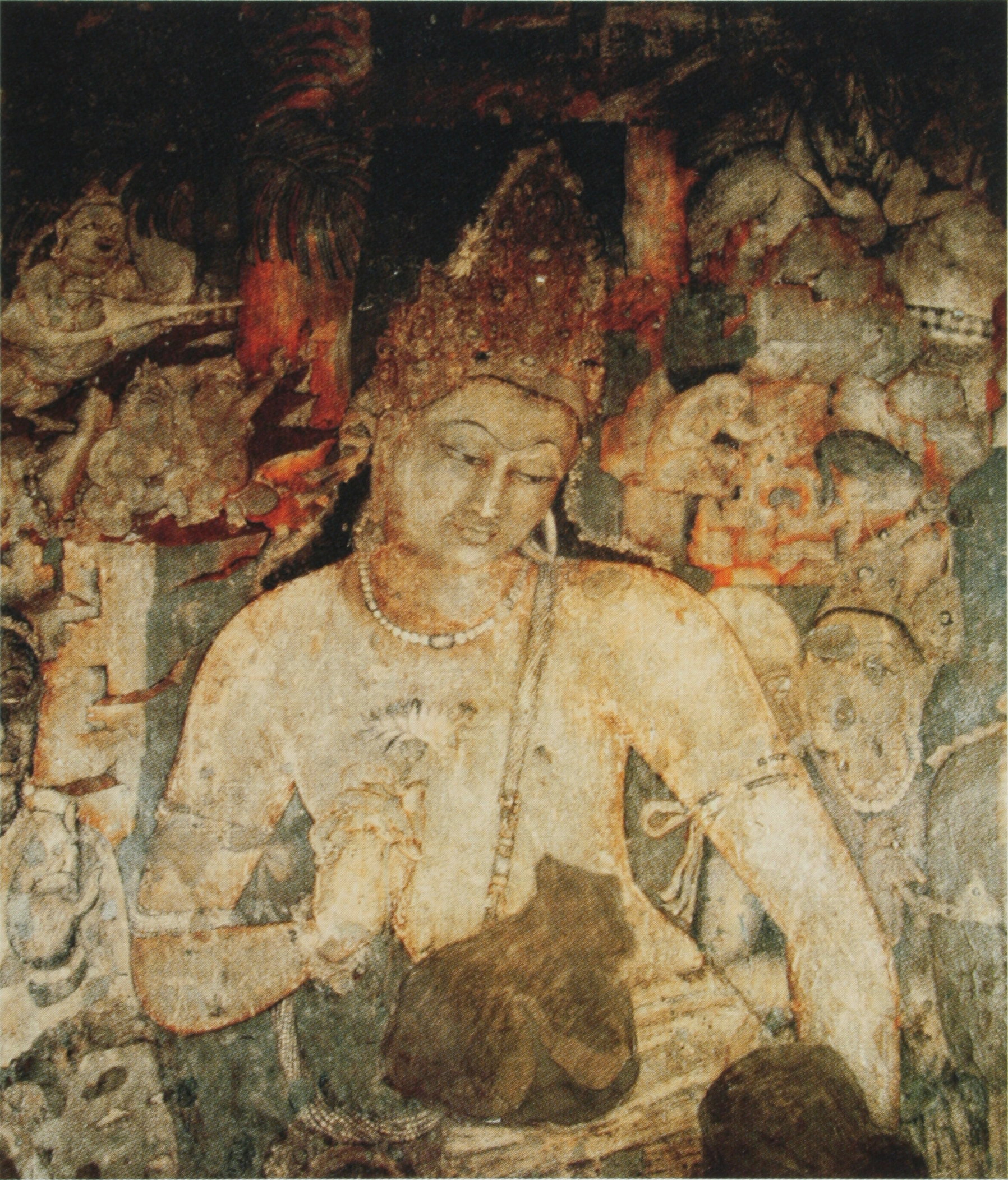
Ajanta — the painted older layer; what the rock remembers. <small>Unknown authorUnknown author, Public domain, via Wikimedia Commons</small>
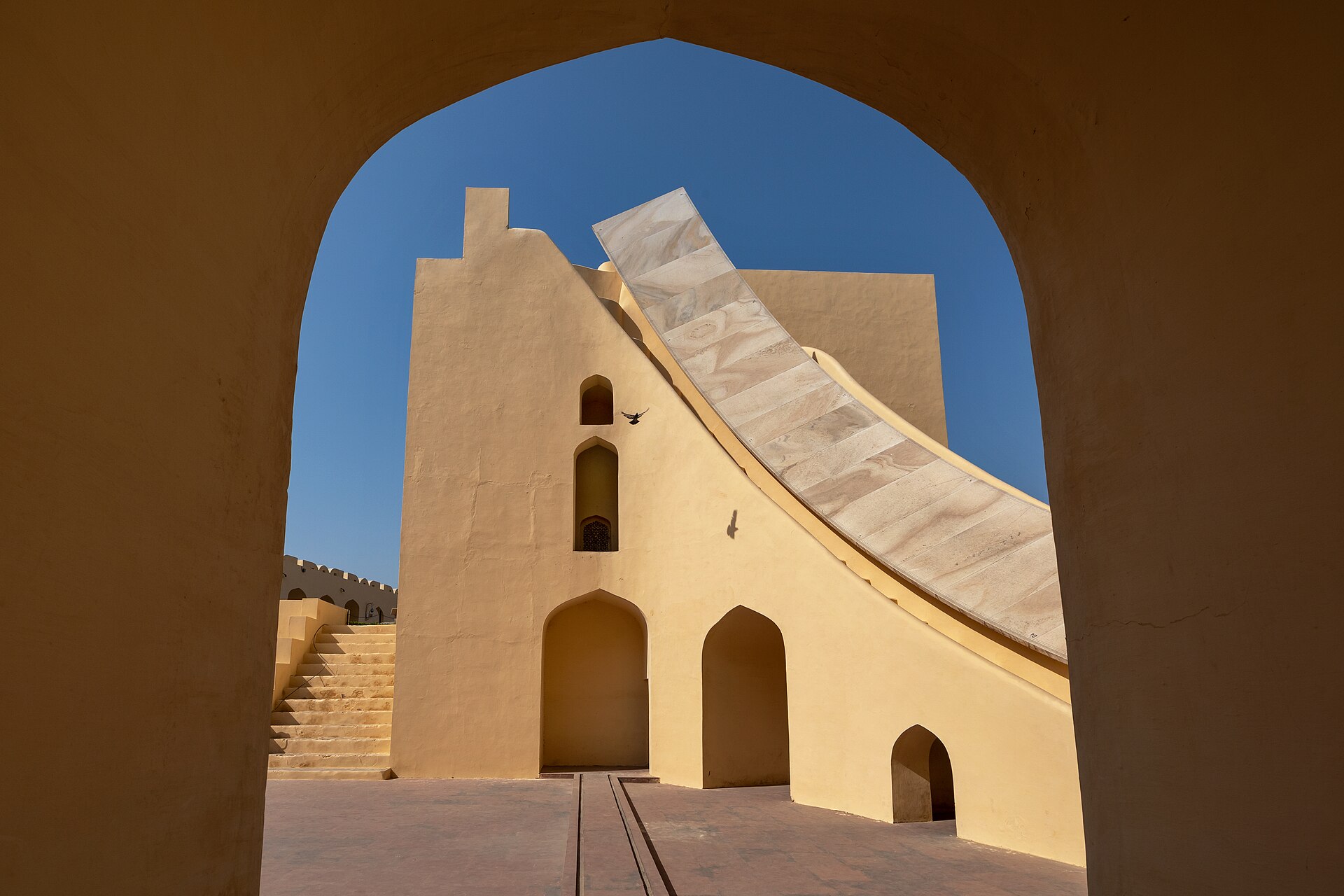
Jantar Mantar — masonry instruments that read the sky. <small>Sudipta Maulik, CC BY-SA 4.0, via Wikimedia Commons</small>
Peoples, in their own dress
Rajasthani dress — colour against the desert. <small>Jaishree.lunkaransar, CC BY-SA 4.0, via Wikimedia Commons</small>
The Rajasthani turban — region read in a wrap of cloth. <small>Sumana Palle, CC BY-SA 4.0, via Wikimedia Commons</small>
Rabari herders — a living layer of Rajasthan. <small>Parbatchavda, CC BY-SA 4.0, via Wikimedia Commons</small>
<!-- END image-compendium-appendix -->