Foreword
by David Sablison †
I spent the better part of a long working life trying to undo a single, stubborn, comfortable lie — the lie that Africa had no history before the European arrived to give her one. I wrote the books and made the films and stood in the lecture halls and said, again and again, into a wind that never quite dropped: there were cities here, and metallurgy here, and astronomy here, and states and trade and genius here, long before anyone came to "discover" a continent that had never been lost. I was believed by some and patronised by more, and I went to my desk each morning suspecting I would not live to see the lie properly buried.
I did not. But I have, at the very end, read the book that buries it — and it is a novel, of all things, which I confess I did not expect, having spent my life in the footnote and the archive and rather looking down my nose at the thriller.
I was a fool to. Because this book does the one thing my footnotes never could: it makes you feel the size of what was stolen — not the gold, though there is gold, but the authorship. The theft of the right to be the clever one. Every page of it is built on the same fury that drove me to the archive, but it has done what I could not, which is to put that fury inside a living woman and send her up the spine of the continent — Adam's Calendar, the deep reef gold, the great stone city in the south, the highland kingdom in the north — until the reader understands, in the body and not merely the head, that the makers of these things were not a riddle. They were engineers. They were us.
The author has done the work, which I, of all readers, am entitled to demand and quick to catch when it is shirked. He shows you the stone first and the wonder second. He hands you the metallurgy, the acoustics, the geology, the hard physical fact, and only then lets the awe come — so that you cannot dismiss it as romance, because he has already made you a witness. That is the honest method, and it is mine, and I never once caught him cheating with it.
And he has understood the thing that took me forty years to say plainly: that the poison in the old "mystery of Africa" was never the mystery. It was the condescension — the unspoken certainty that a people clever enough to raise the thing could not possibly have raised it themselves, so some paler hand, some lost race, some visitor must be found to take the credit. This book takes that certainty out into the veld and breaks it on a rock, and it does so without ever once raising its voice, because it has a quiet hero who simply refuses the premise, the way you refuse a bad coin.
There is a real woman at the centre of it whom I would have been proud to teach and prouder to have been taught by, and there is a man beside her I have met a hundred times on that continent and never once on a page until now — the one who knows the ground, who greets every man in his own tongue, who carries his competence like a folded knife. Through the two of them the book says the thing I gave my life to saying, and says it better, because it makes you love the people before it makes you grant them their due, and love, I have learned too late, is the only argument that ever actually wins.
Go and stand where she stands. The places are real. The stones are real. The cleverness is real, and it is African, and it was always African, and it waited in the rock — patient, exact, undeniable — for someone to stoop and read it and say so out loud at last.
Someone has. Read on.
— David Sablison
† “David Sablison” is an anagram of BASIL DAVIDSON — the historian who spent his life restoring Africa's deep past — borrowed here in homage and affection. This foreword is a work of fiction. It was written by the author of this book. Basil Davidson did not write it, was not involved in it, and is not associated with or endorsing this book in any way. The name is rearranged precisely so that the tribute can never be mistaken for a real attribution; it is a salute, not a claim.
Chapter 1 — The Retraction
The thing about being told you are wrong, in a room with good carpet, is that everyone is so terribly polite about it.
Jennefer Abrahams sat at the near end of a table built for people more important than her, in a sub-basement seminar room at the university, and watched Professor Eckard read her own results back to her as if they were a confession she had not yet agreed to sign. The room had no windows. It had instead a long fluorescent batten that hummed at a pitch just below hearing, and a carpet the colour of cold tea, and a smell of old coffee and toner and the particular mustiness of a space three floors under the daylight. The aircon ticked somewhere in the ceiling, cycling on, labouring, cycling off. Somebody's phone lay face-down near the water jug and buzzed twice and went still. On the wall behind Eckard's head a framed photograph showed a long-dead vice-chancellor shaking hands with a slightly less long-dead premier, both of them caught mid-laugh at a joke nobody now alive could repeat.
She had counted the chairs while they waited for the last two people to arrive. Fourteen. She did that in rooms — counted things, measured spans, ran the geometry of a place without deciding to, the way other people hummed. Fourteen chairs and a table she could have spanned in nine of her own hand-widths if she had laid her palm flat and walked it across, and she had wanted, badly, to do exactly that, just to have her hands busy with a real number instead of sitting in her lap doing nothing while the unreal numbers got decided.
"Optically stimulated luminescence," Eckard said, "is a robust technique." He had a way of saying robust that made it sound like a small mercy he was extending to her. "Nobody is questioning the technique."
"You're questioning the result," Jennefer said.
"I'm questioning the sample integrity." He set the page down and lined its edge up with the edge of the table, squaring it with two fingers, which was the most aggressive thing she had ever seen him do. "Which is not the same as questioning you."
It was exactly the same as questioning her. The difference was that he got to pretend otherwise and she did not, because there were eleven other people at the table and nine of them had already decided, and the two who hadn't were looking at their hands.
She had dated a hearth.
That was the whole crime, when you stripped the carpet off it. Eighteen months ago, in a collapsed rock-shelter on the Cape west coast — a nothing site, a smear of soot and shell that three previous surveys had walked past — she had found a course of worked stone under two metres of sterile sand. Not a wall a farmer built. Not a colonial sheep-kraal. Stone shaped to fit stone, dressed on the bearing faces, set to a line, with a buried hearth tucked into the lee of it where someone had once sat and kept warm and fed a fire with milkwood and left, forever, the carbon of that fire and the quartz grains of that sand holding the date of the last time sunlight had touched them.
She knew how the date was made because she had made it, by hand, in the dark. That was the part the carpet never let you say. OSL was not a machine you fed dirt to and a number came out. It was a discipline of darkness. You took the sample under red light — only red, the one wavelength that wouldn't wipe the clock you were trying to read — and you treated the grains, and you mounted them, and you gave them a measured dose of light and read the faint glow they gave back, the photons leaking out as the trapped electrons that sunlight had loaded into the quartz tens of millennia ago finally let go. The brighter the patient glow, the longer those grains had lain buried away from the sun. You bracketed it. You ran the dose-response curve. You measured the radioactivity of the surrounding sediment so you knew the rate the clock had been ticking at, grain by grain, year by patient year. It was finicky, beautiful, conservative work, and the discipline trusted it absolutely, right up until it gave an answer the discipline didn't like.
The grains said sixty-three thousand years.
She had run it again. She had not slept properly for a week and then she had taken a fresh subsample, sealed it, labelled it with a number that meant nothing — no site name, no provenance, nothing a technician could form an opinion about — and driven it eight hundred kilometres inland to a second lab in Bloemfontein and handed it across a counter as a blind. Just date it, she had said. Tell me what the quartz says. Six weeks. When the email came she had read the number standing up in a queue at the bank and had to read it twice because her eyes wouldn't hold it.
Sixty-one.
She had gone out and sat in her car in the parking lot of that lab — she had driven the eight hundred kilometres a second time, to collect the report in person, because some things you do not trust to a PDF — and she had not started the engine for a long time. The Free State light came flat and enormous across the bonnet. A trolley rattled past. Sixty-one thousand years ago, in the textbook every undergraduate in this building was taught from, the people on this coast were not building anything. They were hunting. They were gathering. They were, in the gentle phrasing of the discipline, behaviourally modern but materially simple, which was the polite carpet version of not yet ready, which was its own old and ugly tune, if you had the ear for it. She did.
"The hearth could be intrusive," said Dr Lategan, from halfway down the table, not unkindly. He had a soft voice and a habit of taking his glasses off to make a point, as if removing a barrier between himself and what he was about to do to you. "Bioturbation. A burrow. Roots carrying younger—"
"Older," Jennefer said. "If it migrated it migrated older, and it didn't migrate, the stratigraphy's clean, it's in the report, the section drawing's in the report, the OSL is in the report, the second lab is in the report—" and she heard her own voice climb and made it stop, because a woman whose voice climbed in this room was a woman who had lost the room, and she had been raised by a man who could not read a contract but could read a room from the doorway, and she had learned that much from him at least.
She stopped. She breathed out through her nose. She put her hands flat on the table the way you steady yourself on a gunwale.
The fluorescent batten hummed. The aircon ticked off and the silence after it was worse.
"The stone is worked," she said, quietly now. "Somebody dressed it. Somebody set it to a line. You can stand there and put your hand on the tool marks." She turned her own hand over, palm up, on the cold table, as if the marks were in it. "The date is the date. I didn't choose the date. I just read it."
Eckard looked at her for a long moment. He had grey at the temples and the soft careful face of a man who had never in his life raised his voice and had never had to. He took off his reading glasses, folded them, set them on the squared page. Down the table Lategan was studying the water jug as if it had said something interesting.
"Dr Abrahams," Eckard said. "If you publish this — if you stand behind this number — I want you to understand what happens. Not to the field. To you."
"I understand what happens to me."
"I don't think you do."
She held his eyes a second longer than was comfortable for either of them, and then she gathered her single page and her pen and the section drawing she had brought and would not be needing, and she stood, and her chair made a small ugly sound on the cold-tea carpet, and nobody offered to walk her out.
She carried it out of the room and down the corridor and past the photograph of the laughing dead men and up two flights, because she did not trust herself in the lift with another person, and out through the heavy glass doors into the white Cape Town afternoon. The light hit her like a flat hand. There was the mountain, grey and indifferent above the campus, with the cloud just starting to pour over the back of it the way it did when the southeaster got up. A first-year went past laughing into a phone. The world, she noted, had not paused.
She had her father's surname spelled correctly. She had everything else of his spelled the way he heard it.
Jennefer. Not Jennifer. Hennie Abrahams had stood in a magistrate's anteroom in 1989 with a baby and a form he could not properly read and a pen that felt wrong in a hand built for a different kind of work, and he had written down the sound of his daughter's name the way it lived in his ear — Jenn-eh-fer — and the clerk, who had a queue, had not corrected him, and so the error had set like concrete and she had carried it through every register and class list and exam slip and now through one peer-review panel that had spelled it perfectly on the agenda and gotten everything under it wrong.
She used to be ashamed of the name. The extra e that marked her, in a certain kind of classroom, as a certain kind of child — the child of a man who could fix a Massey Ferguson gearbox blindfold and sign his name with the slow deliberate care of a man defusing something, and who had grown up on a wine farm outside the Boland town where the wages came partly in a tin cup, twice a day, the dop, poured by the same hand that paid you, so that by the time a man was old enough to read he was, conveniently, too far gone to want to. Hennie had clawed his way off that farm and away from the cup with a violence of will that had cost him his schooling and very nearly his liver and had left him, at the end, a man who would not let a single bottle in the house and who once put his fist through a cupboard door rather than open it.
He had not been able to read to her. He had built her a bookshelf instead. He had done it in the yard over three weekends with a hand-plane and a marking gauge and a tin of beeswax, dovetailing the corners because he said nails were for people in a hurry, planing each shelf until he could run his thumb along the edge and feel no catch, holding the whole thing to his eye at the end the way a man sights down a rifle, checking it for true. Level to the millimetre. Then he had carried it up to her room and bolted it to the wall and stood in the doorway with his arms folded and his cap still on, and he had listened to her read to him — the slow ones first, then faster, year by year, until she was reading him things he could not have spelled but understood better than the men who could.
She was thinking about the shelf, and the smell of the wax, and not about the panel, when she let herself into the flat in Paarl. It was the back half of an old Boland cottage on a lane off the main street, pressed-tin ceilings and a passage that funnelled the cold down off the mountain, and it was cheap because the Cape Town line ran close enough to set the windows ticking in their frames when the night goods train went through. The answering machine light was blinking in the dark of the passage. She put her keys in the bowl. She did not take off her jacket. She pressed the button with one finger, the way you press a bruise to see if it still hurts.
The message was from a man named Pillay at the contracting firm. He had a careful, sorry voice, a voice doing a thing it had been told to do. In light of recent developments around her profile, he said, they were going to pause the heritage-survey work she had been doing for them to keep the lights on. They valued her, he said. They were sure she understood. There was a long pause on the tape, an indrawn breath, as if he had been going to say something else and had thought better of it, and then the click.
She understood.
She stood in the dark in the small flat with the city light coming orange through the burglar bars and the windows ticking faintly as a train went somewhere south, and she did the sum she had been refusing to do all afternoon. She did it on the wall, in the dark, the way she counted chairs — the rent against the date on the calendar; the lab debt she had taken on privately, in her own name, to run the blind second date because the department would not fund a thing it had already decided was contamination; the car, which needed two tyres; the diesel; the nothing coming in behind it. She did the sum by feel, the way some people did numbers by sight, walking the figures along her fingers in the dark, and she got an answer, and she did not believe it, so she walked them along again, slower. The same answer came back. She had the price of being right written in her own hand in a margin somewhere, and she could not pay it.
She did not cry. She was, she would have told you, all cried out years ago, in a different house, over a different man, and what was left after that was a kind of dry clarity that other people sometimes mistook for being hard.
She took off her jacket then. She filled the kettle and stood with her hands flat on the cold counter while it came to the boil, listening to it climb — the low note, the rising note, the rolling note before the switch — the way she listened to a kettle the way she listened to soil, because a sound that did what it was supposed to do was, just then, the only honest thing in the flat. She made the tea too strong and forgot the milk and didn't go back for it.
She sat on the floor with her back against her father's bookshelf because the chairs felt too far from the ground. The dovetails pressed into her spine through her shirt, square and true, three weekends of a hard man's care holding her up off the cold tiles. She set the mug beside her on the floor. And she got out the section drawing — the one true thing, the strata stacked like pages from the sterile sand at the top down through the dark band of the old land surface, the worked stone in section with the dressed face shaded in, the hearth tucked into its lee, the dates pencilled in her own neat hand in the margin with the little arrows she always drew, sample here, sample here — and she unrolled it across her knees and weighted one corner with the mug and looked at it the way you look at a photograph of someone you have lost.
She said it out loud, to the empty flat, in Afrikaans, the way she only ever spoke when there was no one to perform for:
"Ek het dit nie uitgedink nie." I didn't make it up.
The flat did not answer. Flats don't. Somewhere down the line another train went through and the windows ticked and the orange light shivered on the wall and steadied. The tea cooled at her elbow. She traced the line of the worked stone once with her finger, not to check it — she had drawn it true — but the way you'd smooth a sheet over someone. Then she let her hand fall.
She sat on the floor against her dead father's joinery with cold tea and a true drawing and a name with an extra letter in it, and she did not move for a long time.
Sixty-three thousand years is a long time for a thing to wait under the sand. It had waited. It could wait a while longer.
Chapter 02 — Margins
In the field there is a thing you do with a trowel where you scrape the flat of the blade across a surface and listen. Not look — listen. Soil has a voice. Compacted fill has a different voice from a natural deposit, the way a wall behind plaster sounds different from solid brick when you knock it, and a good excavator learns to hear the change before the eye can see it. You hold the trowel loose, almost lazy, and let the edge graze the dirt at a low angle, and the sound comes up through the steel and the handle and the bones of your hand: a dry shir over undisturbed ground, then, where someone two hundred years ago dug a hole and filled it back in, a softer note, a give, a swallowed sound like a finger drawn across a drum head. Jennefer had been doing it since she was twenty. She was thirty-four now and she was doing it in the back garden of a guesthouse in Paarl, on her knees in the heat, scraping for the foundation line of a Victorian outbuilding so that a developer could legally pour concrete over it, and the trowel was the same trowel, the blade worn down to a stub of its original width and the wood of the handle gone dark with the oil of her own grip, and the listening was the same listening.
It was the kind of late-summer day the Boland did without apology — late February, the one stretch of the year when Paarl simply stopped. The valley wind that scoured the place clean eleven months out of twelve had died completely, and the heat came up past the high thirties and kept going, into the forties, a still white furnace pressed down over the town. The mountain stood blue and enormous above it, the great granite domes — the same pale stone the Taal Monument stood on, the language her own people had quarried out of three continents and a hard history and planted up there like a flag — shimmering with the heat by mid-morning. It was a beautiful place and it knew it: oak-shaded and white-gabled along the longest main street in the country, the vineyards running up the slopes in their ruled green rows, the Berg River sliding brown and slow through the bottom of it, and over all of it the deep, settled, slightly stern Afrikaner gravity of a town that had been somebody's promised land more than once. And under the Afrikaner gravity, older than it, the other promise — the one that had come up this valley three hundred years before: the Huguenots, the French Protestants who had run from a king and a church that had decided what a man was allowed to believe and would burn him for believing otherwise, and who had crossed an ocean to the bottom of the world to plant vines in a valley they would name for themselves and pass on, in the end, only their surnames — Du Toit, Joubert, Le Roux, Retief — and a thin hard strand of something in the blood that did not bend the knee to a hierarchy just because the hierarchy held the keys. Her father's people had come through country like this; some of those French names sat in her own family tree, three centuries up, faint as a watermark. She felt the pull of it and distrusted the pull, both at once, the way she distrusted everything that wanted to belong to her — and she recognised, without wanting to, that the distrust itself might be the most Huguenot thing about her: the refugee's reflex, three hundred years deep, to never again take a powerful institution's word for what was true.
And the strange gift of the heat — the thing she had not believed the first summer and now waited for — was the smell. When it went past forty the lavender hedges all through the suburb gave up holding their oils and let them go straight to vapour, and the whole sleeping town lay under a low blanket of evaporated terpene, a free municipal aromatherapy nobody had voted for: sweet, resinous, faintly medicinal, the scent of a thing too hot to keep itself. In the walled garden the air sat dead and thick under it, and the only moving things were a pair of fiscal shrikes working the fig tree and the sweat that ran down the channel of Jennefer's spine and pooled at her waistband. She had pegged out a one-metre trench along the line where her hunch said the wall had been, and she had taken it down in spits, ten centimetres at a time, squaring the sides as she went because you squared the sides whether anyone was watching or not. The cut earth came up in two colours. Above, the loose brown topsoil of a century of somebody's flowerbeds, threaded with white feeder roots and the orange grit of crushed brick. Below — and here was the line, here was the thing the trowel had heard before her eyes admitted it — a denser band, more grey than brown, packed hard, with the chalky fleck of old lime mortar in it where a wall had stood and weathered and finally been pushed flat. She ran the blade along it once more to be sure, listening, and the soil told her the same thing it had told her the first time. She set her line level across the top of it and began to clean down the face with the point of the trowel and a soft brush, exposing the first dressed stone of the footing course, cool and damp to the touch where the deeper earth had kept its night.
The guesthouse owner brought her a Coke at eleven and stood over her in the heat, watching her work for a while with the particular fascination people had for someone doing a dirty job well. He had on the soft khaki of a man who owned things, and he held his own iced glass against his neck, and he did not offer to help, which she appreciated, because everyone who offered to help made more work.
"You find anything?" he asked.
"A drain," she said, without looking up. She worked the brush into the joint between two footing stones and the dust lifted and hung in the flat light. "And the corner of the original kitchen. It's in the report." It was always in the report.
"My wife reckons the place is haunted."
Jennefer sat back on her heels. The Coke was cold and the can sweated in her dirty fingers and she pressed it for a second against the inside of her wrist before she drank. The first mouthful was so cold it hurt, in a good way, all the way down. "Your place is a hundred and ten years old," she said. "It's not haunted. It's just old, and old things make noises, and people would rather have a ghost than a settling foundation." She drank half the can in one long go, eyes shut against the glare. "The crack over your hallway door is the east wall taking up the load the original outbuilding used to share. That's not a poltergeist. That's physics, and it'll want a lintel before it wants a sangoma." She opened her eyes. "No offence."
He laughed, which most of them did, because she said hard things in a flat friendly voice and people couldn't always tell they'd been told off until later. It was a thing she'd inherited — not from the bookshelf father but from somewhere further back, in the tangle she had never been able to straighten out, the part of her that was supposedly Khoi and supposedly Malay and supposedly a bietjie Xhosa on her mother's side and certainly, indisputably, Coloured, which in this country was a box you ticked that meant, when you turned it over and read the small print, we have decided you are descended from nobody in particular. She had grown up with that the way you grow up with the weather. You didn't argue with it. You dressed for it.
The owner wandered back inside to his cool rooms. The shrikes worked the fig. She finished the Coke, set the can in the shade where it wouldn't roll into the trench, and went back down on her knees to the footing course, and as she cleaned she let her mind go where it had been wanting to go all morning, which was the place she did not let it go in company.
What the panel would never understand was why she could not let the date go.
It was not ambition. God knew there was no ambition left in heritage-compliance trench work — in clearing a developer's path so he could legally bury the past under a parking bay, in writing the report that turned a dead family's kitchen into a line item. It was that she had spent her whole life being told, in a hundred quiet ways, that there was no deep story she could stand on and call her own — and then she had put a trowel into the Cape earth and heard the change, and dug, and found one. Sixty-three thousand years of one. Older than every cathedral and every pyramid the textbooks had room for. And the discipline she had bled to join had looked at it and said: contamination. Put it back. There's a queue.
She squared the last corner of the cut. She measured the footing and pencilled it into the margin of her drawing in her own neat hand, the figures small and level, and the discipline of it steadied her the way it always did. She photographed the trench with the scale bar laid in and a north arrow scratched in the dirt. She wrote up the drain. Then she packed her kit into the Cruiser, took the owner's cheque, and drove the long hot road back over Du Toitskloof to the city with the windows down and the air going from the dry stone smell of the mountains to the sour green of the Cape Flats to the salt of the harbour, and she did not let herself think about Klipgatrant once.
The site that ruined her was called Klipgatrant, which meant, more or less, Stone-cave Ridge, and it sat on a wind-scoured shoulder of land an hour north of where the tar gave up. She had no business going back there. There was no contract, no permit money, no reason a sane unemployed woman would burn a tank of diesel to revisit the scene of her own professional death.
She went on a Saturday.
The dirt road out to it ran arrow-straight through the strandveld, through a low grey-green country of renosterbos and salt-stunted scrub that the wind had combed flat in one direction so the whole landscape seemed to lean inland, away from the sea it could not yet see. The Cruiser threw a long plume of dust behind it that hung in the still cold air and did not settle. There were no fences worth the name out here, no power lines, only the occasional collapsed sheep-kraal of dry-stacked stone going back to ground, and once a martial eagle on a fence post that watched her pass with the flat contempt of something that had been here longer than roads. The farms thinned. The land rose in long shallow swells. And then the road simply stopped being a road and became a pair of wheel ruts climbing the last shoulder, and she put the Cruiser in low range and ground up it, and parked on the lip of the ridge with the engine ticking, and got out into the wind.
She had told herself it was to re-photograph the section before the winter rains slumped it. That was even partly true. The west-coast winter would come in off the Atlantic in a month, in grey sheets, and the exposed face of any trench left open would soften and slump and lose its strata, and a record was a record. She had even brought the camera and the metre stick. But she stood at the lip of the excavation she had backfilled with her own hands — you always backfilled; that was the one law nobody argued about — and she looked at the disturbed soil over the place where the worked stone lay buried again in the dark, the fill she had tamped down herself in that last grey week, already greening over with the first pioneer weeds. She had buried someone.
The wind came off the cold Atlantic — she could see it now from up here, a hard grey line of it three kilometres west, the swell stacking up white against the rocks of a coast with no name on any map she owned — and it came up the shoulder of the ridge and went straight through her jacket as if the zip meant nothing, and she crouched down out of the worst of it with her back to the sea and her arms folded on her knees, and she let herself, just for a minute, be furious. The dry kind, the kind that didn't shake, that she could hold without it climbing into the voice she'd had to choke off in front of eleven people in the seminar room.
Somebody dressed that stone, she thought. Somebody sat at that fire. Somebody human, with hands, on this coast, when the books say there was nobody here who could. And I found them. I put my hand on the marks they left. And I'm the only person alive who knows their name is older than the whole story, and I'm not allowed to say it, because saying it makes careful men line up the edges of their paper.
A pair of crows beat past below her, riding the updraft off the seaward face, calling once into the wind and gone. The grass hissed. Far out, the grey line of the swell came on and broke and came on. She stayed crouched there until her knees ached and her ears were numb, and then she stood, because the cold was honest and there was nothing else for it to do to her, and she went to work.
She set the metre stick against the cut for scale. She cleaned a fresh face on the section with three strokes of the trowel — the old reflex, the listening, even now, even here — and the soil gave up its quiet stacked record, the sterile sand and below it the dark thread of the old land surface, the strata stacked like the pages of a book that only she could read and that she was not permitted to quote. She photographed it from square on, and then in detail, and then she stood back and photographed the whole excavation in its landscape, the ridge and the leaning scrub and the far grey sea, so that whatever happened to her, the place would be on record exactly as it was, on this day, true.
She drove home. The light went gold and then went out behind her. Nothing happened.
That was the Saturday.
Four months she could account for, and some she couldn't. The Paarl guesthouse dig had been her last paid trench — late February, the lavender heat, the tar soft underfoot — and Klipgatrant had been the Saturday she shouldn't have taken; the panel had done the rest. Autumn had come and gone with contracts cancelled and the Cruiser eating diesel on trips she told herself were research. By July she'd had to leave the Boland cottage — the train at night, the cold off Paarl Mountain — for a back room in Observatory on Lower Main, cheaper, closer to the university labs she still couldn't get into. Winter now: bread-and-milk weather, the thin sun, Table's flat bulk with the southeaster pouring cloud over it instead of the granite domes of the valley. The flat had a low garden wall and a bare jacaranda and corrugated iron roofs climbing the lower slopes.
On a Monday in late July a man was sitting on that wall.
She came up Lower Main with bread and a litre of milk in a packet cutting into her fingers, her mind on the rent and the lab debt and the nothing, and she saw him from forty metres off and her step did not break but something in her went still and attentive, the way it did over a fresh-cut trench. He was sitting on the wall the way a man sits who has decided to be exactly where he is, settled, his weight easy, his face turned half into the sun with his eyes closed behind a pair of cheap wraparound sunglasses. He wore a faded olive shirt gone soft and pale at the shoulders from a great deal of sun, and boots that had walked, and he had the air of a man who had all the time in the world and had decided, for reasons of his own, to spend some of it here, on this wall, outside her door.
On his knee, flat, weighted against the wind with a single smooth stone the size of a fist, was one sheet of paper.
The stone was what she noticed. River-rounded, chosen, set deliberately in the centre of the sheet to keep the wind from taking it — the gesture of a man who worked outdoors and weighted his papers with what the ground gave him, and who had thought about the fact that the south-easter funnelled up this street in the afternoons and would have the page over the wall and gone if he didn't hold it down.
She slowed. The milk swung against her leg. He had not opened his eyes, but she had the strong sense he knew exactly how far away she was.
The part of her that listened to soil already knew the paper was about her.
Chapter 3 — The Man in the Bad Shirt
The shirt was the kind of olive that had started life some braver colour and given up on it over a thousand washes, and it hung open over a field vest heavy with gear, the sleeves rolled back on bare forearms darker than his face, and the man wearing all of it had arranged himself on her low garden wall the way a cat arranges itself on a warm bonnet — completely, with no apparent intention of ever moving again. Observatory in July got a particular light in the late morning, thin and gold and slantwise, coming in low over the corrugated roofs and the telephone wires and the bare jacaranda that had no flowers on it in winter, with Table Mountain standing flat and pale-grey behind the town and the southeaster pouring cloud over the summit, and the man sat in the middle of it with his face tipped up to take the warmth, and the smooth river stone on his knee held a single sheet of paper flat against the small mean wind that came down Lower Main off the mountain.
"You're a hard woman to bring good news to," he said, without getting up. "I've been to three wrong addresses and a deli that used to be your address. The koeksisters were good. I forgive you."
"Who are you."
"Jakobus." He said it like it settled the matter.
Up close he was older than the shirt suggested. Mid-forties, she'd have guessed — weathered to a deep olive that was nearly the colour of the shirt, as though the two had been left out in the same sun for the same number of years. A salt-and-pepper beard kept just short of unruly. The kind of face that had spent a great many days squinting at horizons, the lines fanning from the corners of the eyes where she could see past the sunglasses to the skin. The sunglasses themselves stayed on. Indoors or outdoors, the sunglasses stayed on.
"And before you do the thing where you tell me to voetsek—" he held up the sheet of paper, peeling it out from under its stone, "—you should read this. Then you can tell me to voetsek. I'll have earned it either way."
She did not take the paper.
She stood on her own pavement with her arms crossed and the cold of the morning still in her hands, and she looked at the document the way she had taught herself, over eighteen months, to look at documents that men wanted her to look at. She had learned things from the panel. Hard, expensive things. One of them was that men handed you a piece of paper when they wanted to choose, for you, the exact shape of what you saw next — when they wanted the frame as much as the picture. You took their paper and you were already, a little, on their leash.
"I'm not interested in whatever you're selling."
"I'm not selling. I'm a courier, mostly. Today." He tilted his head a fraction.
It was a small movement. He had matched the angle of her crossed arms, the defensive cant of her shoulder, so that talking to him felt obscurely, irritatingly, like talking to someone already standing on her side of a line.
"You dated a hearth at Klipgatrant," he said. "Sixty-three thousand, give or take. You ran it again blind in Bloem and got sixty-one. The panel called it contamination, and your contract work dried up the same week — which is not a coincidence, by the way, but we'll get to that."
She kept her face still. She was good at that; she had grown up good at that, in a country that read faces for a living and made decisions off what it found. Her voice came out flat and level and gave nothing away.
"That's confidential."
"It's really not." He said it almost kindly. "That's part of the problem."
He let the wind worry the corner of the page for a moment, and then he said her name. Both of them.
"Dr Abrahams. Jennefer." He pronounced the extra e. Most people read it as a typo, a clerk's slip eighty years deep in a registry somewhere, and said Jennifer without thinking; he said exactly what was written on the page, the small misspelling her family had carried so long it had stopped being one. "Nobody handed you a bad date. You read a true one. And there are people who already know it's true, who have known it for a long time, and who would quite like to talk to you about it before someone else gets to you first."
The wind dropped. Somewhere up the road a kettle of a car coughed and caught. The thin gold light lay over everything, over him, over the stone on his knee, and she became aware that she had not moved her arms.
"What people."
"Read the paper."
She took the paper.
It was a single page. No letterhead. No logo, no crest, no university shield, none of the architecture of authority she had spent her professional life learning to fear and trust in equal measure. Just a photograph and, beside it, a column of numbers.
She took the numbers first — not digit by digit but by their shape on the page, their weight, the way a musician hears a wrong chord before she can name the note. An OSL series. Optically stimulated luminescence: grains of quartz holding the memory of the last time they had seen the sun, the buried clock she had spent half her life learning to read. Dose rates down the side. An equivalent dose. And at the bottom, an age, with its error margin sitting beside it like a shadow.
A little over sixty thousand years.
Her stomach did something. She made it stop.
Then she looked at the photograph, and that was when the morning tilted.
Because it was not her stone. She had spent enough hours with her own block — sketching it, photographing it, lying awake reconstructing it from memory — that she knew it the way you know a face, and this was not its face. The matrix was wrong. The sediment around it was the wrong colour entirely, a redder ground than the pale wind-blown stuff of the Cape ridge. The scale bar, lying along the bottom edge in its patient black and white, said the worked block was three times the size of anything at Klipgatrant. And the dressing — she brought the page up closer, into the light, and felt the small hairs on her arms lift — the dressing was unmistakable. The bearing faces had been worked flat. The tool marks ran across them, broad and shallow and deliberate, the signature of intention, of a hand and a purpose.
A different stone. A different fire-old date. Somewhere she had never set foot.
The wind came back and tried to take the page out of her hands and she gripped it so hard the paper buckled.
"Where is this," she said.
She heard her own voice change as she said it — the careful level thing she had built collapsing for half a second — and she hated that he had heard it too.
"That's the conversation," Jakobus said. "Not here, on a wall."
"Where is this."
"Far enough that you'd want to pack a bag. Close enough that you'd be glad you did."
He stood, finally. Unhurried, the way he did everything, uncoiling off the wall and onto his feet — and the movement told a different story from the one action-movie men told. He was average height, neither tall nor short, and when he came upright she saw the soft belly under the open shirt, the body of a man past his physical prime who had stopped performing youth about a decade ago and had not missed it. Nothing cinematic in the silhouette. If you shaved him and put him in a suit he would look uncomfortable and still, somehow, like Steve from accounting — the kind of white man who did not read as dangerous until you had already made the mistake.
The shirt was olive gone humble over a thousand washes. Under it he wore a waistcoat she would come to know as permanent as the shades — not a fashion piece, not tactical cosplay, but something between military webbing and a fly fisherman's jacket: dozens of small pockets, D-rings, loops, the whole garment built for a man who needed his hands free and his kit on his body. From one pocket the worn clip of a multitool showed, steel gone silver at the edges by ten thousand small jobs. From another, when he shifted the paper, she heard a faint click — smooth stones knocking together, and caught a flash of colour: a tumbled crystal, pocket-worn, gone opal in the thin gold light. He did not explain it. He never would.
"I'm not going to stand here and convince you," he said. "That's not how this works. I'm going to give you a number—" he produced a card, and even the card was bare, blank white but for a cell number written across it by hand in pencil, "—and a fact, and then I'm going to go and get a proper breakfast, because the koeksisters were a starter."
She took the card. The wind tried for that too.
"What fact."
He looked at her for a long moment.
Even through the dark lenses she could feel it — the attention of him, settling on her, complete and unhurried. It was a thing she had no defence prepared for, because nobody looked at you like that anymore. The world had gone over to half-looks: the glance that took your outline and moved on, the eyes that were already on the next thing, the panel that had spelled her name perfectly on every document and never once raised their heads to find her face in the room. It was almost unbearable, and she made herself hold still under it.
"The fact," he said, "is that that room only ever gave you two doors. Fraud, or fool. Eighteen months you've been standing in the corridor between them, trying to decide which one to walk through." He shrugged, a small economical movement. "There's a third one. You found something real. It's bigger and older than you'd believe, standing here right now, and the only thing wrong with your date is the timing — it came up true a few years too early for the people whose job it is to sign off on true."
He let that sit in the cold gold air.
"You're not crazy, Jennefer. The rest is just logistics."
And then he did the most infuriating thing he could have done. He wished her a good day. Politely. The way you'd wish it to a stranger at a bus stop. And he turned and walked off down the road toward the main drag and the cafés and his promised proper breakfast, with the loose, unbothered gait of a man who genuinely, in his bones, did not need her to say yes — who had delivered the thing he came to deliver and was now entirely occupied with the question of eggs.
She stood on the pavement outside her own flat.
In one hand a blank card with a pencilled number. In the other, a photograph of a worked stone that should not exist — sixty thousand years old, dressed by a deliberate hand, from a place she had never been — that someone had taken the trouble to drive across an entire country and put into her hands on a Monday morning.
She told herself she would throw the card away.
She put it in her pocket.
She lasted four days.
She spent the four days being rigorous about it, because rigour was her way of being afraid. She did with the photograph exactly what she would have done with any extraordinary claim that landed on her desk, back when she had a desk and a discipline and the standing to receive claims. She tried to break it. That was the job. You did not fall in love with a result; you took it out into the cold and you tried, methodically, to kill it, and only what survived you were allowed to believe.
The photograph could be faked. She started there, on the first night, at the kitchen table with the page propped against the sugar tin and a hard lamp on it. Anyone with a printer and a grudge could mock up a stone and a column of numbers. So she did not look at whether the data was impressive. She looked at whether it was messy. And it was. The dose rates had the small irregular honesty of real field measurements, the scatter that real grains give you, the imperfections no forger thinks to add, because a forger is trying to convince you and the ground is not trying to do anything at all. The numbers had the texture of having actually happened. That was harder to fake than any sum.
The stone could be a colonial dressing, she thought, on the second day, walking the photograph down to a quiet table at the back of a coffee shop because the flat had started to feel too small to think in. Some farmer's lintel, some nineteenth-century gatepost, dressed with a steel chisel and salted into an old deposit by a careless or a lying excavator. She put her thumbnail against the printed tool marks as if she could feel them. But the marks were wrong for steel. A steel chisel bites narrow and deep and leaves a sharp clean trough; these were broad and shallow, the stone removed in flat scallops, the patient signature of a tool that was not a chisel and a method that was not the one in any of her books. She had seen marks like that exactly once before. They were on her own block, lying backfilled in the dark on a ridge above the cold Atlantic.
The whole thing could be a cruelty. That was the third night, and it was the theory that frightened her most, because it was the one she half-believed she deserved. Some enemy from the faculty — and she had earned a few — setting an elaborate trap: dangle a second impossible stone in front of the woman who had already wrecked herself on the first one, let her chase the phantom out into the country, let her commit, publicly, to another sixty-thousand-year heresy, and then spring it, and finish the job. Make her the fraud they had only managed to call her so far.
She turned that one over for a long time. She wanted it to fit, in a way, because if it fit she could go back to the guesthouse drains and the haunted foundations and stop. But she could not make it fit the man on the wall. A man laying that kind of trap performs. He flatters, he pressures, he asks for something — a signature, a commitment, a yes, today, before you think too hard. This one had asked her for nothing. He had pronounced her name correctly, which no enemy would have bothered to learn, and he had handed her his only piece of paper and let her keep it, and he had walked away to eat eggs.
On the fourth night she did not sit at the table.
She sat on the floor of the front room, on the worn carpet, with her back against her father's bookshelf — the one tangible thing of Hennie's she had kept, packed full of his secondhand paperbacks with their cracked spines, the cheap thrillers and the borrowed-and-never-returned Wilbur Smiths, a whole shelf of a man teaching himself to read for pleasure late, in stolen hours, after a childhood that had not allowed it. She laid the photograph on the carpet in front of her. Beside it, from her own portfolio, she laid her section drawing from Klipgatrant — the strata stacked one on the next like the pages of a book nobody had been allowed to open, the worked stone marked in her own pencil at the depth where she had found it.
Two true things. From two places. That the entire weight of the agreed-upon world insisted could not, between them, be true.
The lamp hummed. Outside a dog went off two gardens over and gave it up. And sitting there on the floor with the cold coming up through the carpet, she stopped pretending the four days had been about deciding.
She had decided on the pavement, in the first thirty seconds, with the page buckling in her grip and her voice cracking out of its careful flatness — and everything since, the kitchen table and the coffee shop and the thumbnail against the tool marks, all of it had simply been her rigour walking the long way round to catch up with her gut.
She thought about Hennie.
He had clawed his way off the farm with nothing in his hands, as a young man, because staying meant the cup — the daily measure, the wine they paid the labourers in instead of money, generation after generation, a wage engineered to keep a man too soft and too thirsty to ever leave. He had left anyway. He had left because some hard true part of him had looked at the cup and the smiling face that offered it and read the whole shape of the thing in one go. He couldn't have read the OSL series. He couldn't have read the section drawing on the carpet, the strata, the careful pencil. But he could have read this. The situation. The room. The man.
Hierdie ou, he'd have said, in the dry flat voice she'd inherited whole, soek niks van jou nie. Dis hoekom jy hom moet dophou. This one wants nothing from you. That's why you watch him. Not trust him. Watch him. A daughter learns the difference, from a man like that, between a hand held out empty and a hand held out with a cup in it.
She sat with that for a while in the lamplight, the two pages on the floor, her father's books at her back.
Then she got up, and her knees complained, and she fetched the card from where it had been living in her jacket pocket for four days, not thrown away, and she dialled the pencilled number.
It rang twice.
"Pack a bag," Jakobus said, before she had said a single word. "I'll be outside at six. Bring the section drawing."
She opened her mouth to say something — she wasn't sure what; something with some dignity in it, some last small assertion that this was her decision and not his foregone conclusion.
"And Jennefer—" she could hear it, impossibly, down the line, in the shape of the words: that he was smiling, "—wear proper boots. Where we're going, the ground's the whole point."
Chapter 4 — The Order
They drove north and east for two days, and Jakobus Swart turned out to be the most restful difficult person she had ever met.
He'd been outside her flat at six, exactly, the Cruiser idling at the kerb with a fine grey skin of Cape morning damp on the windscreen and the koeksister deli not yet open across the road. It was an old Land Cruiser, sun-faded to the grey of a thing that had stopped being any particular colour, dinged along one panel, the kind of vehicle a hundred of which went past you on the N1 every day without registering. She almost didn't register it either. But she'd grown up counting things, reading a structure without deciding to, and as she came round the back she found her eye snagging — on the shocks, a bright unembarrassed yellow under all the dust, and not the cheap kind: each ran to a separate finned canister clamped beside it, the remote reservoir of a damper built to be worked hard and long and not fade; on the snorkel up the A-pillar; on tyres a size bigger than the factory ever fitted, the blocky all-terrain tread you bought when you had been where the tar ends and meant to go back. She crouched without quite meaning to. Under the sills, where a farm truck has nothing, plates — steel, scarred, bolted up to armour the soft underside against rock. And her eye went last to the front of it: behind the tired grille, too big for the gap, the core of an intercooler; and below, a single fat exhaust where a stock diesel runs a modest one — the kind of pipe you fit only when you have given the engine a great deal more to breathe than Toyota ever did. None of it shouted. All of it cost money — serious money, paid many times over — and all of it had gone into the parts you couldn't see the point of unless you'd been somewhere that needed them. The body was a disguise. The bones were serious. Like the man, she'd think later, when she knew him better — exactly like the man. He took her bag without being asked and without making a thing of it, settled it among the gear in the back — coils of rope, a hard case or two, a jerry can, a fat hessian water bag slung off the tailgate and sweating itself dark and cool in the early sun, the ordinary clutter of a man who lived a lot of his life off the tar — and they pulled out of the sleeping town and onto the N1 going north, the great dark hump of Paarl Mountain still a flat black cutout against a sky going the colour of weak tea. By the time the road had hauled them up over the Hex River passes the sun was properly up and the vineyards had given way to the first of the Karoo, and Jakobus reached down and turned on the music.
It was loud, and it had no genre she could name. Tuareg desert guitar, the long hypnotic loping kind, bleeding into something with a kwaito spine, bleeding into an old Boeremusiek concertina thing, bleeding into a low rock track with a didgeridoo droning underneath it, bleeding into Fela Kuti with the horns stacked four deep — the volume up past conversation, so that for long stretches they didn't talk at all, and the Karoo unrolled past the windows in its enormous patient way. She'd forgotten how big it was. You always forgot, between times. Flat red earth and grey scrub stretching to a horizon that never came any closer, the road a single ruled line laid across it, the heat-shimmer lifting off the tar ahead until the distance dissolved into silver and the koppies floated on it, detached from the ground. A windpump turning slow over a dam of brown water. A line of merino sheep strung along a fence doing the arithmetic of shade. Once, a kudu bull standing motionless in the scrub a hundred metres off, watching the Cruiser go by with the great spiralled horns held still, and then gone behind them.
After the first hour the music wasn't for her benefit, and wasn't really music to him the way it was to other people. It was ballast. He drove with one wrist draped over the wheel and the other elbow on the door, easy, unhurried, eating the kilometres, and the noise filled the cab and asked nothing of either of them, and she found — to her own irritation — that she was not bored. The land did the work the music did. It made room.
There was one kind, though, that she came to recognise as his — the one he reached for when the wide stuff had done its job and he wanted the thing underneath it. Old Sesotho music, he told her once, when she asked: the cheap old stuff, made on nothing. And it sounded made on nothing, and that was the whole of its beauty. An electric guitar tuned a hair flat and entirely at peace about it, picking the same bright unhurried figure round and round; a drum machine underneath ticking out one plain pattern for four minutes without apology; a synth-bass thumping soft on the low end; and somewhere in the middle an accordion threading through, and over all of it a man's voice half-singing and half-just-talking in Sesotho — telling something that was a story and a grumble and a praise all at once, the way men talk on a long road. It should have sounded poor. It sounded true. Unfashionable, unpolished, made cheap in some back room with a drum machine and a borrowed guitar and meant to last forever, and it filled the cab and the Karoo took it without comment, and Jennefer watched the man's face go quiet and far away in a particular manner she would later learn to read as homesickness — the eastern Free State of a boy who grew up where the koppies were, coming up out of a flat guitar and a cheap beat on a road a thousand kilometres from any of it.
The thing that snagged her — and she only put it together later, the way she put everything about him together later — was the accordion. The same wheezy push-pull squeeze of it ran through this Sesotho music and through the old Boeremusiek he'd had on an hour before, the Voortrekker dance stuff, the vastrap. The same instrument, in both. She'd asked him about it eventually and he'd told her, pleased she'd noticed: that the concertina came inland on the wagons, on the Trek, the Boere carrying it through the Caledon valley and the foothills past Moshoeshoe's people — and the Basotho had taken it off them, or up from the same traders, and made it sing in Sesotho, longing and praise and the ache of men gone to the mines. Two peoples who had fought each other for that exact ground, and both of them had ended up loving the same little box of reeds. One instrument, he'd said, two ways of being homesick. And he was both, she'd realised — Afrikaner and of-the-Free-State, the Trek and the Basotho both somewhere in him, meeting, like the music did, in one wheezy squeeze of a borrowed European thing made wholly African by the people on both sides who couldn't put it down.
It was on a long empty stretch of it that she found out the truck was a liar too. A cattle truck came up out of the shimmer ahead, vast and slow, a tail of frustrated cars strung out behind it, and on that road — the dashed line, a rise a kilometre on, a bakkie already coming the other way — she did the sum without meaning to and her mind shut the door on it before Jakobus had so much as moved. Not possible. Not in this. She actually opened her mouth to tell him to wait for the next chance.
He'd already gone. There was no drama in it, which was the first wrong thing — no flooring it, no engine-scream of a man asking a tired motor for everything — he simply slid them across the line and put his foot down with the unbothered economy of a man closing a drawer, and the truck went. It came up under her like something waking: a long, smooth, frankly impossible pull, a hand pressing flat between her shoulder blades and holding her into the seat, the fenceposts going from a metronome to a blur, the needle sweeping up through a place an old Cruiser had no business being, and they were tucked back onto their own side of the line with room to spare before her stomach had quite finished catching up. She looked at the fuel gauge, which said the thing drank like a second-year student, and at the soft grey breath of soot it blew on the next rise, and then at him.
And there it was — a thing she had not seen on his face once in two days: plain, private joy, the corner of his mouth gone up under the shades, a man briefly and entirely happy. He felt her looking and didn't bother to wipe it off.
"That cannot live in a truck that looks like this," she said. "I felt Gs. You don't get Gs out of a sad old diesel."
He reached out and patted the top of the cracked dash, twice, soft, the way you'd pat the neck of an animal that had done well. "That'll do, pig," he said — to the truck, not to her — "that'll do."
"Did you just call this bakkie a pig."
"It's from a film. Don't worry about it." The joy settled back down under the calm like a stone going into water. "The Beast," he said then, almost to the truck and not to her. "That's her name. Everything that matters about her is somewhere you can't see it — same as most things worth knowing. Nobody ever thinks she can do a single thing." A glance sideways, dry. "Including, most days, me." And the smoke puffed soft and apologetic on the next rise, as if to put the disguise back on.
When they stopped for fuel he turned it off and became, instantly, a different and sharper man, and she watched him at the first garage.
It was a dorp garage somewhere past Three Sisters, two pumps and a flat-roofed shop selling biltong and cooldrink and last week's newspapers, the kind of place where the heat came off the forecourt concrete in a wall when you opened the door. The petrol attendant was an older man, Sesotho-speaking, tired at the end of a shift, moving with the careful economy of someone whose feet hurt. Jakobus greeted him in Sesotho — not the tourist phrase, the real greeting, the one with the call-and-response in it, Dumela ntate, le kae, and waited, actually waited, for the answer — and as they talked, the nozzle clunking into the tank, the numbers ticking over on the old pump, she saw Jakobus's whole body change.
His stance loosened to match the old man's. His gestures slowed. The pitch of him came down, the words finding a slower gear. He leaned a hip against the Cruiser the way the attendant leaned against the pump. By the time the tank was full the old man was laughing at something, a real laugh that creased his whole face, and had stopped being tired for a minute, and Jakobus paid and added a tip that was too large and was waved off and insisted, quietly, pressed into the man's hand with both of his, and they pulled out and he put the music back on and said nothing about it.
The Karoo gave way slowly to the Free State, and the Free State was a different country — the great flat maize lands, green going gold, the silos standing up out of the wheat-coloured distance like the towers of cities that had no cities under them. They stopped for the night in Bloemfontein, two rooms in a guesthouse off the ring road, and ate steak and slap chips in a near-empty Spur where Jakobus took the sunglasses off, finally, to read the menu — and she got her first real look at his eyes, which were not the brown she'd half-assumed behind the dark lenses but a cool tired grey, grey going faintly green at the edges in the cheap warm light, the colour of weather that hadn't decided yet. He put the glasses back on the moment the waitress came, and when she rattled off the drinks he ordered a Coke and a glass of tap water and nothing else — and when Jennefer, who could have used a glass of wine after eight hundred kilometres of him, glanced the question at him, he said only, "I don't drink," flat, in the particular tone he kept for the things that had a closed door behind them. Never have was in it, and something older than never have that she did not reach for, because she was learning where his doors were and this was plainly one of them. She filed it beside the shades. He paid for that too, before she could reach for her purse, with the same lack of ceremony he did everything.
It was the steak that started it, or rather the chips, and her saying — idle, road-tired, making conversation across the dead Spur — that they weren't far now from Kimberley, and that she'd taken a class of first-years to the Big Hole once and watched them be more impressed by a hole than by anything she'd ever dug up.
"They should be," Jakobus said. He'd gone still in the particular way that meant a door she hadn't known was there had just come open a crack. "It's the right thing to be impressed by. Everybody goes to look at the Big Hole and thinks the marvel is the diamonds. The marvel is the hole. Hand-dug, that — most of it, the deep part, before the machines. Men with picks and buckets and a rope, a kilometre of them, taking the ground out of the earth one headload at a time until they'd dug the biggest hand-made hole on the planet. That's the wonder. African arms and African backs and a tenacity that doesn't quit, going down and down after a stone." He turned his water glass a quarter-turn. "And here's the part nobody puts on the brochure. Kimberley's the famous one. It isn't the deepest. There's a hole at Jagersfontein, an hour or two from where we're sitting, that goes deeper — deepest hand-dug hole there is, they reckon — and you've never heard of it, and nor had I till a man showed me. The famous one isn't the deep one. The deep one's forgotten." A dry beat. "Story of this whole country, that."
"You don't rate the diamonds, then."
"I've got contempt for the diamonds." He said it mildly, which was worse than heat. "Not the stones' fault — they're just carbon that got squeezed. It's the con I can't stand. Diamonds aren't rare, Jennefer. That's the whole dirty secret. There's a mountain of them. One company sat on the mountain and let them out a teaspoon at a time and spent a fortune teaching the whole world that a man who loves you owes you three months' salary in compressed soot — a diamond is forever, which was a thing an advertising man wrote in 1947, not a thing the earth ever said. They manufactured the scarcity and then they manufactured the feeling, and they sold both back to us at a markup that has no bottom." The grey eyes were doing the unguarded thing now, and there was something old and hard under the mildness. "Take a common thing, starve the world of it on purpose, and call the hunger you've created value. It's the ugliest trick there is, and we fall for it every time."
She had not expected the vehemence, and she said so, half a smile.
He looked at his water for a moment. "I've seen the other end of it," he said, and the flatness came down over his voice like a shutter, the closed-door tone. "Where the stones come up out of the ground in places that don't have advertising men. Sierra Leone." He left the word there, and did not decorate it, and she understood she had walked up to the edge of one of the things he didn't open. "There was a film about it. Leo DiCaprio, doing a Rhodesian accent that made every man I know wince and laugh at the same time — TIA, my friend, this is Africa —" the ghost of the dry thing, gone almost before it surfaced — "and the film got the accent wrong and the blood exactly right. People die by the bucketful for the stone we agreed to pretend is precious. I was there for some of it. I don't wear the thing and I don't sell it and I'd sooner give a woman a stone I picked up in a riverbed because it was trying to be something, than the prettiest diamond De Beers ever rationed out of its vault." He drank the last of the water. "There are vaults, by the way. Full of them. Withheld. The whole value of what's in those vaults is that you can't have it. If you ever want to understand the people we're driving away from — Vorster and his kind — start there. Start with a man who builds a vault around a common thing and calls himself rich."
It was, she would think later, the most he'd said in one go since she'd met him, and the only time she'd seen the mildness slip all the way off — and it had been about diamonds, of all things, which told her the diamonds were standing in for something much larger that he wasn't ready to name.
She slept badly, the way she always did in strange beds, and lay listening to the road-noise of the ring road rising and falling beyond the curtains and thought about nothing in particular, which was a luxury she hadn't had in eighteen months. In the morning they pushed on before it was fully light, north and east, coffee in paper cups from a garage and a packet of dried mango between them on the seat, and the land began to fold. The dead-flat highveld gathered itself slowly into ridges. The maize ran out and the grass came in, long and pale and endless, combed all one way by a wind she couldn't hear over the music. Hawks on the fenceposts, one to every tenth pole, hunched and patient. A highveld kite hanging the still cold air above the ridge, riding a thermal that had no right to exist in July, motionless as a nail in the sky. Two days in a car had worked its way into her back and her knees, and she was beginning to smell of the road herself, and she did not particularly mind.
Then, somewhere past Senekal, he turned off the road she'd assumed they were taking.
"This is the long way," she said.
"This is the right way." He didn't elaborate, and forty minutes later he didn't have to, because the country simply stood up out of the grass and turned to fire. Cliffs of sandstone, hundreds of metres of it, banded ochre and rust and a deep arterial red where the dawn caught it, the whole eastern Free State reared up into ramparts and buttresses and great rounded overhangs, and Jennefer — who had spent her life being unmoved by scenery on principle, because scenery was for tourists and she read sections — sat forward against the belt with her mouth open.
"Golden Gate," Jakobus said, and there was something almost shy in how pleased he was. "I grew up an hour from here. Figured a woman who reads rock for a living shouldn't drive past the best pages in the country with her eyes shut." He slowed the Cruiser right down, no music now, and let her look. "Clarens Formation, that pale stuff up top. The red's older. And the whole face is — "
"Fluvial. Aeolian up high — those are fossil dunes, that cross-bedding — " She was out of the seat as much as the belt allowed, reading the cliff the way she read a trench, the layers stacked like the pages of a book a hundred and ninety million years thick. "Jakobus, there are dinosaurs in that sandstone. Massospondylus. Egg sites. This is one of the best Early Jurassic sequences on the — you brought me here."
"I brought you here." He was grinning now, openly, the shades catching the red light. "You've been calling everything since Paarl a disaster waiting to happen. Wanted to see your face do the other thing."
They stopped in Clarens, the little stone town tucked under the mountains where the artists and the weekend Gautengers came, and Jakobus parked the Cruiser on the square with the unhurried certainty of a man going somewhere he had been a hundred times, and walked her past the galleries and the craft shops without a glance, straight to a Wimpy.
Jennefer looked at the orange sign and then at him. "Of all the places in this town."
"Don't," he said, with great seriousness, holding the door, "come between a man and a Wimpy breakfast. I've eaten in that biltong bag since Beaufort West like an animal, and I will again tomorrow, and I'll be perfectly happy. Rusks so old they've gone to stone. I don't care, on the road. But a man needs one proper breakfast or he stops being a person." He was already nodding at a waitress he half-recognised. "Eggs. Or putu — real putu, dry, Free State, the fine crumbly kind, not that wet Gauteng nonsense. After that you can feed me gravel till sundown."
She had the eggs. He had the putu-pap, dry and fine and exactly as he'd specified, and ate it with a seriousness that was somehow the most disarming thing she'd seen him do — this dangerous, sealed, sunglasses-indoors man, made briefly and entirely happy by a bowl of maize meal in a Wimpy in a tourist town. The waitress called him Kobus. The fuel attendant on the way out, an old Sotho man who clearly knew him too, called him Jacob, and lifted a hand, and Jakobus called something back in Sesotho and laughed.
"They've got different names for you," Jennefer said, when they were back on the road, climbing now toward the high country and the calendar still a day off.
"Mm." He thought about it. "My mother said Jakobus. Mates say Jaco. Old folk say Jacob. There's people up in the hills who call me something else entirely." He didn't say what, and she filed it — another door he isn't opening — beside all the others.
"Which people in which hills?"
"Rasta." A small pause, the road unspooling. "They gave me a name. Long time ago. Different life." And that was the whole of it, the door shut so gently she almost didn't hear the latch — a different life, dropped flat onto the seat between them like a stone he wasn't going to pick back up, and she understood she'd just been handed the edge of something large and told, kindly, not to pull on it. "I answer to all of them. Doesn't cost me anything to let a person call me what they see."
"And what do you see, when you look at you?"
He laughed, short and real, and didn't answer, which was its own kind of answer, and turned the music up a notch instead. It was, she would think later, the most Sawubona thing about him: that he let everyone name him, and corrected no one, and was somehow more himself for it, not less — and that the one person who never seemed to get a clean look at Jakobus Swart was Jakobus Swart.
"You do that with everyone," she said, the second time, at the second garage, in Mpumalanga now, the land going green and properly folded, long-grassed hills rolling up towards the blue line of the escarpment in the haze ahead.
"Do what."
"Become them. A little. The way you stand."
He was quiet for a moment, long enough that she thought she'd offended him, the music down to a murmur and the indicator ticking as he eased them off onto the off-ramp, and then he said, "My ouma had a word for it. Well — not a word. A whole idea, in one word." The Cruiser slowed at the top of the ramp. "Sawubona. You know it?"
"It's hello. Zulu."
"It's not hello." He said it without heat, correcting a thing he clearly cared about. "Hello is what you say so you don't have to see somebody. Sawubona means I see you. Not I notice you're there. I see you — the whole of you, the day you're having, where you come from. And the answer—" he glanced at her, the dark lenses catching the flat grey light, "—the answer is Ngikhona. Because you see me, I am here. You make each other real. That's the whole transaction." A beat, the tractor crawling ahead of them. "It comes out of a bigger thing. Umuntu ngumuntu ngabantu — a person is a person through other people. You're not a person on your own, in a room, being right. You're a person because other people see you and you see them back. The whole of who you are is owed to everybody who ever made you real." He said it lightly, eyes on the road, and had no idea — could not have had any idea — that he had just described the exact hole in the middle of her, the one a panel of careful people had spent eighteen months widening.
"So you mirror people to make them feel seen."
"I don't do it." He frowned slightly, and she'd got it wrong again — reduced it to a technique. "It's not a move, Jennefer. It's just — paying attention costs something, and most people won't spend it, and when you spend it on someone they feel it. That's all. The standing-the-same is just what my body does when I'm actually listening." He shrugged, both hands on the wheel now as a tractor pulled out ahead of them and he dropped back to give it room. "People think being able to read a room is a con man's thing. It can be. But mostly it's just respect, done with the body instead of the mouth."
She looked out the window at Mpumalanga going by, the long grass silvering where the wind moved through it, the flat-topped hills, a span of cattle ambling along the verge with a small boy behind them switching the air with a stick. She thought about a panel of careful people who had spelled her name perfectly and never once seen her, and she didn't say anything, because there was nothing to say to a thing that true.
The Order did not have a headquarters with a logo on the door.
She had half-expected one — some moneyed compound, electric fencing, men in linen with quiet money in their faces. What they had, at the end of a long dirt road that left the tar and wound up into the lee of a hill in the Mpumalanga highveld, the Cruiser trailing a plume of red dust that hung in the still afternoon air behind them, was a working farm. A long low whitewashed house with a Cape-Dutch gable, out of place this far north and somehow exactly right, the thatch dark and old and recently re-ridged. A windbreak of bluegums creaking faintly. Sheds, a tractor under a lean-to with its engine in pieces on a tarpaulin, chickens doing their business in the yard, a dog that lifted its head, decided about them, and put it down again. And books — she could see them through the deep small windows even from the car, shelves of them in every room the house had, the kind of accumulation that takes a lifetime or several.
A woman came out onto the stoep to meet the car. She was old — properly old, the age that has stopped counting — and built small and straight, and she wore her years like authority rather than weight, a doek wrapped neat over grey hair and a cardigan against a cold that hadn't arrived yet. She came to the edge of the stoep and looked at Jennefer for a long, frank moment over the cooling tick of the engine before she said anything at all.
"So," she said, finally. "The one who read the fire." Her voice was unhurried, amused, entirely without performance. "I'm Tshabalala. Sit. You've been in a car with this one for two days, you need tea and you need to not look at his face for a while."
"I'm right here, Ma," Jakobus said, coming round the bonnet with Jennefer's bag.
"I know where you are. Go and check the gate you said you'd fix in March." And he went. Actually went — set the bag down inside the door, took a roll of fencing wire and a pair of pliers from a hook on the stoep wall as if he'd hung them there himself, and walked off across the yard towards the bottom paddock, this competent dangerous man, off to fix a gate because an old woman told him to.
Tea came — brought out by a younger woman who smiled and didn't linger, a proper pot under a knitted cosy, condensed milk in a tin with two holes punched in the lid, rusks in a chipped enamel bowl. They sat on the stoep in two old riempie chairs with the highveld going gold towards evening in front of them, the long grass running away down the slope and up the next hill and on, fold after fold, towards the escarpment, where the light was beginning to pool and thicken. A pair of crowned cranes called somewhere down by the dam, that strange creaking trumpet, and went quiet. The first star pricked through over the eastern hills while the west was still on fire.
Ma Tshabalala did not pitch anything. She asked questions. She asked about the section drawing, which Jennefer had brought rolled in a cardboard tube and which she now unrolled and weighted with the milk tin and a rusk, and the old woman looked at it with the unhurried attention of someone who could actually read it — running a dry fingertip along the strata, not touching the surface, the way you handle a thing you respect. Not a scientist, but not a layperson either; someone who had seen a great many such drawings, and knew which marks mattered. She asked about the hearth. She asked, once, gently, about Hennie's farm and the cup, and Jennefer didn't ask how she knew, and answered honestly, because the stoep and the dusk and the old woman's frank kind eyes made lying feel like a thing from another, smaller life.
"We are not a secret society," Ma Tshabalala said at last, when the tea in the pot had gone cold and the rusks were down to crumbs. "People always want us to be. It's more exciting. We are—" she considered the word, turning it over, "—keepers. There are things in the ground of this continent that are older than the story the world agreed to tell. Not magic. Not little grey men." A small dry sound that might have been a laugh. "Older. People who knew things, and built things, and were here, long before the books allow anyone to have been here. The world is not ready to hold that. It has tried, once or twice, to hold it, and it has done ugly things — used it to say Africans couldn't have, so someone else must have." Her face did something complicated and old, and settled. "That is the lie we exist to refuse. The deep things are ours. Everyone's, in the end — but ours first, here, on this ground. We keep them. We map them. We protect them from the ones who would dig them up to sell, or dig them up to prove the wrong thing. And every now and then—" she looked at Jennefer, and there was the whole offer, with no carpet on it at all, "—the ground hands itself to someone, the way it handed itself to you. And then we come, and we say: you're not mad. We see it too. Will you walk with us and see how deep it goes?"
It was then, in the quiet after the offer, that Jennefer noticed the photographs — the way she noticed everything in that house, not meaning to, the part of her brain that read sections reading the room. Ma's walls were mostly books, floor to ceiling, the accumulation of several lifetimes; but between two shelves, where you'd have to be sitting exactly where she was sitting to see it square, there was a cluster of framed photographs, and one of them stopped her.
It was an old man. That was the first, simplest thing, and it was nowhere near the whole of it. He was photographed in full regalia, seated, filling the frame and somehow more than the frame, a rotund and magnificent bulk draped and hung and crowned in a way her eye couldn't take in all at once. Fur, and beadwork in colours that did not photograph quietly, and a headdress she had no word for. And around his neck, layered over all of it, a necklace that was really a collage, a whole gathered cosmology of objects strung together — worked metal, hammered and bright; pale carved bone; and, catching the camera's light dead centre, two things her eye snagged on and would not let go of, because they had no business being on the same string and there they were, easy as anything: a small skull, and an Egyptian ankh. The loop-topped cross of life, on the chest of a Zulu elder, in a farmhouse in the Mpumalanga highveld, and nobody in the picture finding it the least bit strange. Behind the thick lenses of a pair of coke-bottle reading glasses, the kind that take a man's eyes and make two huge gentle pools of them, he looked straight down the camera and was not performing for it. He was simply, enormously, present. The air of him came off the old paper like heat off a stone.
"You don't know him," Ma said. It wasn't a question. She had followed Jennefer's eyes without seeming to.
"No."
"No." She let it sit, and there was a whole country in how she let it sit. "That is the wound, child, in one word. That you can be who you are, from where you are from, and not know his face." She set her cup down, and something in the set of her shoulders came closer, came older. "I knew him. He sat where you are sitting now, more than once. Ate at that table and drank my tea too sweet and had a laugh that came up out of the floor of him and filled the whole house — you would not think it, to look at that stern old face, but the man could laugh." Her thumb moved once on the rim of the cup. "He was a sanusi. The highest kind. A healer, a keeper, a prophet — the old priest-class, the real one, that the church and the empire spent two hundred years teaching us to be ashamed of. They called it witchcraft. They called it the devil. They shamed it out of children until a grandmother would not tell her grandson the stories any more, because she had been taught the stories were darkness — and so the stories died, in the space of one frightened generation, all over this continent, more of them than anyone will ever count." Her eyes had not left the photograph. "He would not let his share of them die. He wrote them down. The first people. The ones who came down for the gold. The twins. The moon. All the things the textbook laughs at and the missionaries burned for — he carried them out of the fire on his own back, an old fat man with bad eyes, and set them down where they could not be unwritten." The next thing came quieter, and cost her something. "He has gone on now. And the keeping I do, that the Order does — half of it, child, is keeping faith with him. With a friend." She was quiet a moment. "You drove all this way chasing a thing in your bag, and you did not know that the man who would have wept to hold it once sat in that chair and called me sister. That is the theft. Not the gold. That."
Jennefer looked at the skull and the ankh, side by side on the old man's chest, and at the two huge eyes behind the glass, and she did not say anything, because for once in her life she understood that there was nothing she could add to a thing that complete.
Out in the dark, down towards the bottom paddock, a gate hinge complained, long and rusty, and then complained again, shorter, and then went quiet. Mended.
Jennefer looked at the section drawing under the old woman's hand — the strata stacked like the pages of a book nobody had been allowed to read — and she thought about the third door, the one Jakobus had named on a wall in Paarl. Eighteen months in a corridor with two doors marked fraud and fool. And here was the third, standing open, with woodsmoke and the mineral cold of the highveld dark coming through it, and an old woman on the other side who hadn't asked her for a single thing.
"Where does it start," she said.
Ma Tshabalala smiled, and it took thirty years off her.
"At dawn," she said. "Up the road. There's a calendar made of stone, and almost nobody knows how to read it, and I think you might." She handed the drawing back, and rose from the riempie chair with the slow care of old knees, and looked out at the dark where the escarpment was now just a deeper black against the stars. "Sleep. Jakobus will take you at first light. The stones only speak properly when the sun comes over the edge of the world — which is the first thing the people who set them there wanted you to understand."
Chapter 5 — The Instrument
They left in the dark and Jakobus drove without the music.
She noticed it the way you notice a clock stopping. For two days the cab had been full of his strange seamless wall of sound — Tuareg guitar into kwaito into concertina into Fela — and now there was only the engine, the tyres, the wind finding the gap in the passenger door, and the small mechanical sounds of a man concentrating. He took the bends of the farm track at a speed that was careful rather than slow, both hands on the wheel, the dark lenses gone, his eyes doing the work the headlights couldn't. She took the silence as a kind of seriousness and did not break it.
The road climbed. She felt it more than saw it — the Cruiser tilting back against her spine, the gears coming down, the country falling away on her side into a blackness she couldn't read. They were on the high ground above the escarpment when the east began to change. Not light, only a softening at the rim of the world, black going to a deep blue-grey, then to the exact colour of a bruise three days old and healing, that sick green-violet that isn't quite any colour at all. The flat-topped hills came up out of it as silhouettes, one behind another, paper cutouts in fading shades, and the grass at the edge of the track caught the first of it and stood up silver and stiff with cold.
She had heard of the place, of course.
Everyone in the field had heard of it, and almost everyone in the field rolled their eyes when they did. A stone arrangement on a Mpumalanga hilltop that a certain kind of enthusiast — the kind with a website, the kind with a YouTube channel and a theory about consciousness — had decided was the oldest structure on Earth. Hundreds of thousands of years old. Built, here came the eye-roll, by ancient visitors. It was, in the discipline, a punchline. It was the slide you put up at the end of the undergraduate methods lecture to explain what proper archaeology was not — the cautionary example, the place where wanting-it-to-be-true had eaten the evidence whole.
And Jennefer, who had been made a punchline herself, who had spent eighteen months as somebody else's cautionary slide, felt the old reflex rise as the headlights swung across the first of the stones: the urge to roll her eyes. To be the rigorous one. To put a clean cold distance between herself and the cranks, the way you step back from a man shouting on a street corner, I am not with him, I am not one of them, look how separate I am.
She held onto the reflex like a railing on a dark stair. It was the only thing keeping her steady.
The Cruiser stopped. Jakobus killed the engine and the silence got bigger, the way it does on high ground at altitude, a silence with size to it, with the whole sleeping country underneath. He didn't move to get out. He let her sit a moment with the stones half-lit in the spill of the headlamps before he switched those off too, and then there was only the grey coming up in the east and the dark shapes standing on the ridge, patient, as they had been patient for a length of time she could not yet measure.
She got out into the cold.
It took her breath. Highveld dawn in the dry season, the air thin and hard and tasting of frost and grass and the mineral smell of dolerite, the kind of cold that doesn't blow but simply is, sitting on the land like water. Her exhale clouded and hung. Somewhere below the ridge a francolin started up, that rusty-hinge alarm call, and then thought better of it and went quiet. She zipped her jacket to the throat and turned to him across the bonnet. His arms were bare — open shirt, no layer under the vest, nothing against the cold — and the cold, clearly, had no opinion about this.
"Whatever you're about to tell me about how old this is," she said, "I want to hear the evidence before the story. Not the story. The evidence. Or I get back in the car."
"Good." He didn't smile, exactly, but something in him approved. "That's exactly right. That's why you're here and not somebody who wants it to be true." He went round to the back of the Cruiser, dropped the tailgate with a clang that the cold made very loud, and dragged a hard case toward him across the bed. "Ma Tshabalala said you'd say something like that. She also said—"
He lifted the case down and held it out to her, both hands, a small formal transfer.
"—to let the stones go first, and you second, and me last. Because I read ground, and you read this—" he nodded at the case in her hands, heavy, the weight settling into her arms "—and she's watched me embarrass myself more than once trying to do your job."
She took it. She'd half-braced for the case to be a prop, the kind of kit a clever fraud carries to look like science. She set it on the lowered tailgate and worked the catches, and the lid came up on grey foam cut to shape, each tool in its own bed.
It was real kit. A total station, the survey instrument folded down into its cradle, its glass eye capped against dust. A sound-level meter. A long fibreglass tape in a yellow case. A sediment auger in sections, the bit dull with use. A sky-quality meter, the small black box that measures how dark a sky is, that you'd only own if you cared about what the night actually looked like. The unglamorous, expensive, patient tools of someone trying to measure a place rather than feel it — calibrated, scarred, looked after. There was a logbook tucked down the side, its corners soft.
She was aware, past the case, of the rest of the load: a camp axe laid along one side of the bed, the head wrapped in leather, the handle wrapped in the same dun cord that covered the steering wheel — tight, even, dark with use. A water bladder. A rolled canvas. The gear of a man who had worked out, over a long time, exactly what he actually needed and stopped carrying anything else.
She had genuinely, in some back room of her mind, expected crystals. She stood looking at the auger and the total station in the grey light and recalibrated something about the whole enterprise without saying so.
The stones came up out of the dark as the light grew, and she walked toward them with the cold biting her ankles and let them be first, as she'd been told.
Dolerite. She knew it under her hand before she was close enough to see the grain — the dark, dense, fine-crystalled rock that the highveld is shot through with, that stands up in ridges and weathers into these blunt grey-black slabs. They were set on edge. That was the first thing the trained part of her registered: set on edge, the long axis vertical, which is not how a rock lies when a rock lies where it fell. A rough circle of them, maybe thirty metres across, she paced it without thinking, her boots whispering through the frost-stiff grass, counting under her breath. The stones came to her shoulder, to her chin, some taller. Their tops were rounded with weathering and their faces carried lichen in slow grey-green continents, the kind of lichen that grows the width of a coin in a human lifetime, and she made herself not do that arithmetic yet.
And to the east, standing apart from the ring, two taller monoliths. They stood a few metres out from the circle on their own, a matched pair, leaning the faintest amount toward the place where the sky was getting bright, and from them — she turned slowly, reading the ground the way Jakobus must read it — a scatter of smaller settings ran off along the spine of the ridge into the half-dark, stone, gap, stone, gap, a dotted line drawn across the hilltop by a hand that meant it.
Weathered. Lichened. Old.
But old how. That was the whole game. Anyone could stand on a hill and say old. Old was free, old was what the cranks sold by the busload.
"Don't tell me," she said. He'd come up quietly behind her and stopped a respectful distance off, hands in his jacket pockets, watching her and not the stones. "Show me. And start with the thing your enthusiasts always skip, which is the only thing I care about, which is how do you date a rock that someone moved."
"Go on," he said.
So she went on, the cold making her words come fast and clipped, the lecture-hall reflex and the field reflex both awake now and pulling the same direction for once. "You can't OSL a standing stone. Optically stimulated luminescence dates the last time grains saw daylight — the surface of this thing has been light-exposed since the day they stood it up, the clock's been wide open for the whole time, it reads now. Useless. You can't carbon-date dolerite, there's no carbon in it, it's igneous, it was never alive. Cosmogenic nuclides date an exposure surface, but again, the surface has been exposed the entire time it's been standing, so all that tells you is how long the rock face has faced the sky, not when somebody stood it on its end." She turned to face him. Her breath came out white and went sideways on the cold air. "So everyone who walks up here and tells me this circle is two hundred thousand years old is lying, or doesn't know what the methods do, because there is no method that hands you that number. So." She let it sit. "What have you actually got."
He held her eye for a second longer than was comfortable, and then nodded, once, like a man unlocking something.
Then, instead of a story, he gave her a method.
"Three things," he said. "One. The calcrete."
He moved to the base of the eastern monolith, the nearer of the two tall stones, and crouched, and she came and crouched beside him with the cold of the ground coming up through her knees. He didn't touch the stone. He pointed.
Around the buried foot of the monolith, where rock met soil, the earth had set into a pale crust — hardpan, calcrete, the dirty-cream concrete that calcium carbonate makes when it precipitates slowly out of soil water in a dry climate and cements the grains together, year on year, a rind growing up around anything that stands still long enough in this ground. She knew it well. She'd cursed it on a dozen digs, the way it armours a section and blunts a trowel.
"You can date the carbonate," he said. "Uranium-thorium. The carbonate locks up a little uranium when it forms, and uranium decays to thorium at a rate we know cold, and you read the ratio." He didn't oversell it; he laid it down flat, fact by fact, the way she'd have wanted it laid down. "And the carbonate can only have started forming after the stone was set in the ground — you don't get a cement collar around a rock that's still lying loose. So whatever age it gives you is a minimum. The stone is at least as old as its crust. Probably older — but at least that."
He reached out, careful, and showed her without touching: a clean wedge-shaped scar low on the calcrete collar where someone had taken a sample, the cut square and deliberate, the kind of cut you make when you intend the lab to trust you.
"The number's in the file. The lab's in the file. The duplicate lab's in the file, because somebody had the sense to split the sample." He let his hand fall. "It's not two hundred thousand. The believers oversell — they always oversell, it's how you can tell they want it. But it's not three hundred years either, which is what your people would need it to be to keep the story tidy." He looked at her sideways, and there was no triumph in it, just a man laying down a true thing and standing back. "It's old enough to break the story. That's all I'll say out loud, because I want you to read the number yourself, with your own eyes, so that nobody can ever tell you I put it in your head."
She didn't answer right away.
She crouched there in the rising cold with her knee printing into the frost and she looked at the sample scar. At the squared, honest wedge of it. At the way it had been cut to be checkable — at the boredom of it, the procedural plainness, no drama, no flourish, just somebody doing the unglamorous thing correctly and writing it down. It was her own kind of evidence — section-drawing, trowel-listening, the blind second lab, the split sample, the refusal to be the only witness to your own claim — made by her own kind of hands, and the eye-roll reflex she'd been gripping like a railing simply let go in her chest, quietly, with no fuss.
She put two fingers to the cold crust beside the scar, not to test it.
"What are the other two," she said. Her voice had changed. She heard it change — the cool clinical distance going out of it, something warmer and more dangerous coming in — and for once she didn't reach to correct it.
"Wait," Jakobus said softly. He was looking past her, east, to the rim of the world. "Just — wait for it. This part you don't measure first. This part you let happen."
So she stood, knees stiff, and turned with him to face the brightening edge of the highveld, and she waited.
The light came up the way it only comes at altitude with no haze in the air — fast and clean, the blue-grey burning off to gold along the horizon, a thin hard line of fire laid down where the sky met the black serration of the far hills. A breath of wind moved through the grass and stilled. A whole choir of birds she hadn't heard switched on at once below the ridge, and the cold reached its deepest just before it broke, that last bite the dawn keeps in its teeth.
The sun came over the edge of the world.
It cleared the far hills as a single white point, then a blade, then a coin of unbearable light, and the shadows of the two eastern monoliths leapt out behind them, long and blue and impossibly defined, and fell — exactly, deliberately, with a precision that lifted the hair off her arms inside her sleeves — down the line of smaller set stones running west along the ridge. The shadow of the left monolith ran the avenue stone to stone to stone, threading the gaps she'd noticed in the dark, each small upright catching the dark line and passing it on, a ruled blue track laid across the gold grass straight as a surveyor's string. A sightline. A bearing taken not on paper but in stone and laid into the ground by somebody who had stood exactly where she was standing, in exactly this cold, and watched exactly this sun clear exactly this horizon, and known, to a finer tolerance than she'd have credited, where it would come up.
"Two," Jakobus said, beside her, quiet. He wasn't mirroring her now, wasn't doing the standing-the-same thing she'd watched him do at the garages; he was just looking at the light with her. "It's aligned. Equinox, solstice, the major rising points — it's in the file, surveyed, to a tolerance you don't get by accident and you don't get by eye in one lifetime. Somebody who understood the sky better than the textbook lets anyone here understand it stood where you're standing and built a machine for catching the sun."
She didn't speak. She watched the blue shadows hold their ruled line, and then the sun lifted a degree clear of the horizon and the angle changed and the shadows began their slow daily swing off the avenue, shortening, the line breaking up stone by stone, the moment closing as it had closed every clear morning on this ridge for longer than she was allowed, in her discipline, to say.
The ordinary day started arriving around the edges of it. A cowbell, far off and small. The wind picking up. Her own shadow, suddenly, thrown long and ordinary across the frost.
"And the third thing," she managed. Her throat had gone tight and she let it.
He smiled then — the first real smile she'd seen from him since the music stopped — and he turned and walked back to the open case on the tailgate, and when he came back he had the sound-level meter in his hand. He held it out to her across the cold bright air the way he'd held out the case in the dark an hour before. Both hands. The same small formal transfer. She took it, and as she did she noticed, in the cold morning light, the cord on his wrist — the same dun braid as the steering wheel, the same as the axe handle in the bed of the truck — worn flat and tight against the inside of his wrist, the knot barely visible. Three things she'd now touched or almost touched, all bound in the same material, all dark with the same years. She said nothing. Neither did he.
"The third thing," he said, "is the one nobody believes until they hear it. And you're going to want to be the one who measures it — you, with this, with the number — so that for the rest of your life, no matter who's in the room, nobody can ever tell you that you imagined it."
She took the meter. It was cold and solid and entirely without wonder, a box that did one honest thing.
"Stand in the middle," he said.
Chapter 06 — It Rings
She stood in the middle of the circle with a sound-level meter in her hand and felt, not for the first time that month, like a fool.
The cold up here had a mineral edge to it, the cold of high ground that the sun had not yet reached, and it came up through the soles of her boots from a ground that had been giving back its heat to the sky all night. Around her the dolerites stood in their rough ring, black against a sky going grey, thirty metres of them, lichen-bearded, leaning a little the way old teeth lean, each one set on its edge so that it stood taller than it had any right to. Mist lay in the valley below the ridge in a flat white lake, and out of it the far hills rose like islands, and somewhere down in the white a dog was barking at nothing, the sound coming up thin and clear across a kilometre of still air. The grass between the stones was winter grass, bleached to straw, beaded silver with dew that had not yet decided whether to be frost. She could smell it. She could smell the dust of the track they'd driven up, and the cold iron smell of the stones themselves, and very faintly the wet-ash smell of a cooking fire from a kraal she could not see.
She turned the meter over in her hand. It was a good instrument, a proper one, its screen still dark, its little foam-collared microphone pointed at nothing. She felt absurd holding it in the centre of a circle of rocks at this hour, like a woman who had been promised a séance and brought a multimeter.
"Now what," she said. Her breath went out white and hung there. "Do I hum? Do I commune?"
"Now you shut up and listen," Jakobus said, not unkindly, from the edge of the ring. "And you watch the meter, not me. I'm going to make a sound at the far stone. You tell me what the number does."
He was a shape at the western arc of the circle, hands in his pockets, the brim of his cap and the dark line of his glasses turned not towards her but towards the stones, reading them the way she'd watched him read ground all morning — as a surface that had things written under it. He moved off along the inside of the ring without hurry, his boots making almost no sound in the dry grass, and she found she was watching him instead of the meter and made herself stop and thumb the instrument awake. The screen lit. A number sat there, small and green: thirty-one decibels. The number of a quiet hilltop at dawn. The number of nothing.
He stopped at the largest of the western dolerites — a slab taller than him, set on its edge, its face turned to the centre of the ring, a great blunt grey door of a stone with a skin of orange lichen across its shoulder. He took from his jacket pocket a simple thing, a hard rubber mallet, the kind you'd use to seat a tent peg, and he weighed it once in his hand. He set his feet. He glanced across the circle at her, and she nodded that she was watching, and he turned back to the stone and struck it once, square, a clean blow at the broad of its face.
The note that came off it was wrong.
Wrong for a rock. She had spent her working life with stone; she had tapped a thousand of them with the back of a trowel, with a geological hammer, with her knuckles. A boulder, struck, gives you a dead thud, a click, the short flat sound of a thing with no give in it, over before it has begun. This was a tone — low, sustained, with a shiver of overtone riding on it, a sound with a length to it. It rolled out off the face of the stone and crossed the ring towards her and went on, and on, the way a tuning fork goes on when you set its heel to a tabletop, a long humming body of sound: the whole mass of the stone, all those tonnes of it, ringing as one.
And the meter in her hand, which only counted pressure waves in the air and turned them into a number, jumped. The green figure leapt from thirty-one to the high sixties and held there a moment, trembling, and then began to fall — not the cliff-edge drop of a transient, a thud, a hammer on dead rock, but a slope, a clean curve sliding down through the sixties and the fifties at a steady, decreasing rate, a long smooth tail of decay laid out as plainly to her as her own handwriting. An exponential die-away. The acoustic signature of a thing that has been rung — a resonant object shedding stored energy back into the air the slow way a wineglass sheds it.
"Rock doesn't do that," she said.
"This rock does."
He struck it again. The tone came again, identical, the same low body of sound crossing the ring, and on her screen the number leapt to the same height and fell along the same curve, the same slope, the same long tail. Repeatable. The word that turned an anecdote into a measurement.
"Dolerite's dense and elastic," he said, and his voice carried easily in the still air, conversational, a man explaining a tool. "It's an igneous rock — cooled slow, deep, fine grain, hardly any flaws to swallow the energy. Under the right conditions it'll ring like metal. There are koppies in this country where a whole hillside of the stuff will chime if you walk on it right; the old people had names for them." He shifted along the arc to the next stone in the ring, a shorter, squarer monolith, and lifted the mallet again. "The believers say the stones 'sing.' That's woo. They'll tell you the ancients knew the music of the spheres and tuned the Earth to the heavens, and they'll sell you a crystal to go with it." He struck the squat stone. "What's not woo—"
A different note came off it. Higher — she heard it as higher even before she looked, a third above the first, a brighter, tighter sound — and the meter caught that one too, the same shape of spike and tail, but her ear had already settled it: a different pitch.
"—is that they ring at different pitches," Jakobus said, "and the pitches aren't random."
She was already moving.
Somewhere in the last ninety seconds she had stopped being cold, and stopped being the woman who felt like a fool, and the other one had taken the wheel — the scientist the panel had stood up in a quiet room and called unreliable and let go, alive and greedy and walking across a ring of stones at dawn with an instrument in her hand and no intention on Earth of stopping. She crossed to the next stone in the circle.
"Strike them in order," she said. "Round the ring. Slow. Let each one die before the next. I need them clean."
"There she is," Jakobus said, very quietly, and went to the first stone.
They went round the circle together, and it became a rhythm, almost a liturgy, though she would not have called it that: he set his feet at a stone and looked to her, and she got the microphone up and read the baseline and nodded, and he struck, once, square, and the tone bloomed off the rock and rolled across the ring, and she watched the number leap and fall and then she said the peak aloud and they both stood in the dying tail of it and let the hilltop go quiet again before they moved on. Stone to stone, sunwise, round the ring. The light was coming up now; the grey was bleeding out of the sky in the east and a band of hard clean gold lay along the rim of the world, and the mist in the valley had begun to stir and tatter at its edges, and the stones threw no shadows yet but stood waiting to. Her fingers were stiff on the meter. She did not notice. She was doing the thing she did with numbers, the thing she had done since she was a girl with a borrowed calculator, holding them by their shape, by the relationships between them, the way a musician holds a chord without naming its notes —
and the shape was —
She stopped at the eastern arc with the meter in her hand and the figures laid out in her head like beads on a wire, and her mouth had gone dry, and it was not the cold.
"They're tuned," she said.
She heard her own voice and it was unsteady and she let it be. There was no one here to perform steadiness for. There was a man at the edge of the ring with a rubber mallet and a circle of stones older than the story she'd been raised inside, and the numbers in her head were doing a thing that numbers do not do by accident.
"Jakobus. These aren't random pitches." She turned to face him across the circle. "Listen to the intervals. Not the absolute frequencies — the intervals, the ratios between them. That stone and that one—" she pointed, west, then north-west, "—that's a fourth. Near enough a perfect fourth, four over three, you can hear it. That one to that one's a fifth. Three over two. There's an octave in here, a clean doubling, I'd put money on it once I run the maths. These stones are tuned to each other. Somebody selected them. Or shaped them, ground them, loaded them — there are ways, you can detune a bell by grinding the inside of the rim, you can tune a stone by where you stand it and how deep you set the foot. But you do not, you do not, get a circle of rocks dragged off a hillside that just happen to ring in consonant intervals against each other. The odds of that—"
She stopped, because she had started to actually compute the odds, the chance of a dozen randomly selected boulders falling by accident into the small handful of frequency ratios the human ear calls harmony, and the number that began to assemble itself was the kind of number that stops you, the kind with a long row of zeroes in the wrong place, and she let it go unfinished because finishing it would have meant nothing that standing here did not already mean.
Jakobus had lowered the mallet. He had stopped explaining. He was watching her arrive somewhere under her own power, and he stayed out of the way of it.
"Now stand in the middle again," he said quietly, "and I'll strike the east stone, and you tell me what you feel in your chest, not your ears."
She walked back into the centre of the ring.
She was aware, doing it, of the geometry of the thing closing around her — of being at the focus of a built circle, the lichened slabs ranged round her at their measured distances, the two taller monoliths standing apart to the east where the gold band of the sky was now a white blaze about to break. She set her feet. She did not bring the meter up. He had told her to feel it in her chest, not read it, and the meter was for later, the meter was for the file, the meter was for the rest of her life when people who had not been here told her she'd imagined it. Right now there was no one to convince. She let her arms hang. She breathed out, slow, and watched the white of it drift and thin.
"Ready," she said.
He crossed to the eastern monolith — the tallest of them all, the one whose foot wore the calcrete crust she'd crouched over an hour ago, the one she'd watched throw its long blue shadow straight down a surveyed avenue of stones at the moment of sunrise. He set his feet at its base. He looked to her, one last time, across the whole width of the ring. Then he turned to the great stone and struck it, low, hard, square at the broad of its face.
The tone came.
It came off the east stone and crossed the ring towards her, and this time she was not at the edge listening to a sound go past — she was at the place the sound was going. The low note rolled in across the dew-silvered grass and reached the centre of the circle and pooled there. It came in off the curved arc of stones from every side at once, drawn to the middle the way the makers had aimed it, and built at the height of a standing human chest into a low standing fullness in the air, a pressure she felt as much in her body as heard, so that she stood inside the sound, wrapped in it, held where the geometry had been built to hold her.
She put her hand on her own sternum.
Under her palm she could feel the long low tone in the flat of her breastbone, a sympathetic shiver come up through the cavity of her own chest, her body answering the stone the way one tuning fork answers another set ringing across a room.
She thought, with the part of her that never stopped being rigorous even now, that never would: acoustic focusing. A concave array. Parabolic geometry, scaled to a landscape. A resonator the size of a hilltop, aimed inward, at the listener. And under that, quieter, in a language she had not chosen and could not have stopped: people with hands and ears and a sky over them stood on this ground and made this.
The sun came clear of the hills.
The light came across the ring in a flat gold flood, and the stones threw their shadows at last, long and blue and reaching west across the grass, and the tone died away under it, the long tail of it sinking back down into silence, and the silence that came after was the silence of an ordinary morning arriving. The mist in the valley was burning off. Somewhere a bird started up, and then a second answered it, and from far down the slope came the flat clonk of a cowbell and a voice calling cattle in a language she knew, and the wind moved once across the hilltop and stirred the winter grass and was gone.
Jakobus came across the ring and stood at the edge of it with the rubber mallet hanging from his hand. He did not say I told you so. He did not say anything at all. He stood and let the day come up, and she was grateful for it, more grateful than she could have explained, because she could not have spoken just then if the work of the world had depended on it.
She lowered her hand from her chest. The sun was warm on the side of her face now where it had been cold a minute before. She made herself breathe in and out a few times, ordinary breaths, and watched a beetle labour across a stone's shadow at her feet, and waited for her throat to come back to her.
"Why doesn't everyone know this," she said at last. It came out hoarse.
"Because the people who'd believe it can't measure it," Jakobus said, "and the people who can measure it won't believe it long enough to come up here and try." He said it without bitterness, the way you'd state a fact about the weather. "The believers come with their hearts open and their instruments in a drawer. They hear the stones sing, they go home happy, they prove nothing to anybody. And your lot come with the training and a sneer already set, and they tap one rock and write anomalous resonance, dolerite, see lit. in a notebook and they're back down the hill before the sun's properly up. They won't stand in the middle of it long enough to feel it. They didn't drive all this way to feel anything." He looked at her. "You're the first in a long time who's both. Who'll measure it and stand in it. That's why Ma sent you."
She looked around the ring.
She looked at the tuned stones in their circle, each one she had read now, each one a number she carried; at the two tall monoliths to the east with the light full on their weathered faces; at the avenue of smaller shadow-stones running away down the ridge towards the risen sun, the surveyed sightline she'd watched the dawn come down at first light; at the white calcrete crusted round the buried feet of the monoliths, the slow stone that proved the older stone had stood here long enough to grow a crust, long enough to break clean through the middle of the story she had been taught and made to teach. And for the first time in eighteen months — for the first time since a quiet room and a long table and a row of careful faces deciding what she was — Jennefer Abrahams stood somewhere and did not feel like a fraud, and did not feel like a fool.
"All right," she said. The hoarseness was going out of her voice. "Show me the rest. All of it. Wherever it goes."
"Careful what you ask for," said a voice that was not Jakobus's, from the edge of the ring.
They both turned.
A man was standing by their Cruiser. He had come up on the eastern side, where the new sun was in their eyes, and behind him stood two more, and beyond the three of them, drawn up on the track below the brow of the hill, was a second vehicle — a clean white double-cab she had not heard climb the rutted track or shut its doors. A whole morning had walked up the hill behind her while she stood inside the sound, and she had not turned once. The lapse went through her, cold in the stomach, like a missed stair.
The man was well-dressed for a hilltop at dawn. Expensively casual — a soft jacket that had cost what she made in a month, good boots that had never broken ground. He was smiling, a warm and open smile that did not reach anything behind itself, the smile of a man who had never once in his life been told he could not have a thing he wanted.
"Because," the man said pleasantly, spreading his hands as though to take in the whole risen morning, "I've been trying to measure these stones for three years. And the woman who finally cracks it walks up here with Swart, of all people."
The easy morning went cold around her.
"Hendrik Vorster," the man said, and let the name sit a moment, as if it ought to mean something to her. "And you, Doctor, are exactly the person I've been looking for."
Chapter 7 — Vorster
Jakobus did not reach for anything.
That was the first thing she noticed, with the part of her that was learning to read him. The morning had just turned — three strangers by the Cruiser, a second engine she had never heard arrive, the easy dawn gone hard in the space of a sentence — and his hands did not go to his pockets, did not curl, did not so much as rise from where they hung. His weight stayed level on both feet. His shoulders stayed loose. Between one breath and the next he had simply become very still. The stillness of the veld a half-second before something runs through it. The grass not yet moving. The bird not yet up.
She made herself look at the rest of it the way he would want her to, which meant looking at all of it at once.
The light was still low and sideways, the sun barely a hand's width above the escarpment, laying the long blue shadows of the monoliths back across the ridge so that the stranger and his two men stood half in shadow-stripe and half in raw new gold. The cold had not lifted yet. It sat in the hollows of the hilltop and in the small of her back, and her breath still showed. Somewhere below the ridge a cow complained and was answered. The ordinary world, going about its morning, four hundred metres down a dirt road that two vehicles had come up and only she had failed to hear.
The man in front was dressed for somewhere with air-conditioning. Expensive trousers, a soft pale shirt, suede on his feet that had no business on a calcrete hilltop and bore no red dust, which meant he had stepped from the car to exactly here and intended to step back the same distance. Sixty, near enough. Silver-haired, evenly tanned, with the smooth heaviness of a man who had not lifted anything heavier than a glass in thirty years. The two behind him were a different species — younger, thicker, dressed for work, standing with the patient blankness of men who were paid to wait and then to stop waiting. They had spread a little without seeming to. One left, one right. Not menacing. Positioned.
"Hendrik," Jakobus said. "You're a long way from your air-conditioning."
"And you're a long way from whatever rock you've been hiding under." The smile did not move when he spoke. That was the thing about it. The mouth made the shapes of friendliness and the eyes ran their own separate errand, and the errand, when the man turned them on Jennefer, was acquisition — a warm, frank, head-to-toe interest, the look of a buyer who has just seen something on a shelf and already owns it in his mind. Her skin tightened across her shoulders. She could have armoured herself against a leer. This was something else: it was genuinely, horribly pleased to see her.
"Dr Abrahams." He came a step closer — only one, careful of the dust — and shook his head with what looked exactly like sorrow. "I read your hearing transcript. Disgraceful, how they treated you. A genuine discovery and they buried it to protect their pensions." A pause, weighted, kind. "I would never have done that. I'd have funded you."
The word landed somewhere under her ribs and she hated that it landed.
"To do what," Jennefer said. Her voice came out level. She was distantly proud of it.
"To find me more." He said it lightly, spreading one soft hand, as though she had asked him whether water was wet. "Do you have any idea what that stone of yours is worth? Not the science — the thing. A sixty-thousand-year-old worked artefact, provenance documented, the oldest in the world." The eyes shone now, properly shone, the way a man's eyes shine when he describes the thing he actually loves. "There are men I know who would build a wing for it. A private wing, with the right climate control and the right NDA. You'd be paid more than your university would pay you in three lifetimes, and you'd never have to sit in front of those careful little people again."
He let that sit in the cold air. Far off, the cow again. The sun lifted another finger-width and the shadow-stripes shortened across the ridge and across the men's legs, and nobody moved inside them.
And she felt the pull of it in her own body before she could refuse it: a small, shameful warmth, low down, the warmth of a starving animal shown food. Eighteen months of being a punchline. Eighteen months of the careful little people and their careful little faces. And here, on a hilltop at dawn, a man with kind eyes offering her money and vindication and revenge in one box, gift-wrapped, no method required, nothing to defend.
She breathed the cold in until it hurt and the warmth went down, and she looked at the thing properly, the way she looked at a section of soil that did not add up.
"You don't want to understand them," she said slowly, working it as she spoke, hearing the shape of it arrive even as her mouth made it. "The stones. You want to own them."
"I want to save them."
And here the smile finally broke — not into anger, into something far stranger. Something real surfaced under it, just for a moment, and moved, and the sincerity of it turned her stomach worse than any salesman's grin could have.
"Do you know what happens to a site like this once it's published?" He gestured at the ring of stones around them, at the tuned dolerites, at the avenue of shadow-stones running east, a man laying claim to the only hands fit to protect them. "The state can't protect it. The looters come. The tourists chip pieces off for the mantelpiece. It cracks. It weathers. The cattle lean on it and over a hundred years they knock it flat. At least in a collection it's safe. At least someone who loves it is keeping it." The voice had gone soft and certain and almost tender. "I'm not the villain here, Doctor. The villain is the room that called you a fraud. I'm the one who came to make you an offer."
She found she had nothing to say to that, because he had built it well, and she could feel the joints of it holding even as she looked for where it was false. Hendrik Vorster did not hate beautiful things. She could see that now in the soft pleased face. He loved them. He loved them so completely that he could not bear the thought of anyone else's hands or eyes on them — could not bear them out in the open, common, shared — and so he would put them in the dark of a private vault and call the dark safety, and never once feel like a thief.
"The offer," Jakobus said, "is no."
He still had not moved. Not a finger. The flatness in his voice had not been there a moment before and it changed the temperature of the hilltop.
"She's with us."
"With you." The warmth went out of Vorster's voice all at once, like a cloud crossing the new sun. The eyes came off Jennefer and went to Jakobus and for the first time the buyer was gone and something colder stood in the suede shoes. "Does she know what 'with you' has cost the people who tried it, Swart? Does she know about—"
"We're leaving now," Jakobus said.
He said it over the top of the question, easily, without heat, and that was the frightening part — that the easy voice now had a floor under it, a flatness with no give in it at all, the verbal equivalent of the dead-end thud a normal rock makes when you strike it. The two men at the edges felt it. She watched them feel it. The one on the left shifted his weight forward onto the balls of his feet and the one on the right let his arms come a little away from his sides, and the whole hilltop tipped a few degrees towards a place Jennefer very much did not want it to go, a place with no method in it, only bodies and stone and a long way down to anyone who might help.
Jakobus did not look at them. He looked only at Vorster.
"Hendrik. Look at where we are." Mild. Almost gentle. "You came up a hilltop with two okes and no plan past charm, because charm's always worked on the clever ones before. But she already measured the stones." A small nod, the first movement he had made, towards the ring. "She already knows they're real. You can't un-ring that bell." A pause, exact. "So you've got nothing to offer her that's bigger than what she felt ten minutes ago. And you know it. That's why you're talking instead of doing."
The words went into Vorster and she watched them work.
She watched his face do the arithmetic — watched the warm eyes go briefly inward, running the sum: a hilltop, full daylight now, a woman who had already seen the thing he wanted to dangle in front of her, two witnesses, a man named Swart standing very still with nothing in his hands and no fear in him. Watched the soft mouth tighten and then, deliberately, ease. A collector did sums. A collector was not a killer, whatever his men were for; and dawn on an open ridge with the cattle complaining and the sun fully up was not the place or the hour where men like Hendrik Vorster did their actual work. She saw him reach the same total Jakobus had laid in front of him, and she saw him decide that today would be a day for retreat.
The men at the edges felt that too, and the morning tipped quietly back.
"You found the calendar," Vorster said.
He was speaking to her again, only to her, Jakobus gone from his attention as though switched off. But the voice had changed once more, and this time the change ran deeper than the others. The salesman was gone. So was the wounded idealist. What stood in their place was patient and unhurried and far more dangerous than either, a man who had simply decided to wait, because waiting cost him nothing and he had more of everything than anyone he was waiting on.
"You'll find the rest. You can't help it — it's what you are." He took a slow step backwards toward the second vehicle, not turning, keeping his face to them, the suede placing itself with care on the calcrete. "And when you do, Doctor, I'll be there, because I have more money and more time and far fewer scruples than your order of dusty idealists, and the difference between us is that they want to keep the past in the ground where nobody can enjoy it, and I want to bring it into the light." Another step. The two men were already drifting back, falling in. "Think about which of us is really the thief."
He turned then, unhurried, and walked to the vehicle, and got in, and the doors thumped, expensive and soft.
They stood in the ring of stones and watched the second vehicle reverse in a careful arc, swing its blunt nose down the slope, and take the dirt road in a slow rolling tail of red dust, down past the place where the ridge fell away, and out of sight, and then they listened to the engine for a while after they could no longer see it, until the sound thinned into the wind and the birds and was gone, and there was only the hilltop again, and the cold lifting now in earnest as the sun got its height, and the stones.
She looked down and found her hands were shaking.
She held them out in front of her and watched them do it, the fine tremor running through her fingers in the new light, and named it honestly, because she had built a whole life on naming things honestly. Adrenaline, mostly — the body's surplus after a danger that goes by without breaking — and under the adrenaline a second thing she did not have as clean a word for, something to do with the warmth she had felt low in her chest when he said funded.
"He's not entirely wrong," she said. "About the room. About what they did to me."
"No." Jakobus moved at last, and the stillness went out of him all at once, replaced by quick economical motion. He crossed to the open case and began packing the instruments — the sound-level meter into its foam bed, the cables coiled in three turns each and clipped, the rubber mallet dropped in last. "Clever men are never all the way wrong. That's how they get you. He just slips the lie in with the true stuff and you don't taste it." He latched the case, the two clasps snapping flat, one and then the other. "His lie's the last bit — that a stone's a stone, vault or ground, long as it's safe. Rubbish."
He straightened and nodded back at the ring, at the tuned dolerites catching the morning along their weathered edges.
"You have to stand in that thing, at dawn, where the sound pools. Put it in a box and it's not safe. It's just dead somewhere nicer."
She turned and looked at the stones one more time. The ring of them, thirty metres across, set on edge by hands she would never name. The two tall monoliths to the east. The shadow-stones, their long blue lines almost gone now as the sun climbed off the horizon. A thing built to put a human being at the centre of a note, standing here through more mornings than she was permitted to count, while empires she had learned the names of rose and fell and crumbled and were dug up again by people who thought they were the deep past.
The shaking in her hands had stopped.
"Where to," she said.
"Down." He swung the case into the bed of the Cruiser and dropped the tailgate shut and went round to the cab. "The calendar's an instrument, and an instrument plays something, and the thing it's tuned to is in the ground — deep." The engine turned over and caught. He let it settle, both hands resting on the wheel, looking out through the dust-filmed windscreen at the road Vorster had taken. "Ma's people have known for years there's a reading here that points down and west, towards the oldest gold on Earth."
He put the Cruiser in gear and they pulled out onto the dirt road, the hilltop and its stones sliding back in the side mirror, the red dust rising behind them.
"You wanted to know why anyone would build a machine like that, this long ago, here." He kept his eyes on the corrugations, working the wheel against the wash-board shudder of the road. "The answer's four kilometres under the Witwatersrand. And getting to it is going to be the worst day of your life so far."
He glanced across at her then, just once, the dark lenses catching the full new sun, a hard white spark in each.
"Still in?"
But it came to her later, the way the true things about him always did — not handed over, just assembled, one piece clicking into the next until the shape stood up on its own. The two men had read him wrong. She'd watched them do it: read him as old, soft, finished, a driver who hadn't earned the stories. And for one moment she had thought they might be right, that the legend was the kind that got bigger the further it travelled, the way legends do.
Then they'd seen him properly.
She did not hear a syllable of what it sounded like in there. But it sounded like this.
This is the inside of the two men. It is loud, and it is fast.
— christ. Christ, it's him, that's — the shirt, the stones on the wall, Pieter said, Pieter swore the oke was just a story, that nobody had actually —
— that? No. No ways, china, look at him, he's old, he's gone soft in the middle, he's sitting down —
— that is exactly, that is word for word what they said he looks like, that's the whole entire point of how he — the wrist. The oke in Rundu with the wrist that never came right. That was a story too until it was your cousin's mate's wrist —
— don't. Whatever you do don't be the one who moves first, you move first you're the one who —
— count it. Two of us. The collector's in the car before it starts, he's soft, so two. Two. Against a story. And when it's finished which one of us is the one who gets to be the man at the bar telling it —
— or the one they tell it about.
And then, in both of them at once, lower than language, the thing the body says before the mind has found the words: let it not be today. Let the soft man choose his lawyers. Please. Not today, not this one, not him.
She did not hear it. She did not have to. She watched it instead — watched the slackness go out of their stance, watched the weight come up off the heels and onto the balls of the feet, not to move, she understood, but because the body does that on its own the moment it stops being sure — and she understood, with the flat clarity she got over a section of soil that did not add up, that the sum they were working had stopped being can we take the old man and become a much smaller, much worse one. Is it him. And if it's him, which of us walks back down this hill to tell it.
And then, under that, badly hidden, almost indecent in how plainly it broke across their big careful faces: relief. A great wash of it. Relief that the soft man with the warm voice had not, in the end, set them on the old lion to find out — that he was going to choose lawyers and money and patience and another day. Relief that they would not, this particular cold morning, have to learn what it was to put hands on a thing that was half a flawed and breakable man and half a story too Hollywood to be real. They didn't know which half they would get. The truth, which she felt go through her like cold water, was that nobody knew which half they would get. Not the two big men. Not her. Not, she was beginning to suspect, always entirely him.
She should have felt only the relief. For a moment she mostly did.
But it came up late and cold underneath, the other thing, the thing she had no name for and did not want one for, while she watched this gentle, strange, supposedly-finished man tuck the sheet of paper back under its stone as though nothing whatever had crossed the hilltop. Because she had just watched him win without moving. He had shown two armed men the exact floor of a hierarchy they hadn't known they were standing inside, and he had done it without baring a single tooth — no snarl, no swelling, none of the honest theatre frightened animals use to look bigger than they are. It was the dominance of the junkyard dog who owns the yard so completely that he can lie in the sun with his eyes shut: not the loudest thing in the yard. The calmest. In total, unhurried control of the soft, and knowing it, all the way down to the floor.
And the floor was the part she couldn't see.
That was the thing, in the end, that put the cold in her. Not the danger she could read — she could read all of that, the necks and the print of the pistol and the arithmetic of bodies and stone and the long drop to anyone who might help. It was the danger she couldn't. Because the calm wasn't emptiness. She was as sure of that as she had ever been of a reading off an instrument. It was a door, held shut and courteous, exactly like the dark glasses he would not take off, and behind it there was a room she was never going to be shown the inside of — a room where, she felt rather than knew, the seconds did not run at the speed they ran out here for everyone else. She had no evidence for it. She filed it anyway, the way she filed the stones in his pocket and the country in his hands and the place on the map he could never go. A man with a room like that in him, sitting in the sun, being kind.
She was, she realised, a little afraid of him now.
She did not think it was going to go away. And she was right. It didn't — though it would be a long time, and a long way north, before she understood that what she had been afraid of, on a cold hilltop with her hand in a sixty-thousand-year-old stone, was a door, and that the door had a far side, and that one day someone was going to be standing on the wrong side of it when it opened.
She looked out at the highveld opening up below the ridge, going gold and enormous to the horizon, the country that hid four kilometres of dark under its grass, and she thought about Vorster's question — which of us is really the thief — turning it over the way she would turn a potsherd, looking for the maker's mark. And she thought about a hearth older than the world's permission. And a ring of stones that put you at the centre of a note. And a father in a small house in the Cape who had built a shelf with his own hands because he could not write the letter the words would not come for.
"Still in," she said.
Chapter 8 — Four Kilometres Down
She found out what he was, finally, in the half-minute before they went down — and it was not what two weeks of borders and roadblocks and that terrible flat calm had taught her to expect.
The cage was a steel box the size of a small lift and the colour of old blood, and it took twenty men at a time, and it hung over a hole that went down into the earth further than her mind would agree to follow. The shift boss who'd been bribed or persuaded or owed loaded them in among a press of miners going down for the back shift, men who did this twice a day and read paperbacks while they did it, and Jennefer pressed herself into the cold mesh and told herself it was an elevator, just a long elevator, people did this for a living, and then the gate came down.
It came down with a sound she would hear for years — a flat industrial clang, final as a cell door, the grille dropping across the only opening in the box — and the cage dropped out from under her stomach, and they fell.
Not metaphor. Fell — a controlled plummet down a black shaft on a cable she chose not to think about, the rough rock wall strobing past the mesh an arm's length away, the air thickening and warming and going wet, her ears stabbing and popping and stabbing again, the daylight at the top of the shaft shrinking to a coin, to a star, to nothing, until there was only the rattle and the falling and twenty silent men and the rock, the rock, kilometres of it stacking up overhead second by second, more of it above her with every metre, the whole weight of the highveld coming to sit on the lid of the world.
And she turned her head to find Jakobus, because some animal part of her wanted to see the unbreakable man be unbreakable, and instead she saw the iceberg.
He had his back flat to the mesh and his eyes open and fixed on the dropping rock wall, and he was breathing — that was the thing, that was the thing that frightened her more than the shaft — he was breathing the way you breathe when breathing has become a job, a deliberate four-count drawn in and a slow four-count let out, his jaw set, a fine sheen on him that was not only the heat. The shades were off. He hadn't taken them off; they'd come off somewhere in his pocket without her seeing, as if even that small armour cost too much attention now. His eyes were doing something she'd never seen them do. They were counting. She could see it — flick, flick, flick — measuring the strobing wall, the cable, the men, the gate, the lights, the gate, the gate, the gate, running and rerunning a sum that came back the same way every time and the only answer to which was there is no way out of this box but down, and you are not the one flying it.
The man who would not be told he couldn't go was being taken, in a locked steel cage, a kilometre into the ground, with the door shut, and there was nothing in the whole catalogue of his terrible competence that could touch it.
She did not take his hand. She understood, without being told, that it would be the wrong thing — that he was holding himself together along a seam and a touch might split it. So she did the only thing she had, which was to lean her shoulder against his, just that, a steady pressure, the way you'd brace a thing that might come off the shelf, and she said, low, under the rattle, "I've got a question about the gold and I need you not to be busy when we land."
It was nothing. It was a thread thrown to a drowning man who could not be seen to be drowning. But she felt the four-count breath hitch and catch on it, and hold, and use it, and after a moment he said, through his teeth, almost the old dryness, "Ask me on the level. Not in the lift." And she understood she had been let just close enough to see it and no closer, and that this — this — was the most of himself he had ever shown her or, she suspected, almost anyone, and that he knew it, and hated it, and was enduring her seeing it as one more cost of a job he had not been able to say no to.
They fell for a small forever. The heat came up to meet them like an open oven. When the cage finally slowed — a long pneumatic sigh, the men around them already shouldering their kit, bored — and the gate clanged up and the working level opened in front of them, hot and roaring and lit and full of exits, she watched it happen in reverse. She watched the catalogue come back online. The breathing went quiet and ordinary. The eyes stopped counting and started reading — the drifts, the rail, the way the airflow moved, the dark mouths of the stopes where men lay on their sides in spaces a metre square and drove hand-drills into a face that had not seen the sun in three billion years. By the time he stepped out of the cage he was Jakobus again, restful and difficult and reading the ground, and only the damp at his hairline and the shades still folded in his fist instead of back on his face said anything at all had happened.
"You could have told me," she said, later, on the level, in the roar. "That you don't like the cage."
"I don't mind the cage," he said. "I mind when I can't leave it."
And she understood, with the same clarity she got when a reading clicked into sense, that this — the letter, the cage, the door he couldn't open, the border he couldn't cross — had been wired into him somewhere far back, under the coffee and the dance and the way he held people in the dark. Somewhere in his body lived a man who could not be locked and was spending his whole life, very carefully, around that fact.
The cage dropped, and kept dropping, and Jennefer learned what four kilometres of straight down does to a body that has spent its whole life near the surface.
It began as a lurch and a falling-away in the gut, the sort of thing a lift in a hotel does for half a second before it remembers its manners. But the hotel lift always remembers. This one did not. It went, and went, and the going became the only fact in the world. The shaft wall blurred past the steel mesh in a grey smear lit by nothing but the bulb in the cage roof and the rhythmic strobe of the buntons flicking by — beam, gap, beam, gap — fast enough that her eye gave up trying to count them and just let them flicker, a stuttering film of descent. Cables sang overhead, a high steel note under the rush of air. Around her stood eight men and Reabetswe and Jakobus, packed shoulder to shoulder in overalls and boots, none of them talking, all of them swaying together as the cage found and lost and found its line in the guides. Nobody braced. Nobody watched the wall. One of the men was finishing a yawn. They went to the centre of the world the way other people caught a bus.
Her ears went first. A pressure, then a dull ache, then the swallow that cracked them open and let the roar back in louder than before. She did it again a minute later. And again. The numbers she had read in the change-house arranged themselves against her body as it fell — that the cage ran at something near sixty kilometres an hour down the shaft, that the trip would take the better part of a quarter of an hour, that she was descending through more vertical rock than the tallest mountain she had ever stood on top of, only the wrong way, into it instead of away. The arithmetic did not help. The body kept its own ledger, and the body said: too far, too far, too far.
Then the heat arrived.
Not the dry heat of the highveld, the clean bake of a Karoo afternoon that she had sweated under all her working life. This was a wet wall of it, and it came up to meet the falling cage like a tide coming in, so that she felt the change as a thing with a surface, a level she dropped through and below which everything was different. The rock around them was giving up the planet's own warmth — the heat of pressure and depth and the slow burn of the Earth's own stone, banked there since before there were oceans — and by the time the cage began to slow, and the slowing pressed her down into her boots, and it sighed and clanged and stopped at the station, the air was a hundred and twenty degrees Fahrenheit and saturated past holding any more water, and she breathed it like soup. It went into her lungs warm and thick. It beaded on her face before she had taken three steps. Within a minute her overalls were dark at the spine and the cooling air from the great ventilation ducts roared past her without cooling anything, because there was nothing dry left in it to cool with.
This was one of the deepest workings on Earth. Men had pulled gold out of this reef for over a century, chasing a seam of it that ran down into the dark at a long shallow angle, generation after generation following it deeper as the easy ground gave out, until the chase had brought the whole apparatus of a modern mine — the cages, the ducts, the refrigeration plant on surface labouring to push cold breath down four kilometres of pipe — to this hot black seam in the bottom of the world. And the reason there was gold here at all — the reason there was so much of it, more than anywhere else on the planet, in a basin the size of a province — was a question Jennefer had never once thought to ask until Jakobus made her ask it.
He had made her ask it up top, in the change-house, where the cool morning still leaked in under the door and the day had not yet become this.
"Why here," he'd said, sitting on the wooden bench, working his feet into the gumboots one at a time. The lockers behind him were the dented green of every changing room everywhere, scrawled with names and shift numbers. The whole place smelled of carbide and old sweat and the rubber of a hundred boots. "Why's the richest gold on Earth in one patch of South African rock?" He stood, stamped each foot down to seat the boot, and reached for the belt. "Geologists have a story. It's a good story. Ancient riverbeds carrying gold dust down into a great inland sea, the dust settling, the sea drying, the whole thing buried and cooked and tilted by a couple of billion years of luck until it ends up here, under our feet, the way the rain happens to fill exactly the ditch you dug." He cinched the belt and the weight of the self-rescuer pack pulled it down on his hip — the little canister you wore on every descent and prayed your whole life never to crack open, the hour of breathable air for the day the mine tried to kill you. "Hold the story loosely. That's all I ask. You held the calendar to its evidence. You wouldn't let me tell you what it was until the calcrete told you how old. Hold this the same way."
She had checked her own lamp then — thumbed it on, watched the beam jump white against the lockers, thumbed it off — because checking the instrument was what her hands did when her head was somewhere it didn't like. "And what's the evidence down here," she'd said.
"Four kilometres down." He'd handed her the hard hat. "That's the only place I can show it to you."
The mine geologist had come for them then. A young woman, Reabetswe — Order-connected, Jakobus said, in the careful flat voice he used for things he wasn't going to explain on a hilltop or in a change-house with other men in it — and she had clearance Jennefer and Jakobus did not, and she got the three of them onto the cage and past the checkpoint with a laminated permit and a nod to the banksman and a sheaf of paperwork that Jennefer chose not to read over her shoulder. Reabetswe was perhaps thirty, compact, unhurried, with the specific calm of a person who is competent in a place that kills the incompetent. She wore the depth like an old coat. When the heat hit at the station she didn't so much as blink, only glanced once at Jennefer's face — checking her, the way you check a new hand — and seemed satisfied by whatever she found there.
"You're all right," she said — half statement, half asking.
"I've been hot before," Jennefer said.
"Not like this." Reabetswe almost smiled. "Drink when I tell you. Don't wait till you're thirsty. Down here thirsty's already too late." She clipped a water bottle off her own belt and into Jennefer's hand, and turned, and led them off the station into the workings.
And they walked. And walked.
The level ran ahead in a long throat of rock, the haulage, lit in pools by lamps strung at intervals so that they moved from light to dark to light, and between the lights the only illumination was the three white cones swinging off their helmets, finding rock and timber and the silver rails of the ore track underfoot. The roof came down in places and they went under it bent, hands on knees, packs scraping, and Reabetswe called the low spots back over her shoulder without turning — watch your head, watch your head — and Jennefer learned to read the warning in the woman's own body, the duck of her shoulders a half-second before the rock came down to meet them. The ventilation roared. It never stopped roaring; it was the sound the whole mine made, a great ceaseless rushing breath through the ducts overhead that you stopped hearing the way you stop hearing your own pulse, until you passed close under a regulator and it climbed to a scream and then fell away behind. The rock was hot to the touch through her gloves. She put a hand on the side wall to steady herself at a bad step and felt the warmth come through the leather, the patient body-heat of the planet, and took the hand away, and put it back, because she could not quite believe it the first time.
She had thought she knew what underground meant. She had dug a thousand trenches. She had sat at the bottom of excavation squares in eleven countries with the cool earth wall at her shoulder and the trowel going scrape, scrape and the sun a bright square far above. She had spent her whole professional life going down into the ground a metre, two metres, three, and calling it underground, and writing the stratigraphy in her notebook with the smell of cut soil in her nose. And now she walked through the actual interior of the world — through ground that had never seen the sun, never would, that lay so deep beneath the trenches of her whole career that her deepest dig was not even a graze on the topmost skin of it. A trench was a scratch. This was the inside of the planet, and they were a long way into it, and getting further with every hot wet step.
She drank when Reabetswe told her to.
And then they came to a place where the modern mining stopped following the gold reef, and started following something else.
She felt the change before Reabetswe named it. The walls altered. The company's tunnels were a particular kind of violence — drilled and blasted, the rock broken in the angular shards that explosive leaves, the surfaces raw and faceted and new, scarred by the patterned holes of the round that had brought them down. She had walked through a kilometre of that. Her eye had filed it as the texture of now. But here, at a junction where the neat blasted haulage ran square into an older working, the older rock was scarred differently — and her eye snagged on it the way it had snagged once on a flake of worked stone in a wash of ordinary gravel, the way trained attention snags on the made thing among the natural ones.
"Here's the thing nobody can explain away," Reabetswe said, and stopped. She lifted her helmet so the lamp swung level and laid its beam flat along the older face, raking it, the way you light a surface to throw its texture into relief. "The old miners. A hundred years ago, the men who opened this field — Cornishmen, mostly, and the men who worked under them, going down with candles and hand steel. They didn't find virgin ground everywhere. In places they broke through into workings that were already here. Already cut. Empty. Old."
Jennefer went down on her heels to read the rock.
It was the oldest reflex she had, older than her degrees — get low, get the light raking, let the surface tell you what made it. The cones of her lamp and Reabetswe's crossed on the face and she leaned in close, close enough to smell the hot mineral breath of the stone, and she read the scars the way she had been reading worked surfaces for twenty years, and her stomach dropped clean away into the four kilometres of dark beneath her.
Because the scars were wrong.
A modern drill left a clean cylindrical kiss, the signature of a tungsten bit. Iron tools — she had a thousand hours with a hand lens behind her, the trenches and the museum drawers — left narrow purposeful gouges, the rhythm of a chisel driven by a hammer, of a metal edge. These were neither. The marks here were broad, not the narrow line of a struck point but a wider removal, the rock taken away in smooth shallow scoops, the surface left dressed in a manner she had no tool to account for. The same wrongness she'd put her hand on at Klipgatrant, on the calendar. She traced one of the scoops with a gloved fingertip and felt the made-ness of it travel up her arm.
"People have mined here before," she said softly. "Long before."
"There are old shafts in this country," Reabetswe said, "filled in, that nobody has a date for. They follow the gold. They follow the specularite — the iron oxide, the shine, the red and silver-grey — down into ground the textbook says nobody worked. The mining companies hit them and logged them and kept blasting, because they were here for the reef, not the mystery. You'll find it in the old reports if you know where to look. Ancient workings, origin unknown. One line. And then the next line is the assay." She moved her lamp slowly along the worked face, and the scoops caught the light one after another, a whole wall of them, patient and deliberate, climbing away into the dark. "We think some of them are very, very old. Older than the story allows. The same hands, maybe, that set your calendar."
Jennefer put her gloved hand flat against the old tool scars in the hot rock, four kilometres under the surface of the Earth.
Someone had stood here. In the absolute dark, with light she could not imagine and tools she could not name, someone had stood exactly here and cut this stone away, scoop by patient scoop, going down after something. She felt the warmth of the planet come through her palm and through the marks a person's hands had made, and the two heats — the Earth's and the inference of that long-gone body — sat under her hand together. She kept it there longer than she needed to. Reabetswe let her. So did Jakobus, standing back in the dark with his second lamp dead in his fist, watching her the way he watched everything, reading the room of her.
When she finally spoke it was the question underneath the one they were waiting for.
"Why gold," she said. She stayed crouched, hand on the rock, looking up the swept face into the climbing dark. "If they weren't making coins — there were no coins. No money. Nothing to buy. Why would people sixty thousand years ago go down — what, four hundred metres? Further? — through solid rock, in the dark, chasing gold?" She turned the impossibility over out loud, working it the way she'd work a section drawing that wouldn't close. "It's soft. It's useless. You can't put an edge on it — it won't hold one, it bends. You can't make a tool of it, or a weapon, or a pot you'd cook in. You can't eat it. The only thing gold is good for is being looked at and being swapped, and there was nobody to swap with and nothing to swap for." She looked from Reabetswe to Jakobus and back. "So what did they want it for? You don't move that much rock for something you can't use. Nobody works that hard for pretty."
"That," said Jakobus, from the dark, "is the question the whole rest of this is going to answer." He clicked his lamp on at last, the brighter one, and the beam jumped down the older working and lost itself where the strung lights of the modern mine did not reach. "And you're not going to like the size of the answer. Ma was very clear about that. She said: don't tell her what's down there. Let her measure it. She won't believe me and she shouldn't." His voice in the hot dark was level and almost gentle. "There's something down the old drive she wants you to see with your own eyes and your own instruments. Not a photograph. Not my word. Not Reabetswe's. Yours — so that for the rest of your life, when somebody in a nice room tells you you imagined it, you'll know exactly what you held and exactly how you measured it, and they can talk till they're hoarse."
Jennefer stood, slowly, her knees protesting the crouch, and looked down the older working where his beam had gone.
"How far," she said.
"Reabetswe can get us another two hundred metres along the old workings." He swung the light back to the junction, to the geologist, to Jennefer's face. "She's got paper for that much. Past it there's no paper, and no track, and no lights, and she's not coming, because it's not her risk to take and I won't let her take it." He nodded once down the drive, into the part with no name on any plan. "After that — it's just us and whatever they left."
Reabetswe checked her watch, then the gas reading on the little monitor clipped at her collar, then the time again. "Two hundred metres," she said. "And then I walk back to the station and I wait, and if you're not back when I say, I make a phone call neither of us wants me to make." She looked at Jennefer, the almost-smile gone now. "Drink." She waited until Jennefer had. "All right. Stay close. The floor's bad ahead — it's old, nobody's maintained it, and it wasn't cut for people your size or mine." She ducked under the lip of the older working and went into it, and her lamp shrank down the drive, and they followed her off the maintained world and into the made dark.
And as they went, Jennefer became aware of two things at once.
The first was that the old working was not random.
A modern tunnel went where the engineers sent it, straight as the rock allowed, square-shouldered, indifferent to everything but the shortest line to the gold. This drive did not. It bent. She felt it in her feet before she trusted it in her head — the slow steady deviation, the way her shoulder kept finding the same wall, the patient consistent curve of it, as though it were not boring through the rock but threading it, following some line laid down before the first cut, the way a river curves because the land tells it to. She put her hand on the inner wall as she walked and felt the swept scoops go by under her glove, on and on, a whole tunnel of them, every metre of it taken away by hand, by hands, going down and around after a thing she could not yet name.
The second thing she became aware of came from behind her, and from above, and it stopped her cold.
It was a sound that did not belong. Faint, far back up the workings, almost lost under the great ceaseless roar of the ventilation — but her ear had spent a fortnight learning the rhythm of this place, the cages and the rock and the breath of the ducts, and this was none of them. It was the particular clang of a cage arriving. Heavy. Final. The sound of a load delivered to the station they had left behind. And no one had told them to expect it. The shift change was hours off. Reabetswe had said the level was theirs.
She would not have trusted it — would have filed it as the mine's own strange acoustics, a sound bent and made meaningless by four kilometres of stone — except that Jakobus had heard it too.
He had stopped dead.
Ahead of her in the curving drive he had gone entirely still, the way he had gone still on the hilltop with three men by a car, every line of him listening, the brighter lamp held low so its beam pooled on the broken floor. And then his hand came back through the dark and found her arm, light, certain, and pressed once — wait — and held.
"Vorster has money," he said, very quietly, his voice pitched to carry exactly as far as her and no further. "And money gets you mine clearance faster than idealism does. Faster than Ma can. He's been buying his way underground while we walked." His grip on her arm did not tighten; it simply stayed, steady as the rock. "So we walk softer now. And whatever you do—" his voice was very level, and in the dark she could not see his face, only feel the care in the words, "—don't run in here. I mean it. Not for him, not for anything. People who run in a mine die in a mine."
Chapter 9 — The Ringing Gold
The old working ended in a chamber that should not have existed.
They came on it the way you come on water in the desert — without warning, the drive narrowing and the air changing first, a half-degree cooler against the soup of heat they'd been wading through for two hundred metres, and then the walls simply opening out and going still. Jennefer's lamp swept ahead of her and found the far face, and her hand stopped on the rock, and she stood in the entrance and did not go in.
It was small. Hand-cut. She could have crossed it in five strides. But the walls were smooth in a way that raw mining never leaves them — not blasted, not hammered, not even dressed with the broad strange tool-bite she'd been crouching to read at every junction since they left Reabetswe's last checkpoint. Finished. The rock surface had a glassiness to it where the lamp crossed, a faint sheen like the inside of a kiln, like something had passed over the stone and closed it. She ran her gloved fingers along it and felt no tool scar at all. Just the cool slick of worked rock, four kilometres under the highveld, in a silence so total that the blood moved audibly in her own ears.
A process she had no name for, and would, she suspected, spend years failing to name. That was a problem for daylight. Down here there was the room, and the dead air, and the thing in the wall.
Set into a worked recess in the far face — a niche cut clean, no bigger than a bread oven, at the height of a standing person's chest — where it had waited in the absolute dark and absolute silence of four kilometres of rock for longer than her species had been telling stories, was a single object.
It was gold.
She knew it before the lamp settled on it, the way you know a face in a crowd. Gold has a colour nothing else has, a warmth that does not depend on the light falling on it but seems to come from somewhere behind the surface, and across the small chamber it caught her beam and threw it back undimmed, the only warm thing in a world of grey rock and black shadow.
Behind her, Jakobus had gone as still as the room. Reabetswe stopped two paces back, her own lamp dropping to the floor as though she had been here before in dreams and did not want to look directly at it. Nobody spoke. The ventilation roar of the modern haulage was a memory now, far up the curving drive; here there was only the small sounds of three people breathing hot wet air and trying not to.
Jennefer crossed the chamber.
It was not a nugget. Not jewellery, not an ingot, nothing she had a drawer of comparisons for. It was a shaped thing, the size of two fists set together, formed into a geometry her eye fought to hold and kept losing — a nested, lobed solid, curves folding into curves, smooth all over, with a precision to those curves that made something cold turn over low in her stomach. She had felt that exact cold once before, on a hilltop in the Karoo, kneeling over a dolerite slab whose alignments the calcrete had dated to a number she'd refused to say out loud. Tolerances you do not get by accident. The phrase arrived unbidden and she pushed it down. Not yet. Look first.
She crouched to the level of the recess and put her lamp where it would rake the object sidelong and show her its form without drowning it in glare. Up close the surface was flawless. No casting seam she could find. No file marks, no chasing, none of the small honest violences a smith leaves on metal. The lobes met in valleys so clean they read as a single grown thing rather than something assembled, and the whole of it sat in the niche as if the niche had been cut to it, or it to the niche, two halves of one intention.
Her hand was moving toward it. She was aware of this distantly, the way you become aware you've been holding your breath.
"Don't touch it yet," Jakobus said, very softly, from the dark behind her.
She hadn't been going to. She was a professional; she'd handled artefacts that turned to powder if you breathed wrong, she knew better than anyone in this hole what an ungloved thumb could do to a context that had held for millennia. But the hand had been moving anyway, drawn, and she stopped it a finger's width short and made a fist of it and brought it back to her chest.
"I know," she said. Her voice came out rougher than she meant. "I know."
She did what she was. She measured first.
She set the scale bar from her belt pouch on the lip of the recess and photographed the object in situ, three angles, the recess, the worked walls behind, the floor below in case anything had fallen from it in sixty thousand years and nobody had been there to sweep. The camera's small artificial click was obscene in that silence and she did it anyway, eleven times, methodical, because the photograph was a witness she could carry out and the memory was not. Her hands were steady. She made them be steady. The shaking, if there was going to be shaking, could wait for the surface too.
"Reabetswe. The XRF."
The young geologist came forward without a word and put the instrument into Jennefer's hands — the handheld X-ray gun that reads what a metal is made of, heavy and blunt and absurdly ordinary, a thing she'd used a hundred times on mine dumps and museum coins. She thumbed it on. The little screen lit blue in the dark, throwing all three of their faces into sudden underlit relief, and Jakobus's eyes behind the shades caught the glow and gave nothing back.
She held the muzzle a centimetre off one smooth lobe, braced her elbows on her knees the way you brace a rifle, and pulled the trigger.
The instrument ticked through its count. Thirty seconds that felt longer. The bar graph built itself on the screen, peak by peak, the spectral fingerprint of whatever the metal held — and she read it, and went cold all over again, a deeper cold than the geometry had given her, because the gold was pure.
Natural gold always carries its birthmarks — silver, a breath of copper, a fingerprint of the particular ore-body it came up from, the way wine carries its hillside. She'd never in her life metered a sample without silver in it somewhere.
There was no silver.
She ran it again, a second spot, the count climbing, the same clean spike where gold should be and the same flat absence everywhere else. The silver driven out, the copper, the trace metals, all of it — refined away, the metal brought to a purity that her own civilisation had not achieved reliably until furnaces and chemistry and the modern era. And someone had done it here, with no record of how, before the people the textbook allowed had supposedly learned to keep a fire hot.
"Somebody refined this," she whispered. The whisper carried in the dead air, too loud, and she didn't care. "You don't find gold this pure in nature. Somebody made it this pure." She heard her own breath catch. "Sixty thousand years ago. Down here, four kilometres under the world."
The XRF didn't care about the impossibility. It sat in her hands and showed her the number and would go on showing anyone the number, in any laboratory on Earth, forever. That was the gift of the instrument and the reason Ma had sent it down: it could not be charmed, could not be talked round, could not be told it had misunderstood the period. It had seen what it had seen. And now neither could she.
"There's more," Jakobus said.
She turned her head. He had crouched a little way off, forearms on his knees, patient as a man waiting out weather.
"Ma said you'd find it yourself," he said. "She said don't tell her, let her find it. So." He nodded at the object in the niche. "Strike it. Gently. With the back of the trowel."
She looked at him a long moment. Then she drew the trowel from her belt — the small pointing trowel worn to a silver edge by a thousand trenches, the most honest tool she owned — and reversed it in her grip, and reached into the recess, and tapped the shaped gold once with the flat of its back.
A tone came off it.
Clear. Sustained. A single pure note that lifted into the chamber and hung there, filling the small worked room edge to edge, riding on nothing, unsupported by any echo because there was nothing in that glassy stone to echo from. It rang the way a wineglass rings under a wet finger, and it did not fall away into noise the way struck metal usually does — it held, clean and singing, and went on holding, thinning slowly, while three people stood four kilometres underground and did not breathe, until at last it died into the rock and the silence closed over the place where it had been.
The hair was up on her arms. She didn't know why yet. Her body had got there ahead of her head, the way it sometimes did, the way it had on the hilltop.
She struck it again. Harder. Because the engineer in her did not believe a thing until she had made it happen twice, and she would not let her own want make her stupid.
Same note.
Exactly the same — the same long unnatural sustain, the same refusal to decay into mere clatter, a deliberate tone, a tuned tone, coming off a lump of impossibly refined gold the size of her two fists, in a hand-finished room that didn't show a single tool mark, at the bottom of the richest gold field on the surface of the planet.
She crouched there with the trowel loose in her fingers and the note still ghosting in her inner ear, and made herself not leap. Don't, she told herself, the old discipline. Measure it. Name it. Write it down. Don't tell yourself a story. She had walked out of a career rather than tell herself a story.
But the note was the same family as the dolerite on the hilltop. The stone had rung when struck; she had recorded its frequency on a phone app, half-laughing at herself, and the number had not been an accident either. And now the gold rang, the same kin of sound, a province away and four kilometres straight down — and the two facts sat in her two hands and would not stay apart no matter how she held them. At last she stopped fighting it and let them touch.
The calendar was tuned. The gold was tuned.
They were the same instrument.
She sat back on her heels in the dark. The size of it came down on her slowly, the way cold water finds its way through good boots — not all at once, a seep, a chill arriving from below until she was standing in it.
They didn't dig for gold because it was precious.
She turned the thought over, testing it the way she'd test a load-bearing assumption, looking for where it would fail. It didn't fail.
It was precious because it did something.
"That's why," she said. Her voice was quiet and very level and she scarcely recognised it. "That's why there's more gold here than anywhere on Earth. It's not luck. Not two billion years of ancient rivers and a lucky sea." She lifted her eyes to the warm shape in the cold niche. "They came here for it. Because this is where it was, in the ground, in these reefs, more of it than anywhere — and they needed it, and they went down after it in the dark with their hands, and—"
A light moved in the old working behind them.
Not their light. She knew the colour of their own lamps the way you know your own lamplight at home; this was wrong — harder, whiter, a cold LED glare with a throw that the warm mining lamps didn't have. It swung once across the curved wall of the drive far back up the tunnel, and with it came the scuff of boots on broken rock, more than one set, unhurried, and then a voice, made flat and strange and oddly intimate by four kilometres of stone, curving down the old drive to them as though the rock itself were speaking:
"Doctor! I told you you'd find it."
Vorster. She had heard that voice across a museum gala, smooth as decanted wine, a collector's voice, a voice that had never once in its life been told no.
"Bring it out, there's a good girl," it said, closer now, conversational, terrible. "And nobody has to have an accident this far from the surface."
Jakobus moved.
It was not dramatic. That was the thing she would remember about it afterward, lying awake — there was no shout, no scramble, none of the choreography of danger from a film. He simply reached out in the half-light and killed both their lamps, hers and his, one and then the other, two small clicks, and the dark came down.
Absolute dark. The true dark of four kilometres of rock, a dark with no grain in it, no grey, no edges, so complete that her eyes strained and strained and gave her nothing, not the suggestion of her own hand in front of her face, not the recess, not Jakobus a foot away. She had thought she'd known what dark was. She had been camping in the Tankwa under a moonless sky and called it dark. This was the inside of the planet with the lights off, a weight pressing on the eyes.
Reabetswe's breathing snagged somewhere to her left and then went deliberately quiet.
A hand found Jennefer's arm in the black — sure, unhesitating, no fumbling, landing on her elbow as though he could see it — and slid down to grip her forearm, and then he was close, his mouth at her ear, and his breath came warm and very low, pitched under the carry of the stone:
"There's a second way out of this chamber. There always is, in the old workings. They didn't dig dead ends." A pause, his grip steady. "Hold my belt. Don't speak. Don't run. Trust the ground."
"I can't see anything—" The words came out of her before she could stop them, a thread, and she heard the edge of panic in them and hated it.
"You don't need to see." His voice in her ear was perfectly calm. "I don't need to see."
And crouched there blind in the absolute dark, with her hand finding the worn leather of his belt at the small of his back, she understood why Ma Tshabalala had paired them, this man with her, for this. Up in the daylight he read terrain the way she read soil, easy and unconscious, knowing without seeming to look how a ridge would carry water or where a path ought to be. Down here, blind, hunted, that strange spatial mind of his — the mind that could not spell its own name — could feel the shape of a cut tunnel in total darkness and find the way out a long-dead miner had left a hundred thousand years before there were any schools at all to fail you.
"Put it in your pocket," he breathed. "The gold. Inside, against your chest. Both hands free."
She reached into the recess.
She closed her fingers around the shaped gold and lifted it free, and it was warm. Or her hand was cold; she genuinely could not tell, and in the dark there was no way to check, and it didn't matter. It was heavy for its size, dense the way only gold is dense, a satisfying impossible weight. She brought it to her chest and tucked it into the inner pocket of her overalls, against her sternum, where she could feel its mass with each breath and where her own heart was going hard and fast and ringing in her like a struck thing.
Then both her hands found his belt, and she held on.
Behind them and above, up the curving drive, Vorster's white light swung at last into the mouth of the chamber. She saw it as a faint grey wash on the inside of her own eyelids before she saw it at all, the first photons to reach this far, and she pressed lower into the dark beside the wall. The beam crossed the worked walls, the floor, the empty recess. It found a finished room with a niche cut in the far face and the niche standing open and bare.
Vorster's voice changed. The wine went out of it. She heard him say something short and hard to the men with him, the words themselves swallowed by the stone before they reached her, but the shape of them was unmistakable.
And then they were in the second tunnel.
She never saw its mouth. One moment the wall was at her shoulder and the next Jakobus had turned them both and the wall was gone and a colder thread of air touched her face, and they were going down — down and around, a long curving descent, deeper before higher, the way the old ones had cut it, chasing whatever they chased into the body of the Earth before turning it back toward the air. Her boots found the floor a half-second after his did, reading the ground through the soles, learning its slope and its rubble by feel. She kept the gold against her heart with the press of her chest and kept both hands on his belt and put one foot blind in front of the other, and the dark went with them, total and patient and old.
She stopped being afraid of it.
The dark had kept this secret for sixty thousand years and given it up to no one until tonight. It could keep them too, if they were quiet, and if she trusted the man who could see with his hands.
She trusted him. She went down into the black.
Chapter 10 — Bain's Kloof
They came out of the mine through a ventilation adit that Reabetswe had marked on a map years before for exactly this kind of bad day — a slot in the hillside two kilometres from where they'd gone in, screened by blue gums, breathing the mine's cold underground breath out into the Highveld night. Jennefer came up the last of the ladder into open air and stood there a moment swaying, filthy and soaked through, and looked at the stars, which were very far away and entirely indifferent and the most beautiful thing she had ever seen.
Then Jakobus had her by the elbow and they were moving again, low and fast across veld grass that whipped wet against her shins, and there was no time to be glad about the stars.
They did not stop driving for three days.
The first night was the worst of it, the Cruiser running without lights down farm tracks Jakobus seemed to pull out of the dark by feel, every set of headlamps on the distant tar a fist closing in her chest. She sat with the shaped gold in her bag between her boots and her hand on the bag and watched the side mirror until her eyes ached. Vorster's voice kept replaying, flattened and curdled by four kilometres of rock — bring it out, there's a good girl — and each time it played she had to talk herself down off the certainty that the next bend would have men standing across it.
The Witwatersrand let them go slowly. For an hour it was a city-glow filling the whole rear window, the great reef lit up gold and sodium-orange, the richest scar on the planet still tearing itself open in the dark. Then it was a smear above the horizon. Then it was a paleness she might have been imagining. Somewhere in the small hours Jakobus risked the lights and put the music on — that genreless wall of his, turned low — and she felt her shoulders come down a single notch, the first in what felt like days.
They crossed the Free State on the second day with the sun a hammer on the roof and the land gone flat and yellow and enormous to every horizon, maize stubble and pylons and the occasional silo standing up out of the heat-shimmer like a grain ship marooned on a dry sea. Jakobus drove and she drove and they did not talk much. There was nothing to say that wasn't the same thing, which was: we are alive, and the thing in the bag is real, and we are being hunted by a man with money. You could only say that so many ways. Mostly they let the road say it for them, the white line unspooling, the towns coming up and falling away — a co-op, a Spar, a church, a war memorial, a dog asleep in the road that lifted its head and did not bother to move.
She slept in jagged pieces against the door and woke each time with her heart going and her hand already on the bag, and each time Jakobus, without looking over, said something small and dry — still here; still us; nobody behind us but a Toyota and a man who wants his lunch — and she would put her head back against the glass and let the road take her under again.
The land began to crumple on the third day. First the long swells of the Karoo, koppies flat-topped and red, the dolerite sills she'd have known anywhere capping the hills in dark stepped bands — the same rock, she noted with the part of her brain that never switched off, the exact same dolerite that rang on a hilltop in the Cape and now sat shaped and tuned in her bag, the bones of the continent showing through its skin all the way down. Then the Karoo gave way and the real mountains came up out of the south, the Cape ranges, folded and torn and standing on end, sandstone strata that had been laid down flat at the bottom of an ancient sea and then shoved skyward and bent like warm toffee by forces she could put numbers to and still not quite feel in her chest. The air changed. It got a green edge to it, a smell of water and fynbos and far-off rain, and something in her that had been clenched since the Highveld began, cautiously, to unclench.
Ma Tshabalala had told them to lie low and let the trail cool, and to come back to her by the long road. The long road took them over Bain's Kloof Pass.
It was a thread of tar laid over a mountain by hands that, Jakobus mentioned, had not been free.
He said it as the Cruiser tipped over the watershed and the whole pass opened below them — a road carved into the living rock of the gorge, switchbacking down a wall of folded sandstone with the Witte River a green-and-white thread in the bottom of it and the Cape folding out beyond, range behind range behind range, going blue and bluer to the very edge of the world. Jennefer's foot came off the accelerator without being told. She had driven a great many roads. She had not driven this one, and the bottom dropped out of her stomach a little, the way it does at the lip of something built right.
"Pull off at the top," Jakobus said. "There's a place. You'll want to stop here. Everyone wants to stop here."
The pull-off was a gravel apron cut into the mountainside, a low stone wall along its lip and nothing beyond the wall but air and the gorge and the long blue tumble of the ranges. She killed the engine and the silence came in — not the dead silence of the chamber four kilometres down, which she could still feel in her back teeth, but a living mountain silence, wind in the proteas, a chat calling somewhere down the slope, the tick of the cooling engine, the faint far roar of the river so steady it became a kind of quiet. She got out. Her legs were three days stiff and she stood holding the door and just breathed it, the cold clean height of it, the fynbos smell sharp as crushed herbs.
The rock of the cutting beside her was very old and very good. She put her palm flat against it without quite deciding to — sandstone, the Table Mountain Group, grain by grain the floor of a sea older than fish — and felt the sun's heat stored in it and the cold of the depth behind that, and read the bedding planes with her thumb the way another woman might have read a rosary. Worked by hand, all of it. You could see where the picks had bitten, where the drills had gone in for the black powder, the road notched out of a cliff a few feet at a time by men with hammers and barrows and no machines worth the name.
Behind her she heard the tailgate drop, and then a small domestic clatter that was so absurd, so wrong for the place and the week, that she turned around.
Jakobus was making coffee.
From the bottomless Cruiser he had produced an actual stovetop pot, a little screw-together aluminium thing, and a single-burner gas ring, and he had it set up on the open tailgate and was unscrewing the pot with the unhurried care of a man performing a rite. There was water in a bottle and ground coffee in a tin that said something faded in Italian. He thumbed the igniter. The flame caught blue and flattened sideways in the wind, and he shifted his body to shield it without breaking the motion.
"You carry a coffee pot," she said, "into a mine robbery."
"I carry it everywhere." He set the pot on the flame and lowered the lid. "You learn, doing what I do — the work is mostly waiting and discomfort, and the difference between a hard week and an unbearable one is whether, at the end of it, you can make yourself a decent cup of coffee on a mountain." He glanced at the gorge, at the road going down it. "And this is a good mountain."
"And what is it you do, exactly. Because it isn't 'the Order's driver.'"
"No." He watched the pot. "It's a lot of things. The waiting kind." A pause she'd learned to read as a door staying shut, and then, unexpectedly, one opening a crack the other way — sideways, into the light instead of the dark. "I dance, when there's a fire and the right music. People always look surprised. Big slow bass, four beats to the bar, the kind you feel in your sternum before your ears — I'll go all night on that. Learned it watching, mostly. You sit at enough fires in enough places and you stop being able to not move." He almost smiled. "You'd be amazed what people will tell a man who can dance and won't tell a man who can't. They decide he's safe." He lifted the lid, judged the coffee by the smell. "Mostly they're right."
She filed that too: that he'd answered what do you do with I dance, and that it was, somehow, not a deflection at all — that it was true, and a true thing he'd handed her instead of the other true thing, and she let him keep the other one. For now.
She came and leaned on the tailgate beside him, out of the wind, and watched the pot, and let the pass do its work on her. Down in the gorge a fish eagle turned on a thermal, not flapping, just leaning on the air. The shadows of the high clouds dragged across the far ranges, slow as ships.
"Italian prisoners," Jakobus said.
She looked at him.
"This pass. Well — not this one, this one's older, Andrew Bain built this with convict labour in the 1850s, which is its own ugly story." He nodded vaguely south, at the blue ranges, at the whole folded Cape. "But half the mountain passes in this country — the Italians built. Second World War. POWs, captured up in North Africa, shipped down here by the boatload and put to work on the roads because there was a war on and the men were away and somebody had to break the rock." The pot began to mutter. "And then the war ended. And a lot of them didn't go home."
The smell of the coffee reached her, dark and good, threading through the fynbos.
"Couldn't face going home to nothing," Jakobus said. "Italy in '45 — there was nothing to go back to, for a lot of them. Or they'd married in by then. Or fell in love. Or just—" he gestured with his chin at the gorge, at the eagle, at the ranges stacked blue to the edge of everything, "—looked at this, and couldn't make their legs walk back onto the boat." He took the pot off the flame just before it boiled over, judged it by sound rather than sight, and poured. "Half the gelato in this country traces back to some boy who decided the Cape was worth more than going home."
He handed her a tin mug. It was too hot and she held it anyway, in both hands, and looked at the pass — at the road laid through the mountain by homesick men who had stayed — and felt something turn over in her that she had been not-thinking-about for weeks. Since before the panel. Since a small white envelope had arrived from a genetic-testing company that she had spat into one night on a whim, half as a joke, half as the oldest ache of her life.
The coffee was very good. The wind moved in the proteas. She didn't decide to say it. It arrived on the back of a mouthful of coffee.
"I did one of those tests," she heard herself say. "The DNA ones."
Jakobus didn't push. He drank his coffee and turned the mug a little in his hands and watched the eagle, and the nothing he gave back had room in it, and she stepped into the room.
"My whole life," she said, "I'm Coloured. Which means — you know what it means. It means a box. It means: we have decided you come from everybody and therefore nobody. Slave and Khoi and settler and God-knows, all stirred together until there's no thread you can pull and say this, this is mine, this is where I'm from." She turned the mug in her hands the way he was turning his, not noticing she'd matched him. "My ouma used to say we were a bietjie of everything and a lot of nothing. She said it like a joke. It wasn't a joke."
"No," Jakobus said. "It wasn't."
A bakkie laboured up the pass behind them, gearing down hard on the gradient, a farmer with a load of sheep, and went on over the top and was gone, and the river-roar came back up to fill the space where it had been.
"So I spat in the tube," she said. "And the email came back, and it's — Khoisan, yes. West African, yes, the slave ships. Malay, a bit, the Cape. All the things I'd been told, finally written down. Which was its own strange thing, by the way — seeing it as percentages. A pie chart of you." She drank. "And then two lines I didn't have a story for. Eight percent Southern European — Italian, the breakdown said, specifically. And a smaller one above it, four percent, French. French." She shook her head. "The French one I could at least half-place — every second Coloured family in this valley has a Huguenot somewhere up the line, the Protestant refugees who ran here from a church that wanted to burn them for reading the Bible wrong; the names are all over the gravestones, half of them turned Afrikaans on the way. That one I could file, just. But Italian? In a Coloured family from the Boland?" She looked out at the pass, at the road the prisoners had cut, at the long blue fall of the ranges. "And then I'm sitting here, on this mountain, drinking your coffee out of an Italian tin, and you're telling me about Italian boys who built these passes and stayed and married in — and I'm thinking—"
She stopped, because her throat had closed, which surprised her, because she was all cried out, had been for years — something she was almost proud of.
The wind came up the gorge and lifted the steam off the coffee and took it. Jakobus let the silence stand a while longer. Then, quietly, into the view, not turning to make her face it:
"You're thinking one of them is in you," he said. "Some boy from Naples or Bari or some hill town nobody's heard of, shipped to the bottom of the world to break rock for the enemy, who got here and looked at all this and stayed. Who fell in love with a brown girl in a valley — when that was a thing that could get both of them hurt, properly hurt, in this country, then. And nobody wrote it down." He turned the mug in his hands. "Because nobody wrote us down. No register, no line in a book. But it's in your blood. So it happened. A man and a woman, in a valley, against the rules."
The tears came, then.
She let them. Two of them. Just two, sliding hot down a face gone cold in the mountain wind, and she wiped them with the heel of her hand, hard, furious and not furious, both at once, the way she'd never managed to be about anything until this man with the shades that never came off had started turning up in her life. The fish eagle dropped off its thermal and slid down the gorge and was gone behind a shoulder of rock. She drank the rest of her coffee, glad of something to do with her hands.
"That's the thing nobody tells you," she said, when she could. "About being from nowhere. You spend your whole life thinking you've got no history. No homeland, no flag, no — village your people come from that you could point to on a map." She breathed. "And it turns out you've got all of it. Every ship. Every road. Every person who got dragged or driven or washed up at the bottom of Africa with nothing in their hands and made a life here anyway. I'm not from nobody. I'm from everybody." She laughed, wet and astonished at herself. "Which is either the loneliest thing in the world or the exact opposite of it, and I genuinely, standing here, cannot tell you which."
"The opposite," Jakobus said. "Trust me on that one."
And there was something in how he said it — some weight under the lightness, some private freight, the voice of a man who knew from the inside what it was to be assembled out of pieces he had not chosen and could not return — that made her look at him properly for the first time in a while. At the shades that never came off, even here, even with no one for thirty kilometres. At the easy charm she was starting to understand was a door he held shut, rather than a window he kept open. At the coffee pot he carried into mine robberies because the work was mostly discomfort and a man had to be able to make himself one decent thing at the end of a hard week.
You're from somewhere too, she thought, watching him watch the gorge. And it's not somewhere good. And one day you're going to have to tell me — not because I'll make you, but because you'll need to put it down, the way I just did, and I'll be the one standing on the mountain with the coffee.
She did not say it. You did not push a door before its hinges were ready; she'd just had three days' lesson in what waiting did. And it wasn't the kind of thing you said to family with a year of knowing between you, let alone a few weeks — and that, she registered with a small private steadiness, was what he had become. Not a man she was working out how to want, but a brother she had not known she'd been short of. She gave him the silence he'd given her, which was the only thing she had that was worth as much, and he took it the way he took everything that mattered, without comment, and refilled her mug from the pot.
They drank the second cup looking at the view and didn't talk, and it was a good not-talking, the kind that has a floor under it.
But not today, the rest of it. The shades. The freight. The somewhere-not-good. Today there was coffee, and a pass built by men who'd chosen to stay, and a piece of impossible gold in a bag between her boots.
The clouds dragged their shadows across the ranges. The river roared its steady quiet. Far down the pass the road went on switchbacking toward the blue, toward the lowlands, toward the next thing.
That night — the worst of them, after the dark four kilometres down, after three days of running and the constant weight of being hunted — she sat shaking by a small fire somewhere in the foothills and could not get the shaking to stop. Not fear, not anymore; she'd burned through fear on the third day. This was the shape it left behind: her hands wouldn't work, her breath wouldn't settle, something in her had come unpinned and she couldn't seem to get it hammered back down.
Jakobus didn't tell her it would be fine. He didn't offer wisdom. He came round behind her and folded his arms across her front, his chin near her shoulder, the whole warm bulk of him at her back, and she felt it start: not the borrowed warmth of another body, which fades, but something active, a heat that came up out of him and went into her, steady and deep, the thing she'd later understand he'd learned from monks on the far side of the world and had been carrying around ever since like a banked fire. The shaking stopped. He held on until it did, and a while after, and said, against her hair, the only thing he said: "Ukhona. You're here. Stay here."
She had grown up in a house of handshakes. She put her cold hands over his warm forearms and let herself be, for once, completely held, and understood that this — not the knife, not the truck, not the eyes — was the most dangerous thing about Jakobus Swart, and the safest: that he had decided, somewhere, to be a man who would simply hold on.
"We should go," Jakobus said at last, and began breaking down the burner, screwing the pot apart, knocking the wet grounds out over the wall into the fynbos with two practised taps. "Ma's waiting. And the gold in your bag is one note of a chord, and she's the only person alive who knows where the rest of it's written down."
"One note," Jennefer said.
"One note. There's a whole song, and she's got the only copy." He stowed the burner, latched the toolbox it lived in, and slammed the tailgate. The clang rang flat off the rock face and fell away down the gorge. "And it's a place you'll want to see anyway, where she's sending us next. Trust me." He came round to the driver's side, paused with his hand on the door, and looked at her across the bed of the Cruiser, over the gorge, with the whole blue Cape behind his head. "Great Zimbabwe. Stone city. Drystone walls higher than a house, built without a drop of mortar, curving — engineering, the real thing, the kind you read with your hands." His mouth did something that was nearly a smile and nearly not. "Built by people the colonists swore black Africans couldn't possibly have built. They invented whole fake histories rather than admit it. Phoenicians, they said. The Queen of Sheba. Vanished white races. Anything, anyone, before the obvious." He let that sit. "Sound familiar?"
She didn't answer.
She didn't need to. It was the same story she'd walked out of a carpeted room carrying a few weeks and a thousand kilometres ago — the same arrow pointing the same wrong way, into the continent and never out of it. She drained the last of her coffee. She put the empty mug on the warm sandstone of the wall and looked one more time down the pass the prisoners had not built but might as well have, at the road going blue into the lowlands, and the strange new lightness was still there in her chest, where the clench had been.
"Drive," she said.
Chapter 11 — The Map Is the Clue
The farmhouse kitchen smelled of woodsmoke and stewed tomato and the particular dust of a place built before anyone worried about damp courses, and the long table down its middle had been scrubbed so many thousands of times that the grain stood up under the pale wood like the bones of a leaf. Late light came in low through the western window and lay across the boards in a long yellow bar. Ma Tshabalala set a folded cloth into the bar of light, smoothed it flat with the side of her hand, and only then took the gold out of Jennefer's bag and laid it down on the cloth where the sun could reach it.
She looked at it for a long time without touching it.
A fly turned its slow circuits against the windowpane. The gold lay in the light and gave the light back, that deep unmixed colour, more orange than anything that came out of a jeweller's case, and Ma Tshabalala looked at it with her hands folded in her lap like a woman at a graveside, and then she did the thing Jennefer had not expected at all.
She laughed.
Low, and delighted, somewhere down in her chest.
"So it's true," she said.
She wiped the corner of one eye with a knuckle, still smiling, not embarrassed by it.
"We had it written, that there would be a tuned piece in the deep gold. Written, mind — not seen. Three generations of us believed it on the strength of a story." She looked up, and her eyes were bright and entirely clear. "And you went down and put your hand on it. Do you understand what you did? You turned our faith into someone's data. That is a holy thing, even if you don't believe in holy things."
"I don't," Jennefer said. "Believe in holy things."
"I know." Ma reached out and drew the cloth back over the gold, folding it closed the way you'd cover a sleeping child. "That's why it works. The ones who believe can't measure. The ones who measure won't believe. You're the seam where the two meet." She settled the last fold and laid her hand flat on top of it. "There's always one, eventually. We wait for them."
A girl of perhaps sixteen came in barefoot and silent, set down three enamel mugs and a dented pot, poured without being asked, and went out again, and the rooibos steamed up red-brown into the slanting light. Jennefer wrapped both hands around the hot enamel. Jakobus took the chair at the end of the table and tilted it back onto two legs against the wall in the manner of a man who has been told off for it in this exact kitchen before and is going to do it anyway.
They sat. And Ma talked.
Jennefer had spent her entire professional life despising precisely this — the oral account, the story-without-a-citation, the my grandmother told me that you could not put in a footnote and could not, when a panel of careful men leaned back in their chairs, defend. And now she sat at a stranger's table with a closed fist of impossible gold under a kitchen cloth and made herself listen as she'd made herself measure in the dark of the mine — not putting the rigour down, but holding it in one hand like a railing while she went somewhere with the other.
The Order, Ma said, did not have a theory.
It had a map.
Not a thing of paper and ink — though there were papers, she said, somewhere safe, in more than one country, because you do not keep the whole of anything in one place if you have learned what happens to things kept in one place. The map was older than its papers. It was handed down, added to, corrected against the ground, the way a real map is. And what it mapped was not a coastline. It was a people. Where the makers had been, traced not by their bones, which time took, but by their inheritance — by who, afterward, had remembered them.
"The makers were here first," Ma said. "Long before. Then they were gone." She moved one hand flat through the air, a tide going out. "Flood, time — we don't pretend to know. We don't pretend, child; that's the discipline of it. But they left things. And they left knowing. And the knowing got inherited."
She turned her mug a quarter-turn on the table — the same gesture Jennefer made when she was thinking with her hands.
"It went up the continent. Hand to hand. King to king. Keeper to keeper." Each phrase a small step north across the scrubbed wood. "The calendar. The gold. The deep workings. And then — Great Zimbabwe. The gold-trade cities, Mapungubwe, Thulamela, the ones with the names and the ones whose names got lost. Up and up. The kingdoms of the great river. Egypt, in the end." Her hand had travelled the whole length of the table now, to where the light didn't reach. "Egypt, which built the grandest rememberings of all and got every gram of the credit, because it left writing — and the southern keepers didn't."
The creases of her face deepened.
"The map is the clue, child. That's the whole of it. It traces gold and memory from the source — here, our ground, under our feet — up to where the inheritors built their cathedrals out of the grandfather's knowing." She drew her hand back down the table, slow, deliberate, against the grain of the story the world had taught. "The colonists got it exactly backwards. They drew their arrows pointing down into the continent — civilisation coming down to Africa, always down, from somewhere they'd decided was worthier. And it went up. Up and out of Africa. The way everything did." A beat. "The way people did."
Jennefer sat very still, both hands around the cooling mug, and felt the floor of the old story tilt under her the way a deck tilts when a ship comes about — not a sudden thing, a slow ponderous coming-around of something very large. She had stood in front of those arrows. She had drawn them herself, on a whiteboard, for first-years, the confident southward-stabbing arrows of the textbook diaspora, and never once turned the marker the other way.
"You're saying the gold I'm holding is part of a network," she said. Slowly. Laying each plank down and testing it before she put her weight on it. "That the makers built things — all the way up Africa — and tuned them, with gold. And the memory of how to use them got passed up the same road the gold went."
"I'm saying," said Ma Tshabalala, "that the next piece of your answer is at Great Zimbabwe."
She let it sit a moment in the red light.
"Because that is where the inheritance is written into the stone, for anyone who can read stone the way you read it. And because that is where someone is waiting who can tell you the part we don't write down." Her gaze moved, deliberately, down the table to the man tilted back against the wall. "The part that only lives in a mouth."
The front legs of Jakobus's chair came down onto the boards with a soft knock.
"You'll take her," Ma told him. "And you'll mind the border. Vorster has men there too, and they'll be watching for a white man and a Coloured woman carrying a piece of gold, which is —" the smallest tilt of her head toward Jennefer, half apology — "forgive me, the two of you. Not a subtle pair."
"I'm extremely subtle," Jakobus said.
"You drive a twenty-year-old Land Cruiser with a sound system that sets off car alarms two streets over."
"That's not subtlety. That's quality. Different thing."
"It's a confession in vinyl lettering." But she was fond when she said it; the fondness sat plainly on her face. She looked at Jakobus a moment longer, and then she turned to Jennefer and spoke about him as though he were not in the room and could not hear.
"He's a good one," Ma said. "Broken in the right places." The word broken went past without weight. "Watch how he is with people. At the border. In the villages on the road. Watch what he does when nobody important is looking — that's the real test of a person, child, not the other one. Not what they do for the king. What they do for the man who can't do anything for them back."
Across the table Jakobus had found something fascinating in the middle distance and was studying it with great attention, and the back of his neck, Jennefer noticed, had gone faintly red.
Ma reached over and patted Jennefer's hand once, dry and warm, the bones close under the skin.
"You'll see," she said. And then, briskly, the benediction folded away as quickly as she'd opened it: "Now eat. Zimbabwe is a long road and the gold travels better on a full stomach."
The girl brought the pot.
They drove two days north through country that thinned out white faces the way the bush thinned out trees, and Jennefer counted because she counted things — the hours since the last fuel stop, the kilometres since the last town with a name on a map, the number of times Jakobus had taken the sunglasses off for a man in a uniform who had less authority than the pole he leaned on.
The fuel she counted most, because the fuel made no sense. The Beast drank — hard, steady, out of all proportion to the tired old shell of her — the same impossible appetite Jennefer had felt as a pull between her shoulder blades on that first Karoo overtake, when a wreck that smoked on the rises had put Gs into her chest. A body that looked like a breakdown waiting to happen, and a thirst no breakdown could explain. They stopped for diesel more often than the distance had any right to ask, and she'd worked out by now that this was the bill for whatever lived under that dented bonnet — invisible, unboasted, paid by the jerry can. Jakobus fed it without once glancing at the number ticking over on the pump.
"That's why you call her the Beast," Jennefer said, watching the litres spin. "She eats like one." It was the obvious answer, the one anyone would land on, and she offered it as a small dry joke.
"Mm," Jakobus said, which was not yes and was not no, and screwed the cap back on, and let her keep the obvious answer, because the obvious answer was a good place for people to stop. He did not tell her that the thirst was the symptom and not the reason, that the name had nothing to do with how much the engine ate and everything to do with what the eating bought, and that she would not understand the name — not really, not in her chest — until a night a long way north when the thing under the bonnet finally showed its teeth. He just let her think it was the thirst. Everyone thought it was the thirst. That was rather the point.
At a drift crossing near a village whose name she would forget and whose people she would not, a woman sold mangoes from a crate and laughed at Jakobus in Shona and he laughed back in the same language, easy, unhurried, and bought four without haggling and handed two over the door to Jennefer without comment.
"You know her," Jennefer said, when they had pulled away.
"I know the drift." He shifted down for the sand. "She's been here since before I had a licence."
"You move like you belong here."
He was quiet a moment. The road was red and the mopane flies were coming up in clouds from the tyres.
"In Africa," he said finally, "you either learn to flow like water or you leave a wake. The wake gets you noticed." He glanced at her — bare eyes, because there was no uniform, only heat and dust — and put the shades back on. "I've been the only white skin for a very long distance more times than I can count. The trick isn't being white. The trick is being the kind of white who knows respect and the old ways — who doesn't arrive like a verdict." A beat. "Most don't learn that. I had time in the bush. I had to."
She watched the village go small in the side mirror, the mango crate and the laughing woman and the children who had waved without performing for tourists, and she thought: Hierdie ou, her father would have said. Hy ken die grond. This one knows the ground.
She found the photos by accident, looking for the music — he'd handed her the laptop to pick something off it while he wrestled a jerry can, and the desktop behind the folders stopped her.
It was a photograph. Not a screensaver a man chooses to look like something; a real one, the kind you keep because it caught a true morning — a road going off into the Kaokoveld under a sky doing something violent and beautiful, the kind of nothing-place most people drive through with the air-con up. And when she opened the pictures folder, because she was nosy and tired and he was busy, it was all like that. Hundreds. Thousands. Dunes. A storm walking across a pan on stilts of rain. A kid laughing on a donkey cart. An old woman's hands. A church, a wreck, a tree that had no business being alive where it was living. She had braced, without quite admitting it, for the other thing — the thing a man like him might have on a hard drive, the trophies, the trade — and there was none of it. Not a weapon. Not a scene. Just the whole continent, loved, one frame at a time, by a man who apparently spent his life looking at beautiful things and saying nothing about it.
And then the Himba.
Several. Him in the red north among the ovaHimba, the women ochre-dark and magnificent and bare-breasted the way they have been for longer than the camera has existed — the old women and the married women and the young ones too, girls of eighteen and twenty as lovely as anything in a magazine — going about the ordinary business of a day, and Jakobus in among them easy as a fence post: being shown something, holding someone's baby in one photo, laughing in another. And here was the thing she kept coming back to. He was not blushing. Not in one frame. This was the man she'd watch go schoolboy-scarlet at a bathroom door for a glimpse he hadn't asked for and had been a perfect gentleman about — and here he sat among a dozen bare-breasted young women without the faintest colour in his face, because the colour was never about breasts; it was about a line being crossed, and out here, in their world, on their ground, by their reckoning, there was no line and so there was nothing to cross. Not one frame had the small wrongness she'd have clocked in a heartbeat — not the over-careful eyes of a man managing himself, not the other thing, the hungry quickness. He just looked there. At home. As unbothered by the bare breasts as he'd have been by bare feet, because to these people, on this afternoon, that is exactly what they were.
Which was funny, because she had also, over two weeks, caught him being entirely a man — the flick of the eye at a woman crossing a forecourt in Bloemfontein, gone before it landed, but she'd seen it; the dry once, at a fuel stop, now THAT is a pair of legs, almost to himself, a legs man and unrepentant about it. He was nobody's monk.
"You're very relaxed," she said, when he came back and reached for the laptop, and she turned it so he could see which photo. "For a man who clocks a good calf across a whole garage."
He looked at the picture — the red women, the easy day — and something fond moved in his face.
"Different thing," he said.
"Is it."
"Ja." He took the laptop, but he didn't close the picture; he looked at it a moment longer, the way he looked at the gold sometimes, like a thing he respected. "What's private isn't the same everywhere, Jennefer. We just decide it is, because ours feels obvious to us. Out there a woman's chest is a chest — it's the ankles that are private." He almost smiled. "Modesty is local. You honour the local line, everywhere you go. That's the whole of it."
She filed that too: that he could be caught by beauty, caught by desire, caught by the ordinary wanting of a body, and it would not move him to entitlement or disrespect — only to the same courtesy he gave everything, the same reading of the ground, the same refusal to leave a wake. A man who saw women as whole people and as bodies, and somehow both things made him safer, not less.
They broke the second day's drive at a guesthouse on the edge of a small dusty town — a low whitewashed place with a tin roof and a jacaranda in the yard and a hand-lettered board that said ROOMS · SECURE PARKING · BREAKFAST, the kind of family B&B that lives on the long roads everywhere in the upcountry, four rooms off a single corridor and, at the end of it, one bathroom shared between them all. Jakobus parked facing out, the way he always did, and carried both their bags because she had stopped fighting him about it three borders back.
It was the bathroom that did it. She'd thought she was alone in the house — the other rooms dark, Jakobus out at the bakkie with the bonnet up — and she'd left the door not properly latched, and she had been standing there in the small steamed room with nothing on at all, towelling her hair, entirely and innocently in her own world, when the door went and there he was for a quarter of a second in the gap of it before he turned away.
"Sorry," he said, to the corridor wall, already a step gone. "Thought it was empty." Flat, easy, the voice of a man who had genuinely seen nothing, and he was down the passage and gone before she'd finished pulling the towel up.
And she stood there, and she laughed, because she did not believe it for one second.
This was the man who could walk into a roadhouse with twenty people in it and tell her, in the car afterward, which two had a history and which one had a gun and which waiter was carrying something heavier than a tray, in bad light, on one glance. This was the man who read a checkpoint like a page and a stranger like a map. This was not a man who didn't notice a naked woman two feet in front of him. He had seen exactly what there was to see and decided, in the same quarter-second he decided everything, to have seen nothing — and the courtesy of that, the sheer reflex of it, the deference she had watched him give every woman from a customs officer to a mango-seller now turned all the way up and pointed at her, was so completely him that she could not let it lie.
She found him at the Cruiser. She leaned on the wing with her hair still wet and said, conversational, "So. Saw nothing, did you."
"Saw nothing," he agreed, to the engine.
"Jakobus. You can count the rounds in a man's magazine by the way his jacket hangs."
"Can't say I was looking at your jacket." Still to the engine — and then it got him. The tips of his ears went first, then the band of skin above the beard, a slow honest schoolboy red climbing his weathered face, and the man who had not been rattled by a gun at dawn on a hilltop or a billionaire's smile or four kilometres of rock over his head was suddenly extremely interested in a bracket that did not need his attention, and had, she saw with delight, no words at all. The honey badger. The one who walked toward the teeth. Undone, pink to his collar, like a boy caught with a magazine under the mattress.
She let it run another second — took a quiet, frank pleasure in it, this strange small power she had stumbled into, that under all the bravado and the banked lethality and the seeing-through-everyone there was a man who could be reduced to a blush by being teased about a thing he'd been a perfect gentleman about — and then she took pity on him.
She leaned in and kissed him on the cheek. Once. The kind of kiss you give a favourite uncle at a wedding — dry, fond, entirely without weather in it — not the kind you give a man, and certainly not the kind you'd give a man with a gift for seeing through people who, somehow, still bothered to see the people themselves.
"You're a good man, Jakobus," she said, and pushed off the wing and went in to dress, and did not look back, and so did not see whether the red faded fast or slow.
But she carried it in with her, warm, the small private knowledge of it: that this fearless, competent, unreadable man had, against everything, one place where he was as helpless as anyone — and that it was her, of all people, who'd found it. Sussie's got your number, she thought, in her father's Afrikaans, and smiled at the dim corridor, and let him keep his dignity, because that, she was learning, was its own kind of seeing.
They crossed at Beitbridge with paperwork Jennefer once again chose not to examine, and she watched Jakobus at the border the way Ma had told her to.
The post sat in a shimmer of its own heat — bleached concrete and razor wire and corrugated roofing pinned down against a sky gone white at the edges, the tar soft enough to print a bootheel, the air thick with diesel and frying oil and the hot-iron reek of a thousand idling engines. The queue of trucks went back over the bridge and out of sight, articulated rigs nose to tail, their drivers asleep across the seats or squatting in the strips of shade under the trailers. Touts and money-changers and women with cooler-boxes worked the spaces between. The Limpopo ran low and brown under the bridge, more sandbank than river, with cattle standing in it.
And into all of that Jakobus walked as if he had been born in it.
The first thing he did at every booth, every counter, every checkpoint, she only clocked the third time, because it was so small and so consistent she'd been reading past it: he took the sunglasses off. The shades that lived on his face indoors and out, that she had seen him keep on through a four-kilometre mine and a confession in the dark — the second a man in a uniform looked at him, off they came, folded into a shirt pocket, and Jakobus met the official's eyes bare. He did it for the customs officer and he did it for the kid at the vehicle check, and later, on a back road, she would watch him do it for a man at a homemade boom — two oil drums and a pole and a teenager in a reflective vest two sizes too big who had no more authority than the pole did — and the glasses came off for him too, exactly the same, no irony in it at all. Here are my eyes, the gesture said. Nothing behind them. Nothing to hide from you. It was the one piece of himself he handed, freely and instantly, to anyone with even the rumour of power over him — and it was, she would understand much later, the most calculated thing he did all day.
With the glasses off he became, without any performance she could put her finger on, a slightly different man for each official he stood in front of. Unhurried with the slow one, leaning an elbow on the counter, in no rush at all about a stamp that was taking a geological age to arrive. Brisk and clipped with the next, the harried one with the line backing up behind them, matching her speed so she could move them on and feel she'd run a tight desk doing it. And then a young guard at the vehicle check, barely out of his teens, bored stiff in the heat — and Jakobus dropped the English and gave him a careful Shona greeting, slow and respectful and clearly costing him some effort, mangwanani, makadii zvenyu, and the boy's whole face came open like a window thrown wide, because a stranger, a white stranger, had walked up out of the diesel and the dust and bothered to say good morning in his language and meant it.
She watched Jakobus notice all the things she did not. Which queue was actually moving and which only looked like it. Which official was tired and which was merely bored and how those two wanted completely different things from you. Where the cameras were bolted up under the eaves and which way they pointed and, more usefully, which way they didn't. He read the whole hot crowded place the way she read a stone face — surface, structure, the load paths, where the pressure went.
And at the chaotic outer edge of it, where the post bled out into a churn of blanket-sellers and barrows and people waiting for buses that might not come, she watched him pass an old woman sitting behind a blanket with almost nothing on it — a few combs, a sleeve of biscuits, three oranges going soft — and without breaking stride, without a glance to see who saw, he set his water bottle down on her blanket and folded most of his change into her hand, closed her fingers over it with both of his, and walked on. And by the time he reached the Cruiser he had visibly, completely forgotten he had done it.
Watch what he does for the man who can't do anything for them back.
The boom lifted. They drove through.
They stopped for fuel at a garage where the pump attendants knew him by a nod and the Wimpy next door had a queue out the door, and Jakobus detoured for eggs with the unembarrassed certainty of a man for whom breakfast was non-negotiable, and Jennefer sat in the Cruiser with her coffee and counted his kit the way she counted strata — because once you saw it you could not unsee it.
Fixed blade on the thigh. Full tang, bushcraft plainness, the kind of knife that had a name in every review and no name on the handle.
Leatherman on the waistcoat, clipped where the webbing met a loop that had been repaired with twine.
At least two folding knives she had watched him use for things that were not fighting — cleaning a nail at a camp table, peeling an apple on the mine road, cutting cord off a crate without getting up.
She carried the whole catalogue of him out of the Cruiser with her coffee — and then she watched the legend get up and walk away on its own.
Because crossing the forecourt toward the Wimpy was a woman — Zimbabwean, fortyish, built, a generous unhurried architecture of a woman in a bright print dress with a basket on her arm and the particular grounded grace of a person entirely at home in her own size and skin — and Jakobus, at the bonnet, clocked her. Not a leer; nothing she could have filed as rude. Just a man's eye going where a man's eye goes, frank and warm, gone before it landed. And the woman, who plainly missed nothing, caught it — and instead of the cool turn-away Jennefer half-expected, she held it. Met his eye square across ten metres of hot tar, and let a slow private smile come up, unbothered, frankly pleased, a grown woman who knew exactly what she was looking at and had decided she didn't mind being looked at by it; and Jakobus dipped his chin a half-degree, the smallest courtesy, ma'am, and something passed between the two of them in a second and a half that had nothing to do with the gold or the road or the war or any single thing Jennefer had been cataloguing — just two adults, in the ordinary sun, liking the look of each other and saying so with their eyes, the oldest and most uncomplicated transaction there is.
And the woman swept on into the Wimpy with her basket and her smile, and Jakobus watched her go for exactly the length of time that was warm and not a beat past it, and turned back to his coffee, and Jennefer stood there with her whole careful section-drawing of him quietly rearranging itself — because she had been building, without quite noticing, a sort of monument, the unreadable dangerous capable man, and what she had just watched was the monument scratch its nose. He wasn't a superhero. He was a middle-aged bloke at a petrol station who fancied a fine-looking woman and was glad she'd fancied him back, and the relief of it — the plain humanness of it — was so unexpected that she nearly laughed out loud. The legend had a pulse. It liked girls. It blushed at petrol stations. It was, underneath all of it, just a person, and somehow that made every dangerous thing about him easier to stand next to, not harder.
She came and leaned on the wing beside him, and she was still enjoying it — the monument with its nose freshly scratched — when his eye went, of its own accord, to the Wimpy's window, where a waitress was clearing a table with the easy economy of long practice, dark and lovely and entirely unbothered by either of them. He clocked her too. Same frank warmth, same gone-before-it-landed, the man simply unable, it seemed, to be in a forecourt with fine-looking women in it and not, briefly, be glad of the fact.
"You like chocolate," Jennefer said. Mild. Conversational. A woman asking an idle question on a hot afternoon.
"Only if it's dark," Jakobus said, honestly, reaching for his coffee, a man answering a straight question about confectionery the way he answered every straight question — flat, true, no thought behind it — and she watched the words leave his mouth a half-second before he heard them himself, watched the trap close on him from the inside, watched the precise instant the innocent answer turned in the air and became the other thing, the irony arriving in his own face like a man who has stepped on the rake and has all the time in the world to consider the handle on its way up.
He did not flail. She gave him that; he never flailed. He let the silence sit exactly as long as it needed to, took an unhurried mouthful of coffee, and said, to the windscreen, with the settled dignity of a man who has decided the only way out of a hole is to stand in it like he meant to dig it: "And now you're going to leave that there. Aren't you."
"I wasn't going to say a word."
"No," he agreed. "You were going to do the worse thing. You were going to let me say it."
The corner of his mouth had gone up under the shades despite himself, the dry coming through, a man caught fair and square and too comfortable in his own skin to pretend otherwise — and Jennefer thought, not for the first time, that the most disarming thing about Jakobus Swart was not the calm or the kit or the way the dangerous men went quiet around him. It was that he could be caught being entirely human, twice in five minutes, and simply own it, because a man who has nothing to prove has nothing to hide either.
She found her place against the wing, coffee in hand, and let him have the last word, which she suspected was the same thing as winning.
"So," she said, after a while. "No gun."
"No gun."
"But you carry —" She nodded at the thigh, the waistcoat, the whole working architecture of him. "That's a small armoury, Jakobus."
He didn't answer straight away. He tilted the coffee toward the shoe-shine boy working the forecourt, the one with the wooden box and the rags, and something in the gesture caught Jakobus's attention. The boy was working on a pair of Jim Greens — high lace-up boots, the sole still good, the leather creased with years.
"Those," Jakobus said, nodding, "are what I'm talking about. Jim Greens. Get them resoled. Six hundred bob, good as new. Same pair, what, eleven years now? You don't throw them away. You put a new sole under them and you keep walking."
He looked at her — bare eyes, because there was no uniform, no performance required, only a woman and a bush road and a question that deserved an answer.
"That little boy's father — someone walked into a garage one day and decided the boots were done. Threw them at a bin or gave them to someone who could still walk them. Instead, the boot-boy's got what? A whole other life in them? That's where they went." He set his coffee down. "Everything on me — the kukri, the cord, the belt, the lot — is made to be carried, and carried until it breaks down to something better. I don't own things. I keep things. And I keep them because the alternative is to let a true thing quietly die, and I've built my life around not doing that."
He did not look defensive. He never did when the question was honest.
"Different things," he said. "A gun at a border is an announcement. It says I might use this. It turns a frightened boy with a stamp into a search." He sipped his coffee. "A knife on a bush belt, in most of Africa, says I live here. It's been saying that a long time."
He nodded across the road.
A girl — ten, twelve, hard to tell in the diesel shimmer — was walking the verge with a bundle of firewood on her head and a panga in her hand, the long curved blade of the region, handle wrapped in cloth gone dark with use, swinging at her side with the thoughtless ease of a third arm.
"That," Jakobus said quietly, "is not a potentially dangerous thing she's carrying. It's a tool in her hands. She had to learn to swing it until the muscle memory and the blade did the work, because she didn't have the brute strength for a splitting axe." He watched the girl pass. "That little girl is dangerous, in her own way. Not the way a tourist thinks."
"In Africa a blade is a tool," he said. "An ancient one. It shaped how people lived here — clearing, harvesting, building, eating. Massive impact. Still does." He looked at his cup, not at Jennefer, the way he looked at hard things. "The Gurkhas — you know the story the world told itself? Secret martial arts. Feared in close combat. One head at a foxhole and let fear do the rest." A pause. "When people studied it, there was no martial art. Just an efficient blade shape with weight in the spine. Chopping, cutting, hacking, digging, harvesting — from childhood it becomes an extension of the body. Not something you think about. One day a gun-wielding, overconfident soldier learns that the hard way, and a legend is born off a tool."
"The ninja," she said, because she had read books too.
"Same family of story. Not the movies. Farmers. People with the tools they already had, the cover of night, and the willingness to forget honour when being effective mattered more." He straightened. "I carry knives because I use them every day. Wire, rope, fruit, nail, wood. The kukri is for when the job exceeds a pocket. None of them turn a checkpoint into a war. That's the gun's job."
The girl walked on without glancing up.
Jennefer looked at the panga, then at the smooth river-worn stone she had seen him take from a waistcoat pocket three days ago to weigh down a map — green and glassy, a boy's treasure, not a weapon — and she did not ask about the stones.
Some things he kept in the pockets with the knives, and some things he never explained, and she was learning that the two categories overlapped more than she had thought.
He was quiet for a moment, turning his coffee in his hands.
"All that engineering," he said, quieter now. "All that cleverness. And you know what taught me the most? The other side. The ones with nothing."
He looked out across the road, past the oil drums and the petrol pump, at the vast flat bush beyond.
"There's an old picture of war. Two armies in a field, in squares, lined up, the generals up on a hill with their telescopes watching it like a game of chess. Honourable. Everybody agrees the rules. By the numbers." A breath. "There's a book — Greene, The 33 Strategies of War — full of the by-the-numbers men who got destroyed, worst beatings in history, because the other fellow had thrown the rulebook in the fire. The guerrilla doesn't stand in your square. He's the ninja of the old stories — no honour, no rules, gone before you've finished aiming. And I learned, the hard way, that honour is a thing you can afford only when you're already winning." He didn't look at her. "Same lesson as the shells in the sand, when you turn it over. The one who adapts lives. I just didn't like who I had to become to learn it."
He killed the last of his coffee and set the cup on the bin.
"But that's the other side of the no-gun thing," he said, shifting tone, the weight coming back lighter. "I'm not soft about it. I'm just not that side any more, if I can help it."
"I'm a very careful person," he said, as if he'd heard her thinking. "It looks the same from the outside."
She let the post fall away behind them as they pulled back onto the tar, the bridge and the river and the last of the trucks receding, and waited until the road had opened out properly into the Zimbabwe lowveld — mopane scrub running flat and grey-green to a horizon that shivered with heat, the sky enormous, the tar a long straight ruled line with the bush pressing close on either side and the occasional baobab standing up out of it like something a child had drawn, all trunk and no sense — before she said anything.
"You speak Shona," she said.
"Enough to be polite." Jakobus had his music back on, the moment they were clear of the post — that genreless wall of sound he carried everywhere, kwela folding into something with strings folding into something with a beat. He drove with one wrist draped over the top of the wheel, easy, the bush sliding past the open window in a hot herbal rush of dust and sun-cooked leaf. "Politeness is most of it, honestly. People forgive you almost anything if you've made the effort to greet them right." A glance sideways, the shades catching the white sky. "I can be polite in eleven languages and fluent in about four. You?"
She'd opened her mouth to answer when he said, "First time the big guns fired into the deep sand up north — proper sand, the soft Kalahari stuff that goes for a thousand kilometres — the shells just buried themselves. Dug straight in and went whump, and the sand sat on the whole explosion like a fat man on a whoopee cushion. Million-rand round. You could've stood thirty metres off and dusted your hat."
She closed her mouth.
"And here's the thing I loved, the thing that actually won it — word got back fast. Field to the drawing board to the field, like that. Next batch, the rounds burst above the ground. Airburst. Never even touched the sand." He glanced at her. "Everybody remembers the gun. I remember the people who sat down and figured out why a shell does nothing in sand and fixed it before the next contact. That's the whole war, Jennefer. Not the firepower. The adapting. The side that learns faster wins, and we learned faster. For a while."
The road went straight ahead into the shimmering distance. When she found her voice, it was steadier than she felt.
"Five, properly," she said. "Afrikaans. English. Xhosa. Sotho. And — I get by in the Nguni languages, they run close enough once you've got Xhosa under you; Zulu, Ndebele, Swati, you can wade across. A bit of Swahili, from a dig." She watched a go-away bird flog itself across the road ahead of them, grey and cross. "I taught myself the roots when I was small. The shapes of words. How they're built."
"How."
She looked out the window.
She had never told anyone this. A child's secret, faintly ridiculous, and she had kept it.
"Shampoo bottles," she said.
Jakobus didn't say anything.
"We didn't have books. My dad couldn't —" she let that go by; there were whole years folded into the gap and she did not unfold them — "there weren't books in the house. Not really. Not the kind you'd read across. But there were these bottles in the bathroom. You know the ones. The labels printed in all eleven official languages, top to bottom, the same handful of words over and over in every one. Ingredients. Directions." Her mouth tugged. "Lather, rinse, repeat. In eleven languages, on the back of a Sunsilk bottle, going green at the bottom from the damp."
The tar hummed under them. A kilometre of bush went by.
"And I'd sit on the edge of the bath," she said, "and read them across. Line by line, down the label, the same instruction eleven different ways. And I started seeing it. How the same idea got built differently in each one. Where the words rhymed and where they didn't. How Zulu would stack a whole long word out of little pieces, prefixes and stems all soldered together, where English needed five short ones strung out in a row to say the identical thing." She laughed, low, a little ashamed of it even now. "I learned grammar off a shampoo bottle. Sat on the edge of the bath and taught myself how meaning gets put together because there was nothing else in the room to read. That's the whole glamorous origin of my so-called gift."
Jakobus didn't laugh.
She had half-expected him to — had braced for it, even, the kindly chuckle, the ag, shame — and he didn't. He drove for a moment with his jaw working slightly, the way it did when he was turning something over.
"That's the most South African thing I've ever heard," he said. And then, before she could armour up against the sweetness of it: "And it's not a small thing, Jennefer. Don't do that — don't make it small. You sat on the edge of a bath and taught yourself how meaning gets built, before you had the first idea it was a skill, before anyone told you it had a name." The shades turned toward her, briefly, then back to the road. "That's why you could read the calendar. You don't read words. You read structure. In stone, in language — doesn't matter, it's the same thing underneath, it's how the pieces lock up to carry the load."
The bush poured past, green and grey and gold.
"Your panel of careful men can't do that," he said, and there was no heat in it, just a flat clean accuracy, like a reading taken off an instrument. "Not one of them. They can only read what's already been written down, in the language they already happen to speak, by someone they've already decided to trust. They read the report of the thing." He changed down for a culvert and the engine dropped a tone. "You can read the thing itself."
She didn't answer.
She looked out at Zimbabwe coming up green and vast on either side, the heat-shimmer lifting off the road ahead so the tar dissolved into silver a half-kilometre out, and she kept her eyes on it because something was loosening in her chest — something that had been clenched tight and small in there since a carpeted room a thousand kilometres and what felt like a whole other life ago — and she did not entirely trust what her voice would do if she opened her mouth to use it.
The music played. He let her have the quiet.
And then, far off, where the road ran up toward a long low rise of granite hills and the mopane began to give way to taller country, the first of the walls began to come up out of the bush.
She saw them before she had a word for what she was looking at — a wrongness in the line of the land, a curve where the bush had no business curving, and then it resolved and went on resolving, grey drystone laid in level course upon level course, enormous, sweeping away into a long sure arc with no mortar holding any of it and no need of any, the granite catching the low sun as deeply as the gold had caught the kitchen light, built without a single binding drop by hands that a century of careful men had insisted, in their careful books, could not possibly have built them.
Jakobus eased off the throttle. The Cruiser slowed. He reached over and turned the music down, the way you drop your voice walking into somewhere old.
"There," he said. "Great Zimbabwe."
The walls rose ahead, and kept rising.
"Let's go read some stone."
Chapter 12 — The Stone City
The walls were still an hour off, the road running them up toward the granite country in the slack heat of the afternoon, when she saw the other thing in him — the one that had nothing to do with reading a stone or a stranger, and everything to do with what he'd been before the Order ever found him.
It happened in the time it takes to drop a cup. Where the road crossed a dry drift below a cluster of huts, a woman half Jennefer's size was trying to get four goats and a toddler across the open ground at the same time, and from the shade of a fig tree a dog came off its belly and at them — a big rangy yellow thing, ridge up, no collar, no owner anywhere giving it a single thought, the kind of dog that has learned that nobody is going to stop it. It wasn't going for the goats. It had read the smallest, slowest thing in the open, which was the child, and it came low and fast and certain across the dust with that horrible silent economy, and the woman screamed and could not let go of the goat-rope, and Jennefer's whole body went to water, because there was nothing, nothing, between the dog and the child but ten metres of open ground.
She did not see Jakobus move. She only knew, the way you know a shadow has crossed the sun, that he was already out of the truck and there, between, dropped into the line of the charge — and pointed, not at the dog but at the fig shade behind it, the place the run had started, the decision made three strides before anyone screamed — and she had the time to think he has no weapon—
He did not need one.
"Terug."
That was all. One word, low, not loud — lower than his ordinary voice, dropped a whole register into some place she'd never heard him go, and a finger come up and levelled at the dog like the barrel of a thing far worse than a finger. He did not shout. She would think about that for a long time afterward, that he had not raised his voice at all, that the word had landed underneath shouting, in a frequency that went past the dog's ears and straight into the part of it older than ears — and the dog, which had not even seen him until that half-second, which had been a hundred kilos of committed murder a stride before, stopped. Stopped dead, all four legs locking into the dust, the back end nearly coming over the front, more astonished than anything — as though the ground had spoken, as though a rule it had never met had just been laid down across the whole world and there was no arguing with it.
And then Jakobus took the shades off.
It was afternoon and the light was flat and he did it anyway, slid them up into his hair, and put the bare shifting eyes on the animal, and Jennefer — her own back pressed to the warm door of the truck, her heart going like a hammer — watched a thing she had no word for and would never quite be able to describe to anyone who hadn't seen it. He did not snarl. He did not swell himself up the way frightened men and frightened dogs both do, the honest theatre of looking bigger. He did the opposite. He went still, and low, and certain, the calmest thing for a kilometre in any direction, and he held the dog's pale eyes with his shifting ones and simply was, without question or hurry, the top of a hierarchy the dog had not known it was standing inside — and she watched the murder go out of the animal and the knowledge come into it, fast, from the eyes inward: not today. Not this one. Not him.
The yellow dog dropped its head. It backed — not in a rout, nothing so undignified, but a careful, face-saving retreat, a sideways drift back toward the fig tree and the slack-jawed boy who half-owned it and had finally, far too late, come jogging up to take a grip on nothing. The dog fell in at the boy's heel, suddenly and absurdly a pet, and — Jennefer would swear this to her grave, and be laughed at, and not care — it looked ashamed. It would not meet Jakobus's eye again.
He put the shades back on. He picked the toddler up off the dust where the mother had finally dropped the rope, and handed the small howling thing back to her gently, and said something in a language Jennefer didn't have that made the woman laugh wetly through the fright, and that was the end of it. Forty seconds, start to finish. He had not touched the dog. He had not raised his voice.
"How," she said, when they were moving again, and found her own voice unsteady. "How do you do that."
He drove for a moment. "You don't do anything," he said, eventually, which was what he always said, and was never the whole truth. "You don't hope. Hope leaves a hole — room for the thing to collapse the wrong way, to zero instead of one." A beat. "You speak like there is no other option. That second. Your whole heart. Not wishing. Knowing. They can hear the gap, if there's a gap." Another beat, the road unspooling. "There isn't, with me. That's the only trick. There's no gap." And something went across the side of his face, there and gone, that she filed beside the shut room and the closed border and the door he kept courteous — because she understood, suddenly and coldly, that what she had just watched him do to a dog he had once, in some country he would never name, done to men, and been very, very good at it, and that the quiet was not the absence of the loud thing. It was the loud thing, held down so hard it had become its opposite.
She thought of the half-feral camp dog she'd watch, a week on, lean its whole filthy weight into him at a keeper's fire and fall asleep against his shin while he did nothing about it for an hour but keep his hand still on its ribs. The voice that had stopped a hundred kilos of murder at ten metres he kept folded away like the knife and the rest of it; with the things he loved he never used it once. That was the whole man, she thought. The command was real. It was just never, ever for them.
By the time the granite hills came up and the first walls showed grey through the bush, the dog was an hour behind them and she had said nothing more about it — but she had filed it, the way she filed everything about him, in the growing drawer marked do not ever mistake the gentleness for the whole of it.
They left the Cruiser in the gravel lot among the tour buses and the rented Corollas, and the heat came up off the ground to meet them like a hand laid flat on the chest. It was the dry-season heat of the Zimbabwe lowveld, thick and mineral, smelling of dust and crushed grass and the resin of the msasa trees that ringed the car park, their leaves gone the deep wine-red of the turning season. Cicadas sawed in the long grass, a wall of sound that rose and fell and never quite stopped. Beyond the visitors' centre, beyond the souvenir tables where women sat in the shade with soapstone birds and beaded wire and bottles of warm Fanta, the hill rose green and granite-boned out of the bush, and on its flank, and on the flat ground below it, the walls began.
Jennefer had seen the photographs. Everyone had seen the photographs. The photographs were liars. They flattened it, made it a ruin, a thing in a frame. Standing in the heat with the gold a small dead weight in the satchel against her hip, she felt the scale of what people meant when they said city arrive all at once. The walls ran away into the trees in long curving courses, granite block on granite block, the colour of old honey and ash, and they did not stop where the eye expected a wall to stop. They kept going. They turned. They climbed.
The man waiting for them at the foot of the path was old in the way of someone who has decided exactly how much of himself to show the world, and shows that much and not a gram more. He stood in the shade of a flat-topped tree with his hands folded in front of him, in a worn jacket too warm for the day, and he watched them come the way a fish-eagle watches water — without moving, missing nothing. His name was Sekuru Mhlanga — Sekuru, grandfather, the respectful word — and he was a guide, officially, one of the men who walked tourists through the ruins for a fee, and he was, unofficially, a keeper, one of Ma Tshabalala's far-flung web of people who held the parts of the map that did not get written down.
He sized Jennefer up the way Ma had, frankly and unhurried, his eyes going from her face to her boots to the satchel and back to her face. He did not look at Jakobus at all. A message in itself. Then he said something to her in Shona, fast, low, the words running together — testing.
She caught maybe half of it. The first part was a greeting, a real one, layered, the kind that asks after your house and your road and your people in the same breath. The rest slid past her like fast water over stone. But she caught the shape of it, the structure, the place where the question lived, and she answered the only way she could, honestly, in a stitched-together mix of the Shona she didn't really have and the Sotho she did and her hands — gesturing the long road behind them, touching her own chest for I, opening her palm for thank you for asking. She heard herself mangle the noun classes. She knew she was getting the tones wrong, that in these languages a wrong tone could turn a greeting into nonsense or worse. She kept going anyway.
Sekuru's stern face cracked, just slightly, at one corner. He glanced at Jakobus for the first time.
"She tries," he said, in English. "Most of them don't try. They come off the bus, they point a camera, they don't even try to say good morning. They take the photograph and they leave, and the stones stay shut." He looked back at Jennefer. "You said thank you for asking after my road and you said it in three languages and none of them properly. But you said it." A pause. "That counts for more than you know."
"She's a trier," Jakobus agreed.
"Good. The stones don't open for tourists." Sekuru unfolded his hands, turned, and walked — and not toward the broad swept path where a tour group was bunching up behind a guide with a clipboard and a raised umbrella. He went the other way, along a narrower track that skirted the base of the wall, where the grass grew up close and the granite leaned over them and the cicada-noise pressed in, and they followed him, away from the cameras, toward the Great Enclosure.
It revealed itself by degrees, the way it must have revealed itself to every soul who had ever walked this track. First the curve of the outer wall, swinging away from them in a vast ellipse, taller than anything around it, eleven metres at its highest and five metres thick at the base, narrowing as it climbed. Then the courses themselves, as they came close enough to read them: granite blocks split and trimmed and laid without a drop of mortar, course upon course upon course, the lines dead level, running true around a curve that never broke. A million blocks, perhaps. More. Fitted dry, each one bearing the weight of every one above it, and standing — standing, after eight hundred years, after a thousand, with no cement and no clay and nothing holding it but the genius of the fit. Above the highest courses ran a long chevron pattern, two bands of dark stone laid in a herringbone the whole length of the upper wall, decoration and signature both. And inside the great curving wall, rising over the top of it as they came around, the conical tower: a solid spire of the same dressed granite, ten metres of it, tapering, blunt at the crown, built for a purpose no one had ever satisfactorily explained.
Jennefer stopped without meaning to. She put one hand on the outer wall, on a single block at chest height, and felt the heat the granite had drunk all morning come back into her palm, and felt under that the faint diagonal nap of the stone where a hand long dead had worked it. She had spent her whole career being told what could and couldn't be built. The wall under her hand did not care what she'd been told.
"You know the story they told," Sekuru said. He had stopped a little ahead, in a slot of shade where the wall threw its shadow across the path, and he was not asking. "The white men who came. They saw this and they could not bear it. A great stone city, in the middle of Africa, built by Africans?" He shook his head slowly, once. "Impossible. They had decided it was impossible before they got off the boat. So they invented Phoenicians. They invented the Queen of Sheba — said this was her palace, Ophir, the gold of Solomon. They invented a lost white race that came down out of the north and built it and died out and left it for the natives to squat in. They wrote it in their books. They taught it in their schools."
The tour group's umbrella bobbed past, far off, on the wide path. Sekuru waited until the noise of them had thinned.
"And when one of their own people proved it false — a woman, an English archaeologist, Caton-Thompson, in the nineteen-twenties, who dug carefully and dated honestly and said plainly that this was built by the ancestors of the people living right here, the Shona, with local hands and local genius and not a Phoenician within three thousand miles of it — they shouted her down. At her own conference. Men stood up and shouted at her." He let that sit. "And the government that came later, the white government, it did worse than shout. It banned the truth. It instructed the museums. It instructed the guides. A man standing where I am standing could lose his job — his licence, his bread — for telling a tourist that black people built this place. For telling the truth in the place where the truth was made."
He turned, then, and put his weathered hand flat against the ancient wall, fingers spread, the way Jennefer had put her hand on the worked stone four kilometres down in the dark of the mine, and the echo of the gesture went through her before she had decided to feel anything.
"All of it," he said, "because they could not stand for us to have built something great. Because a great thing built by the wrong hands is more frightening to them than no great thing at all." He looked at her along the line of his own arm. "Does this sound familiar to you, daughter? A true thing, buried — not because it is false. Because the wrong person found it."
It sounded like a carpeted room with the blinds half-drawn and a panel of careful men explaining, gently, reasonably, why the most rigorous work of her life would not be published. Like a surname spelled wrong on a government form three generations back and never corrected, because correcting it would have cost a labourer a day's wage he didn't have.
"Yes," Jennefer said quietly.
Sekuru nodded, and took his hand off the wall, and something in him settled, as though her one word had paid an entrance fee.
"Then you understand why we keep the deeper things hidden," he said. "Not because they are not true. Because the world has shown us, again and again and again, what it does with our true things. It steals them. Or it gives them to someone whiter and lets him put his name on them. Or it locks them away in a vault and charges admission." On the word vault his eyes went, briefly and deliberately, to Jakobus — and Jennefer caught the glance, and the name Vorster in it, and the long fight she had walked into without knowing its age. "But you," Sekuru went on, "did not drive all this way to hear an old man complain about colonisers. You can read that in any honest book now, if you can find an honest book." A dry flicker, almost a smile. "You came because the gold in your bag wants to find its family. Come. I will introduce you."
He led them off the path entirely, through a gap in an inner wall barely wide enough for his shoulders, into the famous narrow passage that ran between the outer wall and an inner one, the two great curving courses leaning close on either side so the light came down in a thin bright ribbon overhead and the air went suddenly cool and close and smelled of dust and lichen and old rain. The walls rose sheer on both hands, higher than her reach, higher than three of her, and the passage curved so that she could see neither where it began nor where it ended, only the stone bending away ahead and behind into shadow. Their footsteps changed in there — flattened, intimate, the cicada-roar from outside falling to a hum. Somewhere far above, a swift went over the slot of sky and was gone. Jennefer trailed her fingers along the inner courses as she walked and felt the blocks go by under her hand, hundreds of them, thousands, cool and slightly damp now, each one trimmed and seated by a hand that had known exactly what it was doing. The granite breathed its stored cold against her face. The passage curved on, and curved, and then opened without warning into the foot of the conical tower, and the tower went up in front of her, a wall of fitted granite curving away overhead into the bright sky, and at its base, low on the swell of it, where the morning tours and the afternoon tours and ten thousand cameras had slid past it for a century as so much decoration, was a course of stones set differently from all the rest.
She crouched before she had decided to.
It was the body remembering, not the mind. Her knees were on the worn earth and her hand was going into the satchel for the head-lamp before the thought had finished forming, and then the cold white beam was on the stone and she was in it, the scientist awake, the rest of the world gone narrow and quiet at the edges.
"These," she said. Her voice had changed; she heard it change, gone flat and certain, the voice she used over a trench when the soil told her something. "Not the wall. The wall is — the wall is ordinary genius. Ordinary masonry, which is to say superb masonry, split and trimmed and laid by people who could build, better than my own people could build for another five centuries. But ordinary. Human. Toolmarks consistent with iron, with the period, with everything the wall is supposed to be." She moved the lamp along the differently-set course, slow, reading. "But these. Look at the dressing on these."
She got her face down close, close enough to smell the stone, and worked the lamp by hand, tilting it, hunting the angle. Straight on, the differently-set stones gave up nothing — just smooth grey granite. But she had learned this trick in the mine and on the calendar both: light kills detail, raking light reveals it. She brought the beam down low and flat across the surface, almost parallel to the stone, until the shadows leapt up into every fault and ripple of it, and there it was. The signature. She traced one band of it with a fingernail, not touching, just following — the same fine parallel striae, impossibly even, impossibly fine, each line a fixed distance from the next as though ruled by a machine that had no business existing here. She measured it against memory the way she'd been trained never to trust and now trusted anyway: the calendar stones in the cold dawn three weeks and a lifetime ago, the worked face four kilometres down in the dark of the gold mine, her heart going like a hammer then as it was going now. Three times. A thousand kilometres apart. The same.
"The same tool," she said. "The same hand, or the same — process. The exact same signature as the calendar. As the mine." She sat back on her heels and looked up the impossible curve of the tower. "And these stones are older than the city around them. The weathering's wrong — they're worn deeper, the lichen's had longer, the edges have softened in a way the wall above hasn't. The city wasn't built with these. The city was built around them." She looked at Sekuru, the lamp still burning in her hand. "They were here first. The people who built Great Zimbabwe found these already standing, already old, and they knew — somehow — that the stones were special, and they raised their holiest building around them."
"Now," Sekuru said softly, "you are reading."
He lowered himself down beside her, his joints cracking, one hand braced on the cool granite, and for a moment the two of them were crouched together at the foot of the tower in the slot of shade with the lamp throwing its hard white circle on the ancient stone.
"Yes," he said. "The makers came first. They were here, and then they were gone — flood, time, we do not pretend to know, and we do not pretend it is a secret we are keeping from you. It is simply a thing nobody knows. They left things in the ground and they left things in the stone, and the people who came after kept the things, and built around them, and remembered. The city is the inheritance. The great-grandchildren raising their cathedral on the grandfather's stone, because the grandfather's stone was holy and they could feel that it was holy even when they could no longer read why."
He lowered his voice further, though there was no one near, and leaned in until she could hear the dry catch of his breath. This was the part Ma Tshabalala had sent her for — the part that did not get written down, that lived only in a mouth, and passed hand to hand or died.
"And these stones, daughter, are not only dressed," he said. "They are marked. Worn — here. And here. Not by weather. By hands." He lifted one finger from the granite and set it down again, precisely, on a place in the worked surface where the stone dipped into a shallow smooth hollow, the size of a thumb-pad, polished to a softness the rest of the dressing didn't have. "And here." Another. "And here, the long one. The keepers before me put my hands in these places when I was a young man, the way their keepers put theirs, going back, and back, further than the city, they say, further than anyone can count. You put your fingers in the worn places, where ten thousand fingers went before yours, and you feel — it is not decoration. It is a reading. The makers left a bearing in this stone. A direction. The builders of the city kept it and built around it without changing it, because you do not change a holy thing, and the keepers kept it after the city emptied, hand to hand, finger to finger." He turned his head and looked at her, very direct, in the close cool dark of the passage. "We have always believed the gold and the stone were meant to be read together. The one and the other, at the same time. But we never had the gold to try it. The gold went up the continent and out of our hands long ago, or down into the deep workings where no one could reach it." The corner of his mouth moved. "And then a woman went down four kilometres into the dark and put her hand on it and brought a piece of it back. You brought the gold."
He reached out, slowly, and took Jennefer's hand — her right hand, the one not holding the lamp — and guided it, gently, the way you would guide a child's hand to show it something fragile, to the largest of the worn hollows in the ancient granite. Her fingertips found the polished dip in the stone and settled into it, and it fit, it fit, the hollow shaped to fingers across more years than she could make her mind hold, and the cool of the deep granite came up into her hand and she felt, faintly, the ghost-smoothness of every hand that had ever rested where hers rested now.
"Feel it," Sekuru said. "And take out that piece of gold. I think — we have always thought — they were made to be read together."
Her left hand went to the satchel. The buckle was stiff and her fingers were clumsy with the wonder of it, and then the flap was back and her hand closed on the gold and drew it out into the narrow light, warm as it always was, warmer than the air around it had any business making it, the small impossible tuned weight of it sitting in her palm. Her right hand in the worn stone. Her left hand full of gold. The tower curving up over her into the bright sky. Sekuru's breath beside her, held.
She felt the whole thing about to open.
And behind them, back at the mouth of the passage where the afternoon light came in off the open ground in a hard white blade, a tour group's chatter changed pitch — a small ripple of confusion and rearrangement, the sound a group of people makes when someone has stepped through them who does not belong to them, who is going somewhere they are not. And over it, easy and warm and carrying, a voice she had last heard at dawn on a hilltop a whole country away, saying pleasantly to a guide:
"No, no, don't trouble yourself, I see my friends are already here."
Vorster. Inside the walls. Smiling. Walking toward them across the ancient ground with two men a step behind him and all the time in the world.
Chapter 13 — Inheritance
The granite held the day's heat the way the mine had held its cold, and Jennefer felt it come up through her crouched shins from the four-hundred-year-old ground while Vorster crossed it towards her, unhurried, his pale linen jacket catching the four o'clock light. Above him the conical tower stood ten metres of dry-fitted stone against a sky going the colour of weak tea, and the swallows that lived in the wall's high courses cut and turned over all their heads, indifferent, and somewhere off beyond the great curving rampart a tour guide's voice rose and fell in the singsong of a speech given ten thousand times.
"You have to admire her, Swart," Vorster said. He stopped a respectful distance away and spread his soft hands, the picture of a reasonable man at a heritage site, a man who might at any moment produce a brochure. "Most people I've watched chase this gave up at the calendar. She went down a mine. She crossed a border. She's standing at the tower with the gold in her hand." He turned the full warm beam of his attention on her, and that warmth was the worst of him. "You're magnificent, Doctor. Genuinely. Which is why I'm going to make my offer one more time, here, in front of these stones that prove my entire point."
"Your point," Jennefer said.
She had not stood up. Her fingers were still in the worn hollow of the ancient stone, three of them, fitted into a smoothness that older hands than hers had pressed into being, and the gold lay warm in her other palm where she had taken it out of the bag a country and a lifetime ago, when the whole thing had been about to open. Her knees ached. A bead of sweat tracked down the channel of her spine and she let it. Taking inventory of herself like a reading off an instrument, she found she was not as afraid as the arithmetic said she should be — two men behind him, one old guide, Jakobus, and a long way to anyone who'd help. She was too angry. The dry kind. The kind that didn't shake.
"That the world destroys these things." He gestured, grandly, taking in the whole vast ellipse of the Great Enclosure, eleven metres of curving wall, a million blocks laid level without a drop of mortar, the conical tower at its heart. "Look at it. Vandalised by treasure hunters in the 1890s — did you know that, Doctor? A company was chartered. Royally chartered. Men came here with the blessing of a queen on paper and they dug up the gold artefacts and they melted them down." His voice cracked on it, genuinely, the terrible sincerity surfacing whole. "They found Great Zimbabwe full of worked gold, beaten and drawn and shaped, and they turned it into bullion and sold it by weight. Centuries of African genius. Melted into coins. Because the world could not see it as anything but metal." He let that settle in the warm air between them. "That is what happens to the past in the open, Doctor. That is what your publication invites. At least in my care —"
"They melted it," Jennefer said.
She said it slowly, working it out as she said it, the way she worked out a stratum, layer by layer, and she was not looking at him. She was looking at the gold in her hand. At the small impossible object that had come up out of four kilometres of rock, that rang true to a frequency the makers had no business knowing, that some hand ten thousand years gone had tuned like an instrument and meant to be read against this exact stone.
"They melted it because they thought it was only worth its weight." The words came clearer now, finding their edge. "Because they couldn't read it. That's the whole crime, isn't it. The not being able to read it." She lifted her eyes to him at last. "They looked at the most sophisticated objects on the continent and they saw scrap metal — because they'd already decided, before they ever got off the boat, that the people here couldn't make anything worth more than scrap."
She got her feet under her. Her bad knee complained and she ignored it and stood, slow, until she was level with him, the gold closed in her fist between them.
"And you're doing the same thing, Hendrik. You look at this" — she didn't gesture; she didn't need to; the tower did its own arguing behind her — "and you see a collection. A thing to own. You can't read it either. You just want it in a nicer box than the diggers used."
For a moment something moved in his face. A flinch, deep, the way a pond moves when something turns over far below the surface and does not break it. She had a sudden absurd hope — that there was a person down there after all, that the boy who'd once stood in front of a beautiful thing and simply loved it was still in the building somewhere and had heard her. The light shifted. A swallow stitched the silence.
Then it closed. She watched it close, like a man drawing a curtain in a lit window from the inside, and the warmth went out of his eyes and the salesman folded himself away into a drawer, and what was left looking at her was only the buyer.
"The gold, Doctor." Flat now. Final. "I have been patient. I have been charming." The word came out faintly disgusted, as if she'd made him be charming, as if it had cost him. "But there are two of my associates behind me, and one rather elderly guide, and your — companion. And we are a very long way from anyone who would intervene for the likes of you." The pause he put on the likes of you was a small expert cruelty, placed exactly. "So."
He held out his hand. It was soft, manicured, a hand that had never set a stone or held a trowel or done any single thing that left a mark on the world except sign.
"The piece. And the bearing the old man was about to show you — yes, I know there's a bearing; I've been listening. The piece, and the bearing, and then you can go back to your trenches, and I'll send you a very generous cheque, and we'll both pretend this was a transaction between friends."
What happened next happened in the space of about four seconds, and Jennefer would replay it, frame by frame.
It began with the old man.
Sekuru Mhlanga — old, slow, invisible, a guide that nobody important had ever truly looked at in forty years of walking the powerful past these stones — took one shuffling step. He stepped between her and Vorster's outstretched hand. And as he did it he raised his own hands, palms out, a little spread, the gesture of an apologetic old fellow caught in the middle of something above his station, please, please, no trouble, I am only the guide — and it was nothing, it was the most unthreatening movement a human body could make, and it pulled every eye in the clearing to him like a hand passing across a flame. The two men behind Vorster looked at the old man. Vorster looked at the old man. For one second the most harmless thing present was the only thing anyone was watching.
He had bought one second, and spent it on purpose. She saw that much even then.
And in that one second Jakobus moved.
She had braced, somewhere in her body, for him to go for the man giving the orders, the way it happened in films. He didn't. He went the other way entirely — past Vorster, around the edge of the old man's distraction, straight at the two associates behind, the dangerous ones, the only ones in the clearing who actually mattered — and he did it the way she'd watched him pack a level into its foam case at the end of a long day. An economy of motion so complete that there was almost nothing in it to see.
They were not bouncers. Up close, in the second before it started, you could read what they were the way you read a vehicle by its tyres. Props, both — the specific overbuilt frame a man carries who packed down in the front row from the age of six, the kind of body a country like this farms deliberately, fed and drilled and pointed at a scrum until the violence in it became posture. They had learned to hunt before they learned to drive; you could see it in how still they could be. One of them had done his national service on the belt-fed gun, the wide flat stance of a man who had carried real weight on a bipod and knew the sound a thing makes when it stops being a target. And the modern layer over the old country one: the rolled cauliflower ear, the Krav drilled into the shoulders, the jiu-jitsu they had both taken up the season the podcasts made every hard man in the world decide he was an athlete. Bought, earned, certified, stacked. Two of the most comprehensively dangerous men Jennefer had ever stood four metres from, and they knew it, and they had walked up this hill carrying it like men who had never once needed the second half of the conversation.
They had heard the stories about the guide. Everyone on the circuit had — the okes who did this work knew the names that had come out of the old units and the longer wars north of here, knew which of them were dead and which had simply stopped being anywhere, and the soft grey man packing instruments for a foreign doctor had a name attached to him in those circles that surfaced late at night with the bottle most of the way down. Half the stories couldn't be true. A man would have had to live three lives. The bigger of the two had time, in that bought second, to think exactly that — half of it can't be true — and no time at all to find out which half, which was its own kind of answer, and the last clean thought he had before the old man reached him was the cold professional understanding that he was about to learn the difference between a legend and a liability from the wrong side of it.
There was no fight, not the kind she'd have recognised. There was a short ugly efficient flurry that she registered mostly as sound and afterimage — a forearm taken and turned, a wrist folding the wrong way with a noise she felt in her own teeth, a man's knee buckling out from under him because something had been done to it that she never saw, a grunt, a scuff of two boots, a body going down onto granite that had felt very little softer in four centuries — and then a quiet that arrived very, very fast. Faster than the violence. That was the frightening part.
When she could see properly again Jakobus was standing between the two of them, and both men were on the ground, and neither was badly hurt, and neither had the smallest interest in getting up. One sat with his back against the curve of the ancient wall, cradling his wrist against his chest, breathing carefully. The other lay half on his side in the dust and watched Jakobus with the flat patient eyes of a man who has just learned, comprehensively, where he stands in a hierarchy he didn't know he was in.
She would notice something, later, turning it over. The two men had not tried to get up. Not because they couldn't — the one with the wrist had one good arm, the other was only winded — but because they didn't. Something in how they held themselves, in the ground they chose to stay on, was not exactly defeat. It was closer to relief. The relief of a dog who has growled at an old lion and been pinned, briefly, and let up, and understands — correctly — that it could have been a great deal worse, and that the restraint was deliberate, and that staying still is the right answer to deliberate restraint. They had walked up behind a man who looked like Steve from accounting, and what had come back at them had been very different, and they were grateful, in the way that professionals can be quietly grateful, not to have found out any more of it.
Jakobus had not raised his voice. He was not breathing hard. His sunglasses had not even moved.
And what frightened Jennefer — more than the wrist, more than the speed — was how little he had done. How exactly enough it had been, and not one motion past it. He had spent precisely what the task required and nothing more, like a known price paid out in counted coins, and she stood there with the gold biting into her closed palm and thought, against her will, that a man only learned to be that economical with hurting people in a place where hurting people had a tariff, and where running over it got you killed.
"Hendrik," Jakobus said.
He didn't move towards Vorster. He didn't need to, and they all knew it.
"Your problem is you keep bringing collectors to a fight." He let that sit. Out beyond the wall the tour guide's voice ran happily on. "Walk away. We both know you're not going to get your soft hands dirty over this, and your okes are done" — a small lift of the chin at the man against the wall, who flinched — "and there's a gate guard a hundred metres that way who likes me. Because I greeted his mother properly last year, by name, which is more than you've done for anyone in your life." A breath. "Walk away. Keep doing it your way. Money. Lawyers. Patience. You're better at that than this. Much better." And then something came into his voice that was almost gentle and almost the most contemptuous thing she'd ever heard a man say to another. "This was never your kind of ground."
Jennefer watched Hendrik Vorster do the arithmetic.
She watched it move behind his face, cool and quick — two men down, no weapon drawn that would have helped, a driver who was not a driver, a guide who was not only a guide, a gate guard a hundred metres off, a doctor with the gold still in her fist and nothing to gain by handing it over now. She watched him understand that he had walked into a place that asked for something he had never carried and brought charm to it like a man bringing flowers to a knife fight. And then she watched the warmth come back up over his features, deliberate, smooth, like a man shrugging into a good coat against weather — and her own skin went cold, because men like Vorster were never more dangerous than in the moment just after they'd been beaten and had decided, with all their considerable will, to be gracious about it.
"You're right," he said. Pleasant. Entirely recovered. "It's not my ground."
He reached up and adjusted his collar where nothing had disturbed it.
"I'll get her on mine."
He smiled at her then, and she would have given a good deal for it to be a hateful smile, because a hateful smile she could have set her back against. It wasn't. It was admiring.
"Enjoy your bearing, Doctor. Read your stones. Find the rest of it." He said it the way a man encourages a junior colleague. "You're saving me an enormous amount of survey work, do you understand that? Every stone you read, every node you light up, every kilometre of this you walk so it doesn't cost me a cent — and when you've assembled the whole thing, when it's all in one place, all the pieces, the way it was always meant to be —" He spread the soft hands again, taking in some imagined future room, some lit vault with everything in it. "I'll simply buy it. Or take it. In a courtroom, or a boardroom. Somewhere your charming friend's particular talents are no use to anyone at all." The smile deepened, genuinely fond, and the cold went all the way through her. "I'm not in a hurry, Doctor. I've got more money than your idealists and more time than your hearts. Go on, now. Do the hard part for me."
He went to his men.
He helped them up almost tenderly, a hand under an elbow, a steadying palm between the shoulder blades, murmuring something she couldn't hear, the very picture of a decent employer concerned for his staff — and that warmth, poured out on the two men he'd marched into harm and lost, turned her stomach more than any threat had. Then the three of them walked out, the injured one limping, the wrist-cradler white around the mouth, Vorster unhurried in the lead, and they passed through the ancient gate where the long light came slanting in gold across the worn threshold stone, and the swallows turned overhead, and out on the path the tour group laughed at something, oblivious, fifty metres and ten thousand years away.
For a moment nobody in the enclosure said anything. The wall ticked, very faintly, shedding heat.
Sekuru Mhlanga let out a long breath through his nose.
"Well," he said. "That is the most exciting thing to happen at this tower in four hundred years."
He looked at Jakobus, and the frank unhurried way he'd sized up Jennefer two days ago had a new thing in it now, a wariness laid over the respect, the look a man gives a familiar dog that has just shown him a set of teeth he didn't know it had.
"You are not just a driver."
"No," Jakobus agreed.
And for a moment — one moment, while his guard was still down from the work — Jennefer saw it cross his face. A shadow. A cost. The brief visible weight of whatever school had taught a man to fold another man's wrist and stop, exactly, there. It surfaced and it pulled at the corners of him and for a heartbeat he looked older and somewhere else and not at all charming. Then the easy mask came down over it the way Vorster's coat had come down over the buyer, the shades doing the last of the work, and he was the driver again, the one who greeted gate guards' mothers by name. The second crack she'd found in him; she set it carefully beside the first one and thought, with a steadiness that surprised her: one day you are going to have to tell me. Not today. But one day.
"Show her the bearing, Sekuru." Jakobus's voice had gone rough, scraped, as if the violence had used something up in him that talking now had to drag across. He turned away from them, towards the gate, putting his back to the moment, taking up a watch nobody had asked him to keep. "Before something else interrupts. She's earned it the hard way." A beat. "Which is the only way that counts."
The old man came back to her across the granite, joints cracking as he lowered himself, and the late sun laid the long shadow of the conical tower over them both. He took her hand — the empty one — gently, the way he had two days before, as if a person were a thing to be handled with intent. He fitted her three fingers back into the worn hollow low on the curve of the tower, into the smoothness that ten thousand keeping hands had pressed into the hard stone, going back and back past the city's builders to the makers themselves.
"Now," he said softly. "The gold in the other hand. Against the stone, here. Where I show you. The makers meant them to be read together, daughter. We have always believed it. We never had the gold to try." His thumb guided hers a finger's width to the left, to a second worn place she hadn't felt, a shallower one, a companion to the first. "There. Now be still. Close your eyes if it helps the seeing. And read."
She closed her eyes.
The tour group's noise fell away first. Then the swallows. Then the small wind moving in the high courses. She became aware of the stone under her fingertips the way she became aware, sometimes, in the field, of a whole site at once — not as separate facts but as a single readable shape. The hollow was not random wear. It had a lip on one side and not the other; it had a direction worn into it, a grain, the cumulative pressure of generations of hands all drawing the same way, all reading the same line, teaching the next pair of hands the angle as they went. Her fingers found the lip. The gold, pressed warm and humming faintly against the companion hollow, seemed to settle, to want a particular orientation, to lie easy one way and resist another, and when she let it lie easy the worn grain of the stone and the set of the gold agreed, and pointed, and held — and a line ran out of her fingertips and off across the granite and through the eleven-metre wall and out over the darkening hills as cleanly as if someone had drawn it on the air.
She followed it in her mind, off the curve of the tower, out past the gate, out past the ruins and the tour buses and the road they'd come in on, out and out — and the line did not stop at the edge of the enclosure, and it did not stop at the edge of the country, and it did not stop, and she felt the scale of what she was holding open with two fingers and a piece of gold widen and widen under her until it stopped being a thing she could keep inside the borders of the continent she had spent her whole life learning, and went on past those, too.
What she read there — in the smooth worn hollows that ten thousand years of keepers' hands had pressed into the granite, kept and kept and kept and never once written down — was so much bigger than Africa that Jennefer sat down on the four-hundred-year-old ground with the gold still in her open hand, and could not, for a while, speak at all.
Chapter 14 — The Highlands
Sekuru made the rubbing at first light, his old hand steadying the paper while hers worked the wax across the worn hollow at the base of the tower — the companion place, the shallower one, where the gold had lain and the line had run out and not stopped. The graphite ghost that came up was a direction dressed as a curve, a lip of wear translated into grey, and when she held it to the morning the lowveld still rang in her ears from the reading and the gold sat warm in the bag and the whole impossible morning felt like a thing you could put in a pocket if you were very careful.
"You must take this north," Sekuru said. He folded the paper along the crease it wanted and slid it into a flat tin he'd kept for forty years of small important things. "The southern keepers have done their part. The highland keeper must see it before the line goes cold — before a man with money decides paper can replace a hand on stone." He looked at Jakobus, not at her. "Tewodros, at Aksum. You know the road."
"I know the road." Jakobus took the tin without opening it and stowed it in the waistcoat pocket with the stones, near a thing and not on it. "We leave within the hour. Before Vorster's oke stops limping and starts thinking."
Jennefer looked from one to the other. "Aksum."
"Ethiopia," Jakobus said. "Highlands. Where the keeping went next, on the old road Ma drew for you — if you've got to Ma yet." A flicker at the corner of his mouth, gone. "You'll get to Ma. First the stone has to agree with itself across three thousand kilometres. That's the job."
They did not go back through the tour buses and the souvenir tables. They went out the service track Sekuru used when he didn't want company, the Cruiser dropping into the mopane scrub with the bearing still in Jennefer's body like a low note you couldn't hum but couldn't stop hearing, and by noon Great Zimbabwe was a heat-shimmer behind them and the country was opening north.
The road took eleven days if the borders were kind and fourteen if they weren't, and the borders were never kind — only predictable once Jakobus had taken the sunglasses off and said the right greeting in the right language and made the right man feel seen for the one thing about him that mattered to him. He took them the long way up: Mozambique end to end and over the Ruvuma into Tanzania, the slow coastal crossing, when the map and every overlander she'd ever read said the sane route north went up through Malawi — and when she said as much, somewhere on the third day, with the turn-off for the lake road right there on the sign, he drove past it without slowing and said only, "Not Malawi," in a voice that closed the subject like a door, his jaw set the way it set on border and flagged and can't go. She filed it with the rest. Jennefer stopped counting white faces somewhere in Mozambique and started counting instead the number of times he parked facing out, the number of times the music came on after a checkpoint went wrong, the number of times he peeled an apple or an orange or a hard green mango at a fuel stop and handed her half without comment.
She made the rubbing's tin a ritual — out at camp, flat on the tailgate, checked and rechecked the way she checked a level before a survey — and she did not take it out at borders. Some things the clipboard men were not entitled to.
The land climbed. The air thinned. The Cruiser laboured in a way the lowveld had never asked of it — and yet when the grade bit hardest and Jennefer braced for the old diesel to finally cry enough, the Beast found one more gear she'd no business owning and hauled them over the rise anyway, the secret under the bonnet good even up here where the air had gone thin enough to rob a stronger-looking engine of half its breath. Jakobus put two fingers to the cracked dash, soft, that'll do, the way he praised nothing else in the world. The smell of dust changed, went colder, lost the cattle and gained something mineral and old, and on the morning of the twelfth day the obelisks rose out of the pale highland rock like teeth the earth had refused to swallow — carved granite standing in a field of stelae and broken kings, and Jennefer understood, with the same clean drop she had felt at the tower, that the makers had not built up here either. They had left what they meant.
Tewodros met them at a compound wall of rough stone and eucalyptus shade, a small spare man with reading glasses on a cord and hands that had done physical work and a stillness that rhymed with Sekuru's without copying it. He did not perform welcome. He looked at the tin, looked at Jakobus, looked at her face the way Sekuru had on the first day — frankly, unhurried, taking inventory — and said, in English edged with Amharic rhythm, "You are late."
"Vorster," Jakobus said.
"Ah." Tewodros turned and led them in. "Then you are on time."
They ate injera and lentils on a low table in a room that smelled of incense and dark coffee and the particular cold of high places, and Jennefer let the food sit in her while the altitude made her head light and the bearing made her chest tight, two different kinds of thin air. Jakobus drank coffee the way he drank everything that wasn't alcohol — completely, without apology — and Tewodros asked no questions about the gold until the plates were cleared, the way keepers did.
What came after the plates was not hurried, because what came after the plates was coffee, and in this house coffee was not a drink but an hour. A young woman of the household scattered fresh grass across the floor in a green fan, lit a knot of incense, and set a shallow pan on a brazier of coals; and into the pan went a handful of green beans, raw and pale as split peas, just enough, and she roasted them by hand, rolling them with a flat stick until the room filled with a smell that made the back of Jennefer's throat ache — not the brown supermarket ghost of coffee but the thing itself, green going gold going near-black — and she carried the pan to each of them in turn and waved the smoke toward their faces. The beans were ground in a wooden mortar, the pestle's knock falling into the quiet like a slow heartbeat, and brewed in a round-bellied clay pot with a long neck, a jebena, and poured in a thin dark unbroken ribbon from a height into a crowd of small handleless cups, strained through a little wad of horsehair packed in the spout, a filter older than the church on the hill. Sugar went in, a great deal of it. There would be a second round from the same pot, the woman gave her to understand, and a third — weaker each time, the last a blessing — and you did not leave before the third, because the leaving was in the staying.
Jennefer drank, and it was scalding and sweet and so dark it was nearly solid and bore no relation to anything she had been handed in a polystyrene cup in her life; and she looked across the grass and the smoke at Jakobus, holding the tiny cup in his big scarred hands with the stillness he gave a thing he respected, and a thing she'd filed away on a mountain pass a continent ago came clear at last. The screw-together pot he carried into mine robberies. The flat no, I'm fine she'd watched him give a jar of instant at some garage, which she'd read at the time as fussiness. It wasn't fussiness. It was this — that a real thing existed, roasted by hand in the country coffee was born in and strained through horsehair on a floor of fresh grass, and that once a man knew the real thing was out there, somewhere, being done properly, a spoonful of brown dust stirred into lukewarm water was not a smaller version of it. It was a small lie about it. He carried the pot up mountains for the same reason these people scattered grass on the floor: because the alternative was to let a true thing quietly die for the sake of saving an hour, and he had built his entire life around not doing that, to anything.
Then Tewodros laid the rubbing on the table under the lamp and put his thumb near the graphite curve, not on it, and was quiet a long time.
"The southern wear is true," he said at last. "The lip is true. The companion hollow — we have its brother here." He did not touch the gold when she took it out. He waited until she offered, and then he took it in both hands the way you take a thing that has been carried a long way on someone's body. "We have always known the line runs on. We have never had the southern gold to try against our stone."
Outside, the obelisks stood in the last of the afternoon, casting shadows longer than the lowveld ever made.
They read at dusk on the base of the largest still standing — not a performance, not a ceremony for tourists, three people and a piece of metal and a worn place in granite that had been waiting longer than the church on the hill had been praying. Jennefer fitted her fingers where Tewodros showed her. The gold went easy against the stone the way it had at the tower, the way it had in the mine, as if it remembered. The line ran out again — north, and east, off the highlands, off the continent, toward the river mouth and the drowned chambers the southern keepers had always known were there and the highland keepers had always known were the next keeping — and it did not waver, and it did not ask, and she sat back on cold rock with her lungs working the thin air and said, very quietly, "Egypt."
Tewodros nodded once. "As it always does, when the reading is honest." He looked at Jakobus. "You will tell the woman on the yellowwood table, when you reach her, that the highland stone agrees with the southern. The chord is still intact. For now."
"For now," Jakobus repeated, and something in his face tightened on the words, the way it tightened on border and flagged and can't go.
After dark, a second fire.
Not Tewodros's household fire — a smaller one in the yard where the compound wall broke toward the stelae, and men Jennefer did not know on stones and empty crates: two Ethiopian travellers in worn jackets, a third in dreadlocks and a patched green-gold-red who looked at Jakobus as they came out and said, quietly, "Asher." Not a question.
Jakobus had been on the running board with the Leatherman, fixing a bracket the corrugations had shaken loose — shades off, because Tewodros was not a uniform. Against the thin highland cold he'd wound the checked scarf up off his neck and over his head, and Jennefer had watched his hands do it without his eyes leaving the bracket: a few unhurried folds and a tuck, and the square of cloth she'd taken for desert-trooper dressing all the way up the continent had become something else, something that sat on him the way a word sits in the mouth of a man born to the language. She'd assumed the scarf was for show. The fold told her it wasn't, and that there was a whole country in his hands she'd never been to. She filed it; she did not ask. He looked up. Something in his face eased a fraction. Recognition, not performance.
"Irie," he said. And then, to Jennefer, without getting up: "This is the other kind. The kind you don't hide if the circle is right. You can stay. You can go to bed. Your call."
She stayed. She sat on the wall with her arms around her knees and watched.
The chilum came out — plain clay, packed, passed clockwise the way the dreadlocked man set it without explaining, the way a thing is done when everyone already knows. When it reached Jakobus he bumped fists with the man beside him — left hand, brief — and drew, and held the smoke a long moment, and let it go up toward the stars — the cloud had broken that hour, a window in the kiremt overcast that nobody had planned for, and the stars through it were the kind you only saw when they were framed — and passed the pipe on.
He did not change. That was the strange part. He did not get loose or holy or vague. He stayed Jakobus — flat, present, the man who read exits — and when the pipe came round again he took it because that was the circle, not because he needed it.
One of the travellers said something in Amharic. The dreadlocked man laughed softly. "He asks if you're Muslim now. The beard. The not drinking." A glance at Jakobus. "I told him you're just a careful white man who knows which doors to leave closed."
"Both wrong," Jakobus said. "Both useful." He passed the chilum on. "Tell him I don't drink because my father drank. Tell him the rest is none of his business."
She'd wondered why they trusted him so fast — the dreadlocked traveller and the two in the worn jackets, taking this weathered Afrikaner into the circle like a thing already settled. She found out in two parts.
The first was the gun. One of the younger men, somewhere in the slow drift of the talk, said something about soldiers on the road down south, and made a small disgusted shape with his hand — the shape of a rifle — and spat lightly into the fire, and the word he used for it was Babylon. And Jakobus, who said little around a fire that wasn't his, said only, "Ja," and the older man across the coals looked at him — at the build, the stillness, the obvious capability that everyone clocked sooner or later — and then looked at his empty hands and his belt with no holster on it, and something passed between the two of them that Jennefer caught only the edge of: a man who could carry the thing and did not, sitting with men who would not carry it on principle, and all of them understanding, without a word, that they were the same about the one thing that mattered. He won't touch a gun either. That, she understood, was half of why he was Asher and not just a white man at their fire.
The second part he fetched from the Cruiser. He came back with an armful of jackets — camouflage, folded soft with age and washing — and laid them out on a crate, and the brethren came over to them the way men come over to a good thing, unhurried but certain. And Jennefer, who had spent two weeks learning to read his kit, could not place the pattern. It was not the SADF browns she half-knew from a childhood of other people's fathers. It was not the cheap surplus-shop imitation you saw on every second corner. It was real, and it was foreign, and it was from nowhere she could name — some army out of the years he never talked about, the wars that were in no record — and the not-knowing was the whole value of it, to them and to her both. They loved the look of the soldier; he gave them the genuine article, the jacket and not the gun.
"They like the camo," he said quietly, when she raised an eyebrow. "The look. The resistance in it. Down Babylon." He watched the young man shrug a jacket on and stand a little straighter in it, pleased. "They've just got no use for what comes in the pockets." A beat, dry. "Neither have I. So we get on."
They sat with it until the pipe died. Tewodros did not join; he had given permission with his silence, the way keepers did. When it was done Jakobus came back to the Cruiser and rolled one of his thin tobacco cigarettes — top-grade, hand-rolled, the nicotine track — and smoked it looking at the obelisks, and Jennefer stood beside him in the cold that was not highveld cold but something older and damper — the kiremt damp that got into the joints and stayed, the cold of altitude and wet season together, the kind that no amount of fire fully argued with. His arms were still bare. They had been bare since Cape Town.
"You're not cold," she said. It came out more as an accusation than a question.
He didn't answer straight away. He held his hands out, and she found herself taking them — she wasn't sure who moved first — and they were warm. Not the warmth of movement, not the flush of someone who has been running; warm the way a stone holds heat from a day of sun, deep and steady and real, the warmth coming from somewhere inside him that the Aksum air was simply not reaching. She held them for a second and let go.
"Monks," he said. As if that explained it.
She stood with that for a moment in the cold thin highland air.
"If you're going to ask," he said, without turning, "the opium was Afghanistan." He drew on the thin cigarette and let the smoke go up toward the stelae, and she understood, from the fact that he was saying it at all — twelve days in, after the fire, with no one to perform for — that something in him had decided she could be trusted with it. "I'll give you the part that matters, and we leave the rest for a night that isn't this one. It took the pain away. All of it. Everything I'd been carrying my whole life, gone — the first time, like a hand wiped a slate I'd been writing on since I was small. I had never once felt that, Jennefer. Not lighter. Empty. And lying there I understood that I would trade anything in the world to keep on feeling it, and that a man who will trade anything has already started dying and just hasn't been told yet." A long breath of the thin cold air. "So I stopped. It cost me more than I'll put into words on a good night. Different country, different mistake — and the only mistake I've ever made that I will not make twice, because there's no second climb back up out of that particular hole." He killed the cigarette against his boot. "That's the one that scares me. Not the men with guns."
"I'm not going to ask for the rest tonight."
"Good." A beat. "The weed's the compromise. Father's bottle on one side. Oblivion on the other. The circle—" he meant the dead chilum, the quiet yard "—is when the hunch says the door's already open and pretending otherwise is rude." He tapped ash. "Tomorrow we turn south. Vorster won't wait on a confirmation he doesn't know we got."
And then — because the door was open, she would understand later, because it was the one night on the whole road it had been — he talked. Not the wound; never that. He talked about machines, the way she was learning he did when something in him needed a place to put the warmth that had nowhere else to go, and she stood very still and let him, because she had learned that too.
"You want to know the most beautiful thing I ever watched a machine do." He didn't ask it. He looked at the obelisks, pale in the broken starlight, granite that men had stood up here without mortar or crane. "First time the big guns fired into the deep sand up north — proper Kalahari sand, the soft stuff that runs a thousand kays — the shells just buried themselves. Dug straight in and went whump, down under all that sand, and the sand sat on the whole explosion like a fat man on a cushion. Million-rand round. You could've stood thirty metres off and dusted your hat." A short laugh, the engineer's, with no cruelty in it at all. "And here's the thing that actually won it, the thing I loved — word got back fast. Field to a drawing board to the field, like that. Next batch, the rounds burst above the ground. Airburst. Never touched the sand again. Everybody remembers the gun, Jennefer. I remember the people who sat down and worked out why a shell does nothing in sand, and fixed it before the next contact. That's the whole war. Not the firepower. The adapting."
She thought of a stone dressed to hold an angle, on an escarpment, by people who had watched the sky until they understood it. The awe in his voice was the same awe. She said nothing, and he went on, both hands cupped round the dead cigarette for the last of its warmth.
"Our guns. Ours — Denel, Armscor, our own engineers, under sanctions, the whole world refusing to sell us a single bolt, and they built a gun that was about the best on the planet for range and accuracy on open ground." He held up a hand, fingers spread, the way you'd show a child a card trick. "One gun. One target. And it could put three shells on it at the same instant. Send one up high, long lazy arc, takes its time. Next one low and flat, quick. Third a different weight, its own road through the air. All of them timed to arrive together — three booms landing as one boom — and the gun works the angles and the charges out itself, in its head, faster than you could say it." He shook his head, genuinely moved, the way she had never once seen him move about anything he'd hurt. "Somebody thought of that. Sat down with the maths and thought of it. That's the part that gets me. Not what it did. That a person could hold all of that in their head and make iron obey it."
He was quiet a moment. The kiremt cloud had torn fully open now, and the cold had teeth, and high over the broken kings the stars stood in the gap the weather had not planned to give them.
"And once," he said, and his voice changed — went lower, lost the fishing-story lift, and she understood without being told that they had arrived somewhere he went maybe twice in a life — "one of those machines came for me."
She did not move.
"There was a place. Doesn't matter where — one of the bad ones, after the war proper, the kind of job that's in no record because officially we were never there. We got cut off. Behind the lines, surrounded, and I mean the arithmetic where you stop doing the arithmetic. We were finished. I'd made my peace with it. You do, faster than you'd think." He turned the dead cigarette in his fingers and did not light another. "And then I heard it. Before I saw anything — you always hear it first, that's the thing about it — this low wop … wop … wop coming up out of the ground itself, under everything, a bass note you feel in your sternum before your ears will agree it's there. That big rotor. The deep slap of it, carrying for kilometres, hiding in the hills until it's nearly on top of you, because they built it quiet on purpose. And then the whine over the top of it, the turbines, metal singing, sharpening as it came round toward us." A long pause; his bare eyes were somewhere two and a half thousand miles and twenty years from the Aksum cold. "A Rooivalk. Ours. And the whole of me knew, all at once, that some men I'd never met, in a workshop at the bottom of Africa, with the world refusing to sell them a bolt, had thought hard enough and built well enough that the thing was now coming over a hill in the worst country on earth to take me home."
He didn't tell her what it did when it got there. She knew, already, that he never would.
"So when I go on about engineers," he said, quieter, "now you know why. People think I love the machines. I don't. I love the people who thought of them. One of them put me back on my feet on a day I'd stopped counting on having. And I've never been able to thank the right person — you never can, that's the thing of it; the person who saves you is a stranger in a factory you'll never see." He lifted the dead cigarette an inch, to no one, to the whole enormous dark over the highlands. "Dankie," he said, to whoever it had been. "Whoever you were."
The obelisks held their silence. Somewhere below the compound wall a dog turned over and resettled. Jennefer found her own throat had closed, and she let it be closed, and did not insult the moment by filling it.
It was Jakobus who broke it, and he broke it the way he broke everything that got too heavy — sideways, dry, letting the weight off by the back door.
"That's the other half of my gun speech, by the way," he said. "The half nobody waits around for." The corner of his mouth moved. "You've heard me say I won't carry a pistol. People always think that makes me some kind of pacifist. It doesn't. I'm not against guns. I'm against that gun — the one on your hip. Useless. Worse than useless: it turns a man at a boom who'd have waved you through into a man who has to search you, and now you're both having a bad afternoon." He almost smiled. "No. Sometimes you absolutely do need a gun. It just needs to be big. Needs to shoot fast. Needs to be complete, ridiculous, unsporting overkill — and it needs to be bolted to a flying platform that somebody else is flying."
She waited, because she'd long since learned to.
"Most valuable friend a man can have is one who owes you his life and has a gunship to do it with. And I made a few." The warmth came back into his voice, but careful now, banked. "There's one — Henning. Du Toit. Cleanest-cut man you ever met, talks French to his wife, looks like he flies the Bloemfontein milk run — and he is the finest hand on a helicopter I have ever watched put one somewhere a helicopter has no business being. Sierra Leone, the nineties, he was flying a Hind — an old Russian thing held together with wire and bloody-mindedness — and on a very bad day he came down out of the sun for me and a handful of others when the sum said we were done. Years later, different war, different sky — the Congo — it was one of ours that time, the Rooivalk, built at home. Same favour, twice." He flicked a fleck of ash off his knee. "You don't buy that kind of friend. There's only one currency for it and it's the same one every time: you go into the place nobody walks out of, and you carry each other back out."
"He carries less than you," she said, before she could stop it — she had never once seen Jakobus without the vest, the cord, the blade.
"Henning?" That got a real laugh out of him, the first clean one in a while. "One folder. Clips it in his pocket and that's the whole armoury. I asked him about it once, and he looked at me like I was simple and said—" the accent went soft, French sliding up under the Afrikaans "—'Jakobus, my weapon has a rotor.' And anyway his wife's the dangerous one in that house. Margaux. Little thing from the Ivory Coast, comes up to about here on me, teaches people to break arms for a living — jiu-jitsu, kickboxing, the lot — and wears a little knife on a chain round her neck like a bit of jewellery." He shook his head, fond, and the fondness was a window she rarely got. "Whole family's the same trick as me, turned the other way round. Look like nothing on God's earth. Are not nothing."
The lightness held for a moment, and then it settled, the way weight settles when a truck takes its load.
"So no," he said. "I won't carry a pistol. Doesn't mean I'm soft about what a gun is for. It means I know exactly how big the right one is, and I know it isn't on my hip — it's a phone call." He looked at the obelisks. "Some of those friends I can still phone. Henning, ja. Some of them I can't any more." A beat, flat and final. "That's the part of the joke nobody ever laughs at."
She wanted to say something about the eyes she'd seen in the firelight — the shifting grey-green when he wasn't performing — and about the man who could cull a sick animal and weep for a chick and sit in a circle called Asher by strangers who knew a name she'd never been told, and who loved a stranger in a factory he'd never meet for the simple fact of having been clever enough to save him. She said nothing. Some things you filed the way you filed a rubbing: carefully, in a tin, for the next keeper.
Tewodros came out to the Cruiser in the grey before dawn to see them off, and it was there, in the cold blue half-light with the obelisks going from black to grey behind them, that Jennefer learned the last thing about Jakobus she had not had a name for.
He hugged the old man goodbye.
Not the thing she'd have predicted from a fortnight of his carefulness — not the brief manful clasp, not the hand on the shoulder, not the sideways one-armed clamp men give each other to cross the line of touching while making very sure they have not crossed it. She'd watched him take that one, once, up north — an old contact at a fuel stop who'd come at him shoulder-first, two pats on the back, the hug that is really a way of not hugging — and she'd watched Jakobus suffer it politely and give nothing back, and the second the man was gone his face had done a small dry thing. "He hugs like he's worried I'm contagious," he'd said, and that had been the whole of it, and she'd filed it without understanding she'd been shown a whole taxonomy.
She understood now, watching him with Tewodros. Because this was the other kind. The whole front of him, chest to chest, a hand laid flat once on the back of the old man's head, brief and certain — the kind of hug that puts your heartbeat against someone else's whether you planned it or not, given the way you'd hand over a thing you were sure of. And the keeper took it the same way, two unhurried men holding on in the cold for a moment longer than decorum strictly allowed, and then letting go. She had not known men did that. Not the men she'd grown up around, who shook hands and called it warmth.
"You hug like you mean it," she said, when they were moving, the compound dropping away in the mirror.
"It's the same as the eyes." He said it easily, one wrist on the wheel, the shades not yet on because the sun wasn't up. "A real hug — both people agreeing to let the little circle round themselves go at the same time. Front to front. Nowhere to hide it." A flicker at the corner of his mouth. "You find out a lot about a person by whether they can do it. Most people can't, and fail it so gently they never know they sat the test." The mouth went flatter, fonder. "The keepers can. Every one of them I've ever met. It's how I knew, the first time, that I'd found the right people — old men at fires who'd take a stranger chest to chest like he was already family. After a life of handshakes that's a thing you don't forget."
She filed that beside the coffee pot and the bare arms and the stones in his pocket — that under the banked lethality and the seeing-through-everyone there was a man starved of exactly this for most of a hard life, who had found it at last among keepers and Rastas and old women at drifts, and who gave it now, full and unguarded, to anyone he'd decided was real. The most dangerous man she'd ever met was, underneath, the most committed hugger she'd ever met, and the two facts did not fight each other at all.
They left at grey dawn with the tin in the waistcoat and the bearing verified and the inheritance road running on in her body north and east toward a country she would not reach in this book — and south in the vehicle, toward the keepers who still had something Vorster could steal in the open, toward a calendar standing in stone at dawn, toward the price that always came when the relay moved.
The descent took longer than the climb. The borders were slower going back. The music was on more often. On the fourth night south of the highlands she woke once to the smell of something herbal at the Cruiser's open door and found him on the running board with the private middle road, exhaled toward the bush, and he stopped mid-draw when she shifted and did not pretend.
"Sorry," he said. "Thought you were under."
"Go on," she said. "I'm under."
He looked at her a long moment, shades off, eyes pale in the dark — the one part of him that could not lie — and then he finished the draw, killed it against his boot, and said nothing more about it.
By the time the veld went familiar again — grass and distance and the long brown swell running out to a blue escarpment — she had the highlands in her chest next to the mine and the tower and the calendar's cold dawn ring, another node in a chain she was beginning to understand was not a trail she was following but a thing she was being folded into, hand to hand, keeper to keeper, the way Ma would say on a yellowwood table she had not yet seen.
And on the twelfth day south, in the long copper light, the Cruiser ran a dirt road out of a different country's memory toward a farm gate she did not yet know would have men waiting in it with clipboards and a letter that would turn a man's whole life to paper — toward the cost that came after every reading, toward Sekuru Mhlanga and the bearing she held in her head the way you hold a candle through a draughty house, toward everything that still had to be paid before Egypt could be anything more than a direction dressed in grey wax and humming gold.
Chapter 15 — The Cost
The bearing pointed north and east, off the edge of the continent — towards the old inheritor-lands, Egypt and beyond, the place the whole road had always been climbing towards. Tewodros's stone had agreed with Sekuru's. The highlands were behind them now — eleven days up, twelve down, the obelisks and the cold and the chilum and the thin air — and what lay ahead was the price.
She held the bearing in her head the whole way in from the last tar stretch, the way you hold a candle through a draughty house. The Cruiser ran the dirt road in the long copper light, past the granite koppies stacked like a giant's discarded building blocks, the boulders gone the colour of old blood where the sun came in low and sideways across them. Msasa trees threw their thin shade in long bars over the track. A go-away bird scolded them from a thornbush, the same two falling notes, over and over, g'way, g'way, as if it had been posted there to warn the country they were coming. The air through the open window was warm and dry and smelled of dust and cattle and the green-pepper smell of crushed leaves under the tyres, and under all of it, faint, the cold mineral note that she had started to think of as the smell of the gold itself, though she knew that was nonsense, the gold smelled of nothing, it was four kilometres of memory that smelled of something.
The bearing came with a price. Every node on this relay had. The mine had nearly cost her her nerve. The border had cost a night's sleep and a stamp she'd rather not think about. The tower had cost Vorster a bruised pride and two bruised men, and that had only set the meter running.
The price this time was Sekuru Mhlanga.
Not his life. She was grateful, for the rest of hers, that it was not his life. But Vorster, beaten on the ground he'd called not his, had gone away and done the thing he was actually good at — the thing he'd promised, in that horrible admiring voice, that he'd do — and by the time they reached the farm gate of the keeper's homestead, the light gone from copper to the deep bruised purple of a highveld dusk, there were men there already.
These weren't thugs. Her body knew the difference before her mind did. The two of them stood easy in the cooling dusk beside a clean white double-cab, one holding a clipboard against his chest the way a man holds a thing he's proud of, the other with a folded letter and a pen clipped to his shirt pocket. Lanyards. Soft shoes. A government decal on the door of the car, peeling slightly at one corner. They had been waiting a while; there were two cigarette ends ground out in the dust by the gatepost, and the bonnet of their vehicle ticked as it cooled.
The Cruiser's headlights swept across them and steadied. For a moment nobody moved.
"Sekuru Mhlanga?" the one with the letter said, in the over-polite voice of a man who has the law folded in his hand and knows it. He came forward into the headlight beam. "We are from the heritage authority. We have a notice for you."
Sekuru got down from the cab slowly, the way he did everything, and took the letter, and held it up to read in the last of the light. He did not put on glasses; she had never seen him need them. He read it twice. The nightjars had not yet started; the only sound was the diesel ticking and, far off across the veld, a dog announcing nothing to no one.
It was beautifully legal. She could see that even sideways, in the dusk, even before he handed it to her without a word — the letterhead, the case number, the careful bloodless language. A heritage-authority notice, freezing Sekuru's access to the site he had guarded his whole life, pending an investigation into unauthorised antiquities activity. The phrase had Vorster's money behind every typed word of it, and not a fingerprint on it you could lift. That was the point of money like his; it didn't touch the thing, it commissioned the thing, and then it went home and slept well.
"He bought a government department," Sekuru said. He did not seem surprised. He seemed tired, in a way that went down a long way, past this evening, past this year. "Of course he did. It is cheaper than fighting, and he was always going to be cheaper than fighting." He took the letter back from her and folded it again along the lines it had come in, slowly, pressing each crease flat with his thumbnail. A man putting a thing in order because it was the only thing left in reach to order. "I cannot go back to the tower. Forty years I have walked people through those stones. I have shown German professors and schoolchildren and one president the same wall and told them the same true things, and tomorrow a guard with Vorster's paper in his pocket will turn me away from my own grandfather's wall."
He looked at her. There was no self-pity in it. The officials stood a respectful distance off, the way undertakers stand.
"This is the cost, daughter," he said. "Not always a body. Sometimes just a man's whole life's work, taken with a stamp. You should know it, going on. The ones who keep these things pay."
She stood at the gate in the dark with the bearing in her head and the gold in her bag and Sekuru's quiet ruin in front of her. She had thought of the gold, all this time, as a thing she was finding — a trail to follow, a question to answer, a vindication waiting at the end of it like a marker in a trench. Not as a thing that left a wake behind it as it moved, with people in the wake.
And it was then, at the worst possible moment, that Jakobus came apart.
It was small, at first. He'd been on the phone since they pulled up, standing off by the Cruiser's tailgate with one boot on the bumper, low and fast in the dark — arranging the next leg, she'd assumed, the way he'd arranged every leg, the man who knew a guy, who greeted a man's mother, who could make a border guard laugh at four in the morning. She had stopped listening to the content of those calls days ago. She listened only to the music of them, the easy downhill run of a man getting something done.
The music changed.
She heard it before she heard any words — the rhythm going flat, the charm draining out of it like water out of a cracked basin. She heard him say no. Not loud. A particular kind of flat, final no, the no of a door that has just discovered it is also a wall. Then a silence on his end. Then no again, lower, and the small electronic click of a call ended hard.
He stood very still by the tailgate in the dark. Too still. The stillness of a man holding the lid on something with both hands.
And the official with the clipboard — the one who hadn't spoken, who'd been writing something down, their registration plate — chose that moment to raise his voice and gesture with his pen at the Cruiser and say something about impounding the vehicle pending the investigation, the bored officious sing-song of a man reciting a regulation he enjoys reciting.
Jakobus turned on him.
And she saw the thing that frightened her most, and only understood why it frightened her because she'd spent two days watching the opposite: the shades stayed on. For every guard and every boom and every kid in a borrowed vest he had taken them off — here are my eyes, nothing to hide — the courtesy as automatic as breathing. Now there was a uniform in front of him, lanyard and clipboard and a government decal peeling off a car door, and the glasses did not move. Whatever part of him performed the disarming had gone offline. The most reliable thing he did all day, and it had just failed, and that was how she knew, before he moved, that this was not Jakobus choosing anything.
There was no charm in it at all, and no warning either — that was the thing, that was what put the cold finger on the back of her neck — no winding-up, no raised hand, just an instantaneous total change, charm to absence, the way a light goes out. One second he was a driver leaning on a bumper. The next he had crossed the space between them without seeming to hurry and was simply there, inside the man's distance, close, and the official with the clipboard took a step back and then another, and the clipboard came down off his chest like a man lowering a shield he'd just understood was made of cardboard.
Jakobus said something. Low. She didn't catch the words. She caught the man's face going pale in the spill of the headlights, the bored officiousness sliding right off it, and for one second — one — she saw the thing under the thing in Jakobus. The school he'd learned the efficient violence in. The man he could be with the shades off and the door open and no Ma Tshabalala behind a counter telling him to go and fix a gate, go and grease a hinge, go and be useful instead of being whatever this was, this still cold readiness that had done this before, somewhere she would never be told about.
"Jakobus."
She did not touch him. Some old instinct, inherited from a house she'd grown up in, told her not to. You did not put your hand on a man who was somewhere else. You did not crowd the door he might come back through.
"Jakobus. He's not worth it. He's a clipboard. Look at me."
He didn't look at her. He was somewhere else. Somewhere with no exits.
The officials got into their car. They did it without hurry, which cost them something to manage, and the one with the letter even nodded to Sekuru, a small grotesque courtesy. But the one Jakobus had turned on did not look frightened anymore as he pulled his door shut. He looked humiliated, because fear forgets and humiliation files a complaint. He rolled the window down halfway and leaned into it and said, evenly, with the careful calm of a man rebuilding himself one sentence at a time, that he would be filing an obstruction complaint in the morning. And that the Cruiser — he nodded at it, the only vehicle they had, with the gold and the gear and the instruments in the back of it — would be flagged. At every roadblock. Between here and the border.
Then the window went up, and the white double-cab swung around in the yard, its headlights raking across the front of the dark homestead, across Sekuru's still face and the corrugated roof and the bare wire of the gate, and it went out down the track the way they'd come, and the dust rose red in its tail-lights and then there were no tail-lights and then there was no dust, only the dark coming back, and the road north — the road that an hour ago had been merely watched — was now, thanks to ninety seconds Jakobus couldn't hold himself through, actively closed.
Sekuru, who had been turned out of his own life ten minutes ago and still had the grace left to read a room, looked once at Jakobus standing rigid in the yard, and once at Jennefer standing carefully apart from him, and quietly went inside. The screen door tapped shut behind him. A paraffin lamp bloomed yellow in the window, and then a second one deeper in the house, and then the front of the homestead was only a dark shape with two soft squares of light in it, and they were alone in the yard with the cost of the day all around them.
Jakobus stood and breathed like a man who'd run a long way on bad ground.
Jennefer stood two metres off and waited.
She had learned how to do this young, in another yard, on another continent of the heart entirely — how to wait out a thing in a person the way you wait out weather in the veld: without arguing with it, without trying to hurry it, without standing where it could fall on you. You found a patch of ground a careful distance off and you put your weight on it and you stayed, and you let the thing burn down to where the person could be reached again. She put her weight on her ground. Overhead the first stars were out, hard and many and close, the way they only ever were this far from a town, and the cold was coming down off the highveld the instant the sun let go, a dry deep cold with no mercy in it. She did the arithmetic while she waited. One vehicle. Flagged. Every checkpoint. The gold in the back of it. The road north shut. She did the sum twice and put it away.
A nightjar began somewhere out in the dark. A long churring note, then silence, then the note again.
"Two people," Jakobus said at last. Hoarse. Not looking at her, looking out past the gate at the black shape of the veld. "On the phone — that was two people, both talking, both at me — and then the oke shouting about the Cruiser, and the —" He stopped. Started again. "I can't. When it comes at me from two sides at once I go — somewhere. I've always gone somewhere." He pressed the heels of both hands hard against the sunglasses, against his eyes behind them, and held them there. "And being penned. Being told I can't move. Can't take the vehicle. Can't —" His breath caught. "A letter that says you can't go."
His voice did something terrible on the last word.
"I don't do well being told I can't go. It's not a —" He took the heels of his hands away but kept the shades on, kept that one wall up. "It's not a preference. It's older than that. It's in the body."
"I know," she said, quietly. And she did. She'd seen it building for days. He always parked facing out, nose to the road, in every dusty lot and farmyard and border post — she'd thought it was a driver's habit, until she'd noticed he did it on foot too, took the chair that saw the door, walked into a room and located the exits before he located the people. In two weeks he'd never once let a space close around him. "I know. You don't have to explain it."
"I do, though."
He took his hands fully down. The shades stayed on. Out past the gate the nightjar churred and went quiet.
"Because I just closed the only road we had. And got us flagged at every checkpoint to the border. Over a man with a clipboard, a man who couldn't hurt us if he tried for a week — because I couldn't stand still for ninety seconds." He laughed, one breath, with no humour anywhere in it. "That's not a quirk, Jennefer. It's a liability. And you're stuck with it now, and you needed to see it cost something real — see it tonight, in the yard, with the dust still going down — not just hear me be sorry about it later in the daylight when it's safe."
"Jakobus—"
"Ma tells everyone I'm broken in the right places." He said it flat, reciting it, the way the official had recited his regulation. "That's her line. She's been saying it about me for fifteen years and people laugh, and it's a good line, and it's even true. Broken in the right places. Like a horse, she means. Like a thing that's been gentled by the right amount of hurt into something useful." His head turned, finally, towards her in the dark, the headlamp-glare gone now, only starlight on the lenses. "The truth is I'm broken in some wrong ones too. And you should have the whole inventory. Not the good half. The whole thing. Because this road's about to get worse — you felt what you felt at that stone today, you know it goes somewhere big and it's going to cost more before it's done — and you're going to be relying on me in the dark. Really relying. And you deserve to know that the man you're relying on has nights where he buys a crowbar he doesn't need. Just because somebody told him he had to stay home."
She was quiet for a moment.
The cold pressed down. Far off, the dog had given up. The nightjar called, and called again, two long churrs and a stop, the loneliest patient sound in the world.
She thought of a kitchen a long way south and a long time ago. She thought about whether to give him the thing back, the matched thing, the only currency that was any good here — and she found she wanted to, which surprised her, because it was a thing she did not spend.
"My father," she said, "put his fist through a cupboard door once. Rather than open it. Because there was something behind it he couldn't be near."
She kept her voice level. It was a level she had inherited from that same father, the flat steady delivery of a man holding a thing very still so it couldn't get loose, and she only noticed, saying it, that she'd learned the trick from the exact source of the wound.
"Wine," she said. "Behind the door. That's all. A bottle. He'd grown up on a farm where they paid the workers in it — paid them in the thing that was killing them, on purpose, generation after generation, the dop, they called it, the tot, so the men would stay and drink and not save and not leave. He got himself off it. It nearly killed him to get off it and it half killed us watching, and there were years he couldn't have it in the house, couldn't have it behind a closed door six feet away, and one night he hit a cupboard instead of opening it, and I watched him stand there bleeding and shaking — I was small, smaller than any child should have to be for a thing like that — and there are men who spend their whole lives fighting their own wiring, and it has nothing to do with whether they love you."
She let that sit. The nightjar filled the gap.
"So I'm not afraid of broken in the wrong places, Jakobus. I was raised by it. I cut my teeth on it." She took half a step closer, no more. "I know the difference between a man fighting his own wiring and a man who's just cruel. I learned to tell those two apart before I could ride a bicycle, because my life ran on telling them apart. You're the first kind. I can see it from here, in the dark, with the shades on." She paused. "The first kind I can work with."
He had gone very still again — but a different stillness now, not the lid-on-the-thing stillness, a listening one.
"But you have to let me see it when it's happening," she said. "That's the price of working with me. Not handle me — I've had a lifetime of being handled, of men managing me into the safe corner of the room. Not vanish behind the glasses and the charm and a gate that needs fixing the second something gets near the bone." She kept her voice level and it cost her something to keep it there. "See me — the way you keep telling me that word of yours means. Sawubona. You said it to me at the calendar like it was the most ordinary thing in the world. I see you. You've been seeing me for two weeks, reading me like your father read tracks — the DNA test, the bottle, the father, all of it, you saw it before I said a word. So let me see you back. Once. That's the deal. That's what the word actually is, isn't it? It only counts if it goes both ways. Otherwise it's just another thing you do to people so they feel met and never get to meet you."
He went very still.
And for a long moment, in the dark of a ruined keeper's yard, with the nightjar calling and the cold coming down hard off the veld and the cost of the day all around them — the old man's lamp in the window, the flagged Cruiser ticking, the road north shut — she thought she'd pushed too far. Named the one thing he couldn't give. Asked a man who had survived forty years by being the one who saw and was never seen to lay the weapon down in front of her, in the open, in the cold, and stand there without it.
The nightjar stopped.
Then his hands came up, slowly — and he took off the sunglasses.
It came to her later, the way the true things about him always did — not handed over, just assembled, one piece clicking into the next until the shape stood up on its own.
Asher. The dreadlocked traveller at the Aksum fire had said it like a key turning. Asher. Not a question. And Jakobus had answered to it the way he answered to all his names, without correction, and she had filed it with the rest of the iceberg and not asked, because by then she had learned that the asking was how you lost the thing.
But she had grown up reading meaning off surfaces nobody else bothered with — the backs of bottles, the voices of soil — and her mind would not leave a structure alone once it had snagged on it. Asher. A Rasta name, he'd let her understand, from a Book those men read more closely than most priests. And the Book was one she half-knew, in the bones, the way everyone raised where she was raised half-knew it.
Asher. One of the sons of Jacob. One of the twelve tribes of Israel.
And his name — his given name, the one under all the others, the one Ma had said like it settled a matter — was Jakobus. Jacob.
She sat with that for a while, by the fire, watching him not watch her.
They had named the man called Jacob after Jacob's son. The brethren, who knew their scripture cold, had taken one look at this weathered Afrikaner who turned up at their fires and was welcomed at them, and they had reached into the oldest Book they had and pulled out the blessed boy, the fortunate one, and hung the name on him like a bead on a string. And once she saw that, the rest of it came up out of the dark all at once, because she could remember the words — let him be acceptable to his brethren — and she looked at the circle of men around the fire who had taken this white stranger in as though he had always been there, and she thought, well. Yes.
Thy shoes shall be iron and brass.
She looked, before she could stop herself, at his boots. The Jim Greens. The one honest thing on him, the thing he resoled and resoled and would not replace, the thing that had walked the whole length of a continent and would walk it again. Iron and brass. The shoes of a man whose blessing was that he could always, always keep walking.
And as thy days, so shall thy strength be.
She thought about the wars she only half-knew he'd been in, the things he carried and would not set down, the arithmetic by which a man like him should have been dead ten times over — and was not, was here, across a fire, dry and gentle and alive. Strength to match his days, however many and however hard. The fortunate one. The one who, against everything, kept being given another morning.
"They didn't ask you, did they," she said. "Whether you wanted the name."
He turned his head. The shades were off; it was night, and a fire, and brethren. "No," he said. "You don't ask to be blessed. Somebody just decides you are, and says so out loud, and then you have to spend the rest of your life trying not to make a liar of him." He turned a stick in the coals. "There was an old man. Years back. Sat where you're sitting. Watched me eat, and watched me give half of it away without thinking, and watched me dance till the fire went down, and watched me come back the next year and the year after that — and one night he pointed at my feet, at these" — a nod at the boots — "and he laughed, this big laugh, and he called me Asher, and the whole fire took it up like they'd only been waiting for permission. Asher. The happy one. The one whose shoes are iron and brass." A breath. "I didn't choose it. But I've worn it carefully. The way you wear a thing somebody gave you that you couldn't afford to buy yourself."
Jennefer looked at the fire, and at the boots, and at the gentle dangerous fortunate man named twice over for Jacob, and she understood that she had just been handed — sideways, the only way he ever gave anything — the truest name he had.
Chapter 16 — The Eyes
She had wondered, of course. Anyone would, about a man who never took the glasses off. She'd built theories — light sensitivity, vanity, a scar, a tell he didn't want read. The truth was simpler and stranger than any of them.
His eyes, in the spill of light from the farmhouse window, were grey. Or blue. Or — as he looked at her, as something moved in him, as the day's terrible adrenaline drained and something more frightening took its place, which was being seen — they shifted, the way the sea shifts, grey going green going a pale exhausted blue, and she understood at once why he hid them: they were the one part of him that could not lie. The charm was a door he could close. The stance was a thing he could choose. The eyes just told, moment to moment, the whole weather of him, and a man who had survived by being unreadable could not afford a part of himself that broadcast.
"There," he said roughly. "Now you've seen them. They change. Colour, with — whatever's going on in here." He tapped his temple. "My ouma used to say she always knew what I was feeling before I did, just from my eyes, and that's not a gift when you grow up in a house where the safest thing is for nobody to know what you're feeling, least of all the people who—" He stopped. Put the glasses in his pocket instead of on his face, which she understood was an enormous thing, like a man laying down a weapon. "Light hurts them too. That part's just biology. But mostly I wear them so people can't — so I get to decide what they see. You spend your life deciding what people see, when you grow up the way I grew up."
She had meant to ask him how he grew up — had the gentle question ready, the one that leaves a person all the room in the world to say nothing, the way he'd left her room about the DNA test on a wall in Paarl. But she looked at the bare eyes doing the thing they could not help doing, the whole weather of him moving across them, and she understood that the kind thing, the truer thing, was not to make him haul it up out of the dark by himself one more time. So she did the frightening thing instead, and set it down between them, gently, already knowing.
"I know about the night with the safe."
She felt it land. Not a flinch — he was built too well for flinching — but a stillness that came down over the whole of him, the stillness of a hunted thing the moment the hunter stops moving. The bare eyes fixed on her, telling everything, and there was nowhere left for either of them to hide.
"Ma told me," she said, before he could ask, because the asking would have cost him more than the knowing. "Not the way you're thinking. She didn't talk. She gave it to me like a key — said if I was going to walk beside you I should know what I was walking beside, and that I was the one who could carry it." She kept her voice level, the way she kept it level over a thing in the ground that mattered too much to let her hands shake. "The rest I worked out myself. The eyes. The drinking you don't do, and why. That you can't be told you can't go. That you forgave a man most people would have hated their whole lives, and that it cost you everything, and you did it anyway." A breath. "There was a night. You were small. Your father was the worst you'd ever seen him, and he said a thing — about not going alone — and you understood it the way you understand everything, all at once, no working it out. And you did the one thing a child could do to stop it. Alone. At an age when the worst thing in your life should have been field hockey trials — or not catching a cricket ball in the yard — not a safe key and a loaded house." She had to stop. "And you've carried it ever since like it was a thing to be ashamed of. When what you actually did was save — "
"The key," he said.
It came out of him cracked — the first crack she had ever heard go all the way through him. "I took the safe key. Hid it where he'd never find it. I was so small." His shifting eyes were wet, and he did not wipe them, did not hide them, which she understood was the bravest thing she'd ever watched anyone do. And then he gave her the rest — not the way he would have given it cold, to a stranger, building himself up to it across an hour; he gave it the way you finish a thing someone has already seen the shape of, almost gratefully, the worst of the weight already lifted by her having carried the first of it up into the light for him.
He told her about the man. His father — a professional hunter, the real thing, not the rich man's trophy thing; who could read an animal's death in its tracks from a kilometre off, who could put a sick beast down so clean it never knew it had happened, and who taught the boy to do it, so that to this day Jakobus could cull a suffering thing and feel nothing but the rightness of it. And who could drink. "And when he drank, the reading-the-room thing everybody admires in me now — it's not charm, Jennefer. It's a child's burglar alarm I never learned to switch off. I learned to read the weather of a man coming through a door because the wrong reading got you hurt."
He told her how his father never knew about the key. Not for years — not until the two of them, much later, a couple of drinks between them, and the old man said one sentence about that night, the night you stopped me, and Jakobus told him it was fine, and hugged him. "And it wasn't fine," he said, and his voice cracked all the way through now. "But I'd forgiven him by then. I really had. That's the part nobody believes. You can forgive someone all the way down and still have it cost you everything. Both things. At the same time."
"Where is he now," Jennefer asked, though she already knew, from the tense, from the eyes.
"Gone. A long time ago. At the end it was his choice — the way it was nearly his choice that night — and I wasn't a boy with a safe key anymore, I was a grown man a long way off, and I wasn't there. I couldn't get there in time." He finally wiped his face, once, with the heel of his hand, the same gesture she'd made at Bain's Kloof, and she wondered if everyone shaped by this kind of thing learned to wipe their tears the same economical way, as though even grief had to be efficient. "So. That's the inventory. A man who can put a sick animal down without blinking and cried for three days over a guinea fowl chick he found and couldn't keep alive. A man who reads everyone and lets no one read him." The ghost of something that was almost a smile, and gone. "Except, it turns out, the two who decided to anyway." He looked at her, eyes pale and bare and shifting. "Pressure makes you, my ouma said. Like a stone becoming something harder. She meant it kindly. But nobody ever asks the stone."
Jennefer looked at this man — this dangerous, gentle, ruined, competent man, sitting bare-eyed in the cold with the whole of himself laid out because she had reached in and lifted the first of it for him — and she did the only thing that was true.
She didn't fix it. She didn't say it was fine. She reached over, in the dark, and took his hand, the way Sekuru had taken hers at the stone, and she held it, and she said, in Afrikaans, because some things only fit in the language you cry in:
"Ek sien jou." I see you.
And Jakobus Swart, who had spent forty years making sure no one could, let himself be seen.
They sat like that for a while, in the cold, two people assembled out of things they hadn't chosen — she from everybody, he from a hard man and a hard school — holding hands the way family holds hands, which is what they were becoming, she understood; not the other thing, the thing the movies would have made of a man and a woman alone in the dark; something better and more permanent than that, something with no wanting in it to wreck it. And somewhere north and east of them, off the edge of the continent, the bearing pointed on towards Egypt and whatever waited there, and Vorster's money moved in its quiet channels, and the gold sat warm in the bag.
But that was tomorrow. Tonight there was only this: the glasses in his pocket, her hand in his, and the rarest thing either of them had ever been given, which was to be, for one night, completely and unbearably known.
Chapter 17 — The Vault
The bearing pointed to Egypt, but Egypt was for another day. Because before they could follow the inheritance north, Vorster made his move — not in the dark, not with thugs, but in the light, with paper, with money, all at once.
Dawn came to the farmhouse the way it came to the whole highveld in winter — without mercy and without cloud. Jennefer was awake before it, had been awake for an hour, lying on the narrow bed in the back room watching the window go from black to the colour of a bruise to a thin acid yellow along the bottom edge, listening to the corrugated iron of the roof tick and contract as the night's frost let go of it. Somewhere out across the veld a hadeda started up, that raw descending shriek that sounded less like a bird than like a hinge in pain, and another answered it, and then the cold flat grassland was full of them. She lay and let the sound wash over her and did the thing she did every morning now, which was to take a quiet inventory of how far she was from the life she had lost: a guesthouse drain in the Cape, a viva she had failed, a carpeted room and a careful man. A long way. She had stopped being able to measure it.
She heard the phone before she heard the rest of the house wake. The landline — Ma kept a landline, an actual instrument on the wall of the kitchen with a curled cord, because cellular reception out here came and went with the weather and because, Jennefer suspected, the old woman did not entirely trust a thing that could be listened to from a satellite. It rang twice and stopped. By the time Jennefer had pulled on her jersey and her socks against the killing cold of the concrete floor and come down the short passage, the call was already over, and Ma Tshabalala was standing at the kitchen window with the receiver still in her hand and the dawn full on her face.
The kitchen was warm — the stove had been lit, the kettle was beginning its low pre-boil mutter, there was the smell of woodsmoke and last night's potjie and the particular dust of a house that has stood on red soil for sixty years — and the warmth made the look on the old woman's face worse, not better. Ma was a big woman, broad through the shoulders, with hands that had done physical work every day of her life and a stillness in her that Jennefer had come to read as the opposite of calm; it was the stillness of someone holding a great deal down. Now even that had gone wrong. She set the receiver back on its cradle very carefully, the way you handle something when your hands aren't sure they'll obey you, and she did not turn around.
"He's gone for the calendar," she said. "Adam's Calendar. The stones. He's found a — there's a mining company, prospecting rights over that whole stretch of the escarpment, old rights, dormant for years. He's bought the company." She said it the way you'd report a death. "He doesn't need to steal the stones, child. He's going to own the land they stand on, legally, and then he's going to do what mining companies do — fence it, close it, and 'relocate the heritage features to a secure facility,' which is a vault, which is what he wanted from the start. He's going to put the calendar in a box. And it will all be legal, and there will be a press release about preservation, and he will have won."
Jennefer pulled out a chair from the kitchen table and did not sit in it; she just held the back of it, both hands, and felt the worn smoothness of the wood under her palms, the grain of it, decades of forearms and elbows. The table was scarred and scrubbed pale, the place where the keepers had sat. On it, still, from last night, lay the folded cloth and the weight of the gold inside it, dull in the low light.
At the tower, weeks ago now — after the highlands, after the chilum and the cold thin air, but before the calendar — she had said a thing to Vorster's face. She had not been brave when she said it; she had been furious, and a little drunk on her own certainty. A thing built to put a human being at the centre of it is not safe in a vault. It's just dead in a nicer box. He had heard it. He had listened the way she listened to a stratigraphic section — for the one layer that told him everything — and he had turned it over in whatever passed for his collector's heart, and decided it didn't matter.
"When," Jakobus said, from the kitchen doorway.
She hadn't heard him come down — he moved through a house the way he moved through everything, without disturbing the air — and she turned and found him leaning against the jamb with his arms folded, dressed already, boots on, awake in the way she was learning meant he'd been awake a while too. He had the shades on again, the dark glasses pushed onto his face against the morning, and she felt the small disappointment of it before she caught herself. It was different now, the glasses, since the night in the cold with his whole self laid out; he took them off in the evenings now, with her, at the kitchen table when it was just the three of them. The morning was for armour. She'd have worn some too if she'd had any.
"When does he move?"
"Three days." Ma turned from the window at last. "The relocation crew, the heavy equipment, the security. Three days, and then the stones come up out of the ground they've stood in for — for longer than we can say, and they go into a climate-controlled crate, and the alignment is gone, the resonance is gone, the standing-in-it-at-dawn is gone, forever. A calendar you can't stand in is just rocks on a shelf." She came to the table and put both her big hands flat on it, on either side of the gold, and Jennefer saw that they were shaking, very slightly, a fine tremor the old woman could not stop. "We've kept these things safe for generations by keeping them secret. But you can't keep secret what a man already knows and has the law behind. We have three days and no lawyers who can outspend him and no time to find any."
The kettle reached its boil and began to scream. Nobody moved to it. It climbed and shrilled and rattled its lid, and Ma reached over without looking and dragged it off the heat, and the sound died, and the silence that came after was worse.
Outside, the hadedas had stopped. The frost was lifting off the veld in a thin ground-mist the sun was already burning away, and the long horizontal light came in through the kitchen window and lay across the scrubbed table and the folded cloth and the three of them like something being weighed.
Jennefer pulled the chair out the rest of the way and did not sit in it. She let go of it. She stood up straight instead, the way you stand when you have stopped bracing.
"Then we don't out-lawyer him," she said. "And we don't out-spend him. We do the one thing he can't do, the thing that's been the whole point since the hilltop." She looked at Ma, at Jakobus, at the gold on its cloth. "We publish."
"Publish." Ma frowned, and something crossed her face that was close to anger. "Child, the world isn't ready, that's the whole—"
"The world doesn't have to be ready," Jennefer said. "It just has to be watching."
She could feel it assembling as she spoke, the shape of it, the way a survey assembled out of a scatter of points until the structure underneath jumped suddenly into view. She was finding it in the saying.
"Vorster's entire game depends on doing this quietly. A heritage relocation nobody's heard of. A preservation press release with a nice photograph and a quote from a museum he's funded. He can buy a mining company and a government department and a court order because no one's looking — because the thing he's burying is a thing the world doesn't know it has." Her heart had started to go, hard and high under her ribs, but her voice came out level; she had spent eighteen months learning to keep her voice level while she said true things nobody wanted. "But he cannot fence and crate the oldest astronomical site on Earth in front of the entire world's media, with the data already published, peer-checkable, my name and Caton-Thompson and Great Zimbabwe and every melted gold artefact in the historical record attached to it, framed as exactly what it is — a billionaire putting humanity's oldest calendar in his private vault."
She heard her own breath. She made herself slow down.
"He doesn't fear the truth. He told me that himself, on the tower, like it was a kindness. But he fears attention, because attention is the one thing money can't buy back once it's out. You can buy silence. You cannot un-ring a bell that everyone has already heard. So we give the calendar to everyone. Right now. Loudly. We make it so famous, so fast, that touching it is unthinkable."
Jakobus reached up and folded the glasses and slid them into his shirt pocket, in the morning, not the evening, and his bare eyes came up to her face and stayed there, grey going green going that pale exhausted blue, and he was looking at her with an expression she couldn't read even now.
"That's the end of the Order's whole way of doing things," he said quietly. "Secrecy. Protection through silence. A hundred years of it, two hundred, longer. You're talking about throwing the doors open. Once it's out, it's out — the tourists, the looters, the cranks, the souvenir-hunters, the men with metal detectors and the men with theories, the lot. There's no putting it back in the ground."
"I know," Jennefer said. "And the old way is why these things keep getting stolen."
She came around the table now, and she put her own hand flat on it near Ma's, near the gold, feeling the cold smooth wood, grounding herself on it the way she'd ground herself on a trench wall when an argument got away from her.
"You hide a treasure and you make it a thing that can be taken in the dark. You make it small enough to fit in one man's vault and quiet enough that no one will miss it. Every artefact in every locked storeroom in the world is sitting there because it was hidden — that's the condition that lets it be owned. But you give a thing to everyone — loudly, on the record, with the whole world's eyes on it — and you make it unstealable, because now stealing it is a crime against everyone. Ma." She heard her voice drop. "The only way to keep it safe is to give it away, so completely that no one man can ever put it in a box again."
The old woman did not smile.
She looked at Jennefer for a long, long moment, across the scrubbed table in the rising light, and what was in her face was not agreement. She straightened slowly, taking her weight back off her hands, and the tremor in them had stopped.
"You say give it to everyone like the cost is yours to pay," Ma said quietly. "It is not."
She let that sit. The mist outside had burned off. The veld lay flat and gold and enormous to the horizon, and very far away a windpump turned twice and stopped.
"Open those doors and the looters come too. The cranks. The men who chip a piece off for a souvenir, who scratch their name where the sun has fallen for sixty thousand years. And the keepers — Sekuru, who took your hand at the stone; and the ones at the next site, and the next, the names you do not even know — who have stood guard their whole lives because secrecy was the only shield they had. You take their shield away, on a livestream, in seventy-two hours, and you do not ask them first." Her dark eyes did not leave Jennefer's. "Some of them will pay for your idea with the only thing they have, which is the quiet they have lived in. A few of them may pay with more than that. It might still be right. I have lain awake thinking it might be right. But do not stand in my kitchen and tell me it costs nothing. It costs them."
Jennefer held the old woman's eyes.
She could have softened it. The words were right there, easy, the words everyone reaches for — we'll protect them, we'll be careful, no one gets hurt, we'll manage it. She had heard a hundred careful men say versions of them in carpeted rooms, and she had learned what they were worth. Jakobus stood very still beside her, not helping her, letting her stand in it alone. She let the silence run. The stove ticked. She did not reach for the easy thing.
"It costs them," she agreed. "And I'm going to do it anyway."
"Because the alternative is Vorster's vault, and a hidden thing taken in the dark, forever, and no one ever even knowing it was here to be taken. And I would rather they pay for it in the light, where the world can at least see what it cost them — where the cost is on the record with everything else — than have them keep paying in secret for a secret that ends up in a box anyway." She heard how that sounded, cold and certain in a warm kitchen, talking about other people's lives. She did not take it back. "I'm asking you to let me. I'm not pretending it's free. I won't insult you by pretending it's free."
The old woman looked at her a long time more.
The light moved on the table. Somewhere in the house a clock she'd never noticed marked the half-hour with a single soft chime. Jennefer made herself stand still under the looking and not fill the silence, because she had asked for a real thing and a real thing takes its time.
And then Ma Tshabalala nodded, once, slowly. A thing she would grieve, weighed against another grief and found, by the narrowest margin, less terrible.
"Three days," she said. Her voice had gone practical. "Can you do it? Publish, properly, undeniably, loud enough that he cannot wave it away as one disgraced woman and a story?"
Jennefer thought about it. Not a hope — a stocktake, cold and specific, the kind she trusted. She thought about the section drawing rolled in her bag, the careful stratigraphy inked in her own hand, every context numbered. She thought about the calcrete dates — minimum ages, deliberately conservative, the kind of date you could hand to your worst enemy and watch them fail to break. She thought about the surveyed alignments, the bearings she had shot herself with a total station borrowed and begged, the azimuths that fell on the solstice line to within a tolerance that left no room for accident. She thought about the resonance frequencies she had measured with a contact mic and a laptop and her own two hands, kneeling in the cold against a dressed monolith, watching the peak rise on the screen, clean and repeatable. She thought about the XRF reading on the gold under the cloth not a metre from her — the purity number that should not have been possible, that she had run three times because she had not believed it. She thought about the mine workings, the ancient adits, the spoil dated and the depth surveyed. Every careful, boring, undeniable piece of it, gathered the exact way you gather evidence you mean, one day, to make impossible to ignore.
"I've been building the case the whole time," she said slowly. "Without knowing it. I've got the dates. The alignments. The acoustics. The gold purity. The mine workings." She laid them down between them like cards, one at a time. "I've got data, real data, the kind that doesn't care whether the world's ready, the kind a man can't buy his way around because it's been measured and it can be measured again by anyone who turns up with the right instrument. That's the thing about a tolerance. It's true on camera or it isn't true at all, and this one is true."
She looked at Jakobus.
"What I haven't got is the part you've got. I need three days, an internet connection that works, and someone who can get a film crew and a dozen journalists to a hilltop in Mpumalanga at dawn without Vorster's people stopping them on the road."
Jakobus Swart smiled, slow and real, and his bare eyes went bright and green with it, all the weather in them turning at once toward something she had not seen in him before — the look of a man who has just been handed the exact job he was built for.
"Getting people to a place they're not supposed to be," he said, "is the one thing I'm better at than anyone alive."
He pushed off the doorframe and came into the kitchen, into the light, and the room seemed to reorganise itself around him moving.
"Pack a bag, Doctor." He picked the kettle up off the side and set it back on the heat, because some part of him, even now, was already three steps down the road and a person on that road would want tea. "We're going to go and make the oldest thing in the world the most famous thing in the world, in seventy-two hours, before a rich man can put it in a box." He looked across at the old woman, and the gentleness came back into his eyes under the appetite. "Ma. Phone the others. All of them. Every keeper, every name, every site. Call in every favour the Order's owed for a hundred years — and tell them why. Tell them what it costs. Don't you dare make it sound free either."
Ma held his gaze a moment, and something passed between them that was older than Jennefer, a whole shared history in a look, and then the old woman reached for the receiver on the wall.
Jakobus pulled the keys from his pocket. The kettle began, very faintly, to mutter toward its boil again, and the sun cleared the last of the morning haze and came full and gold into the kitchen, and the gold under the cloth on the table caught it and gave it back.
"It's time," he said, "we stopped hiding."
Chapter 18 — The Calendar of Stone
Dawn, on the third day, on the hilltop in Mpumalanga, and it was cold the way only Highveld mornings are cold, a dry stone-cold that got into the teeth and stayed there. Jennefer Abrahams stood in the centre of the stone calendar with a microphone in her hand and the sun not yet up. The grass on the slopes below was silver with frost and dew both, bent over with it, and where the escarpment dropped away to the east the world simply ended in a wall of grey — the great valley still full of night, the far mountains rumours, the air so clear and so still that she could hear, from the parked vehicles two hundred metres down the track, a car door close and a man cough and the small electric whine of a camera rig powering up.
She had her back to the eastern stones, where the light would come. Around her, in a ragged crescent that the cold had pressed close together, stood more people than she had ever spoken to in her life.
She made herself count them, because counting was a thing her hands knew how to do when the rest of her was shaking, and the shaking this morning had nothing to do with the cold.
Jakobus had done the impossible thing, the thing he was better at than anyone alive. In seventy-two hours he had moved people. A documentary crew who owed the Order a decade-old favour and had driven through the night from Nelspruit to repay it, their breath smoking, their cases beaded with dew, a sound man unspooling cable across the frost with the bored competence of someone who had filmed a hundred sunrises before. Two foreign correspondents who had smelled a story the way such people do, from a long way off, downwind — one of them stamping her feet and blowing on her hands, the other already murmuring into a phone in a language Jennefer placed as German before she'd finished the sentence. A science journalist from Johannesburg with a recorder held out in front of her like a candle. A livestream rig run off a generator that someone had wisely set up beyond the lip of the hill so its diesel mutter wouldn't carry, the cable snaking back up over the grass to a satellite uplink dish pointed at a patch of fading stars, a young technician crouched over a laptop whose screen was the brightest thing on the hilltop, his face lit blue from below, watching a number that was the count of how many people, in how many countries, were already awake and already watching an empty circle of stones in the dark.
Three combi-loads of students from the archaeology departments that had once been Jennefer's whole world — the world that had closed its carpeted doors in her face — sat along the low outer stones with the particular shivering reverence of the young who had been told, on the long drive up, that they were about to see something. And standing quietly at the back, a little apart, with the stillness of people who had kept a secret for generations and were about to watch it end, perhaps thirty of Ma Tshabalala's keepers, come from up and down the continent. Old men and old women and a few who were neither. Sekuru was among them; she found his face and he inclined his head a fraction, no more. They did not stamp their feet. They did not blow on their hands. They had stood in cold places guarding things before, and they stood now the way the stones stood, and waited for the light.
He had got them all up here past a security cordon that Vorster's bought company had thrown across the mountain — boom gate, container office, a private guard with a torch and a list of names that did not include any of theirs. He had got them up an old track instead, one that wasn't on Vorster's maps but was on the older map, the keepers' map, because the people who had guarded this place for generations knew ways onto it that no mining survey would ever find: a cattle path off the district road, a drift through a dry stream, a gate that a farmer three valleys over had been quietly leaving unlocked for forty years without ever once being told why. Twelve vehicles, in the dark, in convoy, no headlights for the last kilometre, navigating by a hand-drawn map and the memory of a man who had walked this hill as a boy.
And Vorster's relocation crew was already there. That was the thing that had stopped her heart when the convoy crested the rise and the headlights of the lead bakkie had swung across the saddle of the hill and caught them — the flatbeds, the crane, the men. They'd arrived in the night, ahead of schedule. Vorster was clever; Vorster had heard something. There were two flatbed trucks parked nose to tail with their engines ticking as they cooled, and a mobile crane with its boom still folded, and seven or eight men in hi-vis vests that glowed sickly green-yellow in the half-light, and a site manager with a clipboard and a fluorescent jacket and a court order folded in his breast pocket, and a generator of their own, and arc lamps on stands that they had not yet switched off though the sky was greying, so that the eastern monolith — the tall one, the one that had caught the first sun of how many tens of thousands of mornings — stood lit from below in hard white light with a coil of orange lifting strap already laid out at its base like a noose set down in the grass.
They had been, ten minutes ago, about to begin. She had seen it. The straps uncoiled. A man on a short ladder against the great stone with a tape measure. The crane's outriggers half-deployed. They had been ten minutes, perhaps less, from putting webbing around the eastern monolith and taking up the slack.
They were not putting straps around anything now.
Now they were standing — the whole crew, hi-vis and crane and clipboard — caught and frozen at the edge of the stones, looking back at the thing that had come up the impossible track in the dark and was now unloading itself onto the hilltop in a tide of tripods and cable and people. The man on the ladder had come down off it. The site manager had walked three steps towards the convoy and then stopped, because you cannot stride over and demand to see a permit when one of the things being lifted out of the lead vehicle is a television camera the size of a small dog, and it is pointed at you. The arc lamps still burned, pitilessly, lighting the stone they had come to steal, and nobody on Vorster's crew seemed to know whose job it was to turn them off, or whether turning them off would look worse than leaving them on.
Because you cannot quietly crate the oldest calendar on Earth when there are two television cameras, a live international stream, and thirty witnesses watching you do it, and the woman in the middle of the circle has just raised a microphone to her mouth.
Jennefer had thought about how to do this. She'd had three days, most of them sleepless, to think about it, in the back of the Cruiser and at Ma's kitchen table and in the dark with the section drawing spread out under a lamp, and she had thought about performing — about pitch and pause and the rolling phrase, about doing what the men in the carpeted rooms did, the men who had never once in her hearing said a true thing well — and she had decided against it. She would not perform. She would do the thing she actually was. She would give them the evidence, in order, the way she had wanted to give it to a committee eighteen months ago and never been allowed, the way you lay out finds on a tray: this, and then this, and then this, and let the row of them say the thing your voice cannot.
The technician at the laptop lifted a hand and showed her five fingers, then a fist. Live.
She pressed the button on the microphone and heard the faint pop as the speaker behind her woke, and her own breath, suddenly enormous.
"My name is Doctor Jennefer Abrahams," she said, "and I'm an archaeologist, and I want to show you something real."
Her voice went out across the circle and down the slope and out, through a satellite dish, off the edge of the morning, to wherever the number on the laptop said. It came back to her thinner than she expected, ordinary, a woman's voice on a cold hill. She had been afraid it would shake. It did not shake.
And she showed them.
She had the screen for the data, a portable monitor angled so the cameras could take it, and she didn't dwell on it — she'd learned long ago that the people who linger over their evidence are the ones who don't trust it. The calcrete dates went up first. Minimum ages. Conservative. The lab she'd used, the method, the error bars drawn honest and wide so that no one could say she'd flattered them. "These are the ages of the mineral crust that has grown over the worked surfaces of these stones," she said. "Crust grows slowly. We can measure how slowly. These numbers are the youngest this site can possibly be. It is older than them. We don't know how much older. We know it is not younger." She let the figure sit on the screen a moment, in the grey light, and said nothing else about it, and moved on.
The surveyed alignments next — the theodolite traverse, the azimuths, the bearing to the rising sun at the solstice laid over a satellite image of the circle so the line ran true through the gap in the eastern stones and out to the notch on the horizon where the valley wall dipped.
And as she spoke, the sun came over the edge of the world.
She had timed it. She had not been certain she could — she had stood on this hill at this hour for two mornings running with a watch and a compass, checking, and even so some unrecovered-skeptic part of her had braced for the sky to cheat her in front of the whole world — and then the rim of it cleared the far mountains exactly where the line on the screen said it would, a needle of white that became a coin that became too bright to look at, and the cold light that had been everywhere and nowhere suddenly had a source, low and level and coming straight up the avenue of stones, and the long blue shadows fell.
Down the avenue they went, between the paired uprights, each shadow lying along its neighbour, parallel, ruled, the whole circle resolving in the space of a held breath from a scatter of rocks into a single instrument doing the one thing it had been built to do. Live. On camera. The frost in the grass flared gold along the tops of the shadows and stayed blue in their troughs, and the eastern monolith, which Vorster's arc lamps had been lighting from below in dead white, took the real light along its eastern face and the false light died on it, irrelevant, and somebody on the documentary crew said a word under his breath that the boom would have caught.
And she heard the crowd's breath catch — the students, the journalists, the German correspondent who had stopped talking into his phone — the way her own breath had caught the first morning Ma's people had brought her up here and shown her, before she had measured anything, before she had any right to believe it. The keepers at the back did not gasp. They had seen sixty of these. But she saw an old woman among them close her eyes, and tilt her face up into the new light, and keep it there.
Jennefer did not tell them what it meant. She let them lie.
"The acoustics," she said instead, when the light had climbed enough to loosen the throat of the morning. "These stones were chosen. Not just for where they stand — for what they're made of, and how they're shaped. Some of them ring."
And she nodded across the circle to Jakobus, at the western stone.
He had been standing at the edge of the keepers all this while, dressed like one of them, in among them, doing the thing he did better than breathing — being unremarkable, being already part of the place. He had the rubber mallet in his hand, the head of it black and soft, absurdly ordinary, a thing you'd buy in a hardware shop. He looked at her across the stones and she looked back and there was a half-second in which the whole improbable thing they had built in three days hung between them, and then he turned to the tall western stone and set his other hand flat against it, the way you'd steady something, the way you'd ask it, and he swung.
The mallet struck low on the stone with a sound like nothing — a soft dull tap, the noise of rubber on rock, almost disappointing.
Then the stone answered.
The tone came up out of it slowly, the way warmth comes up off ground, a deep clear note with a body to it that you felt in the breastbone before you heard it with the ears, and it rolled — that was the only word, it rolled — out from the western stone across the open centre of the circle, gathering, and where she stood at the focus the sound arrived from the curving inner faces of the stones all at once and met itself and stood up around her in a column, and the microphone in her hand drank it and threw it out live, off the dish, into however many thousand pairs of headphones and tinny phone speakers and living-room televisions were now turned, in the dark of other countries, towards a hilltop in Africa where a stone older than history was ringing like a struck bell and had been built, by someone, to do exactly that, exactly here, for exactly this — for a human being to stand at the centre of it and be filled with the sound.
It died away slowly, the way bells do, in overtones, and left a quiet behind it that was deeper than the quiet before.
Into that quiet, Jennefer spoke.
"They tell us," she said, "that the people who lived on this land in deep antiquity were simple. That they couldn't have built this. That when we find something this old and this sophisticated in Africa, the answer must be that someone else built it — someone from somewhere worthier. They've said it about Great Zimbabwe. They said it to me, about a hearth I dated on the Cape coast, sixty-three thousand years old. They've been saying it for centuries, and it has always, always been a lie, and it has always been the same lie, and the lie is this: that greatness could not have come from here. From these people. From us."
She looked into the nearest camera, the black lens of it with the small red light beside it, and then past it, at the world.
"This calendar was built by the ancestors of the people standing on this hill. It is the oldest structure of its kind on Earth. It catches the sun. It rings like a bell. It is a work of genius, made by African hands, in African ground, before any cathedral, any pyramid, any written word. And in ten minutes, a man named Hendrik Vorster, who has bought the mining rights to this mountain and a court order to go with them, was going to pull it out of the ground and lock it in a private vault and call it preservation."
She let that land. The site manager, at the edge of her vision, had gone very still.
"He can't do that now. Because now you've all seen it. Now it belongs to you — to everyone watching, in every country, forever. And you can't lock up a thing that belongs to everyone. You can only share it."
She had not raised her voice. She had not needed to. The stones had already done the loud part for her, and the morning held the rest, that enormous Highveld silence with the new sun in it and the frost beginning, here and there along the warming shadows, to let go of the grass in faint threads of steam.
At the edge of the circle, the site manager with the court order took his phone out of his pocket. She watched him do it. The screen was lighting up in his hand, again and again, the way a phone does when something has gone wrong somewhere a long way above your pay grade and everyone is trying to reach you at once. He looked at it. He looked at the two television cameras, both of which were now, she was fairly sure, looking at him. He looked at the crane.
The crane operator had already climbed down.
She hadn't seen him do it — at some point in the last few minutes, somewhere between the shadows and the bell, the man had simply come down out of his cab and was standing now on the grass beside his machine with his hands pushed into the pockets of his hi-vis, looking at the stones like everyone else, having quietly removed himself from the part of this that he was not, court order or no court order, willing to be filmed doing. Crating humanity's oldest calendar while the whole world watches the shadows fall turns out to be a thing some men will not do.
The arc lamps were still burning. In the full light of morning they cast no shadow at all now, and threw no light that mattered, two pale dying suns nobody had switched off, and after a moment one of the men in hi-vis walked over and turned them off, one and then the other, and the small electrical hum of them stopped.
Vorster was not there, of course. Men like Vorster were never there for the part that went wrong; they were somewhere with carpet and good coffee, two steps removed, deniable. But Jennefer's phone — and Ma's, and Jakobus's — would later show the rest of it, the part that played out elsewhere while she stood on a hill watching shadows shorten. The moment his own lawyers began, frantically, to back away from him in a flurry of statements about "ongoing review." The moment the mining company's board, watching the same livestream as everyone else over breakfast in Sandton and London, understood that they had just been made, on camera, in front of the world, the villains in a story the entire world was now telling. The moment the thing became, exactly as she had promised in Ma's kitchen, unstealable, because it now belonged to too many people to be taken by one. There were already, the technician at the laptop told her afterwards, his eyes huge, more viewers than he had a frame of reference for. The number had stopped being a number she could feel.
The sun was fully up. The shadows had shortened, drawing in towards the stones that cast them, the avenue closing like an eye. The frost was gone off the near grass entirely now, only a memory of dampness, and somewhere down the slope a francolin started up its rusty morning racket, indifferent, and the smell of the warming veld came up — dust and crushed grass and a far thread of woodsmoke from a farm. The ordinary day had come.
And Jennefer Abrahams stood in the centre of the calendar she had given to the world, at the focus where the makers had meant a human being to stand, where the sun lined up and the shadows pointed and the sound gathered and stood. She lowered the microphone. Her hand, she noticed, had stopped shaking somewhere back around the calcrete dates and never started again.
She had her vindication now. A thousand times over, live on international television. She had wanted exactly this for eighteen months — had lain awake composing it, the moment they would have to admit she'd been right. And standing in it, she found she had stopped checking for it. She had been checking her whole adult life — over her shoulder, in the eyes of careful men, for the permission that never came — and somewhere in the last hour she had simply put it down. She had stood on the truth and said it out loud, to everyone, with no carpet on it at all, and the truth had been enough. It had been enough sixty-three thousand years ago, when someone dressed a stone and set it to a line so that whoever came after would know they had understood. It was enough now.
Jakobus came across the circle and stood beside her in the centre of the stones. The mallet hung from his hand, forgotten, soft and black and ridiculous. His sunglasses — she noticed, because she always noticed, it had become a thing she watched without meaning to — were pushed up on his head, off his eyes, in front of all these cameras, in front of everyone. His bare eyes, the shifting grey-green of them, were on her. He didn't say I told you so. He didn't look at the cameras, or the frozen crew, or the strap in the grass. He looked at her, and for a moment he didn't say anything at all.
Then he said it, quietly, just for her, under the live feed and the francolin and the diesel mutter of the generator, in the ringing morning:
"Ngikhona." Because you see me, I am here.
And Jennefer Abrahams, who had been told she came from nobody — wrong name, no people, a box on a form that meant descended from no one in particular — standing in the oldest morning in the world, surrounded by the proof that she came from everybody, finally, completely, let herself believe it.
Chapter 19 — Vindicated
The world did what the world does now: it went mad for a week, and then it went mad for something else, and in between, quietly, everything changed.
For the first three days Jennefer watched it happen from the stoep of the farmhouse, in a hard cane chair with a mug going cold at her elbow and her phone face-up on the armrest, buzzing itself in slow circles across the wood like a beetle on its back. She had thought she would want to watch. She had imagined this for eighteen months — not the shape of it, she could never have guessed the shape, but the fact of it, the vindication, arriving — and now that it was here she found she could only take it in small doses, an hour at a time, before she had to put the phone face-down on her thigh and look instead at the highveld, which did not care, which went on being grass and distance and the long brown swell of the land running out to the Drakensberg escarpment, blue and toothed, sixty kilometres off and sharp as a cut in the early light. The land had been here before the calendar. It would be here after the headlines, and after every one of the people now writing about her.
The footage went everywhere. The dawn alignment — the long shadows falling true down the avenue of stones, the eastern monolith ringing out across the live feed with that low bell-tone that made the hair stand on your arms even through a phone speaker — went everywhere, in every language, cut and recut, slowed down, set to music, argued over. And the science held. It held because she had built it to hold; because the boring, careful, undeniable data she had spent two years gathering did exactly the thing she had gathered it to do, which was sit there and refuse to move. The journalists who came to debunk her — and some of them came hungry for it, she could hear it in the framing of the first emails, disgraced archaeologist's extraordinary claims — went looking for the soft place, the overstatement, the cherry-picked sample, the thing that always turned out to be wrong with stories like this. And they found nothing. The calcrete dates were real and conservative. The alignments were surveyed, and anyone with a compass and a sunrise could check them, and a gratifying number of amateurs did, from their own gardens, and reported back that the woman was right. The acoustics were measured, and the measurement was repeatable, and three separate people with proper equipment repeated it.
And the hearth got dug up again.
That was the one that reached her. Klipgatrant — her hearth, the sixty-three-thousand-year-old fire on the Cape coast that had cost her the carpeted room and the funding and the marriage and very nearly the will to keep working — got re-excavated, properly funded this time, under a glare of international attention that no quiet peer-review panel could put a lid on. She watched the first photographs come through from the new dig: the trench squared and stepped the way she'd have squared it herself, the section drawing, the little flags, the burnt lens of the hearth showing dark in the pale sand exactly where she'd left it. And it dated. The third time, as the first two: a fire older than the world's permission. She put her thumb to the screen, over the dark stain of the ash, and held it there a moment, the way you'd touch the forehead of someone you'd thought you'd lost.
Professor Eckard issued a statement.
She read it on the stoep on the fourth morning, with a fresh mug this time, actually warm, and the doves going on in the bluegums down by the dam in their soft idiot two-note way. It was a masterpiece of careful men's prose. It used the words perseverance and rigour and the institution's enduring commitment to inquiry, and it congratulated Dr Abrahams on her vindication, and it managed, across four paragraphs, never once to admit that the institution had tried to break her — had cut her funding, leaked the panel's doubts, let the whisper go round the conferences that she'd fudged a date to make a name. It was the prose of a man arranging the furniture so that, when the photograph was taken, he would be standing somewhere defensible.
She read it twice. She waited for the heat to come up in her, the old familiar heat, the one that had kept her going through eighteen months of editing samples at two in the morning to prove a point to people who would not look. It did not come. She read it a third time, almost curious now, prodding the place where the anger should have been like a tongue at a pulled tooth, and there was only the socket, clean and strange. She deleted it. She drank her tea. Down at the dam a heron stood one-legged in the shallows and did not move for so long she forgot it was alive, and then it stabbed the water and came up with something silver and was gone over the reeds, and that was more interesting to her, that morning, than Professor Eckard.
Professor Daniels did not issue a statement. He phoned.
She almost didn't answer. The number came up and her thumb hovered, and the old reflex went through her — Daniels, her mentor, the one whose belief had mattered more than any of the others, the bridge she had watched burn from the wrong side of the river when he had not stood up for her and she had said things to him, down the phone, eighteen months ago, that she had meant and then had to live with. She had rehearsed, in the bad months, a hundred cold things to say to him if he ever called. She had polished them. Some of them were very good.
She walked out into the yard to take it, away from the house, the gravel sharp through her socks, a guinea fowl scattering off ahead of her with that ratcheting alarm-cry, and she said, "Daniels."
There was a long breath on the line. When he spoke his voice was rougher than she remembered, an old man's voice now, and it shook, and he did not lead with the science.
"I should have stood with you," he said. "I was afraid for my career and I let them do it, and I told myself there were two sides, and there were not two sides, there was you and there was the truth and they were the same side, and I knew it, and I stood on the other one because it was warm over there." A pause; she could hear him breathing, gathering it. "I should have stood with you, Jennefer. And I didn't. And I've been ashamed of it for eighteen months."
She stood in the yard with the phone hot against her ear and every one of the hundred cold sentences laid out and ready, and she found, turning them over, that she did not want a single one of them. They had been made for a different woman, a woman who had still needed the room's permission to exist. She had left that woman somewhere on a hilltop at dawn and had not gone back for her.
"Come and see the hearth," she said instead. "Properly, this time. Not the photographs. Come down to the Cape and put your hand on the stone."
He made a sound that might have been a laugh and might have been the other thing. "I'd like that," he said. "God, I'd like that."
She rang off and stood a while longer in the yard, in the early sun, the guinea fowl regrouping warily at the fence line, and let the morning be ordinary around her.
And then the cost came due, the way Ma had said it would. Not to Jennefer — to the keepers.
It came on the seventh day, in the form of a single photograph with no message attached, because none was needed.
A man had walked into the calendar at three in the morning with an angle grinder and a generator on a hand-trolley, and he had cut a piece out of the eastern monolith the size of a man's fist, and taken it away to sell, because now everyone in the world knew it was worth something. The site she had made unstealable she had, in the same stroke, with the same hands, made famous enough to be worth stealing from. The keeper who sent the photograph was the young one — the one who had begged them, on the group call, in a voice cracking with it, not to do this, not to throw the doors open, you don't know what comes through an open door, and had been overruled, gently, by Ma and by Jennefer and by the long argument that a thing belonged to everyone or it belonged to a man like Vorster and there was no third place to keep it.
The photograph showed the stone in flat grey morning light, and the scar.
The scar was white. That was the thing she could not stop looking at. Sixty-three millennia of weather and lichen and patient slow desert varnish had given the monolith a skin the colour of old bronze, of long time, and the cut went straight through it into the raw pale rock beneath, and the white of it was obscene against the old surface, a fresh wound on something that had been whole since before there was anyone to wound it. She sat with the phone in both hands and looked at the white scar for a long time, longer than she had looked at anything else that week, longer than at Eckard's statement or her own face on the news or the hearth coming clean out of the Cape sand.
She did not get to tell herself she had been wholly right. She had traded one kind of loss for another and stood in the middle of a ringing circle and called it a victory, and the white scar in the old stone was the part of the bill that someone else had paid, in the dark, while she slept.
She did not delete the photograph. She made a folder for it, and she put it there, by itself, and she thought that a person should keep the receipts for what their good ideas cost other people.
Vorster, of course, was untouchable in any way that mattered. Men like Vorster always were.
She watched it play out the way you watch a tide go out — slow, total, and somehow already decided before you noticed it move. The mining company quietly divested the rights. A board that had been made villains on a livestream, in front of however many million people, developed within forty-eight hours a sudden and passionate commitment to heritage preservation; there were words like stewardship and partnership and the cultural patrimony of all South Africans. The calendar was declared a protected site — properly this time, gazetted, with the world watching and unable to be quietly un-watched — and Hendrik Vorster himself issued a statement praising the decision. That was the part that closed her throat. The final, maddening genius of the man: that he could lose, completely, on camera, and within a news cycle become a champion of the very thing he had been ten minutes from prising out of the ground and locking in a vault.
He was not finished. She had learned, this past year, to read more than soil — to read men, and patience, and the long game under the smooth statement. She could hear him saying it, in that dry unhurried voice, in the dark of a place she'd rather not remember: When it's all in one place, I'll simply buy it, or take it, somewhere your friend's talents are no use at all. He had more money than the Order and more time than their hearts. He was somewhere up the road already, she was nearly sure, waiting where the inheritance led, patient as the desert varnish on the stone. But he had lost the calendar. He had lost it because a woman had given it away to everyone, where his money could not follow, and that, Ma Tshabalala said, on the phone, in the dry satisfied voice of a woman who had watched a great many men lose, was a lesson the Order would carry for the next hundred years.
It was the small thing, in the end, that undid her — not the headlines but a moment a week later, at a petrol station on the road back to the farm.
They had been three days on the road, she and Jakobus, the long looping way, because he did not like to take the same route twice and because she had needed, badly, to be moving and not looked at. Now they were coming back up towards the farm with the afternoon stacking up gold and heavy in the west, and the Cruiser wanted fuel, and they pulled into a forecourt outside Lydenburg — a small place, two pumps under a faded canopy, a tuck-shop with a hand-painted Coca-Cola sign and a dog asleep in the only shade, the heat coming up off the tarmac in oily ripples and the smell of diesel and hot dust and somebody's mielies roasting on a drum down the road.
Jakobus went inside to pay. She stayed in the cab with the window down, her elbow on the hot metal of the door, watching nothing — the dog, the ripples, a plastic bag travelling the forecourt in little gusts.
The attendant who came out to the pump was young, maybe twenty, in a sun-bleached overall with the garage's name long since washed out of it. He had not seen the livestream. She was sure of it from the first second — there was nothing in his face, no flicker of the careful new recognition she'd been fielding all week from strangers in airports and farm-stall queues. To him she was a tired woman in a dusty Cruiser, nobody, somebody's passenger. He filled the tank, whistling something tuneless under his breath. He took the squeegee and did the windscreen unasked, leaning across the glass, working the dead insects off the wiper line with the edge of his thumb.
When he had finished and screwed the cap back on and she paid him his tip through the window, she thanked him in Sesotho — the real greeting, the long one, the one with the respect built into the bones of it, the one she had been taught it was polite to use and rude to skip.
And the young man looked at her, and smiled, easy and unguarded, the way you'd smile at an aunt or an elder you had decided on the spot you liked, and he said:
"Ke a leboha, Mme."
Thank you, mother.
Mme. Mother. The respectful word. Given freely, at a fuel pump, by a young man who owed her nothing and wanted nothing and had no idea who she was, to a woman he had decided, in thirty seconds, was worth the honouring of it.
And Jennefer Abrahams — who had been told, her whole life, in a hundred quiet and a few loud ways, that she came from nobody; whose surname was spelled wrong on every document she owned because a clerk a century back had not cared enough to ask; whose ancestry, on the forms, was a box that meant descended from no one in particular, of no fixed people; who had grown up the daughter of a man paid in cheap wine for his labour and broken slowly by it — sat in the passenger seat of a twenty-year-old Land Cruiser that smelled of dust and old biltong and someone's idea of a sound system, and put her hand over her mouth, and wept.
Properly, this time. Not the two-tears economy she had learned at her father's knee, the rationed grief of people who could not afford to be seen breaking. The real thing. Years of it, coming up out of her in great silent heaves while the dog slept and the heat shimmered and the young man, mercifully, had already turned away to the next car. She pressed her hand hard over her mouth and let it come, and it kept coming.
She was from everybody. And everybody, it turned out, could see her.
Jakobus came back across the forecourt with two cold drinks sweating in his hand and saw her crying, and he did not ask why, and he did not try to fix it. He opened the door and got in and set the drinks in the cup-holders and let the engine turn over. Then he reached across and put his hand on her shoulder, just for a moment, the steady weight of it, and she looked up and his glasses were pushed up onto his head — more and more, these days, the shades up, the bare eyes out — and his eyes had gone soft, grey going green in the gold light, the watchfulness all dropped out of them.
"Ja," he said. "This country does that, when you least expect it." He took his hand back, and put the Cruiser in gear. "Lets you be seen."
He did not drive off yet, though. He sat a moment with the engine idling, and then he did a thing she did not understand until later, turning it over on the long quiet road north the way she turned everything over. He reached into the vest — she'd seen him do it a hundred times now, the small click of the stones he carried and would not explain — and came out not with a stone but with a coin. A small one. Old copper, worn nearly smooth, a defunct five-cent piece of the kind that had not bought anything in twenty years, the kind that lies in the dust by a till and nobody bends for. He put it in her hand and closed her fingers over it with that same brief steady weight.
"I pick these up," he said. "Everywhere. People walk past them — too small to matter, not worth the bending." He looked at it in her closed hand, then at her. "But they're real. Real copper, real weight, the genuine article, every time. The shops just stopped agreeing they were worth anything." A beat, dry, the bare green eyes level on hers. "Doesn't change what they are. Only changes who's paying attention." And he put the Cruiser in gear at last and pulled out onto the road, and did not say the rest of it, because he was not a man who said the rest of it — but she sat with the worn coin warm in her fist and heard it anyway, the whole unspoken sentence, clear as if he'd carved it: I knew what you were the morning I picked you up, when the world still had you filed under nothing. The world's catching up. I was just early. She did not thank him. She put the coin in the small zip pocket where she kept the only other thing she could not afford to lose, and she kept it for the rest of her life.
They pulled back onto the road, the Lydenburg light going long and copper across the maize, and she wiped her face with the heel of her hand and asked him the thing she'd been circling for weeks — since the first fuel station, since the border, since she'd watched a hundred strangers decide in thirty seconds that this man was safe and hand him things they handed no one.
"How do you do that. The thing you do — where people just... trust you. Believe you. Open the gate, tell you the thing, give you the room." She turned in the seat to watch him. "There's a trick to it. There has to be. I've watched you do it across two countries. What is it?"
She expected a trick. She wanted the trick; she could have used the trick. She expected the operator's answer — read the micro-expression, mirror the posture, the small con that gets a stranger's guard down — and she had half-decided, since the calendar, since she'd understood a little of what he was under the soft belly and the bad shirt, that whatever it was would be the polished, frightening thing a dangerous man uses on people.
Jakobus thought about it for a while, the way he thought about the things he actually meant, the maize unspooling gold past the window.
"There's no trick," he said. "That's the whole secret, and nobody believes it, so it keeps working." He glanced at her, the bare eyes mild. "You just have to really see them. Who they actually are. Not who you need them to be, not who'd be useful to you — them. People go their whole lives without one single person doing it. So when you do — when you actually look, and they feel themselves get looked at, properly, for once — they'll give you anything. Not because you took it. Because you're the first one who saw them, and a person will follow that to the end of the earth." He put his eyes back on the road. "It's not a con, sussie. A con is the opposite — a con is making someone feel seen so you can take. I just... see them. The rest happens by itself. You can't fake it. People can always tell the difference, in the end, between being seen and being handled. Even when they can't say which it is, they can tell."
And Jennefer Abrahams — who had spent eighteen months being handled by careful men in carpeted rooms, and three weeks being seen by this one — understood that he had just told her the truest thing anyone had said to her in years, and that he had no idea he'd said anything at all, and that this, exactly this, was why it was true.
He pulled out onto the road, north and east into the long light, and he put the music on — the genreless wall of it, his strange seamless tide of sound that had become ballast for both of them now, the thing they did not have to talk over. And then, out of the tide, a song came up that she knew before the first line landed, that everyone in this country knew: the bright accordion run, the beat that meant a thing was finished and finished well — Brenda. "Vulindlela." The song you put on when your child passes matric. The song at the wedding, at the graduation, at the front door when somebody comes home having done the thing nobody thought they'd do. Open the way. MaBrrr's voice went up over the maize, joyful and unbothered and entirely sure of itself.
Vulindlela wemamgobhozi He unyana wam' useyangena Sasingazi ngeke siyibona lendaba Sasingazi ngeke siyibona lemicimbi
Jennefer had the gist of it but not the bones — her isiZulu ran to greetings and not much past — and Jakobus, without taking his eyes off the road, gave it to her in pieces, the way you hand someone the meaning of a thing you love.
Voetsêk jou skinnerbek! My laaitie gaan trou! Nooit gedink ons sal die dag sien nie Nooit gedink ons gaan party hou nie
And Jennefer understood that there was no wedding in this car, and that there did not need to be — that the song had stopped being about a marriage the second Jakobus chose it, and become about her. The one they'd written off. The one the careful men swore would never amount. You did the thing they said you couldn't. Make way. Stand aside. Put your jealousy down, all of you who doubted her, because here she comes and she was right. He had reached into a whole country's worth of music and found the one song that was a proud parent shouting a vindication from a doorway, and he had put it on instead of saying any of that himself, because he was not a man who said such things — he was a man who played them. He did not look at her. He turned it up. That was the whole speech.
The escarpment came up blue on the right. The shadows of the fence posts ran long and black across the gold grass. And they drove back towards the farm where an old woman was waiting with tea, with Vulindlela going out across the highveld ahead of them like good news, and the next leg of a road that ran off the edge of the continent, north and east, towards Egypt, and whatever waited there.
Chapter 20 — The Thread Leaves Africa
The farmhouse table was yellowwood, two centuries old, scrubbed pale down the middle by the women of four generations and dark still at the edges where the hands never reached, and Ma Tshabalala had cleared it of everything — the tin of rusks, the reading glasses, the radio that murmured the farming report at noon — so that there was nothing on it now but the evidence, and the long bar of afternoon light coming in low through the western window to lie across it all.
Jennefer stood at the head of it with her arms folded and made herself read it the slow way.
She had learned, in eighteen months, to distrust the fast answer. The fast answer was the one her gut handed her, and her gut had been wrong about her whole life until a fortnight ago, so she stood and she went over the table object by object the way she'd have logged a trench, left to right, near to far, letting each thing be only what it physically was before she let it mean anything at all.
The gold first. It sat on a fold of soft cloth near the centre, no bigger than a thumb, and even in the flat indoor light it did the thing it had done in the dark of the mine — it gave back more than it was given, a deep warm interior glow with no flash to it, the colour of late honey. Twenty-three carats and some impossible fraction past that. She did not touch it. She had touched it enough.
The rubbing next. Sekuru's hand had steadied the paper while hers had worked the wax across the worn stone at Great Zimbabwe, and the cold of that conical tower's shadow was somehow still in the sheet, in the soft graphite ghost of a line that the world's archaeologists had walked past for a hundred years because they had been told, very firmly, what they were and were not allowed to find there. A bearing. Worn shallow by weather and time and the deliberate erasure of men who had wanted it unread, but a bearing.
The calendar last — her own surveys, the printouts of the alignments she'd taken on the escarpment, the long blue shadows reduced to clean black lines on white. An angle. A direction the makers had dressed a stone to hold.
She moved the three of them with one finger each until they sat in their true relation, and then she stepped back, and the bar of light lay along the table. The gold from the mine. The rubbing from the gold-trade city. The alignment of the calendar. All of it laid out under Ma Tshabalala's careful hands. And all of it pointing the same way.
"North and east," Ma said.
She had been sitting at the far end with her hands flat on the wood, letting Jennefer do the reading herself. Ma rose. She came down the length of the table and put one finger on the cloth beside the gold and drew it slowly across the grain of the yellowwood, across an imagined map that the three objects had drawn between them.
"Up the old inheritance road," Ma said. "The way the knowing travelled, hand to hand, out of this ground and up the continent." Her finger moved, and her voice moved with it, unhurried, naming country. "Great Zimbabwe. The gold-trade cities. Aksum, in the highlands, where the keeping went next." The finger travelled north, and north, the nail pale against the dark old wood, and then it stopped. "And then—"
It rested.
"—Egypt. The grandest rememberers of all. The ones who built in stone so well, and wrote so much, that the world gave them all the credit and forgot that they too were inheritors — that the knowing came up the river to them out of the south."
The clock in the front room ticked. A guineafowl called once out in the dusk-blue yard and went quiet. The light had gone from white to the colour of the gold itself, and it climbed the wall as the sun dropped, and Jennefer watched the old woman's finger sit on a point of bare table that was, if you read the objects right, the mouth of a river two and a half thousand miles away.
"You're saying the makers' network runs to Egypt," Jennefer said.
She heard her own voice come out level, and was distantly amazed by it. There had been a time — a carpeted room, a panel, a younger and more frightened woman — when a sentence like that would have shaken on the way out, would have been the kind of thing that got you laughed out of a discipline. She had stopped shaking. She was learning to say impossible things in a level voice now, because she had stood in the impossible things and put her hands on them and measured them.
"That the gold, the tuning, the deep workings," she said, "it's all part of one thing. And the next piece is in Egypt."
"I'm saying the gold in front of you is one note of a chord," Ma said.
She lifted her hand from the table and laid it flat over the little bar of metal, not touching it, just covering it, the way you'd shade a candle.
"And the chord was struck across a whole continent. And the next note is written into stone beside a river that the world thinks it understands and does not." She let the hand fall away, and the gold gave back its slow honey light. "There are temples there, drowned now, under the dam waters. Coupling chambers, the old texts call them — where water and stone and gold geometry were meant to meet. Nobody living has read them." A breath. "The keeper there has waited a long time."
Jennefer looked at the drowned temples in her mind — black water standing in dressed stone, a chamber built dry by people who had reckoned the sun and gone now under a lake an engineer had made — and the awe came, up the back of her neck, unbidden, the size of the thing arriving the way weather arrives.
Ma turned and looked at her, and it was the same look from that first evening on the stoep, weeks ago and a lifetime ago: frank, assessing, kind without being soft, a woman taking the true measure of another woman and not pretending to do anything else.
"But that is a long road," Ma said, "and a harder one. Across borders where Jakobus's friends are fewer and Vorster's money goes further." She said the name flatly, the way you'd note a weather front. "That is the next book of your life, child. You came here a woman who thought she was from nobody."
The smile started.
"And you are leaving—" the smile arrived, deep in the lined face, "—an elder, by the look of it. Mme."
Jennefer's breath caught. She had told no one. She had sat in the Cruiser at the fuel pump outside Lydenburg and wept years of it into her own hand, and Jakobus had said nothing and asked nothing, and she had thought the moment hers.
"I heard about the fuel station," Ma said, reading her face and answering it. "The young ones know. They always know before the headlines."
Out in the yard the light was going fast now, the long Mpumalanga afternoon folding down into evening the way it did up here on the highveld, sudden after the slow build, the whole western sky lit up orange and ash over the dark line of the escarpment. Jennefer looked from the gold on the table to the doorway.
Jakobus was in it.
He was where he was always, in any room, in any doorway, anywhere there was a way in that someone might come through — half-turned to the outside, his weight on the frame, his eyes doing the slow involuntary sweep of the yard and the track and the dark beyond the outbuildings. Facing out. But the shades were up on his head, pushed back into the grey at his temples, and his bare eyes were not on the yard.
They were on her.
And she let herself feel the whole size of the road ahead — Egypt, and the drowned temples standing full of black water, and, somewhere up that road, patient and rich and unhurried, with more money than the Order and more time than their hearts, Hendrik Vorster, waiting.
"Will you come," she asked Jakobus. "To Egypt. When it's time."
He was quiet for a moment, in the doorway, in the last of the gold light.
The genreless wall of music was off, for once. The old Land Cruiser sat dark in the yard behind him, dust-grey and patient in the dusk, the kind of vehicle that had been everywhere twice and bragged about none of it. He turned the sunglasses over in his hands — she watched him do it, the slow rotation, the thing his hands did when the rest of him was deciding something — and he did not put them on.
"There was a time," he said, "I'd have told you I work alone. That it's safer." He turned the glasses again. "That I don't — that being relied on in the dark is how people get hurt."
He said it without drama, the way he said the true things. She did not fill the silence. She had learned that from him too.
"But you took my glasses off in a yard in Zimbabwe," he said, "and said ek sien jou, and I haven't been able to put them back on properly since."
The corner of his mouth moved.
"And that's either the best thing that's happened to me in forty years, or a tactical catastrophe, and I genuinely can't tell which."
She laughed — a real one, surprised out of her, the laugh that lived in the same place the weeping at the fuel pump had come from, and she felt the dry warm familiarity of him land in her chest exactly where it belonged. He was the brother the dop-stelsel and a misspelled surname and eighteen months of being called a fraud had never given her, arriving forty years late, in a doorway, with sunglasses in his hands.
His bare eyes were green in the last light, and at ease, which she had almost never seen.
"So yes," he said. "To Egypt. When it's time. Somebody has to get you across borders you've got no business crossing, and apparently—" the slow real smile, all of it now, "—that somebody is me."
Outside, the sun went down over the highveld the way it had gone down for longer than anyone was allowed to say, and the first stars came out, and somewhere north and east the inheritance road ran on towards a drowned temple and a river.
But that was the next book of her life.
For now there was the yellowwood table, and the impossible gold lying on its cloth, and the rubbing and the alignments still set in their true relation pointing up the dark continent, and Ma Tshabalala lowering herself back into her chair with a small sound and reaching, at last, for the teapot. There was the smell of woodsmoke starting somewhere out in the quarters and the cooling-iron tick of the Cruiser's engine and the enormous quiet of the highveld coming down with the dark. There was a country that had, against every expectation she'd carried up that first red dirt road, looked at her and called her mother.
Jennefer Abrahams sat down at the long table with the people who had seen her.
She did not feel like a fraud.
She felt, for the first time in her life, completely and unbearably here.
Ngikhona.
The Real Places in This Book
A note from the author, and an invitation.
Everything in this novel is made up. And almost none of it is.
That is the strange, true heart of History Before Time, and it is the reason for these closing pages. Jennefer and Jakobus are invented. The Order is invented. Hendrik Vorster, mercifully, is invented. But the places are real — every one of them — and you can go and stand in them, and I hope, more than I hope anything else about this book, that one day you do. Because the deep past does belong to everyone, and the best way to claim a thing is to go and put your hand on it.
Here is what is real, what is genuinely debated, and what I made up. You deserve to know the difference — that honesty is the whole point.
Adam's Calendar (Mpumalanga, South Africa). Real. A genuine arrangement of dolerite stones on the escarpment near Kaapsehoop, brought to wide attention by Johan Heine and the author Michael Tellinger. What's real: the stones, the site, the dramatic landscape, and the genuine astronomical alignments that have been noted there. Dolerite genuinely can ring when struck — that's real physics. What's debated: the age. Claims of hundreds of thousands of years are not accepted by mainstream archaeology, and you should know that going in. What I invented: the specific calcrete dates, the tuned-to-consonant-intervals resonance, and the gold-key business — that's story. But go at dawn. Watch the light. It's astonishing, and it's free, and it's yours.
The Cradle of Humankind & the deep gold of the Witwatersrand (Gauteng, South Africa). Real. The deepest mines on Earth genuinely are here, and they genuinely intersect "ancient workings of unknown origin" in places — that's in the mining record. The richness of the Witwatersrand basin is real and genuinely unusual. What I invented: the ringing gold artefact and its impossible purity. The mystery of why there's so much gold here, though — that's a real and wonderful question.
Bain's Kloof Pass (Western Cape, South Africa). Real, and one of the most beautiful drives in the country. It was indeed built with the labour of prisoners (Andrew Geddes Bain built the pass in the 1850s using convict labour; Italian POWs built many other South African passes and structures during the Second World War, and many genuinely did stay and marry into local communities afterward). Jennefer's specific ancestry is invented — but that history of Italian POWs settling at the bottom of Africa is real, and it's in a lot more South African families than people realise.
Great Zimbabwe (Zimbabwe). Real, and you must go. The largest ancient stone structure in sub-Saharan Africa, built without mortar by the ancestors of the Shona people between roughly the 11th and 15th centuries. What is heartbreakingly real: colonial authorities genuinely did invent Phoenicians, the Queen of Sheba, and a "lost white race" to avoid crediting Africans with building it; the archaeologist Gertrude Caton-Thompson genuinely did prove its African origin in 1929; and a later government genuinely did pressure guides to obscure that truth. The 1890s looting and melting of its gold artefacts is real. What I invented: the makers'-stones, the worn bearing, Sekuru. The genius of the place needs no invention from me.
A real person — Vusamazulu Credo Mutwa (1921–2020). If you have never heard his name, that is part of the reason this book exists. Credo Mutwa was a Zulu sanusi — a sangoma of the highest and most senior kind, a healer and a diviner — and an author, artist and sculptor who spent a long life doing one enormous thing: keeping. Colonialism and the missions did patient, terrible damage to African oral tradition. They shamed it and outlawed it and taught generations of children that the knowledge of their own ancestors was darkness, and a great deal of it died in the silence of a single frightened generation — more of it, across this continent, than anyone will ever be able to count. Mutwa would not let his share of it die. He wrote it down — Indaba, My Children (1964) and the books that came after — the origin stories, the deep history, the cosmology: the first people, the visitors who came down from the sky for the gold, the twins, the moon. What's real: the man, his dates, his sanusi keepership, his books, his decades of carrying out of the fire the very things that were being burned. What is his own tradition and belief — the deeper cosmology this series leans all the way into — I hand to you as the wonder it is, and I point you to his own words for it. I have not made him a character in this story. A man like that does not need my fiction, and I will not put invented words in his mouth. He stands behind the book where he belongs, the prophet the keepers in these pages revere, and I describe him only once, from a photograph on a wall, exactly as he was: rotund and magnificent in full regalia, the coke-bottle reading glasses making two great gentle pools of his eyes, the collaged necklace of worked metal and pale bone with its small skull and its Egyptian ankh. His truth reads like a tall tale because his truth was tall. Hamba kahle, Baba.
The South African military engineering — the G5 and G6, the Rooikat, the Rooivalk. Real, all of it, and a harder thing to set in these pages than a stone calendar, because it was built for a war this book's dedication does not pretend was just. But the engineering was a genuine marvel, and it was African, and the people who made it deserve their names. Under an arms embargo, cut off from buying so much as a component, engineers at Denel and Armscor built artillery — the towed G5 and the self-propelled G6, 155 mm gun-howitzers — that was, for range and accuracy on open ground, among the best in the world. What's real: the guns, and their signature trick, MRSI — multiple rounds simultaneous impact — a single G6 placing several shells on one target at the same instant, by firing them on different arcs and charges, the angles worked out automatically so they all arrive together. Also real: the Rooikat armoured reconnaissance vehicle; and the Rooivalk attack helicopter, whose nose cannon is slaved to a helmet sight so the gun follows the gunner's eye, and whose rigid rotor carries it clean over the top of a 360-degree loop — momentarily upside down — the way South African Air Force pilots still fly it at the Africa Aerospace and Defence airshow. What I want to say plainly: the reverence belongs to the engineers — the minds that held all of that and made iron obey — and not to the cause they were aimed at. It is the same genius that raised Great Zimbabwe without mortar, surfacing again in a workshop under sanctions at the bottom of Africa. The wonder is real. It was theirs.
On the bigger ideas. This novel plays, for the joy of it, with theories from the edges of history — that deep antiquity was more sophisticated than we're taught, that the story is older than the textbook allows. I love these ideas. I also want to be honest that mainstream archaeology does not accept most of them, and that some versions of "lost advanced civilisation" thinking have an ugly history of denying that Africans (and other peoples) built their own monuments. This book is written in flat refusal of that ugliness. Whatever else is true or invented in these pages, this is the bedrock: the genius of ancient Africa was African. The wonder is real, and it is theirs, and it belongs — now — to all of us.
So: go. Stand in the calendar at dawn. Drive Bain's Kloof with the windows down. Put your hand on the wall at Great Zimbabwe and feel where ten thousand hands went before yours. You don't need a secret order or a piece of impossible gold.
You just need to go and see.
Places in Photographs
These images are freely licensed via Wikimedia Commons. Each file is embedded in the ebook from books/book1-africa/design/images/; the link below is the canonical source and credit line. Full compendium: books/book1-africa/design/IMAGE_COMPENDIUM.md.
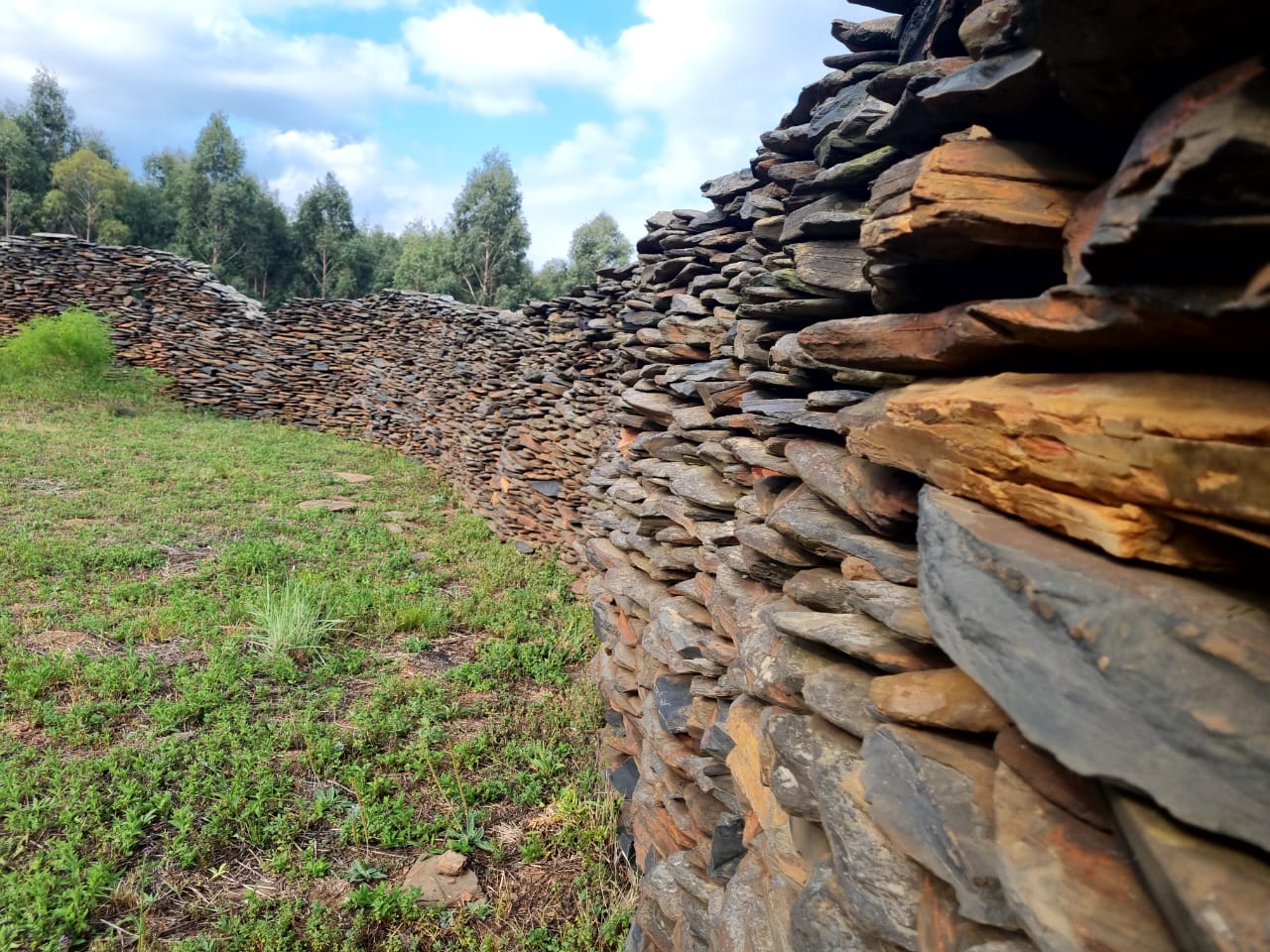
File:Bauwboschkraal Stone Ruins 30-April 2023.jpg — Sháron Viljoen, CC BY-SA 4.0
File:Vredefort Dome in Venterskroon near Parys.jpg — via Wikimedia Commons
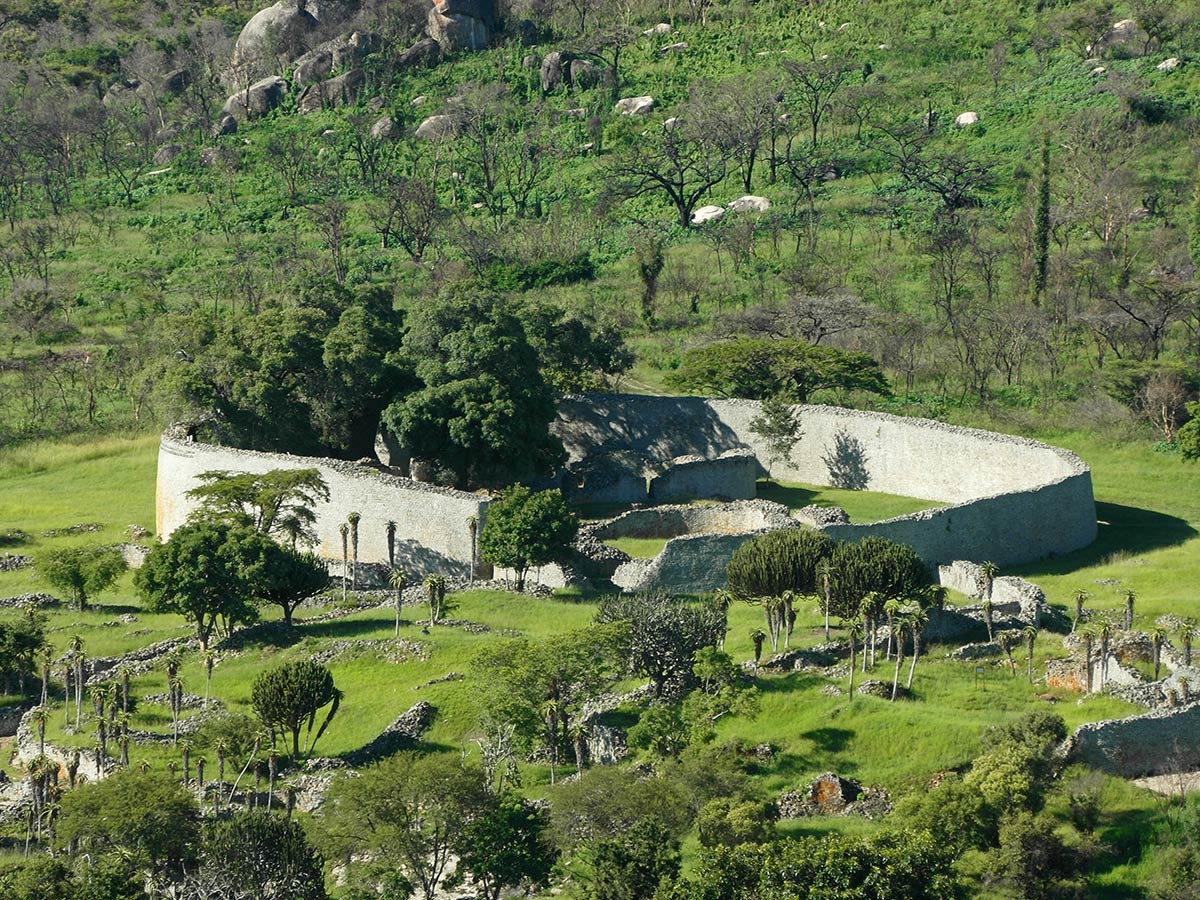
File:Great-Zimbabwe-ruins-outer-walls-3-1200.jpg — via Wikimedia Commons
File:Carbon Leader Gold Ore, Witwatersrand South Africa 4.jpg — James St. John, CC BY 2.0
File:UP rhino.JPG — Sian Tiley-Nel, CC BY-SA 4.0
This book is dedicated to the Coloured people of Cape Town.
I grew up in the Free State and never knew anyone Coloured. But these people went to the same church as me, spoke my language — in their own colourful dialect, in their own way, with their own grace. We were raised in the same stories and the same silences. For too long I did not see that we were the same people, held and shaped by the same terrible history, carrying the same wounded love for a place that tried to teach us we were unequal.
Ek is lief vir julle en glo in my hart that ek ook een van julle is.
I see you. You were always here. You belong here. Your story is the story. Your language is my language — the one that says I see you, in every dialect, under every sky, in every place where people chose to stay and love a land that was not taught to love them back.
Thank you for that. Thank you for the example. Thank you for teaching me, through your very existence, that belonging is not about blood — it is about choice, and choice made in the face of every reason to leave.
Sawubona.
— A.J.G.
And one dedication more, for the makers.
The Rooikat, the Rooivalk, the G5 and the G6 are real — like Adam's Calendar and the walls of Great Zimbabwe, they were dreamed and drawn and built by the people of Africa, under embargo, with the world refusing to sell them a single bolt. Whatever the world later pointed them at, the genius that made them was ours. This last page is for the engineers — the men and women of Denel and Armscor who did the thinking — and for every African mind that was told it could not, and did anyway.
A Note on the Music
The instruments are real, and so is the history hidden in one of them.
Jakobus's playlist is invented, but the kinds of music in it are real, and one detail is true and worth knowing. The concertina that wheezes through both his old Boeremusiek — the Voortrekker dance music, the vastrap — and the Sesotho guitar-and-accordion music he loves most is the same European instrument, and it reached both peoples the same way. It came inland on the wagons of the Great Trek in the 1800s, through the Caledon valley and the foothills below the Maluti mountains, the country of Moshoeshoe's Basotho; and the Basotho took it up, from the trekkers and the traders and the mission stations, and made it sing in their own tongue — the longing music of men walking to the goldfields and home again, today often called famo.
So two peoples who fought each other, bitterly, for that exact stretch of country both came to love the same little box of reeds, and made of it two musics that are, underneath, cousins. There is a whole history in that, and a whole man — Afrikaner and of the Free State at once — and the book leaves it where it found it: in the squeeze of an accordion on a long gold road, saying home in two languages at the same time.
— A.J.G.
The Honey Badger
The honey badger (Mellivora capensis) is the house animal of Arjuna Badger Press. Everything below is true. Most of it sounds made up.
The honey badger has been listed by Guinness World Records as the most fearless animal on Earth. It did not apply for the title and would not have attended the ceremony.
It eats venomous snakes — puff adders, cobras, the lot. If it is bitten badly enough to be knocked out, it has been observed to simply lie down, sleep off the venom, wake up an hour or two later, and finish the snake it was already eating.
Its skin is loose, rubbery, and almost impossible to bite through. A honey badger caught by the scruff can twist around inside its own skin and bite whatever is holding it. Bee stings, porcupine quills, leopard teeth — it shrugs off the kind of day that would end most animals.
It raids beehives for honey and grubs and accepts hundreds of stings as a reasonable cost of doing business. This is, in fact, how it got its name.
It will stand its ground against lions, leopards, and hyenas. Not because it expects to win. Because the alternative — caring — has never occurred to it.
The most famous of them, Stoffel, lived at the Moholoholo rehabilitation centre in South Africa and treated every enclosure ever built for him as a personal insult. He stacked rocks to climb the walls. He rolled balls of mud into steps. He used rakes left in the pen as ladders. He learned to unlatch gates. He is, more or less, the patron saint of engineers who refuse to accept that a thing cannot be done.
Honey badger don't care.