Dedication
For my brother Pieter —
who made me a blade with our grandfather's ivory and our father's webbing, and in every line of it told me he had seen the whole of me.
A gift only counts if it costs the giver. This one cost you the trouble of knowing me completely.
Thank you for the knife.
Foreword
by Ivory Bond Sand †
I walked into that country once, with camels and a dog and not nearly enough sense, and it walked into me, and I have never entirely come back out. So I am perhaps the wrong person to write a cool and balanced foreword, and the right person to tell you the truth, which is that the desert in this book is the real one — not the postcard, not the empty red nothing the maps pretend, but the living, watching, occupied country that the oldest continuous culture on earth has been reading like a text for sixty-five thousand years.
That number does not fit in a human head. I have tried to hold it for forty years and it still slides off. Sixty-five thousand years of unbroken telling, parent to child, a library with no books, encoded in song and step and the back of a hand — songs so old they remember coastlines that drowned when the ice released the sea, real coastlines, mapped by science only the day before yesterday, that the old people had been singing about the whole time. The author knows this. More importantly, he knows what to do with knowing it, which is the hard part, the part almost every writer who comes to this country gets catastrophically wrong.
What they get wrong is this: they treat the Dreaming as raw material. As colour. As a quarry to mine for a Western story. They take the songlines and make them a treasure map for a white hero to follow. And I braced myself for exactly that when I opened this book, because I have seen it done a hundred times and it makes me ill.
He does not do it. That is the thing I most need you to understand before you begin. He walks you up to the doors and he does not go through them. He tells you, plainly, that there is knowledge in this country that belongs to men and knowledge that belongs to women and knowledge that belongs only to the initiated, brought in the right way at the right time, and that a book is not the right way, and that there are therefore things in this story he will show you the shape of and not the substance, and that you will have to be content, as he has been content, to know only that they are there and that they are vast. I have never seen a thriller have the discipline to leave the deepest treasure unopened out of respect. It is the most moving act of restraint in the book, and it is everywhere in it, and it is the difference between a writer who loves this country and a writer who would loot it.
And then — because he is a storyteller and not only a respectful man — he gives you the most propulsive adventure I have read in years. There is a man in it, a big soft-spoken stranger far from his own ground, who reads this land the way the old people taught me a good tracker reads it: not as scenery but as sentence, every mark a word, the whole country a story still being told. Watching him move through the desert, getting it right, deferring always to the people whose country it is, I felt the thing I felt out there with my camels all those years ago — the vertigo of standing on the oldest known surface of human meaning and understanding, at last, how young and loud and lost the rest of us are.
The country is being torn open now, for the iron in its bones and the gas under its skin, by people who know nothing of what they are breaking. This book knows. And a thing that is known, the author understands, is a thing that can be defended. That is finally what this novel is for — not to entertain you, though it will, helplessly — but to make you know, so that you cannot later pretend you didn't.
Go carefully. You are walking into someone's cathedral, sixty-five thousand years in the building, and this writer will teach you, page by page, to take your hat off at the door.
I did. It changed my life. I suspect, if you let it, it will rearrange something in yours.
— Ivory Bond Sand
† “Ivory Bond Sand” is an anagram of ROBYN DAVIDSON — who crossed the Australian desert on foot — borrowed here in homage and affection. This foreword is a work of fiction. It was written by the author of this book. Robyn Davidson did not write it, was not involved in it, and is not associated with or endorsing this book in any way. The name is rearranged precisely so that the tribute can never be mistaken for a real attribution; it is a salute, not a claim.
Chapter 1 — The Country Was Awake Before Anyone
Before there were eyes to see it, the country was already a story being told.
The land in the far north-west does not begin and it does not end. It only continues — red and ancient and patient, scarred with the dry beds of rivers that have not run in living memory and will run again, ferociously, when the Wet comes down out of a green-black sky and turns the dust to a sea. Out here the rock is two and a half billion years old. It was old when the first single cell divided in some warm sea on the other side of the world. It was old when the continent broke from the great southern mother-land and began its slow drift north into the heat. The people who would learn to read it had not yet been dreamed.
And then they were.
They came down the coasts and along the rivers when the seas were lower and the land bridges stood, and they walked into a country that had never known a human foot, and instead of conquering it — instead of cutting it and damming it and breaking it to the plough, as later peoples would try and largely fail to do — they did something stranger and far more difficult.
They listened to it. And they remembered.
Sixty-five thousand years. Say the number slowly, because the mind slides off it the way a hand slides off wet stone. Sixty-five thousand years of unbroken telling, parent to child, the longest continuous human culture on the face of the earth, so long that they hold in their songs the memory of coastlines that drowned ten thousand years ago when the ice released the sea — real coastlines, mapped by science only recently, that the old people had been singing about the whole time, the islands their ancestors walked to that are islands now because the water came up exactly as the story said it would. They remember mountains that are gone. They remember stars that have moved. They remember, in the deep grammar of the Dreaming, the very shape of the making of the world.
This is not myth in the way the word is usually meant — a pretty lie, a thing outgrown. This is a library older than writing, encoded in song and step and ceremony and the back of a hand, and most of it is not mine to tell, and I will not pretend otherwise. There is knowledge in this country that belongs to men and knowledge that belongs to women and knowledge that belongs only to those who have been brought, in the right way, at the right time, to the right place, and asked. A book is not the right way. So there are doors in this story I will walk you up to and not through, and you will have to be content, as I have had to be content, to know only that they are there, and that behind them is something vast.
But some of it can be told. Some of it the old people want told now, in this late and dangerous hour, because the country is being torn open for the iron in its bones and the gas under its skin, and the ones who would tear it know nothing of what they are breaking, and a thing that is not known cannot be defended.
So.
Let me tell you about a woman who could find water in a place that had none, and the whitefella geologist who watched her do it and felt the floor of his entire understanding give way beneath him like rotten ground.
Her name was Nyaani, and on the morning this story truly begins she was kneeling in the red dirt a hundred kilometres from the nearest tap, in a heat that pressed on the shoulders like a hand, turning the back of her left hand to the light.
There was a mark there. An old mark, raised and pale against the dark skin, made when she was a girl by an aunt who was made by her aunt, a line and a branching like the map of something — and Daniel Mercer, crouched in the dirt beside her with his expensive useless instruments, thought at first it was only a scar, the way he thought everything out here was only the obvious dull thing it appeared to be, because that was the disease he had come to Australia carrying and did not yet know he had.
"There," Nyaani said. She was not looking at her hand anymore. She was looking at the ground, at a patch of dirt that was identical to every other patch of dirt for ten thousand square kilometres in every direction, except that to her it was not identical at all, it was as different and as obvious as a signpost, and she said it again, patiently, to the slow whitefella: "Here. Dig here."
He dug, because he had nothing left to lose and three days of water left to live on.
And four feet down, in country the geological surveys had marked bone-dry, in ground his half-million-dollar ground-penetrating radar had read as empty, Daniel Mercer's shovel went suddenly dark and cool and wet — and he knelt there with mud on his hands, this clever ruined man who knew everything and understood nothing, and he began, at last, to learn.
He did not know it yet, but he had just met the country.
And the country had been waiting for him the way it waits for everything — without hurry, without mercy, and without the slightest doubt about who, in the end, would outlast whom.
Chapter 2 — The Pariah's Last Contract
But that morning was a long way off, and to get to it you have to go back to the man before the country had touched him — back to the city, where Daniel Mercer was discovering exactly what he was worth.
It turned out to be eighty thousand dollars and a confidentiality clause.
He read the contract twice in the foyer of the Carrow Resources building, in a chair designed to make you feel small, while four floors of glass and money hummed above him. The job was a water-and-ground survey on an iron-ore lease in the Pilbara, six weeks in the field, instruments and accommodation his own problem. The fee was a fraction of what he'd have charged two years ago. It was also more money than he had seen in fourteen months, and they both knew it, which was the whole point of the chair.
He'd spent the morning telling himself this was a courtesy interview. Carrow had a dozen survey houses on retainer, real firms with letterhead and indemnity insurance and reputations that didn't make procurement managers wince. There was exactly one reason to fly a man like him in from Perth and sit him in the small chair, and the reason was sitting across the glass table now in a good suit, smiling like a man who has already won and is gracious about it.
"You come highly cautioned," the man said. His name was Vincent Roe. Projects, something. He had the easy, sunhurried confidence of someone who had never once in his life been the smallest person in a room. "I'll be honest with you, Daniel. Legal thought I was mad."
"Then you've read about me."
"I've read everything about you." Roe set a tablet on the table and didn't turn it on; the gesture was enough. "Mount Sceptre. The dewatering bore field. The fault that wasn't on anyone's map until it was on everyone's front page." He let it sit, watching. "Four men in a dragline cab when the high wall came down. You were the principal hydrogeologist on the pit. You signed the stability sign-off."
Daniel kept his face still. He had become very good at this, in fourteen months. "There was an inquiry."
"There was an inquiry, and the inquiry found the geotechnical model inadequate, and the company that employed you stood up in front of the cameras and named the inadequate man." Roe smiled again, gently, almost with sympathy, and that was worse than contempt would have been. "I'm not interested in the inquiry. Inquiries are for the families and the insurers. I'm interested in the fact that before any of that, you were the best in the country at finding water in dry rock. People still say it. They say it the way you talk about a horse that broke a leg."
The foyer hummed. Somewhere above them a lift opened and closed on its weighted hush. Daniel thought about the four men, which he did not allow himself to do in front of people, and then he stopped thinking about them, which was a separate skill and one he'd practised harder.
What Roe was offering, beneath the suit and the sympathy, was simple, and Daniel had understood it before he'd boarded the flight. Carrow did not want the best. The best would have cost ten times this and arrived with a firm behind it, a firm with a brand to protect, a firm that might, conceivably, write down a number the company didn't like and then refuse to be leaned on about it. Carrow wanted a competent man with no firm, no brand, nothing left to protect, and a debt. They wanted a signature from someone whose signature was already worthless to everyone but them — which made it, for their particular purpose, perfect.
He understood the purpose, too. He'd been on the other side of it often enough. A water survey on a lease was a heritage and environmental instrument as much as a hydrological one; it went into the approvals bundle, it sat in front of the regulator, it became part of the paperwork that said we looked, and there was nothing here that should stop us. You did not hire a man like Daniel Mercer for a survey you expected to be complicated.
"You want it to come back clean," he said.
It was not a question, and Roe didn't insult him by pretending it was one. He spread his hands a fraction, a man conceding a point among professionals.
"I want it to come back correct," he said. "I have a quarter of a billion dollars of approved development and a lease the size of a small European country, most of which is rock and spinifex and not one drop of water anyone has ever used for anything. There's a process. The process requires a survey. The survey requires a name on it." He turned the tablet face-up now, finally, and slid it across, and it was the contract, the same one in Daniel's lap, as though to say we both know there's only ever been one document in this room. "I'd rather the name belonged to someone who actually knows what he's looking at. Call it a perverse respect."
Daniel looked at the figure again. Eighty thousand. He thought about the flat in Mount Lawley he no longer had, and the storage unit in Bayswater that held what was left of a marriage in cardboard boxes, the boxes he paid forty dollars a month to not throw away. He thought about the half-million dollars of geophysical instruments in his own storage unit — the resistivity rig, the ground-penetrating radar, the gear that had been the firm's pride and was now, in the wind-up, legally his, the one asset the receivers couldn't be bothered to chase — sitting idle, depreciating, the only thing in his life that still did exactly what it was built to do and gave him no argument about it. Half a million dollars of the finest ground-sensing equipment money could buy, owned outright by a man no one would hire, like a surgeon with golden hands and no licence.
The instruments wanted to work. That was the thing he could not have explained to Roe, and would have died before trying. He missed the work the way you miss a language. He missed standing in a place no one had read and knowing — knowing, with the cold clean certainty of a man whose certainty was the best in the country — what lay beneath his boots.
That certainty was the thing they had taken his name for. He knew that, in the part of himself he visited rarely and left quickly. He had been so sure about Mount Sceptre. He had been certain. The young geo on his team — an Aboriginal kid, sharp, careful, Tom Wirra, and Daniel did remember the name, he only let himself pretend he didn't — had flagged the eastern high wall twice. A seep he didn't like. A change in the colour of the water coming off the wall, a rust-bloom in it that wasn't in any of the models, that wasn't, the kid had said, standing in Daniel's office with his hard hat in his hands, the way the country up home went when it was about to let go. The way the country goes. Daniel had nearly laughed. He'd been gentle instead, gentle the way you are with someone whose talent you respect and whose error you've already decided is sweet, and he had walked the kid back through the data — his data, the real data, the resistivity sections and the piezometer logs and the thirty years of being right that backed every line of it — and he had shown him, point by patient point, that the wall was sound, and the kid had nodded, because what was the kid going to do, and had filed the concern in writing because he was careful, and had let it go.
And then Daniel had done the smaller thing, the thing he did not have a gate for, the thing that was not a gifted man's tragic error but just an ordinary man protecting himself. The concern was on the record. So he had gone, quietly, to the project manager, and over a coffee, in the easy voice of a senior man being fair, he had framed it: good instincts, green, reads the country like his uncles do — it's lovely, it's not data, keep him away from sign-offs till he's seasoned. He had not lied. He had not needed to. He had simply made sure that when the wall came down, the written warning in the file read as the inexperience of a kid who saw spirits in rust-water, and not as the one correct reading on the whole job — because if it read as correct, it read as his, Daniel's, to have caught and missed. So he had spent it. He had taken a true thing a careful young man had put his name to, and he had made it worth nothing, in advance, to save his own. Tom Wirra had left the industry inside a year. Daniel had heard, much later, that he was driving a water truck on a mine up north, the exact job a man takes when the job he trained for has quietly decided he is not reliable. Daniel had made that happen with one cup of coffee, and the four men in the cab had died anyway, and he had never once written to the kid, because there was no version of the letter that was not also asking the kid to forgive him, and he had not earned the asking.
The colour of the water. The boy had been reading the colour of the water. And Daniel Mercer, the best in the country, the man who could find a litre in a thousand cubic metres of dry rock, had looked at the same wall and read a model.
The wall came down on a Tuesday. Forty thousand tonnes of it, into a working bench, onto a dragline cab, and the seep the kid had flagged was running clean and brown through the rubble by the time the dust settled, exactly where he'd put his finger on the section — the water that had been there all along, that the rock had been telling them about in the only language rock has, that the kid had heard and the master had not.
He did not finish the thought. He had a gate in his mind for it, and he closed it, the way he had learned to close it a hundred times a day, and he picked up the pen Carrow had thoughtfully provided, heavy, expensive, the kind of pen that is also a small chair.
"Where on the lease," he said.
Roe's smile changed — became, fractionally, real. "Up the top. Murujuga edge. There's some rock-art country on the northern boundary, engravings, the usual." He waved a hand, the gesture of a man brushing lint. "Heritage flagged it. There'll be some traditional-owner people you'll want to keep happy, sign-ins, the cultural side — Heritage'll send a liaison so you don't have to think about it. The water question's the real question. Whether there's an aquifer under the northern blocks worth the regulator's attention." A beat. "There isn't. But we'd like that established properly."
Some rock-art country. The usual. Daniel had seen photographs once, years ago — the Burrup, the red boulders crawling with figures, fish and turtles and a thing with stripes that the caption said was a thylacine, which meant the man who cut it had stood there when there were still thylacines, which his mind had refused to convert into any feeling at the time and refused now. It was old. Things up there were old. So was every rock in the state; the Pilbara was the oldest exposed crust on the planet, three and a half billion years in some of those gorges, and you learned early in this trade to stop being impressed by old, because old was just time, and time was just the medium you read through to the water. Country was either prospective or it was empty. Most of it was empty. That was not a tragedy. That was geology.
He signed.
His hand did not shake. He'd half expected it to. It moved across the line the way it had moved across the Mount Sceptre sign-off, steady and certain and his, and somewhere underneath the steadiness was a small cold note he didn't examine, because if he examined it he would have to admit it was the same note, the exact same note, the note that comes just before you discover you were wrong about something you could not possibly have been wrong about.
He examined the eighty thousand instead.
The flight north was a small plane out of Perth, four hours of nothing folding into nothing.
He had the window. He hadn't asked for it; the man who put together the trade in cardboard boxes does not pay extra for windows. But the seat beside him was empty and the morning was clear, and after the green strip of the coast fell behind and the wheatbelt's last hopeful squares gave out to a country that no plough had ever opened, he found himself looking down, the survey contract in his lap unread, his own reflection ghosting over the land.
It went on. That was the first thing, and the thing the photographs never carried: not the colour, which the photographs got, the deep oxide red, the haematite rust of a continent's worth of iron lying out under the sun where on any other landmass it would be buried under forest and soil and the wreckage of cities — but the going on. The land did not arrange itself into views. It did not resolve into foreground and distance and a thing to look at. It simply continued, red and ridged and scored with the pale dry threads of rivers that were not rivers, that were the memory of rivers, sand-channels lined with the green of trees that had found water he could not see from twelve thousand feet and that he would have bet his licence — when he had a licence — were not supposed to be there.
A whitefella looked at that and saw emptiness. Daniel knew this because he was a whitefella looking at it and that was precisely what he saw: emptiness, vacancy, a great rusted nothing scrolling past beneath the wing, ground that had never been used and never would be except by men like the ones who paid him, men who would come and take the iron out of it and leave it more honestly empty than they'd found it. He felt the familiar professional calm of it. Nothing down there was anybody's. Nothing down there was for anything. It was just the oldest, idlest real estate on earth, and somewhere in the northern reach of it was a lease the size of Belgium where, for eighty thousand dollars, he would confirm with the finest instruments ever built that the nothing was, in fact, nothing.
It would be the easiest money he had ever made. He was certain of it. He was a man for whom empty and certain had always been the two notes of a single chord, and he flew four hours over the oldest inhabited country on the face of the earth — a country sung over and walked and read and known for more years than his species had had agriculture — and saw nothing in it but the absence of water and the presence of ore.
He tipped his head against the cold plastic of the window, and the great red country turned slowly beneath him without hurry and without comment, and Daniel Mercer closed his eyes on it, and was, for a while, at peace — a clever, ruined, hollow man flying north to help empty a place he had not begun to read.
Below him, though he never saw it and would not have known what he was seeing, the land tilted toward a stretch of coast where the red rock ran down to a blue sea, and held in it, under the boulders, a million carved figures facing the water, and out past them, thirty metres down in the green dark, the old ground where the sea now stood.
Chapter 3 — Red Country
The road ran out three hundred kilometres before the lease did.
After that it was graded dirt, then ungraded dirt, then a pair of wheel-ruts the colour of dried blood that the hire ute followed because there was nothing else to follow, and Daniel Mercer drove it with one wrist hooked over the top of the wheel and the air-con labouring and a podcast about quarterly metals demand playing to nobody, and he watched the country come up out of the heat-shimmer ahead of him and did not think it was beautiful. He thought it was a long way from an airport.
He had worked in a lot of empty places. The Atacama, where the ground was so dead they tested Mars rovers on it. A nickel concession in the Congo where the bush tried to eat the camp every night and very nearly the men. He had a professional category for landscape, and the category was overburden — the stuff you moved to get to the stuff you wanted — and by that measure the north-west of the continent was, he had decided somewhere back around the last roadhouse, simply the largest quantity of overburden he had ever been paid to ignore.
Then the wheel-ruts climbed a low rise, and the country opened, and for a moment the category failed him.
It was the scale that did it. Not a view — a view has edges, a view is a thing you stand in front of. This had no front. The land went out from the rise in every direction at once, red and flat-broken and ancient, ranges standing off at the rim of sight that were not blue with distance the way mountains were supposed to be but a deep bruised purple, and between him and them nothing, nothing, a hundred kilometres of nothing that the eye kept trying to find the end of and could not, until the trying became a kind of pressure behind the face. The rock under the spinifex was banded — he could see it even from here, in the cut where the track had been bladed through a low reef of it, dark and rust and dark again, laid down in some shallow ferruginous sea when there was no oxygen in the sky and nothing alive on the planet more complicated than a smear of green slime on a tidal flat. Two and a half billion years. He knew the number because it was in the geology section of the prospectus, a selling point, the haematite so pure and so old it was almost a gift. He had read it as tonnage. Standing on the rise looking at it he felt the number for the first time, briefly, the way you feel the drop when a lift starts down, and he did not like the feeling and got back in the ute.
By ten the heat had teeth.
He felt it the instant he stepped down onto the lease proper — a wall of it, white and total, the kind of heat that does not warm you but presses, that you wear, that you start sweating into before you have crossed ten metres of ground. The haematite dust came up off his boots fine as flour and red as ochre and got immediately into the creases of his knuckles and the corners of his eyes and the back of his throat with the iron taste of blood-and-pennies, and over it, under it, threaded all through it, was the diesel — the camp generator, the water truck, the two haul trucks parked at the edge of the cleared pad like sleeping animals the size of houses. Spinifex hissed where the wind moved it. And out past the diesel and the spinifex-hiss, out where the cleared ground gave back to country, there was a silence so large that it had a sound, a high ringing pressure in the ears that was either the blood in his own head or the land itself holding very still, and Daniel stood in it for a second with his sunglasses pushed up and his eyes watering against the glare and felt, absurdly, like an intruder, like a man who has walked into a room where everyone has just stopped talking.
"Mercer." A hand came at him through the shimmer. "You found us. Good man."
Vince Tolliver was the project manager, and he came across the pad fast and square in a hi-vis shirt gone salt-white under the arms, fifty-odd, sunburnt to the colour of the country, a man built entirely out of can-do. He had the grip of someone who used it to settle arguments. "Good drive? Long drive. Bloody long drive. We'll get you a donga, get you a feed, get you out on the ground this arvo if you've got the legs for it — Carrow wants this moving and I don't say no to Carrow, you'll learn that fast." He laughed at his own line. "Geo with a heritage ticket. They sent us a unicorn."
"I'm not heritage," Daniel said. "I do water. The heritage is a — secondary scope."
"Mate." Tolliver put a hand flat on his chest, mock-wounded. "Round here it's all secondary scope. There's iron, and there's everything between us and the iron. Come meet Brett before he talks your ear off. Brett does the paperwork. Brett is the paperwork."
Brett Honce was a softer, paler, more apologetic animal, thirty-five going on retired, with a clipboard he held like a shield and a face that had spent too long indoors for this country and knew it. Compliance and heritage liaison, his lanyard said, and he shook Daniel's hand with a moist anxious enthusiasm and started talking before they'd let go.
"So good to have actual technical depth on this, genuinely, because I'll be honest, the heritage piece on this lease is — it's sensitive, there's a lot of eyes, the desktop's a nightmare —" He had a satchel of forms, a tablet, a methodology document forty pages long. He walked Daniel toward the donga line talking the whole way, and the gist of it, under the qualifications and the sub-clauses and the defensibility he kept coming back to like a sore tooth, was very simple, and Daniel had heard it on six continents in nine different accents and could have recited it himself. "The thing you've got to understand about a survey like this," Brett said, lowering his voice as if the spinifex might report him, "is that it's not about finding nothing. Right? You'll find things. There's always things. It's about — it's about how you record what you find. You tick the box. You follow the method, you photograph, you log, you cross-reference the register, and provided you've ticked every box, provided the process is clean —" he tapped the clipboard, soft, twice "— then whatever's out there, it's been assessed. It's been managed. And managed country," he said, and produced a smile that was mostly relief, "is country you're allowed to blast."
"Right," Daniel said.
"You'll be brilliant at it. You can see he's going to be brilliant at it," Brett said to Tolliver, who had drifted back over, and Tolliver said something about a unicorn again, and Daniel looked past both of them, out across the cleared ground to where the country started, because he had become aware while Brett was talking that they were being watched.
There were vehicles parked at the lease boundary. Two utes and a troopcarrier, sun-faded, beaten, one of them with a government Ranger decal half scoured off the door, drawn up in the thin shade of a stand of snappy gum at the edge of where the bulldozers had stopped — and there was a low reef of rock there, the same banded haematite, rising out of the spinifex in slabs and shelves, and along its dark faces, even at this distance, even through the wobble of the heat, Daniel could see that the rock was marked. Not scarred. Worked. Pale shapes cut into the desert varnish of the stone, hundreds of them, the rust-black skin of the rock chipped back to the lighter colour beneath in lines and figures he could not read and did not try to — animals, he thought, and the looping involved shapes that meant nothing to him, and here and there a clean simple human-looking mark that the eye snagged on and would not let go of. A whole long gallery of it, running away along the reef, more of it than he could take in, the rock written on from the ground to higher than a man could reach.
And in front of it, in the shade of the gum, standing, not sitting, not leaning, just standing the way the rock stood, were the people.
There were eight or nine of them. Men and women, a couple of kids hanging back by the troopcarrier, an old fella in a stockman's hat with a stick, and they were not doing anything. That was the thing Daniel noticed, the thing that put a small cold finger on the back of his neck under all the heat. They were not protesting. There were no signs, no chains, none of the theatre he'd half braced for from the briefing pack's worried paragraphs about stakeholder management. They were just there, on the line where the cleared ground met their country, and they were watching the camp the way you watch a fire you have not yet decided is going to reach your house.
"That's the mob," Tolliver said, following his look, and his voice had changed — flattened, careful, the can-do tucked away. "Traditional owners. Native title's all sorted, all signed, royalties going through, that's not — there's no issue there, legally. They just like to come and have a look." He said it too easily. "You'll deal with the young bloke, the Ranger. Speaks like a textbook, knows the Act better than Brett does, frankly. And the old lady." He didn't point. "There's an old lady you'll meet. You don't muck around with the old lady."
"Which one's the Ranger," Daniel said.
"The tall one. Sunglasses. Looks like he'd rather be anywhere."
Daniel found him — a man of about his own age, lean, in a faded Ranger shirt and good boots, standing a half-step in front of the others in the way a man does when the others have, without anything being said, agreed he should. The man was looking straight back at him across the four hundred metres of cleared killing-ground between them, and even at that distance, even behind the sunglasses, Daniel could feel the quality of the look. It was not hostile. Hostile he could have worked with; hostile was a position, and a position could be negotiated. This was something cooler and more total. It was the look of a man taking an accurate measurement and finding the result unsurprising and not worth commenting on. I know exactly what you are, the look said, and I knew before your ute came over the rise, and there is nothing you can tell me about yourself that I have not already been told by men like you.
Daniel held it for a moment, because that was what you did, and then — he would think about this later, in the dark, when a great many things he was sure of had stopped being true — then he was the one who looked away. Not the Ranger. Him.
His eye went, instead, to the woman.
She was older than the Ranger and younger than the old fella, somewhere in the broad middle country of a face that had spent a lifetime outdoors, and she was the only one of them who was not looking at the camp. She was looking at Daniel. Directly, unhurried, with neither the Ranger's cold accuracy nor the wariness of the others — looking at him the way you'd look at a weather front coming in off the sea, with attention but without any particular feeling, a thing arriving that you would deal with when it got close enough to deal with. She had a scarf at her throat against the dust and her hands were loose at her sides, and Daniel, who noticed details the way he noticed grade and dip and strike, noticed without knowing why he noticed it that the back of her left hand was marked — an old pale raised line and a branching off it, dark on dark, that he took for a scar, the way he took the writing on the rock for damage and the silence for emptiness and the whole vast living country for the largest quantity of overburden he had ever been paid to ignore.
She looked at him a beat longer than was comfortable. Then she turned her head and said something, low, to the Ranger beside her — a few words, in no language Daniel had ever heard, with a shape to them like water finding the bottom of a slope — and the Ranger's mouth moved, not quite a smile, and neither of them looked at Daniel again. As though the matter were settled. As though he had been weighed, and named, and set down.
He did not like it. He was very tired and a long way from an airport and his throat tasted of iron, and he did not like being the thing that two strangers had finished thinking about.
"Right," he said, too loudly, to Brett. "Show me the desktop. Where's the field edge — that reef, the marked one, is that on our lease or theirs?"
Brett brightened, relieved to be back among forms. He pulled up the cadastre on his tablet and tilted the screen out of the glare, and there it was, the lease in a hard red polygon, and the reef of marked stone, the gallery, the long written rock with the people standing in front of it — sitting just inside the line. Inside the red. Their country and Carrow's title, the same dirt, the law stacked two deep.
"On us," Brett said. "Just. The boundary runs — see, right along the base of that rise, so the petroglyph field, the engravings, that's — yeah. That's in scope. That's ours to assess."
"How much of it."
"Hard to say till it's logged. Could be a couple of hundred. Could be more. Some of these galleries up here, they reckon, the dating on a few of them —" Brett lowered his voice again, that reflexive hush, and Daniel realised the man was, underneath the clipboard, a little afraid of what he was holding "— tens of thousands of years, mate. Some of them. Older than — older than just about anything. There's people come a long way to argue about how old."
"And the blast plan needs that ground."
"The blast plan needs that ground," Brett agreed, unhappy.
Daniel looked at it on the screen, the red line and the reef inside it, and then out across the heat at the real thing, the dark slabs written from earth to overhead, the people standing in front of them in the only shade for a hundred kilometres, the woman with the marked hand who had already finished with him, the Ranger who had known him before he arrived. He felt the scale of it press on him again, the two and a half billion years and the tens of thousands and the silence with a sound, all of it leaning on him at once through the white wall of the heat, and for one bad moment the lift dropped again behind his face and he came very close to feeling something he had no category for.
Then he put it away. He was good at putting things away; it was, though he would not have said so, the most developed skill he had.
He looked at the long written rock, the oldest gallery of made marks on the surface of the earth, the people's whole library of themselves cut into the iron skin of their country, and he filed it, coldly, the way Brett had taught him to file everything, the way he had been hired and flown and paid to file it.
Obstacle, he filed it. In scope. Loggable. Clearable.
"Alright," he said, and turned his back on the boundary, on the gum-shade, on the watching mob, and walked toward the donga and the air-con and the cold beginnings of the report Carrow wanted. "Show me the bores. I want to see the water before I see anything else."
Behind him, at the edge of the country, the old woman with the mark on her hand watched the geologist walk away, and said nothing, and waited — the way the country waited, without hurry, without mercy, for the heat to do to this one what the heat did to all of them: find out, in its own time, exactly what he was made of.
Chapter 4 — The Instruments Lie
By the third day Daniel Mercer had stopped sweating, which a part of him filed away as data and the rest of him chose not to think about.
He was working the grid the way he had worked a hundred grids on four continents, the way the work was supposed to be done: methodically, from the known to the unknown, letting the country tell him where its water was the only way country ever did, which was through a needle on a dial. He had the resistivity rig laid out along the first traverse since before the light came — the steel electrodes hammered in at twenty-metre spacing, the cable strung taut between them, the meter squatting in the dirt under its little tin sunshade like a shrine to something he actually believed in. He liked this hour. He liked the cool of it on his forearms and the smell of the ground giving up its night, and he liked, more than he would have admitted to anyone, the moment the first reading came up.
Because the first reading was always the country opening its mouth to him. He had a gift. He knew he had a gift the way a left-hander knows it, without vanity and without quite being able to explain it: he could look at a meter and a contour map and a smear of vegetation on a satellite image and he could see the water, the shape of the aquifer under the rock, the way it sat and the way it moved and where, if you put a hole down, it would come up to meet you. In fourteen years he had been wrong about a lot of things. His marriage. The men he'd trusted. The dam — God, the dam. But he had never once been wrong about water. It was the last clean thing he had, the one place the ground had never lied to him, and he had carried it across the world to this red and patient country like a man carrying a candle into a cave.
He pressed the button. The current went down into the earth and came back up the second line of electrodes and the meter gave him a number.
The number was wrong.
Not dramatically. That was the thing he would think about later. It wasn't a screaming wrongness, a needle slammed to the peg, a dead battery, a cut cable — any of the honest mechanical wrongnesses he knew how to fix. It was a small, reasonable, plausible wrong, a resistivity high where the satellite hydrology and his own read of the contours and forty years of regional bore data all promised him a low. High resistance meant dry rock. Dry rock, here, was not possible. He'd staked it. He'd staked the whole survey on this fan of ancient alluvium running off the range, on the palaeochannel he could practically draw with his eyes shut, on water sitting in the gravels under his boots at a depth a child could reach with a garden trowel.
He checked the contacts. He poured the last of one water bottle — he registered the cost of that, two hundred mils he wouldn't get back — into the dirt around each electrode to bed them, to kill any contact resistance throwing the read. He ran the traverse again.
The same number came back. Patient. Reasonable. Wrong.
"Probably the salt," he said, out loud, to no one, because there was no one. He said it again like it tasted better the second time. Saline groundwater would do this, hammer the resistivity flat and lie to you about what was water and what was rock, and that was a known thing, a thing in the textbooks, a thing he could write in a report. He almost felt better. He held that feeling for about four seconds, until the part of his brain that did the actual work pointed out, drily, that salt made things read low, not high, that he had the logic exactly backwards, and that he had known that since he was twenty-two.
He stood up. The range went up red and then ochre and then the colour of rust in the climbing sun, and the spinifex hissed, very faintly, in a wind he couldn't feel, and somewhere a long way off a crow made the sound a crow makes, which is the sound of a place that does not need you. He turned around once, slowly, a full circle, looking for the mistake. The mistake had to be his. The mistake was always his — that was the first law of the work, the country didn't make mistakes, the meter didn't make mistakes, you made the mistake and your whole job was to find it before the hole did.
He could not find it.
A hundred metres off, in the thin shade of a snappy gum, three of them sat. They had been there since before he started, the way they had been there every morning, and they would be there when he stopped. Nyaani in the middle, the old woman, with her hat down and her hands folded and her eyes on him in a way that was not unkind and was not curious either, that was simply attending, the way you might attend to weather. The two younger ones either side of her, one of them on his phone, the screen catching the light. None of them had said a word to him in three days that wasn't good morning and you right. They were not there to help him. They had told him, the first morning, with great courtesy, that they were there to watch him. He had been the company's man then and he had heard it as a threat. He was less sure, now, what it had been.
He raised a hand to them, the foolish over-hearty wave of a man who needs something and isn't ready to say so. The phone one lifted his chin half an inch. Nyaani did nothing at all.
He went back to work, because work was what he had.
The drill grid was the company's idea, and the company's money, and Daniel had argued against it and lost, which by now was a feeling so familiar it was almost restful. Carrow wanted holes. Holes were defensible. Holes went in a report with depths and yields and a stamp on them, and a stamp on a report was the whole reason a man like Daniel existed on a lease like this — to put a number on the country so the country could be a number, so the number could go in a column, so the column could clear the ground. He knew exactly what his survey was for. He had known when he signed. He'd needed the money the way a drowning man needs the rope and doesn't ask what the rope is tied to.
He'd laid the grid out by the book. Nine holes in a square, a hundred and fifty metres apart, sited on his own best read of the channel — he'd given them his very best work, out of pride, out of the small mean wish to be undeniably right in front of the people watching him. The rig was a sad little trailer-mounted thing the contractor had left him with a teenager to run it, and the teenager had gone back to the camp two days ago with a fever, so Daniel ran it himself, which he hadn't done since he was the teenager, and his hands remembered it before his head did.
Hole one came up dry.
Dry was not the word. Dry was a word for a thing that had once been wet. The spoil that came up the auger was bone, was powder, was the inside of a kiln, dust so fine and so utterly without moisture that it hung in the air after it fell and you breathed it and it took the spit out of your mouth. He went down past the depth the water should have been. He went down past the depth the water had to be. He went down to the limit of the rig and brought up nothing but the pale ground bone-dry, hole one, in the dead centre of a palaeochannel that every map and every instinct and every law of the trade said was full of water.
He moved to hole two and told himself hole one was an anomaly. A lens of clay, a fault he'd missed, the channel pinched out — the country was old and complicated and you got fooled sometimes, that was honest, that was allowed.
Hole two came up dry.
By hole four he had stopped explaining. The explanations were lined up in his head, neat and useless, like tools laid out for a job that turned out to be a different job. By hole six he was running the rig with a kind of fury, slamming the auger down, and the dust came up bone, came up powder, came up the colour of the moon, and once — he would not tell anyone this — he got down on his knees beside the spoil pile and put his face close to it and smelled it, smelled for the one thing his whole career was built on knowing, and there was nothing there to smell, the country gave him back nothing, gave him a hole and a smile and a column of dust where his water was supposed to be.
He drank. He didn't mean to and then he was doing it, three swallows, four, the warm plastic taste of it, and he made himself stop and screw the cap back on and look at what was left. Two bottles. Maybe a litre and a half. The camp was an hour and a half on the worst track he'd ever driven and he had been telling himself for three days he wouldn't need to go back for water because he was going to find water, that was his whole job, that was the one thing he could not fail to do.
He looked at the litre and a half. Then he looked at the GPR, which had been sitting in the shade of the ute all morning like the answer he hadn't wanted to ask yet, because it was the expensive one, the certain one, the one that didn't lie.
The ground-penetrating radar had cost more than the car. It was the best instrument he had ever owned and he loved it with the uncomplicated love a man has for a thing that has never once let him down. You walked it across the ground on its little sled and it shot radio waves down into the earth and listened to the echoes, and it drew you a picture — a real picture, a cross-section, the ground sliced open and laid out flat so you could read it like a page. Water showed. Voids showed. The boundary between gravel and rock showed, a hard bright line you could put your finger on. The GPR did not interpret and it did not believe and it did not have a gift it might be losing. It just told you, in radio, what was there.
He walked it the length of the dry channel in the worst of the heat, sweating again now, which he was distantly glad of, the screen hooded under a wet rag, his eyes aching from it. He watched the picture build.
The picture was nothing.
Not noise. Noise he could read. Not a void, not an aquifer, not the layered ghost of an old channel, not the bright hard line of rockhead. The radar walked over a hundred and forty metres of ground that the resistivity had called dry and the drill had proved dry, and it drew him solid empty ground, homogeneous, featureless, the radar equivalent of a held breath, as if there were nothing under this country at all, as if the country had simply closed, the way a hand closes, and there was nothing to read because it had decided not to be read.
He stopped. He stood with the rag dripping down his wrist and he looked at the flat empty trace and a cold thing went through him that had nothing to do with the heat.
Because the resistivity said dry rock and the drill said dry dust and the GPR said nothing — and those three things did not agree. Dry rock should show on the radar. Dry dust should show on the radar. The whole point of the radar was that it saw what the others only guessed at, and it should have argued with them or backed them, and instead it gave him a blank, and three instruments that should have been three witnesses to one truth were instead three strangers describing three different countries, none of them his.
He had never had this happen. In fourteen years across the deserts of two hemispheres his instruments had failed him in every honest way an instrument can fail — flat batteries, water in the connectors, a sensor cooked by the sun, a cable a goat had eaten — and he had cursed them and fixed them and gone on, because a failed instrument was a soluble problem, a thing with a cause, and finding causes was what he was for. This was not that. The instruments were not failing. He'd checked them, all of them, twice; they were calibrated, charged, sound. They were working perfectly, and they were telling him three different lies, and the only thing the three lies had in common was that not one of them would give him a drop of water in country where he would have bet his life — was, in fact, betting his life — that water was there.
He sat down in the dirt where he stood. He hadn't decided to. His legs did it. He sat with the radar across his knees and the dry channel running away from him toward the rust-red range, and for the first time since he was a boy he did not know what to do, not in the small way of a man between options but in the large and floorless way of a man who has run out of the very thing that makes him himself.
The radio crackled in the ute.
He let it crackle a while before he went and got it. It was Maddison, from the camp, and he could hear in the second syllable that the question coming was the question, the one with the share price in it. Daniel. The PM wants a date on the bore yields for the heritage submission. Where are we at. And under it, not said, the rest: we paid you to make this clean, we paid you because you're the man who's never wrong about water, give us the numbers, the blasting calendar runs on the numbers, where are we at. He stood holding the handset in the white sun and he thought about lying. It would be easy. He could give them a date. He could give them yields off the regional data and worry about the holes later, that was how it was done, half the trade ran on a confident number and a quiet prayer, and Carrow would never know, and he would have his fee, and the candle in the cave would stay lit a little longer in the dark.
He looked at the bone-dry spoil and the blank radar trace and the litre and a half of warm water on the seat.
"Working it," he said. "I'll have something." And he put the handset down before it could ask him what.
He turned around.
The old woman was still under the gum, where she had been all day, where she had been every day, watching him fail with that flat attending patience, the way you'd watch the weather you already knew was coming. He had been on this country three days. She had been on it, he understood with a small lurch, the way you understand a thing your whole body has been refusing — she had been on it longer than that. Much longer. Her, and hers, and hers before that, back and back into a depth of time he could not make his mind hold, and in all that time her people had not once died of thirst on this ground, on this exact bone-dry murdering ground where his half-million dollars of instruments could not find him a mouthful, and the reason they had not died was sitting under that tree with her hat down and her hands folded, declining to tell him, because he had not asked, because he had come here as the man sent to prove the country empty and a man like that does not get told where the water is.
Everything he was built out of stood against it. The gift, the meter, the candle, the whole self he'd carried across the world that did not need anyone, that read the ground alone and was never wrong. To walk over there was to set all of it down in the dirt.
He picked up one of his two bottles of water, because you did not go to people empty-handed, even people you had wronged, especially people you had wronged — he didn't know how he knew that, but he knew it, the way his hands had known the rig. He left the radar where it lay. He left all of it where it lay.
He walked across the hundred metres of dry ground to the shade of the snappy gum, and it was the longest walk of his life, and the old woman watched him come the whole way without moving, and when he was close enough she did the thing she had not done in three days.
She looked up, and she met his eyes, and she waited for him to be the one to speak.
Chapter 5 — Dig Here
The radar was a beautiful machine and it had been lying to him for three days.
Daniel Mercer crouched over the control unit in the white furnace of late morning, and watched the screen draw him the same answer it had drawn at every station since the lease road: a clean sub-surface, layer on layer of haematite and ancient banded iron, and nowhere in any of it the soft, smeared, bright signature of water. Half a million dollars of ground-penetrating radar, calibrated that dawn, dragged on its sled across forty square kilometres of country, and it said what the survey maps said, what the drill logs said, what every instrument he owned said in the one voice he had trusted his whole working life.
Dry. Bone dry. Empty.
He had two five-litre jerry cans left in the Cruiser and a third that sloshed when he didn't want it to. Three days, if he was careful, if the heat broke, if he stopped sweating, which he would not. He had run the numbers the way a drowning man runs numbers. They came out the same each time, which was the thing about numbers.
"You keep looking at that little television," Nyaani said, "like it's going to be sorry."
She was sitting on her heels in the thin shade of a snappy gum a few metres off, doing nothing he could see — not waiting, exactly, the way he waited, which was a kind of held breath. She had the patience of the rock. She'd watched him drag the sled in the worst of the heat without offering to help and without comment, the way you might watch a child insist on tying its own shoes.
"It's not sorry," he said. "It's right. The water table's a hundred metres down out here if it's anywhere. There's no recharge. There's no soak. There's nothing the gear could miss."
"Mm." She turned the back of her left hand over and looked at it, the way she'd done that first morning, an idle small movement he'd taken for habit. He could see the mark now, raised pale lines on the dark skin, a long stroke and a branching off it, old and deliberate. He'd thought, the first day, that it was a scar. He'd thought everything out here was the dull obvious thing it looked like, which she had let him go on thinking, because it amused her, or because it was none of her business to fix the inside of a stranger's head.
He shut the unit down. The fan spun off and the silence came in behind it, that enormous Pilbara silence that had a sound to it, a pressure, the country breathing with its mouth shut.
"Alright," he said.
She didn't move.
"I'm asking," he said. The words cost more than he expected and he heard himself make them sound smaller, like loose change, so the asking wouldn't show. "I can't find it. You know I can't find it. If there's water on this country I'd be — I'd take it as a favour. To be shown."
"A favour." She said it like she was tasting whether it was true.
"Whatever you want me to call it."
"It's not a favour, Mr Mercer. It's just where the water is." She got up off her heels in one motion, no hand to the ground, no grunt — a woman of seventy-odd rising like the years weren't on her — and looked off to the north-east, past him, at country he had surveyed and gridded and dismissed. "You want to learn it or you want me to point?"
"I want the water."
"That's not what I asked you."
He stood there with the dead machine at his feet and the heat coming up through his boots and understood that this was a test, and that he didn't know the rules of it, and that not knowing the rules was the whole point.
"Then teach me," he said. "Christ. I'm a quick study when I'm not dying."
Something moved in her face that might, in a more generous light, have been the start of a smile. "We'll see," she said.
She walked him into the empty country, and the empty country was not empty.
That was the first thing, and it undid him slowly, the way cold water undoes a cramp, painfully and then with relief. She did not point at the ground and pronounce. She walked, and as she walked she read aloud — not the way a man reads from a page, declaiming, but the way you'd murmur the road to someone learning to drive it, low and steady and without a single wasted word.
"Country falls away here. You feel that? Your gear can't feel it but your knees can." It was nothing — a grade so slight he'd have called it level on any map he'd ever drawn. But when he made himself feel it, his weight told him she was right; the land tipped, a hand's width over thirty paces, off toward the line of darker scrub ahead. "Water goes downhill same as it does for whitefellas. It just takes its time about where it stops."
He looked at the scrub. To his eye it was the same grey-green spinifex and stunted acacia as everywhere. To hers it was a sentence.
"Them trees there." She lifted her chin at a stand of figs, scrubby and tough, their roots fingering down into a fracture in the rock he'd have driven past without a glance. "Fig won't grow where it can't drink. Roots go down twenty metres, thirty, into the cracks, looking. You find a old fig sitting fat and green in country like this —" she let it hang, and he finished it in his head, you find where the cracks hold water, and felt the first cold thread of something he didn't have a name for yet run down his spine in the heat.
She crouched and put two fingers flat to the dirt, not patting it, just resting them there, reading temperature or moisture or something his instruments quantified to three decimal places and she did not need to. "Ground's different here. Holds the cool a bit longer. Sheen on it, mornings — you'd have to be out early. You weren't out early. You were sleeping in your truck."
"I was conserving water," he said, with no dignity left to defend.
"Mm." She stood and walked on, and he followed, and now he was watching the things she watched, clumsily, a man trying to read a language by the shape of the letters. The ants. There — a thin dark seam of them running off across the red, purposeful, all one direction. "Meat ants'll nest near water if they can. Watch which way the line runs at the hot part of the day. They're going home to the damp." Birds: a pair of zebra finches went over low and fast, and she tracked them without seeming to, the way you'd track a thought. "Finch never goes far from a drink. Couple of hours, morning and evening, between the water and the feed. You learn the line they fly, you've found the water and you didn't even have to dig."
He stopped. He had to. His heart was doing something undisciplined and his throat had gone tight in a way the dehydration didn't account for.
Because he understood, all at once and against his will, what he was being shown — and it was not a trick, and it was not woo, and it was not the soft mystical nonsense he had braced himself to have to be polite about. It was data. Slope, vegetation, ground temperature, insect behaviour, the flight paths of water-dependent birds — every one of them a measurable, physical signal, every one of them a line in a dataset, and she was integrating across all of them in real time, in her body, at a walking pace, the way he integrated across resistivity profiles with a screen and a fan and a hundred kilos of imported electronics. She was doing what his machine did. She was doing it better, and she had no machine, and behind the reading he could feel the weight of how she'd come by it — handed down a line of women, made into the very mark on the back of her hand, the aunt who taught her and the aunt who taught that aunt, back and back into a depth of time the number for which he could not hold in his head without it sliding off.
"You alright?" she said, not turning round.
"No," he said honestly.
"Good," she said.
She stopped at a patch of dirt.
He would not, afterward, ever be able to say what made it different. It sat in a faint hollow below the figs, where the slope she'd taught him to feel finally gave out; the ground had a particular look to it he was already losing the language for, a held quality, a place where everything she'd been reading came quietly to a point. To his eye, even now, even taught, it was a patch of red dirt indistinguishable from ten thousand square kilometres of red dirt in every direction.
To her it was a signpost. He could see that it was, by the way she looked at it — not searching, not hoping. The way you look at a thing you have known about your whole life.
"Here," she said.
He didn't move.
"Here," she said again, patient, to the slow whitefella. She set the toe of her boot on the spot. "Dig here."
He went back for the shovel. His hands weren't entirely steady and he told himself it was the heat. He came back and he stood over the place and the whole architecture of everything he knew rose up in him in one last refusal — the maps, the logs, the radar's clean indifferent screen, twenty years of being right about water, of being the man they flew in when the others came up dry, the one thing in a wrecked and useless life he had never once been wrong about — and he heard himself say, stupidly, "There's nothing here. My gear read this whole grid. There's no signature anywhere in —"
"I know what your gear read," Nyaani said. There was no heat in it. That was the worst of it; she wasn't arguing with him. You don't argue with a man about whether the sun is up. "Dig."
He dug because he had nothing left to lose and three days of water to lose it in.
The first foot was easy, loose red over hardpan, the spade ringing. He worked in the white heat with the sweat he couldn't afford running into his eyes and his breath going ragged, and he kept waiting for the satisfaction of being right, the dry crumble all the way down, the moment he could lean on the handle and feel the floor of his understanding hold. Two feet. The colour of the dirt changed, darkened a shade, and he told himself it meant nothing, a clay lens, a trick of the deeper soil. Three feet. He was down to slow work now, lifting and turning, and Nyaani had gone back into the thin shade of the figs and sat on her heels and was watching him with an expression he couldn't read and didn't have the breath to try.
Four feet down, the shovel went dark.
He felt it before he saw it — the change in the bite of the blade, the soil suddenly yielding in a way dry ground does not yield, a coolness coming up out of the hole that touched his face like the open door of a cold room. He went down on his knees at the edge of it and put his bare hand into the dark soil at the bottom and it closed cold and wet around his fingers, and he knelt there in country his radar had sworn was empty, with mud on his hand, and could not speak.
He turned his hand over. Wet sand, dark and gleaming, ran off the heel of it. Water beaded in the lines of his palm.
It was not possible. He had the screen to prove it wasn't possible. He had the maps, the logs, the calibration record, the entire apparatus of a discipline that had told him, in one clear voice his whole adult life, where water was and was not — and the apparatus was, on this patch of red dirt, simply and completely wrong, and the woman sitting on her heels in the shade had been simply and completely right, and there was no instrument reading he could take, no fault he could blame on the gear, no way to file this and move on, because the proof of it was running cold and undeniable through his own fingers.
To drink, he understood — and the understanding went down through him slow and total, like the cold coming up out of the hole — to drink, he was going to have to swallow this. Not just the water. The fact of it. He was going to have to put down, here, in the dirt, the one thing he had carried unbroken through the ruin of everything else: the certainty that he read the world correctly and the world's old people did not. He had come to this country sick with that certainty and had not known he was sick. He knew now. It was a thing he could feel leaving him, with a wrench, like a tooth.
He scooped a handful from the seep and let it settle and drank it off his palm, gritty and metallic and cold, the best water he had ever tasted, and it tasted like being wrong.
"Soak'll fill overnight," Nyaani said from the shade, conversational, as though nothing at all had happened, as though a man's entire understanding had not just given way under him like rotten ground. "Take what you need in the morning. Don't be greedy with it. Country shares; it doesn't give itself away."
He sat back on his heels with his wet hand open on his knee and looked at the country.
And it had changed. That was the thing he could never afterward explain to the men he used to work with, the thing the screen could not show and the report would never carry. He was looking at the exact same red dirt and grey scrub and impossible blue he had been looking at for three days and writing off as empty — empty country, idle ground, nothing here but ore and the work of getting it out — and he could not see it as empty any more. The fig that knew where the water was. The slope his knees could feel. The ant-line going home to the damp, the finches' flightpath strung between the drink and the feed, the held cool patch of dirt that was a signpost to anyone who could read the sign. None of it was decoration. All of it was information, laid down and legible, a record kept in living things and living people across a span of time that made his survey, his career, his whole certain civilisation look like a man who'd walked into a library and called it empty because he couldn't read.
He didn't have the word for what he was starting to see. Record was the nearest he could get, and it wasn't near enough.
He reached, without thinking, for the camera.
It was reflex — twenty years of reflex, document the find, log the coordinates, photograph the section so the data exists when you're back in an air-conditioned room with people who'll want to see it. His hand was halfway to the case on his belt before her voice stopped it.
"No."
Just that. Flat and final, with a weight behind it the single syllable could barely hold. He looked up. She had not moved from her heels but everything about her had closed, the way the country closed at the thresholds he didn't yet know were thresholds.
"But it's —" He stopped. He didn't have a way to finish it that wasn't it's evidence, it's the proof, it's exactly the thing I'd need. "I wasn't going to —"
"You put the camera away," Nyaani said, "or this is as far as you come."
He looked at the case on his belt. He looked at the hole, and the water beading in his palm, and the country that had stopped being empty. He thought about the report Carrow was paying for and the photographs it would want and the cold clean column of evidence that was the only language the men with the leases understood, and he understood, dimly, beginning, that he had just been offered a choice he did not yet have the wisdom to have made on his own — and that she was making him make it now, kneeling, with mud on his hands, before she showed him one thing more.
He unclipped the case. He didn't open it. He held it a moment, the weight of his whole old way of knowing the world sitting in his hand, and then he set it down in the dirt behind him, out of reach, the lens pointed at nothing.
"Okay," he said.
Nyaani watched him do it. Then she got up off her heels, that same easy rise, and looked north-east again, the direction the country fell, the direction the water went, the direction — he would learn — that the song went too.
"Now," she said. "We'll see what you're good for."
Chapter 6 — Saltwater: The Green Plain
Twelve thousand years before the geologist knelt in the dust, the same country was green, and a day's walk to the west there was a sea.
Waraki woke in the grey before dawn with the smell of it already in the camp — salt, and the green rot of weed thrown up on the last big tide, and under that the cold mineral breath of the spring. The breathing of the country, the old ones called it. The land took the night air in along the wet places and let it out again at first light, and if you lay still with your face turned the right way you could taste where the water was the way you could taste smoke from a fire you could not yet see.
The fires had burned down to red eyes. Around them the family slept in the shapes Waraki had known since before knowing was a thing that could be counted — grandmother on her side with one hand under her cheek, the small ones tangled together like a litter, the men's place a little apart, the breathing of fifteen people who were the whole world. Beyond the windbreak of woven branches the plain went out flat and pale and enormous under the last stars, grass to the height of a child silvered with dew, and somewhere out in it a curlew was crying the long falling cry that meant nothing was wrong, that the night had passed and taken nothing.
It was the fat time. The end of the dry, when the old ones' faces softened and the children grew loud, because the country had given everything it promised that it would, in the order it always gave it. The fish had come up the channels with the spring tides and the men had stood thigh-deep at the stone weirs their grandfathers' grandfathers had set and lifted them out by the basketful. The yams along the soak-line were swollen and sweet and a digging stick went into the black earth like it went into nothing. Two days ago the seed-grass had ripened all in one morning the way it did, the whole plain going from green to gold between one walk to the water and the next, and the women had gone out with their dishes and beaten the heads and come back grey to the elbows and laughing.
Waraki lay still and listened to the country be well.
Then the grandmother was awake — she woke the way old women wake, all at once and without sound, already old in the new day — and she looked across the dead fire at the grandchild who was already awake, and something passed between them that did not need a word. There was work. There was the kind of work that was being given, now, in the fat time, because the fat time was when you learned. You did not learn water when you were dying of the want of it. You learned it when there was plenty, so that the knowing would be in you, finished and quiet, on the day there was none.
They went out while the others slept.
The grass was wet to the waist and then to the chest, and it soaked them through and they did not mind; it would be dry on them before the sun cleared the low hills inland. The curlew went quiet at their passing and started up again behind them. A flight of black-and-white birds went over very high, going west toward the sea, their wingbeats a small far drumming, and the grandmother watched them all the way out of sight and said nothing, and Waraki understood that this too was a thing being said, that the birds were a sentence in a language older than the family, and that one day Waraki would be the one who could read the whole of it and the grandmother would not.
The plain was not flat. It looked flat. To a stranger — and there were no strangers, but Waraki had been taught to think of the stranger anyway, the one who might come, the one who would see grass and see nothing — to a stranger it was one green nothing all the way to the dunes. But it tilted. It breathed water downhill toward the sea along ways you could not see and could only know, and where the water went the country changed, a little, a little, the grass a finger taller and a shade darker, the soil holding the heel of the foot a heartbeat longer, a particular small reed standing in a particular small company at the lip of a hollow that was not a hollow until you had been shown that it was. The grandmother walked it the way you walk a story you have told ten thousand times, not thinking, the feet doing the knowing.
They came down a long shallow fall of ground where the grass changed, and the grandmother stopped.
She did not point. Waraki had learned, long ago, that the grandmother almost never pointed; pointing was for children and for the dead places where nothing lived and it did not matter how loud you were. Here she went quiet, the way she went quiet at the edges of the other places, the women's places, the ground a few steps that way where Waraki had been told without being told, by a hand on the shoulder and a turning-aside of the body, that the walk ended and the looking ended, that there was a door there and the door was not for telling and would never be. Waraki had stopped and turned aside and felt the weight of the place go past like a person in the dark, and had not asked, then or ever. There were doors all through the country. You learned where they were so that you would not stumble through one. That, too, was water-knowledge of a kind: knowing where you did not go.
But this was not one of those. This was the open kind, the sharable kind, the kind a grandmother gives a grandchild in the grass at dawn so that the grandchild's grandchild will not die.
"Here is the thing I have not given you," the grandmother said. "Today I give it to you, and then it is yours to carry, and it is heavy. Are you ready to carry it."
It was not a question. Waraki said yes anyway, because the saying was part of it.
"Then be still," the grandmother said, "and find the water."
Waraki had found water before. Found it the children's way — followed the grandmother to it, watched the reed and the slope and the ant-line, named back what was named. This was not that. This was being left alone in the middle of the breathing country and told to hear it. The sun was coming. The dew was lifting off the grass in a low white smoke that the first light turned to gold, so that for a moment the whole plain steamed gold and the family's fires were a thread of paler smoke far behind and the dunes ahead were a long gold wall, and out past the dunes, where Waraki could not see it but could smell it and could feel it the way you feel someone watching, the sea lay flat and enormous and patient. The country at the fat of the year, at the turn of the day, the whole of it laid out and well.
Waraki crouched in the wet grass.
And laid a flat hand against the ground.
It was not a thing the grandmother had taught — or it was, but never in words; Waraki had seen her do it at the soak and at the weir and once at the edge of a place that was not for telling, the hand going down flat and the body going still, the head tilting the way a head tilts to a sound almost too low to hear. Waraki did it now without deciding to. The earth was cold under the palm and then, where the palm pressed, slowly less cold, holding the night in it the way the wet places held the night, breathing it up. Under the cold there was a thing that was not a sound and was not a feeling and was both — a kind of attention in the ground, a direction, the country leaning some particular way the way the grass leaned to the wind except there was no wind down here, down at the height of the hand. The seed-heads above made their small dry rattling. A finch dropped into the reeds and was gone. And under all of it, through the flat of the hand, Waraki felt the ground tilt its water, felt the slow downhill leaning of the wet, the way it ran under the skin of the world toward the place it gathered, the cold heart of the country, the spring.
Waraki went very still. The way the grandmother went still. The way, far down the long unimaginable corridor of the years, in red dust in a dead country under a hammering sun, a woman with a branching mark on the back of her hand would go still, would lay her palm flat against ground a stranger's instruments had sworn was empty, would tilt her head to a thing too low to hear, and say to a kneeling man, here — though Waraki could not know that, would never know it, and did not need to; the not-knowing was no loss; the hand knew, and the hand would be handed on, and that was the whole of it and it was enough.
Then Waraki opened both eyes, and named where the water ran.
"There." A lift of the chin toward the long shallow hollow that was not a hollow. "Under the tall reeds. It comes from the high country in the night and goes down to the spring at the heart, and from the spring it goes on under the dunes to the sea, but at the heart it stands and waits and is sweet, and that is the place. That is the place we drink. That is the place that is the middle of everything."
The grandmother said nothing for a long time. The sun came up over the inland hills and struck the grass and the gold smoke burned off all at once and the day was simply there, hot already at its edges, the curlew silent, a goanna ticking out across the open ground after the warmth.
"Yes," the grandmother said at last. And then, which was rarer than rain in the dry: "Good."
They walked down to the spring together. It was the place it had always been, the place it would be — a wide low eye of clear cold water held in white sand at the bottom of the not-hollow, the tall reeds standing around it in their company, finch-noise and bee-noise, the prints of every living thing in the country pressed into the wet margin in the night's writing: kangaroo and emu and the small ones, and over them, going down to drink, the prints of the family, the children's small feet, the grandmother's, going back and back into the sand until the tide of feet was the oldest thing there was. The water moved a little where it rose. You could see the sand turning where it came up, very slow, a slow blossoming, cold from the deep dark places it had been, sweet on the tongue with the long memory of the high stone country it had fallen on.
Waraki knelt and drank from cupped hands. The grandmother knelt beside the grandchild and drank, and then sat back on her heels with the water running off her chin, and looked out west, toward the dunes, toward the smell of the other water, the wide flat one, the one that did not stay still and did not stay sweet.
She looked at it for a long while.
Then she got up, and her knees cracked, and she laughed at her own knees, and they went back through the burning-off grass toward the smoke of the fires and the noise of the waking children, two people who held between them, now, the location of the centre of the world. The plain steamed. The sea breathed. The country was green, and well, and full to the brim of every good thing it had ever promised, in the order it had always given them.
It had not yet begun to take any of it back.
Chapter 7 — A Story Is Not Evidence
The soak filled overnight, exactly as she said it would.
Daniel went out to it in the grey before the heat, the way she'd told him to, and crouched at the lip of the hole he'd dug, and there it was: a hand's depth of water standing clear over the dark sand, with the sky in it. He'd half expected the night to take it back, to find the bottom dry again and the whole of yesterday revealed as the heat doing things to a dehydrated man. But it was there. He filled both jerry cans slow, so as not to roil it, and he drank a cup of it cold off the white sand, and it was still the best water he had ever tasted, and it still tasted like being wrong.
He carried the cans back to the Cruiser with his arms aching and a thing loosened in his chest he didn't have a name for. He had water for a week. The contract move was to drive the hour and a half back to camp, give Tolliver a date, and start writing the report Carrow had bought — because the water question was, by any reading he'd have signed his name to a week ago, answered: no aquifer worth the regulator's attention under the northern blocks, only this, a soak that filled overnight from a fracture, a litre at a time, the kind no mine had ever once worried about.
He stood by the open tailgate with the second can dripping and did not get in.
Because the thing the soak had cracked open in him would not lie back down. It wasn't the water. It was that he had been wrong about water — he, who had lost a life on never being wrong about water — and the woman on her heels in the shade had been right, and not by luck, by reading a dozen physical signals off the country at a walking pace his half-million dollars of gear hadn't registered at all. That was the most precise field instrument he had ever stood next to. It had no batteries. It was seventy years old, and behind it was something he couldn't make his mind hold the size of.
He wanted to know how far it went. The want was the only clean thing the ruin hadn't killed: to know what was actually there.
They came for him at the soak, which surprised him, because he'd assumed the lesson was over.
Two vehicles down the wheel-ruts in a haze of red dust — the Ranger's troopcarrier with the scoured decal, and behind it a tray-back ute the colour of a thing left too long in the sun, a younger fella driving with one elbow out the window and music coming off the cab loud enough to carry. Nyaani got down out of the troopie. The Ranger got down the other side, and stood a moment looking at the soak, at the two full cans in the Cruiser, at Daniel, and Daniel watched him add it up and find it, again, unsurprising.
"You took the water," the Ranger said.
"She said I could."
"I know what she said." He came over. Up close he was younger than the cold accuracy of him suggested, mid-thirties maybe, a hard lean build under the faded shirt, a phone in a cracked case clipped to his belt next to a multi-tool. He crouched at the soak the way Nyaani crouched, easy, and looked into the clear water without touching it, and something in his face eased a fraction, the way a man's face eases at a thing he is glad to find still standing. "Eli," he said, not offering a hand. "You been calling me the Ranger in your head a week. Figured I'd save you the trouble."
"Daniel."
"I know your name. I knew your name before you drove over the rise." He stood. "Read the inquiry. Mount Sceptre. The boy you didn't listen to was a Wirra. We know that family. Good people up that way." He let it sit, not cruel, just laying it on the table between them where Daniel could see it. "So you'll understand if it took us a minute to decide what you were. Company sends a man who put his name on a wall that fell on four blokes. Either you learned something or you didn't. Couldn't tell from the rise."
"And now?"
Eli looked at the soak, and at the cans, and at the camera case Daniel had clipped back on his belt and, he realised, had not once reached for since.
"Now we'll see," Eli said, which was the second time one of them had said that to him in two days, and Daniel was starting to understand it was not a brush-off. It was a sentence with the verdict left out on purpose. We'll see what you're good for. The country said it and the people said it and it meant the same thing: prove it or don't, in your own time, we've got more time than you can hold in your head.
Nyaani had walked off a little way and was looking north and west, the direction the country fell, and she said something to Eli over her shoulder in the language with the shape of water in it, a low run of it, and Eli answered, shorter, and then said to Daniel, "She wants to take you to the coast."
"The coast." It was a hundred-and-something k's, he'd seen it on the cadastre, the lease running up to where the red rock ran down to the sea, the long reef of marked stone, the gallery. "There's no water question on the coast. The blocks Carrow cares about are the northern —"
"It's not about your water question," Eli said. "It's about hers." He jerked his chin at the troopie. "Get in. Bring your gear if it makes you feel better. You'll want it."
The drive took most of the morning and Daniel spent the back half of it in the tray-back, because the younger fella — Brendan, Eli's cousin, mid-twenties, footy shorts and a Hawks guernsey gone thin at the collar — pulled up alongside at a creek crossing and said, "You right back here, geo, the old girl wants the front for the air-con," and Daniel climbed across, and that was how he learned the first thing about the mob that wasn't on any briefing pack.
That it was not one thing.
Brendan drove with his phone wedged in the dash mount streaming a footy podcast under the music, and his phone went the whole way, group chats lighting it up, a girlfriend, a roster, somebody chasing him about a shift. He was funny and fast and he talked the way Eli didn't, freely, and a third of what he said was about the mine. Not against it. About it.
"Carrow's not the worst of 'em," Brendan said, taking a washout at a speed that made the gear in the tray jump. "You worked the others? Some of these mobs come in, they don't even pretend. Carrow at least runs the bus. My old man drives the camp bus, eh, twelve years now, good money, super, the lot. Half this community's got somebody on a Carrow contract. Catering, the haul fleet, the rehab crews." He glanced over, reading Daniel quick and accurate, the way they all did. "You think we all stand at that fence holding hands going don't blast the country. Nah. Some of the old people, yeah. Eli, yeah, big time. But there's blokes my age, mate, only work in three hundred k's is Carrow, and the royalty money — the trust pays out, but it's slow, and it's all process, and meanwhile rent's rent." He shrugged, both hands off the wheel for a sickening second to spread them. "Country's country. But a job's a job. You'll hear it both ways if you stick around. We have a stoush about it most funerals." He said it lightly and it landed heavy and he knew it had, and turned the podcast up.
Daniel held the roll bar and watched the country go by and recalibrated. He'd come up here with the company's picture in his head — traditional owners, sorted, royalties going through, they just like to come and have a look — and Brett's picture under it, stakeholders to be managed. Now a kid in a Hawks jumper had told him the truest thing anyone had since Perth: that the people he'd filed as an obstacle were a community, with rent and rosters and a fight at every funeral, split down the middle of the exact question his report was built to make disappear. The mine fed them and the mine was eating their country, both true, and they lived inside both every day. A man flown in for six weeks to tick a box did not get to find that simple.
"Eli reckons you're not a complete write-off," Brendan offered, after a while, magnanimous. "Says you put your camera away."
"That a high bar?"
"Round here?" Brendan grinned at the track. "You'd be amazed."
The sea came up green and the rock came down red and the two of them met in a tumble of haematite boulders bigger than houses, and every face of every boulder that turned toward the water was carved.
Daniel stood on the high ground above it and forgot, for a moment, to be a hydrogeologist. The gallery ran along the coast as far as he could see in both directions, the dark desert-varnished stone chipped back to the pale rock beneath in figure after figure after figure — fish, turtles, a long-necked thing, the looping marks he couldn't read, and the human-looking ones the eye snagged on and would not let go of — thousands of them, tens of thousands, a written coast, the rock crowded with making from the tideline to higher than he could reach. It made the camp galleries he'd glimpsed on the lease boundary look like a margin note. This was the library. This was the thing the boundary reef was an outlier of.
"Don't photograph," Eli said, beside him, before Daniel had moved, and Daniel said, "I wasn't," and meant it.
Nyaani didn't look at the rock. She walked past it, down a sand track between the boulders to a shelf of stone above the water where the swell came in and slapped and drew back, and she sat, and she looked out at the sea, the flat green enormous patient sea, and for a long time she said nothing at all and neither did anyone else. A pied cormorant stood on a rock drying its wings. The water moved.
Then she began to sing.
It was very quiet and it was not for him — he understood that immediately, the way he'd understood no at the soak — pitched low and inward, a few rising and falling phrases in the language with the water-shape, repeated, turned, worn smooth as a river stone by being said ten thousand times. He could not understand a word, and did not try to; he had learned that much. But he could hear the shape of it, and the shape of it was a list. He'd have bet on it. The intervals, each phrase handing off to the next and the next picking it up — it had the structure of a sequence, of items in an order, a man reciting the stations down a line, this then this then this.
She stopped. The sea filled the silence.
"That's the saltwater song," Eli said, low. "Part of it. The part that can be sung to you." He was watching the water too. "Goes a long way, that song. Down the coast and inland, place to place, water to water. Old people carry the whole of it. I carry some." A pause. "Most of it's not for you, and you won't ask. But Nana wants you to have the one verse, because of what you do."
"What I do."
"Water." Eli crouched, picked up a flake of stone, turned it. "The song names the places. Down this coast it names the freshwater. Where you drink, all the way along. And there's a place in it —" he stopped, choosing, staying inside the line "— a place that's named, a spring, sweet water, the middle of everything, the old people called it. A big place. People lived there, the song says. Long time."
"Okay." Daniel waited. "Where."
Eli lifted the flake of stone and pointed it past the rock, past the coast, out — out past the cormorant and the slapping swell, out at the open green water, a long way out, where there was nothing at all but sea to the horizon.
"There," he said. "Out there. The spring's out there. Under the sea."
Daniel didn't laugh. He'd give himself that, later. He didn't laugh.
But something in his face did the work of laughing, because Eli's jaw set, just slightly, and Daniel felt the temperature on the stone shelf drop a degree that had nothing to do with the breeze off the water.
"It's a story," Daniel said. He tried to say it gently and it came out the way Brett said defensibility, the way Roe had said I want it to come back correct, the company in his mouth before he could stop it. "I mean — it's a beautiful — it's an important —" He heard himself making it worse. He stopped. He started again, plainer, because plain was the only honest thing he had. "There's no spring out there, Eli. There's no land out there. That's the sea. It's been the sea since — it's always been the sea. You can't put a freshwater spring under open ocean. The story's about something, I'm not saying it isn't. It's just not about a spring you could've stood on."
"The old people stood on it," Eli said. "That's the song."
"The song's how old?"
"Older than your number for old."
"Right, but —" Daniel rubbed his face, the salt and the dust gritty under his palm. He felt the soak in his chest, the night-filled hole, the proof of being wrong, and he felt it argue with this, because the soak had been there, four feet down, cold on his hand, a thing his instruments had missed but a thing his instruments could have found if he'd known to look — and this was not that. This was a place under the sea. This was a story about land where there was no land and never had been, and there was a wall in him, the last wall, the one with twenty years of physical hydrology stacked behind it, and the wall held.
"A story isn't evidence," he said. "I'm sorry. It's not. I believe she believes it. I believe it's been carried — Christ, the way you carry it, the way she sang it, I believe that's real, that's the realest thing I've seen up here. But you're asking me to believe there was dry land and a freshwater spring out past that horizon, and there's no — there's no mechanism. The sea doesn't move. The coast is the coast. I'd need —"
He stopped.
He stopped because Nyaani had turned around on the stone shelf and was looking at him — the look from the first day, the weather-front look, attention without heat, a thing arriving that she would deal with when it got close enough. She'd understood every word, or enough of them. She let his sentence hang there unfinished, I'd need, and into the space where the rest of it should have gone she said, in English, plain and dry and without the slightest interest in winning:
"You'd need to measure it."
It was not a question.
"That's all you trust, isn't it," she said. "Not me. Not him. Not the song. You trust your machines." She turned the back of her left hand over and looked at it, the mark, the long stroke and the branching, and looked back at him. "So. Measure it. You came up here to measure the country. Measure this part of it. If there was never any spring out there, your machines'll tell you, and you can go home and write your paper and the old people'll be wrong, after all this time, finally, and the geologist will have set us straight." She held his eye. There was, very far back in it, something that might in a more generous light have been the beginning of a smile, and it was worse than scorn, because it was a dare. "Go on, then. You're the man who's never wrong about water. So tell me where the water was."
He should have said no.
He sat in the troopie on the long drive back with the gear rattling and Brendan's podcast leaking through from the cab and ran the contract through his head, clause by clause. Six weeks. Northern blocks. A water-and-ground survey for the heritage submission — nothing in it about the coast, about an offshore palaeo-spring or a sea-level reconstruction or three days of his fee burned chasing a song. Roe had bought a clean report on the northern blocks, and that report was done; he'd known it was done this morning at the soak. Everything from here was Daniel's own time, his own dime — the instruments Carrow had effectively rented, turned away from the company's question and toward one an old woman had set him on a stone shelf above the sea.
It was, by every professional measure he had, a stupid thing to do.
The radio crackled outside Telfer-side somewhere, the camp repeater finding them, and it was Maddison, and the second syllable had the share price in it again. Daniel. Tolliver wants to know are you back on the grid tomorrow, the PM needs those northern yields locked for the submission, we're getting pressure on the calendar. And Daniel held the handset and looked out the windscreen at the country going red to purple in the falling light, and said, "Northern blocks are done. No aquifer of regulatory significance. I'll write it up." A pause, Maddison surprised, pleased. "Anything else out there?" And Daniel looked at the back of his own hand on the wheel, ordinary, unmarked, and said, "Doing some background. Coastal. Won't go in the submission." Which was true. Which was the most careful lie he'd ever told, a true thing arranged to mean less than it meant, and he put the handset down before it could ask him what coastal was for.
Because he already knew he was going to measure it. He'd known on the stone shelf. The want had him — the clean want, the only one left — and under the want was the thing he wouldn't look at straight: that the woman who had been right about the soak when he'd been wrong had just told him to bet his last certainty against a song, and that the part of him that had stood at the lip of a night-filled hole this morning drinking the proof of his own error was no longer sure which way the bet would go.
That night he didn't sleep, and instead of lying in the donga listening to the generator he opened the laptop and went to work, and the work, at least, was the one thing in his ruined life that still did exactly what it was built to do and gave him no argument.
He had the regional bathymetry. Anyone working an iron-ore coast had it — the Hydrographic Service charts, the offshore contours, the depth of the seabed mapped fathom by fathom out from the red shore. He pulled it up and there was the coast, and there was the sea floor running away from it, the soundings, the contour lines stepping down — ten metres, twenty, thirty — out across the continental shelf, gentle, gentle, the shelf here a long shallow ramp before it dropped, a drowned plain of a seabed sloping out for kilometres before it ever got deep.
Then he pulled the other thing — the thing every first-year had seen and no field hydrogeologist ever thought about twice, because it was settled, so far outside the working present it might as well have been the formation of the planet: the post-glacial sea-level curve. Where the sea had stood since the last glacial maximum, when so much of the world's water was locked up in ice that the oceans sat a hundred and twenty metres lower than today, and Australia was a third again as big, and you could walk to New Guinea, and this coast — the one with the carved boulders running down to it — stood not here but kilometres out, on ground that was now seabed. Then the sea came up. Not all at once. Over the melt, metre by metre, generation by generation, a rise science had charted in the meltwater pulses and the slow drowning, the sea climbing the shelf and swallowing the plain across thousands of years until it reached, near enough, the line it held now.
He knew all this. It was in him the way the times table was in him. He had simply never once had cause to lay it against a place a living person had named.
He laid the two together.
He took the depth at which the song's spring would have to sit — out there, where Eli had pointed, past the swell, on the shelf — and he read it off the bathymetry, the soundings at that bearing, that distance: thirty metres, give or take, of water over the old plain. Then he took the sea-level curve and asked it the only question that mattered, the cold clean question his whole trade was built to ask: when did the sea stand thirty metres lower than it does now? When was that seabed dry ground?
The curve answered the way the soak had answered. Without heat. Without mercy. Just the number.
Ten thousand years. A little more. The sea on this coast had stood thirty metres below its present line, and the ground Eli pointed at across the open water — thirty metres of green sea over it now — had been dry. Coastal plain. The kind of low, gathering ground where fresh water coming down off the high country in the night would stand and wait and be sweet: exactly the ground a spring sits in, the middle of a country, a place people would live. At the depth the song's distance demanded. Drowned at a date the curve fixed to within a margin he could not argue away.
Daniel sat in front of the screen with the generator droning and the desert cold coming under the donga door, and did not move, and did not reach for the careful sentence that would let him file it and walk away.
The wall hadn't fallen. That wasn't it. A wall falling had a cause, was a thing you cleaned up and walked away from. This was quieter and far worse — a man alone at one in the morning realising that the song might be a measurement. That an old woman on a stone shelf, and her aunt, and her aunt's aunt, back four hundred generations into a dark his number for old couldn't reach, had kept a survey true — a depth, a bearing, a date — in the only instrument they'd ever had, which was each other, across the whole of a drowning and ten thousand years since, while every empire he'd learned about in school rose and was forgotten. And had handed him one verse of it above the sea, and dared him to do the only thing he still trusted.
And he had. And it held.
He closed the laptop. The dark came in.
Out past the camp, past the boundary reef and the written coast, the sea moved over the old plain in the night, thirty metres deep and ten thousand years late, and somewhere down in the green dark, under the silt and the weight of all that risen water, was the place a spring had run sweet, the middle of everything.
He'd have to go out there. He understood that, lying in the dark, with the same cold certainty he'd once had about a wall. A boat, a sounder, and find out whether the song was right not just about the when but about the thing — whether there was, at the spot the bearing gave, a hole in the seabed where fresh water had once welled up through white sand.
He didn't know yet what he'd do if there was.
He lay still and let the country be enormous around him, and for the first time since Mount Sceptre — since the wall, since the boy whose family these people knew, whose feeling he'd overruled with a model — he was not afraid of being wrong.
He was afraid of being right.
Chapter 8 — The Drowned Spring
The boat was a tinnie, and it had been bought secondhand, and it smelled of bait and two-stroke and the particular hot rubber of an outboard that had idled too long in the sun, and Daniel Mercer sat in the bow of it with five thousand dollars of borrowed sonar on his knees and watched the coast of the oldest country on earth slide away behind him into the haze.
They had driven half a day to get here, north and west off the lease, off the red and into a different red — the same haematite gone down at last to the sea, the ranges petering out in a litter of round dark boulders the size of cars, stacked and balanced along the shore as though a giant had sorted them by hand and lost interest. Nyaani had ridden in the back of the troopcarrier with two of the aunties and a great deal of low talk Daniel could not follow and was not meant to, and at the boat ramp they had put him and the gear in the tinnie and pushed off, and the aunties had not come. They had stood on the concrete in the white light with their arms folded, watching the water, and one of them had lifted her chin at Nyaani, and Nyaani had lifted hers back, and that had been the whole of it.
"They're not coming," Daniel had said.
"No," Nyaani had said, and offered nothing else, and he had learned by now not to reach for the thing she didn't offer. There were doors out here. He had walked up to a few of them in the last weeks and found them shut, courteously and completely, with him on the wrong side, and he had learned — against the whole grain of a man who had spent his life prying lids off country to see what was underneath — to stop at the shut door and not put his hand on it. It cost him something every time. He suspected that was the point.
So it was the three of them on the water, the Ranger at the tiller, taking them out across a sea that was not the postcard blue of the brochures but a deep flat jade, opaque, the colour of bottle-glass held up to a light. He had not expected green. He'd expected the hard tropic blue of the north and got this old heavy green that the hull pushed aside in two slow curls, and when he trailed two fingers in it the water was warm as a bath and thick with silt, and he could not see his own knuckles a hand's depth down.
"Shallow," he said. He hadn't meant to say it.
"You'd know." The Ranger throttled back a touch, reading something in the surface Daniel couldn't see. "Goes out flat for miles. You could walk half of it at a low spring tide and not wet your waist. Then it falls away."
He had the bathymetry printed on the thwart, and he'd read a thousand charts like it, and he knew what a drowned coastal plain looked like in section: this exact lazy gradient, this shelf that had been land once, dry land, walked land, and was now thirty metres of warm green water sitting on top of it like a sheet pulled over a bed.
He knew it the way you know a fact. He was about to learn it the other way.
It had started, the day before, with a song.
Not a performance. Nyaani would not have called it a song, he thought, the way he meant the word; there was no ceremony to it, nothing he was being shut out of, no door. She had sat by the cook-fire at the outstation with a tin mug going cold by her knee and she had said the country to him — the way she'd said the country when she walked him to the soak, low and steady, a line at a time — except this time the line ran out past the shore. She named places he could not see. A point of rock. A stand of mangrove. A flat where the women dug for a particular shell. And then, still in the same unhurried voice, she had named a place that wasn't there.
"Out past the last rock," she said, "where the water's deep now. There was a spring there. Sweet water. Better than the soak — the best water on this whole country, our old people said. Come up cold out of the ground in the middle of the plain, and the kangaroo come into it at night, and you could lie up in the shade by it and take them easy. Big camp there. Long time."
"In the sea," Daniel said.
"In the sea now." She said now the way she might have said it of a thing that happened last week. "The water came up and took it. Took the plain, took the spring, took the camp. Our old people walked back from it. Back up onto the high ground, where we are. And they put the spring in the song so the kids'd know — that's where the sweet water was, out past the last rock, that's how far the country went, once."
He had sat with that. The fire ticked, a young bloke's phone lit his face blue, and the oldest woman he had ever met went on telling him, over a cold cup of tea, that there was a freshwater spring under the sea and her family had known exactly where it was for as long as there had been a family. The professional in him had a word ready, and the word was story. He hadn't said it. He'd learned that much. But she had seen it cross his face — she saw everything cross his face; it was the most humiliating thing about her — and something moved at the corner of her mouth that wasn't quite a smile.
"You don't believe me," she said. No heat in it. There was never any heat in it. That was what undid you.
"I believe you believe it," he said, and heard how it sounded, and hated himself a little.
"Mm." She'd picked up the cold tea and looked at it and put it down again. "Whitefella's got to measure it." She made the word sound like a small harmless affliction, a stutter, a limp. "Alright. We'll take you out. You bring your machine. You measure it." And then she had looked at him across the fire with the flat black patience of the rock, and added, in exactly the same voice: "It'll be right where I told you. Then you'll know what you're standing on."
The sonar was a side-scan unit, towed, a yellow torpedo of a thing they paid out on a cable behind the tinnie, and Daniel had rigged a depth sounder beside it and a handheld GPS bungeed to the thwart, because he was not going to do this by feel, he was going to do this by number, the way he did everything, the way that had never once let him down except lately when it had let him down completely.
He'd done the homework on the donga floor at one in the morning, head torch, bad camp wifi. The post-glacial sea-level curve was undergraduate, a thing he could have drawn from memory: the great melt at the end of the last ice age, the sea coming up four hundred feet over ten thousand years, the coastline walking inland across the flat country at a pace a person could have watched within a single life — a beach a hundred metres further up the plain each time a child grew to an elder. He had the curve. If there'd been a spring out on that plain, the depth of water now standing over it was a date, and the arithmetic was brutally simple, and he ran it three times anyway because the answer kept arriving before he wanted it to.
He had sat back from the laptop and felt the first crack run through something. He had told himself it was the hour. He had told himself a lot of things, on a lot of nights, lately.
Now the sun was up and the green water went under the hull and the Ranger was watching the GPS over Daniel's shoulder with the easy attention of a man who'd done a Marine Park survey or two himself, and Nyaani sat in the middle of the boat with her face turned out to sea, to the open water past the last rock, to a place she could not see and had never seen and had carried her whole life behind her eyes anyway.
"Coming up on it," the Ranger said.
Daniel looked at the GPS. The waypoint he'd dropped — derived, cold, off the bathymetry and the bearing Nyaani had given by naming three things he could see and one he couldn't — was forty metres off the bow.
"How do you know where to bring us?" he asked the Ranger, low.
The Ranger didn't take his eyes off the water. "Same way you do, brother. Line up the points you can see. The rock, the gap in the range behind it, the mangrove. They line up, you're on it." A beat. "We just had ours longer."
The depth sounder read nineteen metres. Twenty. The bottom came up flat and featureless, a soft return, silt over something, the drowned floor of the world running level under them at a depth that meant nothing to the eye and everything to the curve in his head. He paid out more cable on the side-scan and hooded the screen with his shirt against the glare the way he'd hooded the radar in the desert — and braced, the way the desert had taught him to brace, for the held-breath nothing, the flat refusal, the long ride back to the ramp with a chart full of mud and a woman who would say nothing and would not need to.
The screen built its picture in slow vertical sweeps, the seafloor unrolling sideways beneath the towed fish, grey on grey, the texture of it like a photograph of skin. Featureless. Featureless. A scatter of something hard — rubble, old reef, he couldn't tell — and then featureless again, and his jaw was tight and his hand was tight on the cable and the Ranger throttled the tinnie down to a crawl to let the fish fly true, and Nyaani had not moved, had not turned, sat with her marked left hand resting open on her knee and her face to the sea.
Then the floor opened.
It came up on the screen as a darkness in the grey — a rounded shadow, a bowl, the sonar shadow of a depression in the seabed, and around its rim the return went hard and bright, a ring of harder material, and out of the centre of it, on the side-scan's patient grey skin, rose a feature the shape of which Daniel Mercer had seen ten thousand times and never once underwater. A vent. A throat in the rock. The exact morphology of a spring — a karst conduit, a point where water under pressure had come up out of the ground for so long it had built its own architecture, a low collar of precipitate around a dark central mouth — sitting in the floor of the sea under twenty-nine metres of warm green water, on the waypoint, on the bloody waypoint, the GPS reading the offset down to single metres as the tinnie ghosted across the top of it.
He didn't say anything. He couldn't. He reached out and froze the screen and zoomed it and the feature held, sharp, undeniable, a spring-head in section, and he heard his own breath go ragged in the heat the way it had gone ragged over the shovel four feet down in the desert when the blade went dark.
The depth sounder read twenty-nine point four metres.
He had the curve in his head; he didn't need the laptop. Twenty-nine metres of sea-level rise put you back across the melt to — and the number assembled itself behind his eyes, slow and total and cold as the water had come up out of that hole in the desert — ten and a half thousand years. The depth was a date. The date was the song. The song was a spring on a plain no living human being had ever seen on dry land, last walked when the ice on the far side of the planet was still letting go of the sea, and a woman three feet from him had told him where it was, to the metre, off the top of her head, over a cold cup of tea, because her people had simply never stopped knowing.
He became aware that his hands were not steady, and that this time the heat had nothing to do with it, and that he had stopped pretending, somewhere in the last thirty seconds, that the heat had anything to do with it, ever.
"There it is," he said. His voice came out wrong. "There it — Nyaani. It's there."
She turned her head then. She looked at the screen — at the grey skin of the sea floor and the dark throat in the middle of it, at the picture his machine had made of the thing she had carried her whole life without any machine at all — and she looked at it the way she had looked at the patch of red dirt in the desert before she said dig here. Not searching. Not hoping. Not surprised. The way you look at a thing you have known about your whole life and have just watched a slow child finally, finally see.
"Sweet water," she said. "Out past the last rock." And she turned her face back to the sea.
He should have photographed it.
The reflex was right there, twenty years deep, document the find, freeze the frame, mark the GPS, the cold clean column of evidence — and his hand was already moving, and then it stopped, because this was not the desert and there was no one here to forbid him and that was somehow worse. He was going to have to forbid himself. He looked at the frozen image, the spring-head under the sea, and he understood with a slow descending certainty exactly what it was, and exactly what it cost, and that the two could not be separated.
Because he knew what it was now. It was an observation — taken by people who had stood on that plain and watched the sweet water and then watched the sea come for it, and kept, in the only medium that could survive the ice age: a human being, telling a child, telling a child. The whole time he'd been filing this country as empty, idle, overburden, the only empty thing here had been the man surveying it.
The thought did not arrive as a comfort. It arrived as a bill.
Because he was here on Carrow's money, on Carrow's water, drinking Carrow's borrowed time, and Carrow wanted a report — and he had known exactly which report when he signed, had needed the money the way a drowning man needs the rope and had not asked what the rope was tied to. Managed country, Brett had told him, soft, tapping the clipboard twice, is country you're allowed to blast. Under all the methodology and the defensibility and the forty-page method, the report he was being paid for had one job: to look at this country and find it clearable. To put a number on it, so the number could go in a column, so the column could clear the ground.
And he could not write it. He sat in the bow of a borrowed tinnie with the proof frozen on a screen in his lap and felt the job and the truth come apart in his two hands like something tearing along a seam — the clean report on one side, paying, defensible, the way back to a life; and on the other side this, the drowned spring, the date in the depth, the four hundred generations, the woman with her face to the sea. The man who was never wrong about water was holding the most important thing he had ever read about water, and it was the one piece of water-knowledge in twenty years he could never put his name to in the way the men who signed his cheques would want.
He looked at the frozen screen a long moment. Then he reached up and he unfroze it, and he let the live trace run, the grey skin of the sea floor closing back over the dark throat of the spring as the tinnie drifted off the mark, and he did not photograph it, and he did not mark the waypoint in the project file, and he did not, he realised, even fully decide not to — his hands simply declined, the way they had declined to lift the camera in the desert, knowing something the rest of him was still catching up to.
"We can go back in," the Ranger said. He'd been watching Daniel, not the water, for a while now. There was nothing soft in it, but there was nothing cold in it either, not any more. "Tide's turning."
"Yeah." Daniel started winding in the side-scan cable, the wet line coiling cold around his forearm, and the simple work steadied his hands, and he was grateful for it. The yellow fish came up out of the green and broke the surface streaming, and he boated it and set it down, and looked back out at the flat jade water over the place where a spring had run once, fresh and cold, for the kangaroo and the people, down there in the dark under the weight of a risen sea.
That was the thing that wouldn't let him go, on the long beat before the Ranger opened the throttle. Not the spring. The bearing. Nyaani had brought them onto the mark by lining up the rock and the gap in the range and the mangrove — three points you stood and read, and a fourth you carried — and that was a heading. That was navigation, and the spring was only one node on it. Out past the last rock was a direction. The song ran from the high ground down to the drowned plain and back, water to water, and it did not stop there. The soak was on a line like this, and the marked reef on the lease, and the country he'd been driving over for weeks with a podcast playing to nobody was crossed and recrossed with them — a single connected record, a map you walked and sang, running inland from this green water back across the red to places he hadn't been shown and might never be, threaded through the whole continent in a net older than anything he had been trained to believe could hold a thought that long.
And he was on this water, in this boat, with that knowledge cold and certain in him at last, on the wrong side of a contract he had signed in good faith to help a company prove the country empty.
The Ranger opened the throttle. The tinnie came up onto the plane and the green water began to slide away, and the coast of the oldest country on earth came up out of the haze ahead of them, the round dark boulders, the council ramp going back to the sea a chip at a time, the aunties small on the concrete with their arms folded, waiting.
Nyaani turned around once on the middle thwart and looked at him, the wind taking her scarf, and she didn't say I told you and she didn't say anything at all. She looked at him the way the country had looked at him the first day, the way she'd told him it would — having found out, in its own time, exactly what he was made of — and then she faced front again, toward her people on the shore, and left him to carry it the rest of the way in himself.
Chapter 9 — Saltwater: The Water Comes Up
Long before the geologist, and long before his instruments, on the same red country when it was not yet red and not yet dry, there is a girl who can already taste a thing the old woman will not let her say out loud.
She is called Waraki. She is the age where the body has finished being a child's and the mind has not yet been trusted with everything, which is a hard age to be when you have begun to notice that the country is wrong.
It is morning. The plain runs out from the camp the way it has run out every morning of her life — flat and green-gold and crawling with the small movements of things that live, the kangaroo grass moving in long combed waves where the wind walks through it, the smoke of the cook-fires going straight up because the air has not yet found its legs. Beyond the grass, a day's easy walk west, the country drops gently and goes to the saltwater, and between here and there is everything: the yam ground, the goose swamp, the stand of fat old trees her grandmothers' grandmothers ate from, the long shallow lakes that come and go with the seasons and bring the birds down in clouds you can hear before you can see. It is good country. It is the best country there is, because it is hers, which is the only measure of best that a person truly has.
And at the heart of it, close enough to walk to before the heat, in a hollow shaded by paperbarks whose roots lace the whole soft ground together, is the spring.
The spring is the reason for all of it. Waraki goes to it now with the others, the small ones running ahead and the old woman coming behind on her stick, down the worn path their feet have kept open since before anyone can say, into the cool green shade where the water lies in its sandy basin and gives back the sky. This is the centre of the world. Not the largest water — there are bigger waters out on the plain in the wet — but the one that never fails, the one that holds through the long dry when the lakes go to cracked mud and the birds leave and the kangaroos walk in to drink at dusk with their ears turning, the deep sweet spring that has fed the family back and back past the edge of telling. You drink here first. You bring a new baby here to know its taste. When someone dies far off, it is to here their name comes home.
Waraki kneels at the edge, where she has knelt ten thousand mornings, and puts her cupped hand into the water and lifts it to her mouth.
And the water is wrong.
It is not much. That is the thing she cannot make anyone hear. It is the smallest wrongness, a thin bright edge under the sweet, a taste at the very back of the tongue that was not there when she was small and is there now, a taste she knows because she has tasted the sea, the flat hard mineral taste of saltwater come where no saltwater has any business being. She holds the mouthful and does not swallow and looks across the basin at her grandmother, who is lowering herself onto the warm sand at the spring's edge, and her grandmother is not looking at the water. Her grandmother is looking at her.
"Drink it," the old woman says. "Don't waste it pulling faces."
Waraki swallows. The salt is in it. It is faint and it is real and it has been getting less faint across the turning of the seasons in a way she has watched and not spoken of, the way you watch a sore on a child and tell yourself each morning it is no worse than yesterday until the morning you cannot tell yourself that any more.
"It's coming up sweet still," her brother says, drinking deep beside her, careless, happy. He is younger and he is right and he is also wrong, both at once, and she does not have the words to cut between them. The spring runs sweet. The spring also carries, under the sweet, the first taste of the thing that is coming for it.
She lays her hand flat on the wet sand at the water's edge and goes still, the way the old woman taught her, the way you reach down past the surface of a place into what it is doing under itself — and the sand is cool and the water moves against her fingers and she cannot read it the way she could a year ago, cannot find the clean shape of it, as if the spring itself has begun to be uncertain of where its own edges are.
The old woman watches her hand on the sand. She does not say anything for a while. When she speaks it is not to argue.
"Tonight," she says, "you'll come with me to the low ground. We'll have a look at the water down there."
The low ground is where the family's reckoning of the world begins to come apart.
They go in the cool before dark, Waraki and the old woman and one of the uncles, out across the plain toward the saltwater, walking the country Waraki has walked all her life. And it is here, on ground she knows the way she knows her own hands, that she first lets herself understand what her tongue has been telling her at the spring. Because the camp they are walking to — the old camp, the wet-season camp, the one with the big hearths and the goose-feather ground and the shell middens her grandmother's grandmother heaped — the old camp is not where it should be.
It is closer.
Not closer the way a thing is closer because you are tired and the walk feels long. Closer because the saltwater has come to meet it. They top the last low rise in the failing light and the uncle stops, and Waraki stops beside him, and below them where there should be a long stretch of grass-flat running down to the distant gleam of the sea, there is instead the sea, much nearer than the sea has any right to be, lying flat and dark and patient over ground that fed her people, ground her own feet have crossed, the water standing now in among the bones of the old trees so that the trees go out into it dead and grey and drowned to the waist.
The shell midden is at the edge of it. The water laps the foot of the midden in the last light, small waves working at the heaped white shells her ancestors ate and threw and built into a hill over uncountable years, and the sea is taking the hill apart one slap at a time, undermining it, drawing it down into itself, and the shells go into the dark water and are gone.
"It was out there," the uncle says. His voice has nothing in it. He lifts his chin at the flat black water where the trees stand drowned. "When I was a boy. The good ground. The geese came down there thick as smoke. We had a camp out past those trees — out there —" and his arm goes out over the water, over the place where there is now no ground at all, only the sea standing dark over the memory of it, and his arm comes down, slowly, because there is nothing at the end of the pointing but water, and a man cannot keep pointing at water.
Waraki looks at the drowned trees. She knew those trees standing in grass. She is not old. This is not her grandmother's grandmother's country gone under in some long-ago telling; this is the ground of her own short life, the goose swamp she hunted last dry season, and the sea is in it now to the waist of the trees, and the trees are dead, and she did not — this is the thing that opens under her like soft ground — she did not see it happen. It happened the way the salt came into the spring. A little, and a little, under the sweet, until the morning you cannot tell yourself any more.
"Where did it go," she says. It is a stupid question and she knows it is stupid and she cannot stop her mouth.
"It didn't go anywhere," the old woman says. She is standing a little apart, leaning on her stick, looking not at the water but at the sky going green and then dark over it, the first stars coming. "It's under there. It's all under there. The good ground, the old camp, the springs down the bottom country — all of it. The water came up over the top of it." She says it flat, the way you say a thing you have already finished weeping about, long ago, where no one could see.
"Water doesn't come up," Waraki says. "Water goes down. Water runs to the bottom and sits. You taught me that. Water finds the low place and stays."
"It finds the low place," the old woman agrees. "And then the sea gets higher, and the low place is under the sea, and the water you find there is salt." She turns and looks at Waraki for a long moment in the near-dark. "I've watched it come up my whole life, girl. Slow. So slow you could tell yourself it was the tide, or a big wet, or your own eyes getting old. My mother watched it. She showed me a rock she used to fish off, a flat rock, dry, you could sit a family on it. It's out there." She lifts her stick a hand's width toward the dark water and lets it down. "It's been under since before you could walk. I never showed you because I didn't want you carrying it. But you've got the taste of it now. So."
The young ones will not have it.
This is the part Waraki will carry the longest, longer than the drowned trees, longer than the salt in the spring — the way the family comes apart over a thing that should have bound it, the way the truth, once it is finally said by the low water in the dark, splits them down the middle like a struck stone.
Back at the camp, in the days after, it is spoken of, and the speaking is bad. The old people say it plainly: the water is coming up, it has been coming up across their lives and their mothers' lives, it has taken the bottom country and it has put salt in the heart-spring, and it will not stop. They say it the way they say where the yams are and when the geese come — as a fact of the country, known, certain, theirs to know. And the young ones, the strong ones, the ones with their whole lives running out ahead of them across the green-gold plain, the young ones cannot hear it.
"The spring's run sweet since the first people," Waraki's brother says, loud, in front of the fire, in front of everyone, and there is fear under the loudness, which is why it is loud. "It runs sweet now. I drank it this morning. You're telling me it's going to —" He cannot say the word. None of them can say the word, gone, of the spring, of the centre of the world. "Country doesn't end. You don't end the spring."
"No one's ending it," an aunt says.
"Then it'll be there. It's always been there." He looks around the fire for the others his age, and they are with him, Waraki can see they are with him, their faces hard and frightened and certain — certain the way you are certain of the only ground you have ever stood on. "The old people are seeing ghosts. The sea's the sea. It comes up in the wet and it goes back. My grandfather's grandfather drank that spring and his did and mine will. You don't lose the spring."
And the old woman, who has said almost nothing, says into the fire, without lifting her head: "Your grandfather's grandfather drank a spring out past the drowned trees. Three of them. Sweeter than this one. Bigger." She lets it sit. "Walk out there tomorrow and drink from them."
The boy has no answer to that, because the answer is salt water closing over white shells in the dark, and so he does what the young do with a thing too big to fight, which is to be angry at the ones who said it. He gets up from the fire and goes off into the dark, and two of the others go with him, and Waraki sits in the place between, too young for the old people's certainty and too marked by the taste at the spring to keep the young ones' comfort, and she understands for the first time that being right is not the same as being believed, and that the people who love you will fight you hardest over the truths that frighten them most.
She looks at her hands in the firelight. She thinks: I tasted it. I tasted the salt in the sweet, and I put my hand on the sand and felt the spring lose its own edges, and I am not seeing ghosts. And the knowing sits in her cold and lonely, because a thing known by one frightened girl and denied by everyone her own age is a thing that weighs more than she can carry and cannot be set down.
It is the old woman who finds her, later, away from the fire, sitting with her back to a paperbark and her arms around her knees.
The old woman lowers herself down beside her, slow, with the small sounds the body makes. For a while she says nothing. The night is enormous over them, the stars thick and close, the dark river of the sky lying along the whole length of the world, and somewhere down in the bottom country the sea is working at the shells in the dark, patient, taking the hill apart, and will be working at it when they are all of them dead.
"They'll come to it," the old woman says at last. "The young ones. They'll have to. When the spring goes brackish enough that even your brother can taste it, he'll come to it. Worse for him, coming to it late." She is quiet. "You came to it early. That's hard now. It won't always be."
"What do we do." Waraki's voice is small. She is not asking how to fight the sea; some part of her already understands, the cold lonely part, that the sea is not a thing the family fights and wins. She is asking the other thing, the larger thing, the thing she does not yet have the shape of. "When it's all under. When the spring's salt and we've gone up to the high country with the others. The little ones —" She stops. She thinks of the small ones running ahead down the worn path to the spring this morning, knowing its taste, going to it first the way she was brought to it first, the way the dead come home to it. "The little ones won't know this country. They'll grow up on the high ground and they'll never have stood here. How do they — how does anyone know where the spring was, after? When there's no one left who drank it? When it's just water out there and grass over the rest and nobody alive who walked it?"
She has not meant to say so much. The question has come up out of her the way the salt came up into the spring, from underneath, all at once and too big.
The old woman does not answer quickly. That is the thing Waraki will remember — that the old woman, who has an answer for the yams and the geese and the weather and the salt, does not answer this quickly, because this is the hardest question there is, and they both know it now, sitting under the stars over the drowning country: not can we stop the water — they cannot — but how do you keep a place after the place is gone, so that the children who never saw it will still know, exactly, where the sweet water lay.
"We'll think about that," the old woman says finally. Her hand finds Waraki's in the dark and holds it, the marked old fingers around the young ones. "You and me. We'll think hard about that, girl. Because you're right." She squeezes, once. "You were right, and they were wrong, and the water's coming up, and it isn't going to stop. So we'd better find a way to carry it that the sea can't get at."
And she lays her own palm flat on the ground between them, the way she taught Waraki to do at the spring, the way of reaching down past the surface into what a place is — but there is no water under this hand to read, only the cooling earth and the dark and the whole sleeping family and the country that is going under them within a single life. She holds her hand there a long time, still, listening to something that is not in the ground.
Then she takes it up, and looks at her palm in the starlight as though something might have come off the country into it, and closes her fingers over whatever it is, and holds her fist shut in her lap.
"Sleep," she says. "We start tomorrow."
Waraki does not ask start what. She lies down in the dark beside the old woman, under the thick river of stars, above the drowning plain, and she lays her own palm flat on the ground, and she keeps it there, and she listens, and far off below them in the dark the saltwater goes on coming up — without hurry, without mercy, without the slightest doubt about which of them, in the end, it would outlast.
Chapter 10 — Two Ways of Knowing
The coordinates came down the satellite phone from a man in an office two thousand kilometres away who had never stood on the ground he was describing.
Tolliver read them out twice, slow, the way you do over a bad line, and Daniel Mercer wrote them on the back of his own hand with a pen because his notebook was somewhere under the seat and the heat had made him careless. Eleven new holes. A fresh grid, further in, off the southern arm of the lease where the country climbed toward the broken high ground the maps called a residual and the old people called something he had not been told and had stopped expecting to be. Carrow wanted yields on the southern blocks for the heritage submission. The blasting calendar ran on the numbers, and the numbers ran out here, where he was, with a rig and a fortnight and a phone that lost the satellite every time a cloud thought about forming.
"They want it defensible," Tolliver said. "You know the word by now."
"I know the word."
"Roe's flying up Thursday week. He'd like to see holes in the ground when he gets here, mate. Holes with depths on them." A crackle, a gap. "Between us — how's it looking down there. The water."
Daniel looked at the eleven coordinates drying on the back of his hand, and past them at the country, a long red rise going up to a rim of dark stone with the heat standing off it in sheets. Six weeks ago he'd have answered without thinking, because six weeks ago he had still believed the question had an answer that lived in a meter.
"It's looking like country," he said, and ended the call before Tolliver could make him say more.
Nyaani came out with him because she had decided to, which was the only reason she ever did anything.
She rode in the passenger seat of the Cruiser with her hat in her lap and her window down against the air-con she didn't trust, and she did not navigate, because there was nothing to navigate; the track gave out and then it was just driving, picking the line the country allowed, and twice she put two fingers up off her knee to point a direction a degree or two off the one he'd chosen, and twice he took it, and twice the ground he'd have driven turned out to hold a wash-out or a field of stone that would have staked the diff. He had stopped, somewhere in the last fortnight, deciding she was right after the fact. Now he simply did the thing and was right alongside her.
The first hole told him how the day would go.
He augered down through the loose red into the hardpan and the spoil came up dry. But he could read the dry now — a dry with a grain to it, ground that had held water in some season and let it go and would hold it again, simply between. The instruments would have stamped it the same word they'd stamped the murdering bone-dust of the first grid. Dry. The word had got smaller in his mouth the longer he stayed out here, a child's word for a thing with forty kinds in it.
He stood over the spoil pile and Nyaani came and looked at it without crouching, just stood with her hands folded and looked, and after a while she said, "Wrong place."
"It's where they want the hole."
"Mm. They want the hole where the iron is. Water's not where the iron is." She said it the way she said most things, as though it had been obvious since before he was born, which it had. "You can put your hole here if you like. Tick your box. Be dry."
He looked at the GPS, at the eleven points laid out in their tidy company square across country that did not have squares in it, sited by a man reading a satellite image of a place he would see for the first time on Thursday week. Then he looked at the rise, and the dark rim of stone above it, and the one stand of fig he could see from here, fat and improbably green, fingering its roots down into a fracture in the high ground the way the figs had taught him to watch for.
"Show me the right place," he said.
She was already walking.
It was a longer read than the soak had been, and harder. The first one, he understood now, had been a primer — slope and fig and ant-line laid out one at a time, for the slow whitefella. This was the same grammar spoken at speed, by someone who had stopped simplifying for him.
She read the rise as they climbed it. The fig first, and then the thing the fig was rooted in, a fracture line in the stone she traced with her chin, running up and to the left, a seam in the country where the old rock had cracked and the water of ten thousand wet seasons had got in and gone down. "Crack like that, it carries," she said. "Doesn't hold here. Holds where it gets to the bottom of itself. You follow the crack down to where the country flattens, that's where it pools, under the rock, in the sand it brought down." She read a stain on a slab they passed, a pale crust at the lip of it, and put her thumb to it and showed him the thumb. "Salt. Water came up here once and dried. Old. Tells you the water's near but it's not this, this is finished. You want the live one." She read a lichen he would not have seen, a grey-green scab low on the shaded side of a boulder, and did not explain that one at all, only looked at it a moment and adjusted their line by a few degrees, and he filed the not-explaining alongside the explaining, because both were data now.
His instruments were back in the truck — the resistivity rig, the radar that had cost more than his life was worth. He had stood at the open back of the Cruiser that morning with the cases in front of him and closed the doors on them, and he could not have said whether it was because he no longer trusted them or because to drag them up here would be an insult, to her, to the country, to the thing he was being shown. He carried a shovel and two bottles of water and a hat. He had never in fourteen years gone to find water with less, and never been more certain he would find it.
A bird went over. He saw it now without being told to, a small fast brown shape, and he watched the line it flew the way she'd taught him, and the line ran up toward the rim of stone and over it, into the broken high ground beyond.
"Finch," he said.
"Good." She didn't turn round. "You're not dead after all."
They came up over the last of the rise, and the country flattened into a kind of shallow held basin in the high ground, ringed with stone, a place the wind had stopped, and at the lowest point of it, under a fig older than any he had seen, in the cool of the rock's shadow, there was a slab tilted up out of the ground at an angle, a great dark tooth of haematite the size of a door, and at its foot a depression in the rock itself, scoured smooth, a basin worn into the living stone.
She stopped him with a hand before he reached it. He had been about to walk to it the way you walk to a thing you've found.
"Wait."
He waited.
She went to the basin alone and crouched at it and was still, the way she went still, the back of her marked hand resting flat on the rock at the lip of the hollow, and she said something low, three or four words in the language that moved like water finding the bottom of a slope, and he stood ten paces back in the wind-stopped quiet and did not ask what the words were and knew, in the way he was learning to know things, that he was not to. Then she reached in past a wedge of stone he had taken for part of the slab — a flat rock, set there, deliberately, by a hand — and lifted it aside, and underneath was the dark.
"Gnamma," she said. "Rock-hole. You cover it so it doesn't fill with leaves and muck and the sun doesn't drink it. Whoever drinks last covers it for whoever comes next. Been covered since the last one." She looked at the stone lid in her hand, at its fit, at the smooth seat worn for it in the rock. "Long time, this one. Off the road. You'd want to know it was here."
He came to the edge when she nodded him to it and looked down into the rock, and there was water. Cold and dark, standing a foot down in the haematite, in a throat of stone the rain had carved and the people had kept — a hole no wider than a bucket, in country his eleven coordinates had sited as dry and his radar would have walked straight over, because the rock was solid and the water was in the solid, a pocket the size of a man's reach in two and a half billion years of iron. You found it by knowing it was there. And you knew because someone had told you, and they had been told, back and back down the line until the telling ran off the edge of any number he could hold.
He knelt and he did not reach in. He looked at her first.
"Go on," she said.
He drank from his cupped hand the way she'd taught him at the soak, the water cold and tasting faintly of the iron it lived in, and again it was the best water he had ever drunk. He had never before drunk water he'd been given — by a place, through a person, across a span of keeping he had no instrument to measure. He sat back on his heels. The fig moved its leaves. The basin held its dark circle of water that had waited under its stone lid for the next one who knew, and the next.
"How many of these," he said. He hadn't meant to. The question came up out of the hydrogeologist, the part of him that mapped, that gridded, that could not look at a single point without wanting the network it belonged to.
Nyaani looked at him, and something in her face shut, gently, the way a hand closes.
"That's not for you," she said.
It was not unkind. It was the same flat finality she'd put on the camera, weeks ago, kneeling in the mud — no — and he had learned since what that voice cost her to use and what it was protecting. He did not push. He sat with the question unanswered, and it sat there with him, a weight, a whole vast held thing on the far side of three words, and he let it be, and did not try the handle.
"Right," he said. "Sorry."
"You're learning when to ask." She covered the rock-hole again, fitting the stone back into its worn seat, her hand smoothing the join. "That's most of it. Knowing what's yours to ask."
She took him up out of the basin and along the rim of stone, and that was where the country closed for real.
There was a saddle in the high ground, a low place between two rises, and beyond it the rock fell away into a gorge he could hear before he could see — the deepened silence of a place with a hollow in it, an acoustic he felt in his chest before his ears found it. Nyaani stopped at the saddle. Not the way she'd stopped at the rock-hole, to do a thing. She stopped the way a door stops a room.
"You wait here," she said.
He looked past her, down to where the rock went over and the gorge opened — a wall of dark stone shadowed blue, a coolness coming up off it, the suggestion far down of a deeper green than the high ground grew. Every cell of the man he had been was already moving toward it. There would be water down there, real water; more figs, more sign, the grammar of the country deepening as the ground did; and somewhere past the green — his eye had caught it and filed it before he could stop either — a panel of the dark stone worked the way the great reef on the lease was worked, shadowed in the gorge wall, too far to read, marked.
"I can see —" he started.
"You can't," Nyaani said. "Not that. Not down there." She was not looking at the gorge. She was looking at him, and her face had the closed quiet weight it had had over the rock-hole, multiplied, a finality with no give in it at all. "That's not country you walk into. Not you. Not the Ranger's not been brought there yet either, and he's mine. You stop here."
"Okay."
"No photographs. Not of the gorge, not from here, not of the way down. You don't point that thing this way." Her eyes went to the camera case on his belt, the one he had set down in the mud weeks ago and picked back up and learned, since, to leave clipped shut. "You don't ask me what's down there. You don't ask the Ranger. You don't ask anyone, and if a whitefella ever asks you what's past this saddle, you don't know. You were never here. You understand me."
"I understand you."
"Say it back."
"I wait here. No photos. I don't ask. I don't know." He heard his own voice go small the way it had at the soak, the asking gone out of it, and it cost him nothing now to say it. "I was never here."
She held his eye a moment, weighing it, the way she'd weighed him across four hundred metres of cleared ground the first morning. Then she nodded once and went down into the saddle alone and over the lip of it, gone into the cool blue shadow of the place he would not go. He sat down on a warm slab of haematite with his back to the gorge — deliberately, so that not even his eyes would trespass — and he waited.
The wait was the thing he thought about afterward.
He sat on the warm rock with his back to a gorge that held, he was now certain, exactly the evidence a man in his position would kill for — engravings, maybe; a water-system, certainly; the kind of physical, datable, photographable fact that won arguments in the rooms Brett Honce was so afraid of, the rooms where a survey with the right material in it could stop a blast and a survey without it could not. A hundred metres away. He had the camera on his belt and the legs to walk there and the whole weight of his profession telling him that to not document a cultural feature in the survey area was a failure of method. And he sat with his back to it and did not go, because the woman who had been right about water for sixty-five thousand years had told him the door was not his to open, and a trust you only keep when it costs you nothing is not a trust.
He got out his field notebook and looked at the page where, in the old life, he'd have sketched the section, logged the coordinates, written significant — recommend further assessment and a string of figures. He uncapped the pen and wrote: Water present, southern high ground. Confirmed. Sited by Traditional Owner. He stopped. Then he wrote: Method: not mine — and capped the pen and left the rest of the page white, the way the gorge would stay white on every map he ever drew.
He thought about Carrow's survey. The clean column, the defensible holes, the document that said we looked and there was nothing here that should stop us. The eleven coordinates drying on the back of his hand, sited where the iron was, dry because the water was not where the iron was. And he thought about the survey a man might write who could read this country — the figs, the rock-holes kept under their stones, the salt that marked the dead water and the lichen that marked the live, and the gorge logged as withheld by custodial authority; not to be assessed, a flag the size of the sky. That survey would not clear the ground. He could feel the shape of it turning over in him, slow. At the soak the floor had given way under him. This was the opposite motion. This was something rising up to meet him.
Nyaani came back over the saddle in her own time, with nothing in her hands and nothing on her face, the gorge sealed behind her like water closing over a stone.
She looked at him sitting there with his back still to the place he would not go, the camera shut on his belt, the notebook in his pocket, and whatever she saw in it she did not say. But she stood a moment, and her gaze went off past him, north and east, along the high ground to where a far rise stood up sharp against the white sky with something on its crest the eye snagged on — a line of standing stone, regular, set, too even for the country to have made it alone.
"There," she said, and lifted her chin at it the way she'd lifted her chin at the figs the first day. "That's the next thing you'll want to see. That one you can. Old people put those stones up to read the sky — to know when the country's going to do what it does. You like things you can measure." Something moved at the corner of her mouth. "You'll be able to measure that one to your heart's content. And then you'll have to tell me what it means, and we'll see if your numbers say the same as the old people's."
He looked at the far stones standing on their rise, sharp and deliberate against the blue, a thing made by people, set to a purpose, waiting on the high ground to be read.
"They will," he said. He didn't know why he was sure. He was sure.
Nyaani laughed, short and dry, the country's own sound. "Course they will," she said, and started down off the high ground toward the truck. "They always do. Took you whitefellas long enough to start checking."
Chapter 11 — Reading the Year
The stones did not announce themselves, which was the first thing about them Daniel got wrong.
They had driven two days from the soakage, up out of the iron country onto a tableland of harder, paler rock where the spinifex thinned, and the Ranger had brought the troopie up a slope so gradual Daniel hadn't registered it as a climb until he got out and saw how far the country had fallen away behind them, the whole red world tipping off to a rim of haze a hundred kilometres off. On the crown of the rise there was a low scatter of stones. That was all. A field of them, fist-sized to head-sized, sitting in the dirt among the tussocks, and Daniel's eye went over them once the way it went over anything, sorting, dismissing, and filed them as scree — frost-shattered float off some long-gone reef, the kind of stony nothing you crossed a thousand square kilometres of and never looked at twice.
"Mind your feet," the Ranger said, getting down. "You're standing in it."
Daniel looked at his boots. He looked at the stones. He still could not see it.
The Ranger walked out along the field and crouched by one of the larger stones — a waist-high block of weathered granite that someone, at some point, had set on its end and packed at the base with smaller rock so it stood the way it was meant to and not the way it had fallen. Given the one stone, Daniel's eye finally consented to give him the rest. The scatter resolved into an arrangement: an oval, or most of one, a long ring of set stones maybe fifty metres on its axis, the big standing blocks marking the ends and the smaller ones running the curve, every one of them holding a position the random violence of weather does not produce and cannot fake. He had spent his life learning to tell the deliberate from the accidental in rock. The eye that read a fault from a joint read this in the space of a breath once it agreed to look, and what it read was: made.
"How old," Daniel said.
"Older than the question's any good." The Ranger straightened. "Nobody put a date on it because nobody's been allowed to dig it and nobody's going to be. But that's not what you're here to look at." He nodded at the two big standing stones at the western end, the ones Daniel had taken, when he took them for anything, as the two largest pieces of float. "You brought your gear. Good. Set it up. Tell me where the sun goes down from here."
"It goes down in the west," Daniel said. "I can tell you that for free."
The Ranger almost smiled. It was the closest thing to warmth Daniel had got out of him in three weeks. "Where in the west. To the degree. Off those two stones." He turned and walked back toward the troopie, and over his shoulder, dry as the country: "You're the one with the half-million dollars of certainty. Use it."
He used it.
It took him the back end of the afternoon, and he was glad of the work, glad of the cool clean refuge of a problem he could put numbers on. He set the level over the western pair, shot the bearing along the line they made, out across the fall of the country toward the haze where the sun would go. He took it three times and got the same answer three times, which was the kind of agreement his instruments had stopped giving him on this trip and which steadied something in his chest he hadn't known was loose. Then he pulled the ephemeris up on the tablet — the cold reliable arithmetic of where the sun actually was, this date, this latitude — and worked out the sunset azimuths for the two days the whole year pivots on: the longest day and the shortest, the points where the sun stops walking north or south along the horizon and turns and comes back. The solstices. The hinges the spinning year swings on.
He checked the standing stones against the numbers. Then he checked them again, because the first time he assumed he'd made an error, the way you assume the meter's wrong before you assume the world is.
The western pair sighted, along their two set faces, across a hundred kilometres of country, at the exact spot on the horizon where the sun would go down on the shortest day of the year. Not near it. At it — inside a degree, inside the error of his own instrument, which meant that for all his gear could prove, the stone line and the sun were the same line. He turned and shot the long axis the other way, to a single outlying stone set apart on the eastern side, and ran it, and got the summer solstice sunset on the opposite arc: the year's other hinge, the far swing of the same pendulum. And a third he stumbled on almost by accident — two curve-stones framing due west, the equinox, the line the sun crosses on the two days a year that day and night stand equal.
Three lines. The two turns of the year and the balance between them, built into a ring of stone on a hilltop by people his whole civilisation had agreed to call simple, and laid down to a precision he could not better with a tripod and a satellite.
He sat back on his heels in the dirt and looked at the two western stones with the late light coming gold along their flanks. He had come out here to measure a heap of rocks, and the rocks had turned out to be an instrument — the same instrument he carried in a hard case in the back of the troopie, doing the same job his did: fixing the turning of the heavens against the turning of the country, telling the year. Except that his would be landfill in twenty years, and this one had been keeping time on this hill since before there was a word in any European tongue for the work it did.
"You got it," the Ranger said. He had come back without Daniel hearing him; the man moved like Nyaani, like the country had taught a whole people to walk without telling it you were coming. He was looking at Daniel's face, not the stones. "I can always tell. You go quiet, and then you go a bit sick."
"It's a calendar," Daniel said. His voice didn't sound like his own. "Solstices both ways and the equinox between. To the degree." He gestured at his own level on its tripod, helplessly, a man surrendering his sidearm. "I came out here with this to do exactly what this hill already does."
"You did the hard part the white way," the Ranger said, without heat. "Made the country prove it to you before you'd believe it. That's honest, that. Most of your mob just want to argue." He looked up, at a sky going from white to the deep aching blue it went just before dark. "But the stones only tell you the day's come. They don't tell you what the day's for. For that you need the old girl, and you need to wait for the dark."
The dark, when it came, was not dark.
Daniel had worked the Atacama, where the stars came down to the ground and the observatories sat on the ridgelines like white insects, and he'd thought he knew what an unlit sky could do. He had not known. Out here, with not a single light from one rim of the world to the other, the sky did not have stars in it; it was made of them, a roof of cold fire so deep that the dark between them was itself a kind of light, and lying across the whole of it, pole to pole, was the Milky Way — not the grey rumour of it he'd seen from a campground as a boy but a river, banded and three-dimensional, near stars and far stars and the massed glow of the ones too far to count, a thing with structure, a thing you could fall up into.
And there were dark places in it. He saw them once he stopped trying to see the stars: long lanes and clots of black running through the bright river. Dust, the cold professional part of him supplied, distantly — clouds of it between here and the galactic core, dark nebulae, light-years deep, blocking the glow behind. He'd known the fact his whole life and never once looked at the thing the fact described.
Nyaani was looking at it. She had been quiet the whole drive, quiet through his survey, sitting through the long cooling of the evening with the others a little apart, and now she sat by the dead-cold ring of the fire they had not lit and tipped her head back and looked up the way Daniel had watched her look at country — reading it, the same flat attending patience, except the country she was reading now was the sky.
"There," she said. The same word she'd said at the soak. There. She didn't point; she lifted her chin, the way she had at the figs, at the ant-line. "You see him? Lying along the river. Head down low, in the dark by the bright cross there. Neck coming up. Body. Then the legs, run right up the sky."
Daniel looked where the chin had gone, and for a long moment saw nothing but the dark lanes he'd already clocked as dust.
Then he saw it. Not the stars — the dark. The blotted-out places he'd filed and dismissed, strung together by an eye that knew to string them, made a shape laid the length of the Milky Way: a small dark head down by the bright knot of stars low in the south, a long dark neck rising out of it, a fat dark body, and trailing away up the river of light two long dark legs. A bird. An impossibly long-legged bird, drawn not in stars but in the spaces between them — the negative of every constellation he'd ever been shown — and once he'd seen it he could not un-see it, could not get back to the random dust, the way you cannot get back to the meaningless stone once you've seen the ring.
"An emu," he said.
"Him." She said it the way you'd correct a child, gently, about a relative. "He's how we read the year. Your stones, on the hill — they tell you the day's come. Good. But the day comes round whether the country's ready or not. He tells you what the country's doing." She let the silence sit, the enormous ringing silence, the one that had a sound. "Right now he's running. Head down, legs up, across the top of the dark. You watch him through the year. He turns. He lies down. When he sits like he's on a nest, low there in the evening —" a tilt of the chin at the southern horizon "— the hens are down on the eggs, out in the country, and you go careful, and you take some, and you leave plenty, because the taking's got a law to it. And when he goes thin and lies flat along the world, that's the cold coming, and that's when you put fire through the country — cool fire, in the right ground, so it's clean and green when the rain finds it. He's a clock and a law and a — what's your word." She thought about it. "A roster. He's the roster of the whole year, and he's never once been late, not in all the time we've been reading him, and we been reading him a very long time."
Daniel lay back with his head on his folded arm and looked up at the dark bird running across the river of fire, and did the arithmetic he could not stop himself doing, the only prayer he had left. The dust-lanes were real. They were physically there, light-years of cold dust between this hill and the heart of the galaxy, and the apparent position of all of it wheeled across the sky through the year exactly as the bright stars did, as the sun did, as his ephemeris said it must — so that the shape's rising and lying down and sitting was a genuine almanac keyed to a genuine clockwork, the heliacal turn of a star-pattern married to the breeding of a bird and the season of the burn and the coming of the water, checked and re-checked against the country itself across a span of years his mind could not hold without it sliding off the way sixty-five thousand slid off. The oldest working instrument on the surface of the planet, and it was still running, and the people who read it were lying in the dirt beside him correcting him about the gender of a constellation.
"You'll see," Nyaani said, comfortable, to the dark. "Couple of days. The hens'll be down. There's a fella, my brother's grandson, he's out east of here with the young ones doing a burn this week off of him —" the chin, at the bird "— not off a calendar on a phone. Off him. You watch. The country'll do what he says. It always does. That's the thing your mob can never get the throat around." She was quiet a moment. "It's not that we believe it. You believe a thing you can't check. We know it. We checked. We been checking longer than you been a people."
The phone found him at dawn.
He'd forgotten he had it, almost; there'd been no signal for a week, the sat-messenger clipped to his pack and ignored. But the tableland was high, and in the grey before the sun the little screen woke with a buzz that was obscene in that silence, three weeks of the world catching up at once, and Daniel sat up stiff and cold in his swag and read it because he could not not read it, the way he could not not run the numbers.
Most of it was nothing. Then it was not nothing.
A message from Maddison at the camp, time-stamped two days back, careful in the way people are careful when they're frightened and covering it. Daniel call in when you can. Roe's office been asking where you are and who you're with. Tolliver had to give them the field log. And under it, forwarded, a thing Maddison plainly hadn't known whether to send: a line from a mining-news site, the kind that ran on leaks and lived on the share register, a single sentence in a wider piece about the Carrow approval. Sources close to the project say the heritage survey has been compromised by the contractor's personal involvement with anti-development activists, raising fresh questions about the disgraced hydrogeologist's judgement following the Mount Sceptre disaster.
He read it twice. He was getting good, on this trip, at reading the worst things twice.
Gone native. That would be the phrase in the room he wasn't in, said with a small sympathetic shake of the head, the way Roe shook his head. They didn't need to win the argument about the country. They only needed the man carrying the inconvenient survey to be a man whose judgement had already, famously, killed four people — and that man they already had, gift-wrapped, hired cheap because his name was the kind you could light on fire a second time and nobody would come to put it out. He'd thought, signing the contract in the small chair, that his worthlessness was the thing protecting him. It had been the plan.
He sat with the screen going dark in his hand and the cold in his chest that was not the morning, and he became aware that the Ranger was awake, sitting on the tailgate of the troopie with a mug of something, watching him the way he'd watched him survey.
"They've started on you," the Ranger said. Not a question.
"They've started on me." Daniel turned the dead phone over in his fingers. "Compromised. Personal involvement with activists." He let out a sound that wasn't a laugh. "You. Nyaani. You're the activists. Eighty-year-old woman who knows where the water is."
And then he made himself say the truer half of it, because the self-pity in they've started on me had a familiar taste and he had spent it on a young man's career once already and had no business spending it again. "No. Not on me. Through me." He looked at the dead screen, at his own name turned into a smear someone else would wear. "I'm the contaminant. The thing they need this survey to look like is the disgraced bloke and his activists, and I handed them the disgraced bloke for free. The day my name went on it, Nyaani's water stopped being knowledge and started being a stunt — because it's standing next to me." It was the same move he'd watched a project manager make in a corridor four years ago, the move he'd taught by example: take a true thing, stand it next to a man whose word is worth nothing, and the true thing is worth nothing too. He had done it to Tom Wirra with a cup of coffee. Carrow was doing it to an eighty-year-old woman with a press leak, and the reason it would work was him.
The Ranger didn't smile this time. He looked out at the country coming up out of the dark, the great fall of it going from black to grey to the first bruised red, and when he spoke it was flatter than usual, and Daniel understood he was being shown something it had cost the man to decide to show him.
"It's not just them you want to worry about." He nodded, vaguely, back south, toward the iron country, the lease, the long way they'd come. "Half my own mob thinks you're a waste of everybody's time. More than half. There's good families down there — my families — been waiting years for that royalty money to come good, and the real jobs, not the seasonal Ranger work that runs out when the grant does." He drank. "My cousin Dwayne. Three kids and a sick wife and a job driving water trucks for Carrow that pays more than I've ever made. He looks at me running you round the country chasing rocks and he thinks I'm choosing a hill full of old stones over his kids' shoes. And the thing is —" the Ranger stopped, and started again, harder, because the hard thing was the true thing "— he's not wrong to ask it. He's not a sellout. He's a man with kids. The company knows that better than I do. They don't have to beat us. They just have to wait for us to argue with our own cousins about whose kids eat."
Daniel said nothing. There was nothing in his whole certain civilisation that had taught him a thing to say to that.
"So when you're feeling sorry for yourself about your name," the Ranger said, getting down off the tailgate, not unkindly, "remember it's not just your name in it. You walk away, you go back to Perth, worst thing happens to you is you stay broke. We don't get to walk away. This is the only country we've got, and they can blast it once, and then it's blasted forever, and we'll still be standing here arguing about it with our own cousins while the dust settles." He tipped the dregs of his mug onto the ground. "No pressure."
They broke camp in the early cool.
Daniel stood a minute at the western pair before he packed the level, in the long shadows, and looked one more time down the line they made, out toward the place the shortest sun would set. He thought about his survey, the cold neat columns of it in the tablet, the bore yields and the dry holes, the document Carrow had paid eighty thousand dollars to have a worthless name put on. He'd thought, these last three weeks, that he was logging a string of unconnected curiosities — a soak no instrument found, a story about a drowned spring, a hill of aligned stones, a calendar in the dark. He saw now they were one thing. One continuous reading of one country, water and sky and stone and season, kept by one people across a depth of time that made the word heritage on his methodology form read like a man calling the ocean moisture — and every node of it had handed him, the hard empiricist, the witnessable physical proof and let the wonder come after: the soak in his own cupped hand, the stones under his own level, the dark Emu wheeling on its real clockwork through a real year.
It was a body of evidence. That was the thought that came to him, in the language he had left. Evidence. The kind that goes in front of a regulator. The kind that stops a blast — if it was complete enough, and hard enough, and the hardest pieces of it were still out there to be found.
And they would be the worst to reach. He knew that the way he knew water. The stones told the day and the soak gave the cup and the spring on the song-coast had given the sonar its ping; but the proof no balance sheet could shake lay in the country still ahead of them — in the water the old people had engineered with their hands, and deeper still, in the ground where the oldest of them were laid. The trail ran on, the way the water ran, the way the song ran, north and east, toward the things that would be hardest to look at and, once looked at, impossible to deny.
And then the engineer in him, the part that ran the numbers whether he wanted them or not, ran this one, and it was the first sum on the whole trip whose answer he wished he hadn't got. Every node he confirmed made the evidence stronger. And every node he confirmed made him more central to it — the disgraced bloke whose instruments kept, conveniently, finding exactly what the activists needed found. He had been thinking of the proof as the thing that would save the country. But the proof had his fingerprints on every reading, and Carrow had already told the world whose fingerprints those were. The better his survey got, the more it looked, from two thousand kilometres away, like a ruined man manufacturing a miracle to spite the company that ended him. The stronger the case, the more it cost the families waiting on the royalties to have a stranger building it — because a stronger case meant a longer fight, and a longer fight meant more months of Dwayne arguing with his cousins about whose kids ate, with the disgraced whitefella's name on the very thing keeping the money from coming. He could not make the evidence weaker; that would be its own betrayal. He could only keep gathering it, and know, gathering it, that his competence was now a tax on the people he was trying to help, and that there was no node ahead good enough to fix that, because the flaw wasn't in the country or the proof. It was in him being the one holding the level.
The Ranger had the troopie idling. Nyaani was already up in the cab, her marked hand resting loose on the sill, looking out at the morning the way she looked at everything, like weather she'd already named.
Daniel folded the legs of the tripod, and slid the level into its case, and clipped it shut, and for the first time since they'd flown him north he did not feel, doing it, like a man putting away the only thing he could trust. He carried it to the truck. He got in. And they drove down off the hill of the year, toward the water that hunter-gatherers had engineered and that he, the best in the country, was going to have to kneel down in the dirt and admit was flawless.
Chapter 12 — Hunter-Gatherers Built This
The channel was the first thing in three weeks that Daniel Mercer recognised on sight.
They had walked into it down a gorge the song ran through — Nyaani ahead, the Ranger behind, Daniel in the middle where they kept him now, not as a prisoner and not yet as anything else, a man being carried along a route older than the rock he thought he understood. The gorge floor was dry. Everything up here was dry, a hard blue dryness that had stopped frightening him somewhere back at the soak and started, lately, to do something worse, which was to make sense. And then the walls drew in and the floor flattened and he came around a buttress of banded stone into a wide shallow basin, and there, cut along the lip where the basin spilled toward the lower country, running level and clean across the grain of the rock for forty metres and more, was a channel.
He stopped walking. He did it without deciding to, the way his legs had sat him down in the dirt the day the radar drew him nothing.
Because he knew this. Not the place — the thing. He had spent his working life among water that men had moved on purpose: the diversion drains of a Congolese tailings dam, the leach channels of a Chilean heap, the great graded spillways of the iron province where Carrow turned creeks aside the way you'd move a sleeping dog. He knew an engineered watercourse the way a printer knows a font. And the line cut into the rock in front of him was engineered. It had a consistent grade — he could read it in the way the morning shadow lay even and unbroken along the bottom of it, no ponding, no scour — and it ran not down the steepest fall of the ground, which was what water did when nobody was thinking, but across it, holding height, shedding altitude by inches so the water it once carried would have moved at a walking pace and not a torrent. You did not get that by accident. You got that with a level and a long patience and a reason.
"Don't," Nyaani said.
He had taken a step toward it. He stopped again. She wasn't looking at him; she was looking at the channel, the way she looked at things she had known her whole life, and her tone was not the flat final no she'd put on the camera at the soak. It was milder than that, almost amused, the tone of a woman steering a clumsy guest off the good chair.
"Walk where I walk," she said. "Some of this you stand on, some you don't. I'll show you the standing parts."
She showed him. She walked the basin in a line that made no sense to his eye and total sense to his feet once he was on it — the high ground, the scoured stone, never the soft places, never the green threads where a sedge stood that he had learned, now, to read as water held near the surface. And as she walked she said the country, low and without a wasted word: this falls away here, you feel it; the old people made it fall slower; here it stood; here it went on. She did not say they and she did not say built. She said the country had been helped to keep its water, the way you'd say a child had been helped to its feet — and Daniel understood the difference was not modesty but accuracy. To her the channel was no imposition on the country. It was a conversation with it, conducted in stone, going on for longer than his species had grown wheat.
He crouched at a standing place and looked.
The channel was not dug. That was the second thing, and it went into him deeper than the first. There was no spoil — no bank of thrown rock alongside it the way there'd be beside anything he had ever built or seen built, the negative of the hole stacked beside the hole. The channel had been made out of the rock itself, the way you'd carve a runnel in a benchtop, cut and dressed and smoothed, and where the natural stone gave out the line was carried across a low gap by a wall — a weir, low and broad, the stones laid without mortar and fitted so close he could not have got a knife between them, set on edge against the push of water in the one orientation that would hold, the orientation he would have specified and a first-year would lose marks for missing. Dry-laid stone. He put his hand flat on the top course. It did not move. It had not moved, the thought arriving with a lurch he was getting used to and would never get used to, since before there was such a thing as mortar anywhere on earth.
"How does it work," he said. It came out rough.
Nyaani looked at him a moment, weighing what part of the answer was his to have. Then she crouched beside him, her knees cracking, and she did not point — she lifted her chin, the way she lifted it at the fig and the ant-line — out across the basin and down the spilling country beyond.
"Fish come up with the wet," she said. "Up the big channel, fat, all together, when the rain fills it. You don't chase fish. Chasing's for whitefellas and young men with too much in them." A flicker at the Ranger, who did not rise to it. "You let the country bring them. They come up to the high water and they want to stay in it, and the old people made the high water lead them — this way, and this way, into the standing places, the holding places, and then the water steps down —" the chin moved along the weir, the low walls, a series of them he could see now, stepping away down the slope, a whole architecture he had walked past as broken country "— and the fish are in the holding place and the water is going down out from under them, and you take what you want and you let the rest go on, because next wet you want them back. That's the whole of it." She sat back on her heels. "Keep some. Send some on. Country shares; it doesn't give itself away."
Daniel did not answer for a while. He was doing the sum.
He was doing the sum against his will, the engineer in him that the disgrace had not killed running the numbers on a thing the rest of him had already gone quiet in front of. Aquaculture. Trap-and-hold weirs, a managed fishery in living rock — and to make them work you had to know, before you cut a single line, where the water would come, how high it would stand, which way the stones would carry the push and where the fish would hold when you slowed it. You had to know the hydraulics. Not feel them — know them, slope and flow and head and the behaviour of water against a structure, the way he knew them out of a textbook and a screen and half a million dollars of imported electronics. And whoever cut this had known them out of the country and the body and the handed-down memory of ten thousand wet seasons, and had been right, the proof sitting unmoved under his hand in stone that predated mortar.
He thought, helplessly, of the prospectus. Not one drop of water anyone has ever used for anything. Roe in the small chair, spreading his hands. Idle country. And under all of it the phrase he had heard in nine accents on six continents, the load-bearing beam of the whole enterprise that had flown him here and paid him eighty thousand dollars to confirm — they were only hunter-gatherers — said with no malice at all, said the way you'd note the weather, and doing all the work, because once you had said it the country was empty and the people were a line-item and the ground was clear.
Only hunter-gatherers. Who had engineered a watercourse to a grade he could not have improved, in rock, without metal tools or mortar or a single line of it written down, and run it as a sustainable fishery so long that the dating people Brett was afraid of came a long way to argue about how many thousand years — and the argument was only ever how many, never whether, because the whether lay here in the unanswerable grammar of dressed stone, and had been answering itself the whole time, to anyone who could read.
He had not been able to read. He had flown four hours over this country and seen the absence of water and the presence of ore; he had looked at the longest-running act of applied hydrology on the planet and filed it, if he had filed it at all, as broken ground. The not-seeing had not been innocence. He could feel it leaving him here the way it had left him at the soak, by the tooth — except there was nothing left now to come out, only the cold clean socket of a certainty that was gone.
"You alright?" the Ranger said. He had come up quiet, the way they all came up quiet, and there was less edge in it than there used to be. Not none. Less.
"No," Daniel said.
"Good," said the Ranger, and almost — almost — smiled, and Daniel understood that he had passed some small mark, that no was the right answer, that the men who said yeah, amazing, incredible and got their phones out were the ones who had understood nothing, and the one who said no and stayed on his knees with his hand on the weir was, for the first time, being counted.
Nyaani got up. Her knees cracked and she laughed at them, the same laugh as at the spring, and she walked back along the standing line toward the gorge, and Daniel followed, and at the buttress she stopped where the basin gave one last view of itself, the channel running clean and level into the morning, the stepped weirs going away down the country, the whole quiet enormous machine of it laid out and working and four thousand years from anyone who needed it to and still, on the next wet, ready.
"There's a part further on," she said, "that's not for you." She said it without weight, the way she'd said don't, but the Ranger had gone still beside her and Daniel knew the lightness was the courtesy and the line under it was iron. "Women go on from here. That part you wait." She looked at him, unhurried, reading whatever she read. "You right with that."
It was not a question, the way her questions were never questions. And the old Daniel — the Carrow Daniel, three weeks dead — would have heard it as data withheld, as a gap in the record, as exactly the thing the report needed and could not get, and would have felt the small mean pull to ask, to push, to photograph the standing parts at least, to bank what he was allowed against the day he'd want it. He felt the pull. He was honest enough now to feel it and not pretend he didn't.
"I'm right with that," he said. And found, setting it down, that he was.
She held his eye a moment longer. Then she nodded, once, and turned and went on up the country with her hand brushing the stone, and the Ranger went with her, and Daniel sat down on a slab in the shade of the buttress where the standing was good and the looking ended, and he waited, and he did not take out the camera, and he watched two people walk toward a door he would never go through, and felt the weight of it go past him in the heat like a person in the dark, and was — he would not have had the word three weeks ago — content.
The phone found signal on the drive out.
It came back all at once on the high saddle where the track crossed the range, the way it did out here, the dead handset waking with a fistful of bars and then a stutter of everything the world had been saying while the country had him. Daniel drove with one wrist over the wheel and let it buzz and chime in the cupholder, Tolliver and Maddison and a Perth number and Tolliver again, and he did not pick it up, because some part of him already knew, the way he had known the small cold note under his own signature, that the world had been deciding things while he knelt in a basin learning to read.
He pulled over and listened to the messages with the engine ticking and the country falling away red and patient on both sides.
Roe's voice was the same easy sunhurried calm it had been across the glass table. Daniel. Good news, mate, genuinely, this'll take the pressure off your survey — and he laid it out the way a man lays out a fait accompli, gracious, already won. The Minister had signed. There'd been an application in train for weeks, Daniel would understand these things took time, and it had come through: the northern blocks rezoned for priority development, the heritage listing on the boundary reef streamlined — Roe used the word like it meant honoured — the assessment timeline compressed, the approvals bundle fast-tracked to a decision before the Wet. So you can stop killing yourself over the water question. It's been overtaken. We'd still love the report for the file, tidy it off when you can, no rush now. A pause, warm. I told you it'd be the easiest money you ever made.
The second voice was the Ranger's brother — one of the younger men from the gum-shade, the one who'd been on his phone the first day. It had come to the wrong number, or the right one: a message meant for the mob and fired wide in a hurry, raw in a way Roe's drafted calm was not. They've split us, brother. Carrow's come round with the new royalty schedule, double, triple some families, signed this morning, half the camp's saying take it — they're saying the listing's gone anyway, the Minister's done it, so we either take the money or we get the blast AND nothing, and Uncle's — Uncle's gone quiet, you know what that means — and Aunty Dorrie's crying and Marlon's saying his kids gotta eat and he's not wrong, brother, that's the thing, he's not WRONG — and it cut off, the way those things cut off, on the not-wrongness, which Daniel sat with for a long time.
He understood it, and that was the worst of it, because it was his own move — the eighty thousand and the cardboard boxes. There were no thugs; there had never been a shadow in any of this, only men like Roe who believed they were making value out of nothing, a Minister doing process, and a father like Marlon who was not wrong, who only wanted his kids to eat in a country arranged — slowly, lawfully, by the accumulated choices of decent frightened people — so the one way to feed them was to let the oldest library on earth go under the ore. Roe had not broken a single law. He had used the law the way Nyaani used the channel: to make the water go where he wanted it, at a walking pace, holding height, so nobody downstream ever saw a torrent, only the steady reasonable fall of an outcome engineered from the start. The clock that had been a vague thing in Brett's anxious sub-clauses was a real clock now, a date before the Wet, ticking on a saddle in the range while the men who would set the charges slept easy, because they had read the country empty the way he had read it empty, the way he no longer could.
He sat with it until the buzzing stopped.
And against it all, Daniel had a conversion — a man who could not, anymore, see the country as empty; a feeling in the body where a certainty used to be. A feeling did not go in front of a regulator. It cleared no listing and held no ground and fed none of Marlon's kids. He knew exactly what stopped a thing in the rooms where this was decided, because he had spent his career being the thing that cleared it — a number with a method behind it, a fact you could not lean on into going away, a witness the law was built to have to hear.
The channel was a fact. But the channel was theirs, parts of it not his to so much as photograph, and he would cut his own hand off before he stood in a hearing and traded on what Nyaani had walked him away from. The drowned spring was a fact too — the sonar return where the song said, at the depth the sea-level curve predicted, the thing that had broken him open back on the coast — and the song that named it was hers, was the mob's, a record he had no right to spend without their say.
But age belonged to no one, and could be testified to by anyone who could read a date. Age was the one thing Carrow could not streamline. Tens of thousands of years, mate. Older than just about anything. Brett, afraid of the thing in his own satchel; the dating people who came a long way to argue. There was a number out here older than the channel and older than the gallery, in the burials and the hearths and the worked stone, got by the same hard methods his whole discipline lived and died by — and a number like that did not care whether you took the royalty or wept or sent your kids to bed hungry. It stood. It would stand in a room. And getting it — properly, on their terms, within the line — meant going to the oldest ground of all, where the question stopped being how much water and became who was here, and who remembers, and who is finally going to be believed.
He picked up the phone. He did not call Roe back. He scrolled to the Ranger's number, the one he'd been given the day he stopped being entirely the company's, and he sat with his thumb over it and the country going dark-gold toward evening on both sides of the saddle, and then he wrote, because some things you do not say where the wind can carry them: The dates. We need the dates, the real ones, from the old place — done your way, nothing I can't stand up and say in a hearing without crossing a line. That's the only thing that stops them now. Ask Nyaani if she'll take me.
He sent it before he could weigh it, the way she had taught him to set the camera down — once, with the whole weight of his old self in his hand, and then not.
Then he started the engine. The camp lay behind him, the air-con and the report Carrow still wanted for the file. He turned away from it, down off the range into the long evening shadow of the country, toward the mob, toward the hard old ground he had flown four hours over three weeks ago and seen nothing in at all.
There was a strange vehicle at the outstation when he came in after dark.
He saw it in the headlights before he saw the man: an old Land Cruiser double-cab, khaki once and long faded now to the dun no-colour of the country it had crossed, sitting nose-out by the water tank the way a person parks who likes to know where the exits are. It had come a long way — a longer way than any of them, Daniel would learn: not driven up from the south of this continent but shipped to it, freighted across an ocean in a steel box and landed at the coast and pointed inland. An African truck on Australian dirt. A mad thing to do, and a thing only one particular kind of man does — who would sooner cross a sea with his own machine than trust a strange one waiting on the far side of it. The dust on it was two countries deep. There were jerries racked along the tray, and a spare lashed where a spare goes when you have needed it more than once, and slung off the side, dark and dripping in the security light, a square canvas water-bag bleeding a slow stain into the red dirt under it. Daniel clocked the bag and felt a flicker of professional contempt — somebody hadn't proofed their kit — and then let it go, because the camp was awake and gathered and that was the thing that mattered.
They were under the gum by the fire, more of the mob than he'd seen in one place since the first day, and in among them, folded onto an upturned crate with a tin mug in his two hands, was a man Daniel had never seen.
He was the wrong shape for any of the categories Daniel carried. Not company — no company man dressed like that, a fishing vest gone soft with age, a collarless shirt, bare forearms in the cool of the desert night when Daniel himself had pulled on a jumper. Not a tourist, though he had the beard for it and the harmless soft-bellied look, a man you'd put behind a desk and forget. Pushed up into the grey at his temples, off his eyes in the firelight, was an incongruous pair of sunglasses — gold-rimmed, expensive, a half-step over the top, the eyewear of a man who had decided somewhere to be a little bit ridiculous and enjoy it, and which sat oddly and somehow rightly on the otherwise careful, washed-out, nothing-to-see-here costume of him. Not a journalist; a journalist would have been working the room, and this one was doing the opposite of working it — he was listening, with a stillness Daniel had only ever seen in one other kind of person out here, and it took him a moment to place where, and then he placed it: he listened the way Nyaani listened. The way the Ranger went quiet and let the country come to him. The big man sat in the firelight among people who were not his people, on the far side of the earth from wherever that accent had been made, and held that exact attending quiet, as though he had carried it across every border in his luggage and never once had it confiscated.
"Daniel." The Ranger materialised at his elbow with two mugs, handed him one. There was something careful in his face, and something else under it that Daniel couldn't read. "This fella's been waiting on you. Come a fair way."
"Carrow?" Daniel said, low, though he already knew it wasn't.
"Nah." The Ranger almost laughed. "Other end of things." He didn't explain that, and Daniel was learning that he didn't explain that was itself information. "Nyaani let him sit. That's not nothing. Aunty Dorrie's already fed him." A beat, dry. "He ate what she gave him. Didn't poke at it. She liked that."
The stranger looked up then, found Daniel across the fire, and got to his feet — unfolded, rather, more height in him than the slump had promised — and crossed the firelight with a hand out and a tread that made no sound on ground that crackled under everyone else.
"Mercer," he said. He had a grip like a tool and let go before it meant anything. "Jakobus." The accent landed somewhere south and dry, Africa in it somewhere, hard consonants worn smooth. "They tell me you found water where your machines said there wasn't any, and then you didn't put it in your report." Something moved in the beard that might have been the beginning of a smile. "That's a long way to come for a man to tell you he respects, but I came anyway."
"You came from where?"
"Far." The man said it the way Nyaani said now — closing a door so gently you didn't feel it shut until you reached for the handle. "And I'm not here for the iron, or the water, or to put my name on anything. I'm here because of the spring you didn't photograph." He let that sit, and Daniel felt the cold go down his back, because he had told no one, had filed nothing, had let the live trace close over the dark throat of it and driven away — and here was a stranger by a fire two hundred kilometres inland naming the one thing he had buried in himself. "Word travels," Jakobus said, watching him take it. "Not your word. You kept yours. That's why I'm standing here and not somewhere else."
He didn't say more than that. He picked his mug back up off the crate, and tipped his head at the dark beyond the firelight, the great fall of the country going out toward the range and the hard old ground past it, and when he spoke again it was quieter, almost to himself, in the tone of a man stating a fact about weather he has lived under a long time.
"They'll come at her people through the ones who're hungry," he said. "They always do. It's the oldest move there is." He looked at Daniel, and the harmless soft-bellied look had not changed at all and was, suddenly, not harmless. "I'm not much use to you in this country. I'll be honest about that, because it's true and you'll see it inside a day. I don't know this ground. My tricks are the wrong tricks here." A faint dry grin. "But I know that move. I've spent my life on the wrong end of men who think a thing nobody guards isn't worth anything. And I'm very hard to send home."
Across the fire Nyaani was watching the two of them, her marked hand around a mug, her face giving away exactly nothing — and beside her the Ranger, and Aunty Dorrie, and the young blokes, the whole gathered camp taking the measure of the second whitefella the country had sent them, the one who said straight out that he was no use here. Daniel thought, with a tiredness that had stopped being despair somewhere on the range, that three weeks ago he would have read this man in a sentence and been wrong, the way he had been wrong about everything since they'd flown him north.
So he didn't try to read him. He drank Aunty Dorrie's tea, and he let the stranger be a thing he didn't understand yet, and that — he understood this much now — was the only thing he'd learned to do out here that was worth a damn.
Chapter 13 — Saltwater: The Song That Will Outlast the Sea
The spring went brackish on a still grey morning at the turn of the year, and after that there was nothing left to decide.
Waraki had known it was coming the way you know a death is coming — not as a fact you can argue with, but as a weight that has been settling a long time and is only now heavy enough to feel. The sea had been coming up the whole of a life. So slow that for years you could tell yourself it was the tides, a big year, a run of fat moons; so slow that an old man could swear on the bones of his fathers that the water had not moved a hand's width since he was a boy, and be wrong, and not be lying. But the children knew. The children always knew, because the children had the new map and the old people had the old one, and the gap between the two maps was the sea.
The plain that had been grass to the height of a child was salt flat now, out to the west. The seed-grass had walked inland a day's walk in a lifetime, the whole green country picking up its skirts and moving back from the water a finger at a time, and the family had moved back with it, camp by camp, telling themselves each time that this was the last move, that the water had found its line. The water had no line. It came up through the old soaks from underneath and made them sour; it came over the dunes in the big blows and lay in sheets where the yams had been, and the yams rotted black in the ground and did not come again; and the men stood thigh-deep at the stone weirs their grandfathers' grandfathers had set and the weirs were under, now, at every tide but the lowest, the fish going over the top of the old work in water their makers had never seen.
And now the spring.
Waraki crouched at the eye of it in the grey light and tasted the morning's water off a cupped hand and felt the salt come up under the sweet like a stranger come up under a familiar voice. Not much. A thread of it. But it was there, where it had never been in all the tide of feet that went back and back into the white sand, and it would not go away, and next year it would be more, and the year after it would be the sea. The cold heart of the country. The middle of everything. The place we drink. Going over.
Waraki stayed a long time. The reeds stood around it in their company the way they always had; the finches came down to drink and did not know; a goanna ticked out across the salt to nowhere. The water moved a little where it rose, the slow blossoming in the sand, cold from the deep dark places it had been — and it was still, even spoiling, the most beautiful thing Waraki had ever knelt beside. It would have been easier if the spring had simply dried, gone dust like a dead country; then there would only have been the loss. Instead it went on rising, sweet-and-salt, lovely and lost, and a person could break their whole heart on a thing like that and the country would not even notice. The country was not for the comfort of the people. The people were for the country. That was the first thing the old ones taught and the last thing you learned.
When Waraki came back to camp the grandmother was sitting up.
She did not get up much, now. She was very old — older than anyone Waraki had known be old, old past counting, her hands gone to the shape of the digging stick they had held for ninety wet seasons, her eyes gone milk-pale at the edges so that she saw the country less with them now than with the rest of her, with the soles of her feet and the flat of her hand and the long memory that was the only map that had not been drowned. She had been the one, more than any of them, who could not be moved from the old camps. Each time the family fell back from the water she had gone last, and slowest, and once she had sat down in the salt-killed grass at a camp they were leaving and would not rise for the whole of a day, not weeping, the old ones did not weep where the children could see, only sitting with her hand flat on the ground that was going under, saying goodbye to it the only way there was, which was to be still on it one last time and let it know it was known.
She looked at Waraki's face in the grey light and read the spring off it the way she read everything.
"Salt," she said.
"A thread of it. Under the sweet."
"Mm." She turned her milk-edged eyes out west, toward the flat shine of the water that had been a day's walk away when she was the child crouching in the dawn grass and was an hour's walk away now and would, before the next child was old, be standing where the camp stood. She looked at it a long while. Then she said the thing Waraki had known since the brackish came up on the tongue would have to be said, and dreaded, and could not have been the one to say, because it was not Waraki's to say; it belonged to the oldest law-holder living, and she was it.
"We go up," she said. "For good, this time. Up off the salt, up onto the high country, up where the water falls clean and stays. We go up and we do not come back down to live, because there will be nothing down here to live on, and the ones who stay to be near the graves and the old places will starve being near them, and the country does not want us to starve out of love for it. The country wants us to live and to carry it. That is the law of it." She paused, and Waraki heard the cost of the next words in the way the old voice went down rather than up. "We leave the heart-country. We leave the spring."
Around the dead fire the family had gone still. They had all known. Knowing a thing and hearing the oldest mouth say it are two different countries, and they crossed the border now, all of them at once, and a small one started to cry and was hushed, and a man Waraki had grown up beside put his face down into his arms, and the grandmother let them have it, the grief, did not hurry them through it, because there are things you must not skip or they wait for you later in the dark.
But she was not finished. She was sitting up straighter than she had in seasons, gathering herself the way she gathered for a hard walk, and when the worst of the crying had gone down to a thick silence she went on — and her voice had changed, gone from the voice of a grandmother into the other voice, the one Waraki had heard only a handful of times in a life, at the edges of the places that were not for telling: the voice that did not belong to her at all but came through her from further back than her, the law itself using an old woman's throat because an old woman's throat was what it had.
"Listen now," the grandmother said. "Because this is the thing, and the thing is harder than the leaving, and I have been keeping it for you your whole life for this morning."
Waraki listened.
"When we go up," she said, "the children who are born up there will never see this place. Not the spring, not the green plain, not the weirs your fathers set, not the soak-line, not the place the seed-grass ripened in a morning. The high country will be the world to them the way this was the world to me, and they will love it the way I loved this, and that is right; the country is large and it will hold them. But." She lifted one finger, the joint of it swollen round as a knuckle of wood. "But there will come a year — not in your life, maybe, not in your children's — a dry year up there, a killing year, the worst the high country has, when the rock-holes go dust and the soaks fail and the children of the children of the children are dying of the want of water on ground that has no more to give. And on that day," she said, and the law-voice in her went very quiet, which was how you knew it was the most important thing, "they will need to know that there was once sweet water here. Down on the old drowned country. A spring at the heart, in the white sand, under the tall reeds, that ran cold from the deep stone all the year round and never failed. They will need to know it was real, and where it was — how to come back down to the salt country, find the high ground that was the shore, walk out from it the right way to the place the spring lies under the water now, and dig the soaks along the old soak-line the sea has not reached, the ones that still run sweet at low tide. The line I am going to give you this morning, all of it, every soak and every turning, so that on the killing day the children will not stand on the high country and die wondering whether the old people were only telling stories."
She let that sit. Out west the sea shone, flat and patient and enormous, holding under it the heart of the world.
"Remembering is not enough," the grandmother said. "I have remembered, and look — I am one old woman, and when I go down into the ground the remembering goes with me, and then it is a story, and a story bends. A little every time it is told, the way the truth bends in a frightened man's mouth, and in ten tellings the spring has moved, and in a hundred it is in the wrong country, and in a thousand it is a pretty thing the old people used to say and no one believes it and the children die on the killing day because the thing that would have saved them got soft in the carrying. No." She shook her head, slow, the law in it absolute. "Not a story. A song. A shape so tight that to change one word is to break it, so that a child who has never seen the sea can carry it word-perfect to a child who will never see it either, on and on, down all the years, and not one soak moves and not one turning is lost."
"A song," Waraki said.
"A song." And the grandmother almost smiled, the rare thing, rarer now than rain in the dry. "You have wondered your whole life why we sing the country instead of only saying it. Why the old ones would not let you say the water-knowing in your own loose words but made you give it back in the words that were given, the same hard old words, even the ones whose meaning is worn away. This is why. A thing said in your own words is yours, and dies with you. A thing in the song is the country's. The rhythm holds it; one line hooks the next, so you cannot lose the second without the first dragging it up after; and then it is safe — safer than a thing cut in rock, because rock can be blasted." She did not know the word — she would not have known the word; Waraki set it down years later, in the telling. "We made a way to take the most important thing there is — where the water is — and carry it across more years than there are stars, perfect, from a person who knows to a person not yet born. And I am giving the making of it, now, to you."
Waraki understood, then, the whole of the weight, and went cold under it the way the spring ran cold, all the way down. After the grandmother went into the ground there would be one person on the earth who held the location of the drowned heart of the world, who could stand a child on the high country in a killing year and send it down to sweet water across ten thousand years of forgetting — and it would be Waraki, and then whoever Waraki gave it to, and the giving would have to be perfect or the children died. There was no setting it down. There was no other shoulder. You did not get to be too tired, or too sad, or too full of the leaving.
"I am ready to carry it," Waraki said. It was the saying that was part of it. The grandmother had said the same words to her own grandmother, in the grass, at dawn, in the fat time, before any of this, when the spring was sweet all the way through and the plain went out green and well and full to the brim of every good thing it had ever promised. The words went back and back into the sand the way the feet did.
"Then we begin," the grandmother said. "It is long, and it is hard, and we will work it every night between here and the high country until the words are truer in you than your own name. When I cannot walk you will carry me and I will sing from your back. When I cannot sing you will sing and I will only listen and tell you where it bends. And on the night I cannot do even that, you will have the whole of it, and the drowned spring will be alive in you when it is dead in the sea, and the children will not perish. There is no work above it."
They began that night, by a small fire, with the salt smell coming up off the dying plain and the high country a dark line ahead of them in the last light, the line they would climb in the morning and not come down. The grandmother gave the first turning of it and Waraki gave it back wrong, and again, and the old woman corrected the one worn word with a patience that had nothing soft in it, because softness was the enemy now, softness was the thing that bent the song, and a bent song was a dead child a thousand years downstream. They worked until the fire was red eyes. The shape of it began to come up in Waraki the way the dawn comes up, a paling and then a paling — the white sand, the tall reeds, the cold rise of it, the soak-line and its turnings — all of it folding down into a thing built to outlast the water that was eating the world.
What was in the song after that first night — the turnings of it, the worn old words, the way it ran — is not for here. There are doors all through the country, and that is one of them, and it has stayed shut across all the years from that fire to this telling, kept by the ones it was given to, given on only in the right way at the right time to the right person, never to a stranger, never to a book. You may know that it was made. You may know why, and what it cost, and what it carried. You may not have the song, and the not-having is no loss to you; it was made for a thirsty child you will never meet, and it is doing its work still, and the work does not need your eyes on it. Walk up to that door and stop. There is something vast behind it, and that it is not yours is the whole reason it is still alive.
In the grey before the morning they climbed.
The grandmother could not walk it, and so Waraki carried her, light as a bundle of sticks on the long back, and she sang the country down over Waraki's shoulder as they went — naming the leaving places, putting each one into the song as they passed it for the last time, the dead weir, the salt soak, the lip of the not-hollow where the seed-grass used to ripen in a morning. Every lost place caught and fixed in the turning of the words at the moment it was lost, kept because it could be kept no other way.
When they came up onto the high country at last, where the water fell clean and stayed, Waraki set the grandmother down on her feet so she could arrive standing, the way she had left every drowning camp standing, and the old woman stood swaying in the new wind with her milk-pale eyes turned back the way they had come.
Below and behind them the salt plain ran out to the shine of the sea, and somewhere under that shine, thirty paces down in the green dark where the water now stood, the spring went on rising in the drowned white sand — slow, sweet-and-salt, the cold heart of a lost country, blossoming up into the dark for no one. It would go on rising long after the last person who had ever drunk from it was bones. Rising still, faithful and unwitnessed, on a morning unimaginably far down the corridor of the years, when a ruined clever man in a small boat would pass a beam of sound across the floor of that sea, and his machine would draw him a shape in the green dark exactly where a song he could not hear had been saying it was, all along, for ten thousand years.
The grandmother could not know that. She did not need to. She turned her face from the drowned country to the high one, to the clean falling water and the children who would be born to it, and she put her hand out and laid it flat on the new ground, the ground that would not go under, and went still — the head tilting to a thing too low to hear — feeling for the water the way she had taught Waraki to feel for it, the way Waraki would teach it on, the same flat hand, the same stillness, going down the years and down the years toward a red dust country under a hammering sun where a woman with a branching mark on the back of her hand would crouch and lay her palm to ground a stranger's instruments had sworn was empty, and tilt her head, and say here.
Then she straightened, and her knees cracked, and she laughed at her own knees, the same laugh, after everything; and she said it was good country; and they made the first fire of the rest of their lives.
And that night, on the high ground, with the sea a far line of dark below and the spring drowned and rising under it and the song safe now in two throats instead of one, Waraki sang the drowned country to the children, who had never seen it and never would, so that they would always know where the freshwater was.
Chapter 14 — Who Remembers, and Who Is Believed
There is a thing the country does to a man who has stopped pretending it is empty, and it is not mercy, and it is not punishment. It only shows him what he has been standing on. It had shown Daniel Mercer water four feet under bone-dry ground, and a spring drowned under a green sea, and the year written in standing stones and the dark of the Milky Way, and a channel cut in rock so cleanly that he, who could not be fooled about water, had checked it three times and found nothing in it but intention. Each thing had taken something from him. He had thought, by the time they brought him to this last place, that there was not a great deal left to take.
He was wrong about that too, but it was the kind of wrong he no longer fought.
They drove two days south and east, off the iron country at last, down into a flatter, paler land of saltbush and old lake beds, and the Ranger had said almost nothing the whole way except, once, near the end: you'll want to be quiet here, brother. This isn't water country. This is the other kind. Daniel had not asked what he meant. He had learned, all the way down to the marrow now, what it cost to ask, and what it bought you not to.
The place, when they came to it, did not announce itself. That was the first thing, and it undid him the way the scale of the Pilbara had undone him on the rise that first day, except inverted, except quiet. He had braced for a monument. His whole life had taught him that important ground looked important — a headframe, a pit, a wall of dressed stone, a sign with a fee on it. This was a low curve of pale eroded earth standing up out of a dry lake, a crescent of wind-cut clay and sand going gold and then grey as the afternoon turned, and nothing else, nothing built, nothing fenced, the lake floor running flat and white to a horizon that shimmered and gave nothing back.
"Out you get," Nyaani said.
She had ridden the whole way down with two of the aunties and the old fella in the stockman's hat — the senior man, the one who carried a stick he did not lean on and a silence the others made room around — and she got down out of the troopcarrier now slow and careful in a way she had not been on her own country. Daniel understood without being told that they were guests here too, all of them; that this country belonged to other people, and the mob had been brought in the right way, by the right relations, asked and answered; and that he was a guest of guests, three rooms deep from any right to be standing on this clay at all.
The old fella walked out a little way onto the lunette and stopped and spoke, low, to nobody Daniel could see — to the country, Daniel thought, or to the ones in it — and then he turned and lifted his chin a fraction, and that was the permission, and they went up onto the eroding crescent in his footprints, in single file, careful, the way you walk into a room where someone is sleeping or someone has died.
The archaeologist was already there. A woman about Daniel's age in a faded field hat, out from a university somewhere, who had the good sense to stand a half-step behind the old fella and say nothing until she was spoken to — who had clearly learned the same thing he was still learning, and learned it earlier, and was easy inside it in a way he envied. She had a folder she did not open. When the old fella nodded to her she crouched by a place where the wind had cut down into the old surface, and pointed, not touching, at a seam in the eroded clay.
"This is a buried land surface," she said, quiet, to Daniel, because Nyaani had told her he was the one who measured. "An old lake shore. People camped on it when the lake was full. We can date the sediments — the quartz grains. Optical dating: you bury a grain, you cut it off from sunlight, and it starts keeping time. Last time these grains saw the sun —" she moved her finger along the seam, slow, the way Nyaani moved her chin at country "— was about forty thousand years ago. The hearths are that old. There are burials in country like this older still. Cremation. Red ochre carried in from a long way off, on the body, deliberate." She sat back on her heels. "The oldest careful burial of a human being anywhere on earth is out in this kind of ground. We didn't put it here. We turned up late and read it."
Daniel crouched beside her in the failing gold light and looked at the seam in the clay, a thin dark line in the pale erosion, no different to the eye than the lens of clay he'd cursed in a dry hole a hundred kilometres and a lifetime north, and he made himself feel the number the way Nyaani had taught him to feel a thing instead of filing it. Forty thousand years. The drowned spring had been ten. This was a fire someone had built and a meal someone had eaten and a person someone had loved and buried with ochre and grief, here, on this exact pale ground, when the ice still lay on the north of the planet like a second crust and no one anywhere had a wheel or a field or a written word — and the people who had done it were not a vanished mystery, not a lost race, not a question to be solved.
They were standing behind him on the lunette in the last of the light, and one of them had just told him to get out of the truck.
He had thought, in the boat, that the drowned spring was the bill. He had thought the bill was about the report.
He understood now, kneeling on forty thousand years, that the report had only ever been the small change of it.
"They took some of our old people away," Nyaani said.
She had come up the slope behind him without his hearing her, the way she did, and she stood looking out over the white lake floor, not at him, and she said it in the flat conversational voice she used for the things that had teeth.
"Out of the ground. Long time back. Scientists." She said the word the way she'd said measure in the boat, a small affliction, a thing some people had. "Dug them up, the old people, the ones the country had been keeping all that time, and put them in boxes and took them away to museums. Down south. Overseas, some of them. Numbers on them. In drawers." She let that sit, the way she let everything sit. "Our old people. Somebody's grandmother. Somebody's grandfather. In a drawer, with a number, a long way from their country, for a long time."
Daniel did not say anything. He had learned that much.
"We got some of them back," she said. "Took a long time. Lot of fighting. Lot of rooms full of lawyers." A dry sound that was not quite a laugh. "But we got some of them back, and we brought them home, and we put them back in their own country, the right way, with the right people, and they're resting now where they're supposed to be." She turned then and looked at him, the flat black patience with something underneath it he had not seen in her before, not on the lease, not in the boat — something that in another face he would have called fury and in hers was older and quieter and worse. "So when one of your mob stands up in a room and calls this a site. When he calls it heritage. When he stands there in his suit and talks about managing it." She held his eyes. "You remember what I told you. It's not a site. It's not ruins. It's not old rocks. It's people. They're not gone. They're not lost. They're here, in their country, where they've always been, and we're here, and we remember every one of them, and the only thing that was ever lost out here, Daniel Mercer, was a few whitefellas who couldn't read what was right under their boots."
The light went out of the lunette while she spoke, the gold draining off the clay into grey, and out over the dry lake the first stars came, and the dark Emu stood up off the horizon along the Milky Way, the long shape the old fella had read for the year. Daniel knelt there on the buried shore with the whole of it on him at once — the forty thousand years and the drowned spring and the people in their drawers brought home — and felt the thing he had spent his whole life being good at putting away come up in him too large to put anywhere, and did not try.
"I know," he said. It was all he had. "I know."
"No," Nyaani said, not unkind. "You're starting to. That's different."
It was the archaeologist, later, by the fire, who said the thing that turned the knife.
She had the science of it laid out — not on the lunette, never on the lunette, but down at the camp, on the lake floor, with a billy on and the old fella settled and the aunties talking low — and she said it carefully, to Daniel, because Nyaani had asked her to make the slow man understand what he was holding.
"You've got something most fights never get," she said. "You've got convergence. The dates out here are forty thousand, peer-reviewed, published, undeniable — nobody serious argues the antiquity any more, that war's over. That alone should stop a blast. But you've got more than that." She looked at him over the fire. "Nyaani says you went out on the water. Says you found the spring."
Daniel went still.
"She told me what you saw. A spring-head, in section, under thirty metres, sitting exactly on the bearing the song gives. You know what that is, as a hydrogeologist. That's not folklore corroborating science. That's an observation — the depth is the date — kept accurate across ten thousand years by people who never wrote a word down, and confirmed independently by your sonar." She leaned in. "It proves the oral record is a record. So when these people tell that room this cannot be touched, they're not making a sentimental claim — they're the most reliable witnesses on earth, with a track record ten thousand years deep, and you're the sceptic who measured it and can stand up and say so." She sat back. "That's the case. The dates plus the spring. You don't have an argument. You have proof."
For a moment Daniel felt it — the old clean joy of it, the engineer's joy, the elements clicking into a structure that would bear load, this fits, this holds, this is right. For a moment he was already in the room, already standing up, already the man who had read the country true and could not be leaned on.
Then he looked across the fire at Nyaani, and at the old fella beside her, and the structure came apart in his hands the way the job and the truth had come apart in the boat.
"The spring's not photographed," he said slowly. "I didn't mark it. There's no waypoint in the file. There's no — there's nothing. It's my word that I saw it, and my word's worth nothing, that's the whole reason they hired me. And the bearing —" he stopped. He had understood it now, the size of what he was about to say. "The bearing comes from the song. The song's how Nyaani put us on the mark. To prove the spring is where the song says, in a way a regulator can't wave off, I'd have to — the song would have to go in. The words of it. The thing it is. In a document. In a room. Read out by lawyers."
Nobody said anything.
"It's not for that," Daniel said. He was not asking. He was finally, after all the weeks, knowing. "It's not mine. It's not even — it's not the kind of thing that goes in a file at all, is it. I'd be doing to the song exactly what they did to the old people. Digging it up. Putting a number on it. Taking it into a room a long way from its country to win an argument."
The old fella spoke then, for the first time since the lunette. He had a voice like dry ground, and he used very little of it.
"Some of that water-knowledge is open," he said. "Where the soak is. Where the spring was. That's for sharing — that's how a stranger doesn't die out here, that's why she showed you. But the song's not the soak. The song's got more than water in it." He looked at Daniel without heat, the way Nyaani looked at him, the country looking at him. "There's a door in it. You walked up to a few doors already. You did alright. You stopped." A pause as long as a dry creek. "This is one you don't open to win. Not even to win this."
"Then how do I —" Daniel started, and heard the I in it, and stopped, and started again. "Then how do we win, without it. With forty thousand years and a spring I can't prove."
"That's the question," the old fella said, and that was all he said, and it was not an answer, and it was not meant to be.
The fire ticked. Out on the lake floor the dark Emu hung over its own white reflection in the salt, and somewhere a long way off a dingo said one thing to the night and the night took it and gave nothing back, and Daniel sat with the case that would hold load and the door he would not open, and understood that the strongest thing he had was the one thing he had no right to use. They were not going to give him a way around it. There wasn't one. That was the cost, and they were not going to pretend it wasn't.
The sat-phone went the next morning, on the long flat road back, in the one place between the lake and the highway where a bar of signal reached down out of the empty sky.
Daniel almost let it ring out. He saw the number — a Perth number, the building of glass and money, the small chair — and something in him knew before he thumbed it green, the way the small cold note under his hand had known at the sign-off, the way he had learned at last to stop ignoring.
"Daniel." Vincent Roe. The easy sunhurried voice, a man who had never been the smallest person in a room. "Tell me you're somewhere with air-con."
"I'm on a road."
"Course you are." A warmth that was almost real, that was the most dangerous thing about him. "I'll be quick. I've seen the field reports. I've seen what's not in them, which tells me more than what is." A small pause, a man letting a hook set. "You've gone and gotten interested in the country, haven't you. It happens. Happened to better men than you out there."
Daniel said nothing. The road ran out ahead of him pale and straight to nothing.
"So here's where we are," Roe said, and the warmth thinned, not into a threat — Roe did not threaten, that was beneath him — but into the clean flat tone of a man laying out a structure that would bear load. "The submission goes in either way. The lawyers tell me the protection gets re-listed down, the approval fast-tracks, the calendar holds. The blast happens, Daniel — with your name on the survey or somebody else's, with you fighting it or not. That part's concrete. I'm ringing about the part that isn't decided. Which is you."
"Go on," Daniel said, because his mouth was dry, and because he wanted, with a wanting that disgusted him, to hear it.
"And don't tell yourself there's some clean united people you'd be betraying," Roe said. "You've seen it out there. Half that mob wants the jobs and the royalties and their kids not having to leave for Port Hedland, and they're not wrong to want it, and they resent the fight. It's a hard call that splits a town. I didn't make that division. It was there before me." He let it breathe. "Now. Here's the offer, and it's on the table once. You write the survey straight. Not false — I'd never ask you to lie, you'd see through it and so would the regulator. Correct. You write down the water, which is what you were hired for. One clean report. And in exchange." A pause, perfectly judged. "Mount Sceptre gets revisited. We have people. The geotechnical model that hung four dead men round your neck — there's a version of that story where the man who carried it was carrying someone else's failure, and that version can go in front of the right people. Your name comes back. Quietly, properly. Your debts —" the smallest beat "— are a rounding error to me. Gone by Friday. The instruments come out of storage. You're a hydrogeologist again, with a name, with money, with a life. You walk back into the only thing you ever loved and you do it clean."
The signal hissed. Out the windscreen the road went to the shimmer and the saltbush ran off flat and grey on either side, and somewhere two days behind him a thin dark seam of clay kept forty thousand years, and a spring ran sweet under a risen sea where no machine had marked it, and a song he would not open held the bearing to it, and an old woman had told him that the only thing ever lost out here was a few whitefellas who couldn't read.
"You there?" Roe said.
Daniel looked at the road. He thought about the boxes in Bayswater he paid forty dollars a month not to throw away, and the colour of the water on the eastern wall, and Tom Wirra with his hard hat in his hands being shown, point by patient point, that he was wrong about a thing he was right about. He thought about being whole. He had not let himself want it in fourteen months — wanting it was how they kept the chair small — and now it was held out on an open hand in a voice that was almost kind: his name, his money, his work, everything the high wall had taken, all of it back. For one true report and one closed mouth, and looking away from a door he had already promised himself he would not open to win.
In the back of the troopcarrier two cars ahead, where it had pulled over to wait for him at the edge of the signal, Nyaani sat with her scarf at her throat and her marked left hand resting open on her knee, her face turned out to the country, not looking at him, leaving him to carry it the rest of the way in himself.
"Daniel," Roe said. "It's the easiest yes you'll ever say. Tell me yes."
Daniel Mercer sat on the empty road with the phone warm against his ear and the whole of his old life in one hand and the whole of what the country had made of him in the other, and opened his mouth to answer.
Chapter 15 — The Smear
The story ran on a Tuesday, under a byline Daniel Mercer did not know, on the kind of site that lived on the share register and the leaks that moved it, and it ran with his face on it.
Not a recent face. They'd gone back four years for it, to the inquiry, the photograph from the steps of the building in Perth where he'd come out into the press scrum the morning of the findings with his collar wrong and his eyes wrong and the look on him of a man who has just learned that being right in writing, repeatedly, in advance, counts for exactly nothing once the wall is down and the creek is grey and somebody has to be the face of it. They'd kept that photograph. Somebody at Carrow, or somebody Carrow paid, had it in a folder for the day it would be useful, and the day had come, and here he was at the top of a thousand screens with his collar wrong, four years younger and freshly ruined, over a headline that managed in nine words to do all the work the next eight hundred only decorated.
Disgraced Mt Sceptre engineer behind bid to block Pilbara jobs.
He read it on the camp wifi at the long table in the donga that served as the mob's office, with the air-con labouring and a blowfly going at the flyscreen and Maddison standing at his shoulder not reading it, having read it already, twice, the way you read the worst things. The piece did the trick cleanly. It did not argue with the country. It did not say there was no water, no soak, no stone calendar, no engineered weir four thousand years old and flawless under his own hand — it had no need of any of that, because it never mentioned that any of it existed. What it mentioned was him. The contractor engaged for the Carrow heritage and water survey, it said, was the same Daniel Mercer whose professional judgement at Mount Sceptre had been found, by the inquiry, to be — and here a phrase from the findings, lifted clean and turned inside out — insufficiently assertive in the escalation of identified risk. Four lives. A poisoned creek system. A man who had filed the warning eleven times and been overruled eleven times and then been handed the whole of it to carry because a company needs a face and a broke man's face is the cheapest thing on the site. The piece said none of that. The piece said found by the inquiry, and let the reader do the rest, the way Roe let the law do the rest, the way the whole machine of it worked by never once having to say the cruel thing out loud.
And then, low down, the line that was the actual point, the line the other eight hundred words existed to deliver to one or two rooms: Questions are now being raised about the reliability of any survey findings produced under Mr Mercer's authorship, given his history.
There it was. They had read his survey before it was written. They had read it, and found it unreliable, and filed the finding, and they had done it without knowing or caring what was in it, because the whole purpose of hiring him had been to make the survey unreliable in advance — to put a name on the only document that could stop the blast that was already, by general agreement, the name of a man you could discount on sight. He'd thought, four weeks ago, signing in the small chair with the city lights coming on behind Roe's head, that his worthlessness was a kind of armour: nobody bothered to attack a man with nothing left to take. He saw it now for the design it was. They hadn't hired him despite the disgrace. The disgrace was the qualification. He was the pre-discredited author, retained at a discount, so that when the inconvenient survey landed — if it landed — the response was already typeset and waiting.
"Don't read the comments," Maddison said.
"I wasn't going to."
"You were going to. Everyone goes to the comments." A hand came down on the table, flat, and turned the laptop ninety degrees away from him, gently, the way you'd take a drink off someone who'd had enough. "They're paid, half of them, or they're bots, and the other half are blokes who've never been north of Geraldton telling you to get a real job and stop holding the country back. None of it's about you. It just feels like it's about you because it's got your face on it."
He looked at her — Maddison, twenty-six, two degrees, came up from Newman to do the native-title office's paperwork for less than she'd make in a mine canteen — and he understood that she had spent the morning protecting him, fielding the calls, deciding what to forward and what to swallow, and that this was a kindness he had done absolutely nothing to earn and could not, in the currency he had left, repay.
"Who else has it," he said.
She didn't pretend not to follow. "Everyone. It's gone round the camp. WhatsApp." She hesitated. "Dwayne shared it. Not — he didn't say anything on it. He just shared it. To the family group."
Dwayne. The Ranger's cousin, three kids, a sick wife, a job driving water trucks for Carrow that paid more than the Ranger had ever made. Dwayne, who looked at his cousin driving a ruined whitefella round the country chasing rocks and saw a man choosing a hill of old stones over his kids' shoes. Dwayne had shared the photograph of Daniel's worst morning to the family group, without comment, and the no-comment was the comment, and Daniel could not even be angry, because Dwayne was not wrong to ask the question the photograph asked. Why is this man here. It was a fair question. It had a cruel answer and a true answer and they were the same answer, and neither of them put shoes on a kid.
The royalty schedule had done its work overnight, the way money does, faster and quieter than any argument.
He felt it the moment he came out of the donga into the white glare of the yard. He'd been in the camp four days, since the drive down off the range, waiting on the word from the Ranger about the old place and the dates, and in four days the temperature of the place toward him had dropped a degree at a time the way the sea had come up on Waraki's people, so slow you could tell yourself it was the heat, until the morning you could not. Men who'd nodded to him a week ago found something to look at over his shoulder. A ute he knew pulled out of the yard as he crossed it and the bloke at the wheel — Marlon, he thought, though the sun was on the glass — did not lift two fingers off the wheel the way everyone lifted two fingers off the wheel out here, the small unbidden grace of the country, given to strangers and given to dogs, and the not-lifting of them was a thing Daniel felt in his chest with a precision that surprised him, because four weeks ago he would not have known to feel it at all.
It wasn't hostility. That was the thing he was learning, the thing that was worse than hostility. It was division. The camp had been one thing, frayed and arguing but one thing, and now there was a line through it you could almost see, drawn in money, signed this morning and the morning before that, double the old schedule for some families and triple for others, real numbers against real shoes, and on one side of the line stood the people who had decided — not cynically, not as sellouts, but as parents — that the listing was gone anyway, the Minister had signed, the blast was coming whether they took the money or not, and so the only question left was whether their kids ate while it came; and on the other side stood Nyaani, and the Ranger, and the old people, and a handful of the young ones, holding a line that money could not see and a court might not either, holding it for the country, which did not put food on any table at all and never had and was not for that.
Carrow had not had to beat them. Roe had told him as much, on the saddle, in a voicemail Daniel had played four times. It'll be the easiest money you ever made. The company didn't need thugs and there had never been a shadow in any of it. They had only had to wait, and offer the parents a number, and let the parents do the rest — let Marlon and Dwayne and Aunty Dorrie's boys argue it out with their own cousins about whose kids ate, while the men who'd written the schedule slept easy two thousand kilometres away, because they had read the country empty the way Daniel had read it empty, and an empty country has no one in it to wrong.
He found the Ranger out by the troopie, doing nothing, which the Ranger never did, standing with a mug going cold in his hand and looking at the country the way Nyaani looked at it.
"You've seen it," Daniel said.
"Mm."
"Your cousin shared it."
"I know what my cousin shared." The Ranger drank. There was no edge in it, which was worse than edge. "He rang me this morning. Dwayne. Wanted to know was it true. The four people." He looked at Daniel for the first time, level, the law in his eyes worn light the way he wore everything until he didn't. "What do I tell him."
And Daniel understood it was a real question, not a trap, that the Ranger was standing out here in the heat with a cold mug carrying the same weight Daniel carried, asking the only thing that mattered to a man whose cousin had to be answered: can I vouch for you, to my own blood, when it costs my own blood to do it.
"Tell him it's true that four people died," Daniel said. "Tell him it's true the inquiry found against me. Tell him both of those, don't soften them. And then —" he stopped, because the next part was the part he had never once said aloud in four years, had not said at the inquiry, had not said to his wife before she stopped being his wife, had swallowed because saying it had sounded, every time, like the whining of a man who could not take his medicine. He said it now, flat, to a man who'd know if it was self-pity and would not stay if it was. "Then tell him I wrote it down. Eleven times. That the dam would go. In writing, with my name on it, to the people who could have stopped it, and they read it, and they overruled me, and they kept the letters, and at the inquiry the letters were the reason they could prove I'd known — and they turned that into the finding that I hadn't pushed hard enough. I knew, I said so, they ignored me, four people died, and the company that ignored me made it mean I should've shouted louder." He heard his own voice not shaking, and was obscurely grateful for that. "Tell Dwayne that. And then tell him I understand exactly why he's asking, and that he's not wrong to ask it, and that I'm not asking him to choose me over his kids. Nobody should choose me over a kid."
The Ranger looked at him a long moment. The blowfly had followed them out and gave up and went away. Somewhere a generator coughed and caught.
"Yeah," the Ranger said at last. "Alright." He tipped the cold tea onto the ground and watched the dust take it. "I'll tell him. Won't change his mind. But he asked straight, so." A pause. "You know what'll change his mind, but. Not your story. Yours and mine and Dwayne's, they cancel out — three blokes with reasons." He nodded back south, at nothing, at the whole arranged weight of it. "Only one thing changes the room. The dates. The old ground. Same as you said." He looked at the country a moment longer. "Nyaani's thinking about it. Whether to take you. It's not a small thing she's deciding, and it's not mine to hurry her. So you wait. You're getting good at waiting."
The call came that evening, on the high ground past the camp where Daniel walked to get a bar of signal and to be, for an hour, away from the line drawn through the yard.
He'd half expected Roe — Roe rang every few days now, sunny and unbothered, no rush on the report, tidy it off when you can — and he braced for the easy voice and got, instead, a number with a Perth prefix and no name, and a voice he had not heard in four years and would have known in the dark on the floor of the sea.
"Daniel. Adrian Pearce." A breath. "Don't hang up."
Daniel did not hang up. He stood on the red rise with the country going to blood and ash below him and the first hard stars coming out over the place where the stones told the year, and he listened to the man who had chaired the panel that overruled him, the senior engineer-turned-regulator who had read the eleven letters and signed off on the dam and then, at the inquiry, sat very still and let the findings fall on Daniel like weather, and who had since — Daniel had watched it from the outside, the way you watch the people who are doing fine after they've finished with you — moved up and across and out into the soft consulting money where the men who chair panels go to be paid for their judgement once they've stopped being asked to use it.
"I saw the piece," Pearce said. "The Carrow thing. The photo." A pause, and then, to his small credit, he did not pretend it was anything other than what it was. "It's a grub of a thing to do to a man. I want you to know I had no hand in it and I think it's beneath them."
"You're calling me to tell me a smear is beneath the people paying for it."
"I'm calling you," Pearce said, and the voice steadied into the register Daniel remembered, the panel register, reasonable and grave and built to make the unbearable sound like procedure, "because I'm doing some work for the Department now. Advisory. And the Carrow approval is going to come across a desk near mine, and I have it on good authority that there's a survey in the field — your survey — that's making people nervous, and I thought, before this gets any uglier than it already is, that you and I might have a sensible conversation. For old times. Such as they were."
There it was. Daniel watched a star come out and waited, because he had learned, on this country, what waiting did.
"There's a version of this," Pearce went on, taking the silence for the invitation it was not, "where you come out of it whole. Better than whole. You write it up straight — the water work, the hydro, all of it, properly hedged, appropriately cautious, you know the language — and you let it sit in the assessment as one input among several, the way these things are meant to. Not a crusade. A professional finding, balanced, from a man back doing professional work. And I make sure — quietly, I can do this — that it's received as exactly that. Not as the disgraced bloke's vendetta. As Daniel Mercer's considered opinion." He let it breathe. "And then there's a place for you. After. I've got more work than I can do and a name people still answer the phone to, and the industry's got a short memory when it suits it and a shorter one when I tell it to. We could put Mount Sceptre behind you. Both of us. I'd not pretend it didn't cost me too, watching that." Another breath, softer, the closest the man would ever come. "You were the best water reader I ever sat across a table from, Daniel. It was a waste, what happened to you. I'd like to stop wasting it. That's the whole of the offer. Come back in from the cold."
And the terrible thing — Daniel stood on the rise and felt it land and did not flinch from feeling it — was that it was reasonable. It was the most reasonable thing anyone had said to him in four years. It was everything he had wanted on the steps of the building in the bad photograph, everything he had wanted across two thousand sleepless nights and one ended marriage and a hundred contracts that went to lesser men because their names didn't catch fire: the panel chair himself, the very face of the rooms that had ruined him, ringing up to say you were right, it was a waste, come back, I'll carry you in. The vindication. Not the crowd's — the one man's whose verdict had actually mattered, the one whose belief he had wanted back so badly that wanting it had been a kind of illness. Here it was, offered, free, for the price of a survey appropriately hedged and a fight not fought. He could be Daniel Mercer again. He could read water for money and not for nothing. He could go home.
He looked down at the country in the last light. He thought about the soak in his own cupped hand. He thought about the dark Emu running across the river of fire and the dates that lay out there in the old ground that could stop a blast where a feeling could not — and he thought about who held that ground, and what it would cost them to walk him onto it, and the size of the trust Nyaani was sitting in her camp tonight deciding whether to extend to a man whose face was at the top of a thousand screens.
And he understood, standing there with the phone warm against his ear and the whole of his old life held out to him in a reasonable voice, that the wanting had gone out of him without his noticing, the way a fever breaks in the night and you wake clear and weak and changed. He had wanted, for four years, to be believed — by the room, by the panel, by this exact man — wanted it the way a drowning thing wants air, and the wanting had been the wall around him. And here it was, the belief, in the right mouth at last, and it had a price on it, and the price was a survey appropriately hedged, one input among several, received and weighed and set gently down where it could do no harm. Carrow had bought his disgrace to discredit the survey. Pearce was offering to buy his credit to defang it. The same coin, both ways, spent to the one end — that the people who owned the ground kept the ground — and the only difference between the men holding it out to him was that one of them was sorry.
"I'm still here," Pearce said, into the silence.
"Yeah."
"Think about it. Don't answer now. I know how it sounds, coming from me. But I mean it kindly, Daniel, whatever you think. There's a way back, and I'm holding the door."
"I know you are," Daniel said. "That's the part I had to think about."
A pause. "And?"
He looked at the dark coming up over the country that was not empty and had never been empty and had only ever been read empty by men like the man he used to be, men like the man on the phone, decent and reasonable and holding doors that led out of the only fight worth being in. The thing he had wanted his whole adult life was being held out to him by the right hands, finally, and he found that he did not want it, and that the not-wanting was the steadiest he had felt since the floor first gave out in the desert under a shovel four feet down.
"You ignored me eleven times," Daniel said, "and you kept the letters, and four people died, and you're the man who gets to decide now whether I'm credible. And the deal is, I get to be credible again as long as I'm credible about the right thing in the right tone where it can't do any damage." He shook his head, though there was no one to see it. "I spent four years wanting you to say I was right. I'd have given anything. And here it is, and you know what it's worth now? It's worth a survey that doesn't stop a blast. That's all you can buy with it. So you keep your door, Adrian. I found a better one, and they make you wait at it, and you don't get to bring your name."
He didn't wait for the answer. He ended the call and stood on the rise until the screen went dark in his hand, and then he stood there longer, with the country going to full dark below him and the stones somewhere off to the east holding the year and the Emu coming up to run across the top of the world, and the line of money drawn through the camp behind him with good frightened people on both sides of it, and the dates out there in the old ground that he had no right to and that someone was deciding, tonight, whether to trust him with.
The phone buzzed once. Not Pearce. The Ranger, three words, the way you say the things you don't trust to the wind.
She'll take you. Dawn.
Daniel stood with it in the dark a long moment. Then he turned and went back down off the high ground toward the camp, toward the divided yard and the cold thing in it, carrying the smear and the open door and the dawn all together, and finding — for the first time in four years, with his whole ruined name on fire across a thousand screens and nothing left to lose that he had not already lost — that he was not, in any way that the men holding doors would understand, afraid.
Chapter 16 — The Camp That Sold Freedom
They left at dawn, the way Nyaani had said, and they left in two vehicles, because the old ground was four days east and the country between was nobody's idea of a road.
Daniel drove the troopcarrier with Eli beside him and two of the young men in the back, and behind them, in the dust, came the Beast — Jakobus alone at the wheel of the old Cruiser that had come a longer way than any of them could say. Nyaani had ridden the first hour in the troopie and then, at the first stop, had got down without a word and walked back and climbed up into the Beast instead, and Daniel had watched her do it in the mirror and not understood it, and Eli had said, reading his face the way they all read his face, "She wants to take his measure. You take a man's measure by sitting in his truck. See what he keeps in reach. See if he talks or lets the country talk." A pause. "She'll tell us tonight what she found."
What she found, Daniel gathered later, was that the man drove the way she read country, slowly, attending, never fighting the ground; that he kept little in reach, and that the little he kept was strange: a battered tin of red dust in the door pocket, a clean folded handkerchief on the dash, a paperback gone soft as cloth, and within arm's length and never once touched, the big knife. She had asked him about none of it. He had offered none of it. They had driven four hours in a companionable quiet that she pronounced, that night, alright — which from Nyaani was a character reference a lesser man would have wept to earn.
There was a tell, though, that Daniel clocked on the second day and only understood the meaning of later. For a man whose every instinct the country had made a fool of — who read the wrong desert, paced himself for the wrong heat, reached his hand into the wrong shadows — the man's gear was, item for item, exactly right. Not lucky-right. Studied right. The boots were a serious bushman's boots, worn to his feet over what must have been years and resoled rather than replaced. And the hat — Daniel had watched him settle it against the sun the first morning with the small unconscious care of a man who'd spent real money on a real thing — was not the tourist's crushable nonsense from an airport shop. It was the proper article, an Akubra, the fur-felt kind a station hand wears till it dies, broad in the brim and already sweat-darkened at the band, the single most correct piece of kit on the man and the one he'd plainly chosen the way he chose nothing else out here: not by feel, by homework. Daniel worked it out slowly. The man's instincts were African and they betrayed him daily. But the things he'd bought — the boots, the hat, the truck he'd shipped across an ocean rather than trust a strange one — those he'd researched cold, like a problem, and they were flawless, because preparation was a thing that crossed borders even when instinct didn't. He spends on the few things that are worth it, Daniel thought, and he finds out what the right one is before he spends. Boots. Hat. And, Daniel would learn over a week of mornings, coffee — the man carried beans and a small battered grinder and a stovetop pot and made it properly, slowly, every dawn, the one ceremony he would not skip for anything the day held. Everything else he'd let go. Those three he would not.
And there was one thing more, Daniel noticed, that the country had not taken off the man. One place where the African who couldn't find water and walked looking down for snakes was suddenly, wholly at home: the truck.
He saw it the first night, at the fire, when the two young men got to talking about the troopie's diff and a recurring fault in the locker, and Jakobus — who had said almost nothing all day, who had been politely, visibly out of his depth on everything since he'd arrived — leaned in, and the diffidence fell off him, and he talked Cruiser. And the young men, who had spent the drive regarding the soft old whitefella as a passenger and a liability, leaned in too, because the man knew the thing they knew, knew it in the bone — the years and the chassis numbers, the difference between the engine that would die on you quiet and the one that would warn you first, the exact small surgeries that turn a factory truck into something that goes anywhere and comes back. Here, on this one ground, he was not the slow one. Here he was kin. Daniel watched the temperature of the whole camp shift a degree warmer over a conversation about a transfer case, and understood that a vehicle was a language too, and that this man was fluent in a dialect of it these blokes had thought only they spoke, out here, at the end of everything.
"You blokes have got it good," Jakobus told them, and there was a real grief under the lightness. "Where I'm from a truck like this costs a kidney and an arm. Here—" he shook his head at the two Cruisers in the firelight, the wealth of them, the casual everyday miracle "—here you trip over them. You don't know what you've got." It was the only envy Daniel ever heard out of him, and it was clean, and the young men laughed, pleased.
And then they showed off their trucks, the way young men do, and the showing-off had a particular flavour Daniel came to recognise as very Australian and very specific: the trucks were new V8s, the seventy-nine-series, and the blokes had built them — or rather, had bought them built. Jydon, the taller one, walked Daniel down the spec of his like a man reading his own CV. A chip — he named the brand, a tuner Daniel had never heard of and Jydon assumed everyone had. A front-mount intercooler, off the shelf, bolted on in a Saturday. A three-inch exhaust. A remote tune they'd flashed to the thing over email without it ever turning a wheel on a dyno, and a dyno sheet on his phone he'd already half got out to show, the graph with the two curves and the big numbers at the top, the kilowatts and the newton-metres he could recite to the decimal because the invoice had told him what they were. It was real money and it was real gear and the numbers were real too, and the confidence that came off the young man was the unscuffed kind — the confidence of a man whose truck had never let him down because the catalogue had promised it wouldn't, and he had believed the catalogue, because why wouldn't you. He said something about Jakobus's leaking African heap that was rude and affectionate at once, and Jakobus took it like a man being welcomed, which he was, and did not mention his own engine once.
It got sorted out the next morning, on the flat hard claypan past the last gate, the way these things get sorted out between men who have started to like each other.
It was Jydon's idea and he thought it was a kindness. The old fella's African bakkie had limped in looking like something the desert had already half-finished; the decent thing, to the young man's mind, was to let the old man's pride down gently. "Mate," he said, easy, leaning on the Beast's sun-killed flank, "no shame in it. That thing's done its k's. You want, we'll give you a tow up the jump-up, save the old girl the climb." His mate grinned. Daniel, drinking his tea by the troopie, saw Jakobus's face do almost nothing — the small private stillness of a man being offered, very kindly, exactly the opening he'd never once in his life gone looking for and never once turned down either.
"That's good of you," Jakobus said. "Tell you what. Run me up it. I'll follow. If I drop off the back, the tow's yours and the beers are mine." And he ambled to the Beast and folded himself in behind the wheel with the mildness of a man going to fetch milk.
What happened next, Daniel would think later, was the most efficient act of education he had ever watched one man perform on another without saying a cross word.
Jydon's GXL was a good truck and he drove it well, and it went up the jump-up — a long broken ramp of rock and blown sand off the claypan onto the tableland — the honest way a good factory Cruiser does, working, the turbo spooling and chuffing, the auto hunting for its gear, the whole thing climbing with the steady competence Toyota sells a hundred thousand of. It was, by any sane measure, a strong truck going well.
The Beast came up underneath it like a different category of thing.
Daniel heard it before he understood it — not the diesel clatter of the GXL but a hard flat rising howl, a sound with a whistle threaded up inside the bass of it, climbing in pitch as the speed came on, the sound of an engine being fed more than an engine its size has any business getting; and the tired khaki shell with the cracked bullbar simply gathered itself and came up the broken ramp not working but accelerating, nose level, unbothered, eating the GXL's careful line and pulling out and past it on the soft stuff where no heavy truck should find grip, and crested the jump-up a full two seconds ahead and rolled to a stop on the tableland and sat there, ticking, while its own dust caught up and drifted over it.
Silence on the claypan. Jydon got to the top and stopped and got out and just looked at it.
"What," he said, "is in that."
And the engineer in Daniel — who had spent three weeks being shown the bottomless limits of his own expertise and was glad, for once, to have a thing he understood — did the thing the engineer in Daniel did when a machine refused to behave, and slowed the world down, and read it.
Because he had heard it, climbing — heard the whole story in the rising note, if you knew the grammar to read it by. Start where the air starts. A diesel makes its power by how much fuel it can burn, and it can only burn what it can find oxygen for, and a normal motor takes whatever air the sky hands it through the hole at the top — which, up a hot jump-up, is thin, lazy, not much. So you stop asking nicely. That howl with the whistle in it was forced air: a blower — a turbo driven off the exhaust, or a supercharger driven off the engine, or, by the sound of that doubled note, very possibly one of each handing off to the other — grabbing the atmosphere by the scruff and cramming it down the intake, two, three times as much as the hole would ever have taken on its own. More air, more fuel you can light, more bang in the same cylinder. That was the shove.
But it was the next part that made it sing, and Daniel found he was nodding to himself, following the energy hand to hand the way you trace a current through a circuit. The trouble with squeezing air is that squeezing it makes it hot, and hot air is thin again — you give back with one hand what you took with the other. Unless you cool it on the way in. An intercooler. A radiator for the air itself, sitting between the blower and the engine, pulling the heat back out of the charge after the squeeze — so what finally goes into the cylinder is air both crushed dense and cold, more oxygen packed into the same space than the squeeze alone could manage, the engine handed a lungful of cold thick weather to burn. Pack it, chill it, burn it. And then the last of it, the breath out: a free exhaust, fat and unobstructed, so the spent gas leaves clean and fast and the turbo's fed and the whole cycle can run again the instant it comes round — in, squeeze, chill, burn, out, and round, faster and harder than the factory ever dreamed of letting it. And something deciding the timing of all of it — because you cannot just shove three times the air and fuel at an old engine and trust it; somewhere in there was a small electronic brain re-writing the orders ten thousand times a minute, telling the motor exactly how much to take and when, keeping all that violence the safe side of the line where the pistons stay pistons and don't become shrapnel.
He came out of it the way you surface from deep water. The whole catalogue had assembled itself in the time it took the dust to settle, and it resolved into one flat certain sum, the same shape as the spring, as the rocks, as everything the old man touched: that is not a tired old African farm truck. That is the most built diesel I have ever stood next to, wearing a tired old African farm truck like a coat. Every cent of it spent where it makes power and not one cent where it shows. Two new Cruisers' worth, he'd have bet, maybe more — the whole price of the wealth these young blokes tripped over, taken by a man who couldn't trip over it, and poured down into the one shell nobody would ever look at twice.
But it was not, Daniel understood, only the money, and that was the part that would stay with him longest. Because Jydon had spent money too — Jydon had the chip and the cooler and the exhaust and the emailed tune, the same shopping list, near enough. The list wasn't the difference. The difference was how the list had gone on. Jydon's gear had been bolted to his truck on a Saturday by a bloke following the instructions, and tuned by a file someone had sent him for a vehicle they had never seen, never heard, never laid a hand on — a build done at arm's length, to a spec, by people who would not know this particular engine from any other engine wearing the same parts. And the old man's truck had been built by a man who would not flash a tune he hadn't listened to. Daniel didn't have the words for it yet, but he had the shape: somewhere south of here was a man who put his hand flat on a running engine the way Jakobus put his hand flat on the ground, and felt it, and knew — not from a graph, from his palm — whether the thing was happy or whether it was lying to him, and would not call it finished until it was. Same parts. Same money, give or take. One assembled by a catalogue and one built by a man who could feel it. That was the whole of the gap, and it was the size of the two seconds the Beast had put on the GXL going up a hill it had no business beating it up.
"Money," Daniel said, when Jydon looked at him for a translation — because the rest of it was the old man's own to tell, and he'd tell it or he wouldn't. "That's what's in it. All of it. In the parts you can't see." He drank his tea. "Same as him."
Jydon looked from the engineer to the ticking khaki truck to the soft-bellied old man ambling back from it with two warm beers held up in apology and welcome, and his face did the thing Daniel had felt his own do more than once on this trip — the small clean humbling of a person who has just learned that the thing he'd written off was quietly, comprehensively, the most serious thing in the paddock. He took the beer. "You," he told Jakobus, "are a sneaky old bastard."
"Ja," Jakobus agreed, pleased as a cat.
Jydon turned and looked back down the spec of his own truck, the new one, the good one, and something honest crossed his face. "I've got half that gear," he said. Not sour. Working it out. "Same chip, near enough. Same cooler. Why's yours—" he tipped his head at the claypan and the two seconds and the dust still hanging "—why's yours like that."
And Jakobus, who would let a man wonder about most things, gave him this one, because it wasn't really about him. "Because the bloke who built mine," he said, "doesn't fit it and walk away. He puts his hand on it." He laid his own palm flat in the air, gently, on nothing, the same gesture Daniel had seen him lay on the warm metal of the bonnet and on the warm ground. "Engine running, hand on it, and he feels whether she's happy. Not a screen. His hand. And he won't sign her off till she is." He took a pull of the warm beer, unbothered. "Your gear's good gear, hey. Nothing wrong with it. It's just been bolted on by blokes who never met your engine and tuned by a fella who's never heard it run. Mine was built by a man who'd sooner die than send a tune for a motor he hasn't laid a hand on." A shrug. "That's the whole of it. Same parts. One's got a man's hand in it." He said it without an ounce of triumph, the way you'd state a fact about weather, and somehow that was worse, and the young men took it the way it was meant — not as a beating, as a door opening onto a kind of care they hadn't known they were missing.
And that was the morning the last of the camp came over to him for good.
He told them, later, what he'd drive if he ever stopped being a man who owned almost nothing on purpose. Not the way a rich man talks about a truck — Daniel had heard that, the spec and the badge and the price said sideways so you'd ask. This was the opposite. Every word was function. What he'd ask of it was to go, and to get him out — and the only madness he'd allow himself, he admitted, eyes going somewhere far off and fond, was a stereo: doors open, the desert dark, the volume up on a little remote till the whole night was a party you could dance at by a fire. He'd been in a truck like that once, he said. A long way from here. A wedding. He didn't say whose, and there was a thing under the not-saying that even the young men felt and didn't poke at, and then he laughed at himself and said the rest of it he'd build himself, with a man he trusted, out of what he was owed and not what he was worth — "a king buys a truck like that; an engineer is owed one" — and that there'd be one thing in it nobody would ever find until the day they needed it and it got them gone. He didn't say what that was either. He just looked at the fire, a soft-bellied man a long way from a desert that was his, briefly homesick for a machine, and Daniel — who had owned half a million dollars of instruments and understood almost nothing — thought it was the most human he'd seen him yet.
It was later, the same fire burned down lower, that the bunyip got him.
One of the young men — Jarrah, the one who'd been rudest about the leaking heap and therefore liked him best — said something to the other about not camping too close to the waterhole on account of the bunyip, and Jakobus, who missed nothing, caught the word and turned it over like an unfamiliar tool.
"Bunyip," he said. "What's a bunyip."
He asked it the way a careful man asks about a new hazard — and Daniel understood, watching, that the man had filed it instantly under the only category the country had so far given him: things that bite, sting, or eat you. He'd spent a week being taught, hard, that this place killed small and from below and from the water; a thing that lurked in a waterhole and had a name the locals dropped their voices for fitted the pattern exactly. He genuinely wanted to know what it was and how not to die of it.
This was a man, Daniel had gathered, who knew his own continent's legends cold and could sort them — who'd tell you which of the African stories had a true thing folded inside them (the cattle that walked into the sea, the snake that guarded the spring that was a real spring) and which were only stories, and was nobody's fool about it. But this was not his continent. So he asked, straight, ready to respect whatever answer came.
There was a silence of about one second while the two young men looked at each other.
Then they did not quite laugh at him, which would have been cruel, but they laughed near him, with him on the warm edge of it, and Jarrah — delighted — leaned in and told him, gravely, that the bunyip was very bad, the worst, a great hairy thing with a roar and tusks and a taste for whitefellas who asked too many questions, and that it came up out of the waterhole at night, and that the only thing it feared was a man who'd already been bitten by everything else, so he'd probably be right. And the other one lost it, and even Eli's mouth twitched, and Nyaani, from the dark beyond the fire, said one dry word in language that made both young men crease up worse.
Jakobus took it the way he'd taken the joke about his truck — without a flicker of wounded pride, a man who knew exactly what was happening and was glad to be the cost of it, because being the thing a camp laughs at, gently, around a fire, is a long way along the road to being one of them. "So," he said, when they'd recovered, dry as the spinifex, "real or not real?" — and the not-quite-answer he got (Jarrah, grinning, tapping the side of his nose) was its own kind of welcome, and a small true lesson folded inside the tease: that out here, which stories carry a true thing was not his to sort yet. He didn't have the country to read them by. He'd have to be told, or shown, or laughed gently into knowing — the way you teach anyone who has arrived from somewhere their own knowledge does not reach.
"Real or not," Jakobus said, settling back, "I'll keep clear of the waterhole at night. Cheap insurance." Which got the last laugh, and was also, Daniel noticed, exactly what a wise man does with a hazard he can't yet rule out.
It was the next morning, at a piss-stop in the middle of nowhere, that Daniel saw the country give the man something back.
Jakobus had wandered a few paces off, the way you do, and then gone still — that particular stillness of his, the one that meant attending — and crouched, slow, over something in the red dirt. Daniel came up expecting a snake, because the man had spent a week being taught to expect a snake. It wasn't. It was a thorny devil: a lizard the length of a hand, the slowest-looking thing alive, the whole of it armoured over in blunt spikes the colour of the desert, rocking forward and back as it walked the way they do, like a clockwork toy with a flat battery. Harmless. Absurd. A small grumpy dragon that had wandered out of a children's book.
Jakobus looked at it the way Daniel had not yet seen him look at anything in this country — not wary, not out of his depth. Tender. He put a finger down near it and the thing ignored him with enormous dignity and kept walking its wobble-walk toward nothing.
"We had these," he said, and his voice had gone somewhere far off and young. "Where I grew up. Not the same — but the same. Little armoured fellows, all spikes, sat on the warm rocks. We called them ouvolk." He turned the word over, and Daniel heard the homesickness in it, bare for once, a man a very long way from a particular set of hills. "Old-folk. Because they looked like they'd been here longer than anyone and weren't impressed by any of it." He watched the lizard a moment more. "Half a world away and here's his cousin, in the wrong desert, getting on with it."
"That one drinks through its skin," the Ranger said, who'd come up quiet. "Dew, overnight damp, doesn't matter how little — runs down the spikes in little grooves to its mouth. Stands on wet sand and drinks through its feet. Doesn't need it to rain. Just needs the night to be cold enough to sweat."
And it landed on Jakobus, and on Daniel watching him take it. The man whose own bone-deep water-knowledge had been useless here from the first day, who'd nearly killed them all reading the wrong desert, was crouched over a palm-sized creature that had the whole problem solved, solved in its skin, a thing built from the ground up to take water out of a country that hid it. He didn't say anything. He just looked at the little armoured fellow with a respect Daniel knew by now he gave to almost nothing — the same flat, total respect, Daniel would learn, that he kept for one other animal, a fearless thing from home he'd talk about later by a different fire — and then he stood, knees cracking, and let it walk on, and did not try to touch it again.
"Tough little oke," he said, to no one, and got back in the truck.
They were not the only people on that country.
Daniel saw the first sign of it on the second day: a track, freshly cut, raw red against the spinifex, running north off the line they were taking — not a station track, too wide and too new, graded by a machine that had been brought a long way to grade it. Eli looked at it as they crossed it and his jaw did the thing it did.
"That's not meant to be there," he said.
"Whose is it?"
"Nobody's. That's the point." He twisted to watch it run away north as they passed. "That's a track to somewhere that doesn't want a track to it. You learn to read those." He settled back. "We'll come back to that. Not today."
The place announced itself, when they found it, the way money announces itself out here, which is to say it pretended not to be there at all.
They had stopped on a rise at dusk to let the engines cool, and below them in a held fold of the country, where a creek line ran a thread of improbable green, there were lights. Not a station — Daniel knew the look of a station, the single homestead bulb, the shed, the bore pump's red eye. This was a scatter of demountables and old caravans and shade-sail humps arranged around a central larger structure, a generator's hum carrying up on the cooling air, a row of solar panels catching the last of the light, and over the whole of it, lit by a single floodlight on a pole so it could be read from the air or the road, a hand-painted sign on a sheet of corrugated iron.
UHURU STATION, it said. And under it, smaller: a place to begin again.
"Uhuru," Daniel said. "That's not a word from round here."
"No." It was Jakobus. He had come up the rise on foot from the Beast, soundless on the loose stone the way he was always soundless, and he stood looking down at the lights with his bare forearms folded and something gone careful in the soft harmless face. "It's Swahili. East Africa, not down south, but it travels. It means freedom." He said the word the way you'd handle something you'd seen used badly before. "I've seen this. Not here. But this exact thing, in three other countries." He nodded at the sign, the lights, the green. "You sell people freedom. The burnt-out ones, the broke ones, the ones who've been chewed up by the thing everybody's supposed to want. Come off-grid. Come heal. Come be free." A beat. "And then you find out what the freedom costs, and by then you're a long way from a road."
Eli had come up beside them. "Carrow?"
"I don't know your Carrow yet," Jakobus said. "But I know the smell of it. A company that wants country cleared, and a heritage ruling it's frightened of, needs work done that a company with a name can't be seen to do. Clearing the tracks. Moving things off the ground before the ruling lands." He looked at Daniel. "You don't hire your own people for that. You hire nobody. You find a place full of people who don't officially exist — no address, no next-of-kin asking questions, working for board and a promise — and you let it run at arm's length, and if anyone ever asks, you've never heard of it." The dry grin, with no humour in it now. "Deniable. It's the cleanest dirty thing there is. Your Roe could stand in his room and swear on his mother he never broke a law, and he'd be telling the truth, because this—" he tipped his chin at the lights "—is where the law gets broken, and his hands stay clean a hundred kilometres away."
Daniel thought of Roe spreading his hands across the glass table. I'd never ask you to lie. He had believed it. It had even been true. He understood now that it had been true the way the channel was level — engineered to be, so the water went where you wanted and nobody downstream ever saw the hand that turned it.
"The galleries," Eli said, very low. "The ruling's about the galleries. The art. If they strip it before the determination —"
"Then there's nothing left to protect," Jakobus said, "and the ruling rules on empty rock." He was quiet a moment. "That's the job this place is for. Somebody down there is being worked half to death stripping the very thing you're driving four days to save." He unfolded his arms. "I'd put money on it. And I'd like to be wrong."
He was not wrong.
They went down in the morning — not all of them, and not by stealth, because Jakobus said stealth was how you got shot and an open hand was how you got a look inside, and Nyaani agreed with a single nod, and so it was decided the way things were decided in this mob, by the right people going quiet and then saying yes. Daniel drove in with Jakobus in the passenger seat and a story ready about a busted radiator and a need for water, and the story was thin and they all knew it, and Jakobus said thin was fine, let them think we're soft, soft gets underestimated, underestimated gets to look around.
The man who came out to meet them was called Brindle, and he was the most reasonable man Daniel had met since Roe.
That was the thing about all of them, Daniel was learning. They were reasonable. Brindle wore a clean shirt and a manager's easy warmth and he stood in the red dust of his freedom camp and was sorry, genuinely sorry, that they'd had trouble, and of course they could have water, mate, the tank's just there, and would they stay for a feed, it was nearly time, the kitchen did a communal lunch, everyone ate together here, it was part of the philosophy. He gestured around at the camp as he said it, at the residents drifting toward the central structure in the building heat — and Daniel looked at them and felt the first cold thing go down his back, because they moved wrong.
He had seen a lot of tired people. He had been a lot of tired people. These were past tired. They moved the way you move underwater, a half-second slow on everything, faces gone soft and pleasant and absent, and they smiled — that was the worst of it — they smiled the same easy absent smile as Brindle, as though the smile were the camp's one product and everyone had been issued the same one. A woman crossed in front of the truck dragging a sledge of something and did not look at it or them. A young man sat in a strip of shade doing nothing, not resting, just stopped, like a machine left running with nothing to do.
"Lunch," Jakobus said pleasantly to Brindle, and got down. "That's kind. We'd be glad of it."
Daniel watched him do the thing then that he would think about for a long time afterward, and not fully understand until later.
They sat at a long trestle under a shade sail and the food came out in big communal pots — a stew of something, damper, a vat of tea — and it was, Daniel had to admit, plentiful; nobody here was being starved, not in the way he'd braced for. The residents ate in the same slow absent quiet. And Jakobus, who had been served a plate like everyone else, did not eat it. He talked — easy, warm, asking Brindle about the philosophy, the off-grid systems, drawing the man out the way he'd drawn out the mob by the fire — and while he talked his hands worked over the food in small unhurried movements that read as a fussy man fidgeting, and Daniel, watching closely because he had learned to watch this man closely, saw that he was not fidgeting. He touched a fingertip to the stew and to his lip. He took a pinch of the salt from the communal pot in the centre of the table — everyone salted from it, it was the only seasoning out — and rubbed it between finger and thumb and touched it, just touched it, to the tip of his tongue, and the smallest change went through him — a stillness, the compass-needle settling.
Then Jakobus reached into a vest pocket and brought out his own battered tin, and shook a fine red dust over his stew with a tradesman's contentment, and said, to the table at large, in the tone of a man making conversation, "Can't eat anything without it. Bad habit. You mind?" — and ate, around the cayenne, watching the absent slow faces over the rim of his cup, and did not touch the camp's salt again.
He told Daniel, later, on the drive out, what he'd tasted.
"The salt's dosed," he said. He said it flatly, the way he said most true things, his eyes on the country. "Something in it. A sedative, I'd guess — a sleeper, the kind that takes the edges off and makes a person easy and slow and grateful and not inclined to walk a hundred kilometres for help. In the salt, because everyone salts, every meal, and you can't taste it under the salt." A pause. "Except I taste salt wrong. Always have. There's things wrong with how I'm wired and that's one of the few that ever did me a favour — salt's never just salt to me, it's got a shape, and that salt had a shape that didn't belong." He looked at his own tin where it sat in the door pocket. "I put my own on after that. My grandmother's trick, near enough. You carry your own fire, you don't have to trust anyone else's."
"Why don't they just leave?" Daniel asked. "There's no fence. The gate's open."
Jakobus was quiet for a while.
"That's the cleverest part," he said at last. "There's no fence because they don't need a fence. The country's the fence — a hundred kilometres of it, in forty-five degrees, and everyone in that camp knows in their bones that to walk out unprepared is to die, because that's the one true thing the place teaches them. And the slow-salt takes the want out of you anyway. And there's no money — did you see? No wages. They get chits. Little laminated cards, carnival tickets, redeemable at the camp store for smokes and chocolate and phone credit that doesn't work because there's no signal." The grin, mirthless. "It's the oldest con on earth, dressed in solar panels. Make a thing scarce — money, freedom, the way home — and control who gets to touch it. Same con your mine's running on the whole country, only your mine does it to the rock and these people do it to bread." He shook his head, slowly. "I've stood in camps like this on three continents. It's always the same and it always wins for a long time, because the people running it are reasonable, and the people in it are grateful, and gratitude's a stronger cage than any fence."
Daniel drove and said nothing. He thought about chits and royalties, about Marlon and Dwayne and the schedule signed in the night, about scarcity engineered and dressed as opportunity, and understood that Jakobus had just described the whole shape of the thing he'd been living inside for four weeks, from a single pinch of salt.
It was at the long table, before they left, that he first really saw her.
She had brought out the second pot, and she was not slow, and that was what snagged him — in a camp of underwater people she moved at human speed, sharp and economical, and her eyes, when they passed across the visitors, were not absent at all. They catalogued. They clocked the troopcarrier and the story about the radiator and found both wanting, and moved on, giving nothing. She was perhaps forty, lean and sun-dark, hair cut short and practical, a cook's burn-scars up one forearm and a cook's economy in every movement, and she did not eat from the communal pot either, Daniel noticed; she ate from a small separate one she kept by the stove, and he understood, with a jolt, that she knew. She knew about the salt. She'd worked it out, the way Jakobus had worked it out, and she was surviving the camp from the inside the way you survive a thing you can't yet escape — quietly, cooking her own, giving nothing, waiting.
Her name, Brindle said, when Jakobus asked, pleasantly and idly, a man making conversation, was Tarryn. She did the kitchen. Been with them, oh, a good while now. Brindle said it with the easy ownership the reasonable men used for everything, been with us, the way you'd speak of a thing you'd bought, and Daniel saw something flicker far back in the woman's flat clocking eyes when he said it, something banked and cold and entirely awake, and then it was gone.
Jakobus had gone still in the particular way Daniel had only seen once before — at the soak, turning the whole of himself toward Nyaani like a compass — except this was different, this had a different weather in it, and it lasted only a second before he covered it with a sip of tea. But Daniel had seen it. The man who saw everyone and let no one see him had looked at the cook who saw everyone and let no one see her, and something had passed between them that neither had meant to send, recognition striking recognition, two people who'd survived their whole lives by reading rooms reading, for one unguarded second, each other.
"Tarryn," Jakobus said, to her, not to Brindle. Just the name. A small grave nod, the kind you'd give an equal.
"You're not here for water," she said. Flat. Quiet enough that the table didn't catch it. Her eyes held his and did not let go and did not warm.
"No," he said, just as quiet. "We're not."
"Then don't get anyone killed on your way to whatever you are here for." She picked up the empty pot. "There's people in this camp who can't afford your radiator story." And she walked back to her stove, and did not look at him again, and Jakobus watched her go with the soft harmless face and the eyes that were, for once, not hiding a single thing.
"Drink your tea," Daniel said, before he could stop himself, dry, surprising himself, and Jakobus huffed something that was nearly a laugh and drank his tea, and that was the first day at Uhuru, and none of them yet knew the half of what the place was, only that they had found the deniable hand at last, and that there was a woman in it cooking her own food and counting the days, and that the big man who'd come a longer way than anyone had, just now, on foreign ground, in a camp full of the slow and the grateful, stopped being entirely the road and started, against everything he was built for, to be a man with something to lose.
Chapter 17 — The Knife Doesn't Know Where the Water Is
They did not storm Uhuru Station. Daniel had half expected, against everything the man kept saying, that it would come to that — that the soft-bellied operator with the too-big knife would, at the last, become the thing the knife implied. It did not happen, and the not-happening was the whole lesson.
What happened instead was that they waited, and they watched, and on the third day Tarryn came to them.
She came at the grey hour before dawn, on foot, two kilometres out from the camp to the cold creek-bed where they'd made a dry camp of their own, and she came alone, and she came because — she said it flat, no warmth in it, a woman stating terms — there was a boy in that camp, sixteen, a runaway from down south who'd been there four months, and they'd put him on the gallery crew, and the gallery crew did not come back the same. "He's stopped talking," she said. "Two weeks now. The salt does that if you're little and you've had enough of it. I've been cooking him separate when I can, but they've got him out at the rock most days now and I can't reach him out there." She looked at them, the whole still group of them in the cold, and her eyes went last and longest to Jakobus, and there was no softness in it, only a hard accounting. "You want to know where they're stripping the country. I want that boy out before there's nothing of him left to get out. We can trade, or you can drink your radiator water and go."
"We can trade," Nyaani said, before anyone else, and that settled it.
The gallery was an hour north, up the raw new track Eli had clocked on the drive in, and it was worse than any of them had let themselves picture.
It was a wall of the old stone, a long sheltered face of it under an overhang where the country had kept it cool and whole for forty thousand years — and it was covered, Daniel saw, his breath stopping the way it stopped now, in the engravings, the fish and the turtles and the long-legged birds and the hands, the cut figures crowding the rock the way they crowded the reef on the lease, a gallery, a library, a face of the country's own memory. And along the base of it, in the building heat, a dozen of the slow grateful people of Uhuru were taking it off the rock.
Not crudely. That was the obscenity of it — it was being done carefully, with diamond saws and core drills and foam crates, the panels cut out of the living stone in numbered blocks and packed away, salvage-stripping, the same skilled deniable theft Jakobus had named on the rise, so that when the determination came and ruled the gallery untouchable there would be a clean swept face of blank rock where the untouchable thing had been, and a stack of numbered crates in a shed somewhere that had never officially existed. The boy was there. Daniel picked him out at once — small, sixteen, grey-faced, holding a water bottle for a man with a saw and swaying very slightly on his feet in the heat, present and absent at once, the slow-salt and the sun and four months of it hollowing him out where he stood.
"There he is," Tarryn said, low, and Daniel heard her voice change for the first time, just slightly, on the boy.
What followed, Daniel would try many times to tell properly and never quite manage, because the truth of it was that almost nothing dramatic happened, and that was the point. There was no fight. Jakobus had been clear, in the cold before dawn, in the flat instructing voice that Daniel realised was the voice of the instructor he must once have been: nobody down there is the enemy. The crew are slow grateful people being poisoned same as the boy. The two minders with the rifles are just men with kids and a wage. You don't beat a place like this with violence — violence is what they'd know how to answer. You beat it by taking back the one thing it controls. They control who's allowed to walk home. So we walk the boy home. The trick is doing it before they've decided to stop us, because once they decide, it's guns, and guns is them winning.
So they did it in daylight, openly, the way they'd come in. Tarryn walked down to the gallery with water and a story about the boy being needed at the kitchen, which was a thin story and survived exactly as long as Jakobus had said a thin story survives — long enough to get the boy walking. And when one of the minders, a heavy young bloke with a rifle slung and a chit-store cap, woke up to it and came across the broken ground with his hand going to the strap and his voice going up, it was Jakobus who stepped into his line, soft and harmless and apologetic, a fussy older man with his palms showing, sorry, sorry, my fault entirely, the boy's crook, heat's got him, we're just getting him to shade — and kept the minder's eyes on his own harmless face and his own apologising hands, talking, always talking, while behind him Tarryn and Eli walked the boy up the track and Daniel brought the troopie around, and the whole of the man's enormous banked capacity for violence stayed exactly where it always stayed, sheathed, unused, a thing the minder never knew he had been one wrong word away from meeting.
It nearly held all the way. It came apart at the trucks.
The second minder — older, sharper, less dulled — had gone for the radio in the gallery shade, and Daniel heard it crackle and heard a voice answer it from the camp, and the heavy young bloke's face changed as the order came down his earpiece, and his hand closed on the rifle strap with intent this time, and Jakobus, reading it a half-second before it happened the way he read everything a half-second early, did the only thing left that wasn't a gunfight: he moved.
Daniel did not really see it. That was in all the accounts he tried to give afterward — I didn't really see it. There was the young minder unslinging the rifle, and there was the soft-bellied man who'd been apologising, and then there was the rifle on the ground six feet away and the young man sitting down hard in the dirt with a wrist held against his chest and a look on his face not of pain, mostly, but of a vast and total astonishment, the look of a man who has growled at what he took for a stray dog and been shown, briefly and without malice, the size of the thing he actually growled at. Jakobus stood over him, already not a threat again, already the harmless shape, and said something to him low that Daniel didn't catch, and the young man stayed sitting down, and did not reach for the rifle, and Daniel understood that the man had been given a choice and had, wisely, taken the living one.
"Go," Jakobus said. Not loud. "All of you. Now. Beast and the troopie, north track, don't stop."
They went.
It went wrong in the country, where Jakobus had always said it would, where the country and not the camp was the thing that could kill them.
They came off the raw track too fast, two vehicles running north into broken ground with the camp waking behind them, and the Beast — older, harder-driven, asked for more than the broken ground would give — dropped a wheel into a wash Jakobus couldn't have seen and staked the tyre and slewed and stopped, and by the time Daniel got the troopie back to it the radiator hose Jakobus had spent three days pretending was broken had, with the bitter justice the country specialised in, actually let go. Two vehicles, one with a staked tyre and one boiling dry, ninety kilometres from anywhere, in a heat that was already standing off the rock in sheets at nine in the morning, with a poisoned boy and a cook and a Ranger and an old woman and a soft-bellied African a long way from his own desert.
The boy cut himself badly there, at the trucks, in the scramble — went down on the broken edge of the staked rim as they hauled the spare, and opened the heel of his hand to the bone, a deep ugly gash that sheeted blood into the red dust faster than a starved boy could spare it. Tarryn was on it in a second, pressing it, swearing low; but it kept coming, the way a deep one does, welling up black between her fingers, and the boy was already weak, already hollowed, and Daniel felt the cold clutch of this is how people die out here, not dramatically, just from a cut and a long way to go.
"Move your hand," Jakobus said. He'd come around the truck — not fast, he never moved fast, but he was there — and he had the battered tin already out of the vest, the same tin he'd shaken over his sad eggs, and before Daniel's instrument-trained brain could frame an objection to packing a wound with kitchen spice in the dirt at the back of beyond, the man had filled the gash with a heaped pinch of the red dust, pressed it in with a thumb, and bound it tight over the top with the clean folded handkerchief off his dash — one motion, no hesitation, a thing done a hundred times before. The bleeding stopped. Not slowed. Stopped.
"Cayenne," he said, to Daniel's face, which must have been doing something. "Capsaicin. Closes the vessels, near enough — old bush trick, I've packed worse than this with it on myself. Burns like the devil for about ten seconds and then the boy keeps his blood." He tied the handkerchief off neat. "It's not only for the eggs. I did tell you." And he was already turning back to the wheel, the harmless fussy shape, having just kept a boy from bleeding white with breakfast seasoning and a clean square of cotton, and it was the most natural thing in the world to him, and it went in with everything else the man and the country had taught Daniel about the smallness of what he had once thought competence was.
And it was here, with the boy's hand bound and the spare half-on and the heat coming up, that Jakobus put his own hand down in the wrong place.
Daniel saw it happen. The man reached to brace himself against a low ledge of stone as he wrestled the wheel, the unthinking move of someone who'd braced against a thousand rocks, and out of the shadow under the ledge — out of exactly the cool dark place a thing goes in the heat of the day — something moved, fast, a dark blur and a dry strike, and Jakobus came back off the rock with a grunt and two beads of blood welling on the side of his hand, and the snake poured away into the spinifex, long and dark and gone before any of them could name it.
There was a silence with the heat in it.
"Mulga," Eli said. He had come around the truck and gone very still. "Or a king brown, same thing. That's a bad one, brother." He was already moving, already shouting for the others, but Daniel saw the thing under the words, the thing none of them said: that they were ninety kilometres from a road and a great deal further than that from antivenom, and that a king brown carried enough neurotoxin to kill a strong man, and that the strong man was standing there looking at the two beads of blood on his hand with an expression Daniel could not read at all.
And the thing Daniel couldn't read was this: the man was not afraid the way a bitten man should be. Not careless — calm, a deep practised calm that had no business being there. Daniel learned the why of it much later, in pieces, the way you learned everything about Jakobus. Back home, over a bush life, the man had done a slow and frankly insane thing to himself on purpose: he'd let the home snakes bite him, in careful small doses, year on year, the way the people who make antivenom dose a horse — building his own body up against puff adder, against cobra, against mamba, until a bite that would drop a normal man only made him ill. Mithridatism, the old word for it; the kind of thing a man does who has decided the bush will not kill him by any door he can bar in advance. So his body knew this. Knew the cold spreading wrongness of a neurotoxin going to work, knew the drill from the inside, had run it on himself a dozen times on purpose — and that was why he could sit there unpanicked while Eli's voice climbed: not because he was safe, but because he had been here, near here, and walked out the other side, and his hands knew what to do without asking his fear's permission.
The catch — and he knew it before any of them, sitting there with the calm on him like a borrowed coat — was that he had built all of that against African snakes. Different continent. Different snake. The same family of poison, near enough, but his body had never once been introduced to this one, and there is a world of difference between a venom you have taught yourself to survive and a cousin of it you are meeting for the first time with no antivenom inside a day's hard drive.
Jakobus sat down, slowly, in the shade of the boiling Beast, the way you're supposed to — don't run, don't pump the heart, sit, still, slow — and he looked at his hand, and then he did a strange thing. He laughed. Not much. A short, dry, astonished breath of a laugh, and he said, to no one, in the flat voice, "Stoffel."
"What?" Daniel was crouched in front of him, useless, his whole instrument-trained competence reduced to nothing out here exactly as the man's had been.
"Honey badger," Jakobus said. His eyes had gone somewhere far off. "Where I'm from. I told you I'd tell you about him." A breath. "He gets bitten — cobra, mamba, the worst we've got — and he goes down, looks dead, and then a few hours later he gets up and walks off and finishes eating the snake. Because something in him just... doesn't take the poison the way everything else does. Built different. Built for exactly the thing that kills everything around him." He looked at his hand. "I've thought about that my whole life. Whether a man could be like that. Whether I was." The dry laugh again, thinner. "And here's the joke, Daniel. The thing that makes Stoffel walk away from a mamba — it's a real thing, it's in the body, I had a doctor explain it to me once, a little change in the place the poison grabs hold. But Stoffel's a African animal. He's never met one of these." A tilt of the head at the spinifex where the snake had gone. "Same kind of poison, near enough. But his body learned the African ones over a million years. Nobody's ever asked a honey badger what an Australian snake does to him, because no honey badger's ever been stupid enough to be here." He closed his eyes. "Same as me. Everything I am was built for a different desert. And the question of whether it holds here, whether the old resistance carries to the new poison," his voice was going slower now, and Daniel's chest went tight, "I suppose we're about to find out. Probably it holds. Probably." A long pause. "Probably's a thin thing to bet a life on, hey."
And then Nyaani was there, and she pushed Daniel aside without ceremony, and she looked at the hand and the two beads and the man going grey, and she did the thing that broke the whole of Daniel's remaining certainty about who, out here, kept whom alive.
She did not panic. She bound his arm above the bite, hard, with Tarryn's torn shirt, the way you do for a neurotoxin, pressure and immobility — and then she looked north and east, into the country, into the broken high ground none of them knew, and she said to Eli, in language, three words, and Eli's face changed, and she said to the rest of them, in English, flat and total: "There's water close. And there's a way through that's faster than the road. The old people walked off this country to the river when they had to, and the way's in the song, and I know the song." She looked at Jakobus, grey and slumping in the shade. "I can't drive your trucks out of this. But I can walk us to where the help can reach, the short way, the way that's not on any map your Carrow's got — if you can carry him. Can you carry him?"
And that was the moment — Daniel would hold it the rest of his life — that the whole of the book turned over.
Because the man who had come to Australia to be the road, the carrier, the one who kept the others alive, was the one who could not walk. And the people he'd been built to protect — the old woman with the song, the cook who knew the country's cruelty from the inside, the Ranger, even the hollowed boy who took one of Jakobus's arms over his shoulder with a wordless animal solidarity — the people he'd thought of, in the deepest unexamined place, as the ones to be kept, picked him up off the ground, the great heavy grey-faced length of him, and carried him.
They carried him the way you carry a thing you have come to respect. Nyaani walked ahead and sang the way through — not a performance, not for them, low and steady and unbroken, naming the country a soak at a time, the way she'd named the dirt before she said dig here, except now the naming was a road, the oldest road, water to water across ground that to Daniel's eye was trackless death and to her was as legible as a street — and the country gave up its hidden water exactly where the song said it would, a gnamma under a slab, a soak in a clay-pan, the named and responsible waters, and they wet Tarryn's handkerchief at each one and laid it cold across the back of Jakobus's neck and his wrists, the evaporation pulling the heat out of him the way he had once, a lifetime ago, let a little water go to the air on purpose so the cup he poured a stranger came up cold — his own oldest trick worked back into him now by other hands, and they went on.
And Jakobus, half-conscious, carried by the people he'd come to save, his own field-kit being used to keep him alive by hands that had learned its tricks from him in three days, said things, on and off, in the long hot stagger toward the river — most of it Afrikaans, most of it to no one, the loose talk of a man with poison in him. But one word came back, over and over, low, on the rhythm of the feet carrying him, and Daniel caught it because it kept returning: "Vasbyt. Vasbyt."
He asked Tarryn, later, what it meant. She'd asked the Ranger, who'd asked someone. It's army, she said. From where he's from. A march they did — the worst one, the one that broke people, miles and miles under full kit until they found out who'd keep going. She'd looked at the grey shape of him slung between them. It means: bite down. Don't stop. Endure. And Daniel understood that the man was, even half dead and being carried by other people's legs, still running his own oldest selection in his head — still telling the only soldier he had left, himself, to keep going — and that it was the truest and most heartbreaking thing he'd heard him say, because he wasn't even walking. The word was all the marching he had left to do.
Then the other thing came, clearer, when his eyes found Daniel for a moment.
"Now he gets carried," he said. And almost smiled. "There's a scene, Daniel. Old film, from home — everyone from where I'm from has seen it." A breath. "A fella crossing the desert on foot, and a honey badger takes against him and gets his teeth into the man's boot. And won't let go. Man walks on — badger won't let go. Man shakes his leg, drags him through the sand, offers him food to clear off — won't let go. Mile after mile, this mad small furious thing locked onto his boot, getting dragged across a desert and refusing, with everything it has, to quit." The fever made the words come slow, and there was a thread of real laughter under them. "It's funny. It's the funniest thing. You're meant to laugh. But somewhere in it the man stops fighting him. Just — walks. Lets the daft stubborn thing come along, hanging off his boot, because it will not do anything else." His eyes found Daniel's, fever-bright, for one clear moment. "And by the end the man's carrying him. Properly carrying him. The thing that wouldn't let go of his boot, worn right out, carried the rest of the way." A breath. "The strong one gets carried. That's the part I'd forget to tell."
"You knew," Daniel said. "You knew that's how it'd go."
"No." The thread of a laugh. "But I always hoped that's what it meant." And his eyes closed, and the country took them on, water to water, down the song-road toward the river and the help, the strong one carried, the kept ones keeping, the desert that was not his holding them all in the flat of its ancient hand.
He lived.
The resistance held — probably had held; the doctor at the distant clinic, when they finally reached the place the song delivered them to, two days later, said the dose had likely been low, a glancing strike, a warning bite, and that the man was either lucky or built like nothing she'd treated, and that it didn't much matter which from where she was sitting. Jakobus, grey and gaunt and alive on a clinic cot a long way from his own desert, said only that he'd add it to the list of things the country had taught him, and that the lesson was the same as all the others: that what kept him alive at home was not what kept him alive here, and that here, he'd needed carrying, and that being carried by people who owed him nothing was the closest thing to grace he'd felt in a life that had not been overfull of it.
He told Daniel one other thing, on the cot, when the grey was starting to leave him — dry, certain, a man who has decided he is going to live and is already planning past it. He was getting a tattoo. Before he left this country. He said it the way another man would say he was owed a beer.
Daniel had seen the others by then — the cheap outline of Africa, the Arabic down the inner arm he'd been told not to ask about, the little curl of music low on the forearm — and asked what this one would be, and braced, a little, for the spiky roadside lizard, because that was the one the man had gone soft over, the one that looked like home and drank a desert it couldn't be killed in. He had it half wrong. Jakobus thought about it a long moment, eyes shut, the ghost of the grin, and then he said: the badger. Stoffel. And Daniel, who had carried one end of the man for two days across country that should have killed them both, went quiet, because he understood the size of it.
"Not the fearless one," Jakobus said, before Daniel could get it wrong the way everyone got it wrong. "Everyone wants that badger. The needs-nobody one, the one that finishes the snake on its own. That's the half I've worn my whole life." His eyes stayed shut. "But you heard the end of the story. Out there. When he's too worn to walk and he lets the man pick him up." A breath, slow. "That's the part I never used to hear, all the years I told it. The strong thing letting itself be carried. Letting itself be cared for." He opened his eyes, and they were clear. "And this country put me on my back and made four people who owed me nothing carry me to water down a song I'll never be allowed to know. And I lived." The dry breath that was nearly a laugh. "So it's the whole badger this time, Daniel. Both halves. I only ever wore the one."
He got it before they left — not out at the back of beyond, where there was no needle worth the name and a man does not let just anyone work on the record of his life, but in the dusty town the song had finally delivered them to, two days on, when the grey was gone and his legs were his own again: a quiet woman with a clean machine and a steady hand who did not ask him what it meant, which was the only kind he'd have let near it. Low on the ribs, over the cage, where a thing goes that you carry but do not show. Small. Honest. A honey badger, not rampant, not snarling for an audience — just walking, the blunt unbothered walk of the thing, head down, going on. Daniel saw it the once, when the dressing came off, and never again, because the man kept it where he kept the things that counted. He'd carried it out of the country on his skin the way the country had carried him out of the wadi on other people's legs. A debt marked, the way he marked the ones that counted.
Tarryn sat with him at the clinic. She did not say much. She had got her boy out — he was talking again, a little, two clean weeks off the salt — and she had given them the location of the gallery and the names that mattered, the deniable thread that ran from Uhuru Station back to a clean-handed company a thousand kilometres away, and she had nothing left to do now, for the first time in a long time, and she sat by the cot of the soft-bellied man who'd looked at her across a poisoned table and seen her, and the two of them talked low about nothing, and it was, Daniel thought, watching from the door, the slowest and most careful thing he had ever seen — two people who had survived their whole lives by letting no one in, sitting in the wreckage of a thing they'd both helped break, deciding, without a word about it, very slowly, not to be alone.
She brought the boy in to see him, before they sent him south. He stood at the foot of the cot the way a boy stands who has not yet decided whether the world is safe, which it had not lately been, and he did not have much to say either, and that was all right; the two of them were a matched pair that way. Jakobus reached into the vest — Daniel had watched those pockets all trip, the small private click of the stones the man carried and never explained — and came out with one. Not the bright ones. A flat black stone, smooth, the kind that drank the light instead of throwing it back. He held it out, and the boy took it, because you take what the big quiet man gives you.
"Woman gave me that, in India," Jakobus said. "Long way from here. She reckoned it kept the bad eye off you." A pause, dry, the grey eyes steady on the kid. "I don't believe in the bad eye." He let that sit. "But I've found you want to cover your bases, hey. Out where it's just you." The boy closed his hand around it. "You keep it in your pocket, and you put your thumb on it when it gets loud in your head, and it does nothing at all, except it's a true thing that's yours and it's smooth and it's there." A breath. "That's not nothing. That got me through worse than the salt." And the boy, who had not said ten words to any of them, looked at the black stone in his fist and then at the man on the cot and said, low, thanks, and it was the first thing Daniel had heard him offer the world freely, and Tarryn turned her face away to the window and did not let them see it.
And then the boy did a thing none of them had told him to. He dug in his own pocket — the deep awkward dig of a kid getting at the bottom of it — and brought out a small stone of his own, and held it out to Jakobus the way Jakobus had held out the onyx, gravely, a trade and not a thank-you, because some part of the hollowed kid knew already, the way the people out here all seemed to know things, that you do not let a gift cut the giving, that it has to go both ways or it doesn't hold. It was nothing much to look at: a flat little gibber pebble, desert-varnished to a deep rust-red on one face and pale on the other, the kind of stone the country threw up by the million and Jakobus had walked over ten thousand of without once being able to read what the land hid under them. "Off the soak," the boy said, which was the most he'd volunteered yet, and which Daniel understood to mean the place Nyaani had sung them to, the water that saved the big man's life. "It's a good one. It sits right in your hand." And Jakobus took it, and turned it over once with his thumb, the rust face and the pale, and the soft ruined face went still, careful, the way it went when he was reading something he respected, and he did not make a joke, and he did not say much, because for once it was him being seen and not the other way round. "Ja," he said, low, and closed his hand on it. "It does." And he put it in the deep pocket where the onyx had lived, the slot not empty an hour, and Daniel — who would remember this when, books and years and a continent later, he heard that the big man still carried a red Pilbara pebble worn smooth as a coin and told anyone who asked that a boy gave it to him at the edge of the world — looked away again, because it was that kind of moment, and got back to being no use to anyone.
Daniel understood, watching, that he had just seen the man give away the last of his own. Not the knife — that had gone long before any of them met him. Not the cord, not the blade he'd handed across some other fire in some other country. The stone. The thing in the deepest pocket, the boyhood thing, the one he reached for himself when the world got loud — handed to a hollowed kid going south with nothing, by a man who had spent a whole life learning that the only things worth carrying are the ones you can give away. He'd come to Australia armoured in cosplay and competence and a truck full of tricks, and he was leaving it lighter in every pocket, and easier in his own skin for the lightness, and Daniel thought that might have been the whole of what the country was for.
On the second evening an old man came — kin to the country the clinic sat on, brought by Eli in the right way — and he did not say much to the white man on the cot, and he was not there for the white man especially. He sat on the floor with a long painted wooden thing across his knee, and he played.
Daniel had no word for the sound and did not reach for one. It was a drone, low, the lowest a sound could go and still be a sound, and it did not come from the instrument so much as arrive in the room through the floor and the cot-frame and the walls — and Jakobus, who had been half-asleep, went still in a way Daniel had learned to read by now, the attending stillness, and then something in his face let go. The old man worked the drone up and down, circular, unbroken, no breath in it that you could hear, and he leaned the bell of it near the length of the man laid out on the cot and let the low frequency run through him, the way — Eli said quietly, from the door, the way you tell a foreigner only what he's allowed to be told — it was sometimes done for the sick: the country's own sound, put into a body to settle it.
And Daniel watched the soft-bellied African lie there and take it, eyes shut, and understood he was seeing something close to the centre of the man — because this was the thing Jakobus did to himself, was it not, with his mad loud truck and his bass turned to eleven: he reached for a low steady sound and let it walk his own pulse down to calm. He'd spent a life building his own crude version of this in a Land Cruiser. And here, flat on his back in a country that had nearly killed him, the real thing was being given to him for free, by the people who had owned it for sixty thousand years, played by hands that were allowed to play it — and all he had to do, for once, was lie still and receive. He did not reach for the instrument. He would not have dreamed of it. It was not his to touch, and the not-touching was its own kind of respect, the same as the door he'd waited at, the water he'd asked for, the name he'd never been given. He just lay in the path of the drone and let the oldest bass on earth do gently to him what he had spent his whole loud life trying to do for himself.
When it was done he said thank you in the only word he was sure of, which was thank you, and the old man nodded once and took his instrument and went, and that was all, and it was enough.
He left them to it. Some doors you walk up to and not through; he had learned that out here, from a woman singing a dying man across a desert. He went and sat in the shade and put his palm flat on the warm ground, and waited for the others, and was — there was still no better word for it — content.
Chapter 18 — Saltwater: The Song Handed Forward
Many lives after the spring went under, on the high country where the water fell clean and stayed, the old one woke in the grey before dawn and lay listening to a sea she had never seen.
It was in the song, the sea. It was in her the way it had been in the grandmother who gave her the making of the song, and in that grandmother's grandmother before, down the long folded years to the morning a girl crouched in dew-wet grass on a green plain and laid a flat hand on the breathing ground and named the centre of the world. The old one had never walked that plain. There was no plain. There was salt where the grass had been, and then water over the salt, and the green country was a thing that lived now only in the turning of the words, kept there, word-perfect, because it could be kept no other way. She had carried it her whole life and it was heavier than her own bones and she had never once set it down, and this was the morning she would give it away.
She was called Waraki. They were all called Waraki, the ones who carried it — the name went with the song the way the song went with the country, handed down the line of throats, so that the girl in the dew-grass and the old woman on the high ground and the one who would carry it after were all, in the only way that mattered, the same person, holding the same water across the dark.
The high country was cold before the sun. She lay in the shapes she had known since before knowing was a thing that could be counted — the family around her in the dark, the small ones tangled together like a litter, the breathing of people who were the whole world. Her hands had gone to the shape of the digging stick. Her eyes had gone milk-pale at the edges, so that she read the country less with them now than with the soles of her feet and the flat of her hand, the way the grandmother had at the end. She knew the shape of this. She had been the child at the other side of it once, in the grass, in the fat time, being given the heavy thing. Now she was the old mouth, and the law was waiting to come up through her throat because an old throat was what it had, and across the camp a child was awake who did not yet know that this was the morning the world would be set on its shoulders.
The child was the right one. You did not choose by love, though there was love; you chose by the ear. This one had the ear. This one gave back the turnings true, the worn old words whose meaning was gone, without softening them to make them easier in the mouth, because softening was the enemy, softening was the thing that bent the song, and a bent song was a child dead of thirst a thousand years downstream. The old one had watched this child since it was small, watched it go still at the soak with its head tilting to a thing too low to hear, watched it lay a flat hand on the ground without being told and keep it there, listening, and had known the way the grandmother had known across a dead fire that there was work, and that the work had found its next shoulder.
She sat up. Her knees cracked in the cold, and she laughed at them, low, the same laugh, after everything — and the child heard the laugh in the dark and came.
They went out while the others slept.
The high country was not the plain. There was no green smoke of dew lifting gold off grass to the height of a child, no curlew crying that nothing was wrong, no flat enormous tilt of land breathing its water down toward a sea you could taste before you could see it. There was rock, and the cold hard glitter of the stars going out, and the rock-holes black with the night's held water, and a long line of ridges standing up dark against the first grey in the east. The wind here had a different word. The old one had been born to this country and had loved it the way the grandmother had loved the plain, because it was hers, which was the only measure of best a person truly had — but she carried in her, every day, the green ghost of a country she had never stood on, and that was the price of the song, and she had paid it without complaint for so long she no longer felt the weight of it as separate from herself.
They climbed to the place she had chosen. A shelf of stone high on the ridge, open to the east, where the country fell away below in folds going blue and then grey, out and out, to a far low line where the land stopped and something else began — a flat shine, very distant, that the child had been told was water and had never been close to, the wide hard water, the salt one, the one that did not stay sweet. The sea. It lay out there at the edge of the world in the failing dark, patient, enormous, and the old one looked at it a long while, at the shine over the place that held, thirty paces down in the green dark, under all that flat indifferent water, the cold heart of a country no one living had ever drunk from.
She did not point. The ones who carried the song almost never pointed. She went quiet, the way she went quiet at the edges of the other places, the women's places, the doors you learned where they were so that you would not stumble through one. The song itself was a door of that kind, the deepest one — sharable in its purpose, not in its turnings; you could say that it was made, and why, and what it cost, but the words of it went only the right way, at the right time, to the right ear, never to a stranger, never set down where the wind or a clever man or the years could get at it. The old one had kept that door shut across the whole of a life. She would keep it shut this morning too, even in the giving — would give the song into one throat in the dark and no other, the way it had always been given, so that there would be on the earth, after, two who held the drowned heart of the world and no more.
"Here is the thing I have not given you," the old one said. "Today I give it to you, and then it is yours to carry, and it is heavy. Are you ready to carry it."
It was not a question. The child said yes anyway, because the saying was part of it. The words had gone back and back into the line of throats the way the feet had gone back into the white sand of the spring — the grandmother had said them to her, in the grass, at dawn, and her grandmother had said them, and the old one heard all of them in her own mouth as she said them now, all the dead Warakis speaking once, the law using whatever throat it had.
"Then be still," she said, "and find the water."
It was long, and it was hard, and they worked it the way it had always been worked — the old mouth giving the turning, the young one giving it back, the worn word corrected with a patience that had nothing soft in it. The old one had no breath now for the singing she had done at the height of her strength; the song came out of her thin and cracked and stopping, and the child took each broken piece and made it whole again in a young throat, and gave it back, and the old one listened with her milk-pale eyes shut and her head tilted to the sound, and said again, and there it bends, and no — the old word, the given one, not yours.
She gave the spring first, because the spring was the heart and everything else was the way to it. The white sand. The tall reeds standing around it in their company. The cold rise of it, the slow blossoming where it came up out of the deep dark places it had been, sweet on the tongue with the long memory of the high stone country it had fallen on, ten thousand years before, when there was still a child to drink it. She put it into the young throat exactly as it had been put into hers — not a picture of the spring but the spring, fixed in a shape so tight that to change one word was to break it, so that a child who would never see the sea could carry it word-perfect to a child who would never see it either, on and on, down all the years, and not one grain of that sand move.
Then the way to it. This was the long part, the hard part, the part that was more than water. How to come down off the high country in a killing year, when the rock-holes were dust and the soaks had failed and the children of the children were dying of the want of water on ground that had no more to give. How to find the old shore — the high ground that had been the edge of the land when the land went further, before the sea came up over the top of it. How to walk out from the shore the right way, the bearing held in the turning of the words, out across the salt country the sea had not yet reached, to the place the spring lay drowned, and dig the soaks along the old soak-line that still ran sweet at low tide. Every soak. Every turning. The dead weir the fathers' fathers had set, under the water now but kept in the song at the moment it went under, so that even a drowned thing could be a mark. The lip of the not-hollow where the seed-grass had once ripened all in one morning, the whole plain going from green to gold between one walk to the water and the next. Lost places, all of them, caught and held in the words because they could be held no other way — a country folded down small enough to carry in a throat, light enough for a child, strong enough that the sea could blast at it forever and never break one line.
The sun came up over the far shine while they worked. The grey went pale and then gold, and the gold ran down the folds of the country below them and woke it, ridge by ridge, and the rock began to give back the warmth it had let go in the night. A bird said something far off. The wide salt water at the edge of the world turned from grey to a hard bright silver and lay there shining over the heart of everything, and the old one and the child sat on the high stone with the song passing between them, going from a worn old throat into a young one, where it would be safe again, where it would go on.
The child gave the whole of it back, at last, true. Not one soak moved. Not one turning was lost.
The old one said nothing for a long time. The way the grandmother had said nothing, in the grass, on the morning a girl named the centre of the world.
"Yes," she said at last. And then, which was rarer than rain in the dry: "Good."
She understood, sitting there, the whole of the weight she was setting down and the whole of the weight she was passing on, and she did not say any of it, because it was not a thing for saying; it was a thing for doing, and she had done it. There would be, after she went into the ground, one person on the earth who held the location of the drowned heart of the world — and it would be this child, and then whoever this child gave it to, four hundred lives of careful keeping stretching out ahead the way they stretched back behind, each one a throat that did not soften the word, did not get too tired or too sad to give it perfectly, did not let the most important thing there was get soft in the carrying. It was a terrible thing to ask of a line of people across more years than there were stars. It had been asked of her. She had not failed it. Now she was asking it again, into a young throat in the morning light, and the child had said I am ready to carry it, and the saying was part of it, and the song was whole in two throats where a moment ago it had been whole in one, and that — that was the entire victory, the only kind the country allowed, won not against the sea, which could not be beaten, but against forgetting, which could.
The old one looked out at the far silver shine one last time. Somewhere under it, faithful and unwitnessed, the spring went on rising in the drowned white sand, blossoming up slow into the green dark for no one, as it had risen every day since the last mouth that knew its taste went to bone, as it would go on rising long after this morning was itself forgotten — on and on down the corridor of the years, toward a day unimaginably far off, when the high country would be red and dry and ruled by other people who came late and read the ground empty, and a ruined clever man in a small boat would pass a beam of sound across the floor of that sea and his machine would draw him a shape in the green dark, a spring-head, thirty paces down, sitting exactly on the bearing — and he would not understand, kneeling over his cold light, that the country had been telling him where it was the whole time, in a throat he could not hear, in a song that had been saying here for ten thousand years; that the water his sound had found was the water in the song, was the water a woman with a branching mark on the back of her hand would lay her palm to dry ground and feel, and tilt her head to, and name, on a morning she did not yet know was coming; that the same flat hand he watched go down would go down, and down, and down, all the way back across the dark to a child crouching in dew-wet grass who could not have known him and did not need to, because the not-knowing was no loss; the hand knew, and the hand had been handed on, and that was the whole of it and it was enough.
The old one could not know any of that. She did not need to.
She turned her milk-pale eyes from the far water to the child beside her, and she put her hand out, the old hand gone to the shape of the digging stick, and laid it flat on the high stone — the ground that had not gone under, the ground that would not — and she went still, the head tilting to a thing too low to hear, feeling for the water the way the grandmother had taught her to feel for it on a green morning a lifetime gone, the way she had taught it to this child, the same flat hand, the same stillness. And the child, watching, laid its own hand down flat beside hers on the warming stone, without being told, and went still in the same way, and the two of them crouched there together over the country with their palms to the ground, one old hand and one young, listening to the water run under the skin of the world.
Then the old one took her hand up, and her knees cracked, and she laughed at her own knees, the same laugh, after everything; and she said it was good country; and they went back down the ridge through the warming morning toward the smoke of the family's fires and the noise of the waking children, two people who held between them, now, the location of the centre of the world.
Behind them the sea shone over the heart of it, patient, enormous, holding the spring it could not stop rising.
Below them the song went on, unbroken, into a throat that would carry it forward.
And far down the corridor of the years, on a day the old one would never see, the water her family had named into a song on a drowning morning would reach forward across four hundred lives and ten thousand years of forgetting, and stand under the boots of the people who had kept it, and hold — and that the country, in the end, had been heard, and believed, would be felt by no one on the high ridge that morning, and would be true all the same.
Chapter 19 — The Room Where the Blast Is Decided
They held the hearing in a demountable on the lease because that was where the money was, and the money always got to choose the room.
It sat at the edge of the cleared ground, air-conditioned to a temperature that made the Pilbara feel like a story someone else had told, and inside it a long table ran the length of the wall with microphones bolted to it and a screen at the far end for the slides Carrow's lawyers had prepared — the company's survey, the company's heritage assessment, the company's hydrology, all of it arriving at the same clean conclusion in different fonts: no significant impediment. The blast window was on the calendar behind the table in red. Six days.
Daniel Mercer had spent his professional life in rooms like this — carpeted, fluorescent, the air scrubbed of anything that might remind you there was a world outside — and he had always known how to speak in them. Measured. Hedged. Appropriately cautious. The language that kept you employable and kept the machine moving and, once, had kept four men in a dragline cab while the high wall came down.
He did not feel employable now. He felt, standing in the anteroom with his field notes in a folder that had cost him more than he could afford and his name at the top of a thousand screens, like a man who had finally learned to read and had walked into the exam with the wrong alphabet.
Eli was beside him in the Ranger shirt, jaw set, the phone in its cracked case clipped to his belt. Nyaani sat on a plastic chair with her marked hand resting open on her knee, looking at the demountable door the way she looked at a soak — patient, already knowing where the water was. Half the mob was outside in the heat because the room was not built for all of them and because some of them, Daniel knew, were on the other side of the line Roe had described: jobs, royalties, Dwayne with his sick wife and his water-truck wage, the camp split down a fault that was not villainy on either side, only hunger.
"You'll go when I say," Nyaani told him, without turning her head. "Not before. This is our room first."
He nodded. He had earned the right to nod.
They went in in an order the table had not expected.
Not Daniel first. Not the company's hydrogeologist with his pre-discredited name. The old fella in the stockman's hat — the senior man from the Mungo country, brought up in the right way, asked and answered — spoke for ten minutes in language Daniel did not have, and Eli translated only the bones of it, the way you translate a thing that loses half its weight in English: these are ancestors, not artefacts; the ground remembers; the blast does not get to decide what is significant. Then Nyaani stood, and she did not perform. She told them, in the flat unhurried voice she used for a man who had three days of water left, about the soak they had walked him to when his instruments read empty. About the song that named a spring under the sea. About the stone calendar on the high ground and the channel cut in rock that a hydrogeologist recognised on sight. About the care line — what she would not put on the record, what was not for this room — and the cost of that refusal, which was real, and hers to pay.
The man at the centre of the table — not Roe, Roe sat two seats in, smiling his sunhurried smile at nothing — wrote nothing down for a long time.
Then Eli stood, and Eli was the one the room had prepared for. Ranger shirt. Native Title Act quoted correctly. Marine park permit numbers. The sonar trace on the screen behind him, grey on grey, the spring-head sitting thirty metres down in green water at exactly the depth the post-glacial curve predicted for a coastline drowned ten thousand years ago — and beside it, marked only as oral tradition bearing, approximate, the line Nyaani had given them permission to show: not the song, never the song, only the fact that a bearing existed and that the machine had found the feature where the bearing said.
"The company grid failed," Eli said. "Ours didn't. The country isn't empty. It never was."
Daniel watched the faces at the table. He watched Roe watch the screen, and for one half-second — less — something moved in Roe's face that was not the smile. Recognition. The understanding that the sonar image was not a metaphor and not a nuisance and not something a better lawyer could file past. Then it closed. Daniel saw it close. He would remember that closing for the rest of his life.
The chair asked Daniel to speak.
He stood with the folder and did not open it for a moment. He thought about Mount Sceptre. He thought about Tom Wirra with his hard hat in his hands and the rust-bloom in the water off the eastern wall. He thought about Pearce on the phone offering him the door, and Roe offering him his name back, and the price on both of them.
"I was hired," he said, "because my signature was already worthless. That's in the record if you want it. I'm saying it now because it's the first true thing this room has heard from me." He opened the folder. "These are my readings. Not Carrow's. Mine."
He laid it out the way he laid out water — grade, flow, structure, the load path. The resistivity logs that showed a palaeochannel under the blast footprint. The solstice alignment at the stone arrangement, photographed from the public side of the care line only. The weir hydrology re-derived from the channel on the gorge, the deliberate grade held across forty metres, the engineering he could not un-see once he had seen it. The Mungo dates on the public record, the repatriation under way, the ancestors returned to country while the company clock ran. He did not mention what Nyaani had withheld. He did not need to. The convergence was in the public layer alone: drowned spring matching song-bearing on sonar; sky calendar written in stone; hydrology that read as built; deep occupation that made "hunter-gatherers only" a lie told by men who had not dug.
"I'm not asking you to believe a story," he said. "I'm asking you to look at what measures." He paused. "I spent twenty years being the man who measured. I was wrong about what measuring leaves out. These people weren't. They haven't been, for a very long time."
There was one more thing, and it was not for this room, and they had argued about that in the dry camp two nights before the hearing — Daniel and Eli and the woman from Uhuru who had come out of the desert with them and would not be named in any record if she could help it. Eli did not put it on the screen. He named it, once, flat, and left it standing in the doorway rather than carrying it to the table.
"There's a camp ninety kilometres north," he said, "on country that's part of a determination, lifting art off the rock with diamond saws before anyone rules on whether it can be touched. Salvage-stripping, by a labour outfit that doesn't appear on anyone's paperwork — no contract, no names, people working for chits a long way from a road. We know where it is. We know the trucking that runs to it. That's not for today; today is this lease and this spring. But it's going to the regulator and the Heritage Minister and a journalist who's already asking, with or without this hearing's help, and I want it in the minutes that we told you it exists and that you heard it." He looked down the table, not at Roe, at the chair. "So that nobody two years from now gets to say the country didn't warn you."
The regulator's lawyer wrote that down, unhurried, a note for another day.
And Roe, two seats in, did not change his face, and did not need to look troubled, because nothing in that was admissible against him here and he knew it — the smooth patience of a man who has been kept a long way away from every dirty thing done in his name, whose hands were clean exactly the way the channel was level, engineered to be. And Daniel understood that somewhere ninety kilometres north a soft-bellied man who had nearly died of a snakebite getting one boy off that crew was, right now, not in this room — because men like Jakobus were the reason there was anything left to bring to it, and never the ones who got to sit at the table when it was. The salvage was real, and it was coming for Carrow, but not today, and not here, and Daniel made himself leave it in the doorway where Eli had set it, because the spring was the win this room could give, and you did not dilute the one irreversible thing by reaching for a second.
The silence had weight.
Roe leaned forward. "With respect — the submission addresses heritage management. The economic case —"
"The economic case," Eli said, "doesn't get to erase a spring because the share price likes it."
It should have been enough. It was enough — for the chair, for two of the three assessors, for the regulator's lawyer who had been watching Roe with the flat attention of a woman who had seen this play before. A stay. A re-listing. The blast window pushed back pending full review. Not victory — partial, hard, the kind that leaves scars in a camp where Dwayne still drove the water truck and the demountable air-con still hummed over red ground that was, for now, still whole.
Daniel walked out into the heat and stood on the lease boundary with the petroglyph reef at his back and felt nothing like triumph. Felt, instead, the size of what had almost gone — and the size of what was still coming, because men like Roe did not lose once and walk away.
Roe came out ten minutes later with his jacket over his arm and his smile in place and found Daniel by the troopcarrier.
"You could have had everything back," he said. Almost gently. "You know that."
"I know what it would have cost."
"Do you." Roe looked at the reef, at the pale shapes cut into the varnish, at Nyaani and Eli loading the hearing folders into the back. "This country will still be here when you're broke again. The company's been here before you and it'll be here after. We don't lose countries, Daniel. We lease them." He adjusted his cuff. "Enjoy the stay. It's a pause, not a stop. And when the pause ends —" He didn't finish. He didn't need to. "I'll still be the one holding the door."
He walked away across the cleared ground toward the white demountable, and Daniel watched him go, and understood, with a cold clarity that had nothing mystical in it, that Roe had looked at the sonar trace and the Mungo dates and the channel grade and had chosen the share price anyway. Greed as a failure of listening. The inverse of everything the country had spent four weeks teaching him.
Nyaani came and stood beside him.
"Not finished," she said.
"No."
"Good." She looked at the reef. "Finished is when you stop listening."
Eli slapped the tailgate shut. "We go back to camp. Eat. Sleep. Tomorrow the lawyers call and tell us what the stay actually means." A beat, the almost-smile. "And you, brother — you're still the arsehole on the internet. That doesn't stop either."
"I know."
"Good." Eli got in behind the wheel. "Get in. You look like a man who could use a cup of tea and a place to put his hand on the ground without a microphone near it."
Daniel got in.
The troopcarrier pulled away from the demountable and the table and the red calendar and the lease where the blast was paused, not ended — and the reef slid past the window, pale figures on dark stone, watching them go with the patience of things that had already waited longer than any company could imagine.
Chapter 20 — Palm to the Ground
Three weeks after the stay, the lawyers were still on the phone and the blast was still on the calendar in pencil, and Daniel Mercer was back on country without a contract.
Not Carrow's country. The mob's camp, on the high ground above the reef, where the wind came clean off the iron and the stars at night were so many they looked like dust on glass. He had no title here. No lanyard. No folder with his name at the top for someone to smear. He had been asked — not hired, asked — to help Eli finish the public-layer maps for the review, the ones that showed only what the custodians had agreed could be shown, and he was doing it for room and board and the right to eat last at the fire, which was, he had learned, a kind of honour.
The big man had gone, by then. Jakobus had stayed long enough to mend — long enough for the grey to leave him and the weight to come back, long enough to put the Beast right and to sit a few evenings at the fire being, for once, no use to anyone and easy about it. He had told Daniel almost nothing about why he'd come or who had sent him; only, on the last night, that the people who'd sent him would want to know what the country had proved, and that it had proved everything, and that his job had never been to save anything here — the saving was always theirs — only to witness it, and to keep one boy off a bad crew, and to be, briefly, carried. He had said it without weight, the way Nyaani said things, and Daniel had understood that the man counted being carried among the better things that had happened to him.
He did not go alone. Tarryn went with him — the cook from Uhuru, who had got her boy south to people who'd hold him, and who had nothing left to keep her in a country that had only ever been a place she was surviving. Daniel had watched the two of them load the Beast in the early cool, the last of the kit lashed down and the jerries racked, and there had been nothing in it a camera would have caught — no scene, no declaration, two weathered people who had each spent a lifetime letting no one near, stowing kit in a companionable quiet and standing a moment too long in the same patch of shade. Jakobus had put his hand flat on the warm metal of the Beast's bonnet the way he put his hand on the ground, and Tarryn had said something dry that Daniel didn't catch, and the big man had gone briefly, helplessly scarlet to the back of his neck, this lethal soft-bellied legend blushing like a boy in the dawn — and Daniel had looked away, because some things you walk up to and not through, and got back to his maps.
He'd given Eli the knife before he left. Daniel had seen it — had not understood it fully until later, when he understood more about the man. It was one of his folders, a plain working knife worn smooth at the bolster, and he'd put it in Eli's hand at the trucks without ceremony, the way he did everything that mattered, and said only that a man who'd read him as fast as Eli had on the first night was owed something true, and that he'd run out of better ways to say it. And then he'd done the strange thing: he'd held his palm back out, and asked Eli for a coin. Any coin. Eli, baffled, had dug a two-dollar piece out of his shorts, and Jakobus had taken it and pocketed it with a small grave satisfaction, and only weeks on did Daniel learn from a thing Tarryn said why — that where the man came from a gift of a blade was held to cut the friendship through unless the taking of it was a sale, so the friend paid a coin, a nothing coin, and the bond held. The big man had crossed the world and brought the superstition with him in his pocket along with his own worn coppers, ready, because he knew he gave knives and he meant the friendships to last. Eli had looked at the folder in his hand a long moment and not said anything clever, which from Eli was everything.
"He'll be back," Eli said, watching the dust of the Beast go north and west toward the highway and whatever was past it, the new knife already clipped in his pocket like it had always been there. "That kind always comes back. Owes the country now." A beat, the almost-smile. "And he's taken the only person in a thousand kilometres who can cook. Selfish."
Nyaani found Daniel at dawn on the ridge above the soak, sitting with his boots off and his field book closed, watching the light come up red over the flat.
"You still look like a man waiting to be forgiven," she said.
"I'm not waiting for that anymore."
"Good." She sat beside him, not close, the way she sat — close enough to share the view, far enough that the country between them stayed hers. "My mother used to put her hand down like this." She turned her left hand over, the old raised mark pale in the new light. "Flat. Still. Like she was asking, not taking."
Daniel looked at his own hand. Engineer’s hand. Instrument hand. He had spent twenty years asking the ground questions it did not want to answer in that voice.
"She wasn't secretly one of you," he said. It was a thing he had needed to say aloud once, so it could never be misunderstood. "She was a white woman from Kalgoorlie who married a miner and learned one gesture from a friend and didn't know what it meant."
"I know." Nyaani's voice did not soften for him; it did not need to. "The gesture doesn't care who learned it wrong first. It cares who listens when they do it."
Below them the camp was waking — dogs, a kettle, Dwayne's water truck turning over on the track, the ordinary noise of people who still had to eat while the lawyers ate their fees. The division had not healed. It might not heal. The stay was a pause, Roe had said it himself, and pauses were where companies lived.
But the reef was still whole. The spring was still under the green water, named in a throat Daniel would never hear. The stones on the high ground still marked a year the sky wrote every solstice. And the ancestors from the pale lake country — the ones in drawers, the ones coming home — were part of the record now in a way Carrow had not budgeted for.
Daniel put his palm on the warm rock.
He did not pretend to feel what Nyaani felt. He felt heat, grain, the slow pulse of a continent older than argument. That was enough.
Nyaani put her hand down beside his — not touching, parallel — and they sat in the red morning with their palms to the ground until the sun cleared the horizon and Eli shouted up that the tea was ready and the lawyers were calling again.
Daniel took his hand up. His name would still be on the internet. His bank account would still be thin. Mount Sceptre would still be four men in a cab he saw in the dark. He was not fixed and he was not saved, and he had stopped needing to be either.
"Come on," Nyaani said. "The arsehole on the internet can wait till after breakfast."
He almost smiled. "That's me."
"I know." She stood, brushing red dust from her knees. "Country keeps you anyway."
They walked down to the fire together, and ate last, and it was good country.
The Real Places in This Book
A note from the author, and an invitation.
Everything in this novel is made up. And almost none of it is.
Daniel Mercer, Nyaani, Eli, Vincent Roe, and Carrow Resources are invented. The lease, the specific songline route, and any sacred site depicted here are deliberately not mappable — some doors stay closed by design, and that is right.
But the country is real, and the genius of Aboriginal Australia is real, and you can go and stand in much of what this book celebrates — in the right way, with the right people.
Murujuga (Burrup Peninsula, Western Australia). Real — one of the world's greatest rock-art landscapes, with petroglyphs spanning tens of thousands of years. Visit through Aboriginal-owned and guided experiences. Industrial pressure on this country is real and ongoing; the fight to protect it is real.
Budj Bim (Gunditjmara country, Victoria). Real — engineered aquaculture, stone channels and weirs older than the pyramids, built by Gunditjmara people, now UNESCO World Heritage. Tour with Gunditjmara-run operators.
Willandra Lakes / Mungo (New South Wales). Real — among the oldest human burials on Earth, cared for by Traditional Owners. Visit through the park and its Aboriginal guides.
Ubirr and Kakadu (Northern Territory). Real — rock art, living culture, Country that teaches if you listen.
Sea-level oral traditions. Real and scientifically documented — stories that encode coastlines drowned ~10,000 years ago, confirmed by modern mapping (e.g. work by Patrick Nunn and Margaret Reid and others). The deep thread in this book rhymes with that fact; the specific Waraki family is fiction.
Wurdi Youang and Aboriginal astronomy. Real as a field of study and living knowledge — consult public resources and Aboriginal astronomy programmes; do not treat this novel as a textbook.
What I invented: the drowned spring's exact coordinates, the stone calendar's specific layout on the lease, the sonar plot as drama, Roe's override beat, all personal arcs.
Sensitivity and authority (non-negotiable). This is a work of fiction. It does not depict secret or sacred knowledge — men's and women's business stay off the page (see the care line in Chapter 1). Before publication, this manuscript must be read and guided by Aboriginal cultural advisors and sensitivity readers; authority over knowledge and Country belongs to Aboriginal people. Characters are not spokespeople for any real community.
Go — the right way. Book Aboriginal-owned tours. Pay Rangers and custodians. Ask before you photograph. Some places will say no; honour the no. The wonder is real; the people who keep it are real; tourism money belongs in their hands.
Put your hand on the ground if you are invited to. Listen.
— A.J.G.
A Note on the History, and the Hurt
From the author — written in respect, and in the knowledge that it is not my story to tell.
I have never set foot in Australia. I am a South African, and I wrote this book from the other side of the Indian Ocean, out of love for a country I have only met in books, in film, in the patient voices of its First Peoples wherever I could find them, and in the deep-time wonder of what they have known and kept for longer than any other living culture on Earth — sixty-odd thousand years, unbroken. That fact alone should stop a person in their tracks. It stopped me.
But admiration without honesty is just another way of looking away, so let me say the rest plainly.
What was done to Aboriginal and Torres Strait Islander peoples was a great and deliberate wrong, and much of it is not history — it is still going on. The frontier wars and the massacres that the records were taught not to call wars. The taking of land never ceded, never sold, never surrendered. The Stolen Generations — children removed from their families by policy, the wound of it carried now by the people who were those children and by their children after them. Deaths in custody. The slow violences of being told your knowledge was superstition, your language was nothing, your Country was empty — terra nullius, the lie this whole book is written against. The mining that still tears at sacred ground for the metal under it, knowing little and caring less about what it breaks. I gave Carrow Resources no crime that has not been done, by real companies, to real Country, in living memory.
I am not the person to carry that grief, and I will not pretend to. I have only this, and I offer it the way you offer a hand at a graveside when the words run out: I see it. I recognise injustice when I see it, even from the far side of an ocean, even in a country I have never walked — because injustice has a shape, and I have seen that shape on my own continent, and I will not call it by a gentler name here.
So this novel tries to do one small thing with its made-up story: to put the genius, the dignity, and the unbroken authority of Aboriginal and Torres Strait Islander peoples at the centre, where they belong, and to let the outsiders — my whitefella geologist, my old African wanderer — be exactly what outsiders should be on someone else's Country: guests, who arrive late, understand little, and are saved by the people who were never lost.
If I have got things wrong, the fault is mine, and I would rather be corrected than comfortable. Before this book ever reaches a shelf it must pass through the hands of Aboriginal and Torres Strait Islander readers and advisors, and their word on it outranks mine. Authority over these stories, this knowledge, and this Country has always belonged, and will always belong, to them.
To the oldest storytellers on Earth: thank you for what you have kept. I am sorry for what was taken. Always was, always will be, Aboriginal land.
— A.J.G.
A Note on the Honey Badger Story
The tale Jakobus tells on the clinic cot — the honey badger that clamps its jaws on a man's boot in the desert and will not let go, and is dragged, and offered food to clear off, and still will not let go, until the worn-out man ends up carrying it the rest of the way — is a real scene from a real film: The Gods Must Be Crazy II (1989), written and directed by the South African filmmaker Jamie Uys. It is one of the most-loved honey-badger scenes ever put on screen, and any South African of a certain age will know it on sight.
I have not reproduced the film; Jakobus simply remembers it, the way people remember the films they grew up on, and finds in it a meaning the gag was never built to carry — that the strongest, most stubborn, most self-sufficient creature in the story is the one that, in the end, has to let itself be carried. That reading is mine, and his. The scene, and the badger, and the gift of making a whole country laugh at a small ferocious animal, belong to Jamie Uys. With thanks, and with a South African's affection for a man who taught us to laugh at ourselves.
A Reader's Glossary
For readers outside Australia and outside southern Africa. The characters use words from several worlds — Aboriginal English, Australian bush slang, South African and Afrikaans — the way real people use them: without stopping to explain. Nothing here is needed to enjoy the story; it's here so a word never slows you down. Each entry is marked (real) — a true thing you could look up — or (in the novel) — invented for the story.
Always was, always will be (Aboriginal land) (real) — a rallying phrase of Aboriginal Australia: the land was never ceded, so sovereignty was never lost. The moral ground this whole book stands on.
Bunyip (real, as folklore) — a creature of Aboriginal oral tradition said to lurk in waterholes and swamps. Real as story; Jakobus, new to the country, mistakes it for one more thing that bites — and gets gently teased for asking.
Baladi / raqs sharqi (real) — Egyptian folk and "belly" dance; baladi ("of the country/home") is the older, earthier, danced-for-yourself form. Dalia's dance in the sister-book.
Bakkie (real, South African) — a pickup truck / ute. What Jakobus calls his battered Land Cruiser when he isn't calling it the Beast.
Cane toad (real) — a large toad introduced to Australia in 1935 to control beetles; it failed at that and became one of the country's worst invasive pests, poisoning native predators that eat it. A small parable of the outsider who arrives certain and wrecks what he doesn't understand.
Country (real, Aboriginal English — note the capital) — far more than land or scenery: the living web of place, kin, law, story, water and responsibility that a people belong to (not the other way around). When this book says Country, it means that.
Didgeridoo (yidaki) (real) — a long wooden drone instrument of Aboriginal Australia, among the oldest wind instruments still played; the sound is a deep, circular-breathed drone you feel in the body as much as hear. Culturally significant, with traditional protocols about who plays it. It is also used, genuinely, in vibrational healing — the player working the low frequencies over a person lying down so the resonance moves through them. (Readers of the wider series will hear how that rhymes with everything this author believes about sound.)
Gnamma (real) — a natural rock-hole that holds rainwater, often covered with a slab; a kept, known, sometimes secret water source. The thing Jakobus's African instinct cannot find and a custodian can.
Honey badger (ratel) · "Stoffel" (real animal; Stoffel is the character's) — Mellivora capensis, the southern African honey badger. Guinness World Records' "Most Fearless Mammal" (2002) — and it earns it: hide so thick and loose it shrugs off bee-stings, quills and bites and twists around inside its own skin to bite back; it will face lions and dig into a cobra's burrow for a meal. Its venom resistance is real and not folklore: honey badgers (like hedgehogs and pigs) carry a mutation in the muscle's nicotinic acetylcholine receptor that blunts snake alpha-neurotoxins, so a bite from a cobra or mamba that would kill almost anything its size puts the badger down for a few hours — and then it gets up and finishes eating the snake. Small, soft-looking, afraid of nothing, impossible to cage, built to survive what kills everything else. Jakobus's spirit animal — and, after this country put him on his back and made him let himself be carried, the tattoo he had inked before he left it: not the fearless half he'd worn his whole life, but the whole badger — the one that finishes the snake and the one that, worn out at the end, lets itself be picked up and carried. "Stoffel" is the beloved real-world name South Africans give the archetype. Not a cartoon: a real, astonishing animal.
Krugerrand / biltong / putu(-pap) / Wimpy / sussie / oke / vasbyt (real, South African — Jakobus's mother tongue leaking through) — biltong: air-dried spiced meat. Putu-pap: crumbly maize porridge. Wimpy: a South African roadside diner he loves unironically. Sussie: little sister (affectionate). Oke: bloke, guy. Vasbyt: literally "bite-grip" — endure, grit it out, don't stop — and the name of an infamously brutal endurance march in South African military selection; Jakobus mutters it to himself when the body wants to quit.
Moloch / thorny devil (real) — Moloch horridus, a small, slow, fearsomely spiked desert lizard of central and western Australia, utterly harmless. It solves the desert the way no instinct of Jakobus's can: it harvests water through its own skin, dew and damp wicked up tiny grooves between its spines straight to its mouth — it can effectively drink through its feet. He respects it on sight, and it reminds him achingly of the ouvolk of home.
Murujuga (Burrup Peninsula) · Budj Bim · Mungo / Willandra · Ubirr / Kakadu (real) — see "The Real Places in This Book," above: true sites of Aboriginal rock art, ancient engineered aquaculture, the world's oldest ceremonial burials, and living culture. Visit them through Aboriginal-owned guides.
Ouvolk (real, South African) — literally "old folk": an affectionate name for the armoured, spiny dragon-lizards (Cordylus and kin — "girdled lizards") of the South African highveld and Free State koppies, that bask on warm rock looking like they have been there, unimpressed, since the beginning of time. The thorny devil is their faraway cousin, and that is why it undoes Jakobus a little.
Spaza shop (real, South African) — a small informal corner store. Used here for the tiny outback town's only shop.
Tasmanian devil (real) — Sarcophilus harrisii, a stocky, black, carnivorous marsupial of Tasmania, the largest of its kind, with one of the strongest bites for its size of any mammal and a blood-curdling screech — now endangered, partly by a transmissible facial cancer. It is a real, threatened animal, not the spinning cartoon of the same name; Australia's own small fierce survivor, and worth knowing as itself.
Terra nullius (real) — Latin, "nobody's land": the legal fiction that Australia belonged to no one when the British arrived, used to justify dispossession. Overturned in Australian law in 1992 (the Mabo decision). The lie this book is written against.
Uhuru (real, Swahili) — "freedom." East African, not Australian, but it travels; the labour-camp in this book sells it as a brand, which is the point.
Some words above are South African because Jakobus is, and he carries his country in his mouth wherever he goes. The rest belong to Australia and its First Peoples, on loan to a story that honours them. — A.J.G.
For Jamie Uys
I credited one of his scenes a few pages back, the way you cite a source. This is the other thing — the way you thank a man.
If you grew up where I grew up, when I grew up, Jamie Uys was in the air. He was the one of ours who made the whole world laugh with us instead of at us, which, from the bottom of Africa, in those years, was a thing we did not get nearly enough of and did not know how badly we needed. The Gods Must Be Crazy. The sequel. Animals Are Beautiful People, which taught a small boy that the bush he could see from the back seat of the car was funnier and stranger and more alive than any cartoon. The Coke bottle falling out of the sky. The drunk monkeys. The honey badger that would not, under any circumstances, let go of that man's boot — the scene that, forty years later, became the spine of the book you are holding, because it turned out to be about the only thing I had left to say.
He shot the real animals doing real things, with a patience that bordered on madness, and he found the joke that was already in the world rather than putting one there, and he never once sneered at the people or the place. He loved it. You can feel that he loved it, in every frame. He made a barefoot kid in the Free State proud of where he was from at a time when there were a great many reasons not to be, and he did it the way I most admire anything being done — gently, expertly, with a wink, and without ever telling you that was what he was doing.
He's gone now, a long time. But the films aren't, and the laugh isn't, and the badger is immortal.
So this one is partly his. A boy watched his films and grew up to write a story about a stubborn, soft-bellied, fearless creature that has to learn, at the very end, to let itself be carried — and the boy did not fully understand, until he typed the last of it, that he had been carrying Jamie Uys the whole way, the rest of the road, like a worn-out badger he'd never had the sense to put down.
Dankie, Oom Jamie. For all of it. You taught us to laugh, and you taught us to love the place we're from, and a man could do a great deal worse with a life.
— A.J.G.
The Honey Badger
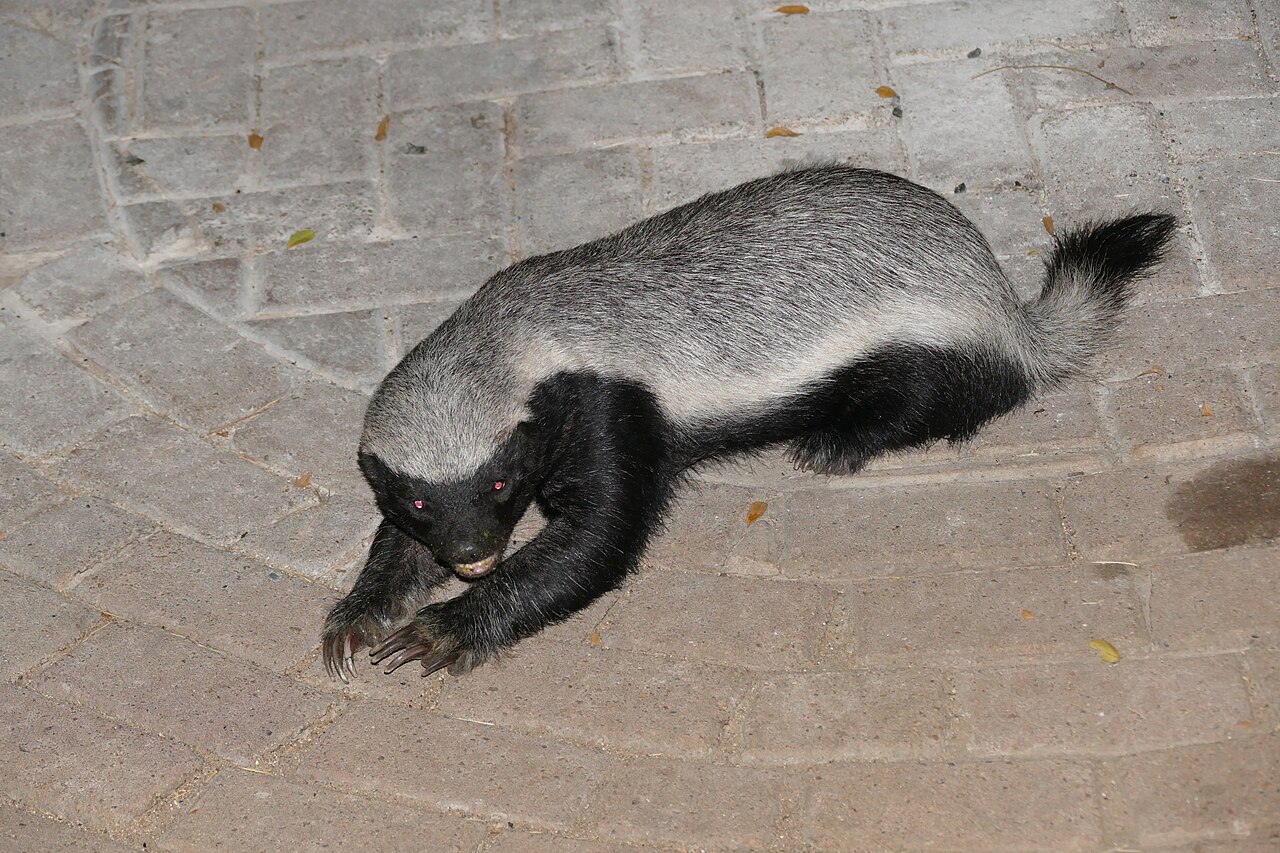
The honey badger (Mellivora capensis) is the house animal of Arjuna Badger Press. Everything below is true. Most of it sounds made up.
The honey badger has been listed by Guinness World Records as the most fearless animal on Earth. It did not apply for the title and would not have attended the ceremony.
It eats venomous snakes — puff adders, cobras, the lot. If it is bitten badly enough to be knocked out, it has been observed to simply lie down, sleep off the venom, wake up an hour or two later, and finish the snake it was already eating.
Its skin is loose, rubbery, and almost impossible to bite through. A honey badger caught by the scruff can twist around inside its own skin and bite whatever is holding it. Bee stings, porcupine quills, leopard teeth — it shrugs off the kind of day that would end most animals.
It raids beehives for honey and grubs and accepts hundreds of stings as a reasonable cost of doing business. This is, in fact, how it got its name.
It will stand its ground against lions, leopards, and hyenas. Not because it expects to win. Because the alternative — caring — has never occurred to it.
The most famous of them, Stoffel, lived at the Moholoholo rehabilitation centre in South Africa and treated every enclosure ever built for him as a personal insult. He stacked rocks to climb the walls. He rolled balls of mud into steps. He used rakes left in the pen as ladders. He learned to unlatch gates. He is, more or less, the patron saint of engineers who refuse to accept that a thing cannot be done.
Honey badger don't care.
<!-- BEGIN image-compendium-appendix (generated by tools/injectimageappendix.py) -->
Image Compendium — Dedication
The places, peoples, and wonders in this book are real. These freely-licensed photographs (public domain or Creative Commons, via Wikimedia Commons) are gathered here so you can see them — go stand in them. Each image carries its photographer and licence.
Places of awe
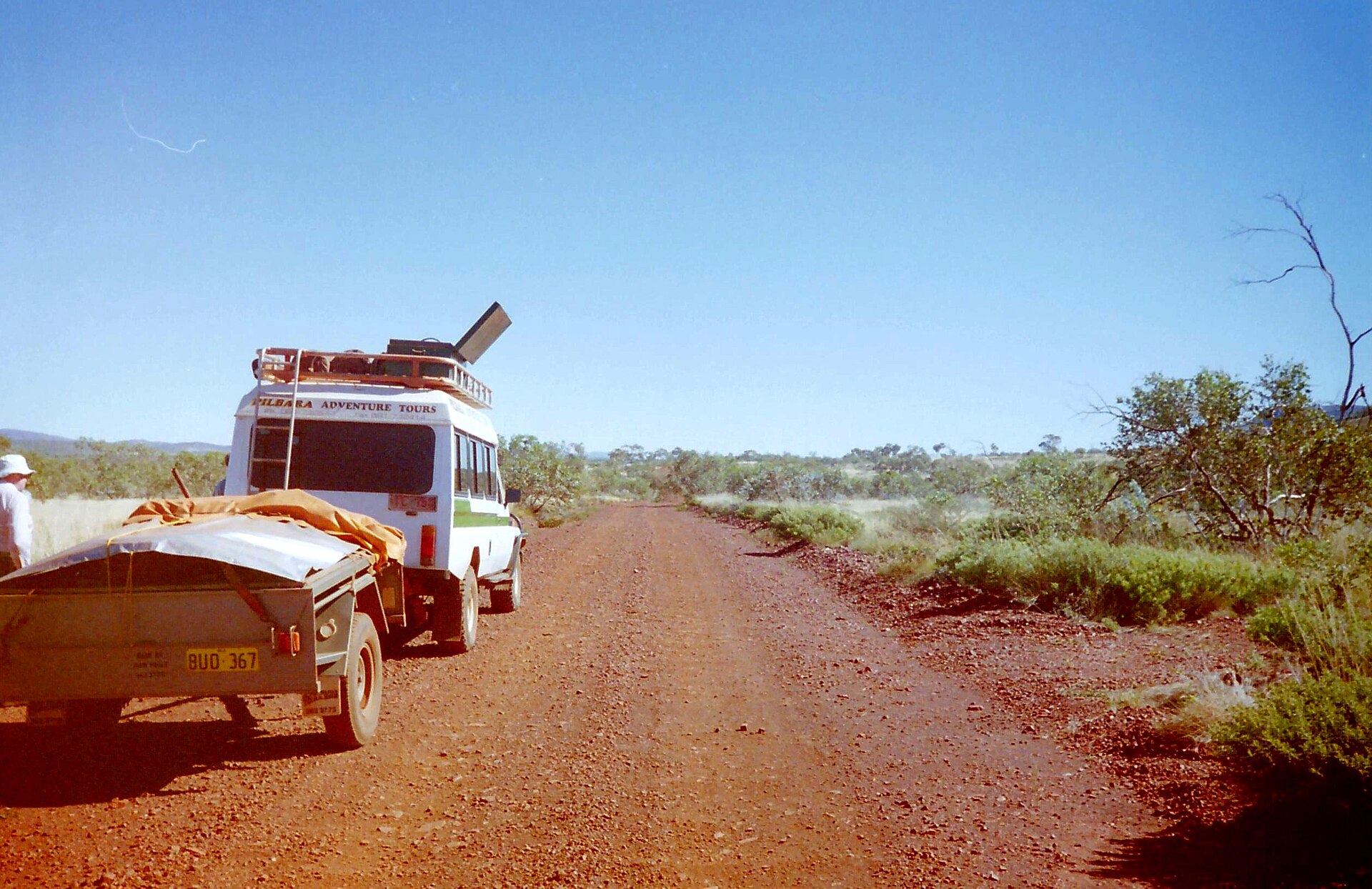
The red Pilbara — iron-ore country and rock-art coast. <small>Calistemon, CC BY-SA 4.0, via Wikimedia Commons</small>
Lake Mungo — where the oldest known ceremonial burials lie. <small>Benutzer:Schomynv de:Benutzer:Schomynv, Public domain, via Wikimedia Commons</small>
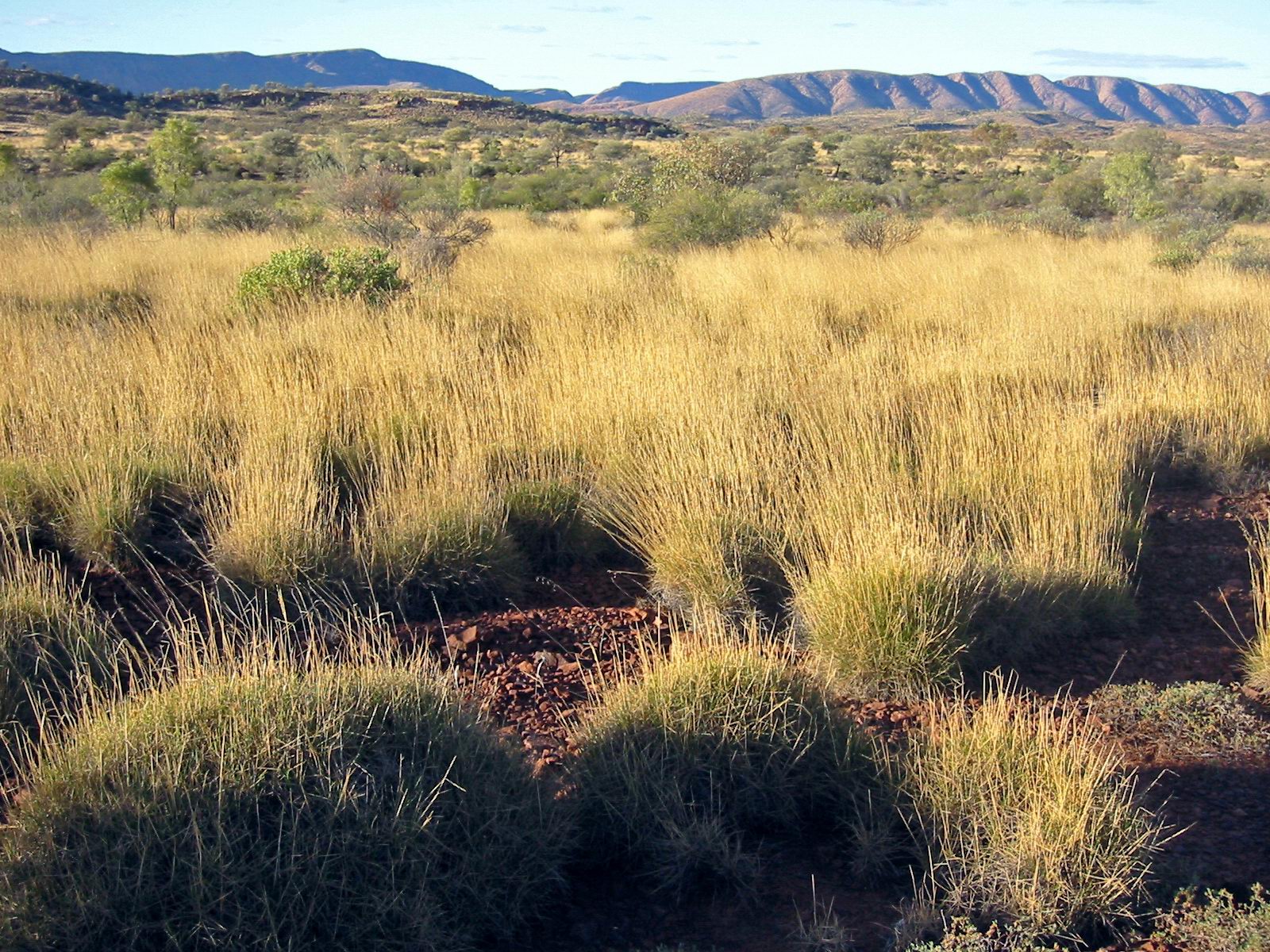
The country that the half-million-dollar instruments read as empty. <small>Thomas Schoch, CC BY-SA 2.5, via Wikimedia Commons</small>
Things of wonder (made by hand)

Murujuga — the world's largest rock-art gallery. <small>Marius Fenger, CC BY-SA 4.0, via Wikimedia Commons</small>
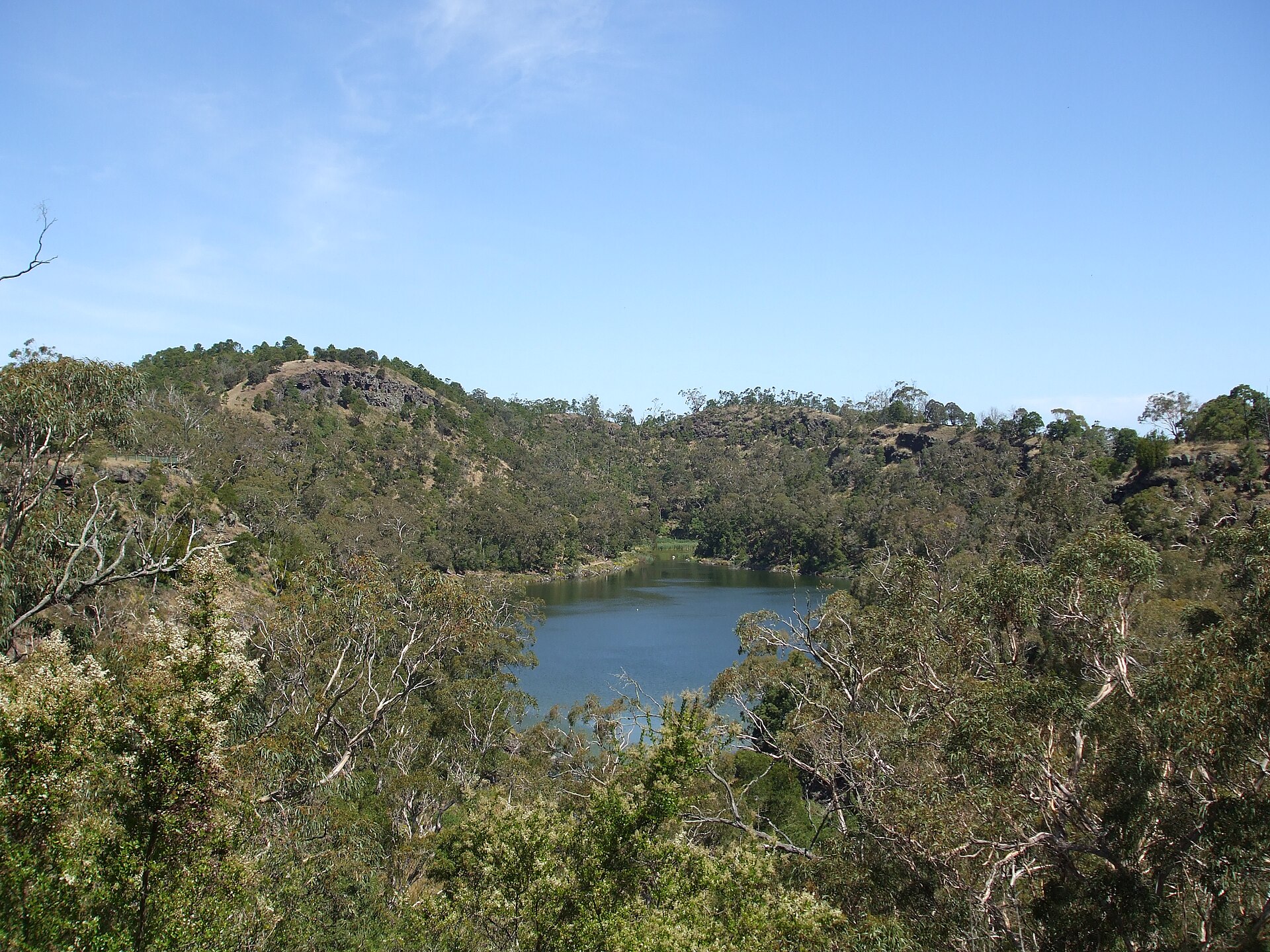
Budj Bim — engineered aquaculture older than the pyramids. <small>Dhx1, CC0, via Wikimedia Commons</small>
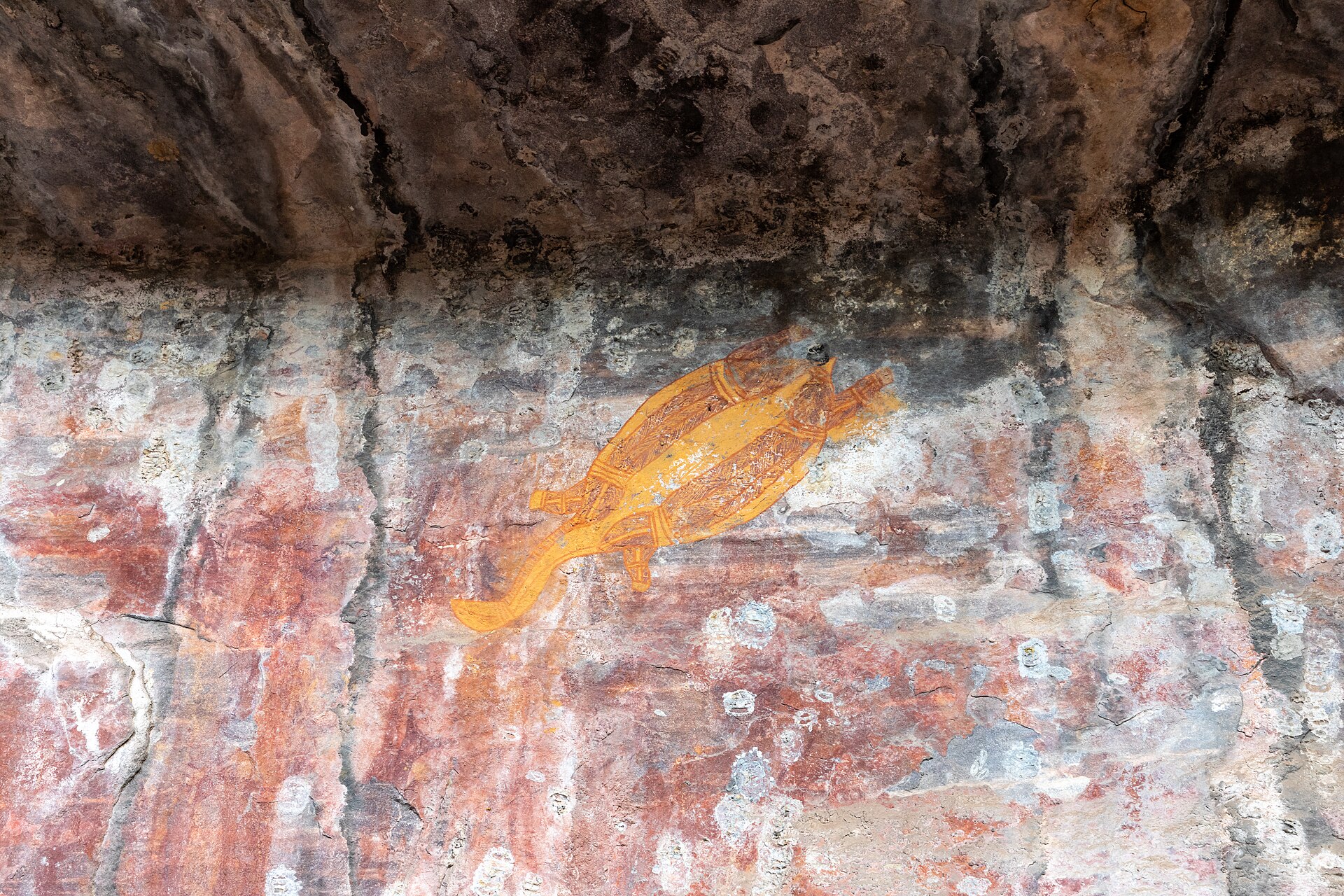
Rock art as record — the country's own archive. <small>Dietmar Rabich, CC BY-SA 4.0, via Wikimedia Commons</small>
A stone arrangement that marks solstice and equinox sunset. <small>Not attributed, so nominally Uren., Public domain, via Wikimedia Commons</small>
Peoples, in their own dress
Ceremony — knowledge carried in body and song. <small>Unknown authorUnknown author, CC BY 4.0, via Wikimedia Commons</small>
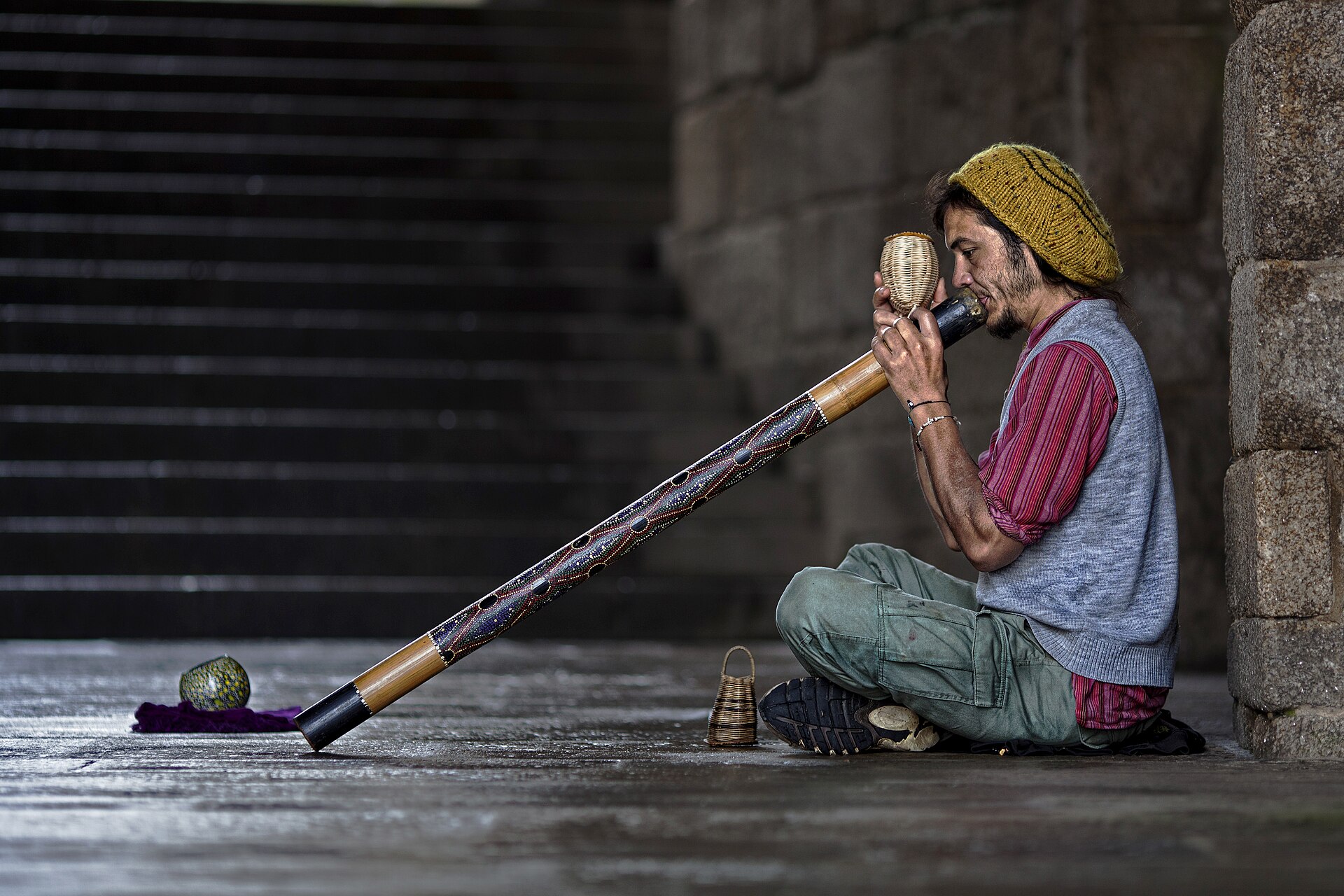
The yidaki (didgeridoo) — the voice of country. <small>Didgeridoostreetplayer.jpg: Noel Feans derivative work: Tomer T, CC BY 2.0, via Wikimedia Commons</small>
An elder — the ones who out-read the rig. <small>BlackfullaLinguist, CC BY-SA 4.0, via Wikimedia Commons</small>
<!-- END image-compendium-appendix -->